SANJAY CHOUBEY 1
Selectionof cloud based ERP: Key Considerations
Software asa Service (SaaS) hasopenedupanew game-changing/disruptivesoftwaredeliverymodel.It
has several known advantagessuchasreducedCost, increased flexibilityandease of doingbusiness due
to the aggressive marketingbySaaSvendors. All of whichare difficulttoignore inthe pursuitof cost
reduction,andagile environment goals.Althoughthisgame-changingmodel eliminatesseveralbarriers
as well asbuildsseveral bridges,one shouldkeepinmindsome KeyconsiderationswhileselectingCloud
basedSystems.
KeyConsiderationsforanyone decidingaboutCloudbasedsystems includesthe following:
1. Core StrengthMapping
It is worth consideringthatnot all the cloud based systems are equally strong across all theareas and may
not be the right fitfor your organization.Early identification and comparative fitmeasurement of offered
business functions such asback officefunctions (Finance,Procurement – Direct & Indirect,Human
Resources etc.), Supply Chain Management & ManufacturingOperations offers a good indicator. Itis very
important to ascertain the actual need of the business and strengths of the SaaS provider.Mappingof real
business need and comparativestrength of the cloud-based systemwith a weighting system helps in
overall evaluation and selection.
2. FlexibilityforCustomization
Typical sales talk aside,itis critical to understand the flexibility of cloud based systems for customization
for different business functions.Itcan be accomplished by engaging in detailed discussions aboutoffered
possibilities of customization with experts of the SaaS provider. For many Customers, a “Cookie-Cutter”
or out of the box approach may not be feasiblefor key business functions. This is wheresinglevs.multi-
Tenancy Options show importantdifferentiators.
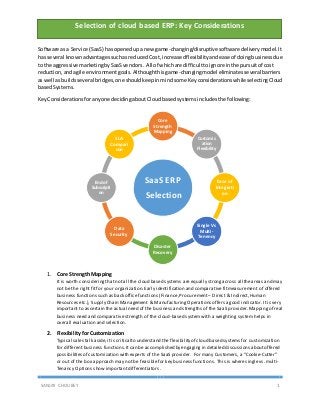
SaaS ERP
Selection
Core
Strength
Mapping
Customiz
ation
Flexibility
Ease of
Integrati
on
Single Vs
Multi-
Tenency
Disaster
Recovery
Data
Security
End of
Subscripti
on
SLA
Compari
son
2.
SANJAY CHOUBEY 2
Selectionof cloud based ERP: Key Considerations
3. Ease of Integration
In an ideal world,everyone would liketo start from zero to add new cloud based systems for
transformation. However it is importantto consider existingsystem & application landscapesand their
need to integrate them with these new cloud based systems.Generally vendors of all the cloud based
applicationsoffer integration capabilities. However flexibility,easeof integration as well as Costof
Integration need to be considered.
4. Single Vs.Multi-TenancyOptions
There are several deployment models within Cloud based system ecosystem with varyingcost& flexibility
models. Singletenancy model offers dedicated software hosting, better flexibility,offers more control but
comes with higher cost; whereas multi-tenancy model offers lesser flexibility & control for a lower cost.
As the Organization evolves,one shouldn’trule out the possibility to change from one model to another
duringthe lifecycleof hosted applications.Flexibility offered by SaaS provider within Tenancy options
should form one of the critical considerations.
5. Disaster Recovery
Knowledge of robust disaster recovery plans and processes of the SaaS provider plays critical rolein
gainingconfidencein the hosted applications ultimateavailability. Prior track record of disaster recovery,
hostinglocations, geographical coverage,data centers, backup policies,systemredundancies should form
key confidence-buildingmeasures and partof selection criteria.
6. Data Security Measures& Protection Compliance
It is of the utmost importance to verify policies and procedures of a cloud-based systemprovider before
they can be trusted to host business critical data. Data protection & complianceforms a critical legal &
regulatory requirement for most of the organizations.AssessingVendor’s capabilitiesand maturity to
meet these data complianceneeds can be a deal-breaker. A thorough examination of the SaaS vendor’s
data security Policies can reveal thecomparativedifferences, which can form partof selection criteria.
7. End of Subscription(Price Protection & Data Recovery)
In a fast-paced and competitive SaaS world, where subscription costs arekept at a minimum to capture
broader market share; itis critical to know about the priceprotection for the duration as well as Renewal
cost at the end of subscription period. Itis often very difficultto change the SaaS provider after 36
months or 60 months because of challenges of business disruption. Itis prudentto understand the
Renewal prices and potential M&A flexibilities for the licenses up front.
Cost of business data recovery at the end of subscription should also formpartof cons ideration,in the
event of non-renewal of services.
8. SLA Comparison
Last but not the least, a comparison of several Service Level Agreements (SLAs) offered by different SaaS
providers’forms a key indicator to select a particular vendor. References and previous history of
adherence to SLA commitments and its clear reportinghelp in buildingconfidence.