Column Qualifier Encoding
in
Apache Phoenix
Samarth Jain
About Me
• Software Engineer @ Salesforce
• Previously, Software Engineer @ eBay
• Apache Phoenix PMC
• PHOENIX-1819 – Metrics collection framework
• PHOENIX-1504 – Altering views
• PHOENIX-1779 – 8x faster non-aggregate, non-
ordered queries
• PHOENIX-914 – Row timestamp feature
• PHOENIX-1598 – Column qualifier encoding
Overview
• Data model
• Drawbacks
• Column qualifier encoding
• Benefits
• ORDER BY performance
• GROUP BY performance
Drawbacks
• Column names used as column qualifiers
• Size bloat: dense tables with large column
names
• Inefficient column renaming
• GC pressure, network i/o, block cache
• Lack of control on column qualifiers prevents
possible optimizations
Column Qualifier Encoding
• Simple
• Don’t use column names as HBase column
qualifiers
• Using numbers (short/integer) as column
qualifiers
• Controlled assignment of column qualifiers
Column Renaming
• Currently renaming column isn’t possible without
having to copy data using the new column
qualifier (PHOENIX-2341)
• Phoenix stores table related metadata in its
SYSTEM.CATALOG table
• Store mapping of column name to column
qualifier
• Renaming a column would then just involve
updating a few metadata rows in
SYSTEM.CATALOG
Packing Key Values in
Immutable Tables
• Store all column values in a single column
qualifier per column family PHOENIX-2565
• Uses variable width array format for storing
values
• Column encoding provides capability to index
into array for accessing the value of a key
value column
Performance Benefits
• Considerable disk size reduction
• More number of rows will fit into block cache
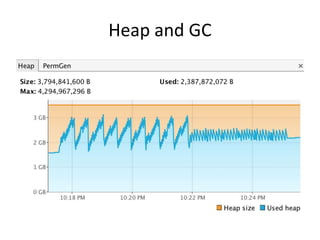
• Relieved GC pressure as garbage size would go
down
• Replace binary search of column qualifiers
with O(1) look up
ORDER BY Overview
• Phoenix compiles the query into scans
projecting columns in <SELECT >, <ORDER BY>,
and <WHERE>
• Phoenix co-processor retrieves rows by asking
HRegionScanner to fill List<Cell>
• List<Cell> lexicographically sorted
• Adds rows to the Phoenix sort data-structure
• Sort keys formed by doing binary search in the
List<Cell> filled by HRegionScanner
ORDER BY with Column Encoding
• Use numbers as column qualifiers
• Custom list implementation for HBase
scanners to fill the key values in
• Key values added to the list at index
determined by converting qualifier byte[] to
integer/short
• Replaces binary search with O(1) lookup
ORDER BY with Column Encoding
• Table with 50 columns
• Dense
• 20 characters column names generated
randomly
• ORDER BY columns selected were the first and
last in lexicographical order
ORDER BY Performance
Test Results
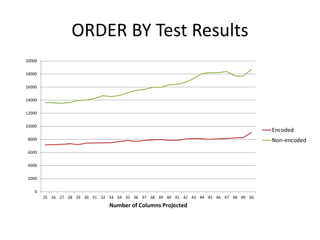
• Table size: 5x smaller (4byte CQ vs 20 byte)
• 2x faster (with and without block cache)
• Near constant/slow growth with increase in
number of columns projected
ORDER BY Test Results
0
2000
4000
6000
8000
10000
12000
14000
16000
18000
20000
25 26 27 28 29 30 31 32 33 34 35 36 37 38 39 40 41 42 43 44 45 46 47 48 49 50
Number of Columns Projected
Encoded
Non-encoded
GROUPED AGGREGATIONS Overview
• Queries compiled to scans that project key
value columns in <SELECT>, <GROUP BY>, and
<WHERE>
• Rows aggregated in a GROUP BY map in
Phoenix’s aggregate co-processor
• Map key – binary search in List<Cell>
• Number based column qualifiers and custom
list implementation to rescue again
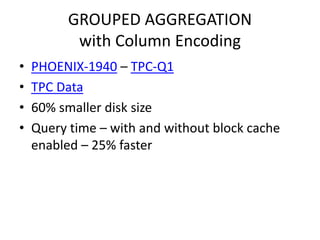
GROUPED AGGREGATION
with Column Encoding
• PHOENIX-1940 – TPC-Q1
• TPC Data
• 60% smaller disk size
• Query time – with and without block cache
enabled – 25% faster
Heap and GC
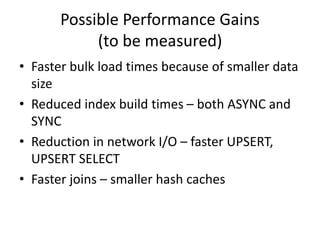
Possible Performance Gains
(to be measured)
• Faster bulk load times because of smaller data
size
• Reduced index build times – both ASYNC and
SYNC
• Reduction in network I/O – faster UPSERT,
UPSERT SELECT
• Faster joins – smaller hash caches
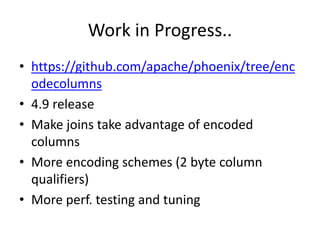
Work in Progress..
• https://github.com/apache/phoenix/tree/enc
odecolumns
• 4.9 release
• Make joins take advantage of encoded
columns
• More encoding schemes (2 byte column
qualifiers)
• More perf. testing and tuning
Thank You!

Column encoding

  • 1.
  • 2.
    About Me • SoftwareEngineer @ Salesforce • Previously, Software Engineer @ eBay • Apache Phoenix PMC • PHOENIX-1819 – Metrics collection framework • PHOENIX-1504 – Altering views • PHOENIX-1779 – 8x faster non-aggregate, non- ordered queries • PHOENIX-914 – Row timestamp feature • PHOENIX-1598 – Column qualifier encoding
  • 3.
    Overview • Data model •Drawbacks • Column qualifier encoding • Benefits • ORDER BY performance • GROUP BY performance
  • 8.
    Drawbacks • Column namesused as column qualifiers • Size bloat: dense tables with large column names • Inefficient column renaming • GC pressure, network i/o, block cache • Lack of control on column qualifiers prevents possible optimizations
  • 9.
    Column Qualifier Encoding •Simple • Don’t use column names as HBase column qualifiers • Using numbers (short/integer) as column qualifiers • Controlled assignment of column qualifiers
  • 10.
    Column Renaming • Currentlyrenaming column isn’t possible without having to copy data using the new column qualifier (PHOENIX-2341) • Phoenix stores table related metadata in its SYSTEM.CATALOG table • Store mapping of column name to column qualifier • Renaming a column would then just involve updating a few metadata rows in SYSTEM.CATALOG
  • 11.
    Packing Key Valuesin Immutable Tables • Store all column values in a single column qualifier per column family PHOENIX-2565 • Uses variable width array format for storing values • Column encoding provides capability to index into array for accessing the value of a key value column
  • 12.
    Performance Benefits • Considerabledisk size reduction • More number of rows will fit into block cache • Relieved GC pressure as garbage size would go down • Replace binary search of column qualifiers with O(1) look up
  • 13.
    ORDER BY Overview •Phoenix compiles the query into scans projecting columns in <SELECT >, <ORDER BY>, and <WHERE> • Phoenix co-processor retrieves rows by asking HRegionScanner to fill List<Cell> • List<Cell> lexicographically sorted • Adds rows to the Phoenix sort data-structure • Sort keys formed by doing binary search in the List<Cell> filled by HRegionScanner
  • 14.
    ORDER BY withColumn Encoding • Use numbers as column qualifiers • Custom list implementation for HBase scanners to fill the key values in • Key values added to the list at index determined by converting qualifier byte[] to integer/short • Replaces binary search with O(1) lookup
  • 15.
    ORDER BY withColumn Encoding • Table with 50 columns • Dense • 20 characters column names generated randomly • ORDER BY columns selected were the first and last in lexicographical order
  • 16.
    ORDER BY Performance TestResults • Table size: 5x smaller (4byte CQ vs 20 byte) • 2x faster (with and without block cache) • Near constant/slow growth with increase in number of columns projected
  • 17.
    ORDER BY TestResults 0 2000 4000 6000 8000 10000 12000 14000 16000 18000 20000 25 26 27 28 29 30 31 32 33 34 35 36 37 38 39 40 41 42 43 44 45 46 47 48 49 50 Number of Columns Projected Encoded Non-encoded
  • 18.
    GROUPED AGGREGATIONS Overview •Queries compiled to scans that project key value columns in <SELECT>, <GROUP BY>, and <WHERE> • Rows aggregated in a GROUP BY map in Phoenix’s aggregate co-processor • Map key – binary search in List<Cell> • Number based column qualifiers and custom list implementation to rescue again
  • 19.
    GROUPED AGGREGATION with ColumnEncoding • PHOENIX-1940 – TPC-Q1 • TPC Data • 60% smaller disk size • Query time – with and without block cache enabled – 25% faster
  • 20.
  • 21.
    Possible Performance Gains (tobe measured) • Faster bulk load times because of smaller data size • Reduced index build times – both ASYNC and SYNC • Reduction in network I/O – faster UPSERT, UPSERT SELECT • Faster joins – smaller hash caches
  • 22.
    Work in Progress.. •https://github.com/apache/phoenix/tree/enc odecolumns • 4.9 release • Make joins take advantage of encoded columns • More encoding schemes (2 byte column qualifiers) • More perf. testing and tuning
  • 23.