Chapter 6
Cultures of the World
Listening and Speaking
Saad Eid Adehaimi
Lecturer of Linguistics
School of English Language
Qilwah College of Arts and Sciences
Albaha University
Activity (2) Previewing Vocabulary
 1. impression: Opinion
 2. used to: Familiar with
 3. exotic: very different, strange, or unusual
 4. doggie bag: a bag that is used for carrying home food that is
left over from a meal eaten at a restaurant.
 5. amazed: Surprise
 6. so far: Until now
 7. leftovers: The food that was not eaten
Activity (3)
 1. What is Salma’s impression of the United
States?
 People are friendly, and the city is beautiful.
But the food is not good.
 2. What surprised Salma in the restaurant?
 Salma was surprised when Yolanda took the
leftovers home in a doggie bag
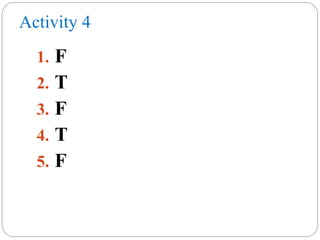
Activity 4
1. F
2. T
3. F
4. T
5. F
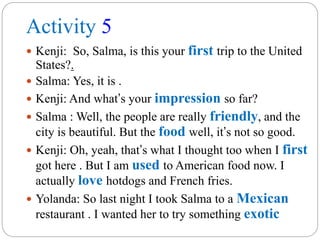
Activity 5
 Kenji: So, Salma, is this your first trip to the United
States?.
 Salma: Yes, it is .
 Kenji: And what’s your impression so far?
 Salma : Well, the people are really friendly, and the
city is beautiful. But the food well, it’s not so good.
 Kenji: Oh, yeah, that’s what I thought too when I first
got here . But I am used to American food now. I
actually love hotdogs and French fries.
 Yolanda: So last night I took Salma to a Mexican
restaurant . I wanted her to try something exotic
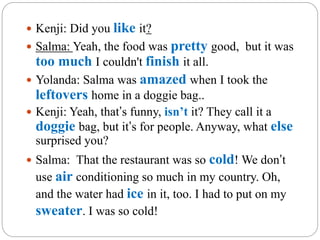
 Kenji: Did you like it?
 Salma: Yeah, the food was pretty good, but it was
too much I couldn't finish it all.
 Yolanda: Salma was amazed when I took the
leftovers home in a doggie bag..
 Kenji: Yeah, that’s funny, isn’t it? They call it a
doggie bag, but it’s for people. Anyway, what else
surprised you?
 Salma: That the restaurant was so cold! We don’t
use air conditioning so much in my country. Oh,
and the water had ice in it, too. I had to put on my
sweater. I was so cold!
Activity 6
Comparing Unreduced and Reduced
Pronunciation.
See the book p. 105 please
Activity 7
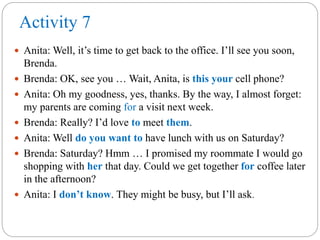
 Anita: Well, it’s time to get back to the office. I’ll see you soon,
Brenda.
 Brenda: OK, see you … Wait, Anita, is this your cell phone?
 Anita: Oh my goodness, yes, thanks. By the way, I almost forget:
my parents are coming for a visit next week.
 Brenda: Really? I’d love to meet them.
 Anita: Well do you want to have lunch with us on Saturday?
 Brenda: Saturday? Hmm … I promised my roommate I would go
shopping with her that day. Could we get together for coffee later
in the afternoon?
 Anita: I don’t know. They might be busy, but I’ll ask.
Activity 8 & 9
Using vocabulary and discuss behaviour
See the book p. 106 please
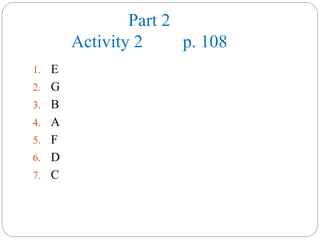
Part 2
Activity 2 p. 108
1. E
2. G
3. B
4. A
5. F
6. D
7. C
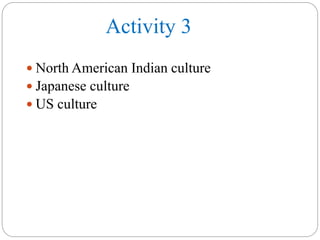
Activity 3
 North American Indian culture
 Japanese culture
 US culture
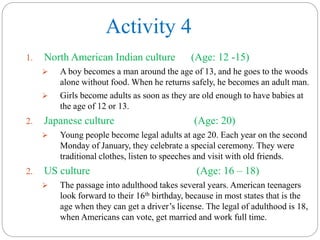
Activity 4
1. North American Indian culture (Age: 12 -15)
 A boy becomes a man around the age of 13, and he goes to the woods
alone without food. When he returns safely, he becomes an adult man.
 Girls become adults as soon as they are old enough to have babies at
the age of 12 or 13.
2. Japanese culture (Age: 20)
 Young people become legal adults at age 20. Each year on the second
Monday of January, they celebrate a special ceremony. They were
traditional clothes, listen to speeches and visit with old friends.
2. US culture (Age: 16 – 18)
 The passage into adulthood takes several years. American teenagers
look forward to their 16th birthday, because in most states that is the
age when they can get a driver’s license. The legal of adulthood is 18,
when Americans can vote, get married and work full time.
Activity 5 P. 109
Summarising Ideas
Homework (2 marks if needed)
Activity 6 & 7
Using vocabulary and talk
See the book p. 109 & 110
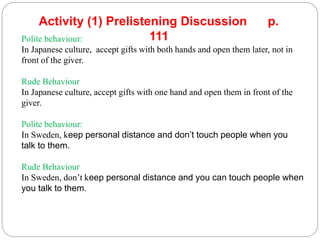
Polite behaviour:
In Japanese culture, accept gifts with both hands and open them later, not in
front of the giver.
Rude Behaviour
In Japanese culture, accept gifts with one hand and open them in front of the
giver.
Polite behaviour:
In Sweden, keep personal distance and don’t touch people when you
talk to them.
Rude Behaviour
In Sweden, don’t keep personal distance and you can touch people when
you talk to them.
Activity (1) Prelistening Discussion p.
111
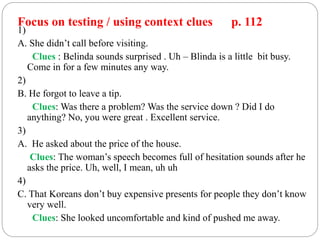
Focus on testing / using context clues p. 112
1)
A. She didn’t call before visiting.
Clues : Belinda sounds surprised . Uh – Blinda is a little bit busy.
Come in for a few minutes any way.
2)
B. He forgot to leave a tip.
Clues: Was there a problem? Was the service down ? Did I do
anything? No, you were great . Excellent service.
3)
A. He asked about the price of the house.
Clues: The woman’s speech becomes full of hesitation sounds after he
asks the price. Uh, well, I mean, uh uh
4)
C. That Koreans don’t buy expensive presents for people they don’t know
very well.
Clues: She looked uncomfortable and kind of pushed me away.
Activity 2
Comparing Customs
See the book p. 113
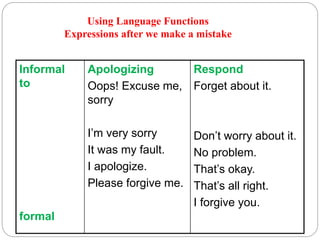
Using Language Functions
Expressions after we make a mistake
Respond
Forget about it.
Don’t worry about it.
No problem.
That’s okay.
That’s all right.
I forgive you.
Apologizing
Oops! Excuse me,
sorry
I’m very sorry
It was my fault.
I apologize.
Please forgive me.
Informal
to
formal
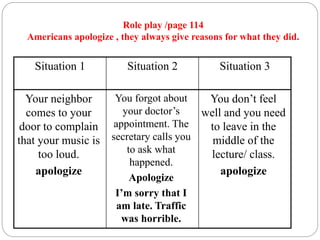
Role play /page 114
Americans apologize , they always give reasons for what they did.
Situation 3Situation 2Situation 1
You don’t feel
well and you need
to leave in the
middle of the
lecture/ class.
apologize
You forgot about
your doctor’s
appointment. The
secretary calls you
to ask what
happened.
Apologize
I’m sorry that I
am late. Traffic
was horrible.
Your neighbor
comes to your
door to complain
that your music is
too loud.
apologize
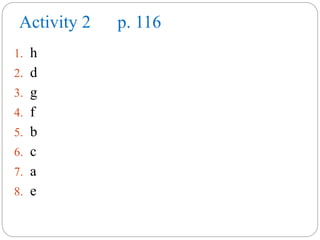
Activity 2 p. 116
1. h
2. d
3. g
4. f
5. b
6. c
7. a
8. e
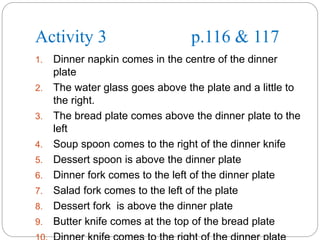
Activity 3 p.116 & 117
1. Dinner napkin comes in the centre of the dinner
plate
2. The water glass goes above the plate and a little to
the right.
3. The bread plate comes above the dinner plate to the
left
4. Soup spoon comes to the right of the dinner knife
5. Dessert spoon is above the dinner plate
6. Dinner fork comes to the left of the dinner plate
7. Salad fork comes to the left of the plate
8. Dessert fork is above the dinner plate
9. Butter knife comes at the top of the bread plate
That’s the end of Chapter 6

Chapter 6 Cultures of the World (Interactions 1 Listening and Speaking)

  • 1.
    Chapter 6 Cultures ofthe World Listening and Speaking Saad Eid Adehaimi Lecturer of Linguistics School of English Language Qilwah College of Arts and Sciences Albaha University
  • 2.
    Activity (2) PreviewingVocabulary  1. impression: Opinion  2. used to: Familiar with  3. exotic: very different, strange, or unusual  4. doggie bag: a bag that is used for carrying home food that is left over from a meal eaten at a restaurant.  5. amazed: Surprise  6. so far: Until now  7. leftovers: The food that was not eaten
  • 3.
    Activity (3)  1.What is Salma’s impression of the United States?  People are friendly, and the city is beautiful. But the food is not good.  2. What surprised Salma in the restaurant?  Salma was surprised when Yolanda took the leftovers home in a doggie bag
  • 4.
    Activity 4 1. F 2.T 3. F 4. T 5. F
  • 5.
    Activity 5  Kenji:So, Salma, is this your first trip to the United States?.  Salma: Yes, it is .  Kenji: And what’s your impression so far?  Salma : Well, the people are really friendly, and the city is beautiful. But the food well, it’s not so good.  Kenji: Oh, yeah, that’s what I thought too when I first got here . But I am used to American food now. I actually love hotdogs and French fries.  Yolanda: So last night I took Salma to a Mexican restaurant . I wanted her to try something exotic
  • 6.
     Kenji: Didyou like it?  Salma: Yeah, the food was pretty good, but it was too much I couldn't finish it all.  Yolanda: Salma was amazed when I took the leftovers home in a doggie bag..  Kenji: Yeah, that’s funny, isn’t it? They call it a doggie bag, but it’s for people. Anyway, what else surprised you?  Salma: That the restaurant was so cold! We don’t use air conditioning so much in my country. Oh, and the water had ice in it, too. I had to put on my sweater. I was so cold!
  • 7.
    Activity 6 Comparing Unreducedand Reduced Pronunciation. See the book p. 105 please
  • 8.
    Activity 7  Anita:Well, it’s time to get back to the office. I’ll see you soon, Brenda.  Brenda: OK, see you … Wait, Anita, is this your cell phone?  Anita: Oh my goodness, yes, thanks. By the way, I almost forget: my parents are coming for a visit next week.  Brenda: Really? I’d love to meet them.  Anita: Well do you want to have lunch with us on Saturday?  Brenda: Saturday? Hmm … I promised my roommate I would go shopping with her that day. Could we get together for coffee later in the afternoon?  Anita: I don’t know. They might be busy, but I’ll ask.
  • 9.
    Activity 8 &9 Using vocabulary and discuss behaviour See the book p. 106 please
  • 10.
    Part 2 Activity 2p. 108 1. E 2. G 3. B 4. A 5. F 6. D 7. C
  • 11.
    Activity 3  NorthAmerican Indian culture  Japanese culture  US culture
  • 12.
    Activity 4 1. NorthAmerican Indian culture (Age: 12 -15)  A boy becomes a man around the age of 13, and he goes to the woods alone without food. When he returns safely, he becomes an adult man.  Girls become adults as soon as they are old enough to have babies at the age of 12 or 13. 2. Japanese culture (Age: 20)  Young people become legal adults at age 20. Each year on the second Monday of January, they celebrate a special ceremony. They were traditional clothes, listen to speeches and visit with old friends. 2. US culture (Age: 16 – 18)  The passage into adulthood takes several years. American teenagers look forward to their 16th birthday, because in most states that is the age when they can get a driver’s license. The legal of adulthood is 18, when Americans can vote, get married and work full time.
  • 13.
    Activity 5 P.109 Summarising Ideas Homework (2 marks if needed)
  • 14.
    Activity 6 &7 Using vocabulary and talk See the book p. 109 & 110
  • 15.
    Polite behaviour: In Japaneseculture, accept gifts with both hands and open them later, not in front of the giver. Rude Behaviour In Japanese culture, accept gifts with one hand and open them in front of the giver. Polite behaviour: In Sweden, keep personal distance and don’t touch people when you talk to them. Rude Behaviour In Sweden, don’t keep personal distance and you can touch people when you talk to them. Activity (1) Prelistening Discussion p. 111
  • 16.
    Focus on testing/ using context clues p. 112 1) A. She didn’t call before visiting. Clues : Belinda sounds surprised . Uh – Blinda is a little bit busy. Come in for a few minutes any way. 2) B. He forgot to leave a tip. Clues: Was there a problem? Was the service down ? Did I do anything? No, you were great . Excellent service. 3) A. He asked about the price of the house. Clues: The woman’s speech becomes full of hesitation sounds after he asks the price. Uh, well, I mean, uh uh 4) C. That Koreans don’t buy expensive presents for people they don’t know very well. Clues: She looked uncomfortable and kind of pushed me away.
  • 17.
  • 18.
    Using Language Functions Expressionsafter we make a mistake Respond Forget about it. Don’t worry about it. No problem. That’s okay. That’s all right. I forgive you. Apologizing Oops! Excuse me, sorry I’m very sorry It was my fault. I apologize. Please forgive me. Informal to formal
  • 19.
    Role play /page114 Americans apologize , they always give reasons for what they did. Situation 3Situation 2Situation 1 You don’t feel well and you need to leave in the middle of the lecture/ class. apologize You forgot about your doctor’s appointment. The secretary calls you to ask what happened. Apologize I’m sorry that I am late. Traffic was horrible. Your neighbor comes to your door to complain that your music is too loud. apologize
  • 20.
    Activity 2 p.116 1. h 2. d 3. g 4. f 5. b 6. c 7. a 8. e
  • 21.
    Activity 3 p.116& 117 1. Dinner napkin comes in the centre of the dinner plate 2. The water glass goes above the plate and a little to the right. 3. The bread plate comes above the dinner plate to the left 4. Soup spoon comes to the right of the dinner knife 5. Dessert spoon is above the dinner plate 6. Dinner fork comes to the left of the dinner plate 7. Salad fork comes to the left of the plate 8. Dessert fork is above the dinner plate 9. Butter knife comes at the top of the bread plate
  • 22.
    That’s the endof Chapter 6