Ivar Virgin
SEI
The State of the Bioeconomy in Eastern Africa: 2022The State of the Bioeconomy in Eastern
A Research
Perspective
Reaching SDG 2- Some of the Issues
 Reaching SDG 2, ending hunger and making agri-food systems more productive, sustainable,
and resilient to ensure nutritious, safe, and affordable diets for all is one of our time’s greatest
global challenges
 Farmers in the global South, particularly smallholder farmers, are key for reaching SDG 2, and
in regions such as sub-Saharan Africa (SSA) and large parts of Asia, smallholder farmers
provide about 80% of all food consumed.
 For smallholders to become more productive, profitable, and environmentally and socially
sustainable, they need a transformation agenda to support them.
 This transformation is complex, and to be fully effective, it must be rooted in science and
best available knowledge and tailored to country-specific conditions
New opportunities for smallholders……
 A wide range of technologies, precision farming and soil nutrient
optimization, improved seeds and cultivars, agrobiologicals, digital
extension increasingly accessible to smallholders
 Emergence of new more effective governance and land use systems
 Scientists with an ability to analyse, synthesize, and communicate their
research findings and collaboratively work with local stakeholders in
supporting smallholder farming, are therefore greatly needed.
Seeing the whole picture and understanding the
process towards impact and change not so easy….
Engaging with stakeholders
• Focusing on sustainable
intensification of smallholder
farming systems in sub-Saharan
Africa (SSA) and Southeast Asia
for improved food and nutrition
security
• synthesising and translates
science into policy and
develops capacity to achieve
• Contribute to the social,
environmental sustainability of
smallholder farming
The AgriFoSe2030 Programme
AgriFoSe2030 connects and synthesize best available
scientific research with policymaking processes, as well as
with practices on the ground
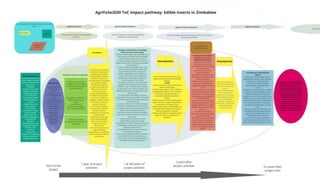
Using the Theory of Change in a collaborative process,
together with stakeholders…
How to create a change, contributing to SDG2 targets
 What type of change is needed?
 How and why will change happen?
 Why will it happen this way and not another way?
 What changes will we see, step by step along the way?
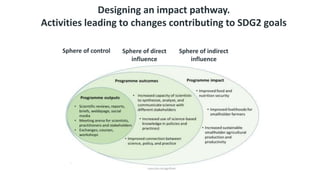
Sphere of control Sphere of direct
influence
Sphere of indirect
influence
Designing an impact pathway.
Activities leading to changes contributing to SDG2 goals
Thank You

Research perspective

  • 1.
    Ivar Virgin SEI The Stateof the Bioeconomy in Eastern Africa: 2022The State of the Bioeconomy in Eastern A Research Perspective
  • 2.
    Reaching SDG 2-Some of the Issues  Reaching SDG 2, ending hunger and making agri-food systems more productive, sustainable, and resilient to ensure nutritious, safe, and affordable diets for all is one of our time’s greatest global challenges  Farmers in the global South, particularly smallholder farmers, are key for reaching SDG 2, and in regions such as sub-Saharan Africa (SSA) and large parts of Asia, smallholder farmers provide about 80% of all food consumed.  For smallholders to become more productive, profitable, and environmentally and socially sustainable, they need a transformation agenda to support them.  This transformation is complex, and to be fully effective, it must be rooted in science and best available knowledge and tailored to country-specific conditions
  • 3.
    New opportunities forsmallholders……  A wide range of technologies, precision farming and soil nutrient optimization, improved seeds and cultivars, agrobiologicals, digital extension increasingly accessible to smallholders  Emergence of new more effective governance and land use systems  Scientists with an ability to analyse, synthesize, and communicate their research findings and collaboratively work with local stakeholders in supporting smallholder farming, are therefore greatly needed.
  • 4.
    Seeing the wholepicture and understanding the process towards impact and change not so easy….
  • 5.
  • 6.
    • Focusing onsustainable intensification of smallholder farming systems in sub-Saharan Africa (SSA) and Southeast Asia for improved food and nutrition security • synthesising and translates science into policy and develops capacity to achieve • Contribute to the social, environmental sustainability of smallholder farming The AgriFoSe2030 Programme
  • 7.
    AgriFoSe2030 connects andsynthesize best available scientific research with policymaking processes, as well as with practices on the ground
  • 8.
    Using the Theoryof Change in a collaborative process, together with stakeholders…
  • 9.
    How to createa change, contributing to SDG2 targets  What type of change is needed?  How and why will change happen?  Why will it happen this way and not another way?  What changes will we see, step by step along the way?
  • 10.
    Sphere of controlSphere of direct influence Sphere of indirect influence Designing an impact pathway. Activities leading to changes contributing to SDG2 goals
  • 12.

Editor's Notes

  • #9 Training for designing projects in Soil and Livestock themes Design of science translation projects – Insects for Food, Jersey project and Goat project in Laos