Hormone
Hypothalamus-pituitary
axis
Presented by: Dr. Afrisham
In the name of God 1
Outlines
 Introduction
 Human endocrine glands
 Mechanisms of hormone release
 Feedback system
 Hypothalamus-pituitary axis
 Hypothalamic releasing hormones
 Anterior and posterior pituitary hormones
• PRL
• GH
2
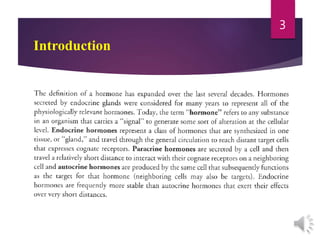
Introduction
3
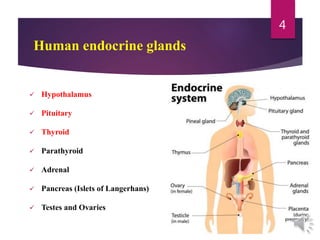
Human endocrine glands
 Hypothalamus
 Pituitary
 Thyroid
 Parathyroid
 Adrenal
 Pancreas (Islets of Langerhans)
 Testes and Ovaries
4
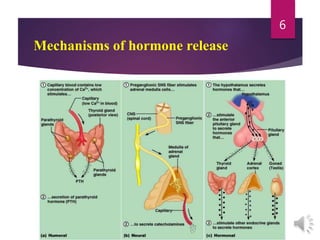
Mechanisms of hormone release
Humoral: In response to changing levels of ions or nutrients in the blood.
Neural: Stimulation by nerves.
Hormonal: Stimulation received from other hormones.
5
Mechanisms of hormone release
6
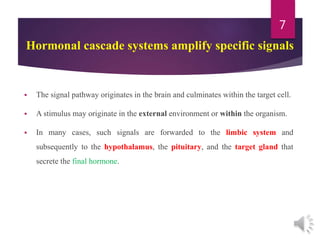
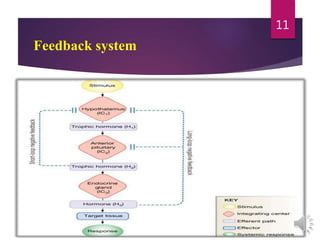
Hormonal cascade systems amplify specific signals
 The signal pathway originates in the brain and culminates within the target cell.
 A stimulus may originate in the external environment or within the organism.
 In many cases, such signals are forwarded to the limbic system and
subsequently to the hypothalamus, the pituitary, and the target gland that
secrete the final hormone.
7
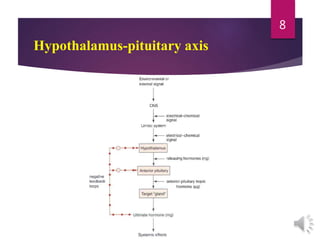
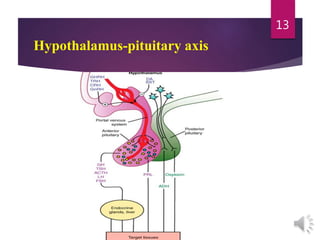
Hypothalamus-pituitary axis
8
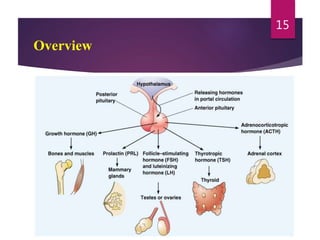
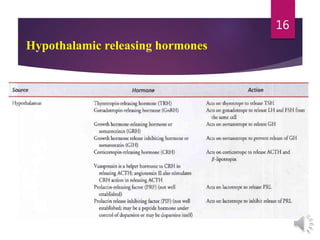
Releasing hormones of the hypothalamus
 Aminergic neurons (secreting dopamine and serotonin) connect to neurons involved in
the synthesis and release of the releasing hormones of the hypothalamus.
 Aminergic neurons fire depending on various types of internal or external signals.
The activities of these neurons account for:
(a) The pulsatile release of some hormones like GnRH.
(b) The rhythmic cyclic release of other hormones like cortisol.
9
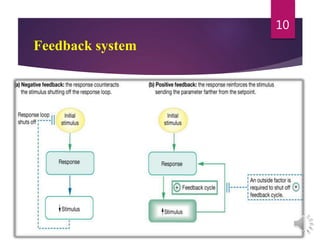
Feedback system
10
Feedback system
11
Hypothalamus-pituitary axis
12
Hypothalamus-pituitary axis
13
Hypothalamic-pituitary-thyroid axis
14
Overview
15
Hypothalamic releasing hormones
16
Pituitary gland
It is divided into an anterior lobe (adenohypophysis) and a posterior lobe
(neurohypophysis).
It weighs about 0.6 g and measures about 12 mm in transverse and 8 mm in
anteroposterior diameter.
The anterior pituitary gland possesses five distinct hormone- synthesizing and
hormone-secreting populations of cells.
17
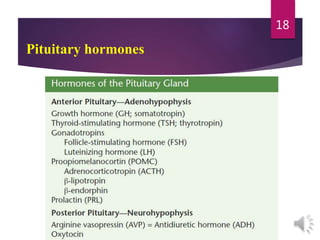
Pituitary hormones
18
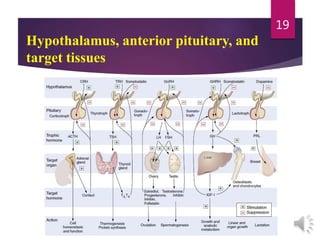
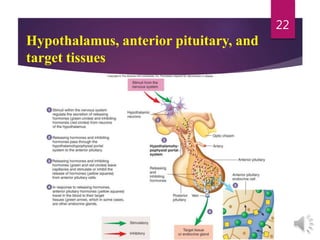
Hypothalamus, anterior pituitary, and
target tissues
19
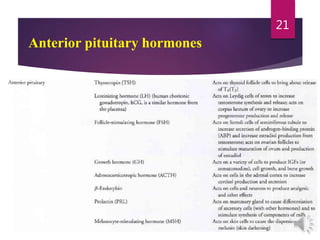
Anterior pituitary hormones
There are 6 main hormones which are secreted by the adenohypophysis:
1) Growth hormone (also known as somatotropin)
2) Thyroid-stimulating hormone (also known as thyrotropin)
3) Adrenocorticotropic hormone (also known as corticotropin)
4) Prolactin
5) Follicle-stimulating hormone
6) Luteinizing hormone
20
Anterior pituitary hormones
21
Hypothalamus, anterior pituitary, and
target tissues
22
Hypopituitarism
The connection between the hypothalamus and anterior pituitary can be disrupted by
trauma or tumors.
Trauma can occur in automobile accidents or other local damaging events chat may
result in severing of the stalk, thus preventing the releasing hormones from reaching
their target anterior pituitary cells.
When this happens, the anterior pituitary cells no longer have their signaling
mechanism for the release of anterior pituitary hormones.
23
Hypopituitarism
In the case of tumors of the pituitary gland, all of the anterior pituitary
hormones may not be shut off to the same degree or the secretion of some
may disappear sooner than others.
This condition may result in a life-threatening situation in which the clinician
must determine the extent of loss of pituitary hormones, especially ACTH.
Posterior pituitary hormones may also be lost, precipitating a problem of
excessive urination (vasopressin deficiency) that must be addressed.
24
Causes of pituitary hormonal deficiency
 Pituitary neoplasm
 Pituitary adenoma
 Metastases or rarely primary carcinoma
 Radiation
 Stalk resection
 Granulomatous disease
 Sarcoidosis
 Infection
 Tuberculosis
 Syphilis
 Fungi
 Hemorrhage and infarction
 Postpartum necrosis (Sheehan
syndrome)
 Idiopathic or genetic deficiencies
25
Pituitary tumors
Pituitary tumors may be classified as microadenomas (<1 cm in greatest
diameter) or macroadenomas (≥ 1 cm in greatest diameter).
They are further subcategorized into secretory and non-secretory varieties.
All tumors have the potential to grow; in doing so, they can compress the optic
chiasm, resulting in visual field defects.
These tumors can cause hormonal deficiency due to compression of other cell
lineages within the pituitary gland.
26
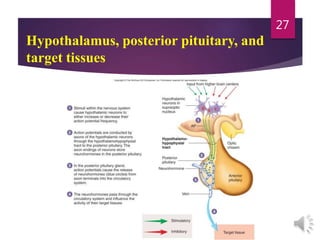
Hypothalamus, posterior pituitary, and
target tissues
27
Prolactin (PRL)
 Structurally, very similar to growth hormone (single peptide chain of 198
amino acids).
 PRL is secreted by mammotrophs (also referred to as lactotrophs).
 It is responsible for the initiation and maintenance of lactation.
 Stimulates further development of mammary glands during pregnancy.
 Secretion of PRL is also under dual control by the hypothalamus.
 Dopamine is secreted by neuroendocrine cells in the hypothalamus and
inhibits PRL release.
28
Prolactin (PRL)
 Primarily under inhibitory control. This means that if there is an injury to
the hypophyseal portal system which blocks hypothalamic regulation of the
pituitary gland, PRL levels increase. All other pituitary hormone levels
decrease when this happens.
 PRL release is stimulated by thyrotropin releasing hormone (TRH).
 PRL activates a tyrosine kinase receptor.
29
Prolactin (PRL)
 PRL is secreted in a circadian fashion, with the highest levels attained
during sleep and a nadir occurring between 10 am.
 PRL is also secreted in a pulsatile fashion, are influenced by a variety of
physiologic stimuli (e.g., stress, pregnancy, exercise).
 Because of these factors and a serum half-life of 26 to 47 minutes, it had
been recommended that when screening for hyperprolactinemia three
specimens be obtained at 20-to 30-minute intervals.
30
Hyperprolactinemia
 The degree of PRL elevation usually correlates well with tumor size.
 Symptoms in women usually include amenorrhea (cessation of
menstruation), galactorrhea (abnormal lactation) and infertility.
 In men, infertility and galactorrhea are the most common symptoms.
 Treatment usually consists of administration of a dopaminergic agonist,
such as bromocriptine.
31
Hyperprolactinemia
 PRL also acts at the hypothalamus to inhibit the secretion of GnRH.
 It results in a decrease in the release of LH and FSH from the anterior pituitary gland.
 In females, this leads to a decrease in estrogen and progesterone synthesis and secretion
by the ovaries, along with failure of ovarian follicular maturation (ovulation).
 In males, a deficiency of FSH and LH causes a decrease in testicular production and
synthesis of testosterone, along with a halt in spermatogenesis.
32
Hyperprolactinemia
 Another important cause of hyperprolactinemia is hypothyroidism.
 TRH stimulates PRL secretion, thus explaining the mild hyperprolactinemia seen in both
primary (thyroid) and secondary (pituitary) hypothyroidism.
 Thyroid function tests (free thyroxine [FT4] and TSH) are always indicated to rule out
hypothyroidism when a patient with hyperprolactinemia is evaluated.
33
Reference value for serum PRL
 The reference value for serum PRL is 1 to 25 ng/mL (1–25 μg/L) for women and 1 to 20
ng/mL (1–20 μg/L) for men.
 During pregnancy, a progressive rise in serum PRL is observed, with levels reportedly
reaching as high as 500 ng/mL by the third trimester.
 In nursing mothers, basal PRL levels remain moderately elevated, with episodic bursts
in secretion in response to suckling.
34
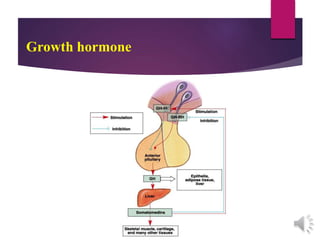
 GH is a single-chain polypeptide of 191 amino acids synthesized, stored, and secreted
by the somatotrophs of the pituitary gland in response to the secretion of growth
hormone–releasing hormone (GHRH) by the hypothalamus.
 Somatostatin, also produced by the hypothalamus, inhibits GH synthesis and release.
 Most of its anabolic and metabolic actions are mediated indirectly through an
intermediary, IGF-1 (also called somatomedin C).
35
Growth hormone
Growth hormone
Growth hormone
 GH is secreted in a pulsatile fashion; the frequency and amplitude of the peaks are
greatest during puberty, exhibiting a steady decline with increasing age.
 As up to 70% of GH secretion occurs during stage 4 (slow-wave) sleep, it has been
suggested that the age-related decline in stage 4 sleep may account for the decline in GH
seen with aging.
38
Secretion of GH
 Idiopathic growth hormone deficiency is the most common cause of GH deficiency (GHD) in
children, whereas a pituitary adenoma is the most common etiology in adult-onset GHD.
 Pre-adolescents:
 Decreased GH secretion (or sensitivity) results in slow growth and delayed onset of
sexual maturation.
 Post-adolescents:
 Generally, no serious problems are associated in mature individuals. However, in very
severe cases there can be progeria (rapid and premature aging).
39
Pathophysiology of abnormal GH secretion
(Hyposecretion)
 The insulin tolerance test (ITT) has long been considered the gold standard for diagnosing GHD.
 However, it is most unpleasant for the patient, and is contraindicated in those with a history of
seizures or cardiac or cerebrovascular disease.
 Failure of GH to rise above 3 to 5 ng/mL in adults and above 10 ng/mL in children is considered to
be abnormal.
 Arginine stimulation alone or in combination with GHRH is usually the next step.
 Combination testing with GHRH plus arginine was preferred, as many normal adults failed
stimulation with arginine alone
40
Detection of GHD
For children, it is common to use exercise testing in screening for GHD.
 Pre-adolescents (before closure of epiphyseal plates):
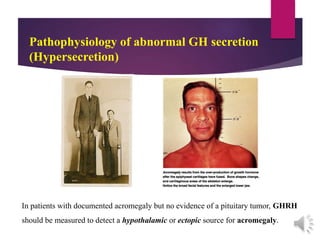
 Results in gigantism, where affected individuals grow extremely rapidly and become
abnormally tall. Body proportions remain relatively normal. Usually, there are
cardiovascular complications later in life.
 Post-adolescents (after epiphyseal closure):
 Hypersecretion results in tissue enlargement. They cannot elongate since the epiphyseal
plates are closed. A common symptom is a coarsening of the facial features and
enlargement of the hands and feet. This condition is known as acromegaly.
41
Pathophysiology of abnormal GH secretion
(Hypersecretion)
Pathophysiology of abnormal GH secretion
(Hypersecretion)
In patients with documented acromegaly but no evidence of a pituitary tumor, GHRH
should be measured to detect a hypothalamic or ectopic source for acromegaly.
 If the level of IGF-1 is elevated or borderline, it becomes necessary to confirm the diagnosis
using an oral glucose tolerance test (OGTT).
 The OGTT is performed by obtaining baseline blood samples for glucose and GH,
administering 75 g of glucose orally, and then obtaining blood for glucose and GH every 30
minutes over the next 2 hours.
 A normal response is suppression of GH to <1 ng/mL at any time during the test.
 If GH fails to drop to below 1 ng/mL, the patient is diagnosed as having acromegaly.
43
Detection of GH excess
References
• Devlin TM, editor. Textbook of biochemistry with clinical correlations. John
Wiley & Sons; 2010 Jan 19.
• McPherson RA, Pincus MR. Henry's clinical diagnosis and management by
laboratory methods E-book. Elsevier Health Sciences; 2021 Jun 9.
• Burtis CA, Bruns DE. Tietz fundamentals of clinical chemistry and molecular
diagnostics-e-book. Elsevier Health Sciences; 2014 Aug 14.
44

Hormone (2).pptx

  • 1.
  • 2.
    Outlines  Introduction  Humanendocrine glands  Mechanisms of hormone release  Feedback system  Hypothalamus-pituitary axis  Hypothalamic releasing hormones  Anterior and posterior pituitary hormones • PRL • GH 2
  • 3.
  • 4.
    Human endocrine glands Hypothalamus  Pituitary  Thyroid  Parathyroid  Adrenal  Pancreas (Islets of Langerhans)  Testes and Ovaries 4
  • 5.
    Mechanisms of hormonerelease Humoral: In response to changing levels of ions or nutrients in the blood. Neural: Stimulation by nerves. Hormonal: Stimulation received from other hormones. 5
  • 6.
  • 7.
    Hormonal cascade systemsamplify specific signals  The signal pathway originates in the brain and culminates within the target cell.  A stimulus may originate in the external environment or within the organism.  In many cases, such signals are forwarded to the limbic system and subsequently to the hypothalamus, the pituitary, and the target gland that secrete the final hormone. 7
  • 8.
  • 9.
    Releasing hormones ofthe hypothalamus  Aminergic neurons (secreting dopamine and serotonin) connect to neurons involved in the synthesis and release of the releasing hormones of the hypothalamus.  Aminergic neurons fire depending on various types of internal or external signals. The activities of these neurons account for: (a) The pulsatile release of some hormones like GnRH. (b) The rhythmic cyclic release of other hormones like cortisol. 9
  • 10.
  • 11.
  • 12.
  • 13.
  • 14.
  • 15.
  • 16.
  • 17.
    Pituitary gland It isdivided into an anterior lobe (adenohypophysis) and a posterior lobe (neurohypophysis). It weighs about 0.6 g and measures about 12 mm in transverse and 8 mm in anteroposterior diameter. The anterior pituitary gland possesses five distinct hormone- synthesizing and hormone-secreting populations of cells. 17
  • 18.
  • 19.
    Hypothalamus, anterior pituitary,and target tissues 19
  • 20.
    Anterior pituitary hormones Thereare 6 main hormones which are secreted by the adenohypophysis: 1) Growth hormone (also known as somatotropin) 2) Thyroid-stimulating hormone (also known as thyrotropin) 3) Adrenocorticotropic hormone (also known as corticotropin) 4) Prolactin 5) Follicle-stimulating hormone 6) Luteinizing hormone 20
  • 21.
  • 22.
    Hypothalamus, anterior pituitary,and target tissues 22
  • 23.
    Hypopituitarism The connection betweenthe hypothalamus and anterior pituitary can be disrupted by trauma or tumors. Trauma can occur in automobile accidents or other local damaging events chat may result in severing of the stalk, thus preventing the releasing hormones from reaching their target anterior pituitary cells. When this happens, the anterior pituitary cells no longer have their signaling mechanism for the release of anterior pituitary hormones. 23
  • 24.
    Hypopituitarism In the caseof tumors of the pituitary gland, all of the anterior pituitary hormones may not be shut off to the same degree or the secretion of some may disappear sooner than others. This condition may result in a life-threatening situation in which the clinician must determine the extent of loss of pituitary hormones, especially ACTH. Posterior pituitary hormones may also be lost, precipitating a problem of excessive urination (vasopressin deficiency) that must be addressed. 24
  • 25.
    Causes of pituitaryhormonal deficiency  Pituitary neoplasm  Pituitary adenoma  Metastases or rarely primary carcinoma  Radiation  Stalk resection  Granulomatous disease  Sarcoidosis  Infection  Tuberculosis  Syphilis  Fungi  Hemorrhage and infarction  Postpartum necrosis (Sheehan syndrome)  Idiopathic or genetic deficiencies 25
  • 26.
    Pituitary tumors Pituitary tumorsmay be classified as microadenomas (<1 cm in greatest diameter) or macroadenomas (≥ 1 cm in greatest diameter). They are further subcategorized into secretory and non-secretory varieties. All tumors have the potential to grow; in doing so, they can compress the optic chiasm, resulting in visual field defects. These tumors can cause hormonal deficiency due to compression of other cell lineages within the pituitary gland. 26
  • 27.
  • 28.
    Prolactin (PRL)  Structurally,very similar to growth hormone (single peptide chain of 198 amino acids).  PRL is secreted by mammotrophs (also referred to as lactotrophs).  It is responsible for the initiation and maintenance of lactation.  Stimulates further development of mammary glands during pregnancy.  Secretion of PRL is also under dual control by the hypothalamus.  Dopamine is secreted by neuroendocrine cells in the hypothalamus and inhibits PRL release. 28
  • 29.
    Prolactin (PRL)  Primarilyunder inhibitory control. This means that if there is an injury to the hypophyseal portal system which blocks hypothalamic regulation of the pituitary gland, PRL levels increase. All other pituitary hormone levels decrease when this happens.  PRL release is stimulated by thyrotropin releasing hormone (TRH).  PRL activates a tyrosine kinase receptor. 29
  • 30.
    Prolactin (PRL)  PRLis secreted in a circadian fashion, with the highest levels attained during sleep and a nadir occurring between 10 am.  PRL is also secreted in a pulsatile fashion, are influenced by a variety of physiologic stimuli (e.g., stress, pregnancy, exercise).  Because of these factors and a serum half-life of 26 to 47 minutes, it had been recommended that when screening for hyperprolactinemia three specimens be obtained at 20-to 30-minute intervals. 30
  • 31.
    Hyperprolactinemia  The degreeof PRL elevation usually correlates well with tumor size.  Symptoms in women usually include amenorrhea (cessation of menstruation), galactorrhea (abnormal lactation) and infertility.  In men, infertility and galactorrhea are the most common symptoms.  Treatment usually consists of administration of a dopaminergic agonist, such as bromocriptine. 31
  • 32.
    Hyperprolactinemia  PRL alsoacts at the hypothalamus to inhibit the secretion of GnRH.  It results in a decrease in the release of LH and FSH from the anterior pituitary gland.  In females, this leads to a decrease in estrogen and progesterone synthesis and secretion by the ovaries, along with failure of ovarian follicular maturation (ovulation).  In males, a deficiency of FSH and LH causes a decrease in testicular production and synthesis of testosterone, along with a halt in spermatogenesis. 32
  • 33.
    Hyperprolactinemia  Another importantcause of hyperprolactinemia is hypothyroidism.  TRH stimulates PRL secretion, thus explaining the mild hyperprolactinemia seen in both primary (thyroid) and secondary (pituitary) hypothyroidism.  Thyroid function tests (free thyroxine [FT4] and TSH) are always indicated to rule out hypothyroidism when a patient with hyperprolactinemia is evaluated. 33
  • 34.
    Reference value forserum PRL  The reference value for serum PRL is 1 to 25 ng/mL (1–25 μg/L) for women and 1 to 20 ng/mL (1–20 μg/L) for men.  During pregnancy, a progressive rise in serum PRL is observed, with levels reportedly reaching as high as 500 ng/mL by the third trimester.  In nursing mothers, basal PRL levels remain moderately elevated, with episodic bursts in secretion in response to suckling. 34
  • 35.
     GH isa single-chain polypeptide of 191 amino acids synthesized, stored, and secreted by the somatotrophs of the pituitary gland in response to the secretion of growth hormone–releasing hormone (GHRH) by the hypothalamus.  Somatostatin, also produced by the hypothalamus, inhibits GH synthesis and release.  Most of its anabolic and metabolic actions are mediated indirectly through an intermediary, IGF-1 (also called somatomedin C). 35 Growth hormone
  • 36.
  • 37.
  • 38.
     GH issecreted in a pulsatile fashion; the frequency and amplitude of the peaks are greatest during puberty, exhibiting a steady decline with increasing age.  As up to 70% of GH secretion occurs during stage 4 (slow-wave) sleep, it has been suggested that the age-related decline in stage 4 sleep may account for the decline in GH seen with aging. 38 Secretion of GH
  • 39.
     Idiopathic growthhormone deficiency is the most common cause of GH deficiency (GHD) in children, whereas a pituitary adenoma is the most common etiology in adult-onset GHD.  Pre-adolescents:  Decreased GH secretion (or sensitivity) results in slow growth and delayed onset of sexual maturation.  Post-adolescents:  Generally, no serious problems are associated in mature individuals. However, in very severe cases there can be progeria (rapid and premature aging). 39 Pathophysiology of abnormal GH secretion (Hyposecretion)
  • 40.
     The insulintolerance test (ITT) has long been considered the gold standard for diagnosing GHD.  However, it is most unpleasant for the patient, and is contraindicated in those with a history of seizures or cardiac or cerebrovascular disease.  Failure of GH to rise above 3 to 5 ng/mL in adults and above 10 ng/mL in children is considered to be abnormal.  Arginine stimulation alone or in combination with GHRH is usually the next step.  Combination testing with GHRH plus arginine was preferred, as many normal adults failed stimulation with arginine alone 40 Detection of GHD For children, it is common to use exercise testing in screening for GHD.
  • 41.
     Pre-adolescents (beforeclosure of epiphyseal plates):  Results in gigantism, where affected individuals grow extremely rapidly and become abnormally tall. Body proportions remain relatively normal. Usually, there are cardiovascular complications later in life.  Post-adolescents (after epiphyseal closure):  Hypersecretion results in tissue enlargement. They cannot elongate since the epiphyseal plates are closed. A common symptom is a coarsening of the facial features and enlargement of the hands and feet. This condition is known as acromegaly. 41 Pathophysiology of abnormal GH secretion (Hypersecretion)
  • 42.
    Pathophysiology of abnormalGH secretion (Hypersecretion) In patients with documented acromegaly but no evidence of a pituitary tumor, GHRH should be measured to detect a hypothalamic or ectopic source for acromegaly.
  • 43.
     If thelevel of IGF-1 is elevated or borderline, it becomes necessary to confirm the diagnosis using an oral glucose tolerance test (OGTT).  The OGTT is performed by obtaining baseline blood samples for glucose and GH, administering 75 g of glucose orally, and then obtaining blood for glucose and GH every 30 minutes over the next 2 hours.  A normal response is suppression of GH to <1 ng/mL at any time during the test.  If GH fails to drop to below 1 ng/mL, the patient is diagnosed as having acromegaly. 43 Detection of GH excess
  • 44.
    References • Devlin TM,editor. Textbook of biochemistry with clinical correlations. John Wiley & Sons; 2010 Jan 19. • McPherson RA, Pincus MR. Henry's clinical diagnosis and management by laboratory methods E-book. Elsevier Health Sciences; 2021 Jun 9. • Burtis CA, Bruns DE. Tietz fundamentals of clinical chemistry and molecular diagnostics-e-book. Elsevier Health Sciences; 2014 Aug 14. 44