CENTER FOR INVENTION INNOVATION INCUBATION AND TRAINING
GOVERNMENT COLLEGE OF ENGINEERING
CHANDRAPUR
NAME : Vivek Atalkar
YEAR : 3RD YEAR
CLOUD COMPUTING
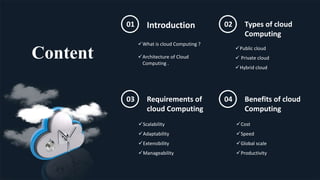
Content
Introduction
What is cloud Computing ?
Architecture of Cloud
Computing .
01 Types of cloud
Computing
Public cloud
 Private cloud
Hybrid cloud
02
Requirements of
cloud Computing
Scalability
Adaptability
Extensibility
Manageability
03 Benefits of cloud
Computing
Cost
Speed
Global scale
Productivity
04
What is Cloud Computing ?
Cloud computing is the delivery of computing
services including servers, storage, databases,
networking, software, analytics, and intelligence
over the Internet (“the cloud”) to offer faster
innovation, flexible resources, and economies of
scale. You typically pay only for cloud services
you use, helping lower your operating costs, run
your infrastructure more efficiently and scale as
your business needs change.
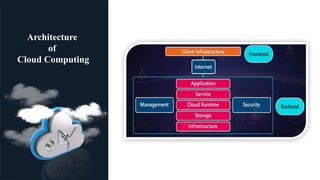
Cloud computing architecture refers to the
components and subcomponents required
for cloud computing. These components
typically consist of a front end platform (fat
client, thin client, mobile ),back end platforms
(servers, storage), a cloud based delivery, and a
network (Internet, Intranet, Intercloud).
Combined, these components make up cloud
computing architecture.
Architecture of Cloud Computing
Architecture
of
Cloud Computing
Types of
cloud Computing
Private
Cloud
Public Cloud
Hybrid
Cloud
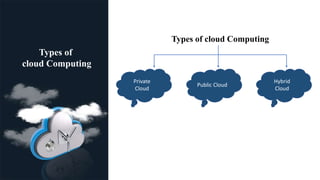
Types of cloud Computing
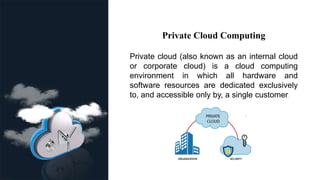
Private Cloud Computing
Private cloud (also known as an internal cloud
or corporate cloud) is a cloud computing
environment in which all hardware and
software resources are dedicated exclusively
to, and accessible only by, a single customer.
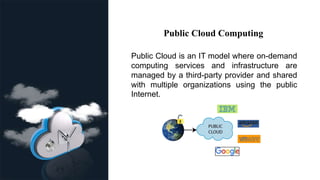
Public Cloud Computing
Public Cloud is an IT model where on-demand
computing services and infrastructure are
managed by a third-party provider and shared
with multiple organizations using the public
Internet.
.
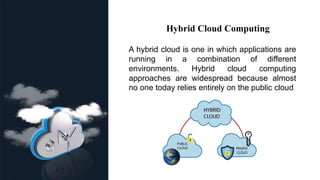
Hybrid Cloud Computing
A hybrid cloud is one in which applications are
running in a combination of different
environments. Hybrid cloud computing
approaches are widespread because almost
no one today relies entirely on the public cloud.
.
Requirements
of
Cloud Computing
 Scalability
Different companies have different IT needs a large enterprise of
1000+ employees won’t have the same IT requirements as a start-up
.Using cloud is a great solution because it enables enterprise to
efficiently and quickly scale up/down according to business
demands.
 Adaptability
The first key characteristic of cloud computing is the adaptability
that it offers. Cloud computing is ideal for businesses with growing
demands because it allows you to quickly adapt to changes without
your business skipping a beat.
.
 Extensibility
Oracle Cloud Extensibility Framework enables all cloud interfaces
to be exposed directly to customers, reducing manual integration
development tasks such as: Creating physical connections. Data
transformation.
 Manageability
The Manageability Challenge Other applications may consume
resources that cause performance to be slower for the businesses'
employees. Using a private cloud solution increases the
manageability of cloud resources, however; IT consulting firms can
advise small businesses on how to implement such a solution.
Benefits
of
Cloud Computing
Cost
Cloud computing eliminates the capital expense
of buying hardware and software and setting up
and running on-site datacenters—the racks of
servers, the round-the-clock electricity for power
and cooling, the IT experts for managing the
infrastructure. It adds up fast.
Speed
Most cloud computing services are provided self
service and on demand, so even vast amounts of
computing resources can be provisioned in
minutes, typically with just a few mouse clicks,
giving businesses a lot of flexibility and taking
the pressure off capacity planning.
.
Global scale
The benefits of cloud computing services include
the ability to scale elastically. In cloud speak, that
means delivering the right amount of IT resources
for example, more or less computing power,
storage, bandwidth right when it is needed and
from the right geographic location.
Productivity
On-site datacenters typically require a lot of
“racking and stacking”hardware setup, software
patching, and other time-consuming IT
management chores. Cloud computing removes
the need for many of these tasks, so IT teams can
spend time on achieving more important business
goals.
THANK YOU

Presentation on Cloud Computing by Vivek Atalkar.pptx

  • 1.
    CENTER FOR INVENTIONINNOVATION INCUBATION AND TRAINING GOVERNMENT COLLEGE OF ENGINEERING CHANDRAPUR NAME : Vivek Atalkar YEAR : 3RD YEAR
  • 2.
  • 3.
    Content Introduction What is cloudComputing ? Architecture of Cloud Computing . 01 Types of cloud Computing Public cloud  Private cloud Hybrid cloud 02 Requirements of cloud Computing Scalability Adaptability Extensibility Manageability 03 Benefits of cloud Computing Cost Speed Global scale Productivity 04
  • 4.
    What is CloudComputing ? Cloud computing is the delivery of computing services including servers, storage, databases, networking, software, analytics, and intelligence over the Internet (“the cloud”) to offer faster innovation, flexible resources, and economies of scale. You typically pay only for cloud services you use, helping lower your operating costs, run your infrastructure more efficiently and scale as your business needs change.
  • 5.
    Cloud computing architecturerefers to the components and subcomponents required for cloud computing. These components typically consist of a front end platform (fat client, thin client, mobile ),back end platforms (servers, storage), a cloud based delivery, and a network (Internet, Intranet, Intercloud). Combined, these components make up cloud computing architecture. Architecture of Cloud Computing
  • 6.
  • 7.
    Types of cloud Computing Private Cloud PublicCloud Hybrid Cloud Types of cloud Computing
  • 8.
    Private Cloud Computing Privatecloud (also known as an internal cloud or corporate cloud) is a cloud computing environment in which all hardware and software resources are dedicated exclusively to, and accessible only by, a single customer.
  • 9.
    Public Cloud Computing PublicCloud is an IT model where on-demand computing services and infrastructure are managed by a third-party provider and shared with multiple organizations using the public Internet.
  • 10.
    . Hybrid Cloud Computing Ahybrid cloud is one in which applications are running in a combination of different environments. Hybrid cloud computing approaches are widespread because almost no one today relies entirely on the public cloud.
  • 11.
    . Requirements of Cloud Computing  Scalability Differentcompanies have different IT needs a large enterprise of 1000+ employees won’t have the same IT requirements as a start-up .Using cloud is a great solution because it enables enterprise to efficiently and quickly scale up/down according to business demands.  Adaptability The first key characteristic of cloud computing is the adaptability that it offers. Cloud computing is ideal for businesses with growing demands because it allows you to quickly adapt to changes without your business skipping a beat.
  • 12.
    .  Extensibility Oracle CloudExtensibility Framework enables all cloud interfaces to be exposed directly to customers, reducing manual integration development tasks such as: Creating physical connections. Data transformation.  Manageability The Manageability Challenge Other applications may consume resources that cause performance to be slower for the businesses' employees. Using a private cloud solution increases the manageability of cloud resources, however; IT consulting firms can advise small businesses on how to implement such a solution.
  • 13.
    Benefits of Cloud Computing Cost Cloud computingeliminates the capital expense of buying hardware and software and setting up and running on-site datacenters—the racks of servers, the round-the-clock electricity for power and cooling, the IT experts for managing the infrastructure. It adds up fast. Speed Most cloud computing services are provided self service and on demand, so even vast amounts of computing resources can be provisioned in minutes, typically with just a few mouse clicks, giving businesses a lot of flexibility and taking the pressure off capacity planning.
  • 14.
    . Global scale The benefitsof cloud computing services include the ability to scale elastically. In cloud speak, that means delivering the right amount of IT resources for example, more or less computing power, storage, bandwidth right when it is needed and from the right geographic location. Productivity On-site datacenters typically require a lot of “racking and stacking”hardware setup, software patching, and other time-consuming IT management chores. Cloud computing removes the need for many of these tasks, so IT teams can spend time on achieving more important business goals.
  • 15.