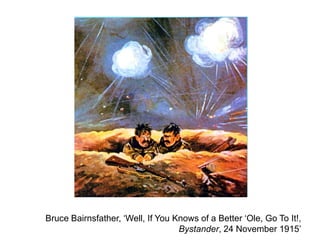
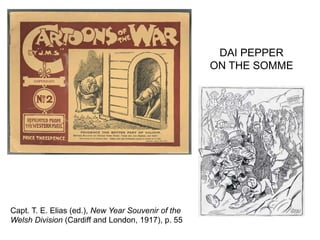
DAI PEPPER
ON THESOMME
Capt. T. E. Elias (ed.), New Year Souvenir of the
Welsh Division (Cardiff and London, 1917), p. 55
5.
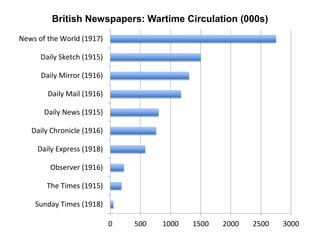
0 500 10001500 2000 2500 3000
Sunday Times (1918)
The Times (1915)
Observer (1916)
Daily Express (1918)
Daily Chronicle (1916)
Daily News (1915)
Daily Mail (1916)
Daily Mirror (1916)
Daily Sketch (1915)
News of the World (1917)
British Newspapers: Wartime Circulation (000s)
6.
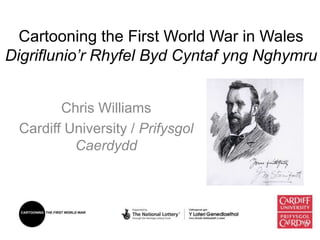
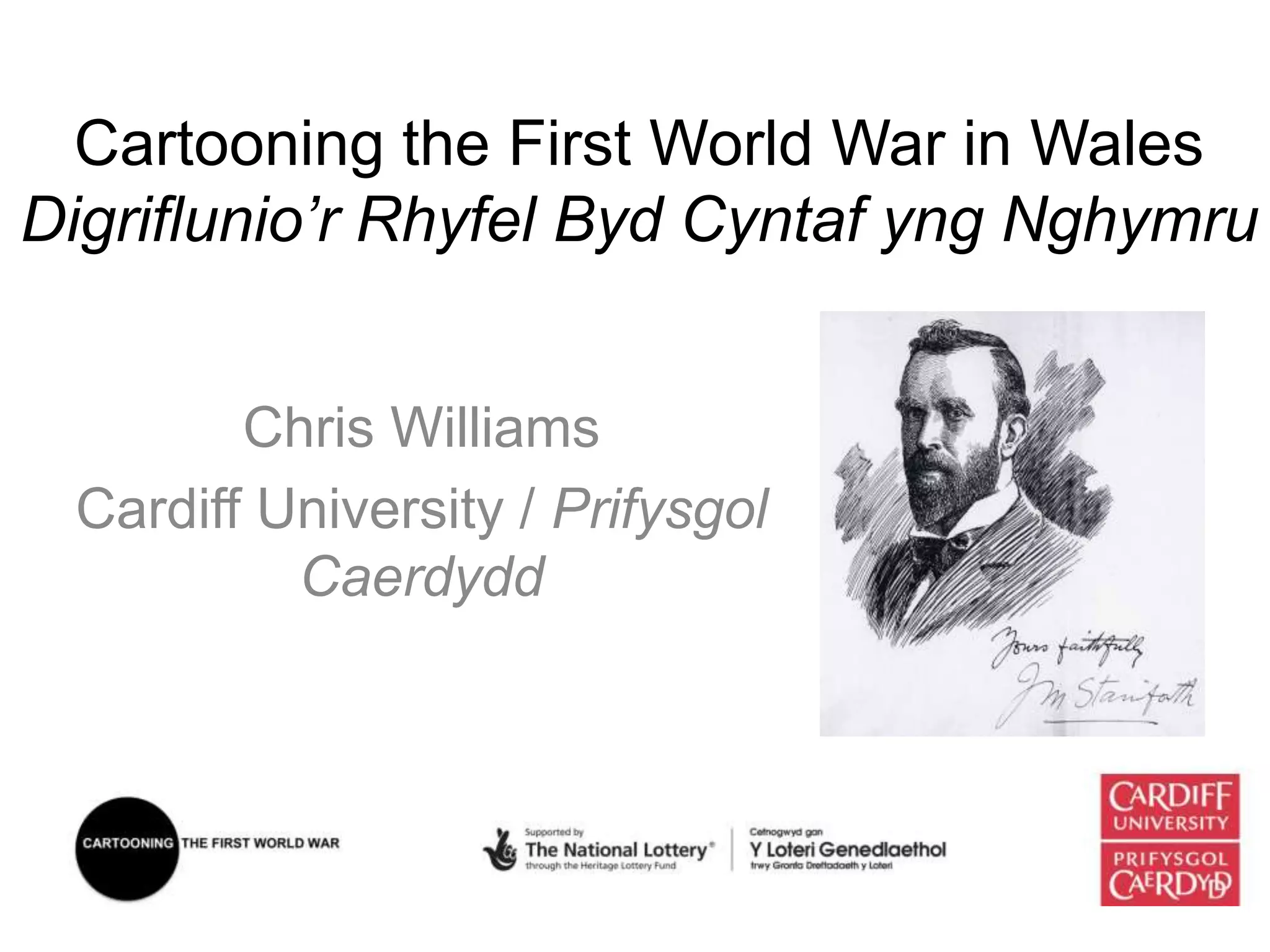
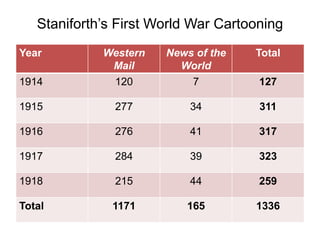
Staniforth’s First WorldWar Cartooning
Year Western
Mail
News of the
World
Total
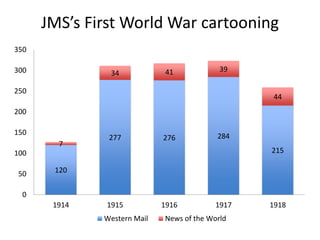
1914 120 7 127
1915 277 34 311
1916 276 41 317
1917 284 39 323
1918 215 44 259
Total 1171 165 1336
7.
JMS’s First WorldWar cartooning
120
277 276 284
215
7
34 41 39
44
0
50
100
150
200
250
300
350
1914 1915 1916 1917 1918
Western Mail News of the World
Quick Search...
Home ContactUs Login FAQs Blog Resources My Lightbox Glossary Useful Links Report a Fault
You are here: Home
Welcome to Cartooningthe
First World War
Cartooningthe First World War bringstogether all thewartimenewspaper
cartoonsof Joseph Morewood Staniforth (‘JMS’), which originally appeared in
theBritish Sunday paper the Newsof theWorld and theCardi! daily paper the
Western Mail. Over 1300cartoonsdocument thewar’schangingfortunesand
thewaysin which theconflict wasexperienced and represented by oneof the
most popular visual artistsof thetime. Each cartoon ispresented with
explanatory notesand with an open invitation to usersto comment on the
imageand itspossiblemeanings. Thecartoonsareaccompanied by a rangeof
resourceswhich help to contextualisethecartoonist, hiswork, and the
newspaperswhich published him.
Please note that the website currently holdscartoonsup tothe end of May
1917, with some from June 1917. In most casesthese are accompanied by
commentaries: any remainingcommentarieswill be supplied in the very
near future. In the next phase of work we will be uploadingfurther
cartoonsand commentariesup tothe end of 1917.
Cartooningthe First World War isa project supported by theHeritageLottery
Fund and based at Cardi! University, whereit isled by Professor Chris
Williams, Head of theSchool of History, Archaeology and Religion.
Enter Keyword...
Day Month Year
By Event
By Individual
By Topic
Search
You can search by free text,
use the drop down menusor
by keyword.
or Search by Date:
or Search material by:
Search
Image of the Week
Resources
View Resources
My Lightbox
View Lightbox
Contact Us
To get in touch with the
project team pleasefollow this
Register
If you would liketo register as
a project user pleasefollow
Blog
[Title]TheVisual Cultureof the
First World War
Twitter
#OTD1915 #WW1 as#waterpolo.
Commentary at cartoonww1.org
pic.twitter.com/XjxbpxEesh 2 hoursago via
iOS
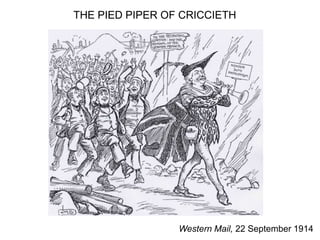
THEPIEDPIPEROF
CRICCIETH
Western Mail, 22 September
1914
Click here tofind out more
15.
Home Contact UsLogin FAQs Blog Resources My Lightbox Glossary Useful Links Report a Fault
You arehere: Home
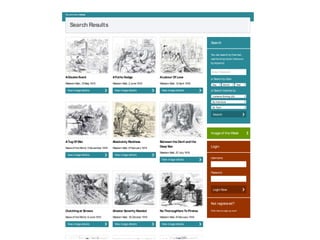
Search Results
Enter Keyword...
Day Month Year
Lusitania Sinking (20)
By Individual
By Topic
Username
Password
ADouble Event
Western Mail, 15May 1915
View image details
AFutile Dodge
Western Mail, 2June1915
View image details
ALabour Of Love
Western Mail, 12April 1916
View image details
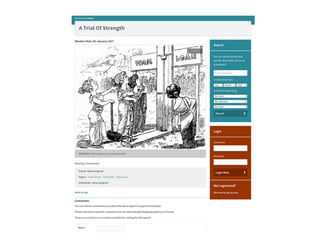
ATugOf War
Newsof theWorld, 5November 1916
View image details
Absolutely Reckless
Western Mail, 6February 1915
View image details
Between the Devil and the
Deep Sea
Western Mail, 27July 1915
View image details
Clutchingat Straws
Newsof theWorld, 6June1915
View image details
Greater Severity Needed
Western Mail, 16October 1915
View image details
NoThoroughfare ToPirates
Western Mail, 8February 1916
View image details
Search
You can search by freetext,
usethedrop down menusor
by keyword.
or Search by Date:
or Search material by:
Search
Image of theWeek
Login
Login Now
Not registered?
Click hereto sign up now!
18.
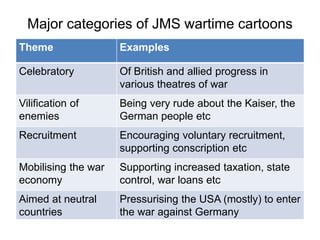
Major categories ofJMS wartime cartoons
Theme Examples
Celebratory Of British and allied progress in
various theatres of war
Vilification of
enemies
Being very rude about the Kaiser, the
German people etc
Recruitment Encouraging voluntary recruitment,
supporting conscription etc
Mobilising the war
economy
Supporting increased taxation, state
control, war loans etc
Aimed at neutral
countries
Pressurising the USA (mostly) to enter
the war against Germany
19.
Minor categories ofJMS wartime cartoons
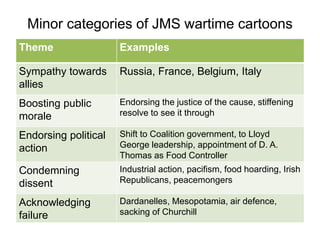
Theme Examples
Sympathy towards
allies
Russia, France, Belgium, Italy
Boosting public
morale
Endorsing the justice of the cause, stiffening
resolve to see it through
Endorsing political
action
Shift to Coalition government, to Lloyd
George leadership, appointment of D. A.
Thomas as Food Controller
Condemning
dissent
Industrial action, pacifism, food hoarding, Irish
Republicans, peacemongers
Acknowledging
failure
Dardanelles, Mesopotamia, air defence,
sacking of Churchill
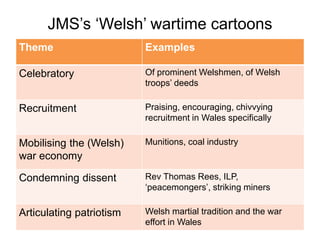
JMS’s ‘Welsh’ wartimecartoons
Theme Examples
Celebratory Of prominent Welshmen, of Welsh
troops’ deeds
Recruitment Praising, encouraging, chivvying
recruitment in Wales specifically
Mobilising the (Welsh)
war economy
Munitions, coal industry
Condemning dissent Rev Thomas Rees, ILP,
‘peacemongers’, striking miners
Articulating patriotism Welsh martial tradition and the war
effort in Wales
22.
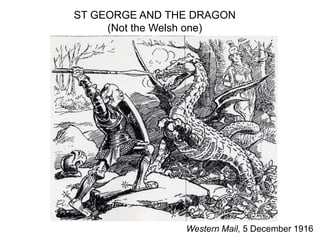
Western Mail, 5December 1916
ST GEORGE AND THE DRAGON
(Not the Welsh one)
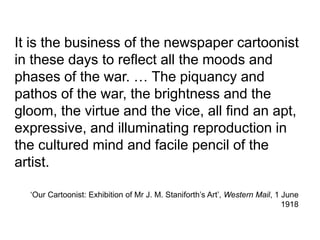
‘Our Cartoonist: Exhibitionof Mr J. M. Staniforth’s Art’, Western Mail, 1 June
1918
It is the business of the newspaper cartoonist
in these days to reflect all the moods and
phases of the war. … The piquancy and
pathos of the war, the brightness and the
gloom, the virtue and the vice, all find an apt,
expressive, and illuminating reproduction in
the cultured mind and facile pencil of the
artist.
30.
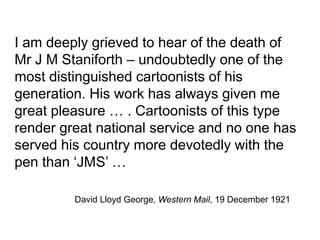
David Lloyd George,Western Mail, 19 December 1921
I am deeply grieved to hear of the death of
Mr J M Staniforth – undoubtedly one of the
most distinguished cartoonists of his
generation. His work has always given me
great pleasure … . Cartoonists of this type
render great national service and no one has
served his country more devotedly with the
pen than ‘JMS’ …
31.
Website: cartoonww1.org
Facebook: Cartooningthe First World War in
Wales
Twitter: @CartoonWW1
Contact:
Chris Williams: williamsc92@cardiff.ac.uk
Rhianydd Biebrach: biebrachr@cardiff.ac.uk
Editor's Notes
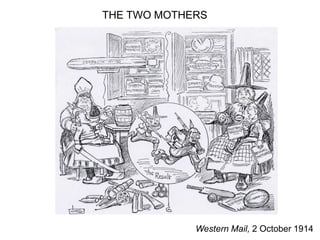
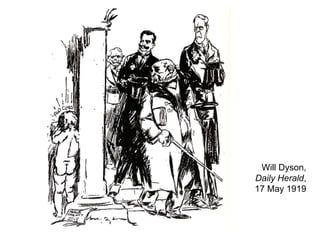
#4 The Tiger, Curious, I seem to hear a child weeping.
#6 Niall Ferguson, The Pity of War (London, 1999), p. 243
Other figures; News of the World 1915: 2m
The Times (1914) 183000; (1917) 137000; (1918) 131000
News of the World circulation rose during wartime; that of The Times fell
#7 1914 and 1918 totals include only the wartime months.
Does not include any cartoons published in the Evening Express, Football Express or one-off publications.
#8 Total: 1171 Western Mail, 165 News of the World. 1336
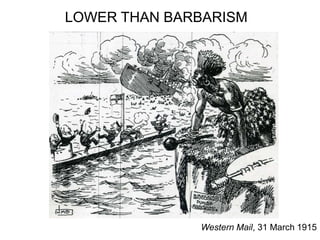
#9 THE SAVAGE: ‘Yah! Dere am some people dat insult me by calling dose decivilised Germans “barbarians”!’
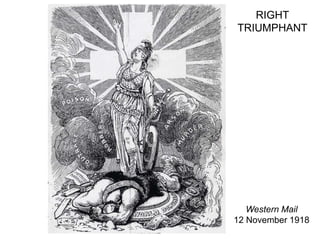
#10 Civilisation triumphs over poison, outrage, robbery, arson, murder, Prussian militarism, methods of barbarism and ambition for world domination.
Note also the cross in the background.
This cartoon appeared as a full page in the Western Mail the day after the armistice was declared. The cessation of hostilities had been anticipated for some weeks, and it is likely that Staniforth had been working on this image for longer than was normal for his cartoons. The fact that the newspaper gave over an entire one-eighth of its space to the cartoon is indicative of the importance and power of the visual image. The message is unambiguous: civilisation has triumphed over Prussian militarism, Christian virtue over heinous ‘methods of barbarism’ (the phrase an echo of the controversies surrounding British policy during the South African war of 1899-1902).
#11 'For he led us, he said, to a joyous land, ... Where waters gushed and fruit trees grew, And flowers put forth a fairer hue' (Robert Browning)
Excerpt from (the concluding passage of the famous) speech by Lloyd George at the Queen's Hall, London (September 19):
'We have been too comfortable, too indulging -- many, perhaps, too selfish. And the stern hand of Fate has scourged us to an elevation where we can see the great everlasting things that matter for a nation. The great peaks of honour we had forgotten, duty and patriotism, clad in glittering white. The great pinnacle of sacrifice, pointing like a rugged finger to heaven. We shall descend into valleys again, but as long as the men and women of this generation last they will carry in their hearts the image of these great mountain peaks, whose fingers are unshaken, though Europe rock and sway in the convulsions of a great war.’
/////
Lloyd George’s home was at Llanystumdwy, near Criccieth, in Caernarvonshire.
Note: DLG clad in Union Flag cloak, blowing a horn (or a pipe) of ‘honour’, ‘duty’ and ‘patriotism’.
The sign reads: ‘To the recruiting station and the removal of the German menace’.
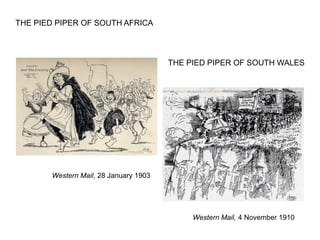
Lloyd George made this speech, calling for the creation of a Welsh Army Corps, and drawing on his version of a Welsh martial tradition stretching back to the Dark Ages. He was clearly attempting to reconcile the distinctiveness of Welsh national sentiment and patriotism with the wider interests of the British state and British Empire. To be fair, relatively few thought them incompatible at that time. It was a rousing call to arms and I’m sure Staniforth shared Lloyd George’s hope that it would meet with an enthusiastic response from the young men of Wales. Yet it is entirely possible that a reader might have drawn a different conclusion from the same piece of artwork. The story of the Pied Piper does not end happily, after all, for, as Browning puts it, at the end ‘Piper and dancers were gone for ever’. Although Staniforth meant to boost the patriotism of his readers, we can not be certain that he achieved his desired impact.
What is even more perplexing is that Staniforth had used a similar image on previous occasions to suggest that following a different ‘Pied Piper’ (such as C. B. Stanton, the militant miners’ agent) would lead to disaster. He cannot have been unaware of the potential for ambiguity.
#12 ‘All the little boys and girls …
Tripping and skipping, ran merrily after
The wonderful music, with shouting and laughter.
For he led us, he said, to a joyous land,
Where waters gushed and fruit trees grew,
And flowers put forth a fairer hue,
And everything was strange and new.’
(Robert Browning)
‘I, who have seen so much of the war, could never have believed it possible that the man who was execrated a year ago would be welcomed so heartily to-day. He seems to exercise a curious fascination over the rough sons of the veldt.’ – Press Association Correspondent, at Ventersdorp.
[Published volume]: Remarkable enthusiasm was raised amongst all sections in South Africa by Mr Chamberlain’s conciliatory speeches, and by his promises on behalf of the Government during his tour through the country.]
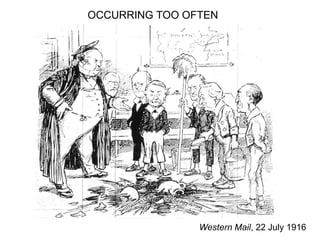
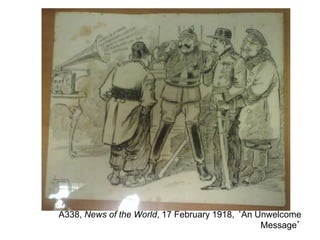
#21 CHORUS OF VOICES: What a dreadful mess! It wasn’t we who did it.
DR. JOHN BULL: Well, I shall expect you to find out who did do it, and to see that such scandalous things do not occur again.
The mess consists of the campaigns in the Dardanelles and Mesopotamia. Amongst the politicians in the picture are Asquith, Lloyd George, Churchill – and some others.
#23 Staniforth gets himself into a bit of a muddle with this cartoon.
Saint (Lloyd) George on the left.
Dragon is marked with ‘War dilatoriness’, ‘indecision’ and ‘delay’.
Lloyd George was about to become Prime Minister (on 7th).
Britannia tied to a tree in the background.
Lloyd George is becoming a Welsh icon in his own right – the first Welshman to be Prime Minister, the only Prime Minister not to speak English as his first language, a Prime Minister clearly identified with the key characteristics of modern Welsh identity through his career as a leading Welsh Liberal MP, advocate of disestablishment, the Cymru Fydd movement and so on.
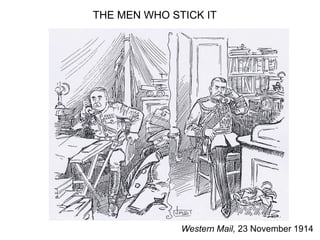
#24 LORD KITCHENER (at the War Office): Well, French, how are things going?
GENERAL FRENCH (at the Front): Splendidly! We are holding our own well. But I want more men – and especially Welshmen.
----------
There was one man whom they all knew – Captain Haggard, of the 5th Welsh – who, when dying, turned round to the Welshmen around him and said, “Stick it, Welsh.” (applause.) He appealed to all Welshmen to live up to that motto at the present time, and he could not finish with anything better than to say, “Stick it, Welsh.” (Applause.) – General Sir Francis Lloyd at Cardiff.
///
Early proof that the Welsh were not lacking in martial vigour and courage.
Mark Haggard, nephew of Rider Haggard. Died of wounds. Rescued by Lance Corporal Fuller who won the VC for doing so. 19 September 1914. Sometimes ‘Stick it, the Welsh’.
Kitchener was Secretary of State for War. French was Commander of the BEF.
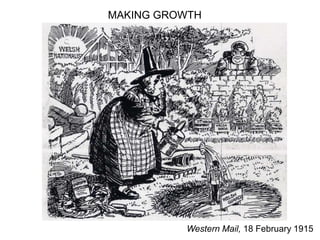
#25 JOHN BULL: Compliment you, ma’am, on your new plant! How’s it getting on?
DAME WALES: Fammous, look you. I do expect it will be a fine, sturdy plant in a few weeks’ time; yes, indeet.
///
Note: Dame Wales is watering ‘Welsh Guards’, using ‘Welsh Enthusiasm’ (from the watering can) and ‘Cardiff fertiliser’.
There are many other plants growing in the bed behind: ‘2nd Welsh Regiment’, ‘Welsh Horse’, ‘South Wales Borderers’, ‘3rd Welsh Regiment’, ‘Welsh Bantams’.
The Sun is ‘Welsh Nationalism’. Should be understood in the sense of Welsh national spirit, distinctiveness and pride rather than separatism.
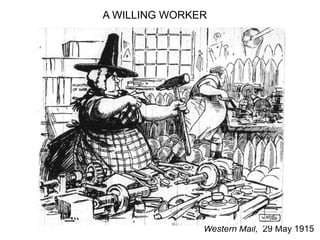
#26 DAME WALES (preparing to start): More munitions we do want, is it? Well, indeed, now, it wass a bit out of my line, but I will do my best, look you, an’ help to smash them old wicked Germans!
Behind her shoulder is ‘Munitions of War’.
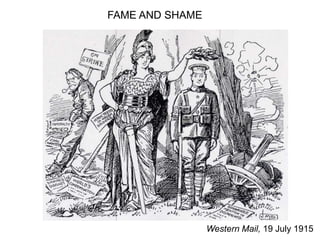
#27 The Welshman had become very popular. You could not fail to discern that in the reception of music-hall jokes at his expense, and the Welsh National Anthem or “The Men of Harlech” has latterly been invariably included with the hymns of the allies at the theatres and hails as a distinct recognition of the part Wales has been taking in the war. Yet to-day it is almost a reproach to be a Welshman in the eyes of the Londoner one meets in the club or anywhere else. – Our London Letter.
Notices: ‘Honourable Mention in Dispatches’, ‘World’s Condemnation’, ‘Empire’s Disgust’, ‘Heroic Deeds of Welsh Soldiers’, ‘On Strike’, ‘Admiralty’, ‘Coal Wanted’
#28 We will be none the worse soldiers in Wales because the military spirit has not been fostered and encouraged and whetted from childhood upwards as it has in Germany, where they feed their children on gunpowder. (Laughter.) A nation whose spirit is roused by the call to its magnanimity and manly qualities will go into action with all the greater heart because for centuries its soul has been cleansed from the mere lust of killing. (“Hear, hear,” and applause.). – Mr Lloyd George at Cardiff.
-------------
Mr Lloyd George inaugurates the movement for the formation of a Welsh Army Corps.
/////
This point is reinforced in this cartoons where it is freely acknowledged that ‘the military spirit has not been fostered’ in Wales. So whereas German children are surrounded by ‘Zeppelin’, ‘Despotic militarism’, ‘Barbarism jam’, ‘Gunpowder’, ‘Murder Treacle’, ‘Outrage Biscuits’, Welsh children have a background in ‘Right Living’, ‘Technical Training’, ‘Singing’, ‘Sports’, ‘Education’, ‘Religion and Nationalism’, ‘Football Results’, ‘Revival Pictures’, ‘National Eisteddfod’. Ultimately this will make them more effective soldiers.
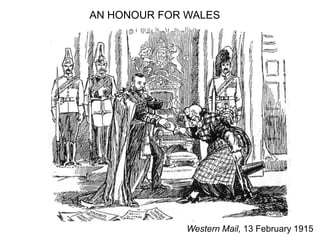
#29 HIS MAJESTY THE KING: Madam, your patriotism and contribution to my army since the war began have been all that I could wish. I, therefore, shall be delighted if you will send me a Battalion of Welsh Guards to join the three I have.
/////
If Wales’s proud contribution to the war through recruitment and deeds on the field of battle is a major theme in Staniforth’s cartoons, then so is the honour that such actions confer upon the Welsh people. Here we have the very public recognition of Wales’s efforts (‘Splendid recruiting in South Wales’, ‘Welsh Loyalty’) which are rewarded with elevation to the status of having its own Guards regiment – sharing that with the Scots, Irish and of course English.Irish Guards, English Guards (sic) and the Scotch Guards (sic). Should be Grenadier, Scots (and Coldstream).
Worth noting that Welsh patriots were sensitive to Wales’s inferior status within the United Kingdom as a Principality that had been conquered rather than a Kingdom / State that had been ‘united’. The legislative acquisition of Wales by England had been formalised in the sixteenth century. It was only in the late nineteenth century, and with the awareness of the acts of 1707 and 1800 that had brought first Scotland and then Ireland into the UK, that these were termed the Welsh ‘Acts of Union’. Staniforth was also a long-term supporter of a campaign to have the arms of Wales placed on the royal standard (alongside those of England, Scotland and Ireland). So the award of its own Guards Regiment was a significant act of recognition of the distinctive claims of Wales on the part of the British state.
![Quick Search...
Home Contact Us Login FAQs Blog Resources My Lightbox Glossary Useful Links Report a Fault
You are here: Home
Welcome to Cartooningthe
First World War
Cartooningthe First World War bringstogether all thewartimenewspaper
cartoonsof Joseph Morewood Staniforth (‘JMS’), which originally appeared in
theBritish Sunday paper the Newsof theWorld and theCardi! daily paper the
Western Mail. Over 1300cartoonsdocument thewar’schangingfortunesand
thewaysin which theconflict wasexperienced and represented by oneof the
most popular visual artistsof thetime. Each cartoon ispresented with
explanatory notesand with an open invitation to usersto comment on the
imageand itspossiblemeanings. Thecartoonsareaccompanied by a rangeof
resourceswhich help to contextualisethecartoonist, hiswork, and the
newspaperswhich published him.
Please note that the website currently holdscartoonsup tothe end of May
1917, with some from June 1917. In most casesthese are accompanied by
commentaries: any remainingcommentarieswill be supplied in the very
near future. In the next phase of work we will be uploadingfurther
cartoonsand commentariesup tothe end of 1917.
Cartooningthe First World War isa project supported by theHeritageLottery
Fund and based at Cardi! University, whereit isled by Professor Chris
Williams, Head of theSchool of History, Archaeology and Religion.
Enter Keyword...
Day Month Year
By Event
By Individual
By Topic
Search
You can search by free text,
use the drop down menusor
by keyword.
or Search by Date:
or Search material by:
Search
Image of the Week
Resources
View Resources
My Lightbox
View Lightbox
Contact Us
To get in touch with the
project team pleasefollow this
Register
If you would liketo register as
a project user pleasefollow
Blog
[Title]TheVisual Cultureof the
First World War
Twitter
#OTD1915 #WW1 as#waterpolo.
Commentary at cartoonww1.org
pic.twitter.com/XjxbpxEesh 2 hoursago via
iOS
THEPIEDPIPEROF
CRICCIETH
Western Mail, 22 September
1914
Click here tofind out more](https://image.slidesharecdn.com/20-150226081856-conversion-gate01/85/Cartooning-the-First-World-War-Professor-Chris-Williams-Cardiff-University-14-320.jpg)