Deep dive into LibraBFT consensus
Libra Developer Meeting #1
July 24, 2019
Phuwanai Thummavet
Blockchain Developer | Security Researcher
2
Phuwanai Thummavet (Bright)
Blockchain Developer | Security
Researcher
Website: www.serial-coder.com
Blog: medium.com/@serial_coder
Outline
3
● Overview of Byzantine Fault Tolerance consensus
● Overview of LibraBFT consensus
● How does HotStuff consensus work?
● What is Libra’s Pacemaker module?
● Participation and incentives
● Key takeaway
● References
Overview of Byzantine Fault
Tolerance consensus
1
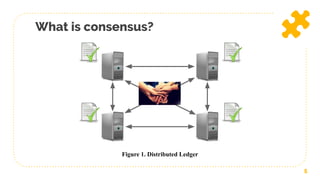
What is consensus?
5
Figure 1. Distributed Ledger
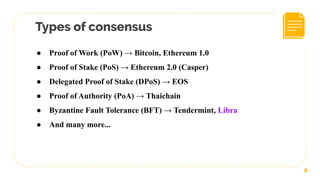
Types of consensus
6
● Proof of Work (PoW) → Bitcoin, Ethereum 1.0
● Proof of Stake (PoS) → Ethereum 2.0 (Casper)
● Delegated Proof of Stake (DPoS) → EOS
● Proof of Authority (PoA) → Thaichain
● Byzantine Fault Tolerance (BFT) → Tendermint, Libra
● And many more...
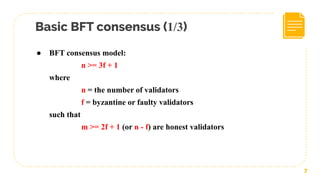
Basic BFT consensus (1/3)
7
● BFT consensus model:
n >= 3f + 1
where
n = the number of validators
f = byzantine or faulty validators
such that
m >= 2f + 1 (or n - f) are honest validators
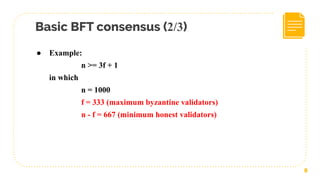
Basic BFT consensus (2/3)
8
● Example:
n >= 3f + 1
in which
n = 1000
f = 333 (maximum byzantine validators)
n - f = 667 (minimum honest validators)
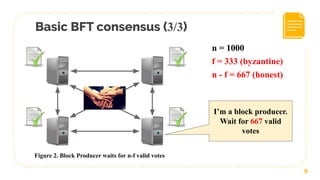
Basic BFT consensus (3/3)
9
n = 1000
f = 333 (byzantine)
n - f = 667 (honest)
Figure 2. Block Producer waits for n-f valid votes
I’m a block producer.
Wait for 667 valid
votes
Overview of LibraBFT consensus
2
LibraBFT key technical (1/3)
11
● LibraBFT is a consensus protocol that progresses in rounds
● In each round, a leader is chosen amongst the validators
● Correct leader scenario
○ The leader proposes a new block of transactions and broadcast it
to the rest of the validators
○ The leader collects enough votes (n-f) to form a Quorum
Certificate (QC)
LibraBFT key technical (2/3)
12
● Correct leader scenario (cont.)
○ The leader broadcasts QC to all validators
○ Each validator verifies QC validity and then commits the
proposed block onto its local storage
○ The current round finishes
■ Starts the next round
LibraBFT key technical (3/3)
13
● Leader fails to propose a block scenario
○ Causes
■ A leader is down
■ A leader cannot aggregate enough votes
○ Consequently, a timeout mechanism will force a new round
○ A new leader will be chosen from the validators
Libra: life cycle of transaction
14
Figure 3. Logical components of a
Libra validator [1]
Commit rule of LibraBFT
15
Figure 4. B1
matches the commit
rule, it becomes committed onto
the local world state database
Commit rule:
B1
is said to match the
commit rule if and only if it is the
head of a 3-chain with contiguous
rounds [2]
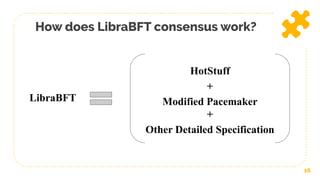
How does LibraBFT consensus work?
16
LibraBFT
HotStuff
+
Modified Pacemaker
+
Other Detailed Specification
How does HotStuff consensus work?
3
Complexity of HotStuff
18
Table 1. Authenticator complexity comparison [3]
Network topology change
19
Figure 5. Mesh topology to Star topology [4]
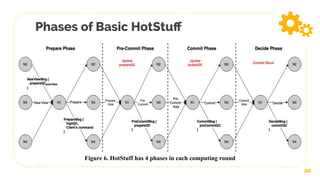
Phases of Basic HotStuff
20
Figure 6. HotStuff has 4 phases in each computing round
Chained HotStuff
21
Figure 7. Chained HotStuff in which a QC can serve in different phases simultaneously [3]
What is Libra’s Pacemaker module?
4
Overview of the Pacemaker
23
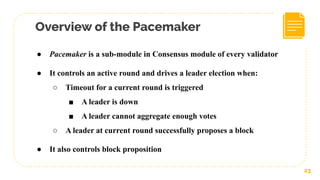
● Pacemaker is a sub-module in Consensus module of every validator
● It controls an active round and drives a leader election when:
○ Timeout for a current round is triggered
■ A leader is down
■ A leader cannot aggregate enough votes
○ A leader at current round successfully proposes a block
● It also controls block proposition
What does the Pacemaker control?
24
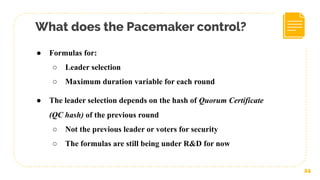
● Formulas for:
○ Leader selection
○ Maximum duration variable for each round
● The leader selection depends on the hash of Quorum Certificate
(QC hash) of the previous round
○ Not the previous leader or voters for security
○ The formulas are still being under R&D for now
Assigning leaders to rounds (1/3)
25
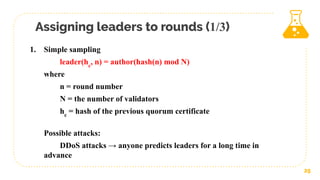
1. Simple sampling
leader(hc
, n) = author(hash(n) mod N)
where
n = round number
N = the number of validators
hc
= hash of the previous quorum certificate
Possible attacks:
DDoS attacks → anyone predicts leaders for a long time in
advance
Assigning leaders to rounds (2/3)
26
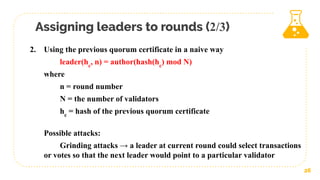
2. Using the previous quorum certificate in a naive way
leader(hc
, n) = author(hash(hc
) mod N)
where
n = round number
N = the number of validators
hc
= hash of the previous quorum certificate
Possible attacks:
Grinding attacks → a leader at current round could select transactions
or votes so that the next leader would point to a particular validator
Assigning leaders to rounds (3/3)
27
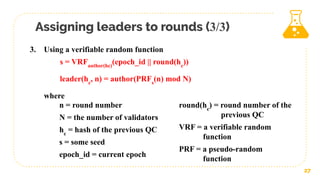
3. Using a verifiable random function
s = VRFauthor(hc)
(epoch_id || round(hc
))
leader(hc
, n) = author(PRFs
(n) mod N)
where
n = round number
N = the number of validators
hc
= hash of the previous QC
s = some seed
epoch_id = current epoch
round(hc
) = round number of the
previous QC
VRF = a verifiable random
function
PRF = a pseudo-random
function
Participation and incentives,
Key takeaway & References
5
Participation and incentives
29
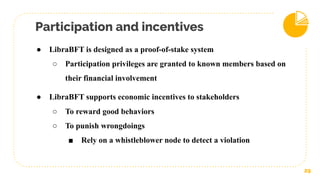
● LibraBFT is designed as a proof-of-stake system
○ Participation privileges are granted to known members based on
their financial involvement
● LibraBFT supports economic incentives to stakeholders
○ To reward good behaviors
○ To punish wrongdoings
■ Rely on a whistleblower node to detect a violation
Key takeaway (1/2)
30
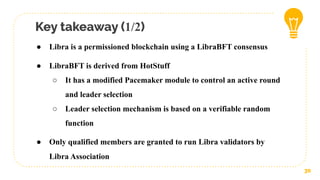
● Libra is a permissioned blockchain using a LibraBFT consensus
● LibraBFT is derived from HotStuff
○ It has a modified Pacemaker module to control an active round
and leader selection
○ Leader selection mechanism is based on a verifiable random
function
● Only qualified members are granted to run Libra validators by
Libra Association
Key takeaway (2/2)
31
● LibraBFT supports economic incentives to stakeholders based on
their behaviors
● Libra is secure as long as the number of byzantine/faulty validators
does not exceed 1/3 of total validators
● LibraBFT is scalable linearly with complexity O(n), where n is the
number of validators
References (1/2)
32
[1] - Libra Association, “Life of a Transaction,” 2019.
https://developers.libra.org/docs/life-of-a-transaction
[2] - M. Baudet, et al., “State Machine Replication in the Libra Blockchain,”
2019. https://developers.libra.org/docs/assets/papers/libra-consensus-
state-machine-replication-in-the-libra-blockchain.pdf
[3] - M. Yin, D. Malkhi, M. K. Reiterand, G. G. Gueta, and I. Abraham,
“HotStuff: BFT consensus in the lens of blockchain,” 2019.
https://arxiv.org/pdf/1803.05069.pdf
References (2/2)
33
[4] - The Ontology Team, “HotStuff: the consensus protocol behind Facebook’s
LibraBFT,” 2019. https://medium.com/ontologynetwork/hotstuff-the-
consensus-protocol-behind-facebooks-librabft-a5503680b151
34
Thanks!
Any questions?
You can find me at www.serial-coder.com
Deep dive into LibraBFT consensus
Phuwanai Thummavet
Blockchain Developer | Security Researcher
Website: www.serial-coder.com
Blog: medium.com/@serial_coder

Deep dive into LibraBFT consensus

  • 1.
    Deep dive intoLibraBFT consensus Libra Developer Meeting #1 July 24, 2019 Phuwanai Thummavet Blockchain Developer | Security Researcher
  • 2.
    2 Phuwanai Thummavet (Bright) BlockchainDeveloper | Security Researcher Website: www.serial-coder.com Blog: medium.com/@serial_coder
  • 3.
    Outline 3 ● Overview ofByzantine Fault Tolerance consensus ● Overview of LibraBFT consensus ● How does HotStuff consensus work? ● What is Libra’s Pacemaker module? ● Participation and incentives ● Key takeaway ● References
  • 4.
    Overview of ByzantineFault Tolerance consensus 1
  • 5.
    What is consensus? 5 Figure1. Distributed Ledger
  • 6.
    Types of consensus 6 ●Proof of Work (PoW) → Bitcoin, Ethereum 1.0 ● Proof of Stake (PoS) → Ethereum 2.0 (Casper) ● Delegated Proof of Stake (DPoS) → EOS ● Proof of Authority (PoA) → Thaichain ● Byzantine Fault Tolerance (BFT) → Tendermint, Libra ● And many more...
  • 7.
    Basic BFT consensus(1/3) 7 ● BFT consensus model: n >= 3f + 1 where n = the number of validators f = byzantine or faulty validators such that m >= 2f + 1 (or n - f) are honest validators
  • 8.
    Basic BFT consensus(2/3) 8 ● Example: n >= 3f + 1 in which n = 1000 f = 333 (maximum byzantine validators) n - f = 667 (minimum honest validators)
  • 9.
    Basic BFT consensus(3/3) 9 n = 1000 f = 333 (byzantine) n - f = 667 (honest) Figure 2. Block Producer waits for n-f valid votes I’m a block producer. Wait for 667 valid votes
  • 10.
  • 11.
    LibraBFT key technical(1/3) 11 ● LibraBFT is a consensus protocol that progresses in rounds ● In each round, a leader is chosen amongst the validators ● Correct leader scenario ○ The leader proposes a new block of transactions and broadcast it to the rest of the validators ○ The leader collects enough votes (n-f) to form a Quorum Certificate (QC)
  • 12.
    LibraBFT key technical(2/3) 12 ● Correct leader scenario (cont.) ○ The leader broadcasts QC to all validators ○ Each validator verifies QC validity and then commits the proposed block onto its local storage ○ The current round finishes ■ Starts the next round
  • 13.
    LibraBFT key technical(3/3) 13 ● Leader fails to propose a block scenario ○ Causes ■ A leader is down ■ A leader cannot aggregate enough votes ○ Consequently, a timeout mechanism will force a new round ○ A new leader will be chosen from the validators
  • 14.
    Libra: life cycleof transaction 14 Figure 3. Logical components of a Libra validator [1]
  • 15.
    Commit rule ofLibraBFT 15 Figure 4. B1 matches the commit rule, it becomes committed onto the local world state database Commit rule: B1 is said to match the commit rule if and only if it is the head of a 3-chain with contiguous rounds [2]
  • 16.
    How does LibraBFTconsensus work? 16 LibraBFT HotStuff + Modified Pacemaker + Other Detailed Specification
  • 17.
    How does HotStuffconsensus work? 3
  • 18.
    Complexity of HotStuff 18 Table1. Authenticator complexity comparison [3]
  • 19.
    Network topology change 19 Figure5. Mesh topology to Star topology [4]
  • 20.
    Phases of BasicHotStuff 20 Figure 6. HotStuff has 4 phases in each computing round
  • 21.
    Chained HotStuff 21 Figure 7.Chained HotStuff in which a QC can serve in different phases simultaneously [3]
  • 22.
    What is Libra’sPacemaker module? 4
  • 23.
    Overview of thePacemaker 23 ● Pacemaker is a sub-module in Consensus module of every validator ● It controls an active round and drives a leader election when: ○ Timeout for a current round is triggered ■ A leader is down ■ A leader cannot aggregate enough votes ○ A leader at current round successfully proposes a block ● It also controls block proposition
  • 24.
    What does thePacemaker control? 24 ● Formulas for: ○ Leader selection ○ Maximum duration variable for each round ● The leader selection depends on the hash of Quorum Certificate (QC hash) of the previous round ○ Not the previous leader or voters for security ○ The formulas are still being under R&D for now
  • 25.
    Assigning leaders torounds (1/3) 25 1. Simple sampling leader(hc , n) = author(hash(n) mod N) where n = round number N = the number of validators hc = hash of the previous quorum certificate Possible attacks: DDoS attacks → anyone predicts leaders for a long time in advance
  • 26.
    Assigning leaders torounds (2/3) 26 2. Using the previous quorum certificate in a naive way leader(hc , n) = author(hash(hc ) mod N) where n = round number N = the number of validators hc = hash of the previous quorum certificate Possible attacks: Grinding attacks → a leader at current round could select transactions or votes so that the next leader would point to a particular validator
  • 27.
    Assigning leaders torounds (3/3) 27 3. Using a verifiable random function s = VRFauthor(hc) (epoch_id || round(hc )) leader(hc , n) = author(PRFs (n) mod N) where n = round number N = the number of validators hc = hash of the previous QC s = some seed epoch_id = current epoch round(hc ) = round number of the previous QC VRF = a verifiable random function PRF = a pseudo-random function
  • 28.
    Participation and incentives, Keytakeaway & References 5
  • 29.
    Participation and incentives 29 ●LibraBFT is designed as a proof-of-stake system ○ Participation privileges are granted to known members based on their financial involvement ● LibraBFT supports economic incentives to stakeholders ○ To reward good behaviors ○ To punish wrongdoings ■ Rely on a whistleblower node to detect a violation
  • 30.
    Key takeaway (1/2) 30 ●Libra is a permissioned blockchain using a LibraBFT consensus ● LibraBFT is derived from HotStuff ○ It has a modified Pacemaker module to control an active round and leader selection ○ Leader selection mechanism is based on a verifiable random function ● Only qualified members are granted to run Libra validators by Libra Association
  • 31.
    Key takeaway (2/2) 31 ●LibraBFT supports economic incentives to stakeholders based on their behaviors ● Libra is secure as long as the number of byzantine/faulty validators does not exceed 1/3 of total validators ● LibraBFT is scalable linearly with complexity O(n), where n is the number of validators
  • 32.
    References (1/2) 32 [1] -Libra Association, “Life of a Transaction,” 2019. https://developers.libra.org/docs/life-of-a-transaction [2] - M. Baudet, et al., “State Machine Replication in the Libra Blockchain,” 2019. https://developers.libra.org/docs/assets/papers/libra-consensus- state-machine-replication-in-the-libra-blockchain.pdf [3] - M. Yin, D. Malkhi, M. K. Reiterand, G. G. Gueta, and I. Abraham, “HotStuff: BFT consensus in the lens of blockchain,” 2019. https://arxiv.org/pdf/1803.05069.pdf
  • 33.
    References (2/2) 33 [4] -The Ontology Team, “HotStuff: the consensus protocol behind Facebook’s LibraBFT,” 2019. https://medium.com/ontologynetwork/hotstuff-the- consensus-protocol-behind-facebooks-librabft-a5503680b151
  • 34.
    34 Thanks! Any questions? You canfind me at www.serial-coder.com
  • 35.
    Deep dive intoLibraBFT consensus Phuwanai Thummavet Blockchain Developer | Security Researcher Website: www.serial-coder.com Blog: medium.com/@serial_coder