American Academy of Matrimonial Lawyers
Mountain States Chapter
June 9, 2017
Speaker
Peter M. Walzer , Esq.
Walzer Melcher LLP
5941 Variel Ave.
Woodland Hills, CA 91367
1820 14th
St.
Santa Monica, CA 90404
818-591-3700
pmw@walzermelcher.com
Walzer Melcher LLP
INTRODUCTION
Alimony/maintenance/
spousal support
Property division
ALIMONY OVERVIEW
Every time we deal with alimony, we are doing a
form of tax planning.
The parties are subject to the tax consequences
every year when they file tax returns.
When we use the tax rules to the advantage of
our clients, they can save lots of money.
However, nasty surprises for the client (and us
too) can occur if the deal is not structured
correctly.
FREE MONEY!
Maintenance is way of shifting taxes, where
taxable income is taken from one party and given
to the other.
When the payer is in a higher tax bracket than
the payee, the IRS ends up subsidizing part of the
maintenance payment.
Here is how it works:
EXAMPLE
H makes $25,000/month. W has no income.
H is ordered to pay $9,000/month in alimony to
W.
After receiving the tax deduction, the cost of that
payment to H is $5,000/month. The tax savings is
high because H is in a high tax bracket.
Wife is in a lower tax bracket, so she nets
$7,000/month after paying taxes.
The $2,000 difference is subsidized by the IRS.
8 SIMPLE RULES
To deduct support, the payments must meet the
test for “alimony” under IRC 71.
Paid in cash
To/for a spouse or ex
Under an instrument
Doesn’t say non-taxable
Parties don’t live together
Terminates on payee’s
death
Not fixed as child support
Joint return not filed
HYPOTHETICAL #1
The court makes the following order: “H shall
pay $1,500/month in permanent maintenance to
W.”
That’s the entire order.
Issue:
-- Can H deduct the payments/are the payments income
to W?
HYPOTHETICAL #2
The parties agree in writing that “Husband will
pay $10,000 to Wife’s attorney.”
Issue:
-- Can H deduct the payment as alimony/are the
payments included in W’s income?
-- What if the agreement states that the payment is made
“as and for additional alimony”?
HYPOTHETICAL #3
W has been making alimony payments to H since
1/1/09 under an oral agreement.
The parties stipulate to a court order on 8/1/09,
formally setting maintenance and agreeing that
the order is retroactive to 1/1/09.
Issue:
-- Are the payments made between 1/1/09 through
7/31/09 deductible by W and included in H’s income?
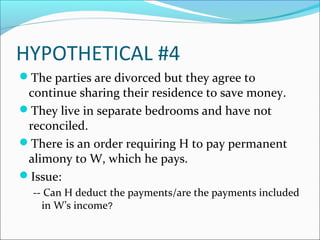
HYPOTHETICAL #4
The parties are divorced but they agree to
continue sharing their residence to save money.
They live in separate bedrooms and have not
reconciled.
There is an order requiring H to pay permanent
alimony to W, which he pays.
Issue:
-- Can H deduct the payments/are the payments included
in W’s income?
HYPOTHETICAL #5
W is ordered to pay the mortgage, property taxes,
and insurance on the family residence as
“alimony” for H, terminating on H’s death.
The parties own the home jointly and the loan is
in both of their names.
Issues:
-- How much of the payments can W deduct/are included
in H’s income?
-- May either party take an itemized deduction for the
interest and property tax payments?
HYPOTHETICAL #6
H is ordered to obtain a life insurance policy on
his life, naming W as the beneficiary.
H is ordered to pay the premiums as additional
alimony, terminating on W’s death.
Issues:
-- Are the premiums deductible by H and included in W’s
income?
-- Can H reserve the right to name a successor beneficiary
if W predeceases him?
HYPOTHETICAL #7
H agrees to pay $5,000/month in alimony to W
until her death.
W has custody of their children.
The agreement states: “Upon W’s death, H will
pay $2,500/month to a trust for their minor
children until their youngest child turns 18.”
Issue:
-- Can H deduct all of the payments /are they included in
W’s income?
HYPOTHETICAL #8
Upon divorce, H is ordered to pay $36,000/year in
permanent maintenance to W until further order
or W’s death.
After two years, Husband is injured and the court
reduces his support to $5,000/year.
Issue:
-- What are the tax consequences of this reduction?
Recapture Worksheet
PROPERTY OVERVIEW
Transfers incident to
divorce
Tax basis
Carryforwards
Transferring tax liability
TRANSFERS INCIDENT TO DIVORCE
A transfer between spouses / former spouses,
“incident to divorce” is not taxable generally. (IRC
1041)
The transfer is treated as a gift. The transferee
takes the transferor’s tax basis in the property. (no
step up!)
This defers the tax consequences of the transfer
(recognition of gain or loss) until the recipient
disposes of the property.
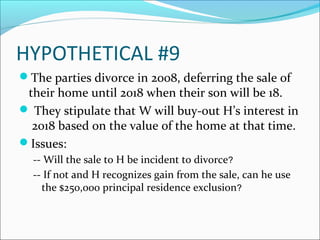
HYPOTHETICAL #9
The parties divorce in 2008, deferring the sale of
their home until 2018 when their son will be 18.
 They stipulate that W will buy-out H’s interest in
2018 based on the value of the home at that time.
Issues:
-- Will the sale to H be incident to divorce?
-- If not and H recognizes gain from the sale, can he use
the $250,000 principal residence exclusion?
HYPOTHETICAL #10
H and W agree to divide all of their property.
You represent W, who lives in Utah and is an
American citizen.
H lives in Canada and is a Canadian citizen. H
ends each sentence in “eh.”
Issue:
-- What are the tax consequences of their division of
property?
-- Who gets hosed on this deal, eh?
(Issue also comes up in prenups)
CONSIDERING TAX BASIS
Don’t mix apples and oranges by just focusing on
the value of property when making a division.
Consider the tax basis because if the value
exceeds the basis, there will be a taxable gain
when the property is later sold.
Tax basis is generally the cost of the property,
adjusted for improvements (which add to the
basis) or depreciation deductions (which lower
the basis).
HYPOTHETICAL #11
The parties agree to split everything 50-50.
W gets the party’s apartment building, with an
equity of $1,000,000.
Husband gets $1,000,000 in cash.
Issues:
-- Is this an equal division?
-- What if W has no intention of selling the building, or
will eventually do a IRC 1031 exchange?
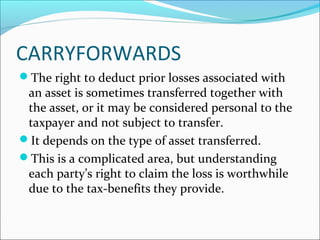
CARRYFORWARDS
The right to deduct prior losses associated with
an asset is sometimes transferred together with
the asset, or it may be considered personal to the
taxpayer and not subject to transfer.
It depends on the type of asset transferred.
This is a complicated area, but understanding
each party’s right to claim the loss is worthwhile
due to the tax-benefits they provide.
TYPES OF CARRYFORWARDS
Net operating loss (NOL).
For businesses with material participation. Carried
forward 20 years. Allocated between parties.
Capital loss.
From investments. May take $3,000 loss against
ordinary income, rest carried forward indefinitely .
Allocated between parties.
Passive activity loss (PAL).
Deduction limited to extent passive income generated
(PIG). Indefinitely carried forward. Stays with asset.
CONCLUSION
Feel free contact us with any questions:
Peter M. Walzer, Esq.
Walzer Melcher LLP
5941 Variel Ave.,Woodland Hills, CA 91367
1820 14th
St., Santa Monica, CA 90404
818-591-3700
pmw@walzermelcher.com

Divorce tax 2017

  • 1.
    American Academy ofMatrimonial Lawyers Mountain States Chapter June 9, 2017
  • 2.
    Speaker Peter M. Walzer, Esq. Walzer Melcher LLP 5941 Variel Ave. Woodland Hills, CA 91367 1820 14th St. Santa Monica, CA 90404 818-591-3700 pmw@walzermelcher.com
  • 3.
  • 4.
  • 5.
    ALIMONY OVERVIEW Every timewe deal with alimony, we are doing a form of tax planning. The parties are subject to the tax consequences every year when they file tax returns. When we use the tax rules to the advantage of our clients, they can save lots of money. However, nasty surprises for the client (and us too) can occur if the deal is not structured correctly.
  • 6.
    FREE MONEY! Maintenance isway of shifting taxes, where taxable income is taken from one party and given to the other. When the payer is in a higher tax bracket than the payee, the IRS ends up subsidizing part of the maintenance payment. Here is how it works:
  • 7.
    EXAMPLE H makes $25,000/month.W has no income. H is ordered to pay $9,000/month in alimony to W. After receiving the tax deduction, the cost of that payment to H is $5,000/month. The tax savings is high because H is in a high tax bracket. Wife is in a lower tax bracket, so she nets $7,000/month after paying taxes. The $2,000 difference is subsidized by the IRS.
  • 8.
    8 SIMPLE RULES Todeduct support, the payments must meet the test for “alimony” under IRC 71. Paid in cash To/for a spouse or ex Under an instrument Doesn’t say non-taxable Parties don’t live together Terminates on payee’s death Not fixed as child support Joint return not filed
  • 9.
    HYPOTHETICAL #1 The courtmakes the following order: “H shall pay $1,500/month in permanent maintenance to W.” That’s the entire order. Issue: -- Can H deduct the payments/are the payments income to W?
  • 10.
    HYPOTHETICAL #2 The partiesagree in writing that “Husband will pay $10,000 to Wife’s attorney.” Issue: -- Can H deduct the payment as alimony/are the payments included in W’s income? -- What if the agreement states that the payment is made “as and for additional alimony”?
  • 11.
    HYPOTHETICAL #3 W hasbeen making alimony payments to H since 1/1/09 under an oral agreement. The parties stipulate to a court order on 8/1/09, formally setting maintenance and agreeing that the order is retroactive to 1/1/09. Issue: -- Are the payments made between 1/1/09 through 7/31/09 deductible by W and included in H’s income?
  • 12.
    HYPOTHETICAL #4 The partiesare divorced but they agree to continue sharing their residence to save money. They live in separate bedrooms and have not reconciled. There is an order requiring H to pay permanent alimony to W, which he pays. Issue: -- Can H deduct the payments/are the payments included in W’s income?
  • 13.
    HYPOTHETICAL #5 W isordered to pay the mortgage, property taxes, and insurance on the family residence as “alimony” for H, terminating on H’s death. The parties own the home jointly and the loan is in both of their names. Issues: -- How much of the payments can W deduct/are included in H’s income? -- May either party take an itemized deduction for the interest and property tax payments?
  • 14.
    HYPOTHETICAL #6 H isordered to obtain a life insurance policy on his life, naming W as the beneficiary. H is ordered to pay the premiums as additional alimony, terminating on W’s death. Issues: -- Are the premiums deductible by H and included in W’s income? -- Can H reserve the right to name a successor beneficiary if W predeceases him?
  • 15.
    HYPOTHETICAL #7 H agreesto pay $5,000/month in alimony to W until her death. W has custody of their children. The agreement states: “Upon W’s death, H will pay $2,500/month to a trust for their minor children until their youngest child turns 18.” Issue: -- Can H deduct all of the payments /are they included in W’s income?
  • 16.
    HYPOTHETICAL #8 Upon divorce,H is ordered to pay $36,000/year in permanent maintenance to W until further order or W’s death. After two years, Husband is injured and the court reduces his support to $5,000/year. Issue: -- What are the tax consequences of this reduction?
  • 17.
  • 18.
    PROPERTY OVERVIEW Transfers incidentto divorce Tax basis Carryforwards Transferring tax liability
  • 19.
    TRANSFERS INCIDENT TODIVORCE A transfer between spouses / former spouses, “incident to divorce” is not taxable generally. (IRC 1041) The transfer is treated as a gift. The transferee takes the transferor’s tax basis in the property. (no step up!) This defers the tax consequences of the transfer (recognition of gain or loss) until the recipient disposes of the property.
  • 20.
    HYPOTHETICAL #9 The partiesdivorce in 2008, deferring the sale of their home until 2018 when their son will be 18.  They stipulate that W will buy-out H’s interest in 2018 based on the value of the home at that time. Issues: -- Will the sale to H be incident to divorce? -- If not and H recognizes gain from the sale, can he use the $250,000 principal residence exclusion?
  • 21.
    HYPOTHETICAL #10 H andW agree to divide all of their property. You represent W, who lives in Utah and is an American citizen. H lives in Canada and is a Canadian citizen. H ends each sentence in “eh.” Issue: -- What are the tax consequences of their division of property? -- Who gets hosed on this deal, eh? (Issue also comes up in prenups)
  • 22.
    CONSIDERING TAX BASIS Don’tmix apples and oranges by just focusing on the value of property when making a division. Consider the tax basis because if the value exceeds the basis, there will be a taxable gain when the property is later sold. Tax basis is generally the cost of the property, adjusted for improvements (which add to the basis) or depreciation deductions (which lower the basis).
  • 23.
    HYPOTHETICAL #11 The partiesagree to split everything 50-50. W gets the party’s apartment building, with an equity of $1,000,000. Husband gets $1,000,000 in cash. Issues: -- Is this an equal division? -- What if W has no intention of selling the building, or will eventually do a IRC 1031 exchange?
  • 24.
    CARRYFORWARDS The right todeduct prior losses associated with an asset is sometimes transferred together with the asset, or it may be considered personal to the taxpayer and not subject to transfer. It depends on the type of asset transferred. This is a complicated area, but understanding each party’s right to claim the loss is worthwhile due to the tax-benefits they provide.
  • 25.
    TYPES OF CARRYFORWARDS Netoperating loss (NOL). For businesses with material participation. Carried forward 20 years. Allocated between parties. Capital loss. From investments. May take $3,000 loss against ordinary income, rest carried forward indefinitely . Allocated between parties. Passive activity loss (PAL). Deduction limited to extent passive income generated (PIG). Indefinitely carried forward. Stays with asset.
  • 26.
    CONCLUSION Feel free contactus with any questions: Peter M. Walzer, Esq. Walzer Melcher LLP 5941 Variel Ave.,Woodland Hills, CA 91367 1820 14th St., Santa Monica, CA 90404 818-591-3700 pmw@walzermelcher.com

Editor's Notes

  • #8 If the parties are in the same tax bracket, there may not be a benefit, unless wife has a deduction that will offset the alimony
  • #10 Depends on whether state law states that permanent maintenance awards terminate at the payee’s death by operation of law. If so, the order will qualify even though silent about terminating on death. (Check on New Mexico, Montana, Utah)
  • #11 Labels don’t count for much under IRC 71. Could this be a maintenance payment “on behalf of” Wife, since she owes the $10,000 to her attorney? Does H’s obligation to make the payment terminate on W’s death?
  • #12 No, the order was not in effect when the payments were made.
  • #13 If the parties continue living together for more than 30 days after the divorce is entered, the payments are not deductible.
  • #14 Since the home is owned jointly, only 50% of the payments are deductible. W is paying the other 50% on her own behalf as a co-owner of the property, not for H’s benefit. Although W is making 100% of the payments, each party has an itemized deduction for 50% of the interest and property tax payments because H is effectively using his maintenance money to make his share of the payment.
  • #15 The payments can be deducted if H is not the owner of the policy. If H retains rights in the policy, the payments are made for W’s benefit. Per case law, H can keep the right to name a successor beneficiary under the order and still deduct the premiums.
  • #16 $2,500 of the payments will be deemed as being fixed for child support (disguised child support) because H must continue paying that portion of the payment after W’s death for the benefit of the kids.
  • #17 Is there a recapture issue here?
  • #20 Very important in determining whether there is an equal division
  • #21 Under the Treasury Regulations, the transfer must occur within 6 years of the cessation of the marriage or it will be presumed to be unrelated to the divorce. The presumption is rebuttable. For example, the transfer will be considered related to the divorce if there was a legal impediment to transferring the property within the 6 year period. Here, the answer is not clear. It is probably a transfer incident to divorce because the sale is required by the divorce agreement. If not, H won’t be able to claim the $250,000 exclusion unless he was absent from the residence pursuant to a separation agreement.
  • #22 When the spouse who receives property incident to divorce is a nonresident alien, taxable gain will be recognized on the transfer. The spouse making the transferor will be taxed on the gain.
  • #24 Depends on tax basis in apartment. Many apartment owners defer the recognition of gain by doing a 1031 exchange if they want to buy another income-producing property.