Contextual Information Bo Begole, Ph.D. Ubiquitous Computing Computing Science Laboratory
confidential Support revolutionary new  context-enabled  applications Information and people always linked to each other thru context Information self-organizes for faster  retreival New context-enabled applications for vertical markets Better generic applications such as enterprise semantic search Sensed Location Proximity to other devices Inferred from activity Author Task, activity Relation to other documents Relation to people Explicit Social tagging Comments Bookmarks Extracted from content Topic Author Document type People, places,  and things Key concepts Project Automatically build  context  around information & interactions Harness content and context relationships to make knowledge use  much  easier People Content Tasks Events Places Topics
Contextual Intelligence Converting the ocean of  unstructured , human readable information into a Personal Semantic Network would allow you to: See more Discover new information serendipitously Deliver information proactively See less Better filter and sort search results Auto-update business processes See relationships Summarize related items Support multi-tasking email web plain text images audio office documents People Content Tasks Events Places Topics
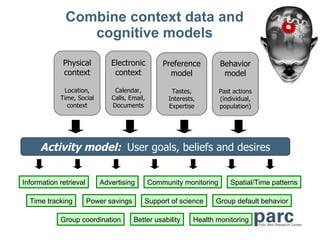
Combine context data and cognitive models Activity model:  User goals, beliefs and desires Physical context Location, Time, Social context Behavior model Past actions (individual, population) Preference model Tastes, Interests, Expertise Electronic context Calendar, Calls, Email, Documents Advertising Community monitoring Information retrieval Spatial/Time patterns Time tracking Power savings Support of science Group default behavior Group coordination Better usability Health monitoring
Recommendation  service Consumer Local area Mobile device Leisure information and suggestions based on Situation Past behavior Personal preferences Trials in Japan, spring 2010  [ Nikkei Trendy Net ] Magitti: Activity-aware leisure guide Context:  Time, location, recent messages, etc.  Restaurants, stores, events, etc. Filter and rank  information items Infer activity Feedback Model preferences
Magitti demo video http://www2. parc . com/csl/groups/ubicomp/videos/magitti_project_demonstration . wmv
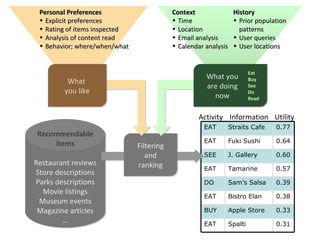
Recommendable items Restaurant reviews Store descriptions Parks descriptions Movie listings Museum events Magazine articles … Filtering and ranking Activity Utility Information What  you like Personal Preferences Explicit preferences Rating of items inspected Analysis of content read Behavior; where/when/what Context Time  Location Email analysis Calendar analysis History Prior population patterns User queries User locations  Eat Buy See Do Read What you are doing now EAT Straits Cafe 0.77 EAT Fuki Sushi 0.64 SEE J. Gallery 0.60 EAT Tamarine 0.57 DO Sam’s Salsa 0.39 EAT Bistro Elan 0.38 BUY Apple Store 0.33 EAT Spalti 0.31
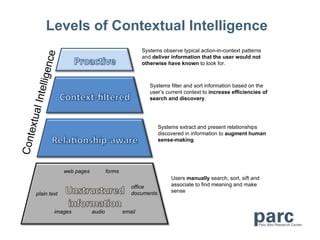
Levels of Contextual Intelligence email web pages plain text images audio forms office documents Systems observe typical action-in-context patterns and  deliver information that the user would not otherwise have known  to look for. Systems extract and present relationships discovered in information to  augment human sense-making . Users  manually  search, sort, sift and associate to find meaning and make sense Systems filter and sort information based on the user’s current context to  increase efficiencies of search and discovery . Contextual Intelligence
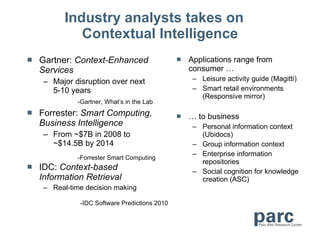
Industry analysts takes on  Contextual Intelligence Gartner:  Context-Enhanced Services Major disruption over next 5-10 years Forrester:  Smart Computing, Business Intelligence From ~$7B in 2008 to ~$14.5B by 2014 IDC:  Context-based Information Retrieval Real-time decision making Applications range from consumer … Leisure activity guide (Magitti) Smart retail environments (Responsive mirror) …  to business Personal information context (Ubidocs) Group information context Enterprise information repositories Social cognition for knowledge creation (ASC) -Forrester Smart Computing -Gartner, What’s in the Lab -IDC Software Predictions 2010
To subscribe to the PARC Innovations Update e-newsletter or blog and other feeds, or to follow us on Twitter, go to   www.parc.com/subscribe For more information, please contact: Bo Begole, Principal Scientist Bo. [email_address] .com Lawrence Lee, Business Development Lawrence. [email_address] .com

Contextual Information

  • 1.
    Contextual Information BoBegole, Ph.D. Ubiquitous Computing Computing Science Laboratory
  • 2.
    confidential Support revolutionarynew context-enabled applications Information and people always linked to each other thru context Information self-organizes for faster retreival New context-enabled applications for vertical markets Better generic applications such as enterprise semantic search Sensed Location Proximity to other devices Inferred from activity Author Task, activity Relation to other documents Relation to people Explicit Social tagging Comments Bookmarks Extracted from content Topic Author Document type People, places, and things Key concepts Project Automatically build context around information & interactions Harness content and context relationships to make knowledge use much easier People Content Tasks Events Places Topics
  • 3.
    Contextual Intelligence Convertingthe ocean of unstructured , human readable information into a Personal Semantic Network would allow you to: See more Discover new information serendipitously Deliver information proactively See less Better filter and sort search results Auto-update business processes See relationships Summarize related items Support multi-tasking email web plain text images audio office documents People Content Tasks Events Places Topics
  • 4.
    Combine context dataand cognitive models Activity model: User goals, beliefs and desires Physical context Location, Time, Social context Behavior model Past actions (individual, population) Preference model Tastes, Interests, Expertise Electronic context Calendar, Calls, Email, Documents Advertising Community monitoring Information retrieval Spatial/Time patterns Time tracking Power savings Support of science Group default behavior Group coordination Better usability Health monitoring
  • 5.
    Recommendation serviceConsumer Local area Mobile device Leisure information and suggestions based on Situation Past behavior Personal preferences Trials in Japan, spring 2010 [ Nikkei Trendy Net ] Magitti: Activity-aware leisure guide Context: Time, location, recent messages, etc. Restaurants, stores, events, etc. Filter and rank information items Infer activity Feedback Model preferences
  • 6.
    Magitti demo videohttp://www2. parc . com/csl/groups/ubicomp/videos/magitti_project_demonstration . wmv
  • 7.
    Recommendable items Restaurantreviews Store descriptions Parks descriptions Movie listings Museum events Magazine articles … Filtering and ranking Activity Utility Information What you like Personal Preferences Explicit preferences Rating of items inspected Analysis of content read Behavior; where/when/what Context Time Location Email analysis Calendar analysis History Prior population patterns User queries User locations Eat Buy See Do Read What you are doing now EAT Straits Cafe 0.77 EAT Fuki Sushi 0.64 SEE J. Gallery 0.60 EAT Tamarine 0.57 DO Sam’s Salsa 0.39 EAT Bistro Elan 0.38 BUY Apple Store 0.33 EAT Spalti 0.31
  • 8.
    Levels of ContextualIntelligence email web pages plain text images audio forms office documents Systems observe typical action-in-context patterns and deliver information that the user would not otherwise have known to look for. Systems extract and present relationships discovered in information to augment human sense-making . Users manually search, sort, sift and associate to find meaning and make sense Systems filter and sort information based on the user’s current context to increase efficiencies of search and discovery . Contextual Intelligence
  • 9.
    Industry analysts takeson Contextual Intelligence Gartner: Context-Enhanced Services Major disruption over next 5-10 years Forrester: Smart Computing, Business Intelligence From ~$7B in 2008 to ~$14.5B by 2014 IDC: Context-based Information Retrieval Real-time decision making Applications range from consumer … Leisure activity guide (Magitti) Smart retail environments (Responsive mirror) … to business Personal information context (Ubidocs) Group information context Enterprise information repositories Social cognition for knowledge creation (ASC) -Forrester Smart Computing -Gartner, What’s in the Lab -IDC Software Predictions 2010
  • 10.
    To subscribe tothe PARC Innovations Update e-newsletter or blog and other feeds, or to follow us on Twitter, go to www.parc.com/subscribe For more information, please contact: Bo Begole, Principal Scientist Bo. [email_address] .com Lawrence Lee, Business Development Lawrence. [email_address] .com

Editor's Notes

  • #5 collect data about people’s every day lives. several data types (e.g., time, location, motion, computer use, cellphone use, object use, people nearby) several data sources (phones, computers, fixed infrastructure (security cameras, polycoms, etc.)) process this data. draw “higher level conclusions” such as place visited, activity performed, project worked on. exploit the data. e.g: help people find stores and restaurants they will like. help advertisers target better. help users coordinate with each other more easily. help epidemiologists understand disease sources. help enterprise workers automatically organize notes. ------------- Behavior -/ activity -aware systems: Just being aware of the situation is not sufficient Applications must behave appropriately in the situation - Models human behavior and activity (whereby “behavior” refers to a person’s actions or reactions, usually in relation to the environment, and can be conscious or unconscious, overt or covert, and voluntary or involuntary; while “activity” is a conscious, voluntary pursuit) - Enable applications that use context-aware data collection, with their primary value centers on the ability to infer, and potentially respond to, present behavior, instead of intent. Examples: - Consumer observation - Health monitoring - Elder care - Interruptibility modeling - In-situ information delivery - Security monitoring - “Contextual” reminders
  • #6 The fieldwork led to this general architectural vision. I’ll show you a more detailed View on the next slide, but I’d like you to understand the high-level picture first. As I mentioned at the start, our goal is to spontaneously provide appropriate recommendations. The system does this by determining both long-term preferences of genres of things that you like, and your immediate situation through Contextual data. From contextual data, the system estimates what activities You are likely to perform, filters and ranks the items in its database and returns To the client a useful list. When the user reviews the list, they may leave feedback, which is later used to Update their preferences. Now to explain how activity is represented, I have to go into a little more detail about The content recommender server
  • #8 Next, we rank each piece of content in the repository according to the likely utility of the content based on a model of the user's personal preferences which is generated from multiple sources: The user's explicitly stated preferences, The ratings they've made of items they've seen and done, The topics of documents and web pages they've looked at, And what the user has done in the past. This generates a utility score for each item which determines the ranking of each item in the interface.