March, 2020
Hunting Riflescopes
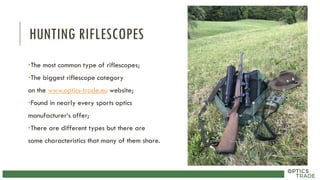
HUNTING RIFLESCOPES
•The most common type of riflescopes;
•The biggest riflescope category
on the www.optics-trade.eu website;
•Found in nearly every sports optics
manufacturer‘s offer;
•There are different types but there are
some characteristics that many of them share.
TUBE DIAMETER
•30 and 25.4 mm – most common
•34 mm – rare (Schmidt & Bender Polar T96)
•36 mm – rare (Zeiss Victory V8, Blaser Infinity)
•40 mm – Swarovski dS only (in 2020)
•Tube diameter does not affect the light transmission rate of a riflescope
MOUNTING SOLUTIONS – RING AND RAIL
MOUNTS
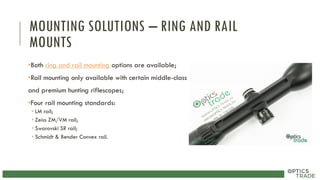
•Both ring and rail mounting options are available;
•Rail mounting only available with certain middle-class
and premium hunting riflescopes;
•Four rail mounting standards:
• LM rail;
• Zeiss ZM/VM rail;
• Swarovski SR rail;
• Schmidt & Bender Convex rail.
TURRETS IN HUNTING RIFLESCOPES
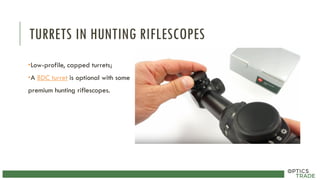
•Low-profile, capped turrets;
•A BDC turret is optional with some
premium hunting riflescopes.
RETICLES IN HUNTING RIFLESCOPES
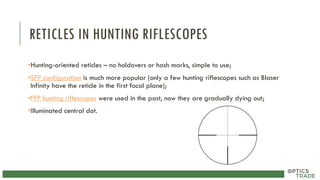
•Hunting-oriented reticles – no holdovers or hash marks, simple to use;
•SFP configuration is much more popular (only a few hunting riflescopes such as Blaser
Infinity have the reticle in the first focal plane);
•FFP hunting riflescopes were used in the past, now they are gradually dying out;
•Illuminated central dot.
MAGNIFICATION IN HUNTING RIFLESCOPES
•Fixed or variable;
•A few decades ago, fixed magnification riflescopes were more popular, now it is the
other way around;
•England, Scotland, South Africa – many hunters from these countries still prefer fixed
magnification riflescopes;
•Entry-level – 4x–6x zoom factor;
•Middle-class, premium – 6x–8x zoom factor.
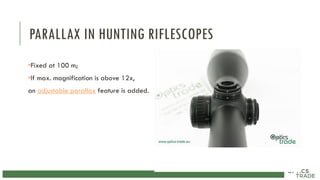
PARALLAX IN HUNTING RIFLESCOPES
•Fixed at 100 m;
•If max. magnification is above 12x,
an adjustable parallax feature is added.
PREMIUM HUNTING RIFLESCOPES
•Zeiss, Swarovski, Leica, Schmidt & Bender, Kahles, Blaser – manufacturers of premium
hunting riflescopes;
•Features of premium hunting riflescopes:
• Illuminated reticle, a finely adjustable central dot is common;
• 6x zoom factor or greater;
• An option of purchasing a BDC turret;
• SFP configuration (Blaser Infinity riflescopes are an exception);
• Exceptional field of view;
• Impressive resolution;
• High light transmission rate;
• Difficult to choose the best – each riflescope has its own strong points.
MIDDLE-CLASS HUNTING RIFLESCOPES
•Most are made in Japan, some in Europe;
•A great price to performance ratio;
•Their popularity has risen considerably in the last few years.
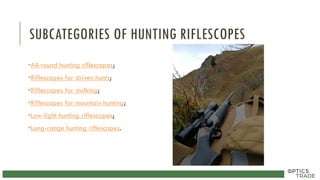
SUBCATEGORIES OF HUNTING RIFLESCOPES
•All-round hunting riflescopes;
•Riflescopes for driven hunts;
•Riflescopes for stalking;
•Riflescopes for mountain hunting;
•Low-light hunting riflescopes;
•Long-range hunting riflescopes.
Short Presentation | Hunting Riflescopes | Optics Trade

Short Presentation | Hunting Riflescopes | Optics Trade

  • 1.
  • 2.
    HUNTING RIFLESCOPES •The mostcommon type of riflescopes; •The biggest riflescope category on the www.optics-trade.eu website; •Found in nearly every sports optics manufacturer‘s offer; •There are different types but there are some characteristics that many of them share.
  • 3.
    TUBE DIAMETER •30 and25.4 mm – most common •34 mm – rare (Schmidt & Bender Polar T96) •36 mm – rare (Zeiss Victory V8, Blaser Infinity) •40 mm – Swarovski dS only (in 2020) •Tube diameter does not affect the light transmission rate of a riflescope
  • 4.
    MOUNTING SOLUTIONS –RING AND RAIL MOUNTS •Both ring and rail mounting options are available; •Rail mounting only available with certain middle-class and premium hunting riflescopes; •Four rail mounting standards: • LM rail; • Zeiss ZM/VM rail; • Swarovski SR rail; • Schmidt & Bender Convex rail.
  • 5.
    TURRETS IN HUNTINGRIFLESCOPES •Low-profile, capped turrets; •A BDC turret is optional with some premium hunting riflescopes.
  • 6.
    RETICLES IN HUNTINGRIFLESCOPES •Hunting-oriented reticles – no holdovers or hash marks, simple to use; •SFP configuration is much more popular (only a few hunting riflescopes such as Blaser Infinity have the reticle in the first focal plane); •FFP hunting riflescopes were used in the past, now they are gradually dying out; •Illuminated central dot.
  • 7.
    MAGNIFICATION IN HUNTINGRIFLESCOPES •Fixed or variable; •A few decades ago, fixed magnification riflescopes were more popular, now it is the other way around; •England, Scotland, South Africa – many hunters from these countries still prefer fixed magnification riflescopes; •Entry-level – 4x–6x zoom factor; •Middle-class, premium – 6x–8x zoom factor.
  • 8.
    PARALLAX IN HUNTINGRIFLESCOPES •Fixed at 100 m; •If max. magnification is above 12x, an adjustable parallax feature is added.
  • 9.
    PREMIUM HUNTING RIFLESCOPES •Zeiss,Swarovski, Leica, Schmidt & Bender, Kahles, Blaser – manufacturers of premium hunting riflescopes; •Features of premium hunting riflescopes: • Illuminated reticle, a finely adjustable central dot is common; • 6x zoom factor or greater; • An option of purchasing a BDC turret; • SFP configuration (Blaser Infinity riflescopes are an exception); • Exceptional field of view; • Impressive resolution; • High light transmission rate; • Difficult to choose the best – each riflescope has its own strong points.
  • 10.
    MIDDLE-CLASS HUNTING RIFLESCOPES •Mostare made in Japan, some in Europe; •A great price to performance ratio; •Their popularity has risen considerably in the last few years.
  • 11.
    SUBCATEGORIES OF HUNTINGRIFLESCOPES •All-round hunting riflescopes; •Riflescopes for driven hunts; •Riflescopes for stalking; •Riflescopes for mountain hunting; •Low-light hunting riflescopes; •Long-range hunting riflescopes.