Parallel Lines and the Angles Formed
Slide 1
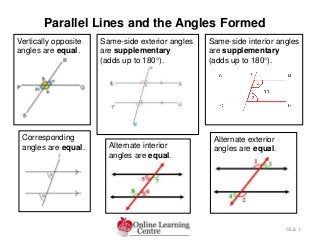
Vertically opposite
angles are equal.
Corresponding
angles are equal.
Same-side interior angles
are supplementary
(adds up to 180).
Alternate interior
angles are equal.
Same-side exterior angles
are supplementary
(adds up to 180).
Alternate exterior
angles are equal.
Slide 2
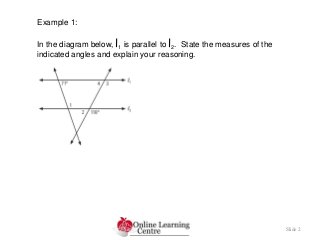
Example 1:
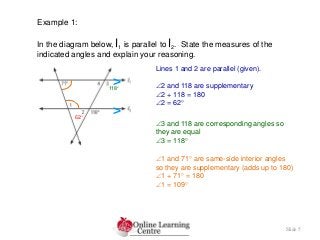
In the diagram below, l1 is parallel to l2. State the measures of the
indicated angles and explain your reasoning.
Slide 3
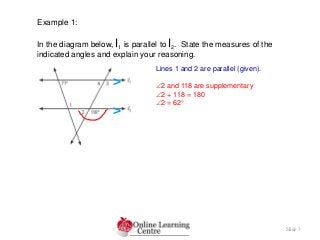
Example 1:
In the diagram below, l1 is parallel to l2. State the measures of the
indicated angles and explain your reasoning.
Lines 1 and 2 are parallel (given).
2 and 118 are supplementary
2 + 118 = 180
2 = 62
>
>
Slide 4
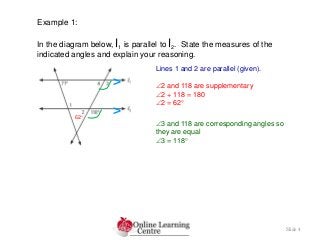
Example 1:
In the diagram below, l1 is parallel to l2. State the measures of the
indicated angles and explain your reasoning.
Lines 1 and 2 are parallel (given).
2 and 118 are supplementary
2 + 118 = 180
2 = 62
3 and 118 are corresponding angles so
they are equal
3 = 118
>
>62
Slide 5
Example 1:
In the diagram below, l1 is parallel to l2. State the measures of the
indicated angles and explain your reasoning.
Lines 1 and 2 are parallel (given).
2 and 118 are supplementary
2 + 118 = 180
2 = 62
3 and 118 are corresponding angles so
they are equal
3 = 118
1 and 71 are same-side interior angles
so they are supplementary (adds up to 180)
1 + 71 = 180
1 = 109
>
>62
118
Slide 6
Example 1:
In the diagram below, l1 is parallel to l2. State the measures of the
indicated angles and explain your reasoning.
Lines 1 and 2 are parallel (given).
2 and 118 are supplementary
2 + 118 = 180
2 = 62
3 and 118 are corresponding angles so
they are equal
3 = 118
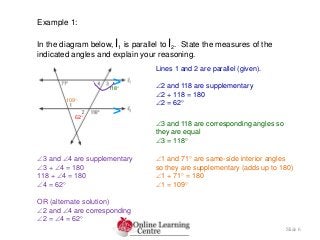
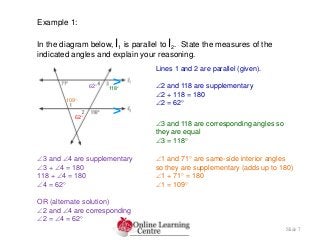
3 and 4 are supplementary
3 + 4 = 180
118 + 4 = 180
4 = 62
OR (alternate solution)
2 and 4 are corresponding
2 = 4 = 62
1 and 71 are same-side interior angles
so they are supplementary (adds up to 180)
1 + 71 = 180
1 = 109
>
>62
118
109
Slide 7
Example 1:
In the diagram below, l1 is parallel to l2. State the measures of the
indicated angles and explain your reasoning.
Lines 1 and 2 are parallel (given).
2 and 118 are supplementary
2 + 118 = 180
2 = 62
3 and 118 are corresponding angles so
they are equal
3 = 118
3 and 4 are supplementary
3 + 4 = 180
118 + 4 = 180
4 = 62
OR (alternate solution)
2 and 4 are corresponding
2 = 4 = 62
1 and 71 are same-side interior angles
so they are supplementary (adds up to 180)
1 + 71 = 180
1 = 109
>
>62
118
109
62
Slide 8
Example 2:
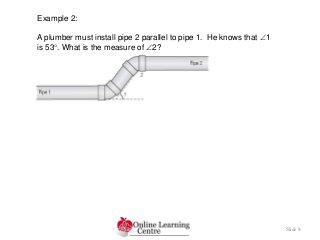
A plumber must install pipe 2 parallel to pipe 1. He knows that 1
is 53. What is the measure of 2?
Slide 9
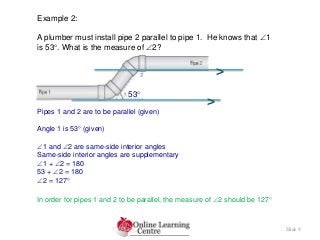
Example 2:
A plumber must install pipe 2 parallel to pipe 1. He knows that 1
is 53. What is the measure of 2?
Pipes 1 and 2 are to be parallel (given)
1 and 2 are same-side interior angles
Same-side interior angles are supplementary
1 + 2 = 180
53 + 2 = 180
2 = 127
Angle 1 is 53 (given)
In order for pipes 1 and 2 to be parallel, the measure of 2 should be 127
>
>
53

MWA 10 5.4 Angles and Parallel Lines

  • 1.
    Parallel Lines andthe Angles Formed Slide 1 Vertically opposite angles are equal. Corresponding angles are equal. Same-side interior angles are supplementary (adds up to 180). Alternate interior angles are equal. Same-side exterior angles are supplementary (adds up to 180). Alternate exterior angles are equal.
  • 2.
    Slide 2 Example 1: Inthe diagram below, l1 is parallel to l2. State the measures of the indicated angles and explain your reasoning.
  • 3.
    Slide 3 Example 1: Inthe diagram below, l1 is parallel to l2. State the measures of the indicated angles and explain your reasoning. Lines 1 and 2 are parallel (given). 2 and 118 are supplementary 2 + 118 = 180 2 = 62 > >
  • 4.
    Slide 4 Example 1: Inthe diagram below, l1 is parallel to l2. State the measures of the indicated angles and explain your reasoning. Lines 1 and 2 are parallel (given). 2 and 118 are supplementary 2 + 118 = 180 2 = 62 3 and 118 are corresponding angles so they are equal 3 = 118 > >62
  • 5.
    Slide 5 Example 1: Inthe diagram below, l1 is parallel to l2. State the measures of the indicated angles and explain your reasoning. Lines 1 and 2 are parallel (given). 2 and 118 are supplementary 2 + 118 = 180 2 = 62 3 and 118 are corresponding angles so they are equal 3 = 118 1 and 71 are same-side interior angles so they are supplementary (adds up to 180) 1 + 71 = 180 1 = 109 > >62 118
  • 6.
    Slide 6 Example 1: Inthe diagram below, l1 is parallel to l2. State the measures of the indicated angles and explain your reasoning. Lines 1 and 2 are parallel (given). 2 and 118 are supplementary 2 + 118 = 180 2 = 62 3 and 118 are corresponding angles so they are equal 3 = 118 3 and 4 are supplementary 3 + 4 = 180 118 + 4 = 180 4 = 62 OR (alternate solution) 2 and 4 are corresponding 2 = 4 = 62 1 and 71 are same-side interior angles so they are supplementary (adds up to 180) 1 + 71 = 180 1 = 109 > >62 118 109
  • 7.
    Slide 7 Example 1: Inthe diagram below, l1 is parallel to l2. State the measures of the indicated angles and explain your reasoning. Lines 1 and 2 are parallel (given). 2 and 118 are supplementary 2 + 118 = 180 2 = 62 3 and 118 are corresponding angles so they are equal 3 = 118 3 and 4 are supplementary 3 + 4 = 180 118 + 4 = 180 4 = 62 OR (alternate solution) 2 and 4 are corresponding 2 = 4 = 62 1 and 71 are same-side interior angles so they are supplementary (adds up to 180) 1 + 71 = 180 1 = 109 > >62 118 109 62
  • 8.
    Slide 8 Example 2: Aplumber must install pipe 2 parallel to pipe 1. He knows that 1 is 53. What is the measure of 2?
  • 9.
    Slide 9 Example 2: Aplumber must install pipe 2 parallel to pipe 1. He knows that 1 is 53. What is the measure of 2? Pipes 1 and 2 are to be parallel (given) 1 and 2 are same-side interior angles Same-side interior angles are supplementary 1 + 2 = 180 53 + 2 = 180 2 = 127 Angle 1 is 53 (given) In order for pipes 1 and 2 to be parallel, the measure of 2 should be 127 > > 53