Presented By: Niveditha H.P
U01HY21E0024
JSS INSTITUTE OF EDUCATION
SAKLESHPUR
Oral language
Oral language some times called spoken language, includes speaking and listening the ways that
humans communicate with one another to express knowledge, ideas, and feelings.
Oral skills in English refers to being able to listen, speak and interact using the English language.
 Oral language skills provides the foundation for word reading and comprehension.
 Oral language is often associated with vocabulary as the main component.
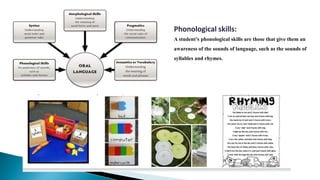
 In broadest definition, oral language consists of six areas: phonological skills, pragmatics, syntax,
morphological skills, and vocabulary(also referred to as semantics).
All of these components of oral language are necessary to communicate and learn through
conversation and spoken interaction;
Phonological skills:
A student’s phonological skills are those that give them an
awareness of the sounds of language, such as the sounds of
syllables and rhymes.
Syntax
Syntax refers to an understanding of word order and grammatical rules.
Morphology
Morphology refers to the smallest meaningful parts from which words are created, including roots, suffixes, and prefixes.
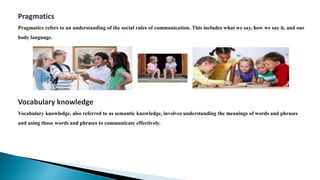
Pragmatics
Pragmatics refers to an understanding of the social rules of communication. This includes what we say, how we say it, and our
body language.
Vocabulary knowledge
Vocabulary knowledge, also referred to as semantic knowledge, involves understanding the meanings of words and phrases
and using those words and phrases to communicate effectively.
Responsive classroom: four key domains
Engaging academics:
 Teachers create learning tasks that are active, interactive, appropriately challenging, purposeful, and connected to
students interests.
Positive community:
 Teachers nurture a sense of belonging, significance, and emotional safety so that students fell comfortable taking risks
and working with a variety of peers.
Effective management:
 Teachers create a calm, orderly environment that promotes autonomy and allows to focus on learning.
Developmental awareness:
 Teachers use knowledge of child development, along with observations of students, to create a developmentally
appropriate learning environment.
oral language (1)-1.pptx

oral language (1)-1.pptx

  • 1.
    Presented By: NivedithaH.P U01HY21E0024 JSS INSTITUTE OF EDUCATION SAKLESHPUR
  • 2.
    Oral language Oral languagesome times called spoken language, includes speaking and listening the ways that humans communicate with one another to express knowledge, ideas, and feelings. Oral skills in English refers to being able to listen, speak and interact using the English language.  Oral language skills provides the foundation for word reading and comprehension.  Oral language is often associated with vocabulary as the main component.  In broadest definition, oral language consists of six areas: phonological skills, pragmatics, syntax, morphological skills, and vocabulary(also referred to as semantics). All of these components of oral language are necessary to communicate and learn through conversation and spoken interaction;
  • 3.
    Phonological skills: A student’sphonological skills are those that give them an awareness of the sounds of language, such as the sounds of syllables and rhymes.
  • 4.
    Syntax Syntax refers toan understanding of word order and grammatical rules. Morphology Morphology refers to the smallest meaningful parts from which words are created, including roots, suffixes, and prefixes.
  • 5.
    Pragmatics Pragmatics refers toan understanding of the social rules of communication. This includes what we say, how we say it, and our body language. Vocabulary knowledge Vocabulary knowledge, also referred to as semantic knowledge, involves understanding the meanings of words and phrases and using those words and phrases to communicate effectively.
  • 6.
    Responsive classroom: fourkey domains Engaging academics:  Teachers create learning tasks that are active, interactive, appropriately challenging, purposeful, and connected to students interests. Positive community:  Teachers nurture a sense of belonging, significance, and emotional safety so that students fell comfortable taking risks and working with a variety of peers. Effective management:  Teachers create a calm, orderly environment that promotes autonomy and allows to focus on learning. Developmental awareness:  Teachers use knowledge of child development, along with observations of students, to create a developmentally appropriate learning environment.