i
NIKO HOLKKO
MECHANISMS OF ARMOUR PENETRATION
Bachelor’s Thesis
Inspector: lecturer Risto Alanko
ABSCTRACT
NIKO HOLKKO: Mechanisms of armour penetration
Tampere University of Technology
Bachelor’s Thesis, 30 pages, 8 appendix pages
March 2015
Bachelor’s Degree Programme in Mechanical Engineering
Major: Machine Construction
Examiner: Risto Alanko
Keywords: armour penetration, armour, armour piercing, piercing
The ability of an armour piercing shell to penetrate armour depends on both the shell’s
and the armour’s geometries and their material properties. At the moment of impact, the
armour is perforated, or penetrated, with one of three perforation mechanisms. The ar-
mour can be damaged even in a failed penetration.
There are several types of shells, all of which have their unique properties and uses. The
impact behaviour differs as well between different types of shells. There are different
types of armours and armoured plates can be used to create multiple configurations that
impact the armour’s ability to resist penetration.
Predictive mathematical models can be created to different shells by using statistical data.
Using these models, the penetration capability of shells can be estimated as a function of
their type, calibre, mass and range of impact.
TABLE OF CONTENTS
1. INTRODUCTION ....................................................................................................1
2. MECHANISMS OF ARMOUR PENETRATION...................................................2
2.1 Shell types ......................................................................................................7
2.2 Armour types..................................................................................................8
3. MATHEMATICAL PREDICTION MODEL ........................................................19
4. SUMMARY............................................................................................................28
BIBLIOGRAPHY...........................................................................................................30
APPENDIX A: BALLISTIC PERFORMANCE INDEX
APPENDIX B: BALLISTIC PERFORMANCE MAPS
APPENDIX C: CONSTANTS OF THE SLOPE COEFFICIENT
APPENDIX D: PROPERTY TABLE OF AP-SHELLS
APPENDIX E: PROPERTY TABLES OF APC- AND APBC-SHELLS
APPENDIX F: PROPERTY TABLE OF APCBC-SHELLS
APPENDIX G: PROPERTY TABLE OF APCR-SHELLS
APPENDIX H: ARMOUR PIERCING SHELL TYPES
TABLE OF FIGURES
Kuva 1. Schematics of armour penetration. ................................................................2
Kuva 2. Nose shapes, conical and ogive. ....................................................................3
Kuva 3. Fracture mechanisms.....................................................................................4
Kuva 4. Spalling (Rosenberg & Dekel, 2012 s. 40).....................................................5
Kuva 5. Penetrating sloped armour.............................................................................9
Kuva 6. Slope coefficient as a function of the angle of impact when K = 1.3 and
0.4.................................................................................................................10
Kuva 7. Slope coefficients for 76 mm and 90 mm APCR-shells as a function of
the angle if impact........................................................................................11
Kuva 8. Values for the BHN-coefficient as a function of caliber thickness for
different calibers, when the hardness value of the plate is 460 BHN. .........12
Kuva 9. Spaced Armour.............................................................................................14
Kuva 10. Single plates equivalent to spaced armour in different impact cases. .........16
Kuva 11. Comparison of layered and spaced armour.................................................18
Kuva 12. Penetration of an AP-shell as a function of the kinetic energy
coefficient. ....................................................................................................20
Kuva 13. Relational penetration of British AP-shells of different velocities as a
function of distance. .....................................................................................21
Kuva 14. Change in relational penetration with different calibers and masses. ........21
Kuva 15. Penetration and relational penetration for different shells types as a
function of distance. .....................................................................................25
ABBREVIATIONS AND NOTATIONS
AP Armour Piercing
APBC Armour Piercing Ballistic Capped
APC Armour Piercing Capped
APCBC Armour Piercing Capped Ballistic Capped
APCR Armour Piercing Composite Rigid
APHE Armour Piercing High Explosive
BHN Brinell Hardness Number
BPI Ballistic Performance Index
CHA Cast Homogeneous Armour
CRH Caliber-radius-heads
HEAT High Explosive Anti Tank
HVAP High Velocity Armour Piercing
RHA Rolled Homogeneous Armour
FHA Face-Hardened Armour
A shell and armour constant
BC ballistic coefficient
D diameter
E elastic modulus/Young’s modulus
KE kinetic energy
F force
H strain hardening rate
h thickness of molten layer
I ratio of mass and the cube of the diameter
i shape coefficient
K caliber thickness
L length of shell
L length of the nose of the shell
m mass
P penetration capability
R hardness
r distance
S sharpness
s radius
Tm melting temperature
t thickness
v velocity
vbl ballistic limit velocity
εr strain fracture
φ angle of oblique
ρ density
σm ultimate tensile strength
σr penetration strength
σspall spall strength
σε yield strength
µ coefficient of friction
γ Poisson’s constant
1
1. INTRODUCTION
The term armour penetration is usually used to refer to the perforation of armoured plates
with varying ammunition in warfare. The goal of armour penetration is to destroy a target
protected by armoured plates, such a vehicle or its crew. Armour penetration has been a
phenomenon of interest of both civil and military engineers for nearly two hundred years.
The study of armour penetration first became important during the naval battles of the
19th century and at the advent of steel-protected war ships. As the first tanks appeared
during World War I, the science of armour penetration moved to study land targets as
well.
The first ammunition that was used against tanks and other armoured vehicles were made
of solid steel and shaped similar to bullets. Their penetration capability was based on their
kinetic energy. The shells were called armour piercing shells, or AP-shells. During the
2nd
World War AP-shells were improved in multiple ways as the thickness of armoured
plates grew. In addition, the solid steel shots were designed to include parts made of other
materials than steel, such as tungsten. In the end, the traditional shells were replaced by
modern dart-shaped ammunition that were made completely out of heavy materials, such
as the aforementioned tungsten or depleted uranium. During World War II, other types of
shells appeared as well, such as chemical energy penetrators. These include shells such
as high explosive anti-tank shells (HEAT). HEAT-shells penetrate armour by firing a jet
of metal towards an armoured plate. The metal then penetrates through the armour
through its kinetic energy. In modern warfare, HEAT and dart-shaped ammunition are
the most commonly used ammunition types.
Armour piercing projectiles are fired out of a cannon. The projectile as a whole is com-
prised of an armour piercing shot and shell. The shot is the penetrating part and the shell
includes the primer and propellant. In general, the word shell can be used to refer to the
armour piercing part of to the whole combination. In this text, the word shell is used to
refer to the armour piercing projectile, or shot. The word projectile is also used.
This thesis focuses on the traditional kinetic AP-shells and the mechanisms of the event
of penetration. This work also studies how different ammunition and armour types affect
penetration. A mathematical model based on statistics is also derived. This model can be
used to predict the behaviour of different types of armour piercing shells.
2
2. MECHANISMS OF ARMOUR PENETRATION
The penetration capability of a kinetic penetrator is based on its kinetic energy. The en-
ergy is maximised through the mass and velocity of the projectile. For this reason, the
projectiles are usually made out of heavy materials.
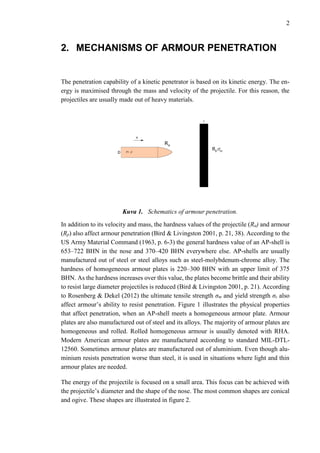
Kuva 1. Schematics of armour penetration.
In addition to its velocity and mass, the hardness values of the projectile (Ra) and armour
(Rp) also affect armour penetration (Bird & Livingston 2001, p. 21, 38). According to the
US Army Material Command (1963, p. 6-3) the general hardness value of an AP-shell is
653–722 BHN in the nose and 370–420 BHN everywhere else. AP-shells are usually
manufactured out of steel or steel alloys such as steel-molybdenum-chrome alloy. The
hardness of homogeneous armour plates is 220–300 BHN with an upper limit of 375
BHN. As the hardness increases over this value, the plates become brittle and their ability
to resist large diameter projectiles is reduced (Bird & Livingston 2001, p. 21). According
to Rosenberg & Dekel (2012) the ultimate tensile strength σm and yield strength σε also
affect armour’s ability to resist penetration. Figure 1 illustrates the physical properties
that affect penetration, when an AP-shell meets a homogeneous armour plate. Armour
plates are also manufactured out of steel and its alloys. The majority of armour plates are
homogeneous and rolled. Rolled homogeneous armour is usually denoted with RHA.
Modern American armour plates are manufactured according to standard MIL-DTL-
12560. Sometimes armour plates are manufactured out of aluminium. Even though alu-
minium resists penetration worse than steel, it is used in situations where light and thin
armour plates are needed.
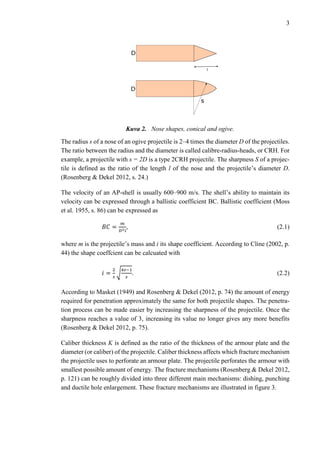
The energy of the projectile is focused on a small area. This focus can be achieved with
the projectile’s diameter and the shape of the nose. The most common shapes are conical
and ogive. These shapes are illustrated in figure 2.
3
Kuva 2. Nose shapes, conical and ogive.
The radius s of a nose of an ogive projectile is 2–4 times the diameter D of the projectiles.
The ratio between the radius and the diameter is called calibre-radius-heads, or CRH. For
example, a projectile with s = 2D is a type 2CRH projectile. The sharpness S of a projec-
tile is defined as the ratio of the length l of the nose and the projectile’s diameter D.
(Rosenberg & Dekel 2012, s. 24.)
The velocity of an AP-shell is usually 600–900 m/s. The shell’s ability to maintain its
velocity can be expressed through a ballistic coefficient BC. Ballistic coefficient (Moss
et al. 1955, s. 86) can be expressed as
𝐵𝐶 =
𝑚
𝐷2 𝑖
, (2.1)
where m is the projectile’s mass and i its shape coefficient. According to Cline (2002, p.
44) the shape coeffcient can be calcuated with
𝑖 =
2
𝑠
√
4𝑠−1
𝑠
. (2.2)
According to Masket (1949) and Rosenberg & Dekel (2012, p. 74) the amount of energy
required for penetration approximately the same for both projectile shapes. The penetra-
tion process can be made easier by increasing the sharpness of the projectile. Once the
sharpness reaches a value of 3, increasing its value no longer gives any more benefits
(Rosenberg & Dekel 2012, p. 75).
Caliber thickness K is defined as the ratio of the thickness of the armour plate and the
diameter (or caliber) of the projectile. Caliber thickness affects which fracture mechanism
the projectile uses to perforate an armour plate. The projectile perforates the armour with
smallest possible amount of energy. The fracture mechanisms (Rosenberg & Dekel 2012,
p. 121) can be roughly divided into three different main mechanisms: dishing, punching
and ductile hole enlargement. These fracture mechanisms are illustrated in figure 3.
4
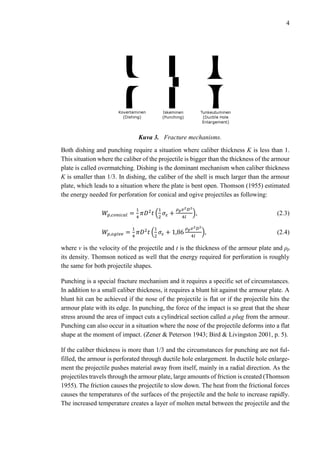
Kuva 3. Fracture mechanisms.
Both dishing and punching require a situation where caliber thickness K is less than 1.
This situation where the caliber of the projectile is bigger than the thickness of the armour
plate is called overmatching. Dishing is the dominant mechanism when caliber thickness
K is smaller than 1/3. In dishing, the caliber of the shell is much larger than the armour
plate, which leads to a situation where the plate is bent open. Thomson (1955) estimated
the energy needed for perforation for conical and ogive projectiles as following:
𝑊𝑝,𝑐𝑜𝑛𝑖𝑐𝑎𝑙 =
1
4
𝜋𝐷2
𝑡 (
1
2
𝜎𝜀 +
𝜌 𝑝 𝑣2 𝐷2
4𝑙
), (2.3)
𝑊𝑝,𝑜𝑔𝑖𝑣𝑒 =
1
4
𝜋𝐷2
𝑡 (
1
2
𝜎𝜀 + 1,86
𝜌 𝑝 𝑣2 𝐷2
4𝑙
), (2.4)
where v is the velocity of the projectile and t is the thickness of the armour plate and ρp
its density. Thomson noticed as well that the energy required for perforation is roughly
the same for both projectile shapes.
Punching is a special fracture mechanism and it requires a specific set of circumstances.
In addition to a small caliber thickness, it requires a blunt hit against the armour plate. A
blunt hit can be achieved if the nose of the projectile is flat or if the projectile hits the
armour plate with its edge. In punching, the force of the impact is so great that the shear
stress around the area of impact cuts a cylindrical section called a plug from the armour.
Punching can also occur in a situation where the nose of the projectile deforms into a flat
shape at the moment of impact. (Zener & Peterson 1943; Bird & Livingston 2001, p. 5).
If the caliber thickness is more than 1/3 and the circumstances for punching are not ful-
filled, the armour is perforated through ductile hole enlargement. In ductile hole enlarge-
ment the projectile pushes material away from itself, mainly in a radial direction. As the
projectiles travels through the armour plate, large amounts of friction is created (Thomson
1955). The friction causes the projectile to slow down. The heat from the frictional forces
causes the temperatures of the surfaces of the projectile and the hole to increase rapidly.
The increased temperature creates a layer of molten metal between the projectile and the
5
hole. This molten metal acts as a lubricant which then reduces the friction. Both Zener &
Peterson (1943) and Rosenberg & Dekel (2012, p. 96) note that friction uses only a small
amount of the total kinetic energy of the projectile. The majority of the energy is used to
deform the armour plate and the projectile. According to Thomson (1955), the amount of
energy required to create the molten layer of metal during perforation is
𝑊𝑞 = 2𝜋𝜇𝑡𝑣 (
𝜎 𝜀 𝐷𝑙
16𝑣
+
3𝜌 𝑝 𝐷3 𝑣
64𝑙
), (2.5)
where µ is the coefficient of friction, which is roughly 0.02. Thomson also estimated that
the thickness h of the molten layer can be expressed with the equation
3
8
𝜋𝐷2
ℎ =
𝑊𝑞
285𝑇 𝑚
, (2.6)
where Tm is the required change in temperature to melt the material of the armour.
In a situation where the projectile does not penetrate the armour, it shatters against the
surface or bounces away. A failed penetration usually leaves a pit or a dent on the surface
of the armour plate and in some cases it can cause the inside layer of the armour plate to
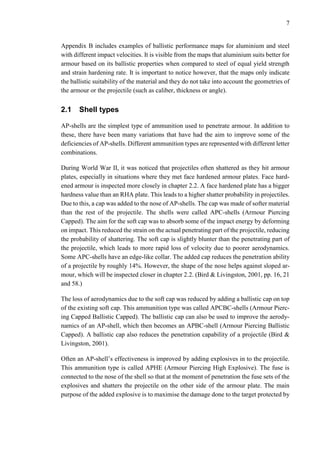
spall. During impact, the pressure waves reflect from the back of the armour plate, which
causes tension on its surface. This tension can cause cleaving, chipping and fracturing,
which are often referred to as spalling. (Rosenberg & Dekel 2012, s. 39–42.)
Kuva 4. Spalling (Rosenberg & Dekel, 2012 s. 40).
The spalling of an aluminous plate caused by a glass ball can be seen in figure 5. Accord-
ing to Rosenberg & Dekel (2012, pp. 39–42) the spall strength of a material can be esti-
mated with
𝜎𝑠𝑝𝑎𝑙𝑙 =
2𝜎 𝜀
3
[2 + ln (
𝐸
3(1−𝛾)𝜎 𝜀
)], (2.7)
where γ is the Poisson’s constant of the material and E its Young’s modulus. The formula
gives values close to real life empirical values according to Rosenberg & Dekel.
6
The ability of a material to resist penetration can be estimated through multiple ways. The
most common way is with the ballistic limit velocity. Ballistic limit velocity is the veloc-
ity of a projectile that it needs to penetrate an armour plate of certain thickness. In order
to define the ballistic limit velocity, the material parameters of both the projectile and
armour are needed. According to Rosenberg & Dekel (2012, pp. 117–120) ballistic limit
velocity can be calculated with
𝑣 𝑏𝑙 = √
2𝑡𝜎 𝑟
𝜌 𝑝 𝐿
, (2.8)
where L is the length of the projectile and σr is penetration strength. Penetration strength
characterises the armour’s ability to resist penetration. Penetration strength is dependent
on caliber thickness and it can be divided in to three different forms:
𝜎𝑟 =
{
(
2
3
+ 4𝐾) 𝜎𝜀 , 𝐾 ≤
1
3
2𝜎𝜀 ,
1
3
< 𝐾 ≤ 1
(2 + 0,8 ln 𝐾)𝜎𝜀 , 𝐾 > 1
. (2.9)
Rosenberg & Dekel (2012, s. 120) note, that the values for ballistic limit velocity calcu-
lated through the formula 2.8 differ from real life empirical values by ±2.5 %.
The suitability of a material as an armouring material can be measured by the ballistic
performance index BPI created by Srivathsa and Ramakrishnan (1997). BPI is a dimen-
sionless number and it can be used to compare different materials and different impact
velocities. BPI can be calculated with
Φ = [
𝛼 𝐼
2(1+𝑘 𝑏)2
+ 𝛼𝐼𝐼
(1+𝑘 𝑒)2 𝑘 𝛾
2
2𝑘 𝑗
2 +
1
𝑘 𝑗
(1 +
1
𝑘 𝑝
) +
1
2𝑘 𝑝
2 +
1
2
(1 +
1
𝑘 𝑝
)
2
]. (2.10)
In the equation the first two terms describe the material’s elastic behaviour, the next two
its plastic behaviour and the last term includes the kinetic energy. Explaining the param-
eters ki is not necessary for this work and equation 2.10 is defined more in-depth in ap-
pendix A. However, the index is dependent on the mechanical properties of the material
and the impact velocity, so the index can be defined as a function in the form of
Φ = Φ(𝐸, 𝜌, 𝜎𝜀, 𝜎 𝑚, 𝜀 𝑟, 𝑣), (2.11)
where εr is fracture strain. Based on the BPI, Srivathsa & Ramakrishnan (1999) created
ballistic performance maps. The maps were created as a function of yield strength and
strain hardening rate. The strain hardening rate for a material can be derived from its other
material values and it can calculated with the following equation:
𝐻 =
𝜎 𝑚(1+𝜀 𝑟)−𝜎 𝜀
𝜀 𝑟
. (2.12)
7
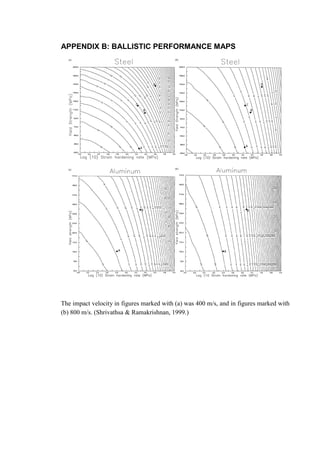
Appendix B includes examples of ballistic performance maps for aluminium and steel
with different impact velocities. It is visible from the maps that aluminium suits better for
armour based on its ballistic properties when compared to steel of equal yield strength
and strain hardening rate. It is important to notice however, that the maps only indicate
the ballistic suitability of the material and they do not take into account the geometries of
the armour or the projectile (such as caliber, thickness or angle).
2.1 Shell types
AP-shells are the simplest type of ammunition used to penetrate armour. In addition to
these, there have been many variations that have had the aim to improve some of the
deficiencies of AP-shells. Different ammunition types are represented with different letter
combinations.
During World War II, it was noticed that projectiles often shattered as they hit armour
plates, especially in situations where they met face hardened armour plates. Face hard-
ened armour is inspected more closely in chapter 2.2. A face hardened plate has a bigger
hardness value than an RHA plate. This leads to a higher shatter probability in projectiles.
Due to this, a cap was added to the nose of AP-shells. The cap was made of softer material
than the rest of the projectile. The shells were called APC-shells (Armour Piercing
Capped). The aim for the soft cap was to absorb some of the impact energy by deforming
on impact. This reduced the strain on the actual penetrating part of the projectile, reducing
the probability of shattering. The soft cap is slightly blunter than the penetrating part of
the projectile, which leads to more rapid loss of velocity due to poorer aerodynamics.
Some APC-shells have an edge-like collar. The added cap reduces the penetration ability
of a projectile by roughly 14%. However, the shape of the nose helps against sloped ar-
mour, which will be inspected closer in chapter 2.2. (Bird & Livingston, 2001, pp. 16, 21
and 58.)
The loss of aerodynamics due to the soft cap was reduced by adding a ballistic cap on top
of the existing soft cap. This ammunition type was called APCBC-shells (Armour Pierc-
ing Capped Ballistic Capped). The ballistic cap can also be used to improve the aerody-
namics of an AP-shell, which then becomes an APBC-shell (Armour Piercing Ballistic
Capped). A ballistic cap also reduces the penetration capability of a projectile (Bird &
Livingston, 2001).
Often an AP-shell’s effectiveness is improved by adding explosives in to the projectile.
This ammunition type is called APHE (Armour Piercing High Explosive). The fuse is
connected to the nose of the shell so that at the moment of penetration the fuse sets of the
explosives and shatters the projectile on the other side of the armour plate. The main
purpose of the added explosive is to maximise the damage done to the target protected by
8
the armour plate, such as a vehicle or its crew. According to the US Army Material Com-
mand (1963, p. 6-4) the maximum proportional volume of the high explosive part is 5 %
of the total volume of the projectile. Increasing the size of the explosive filler further
weakens the structure of the projectile too much, causing it to shatter more easily. Bird &
Livingston (2001, p. 58) estimated that an explosive filler reduces the penetration capa-
bility of a projectile by 13 %. The explosive filler can also be added to APCBC-, APBC-
and APC-shells.
As armour grew thicker during World War II, the need for better AP-shells increased.
The increase in the penetration capability of traditional AP-shells could not be achieved
by increasing their velocity, as steel had the tendency to shatter at large velocities (a so
called shatter velocity). The problem was solved by adding a heavy metal core into AP-
shells. The high hardness and strength of the core allowed bigger impact velocities. In
addition, the stronger material offered a better penetration capability even at normal ve-
locities. The shells were called APCR-shells (Armour Piercing Composite Rigid). The
core of the APCR-shells is usually manufactured out of tungsten carbide. The hardness
value of APCR-shells is usually 760–800 BHN (Engineering Design Handbook - Ele-
ments of Terminal Ballistics, 1963, pp. 6-7–6-8). The velocity of APCR-shells is roughly
1200 m/s but their poor ballistic properties mean that they lose their velocity faster than
traditional AP-shells. APCR-shells are often shorter than their AP counterparts, resulting
in less mass. In American literature APCR-shells are often referred to as HVAP (High
Velocity Armour Piercing).
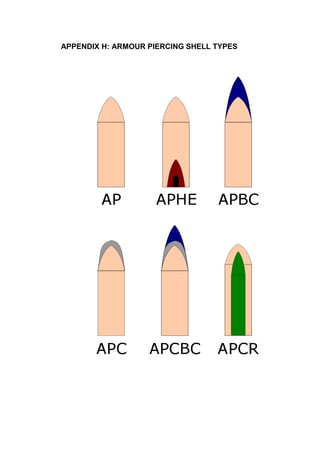
The most common shell types are illustrated in appendix H. Brown color denotes the base
of the shell, blue is the ballistic cap, grey the soft cap and green the heavy metal core. The
explosive filler is marked with red and the fuse with black.
2.2 Armour types
In chapter 2, the impact against a homogeneous vertical plate was discussed. By changing
the parameters of the armour plate, its ability to resist penetration can be improved, or in
some cases, worsened.
The most common way of improving penetration resistance is by changing the angle of
the armour plate, or sloping the armour. The slope causes the effective thickness of the
armour plate to increase so that the projectile has to travel a longer distance. An impact
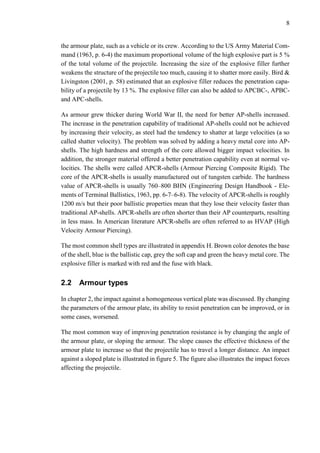
against a sloped plate is illustrated in figure 5. The figure also illustrates the impact forces
affecting the projectile.
9
Kuva 5. Penetrating sloped armour.
The forces F1 and F2 that resist penetration create an asymmetrical pressure field against
the projectile. This asymmetry causes the projectile to be tilted away from the armour
plate. This causes the effective thickness of the plate to be more than just the geometrical
thickness. In the case of an APC-shell, the force F1 is smaller than force F2 due to the
blunt nose. This causes the shell to tilt slightly towards the normal which leads to a smaller
sloping effect than with AP-shells (Bird & Livingston, 2001, p. 16). The same effect can
be achieved even if the nose of the APC-shells isn’t blunt. At the moment of impact, the
softer metal spreads against the surface of the plate and “sticks” to it. According to Zener
& Peterson (1943) the projectile also tilts towards the normal when the penetration mech-
anism is punching. The creation of the plug reduces the force F1 which then creates a
pressure field that pushes the nose of the projectile downwards.
The angle of oblique φ is defined as the angle between the movement vector of the pro-
jectile and the normal of the armour plate. The effective thickness of the plate according
to its geometry would be
𝑡 𝑒𝑓𝑓 =
𝑡
cos 𝜑
. (2.2.1)
Like mentioned earlier, the effective thickness is in reality more than just the trigonomet-
rical result. Bird & Livingston (2001, p. 118) defined a slope coefficient that can be used
to calculate the true thickness of the armour plate. The slope coefficient can be calculated
with the equation
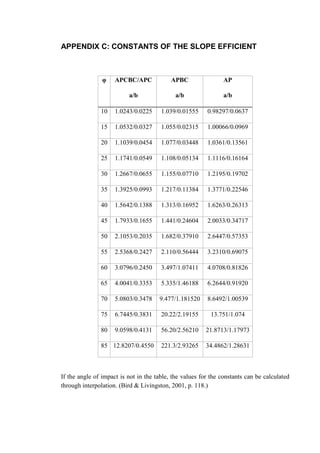
𝑠𝑙𝑜𝑝𝑒 𝑐𝑜𝑒𝑓𝑓𝑖𝑐𝑖𝑒𝑛𝑡 = 𝑎𝐾 𝑏
, (2.2.2)
where a and b are empirical constants that depend both on the angle of oblique and the
type of the shells. Values for the constants can be found in the table of appendix C. The
true thickness of the armour can be calculated by multiplying the nominal thickness of
10
the armour with the coefficient. For example, let’s look at a situation where a 76 mm AP-
projectile impacts a 100 mm thick armour plate at an angle of 30°. This gives us a slope
coefficient of roughly 1.29 (K ≈ 1.316, a = 1.2195 and b = 0.19702). In this case, a 100
mm thick plate at an angle of 30° is equal to 129 mm vertical plate. By calculating with
just trigonometry, the effective thickness would be about 115 mm. The 30° angle of im-
pact increases the thickness of the armour plate by 14 % against the chosen AP-shell when
compared to the trigonometrical effective thickness.
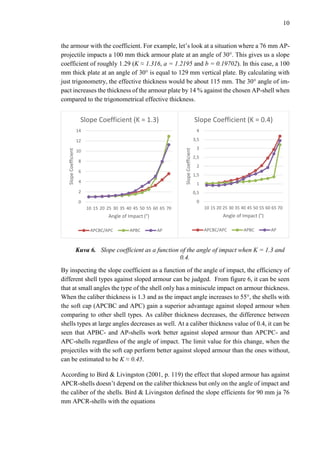
Kuva 6. Slope coefficient as a function of the angle of impact when K = 1.3 and
0.4.
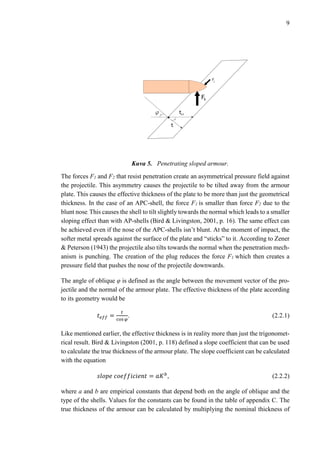
By inspecting the slope coefficient as a function of the angle of impact, the efficiency of
different shell types against sloped armour can be judged. From figure 6, it can be seen
that at small angles the type of the shell only has a miniscule impact on armour thickness.
When the caliber thickness is 1.3 and as the impact angle increases to 55°, the shells with
the soft cap (APCBC and APC) gain a superior advantage against sloped armour when
comparing to other shell types. As caliber thickness decreases, the difference between
shells types at large angles decreases as well. At a caliber thickness value of 0.4, it can be
seen that APBC- and AP-shells work better against sloped armour than APCPC- and
APC-shells regardless of the angle of impact. The limit value for this change, when the
projectiles with the soft cap perform better against sloped armour than the ones without,
can be estimated to be K ≈ 0.45.
According to Bird & Livingston (2001, p. 119) the effect that sloped armour has against
APCR-shells doesn’t depend on the caliber thickness but only on the angle of impact and
the caliber of the shells. Bird & Livingston defined the slope efficients for 90 mm ja 76
mm APCR-shells with the equations
0
2
4
6
8
10
12
14
10 15 20 25 30 35 40 45 50 55 60 65 70
SlopeCoefficient
Angle of Impact (°)
Slope Coefficient (K = 1.3)
APCBC/APC APBC AP
0
0,5
1
1,5
2
2,5
3
3,5
4
10 15 20 25 30 35 40 45 50 55 60 65 70
SlopeCoefficient
Angle of Impact (°)
Slope Coefficient (K = 0.4)
APCBC/APC APBC AP
11
𝑠𝑙𝑜𝑝𝑒 𝑐𝑜𝑒𝑓𝑓𝑖𝑐𝑖𝑒𝑛𝑡90 = {
2,71828(𝜑1,75∗0,000662)
, 𝑤ℎ𝑒𝑛 0° < 𝜑 ≤ 30°
0,9043 ∗ 2,71828(𝜑2,2∗0,001987)
, 𝑤ℎ𝑒𝑛 𝜑 > 30°
(2.2.3)
𝑠𝑙𝑜𝑝𝑒 𝑐𝑜𝑒𝑓𝑓𝑖𝑐𝑖𝑒𝑛𝑡76 = {
2,71828(𝜑2,2∗0,0001727)
, 𝑤ℎ𝑒𝑛 0° < 𝜑 ≤ 25°
0,7277 ∗ 2,71828(𝜑1,5∗0,003787)
, 𝑤ℎ𝑒𝑛 𝜑 > 25°
.(2.2.4)
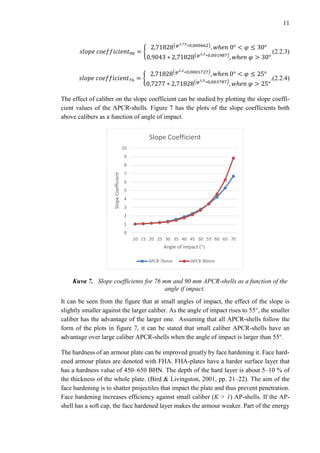
The effect of caliber on the slope coefficient can be studied by plotting the slope coeffi-
cient values of the APCR-shells. Figure 7 has the plots of the slope coefficients both
above calibers as a function of angle of impact.
Kuva 7. Slope coefficients for 76 mm and 90 mm APCR-shells as a function of the
angle if impact.
It can be seen from the figure that at small angles of impact, the effect of the slope is
slightly smaller against the larger caliber. As the angle of impact rises to 55°, the smaller
caliber has the advantage of the larger one. Assuming that all APCR-shells follow the
form of the plots in figure 7, it can be stated that small caliber APCR-shells have an
advantage over large caliber APCR-shells when the angle of impact is larger than 55°.
The hardness of an armour plate can be improved greatly by face hardening it. Face hard-
ened armour plates are denoted with FHA. FHA-plates have a harder surface layer that
has a hardness value of 450–650 BHN. The depth of the hard layer is about 5–10 % of
the thickness of the whole plate. (Bird & Livingston, 2001, pp. 21–22). The aim of the
face hardening is to shatter projectiles that impact the plate and thus prevent penetration.
Face hardening increases efficiency against small caliber (K > 1) AP-shells. If the AP-
shell has a soft cap, the face hardened layer makes the armour weaker. Part of the energy
0
1
2
3
4
5
6
7
8
9
10
10 15 20 25 30 35 40 45 50 55 60 65 70
SlopeCoefficient
Angle of Impact (°)
Slope Coefficient
APCR 76mm APCR 90mm
12
is absorbed by the soft cap which prevents the projectile from shattering. The armour
plate however can’t absorb large amounts of energy due to the surface layer of increased
hardness which leads to brittle behaviour of the armour plate. According to Bird & Liv-
ingston (2001, p. 24) the effect of face hardening on an armour plate can be estimated
with the equation
𝐵𝐻𝑁 − 𝑐𝑜𝑒𝑓𝑓𝑖𝑐𝑖𝑒𝑛𝑡 = 0,01 ∗ 977,07 ∗ 𝐷0,06111
∗ 𝐾0,2821
∗ 𝐵𝐻𝑁−0,4363
, (2.2.5)
where BHN is the Brinell hardness of the armour plate and D is the diameter of the shells
in millimetres. By multiplying the thickness of the FHA-plate with the BHN-coefficient,
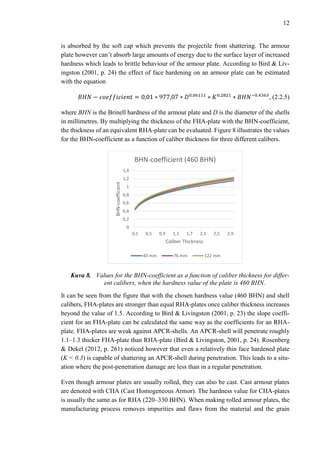
the thickness of an equivalent RHA-plate can be evaluated. Figure 8 illustrates the values
for the BHN-coefficient as a function of caliber thickness for three different calibers.
Kuva 8. Values for the BHN-coefficient as a function of caliber thickness for differ-
ent calibers, when the hardness value of the plate is 460 BHN.
It can be seen from the figure that with the chosen hardness value (460 BHN) and shell
calibers, FHA-plates are stronger than equal RHA-plates once caliber thickness increases
beyond the value of 1.5. According to Bird & Livingston (2001, p. 23) the slope coeffi-
cient for an FHA-plate can be calculated the same way as the coefficients for an RHA-
plate. FHA-plates are weak against APCR-shells. An APCR-shell will penetrate roughly
1.1–1.3 thicker FHA-plate than RHA-plate (Bird & Livingston, 2001, p. 24). Rosenberg
& Dekel (2012, p. 261) noticed however that even a relatively thin face hardened plate
(K < 0.3) is capable of shattering an APCR-shell during penetration. This leads to a situ-
ation where the post-penetration damage are less than in a regular penetration.
Even though armour plates are usually rolled, they can also be cast. Cast armour plates
are denoted with CHA (Cast Homogeneous Armor). The hardness value for CHA-plates
is usually the same as for RHA (220–330 BHN). When making rolled armour plates, the
manufacturing process removes impurities and flaws from the material and the grain
0
0,2
0,4
0,6
0,8
1
1,2
1,4
0,1 0,5 0,9 1,3 1,7 2,1 2,5 2,9
BHN-coefficient
Caliber Thickness
BHN-coefficient (460 BHN)
40 mm 76 mm 122 mm
13
structure of the material is made stronger. If the plates are manufactured through casting,
this doesn’t happen which leads to cast plates being weaker than rolled ones. As a general
rule, cast armour is roughly 15 % weaker than rolled armour. When caliber thickness is
extremely big (K > 2.5), the differences between cast and rolled armour are minimal. Bird
& Livingston (2001, p. 26) created an equation to estimate the effect of casting. The equa-
tion is in the form of
𝑐𝑎𝑠𝑡 𝑐𝑜𝑒𝑓𝑓𝑐𝑖𝑒𝑛𝑡 = 0,8063 + 0,001238𝑡 − 0,0002628𝐷 + 0,02706𝐾, (2.2.6)
where t and D are the thickness of the armour plate and the diameter of the shell in milli-
metres. The maximum value for the cast coefficient is 1, which means that cast armour is
never stronger than rolled armour. The cast coefficient is used like the BHN- or sloped
coefficient. The sloped coefficients for cast armour is the same as for rolled armour.
The ability for armour to resist penetration also depends on its quality. During production,
several flaws can form in the armour plates. These flaws include impurities, cracks and
flaws in the grain structure of the material. The effect of a flaw is directly proportional to
the caliber thickness. As caliber thickness decreases, the effect of the flaw increases (Bird
& Livingston, 2001, pp. 28–29). Any damage inflicted on the armour also decreases its
ability to resist penetration. Usually the damage is caused by projectiles that haven’t pen-
etrated the armour. The non-penetrating hits often create cracks on the armour’s surface.
In addition to this, they enlarge the existing cracks of the armour through fatigue.
By having two armour plates separate from each other, spaced armour is created. Usually,
spaced armour is used to protect from shaped charges (HEAT) but they can also bring
protection against traditional armour piercing shells if certain conditions are met. Figure
9 illustrates the principle of spaced armour.
14
Kuva 9. Spaced Armour..
According to Bird & Livingston (2001, p. 36) a single plate that is equivalent to a certain
spaced armour combination can be calculated with Okun’s equation
𝑡 𝑒𝑓𝑓 = [(1,15𝑡1)1,4
+ 𝐴1,4
𝑡2
1,4
]
1
1,4
, (2.2.6)
where t1 and t2 are the thickness of the primary and secondary plates and A is a constant
that is dependent on the type of shell and armour. A is 1 if the shell type is APC, APBC
or APCBC. If the shell is an AP-shell, A is 1.05. If the primary plate is face hardened and
the secondary plate is homogeneous, A is 1.10. By looking at the equation, it can be seen
that regardless of the value of A, the primary plate has a larger impact on the effective
thickness of the plate. If the impacts against the primary and secondary plates are not
perpendicular, the thickness of the single plate can be estimated with the slope coeffi-
cients of equation 2.2.2. Once the angle have been taken into account, the effective thick-
ness can be calculated with equation 2.2.6.
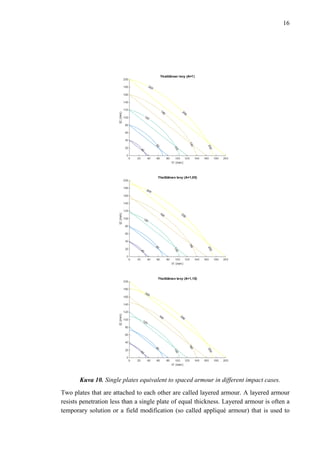
Figure 10 illustrates the contour curves of equation 2.2.6 as a function of plate thicknesses
in all three cases. The figure also includes the contours of the unified thickness of the
plates (𝑡1 + 𝑡2). It can be seen from the figure that spaced armour is slightly better than a
single plate if the primary plate is noticeably thicker than the secondary plate. For exam-
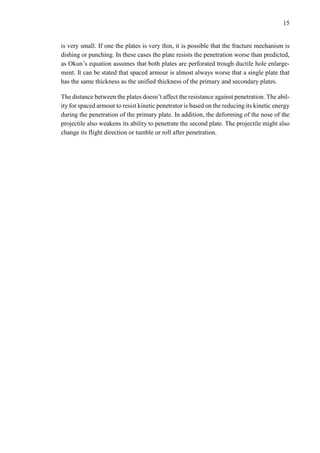
ple, a primary plate of 36.0 mm and a secondary plate of 2.0 mm, would equal to a single
plate of 41.8 mm, 40.2 mm or 40.3 mm depending on the value of A. In the case of both
the AP-shells and the face hardened primary plate, the effective thickness can be made
stronger than the unified thickness when the primary plate is noticeably thinner than the
secondary plate. In all the cases where the spaced armour combination has better effective
thickness than a single plate of their unified thickness, the difference in these thicknesses
15
is very small. If one the plates is very thin, it is possible that the fracture mechanism is
dishing or punching. In these cases the plate resists the penetration worse than predicted,
as Okun’s equation assumes that both plates are perforated trough ductile hole enlarge-
ment. It can be stated that spaced armour is almost always worse that a single plate that
has the same thickness as the unified thickness of the primary and secondary plates.
The distance between the plates doesn’t affect the resistance against penetration. The abil-
ity for spaced armour to resist kinetic penetrator is based on the reducing its kinetic energy
during the penetration of the primary plate. In addition, the deforming of the nose of the
projectile also weakens its ability to penetrate the second plate. The projectile might also
change its flight direction or tumble or roll after penetration.
16
Kuva 10. Single plates equivalent to spaced armour in different impact cases.
Two plates that are attached to each other are called layered armour. A layered armour
resists penetration less than a single plate of equal thickness. Layered armour is often a
temporary solution or a field modification (so called appliqué armour) that is used to
17
strengthen an already existing armour plate. Bird & Livingston (2001, pp. 38–39) define
three methods of calculating the effective thickness of layered armour. The first method
is based on tests made by the US Navy and the statistical analysis of their results. The
effective thickness of layered armour is then
𝑡 𝑒𝑓𝑓,𝑠𝑡𝑎𝑡 = (𝑡1 + 𝑡2) [0,3129 (
𝑡1
𝑡2
)
0,02527
∗ (𝑚𝑎𝑥(𝑡1, 𝑡2))
0,2439
]. (2.2.7)
The equation has a both minimum and maximum value. The minimum and maximum
values for the equation are
𝑡 𝑒𝑓𝑓,𝑠𝑡𝑎𝑡,𝑚𝑖𝑛 = 0,3 ∗ min(𝑡1, 𝑡2) + max(𝑡1, 𝑡2) (2.2.8)
𝑡 𝑒𝑓𝑓,𝑠𝑡𝑎𝑡,𝑚𝑎𝑥 = 0,96(𝑡1 + 𝑡2). (2.2.9)
In the equations the function max(x1,x2) evaluates as the larger number inside the paren-
theses and min(x1,x2) evaluates as the smaller of the values. The second way of calculating
the effective is through the navy rule of thumb, which is
𝑡 𝑒𝑓𝑓,𝑛𝑎𝑣𝑦 = 0,7𝑡1 + 𝑡2. (2.2.10)
The third way is to use Nathan Okun’s equation. Okun’s layered armour equation is based
on the average of the spaced armour equation and the unified thickness of the plates.
Okun’s layered armour equation is in the form of
𝑡 𝑒𝑓𝑓.𝑂𝑘𝑢𝑛 = 0,5 ∗ [(𝑡1 + 𝑡2) + (𝑡1
1,4
+ 𝑡2
1,4
)
1
1,4
]. (2.2.11)
It is important to notice that Okun’s equation doesn’t take into account which of the plates
is thicker. For example, a 40 mm primary plate and a 20 mm secondary plate get an ef-
fective thickness of 47 mm through the statistical method, 48 mm through the navy rule
of thumb and 55 mm through Okun’s equation. The same plates in the reverse order would
get thicknesses of 45 mm, 54 mm and 55 mm respectively. The exact effective thickness
is difficult to evaluate but it can be stated that the effective thickness is between the uni-
fied thickness of the plates and the thickness of the thicker plate.
18
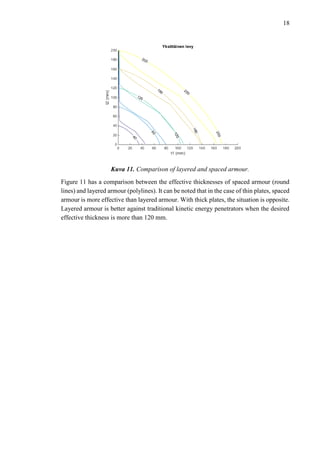
Kuva 11. Comparison of layered and spaced armour.
Figure 11 has a comparison between the effective thicknesses of spaced armour (round
lines) and layered armour (polylines). It can be noted that in the case of thin plates, spaced
armour is more effective than layered armour. With thick plates, the situation is opposite.
Layered armour is better against traditional kinetic energy penetrators when the desired
effective thickness is more than 120 mm.
19
3. MATHEMATICAL PREDICTION MODEL
Often when studying different types of ammunition, the main point of interest is finding
out how much a certain projectile can penetrate. Most current models are based on statis-
tical analysis and require a reference case to be used. One of the most common ways to
estimate a projectile penetration capability is through DeMarre’s equation. DeMarre
equation can be used to estimate penetration against RHA-plates if the penetration for a
projectile of the same type is known. DeMarre’s equation can be written as
𝑃 = 𝑃𝑟𝑒𝑓𝑓 (
𝑣
𝑣 𝑟𝑒𝑓𝑓
)
1.4283
(
𝐷
𝐷 𝑟𝑒𝑓𝑓
)
1.0714
(
𝑚
𝐷3
𝑚 𝑟𝑒𝑓𝑓
𝐷 𝑟𝑒𝑓𝑓
3
)
0.7143
, (3.1)
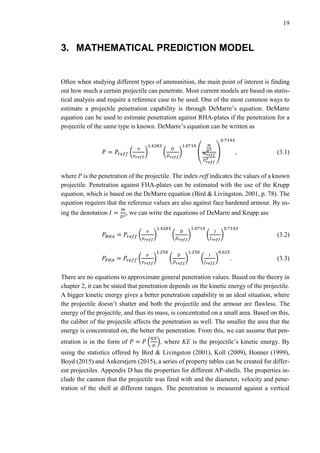
where P is the penetration of the projectile. The index reff indicates the values of a known
projectile. Penetration against FHA-plates can be estimated with the use of the Krupp
equation, which is based on the DeMarre equation (Bird & Livingston, 2001, p. 78). The
equation requires that the reference values are also against face hardened armour. By us-
ing the denotation 𝐼 =
𝑚
𝐷3
, we can write the equations of DeMarre and Krupp ass
𝑃𝑅𝐻𝐴 = 𝑃𝑟𝑒𝑓𝑓 (
𝑣
𝑣 𝑟𝑒𝑓𝑓
)
1.4283
(
𝐷
𝐷 𝑟𝑒𝑓𝑓
)
1.0714
(
𝐼
𝐼 𝑟𝑒𝑓𝑓
)
0.7143
(3.2)
𝑃𝐹𝐻𝐴 = 𝑃𝑟𝑒𝑓𝑓 (
𝑣
𝑣 𝑟𝑒𝑓𝑓
)
1.250
(
𝐷
𝐷 𝑟𝑒𝑓𝑓
)
1.250
(
𝐼
𝐼 𝑟𝑒𝑓𝑓
)
0.625
. (3.3)
There are no equations to approximate general penetration values. Based on the theory in
chapter 2, it can be stated that penetration depends on the kinetic energy of the projectile.
A bigger kinetic energy gives a better penetration capability in an ideal situation, where
the projectile doesn’t shatter and both the projectile and the armour are flawless. The
energy of the projectile, and thus its mass, is concentrated on a small area. Based on this,
the caliber of the projectile affects the penetration as well. The smaller the area that the
energy is concentrated on, the better the penetration. From this, we can assume that pen-
etration is in the form of 𝑃 = 𝑃 (
𝐾𝐸
𝐷
), where KE is the projectile’s kinetic energy. By
using the statistics offered by Bird & Livingston (2001), Koll (2009), Honner (1999),
Boyd (2015) and Ankerstjern (2015), a series of property tables can be created for differ-
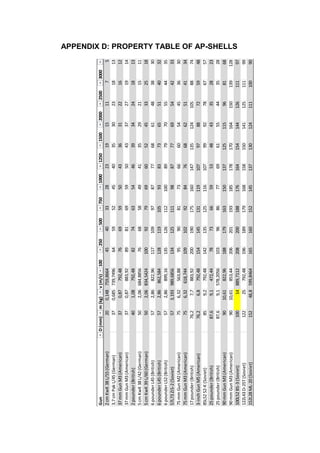
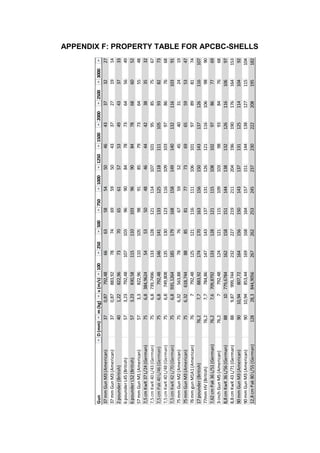
ent projectiles. Appendix D has the properties for different AP-shells. The properties in-
clude the cannon that the projectile was fired with and the diameter, velocity and pene-
tration of the shell at different ranges. The penetration is measured against a vertical
20
RHA-plate. The penetration value at 100 m can be assumed to be the maximum penetra-
tion of the said projectile. A kinetic energy coefficient was calculated for all of the shells
using the equation
𝑘𝑖𝑛𝑒𝑡𝑖𝑐 𝑒𝑛𝑒𝑟𝑔𝑦 𝑐𝑜𝑒𝑓𝑓𝑖𝑐𝑖𝑒𝑛𝑡 =
𝑚𝑣2
𝐷∗104
(3.4)
The kinetic energy coefficient represents how the kinetic energy is distributed in relation
to the projectile’s diameter.
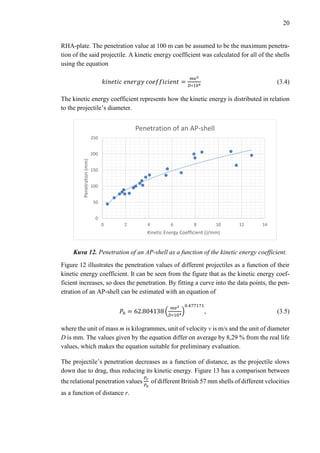
Kuva 12. Penetration of an AP-shell as a function of the kinetic energy coefficient.
Figure 12 illustrates the penetration values of different projectiles as a function of their
kinetic energy coefficient. It can be seen from the figure that as the kinetic energy coef-
ficient increases, so does the penetration. By fitting a curve into the data points, the pen-
etration of an AP-shell can be estimated with an equation of
𝑃0 = 62.804138 (
𝑚𝑣2
𝐷∗104)
0.477171
, (3.5)
where the unit of mass m is kilogrammes, unit of velocity v is m/s and the unit of diameter
D is mm. The values given by the equation differ on average by 8,29 % from the real life
values, which makes the equation suitable for preliminary evaluation.
The projectile’s penetration decreases as a function of distance, as the projectile slows
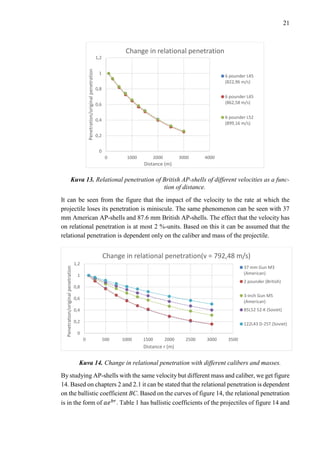
down due to drag, thus reducing its kinetic energy. Figure 13 has a comparison between
the relational penetration values
𝑃𝑟
𝑃0
of different British 57 mm shells of different velocities
as a function of distance r.
0
50
100
150
200
250
0 2 4 6 8 10 12 14
Penetration(mm)
Kinetic Energy Coefficient (J/mm)
Penetration of an AP-shell
21
Kuva 13. Relational penetration of British AP-shells of different velocities as a func-
tion of distance.
It can be seen from the figure that the impact of the velocity to the rate at which the
projectile loses its penetration is miniscule. The same phenomenon can be seen with 37
mm American AP-shells and 87.6 mm British AP-shells. The effect that the velocity has
on relational penetration is at most 2 %-units. Based on this it can be assumed that the
relational penetration is dependent only on the caliber and mass of the projectile.
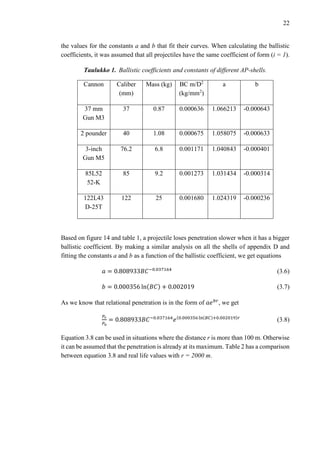
Kuva 14. Change in relational penetration with different calibers and masses.
By studying AP-shells with the same velocity but different mass and caliber, we get figure
14. Based on chapters 2 and 2.1 it can be stated that the relational penetration is dependent
on the ballistic coefficient BC. Based on the curves of figure 14, the relational penetration
is in the form of 𝑎𝑒 𝑏𝑟
. Table 1 has ballistic coefficients of the projectiles of figure 14 and
0
0,2
0,4
0,6
0,8
1
1,2
0 1000 2000 3000 4000
Penetration/originalpenetration
Distance (m)
Change in relational penetration
6 pounder L45
(822,96 m/s)
6 pounder L45
(862,58 m/s)
6 pounder L52
(899,16 m/s)
0
0,2
0,4
0,6
0,8
1
1,2
0 500 1000 1500 2000 2500 3000 3500
Penetration/originalpenetration
Distance r (m)
Change in relational penetration(v = 792,48 m/s)
37 mm Gun M3
(American)
2 pounder (British)
3-inch Gun M5
(American)
85L52 52-K (Soviet)
122L43 D-25T (Soviet)
22
the values for the constants a and b that fit their curves. When calculating the ballistic
coefficients, it was assumed that all projectiles have the same coefficient of form (i = 1).
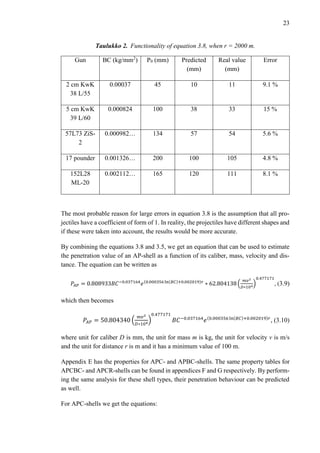
Taulukko 1. Ballistic coefficients and constants of different AP-shells.
Cannon Caliber
(mm)
Mass (kg) BC m/D2
(kg/mm2
)
a b
37 mm
Gun M3
37 0.87 0.000636 1.066213 -0.000643
2 pounder 40 1.08 0.000675 1.058075 -0.000633
3-inch
Gun M5
76.2 6.8 0.001171 1.040843 -0.000401
85L52
52-K
85 9.2 0.001273 1.031434 -0.000314
122L43
D-25T
122 25 0.001680 1.024319 -0.000236
Based on figure 14 and table 1, a projectile loses penetration slower when it has a bigger
ballistic coefficient. By making a similar analysis on all the shells of appendix D and
fitting the constants a and b as a function of the ballistic coefficient, we get equations
𝑎 = 0.808933𝐵𝐶−0.037164
(3.6)
𝑏 = 0.000356 ln(𝐵𝐶) + 0.002019 (3.7)
As we know that relational penetration is in the form of 𝑎𝑒 𝑏𝑟
, we get
𝑃𝑟
𝑃0
= 0.808933𝐵𝐶−0.037164
𝑒(0.000356 ln(𝐵𝐶)+0.002019)𝑟
(3.8)
Equation 3.8 can be used in situations where the distance r is more than 100 m. Otherwise
it can be assumed that the penetration is already at its maximum. Table 2 has a comparison
between equation 3.8 and real life values with r = 2000 m.
23
Taulukko 2. Functionality of equation 3.8, when r = 2000 m.
Gun BC (kg/mm2
) P0 (mm) Predicted
(mm)
Real value
(mm)
Error
2 cm KwK
38 L/55
0.00037 45 10 11 9.1 %
5 cm KwK
39 L/60
0.000824 100 38 33 15 %
57L73 ZiS-
2
0.000982… 134 57 54 5.6 %
17 pounder 0.001326… 200 100 105 4.8 %
152L28
ML-20
0.002112… 165 120 111 8.1 %
The most probable reason for large errors in equation 3.8 is the assumption that all pro-
jectiles have a coefficient of form of 1. In reality, the projectiles have different shapes and
if these were taken into account, the results would be more accurate.
By combining the equations 3.8 and 3.5, we get an equation that can be used to estimate
the penetration value of an AP-shell as a function of its caliber, mass, velocity and dis-
tance. The equation can be written as
𝑃𝐴𝑃 = 0.808933𝐵𝐶−0.037164
𝑒(0.000356 ln(𝐵𝐶)+0.002019)𝑟
∗ 62.804138 (
𝑚𝑣2
𝐷∗104)
0.477171
, (3.9)
which then becomes
𝑃𝐴𝑃 = 50.804340 (
𝑚𝑣2
𝐷∗104
)
0.477171
𝐵𝐶−0.037164
𝑒(0.000356 ln(𝐵𝐶)+0.002019)𝑟
, (3.10)
where unit for caliber D is mm, the unit for mass m is kg, the unit for velocity v is m/s
and the unit for distance r is m and it has a minimum value of 100 m.
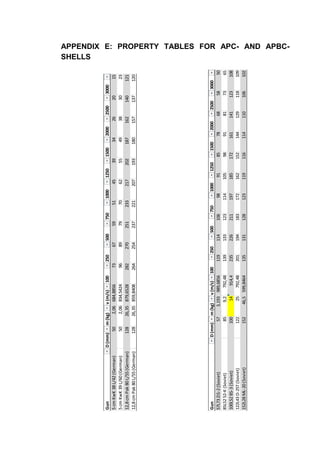
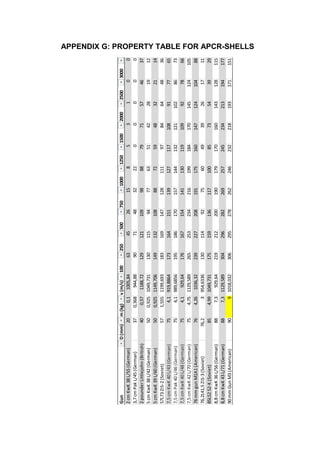
Appendix E has the properties for APC- and APBC-shells. The same property tables for
APCBC- and APCR-shells can be found in appendices F and G respectively. By perform-
ing the same analysis for these shell types, their penetration behaviour can be predicted
as well.
For APC-shells we get the equations:
24
𝑃0 = 48.844680 (
𝑚𝑣2
𝐷∗104
)
0.627189
(3.11)
𝑃𝑟
𝑃0
= 0.817308𝐵𝐶−0.035818
𝑒(0.000349 ln(𝐵𝐶)+0.001964)𝑟
(3.12)
𝑃𝐴𝑃𝐶 = 39.921148 (
𝑚𝑣2
𝐷∗104
)
0.627189
𝐵𝐶−0.035818
𝑒(0.000349 ln(𝐵𝐶)+0.001964)𝑟
. (3.13)
For APBC-shells we get the equations:
𝑃0 = 42.980939 (
𝑚𝑣2
𝐷∗104
)
0.596242
(3.14)
𝑃𝑟
𝑃0
= 0.703895𝐵𝐶−0.055240
𝑒(0.000267 ln(𝐵𝐶)+0.001522)𝑟
(3.15)
𝑃𝐴𝑃𝐵𝐶 = 30.254068 (
𝑚𝑣2
𝐷∗104
)
0.596242
𝐵𝐶−0.055240
𝑒(0.000267 ln(𝐵𝐶)+0.001522)𝑟
. (3.16)
When looking at APC- and APBC-shells, it should be noticed that their property tables
only include a few different projectiles. This may lead to great difference between the
behaviour of these equations and their real life counterparts.
For APCBC-shells we get the equations:
𝑃0 = 47.338655 (
𝑚𝑣2
𝐷∗104)
0.620892
(3.17)
𝑃𝑟
𝑃0
= 0.908771𝐵𝐶−0.017257
𝑒(0.000189 ln(𝐵𝐶)+0.001061)𝑟
(3.18)
𝑃𝐴𝑃𝐶𝐵𝐶 = 43.019997 (
𝑚𝑣2
𝐷∗104
)
0.620892
𝐵𝐶−0.017257
𝑒(0.000189 ln(𝐵𝐶)+0.001061)𝑟
. (3.19)
And for APCR-shells we get the equations:
𝑃0 = 88.951277 (
𝑚𝑣2
𝐷∗104
)
0.482321
(3.20)
𝑃𝑟
𝑃0
= 0.533666𝐵𝐶−0.092555
𝑒(0.000966 ln(𝐵𝐶)+0.006577)𝑟
(3.21)
𝑃𝐴𝑃𝐶𝑅 = 47.470272 (
𝑚𝑣2
𝐷∗104
)
0.482321
𝐵𝐶−0.092555
𝑒(0.000966 ln(𝐵𝐶)+0.006577)𝑟
. (3.22)
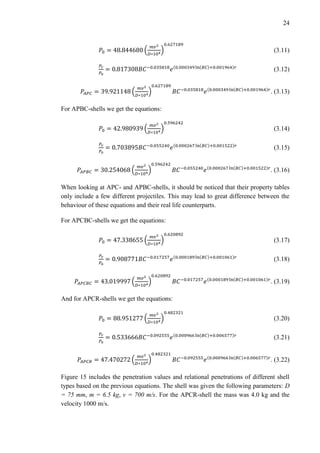
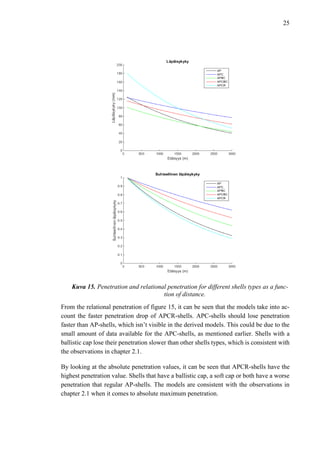
Figure 15 includes the penetration values and relational penetrations of different shell
types based on the previous equations. The shell was given the following parameters: D
= 75 mm, m = 6.5 kg, v = 700 m/s. For the APCR-shell the mass was 4.0 kg and the
velocity 1000 m/s.
25
Kuva 15. Penetration and relational penetration for different shells types as a func-
tion of distance.
From the relational penetration of figure 15, it can be seen that the models take into ac-
count the faster penetration drop of APCR-shells. APC-shells should lose penetration
faster than AP-shells, which isn’t visible in the derived models. This could be due to the
small amount of data available for the APC-shells, as mentioned earlier. Shells with a
ballistic cap lose their penetration slower than other shells types, which is consistent with
the observations in chapter 2.1.
By looking at the absolute penetration values, it can be seen that APCR-shells have the
highest penetration value. Shells that have a ballistic cap, a soft cap or both have a worse
penetration that regular AP-shells. The models are consistent with the observations in
chapter 2.1 when it comes to absolute maximum penetration.
26
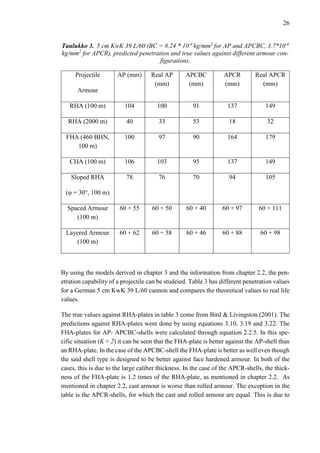
Taulukko 3. 5 cm KwK 39 L/60 (BC = 8.24 * 10-4
kg/mm2
for AP and APCBC, 3.7*10-4
kg/mm2
for APCR), predicted penetration and true values against different armour con-
figurations.
Projectile
Armour
AP (mm) Real AP
(mm)
APCBC
(mm)
APCR
(mm)
Real APCR
(mm)
RHA (100 m) 104 100 91 137 149
RHA (2000 m) 40 33 53 18 32
FHA (460 BHN,
100 m)
100 97 90 164 179
CHA (100 m) 106 103 95 137 149
Sloped RHA
(φ = 30°, 100 m)
78 76 70 94 105
Spaced Armour
(100 m)
60 + 55 60 + 50 60 + 40 60 + 97 60 + 111
Layered Armour
(100 m)
60 + 62 60 + 58 60 + 46 60 + 88 60 + 98
By using the models derived in chapter 3 and the information from chapter 2.2, the pen-
etration capability of a projectile can be studeied. Table 3 has different penetration values
for a German 5 cm KwK 39 L/60 cannon and compares the theoretical values to real life
values.
The true values against RHA-plates in table 3 come from Bird & Livingston (2001). The
predictions against RHA-plates were done by using equations 3.10, 3.19 and 3.22. The
FHA-plates for AP- APCBC-shells were calculated through equation 2.2.5. In this spe-
cific situation (K ≈ 2) it can be seen that the FHA-plate is better against the AP-shell than
an RHA-plate. In the case of the APCBC-shell the FHA-plate is better as well even though
the said shell type is designed to be better against face hardened armour. In both of the
cases, this is due to the large caliber thickness. In the case of the APCR-shells, the thick-
ness of the FHA-plate is 1.2 times of the RHA-plate, as mentioned in chapter 2.2. As
mentioned in chapter 2.2, cast armour is worse than rolled armour. The exception in the
table is the APCR-shells, for which the cast and rolled armour are equal. This is due to
27
the large caliber thickness. The values for CHA-plates were calculated with equation
2.2.6.
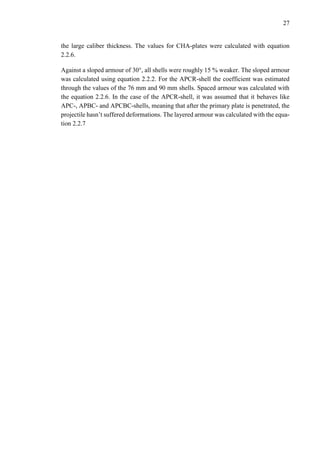
Against a sloped armour of 30°, all shells were roughly 15 % weaker. The sloped armour
was calculated using equation 2.2.2. For the APCR-shell the coefficient was estimated
through the values of the 76 mm and 90 mm shells. Spaced armour was calculated with
the equation 2.2.6. In the case of the APCR-shell, it was assumed that it behaves like
APC-, APBC- and APCBC-shells, meaning that after the primary plate is penetrated, the
projectile hasn’t suffered deformations. The layered armour was calculated with the equa-
tion 2.2.7
28
4. SUMMARY
An armour piercing shell penetrates armour through its kinetic energy. Perforation is af-
fected by the mass, density, velocity, diameter, hardness and sharpness of the projectile
and the hardness, density, ultimate tensile strength and yield strength of the armour. Pen-
etration can be achieved through three different mechanisms: dishing, punching or ductile
hole enlargement. The dominant fracture mechanism depends mainly on the caliber thick-
ness. If the caliber thickness is small, the mechanism is dishing. In dishing, the armour
plate is bent open. Punching requires a blunt impact and a small caliber thickness. During
punching a plug is detached from the armour due to the shear tension of the impact. In
other cases the mechanism is ductile hole enlargement. In ductile hole enlargement the
projectile digs in to the armour causes the material to flow away from the projectile. If
the armour doesn’t penetrate the armour, spalling may occur.
The ability of armour to resist penetration can be measured in different ways, the most
common of which is the ballistic limit velocity. Ballistic limit velocity is the velocity
required for a certain projectile to penetrate an armour plate of certain thickness. The
suitability of armour material can be measured with the ballistic performance index.
Basic shell types can be divided into groups based on their properties. The shell types are
 AP – armour piercing
 APHE – armour piercing high explosive
 APC – armour piercing capped
 APBC – armour piercing ballistic capped
 APCBC – armour piercing capped ballistic capped
 APCR – armour piercing composite rigid.
Different shell types apply for different situations. Shells with high explosives are de-
signed to explode after penetration and maximised the damage to the target behind the
armour. Adding a soft cap reduces the probability of the shattering of the projectile and
improve its efficiency against sloped armour. A ballistic cap increases the aerodynamics
of a projectile. A projectile with a rigid core are an improved version of the traditional
armour piercing shells. These projectiles have their mass concentrated on a smaller area,
which increases their penetration.
Armour plates can be divided into three groups based on the manufacturing method:
rolled homogeneous armour (RHA), face hardened armour (FHA) and cast homogeneous
armour (CHA). RHA-plates are the most common. Face hardened plates have a harder
surface layer. Face hardened plates work well against AP-shells when caliber thickness
29
is big. Cast plates are weaker than RHA- or FHA-plates. When manufacturing armour
plates, any flaws in their structure will weaken them.
If the projectile doesn’t hit the armour perpendicularly, it is a case of sloped armour. The
thickness of a sloped armour plate can be calculated through a slope coefficient. The slope
coefficient is dependent on the shell type, angle of impact and caliber thickness. For
APCR-shells, the caliber thickness doesn’t affect the slope coefficient. By having two
plates separated from each other, spaced armour can be created. If the plates are in contact
with each other, it is called layered armour. In most cases, the combinations of two armour
plates are worse than a single plate of equal unified thickness. When comparing armour
of two combined plates, we notice that spaced armour is better if the plates are thin. In
the case of thick plates, layered armour is better.
The penetration capability of different shell types can be estimated with the following
equations:
𝑃𝐴𝑃 = 50.804340 (
𝑚𝑣2
𝐷∗104)
0.477171
𝐵𝐶−0.037164
𝑒(0.000356 ln(𝐵𝐶)+0.002019)𝑟
(4.1)
𝑃𝐴𝑃𝐶 = 39.921148 (
𝑚𝑣2
𝐷∗104
)
0.627189
𝐵𝐶−0.035818
𝑒(0.000349 ln(𝐵𝐶)+0.001964)𝑟
(4.2)
𝑃𝐴𝑃𝐵𝐶 = 30.254068 (
𝑚𝑣2
𝐷∗104
)
0.596242
𝐵𝐶−0.055240
𝑒(0.000267 ln(𝐵𝐶)+0.001522)𝑟
(4.3)
𝑃𝐴𝑃𝐶𝐵𝐶 = 43.019997 (
𝑚𝑣2
𝐷∗104)
0.620892
𝐵𝐶−0.017257
𝑒(0.000189 ln(𝐵𝐶)+0.001061)𝑟
(4.4)
𝑃𝐴𝑃𝐶𝑅 = 47.470272 (
𝑚𝑣2
𝐷∗104
)
0.482321
𝐵𝐶−0.092555
𝑒(0.000966 ln(𝐵𝐶)+0.006577)𝑟
(4.5)
In the equations, the unit for the mass m is kg, the unit for the velocity v is m/s, the unit
for the diameter D of the shell is mm and the distance r is m. BC is the ballistic coefficient
of the projectile. The efficient can be calculated with equation 2.1, assuming that the co-
efficient of form i = 1. The minimum value for the distance is 100 m. The equation can
be used to calculate a preliminary estimate of a projectile’s penetration. The equation
follow projectile properties (AP- and APCR-shells have the highest penetration, but lose
it the fastest). From the equations, the equations for APC- and APC-shells can be seen as
unreliable. The reason for this was the small amount of data available when creating the
model. If the different ballistic coefficient of the different projectiles were taken into ac-
count during the creation of these models, they would be more accurate.
30
BIBLIOGRAPHY
Bird, L.R. & Livingston, R.D. (2001). World War II Ballistics: Armor and Gunnery. 2nd
ed. Albany, New York, and Woodbridge, Connecticut, U.S.A, Overmatch Press.
British Equipment of the Second World War (2015), David Boyd, web page. Available
(referenced 7.3.2015): http://www.wwiiequipment.com/
Cline, Donna (2002). Exterior Ballistics Explained, Trajectories, Part 3 "Atmosphere".
Lattie Stone Ballistics.
Engineering Design Handbook - Elements of Terminal Ballistics, Parts One and Two:
(AMCP 706-160, 706-161). (1963). U.S. Army Materiel Command.
Guns vs Armour 1939 to 1945 (1999), David Michael Honner, web page. Available (ref-
erenced 7.3.2015): http://amizaur.prv.pl/www.wargamer.org/GvA/index.html
Masket, A.V. (1949). The Measurement of Forces Resisting Armor Penetration. Journal
of Applied Physics 20, 2, pp. 132–140.
Moss G.M., Leeming D.W. & Farrar C.L. (1995). Brassey's Land Warfare Series: Mili-
tary Ballistics. Royal Military College of Science, Shrivenham, UK.
Panzerworld, Christian Ankerstjerne (2015), web page. Available (referenced 7.3.2015):
http://www.panzerworld.com/
Rosenberg, Z. & Dekel, E. (2012). Terminal Ballistics. 14th ed. Springer Berlin Heidel-
berg.
Srivathsa, B. & Ramakrishnan, N. (1997). On the ballistic performance of metallic mate-
rials. Bulletin of Materials Science 20, 1, pp. 111–123.
Srivathsa, B. & Ramakrishnan, N. (1999). Ballistic performance maps for thick metallic
armour. Journal of Materials Processing Technology 96, 1–3, pp. 81–91.
The Russian Ammunition Page (2009), Christian Koll, web page. Available (referenced
7.3.2015): http://russianammo.org/index.html
Thomson, W.T. (1955). An Approximate Theory of Armor Penetration. Journal of Ap-
plied Physics 26, 1, pp. 80–82.
Zener, C. & Peterson, R.E. (1943). Mechanism of Armor Penetration. Watertown, Mas-
sachusetts, Watertown Arsenal. 710/492.
APPENDIX A: BALLISTIC PERFORMANCE INDEX
When inspecting penetration, the armour is divided into two sectors in the direction of
the projectile and into three sector in a radial direction. In sector I the material flows into
radially and in sector II the armour bulges in the direction of movement of the projectile.
The radial sector are divided into the projectile’s diameter i, the plastic region ii and the
elastic region iii. The parameters of equation 2.10 are defined as:
𝑘 𝛾 = √
1−𝛾
(1−2𝛾)(1+𝛾)
,
𝑘 𝑒 =
𝑣 𝑟
𝑘 𝛾
√
𝜌
𝐸
,
𝑘𝑗 =
𝜌𝑣 𝑟
2
𝜎 𝜀
,
𝑘 𝑏 = 𝑣𝑟√
𝜌
𝐶
, 𝑤ℎ𝑒𝑟𝑒 𝐶 =
𝐸
3(1−2𝛾)
,
𝑘 𝑝 = 𝑣𝑟√
𝜌
𝐸 𝑝
, 𝑤ℎ𝑒𝑟𝑒 𝐸 𝑝 =
𝜎 𝑚(1+𝜀 𝑟)−𝜎 𝜀
𝜀 𝑟
,
𝛼𝐼 = 1 − 𝛼𝐼𝐼 = 1 − √
𝑣⊥
𝑣
, 𝑤ℎ𝑒𝑟𝑒 𝑣⊥ =
−𝑘 𝛾√𝜌𝐸+√𝑘 𝛾
2 𝐸𝜌+10,4𝜌𝜎 𝜀
2𝜌
,
𝑣𝑟 =
𝑣
1,85
,
where γ is the Poisson’s constant of the material, ρ its density, E Young’s modulus, σε
yield strength, σm ultimate tensile strength, εr fracture strain ja v impact velocity. (Shri-
vathsa & Ramakrishnan, 1999.)
APPENDIX B: BALLISTIC PERFORMANCE MAPS
The impact velocity in figures marked with (a) was 400 m/s, and in figures marked with
(b) 800 m/s. (Shrivathsa & Ramakrishnan, 1999.)
APPENDIX C: CONSTANTS OF THE SLOPE EFFICIENT
φ APCBC/APC
a/b
APBC
a/b
AP
a/b
10 1.0243/0.0225 1.039/0.01555 0.98297/0.0637
15 1.0532/0.0327 1.055/0.02315 1.00066/0.0969
20 1.1039/0.0454 1.077/0.03448 1.0361/0.13561
25 1.1741/0.0549 1.108/0.05134 1.1116/0.16164
30 1.2667/0.0655 1.155/0.07710 1.2195/0.19702
35 1.3925/0.0993 1.217/0.11384 1.3771/0.22546
40 1.5642/0.1388 1.313/0.16952 1.6263/0.26313
45 1.7933/0.1655 1.441/0.24604 2.0033/0.34717
50 2.1053/0.2035 1.682/0.37910 2.6447/0.57353
55 2.5368/0.2427 2.110/0.56444 3.2310/0.69075
60 3.0796/0.2450 3.497/1.07411 4.0708/0.81826
65 4.0041/0.3353 5.335/1.46188 6.2644/0.91920
70 5.0803/0.3478 9.477/1.181520 8.6492/1.00539
75 6.7445/0.3831 20.22/2.19155 13.751/1.074
80 9.0598/0.4131 56.20/2.56210 21.8713/1.17973
85 12.8207/0.4550 221.3/2.93265 34.4862/1.28631
If the angle of impact is not in the table, the values for the constants can be calculated
through interpolation. (Bird & Livingston, 2001, p. 118.)
APPENDIX D: PROPERTY TABLE OF AP-SHELLS
GunD(mm)m(kg)v(m/s)100250500750100012501500200025003000
2cmKwK38L/55(German)200,148759,8664454033282319151175
3,7cmPakL/45(German)370,685739,749664595245403530231813
37mmGunM3(American)370,87792,4876695950433631221612
37mmGunM3(American)370,87883,9289816959504337271914
2pounder(British)401,08792,4882746354463934241813
5cmKwK38L/42(German)502,06684,885676685849413529211511
5cmKwK39L/60(German)502,06834,5424100927969605245332518
6pounderL45(British)572,86822,961171099787776861483830
6pounderL45(British)572,86862,58412811910593837365514032
6pounderL52(British)572,86899,16135126112100897970554435
57L73ZiS-2(Soviet)573,193989,685613412511198877769544233
75mmGunM2(American)756,32563,8895908173666054453630
75mmGunM3(American)756,32618,7441091029284766862514134
17pounder(British)76,27,7883,922001901751601471351241058874
3-inchGunM5(American)76,26,8792,481541451311191079788725948
85L5252-K(Soviet)859,2792,481421351251161079992786757
25pounder(British)87,69,1472,4478736659534843352823
25pounder(British)87,69,1578,2056103968677696155443528
90mmGunM3(American)9010,61822,96188179163150137125115968168
90mmGunM3(American)9010,61853,44206201193185178170164150139128
100L52BS-3(Soviet)10014889,711220820018817616415414412611197
122L43D-25T(Soviet)12225792,4819618917916815815014112511199
152L28ML-20(Soviet)15248,8599,846416516015214513713012411110090
APPENDIX E: PROPERTY TABLES FOR APC- AND APBC-
SHELLS
GunD(mm)m(kg)v(m/s)100250500750100012501500200025003000
5cmKwK38L/42(German)502,06684,885673675951453934262015
5cmKwK39L/60(German)502,06834,542496897970625549383023
12,8cmPak80L/55(German)12826,35879,6528282270251233217202187162140121
12,8cmPak80L/55(German)12826,35859,8408264254237221207193180157137120
GunD(mm)m(kg)v(m/s)100250500750100012501500200025003000
57L73ZiS-2(Soviet)573,193989,685611911410698918578685850
85L5252-K(Soviet)859,2792,481391331231141059891817365
100L52BS-3(Soviet)10014914,4235226211197185172161141123108
122L43D-25T(Soviet)12225792,48201194183172162152144129118109
152L28ML-20(Soviet)15246,5599,8464135131128123119116114110106102
APPENDIX F: PROPERTY TABLE FOR APCBC-SHELLS
GunD(mm)m(kg)v(m/s)100250500750100012501500200025003000
37mmGunM3(American)370,87792,4866635854504643373227
37mmGunM3(American)370,87883,9278746959504337271914
2pounder(British)401,22822,9673706561575349433733
6pounderL45(British)573,23792,481071039690847873645649
6pounderL52(British)573,23830,5811511010396908478686052
57mmGunM1(American)573,3822,961101059891857973645548
7,5cmKwK37L/24(German)756,8384,962454535048464442383532
7,5cmKwK40L/43(German)756,8739,749613312812111410710195857567
7,5cmPak40L/46(German)756,8792,48146141133125118111105938273
7,5cmKwK40L/48(German)756,8749,80813513012311610910397867668
7,5cmKwK42L/70(German)756,8935,126418517916815814914013211610391
75mmGunM2(American)756,32563,8878766759524540312419
75mmGunM3(American)756,32618,74488858177736965595347
76mmgunM1A1(American)767792,4812512111611110610197898174
17pounder(British)76,27,7883,92174170163156150143137126116107
77mmHV(British)76,27,7784,861471431371311261211161069890
7,62cmPak36L/51(German)76,27,6709,879213312812111510810297867769
3-inchGunM5(American)76,27792,481241211151091039893847668
8,8cmKwK36L/56(German)8810779,678416215815114413813212611610697
8,8cmKwK43L/71(German)889,87999,744232227219211204196190176164153
90mmGunM3(American)9010,94807,7216415615014313713112511410492
90mmGunM3(American)9010,94853,44169168164157151144138127115104
12,8cmPak80L/55(German)12828,3844,9056267262253245237230222208195182
APPENDIX G: PROPERTY TABLE FOR APCR-SHELLS
GunD(mm)m(kg)v(m/s)100250500750100012501500200025003000
2cmKwK38L/55(German)200,11005,8463452615853100
3,7cmPakL/45(German)370,368944,88907148322200000
2pounderLittlejohn(British)400,571188,7212912110998887971574637
5cmKwK38L/42(German)500,9251049,7311301159477635142281912
5cmKwK39L/60(German)500,9251149,70614913210888725948322114
57L73ZiS-2(Soviet)571,5551199,6931831691471281119784644836
7,5cmKwK40L/43(German)754,1919,8864173164151139127117108917765
7,5cmPak40L/46(German)754,1989,68561951861701571441321211028673
7,5cmKwK40L/48(German)754,1929,64176167154141130119109927866
7,5cmKwK42L/70(German)754,751129,589265253234216199184170145124105
76mmgunM1A1(American)764,261036,3223922720819117516014712410488
76,2L41,5ZiS-3(Soviet)76,23954,63361301149275604939261711
85L5252-K(Soviet)854,991049,7311751591361171008573543929
8,8cmKwK36L/56(German)887,3929,64219212200190179170160143128115
8,8cmKwK43L/71(German)887,31129,589304296282269257245234213194177
90mmGunM3(American)9091018,032306295278262246232218193171151
APPENDIX H: ARMOUR PIERCING SHELL TYPES

Mechanisms of Armour Penetration

  • 1.
    i NIKO HOLKKO MECHANISMS OFARMOUR PENETRATION Bachelor’s Thesis Inspector: lecturer Risto Alanko
  • 2.
    ABSCTRACT NIKO HOLKKO: Mechanismsof armour penetration Tampere University of Technology Bachelor’s Thesis, 30 pages, 8 appendix pages March 2015 Bachelor’s Degree Programme in Mechanical Engineering Major: Machine Construction Examiner: Risto Alanko Keywords: armour penetration, armour, armour piercing, piercing The ability of an armour piercing shell to penetrate armour depends on both the shell’s and the armour’s geometries and their material properties. At the moment of impact, the armour is perforated, or penetrated, with one of three perforation mechanisms. The ar- mour can be damaged even in a failed penetration. There are several types of shells, all of which have their unique properties and uses. The impact behaviour differs as well between different types of shells. There are different types of armours and armoured plates can be used to create multiple configurations that impact the armour’s ability to resist penetration. Predictive mathematical models can be created to different shells by using statistical data. Using these models, the penetration capability of shells can be estimated as a function of their type, calibre, mass and range of impact.
  • 3.
    TABLE OF CONTENTS 1.INTRODUCTION ....................................................................................................1 2. MECHANISMS OF ARMOUR PENETRATION...................................................2 2.1 Shell types ......................................................................................................7 2.2 Armour types..................................................................................................8 3. MATHEMATICAL PREDICTION MODEL ........................................................19 4. SUMMARY............................................................................................................28 BIBLIOGRAPHY...........................................................................................................30 APPENDIX A: BALLISTIC PERFORMANCE INDEX APPENDIX B: BALLISTIC PERFORMANCE MAPS APPENDIX C: CONSTANTS OF THE SLOPE COEFFICIENT APPENDIX D: PROPERTY TABLE OF AP-SHELLS APPENDIX E: PROPERTY TABLES OF APC- AND APBC-SHELLS APPENDIX F: PROPERTY TABLE OF APCBC-SHELLS APPENDIX G: PROPERTY TABLE OF APCR-SHELLS APPENDIX H: ARMOUR PIERCING SHELL TYPES
  • 4.
    TABLE OF FIGURES Kuva1. Schematics of armour penetration. ................................................................2 Kuva 2. Nose shapes, conical and ogive. ....................................................................3 Kuva 3. Fracture mechanisms.....................................................................................4 Kuva 4. Spalling (Rosenberg & Dekel, 2012 s. 40).....................................................5 Kuva 5. Penetrating sloped armour.............................................................................9 Kuva 6. Slope coefficient as a function of the angle of impact when K = 1.3 and 0.4.................................................................................................................10 Kuva 7. Slope coefficients for 76 mm and 90 mm APCR-shells as a function of the angle if impact........................................................................................11 Kuva 8. Values for the BHN-coefficient as a function of caliber thickness for different calibers, when the hardness value of the plate is 460 BHN. .........12 Kuva 9. Spaced Armour.............................................................................................14 Kuva 10. Single plates equivalent to spaced armour in different impact cases. .........16 Kuva 11. Comparison of layered and spaced armour.................................................18 Kuva 12. Penetration of an AP-shell as a function of the kinetic energy coefficient. ....................................................................................................20 Kuva 13. Relational penetration of British AP-shells of different velocities as a function of distance. .....................................................................................21 Kuva 14. Change in relational penetration with different calibers and masses. ........21 Kuva 15. Penetration and relational penetration for different shells types as a function of distance. .....................................................................................25
  • 5.
    ABBREVIATIONS AND NOTATIONS APArmour Piercing APBC Armour Piercing Ballistic Capped APC Armour Piercing Capped APCBC Armour Piercing Capped Ballistic Capped APCR Armour Piercing Composite Rigid APHE Armour Piercing High Explosive BHN Brinell Hardness Number BPI Ballistic Performance Index CHA Cast Homogeneous Armour CRH Caliber-radius-heads HEAT High Explosive Anti Tank HVAP High Velocity Armour Piercing RHA Rolled Homogeneous Armour FHA Face-Hardened Armour A shell and armour constant BC ballistic coefficient D diameter E elastic modulus/Young’s modulus KE kinetic energy F force H strain hardening rate h thickness of molten layer I ratio of mass and the cube of the diameter i shape coefficient K caliber thickness L length of shell L length of the nose of the shell m mass P penetration capability R hardness r distance S sharpness s radius Tm melting temperature t thickness v velocity vbl ballistic limit velocity εr strain fracture φ angle of oblique ρ density σm ultimate tensile strength σr penetration strength σspall spall strength σε yield strength µ coefficient of friction γ Poisson’s constant
  • 6.
    1 1. INTRODUCTION The termarmour penetration is usually used to refer to the perforation of armoured plates with varying ammunition in warfare. The goal of armour penetration is to destroy a target protected by armoured plates, such a vehicle or its crew. Armour penetration has been a phenomenon of interest of both civil and military engineers for nearly two hundred years. The study of armour penetration first became important during the naval battles of the 19th century and at the advent of steel-protected war ships. As the first tanks appeared during World War I, the science of armour penetration moved to study land targets as well. The first ammunition that was used against tanks and other armoured vehicles were made of solid steel and shaped similar to bullets. Their penetration capability was based on their kinetic energy. The shells were called armour piercing shells, or AP-shells. During the 2nd World War AP-shells were improved in multiple ways as the thickness of armoured plates grew. In addition, the solid steel shots were designed to include parts made of other materials than steel, such as tungsten. In the end, the traditional shells were replaced by modern dart-shaped ammunition that were made completely out of heavy materials, such as the aforementioned tungsten or depleted uranium. During World War II, other types of shells appeared as well, such as chemical energy penetrators. These include shells such as high explosive anti-tank shells (HEAT). HEAT-shells penetrate armour by firing a jet of metal towards an armoured plate. The metal then penetrates through the armour through its kinetic energy. In modern warfare, HEAT and dart-shaped ammunition are the most commonly used ammunition types. Armour piercing projectiles are fired out of a cannon. The projectile as a whole is com- prised of an armour piercing shot and shell. The shot is the penetrating part and the shell includes the primer and propellant. In general, the word shell can be used to refer to the armour piercing part of to the whole combination. In this text, the word shell is used to refer to the armour piercing projectile, or shot. The word projectile is also used. This thesis focuses on the traditional kinetic AP-shells and the mechanisms of the event of penetration. This work also studies how different ammunition and armour types affect penetration. A mathematical model based on statistics is also derived. This model can be used to predict the behaviour of different types of armour piercing shells.
  • 7.
    2 2. MECHANISMS OFARMOUR PENETRATION The penetration capability of a kinetic penetrator is based on its kinetic energy. The en- ergy is maximised through the mass and velocity of the projectile. For this reason, the projectiles are usually made out of heavy materials. Kuva 1. Schematics of armour penetration. In addition to its velocity and mass, the hardness values of the projectile (Ra) and armour (Rp) also affect armour penetration (Bird & Livingston 2001, p. 21, 38). According to the US Army Material Command (1963, p. 6-3) the general hardness value of an AP-shell is 653–722 BHN in the nose and 370–420 BHN everywhere else. AP-shells are usually manufactured out of steel or steel alloys such as steel-molybdenum-chrome alloy. The hardness of homogeneous armour plates is 220–300 BHN with an upper limit of 375 BHN. As the hardness increases over this value, the plates become brittle and their ability to resist large diameter projectiles is reduced (Bird & Livingston 2001, p. 21). According to Rosenberg & Dekel (2012) the ultimate tensile strength σm and yield strength σε also affect armour’s ability to resist penetration. Figure 1 illustrates the physical properties that affect penetration, when an AP-shell meets a homogeneous armour plate. Armour plates are also manufactured out of steel and its alloys. The majority of armour plates are homogeneous and rolled. Rolled homogeneous armour is usually denoted with RHA. Modern American armour plates are manufactured according to standard MIL-DTL- 12560. Sometimes armour plates are manufactured out of aluminium. Even though alu- minium resists penetration worse than steel, it is used in situations where light and thin armour plates are needed. The energy of the projectile is focused on a small area. This focus can be achieved with the projectile’s diameter and the shape of the nose. The most common shapes are conical and ogive. These shapes are illustrated in figure 2.
  • 8.
    3 Kuva 2. Noseshapes, conical and ogive. The radius s of a nose of an ogive projectile is 2–4 times the diameter D of the projectiles. The ratio between the radius and the diameter is called calibre-radius-heads, or CRH. For example, a projectile with s = 2D is a type 2CRH projectile. The sharpness S of a projec- tile is defined as the ratio of the length l of the nose and the projectile’s diameter D. (Rosenberg & Dekel 2012, s. 24.) The velocity of an AP-shell is usually 600–900 m/s. The shell’s ability to maintain its velocity can be expressed through a ballistic coefficient BC. Ballistic coefficient (Moss et al. 1955, s. 86) can be expressed as 𝐵𝐶 = 𝑚 𝐷2 𝑖 , (2.1) where m is the projectile’s mass and i its shape coefficient. According to Cline (2002, p. 44) the shape coeffcient can be calcuated with 𝑖 = 2 𝑠 √ 4𝑠−1 𝑠 . (2.2) According to Masket (1949) and Rosenberg & Dekel (2012, p. 74) the amount of energy required for penetration approximately the same for both projectile shapes. The penetra- tion process can be made easier by increasing the sharpness of the projectile. Once the sharpness reaches a value of 3, increasing its value no longer gives any more benefits (Rosenberg & Dekel 2012, p. 75). Caliber thickness K is defined as the ratio of the thickness of the armour plate and the diameter (or caliber) of the projectile. Caliber thickness affects which fracture mechanism the projectile uses to perforate an armour plate. The projectile perforates the armour with smallest possible amount of energy. The fracture mechanisms (Rosenberg & Dekel 2012, p. 121) can be roughly divided into three different main mechanisms: dishing, punching and ductile hole enlargement. These fracture mechanisms are illustrated in figure 3.
  • 9.
    4 Kuva 3. Fracturemechanisms. Both dishing and punching require a situation where caliber thickness K is less than 1. This situation where the caliber of the projectile is bigger than the thickness of the armour plate is called overmatching. Dishing is the dominant mechanism when caliber thickness K is smaller than 1/3. In dishing, the caliber of the shell is much larger than the armour plate, which leads to a situation where the plate is bent open. Thomson (1955) estimated the energy needed for perforation for conical and ogive projectiles as following: 𝑊𝑝,𝑐𝑜𝑛𝑖𝑐𝑎𝑙 = 1 4 𝜋𝐷2 𝑡 ( 1 2 𝜎𝜀 + 𝜌 𝑝 𝑣2 𝐷2 4𝑙 ), (2.3) 𝑊𝑝,𝑜𝑔𝑖𝑣𝑒 = 1 4 𝜋𝐷2 𝑡 ( 1 2 𝜎𝜀 + 1,86 𝜌 𝑝 𝑣2 𝐷2 4𝑙 ), (2.4) where v is the velocity of the projectile and t is the thickness of the armour plate and ρp its density. Thomson noticed as well that the energy required for perforation is roughly the same for both projectile shapes. Punching is a special fracture mechanism and it requires a specific set of circumstances. In addition to a small caliber thickness, it requires a blunt hit against the armour plate. A blunt hit can be achieved if the nose of the projectile is flat or if the projectile hits the armour plate with its edge. In punching, the force of the impact is so great that the shear stress around the area of impact cuts a cylindrical section called a plug from the armour. Punching can also occur in a situation where the nose of the projectile deforms into a flat shape at the moment of impact. (Zener & Peterson 1943; Bird & Livingston 2001, p. 5). If the caliber thickness is more than 1/3 and the circumstances for punching are not ful- filled, the armour is perforated through ductile hole enlargement. In ductile hole enlarge- ment the projectile pushes material away from itself, mainly in a radial direction. As the projectiles travels through the armour plate, large amounts of friction is created (Thomson 1955). The friction causes the projectile to slow down. The heat from the frictional forces causes the temperatures of the surfaces of the projectile and the hole to increase rapidly. The increased temperature creates a layer of molten metal between the projectile and the
  • 10.
    5 hole. This moltenmetal acts as a lubricant which then reduces the friction. Both Zener & Peterson (1943) and Rosenberg & Dekel (2012, p. 96) note that friction uses only a small amount of the total kinetic energy of the projectile. The majority of the energy is used to deform the armour plate and the projectile. According to Thomson (1955), the amount of energy required to create the molten layer of metal during perforation is 𝑊𝑞 = 2𝜋𝜇𝑡𝑣 ( 𝜎 𝜀 𝐷𝑙 16𝑣 + 3𝜌 𝑝 𝐷3 𝑣 64𝑙 ), (2.5) where µ is the coefficient of friction, which is roughly 0.02. Thomson also estimated that the thickness h of the molten layer can be expressed with the equation 3 8 𝜋𝐷2 ℎ = 𝑊𝑞 285𝑇 𝑚 , (2.6) where Tm is the required change in temperature to melt the material of the armour. In a situation where the projectile does not penetrate the armour, it shatters against the surface or bounces away. A failed penetration usually leaves a pit or a dent on the surface of the armour plate and in some cases it can cause the inside layer of the armour plate to spall. During impact, the pressure waves reflect from the back of the armour plate, which causes tension on its surface. This tension can cause cleaving, chipping and fracturing, which are often referred to as spalling. (Rosenberg & Dekel 2012, s. 39–42.) Kuva 4. Spalling (Rosenberg & Dekel, 2012 s. 40). The spalling of an aluminous plate caused by a glass ball can be seen in figure 5. Accord- ing to Rosenberg & Dekel (2012, pp. 39–42) the spall strength of a material can be esti- mated with 𝜎𝑠𝑝𝑎𝑙𝑙 = 2𝜎 𝜀 3 [2 + ln ( 𝐸 3(1−𝛾)𝜎 𝜀 )], (2.7) where γ is the Poisson’s constant of the material and E its Young’s modulus. The formula gives values close to real life empirical values according to Rosenberg & Dekel.
  • 11.
    6 The ability ofa material to resist penetration can be estimated through multiple ways. The most common way is with the ballistic limit velocity. Ballistic limit velocity is the veloc- ity of a projectile that it needs to penetrate an armour plate of certain thickness. In order to define the ballistic limit velocity, the material parameters of both the projectile and armour are needed. According to Rosenberg & Dekel (2012, pp. 117–120) ballistic limit velocity can be calculated with 𝑣 𝑏𝑙 = √ 2𝑡𝜎 𝑟 𝜌 𝑝 𝐿 , (2.8) where L is the length of the projectile and σr is penetration strength. Penetration strength characterises the armour’s ability to resist penetration. Penetration strength is dependent on caliber thickness and it can be divided in to three different forms: 𝜎𝑟 = { ( 2 3 + 4𝐾) 𝜎𝜀 , 𝐾 ≤ 1 3 2𝜎𝜀 , 1 3 < 𝐾 ≤ 1 (2 + 0,8 ln 𝐾)𝜎𝜀 , 𝐾 > 1 . (2.9) Rosenberg & Dekel (2012, s. 120) note, that the values for ballistic limit velocity calcu- lated through the formula 2.8 differ from real life empirical values by ±2.5 %. The suitability of a material as an armouring material can be measured by the ballistic performance index BPI created by Srivathsa and Ramakrishnan (1997). BPI is a dimen- sionless number and it can be used to compare different materials and different impact velocities. BPI can be calculated with Φ = [ 𝛼 𝐼 2(1+𝑘 𝑏)2 + 𝛼𝐼𝐼 (1+𝑘 𝑒)2 𝑘 𝛾 2 2𝑘 𝑗 2 + 1 𝑘 𝑗 (1 + 1 𝑘 𝑝 ) + 1 2𝑘 𝑝 2 + 1 2 (1 + 1 𝑘 𝑝 ) 2 ]. (2.10) In the equation the first two terms describe the material’s elastic behaviour, the next two its plastic behaviour and the last term includes the kinetic energy. Explaining the param- eters ki is not necessary for this work and equation 2.10 is defined more in-depth in ap- pendix A. However, the index is dependent on the mechanical properties of the material and the impact velocity, so the index can be defined as a function in the form of Φ = Φ(𝐸, 𝜌, 𝜎𝜀, 𝜎 𝑚, 𝜀 𝑟, 𝑣), (2.11) where εr is fracture strain. Based on the BPI, Srivathsa & Ramakrishnan (1999) created ballistic performance maps. The maps were created as a function of yield strength and strain hardening rate. The strain hardening rate for a material can be derived from its other material values and it can calculated with the following equation: 𝐻 = 𝜎 𝑚(1+𝜀 𝑟)−𝜎 𝜀 𝜀 𝑟 . (2.12)
  • 12.
    7 Appendix B includesexamples of ballistic performance maps for aluminium and steel with different impact velocities. It is visible from the maps that aluminium suits better for armour based on its ballistic properties when compared to steel of equal yield strength and strain hardening rate. It is important to notice however, that the maps only indicate the ballistic suitability of the material and they do not take into account the geometries of the armour or the projectile (such as caliber, thickness or angle). 2.1 Shell types AP-shells are the simplest type of ammunition used to penetrate armour. In addition to these, there have been many variations that have had the aim to improve some of the deficiencies of AP-shells. Different ammunition types are represented with different letter combinations. During World War II, it was noticed that projectiles often shattered as they hit armour plates, especially in situations where they met face hardened armour plates. Face hard- ened armour is inspected more closely in chapter 2.2. A face hardened plate has a bigger hardness value than an RHA plate. This leads to a higher shatter probability in projectiles. Due to this, a cap was added to the nose of AP-shells. The cap was made of softer material than the rest of the projectile. The shells were called APC-shells (Armour Piercing Capped). The aim for the soft cap was to absorb some of the impact energy by deforming on impact. This reduced the strain on the actual penetrating part of the projectile, reducing the probability of shattering. The soft cap is slightly blunter than the penetrating part of the projectile, which leads to more rapid loss of velocity due to poorer aerodynamics. Some APC-shells have an edge-like collar. The added cap reduces the penetration ability of a projectile by roughly 14%. However, the shape of the nose helps against sloped ar- mour, which will be inspected closer in chapter 2.2. (Bird & Livingston, 2001, pp. 16, 21 and 58.) The loss of aerodynamics due to the soft cap was reduced by adding a ballistic cap on top of the existing soft cap. This ammunition type was called APCBC-shells (Armour Pierc- ing Capped Ballistic Capped). The ballistic cap can also be used to improve the aerody- namics of an AP-shell, which then becomes an APBC-shell (Armour Piercing Ballistic Capped). A ballistic cap also reduces the penetration capability of a projectile (Bird & Livingston, 2001). Often an AP-shell’s effectiveness is improved by adding explosives in to the projectile. This ammunition type is called APHE (Armour Piercing High Explosive). The fuse is connected to the nose of the shell so that at the moment of penetration the fuse sets of the explosives and shatters the projectile on the other side of the armour plate. The main purpose of the added explosive is to maximise the damage done to the target protected by
  • 13.
    8 the armour plate,such as a vehicle or its crew. According to the US Army Material Com- mand (1963, p. 6-4) the maximum proportional volume of the high explosive part is 5 % of the total volume of the projectile. Increasing the size of the explosive filler further weakens the structure of the projectile too much, causing it to shatter more easily. Bird & Livingston (2001, p. 58) estimated that an explosive filler reduces the penetration capa- bility of a projectile by 13 %. The explosive filler can also be added to APCBC-, APBC- and APC-shells. As armour grew thicker during World War II, the need for better AP-shells increased. The increase in the penetration capability of traditional AP-shells could not be achieved by increasing their velocity, as steel had the tendency to shatter at large velocities (a so called shatter velocity). The problem was solved by adding a heavy metal core into AP- shells. The high hardness and strength of the core allowed bigger impact velocities. In addition, the stronger material offered a better penetration capability even at normal ve- locities. The shells were called APCR-shells (Armour Piercing Composite Rigid). The core of the APCR-shells is usually manufactured out of tungsten carbide. The hardness value of APCR-shells is usually 760–800 BHN (Engineering Design Handbook - Ele- ments of Terminal Ballistics, 1963, pp. 6-7–6-8). The velocity of APCR-shells is roughly 1200 m/s but their poor ballistic properties mean that they lose their velocity faster than traditional AP-shells. APCR-shells are often shorter than their AP counterparts, resulting in less mass. In American literature APCR-shells are often referred to as HVAP (High Velocity Armour Piercing). The most common shell types are illustrated in appendix H. Brown color denotes the base of the shell, blue is the ballistic cap, grey the soft cap and green the heavy metal core. The explosive filler is marked with red and the fuse with black. 2.2 Armour types In chapter 2, the impact against a homogeneous vertical plate was discussed. By changing the parameters of the armour plate, its ability to resist penetration can be improved, or in some cases, worsened. The most common way of improving penetration resistance is by changing the angle of the armour plate, or sloping the armour. The slope causes the effective thickness of the armour plate to increase so that the projectile has to travel a longer distance. An impact against a sloped plate is illustrated in figure 5. The figure also illustrates the impact forces affecting the projectile.
  • 14.
    9 Kuva 5. Penetratingsloped armour. The forces F1 and F2 that resist penetration create an asymmetrical pressure field against the projectile. This asymmetry causes the projectile to be tilted away from the armour plate. This causes the effective thickness of the plate to be more than just the geometrical thickness. In the case of an APC-shell, the force F1 is smaller than force F2 due to the blunt nose. This causes the shell to tilt slightly towards the normal which leads to a smaller sloping effect than with AP-shells (Bird & Livingston, 2001, p. 16). The same effect can be achieved even if the nose of the APC-shells isn’t blunt. At the moment of impact, the softer metal spreads against the surface of the plate and “sticks” to it. According to Zener & Peterson (1943) the projectile also tilts towards the normal when the penetration mech- anism is punching. The creation of the plug reduces the force F1 which then creates a pressure field that pushes the nose of the projectile downwards. The angle of oblique φ is defined as the angle between the movement vector of the pro- jectile and the normal of the armour plate. The effective thickness of the plate according to its geometry would be 𝑡 𝑒𝑓𝑓 = 𝑡 cos 𝜑 . (2.2.1) Like mentioned earlier, the effective thickness is in reality more than just the trigonomet- rical result. Bird & Livingston (2001, p. 118) defined a slope coefficient that can be used to calculate the true thickness of the armour plate. The slope coefficient can be calculated with the equation 𝑠𝑙𝑜𝑝𝑒 𝑐𝑜𝑒𝑓𝑓𝑖𝑐𝑖𝑒𝑛𝑡 = 𝑎𝐾 𝑏 , (2.2.2) where a and b are empirical constants that depend both on the angle of oblique and the type of the shells. Values for the constants can be found in the table of appendix C. The true thickness of the armour can be calculated by multiplying the nominal thickness of
  • 15.
    10 the armour withthe coefficient. For example, let’s look at a situation where a 76 mm AP- projectile impacts a 100 mm thick armour plate at an angle of 30°. This gives us a slope coefficient of roughly 1.29 (K ≈ 1.316, a = 1.2195 and b = 0.19702). In this case, a 100 mm thick plate at an angle of 30° is equal to 129 mm vertical plate. By calculating with just trigonometry, the effective thickness would be about 115 mm. The 30° angle of im- pact increases the thickness of the armour plate by 14 % against the chosen AP-shell when compared to the trigonometrical effective thickness. Kuva 6. Slope coefficient as a function of the angle of impact when K = 1.3 and 0.4. By inspecting the slope coefficient as a function of the angle of impact, the efficiency of different shell types against sloped armour can be judged. From figure 6, it can be seen that at small angles the type of the shell only has a miniscule impact on armour thickness. When the caliber thickness is 1.3 and as the impact angle increases to 55°, the shells with the soft cap (APCBC and APC) gain a superior advantage against sloped armour when comparing to other shell types. As caliber thickness decreases, the difference between shells types at large angles decreases as well. At a caliber thickness value of 0.4, it can be seen that APBC- and AP-shells work better against sloped armour than APCPC- and APC-shells regardless of the angle of impact. The limit value for this change, when the projectiles with the soft cap perform better against sloped armour than the ones without, can be estimated to be K ≈ 0.45. According to Bird & Livingston (2001, p. 119) the effect that sloped armour has against APCR-shells doesn’t depend on the caliber thickness but only on the angle of impact and the caliber of the shells. Bird & Livingston defined the slope efficients for 90 mm ja 76 mm APCR-shells with the equations 0 2 4 6 8 10 12 14 10 15 20 25 30 35 40 45 50 55 60 65 70 SlopeCoefficient Angle of Impact (°) Slope Coefficient (K = 1.3) APCBC/APC APBC AP 0 0,5 1 1,5 2 2,5 3 3,5 4 10 15 20 25 30 35 40 45 50 55 60 65 70 SlopeCoefficient Angle of Impact (°) Slope Coefficient (K = 0.4) APCBC/APC APBC AP
  • 16.
    11 𝑠𝑙𝑜𝑝𝑒 𝑐𝑜𝑒𝑓𝑓𝑖𝑐𝑖𝑒𝑛𝑡90 ={ 2,71828(𝜑1,75∗0,000662) , 𝑤ℎ𝑒𝑛 0° < 𝜑 ≤ 30° 0,9043 ∗ 2,71828(𝜑2,2∗0,001987) , 𝑤ℎ𝑒𝑛 𝜑 > 30° (2.2.3) 𝑠𝑙𝑜𝑝𝑒 𝑐𝑜𝑒𝑓𝑓𝑖𝑐𝑖𝑒𝑛𝑡76 = { 2,71828(𝜑2,2∗0,0001727) , 𝑤ℎ𝑒𝑛 0° < 𝜑 ≤ 25° 0,7277 ∗ 2,71828(𝜑1,5∗0,003787) , 𝑤ℎ𝑒𝑛 𝜑 > 25° .(2.2.4) The effect of caliber on the slope coefficient can be studied by plotting the slope coeffi- cient values of the APCR-shells. Figure 7 has the plots of the slope coefficients both above calibers as a function of angle of impact. Kuva 7. Slope coefficients for 76 mm and 90 mm APCR-shells as a function of the angle if impact. It can be seen from the figure that at small angles of impact, the effect of the slope is slightly smaller against the larger caliber. As the angle of impact rises to 55°, the smaller caliber has the advantage of the larger one. Assuming that all APCR-shells follow the form of the plots in figure 7, it can be stated that small caliber APCR-shells have an advantage over large caliber APCR-shells when the angle of impact is larger than 55°. The hardness of an armour plate can be improved greatly by face hardening it. Face hard- ened armour plates are denoted with FHA. FHA-plates have a harder surface layer that has a hardness value of 450–650 BHN. The depth of the hard layer is about 5–10 % of the thickness of the whole plate. (Bird & Livingston, 2001, pp. 21–22). The aim of the face hardening is to shatter projectiles that impact the plate and thus prevent penetration. Face hardening increases efficiency against small caliber (K > 1) AP-shells. If the AP- shell has a soft cap, the face hardened layer makes the armour weaker. Part of the energy 0 1 2 3 4 5 6 7 8 9 10 10 15 20 25 30 35 40 45 50 55 60 65 70 SlopeCoefficient Angle of Impact (°) Slope Coefficient APCR 76mm APCR 90mm
  • 17.
    12 is absorbed bythe soft cap which prevents the projectile from shattering. The armour plate however can’t absorb large amounts of energy due to the surface layer of increased hardness which leads to brittle behaviour of the armour plate. According to Bird & Liv- ingston (2001, p. 24) the effect of face hardening on an armour plate can be estimated with the equation 𝐵𝐻𝑁 − 𝑐𝑜𝑒𝑓𝑓𝑖𝑐𝑖𝑒𝑛𝑡 = 0,01 ∗ 977,07 ∗ 𝐷0,06111 ∗ 𝐾0,2821 ∗ 𝐵𝐻𝑁−0,4363 , (2.2.5) where BHN is the Brinell hardness of the armour plate and D is the diameter of the shells in millimetres. By multiplying the thickness of the FHA-plate with the BHN-coefficient, the thickness of an equivalent RHA-plate can be evaluated. Figure 8 illustrates the values for the BHN-coefficient as a function of caliber thickness for three different calibers. Kuva 8. Values for the BHN-coefficient as a function of caliber thickness for differ- ent calibers, when the hardness value of the plate is 460 BHN. It can be seen from the figure that with the chosen hardness value (460 BHN) and shell calibers, FHA-plates are stronger than equal RHA-plates once caliber thickness increases beyond the value of 1.5. According to Bird & Livingston (2001, p. 23) the slope coeffi- cient for an FHA-plate can be calculated the same way as the coefficients for an RHA- plate. FHA-plates are weak against APCR-shells. An APCR-shell will penetrate roughly 1.1–1.3 thicker FHA-plate than RHA-plate (Bird & Livingston, 2001, p. 24). Rosenberg & Dekel (2012, p. 261) noticed however that even a relatively thin face hardened plate (K < 0.3) is capable of shattering an APCR-shell during penetration. This leads to a situ- ation where the post-penetration damage are less than in a regular penetration. Even though armour plates are usually rolled, they can also be cast. Cast armour plates are denoted with CHA (Cast Homogeneous Armor). The hardness value for CHA-plates is usually the same as for RHA (220–330 BHN). When making rolled armour plates, the manufacturing process removes impurities and flaws from the material and the grain 0 0,2 0,4 0,6 0,8 1 1,2 1,4 0,1 0,5 0,9 1,3 1,7 2,1 2,5 2,9 BHN-coefficient Caliber Thickness BHN-coefficient (460 BHN) 40 mm 76 mm 122 mm
  • 18.
    13 structure of thematerial is made stronger. If the plates are manufactured through casting, this doesn’t happen which leads to cast plates being weaker than rolled ones. As a general rule, cast armour is roughly 15 % weaker than rolled armour. When caliber thickness is extremely big (K > 2.5), the differences between cast and rolled armour are minimal. Bird & Livingston (2001, p. 26) created an equation to estimate the effect of casting. The equa- tion is in the form of 𝑐𝑎𝑠𝑡 𝑐𝑜𝑒𝑓𝑓𝑐𝑖𝑒𝑛𝑡 = 0,8063 + 0,001238𝑡 − 0,0002628𝐷 + 0,02706𝐾, (2.2.6) where t and D are the thickness of the armour plate and the diameter of the shell in milli- metres. The maximum value for the cast coefficient is 1, which means that cast armour is never stronger than rolled armour. The cast coefficient is used like the BHN- or sloped coefficient. The sloped coefficients for cast armour is the same as for rolled armour. The ability for armour to resist penetration also depends on its quality. During production, several flaws can form in the armour plates. These flaws include impurities, cracks and flaws in the grain structure of the material. The effect of a flaw is directly proportional to the caliber thickness. As caliber thickness decreases, the effect of the flaw increases (Bird & Livingston, 2001, pp. 28–29). Any damage inflicted on the armour also decreases its ability to resist penetration. Usually the damage is caused by projectiles that haven’t pen- etrated the armour. The non-penetrating hits often create cracks on the armour’s surface. In addition to this, they enlarge the existing cracks of the armour through fatigue. By having two armour plates separate from each other, spaced armour is created. Usually, spaced armour is used to protect from shaped charges (HEAT) but they can also bring protection against traditional armour piercing shells if certain conditions are met. Figure 9 illustrates the principle of spaced armour.
  • 19.
    14 Kuva 9. SpacedArmour.. According to Bird & Livingston (2001, p. 36) a single plate that is equivalent to a certain spaced armour combination can be calculated with Okun’s equation 𝑡 𝑒𝑓𝑓 = [(1,15𝑡1)1,4 + 𝐴1,4 𝑡2 1,4 ] 1 1,4 , (2.2.6) where t1 and t2 are the thickness of the primary and secondary plates and A is a constant that is dependent on the type of shell and armour. A is 1 if the shell type is APC, APBC or APCBC. If the shell is an AP-shell, A is 1.05. If the primary plate is face hardened and the secondary plate is homogeneous, A is 1.10. By looking at the equation, it can be seen that regardless of the value of A, the primary plate has a larger impact on the effective thickness of the plate. If the impacts against the primary and secondary plates are not perpendicular, the thickness of the single plate can be estimated with the slope coeffi- cients of equation 2.2.2. Once the angle have been taken into account, the effective thick- ness can be calculated with equation 2.2.6. Figure 10 illustrates the contour curves of equation 2.2.6 as a function of plate thicknesses in all three cases. The figure also includes the contours of the unified thickness of the plates (𝑡1 + 𝑡2). It can be seen from the figure that spaced armour is slightly better than a single plate if the primary plate is noticeably thicker than the secondary plate. For exam- ple, a primary plate of 36.0 mm and a secondary plate of 2.0 mm, would equal to a single plate of 41.8 mm, 40.2 mm or 40.3 mm depending on the value of A. In the case of both the AP-shells and the face hardened primary plate, the effective thickness can be made stronger than the unified thickness when the primary plate is noticeably thinner than the secondary plate. In all the cases where the spaced armour combination has better effective thickness than a single plate of their unified thickness, the difference in these thicknesses
  • 20.
    15 is very small.If one the plates is very thin, it is possible that the fracture mechanism is dishing or punching. In these cases the plate resists the penetration worse than predicted, as Okun’s equation assumes that both plates are perforated trough ductile hole enlarge- ment. It can be stated that spaced armour is almost always worse that a single plate that has the same thickness as the unified thickness of the primary and secondary plates. The distance between the plates doesn’t affect the resistance against penetration. The abil- ity for spaced armour to resist kinetic penetrator is based on the reducing its kinetic energy during the penetration of the primary plate. In addition, the deforming of the nose of the projectile also weakens its ability to penetrate the second plate. The projectile might also change its flight direction or tumble or roll after penetration.
  • 21.
    16 Kuva 10. Singleplates equivalent to spaced armour in different impact cases. Two plates that are attached to each other are called layered armour. A layered armour resists penetration less than a single plate of equal thickness. Layered armour is often a temporary solution or a field modification (so called appliqué armour) that is used to
  • 22.
    17 strengthen an alreadyexisting armour plate. Bird & Livingston (2001, pp. 38–39) define three methods of calculating the effective thickness of layered armour. The first method is based on tests made by the US Navy and the statistical analysis of their results. The effective thickness of layered armour is then 𝑡 𝑒𝑓𝑓,𝑠𝑡𝑎𝑡 = (𝑡1 + 𝑡2) [0,3129 ( 𝑡1 𝑡2 ) 0,02527 ∗ (𝑚𝑎𝑥(𝑡1, 𝑡2)) 0,2439 ]. (2.2.7) The equation has a both minimum and maximum value. The minimum and maximum values for the equation are 𝑡 𝑒𝑓𝑓,𝑠𝑡𝑎𝑡,𝑚𝑖𝑛 = 0,3 ∗ min(𝑡1, 𝑡2) + max(𝑡1, 𝑡2) (2.2.8) 𝑡 𝑒𝑓𝑓,𝑠𝑡𝑎𝑡,𝑚𝑎𝑥 = 0,96(𝑡1 + 𝑡2). (2.2.9) In the equations the function max(x1,x2) evaluates as the larger number inside the paren- theses and min(x1,x2) evaluates as the smaller of the values. The second way of calculating the effective is through the navy rule of thumb, which is 𝑡 𝑒𝑓𝑓,𝑛𝑎𝑣𝑦 = 0,7𝑡1 + 𝑡2. (2.2.10) The third way is to use Nathan Okun’s equation. Okun’s layered armour equation is based on the average of the spaced armour equation and the unified thickness of the plates. Okun’s layered armour equation is in the form of 𝑡 𝑒𝑓𝑓.𝑂𝑘𝑢𝑛 = 0,5 ∗ [(𝑡1 + 𝑡2) + (𝑡1 1,4 + 𝑡2 1,4 ) 1 1,4 ]. (2.2.11) It is important to notice that Okun’s equation doesn’t take into account which of the plates is thicker. For example, a 40 mm primary plate and a 20 mm secondary plate get an ef- fective thickness of 47 mm through the statistical method, 48 mm through the navy rule of thumb and 55 mm through Okun’s equation. The same plates in the reverse order would get thicknesses of 45 mm, 54 mm and 55 mm respectively. The exact effective thickness is difficult to evaluate but it can be stated that the effective thickness is between the uni- fied thickness of the plates and the thickness of the thicker plate.
  • 23.
    18 Kuva 11. Comparisonof layered and spaced armour. Figure 11 has a comparison between the effective thicknesses of spaced armour (round lines) and layered armour (polylines). It can be noted that in the case of thin plates, spaced armour is more effective than layered armour. With thick plates, the situation is opposite. Layered armour is better against traditional kinetic energy penetrators when the desired effective thickness is more than 120 mm.
  • 24.
    19 3. MATHEMATICAL PREDICTIONMODEL Often when studying different types of ammunition, the main point of interest is finding out how much a certain projectile can penetrate. Most current models are based on statis- tical analysis and require a reference case to be used. One of the most common ways to estimate a projectile penetration capability is through DeMarre’s equation. DeMarre equation can be used to estimate penetration against RHA-plates if the penetration for a projectile of the same type is known. DeMarre’s equation can be written as 𝑃 = 𝑃𝑟𝑒𝑓𝑓 ( 𝑣 𝑣 𝑟𝑒𝑓𝑓 ) 1.4283 ( 𝐷 𝐷 𝑟𝑒𝑓𝑓 ) 1.0714 ( 𝑚 𝐷3 𝑚 𝑟𝑒𝑓𝑓 𝐷 𝑟𝑒𝑓𝑓 3 ) 0.7143 , (3.1) where P is the penetration of the projectile. The index reff indicates the values of a known projectile. Penetration against FHA-plates can be estimated with the use of the Krupp equation, which is based on the DeMarre equation (Bird & Livingston, 2001, p. 78). The equation requires that the reference values are also against face hardened armour. By us- ing the denotation 𝐼 = 𝑚 𝐷3 , we can write the equations of DeMarre and Krupp ass 𝑃𝑅𝐻𝐴 = 𝑃𝑟𝑒𝑓𝑓 ( 𝑣 𝑣 𝑟𝑒𝑓𝑓 ) 1.4283 ( 𝐷 𝐷 𝑟𝑒𝑓𝑓 ) 1.0714 ( 𝐼 𝐼 𝑟𝑒𝑓𝑓 ) 0.7143 (3.2) 𝑃𝐹𝐻𝐴 = 𝑃𝑟𝑒𝑓𝑓 ( 𝑣 𝑣 𝑟𝑒𝑓𝑓 ) 1.250 ( 𝐷 𝐷 𝑟𝑒𝑓𝑓 ) 1.250 ( 𝐼 𝐼 𝑟𝑒𝑓𝑓 ) 0.625 . (3.3) There are no equations to approximate general penetration values. Based on the theory in chapter 2, it can be stated that penetration depends on the kinetic energy of the projectile. A bigger kinetic energy gives a better penetration capability in an ideal situation, where the projectile doesn’t shatter and both the projectile and the armour are flawless. The energy of the projectile, and thus its mass, is concentrated on a small area. Based on this, the caliber of the projectile affects the penetration as well. The smaller the area that the energy is concentrated on, the better the penetration. From this, we can assume that pen- etration is in the form of 𝑃 = 𝑃 ( 𝐾𝐸 𝐷 ), where KE is the projectile’s kinetic energy. By using the statistics offered by Bird & Livingston (2001), Koll (2009), Honner (1999), Boyd (2015) and Ankerstjern (2015), a series of property tables can be created for differ- ent projectiles. Appendix D has the properties for different AP-shells. The properties in- clude the cannon that the projectile was fired with and the diameter, velocity and pene- tration of the shell at different ranges. The penetration is measured against a vertical
  • 25.
    20 RHA-plate. The penetrationvalue at 100 m can be assumed to be the maximum penetra- tion of the said projectile. A kinetic energy coefficient was calculated for all of the shells using the equation 𝑘𝑖𝑛𝑒𝑡𝑖𝑐 𝑒𝑛𝑒𝑟𝑔𝑦 𝑐𝑜𝑒𝑓𝑓𝑖𝑐𝑖𝑒𝑛𝑡 = 𝑚𝑣2 𝐷∗104 (3.4) The kinetic energy coefficient represents how the kinetic energy is distributed in relation to the projectile’s diameter. Kuva 12. Penetration of an AP-shell as a function of the kinetic energy coefficient. Figure 12 illustrates the penetration values of different projectiles as a function of their kinetic energy coefficient. It can be seen from the figure that as the kinetic energy coef- ficient increases, so does the penetration. By fitting a curve into the data points, the pen- etration of an AP-shell can be estimated with an equation of 𝑃0 = 62.804138 ( 𝑚𝑣2 𝐷∗104) 0.477171 , (3.5) where the unit of mass m is kilogrammes, unit of velocity v is m/s and the unit of diameter D is mm. The values given by the equation differ on average by 8,29 % from the real life values, which makes the equation suitable for preliminary evaluation. The projectile’s penetration decreases as a function of distance, as the projectile slows down due to drag, thus reducing its kinetic energy. Figure 13 has a comparison between the relational penetration values 𝑃𝑟 𝑃0 of different British 57 mm shells of different velocities as a function of distance r. 0 50 100 150 200 250 0 2 4 6 8 10 12 14 Penetration(mm) Kinetic Energy Coefficient (J/mm) Penetration of an AP-shell
  • 26.
    21 Kuva 13. Relationalpenetration of British AP-shells of different velocities as a func- tion of distance. It can be seen from the figure that the impact of the velocity to the rate at which the projectile loses its penetration is miniscule. The same phenomenon can be seen with 37 mm American AP-shells and 87.6 mm British AP-shells. The effect that the velocity has on relational penetration is at most 2 %-units. Based on this it can be assumed that the relational penetration is dependent only on the caliber and mass of the projectile. Kuva 14. Change in relational penetration with different calibers and masses. By studying AP-shells with the same velocity but different mass and caliber, we get figure 14. Based on chapters 2 and 2.1 it can be stated that the relational penetration is dependent on the ballistic coefficient BC. Based on the curves of figure 14, the relational penetration is in the form of 𝑎𝑒 𝑏𝑟 . Table 1 has ballistic coefficients of the projectiles of figure 14 and 0 0,2 0,4 0,6 0,8 1 1,2 0 1000 2000 3000 4000 Penetration/originalpenetration Distance (m) Change in relational penetration 6 pounder L45 (822,96 m/s) 6 pounder L45 (862,58 m/s) 6 pounder L52 (899,16 m/s) 0 0,2 0,4 0,6 0,8 1 1,2 0 500 1000 1500 2000 2500 3000 3500 Penetration/originalpenetration Distance r (m) Change in relational penetration(v = 792,48 m/s) 37 mm Gun M3 (American) 2 pounder (British) 3-inch Gun M5 (American) 85L52 52-K (Soviet) 122L43 D-25T (Soviet)
  • 27.
    22 the values forthe constants a and b that fit their curves. When calculating the ballistic coefficients, it was assumed that all projectiles have the same coefficient of form (i = 1). Taulukko 1. Ballistic coefficients and constants of different AP-shells. Cannon Caliber (mm) Mass (kg) BC m/D2 (kg/mm2 ) a b 37 mm Gun M3 37 0.87 0.000636 1.066213 -0.000643 2 pounder 40 1.08 0.000675 1.058075 -0.000633 3-inch Gun M5 76.2 6.8 0.001171 1.040843 -0.000401 85L52 52-K 85 9.2 0.001273 1.031434 -0.000314 122L43 D-25T 122 25 0.001680 1.024319 -0.000236 Based on figure 14 and table 1, a projectile loses penetration slower when it has a bigger ballistic coefficient. By making a similar analysis on all the shells of appendix D and fitting the constants a and b as a function of the ballistic coefficient, we get equations 𝑎 = 0.808933𝐵𝐶−0.037164 (3.6) 𝑏 = 0.000356 ln(𝐵𝐶) + 0.002019 (3.7) As we know that relational penetration is in the form of 𝑎𝑒 𝑏𝑟 , we get 𝑃𝑟 𝑃0 = 0.808933𝐵𝐶−0.037164 𝑒(0.000356 ln(𝐵𝐶)+0.002019)𝑟 (3.8) Equation 3.8 can be used in situations where the distance r is more than 100 m. Otherwise it can be assumed that the penetration is already at its maximum. Table 2 has a comparison between equation 3.8 and real life values with r = 2000 m.
  • 28.
    23 Taulukko 2. Functionalityof equation 3.8, when r = 2000 m. Gun BC (kg/mm2 ) P0 (mm) Predicted (mm) Real value (mm) Error 2 cm KwK 38 L/55 0.00037 45 10 11 9.1 % 5 cm KwK 39 L/60 0.000824 100 38 33 15 % 57L73 ZiS- 2 0.000982… 134 57 54 5.6 % 17 pounder 0.001326… 200 100 105 4.8 % 152L28 ML-20 0.002112… 165 120 111 8.1 % The most probable reason for large errors in equation 3.8 is the assumption that all pro- jectiles have a coefficient of form of 1. In reality, the projectiles have different shapes and if these were taken into account, the results would be more accurate. By combining the equations 3.8 and 3.5, we get an equation that can be used to estimate the penetration value of an AP-shell as a function of its caliber, mass, velocity and dis- tance. The equation can be written as 𝑃𝐴𝑃 = 0.808933𝐵𝐶−0.037164 𝑒(0.000356 ln(𝐵𝐶)+0.002019)𝑟 ∗ 62.804138 ( 𝑚𝑣2 𝐷∗104) 0.477171 , (3.9) which then becomes 𝑃𝐴𝑃 = 50.804340 ( 𝑚𝑣2 𝐷∗104 ) 0.477171 𝐵𝐶−0.037164 𝑒(0.000356 ln(𝐵𝐶)+0.002019)𝑟 , (3.10) where unit for caliber D is mm, the unit for mass m is kg, the unit for velocity v is m/s and the unit for distance r is m and it has a minimum value of 100 m. Appendix E has the properties for APC- and APBC-shells. The same property tables for APCBC- and APCR-shells can be found in appendices F and G respectively. By perform- ing the same analysis for these shell types, their penetration behaviour can be predicted as well. For APC-shells we get the equations:
  • 29.
    24 𝑃0 = 48.844680( 𝑚𝑣2 𝐷∗104 ) 0.627189 (3.11) 𝑃𝑟 𝑃0 = 0.817308𝐵𝐶−0.035818 𝑒(0.000349 ln(𝐵𝐶)+0.001964)𝑟 (3.12) 𝑃𝐴𝑃𝐶 = 39.921148 ( 𝑚𝑣2 𝐷∗104 ) 0.627189 𝐵𝐶−0.035818 𝑒(0.000349 ln(𝐵𝐶)+0.001964)𝑟 . (3.13) For APBC-shells we get the equations: 𝑃0 = 42.980939 ( 𝑚𝑣2 𝐷∗104 ) 0.596242 (3.14) 𝑃𝑟 𝑃0 = 0.703895𝐵𝐶−0.055240 𝑒(0.000267 ln(𝐵𝐶)+0.001522)𝑟 (3.15) 𝑃𝐴𝑃𝐵𝐶 = 30.254068 ( 𝑚𝑣2 𝐷∗104 ) 0.596242 𝐵𝐶−0.055240 𝑒(0.000267 ln(𝐵𝐶)+0.001522)𝑟 . (3.16) When looking at APC- and APBC-shells, it should be noticed that their property tables only include a few different projectiles. This may lead to great difference between the behaviour of these equations and their real life counterparts. For APCBC-shells we get the equations: 𝑃0 = 47.338655 ( 𝑚𝑣2 𝐷∗104) 0.620892 (3.17) 𝑃𝑟 𝑃0 = 0.908771𝐵𝐶−0.017257 𝑒(0.000189 ln(𝐵𝐶)+0.001061)𝑟 (3.18) 𝑃𝐴𝑃𝐶𝐵𝐶 = 43.019997 ( 𝑚𝑣2 𝐷∗104 ) 0.620892 𝐵𝐶−0.017257 𝑒(0.000189 ln(𝐵𝐶)+0.001061)𝑟 . (3.19) And for APCR-shells we get the equations: 𝑃0 = 88.951277 ( 𝑚𝑣2 𝐷∗104 ) 0.482321 (3.20) 𝑃𝑟 𝑃0 = 0.533666𝐵𝐶−0.092555 𝑒(0.000966 ln(𝐵𝐶)+0.006577)𝑟 (3.21) 𝑃𝐴𝑃𝐶𝑅 = 47.470272 ( 𝑚𝑣2 𝐷∗104 ) 0.482321 𝐵𝐶−0.092555 𝑒(0.000966 ln(𝐵𝐶)+0.006577)𝑟 . (3.22) Figure 15 includes the penetration values and relational penetrations of different shell types based on the previous equations. The shell was given the following parameters: D = 75 mm, m = 6.5 kg, v = 700 m/s. For the APCR-shell the mass was 4.0 kg and the velocity 1000 m/s.
  • 30.
    25 Kuva 15. Penetrationand relational penetration for different shells types as a func- tion of distance. From the relational penetration of figure 15, it can be seen that the models take into ac- count the faster penetration drop of APCR-shells. APC-shells should lose penetration faster than AP-shells, which isn’t visible in the derived models. This could be due to the small amount of data available for the APC-shells, as mentioned earlier. Shells with a ballistic cap lose their penetration slower than other shells types, which is consistent with the observations in chapter 2.1. By looking at the absolute penetration values, it can be seen that APCR-shells have the highest penetration value. Shells that have a ballistic cap, a soft cap or both have a worse penetration that regular AP-shells. The models are consistent with the observations in chapter 2.1 when it comes to absolute maximum penetration.
  • 31.
    26 Taulukko 3. 5cm KwK 39 L/60 (BC = 8.24 * 10-4 kg/mm2 for AP and APCBC, 3.7*10-4 kg/mm2 for APCR), predicted penetration and true values against different armour con- figurations. Projectile Armour AP (mm) Real AP (mm) APCBC (mm) APCR (mm) Real APCR (mm) RHA (100 m) 104 100 91 137 149 RHA (2000 m) 40 33 53 18 32 FHA (460 BHN, 100 m) 100 97 90 164 179 CHA (100 m) 106 103 95 137 149 Sloped RHA (φ = 30°, 100 m) 78 76 70 94 105 Spaced Armour (100 m) 60 + 55 60 + 50 60 + 40 60 + 97 60 + 111 Layered Armour (100 m) 60 + 62 60 + 58 60 + 46 60 + 88 60 + 98 By using the models derived in chapter 3 and the information from chapter 2.2, the pen- etration capability of a projectile can be studeied. Table 3 has different penetration values for a German 5 cm KwK 39 L/60 cannon and compares the theoretical values to real life values. The true values against RHA-plates in table 3 come from Bird & Livingston (2001). The predictions against RHA-plates were done by using equations 3.10, 3.19 and 3.22. The FHA-plates for AP- APCBC-shells were calculated through equation 2.2.5. In this spe- cific situation (K ≈ 2) it can be seen that the FHA-plate is better against the AP-shell than an RHA-plate. In the case of the APCBC-shell the FHA-plate is better as well even though the said shell type is designed to be better against face hardened armour. In both of the cases, this is due to the large caliber thickness. In the case of the APCR-shells, the thick- ness of the FHA-plate is 1.2 times of the RHA-plate, as mentioned in chapter 2.2. As mentioned in chapter 2.2, cast armour is worse than rolled armour. The exception in the table is the APCR-shells, for which the cast and rolled armour are equal. This is due to
  • 32.
    27 the large caliberthickness. The values for CHA-plates were calculated with equation 2.2.6. Against a sloped armour of 30°, all shells were roughly 15 % weaker. The sloped armour was calculated using equation 2.2.2. For the APCR-shell the coefficient was estimated through the values of the 76 mm and 90 mm shells. Spaced armour was calculated with the equation 2.2.6. In the case of the APCR-shell, it was assumed that it behaves like APC-, APBC- and APCBC-shells, meaning that after the primary plate is penetrated, the projectile hasn’t suffered deformations. The layered armour was calculated with the equa- tion 2.2.7
  • 33.
    28 4. SUMMARY An armourpiercing shell penetrates armour through its kinetic energy. Perforation is af- fected by the mass, density, velocity, diameter, hardness and sharpness of the projectile and the hardness, density, ultimate tensile strength and yield strength of the armour. Pen- etration can be achieved through three different mechanisms: dishing, punching or ductile hole enlargement. The dominant fracture mechanism depends mainly on the caliber thick- ness. If the caliber thickness is small, the mechanism is dishing. In dishing, the armour plate is bent open. Punching requires a blunt impact and a small caliber thickness. During punching a plug is detached from the armour due to the shear tension of the impact. In other cases the mechanism is ductile hole enlargement. In ductile hole enlargement the projectile digs in to the armour causes the material to flow away from the projectile. If the armour doesn’t penetrate the armour, spalling may occur. The ability of armour to resist penetration can be measured in different ways, the most common of which is the ballistic limit velocity. Ballistic limit velocity is the velocity required for a certain projectile to penetrate an armour plate of certain thickness. The suitability of armour material can be measured with the ballistic performance index. Basic shell types can be divided into groups based on their properties. The shell types are  AP – armour piercing  APHE – armour piercing high explosive  APC – armour piercing capped  APBC – armour piercing ballistic capped  APCBC – armour piercing capped ballistic capped  APCR – armour piercing composite rigid. Different shell types apply for different situations. Shells with high explosives are de- signed to explode after penetration and maximised the damage to the target behind the armour. Adding a soft cap reduces the probability of the shattering of the projectile and improve its efficiency against sloped armour. A ballistic cap increases the aerodynamics of a projectile. A projectile with a rigid core are an improved version of the traditional armour piercing shells. These projectiles have their mass concentrated on a smaller area, which increases their penetration. Armour plates can be divided into three groups based on the manufacturing method: rolled homogeneous armour (RHA), face hardened armour (FHA) and cast homogeneous armour (CHA). RHA-plates are the most common. Face hardened plates have a harder surface layer. Face hardened plates work well against AP-shells when caliber thickness
  • 34.
    29 is big. Castplates are weaker than RHA- or FHA-plates. When manufacturing armour plates, any flaws in their structure will weaken them. If the projectile doesn’t hit the armour perpendicularly, it is a case of sloped armour. The thickness of a sloped armour plate can be calculated through a slope coefficient. The slope coefficient is dependent on the shell type, angle of impact and caliber thickness. For APCR-shells, the caliber thickness doesn’t affect the slope coefficient. By having two plates separated from each other, spaced armour can be created. If the plates are in contact with each other, it is called layered armour. In most cases, the combinations of two armour plates are worse than a single plate of equal unified thickness. When comparing armour of two combined plates, we notice that spaced armour is better if the plates are thin. In the case of thick plates, layered armour is better. The penetration capability of different shell types can be estimated with the following equations: 𝑃𝐴𝑃 = 50.804340 ( 𝑚𝑣2 𝐷∗104) 0.477171 𝐵𝐶−0.037164 𝑒(0.000356 ln(𝐵𝐶)+0.002019)𝑟 (4.1) 𝑃𝐴𝑃𝐶 = 39.921148 ( 𝑚𝑣2 𝐷∗104 ) 0.627189 𝐵𝐶−0.035818 𝑒(0.000349 ln(𝐵𝐶)+0.001964)𝑟 (4.2) 𝑃𝐴𝑃𝐵𝐶 = 30.254068 ( 𝑚𝑣2 𝐷∗104 ) 0.596242 𝐵𝐶−0.055240 𝑒(0.000267 ln(𝐵𝐶)+0.001522)𝑟 (4.3) 𝑃𝐴𝑃𝐶𝐵𝐶 = 43.019997 ( 𝑚𝑣2 𝐷∗104) 0.620892 𝐵𝐶−0.017257 𝑒(0.000189 ln(𝐵𝐶)+0.001061)𝑟 (4.4) 𝑃𝐴𝑃𝐶𝑅 = 47.470272 ( 𝑚𝑣2 𝐷∗104 ) 0.482321 𝐵𝐶−0.092555 𝑒(0.000966 ln(𝐵𝐶)+0.006577)𝑟 (4.5) In the equations, the unit for the mass m is kg, the unit for the velocity v is m/s, the unit for the diameter D of the shell is mm and the distance r is m. BC is the ballistic coefficient of the projectile. The efficient can be calculated with equation 2.1, assuming that the co- efficient of form i = 1. The minimum value for the distance is 100 m. The equation can be used to calculate a preliminary estimate of a projectile’s penetration. The equation follow projectile properties (AP- and APCR-shells have the highest penetration, but lose it the fastest). From the equations, the equations for APC- and APC-shells can be seen as unreliable. The reason for this was the small amount of data available when creating the model. If the different ballistic coefficient of the different projectiles were taken into ac- count during the creation of these models, they would be more accurate.
  • 35.
    30 BIBLIOGRAPHY Bird, L.R. &Livingston, R.D. (2001). World War II Ballistics: Armor and Gunnery. 2nd ed. Albany, New York, and Woodbridge, Connecticut, U.S.A, Overmatch Press. British Equipment of the Second World War (2015), David Boyd, web page. Available (referenced 7.3.2015): http://www.wwiiequipment.com/ Cline, Donna (2002). Exterior Ballistics Explained, Trajectories, Part 3 "Atmosphere". Lattie Stone Ballistics. Engineering Design Handbook - Elements of Terminal Ballistics, Parts One and Two: (AMCP 706-160, 706-161). (1963). U.S. Army Materiel Command. Guns vs Armour 1939 to 1945 (1999), David Michael Honner, web page. Available (ref- erenced 7.3.2015): http://amizaur.prv.pl/www.wargamer.org/GvA/index.html Masket, A.V. (1949). The Measurement of Forces Resisting Armor Penetration. Journal of Applied Physics 20, 2, pp. 132–140. Moss G.M., Leeming D.W. & Farrar C.L. (1995). Brassey's Land Warfare Series: Mili- tary Ballistics. Royal Military College of Science, Shrivenham, UK. Panzerworld, Christian Ankerstjerne (2015), web page. Available (referenced 7.3.2015): http://www.panzerworld.com/ Rosenberg, Z. & Dekel, E. (2012). Terminal Ballistics. 14th ed. Springer Berlin Heidel- berg. Srivathsa, B. & Ramakrishnan, N. (1997). On the ballistic performance of metallic mate- rials. Bulletin of Materials Science 20, 1, pp. 111–123. Srivathsa, B. & Ramakrishnan, N. (1999). Ballistic performance maps for thick metallic armour. Journal of Materials Processing Technology 96, 1–3, pp. 81–91. The Russian Ammunition Page (2009), Christian Koll, web page. Available (referenced 7.3.2015): http://russianammo.org/index.html Thomson, W.T. (1955). An Approximate Theory of Armor Penetration. Journal of Ap- plied Physics 26, 1, pp. 80–82. Zener, C. & Peterson, R.E. (1943). Mechanism of Armor Penetration. Watertown, Mas- sachusetts, Watertown Arsenal. 710/492.
  • 36.
    APPENDIX A: BALLISTICPERFORMANCE INDEX When inspecting penetration, the armour is divided into two sectors in the direction of the projectile and into three sector in a radial direction. In sector I the material flows into radially and in sector II the armour bulges in the direction of movement of the projectile. The radial sector are divided into the projectile’s diameter i, the plastic region ii and the elastic region iii. The parameters of equation 2.10 are defined as: 𝑘 𝛾 = √ 1−𝛾 (1−2𝛾)(1+𝛾) , 𝑘 𝑒 = 𝑣 𝑟 𝑘 𝛾 √ 𝜌 𝐸 , 𝑘𝑗 = 𝜌𝑣 𝑟 2 𝜎 𝜀 , 𝑘 𝑏 = 𝑣𝑟√ 𝜌 𝐶 , 𝑤ℎ𝑒𝑟𝑒 𝐶 = 𝐸 3(1−2𝛾) , 𝑘 𝑝 = 𝑣𝑟√ 𝜌 𝐸 𝑝 , 𝑤ℎ𝑒𝑟𝑒 𝐸 𝑝 = 𝜎 𝑚(1+𝜀 𝑟)−𝜎 𝜀 𝜀 𝑟 , 𝛼𝐼 = 1 − 𝛼𝐼𝐼 = 1 − √ 𝑣⊥ 𝑣 , 𝑤ℎ𝑒𝑟𝑒 𝑣⊥ = −𝑘 𝛾√𝜌𝐸+√𝑘 𝛾 2 𝐸𝜌+10,4𝜌𝜎 𝜀 2𝜌 , 𝑣𝑟 = 𝑣 1,85 , where γ is the Poisson’s constant of the material, ρ its density, E Young’s modulus, σε yield strength, σm ultimate tensile strength, εr fracture strain ja v impact velocity. (Shri- vathsa & Ramakrishnan, 1999.)
  • 37.
    APPENDIX B: BALLISTICPERFORMANCE MAPS The impact velocity in figures marked with (a) was 400 m/s, and in figures marked with (b) 800 m/s. (Shrivathsa & Ramakrishnan, 1999.)
  • 38.
    APPENDIX C: CONSTANTSOF THE SLOPE EFFICIENT φ APCBC/APC a/b APBC a/b AP a/b 10 1.0243/0.0225 1.039/0.01555 0.98297/0.0637 15 1.0532/0.0327 1.055/0.02315 1.00066/0.0969 20 1.1039/0.0454 1.077/0.03448 1.0361/0.13561 25 1.1741/0.0549 1.108/0.05134 1.1116/0.16164 30 1.2667/0.0655 1.155/0.07710 1.2195/0.19702 35 1.3925/0.0993 1.217/0.11384 1.3771/0.22546 40 1.5642/0.1388 1.313/0.16952 1.6263/0.26313 45 1.7933/0.1655 1.441/0.24604 2.0033/0.34717 50 2.1053/0.2035 1.682/0.37910 2.6447/0.57353 55 2.5368/0.2427 2.110/0.56444 3.2310/0.69075 60 3.0796/0.2450 3.497/1.07411 4.0708/0.81826 65 4.0041/0.3353 5.335/1.46188 6.2644/0.91920 70 5.0803/0.3478 9.477/1.181520 8.6492/1.00539 75 6.7445/0.3831 20.22/2.19155 13.751/1.074 80 9.0598/0.4131 56.20/2.56210 21.8713/1.17973 85 12.8207/0.4550 221.3/2.93265 34.4862/1.28631 If the angle of impact is not in the table, the values for the constants can be calculated through interpolation. (Bird & Livingston, 2001, p. 118.)
  • 39.
    APPENDIX D: PROPERTYTABLE OF AP-SHELLS GunD(mm)m(kg)v(m/s)100250500750100012501500200025003000 2cmKwK38L/55(German)200,148759,8664454033282319151175 3,7cmPakL/45(German)370,685739,749664595245403530231813 37mmGunM3(American)370,87792,4876695950433631221612 37mmGunM3(American)370,87883,9289816959504337271914 2pounder(British)401,08792,4882746354463934241813 5cmKwK38L/42(German)502,06684,885676685849413529211511 5cmKwK39L/60(German)502,06834,5424100927969605245332518 6pounderL45(British)572,86822,961171099787776861483830 6pounderL45(British)572,86862,58412811910593837365514032 6pounderL52(British)572,86899,16135126112100897970554435 57L73ZiS-2(Soviet)573,193989,685613412511198877769544233 75mmGunM2(American)756,32563,8895908173666054453630 75mmGunM3(American)756,32618,7441091029284766862514134 17pounder(British)76,27,7883,922001901751601471351241058874 3-inchGunM5(American)76,26,8792,481541451311191079788725948 85L5252-K(Soviet)859,2792,481421351251161079992786757 25pounder(British)87,69,1472,4478736659534843352823 25pounder(British)87,69,1578,2056103968677696155443528 90mmGunM3(American)9010,61822,96188179163150137125115968168 90mmGunM3(American)9010,61853,44206201193185178170164150139128 100L52BS-3(Soviet)10014889,711220820018817616415414412611197 122L43D-25T(Soviet)12225792,4819618917916815815014112511199 152L28ML-20(Soviet)15248,8599,846416516015214513713012411110090
  • 40.
    APPENDIX E: PROPERTYTABLES FOR APC- AND APBC- SHELLS GunD(mm)m(kg)v(m/s)100250500750100012501500200025003000 5cmKwK38L/42(German)502,06684,885673675951453934262015 5cmKwK39L/60(German)502,06834,542496897970625549383023 12,8cmPak80L/55(German)12826,35879,6528282270251233217202187162140121 12,8cmPak80L/55(German)12826,35859,8408264254237221207193180157137120 GunD(mm)m(kg)v(m/s)100250500750100012501500200025003000 57L73ZiS-2(Soviet)573,193989,685611911410698918578685850 85L5252-K(Soviet)859,2792,481391331231141059891817365 100L52BS-3(Soviet)10014914,4235226211197185172161141123108 122L43D-25T(Soviet)12225792,48201194183172162152144129118109 152L28ML-20(Soviet)15246,5599,8464135131128123119116114110106102
  • 41.
    APPENDIX F: PROPERTYTABLE FOR APCBC-SHELLS GunD(mm)m(kg)v(m/s)100250500750100012501500200025003000 37mmGunM3(American)370,87792,4866635854504643373227 37mmGunM3(American)370,87883,9278746959504337271914 2pounder(British)401,22822,9673706561575349433733 6pounderL45(British)573,23792,481071039690847873645649 6pounderL52(British)573,23830,5811511010396908478686052 57mmGunM1(American)573,3822,961101059891857973645548 7,5cmKwK37L/24(German)756,8384,962454535048464442383532 7,5cmKwK40L/43(German)756,8739,749613312812111410710195857567 7,5cmPak40L/46(German)756,8792,48146141133125118111105938273 7,5cmKwK40L/48(German)756,8749,80813513012311610910397867668 7,5cmKwK42L/70(German)756,8935,126418517916815814914013211610391 75mmGunM2(American)756,32563,8878766759524540312419 75mmGunM3(American)756,32618,74488858177736965595347 76mmgunM1A1(American)767792,4812512111611110610197898174 17pounder(British)76,27,7883,92174170163156150143137126116107 77mmHV(British)76,27,7784,861471431371311261211161069890 7,62cmPak36L/51(German)76,27,6709,879213312812111510810297867769 3-inchGunM5(American)76,27792,481241211151091039893847668 8,8cmKwK36L/56(German)8810779,678416215815114413813212611610697 8,8cmKwK43L/71(German)889,87999,744232227219211204196190176164153 90mmGunM3(American)9010,94807,7216415615014313713112511410492 90mmGunM3(American)9010,94853,44169168164157151144138127115104 12,8cmPak80L/55(German)12828,3844,9056267262253245237230222208195182
  • 42.
    APPENDIX G: PROPERTYTABLE FOR APCR-SHELLS GunD(mm)m(kg)v(m/s)100250500750100012501500200025003000 2cmKwK38L/55(German)200,11005,8463452615853100 3,7cmPakL/45(German)370,368944,88907148322200000 2pounderLittlejohn(British)400,571188,7212912110998887971574637 5cmKwK38L/42(German)500,9251049,7311301159477635142281912 5cmKwK39L/60(German)500,9251149,70614913210888725948322114 57L73ZiS-2(Soviet)571,5551199,6931831691471281119784644836 7,5cmKwK40L/43(German)754,1919,8864173164151139127117108917765 7,5cmPak40L/46(German)754,1989,68561951861701571441321211028673 7,5cmKwK40L/48(German)754,1929,64176167154141130119109927866 7,5cmKwK42L/70(German)754,751129,589265253234216199184170145124105 76mmgunM1A1(American)764,261036,3223922720819117516014712410488 76,2L41,5ZiS-3(Soviet)76,23954,63361301149275604939261711 85L5252-K(Soviet)854,991049,7311751591361171008573543929 8,8cmKwK36L/56(German)887,3929,64219212200190179170160143128115 8,8cmKwK43L/71(German)887,31129,589304296282269257245234213194177 90mmGunM3(American)9091018,032306295278262246232218193171151
  • 43.
    APPENDIX H: ARMOURPIERCING SHELL TYPES