EARTH OBSERVATION
FROM THE ISS
ENGINEERING
MARVEL
DESIGN A
SPACE STATION
Objectives
Students will identify the
regions, landmarks, and
activities presented by each
astronaut photograph taken
from the ISS.
Students will understand
the uniqueness and
importance of the ISS from
a science, engineering, and
cultural point of view.
Students will use teamwork
to design, engineer, and
build their own Space
Station.
TeacherPrep
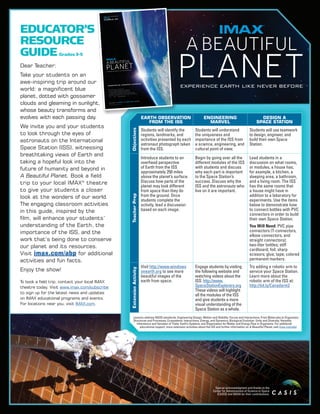
Introduce students to an
overhead perspective
of Earth from the ISS
approximately 250 miles
above the planet’s surface.
Discuss how parts of the
planet may look different
from space than they do
from the ground. Once
students complete the
activity, lead a discussion
based on each image.
Begin by going over all the
different modules of the ISS
with students and discuss
why each part is important
to the Space Station’s
success. Discuss why the
ISS and the astronauts who
live on it are important.
Lead students in a
discussion on what rooms,
or modules, a house has;
for example, a kitchen, a
sleeping area, a bathroom,
and a living room. The ISS
has the same rooms that
a house might have in
addition to a laboratory for
experiments. Use the items
below to demonstrate how
to connect bottles with PVC
connectors in order to build
their own Space Station.
You Will Need: PVC pipe
connectors (T-connectors,
elbow connectors, and
straight connectors);
two-liter bottles; stiff
cardboard; foil; sharp
scissors; glue; tape; colored
permanent markers.
ExtensionActivity
Visit http://www.windows
onearth.org to see more
beautiful images of the
earth from space.
Engage students by visiting
the following website and
watching videos about the
ISS: http://www.
SpaceStationExplorers.org
These videos will highlight
all the modules of the ISS
and give students a more
visual understanding of the
Space Station as a whole.
Try adding a robotic arm to
service your Space Station.
Learn more about the
robotic arm of the ISS at:
http://bit.ly/Canadarm2
Special acknowledgment and thanks to the
Center for Advancement of Science in Space
(CASIS) and NASA for their contributions.
Dear Teacher:
Take your students on an
awe-inspiring trip around our
world: a magnificent blue
planet, dotted with gossamer
clouds and gleaming in sunlight,
whose beauty transforms and
evolves with each passing day.
We invite you and your students
to look through the eyes of
astronauts on the International
Space Station (ISS), witnessing
breathtaking views of Earth and
taking a hopeful look into the
future of humanity and beyond in
A Beautiful Planet. Book a field
trip to your local IMAX®
theatre
to give your students a closer
look at the wonders of our world.
The engaging classroom activities
in this guide, inspired by the
film, will enhance your students’
understanding of the Earth, the
importance of the ISS, and the
work that’s being done to conserve
our planet and its resources.
Visit imax.com/abp for additional
activities and fun facts.
Enjoy the show!
To book a field trip, contact your local IMAX
theatre today. Visit www.imax.com/subscribe
to sign up for the latest news and updates
on IMAX educational programs and events.
For locations near you, visit IMAX.com.
EDUCATOR’S
RESOURCE
GUIDEGrades 3-5
Lessons address NGSS standards: Engineering Design; Motion and Stability: Forces and Interactions; From Molecules to Organisms:
Structures and Processes; Ecosystems: Interactions, Energy, and Dynamics; Biological Evolution: Unity and Diversity; Heredity:
Inheritance and Variation of Traits; Earth’s Systems; and Organization for Matter and Energy Flow in Organisms. For additional
educational support, more extension activities about the ISS and further information on A Beautiful Planet, visit imax.com/abp
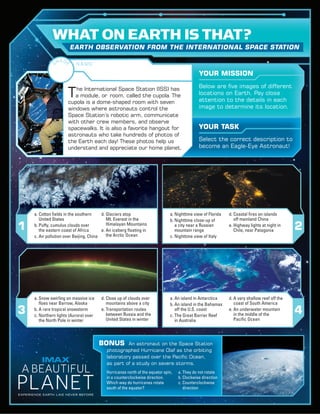
T‌he International Space Station (ISS) has
a module, or ‌room, called the cupola. The
cupola is a dome-shaped room with seven
windows where astronauts control the
Space Station’s robotic arm, communicate
with other crew members, and observe
spacewalks. It is also a favorite hangout for
astronauts who take hundreds of photos of
the Earth each day! These photos help us
understand and appreciate our home planet.
Below are five images of different
locations on Earth. Pay close
attention to the details in each
image to determine its location.
Select the correct description to
become an Eagle-Eye Astronaut!
YOUR MISSION
YOUR TASK
a. Nighttime view of Florida
b. Nighttime close-up of
a city near a Russian
mountain range
c. Nighttime view of Italy
d. Coastal fires on islands
off mainland China
e. Highway lights at night in
Chile, near Patagonia
a. Cotton fields in the southern
United States
b. Puffy, cumulus clouds over
the eastern coast of Africa
c. Air pollution over Beijing, China
d. Glaciers atop
Mt. Everest in the
Himalayan Mountains
e. An iceberg floating in
the Arctic Ocean
a. Snow swirling on massive ice
floes near Barrow, Alaska
b. A rare tropical snowstorm
c. Northern lights (Aurora) over
the North Pole in winter
d. Close up of clouds over
mountains above a city
e. Transportation routes
between Russia and the
United States in winter
a. An island in Antarctica
b. An island in the Bahamas
off the U.S. coast
c. The Great Barrier Reef
in Australia
d. A very shallow reef off the
coast of South America
e. An underwater mountain
in the middle of the
Pacific Ocean
BONUS	 An astronaut on the Space Station
photographed Hurricane Olaf as the orbiting
laboratory passed over the Pacific Ocean,
as part of a study on severe storms.
WHAT ON EARTH IS THAT?
EARTH OBSERVATION FROM THE INTERNATIONAL SPACE STATION
Hurricanes north of the equator spin,
in a counterclockwise direction.
Which way do hurricanes rotate
south of the equator?
a. They do not rotate
b. Clockwise direction
c. Counterclockwise
direction
N A M E
3 4
1 2
RG
ADE
T
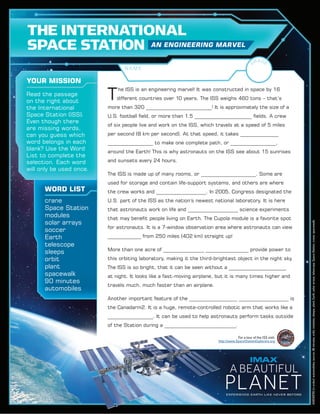
‌he ISS is an engineering marvel! It was constructed in space by 16
different countries over 10 years. The ISS weighs 460 tons – that’s
more than 320 ___________________________! It is approximately the size of a
U.S. football field, or more than 1.5 ________________________ fields. A crew
of six people live and work on the ISS, which travels at a speed of 5 miles
per second (8 km per second). At that speed, it takes ________________
___________________ to make one complete path, or ___________________,
around the Earth! This is why astronauts on the ISS see about 15 sunrises
and sunsets every 24 hours.
The ISS is made up of many rooms, or _______________________. Some are
used for storage and contain life-support systems, and others are where
the crew works and _____________________. In 2005, Congress designated the
U.S. part of the ISS as the nation’s newest national laboratory. It is here
that astronauts work on life and _____________________ science experiments
that may benefit people living on Earth. The Cupola module is a favorite spot
for astronauts. It is a 7-window observation area where astronauts can view
______________ from 250 miles (402 km) straight up!
More than one acre of _________________ __________________ provide power to
this orbiting laboratory, making it the third-brightest object in the night sky.
The ISS is so bright, that it can be seen without a ________________________
at night. It looks like a fast-moving airplane, but it is many times higher and
travels much, much faster than an airplane.
Another important feature of the ____________________ _____________________ is
the Canadarm2. It is a huge, remote-controlled robotic arm that works like a
___________________. It can be used to help astronauts perform tasks outside
of the Station during a ______________________________.
crane
Space Station
modules
solar arrays
soccer
Earth
telescope
sleeps
orbit
plant
spacewalk
90 minutes
automobiles
YOUR MISSION
WORD LIST
THE INTERNATIONAL
SPACE STATION AN ENGINEERING MARVEL
N A M E
Read the passage
on the right about
the International
Space Station (ISS).
Even though there
are missing words,
can you guess which
word belongs in each
blank? Use the Word
List to complete the
selection. Each word
will only be used once.
For a tour of the ISS visit:
http://www.SpaceStationExplorers.org
RG
ADE
ANSWERS(inorder):automobiles,soccer,90minutes,orbit,modules,sleeps,plant,Earth,solararrays,telescope,SpaceStation,crane,spacewalk.
Cut out a window in the
	 side of each one of the
bottles and design the inside of
each room, or module.
	 Work as a team to
	 brainstorm a design
for your Space Station. What does a
Space Station need to keep humans alive?
What is it like to live in space? Would you float
instead of walk? How would you sleep? How would
you exercise? How will you provide electricity for
living and working?
Connect your Space Station’s
modules using glue and PVC joints.
You can use tape to hold the joints
together while the glue dries.
4 ASSEMBLE
3 DESIGN
	 Examine the materials your teacher has
	 made available. Make a list of the materials
you will use to create your Space Station and draw
a sketch of your team’s design before you build it.
2 LIST
N A M E
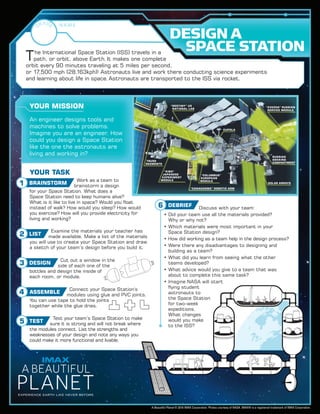
T‌he International Space Station (ISS) travels in a
path, or orbit, above Earth.It makes one complete
orbit every 90 minutes traveling at 5 miles per second,
or 17,500 mph (28,163kph)! Astronauts live and work there conducting science experiments
and learning about life in space.Astronauts are transported to the ISS via rocket.
An engineer designs tools and
machines to solve problems.
Imagine you are an engineer. How
could you design a Space Station
like the one the astronauts are
living and working in?
YOUR MISSION
YOUR TASK
BRAINSTORM1
DESIGNA
	 SPACE STATION
“DESTINY” US
NATIONAL LAB
TRUSS
SEGMENTS
“KIBO”
JAPANESE
EXPERIMENT
MODULE
“CANADARM2” ROBOTIC ARM
“COLUMBUS”
EUROPEAN
MODULE
“ZVEZDA” RUSSIAN
SERVICE MODULE
RUSSIAN
DOCKING
COMPARTMENT
SOLAR ARRAYS
CUPOLA
5
	 Test your team’s Space Station to make
sure it is strong and will not break where
the modules connect. List the strengths and
weaknesses of your design and note any ways you
could make it more functional and livable.
TEST
RG
ADE
DEBRIEF6 Discuss with your team:
• Did your team use all the materials provided?
Why or why not?
• Which materials were most important in your
Space Station design?
• How did working as a team help in the design process?
• Were there any disadvantages to designing and
building as a team?
• What did you learn from seeing what the other
teams developed?
• What advice would you give to a team that was
about to complete this same task?
• Imagine NASA will start
flying student
astronauts to
the Space Station
for two-week
expeditions.
What changes
would you make
to the ISS?
A Beautiful Planet © 2016 IMAX Corporation. Photos courtesy of NASA. IMAX® is a registered trademark of IMAX Corporation.

BeauPlanet

  • 2.
    EARTH OBSERVATION FROM THEISS ENGINEERING MARVEL DESIGN A SPACE STATION Objectives Students will identify the regions, landmarks, and activities presented by each astronaut photograph taken from the ISS. Students will understand the uniqueness and importance of the ISS from a science, engineering, and cultural point of view. Students will use teamwork to design, engineer, and build their own Space Station. TeacherPrep Introduce students to an overhead perspective of Earth from the ISS approximately 250 miles above the planet’s surface. Discuss how parts of the planet may look different from space than they do from the ground. Once students complete the activity, lead a discussion based on each image. Begin by going over all the different modules of the ISS with students and discuss why each part is important to the Space Station’s success. Discuss why the ISS and the astronauts who live on it are important. Lead students in a discussion on what rooms, or modules, a house has; for example, a kitchen, a sleeping area, a bathroom, and a living room. The ISS has the same rooms that a house might have in addition to a laboratory for experiments. Use the items below to demonstrate how to connect bottles with PVC connectors in order to build their own Space Station. You Will Need: PVC pipe connectors (T-connectors, elbow connectors, and straight connectors); two-liter bottles; stiff cardboard; foil; sharp scissors; glue; tape; colored permanent markers. ExtensionActivity Visit http://www.windows onearth.org to see more beautiful images of the earth from space. Engage students by visiting the following website and watching videos about the ISS: http://www. SpaceStationExplorers.org These videos will highlight all the modules of the ISS and give students a more visual understanding of the Space Station as a whole. Try adding a robotic arm to service your Space Station. Learn more about the robotic arm of the ISS at: http://bit.ly/Canadarm2 Special acknowledgment and thanks to the Center for Advancement of Science in Space (CASIS) and NASA for their contributions. Dear Teacher: Take your students on an awe-inspiring trip around our world: a magnificent blue planet, dotted with gossamer clouds and gleaming in sunlight, whose beauty transforms and evolves with each passing day. We invite you and your students to look through the eyes of astronauts on the International Space Station (ISS), witnessing breathtaking views of Earth and taking a hopeful look into the future of humanity and beyond in A Beautiful Planet. Book a field trip to your local IMAX® theatre to give your students a closer look at the wonders of our world. The engaging classroom activities in this guide, inspired by the film, will enhance your students’ understanding of the Earth, the importance of the ISS, and the work that’s being done to conserve our planet and its resources. Visit imax.com/abp for additional activities and fun facts. Enjoy the show! To book a field trip, contact your local IMAX theatre today. Visit www.imax.com/subscribe to sign up for the latest news and updates on IMAX educational programs and events. For locations near you, visit IMAX.com. EDUCATOR’S RESOURCE GUIDEGrades 3-5 Lessons address NGSS standards: Engineering Design; Motion and Stability: Forces and Interactions; From Molecules to Organisms: Structures and Processes; Ecosystems: Interactions, Energy, and Dynamics; Biological Evolution: Unity and Diversity; Heredity: Inheritance and Variation of Traits; Earth’s Systems; and Organization for Matter and Energy Flow in Organisms. For additional educational support, more extension activities about the ISS and further information on A Beautiful Planet, visit imax.com/abp
  • 3.
    T‌he International SpaceStation (ISS) has a module, or ‌room, called the cupola. The cupola is a dome-shaped room with seven windows where astronauts control the Space Station’s robotic arm, communicate with other crew members, and observe spacewalks. It is also a favorite hangout for astronauts who take hundreds of photos of the Earth each day! These photos help us understand and appreciate our home planet. Below are five images of different locations on Earth. Pay close attention to the details in each image to determine its location. Select the correct description to become an Eagle-Eye Astronaut! YOUR MISSION YOUR TASK a. Nighttime view of Florida b. Nighttime close-up of a city near a Russian mountain range c. Nighttime view of Italy d. Coastal fires on islands off mainland China e. Highway lights at night in Chile, near Patagonia a. Cotton fields in the southern United States b. Puffy, cumulus clouds over the eastern coast of Africa c. Air pollution over Beijing, China d. Glaciers atop Mt. Everest in the Himalayan Mountains e. An iceberg floating in the Arctic Ocean a. Snow swirling on massive ice floes near Barrow, Alaska b. A rare tropical snowstorm c. Northern lights (Aurora) over the North Pole in winter d. Close up of clouds over mountains above a city e. Transportation routes between Russia and the United States in winter a. An island in Antarctica b. An island in the Bahamas off the U.S. coast c. The Great Barrier Reef in Australia d. A very shallow reef off the coast of South America e. An underwater mountain in the middle of the Pacific Ocean BONUS An astronaut on the Space Station photographed Hurricane Olaf as the orbiting laboratory passed over the Pacific Ocean, as part of a study on severe storms. WHAT ON EARTH IS THAT? EARTH OBSERVATION FROM THE INTERNATIONAL SPACE STATION Hurricanes north of the equator spin, in a counterclockwise direction. Which way do hurricanes rotate south of the equator? a. They do not rotate b. Clockwise direction c. Counterclockwise direction N A M E 3 4 1 2 RG ADE
  • 4.
    T ‌he ISS isan engineering marvel! It was constructed in space by 16 different countries over 10 years. The ISS weighs 460 tons – that’s more than 320 ___________________________! It is approximately the size of a U.S. football field, or more than 1.5 ________________________ fields. A crew of six people live and work on the ISS, which travels at a speed of 5 miles per second (8 km per second). At that speed, it takes ________________ ___________________ to make one complete path, or ___________________, around the Earth! This is why astronauts on the ISS see about 15 sunrises and sunsets every 24 hours. The ISS is made up of many rooms, or _______________________. Some are used for storage and contain life-support systems, and others are where the crew works and _____________________. In 2005, Congress designated the U.S. part of the ISS as the nation’s newest national laboratory. It is here that astronauts work on life and _____________________ science experiments that may benefit people living on Earth. The Cupola module is a favorite spot for astronauts. It is a 7-window observation area where astronauts can view ______________ from 250 miles (402 km) straight up! More than one acre of _________________ __________________ provide power to this orbiting laboratory, making it the third-brightest object in the night sky. The ISS is so bright, that it can be seen without a ________________________ at night. It looks like a fast-moving airplane, but it is many times higher and travels much, much faster than an airplane. Another important feature of the ____________________ _____________________ is the Canadarm2. It is a huge, remote-controlled robotic arm that works like a ___________________. It can be used to help astronauts perform tasks outside of the Station during a ______________________________. crane Space Station modules solar arrays soccer Earth telescope sleeps orbit plant spacewalk 90 minutes automobiles YOUR MISSION WORD LIST THE INTERNATIONAL SPACE STATION AN ENGINEERING MARVEL N A M E Read the passage on the right about the International Space Station (ISS). Even though there are missing words, can you guess which word belongs in each blank? Use the Word List to complete the selection. Each word will only be used once. For a tour of the ISS visit: http://www.SpaceStationExplorers.org RG ADE ANSWERS(inorder):automobiles,soccer,90minutes,orbit,modules,sleeps,plant,Earth,solararrays,telescope,SpaceStation,crane,spacewalk.
  • 5.
    Cut out awindow in the side of each one of the bottles and design the inside of each room, or module. Work as a team to brainstorm a design for your Space Station. What does a Space Station need to keep humans alive? What is it like to live in space? Would you float instead of walk? How would you sleep? How would you exercise? How will you provide electricity for living and working? Connect your Space Station’s modules using glue and PVC joints. You can use tape to hold the joints together while the glue dries. 4 ASSEMBLE 3 DESIGN Examine the materials your teacher has made available. Make a list of the materials you will use to create your Space Station and draw a sketch of your team’s design before you build it. 2 LIST N A M E T‌he International Space Station (ISS) travels in a path, or orbit, above Earth.It makes one complete orbit every 90 minutes traveling at 5 miles per second, or 17,500 mph (28,163kph)! Astronauts live and work there conducting science experiments and learning about life in space.Astronauts are transported to the ISS via rocket. An engineer designs tools and machines to solve problems. Imagine you are an engineer. How could you design a Space Station like the one the astronauts are living and working in? YOUR MISSION YOUR TASK BRAINSTORM1 DESIGNA SPACE STATION “DESTINY” US NATIONAL LAB TRUSS SEGMENTS “KIBO” JAPANESE EXPERIMENT MODULE “CANADARM2” ROBOTIC ARM “COLUMBUS” EUROPEAN MODULE “ZVEZDA” RUSSIAN SERVICE MODULE RUSSIAN DOCKING COMPARTMENT SOLAR ARRAYS CUPOLA 5 Test your team’s Space Station to make sure it is strong and will not break where the modules connect. List the strengths and weaknesses of your design and note any ways you could make it more functional and livable. TEST RG ADE DEBRIEF6 Discuss with your team: • Did your team use all the materials provided? Why or why not? • Which materials were most important in your Space Station design? • How did working as a team help in the design process? • Were there any disadvantages to designing and building as a team? • What did you learn from seeing what the other teams developed? • What advice would you give to a team that was about to complete this same task? • Imagine NASA will start flying student astronauts to the Space Station for two-week expeditions. What changes would you make to the ISS? A Beautiful Planet © 2016 IMAX Corporation. Photos courtesy of NASA. IMAX® is a registered trademark of IMAX Corporation.