How I learned
to stop worrying and
love atomic()
Database integrity fundamentals in Django
Nick Sweeting
@theSquashSH
Nick	Swee)ng	
@theSquashSH	
Co-Founder/CTO	@	Monadical.com	


We	built	OddSlingers.com,	a	fast,	clean	online	poker	
experience	made	with	Django	+	Channels	&	React/Redux.	
We	learned	a	lot	about	database	integrity	along	the	way.
Background
Disclaimer:	I	am	not		
a	distributed	systems	expert.	
I	just	think	they're	neat.
It	all	starts	with	a	single	salami	slice.
It	ends	with	millions	of	dollars	missing.
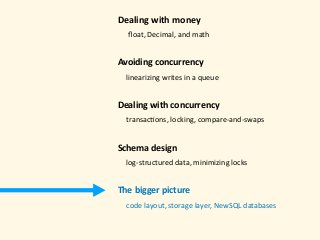
Dealing	with	money

					float,	Decimal,	and	math

Avoiding	concurrency	
				linearizing	writes	in	a	queue

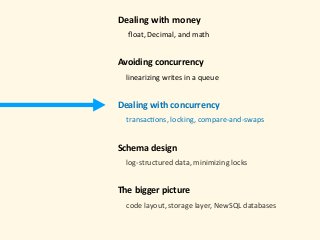
Dealing	with	concurrency

				transac)ons,	locking,	compare-and-swaps

Schema	design

				log-structured	data,	minimizing	locks

The	bigger	picture

				code	layout,	storage	layer,	NewSQL	databases
Dealing With Money


float,	Decimal,	&	math
Losing	track	of	frac)onal	cents
(aka	salami	slicing)
I know you're tempted,

don't even try it...

salami slicers all 

get caught eventually
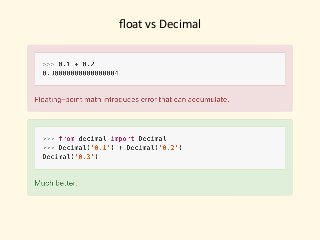
float	vs	Decimal
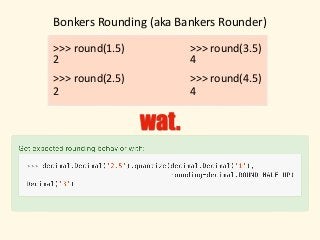
Bonkers	Rounding	(aka	Bankers	Rounder)
>>>	round(1.5)
>>>	round(2.5)
2
2
wat.
>>>	round(3.5)
>>>	round(4.5)
4
4
Dealing	with	money

					float,	Decimal,	and	math

Avoiding	concurrency	
				linearizing	writes	in	a	queue

Dealing	with	concurrency

				transac)ons,	locking,	compare-and-swaps

Schema	design

				log-structured	data,	minimizing	locks

The	bigger	picture

				code	layout,	storage	layer,	NewSQL	databases
Avoid Concurrency


Eliminate	the	dragons.
?
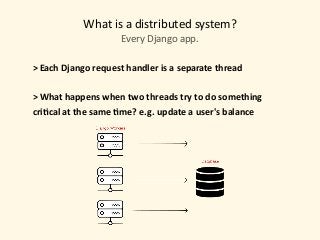
What	is	a	distributed	system?
Every	Django	app.
>	Each	Django	request	handler	is	a	separate	thread	
>	What	happens	when	two	threads	try	to	do	something	
cri?cal	at	the	same	?me?	e.g.	update	a	user's	balance

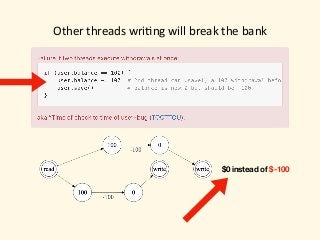
Other	threads	wri)ng	will	break	the	bank
$0 instead of $-100
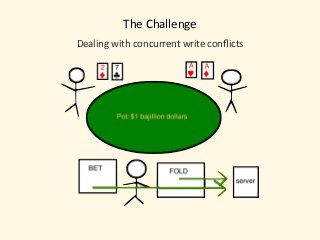
The	Challenge
Dealing	with	concurrent	write	conflicts
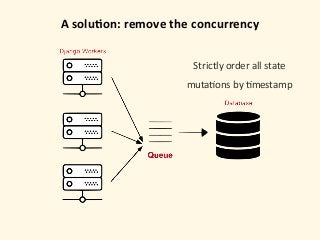
A	solu?on:	remove	the	concurrency
Strictly	order	all	state	

muta)ons	by	)mestamp
Linearize	all	the	writes	into	a	single	queue
transactions = [
# timestamp condition action
(1523518620, "can_deposit(241)" , "deposit_usd(241, 50)"),
(1523518634, "balance_gt(241, 50)", "buy_chips(241, 50)"),
]
If	only	one	change	happens	at	a	)me,	
no	conflic)ng	writes	can	occur.
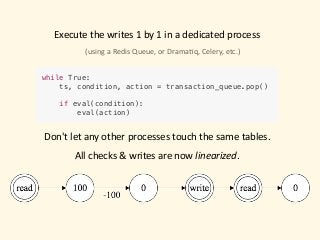
Execute	the	writes	1	by	1	in	a	dedicated	process
while True:
ts, condition, action = transaction_queue.pop()
if eval(condition):
eval(action)
(using	a	Redis	Queue,	or	Drama)q,	Celery,	etc.)
Don't	let	any	other	processes	touch	the	same	tables.	
All	checks	&	writes	are	now	linearized.
If	you	value	your	sanity,	
linearize	cri)cal	transac)ons	into	a	single	queue	
whenever	possible.

Don't	even	watch	the	rest	of	the	talk,	
just	stop	now,	really,	you	probably	don't	need	concurrency...
Eliminate	concurrency	at	all	costs.
Dealing	with	money

					float,	Decimal,	and	math

Avoiding	concurrency	
				linearizing	writes	in	a	queue

Dealing	with	concurrency

				transac)ons,	locking,	compare-and-swaps

Schema	design

				log-structured	data,	minimizing	locks

The	bigger	picture

				code	layout,	storage	layer,	NewSQL	databases
Dealing With Concurrency

transac)ons,	locking,	compare-and-swaps

I	warned	you	about	the	dragons...	
❤
!
❤
❤
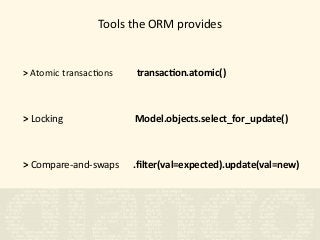
Tools	the	ORM	provides
>	Atomic	transac)ons										transac?on.atomic()	
>	Locking																														Model.objects.select_for_update()	
>	Compare-and-swaps						.filter(val=expected).update(val=new)

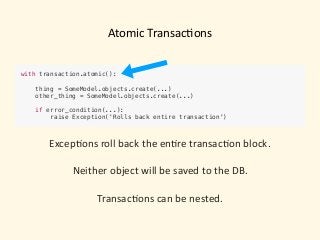
Atomic	Transac)ons
with transaction.atomic():


thing = SomeModel.objects.create(...)
other_thing = SomeModel.objects.create(...)


if error_condition(...):

raise Exception('Rolls back entire transaction')
Excep)ons	roll	back	the	en)re	transac)on	block.	
Neither	object	will	be	saved	to	the	DB.


Transac)ons	can	be	nested.
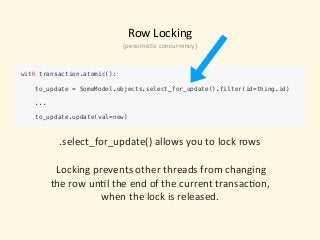
Row	Locking
with transaction.atomic():


to_update = SomeModel.objects.select_for_update().filter(id=thing.id)
...


to_update.update(val=new)
.select_for_update()	allows	you	to	lock	rows	
	Locking	prevents	other	threads	from	changing	
the	row	un)l	the	end	of	the	current	transac)on,		
when	the	lock	is	released.
(pessimis)c	concurrency)
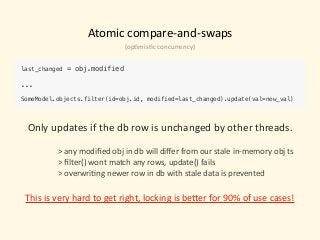
Atomic	compare-and-swaps
last_changed = obj.modified

...


SomeModel.objects.filter(id=obj.id, modified=last_changed).update(val=new_val)
Only	updates	if	the	db	row	is	unchanged	by	other	threads.	


>	any	modified	obj	in	db	will	differ	from	our	stale	in-memory	obj	ts	
>	filter()	wont	match	any	rows,	update()	fails	
>	overwri)ng	newer	row	in	db	with	stale	data	is	prevented	
This	is	very	hard	to	get	right,	locking	is	beeer	for	90%	of	use	cases!
(op)mis)c	concurrency)
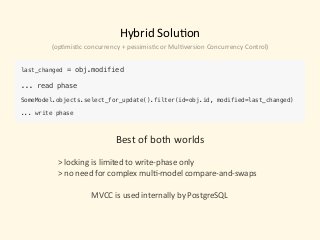
Hybrid	Solu)on
last_changed = obj.modified

... read phase


SomeModel.objects.select_for_update().filter(id=obj.id, modified=last_changed)


... write phase
Best	of	both	worlds	


>	locking	is	limited	to	write-phase	only	
>	no	need	for	complex	mul)-model	compare-and-swaps	
																	MVCC	is	used	internally	by	PostgreSQL
(op)mis)c	concurrency	+	pessimis)c	or	Mul)version	Concurrency	Control)
Dealing	with	money

					float,	Decimal,	and	math

Avoiding	concurrency	
				linearizing	writes	in	a	queue

Dealing	with	concurrency

				transac)ons,	locking,	compare-and-swaps

Schema	design

				log-structured	data,	minimizing	locks

The	bigger	picture

				code	layout,	storage	layer,	NewSQL	databases
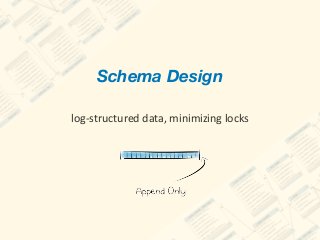
Schema Design

log-structured	data,	minimizing	locks
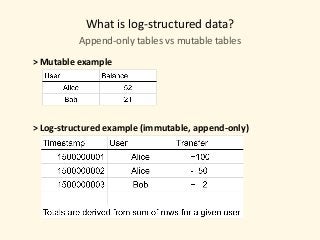
What	is	log-structured	data?
Append-only	tables	vs	mutable	tables
>	Mutable	example	
					User.balance	=	100	


>	Log-structured	example	(immutable,	append-only)	
					User.balance	=	()	=>	
										sum(BalanceTransfer.objects	
																																	.filter(user=user)	
																																	.values_list('amt',	flat=True))
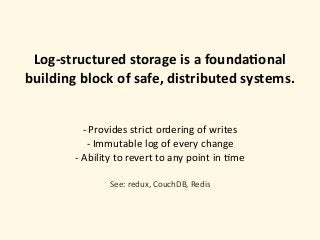
Log-structured	storage	is	a	founda?onal	
building	block	of	safe,	distributed	systems.
-	Provides	strict	ordering	of	writes	
-	Immutable	log	of	every	change	
-	Ability	to	revert	to	any	point	in	)me	


See:	redux,	CouchDB,	Redis
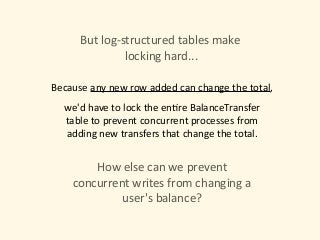
But	log-structured	tables	make	
	locking	hard...
we'd	have	to	lock	the	en)re	BalanceTransfer	
table	to	prevent	concurrent	processes	from	
adding	new	transfers	that	change	the	total.
How	else	can	we	prevent	
concurrent	writes	from	changing	a	
user's	balance?
Because	any	new	row	added	can	change	the	total,
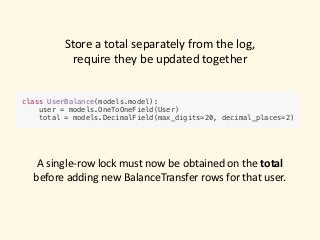
Store	a	total	separately	from	the	log,		
require	they	be	updated	together
class UserBalance(models.model):
user = models.OneToOneField(User)
total = models.DecimalField(max_digits=20, decimal_places=2)
A	single-row	lock	must	now	be	obtained	on	the	total	
before	adding	new	BalanceTransfer	rows	for	that	user.
Full	example	using	locking
def send_money(src, dst, amt):
with transaction.atomic():
# Lock balance rows, preventing other threads from making changes
src_bal = UserBalance.objects.select_for_update().filter(id=src)

dst_bal = UserBalance.objects.select_for_update().filter(id=dst)
if src_bal[0].total < amt:
raise Exception('Not enough balance to complete transaction')
# Update the totals and add a BalanceTransfer log row together
BalanceTransfer.objects.create(src=src, dst=dst, amt=amt)
src_bal.update(total=F('total') - amt)
dst_bal.update(total=F('total') + amt)
Side	benefit:	no	need	to	scan	en)re	BalanceTransfer		
table	anymore	to	get	a	user's	balance
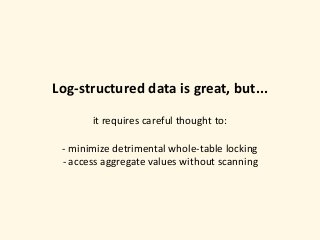
Log-structured	data	is	great,	but...	
it	requires	careful	thought	to:	
-	minimize	detrimental	whole-table	locking

-	access	aggregate	values	without	scanning
Dealing	with	money

					float,	Decimal,	and	math

Avoiding	concurrency	
				linearizing	writes	in	a	queue

Dealing	with	concurrency

				transac)ons,	locking,	compare-and-swaps

Schema	design

				log-structured	data,	minimizing	locks

The	bigger	picture

				code	layout,	storage	layer,	NewSQL	databases
The bigger picture

code	layout,	storage	layer,	NewSQL	databases	


What	happens	when	the	bueerflies	flip	your	bits?
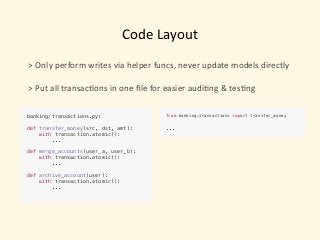
Code	Layout
>	Only	perform	writes	via	helper	funcs,	never	update	models	directly	


>	Put	all	transac)ons	in	one	file	for	easier	audi)ng	&	tes)ng
banking/transactions.py:


def transfer_money(src, dst, amt):
with transaction.atomic():
...
def merge_accounts(user_a, user_b):
with transaction.atomic():
...
def archive_account(user):
with transaction.atomic():
...
from banking.transactions import transfer_money
...
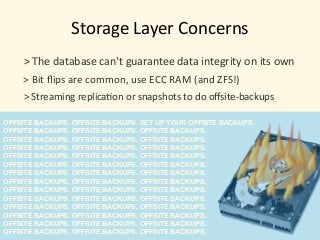
OFFSITE BACKUPS. OFFSITE BACKUPS. SET UP YOUR OFFSITE BACKUPS.
OFFSITE BACKUPS. OFFSITE BACKUPS. OFFSITE BACKUPS.
Storage	Layer	Concerns
>	Bit	flips	are	common,	use	ECC	RAM	(and	ZFS!)
>	The	database	can't	guarantee	data	integrity	on	its	own
>	Streaming	replica)on	or	snapshots	to	do	offsite-backups
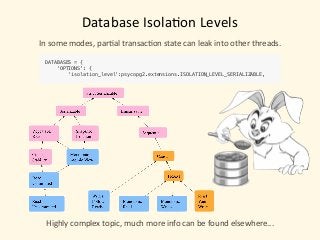
Database	Isola)on	Levels
In	some	modes,	par)al	transac)on	state	can	leak	into	other	threads.
DATABASES = {

'OPTIONS': {

'isolation_level':psycopg2.extensions.ISOLATION_LEVEL_SERIALIZABLE,
Highly	complex	topic,	much	more	info	can	be	found	elsewhere...
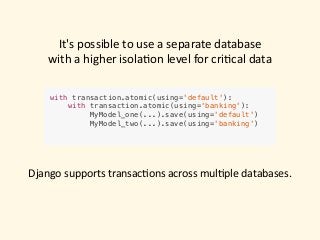
It's	possible	to	use	a	separate	database	
with	a	higher	isola)on	level	for	cri)cal	data
with transaction.atomic(using='default'):
with transaction.atomic(using='banking'):
MyModel_one(...).save(using='default')
MyModel_two(...).save(using='banking')
Django	supports	transac)ons	across	mul)ple	databases.
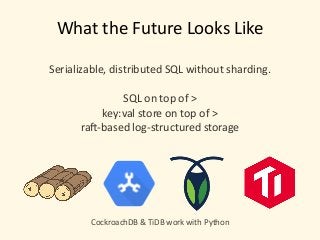
What	the	Future	Looks	Like

Serializable,	distributed	SQL	without	sharding.	
SQL	on	top	of	>	
key:val	store	on	top	of	>	
ran-based	log-structured	storage	
CockroachDB	&	TiDB	work	with	Python
Dealing	with	money

					float,	Decimal,	and	math

Avoiding	concurrency	
				linearizing	writes	in	a	queue

Dealing	with	concurrency

				transac)ons,	locking,	compare-and-swaps

Schema	design

				log-structured	data,	minimizing	locks

The	bigger	picture

				code	layout,	storage	layer,	NewSQL	databases
The End
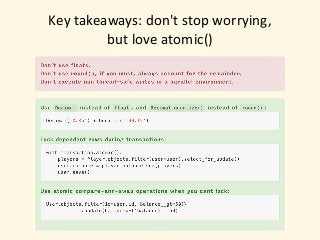
Key	takeaways:	don't	stop	worrying,	
but	love	atomic()
Special	thanks	to:	
Django	Core	Team	&	Contributors,	

PyGotham	Organizers,	Andrew	Godwin,		
Aphyr,	Tyler	Neely	
Final	Disclaimer:	I'm	not	qualified	to	tell	you	how	to		
design	your	distributed	system.	Get	a	professional	for	that.	


I	can	only	show	you	challenges	and	solu)ons	I've	discovered	in	my	personal	
adventures	with	Django.		Please	let	me	know	if	you	have	correc)ons!	


Monadical	is	hiring	remote	developers!	
Ping	me	@theSquashSH	on	Twieer!
Q&A

How I Learned to Stop Worrying and Love atomic(): Banking Blunders & Concurrency Challenges