PubChem as a Biologics
Database
Noel O’Boyle and Roger Sayle
NextMove Software
Evan Bolton
PubChem, NCBI-NIH
254th ACS National Meeting Washington Aug 2017
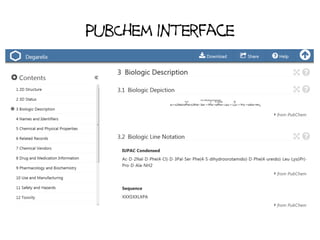
PubChem Interface
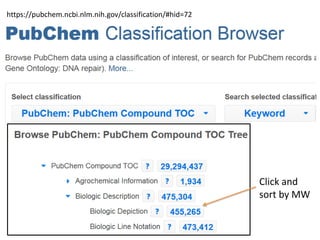
https://pubchem.ncbi.nlm.nih.gov/classification/#hid=72
Click and
sort by MW
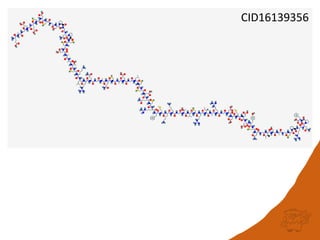
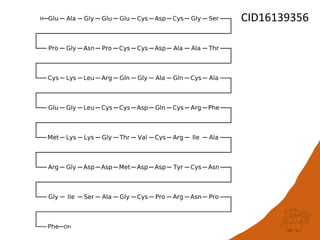
CID16139356
CID16139356
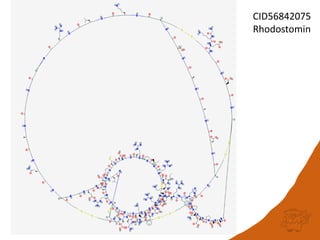
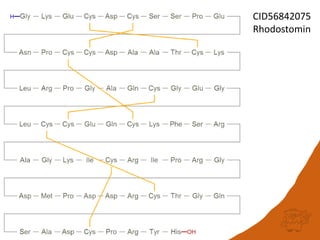
CID56842075
Rhodostomin
CID56842075
Rhodostomin
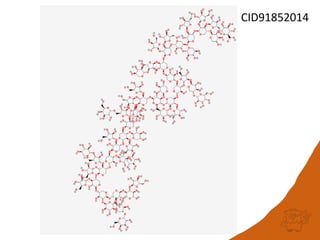
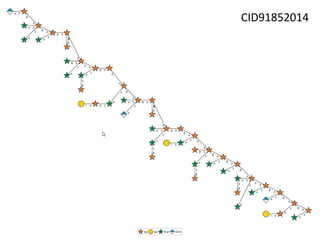
CID91852014
CID91852014
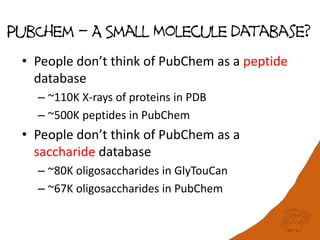
PubChem – A Small Molecule database?
• People don’t think of PubChem as a peptide
database
– ~110K X-rays of proteins in PDB
– ~500K peptides in PubChem
• People don’t think of PubChem as a
saccharide database
– ~80K oligosaccharides in GlyTouCan
– ~67K oligosaccharides in PubChem
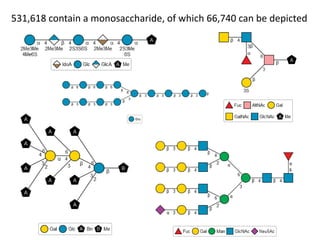
531,618 contain a monosaccharide, of which 66,740 can be depicted
How many MonoSaccharides present?
L-Glcf, Mans, 2-deoxy-D-manHept, 3-deoxy-D-glcOct2ulo-onic
a-Man, 3,4-deoxy-a-D-eryHex, b-Tyv
Xylf5Me, a-L-ManNAc3Ac4Ac6Ac, Glc2P3P6P
AltA, Glc, L-Man, L-Gal, Fru, L-gro-D-glcHept
113 aldoses, ketoses, aldonic and uronic acids with from 5-9 carbons
407 including deoxy variants, ring variants
7094 including common substituents at non-
anomeric positions
26641 including any substituent anywhere
Bz(-2)[Tos(-3)]Ara4Ac(b)-O-Me, TMS(-4)[TMS(-6)]GlcNAc3Me(a)-O-Me
971 including anomeric stereo
* This analysis excludes monosaccharides with missing stereochemistry
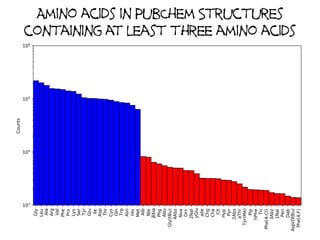
Amino acids in PubChem Structures
containing at least three amino acids
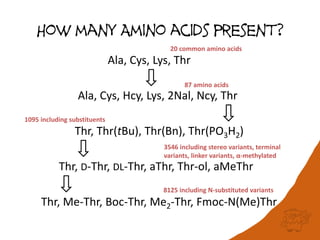
How many Amino acids present?
Ala, Cys, Hcy, Lys, 2Nal, Ncy, Thr
Thr, Thr(tBu), Thr(Bn), Thr(PO3H2)
Thr, D-Thr, DL-Thr, aThr, Thr-ol, aMeThr
Thr, Me-Thr, Boc-Thr, Me2-Thr, Fmoc-N(Me)Thr
Ala, Cys, Lys, Thr
20 common amino acids
87 amino acids
1095 including substituents
3546 including stereo variants, terminal
variants, linker variants, α-methylated
8125 including N-substituted variants
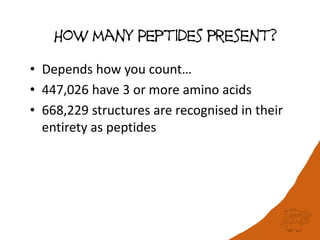
• Depends how you count…
• 447,026 have 3 or more amino acids
• 668,229 structures are recognised in their
entirety as peptides
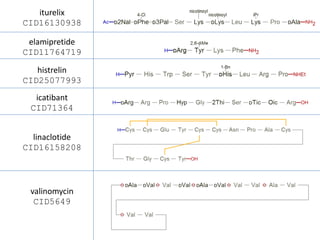
How many Peptides present?
iturelix
CID16130938
elamipretide
CID11764719
histrelin
CID25077993
icatibant
CID71364
linaclotide
CID16158208
valinomycin
CID5649
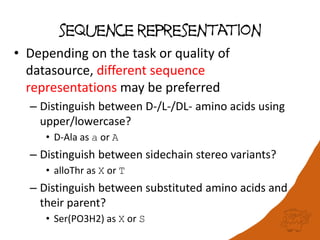
sequence representation
• Depending on the task or quality of
datasource, different sequence
representations may be preferred
– Distinguish between D-/L-/DL- amino acids using
upper/lowercase?
• D-Ala as a or A
– Distinguish between sidechain stereo variants?
• alloThr as X or T
– Distinguish between substituted amino acids and
their parent?
• Ser(PO3H2) as X or S
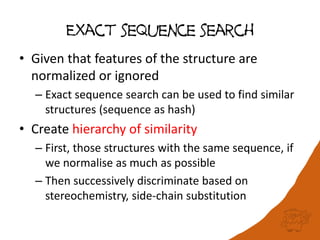
Exact sequence search
• Given that features of the structure are
normalized or ignored
– Exact sequence search can be used to find similar
structures (sequence as hash)
• Create hierarchy of similarity
– First, those structures with the same sequence, if
we normalise as much as possible
– Then successively discriminate based on
stereochemistry, side-chain substitution
Search for Kemptide: LRRASLG
LRRASLG
LRRASLG
Ac-DL-Leu-DL-Arg-DL-Arg-DL-Ala-DL-Ser-DL-Leu-Gly-OH 78069426 acetyl-kemptide
Ac-Leu-Arg-Arg-Ala-Ser-Leu-Gly-OH 71429096 acetyl-kemptide
H-DL-Leu-DL-Arg-DL-Arg-DL-Ala-DL-Ser-DL-Leu-Gly-NH2 85062657 kemptide amide
H-DL-Leu-DL-Arg-DL-Arg-DL-Ala-DL-Ser-DL-Leu-Gly-OH 100074 kemptide
H-DL-Leu-DL-Arg-DL-Arg-DL-Ala-DL-Ser-DL-Leu-Gly-OH.TFA 118797564
H-Leu-Arg-Arg-Ala-Ser-Leu-Gly-NH2 9897033 kemptide amide
H-Leu-Arg-Arg-Ala-Ser-Leu-Gly-OH 9962276 kemptide
Unk-Leu-Arg-Arg-Ala-Ser-Leu-Gly-OH 11650926,101224399,101878757
LRRAXLG
H-Leu-Arg-Arg-Ala-Ser(PO3H2)-Leu-Gly-NH2 102212089 [Ser(PO3H2)-5]kemptide amide
H-Leu-Arg-Arg-Ala-Ser(PO3H2)-Leu-Gly-OH 13783725 [Ser(PO3H2)-5]kemptide
LRraSLG
LRraSLG
H-Leu-Arg-D-Arg-D-Ala-Ser-Leu-Gly-OH 53393688 [D-Arg3,D-Ala4]kemptide
LrRASLG
LrRASLG
H-Leu-D-Arg-Arg-Ala-Ser-Leu-Gly-OH 99864041 [D-Arg2]kemptide
lRRASLG
lRRASLG
H-D-Leu-Arg-Arg-Ala-Ser-Leu-Gly-OH 99864040 [D-Leu1]kemptide
lrRASLG
lrRASLG
H-D-Leu-D-Arg-Arg-Ala-Ser-Leu-Gly-OH 99864042 [D-Leu1,D-Arg2]kemptide
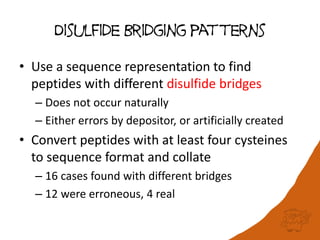
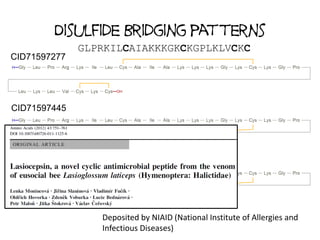
Disulfide Bridging patterns
• Use a sequence representation to find
peptides with different disulfide bridges
– Does not occur naturally
– Either errors by depositor, or artificially created
• Convert peptides with at least four cysteines
to sequence format and collate
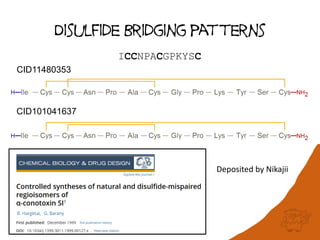
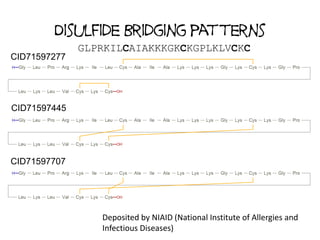
– 16 cases found with different bridges
– 12 were erroneous, 4 real
Disulfide Bridging patterns
ICCNPACGPKYSC
CID11480353
CID101041637
Deposited by Nikajii
Disulfide Bridging patterns
GLPRKILCAIAKKKGKCKGPLKLVCKC
CID71597277
CID71597445
CID71597707
Deposited by NIAID (National Institute of Allergies and
Infectious Diseases)
Disulfide Bridging patterns
GLPRKILCAIAKKKGKCKGPLKLVCKC
CID71597277
CID71597445
CID71597707
Deposited by NIAID (National Institute of Allergies and
Infectious Diseases)
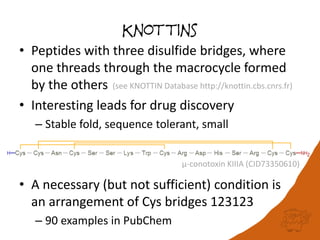
Knottins
• Peptides with three disulfide bridges, where
one threads through the macrocycle formed
by the others
• Interesting leads for drug discovery
– Stable fold, sequence tolerant, small
• A necessary (but not sufficient) condition is
an arrangement of Cys bridges 123123
– 90 examples in PubChem
(see KNOTTIN Database http://knottin.cbs.cnrs.fr)
μ-conotoxin KIIIA (CID73350610)
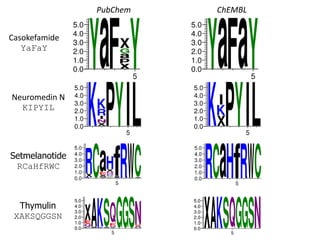
Sequence Variation
• Which parts of a sequence have seen the most
variants?
– Of interest for drug discovery, activity modulation
• Looked for variants of a sequence that are one
substitution away from a known peptide
– Required strict matching of the sequence to
minimize ‘mutations’ due to errors
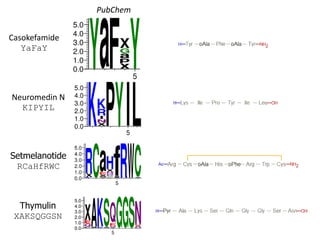
Casokefamide
YaFaY
Neuromedin N
KIPYIL
Setmelanotide
RCaHfRWC
Thymulin
XAKSQGGSN
PubChem
Casokefamide
YaFaY
Neuromedin N
KIPYIL
Setmelanotide
RCaHfRWC
Thymulin
XAKSQGGSN
PubChem ChEMBL
Are PubChem Peptides variants of
KNOWN PEPTIDES?
• Hypothesis: observed peptides are close
variants of a small number of known peptides
• Curated database of oligopeptides of
biological interest (currently 452 entries)
• 10.5% of the 170,708 peptides of length 5 or
greater in PubChem can be named as variants
of these
– argipressin (1-8)
– Cbz-cholecystokinin octapeptide (2-7) amide
– [Ile1,Ser2,Ser8]cyphokinin
Summary
• PubChem is a rich source of information on
oligopeptides and oligosaccharides
– Often heavily modified, rather than natural
• Due to chemical modifications, we need to think
in terms of 10s of thousands of monomers
• Sequence representations act as a key:
– To collate similar peptides
– To find sequence variants, sites of variation
– To find disulfide bridge variants, knottins
Acknowledgements
• Paul Thiessen PubChem
http://nextmovesoftware.com
http://nextmovesoftware.com/blog
noel@nextmovesoftware.com
Sugar & Splice
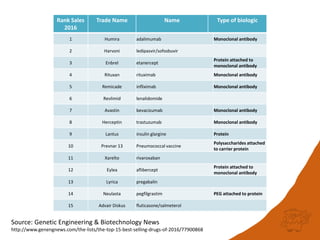
Rank Sales
2016
Trade Name Name Type of biologic
1 Humira adalimumab Monoclonal antibody
2 Harvoni ledipasvir/sofosbuvir
3 Enbrel etanercept
Protein attached to
monoclonal antibody
4 Rituxan rituximab Monoclonal antibody
5 Remicade infliximab Monoclonal antibody
6 Revlimid lenalidomide
7 Avastin bevacizumab Monoclonal antibody
8 Herceptin trastuzumab Monoclonal antibody
9 Lantus insulin glargine Protein
10 Prevnar 13 Pneumococcal vaccine
Polysaccharides attached
to carrier protein
11 Xarelto rivaroxaban
12 Eylea aflibercept
Protein attached to
monoclonal antibody
13 Lyrica pregabalin
14 Neulasta pegfilgrastim PEG attached to protein
15 Advair Diskus fluticasone/salmeterol
Source: Genetic Engineering & Biotechnology News
http://www.genengnews.com/the-lists/the-top-15-best-selling-drugs-of-2016/77900868
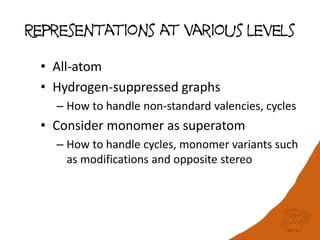
Representations at various levels
• All-atom
• Hydrogen-suppressed graphs
– How to handle non-standard valencies, cycles
• Consider monomer as superatom
– How to handle cycles, monomer variants such
as modifications and opposite stereo
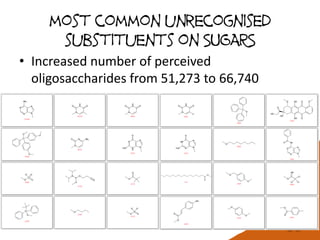
most common unrecognised
substituents on SUGARS
• Increased number of perceived
oligosaccharides from 51,273 to 66,740

PubChem as a Biologics Database

  • 1.
    PubChem as aBiologics Database Noel O’Boyle and Roger Sayle NextMove Software Evan Bolton PubChem, NCBI-NIH 254th ACS National Meeting Washington Aug 2017
  • 2.
  • 3.
  • 4.
  • 5.
  • 6.
  • 7.
  • 8.
  • 9.
  • 10.
    PubChem – ASmall Molecule database? • People don’t think of PubChem as a peptide database – ~110K X-rays of proteins in PDB – ~500K peptides in PubChem • People don’t think of PubChem as a saccharide database – ~80K oligosaccharides in GlyTouCan – ~67K oligosaccharides in PubChem
  • 11.
    531,618 contain amonosaccharide, of which 66,740 can be depicted
  • 12.
    How many MonoSaccharidespresent? L-Glcf, Mans, 2-deoxy-D-manHept, 3-deoxy-D-glcOct2ulo-onic a-Man, 3,4-deoxy-a-D-eryHex, b-Tyv Xylf5Me, a-L-ManNAc3Ac4Ac6Ac, Glc2P3P6P AltA, Glc, L-Man, L-Gal, Fru, L-gro-D-glcHept 113 aldoses, ketoses, aldonic and uronic acids with from 5-9 carbons 407 including deoxy variants, ring variants 7094 including common substituents at non- anomeric positions 26641 including any substituent anywhere Bz(-2)[Tos(-3)]Ara4Ac(b)-O-Me, TMS(-4)[TMS(-6)]GlcNAc3Me(a)-O-Me 971 including anomeric stereo * This analysis excludes monosaccharides with missing stereochemistry
  • 13.
    Amino acids inPubChem Structures containing at least three amino acids
  • 14.
    How many Aminoacids present? Ala, Cys, Hcy, Lys, 2Nal, Ncy, Thr Thr, Thr(tBu), Thr(Bn), Thr(PO3H2) Thr, D-Thr, DL-Thr, aThr, Thr-ol, aMeThr Thr, Me-Thr, Boc-Thr, Me2-Thr, Fmoc-N(Me)Thr Ala, Cys, Lys, Thr 20 common amino acids 87 amino acids 1095 including substituents 3546 including stereo variants, terminal variants, linker variants, α-methylated 8125 including N-substituted variants
  • 15.
    • Depends howyou count… • 447,026 have 3 or more amino acids • 668,229 structures are recognised in their entirety as peptides How many Peptides present?
  • 16.
  • 17.
    sequence representation • Dependingon the task or quality of datasource, different sequence representations may be preferred – Distinguish between D-/L-/DL- amino acids using upper/lowercase? • D-Ala as a or A – Distinguish between sidechain stereo variants? • alloThr as X or T – Distinguish between substituted amino acids and their parent? • Ser(PO3H2) as X or S
  • 18.
    Exact sequence search •Given that features of the structure are normalized or ignored – Exact sequence search can be used to find similar structures (sequence as hash) • Create hierarchy of similarity – First, those structures with the same sequence, if we normalise as much as possible – Then successively discriminate based on stereochemistry, side-chain substitution
  • 19.
    Search for Kemptide:LRRASLG LRRASLG LRRASLG Ac-DL-Leu-DL-Arg-DL-Arg-DL-Ala-DL-Ser-DL-Leu-Gly-OH 78069426 acetyl-kemptide Ac-Leu-Arg-Arg-Ala-Ser-Leu-Gly-OH 71429096 acetyl-kemptide H-DL-Leu-DL-Arg-DL-Arg-DL-Ala-DL-Ser-DL-Leu-Gly-NH2 85062657 kemptide amide H-DL-Leu-DL-Arg-DL-Arg-DL-Ala-DL-Ser-DL-Leu-Gly-OH 100074 kemptide H-DL-Leu-DL-Arg-DL-Arg-DL-Ala-DL-Ser-DL-Leu-Gly-OH.TFA 118797564 H-Leu-Arg-Arg-Ala-Ser-Leu-Gly-NH2 9897033 kemptide amide H-Leu-Arg-Arg-Ala-Ser-Leu-Gly-OH 9962276 kemptide Unk-Leu-Arg-Arg-Ala-Ser-Leu-Gly-OH 11650926,101224399,101878757 LRRAXLG H-Leu-Arg-Arg-Ala-Ser(PO3H2)-Leu-Gly-NH2 102212089 [Ser(PO3H2)-5]kemptide amide H-Leu-Arg-Arg-Ala-Ser(PO3H2)-Leu-Gly-OH 13783725 [Ser(PO3H2)-5]kemptide LRraSLG LRraSLG H-Leu-Arg-D-Arg-D-Ala-Ser-Leu-Gly-OH 53393688 [D-Arg3,D-Ala4]kemptide LrRASLG LrRASLG H-Leu-D-Arg-Arg-Ala-Ser-Leu-Gly-OH 99864041 [D-Arg2]kemptide lRRASLG lRRASLG H-D-Leu-Arg-Arg-Ala-Ser-Leu-Gly-OH 99864040 [D-Leu1]kemptide lrRASLG lrRASLG H-D-Leu-D-Arg-Arg-Ala-Ser-Leu-Gly-OH 99864042 [D-Leu1,D-Arg2]kemptide
  • 20.
    Disulfide Bridging patterns •Use a sequence representation to find peptides with different disulfide bridges – Does not occur naturally – Either errors by depositor, or artificially created • Convert peptides with at least four cysteines to sequence format and collate – 16 cases found with different bridges – 12 were erroneous, 4 real
  • 21.
  • 22.
  • 23.
  • 24.
    Knottins • Peptides withthree disulfide bridges, where one threads through the macrocycle formed by the others • Interesting leads for drug discovery – Stable fold, sequence tolerant, small • A necessary (but not sufficient) condition is an arrangement of Cys bridges 123123 – 90 examples in PubChem (see KNOTTIN Database http://knottin.cbs.cnrs.fr) μ-conotoxin KIIIA (CID73350610)
  • 25.
    Sequence Variation • Whichparts of a sequence have seen the most variants? – Of interest for drug discovery, activity modulation • Looked for variants of a sequence that are one substitution away from a known peptide – Required strict matching of the sequence to minimize ‘mutations’ due to errors
  • 26.
  • 27.
  • 28.
    Are PubChem Peptidesvariants of KNOWN PEPTIDES? • Hypothesis: observed peptides are close variants of a small number of known peptides • Curated database of oligopeptides of biological interest (currently 452 entries) • 10.5% of the 170,708 peptides of length 5 or greater in PubChem can be named as variants of these – argipressin (1-8) – Cbz-cholecystokinin octapeptide (2-7) amide – [Ile1,Ser2,Ser8]cyphokinin
  • 29.
    Summary • PubChem isa rich source of information on oligopeptides and oligosaccharides – Often heavily modified, rather than natural • Due to chemical modifications, we need to think in terms of 10s of thousands of monomers • Sequence representations act as a key: – To collate similar peptides – To find sequence variants, sites of variation – To find disulfide bridge variants, knottins
  • 30.
    Acknowledgements • Paul ThiessenPubChem http://nextmovesoftware.com http://nextmovesoftware.com/blog noel@nextmovesoftware.com Sugar & Splice
  • 32.
    Rank Sales 2016 Trade NameName Type of biologic 1 Humira adalimumab Monoclonal antibody 2 Harvoni ledipasvir/sofosbuvir 3 Enbrel etanercept Protein attached to monoclonal antibody 4 Rituxan rituximab Monoclonal antibody 5 Remicade infliximab Monoclonal antibody 6 Revlimid lenalidomide 7 Avastin bevacizumab Monoclonal antibody 8 Herceptin trastuzumab Monoclonal antibody 9 Lantus insulin glargine Protein 10 Prevnar 13 Pneumococcal vaccine Polysaccharides attached to carrier protein 11 Xarelto rivaroxaban 12 Eylea aflibercept Protein attached to monoclonal antibody 13 Lyrica pregabalin 14 Neulasta pegfilgrastim PEG attached to protein 15 Advair Diskus fluticasone/salmeterol Source: Genetic Engineering & Biotechnology News http://www.genengnews.com/the-lists/the-top-15-best-selling-drugs-of-2016/77900868
  • 33.
    Representations at variouslevels • All-atom • Hydrogen-suppressed graphs – How to handle non-standard valencies, cycles • Consider monomer as superatom – How to handle cycles, monomer variants such as modifications and opposite stereo
  • 34.
    most common unrecognised substituentson SUGARS • Increased number of perceived oligosaccharides from 51,273 to 66,740