FIRE SAFETY
TOPICS
➢What is Fire ?
➢Methods to extinguish Fire.
➢Classification of Fire and their preventions.
➢Types of Fire Extinguishers.
➢ Anatomy of Fire Extinguishers and their operation.
➢ Safety guidelines while working at Chemical Labs.
➢ Fire Fighting decision criteria.
➢ Fire Survey Report
WE KNOW……
FIRE TETRAHEDRON
➢Triangle is out….now Tetrahedron is in…
➢Consists of 4 Sides
Oxygen Fuel
Heat Chain of reaction
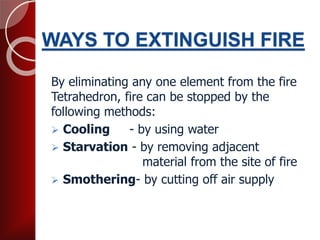
WAYS TO EXTINGUISH FIRE
By eliminating any one element from the fire
Tetrahedron, fire can be stopped by the
following methods:
➢ Cooling - by using water
➢ Starvation - by removing adjacent
material from the site of fire
➢ Smothering- by cutting off air supply
CLASSIFICATION OF FIRE
TO PREVENT FIRES
Class  Ordinary Combustibles:
➢ Keep storage and working areas free of
trash.
➢ Good House keeping practices reduce
the chances of general fire.
➢ Place oily rags in covered containers.
➢ No Smoking is to be strictly adhered by
all at working areas.
TO PREVENT FIRES
Class  Inflammables Liquids & Gases:
➢ Don’t refuel gasoline-powered equipment in
a confined space, in the presence of an
open flame, or while the equipment is hot.
➢ Keep flammable liquids stored in a tightly
closed container and away from spark
producing sources.
➢ Use flammable liquids only in well ventilated
areas.
➢ Never use mobile phones at Fuel stations.
TO PREVENT FIRES
Class  Electrical Equipments:
➢ Never install a fuse rated higher than
specified for the circuit.
➢ Investigate any appliance or electrical
equipment that smells strange. Unusual
odors can be the first sign of a potential fire.
➢ Utility lights should always have some type
of wire guard over them.
➢ Switch off electrical appliances when
not in use.
TO PREVENT FIRES
Class  Electrical Equipments:
Please do not use power plugs more than their ratings.
TO PREVENT FIRES
Class  Flammable metals:
➢ Knowledge of the properties of the
metals and using good judgment will
assist you in controlling or avoiding
potential fires/reactions.
➢ Store inflammable metals away from the
working areas.
TYPES OF PORTABLE FIRE
EXTINGUISHER
Three types of commonly used Portable
fire extinguishers :
➢ AFFF compound (water based)
➢ Dry Chemical Powder (MAP powder)
➢ CO2
TYPES OF PORTABLE FIRE
EXTINGUISHER
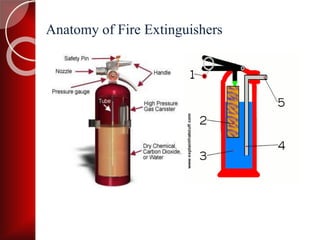
ANATOMY OF PORTABLE
FIRE EXTINGUISHER
Anatomy of Fire Extinguishers
HOW TO USE PORTABLE
FIRE EXTINGUISHERS
IF YOU FIGHT A FIRE, REMEMBER THE WORD
P A S S
PULL . . . AIM . . . SQUEEZE . . . SWEEP
COMMON SAFETY
GUIDELINES AT LABS
➢Use personal protective equipment.
➢Chemicals received must be checked to ensure
that the containers are in good condition.
➢Details of new chemicals must be entered in the
laboratory inventory and stored in a designated
area.
➢Bulk stocks must be stored in a separate building.
➢Chemicals must not be placed indiscriminately in
the storage shelf. They must be grouped based on
their compatibility.
➢In the event of an accidental breakage or seismic
activity, incompatible chemicals that are stored in
close proximity can mix to start a fire, hazardous
fumes or explosions.
➢Ensure eye washer and Safety Shower are
operational.
➢Ensure proper ventilation of the working area.
➢Do not work alone in the laboratories particularly
when performing hazardous procedures.
➢Do not perform unauthorized Experiments.
➢Know Emergency Escape routes of the Building.
➢Know operation of Portable Fire extinguisher and
their location.
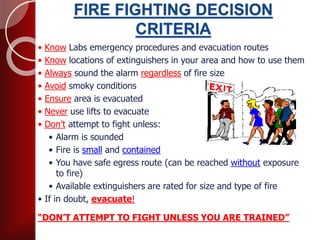
FIRE FIGHTING DECISION
CRITERIA
• Know Labs emergency procedures and evacuation routes
• Know locations of extinguishers in your area and how to use them
• Always sound the alarm regardless of fire size
• Avoid smoky conditions
• Ensure area is evacuated
• Never use lifts to evacuate
• Don’t attempt to fight unless:
• Alarm is sounded
• Fire is small and contained
• You have safe egress route (can be reached without exposure
to fire)
• Available extinguishers are rated for size and type of fire
• If in doubt, evacuate!
“DON’T ATTEMPT TO FIGHT UNLESS YOU ARE TRAINED”
KNOW FIRE SURVEY REPORT
➢On an average, in India, every year, about 25,000
persons die due to fire accidents.
➢Female accounts for about 66% of those killed in fire
accidents.
➢It is estimated that about 42 females and 19 males
die every day in India due to fire accidents.
➢According to losses reported by the Indian Insurance
Companies, that about 45% of the claims are due to
fire losses.
➢ According to another estimate about Rs. 1000 crores
are lost every year due to fire.
➢In Mumbai about 75% of fire-related incidents occur
because of short circuit caused by loose wiring in year
2017.
IN CASE OF FIRE
➢INFORM FOLLOWING IMMIDIATELY:
Main Gate, South Campus – 01905 267096
Main Gate, North Campus – 01905 267219
Fire – 101
Security Officer – 9418053088
FIRE SAFETY IS EVERYONES BUISNESS
Thank You

fire_safety.pdf

  • 1.
  • 2.
    TOPICS ➢What is Fire? ➢Methods to extinguish Fire. ➢Classification of Fire and their preventions. ➢Types of Fire Extinguishers. ➢ Anatomy of Fire Extinguishers and their operation. ➢ Safety guidelines while working at Chemical Labs. ➢ Fire Fighting decision criteria. ➢ Fire Survey Report
  • 3.
  • 4.
    FIRE TETRAHEDRON ➢Triangle isout….now Tetrahedron is in… ➢Consists of 4 Sides Oxygen Fuel Heat Chain of reaction
  • 5.
    WAYS TO EXTINGUISHFIRE By eliminating any one element from the fire Tetrahedron, fire can be stopped by the following methods: ➢ Cooling - by using water ➢ Starvation - by removing adjacent material from the site of fire ➢ Smothering- by cutting off air supply
  • 6.
  • 7.
    TO PREVENT FIRES Class Ordinary Combustibles: ➢ Keep storage and working areas free of trash. ➢ Good House keeping practices reduce the chances of general fire. ➢ Place oily rags in covered containers. ➢ No Smoking is to be strictly adhered by all at working areas.
  • 8.
    TO PREVENT FIRES Class Inflammables Liquids & Gases: ➢ Don’t refuel gasoline-powered equipment in a confined space, in the presence of an open flame, or while the equipment is hot. ➢ Keep flammable liquids stored in a tightly closed container and away from spark producing sources. ➢ Use flammable liquids only in well ventilated areas. ➢ Never use mobile phones at Fuel stations.
  • 9.
    TO PREVENT FIRES Class Electrical Equipments: ➢ Never install a fuse rated higher than specified for the circuit. ➢ Investigate any appliance or electrical equipment that smells strange. Unusual odors can be the first sign of a potential fire. ➢ Utility lights should always have some type of wire guard over them. ➢ Switch off electrical appliances when not in use.
  • 10.
    TO PREVENT FIRES Class Electrical Equipments: Please do not use power plugs more than their ratings.
  • 11.
    TO PREVENT FIRES Class Flammable metals: ➢ Knowledge of the properties of the metals and using good judgment will assist you in controlling or avoiding potential fires/reactions. ➢ Store inflammable metals away from the working areas.
  • 12.
    TYPES OF PORTABLEFIRE EXTINGUISHER Three types of commonly used Portable fire extinguishers : ➢ AFFF compound (water based) ➢ Dry Chemical Powder (MAP powder) ➢ CO2
  • 13.
    TYPES OF PORTABLEFIRE EXTINGUISHER
  • 14.
  • 15.
    Anatomy of FireExtinguishers
  • 16.
    HOW TO USEPORTABLE FIRE EXTINGUISHERS
  • 17.
    IF YOU FIGHTA FIRE, REMEMBER THE WORD P A S S PULL . . . AIM . . . SQUEEZE . . . SWEEP
  • 18.
    COMMON SAFETY GUIDELINES ATLABS ➢Use personal protective equipment. ➢Chemicals received must be checked to ensure that the containers are in good condition. ➢Details of new chemicals must be entered in the laboratory inventory and stored in a designated area. ➢Bulk stocks must be stored in a separate building. ➢Chemicals must not be placed indiscriminately in the storage shelf. They must be grouped based on their compatibility.
  • 19.
    ➢In the eventof an accidental breakage or seismic activity, incompatible chemicals that are stored in close proximity can mix to start a fire, hazardous fumes or explosions. ➢Ensure eye washer and Safety Shower are operational. ➢Ensure proper ventilation of the working area. ➢Do not work alone in the laboratories particularly when performing hazardous procedures. ➢Do not perform unauthorized Experiments. ➢Know Emergency Escape routes of the Building. ➢Know operation of Portable Fire extinguisher and their location.
  • 20.
    FIRE FIGHTING DECISION CRITERIA •Know Labs emergency procedures and evacuation routes • Know locations of extinguishers in your area and how to use them • Always sound the alarm regardless of fire size • Avoid smoky conditions • Ensure area is evacuated • Never use lifts to evacuate • Don’t attempt to fight unless: • Alarm is sounded • Fire is small and contained • You have safe egress route (can be reached without exposure to fire) • Available extinguishers are rated for size and type of fire • If in doubt, evacuate! “DON’T ATTEMPT TO FIGHT UNLESS YOU ARE TRAINED”
  • 21.
    KNOW FIRE SURVEYREPORT ➢On an average, in India, every year, about 25,000 persons die due to fire accidents. ➢Female accounts for about 66% of those killed in fire accidents. ➢It is estimated that about 42 females and 19 males die every day in India due to fire accidents. ➢According to losses reported by the Indian Insurance Companies, that about 45% of the claims are due to fire losses. ➢ According to another estimate about Rs. 1000 crores are lost every year due to fire. ➢In Mumbai about 75% of fire-related incidents occur because of short circuit caused by loose wiring in year 2017.
  • 22.
    IN CASE OFFIRE ➢INFORM FOLLOWING IMMIDIATELY: Main Gate, South Campus – 01905 267096 Main Gate, North Campus – 01905 267219 Fire – 101 Security Officer – 9418053088
  • 23.
    FIRE SAFETY ISEVERYONES BUISNESS Thank You