ENTREPRENEURSHIP
13-Sep-18
MOHIT SENGER (Assistant Professor, COER)
1
ENTREPRENEURSHIP
Entrepreneurship refers to a process of action an
entrepreneur undertakes to establish his enterprise.
In other words entrepreneurship can be defined as an
ability to discover, create or invent opportunities and
exploit them to the benefit of the society, which in turn
brings prosperity to the innovator and his organization.
13-Sep-18 MOHIT SENGER (Assistant Professor, COER) 2
Entrepreneurship = Entrepreneur + Enterprise
ENTREPRENEUR
Entrepreneur is “one who organizes, manages and
assumes the risks of a business or enterprise.” In other
words “a person who organizes and manages any
enterprise, especially a business, usually with
considerable initiative and risk.”
 Peter Drucker : “An entrepreneur searches for change,
responds to it and exploits opportunities. Innovation is a
specific tool of an entrepreneur hence an effective
entrepreneur converts a source into a resource”.
13-Sep-18 MOHIT SENGER (Assistant Professor, COER) 3
CHARACTERISTICS / QUALITY OF AN ENTREPRENEUR
 Desire to Excel
 Hard Work
 Self Confidence
 Initiative
 Moderate Risk-Taker (Calculative Risk)
 Innovative
 Motivation
 Optimistic
13-Sep-18 MOHIT SENGER (Assistant Professor, COER) 4
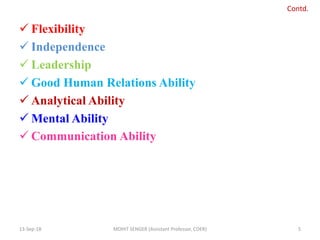
 Flexibility
 Independence
 Leadership
 Good Human Relations Ability
 Analytical Ability
 Mental Ability
 Communication Ability
13-Sep-18 MOHIT SENGER (Assistant Professor, COER) 5
Contd.
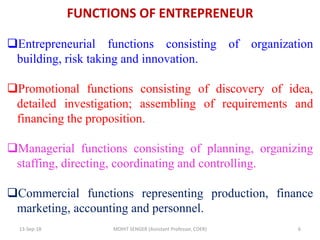
FUNCTIONS OF ENTREPRENEUR
13-Sep-18 MOHIT SENGER (Assistant Professor, COER) 6
Entrepreneurial functions consisting of organization
building, risk taking and innovation.
Promotional functions consisting of discovery of idea,
detailed investigation; assembling of requirements and
financing the proposition.
Managerial functions consisting of planning, organizing
staffing, directing, coordinating and controlling.
Commercial functions representing production, finance
marketing, accounting and personnel.
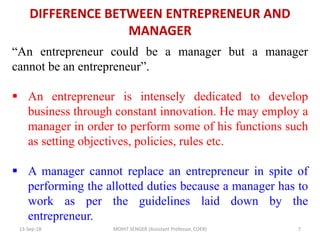
DIFFERENCE BETWEEN ENTREPRENEUR AND
MANAGER
13-Sep-18 MOHIT SENGER (Assistant Professor, COER) 7
“An entrepreneur could be a manager but a manager
cannot be an entrepreneur”.
 An entrepreneur is intensely dedicated to develop
business through constant innovation. He may employ a
manager in order to perform some of his functions such
as setting objectives, policies, rules etc.
 A manager cannot replace an entrepreneur in spite of
performing the allotted duties because a manager has to
work as per the guidelines laid down by the
entrepreneur.
13-Sep-18 MOHIT SENGER (Assistant Professor, COER) 8
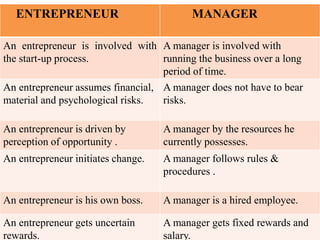
ENTREPRENEUR MANAGER
An entrepreneur is involved with
the start-up process.
A manager is involved with
running the business over a long
period of time.
An entrepreneur assumes financial,
material and psychological risks.
A manager does not have to bear
risks.
An entrepreneur is driven by
perception of opportunity .
A manager by the resources he
currently possesses.
An entrepreneur initiates change. A manager follows rules &
procedures .
An entrepreneur is his own boss. A manager is a hired employee.
An entrepreneur gets uncertain
rewards.
A manager gets fixed rewards and
salary.
13-Sep-18 MOHIT SENGER (Assistant Professor, COER) 9
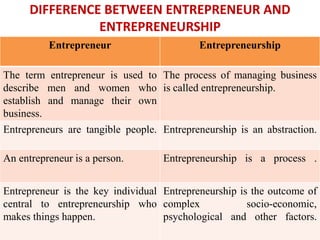
Entrepreneur Entrepreneurship
The term entrepreneur is used to
describe men and women who
establish and manage their own
business.
The process of managing business
is called entrepreneurship.
Entrepreneurs are tangible people. Entrepreneurship is an abstraction.
An entrepreneur is a person. Entrepreneurship is a process .
Entrepreneur is the key individual
central to entrepreneurship who
makes things happen.
Entrepreneurship is the outcome of
complex socio-economic,
psychological and other factors.
DIFFERENCE BETWEEN ENTREPRENEUR AND
ENTREPRENEURSHIP
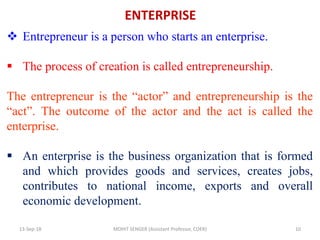
ENTERPRISE
13-Sep-18 MOHIT SENGER (Assistant Professor, COER) 10
 Entrepreneur is a person who starts an enterprise.
 The process of creation is called entrepreneurship.
The entrepreneur is the “actor” and entrepreneurship is the
“act”. The outcome of the actor and the act is called the
enterprise.
 An enterprise is the business organization that is formed
and which provides goods and services, creates jobs,
contributes to national income, exports and overall
economic development.
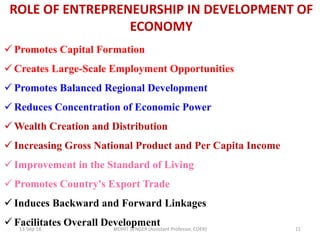
ROLE OF ENTREPRENEURSHIP IN DEVELOPMENT OF
ECONOMY
13-Sep-18 MOHIT SENGER (Assistant Professor, COER) 11
 Promotes Capital Formation
 Creates Large-Scale Employment Opportunities
 Promotes Balanced Regional Development
 Reduces Concentration of Economic Power
 Wealth Creation and Distribution
 Increasing Gross National Product and Per Capita Income
 Improvement in the Standard of Living
 Promotes Country's Export Trade
 Induces Backward and Forward Linkages
 Facilitates Overall Development
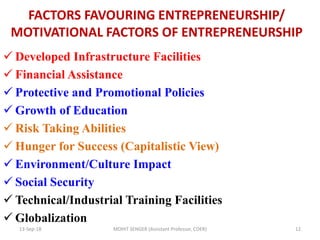
FACTORS FAVOURING ENTREPRENEURSHIP/
MOTIVATIONAL FACTORS OF ENTREPRENEURSHIP
 Developed Infrastructure Facilities
 Financial Assistance
 Protective and Promotional Policies
 Growth of Education
 Risk Taking Abilities
 Hunger for Success (Capitalistic View)
 Environment/Culture Impact
 Social Security
 Technical/Industrial Training Facilities
 Globalization
13-Sep-18 MOHIT SENGER (Assistant Professor, COER) 12
DEFINITIONS OF SMALL SCALE INDUSTRY (SSI)
 An industrial undertaking in which the investment in fixed
assets in plant and machinery, whether held on ownership
terms or on lease or by hire purchase, does not exceed
Rs.1 Crore as on March 31, 2010, is to be treated as a
small-scale industrial unit. However, this investment limit
is varied by the Government from time to time.
13-Sep-18 MOHIT SENGER (Assistant Professor, COER) 13
SMALL SCALE INDUSTRIES (SSI)
In most of the developing countries like India, Small
Scale Industries (SSI) constitutes an important and crucial
segment of the industrial sector.
SSI play an important role in employment creation,
resource utilisation and income generation and helping to
promote changes in a gradual and phased manner.
13-Sep-18 MOHIT SENGER (Assistant Professor, COER) 14
Small scale enterprises are generally more labour
intensive than larger organisations. As a matter of fact,
small scale sector has now emerged as a dynamic and
vibrant sector for the Indian economy in recent years.
Small Scale sector has attracted so much attention not
only from industrial planners and economists but also
from sociologists, administrators and politicians.
13-Sep-18 MOHIT SENGER (Assistant Professor, COER) 15
Contd.
 Ancillary Unit : This is a sub-class of SSIs. An industrial
undertaking which is engaged or is proposed to be
engaged in
 The manufacture of parts, components, sub-assemblies,
tooling or intermediates.
 Rendering of services, or supplying or rendering not
less than 50 per cent of its production or its total services,
as the case may be, to other units for production of other
articles and whose investment in fixed assets in plant and
machinery, whether held on ownership terms or on lease
or on hire purchase, does not exceed Rs 1 crore as on
March 31, 2001, is to be treated as an ancillary enterprise.
13-Sep-18 MOHIT SENGER (Assistant Professor, COER) 16
Contd.
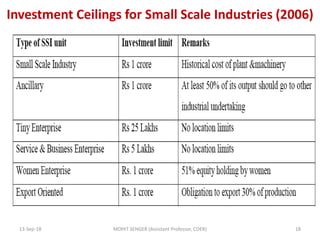
 Export-oriented Unit (EOU): An industrial undertaking in
which the investment in fixed assets in plant and machinery,
whether held on ownership terms, or on lease, or by hire
purchase, does not exceed Rs.100 lakh i.e.1 crore and has an
obligation to export 30 per cent of production.
 Tiny Unit: The investment limit in plant and
machinery in respect of tiny enterprises is Rs 25 lakhs
irrespective of the location of the unit.
 Women entrepreneurs: A small-scale industrial
unit/industry related service or business enterprise,
managed by one or more women entrepreneurs in
proprietary concerns, or in which she/they individually or
jointly have
13-Sep-18 MOHIT SENGER (Assistant Professor, COER) 17
Contd.
Investment Ceilings for Small Scale Industries (2006)
13-Sep-18 MOHIT SENGER (Assistant Professor, COER) 18
OBJECTIVES OF SMALL SCALE INDUSTRIES
The small scale sector can stimulate economic activity and is
entrusted with the responsibility of realising the following
objectives:-
 To create more employment opportunities with less
investment.
 To remove economic backwardness of rural and less
developed regions of the economy.
 To reduce regional imbalances.
 To mobilise and ensure optimum utilisation of unexploited
resources of the country.
13-Sep-18 MOHIT SENGER (Assistant Professor, COER) 19
 To improve standard of living of people.
 To ensure equitable distribution of income and
wealth.
 To solve unemployment problem.
 To attain self-reliance.
 To adopt latest technology aimed at producing better
quality products at lower costs.
13-Sep-18 MOHIT SENGER (Assistant Professor, COER) 20
Contd.
ROLE OF SSIS IN NATIONAL ECONOMY
 Employment generation
 Mobilisation of resources and entrepreneurial skill
 Regional dispersal of industries
 Provides opportunities for development of technology
 Promotes exports
 Supports the growth of large industries
 Better industrial relations
13-Sep-18 MOHIT SENGER (Assistant Professor, COER) 21
CHARACTERISTICS OF SMALL SCALE INDUSTRIES
 Personal Character
 Flexibility
 Labour Intensive
 Local Area of Operation
 Short Gestation Period
 Registration
 Size
 Capital
13-Sep-18 MOHIT SENGER (Assistant Professor, COER) 22
GOVERNMENT POLICIES FOR SSI
Government policies are flexible and changes from
time to time, place to place and product to product.
Different policies are applicable for different states as
per the suitability of the states.
 Sales tax concessions.
 Water tax concessions.
 Electricity duty exemption  concession
13-Sep-18 MOHIT SENGER (Assistant Professor, COER) 23
 Marketing assistance.
 Price preference while supplying products to government
organisation.
 Subsidy on expenses made on research and development .
 Subsidy on acquiring quality certificate like ISI marks,
AG mark, ISO 9000 series, ISO 14000 series.
 Single window system of clearance.
13-Sep-18 MOHIT SENGER (Assistant Professor, COER) 24
Contd.
SMALL BUSINESS AS A SEED TO ENTREPRENEURSHIP
Small enterprises are called Seedbed of entrepreneurship
due to the following reasons:
Small-scale enterprises can be started with lesser
investment, which can be contributed by the promoter or
arranged from friends and relatives.
Small-scale units carry on business on a small scale and
as such the element of risk is less.
Small-scale units are generally based on local resources
and as such there is no problem regarding their
availability.
13-Sep-18 MOHIT SENGER (Assistant Professor, COER) 25
 Small-scale entrepreneur adopts labour intensive
technology Thus he generates employment for himself as
well as for others.
 Small-scale units can be located anywhere and thus help
in the development of backward areas of the country.
 Small-scale units generally cater to local demand and
necessary modifications can be made in the products.
 Small-scale units provide ample opportunities for
creativity and experimentation.
13-Sep-18 MOHIT SENGER (Assistant Professor, COER) 26
Contd.
 Small-scale units have shorter gestation period and
hence waiting period for getting return on
investment is less.
 These units are relatively more environmental
friendly.
 Small-scale units help in building achievement
motivation amongst entrepreneurs.
13-Sep-18 MOHIT SENGER (Assistant Professor, COER) 27
Contd.
TYPES OF SMALL SCALE INDUSTRIES
 Resources Based SSI
 Demand Based SSI
 Ancillary Based SSIs
 Subsidiary type or Sub- Control type SSIs
 Linkage Based SSIs
 Export oriented based SSI
 Import substitute based SSI
 Technology based SSI
 Preference based SSI
 Policies Based SSI
 Competence Base SSI
13-Sep-18 MOHIT SENGER (Assistant Professor, COER) 28
STEPS TO START A SSI
1. Preliminary stage
 Decision to become an entrepreneur and start an
enterprise.
 Developing entrepreneurial characteristics.
 Studying business environment.
 Meeting entrepreneurs, people, experts and others.
 Searching the opportunity.
13-Sep-18 MOHIT SENGER (Assistant Professor, COER) 29
2. Decision making Stage
 Selecting business opportunities.
 Consulting DIC (Direct Industry Centre), SISI (Small Industries
Service Institute), consultants, banks, licensing authorities.
 Deciding the size, type, technology of the project.
 Deciding the location and survey site.
 Selection of exact site.
 Preparation of the project report
 Studying the project from technical, financial,
managerial and operational point of view.
 Deciding the product
13-Sep-18 MOHIT SENGER (Assistant Professor, COER)
30
Contd.
3. Planning stage
 Application for acquisition of land or exact site.
 Application for provisional registration
 Application for No-objection certificate, assurance from
bankers for finance.
 Application for licenses, permission, clearances from
state government, central government and from the
local authorities.
13-Sep-18 MOHIT SENGER (Assistant Professor, COER) 31
Contd.
 Application for loans and arrangement of capital
 Enquiry for plant and machineries etc.
 Preparing plans of the factory buildings
 Preparing plans for acquiring plants and machineries,
tools and equipment’s, furniture etc.
 Prepare the detailed project report
13-Sep-18 MOHIT SENGER (Assistant Professor, COER) 32
Contd.
4. Implementation stage
 Acquisition of land.
 Development of site.
 Construction of buildings and other infrastructure like
road, affluent disposed etc.
 Placing orders for plants and machineries, tools and
equipment, furniture and fixtures etc.
 Arranging electricity, water connection.
 Installation of plants and machineries and test running.
13-Sep-18 MOHIT SENGER (Assistant Professor, COER) 33
Contd.
 Recruitment, selection, training and placement of
manpower
 Procurement of raw material and other materials
 Finalise the marketing channel, distribution policy,
percentage of margin and commission to the middleman
etc.
 Carry on trial production and test marketing
13-Sep-18 MOHIT SENGER (Assistant Professor, COER) 34
Contd.
13-Sep-18 MOHIT SENGER (Assistant Professor, COER) 35
5. Managerial stage
 Evaluate the field performance of product and
examine the consumer's response.
 Appoint dealer, wholesalers, agents, and arrange
showrooms etc.
 Carry on commercial production.
 Carry on advertising and marketing activities.
 Distribution and selling.
 Managing the enterprise.
 Creation of external economies.
 Consolidating the marketing and selling network.
 Ensure growth and generate profits.
 Repayment of loan and interest.
 Keep pace with the change in technology, change in taste,
fashion of consumers, competition, and development of
new product, new substitute or alternatives.
 Carry on modernization, expansion, diversification etc.
13-Sep-18 MOHIT SENGER (Assistant Professor, COER) 36
Contd.

Entrepreneurship Development Program

  • 1.
  • 2.
    ENTREPRENEURSHIP Entrepreneurship refers toa process of action an entrepreneur undertakes to establish his enterprise. In other words entrepreneurship can be defined as an ability to discover, create or invent opportunities and exploit them to the benefit of the society, which in turn brings prosperity to the innovator and his organization. 13-Sep-18 MOHIT SENGER (Assistant Professor, COER) 2 Entrepreneurship = Entrepreneur + Enterprise
  • 3.
    ENTREPRENEUR Entrepreneur is “onewho organizes, manages and assumes the risks of a business or enterprise.” In other words “a person who organizes and manages any enterprise, especially a business, usually with considerable initiative and risk.”  Peter Drucker : “An entrepreneur searches for change, responds to it and exploits opportunities. Innovation is a specific tool of an entrepreneur hence an effective entrepreneur converts a source into a resource”. 13-Sep-18 MOHIT SENGER (Assistant Professor, COER) 3
  • 4.
    CHARACTERISTICS / QUALITYOF AN ENTREPRENEUR  Desire to Excel  Hard Work  Self Confidence  Initiative  Moderate Risk-Taker (Calculative Risk)  Innovative  Motivation  Optimistic 13-Sep-18 MOHIT SENGER (Assistant Professor, COER) 4
  • 5.
     Flexibility  Independence Leadership  Good Human Relations Ability  Analytical Ability  Mental Ability  Communication Ability 13-Sep-18 MOHIT SENGER (Assistant Professor, COER) 5 Contd.
  • 6.
    FUNCTIONS OF ENTREPRENEUR 13-Sep-18MOHIT SENGER (Assistant Professor, COER) 6 Entrepreneurial functions consisting of organization building, risk taking and innovation. Promotional functions consisting of discovery of idea, detailed investigation; assembling of requirements and financing the proposition. Managerial functions consisting of planning, organizing staffing, directing, coordinating and controlling. Commercial functions representing production, finance marketing, accounting and personnel.
  • 7.
    DIFFERENCE BETWEEN ENTREPRENEURAND MANAGER 13-Sep-18 MOHIT SENGER (Assistant Professor, COER) 7 “An entrepreneur could be a manager but a manager cannot be an entrepreneur”.  An entrepreneur is intensely dedicated to develop business through constant innovation. He may employ a manager in order to perform some of his functions such as setting objectives, policies, rules etc.  A manager cannot replace an entrepreneur in spite of performing the allotted duties because a manager has to work as per the guidelines laid down by the entrepreneur.
  • 8.
    13-Sep-18 MOHIT SENGER(Assistant Professor, COER) 8 ENTREPRENEUR MANAGER An entrepreneur is involved with the start-up process. A manager is involved with running the business over a long period of time. An entrepreneur assumes financial, material and psychological risks. A manager does not have to bear risks. An entrepreneur is driven by perception of opportunity . A manager by the resources he currently possesses. An entrepreneur initiates change. A manager follows rules & procedures . An entrepreneur is his own boss. A manager is a hired employee. An entrepreneur gets uncertain rewards. A manager gets fixed rewards and salary.
  • 9.
    13-Sep-18 MOHIT SENGER(Assistant Professor, COER) 9 Entrepreneur Entrepreneurship The term entrepreneur is used to describe men and women who establish and manage their own business. The process of managing business is called entrepreneurship. Entrepreneurs are tangible people. Entrepreneurship is an abstraction. An entrepreneur is a person. Entrepreneurship is a process . Entrepreneur is the key individual central to entrepreneurship who makes things happen. Entrepreneurship is the outcome of complex socio-economic, psychological and other factors. DIFFERENCE BETWEEN ENTREPRENEUR AND ENTREPRENEURSHIP
  • 10.
    ENTERPRISE 13-Sep-18 MOHIT SENGER(Assistant Professor, COER) 10  Entrepreneur is a person who starts an enterprise.  The process of creation is called entrepreneurship. The entrepreneur is the “actor” and entrepreneurship is the “act”. The outcome of the actor and the act is called the enterprise.  An enterprise is the business organization that is formed and which provides goods and services, creates jobs, contributes to national income, exports and overall economic development.
  • 11.
    ROLE OF ENTREPRENEURSHIPIN DEVELOPMENT OF ECONOMY 13-Sep-18 MOHIT SENGER (Assistant Professor, COER) 11  Promotes Capital Formation  Creates Large-Scale Employment Opportunities  Promotes Balanced Regional Development  Reduces Concentration of Economic Power  Wealth Creation and Distribution  Increasing Gross National Product and Per Capita Income  Improvement in the Standard of Living  Promotes Country's Export Trade  Induces Backward and Forward Linkages  Facilitates Overall Development
  • 12.
    FACTORS FAVOURING ENTREPRENEURSHIP/ MOTIVATIONALFACTORS OF ENTREPRENEURSHIP  Developed Infrastructure Facilities  Financial Assistance  Protective and Promotional Policies  Growth of Education  Risk Taking Abilities  Hunger for Success (Capitalistic View)  Environment/Culture Impact  Social Security  Technical/Industrial Training Facilities  Globalization 13-Sep-18 MOHIT SENGER (Assistant Professor, COER) 12
  • 13.
    DEFINITIONS OF SMALLSCALE INDUSTRY (SSI)  An industrial undertaking in which the investment in fixed assets in plant and machinery, whether held on ownership terms or on lease or by hire purchase, does not exceed Rs.1 Crore as on March 31, 2010, is to be treated as a small-scale industrial unit. However, this investment limit is varied by the Government from time to time. 13-Sep-18 MOHIT SENGER (Assistant Professor, COER) 13
  • 14.
    SMALL SCALE INDUSTRIES(SSI) In most of the developing countries like India, Small Scale Industries (SSI) constitutes an important and crucial segment of the industrial sector. SSI play an important role in employment creation, resource utilisation and income generation and helping to promote changes in a gradual and phased manner. 13-Sep-18 MOHIT SENGER (Assistant Professor, COER) 14
  • 15.
    Small scale enterprisesare generally more labour intensive than larger organisations. As a matter of fact, small scale sector has now emerged as a dynamic and vibrant sector for the Indian economy in recent years. Small Scale sector has attracted so much attention not only from industrial planners and economists but also from sociologists, administrators and politicians. 13-Sep-18 MOHIT SENGER (Assistant Professor, COER) 15 Contd.
  • 16.
     Ancillary Unit: This is a sub-class of SSIs. An industrial undertaking which is engaged or is proposed to be engaged in  The manufacture of parts, components, sub-assemblies, tooling or intermediates.  Rendering of services, or supplying or rendering not less than 50 per cent of its production or its total services, as the case may be, to other units for production of other articles and whose investment in fixed assets in plant and machinery, whether held on ownership terms or on lease or on hire purchase, does not exceed Rs 1 crore as on March 31, 2001, is to be treated as an ancillary enterprise. 13-Sep-18 MOHIT SENGER (Assistant Professor, COER) 16 Contd.
  • 17.
     Export-oriented Unit(EOU): An industrial undertaking in which the investment in fixed assets in plant and machinery, whether held on ownership terms, or on lease, or by hire purchase, does not exceed Rs.100 lakh i.e.1 crore and has an obligation to export 30 per cent of production.  Tiny Unit: The investment limit in plant and machinery in respect of tiny enterprises is Rs 25 lakhs irrespective of the location of the unit.  Women entrepreneurs: A small-scale industrial unit/industry related service or business enterprise, managed by one or more women entrepreneurs in proprietary concerns, or in which she/they individually or jointly have 13-Sep-18 MOHIT SENGER (Assistant Professor, COER) 17 Contd.
  • 18.
    Investment Ceilings forSmall Scale Industries (2006) 13-Sep-18 MOHIT SENGER (Assistant Professor, COER) 18
  • 19.
    OBJECTIVES OF SMALLSCALE INDUSTRIES The small scale sector can stimulate economic activity and is entrusted with the responsibility of realising the following objectives:-  To create more employment opportunities with less investment.  To remove economic backwardness of rural and less developed regions of the economy.  To reduce regional imbalances.  To mobilise and ensure optimum utilisation of unexploited resources of the country. 13-Sep-18 MOHIT SENGER (Assistant Professor, COER) 19
  • 20.
     To improvestandard of living of people.  To ensure equitable distribution of income and wealth.  To solve unemployment problem.  To attain self-reliance.  To adopt latest technology aimed at producing better quality products at lower costs. 13-Sep-18 MOHIT SENGER (Assistant Professor, COER) 20 Contd.
  • 21.
    ROLE OF SSISIN NATIONAL ECONOMY  Employment generation  Mobilisation of resources and entrepreneurial skill  Regional dispersal of industries  Provides opportunities for development of technology  Promotes exports  Supports the growth of large industries  Better industrial relations 13-Sep-18 MOHIT SENGER (Assistant Professor, COER) 21
  • 22.
    CHARACTERISTICS OF SMALLSCALE INDUSTRIES  Personal Character  Flexibility  Labour Intensive  Local Area of Operation  Short Gestation Period  Registration  Size  Capital 13-Sep-18 MOHIT SENGER (Assistant Professor, COER) 22
  • 23.
    GOVERNMENT POLICIES FORSSI Government policies are flexible and changes from time to time, place to place and product to product. Different policies are applicable for different states as per the suitability of the states.  Sales tax concessions.  Water tax concessions.  Electricity duty exemption concession 13-Sep-18 MOHIT SENGER (Assistant Professor, COER) 23
  • 24.
     Marketing assistance. Price preference while supplying products to government organisation.  Subsidy on expenses made on research and development .  Subsidy on acquiring quality certificate like ISI marks, AG mark, ISO 9000 series, ISO 14000 series.  Single window system of clearance. 13-Sep-18 MOHIT SENGER (Assistant Professor, COER) 24 Contd.
  • 25.
    SMALL BUSINESS ASA SEED TO ENTREPRENEURSHIP Small enterprises are called Seedbed of entrepreneurship due to the following reasons: Small-scale enterprises can be started with lesser investment, which can be contributed by the promoter or arranged from friends and relatives. Small-scale units carry on business on a small scale and as such the element of risk is less. Small-scale units are generally based on local resources and as such there is no problem regarding their availability. 13-Sep-18 MOHIT SENGER (Assistant Professor, COER) 25
  • 26.
     Small-scale entrepreneuradopts labour intensive technology Thus he generates employment for himself as well as for others.  Small-scale units can be located anywhere and thus help in the development of backward areas of the country.  Small-scale units generally cater to local demand and necessary modifications can be made in the products.  Small-scale units provide ample opportunities for creativity and experimentation. 13-Sep-18 MOHIT SENGER (Assistant Professor, COER) 26 Contd.
  • 27.
     Small-scale unitshave shorter gestation period and hence waiting period for getting return on investment is less.  These units are relatively more environmental friendly.  Small-scale units help in building achievement motivation amongst entrepreneurs. 13-Sep-18 MOHIT SENGER (Assistant Professor, COER) 27 Contd.
  • 28.
    TYPES OF SMALLSCALE INDUSTRIES  Resources Based SSI  Demand Based SSI  Ancillary Based SSIs  Subsidiary type or Sub- Control type SSIs  Linkage Based SSIs  Export oriented based SSI  Import substitute based SSI  Technology based SSI  Preference based SSI  Policies Based SSI  Competence Base SSI 13-Sep-18 MOHIT SENGER (Assistant Professor, COER) 28
  • 29.
    STEPS TO STARTA SSI 1. Preliminary stage  Decision to become an entrepreneur and start an enterprise.  Developing entrepreneurial characteristics.  Studying business environment.  Meeting entrepreneurs, people, experts and others.  Searching the opportunity. 13-Sep-18 MOHIT SENGER (Assistant Professor, COER) 29
  • 30.
    2. Decision makingStage  Selecting business opportunities.  Consulting DIC (Direct Industry Centre), SISI (Small Industries Service Institute), consultants, banks, licensing authorities.  Deciding the size, type, technology of the project.  Deciding the location and survey site.  Selection of exact site.  Preparation of the project report  Studying the project from technical, financial, managerial and operational point of view.  Deciding the product 13-Sep-18 MOHIT SENGER (Assistant Professor, COER) 30 Contd.
  • 31.
    3. Planning stage Application for acquisition of land or exact site.  Application for provisional registration  Application for No-objection certificate, assurance from bankers for finance.  Application for licenses, permission, clearances from state government, central government and from the local authorities. 13-Sep-18 MOHIT SENGER (Assistant Professor, COER) 31 Contd.
  • 32.
     Application forloans and arrangement of capital  Enquiry for plant and machineries etc.  Preparing plans of the factory buildings  Preparing plans for acquiring plants and machineries, tools and equipment’s, furniture etc.  Prepare the detailed project report 13-Sep-18 MOHIT SENGER (Assistant Professor, COER) 32 Contd.
  • 33.
    4. Implementation stage Acquisition of land.  Development of site.  Construction of buildings and other infrastructure like road, affluent disposed etc.  Placing orders for plants and machineries, tools and equipment, furniture and fixtures etc.  Arranging electricity, water connection.  Installation of plants and machineries and test running. 13-Sep-18 MOHIT SENGER (Assistant Professor, COER) 33 Contd.
  • 34.
     Recruitment, selection,training and placement of manpower  Procurement of raw material and other materials  Finalise the marketing channel, distribution policy, percentage of margin and commission to the middleman etc.  Carry on trial production and test marketing 13-Sep-18 MOHIT SENGER (Assistant Professor, COER) 34 Contd.
  • 35.
    13-Sep-18 MOHIT SENGER(Assistant Professor, COER) 35 5. Managerial stage  Evaluate the field performance of product and examine the consumer's response.  Appoint dealer, wholesalers, agents, and arrange showrooms etc.  Carry on commercial production.  Carry on advertising and marketing activities.  Distribution and selling.  Managing the enterprise.
  • 36.
     Creation ofexternal economies.  Consolidating the marketing and selling network.  Ensure growth and generate profits.  Repayment of loan and interest.  Keep pace with the change in technology, change in taste, fashion of consumers, competition, and development of new product, new substitute or alternatives.  Carry on modernization, expansion, diversification etc. 13-Sep-18 MOHIT SENGER (Assistant Professor, COER) 36 Contd.