Band reject filter
Introduction
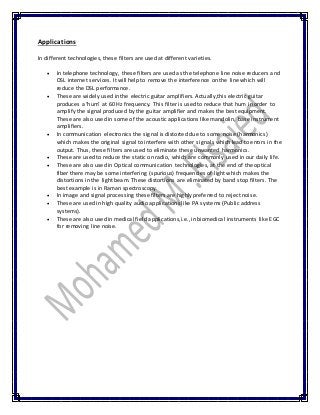
Theband stop filter is formed by the combination of low pass and high pass filters with a
parallel connection instead of cascading connection. The name itself indicates that it will stop a
particular band of frequencies. Since it eliminates frequencies, it is also called as band
elimination filter or band reject filter or notch filter.
We know that unlike high pass and low pass filters, band pass and band stop filters have two
cut-off frequencies. It will pass above and below a particular range of frequencies whose cut off
frequencies are predetermined depending upon the value of the components used in the circuit
design
Definition
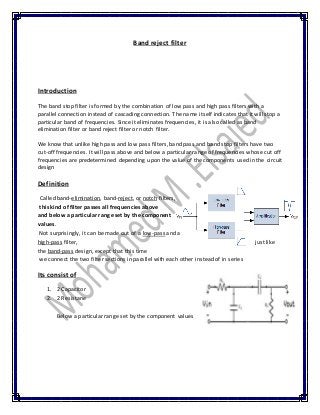
Called band-elimination, band-reject, or notch filters,
this kind of filter passes all frequencies above
and below a particular range set by the component
values.
Not surprisingly, it can be made out of a low-pass and a
high-pass filter, just like
the band-pass design, except that this time
we connect the two filter sections in parallel with each other instead of in series
Its consist of
1. 2 Capacitor
2. 2 Resistane
Below a particular range set by the component values
2.
Wide Band-Stop (orReject) Filter.
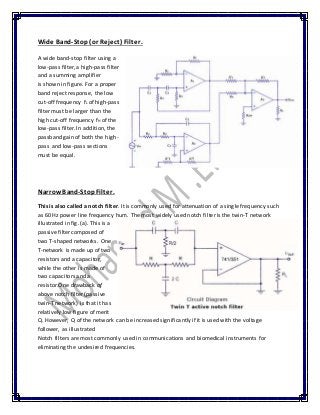
A wide band-stop filter using a
low-pass filter, a high-pass filter
and a summing amplifier
is shown in figure. For a proper
band reject response, the low
cut-off frequency fL of high-pass
filter must be larger than the
high cut-off frequency fH of the
low-pass filter. In addition, the
passband gain of both the high-
pass and low-pass sections
must be equal.
Narrow Band-StopFilter.
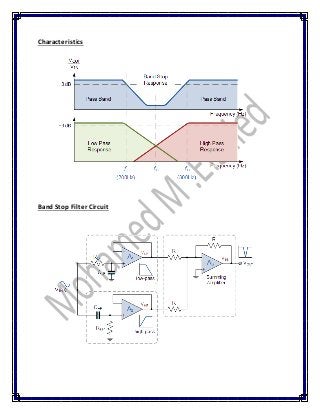
This is also called a notch filter. It is commonly used for attenuation of a single frequency such
as 60 Hz power line frequency hum. The most widely used notch filter is the twin-T network
illustrated in fig. (a). This is a
passive filter composed of
two T-shaped networks. One
T-network is made up of two
resistors and a capacitor,
while the other is made of
two capacitors and a
resistor.One drawback of
above notch filter (passive
twin-T network) is that it has
relatively low figure of merit
Q. However, Q of the network can be increased significantly if it is used with the voltage
follower, as illustrated
Notch filters are most commonly used in communications and biomedical instruments for
eliminating the undesired frequencies.
Applications
In different technologies,these filters are used at different varieties.
In telephone technology, these filters are used as the telephone line noise reducers and
DSL internet services. It will help to remove the interference on the line which will
reduce the DSL performance.
These are widely used in the electric guitar amplifiers. Actually,this electric guitar
produces a ‘hum’ at 60 Hz frequency. This filter is used to reduce that hum in order to
amplify the signal produced by the guitar amplifier and makes the best equipment.
These are also used in some of the acoustic applications like mandolin, base instrument
amplifiers.
In communication electronics the signal is distorted due to some noise (harmonics)
which makes the original signal to interfere with other signals which lead to errors in the
output. Thus, these filters are used to eliminate these unwanted harmonics.
These are used to reduce the static on radio, which are commonly used in our daily life.
These are also used in Optical communication technologies, at the end of the optical
fiber there may be some interfering (spurious) frequencies of light which makes the
distortions in the light beam. These distortions are eliminated by band stop filters. The
best example is in Raman spectroscopy.
In image and signal processing these filters are highly preferred to reject noise.
These are used in high quality audio applications like PA systems (Public address
systems).
These are also used in medical field applications,i.e., in biomedical instruments like EGC
for removing line noise.