#SMX #23A @maxxeight
What SEOs Need To Know
JavaScript &
Progressive
Web Apps (PWAs)
#SMX #23A @maxxeight
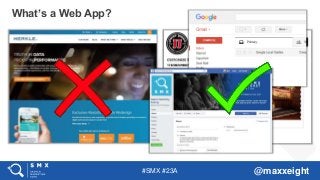
What’s a Web App?
#SMX #23A @maxxeight
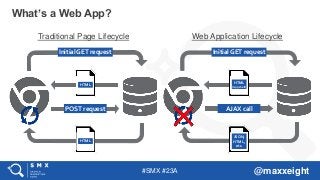
Traditional Page Lifecycle Web Application Lifecycle
What’s a Web App?
Initial GET request
POST request
HTML
HTML
Initial GET request
AJAX call
HTML
(App shell)
JSON,
HTML,
etc.
#SMX #23A @maxxeight
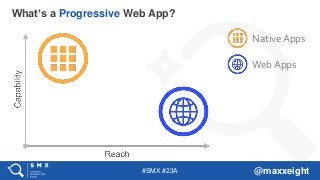
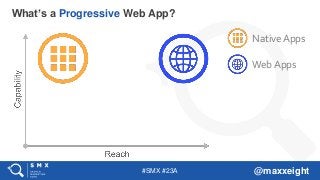
What’s a Progressive Web App?
NativeApps
Web Apps
#SMX #23A @maxxeight
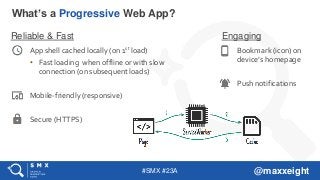
Reliable & Fast
App shell cached locally (on 1st load)
• Fast loading when offline or with slow
connection (on subsequent loads)
Mobile-friendly (responsive)
Secure (HTTPS)
What’s a Progressive Web App?
Engaging
Bookmark (icon) on
device’s homepage
Push notifications
#SMX #23A @maxxeight
What’s a Progressive Web App?
#SMX #23A @maxxeight
WHAT ABOUT ACCESSIBILITY
FOR SEARCH ENGINE BOTS?
#SMX #23A @maxxeight
What’s a Progressive Web App?
NativeApps
Web Apps
#SMX #23A @maxxeight
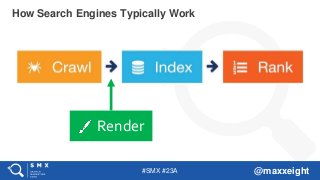
How Search Engines Typically Work
Render
#SMX #23A @maxxeight
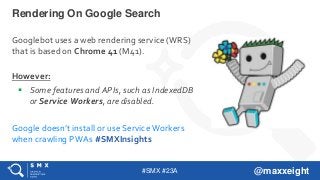
Rendering On Google Search
Googlebot uses a web rendering service (WRS)
that is based on Chrome 41 (M41).
However:
 Some features and APIs, such as IndexedDB
or Service Workers, are disabled.
Google doesn’t install or use Service Workers
when crawling PWAs #SMXInsights
#SMX #23A @maxxeight
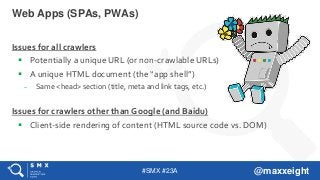
Issues for all crawlers
 Potentially a unique URL (or non-crawlable URLs)
 A unique HTML document (the “app shell”)
– Same <head> section (title, meta and link tags, etc.)
Issues for crawlers other than Google (and Baidu)
 Client-side rendering of content (HTML source code vs. DOM)
Web Apps (SPAs, PWAs)
#SMX #23A @maxxeight
 Crawling
– 1 unique “clean” URL per piece of content (and vice-versa)
Making Sure Search Engines Can Understand Your Pages
#SMX #23A @maxxeight
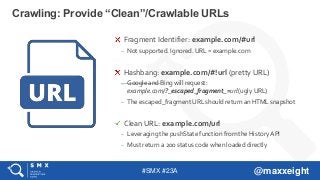
Crawling: Provide “Clean”/Crawlable URLs
Fragment Identifier: example.com/#url
– Not supported. Ignored. URL = example.com
Hashbang: example.com/#!url (pretty URL)
– Google and Bing will request:
example.com/?_escaped_fragment_=url (ugly URL)
– The escaped_fragment URL should return an HTML snapshot
Clean URL: example.com/url
– Leveraging the pushState function from the History API
– Must return a 200 status code when loaded directly
#SMX #23A @maxxeight
 Crawling
– 1 unique “clean” URL per piece of content (and vice-versa)
– onclick + window.location ≠ <a href=”link.html”>
Making Sure Search Engines Can Understand Your Pages
#SMX #23A @maxxeight
 Crawling
– 1 unique “clean” URL per piece of content (and vice-versa)
– onclick + window.location ≠ <a href=”link.html”>
 Rendering
– Don’t block JavaScript resources via robots.txt
Making Sure Search Engines Can Understand Your Pages
#SMX #23A @maxxeight
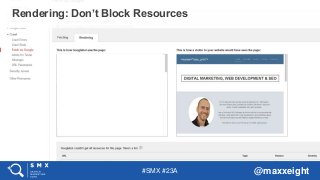
Rendering: Don’t Block Resources
#SMX #23A @maxxeight
 Crawling
– 1 unique “clean” URL per piece of content (and vice-versa)
– onclick + window.location ≠ <a href=”link.html”>
 Rendering
– Don’t block JavaScript resources via robots.txt
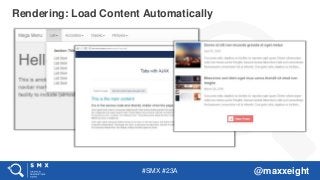
– Load content automatically, not based on user interaction (click,
mouseover, scroll)
Making Sure Search Engines Can Understand Your Pages
#SMX #23A @maxxeight
Rendering: Load Content Automatically
#SMX #23A @maxxeight
 Crawling
– 1 unique “clean” URL per piece of content (and vice-versa)
– onclick + window.location ≠ <a href=”link.html”>
 Rendering
– Don’t block JavaScript resources via robots.txt
– Load content automatically, not based on user interaction (click,
mouseover, scroll)
– For Bing and other crawlers: HTML snapshots
Making Sure Search Engines Can Understand Your Pages
#SMX #23A @maxxeight
 Crawling
– 1 unique “clean” URL per piece of content (and vice-versa)
– onclick + window.location ≠ <a href=”link.html”>
 Rendering
– Don’t block JavaScript resources via robots.txt
– Load content automatically, not based on user interaction (click,
mouseover, scroll)
– For Bing and other crawlers: HTML snapshots
 Indexing
– Avoid duplicate <head> section elements (title, meta description,
etc.)
Making Sure Search Engines Can Understand Your Pages
#SMX #23A @maxxeight
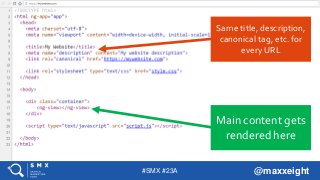
Main content gets
rendered here
Same title, description,
canonical tag, etc. for
every URL
#SMX #23A @maxxeight
Share these #SMXInsights on your social channels!
#SMXInsights
 SEO Best Practices For JavaScript
Sites
– Crawling: use clean URLs and proper <a href> elements
– Rendering: avoid blocking resources and loading content
upon user interaction
– Indexing: make sure meta data in <head> is not
duplicated across pages
#SMX #23A @maxxeight
Tools
#SMX #23A @maxxeight
Share these #SMXInsights on your social channels!
#SMXInsights
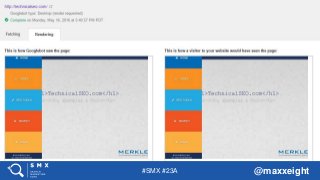
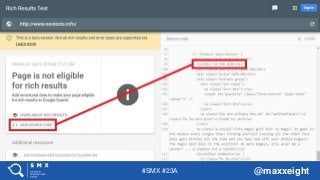
 The Rich Results Testing Tool is the only Google-
provided tool showing the rendered code (DOM)
#SMX #23A @maxxeight
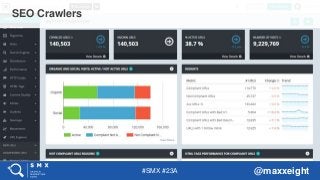
SEO Crawlers
#SMX #23A @maxxeight
LEARN MORE: UPCOMING @SMX EVENTS
THANK YOU!
SEE YOU AT THE NEXT #SMX

Max Prin - SMX West 2018 - JavaScript & PWAs - What SEOs Need To Know

  • 1.
    #SMX #23A @maxxeight WhatSEOs Need To Know JavaScript & Progressive Web Apps (PWAs)
  • 2.
  • 3.
  • 4.
    #SMX #23A @maxxeight TraditionalPage Lifecycle Web Application Lifecycle What’s a Web App? Initial GET request POST request HTML HTML Initial GET request AJAX call HTML (App shell) JSON, HTML, etc.
  • 5.
    #SMX #23A @maxxeight What’sa Progressive Web App? NativeApps Web Apps
  • 6.
    #SMX #23A @maxxeight Reliable& Fast App shell cached locally (on 1st load) • Fast loading when offline or with slow connection (on subsequent loads) Mobile-friendly (responsive) Secure (HTTPS) What’s a Progressive Web App? Engaging Bookmark (icon) on device’s homepage Push notifications
  • 7.
    #SMX #23A @maxxeight What’sa Progressive Web App?
  • 8.
    #SMX #23A @maxxeight WHATABOUT ACCESSIBILITY FOR SEARCH ENGINE BOTS?
  • 9.
    #SMX #23A @maxxeight What’sa Progressive Web App? NativeApps Web Apps
  • 10.
    #SMX #23A @maxxeight HowSearch Engines Typically Work Render
  • 11.
    #SMX #23A @maxxeight RenderingOn Google Search Googlebot uses a web rendering service (WRS) that is based on Chrome 41 (M41). However:  Some features and APIs, such as IndexedDB or Service Workers, are disabled. Google doesn’t install or use Service Workers when crawling PWAs #SMXInsights
  • 12.
    #SMX #23A @maxxeight Issuesfor all crawlers  Potentially a unique URL (or non-crawlable URLs)  A unique HTML document (the “app shell”) – Same <head> section (title, meta and link tags, etc.) Issues for crawlers other than Google (and Baidu)  Client-side rendering of content (HTML source code vs. DOM) Web Apps (SPAs, PWAs)
  • 13.
    #SMX #23A @maxxeight Crawling – 1 unique “clean” URL per piece of content (and vice-versa) Making Sure Search Engines Can Understand Your Pages
  • 14.
    #SMX #23A @maxxeight Crawling:Provide “Clean”/Crawlable URLs Fragment Identifier: example.com/#url – Not supported. Ignored. URL = example.com Hashbang: example.com/#!url (pretty URL) – Google and Bing will request: example.com/?_escaped_fragment_=url (ugly URL) – The escaped_fragment URL should return an HTML snapshot Clean URL: example.com/url – Leveraging the pushState function from the History API – Must return a 200 status code when loaded directly
  • 15.
    #SMX #23A @maxxeight Crawling – 1 unique “clean” URL per piece of content (and vice-versa) – onclick + window.location ≠ <a href=”link.html”> Making Sure Search Engines Can Understand Your Pages
  • 16.
    #SMX #23A @maxxeight Crawling – 1 unique “clean” URL per piece of content (and vice-versa) – onclick + window.location ≠ <a href=”link.html”>  Rendering – Don’t block JavaScript resources via robots.txt Making Sure Search Engines Can Understand Your Pages
  • 17.
    #SMX #23A @maxxeight Rendering:Don’t Block Resources
  • 18.
    #SMX #23A @maxxeight Crawling – 1 unique “clean” URL per piece of content (and vice-versa) – onclick + window.location ≠ <a href=”link.html”>  Rendering – Don’t block JavaScript resources via robots.txt – Load content automatically, not based on user interaction (click, mouseover, scroll) Making Sure Search Engines Can Understand Your Pages
  • 19.
    #SMX #23A @maxxeight Rendering:Load Content Automatically
  • 20.
    #SMX #23A @maxxeight Crawling – 1 unique “clean” URL per piece of content (and vice-versa) – onclick + window.location ≠ <a href=”link.html”>  Rendering – Don’t block JavaScript resources via robots.txt – Load content automatically, not based on user interaction (click, mouseover, scroll) – For Bing and other crawlers: HTML snapshots Making Sure Search Engines Can Understand Your Pages
  • 21.
    #SMX #23A @maxxeight Crawling – 1 unique “clean” URL per piece of content (and vice-versa) – onclick + window.location ≠ <a href=”link.html”>  Rendering – Don’t block JavaScript resources via robots.txt – Load content automatically, not based on user interaction (click, mouseover, scroll) – For Bing and other crawlers: HTML snapshots  Indexing – Avoid duplicate <head> section elements (title, meta description, etc.) Making Sure Search Engines Can Understand Your Pages
  • 22.
    #SMX #23A @maxxeight Maincontent gets rendered here Same title, description, canonical tag, etc. for every URL
  • 23.
    #SMX #23A @maxxeight Sharethese #SMXInsights on your social channels! #SMXInsights  SEO Best Practices For JavaScript Sites – Crawling: use clean URLs and proper <a href> elements – Rendering: avoid blocking resources and loading content upon user interaction – Indexing: make sure meta data in <head> is not duplicated across pages
  • 24.
  • 25.
  • 26.
  • 27.
  • 28.
    #SMX #23A @maxxeight Sharethese #SMXInsights on your social channels! #SMXInsights  The Rich Results Testing Tool is the only Google- provided tool showing the rendered code (DOM)
  • 29.
  • 30.
  • 31.
    #SMX #23A @maxxeight LEARNMORE: UPCOMING @SMX EVENTS THANK YOU! SEE YOU AT THE NEXT #SMX

Editor's Notes

  • #4 In computing, a web application or web app is a client–server computer program in which the client (including the user interface and client-side logic) runs in a web browser. Common web applications include webmail, online retail sales, online auctions, wikis, instant messaging services and many other functions. https://en.wikipedia.org/wiki/Web_application Any website can be a web app. But in general, a web app provides some type of functionality/interactive experience such as ordering something online. “In general” sites with static content such as corporate websites and news publishers are not web apps. This changed with the rise of PWAs.
  • #5 Single-Page Applications (SPAs) are Web apps that load a single HTML page and dynamically update that page as the user interacts with the app. SPAs use AJAX and HTML5 to create fluid and responsive Web apps, without constant page reloads. However, this means much of the work happens on the client side, in JavaScript. https://msdn.microsoft.com/en-us/magazine/dn463786.aspx
  • #6 Why is the reach of web apps higher? Search engines (vs. app stores).
  • #8 No need to be indexed
  • #11 “rendering” is the keyword. Google is, since a few years now, rendering web pages, after crawling and before indexing, in order to understand them better.
  • #12 https://developers.google.com/search/docs/guides/rendering
  • #15 Fragment identifier: this URL structure is already a concept in the web and relates to deep linking into content on a particular page (“jump links”). Can’t be accessed/crawled/indexed. Hashbang: Used with the “old” AJAX crawling scheme. Not recommended, more complex to implement. Clean URL using History API’s pushState function. AJAX-crawling scheme Google has deprecated this recommendation in October 2015 Won’t be supported by ~Q2 2018
  • #20 Mega menu – mouseover + ajax Tabs/accordeons – click + ajax Load more/infinite scroll - click/scroll + ajax
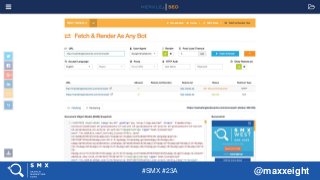
  • #27 But it’s still a better source of info than the cache. It fetches pages from a Google IP (it makes a difference sometimes for websites blocking “Googlebot” user-agent if not coming from a known Google IP) It leverages Googlebot’s JavaScript rendering engine which is likely to be more advanced than PhantomJS.

  • #28 But it’s still a better source of info than the cache. It fetches pages from a Google IP (it makes a difference sometimes for websites blocking “Googlebot” user-agent if not coming from a known Google IP) It leverages Googlebot’s JavaScript rendering engine which is likely to be more advanced than PhantomJS.
  • #31 Botify ScreamingFrog Sitebulb