Bidgoli, MIS, 10th Edition. © 2021 Cengage. All Rights Reserved. May not be scanned, copied or duplicated, or
posted to a publicly accessible website, in whole or in part.
Module 3
Data and Business Intelligence
Bidgoli, MIS, 10th Edition. © 2021 Cengage. All Rights Reserved. May not be scanned, copied or duplicated,
or posted to a publicly accessible website, in whole or in part.
Bidgoli, MIS, 10th Edition. © 2021 Cengage. All Rights Reserved. May not be scanned, copied or duplicated, or
posted to a publicly accessible website, in whole or in part.
Bidgoli, MIS, 10th Edition. © 2021 Cengage. All Rights Reserved. May not be scanned, copied or duplicated, or
posted to a publicly accessible website, in whole or in part.
Learning Objectives (1 of 2)
• Define a database and a database management system
• Explain logical database design and the relational database model
• Define the five components of a database management system
• Summarize three recent trends in database design and use
• Explain the four major components and functions of a data warehouse and their use for
business
Bidgoli, MIS, 10th Edition. © 2021 Cengage. All Rights Reserved. May not be scanned, copied or duplicated, or
posted to a publicly accessible website, in whole or in part.
Bidgoli, MIS, 10th Edition. © 2021 Cengage. All Rights Reserved. May not be scanned, copied or duplicated, or
posted to a publicly accessible website, in whole or in part.
Learning Objectives (2 of 2)
• Describe the functions of a data mart
• Explain business analytics and describe its role in the decision-making process
• Explain the advantages and challenges of big data and predictive analytics for a business
• Explain database marketing and its business applications
• Explain key features of Tableau and Power BI as two popular business intelligence and
visualization platforms
Bidgoli, MIS, 10th Edition. © 2021 Cengage. All Rights Reserved. May not be scanned, copied or duplicated, or
posted to a publicly accessible website, in whole or in part.
Bidgoli, MIS, 10th Edition. © 2021 Cengage. All Rights Reserved. May not be scanned, copied or duplicated, or
posted to a publicly accessible website, in whole or in part.
Databases
• Database
• Collection of related data that is stored in a central location or in multiple locations
• Data hierarchy
• Structure and organization of data, which involves fields, records, and files
• Database management system (DBMS)
• Software for creating, storing, maintaining, and accessing database files
• Makes using databases more efficient
Bidgoli, MIS, 10th Edition. © 2021 Cengage. All Rights Reserved. May not be scanned, copied or duplicated, or
posted to a publicly accessible website, in whole or in part.
Bidgoli, MIS, 10th Edition. © 2021 Cengage. All Rights Reserved. May not be scanned, copied or duplicated, or
posted to a publicly accessible website, in whole or in part.
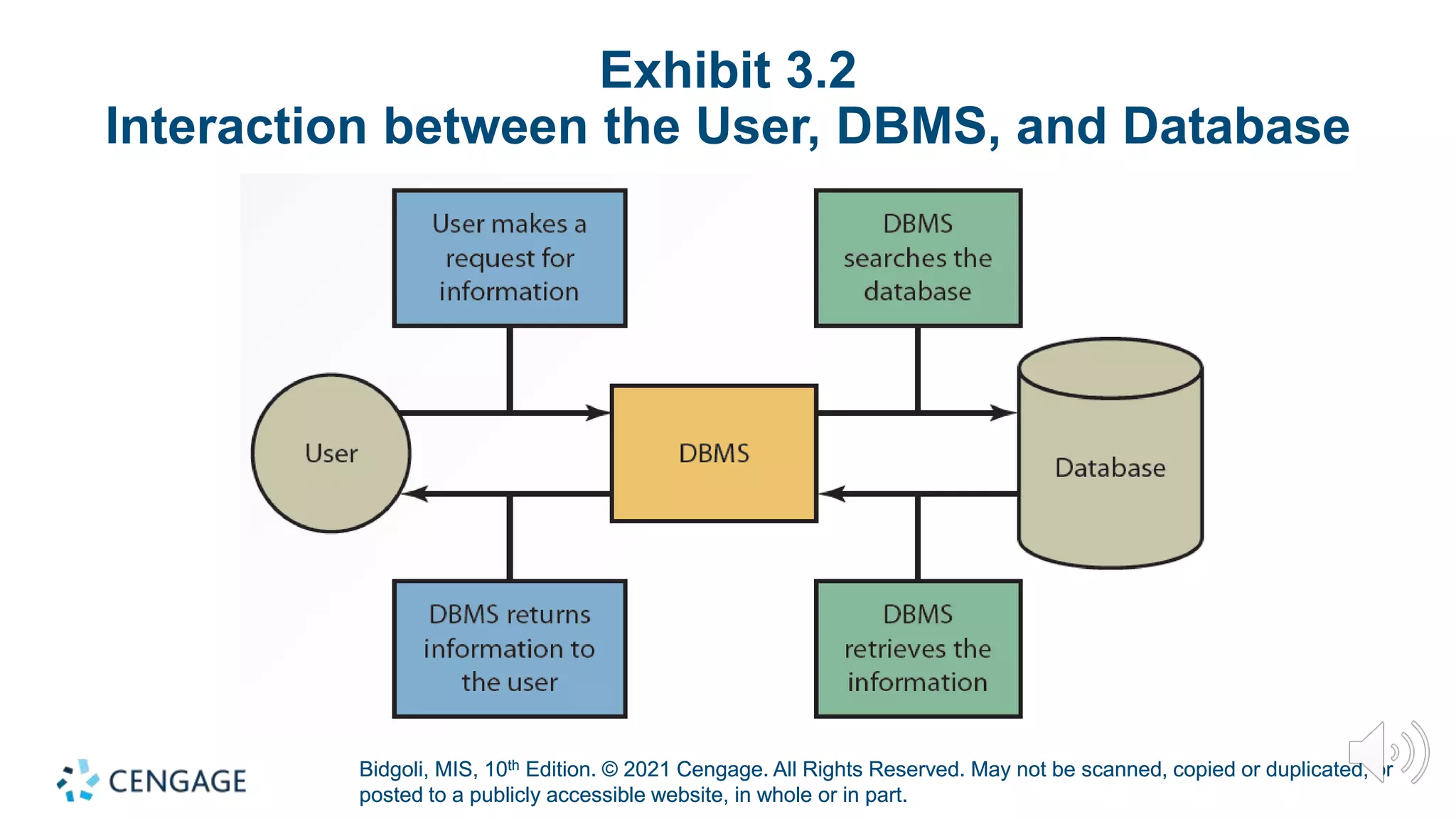
Exhibit 3.2
Interaction between the User, DBMS, and Database
Bidgoli, MIS, 10th Edition. © 2021 Cengage. All Rights Reserved. May not be scanned, copied or duplicated, or
posted to a publicly accessible website, in whole or in part.
Bidgoli, MIS, 10th Edition. © 2021 Cengage. All Rights Reserved. May not be scanned, copied or duplicated, or
posted to a publicly accessible website, in whole or in part.
Types of Data in a Database
• Internal data
• Collected from within an organization
• Stored in the organization’s internal databases and can be used by functional information
systems
• External data
• Comes from a variety of sources
• Stored in a data warehouse
Bidgoli, MIS, 10th Edition. © 2021 Cengage. All Rights Reserved. May not be scanned, copied or duplicated, or
posted to a publicly accessible website, in whole or in part.
Bidgoli, MIS, 10th Edition. © 2021 Cengage. All Rights Reserved. May not be scanned, copied or duplicated, or
posted to a publicly accessible website, in whole or in part.
Methods for Accessing Files (1 of 3)
• Sequential access file structure
• Records in files are organized and processed in numerical or sequential order
• Records are organized based on a primary key (e.g., Social Security numbers or account
numbers)
• Used for backup and archive files because they rarely need updating
Bidgoli, MIS, 10th Edition. © 2021 Cengage. All Rights Reserved. May not be scanned, copied or duplicated, or
posted to a publicly accessible website, in whole or in part.
Bidgoli, MIS, 10th Edition. © 2021 Cengage. All Rights Reserved. May not be scanned, copied or duplicated, or
posted to a publicly accessible website, in whole or in part.
Methods for Accessing Files (2 of 3)
• Random access file structure
• Records can be accessed in any order, regardless of their physical locations in storage
media
• Fast and very effective when a small number of records need to be processed daily or
weekly
• Records are stored on magnetic disks to achieve speed
Bidgoli, MIS, 10th Edition. © 2021 Cengage. All Rights Reserved. May not be scanned, copied or duplicated, or
posted to a publicly accessible website, in whole or in part.
Bidgoli, MIS, 10th Edition. © 2021 Cengage. All Rights Reserved. May not be scanned, copied or duplicated, or
posted to a publicly accessible website, in whole or in part.
Methods for Accessing Files (3 of 3)
• Indexed sequential access method (ISAM)
• Records accessed sequentially or randomly, depending on the number accessed
• Random access: used for a small number
• Sequential access: used for a large number
• Uses an index structure and has two parts
▶ Indexed value
▶ Pointer to the disk location of the record matching the indexed value
Bidgoli, MIS, 10th Edition. © 2021 Cengage. All Rights Reserved. May not be scanned, copied or duplicated, or
posted to a publicly accessible website, in whole or in part.
Bidgoli, MIS, 10th Edition. © 2021 Cengage. All Rights Reserved. May not be scanned, copied or duplicated, or
posted to a publicly accessible website, in whole or in part.
Logical Database Design (1 of 3)
• Information is viewed in a database in two ways
• Physical view: how data is stored on and retrieved from storage media
• Logical view: how information appears to users and how it can be organized and
retrieved
• Depending on the user, there can be more than one logical view of data
Bidgoli, MIS, 10th Edition. © 2021 Cengage. All Rights Reserved. May not be scanned, copied or duplicated, or
posted to a publicly accessible website, in whole or in part.
Bidgoli, MIS, 10th Edition. © 2021 Cengage. All Rights Reserved. May not be scanned, copied or duplicated, or
posted to a publicly accessible website, in whole or in part.
Logical Database Design (2 of 3)
• Data model determines how data is created, represented, organized, and maintained
• Includes:
• Data structure
• Operations
• Integrity rules
Bidgoli, MIS, 10th Edition. © 2021 Cengage. All Rights Reserved. May not be scanned, copied or duplicated, or
posted to a publicly accessible website, in whole or in part.
Bidgoli, MIS, 10th Edition. © 2021 Cengage. All Rights Reserved. May not be scanned, copied or duplicated, or
posted to a publicly accessible website, in whole or in part.
Logical Database Design (3 of 3)
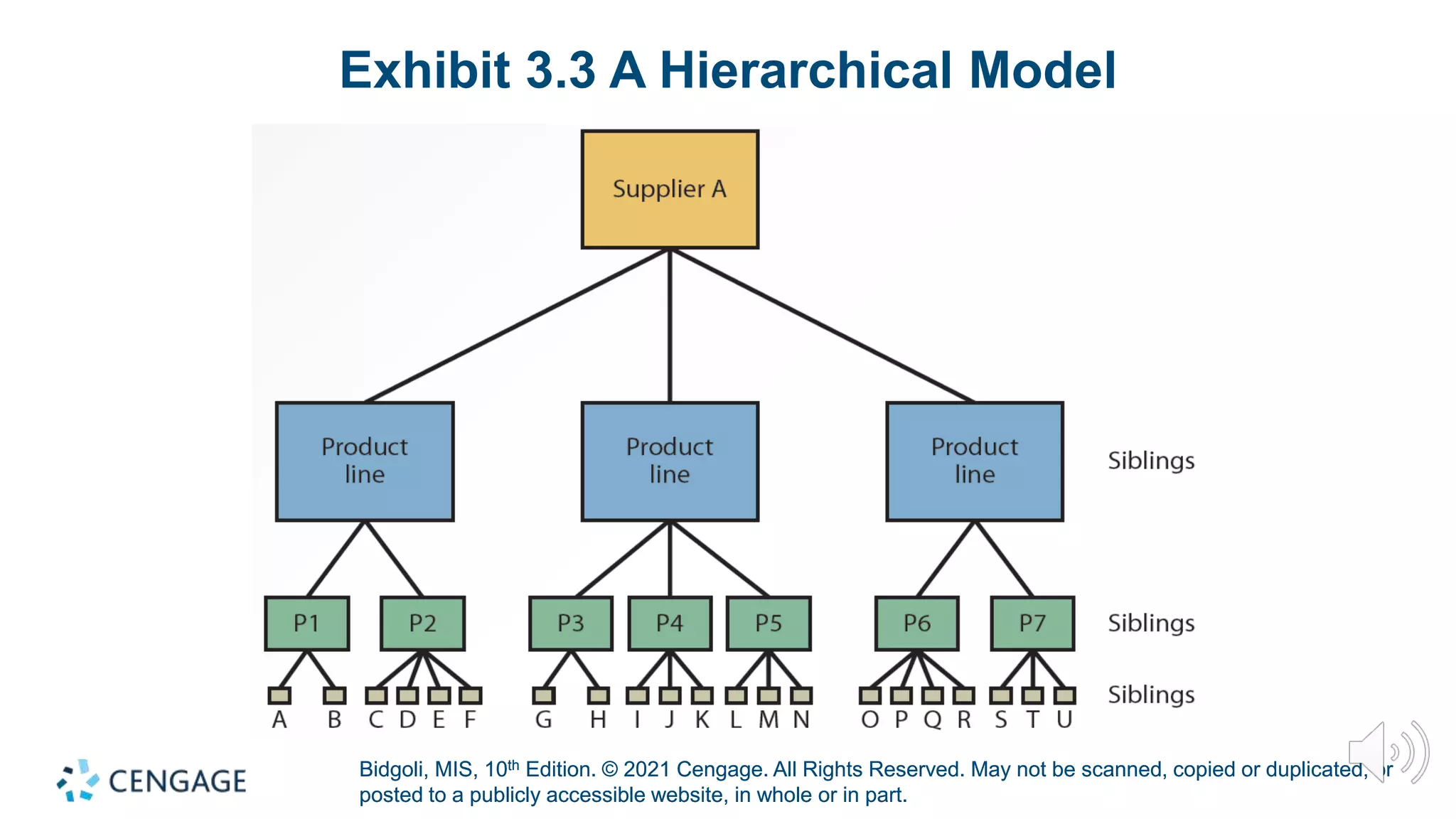
• Hierarchical model
• Relationships between records form a treelike structure
• Records are called nodes, and relationships between records are called branches
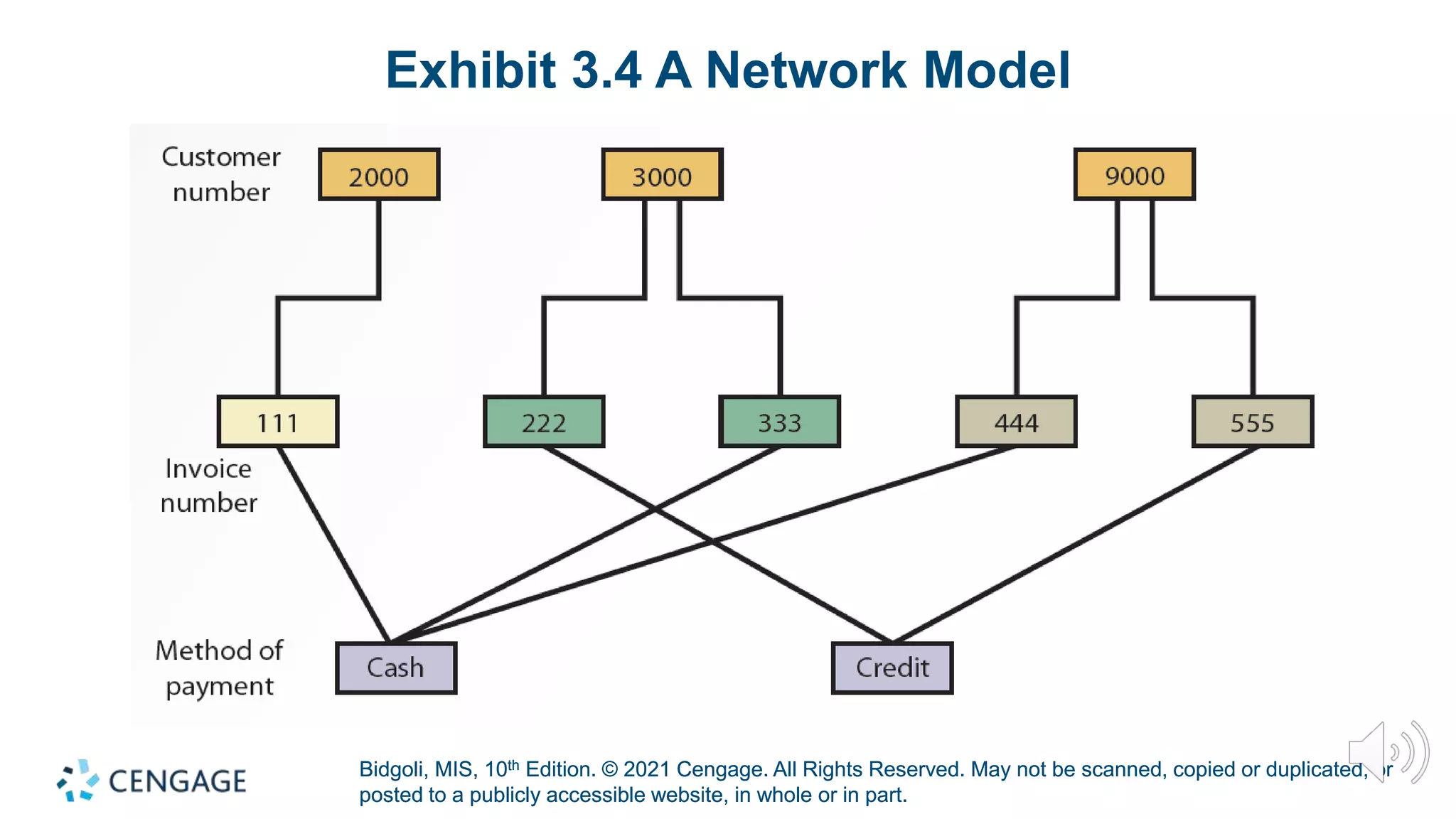
• Network model
• Similar to the hierarchical model but records are organized differently
• Each record can have multiple parent and child records
Bidgoli, MIS, 10th Edition. © 2021 Cengage. All Rights Reserved. May not be scanned, copied or duplicated, or
posted to a publicly accessible website, in whole or in part.
Bidgoli, MIS, 10th Edition. © 2021 Cengage. All Rights Reserved. May not be scanned, copied or duplicated, or
posted to a publicly accessible website, in whole or in part.
Exhibit 3.3 A Hierarchical Model
Bidgoli, MIS, 10th Edition. © 2021 Cengage. All Rights Reserved. May not be scanned, copied or duplicated, or
posted to a publicly accessible website, in whole or in part.
Bidgoli, MIS, 10th Edition. © 2021 Cengage. All Rights Reserved. May not be scanned, copied or duplicated, or
posted to a publicly accessible website, in whole or in part.
Exhibit 3.4 A Network Model
Bidgoli, MIS, 10th Edition. © 2021 Cengage. All Rights Reserved. May not be scanned, copied or duplicated, or
posted to a publicly accessible website, in whole or in part.
Bidgoli, MIS, 10th Edition. © 2021 Cengage. All Rights Reserved. May not be scanned, copied or duplicated, or
posted to a publicly accessible website, in whole or in part.
The Relational Model (1 of 4)
• Uses a two-dimensional table of rows and columns of data
• Rows are records (i.e., tuples)
• Columns are fields (i.e., attributes)
• Data dictionary
• Stores definitions, such as data types for fields, default values, and validation rules for
data in each field
Bidgoli, MIS, 10th Edition. © 2021 Cengage. All Rights Reserved. May not be scanned, copied or duplicated, or
posted to a publicly accessible website, in whole or in part.
Bidgoli, MIS, 10th Edition. © 2021 Cengage. All Rights Reserved. May not be scanned, copied or duplicated, or
posted to a publicly accessible website, in whole or in part.
The Relational Model (2 of 4)
• Primary key
• Uniquely identifies every record in a relational database
• Foreign key
• Field in a relational table that matches the primary key column of another table
• Used to cross-reference tables
Bidgoli, MIS, 10th Edition. © 2021 Cengage. All Rights Reserved. May not be scanned, copied or duplicated, or
posted to a publicly accessible website, in whole or in part.
Bidgoli, MIS, 10th Edition. © 2021 Cengage. All Rights Reserved. May not be scanned, copied or duplicated, or
posted to a publicly accessible website, in whole or in part.
The Relational Model (3 of 4)
• Normalization
• Used to improve database efficiency
• Eliminates redundant data
• Ensures only related data is stored in a table
• Goes through different stages, from first normal form (1NF) to fifth normal form (5NF)
Bidgoli, MIS, 10th Edition. © 2021 Cengage. All Rights Reserved. May not be scanned, copied or duplicated, or
posted to a publicly accessible website, in whole or in part.
Bidgoli, MIS, 10th Edition. © 2021 Cengage. All Rights Reserved. May not be scanned, copied or duplicated, or
posted to a publicly accessible website, in whole or in part.
The Relational Model (4 of 4)
• Operations
• Help retrieve data from tables
• Common operations: select, project, join, intersect, union, and difference
Bidgoli, MIS, 10th Edition. © 2021 Cengage. All Rights Reserved. May not be scanned, copied or duplicated, or
posted to a publicly accessible website, in whole or in part.
Bidgoli, MIS, 10th Edition. © 2021 Cengage. All Rights Reserved. May not be scanned, copied or duplicated, or
posted to a publicly accessible website, in whole or in part.
Components of a DBMS (1 of 4)
• DBMS software components
• Database engine
• Data definition
• Data manipulation
• Application generation
• Data administration
Bidgoli, MIS, 10th Edition. © 2021 Cengage. All Rights Reserved. May not be scanned, copied or duplicated, or
posted to a publicly accessible website, in whole or in part.
Bidgoli, MIS, 10th Edition. © 2021 Cengage. All Rights Reserved. May not be scanned, copied or duplicated, or
posted to a publicly accessible website, in whole or in part.
Components of a DBMS (2 of 4)
• Database engine
• Responsible for data storage, manipulation, and retrieval
• Interacts with other components of the DBMS to convert logical requests from users into
their physical equivalents
• Data definition
• Used to create and maintain the data dictionary and define database file structure
• Makes changes to a database’s structure
Bidgoli, MIS, 10th Edition. © 2021 Cengage. All Rights Reserved. May not be scanned, copied or duplicated, or
posted to a publicly accessible website, in whole or in part.
Bidgoli, MIS, 10th Edition. © 2021 Cengage. All Rights Reserved. May not be scanned, copied or duplicated, or
posted to a publicly accessible website, in whole or in part.
Components of a DBMS (3 of 4)
• Data manipulation
• Used to add, delete, modify, and retrieve records from a database
• Uses a query language, such as Structured Query Language (SQL)
• Application generation
• Designs elements of an application using a database
• Used by IT professionals and database administrators
Bidgoli, MIS, 10th Edition. © 2021 Cengage. All Rights Reserved. May not be scanned, copied or duplicated, or
posted to a publicly accessible website, in whole or in part.
Bidgoli, MIS, 10th Edition. © 2021 Cengage. All Rights Reserved. May not be scanned, copied or duplicated, or
posted to a publicly accessible website, in whole or in part.
Components of a DBMS (4 of 4)
• Data administration
• Used for tasks such as backup and recovery, security, and change management
• Used to determine who has permission to perform certain functions, summarized as
create, read, update, and delete (CRUD)
• Database administrators (DBAs)
• Handle database design and management
• Establish security measures
• Develop recovery procedures
• Evaluate database performance
• Add and fine-tune database functions
Bidgoli, MIS, 10th Edition. © 2021 Cengage. All Rights Reserved. May not be scanned, copied or duplicated, or
posted to a publicly accessible website, in whole or in part.
Bidgoli, MIS, 10th Edition. © 2021 Cengage. All Rights Reserved. May not be scanned, copied or duplicated, or
posted to a publicly accessible website, in whole or in part.
Recent Trends in Database Design and Use
• Include:
• Data-driven Web sites
• Natural language processing
• Distributed databases
• Object-oriented databases
• Advances in artificial intelligence
Bidgoli, MIS, 10th Edition. © 2021 Cengage. All Rights Reserved. May not be scanned, copied or duplicated, or
posted to a publicly accessible website, in whole or in part.
Bidgoli, MIS, 10th Edition. © 2021 Cengage. All Rights Reserved. May not be scanned, copied or duplicated, or
posted to a publicly accessible website, in whole or in part.
Data-Driven Web Sites
• Act as an interface to a database
• Retrieve data and allow users to enter data in the database
• Improve access to information
• Reduce support and overhead needed to maintain static Web sites
• Give users more current information from a variety of data sources
Bidgoli, MIS, 10th Edition. © 2021 Cengage. All Rights Reserved. May not be scanned, copied or duplicated, or
posted to a publicly accessible website, in whole or in part.
Bidgoli, MIS, 10th Edition. © 2021 Cengage. All Rights Reserved. May not be scanned, copied or duplicated, or
posted to a publicly accessible website, in whole or in part.
Distributed Databases (1 of 2)
• Distributed Database Management System (DDBMS)
• Stores data on multiple servers throughout an organization
• Several advantages
• Design better reflects the firm’s structure
• Local data storage reduces response time
• Minimizes effects of computer failure
• Cost advantage
• Not limited by physical location of the data
Bidgoli, MIS, 10th Edition. © 2021 Cengage. All Rights Reserved. May not be scanned, copied or duplicated, or
posted to a publicly accessible website, in whole or in part.
Bidgoli, MIS, 10th Edition. © 2021 Cengage. All Rights Reserved. May not be scanned, copied or duplicated, or
posted to a publicly accessible website, in whole or in part.
Distributed Databases (2 of 2)
• Three approaches to setting up a DDBMS
• Fragmentation: addresses how tables are divided among multiple locations
• Replication: each site stores a copy of the data in the organization’s database
• Allocation: combines fragmentation and replication
Bidgoli, MIS, 10th Edition. © 2021 Cengage. All Rights Reserved. May not be scanned, copied or duplicated, or
posted to a publicly accessible website, in whole or in part.
Bidgoli, MIS, 10th Edition. © 2021 Cengage. All Rights Reserved. May not be scanned, copied or duplicated, or
posted to a publicly accessible website, in whole or in part.
Object-Oriented Databases (1 of 2)
• Data and their relationships are contained in a single object
• An object consists of attributes and methods that can be performed on the object’s data
• Encapsulation: grouping objects along with their attributes and methods into a class
▶ (i.e. Grouping related items into a single unit)
• Inheritance: new objects can be created faster and more easily by entering new data
in attributes
Bidgoli, MIS, 10th Edition. © 2021 Cengage. All Rights Reserved. May not be scanned, copied or duplicated, or
posted to a publicly accessible website, in whole or in part.
Bidgoli, MIS, 10th Edition. © 2021 Cengage. All Rights Reserved. May not be scanned, copied or duplicated, or
posted to a publicly accessible website, in whole or in part.
Object-Oriented Databases (2 of 2)
• Advantages of object-oriented database
• Supports more complex data management
• Handles storing and manipulating all types of multimedia as well as numbers and
characters
Bidgoli, MIS, 10th Edition. © 2021 Cengage. All Rights Reserved. May not be scanned, copied or duplicated, or
posted to a publicly accessible website, in whole or in part.
Bidgoli, MIS, 10th Edition. © 2021 Cengage. All Rights Reserved. May not be scanned, copied or duplicated, or
posted to a publicly accessible website, in whole or in part.
Data Warehouses (1 of 2)
• Collection of data from a variety of sources
• Support decision-making applications
• Generate business intelligence
• Called hypercubes because they store multidimensional data
Bidgoli, MIS, 10th Edition. © 2021 Cengage. All Rights Reserved. May not be scanned, copied or duplicated, or
posted to a publicly accessible website, in whole or in part.
Bidgoli, MIS, 10th Edition. © 2021 Cengage. All Rights Reserved. May not be scanned, copied or duplicated, or
posted to a publicly accessible website, in whole or in part.
Data Warehouses (2 of 2)
• Characteristics of data in a data warehouse
• Subject oriented; focused on a specific area
• Comes from a variety of sources
• Categorized based on time
• Captures aggregated data
• Used for analytical purposes
Bidgoli, MIS, 10th Edition. © 2021 Cengage. All Rights Reserved. May not be scanned, copied or duplicated, or
posted to a publicly accessible website, in whole or in part.
Bidgoli, MIS, 10th Edition. © 2021 Cengage. All Rights Reserved. May not be scanned, copied or duplicated, or
posted to a publicly accessible website, in whole or in part.
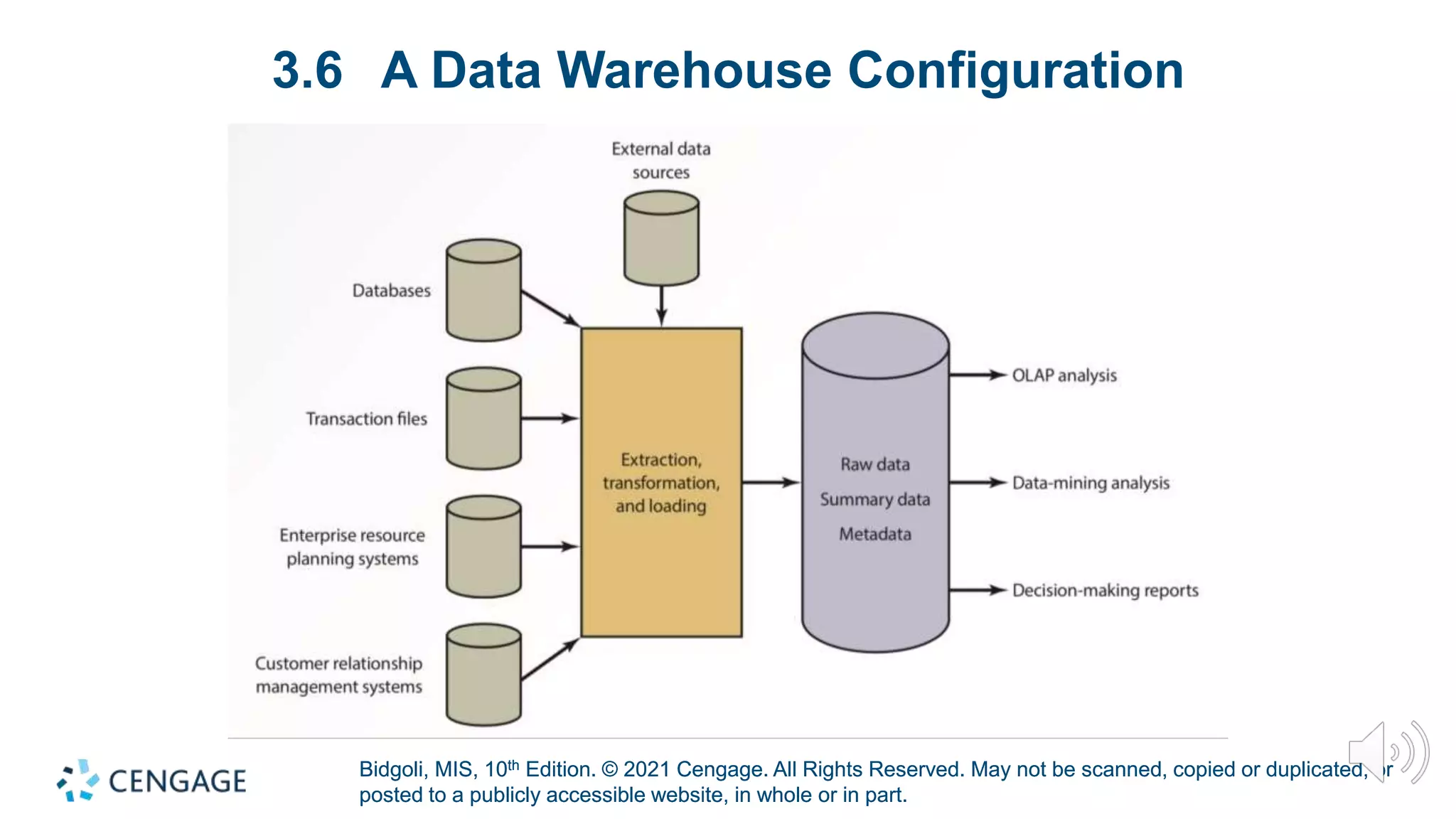
3.6 A Data Warehouse Configuration
Bidgoli, MIS, 10th Edition. © 2021 Cengage. All Rights Reserved. May not be scanned, copied or duplicated, or
posted to a publicly accessible website, in whole or in part.
Bidgoli, MIS, 10th Edition. © 2021 Cengage. All Rights Reserved. May not be scanned, copied or duplicated, or
posted to a publicly accessible website, in whole or in part.
Input
• A variety of data sources provide the input for a data warehouse to perform analyses and
generate reports. These sources can include:
• External data sources, databases, and transaction files
• Enterprise resource planning (ERP) systems
• Customer relationship management (CRM) systems
Bidgoli, MIS, 10th Edition. © 2021 Cengage. All Rights Reserved. May not be scanned, copied or duplicated, or
posted to a publicly accessible website, in whole or in part.
Bidgoli, MIS, 10th Edition. © 2021 Cengage. All Rights Reserved. May not be scanned, copied or duplicated, or
posted to a publicly accessible website, in whole or in part.
ETL
• Extraction, transformation, and loading
• Processes used in a data warehouse
• Extracting (collecting) data from a variety of sources
• Transformation processing to make sure data fits operational needs
• Loading into the end target (database or data warehouse)
Bidgoli, MIS, 10th Edition. © 2021 Cengage. All Rights Reserved. May not be scanned, copied or duplicated, or
posted to a publicly accessible website, in whole or in part.
Bidgoli, MIS, 10th Edition. © 2021 Cengage. All Rights Reserved. May not be scanned, copied or duplicated, or
posted to a publicly accessible website, in whole or in part.
Storage
• Collected information is organized in a data warehouse as:
• Raw data: information in its original form
• Summary data: gives users subtotals of various categories
• Metadata: information about data’s content, quality, condition, origin, and other
characteristics
Bidgoli, MIS, 10th Edition. © 2021 Cengage. All Rights Reserved. May not be scanned, copied or duplicated, or
posted to a publicly accessible website, in whole or in part.
Bidgoli, MIS, 10th Edition. © 2021 Cengage. All Rights Reserved. May not be scanned, copied or duplicated, or
posted to a publicly accessible website, in whole or in part.
Output (1 of 3)
• Data warehouses use the following to generate reports:
• Online analytical processing (OLAP)
• Uses multiple sources of information and provides multidimensional analysis
• Generates business intelligence
• Data-mining analysis
• Used to discover patterns and relationships
Bidgoli, MIS, 10th Edition. © 2021 Cengage. All Rights Reserved. May not be scanned, copied or duplicated, or
posted to a publicly accessible website, in whole or in part.
Bidgoli, MIS, 10th Edition. © 2021 Cengage. All Rights Reserved. May not be scanned, copied or duplicated, or
posted to a publicly accessible website, in whole or in part.
Output (2 of 3)
• Benefits of data warehouses
• Cross-reference segments of an organization’s operations for comparison
• Generate complex queries and reports faster than when using databases
• Generate reports efficiently using data from a variety of sources
• Find patterns and trends that cannot be found with databases
Bidgoli, MIS, 10th Edition. © 2021 Cengage. All Rights Reserved. May not be scanned, copied or duplicated, or
posted to a publicly accessible website, in whole or in part.
Bidgoli, MIS, 10th Edition. © 2021 Cengage. All Rights Reserved. May not be scanned, copied or duplicated, or
posted to a publicly accessible website, in whole or in part.
Output (3 of 3)
• Benefits of data warehouses (continued)
• Analyze large amounts of historical data quickly
• Assist management in making well-informed business decisions
• Manage a high demand for information from many users with different needs and
decision-making styles
Bidgoli, MIS, 10th Edition. © 2021 Cengage. All Rights Reserved. May not be scanned, copied or duplicated, or
posted to a publicly accessible website, in whole or in part.
Bidgoli, MIS, 10th Edition. © 2021 Cengage. All Rights Reserved. May not be scanned, copied or duplicated, or
posted to a publicly accessible website, in whole or in part.
Data Marts (1 of 2)
• Smaller version of a data warehouse, used by a single department or function
• Advantages over data warehouses
• Faster access to data owing to their smaller size
• Improved response time for users
• Easier to create because of their size and simplicity
• Less expensive
• Effective targeting of users
Bidgoli, MIS, 10th Edition. © 2021 Cengage. All Rights Reserved. May not be scanned, copied or duplicated, or
posted to a publicly accessible website, in whole or in part.
Bidgoli, MIS, 10th Edition. © 2021 Cengage. All Rights Reserved. May not be scanned, copied or duplicated, or
posted to a publicly accessible website, in whole or in part.
Data Marts (2 of 2)
• Disadvantages
• Limited scope
• Difficulty in consolidating information from different departments or functional areas
Bidgoli, MIS, 10th Edition. © 2021 Cengage. All Rights Reserved. May not be scanned, copied or duplicated, or
posted to a publicly accessible website, in whole or in part.
Bidgoli, MIS, 10th Edition. © 2021 Cengage. All Rights Reserved. May not be scanned, copied or duplicated, or
posted to a publicly accessible website, in whole or in part.
Business Analytics (1 of 3)
• Uses data and statistical methods
• Gains insight into the data
• Provides decision makers with information to act on
• Methods
• Descriptive
• Predictive
• Prescriptive
Bidgoli, MIS, 10th Edition. © 2021 Cengage. All Rights Reserved. May not be scanned, copied or duplicated, or
posted to a publicly accessible website, in whole or in part.
Bidgoli, MIS, 10th Edition. © 2021 Cengage. All Rights Reserved. May not be scanned, copied or duplicated, or
posted to a publicly accessible website, in whole or in part.
Business Analytics (2 of 3)
• Descriptive analytics
• Reactive strategy
• Reviews past events, analyzes the data, and provides a report indicating:
• What happened in a given period of time
• How to prepare for the future
Bidgoli, MIS, 10th Edition. © 2021 Cengage. All Rights Reserved. May not be scanned, copied or duplicated, or
posted to a publicly accessible website, in whole or in part.
Bidgoli, MIS, 10th Edition. © 2021 Cengage. All Rights Reserved. May not be scanned, copied or duplicated, or
posted to a publicly accessible website, in whole or in part.
Business Analytics (3 of 3)
• Predictive analytics
• Proactive strategy
• Prepares decision makers for future events
• Prescriptive analytics
• Recommends a course of action that decision makers should follow
• Shows the likely outcome of each decision
Bidgoli, MIS, 10th Edition. © 2021 Cengage. All Rights Reserved. May not be scanned, copied or duplicated, or
posted to a publicly accessible website, in whole or in part.
Bidgoli, MIS, 10th Edition. © 2021 Cengage. All Rights Reserved. May not be scanned, copied or duplicated, or
posted to a publicly accessible website, in whole or in part.
The Big Data Era (1 of 3)
• Voluminous data
• Conventional computing methods are unable to efficiently process and manage it
• Involves five dimensions (the 5 Vs):
• Volume
• Variety
• Velocity
• Veracity
• Value
Bidgoli, MIS, 10th Edition. © 2021 Cengage. All Rights Reserved. May not be scanned, copied or duplicated, or
posted to a publicly accessible website, in whole or in part.
Bidgoli, MIS, 10th Edition. © 2021 Cengage. All Rights Reserved. May not be scanned, copied or duplicated, or
posted to a publicly accessible website, in whole or in part.
The Big Data Era (2 of 3)
• Provides competitive advantage in many areas
• Retail, financial services, advertising and public relations, government, manufacturing,
media and telecommunications, energy, healthcare
• Many technologies and applications have contributed to growth and popularity
• Mobile and wireless technology, the popularity of social networks, improvements in
storage and affordability
Bidgoli, MIS, 10th Edition. © 2021 Cengage. All Rights Reserved. May not be scanned, copied or duplicated, or
posted to a publicly accessible website, in whole or in part.
Bidgoli, MIS, 10th Edition. © 2021 Cengage. All Rights Reserved. May not be scanned, copied or duplicated, or
posted to a publicly accessible website, in whole or in part.
The Big Data Era (3 of 3)
• Executives should guard against privacy risks
• Discrimination, privacy breaches and embarrassments, unethical actions based on
interpretations, loss of anonymity, etc.
Bidgoli, MIS, 10th Edition. © 2021 Cengage. All Rights Reserved. May not be scanned, copied or duplicated, or
posted to a publicly accessible website, in whole or in part.
Bidgoli, MIS, 10th Edition. © 2021 Cengage. All Rights Reserved. May not be scanned, copied or duplicated, or
posted to a publicly accessible website, in whole or in part.
Database Marketing (1 of 3)
• Uses an organization's database of customers and potential customers to promote products
or services
• Main goal: use information within the database to implement marketing strategies
▶ Increase profits
▶ Enhance competitiveness
▶ Establish and maintain long-term customer relationships
Bidgoli, MIS, 10th Edition. © 2021 Cengage. All Rights Reserved. May not be scanned, copied or duplicated, or
posted to a publicly accessible website, in whole or in part.
Bidgoli, MIS, 10th Edition. © 2021 Cengage. All Rights Reserved. May not be scanned, copied or duplicated, or
posted to a publicly accessible website, in whole or in part.
Database Marketing (2 of 3)
• Transforms marketing from a reactive to a proactive process
• Multivariate analysis
• Data segmentation
• Automated tools
Bidgoli, MIS, 10th Edition. © 2021 Cengage. All Rights Reserved. May not be scanned, copied or duplicated, or
posted to a publicly accessible website, in whole or in part.
Bidgoli, MIS, 10th Edition. © 2021 Cengage. All Rights Reserved. May not be scanned, copied or duplicated, or
posted to a publicly accessible website, in whole or in part.
Database Marketing (3 of 3)
• Tasks performed by successful database marketing campaigns
• Calculating customer lifetime value (CLTV)
• Conducting recency, frequency, and monetary analysis (RFM)
• Using different techniques to communicate effectively with customers
• Using analytical software and different techniques to monitor customer behavior across a
number of retail channels
Bidgoli, MIS, 10th Edition. © 2021 Cengage. All Rights Reserved. May not be scanned, copied or duplicated, or
posted to a publicly accessible website, in whole or in part.
Bidgoli, MIS, 10th Edition. © 2021 Cengage. All Rights Reserved. May not be scanned, copied or duplicated, or
posted to a publicly accessible website, in whole or in part.
Tableau and Power BI
Two Popular BI and Visualization Platforms
• Tableau
• Data visualization tool
• Used for generating business intelligence (BI)
• Analyzes data for generating trends using graphs and charts
• “What-if” analysis
• Power BI
• Microsoft platform
• Allows user to analyze and visualize data
• Different sources
• Different formats
• Integrates with existing data and applications
Bidgoli, MIS, 10th Edition. © 2021 Cengage. All Rights Reserved. May not be scanned, copied or duplicated, or
posted to a publicly accessible website, in whole or in part.
Bidgoli, MIS, 10th Edition. © 2021 Cengage. All Rights Reserved. May not be scanned, copied or duplicated, or
posted to a publicly accessible website, in whole or in part.
Summary (1 of 4)
• All files are integrated in a database, which enables faster retrieval of data
• The five components of a DBMS are database engine, data definition, data manipulation,
application generation, and data administration
• Recent trends in database design are data-driven Web sites, distributed database
management system (DDBMS), and object-oriented databases
Bidgoli, MIS, 10th Edition. © 2021 Cengage. All Rights Reserved. May not be scanned, copied or duplicated, or
posted to a publicly accessible website, in whole or in part.
Bidgoli, MIS, 10th Edition. © 2021 Cengage. All Rights Reserved. May not be scanned, copied or duplicated, or
posted to a publicly accessible website, in whole or in part.
Summary (2 of 4)
• Data warehouse is a collection of data from a variety of sources
• Major components of a data warehouse include:
• Input
• Extraction, transformation, loading (ETL)
• Storage
• Output
• Data marts focus on business functions for a specific user group in an organization
• Smaller version of a data warehouse
Bidgoli, MIS, 10th Edition. © 2021 Cengage. All Rights Reserved. May not be scanned, copied or duplicated, or
posted to a publicly accessible website, in whole or in part.
Bidgoli, MIS, 10th Edition. © 2021 Cengage. All Rights Reserved. May not be scanned, copied or duplicated, or
posted to a publicly accessible website, in whole or in part.
Summary (3 of 4)
• Industries gain a competitive advantage from big data analytics
• Provides decision makers with actionable information
• 5 Vs of big data
• Volume, variety, velocity, veracity, value
Bidgoli, MIS, 10th Edition. © 2021 Cengage. All Rights Reserved. May not be scanned, copied or duplicated, or
posted to a publicly accessible website, in whole or in part.
Bidgoli, MIS, 10th Edition. © 2021 Cengage. All Rights Reserved. May not be scanned, copied or duplicated, or
posted to a publicly accessible website, in whole or in part.
Summary (4 of 4)
• Database marketing
• Uses database of customers and potential customers to promote products or services
• Tableau
• Data visualization tool
• Uses graphs and charts to generate trends
• Power BI
• Analyzes and visualizes data
• Different sources
• Different formats

MOK8 Module 3 Data and Bus Intelligence

  • 1.
    Bidgoli, MIS, 10thEdition. © 2021 Cengage. All Rights Reserved. May not be scanned, copied or duplicated, or posted to a publicly accessible website, in whole or in part. Module 3 Data and Business Intelligence Bidgoli, MIS, 10th Edition. © 2021 Cengage. All Rights Reserved. May not be scanned, copied or duplicated, or posted to a publicly accessible website, in whole or in part.
  • 2.
    Bidgoli, MIS, 10thEdition. © 2021 Cengage. All Rights Reserved. May not be scanned, copied or duplicated, or posted to a publicly accessible website, in whole or in part. Bidgoli, MIS, 10th Edition. © 2021 Cengage. All Rights Reserved. May not be scanned, copied or duplicated, or posted to a publicly accessible website, in whole or in part. Learning Objectives (1 of 2) • Define a database and a database management system • Explain logical database design and the relational database model • Define the five components of a database management system • Summarize three recent trends in database design and use • Explain the four major components and functions of a data warehouse and their use for business
  • 3.
    Bidgoli, MIS, 10thEdition. © 2021 Cengage. All Rights Reserved. May not be scanned, copied or duplicated, or posted to a publicly accessible website, in whole or in part. Bidgoli, MIS, 10th Edition. © 2021 Cengage. All Rights Reserved. May not be scanned, copied or duplicated, or posted to a publicly accessible website, in whole or in part. Learning Objectives (2 of 2) • Describe the functions of a data mart • Explain business analytics and describe its role in the decision-making process • Explain the advantages and challenges of big data and predictive analytics for a business • Explain database marketing and its business applications • Explain key features of Tableau and Power BI as two popular business intelligence and visualization platforms
  • 4.
    Bidgoli, MIS, 10thEdition. © 2021 Cengage. All Rights Reserved. May not be scanned, copied or duplicated, or posted to a publicly accessible website, in whole or in part. Bidgoli, MIS, 10th Edition. © 2021 Cengage. All Rights Reserved. May not be scanned, copied or duplicated, or posted to a publicly accessible website, in whole or in part. Databases • Database • Collection of related data that is stored in a central location or in multiple locations • Data hierarchy • Structure and organization of data, which involves fields, records, and files • Database management system (DBMS) • Software for creating, storing, maintaining, and accessing database files • Makes using databases more efficient
  • 5.
    Bidgoli, MIS, 10thEdition. © 2021 Cengage. All Rights Reserved. May not be scanned, copied or duplicated, or posted to a publicly accessible website, in whole or in part. Bidgoli, MIS, 10th Edition. © 2021 Cengage. All Rights Reserved. May not be scanned, copied or duplicated, or posted to a publicly accessible website, in whole or in part. Exhibit 3.2 Interaction between the User, DBMS, and Database
  • 6.
    Bidgoli, MIS, 10thEdition. © 2021 Cengage. All Rights Reserved. May not be scanned, copied or duplicated, or posted to a publicly accessible website, in whole or in part. Bidgoli, MIS, 10th Edition. © 2021 Cengage. All Rights Reserved. May not be scanned, copied or duplicated, or posted to a publicly accessible website, in whole or in part. Types of Data in a Database • Internal data • Collected from within an organization • Stored in the organization’s internal databases and can be used by functional information systems • External data • Comes from a variety of sources • Stored in a data warehouse
  • 7.
    Bidgoli, MIS, 10thEdition. © 2021 Cengage. All Rights Reserved. May not be scanned, copied or duplicated, or posted to a publicly accessible website, in whole or in part. Bidgoli, MIS, 10th Edition. © 2021 Cengage. All Rights Reserved. May not be scanned, copied or duplicated, or posted to a publicly accessible website, in whole or in part. Methods for Accessing Files (1 of 3) • Sequential access file structure • Records in files are organized and processed in numerical or sequential order • Records are organized based on a primary key (e.g., Social Security numbers or account numbers) • Used for backup and archive files because they rarely need updating
  • 8.
    Bidgoli, MIS, 10thEdition. © 2021 Cengage. All Rights Reserved. May not be scanned, copied or duplicated, or posted to a publicly accessible website, in whole or in part. Bidgoli, MIS, 10th Edition. © 2021 Cengage. All Rights Reserved. May not be scanned, copied or duplicated, or posted to a publicly accessible website, in whole or in part. Methods for Accessing Files (2 of 3) • Random access file structure • Records can be accessed in any order, regardless of their physical locations in storage media • Fast and very effective when a small number of records need to be processed daily or weekly • Records are stored on magnetic disks to achieve speed
  • 9.
    Bidgoli, MIS, 10thEdition. © 2021 Cengage. All Rights Reserved. May not be scanned, copied or duplicated, or posted to a publicly accessible website, in whole or in part. Bidgoli, MIS, 10th Edition. © 2021 Cengage. All Rights Reserved. May not be scanned, copied or duplicated, or posted to a publicly accessible website, in whole or in part. Methods for Accessing Files (3 of 3) • Indexed sequential access method (ISAM) • Records accessed sequentially or randomly, depending on the number accessed • Random access: used for a small number • Sequential access: used for a large number • Uses an index structure and has two parts ▶ Indexed value ▶ Pointer to the disk location of the record matching the indexed value
  • 10.
    Bidgoli, MIS, 10thEdition. © 2021 Cengage. All Rights Reserved. May not be scanned, copied or duplicated, or posted to a publicly accessible website, in whole or in part. Bidgoli, MIS, 10th Edition. © 2021 Cengage. All Rights Reserved. May not be scanned, copied or duplicated, or posted to a publicly accessible website, in whole or in part. Logical Database Design (1 of 3) • Information is viewed in a database in two ways • Physical view: how data is stored on and retrieved from storage media • Logical view: how information appears to users and how it can be organized and retrieved • Depending on the user, there can be more than one logical view of data
  • 11.
    Bidgoli, MIS, 10thEdition. © 2021 Cengage. All Rights Reserved. May not be scanned, copied or duplicated, or posted to a publicly accessible website, in whole or in part. Bidgoli, MIS, 10th Edition. © 2021 Cengage. All Rights Reserved. May not be scanned, copied or duplicated, or posted to a publicly accessible website, in whole or in part. Logical Database Design (2 of 3) • Data model determines how data is created, represented, organized, and maintained • Includes: • Data structure • Operations • Integrity rules
  • 12.
    Bidgoli, MIS, 10thEdition. © 2021 Cengage. All Rights Reserved. May not be scanned, copied or duplicated, or posted to a publicly accessible website, in whole or in part. Bidgoli, MIS, 10th Edition. © 2021 Cengage. All Rights Reserved. May not be scanned, copied or duplicated, or posted to a publicly accessible website, in whole or in part. Logical Database Design (3 of 3) • Hierarchical model • Relationships between records form a treelike structure • Records are called nodes, and relationships between records are called branches • Network model • Similar to the hierarchical model but records are organized differently • Each record can have multiple parent and child records
  • 13.
    Bidgoli, MIS, 10thEdition. © 2021 Cengage. All Rights Reserved. May not be scanned, copied or duplicated, or posted to a publicly accessible website, in whole or in part. Bidgoli, MIS, 10th Edition. © 2021 Cengage. All Rights Reserved. May not be scanned, copied or duplicated, or posted to a publicly accessible website, in whole or in part. Exhibit 3.3 A Hierarchical Model
  • 14.
    Bidgoli, MIS, 10thEdition. © 2021 Cengage. All Rights Reserved. May not be scanned, copied or duplicated, or posted to a publicly accessible website, in whole or in part. Bidgoli, MIS, 10th Edition. © 2021 Cengage. All Rights Reserved. May not be scanned, copied or duplicated, or posted to a publicly accessible website, in whole or in part. Exhibit 3.4 A Network Model
  • 15.
    Bidgoli, MIS, 10thEdition. © 2021 Cengage. All Rights Reserved. May not be scanned, copied or duplicated, or posted to a publicly accessible website, in whole or in part. Bidgoli, MIS, 10th Edition. © 2021 Cengage. All Rights Reserved. May not be scanned, copied or duplicated, or posted to a publicly accessible website, in whole or in part. The Relational Model (1 of 4) • Uses a two-dimensional table of rows and columns of data • Rows are records (i.e., tuples) • Columns are fields (i.e., attributes) • Data dictionary • Stores definitions, such as data types for fields, default values, and validation rules for data in each field
  • 16.
    Bidgoli, MIS, 10thEdition. © 2021 Cengage. All Rights Reserved. May not be scanned, copied or duplicated, or posted to a publicly accessible website, in whole or in part. Bidgoli, MIS, 10th Edition. © 2021 Cengage. All Rights Reserved. May not be scanned, copied or duplicated, or posted to a publicly accessible website, in whole or in part. The Relational Model (2 of 4) • Primary key • Uniquely identifies every record in a relational database • Foreign key • Field in a relational table that matches the primary key column of another table • Used to cross-reference tables
  • 17.
    Bidgoli, MIS, 10thEdition. © 2021 Cengage. All Rights Reserved. May not be scanned, copied or duplicated, or posted to a publicly accessible website, in whole or in part. Bidgoli, MIS, 10th Edition. © 2021 Cengage. All Rights Reserved. May not be scanned, copied or duplicated, or posted to a publicly accessible website, in whole or in part. The Relational Model (3 of 4) • Normalization • Used to improve database efficiency • Eliminates redundant data • Ensures only related data is stored in a table • Goes through different stages, from first normal form (1NF) to fifth normal form (5NF)
  • 18.
    Bidgoli, MIS, 10thEdition. © 2021 Cengage. All Rights Reserved. May not be scanned, copied or duplicated, or posted to a publicly accessible website, in whole or in part. Bidgoli, MIS, 10th Edition. © 2021 Cengage. All Rights Reserved. May not be scanned, copied or duplicated, or posted to a publicly accessible website, in whole or in part. The Relational Model (4 of 4) • Operations • Help retrieve data from tables • Common operations: select, project, join, intersect, union, and difference
  • 19.
    Bidgoli, MIS, 10thEdition. © 2021 Cengage. All Rights Reserved. May not be scanned, copied or duplicated, or posted to a publicly accessible website, in whole or in part. Bidgoli, MIS, 10th Edition. © 2021 Cengage. All Rights Reserved. May not be scanned, copied or duplicated, or posted to a publicly accessible website, in whole or in part. Components of a DBMS (1 of 4) • DBMS software components • Database engine • Data definition • Data manipulation • Application generation • Data administration
  • 20.
    Bidgoli, MIS, 10thEdition. © 2021 Cengage. All Rights Reserved. May not be scanned, copied or duplicated, or posted to a publicly accessible website, in whole or in part. Bidgoli, MIS, 10th Edition. © 2021 Cengage. All Rights Reserved. May not be scanned, copied or duplicated, or posted to a publicly accessible website, in whole or in part. Components of a DBMS (2 of 4) • Database engine • Responsible for data storage, manipulation, and retrieval • Interacts with other components of the DBMS to convert logical requests from users into their physical equivalents • Data definition • Used to create and maintain the data dictionary and define database file structure • Makes changes to a database’s structure
  • 21.
    Bidgoli, MIS, 10thEdition. © 2021 Cengage. All Rights Reserved. May not be scanned, copied or duplicated, or posted to a publicly accessible website, in whole or in part. Bidgoli, MIS, 10th Edition. © 2021 Cengage. All Rights Reserved. May not be scanned, copied or duplicated, or posted to a publicly accessible website, in whole or in part. Components of a DBMS (3 of 4) • Data manipulation • Used to add, delete, modify, and retrieve records from a database • Uses a query language, such as Structured Query Language (SQL) • Application generation • Designs elements of an application using a database • Used by IT professionals and database administrators
  • 22.
    Bidgoli, MIS, 10thEdition. © 2021 Cengage. All Rights Reserved. May not be scanned, copied or duplicated, or posted to a publicly accessible website, in whole or in part. Bidgoli, MIS, 10th Edition. © 2021 Cengage. All Rights Reserved. May not be scanned, copied or duplicated, or posted to a publicly accessible website, in whole or in part. Components of a DBMS (4 of 4) • Data administration • Used for tasks such as backup and recovery, security, and change management • Used to determine who has permission to perform certain functions, summarized as create, read, update, and delete (CRUD) • Database administrators (DBAs) • Handle database design and management • Establish security measures • Develop recovery procedures • Evaluate database performance • Add and fine-tune database functions
  • 23.
    Bidgoli, MIS, 10thEdition. © 2021 Cengage. All Rights Reserved. May not be scanned, copied or duplicated, or posted to a publicly accessible website, in whole or in part. Bidgoli, MIS, 10th Edition. © 2021 Cengage. All Rights Reserved. May not be scanned, copied or duplicated, or posted to a publicly accessible website, in whole or in part. Recent Trends in Database Design and Use • Include: • Data-driven Web sites • Natural language processing • Distributed databases • Object-oriented databases • Advances in artificial intelligence
  • 24.
    Bidgoli, MIS, 10thEdition. © 2021 Cengage. All Rights Reserved. May not be scanned, copied or duplicated, or posted to a publicly accessible website, in whole or in part. Bidgoli, MIS, 10th Edition. © 2021 Cengage. All Rights Reserved. May not be scanned, copied or duplicated, or posted to a publicly accessible website, in whole or in part. Data-Driven Web Sites • Act as an interface to a database • Retrieve data and allow users to enter data in the database • Improve access to information • Reduce support and overhead needed to maintain static Web sites • Give users more current information from a variety of data sources
  • 25.
    Bidgoli, MIS, 10thEdition. © 2021 Cengage. All Rights Reserved. May not be scanned, copied or duplicated, or posted to a publicly accessible website, in whole or in part. Bidgoli, MIS, 10th Edition. © 2021 Cengage. All Rights Reserved. May not be scanned, copied or duplicated, or posted to a publicly accessible website, in whole or in part. Distributed Databases (1 of 2) • Distributed Database Management System (DDBMS) • Stores data on multiple servers throughout an organization • Several advantages • Design better reflects the firm’s structure • Local data storage reduces response time • Minimizes effects of computer failure • Cost advantage • Not limited by physical location of the data
  • 26.
    Bidgoli, MIS, 10thEdition. © 2021 Cengage. All Rights Reserved. May not be scanned, copied or duplicated, or posted to a publicly accessible website, in whole or in part. Bidgoli, MIS, 10th Edition. © 2021 Cengage. All Rights Reserved. May not be scanned, copied or duplicated, or posted to a publicly accessible website, in whole or in part. Distributed Databases (2 of 2) • Three approaches to setting up a DDBMS • Fragmentation: addresses how tables are divided among multiple locations • Replication: each site stores a copy of the data in the organization’s database • Allocation: combines fragmentation and replication
  • 27.
    Bidgoli, MIS, 10thEdition. © 2021 Cengage. All Rights Reserved. May not be scanned, copied or duplicated, or posted to a publicly accessible website, in whole or in part. Bidgoli, MIS, 10th Edition. © 2021 Cengage. All Rights Reserved. May not be scanned, copied or duplicated, or posted to a publicly accessible website, in whole or in part. Object-Oriented Databases (1 of 2) • Data and their relationships are contained in a single object • An object consists of attributes and methods that can be performed on the object’s data • Encapsulation: grouping objects along with their attributes and methods into a class ▶ (i.e. Grouping related items into a single unit) • Inheritance: new objects can be created faster and more easily by entering new data in attributes
  • 28.
    Bidgoli, MIS, 10thEdition. © 2021 Cengage. All Rights Reserved. May not be scanned, copied or duplicated, or posted to a publicly accessible website, in whole or in part. Bidgoli, MIS, 10th Edition. © 2021 Cengage. All Rights Reserved. May not be scanned, copied or duplicated, or posted to a publicly accessible website, in whole or in part. Object-Oriented Databases (2 of 2) • Advantages of object-oriented database • Supports more complex data management • Handles storing and manipulating all types of multimedia as well as numbers and characters
  • 29.
    Bidgoli, MIS, 10thEdition. © 2021 Cengage. All Rights Reserved. May not be scanned, copied or duplicated, or posted to a publicly accessible website, in whole or in part. Bidgoli, MIS, 10th Edition. © 2021 Cengage. All Rights Reserved. May not be scanned, copied or duplicated, or posted to a publicly accessible website, in whole or in part. Data Warehouses (1 of 2) • Collection of data from a variety of sources • Support decision-making applications • Generate business intelligence • Called hypercubes because they store multidimensional data
  • 30.
    Bidgoli, MIS, 10thEdition. © 2021 Cengage. All Rights Reserved. May not be scanned, copied or duplicated, or posted to a publicly accessible website, in whole or in part. Bidgoli, MIS, 10th Edition. © 2021 Cengage. All Rights Reserved. May not be scanned, copied or duplicated, or posted to a publicly accessible website, in whole or in part. Data Warehouses (2 of 2) • Characteristics of data in a data warehouse • Subject oriented; focused on a specific area • Comes from a variety of sources • Categorized based on time • Captures aggregated data • Used for analytical purposes
  • 31.
    Bidgoli, MIS, 10thEdition. © 2021 Cengage. All Rights Reserved. May not be scanned, copied or duplicated, or posted to a publicly accessible website, in whole or in part. Bidgoli, MIS, 10th Edition. © 2021 Cengage. All Rights Reserved. May not be scanned, copied or duplicated, or posted to a publicly accessible website, in whole or in part. 3.6 A Data Warehouse Configuration
  • 32.
    Bidgoli, MIS, 10thEdition. © 2021 Cengage. All Rights Reserved. May not be scanned, copied or duplicated, or posted to a publicly accessible website, in whole or in part. Bidgoli, MIS, 10th Edition. © 2021 Cengage. All Rights Reserved. May not be scanned, copied or duplicated, or posted to a publicly accessible website, in whole or in part. Input • A variety of data sources provide the input for a data warehouse to perform analyses and generate reports. These sources can include: • External data sources, databases, and transaction files • Enterprise resource planning (ERP) systems • Customer relationship management (CRM) systems
  • 33.
    Bidgoli, MIS, 10thEdition. © 2021 Cengage. All Rights Reserved. May not be scanned, copied or duplicated, or posted to a publicly accessible website, in whole or in part. Bidgoli, MIS, 10th Edition. © 2021 Cengage. All Rights Reserved. May not be scanned, copied or duplicated, or posted to a publicly accessible website, in whole or in part. ETL • Extraction, transformation, and loading • Processes used in a data warehouse • Extracting (collecting) data from a variety of sources • Transformation processing to make sure data fits operational needs • Loading into the end target (database or data warehouse)
  • 34.
    Bidgoli, MIS, 10thEdition. © 2021 Cengage. All Rights Reserved. May not be scanned, copied or duplicated, or posted to a publicly accessible website, in whole or in part. Bidgoli, MIS, 10th Edition. © 2021 Cengage. All Rights Reserved. May not be scanned, copied or duplicated, or posted to a publicly accessible website, in whole or in part. Storage • Collected information is organized in a data warehouse as: • Raw data: information in its original form • Summary data: gives users subtotals of various categories • Metadata: information about data’s content, quality, condition, origin, and other characteristics
  • 35.
    Bidgoli, MIS, 10thEdition. © 2021 Cengage. All Rights Reserved. May not be scanned, copied or duplicated, or posted to a publicly accessible website, in whole or in part. Bidgoli, MIS, 10th Edition. © 2021 Cengage. All Rights Reserved. May not be scanned, copied or duplicated, or posted to a publicly accessible website, in whole or in part. Output (1 of 3) • Data warehouses use the following to generate reports: • Online analytical processing (OLAP) • Uses multiple sources of information and provides multidimensional analysis • Generates business intelligence • Data-mining analysis • Used to discover patterns and relationships
  • 36.
    Bidgoli, MIS, 10thEdition. © 2021 Cengage. All Rights Reserved. May not be scanned, copied or duplicated, or posted to a publicly accessible website, in whole or in part. Bidgoli, MIS, 10th Edition. © 2021 Cengage. All Rights Reserved. May not be scanned, copied or duplicated, or posted to a publicly accessible website, in whole or in part. Output (2 of 3) • Benefits of data warehouses • Cross-reference segments of an organization’s operations for comparison • Generate complex queries and reports faster than when using databases • Generate reports efficiently using data from a variety of sources • Find patterns and trends that cannot be found with databases
  • 37.
    Bidgoli, MIS, 10thEdition. © 2021 Cengage. All Rights Reserved. May not be scanned, copied or duplicated, or posted to a publicly accessible website, in whole or in part. Bidgoli, MIS, 10th Edition. © 2021 Cengage. All Rights Reserved. May not be scanned, copied or duplicated, or posted to a publicly accessible website, in whole or in part. Output (3 of 3) • Benefits of data warehouses (continued) • Analyze large amounts of historical data quickly • Assist management in making well-informed business decisions • Manage a high demand for information from many users with different needs and decision-making styles
  • 38.
    Bidgoli, MIS, 10thEdition. © 2021 Cengage. All Rights Reserved. May not be scanned, copied or duplicated, or posted to a publicly accessible website, in whole or in part. Bidgoli, MIS, 10th Edition. © 2021 Cengage. All Rights Reserved. May not be scanned, copied or duplicated, or posted to a publicly accessible website, in whole or in part. Data Marts (1 of 2) • Smaller version of a data warehouse, used by a single department or function • Advantages over data warehouses • Faster access to data owing to their smaller size • Improved response time for users • Easier to create because of their size and simplicity • Less expensive • Effective targeting of users
  • 39.
    Bidgoli, MIS, 10thEdition. © 2021 Cengage. All Rights Reserved. May not be scanned, copied or duplicated, or posted to a publicly accessible website, in whole or in part. Bidgoli, MIS, 10th Edition. © 2021 Cengage. All Rights Reserved. May not be scanned, copied or duplicated, or posted to a publicly accessible website, in whole or in part. Data Marts (2 of 2) • Disadvantages • Limited scope • Difficulty in consolidating information from different departments or functional areas
  • 40.
    Bidgoli, MIS, 10thEdition. © 2021 Cengage. All Rights Reserved. May not be scanned, copied or duplicated, or posted to a publicly accessible website, in whole or in part. Bidgoli, MIS, 10th Edition. © 2021 Cengage. All Rights Reserved. May not be scanned, copied or duplicated, or posted to a publicly accessible website, in whole or in part. Business Analytics (1 of 3) • Uses data and statistical methods • Gains insight into the data • Provides decision makers with information to act on • Methods • Descriptive • Predictive • Prescriptive
  • 41.
    Bidgoli, MIS, 10thEdition. © 2021 Cengage. All Rights Reserved. May not be scanned, copied or duplicated, or posted to a publicly accessible website, in whole or in part. Bidgoli, MIS, 10th Edition. © 2021 Cengage. All Rights Reserved. May not be scanned, copied or duplicated, or posted to a publicly accessible website, in whole or in part. Business Analytics (2 of 3) • Descriptive analytics • Reactive strategy • Reviews past events, analyzes the data, and provides a report indicating: • What happened in a given period of time • How to prepare for the future
  • 42.
    Bidgoli, MIS, 10thEdition. © 2021 Cengage. All Rights Reserved. May not be scanned, copied or duplicated, or posted to a publicly accessible website, in whole or in part. Bidgoli, MIS, 10th Edition. © 2021 Cengage. All Rights Reserved. May not be scanned, copied or duplicated, or posted to a publicly accessible website, in whole or in part. Business Analytics (3 of 3) • Predictive analytics • Proactive strategy • Prepares decision makers for future events • Prescriptive analytics • Recommends a course of action that decision makers should follow • Shows the likely outcome of each decision
  • 43.
    Bidgoli, MIS, 10thEdition. © 2021 Cengage. All Rights Reserved. May not be scanned, copied or duplicated, or posted to a publicly accessible website, in whole or in part. Bidgoli, MIS, 10th Edition. © 2021 Cengage. All Rights Reserved. May not be scanned, copied or duplicated, or posted to a publicly accessible website, in whole or in part. The Big Data Era (1 of 3) • Voluminous data • Conventional computing methods are unable to efficiently process and manage it • Involves five dimensions (the 5 Vs): • Volume • Variety • Velocity • Veracity • Value
  • 44.
    Bidgoli, MIS, 10thEdition. © 2021 Cengage. All Rights Reserved. May not be scanned, copied or duplicated, or posted to a publicly accessible website, in whole or in part. Bidgoli, MIS, 10th Edition. © 2021 Cengage. All Rights Reserved. May not be scanned, copied or duplicated, or posted to a publicly accessible website, in whole or in part. The Big Data Era (2 of 3) • Provides competitive advantage in many areas • Retail, financial services, advertising and public relations, government, manufacturing, media and telecommunications, energy, healthcare • Many technologies and applications have contributed to growth and popularity • Mobile and wireless technology, the popularity of social networks, improvements in storage and affordability
  • 45.
    Bidgoli, MIS, 10thEdition. © 2021 Cengage. All Rights Reserved. May not be scanned, copied or duplicated, or posted to a publicly accessible website, in whole or in part. Bidgoli, MIS, 10th Edition. © 2021 Cengage. All Rights Reserved. May not be scanned, copied or duplicated, or posted to a publicly accessible website, in whole or in part. The Big Data Era (3 of 3) • Executives should guard against privacy risks • Discrimination, privacy breaches and embarrassments, unethical actions based on interpretations, loss of anonymity, etc.
  • 46.
    Bidgoli, MIS, 10thEdition. © 2021 Cengage. All Rights Reserved. May not be scanned, copied or duplicated, or posted to a publicly accessible website, in whole or in part. Bidgoli, MIS, 10th Edition. © 2021 Cengage. All Rights Reserved. May not be scanned, copied or duplicated, or posted to a publicly accessible website, in whole or in part. Database Marketing (1 of 3) • Uses an organization's database of customers and potential customers to promote products or services • Main goal: use information within the database to implement marketing strategies ▶ Increase profits ▶ Enhance competitiveness ▶ Establish and maintain long-term customer relationships
  • 47.
    Bidgoli, MIS, 10thEdition. © 2021 Cengage. All Rights Reserved. May not be scanned, copied or duplicated, or posted to a publicly accessible website, in whole or in part. Bidgoli, MIS, 10th Edition. © 2021 Cengage. All Rights Reserved. May not be scanned, copied or duplicated, or posted to a publicly accessible website, in whole or in part. Database Marketing (2 of 3) • Transforms marketing from a reactive to a proactive process • Multivariate analysis • Data segmentation • Automated tools
  • 48.
    Bidgoli, MIS, 10thEdition. © 2021 Cengage. All Rights Reserved. May not be scanned, copied or duplicated, or posted to a publicly accessible website, in whole or in part. Bidgoli, MIS, 10th Edition. © 2021 Cengage. All Rights Reserved. May not be scanned, copied or duplicated, or posted to a publicly accessible website, in whole or in part. Database Marketing (3 of 3) • Tasks performed by successful database marketing campaigns • Calculating customer lifetime value (CLTV) • Conducting recency, frequency, and monetary analysis (RFM) • Using different techniques to communicate effectively with customers • Using analytical software and different techniques to monitor customer behavior across a number of retail channels
  • 49.
    Bidgoli, MIS, 10thEdition. © 2021 Cengage. All Rights Reserved. May not be scanned, copied or duplicated, or posted to a publicly accessible website, in whole or in part. Bidgoli, MIS, 10th Edition. © 2021 Cengage. All Rights Reserved. May not be scanned, copied or duplicated, or posted to a publicly accessible website, in whole or in part. Tableau and Power BI Two Popular BI and Visualization Platforms • Tableau • Data visualization tool • Used for generating business intelligence (BI) • Analyzes data for generating trends using graphs and charts • “What-if” analysis • Power BI • Microsoft platform • Allows user to analyze and visualize data • Different sources • Different formats • Integrates with existing data and applications
  • 50.
    Bidgoli, MIS, 10thEdition. © 2021 Cengage. All Rights Reserved. May not be scanned, copied or duplicated, or posted to a publicly accessible website, in whole or in part. Bidgoli, MIS, 10th Edition. © 2021 Cengage. All Rights Reserved. May not be scanned, copied or duplicated, or posted to a publicly accessible website, in whole or in part. Summary (1 of 4) • All files are integrated in a database, which enables faster retrieval of data • The five components of a DBMS are database engine, data definition, data manipulation, application generation, and data administration • Recent trends in database design are data-driven Web sites, distributed database management system (DDBMS), and object-oriented databases
  • 51.
    Bidgoli, MIS, 10thEdition. © 2021 Cengage. All Rights Reserved. May not be scanned, copied or duplicated, or posted to a publicly accessible website, in whole or in part. Bidgoli, MIS, 10th Edition. © 2021 Cengage. All Rights Reserved. May not be scanned, copied or duplicated, or posted to a publicly accessible website, in whole or in part. Summary (2 of 4) • Data warehouse is a collection of data from a variety of sources • Major components of a data warehouse include: • Input • Extraction, transformation, loading (ETL) • Storage • Output • Data marts focus on business functions for a specific user group in an organization • Smaller version of a data warehouse
  • 52.
    Bidgoli, MIS, 10thEdition. © 2021 Cengage. All Rights Reserved. May not be scanned, copied or duplicated, or posted to a publicly accessible website, in whole or in part. Bidgoli, MIS, 10th Edition. © 2021 Cengage. All Rights Reserved. May not be scanned, copied or duplicated, or posted to a publicly accessible website, in whole or in part. Summary (3 of 4) • Industries gain a competitive advantage from big data analytics • Provides decision makers with actionable information • 5 Vs of big data • Volume, variety, velocity, veracity, value
  • 53.
    Bidgoli, MIS, 10thEdition. © 2021 Cengage. All Rights Reserved. May not be scanned, copied or duplicated, or posted to a publicly accessible website, in whole or in part. Bidgoli, MIS, 10th Edition. © 2021 Cengage. All Rights Reserved. May not be scanned, copied or duplicated, or posted to a publicly accessible website, in whole or in part. Summary (4 of 4) • Database marketing • Uses database of customers and potential customers to promote products or services • Tableau • Data visualization tool • Uses graphs and charts to generate trends • Power BI • Analyzes and visualizes data • Different sources • Different formats