E1 Mary Waya -
Netball Queen
C7E1
Mary Waya and Jasmine Lehnis Leitao
photos courtesy of Mary Waya
Illustrations. Haswell Kunyenje and Joanna Lehnis
Acknowledgements
The CharChar Trust would like to thank
the following for their contributions to
the production of the CharCharTrust
Readers Series: St. Andrews International
Primary School and the Dept. of Education
Management (particularly Victoria Ganiza)
in Blantyre, Malawi, for their help in
coordinating the grading and approval
processes; Gallery Ltd for donating
their design and production services
for the books; Paul Tagg and the
Loseby Settlement for their moral and
financial support of the Trust; and
especially the countless people in Africa
who help the Trust reach children and
schools in need, and the writers and
illustrators who have selflessly donated
their works to the series.
The production of this book
was sponsored by Illovo Sugar Group.
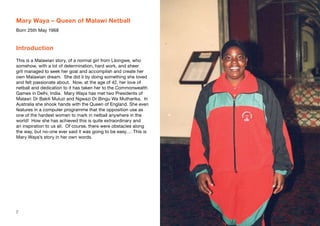
Mary Waya – Queen of Malawi Netball
Born 25th May 1968
Introduction
This is a Malawian story, of a normal girl from Lilongwe, who
somehow, with a lot of determination, hard work, and sheer
grit managed to seek her goal and accomplish and create her
own Malawian dream. She did it by doing something she loved
and felt passionate about. Now, at the age of 42, her love of
netball and dedication to it has taken her to the Commonwealth
Games in Delhi, India. Mary Waya has met two Presidents of
Malawi: Dr Bakili Muluzi and Ngwazi Dr Bingu Wa Mutharika. In
Australia she shook hands with the Queen of England. She even
features in a computer programme that the opposition use as
one of the hardest women to mark in netball anywhere in the
world! How she has achieved this is quite extraordinary and
an inspiration to us all. Of course, there were obstacles along
the way, but no-one ever said it was going to be easy…. This is
Mary Waya’s story in her own words.
2 3
Mary Waya’s story
I don’t know where to start …2010 was an incredible year for
me. When I look back to my childhood over forty years ago,
and see what I’ve managed to achieve, I never imagined so
much would have been possible!
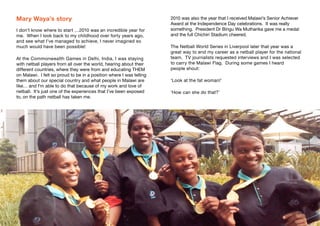
At the Commonwealth Games in Delhi, India, I was staying
with netball players from all over the world, hearing about their
different countries, where they were from and educating THEM
on Malawi. I felt so proud to be in a position where I was telling
them about our special country and what people in Malawi are
like… and I’m able to do that because of my work and love of
netball. It’s just one of the experiences that I’ve been exposed
to, on the path netball has taken me.
2010 was also the year that I received Malawi’s Senior Achiever
Award at the Independence Day celebrations. It was really
something. President Dr Bingu Wa Mutharika gave me a medal
and the full Chichiri Stadium cheered.
The Netball World Series in Liverpool later that year was a
great way to end my career as a netball player for the national
team. TV journalists requested interviews and I was selected
to carry the Malawi Flag. During some games I heard
people shout:
‘Look at the fat woman!’
‘How can she do that?’
4 5
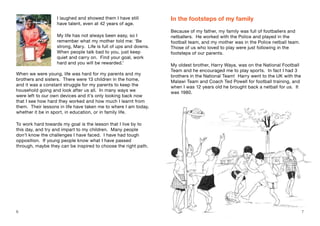
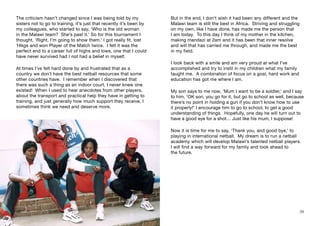
I laughed and showed them I have still
have talent, even at 42 years of age.
My life has not always been easy, so I
remember what my mother told me: ‘Be
strong, Mary. Life is full of ups and downs.
When people talk bad to you, just keep
quiet and carry on. Find your goal, work
hard and you will be rewarded.’
When we were young, life was hard for my parents and my
brothers and sisters. There were 13 children in the home,
and it was a constant struggle for my parents to keep the
household going and look after us all. In many ways we
were left to our own devices and it’s only looking back now
that I see how hard they worked and how much I learnt from
them. Their lessons in life have taken me to where I am today,
whether it be in sport, in education, or in family life.
To work hard towards my goal is the lesson that I live by to
this day, and try and impart to my children. Many people
don’t know the challenges I have faced. I have had tough
opposition. If young people know what I have passed
through, maybe they can be inspired to choose the right path.
In the footsteps of my family
Because of my father, my family was full of footballers and
netballers. He worked with the Police and played in the
football team, and my mother was in the Police netball team.
Those of us who loved to play were just following in the
footsteps of our parents.
My oldest brother, Harry Waya, was on the National Football
Team and he encouraged me to play sports. In fact I had 3
brothers in the National Team! Harry went to the UK with the
Malawi Team and Coach Ted Powell for football training, and
when I was 12 years old he brought back a netball for us. It
was 1980.
6 7
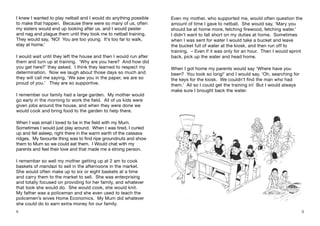
I knew I wanted to play netball and I would do anything possible
to make that happen. Because there were so many of us, often
my sisters would end up looking after us, and I would pester
and nag and plague them until they took me to netball training.
They would say, ‘NO! You are too young. It’s too far to walk,
stay at home.’
I would wait until they left the house and then I would run after
them and turn up at training. ‘Why are you here? And how did
you get here?’ they asked. I think they learned to respect my
determination. Now we laugh about those days so much and
they will call me saying, ‘We saw you in the paper, we are so
proud of you.’ They are so supportive.
I remember our family had a large garden. My mother would
go early in the morning to work the field. All of us kids were
given jobs around the house, and when they were done we
would cook and bring food to the garden to help there.
When I was small I loved to be in the field with my Mum.
Sometimes I would just play around. When I was tired, I curled
up and fell asleep, right there in the warm earth of the cassava
ridges. My favourite thing was to find ripe groundnuts and show
them to Mum so we could eat them. I Would chat with my
parents and feel their love and that made me a strong person.
I remember so well my mother getting up at 2 am to cook
baskets of mandazi to sell in the afternoons in the market.
She would often make up to six or eight baskets at a time
and carry them to the market to sell. She was enterprising
and totally focused on providing for her family, and whatever
that took she would do. She would cook, she would knit.
My father was a policeman and she even used to teach the
policemen’s wives Home Economics. My Mum did whatever
she could do to earn extra money for our family.
Even my mother, who supported me, would often question the
amount of time I gave to netball. She would say, ‘Mary you
should be at home more, fetching firewood, fetching water.’
I didn’t want to fall short on my duties at home. Sometimes
when I was sent for water I would take a bucket and leave
the bucket full of water at the kiosk, and then run off to
training. – Even if it was only for an hour. Then I would sprint
back, pick up the water and head home.
When I got home my parents would say ‘Where have you
been? You took so long!’ and I would say, ‘Oh, searching for
the keys for the kiosk. We couldn’t find the man who had
them.’ All so I could get the training in! But I would always
make sure I brought back the water.
8 9
10 11
Primary education
In Lilongwe, I went to Chimutu Primary School. My father
transferred to Mzuzu in 1983 and I started to play at a netball
club: the Oriental Tobacco Sisters Club. They supplied me
with everything that I needed for school. They taught me
that first I have to study and then I can play netball, because
education is the key to every child’s life.
At the Club most of the players were much older than me. One
day at training, a group of girls looked at me and said, ‘You! How
dare you come here to play with us older ones? Go home to your
mother for breast feeding! You are too young to compete with
us.’ This made me furious!
The bullying could not make me stop playing. I knew I was
capable, despite my age, and soon proved it. After more training
sessions, the same girls told the Coach that I must be included
in the first team. They saw that I was a good player: I could run,
I could turn, I could mark, and no one could touch me on the
court. I started playing with the first seven as a Center and I
helped the team win a lot of matches. Our team became first in
Mzuzu District Netball League.
I see now that I would not have achieved many things if I
hadn’t gone to school. Because I learned that there was time
for me to do the training and get the water—if I organized
my day—that’s something I’ve always tried to do.
Netball was my love and passion, but
I needed the balance of education
in my life to make the dream a
reality. It disciplined me, it helped
me concentrate and made me more
efficient with my time. If you divide
your day, you can go to school in
the morning, play netball in the
afternoon, do the house jobs in the
evening and then sleep! I’m sure
that the busier you are the more you
achieve and if you work hard and
have hope then anything is possible.
I have a lot to thank my schooling for. If I hadn’t learned
English to a high level, it would have been so much harder
for me to attend tournaments and engage in netball on
an international level. There is also a huge amount of
mathematics and geography in netball, all of which I have my
teachers to thank for. I think it has helped me learn to cope
with pressure and manage tough situations in my life.
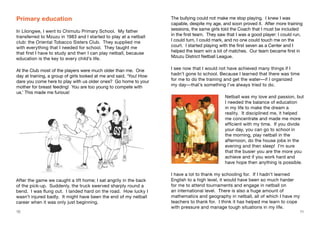
After the game we caught a lift home; I sat angrily in the back
of the pick-up. Suddenly, the truck swerved sharply round a
bend. I was flung out. I landed hard on the road. How lucky I
wasn’t injured badly. It might have been the end of my netball
career when it was only just beginning.
12 13
A teenage girl
Life in Mzuzu was not always easy for us. My parents helped
our relatives in the village to send their children to school, so
I lived with four other children and my nieces and nephews.
After my older brothers and sisters moved out I was expected
to help more around the house. When my father retired he
used his savings to buy a piece of land. He said one day his
children would need a place to live and cultivate.
I would get up early in the morning to collect firewood and
fetch water. After school and netball training, I would go to
the garden and see what was ready to harvest. I might find
bananas, cassava, or green maize, and then I went to the road
side to sell them.
‘Mum,’ I would say when I got home, ‘I made a little money. I
want you to have it so you can budget for what we need. We
can buy relish, and maybe when I need something you can get
it for me.’
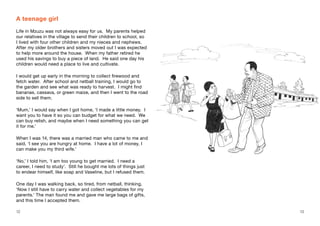
When I was 14, there was a married man who came to me and
said, ‘I see you are hungry at home. I have a lot of money, I
can make you my third wife.’
‘No,’ I told him, ‘I am too young to get married. I need a
career, I need to study’. Still he bought me lots of things just
to endear himself, like soap and Vaseline, but I refused them.
One day I was walking back, so tired, from netball, thinking,
‘Now I still have to carry water and collect vegetables for my
parents.’ The man found me and gave me large bags of gifts,
and this time I accepted them.
1514
From a long way away, my mother saw me coming with the
shopping bags. She knew if I had money I would give it to
her first so she was wondering what had happened. I arrived
home and found her sitting by the door. ‘Where have you
come from?’ she asked.
‘Training, look, Aunty Martha bought these things for you,’
I lied.
After I had cooked dinner and everyone had eaten, my Dad
spoke to me. ‘Those things didn’t come from your Aunty
Martha.’
‘Yes they did!’ I insisted.
‘OK, tomorrow I will go and ask her.’
‘No, you can’t ...’ I replied, and finally told my parents
everything. My Mum took the things and threw them in the
toilet. I started crying and she beat me.
Afterwards, I went to the man and said, ‘I never want you to
talk to me again. I know what I want, I want a career. I am only
14; I don’t want to be married to a man who has three wives!’
I learnt a lot from that experience. My whole life could have
taken a very different path. All of my friends from that time
who followed that culture of having men when they were
young are passed away now. Only their children remain.
Netball takes me to new places
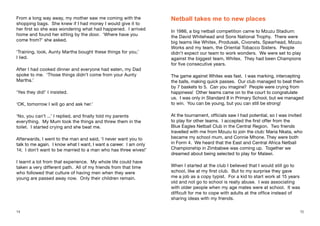
In 1986, a big netball competition came to Mzuzu Stadium:
the David Whitehead and Sons National Trophy. There were
big teams like Whitex, Produsak, Civonets, Spearhead, Mzuzu
Works and my team, the Oriental Tobacco Sisters. People
didn’t expect our team to work wonders. We were set to play
against the biggest team, Whitex. They had been Champions
for five consecutive years.
The game against Whitex was fast. I was marking, intercepting
the balls, making quick passes. Our club managed to beat them
by 7 baskets to 5. Can you imagine? People were crying from
happiness! Other teams came on to the court to congratulate
us. I was only in Standard 8 in Primary School, but we managed
to win. You can be young, but you can still be strong!
At the tournament, officials saw I had potential, so I was invited
to play for other teams. I accepted the first offer from the
Blue Eagles Netball Club in the Central Region. Two friends
travelled with me from Mzuzu to join the club: Maria Nkata, who
became my school mum, and Connie Mhone. They were both
in Form 4. We heard that the East and Central Africa Netball
Championship in Zimbabwe was coming up. Together we
dreamed about being selected to play for Malawi.
When I started at the club I believed that I would still go to
school, like at my first club. But to my surprise they gave
me a job as a copy typist. For a kid to start work at 15 years
old and not go to school is really abuse. I was associating
with older people when my age mates were at school. It was
difficult for me to cope with adults at the office instead of
sharing ideas with my friends.
16 17
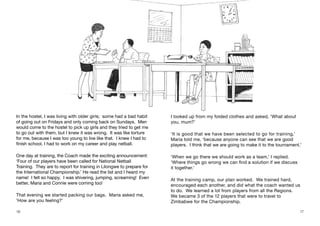
In the hostel, I was living with older girls; some had a bad habit
of going out on Fridays and only coming back on Sundays. Men
would come to the hostel to pick up girls and they tried to get me
to go out with them, but I knew it was wrong. It was like torture
for me, because I was too young to live like that. I knew I had to
finish school, I had to work on my career and play netball.
One day at training, the Coach made the exciting announcement:
‘Four of our players have been called for National Netball
Training. They are to report for training in Lilongwe to prepare for
the International Championship.’ He read the list and I heard my
name! I felt so happy. I was shivering, jumping, screaming! Even
better, Maria and Connie were coming too!
That evening we started packing our bags. Maria asked me,
‘How are you feeling?’
I looked up from my folded clothes and asked, ‘What about
you, mum?’
‘It is good that we have been selected to go for training,’
Maria told me, ‘because anyone can see that we are good
players. I think that we are going to make it to the tournament.’
‘When we go there we should work as a team,’ I replied.
‘Where things go wrong we can find a solution if we discuss
it together.’
At the training camp, our plan worked. We trained hard,
encouraged each another, and did what the coach wanted us
to do. We learned a lot from players from all the Regions.
We became 3 of the 12 players that were to travel to
Zimbabwe for the Championship.
1918
Zimbabwe
I wondered how we would travel to Zimbabwe for the
Championship, so one day I asked the Team Manager. He said
‘We are going to travel by plane. It will take only two hours.’
When I heard the news, I asked myself ‘How can I fly in the sky
with this plane? I have never travelled by plane before!’
I asked the Coach, ‘Can’t we go by road?’ because I was
thinking I would die in the sky!
He answered, ‘No, that’s the only way we can go. The
tournament will start in just a few days’.
The day to travel arrived and the team excitedly boarded the
bus, chatting and singing the whole way to the airport. We were
going outside Malawi and would experience a new country for
the first time. When the tickets were checked at the airport, I
met my brother’s girlfriend, an air hostess, Eleanor Malunga.
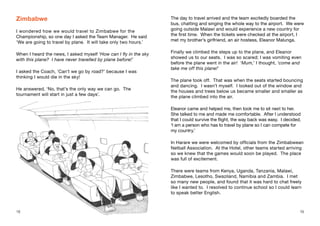
Finally we climbed the steps up to the plane, and Eleanor
showed us to our seats. I was so scared; I was vomiting even
before the plane went in the air! ‘Mum,’ I thought, ‘come and
take me off this plane!’
The plane took off. That was when the seats started bouncing
and dancing. I wasn’t myself. I looked out of the window and
the houses and trees below us became smaller and smaller as
the plane climbed into the air.
Eleanor came and helped me, then took me to sit next to her.
She talked to me and made me comfortable. After I understood
that I could survive the flight, the way back was easy. I decided,
‘I am a person who has to travel by plane so I can compete for
my country.’
In Harare we were welcomed by officials from the Zimbabwean
Netball Association. At the Hotel, other teams started arriving
so we knew that the games would soon be played. The place
was full of excitement.
There were teams from Kenya, Uganda, Tanzania, Malawi,
Zimbabwe, Lesotho, Swaziland, Namibia and Zambia. I met
so many new people, and found that it was hard to chat freely
like I wanted to. I resolved to continue school so I could learn
to speak better English.
18 19
20 21
I remember when I first started playing in big netball matches
at school. Before the game I would be shaking and crying, so
nervous. I had played in crowds of kids, but never before so
many adults and big people. With time, I gained confidence,
and now I was ready for Zimbabwe.
At the opening ceremony, all the teams were introduced.
When the Malawi National Anthem was played, our team felt
a thrill of pride. Our first game was against Lesotho and we
won! We gained victory against Swaziland, but lost to the
other teams.
I learnt so much from the tournament, and met an amazing
Kenyan Centre Court player aged 35. When the teams finished
competing I asked her, ‘How are you still playing at your age?’
She replied, ‘You have to train hard. When you see a good play
you have to teach yourself. Try it at home until you can do it. You
have to listen and understand your coach when he teaches you
new things. And in any achievement we must not forget to thank
God, because He has given us the talent.’ I was encouraged. I
knew that if I took her advice it would make me one of the
best players.
Back to studies, and winning first
international trophy
When we returned to Malawi I told my brother, Lawrence, that
I wasn’t given a chance to study, so I wanted to quit the job as
a copy typist. He helped me to move to Blantyre.
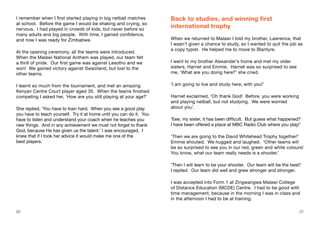
I went to my brother Alexander’s home and met my older
sisters, Harriet and Emmie. Harriet was so surprised to see
me, ‘What are you doing here?’ she cried.
‘I am going to live and study here, with you!’
Harriet exclaimed, ‘Oh thank God! Before, you were working
and playing netball, but not studying. We were worried
about you’.
‘Eee, my sister, it has been difficult. But guess what happened?
I have been offered a place at MBC Radio Club where you play!’
‘Then we are going to the David Whitehead Trophy together!’
Emmie shouted. We hugged and laughed. ‘Other teams will
be so surprised to see you in our red, green and white colours!
You know, what our team really needs is a shooter.’
‘Then I will learn to be your shooter. Our team will be the best!’
I replied. Our team did well and grew stronger and stronger.
I was accepted into Form 1 at Zingwangwa Malawi College
of Distance Education (MCDE) Centre. I had to be good with
time management, because in the morning I was in class and
in the afternoon I had to be at training.
20 21
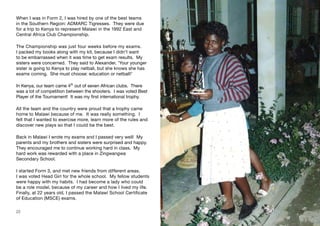
When I was in Form 2, I was hired by one of the best teams
in the Southern Region: ADMARC Tigresses. They were due
for a trip to Kenya to represent Malawi in the 1992 East and
Central Africa Club Championship.
The Championship was just four weeks before my exams.
I packed my books along with my kit, because I didn’t want
to be embarrassed when it was time to get exam results. My
sisters were concerned. They said to Alexander, ‘Your younger
sister is going to Kenya to play netball, but she knows she has
exams coming. She must choose: education or netball!’
In Kenya, our team came 4th
out of seven African clubs. There
was a lot of competition between the shooters. I was voted Best
Player of the Tournament! It was my first international trophy.
All the team and the country were proud that a trophy came
home to Malawi because of me. It was really something. I
felt that I wanted to exercise more, learn more of the rules and
discover new plays so that I could be the best.
Back in Malawi I wrote my exams and I passed very well! My
parents and my brothers and sisters were surprised and happy.
They encouraged me to continue working hard in class. My
hard work was rewarded with a place in Zingwangwa
Secondary School.
I started Form 3, and met new friends from different areas.
I was voted Head Girl for the whole school. My fellow students
were happy with my habits. I had become a lady who could
be a role model, because of my career and how I lived my life.
Finally, at 22 years old, I passed the Malawi School Certificate
of Education (MSCE) exams.
22 23
Hard times
Of course there are times in life which no amount of experience
can prepare you for. There have been periods when I thought, ‘I
don’t know if I have the strength to keep on fighting for this goal.’
When I was 23 years old my elder brother Harry died. I was
living with him at the time, as his wife had already passed away,
and I was helping him to bring up and look after his four children.
He was like a father to me in many ways, because he was about
twenty years older than me. What really bonded us was our
absolute love of sport.
Harry was the most amazing footballer and he advised me so
much in my netball. He died aged 44, after a long battle with
cancer, and there was a time after this when I questioned how
I was going to be able to carry on. But his message to me
stays with me every day. He used to say, ‘Mary, you have to
be strong. You have to not react to the things going on around
you. You must look forward and see the bigger picture. Keep
sight of your goal and see the consequences of your actions.’
When he died I had to understand that he was gone and pave
a way for a new life without him. I am trying to live out his
wisdom every day, and I have the most incredible memories of
him, how he used to take us to football matches, and how he
used to love listening to Bob Marley tunes.
Harry was without a doubt such an influence on me, and when
people would criticize the amount of time I put into netball he
would stand up for me. When they do now, I think about what
Harry would say, and I rise above it.
Out of Africa: Netball World Championship
My first tournament outside Africa was the Netball World
Championship in England in 1995, with 32 teams from around
the world. My sister, Emmie was voted Captain of the team.
I was so excited that I would be going to experience another
side of the world. Our family was happy for us too, because
we were part of Malawi’s first time participating in this big
event outside Africa.
Our team had only read about England in the papers and
magazines before, now we landed in the big, big airport that
is Heathrow. A crowd of people welcomed us, singing and
waving placards.
I had never experienced such a big city as London. We wanted
to see everything! I laughed when I first saw a telephone booth.
We travelled past the huge Wembley Stadium, saw double-
decker buses. It was very exciting. We knew that we had come
there to show everyone that Malawi is a small country, but can
do big things.
We went straight to Cardiff, in Wales, to play friendlies, because
the Welsh had sent experts to Malawi to train some players and
coaches. It was great preparation because the Welsh Team
was ranked 5th
in the world at that time.
The Welsh players were tall, massive and very fit. Compared
to them, we looked like we had been sick! They went to gym
and had large muscles, but we knew how to play. In the evening
we played the first game. We lost, but it was an exciting game
because they didn’t expect us to give them such a small margin.
The next game we drew, and in the last game we beat them by
two baskets!
24 25
After the games, the Mayor of Cardiff invited us for a formal
dinner and we were given VIP treatment. We signed the City’s
Visitors Book, and I like to think that my name and signature is
there till today.
From Wales we travelled to Birmingham for the Netball World
Championship. Before training, we met ladies from Sri Lanka.
They were laughing at us and saying, ‘You are as short as
school kids! You have just come here for the shopping and
entertainment. You can’t actually compete!’
We were wondering why they said this to us. They didn’t know
how we play—we have our own style. Most countries say we
play the underdog’s netball. Many teams wanted to watch us
in training so they could see how we performed, but they would
have to wait for the Championships to see what we could do.
After three days, the Championship started with the Opening
Ceremony. It was held in a huge building with an indoor arena.
We proudly marched as a team to music from our country,
carrying the flag.
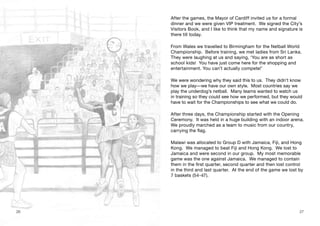
Malawi was allocated to Group D with Jamaica, Fiji, and Hong
Kong. We managed to beat Fiji and Hong Kong. We lost to
Jamaica and were second in our group. My most memorable
game was the one against Jamaica. We managed to contain
them in the first quarter, second quarter and then lost control
in the third and last quarter. At the end of the game we lost by
7 baskets (54-47).
26 27
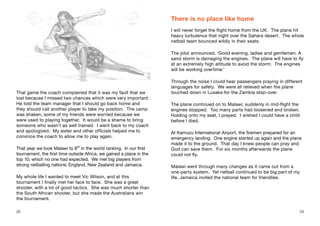
That game the coach complained that it was my fault that we
lost because I missed two chances which were very important.
He told the team manager that I should go back home and
they should call another player to take my position. The camp
was shaken, some of my friends were worried because we
were used to playing together. It would be a shame to bring
someone who wasn’t as well trained. I went back to my coach
and apologized. My sister and other officials helped me to
convince the coach to allow me to play again.
That year we took Malawi to 8th
in the world ranking. In our first
tournament, the first time outside Africa, we gained a place in the
top 10, which no one had expected. We met big players from
strong netballing nations: England, New Zealand and Jamaica.
My whole life I wanted to meet Vic Wilson, and at this
tournament I finally met her face to face. She was a great
shooter, with a lot of good tactics. She was much shorter than
the South African shooter, but she made the Australians win
the tournament.
There is no place like home
I will never forget the flight home from the UK. The plane hit
heavy turbulence that night over the Sahara desert. The whole
netball team bounced wildly in their seats.
The pilot announced, ‘Good evening, ladies and gentlemen. A
sand storm is damaging the engines. The plane will have to fly
at an extremely high altitude to avoid the storm. The engines
will be working overtime.’
Through the noise I could hear passengers praying in different
languages for safety. We were all relieved when the plane
touched down in Lusaka for the Zambia stop-over.
The plane continued on to Malawi; suddenly in mid-flight the
engines stopped. Too many parts had loosened and broken.
Holding onto my seat, I prayed. I wished I could have a child
before I died.
At Kamuzu International Airport, the firemen prepared for an
emergency landing. One engine started up again and the plane
made it to the ground. That day I knew people can pray and
God can save them. For six months afterwards the plane
could not fly.
Malawi went through many changes as it came out from a
one-party system. Yet netball continued to be big part of my
life. Jamaica invited the national team for friendlies.
28 29
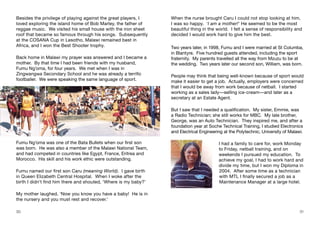
Besides the privilege of playing against the great players, I
loved exploring the island home of Bob Marley, the father of
reggae music. We visited his small house with the iron sheet
roof that became so famous through his songs. Subsequently
at the COSANA Cup in Lesotho, Malawi remained best in
Africa, and I won the Best Shooter trophy.
Back home in Malawi my prayer was answered and I became a
mother. By that time I had been friends with my husband,
Fumu Ng’oma, for four years. We met when I was in
Zingwangwa Secondary School and he was already a terrific
footballer. We were speaking the same language of sport.
When the nurse brought Caru I could not stop looking at him,
I was so happy. ‘I am a mother!’ He seemed to be the most
beautiful thing in the world. I felt a sense of responsibility and
decided I would work hard to give him the best.
Two years later, in 1998, Fumu and I were married at St Columba,
in Blantyre. Five hundred guests attended, including the sport
fraternity. My parents travelled all the way from Mzuzu to be at
the wedding. Two years later our second son, William, was born.
People may think that being well-known because of sport would
make it easier to get a job. Actually, employers were concerned
that I would be away from work because of netball. I started
working as a sales lady—selling ice-cream—and later as a
secretary at an Estate Agent.
But I saw that I needed a qualification. My sister, Emmie, was
a Radio Technician; she still works for MBC. My late brother,
George, was an Auto Technician. They inspired me, and after a
foundation year at Soche Technical Training, I studied Electronics
and Electrical Engineering at the Polytechnic, University of Malawi.
I had a family to care for, work Monday
to Friday, netball training, and on
weekends I pursued my education. To
achieve my goal, I had to work hard and
divide my time, but I won my Diploma in
2004. After some time as a technician
with MTL I finally secured a job as a
Maintenance Manager at a large hotel.
30 31
Fumu Ng’oma was one of the Bata Bullets when our first son
was born. He was also a member of the Malawi National Team,
and had competed in countries like Egypt, France, Eritrea and
Morocco. His skill and his work ethic were outstanding.
Fumu named our first son Caru (meaning World). I gave birth
in Queen Elizabeth Central Hospital. When I woke after the
birth I didn’t find him there and shouted, ‘Where is my baby?’
My mother laughed, ‘Now you know you have a baby! He is in
the nursery and you must rest and recover.’
Commonwealth Games,
Melbourne
In 2007 Malawi’s Netball team was
unranked on the world stage, because
the team had not participated in enough
major tournaments. It was time to
show what we were made of when the
Commonwealth Games took place in
Melbourne, Australia.
A whole village had been constructed for
the games: housing, restaurants, playing
courts, coaches’ offices and doctor’s
stations were all in place. As our bus
arrived, we watched Aborigines protesting
in the streets in full traditional wear with
their faces painted with white markings.
Malawi sent about 60 athletes to compete
at the games. The boxers were one of
our star attractions. Disabled athletes
were included in the games as well. A
very strong deaf man ran in the 100m
sprint, and when he reached the finish line
he just kept on running! A coach tried to
tackle him off the track but he dodged
and carried on! It was such a scandal,
but really I love watching people compete
without letting their handicap get in
their way.
The major Australian cities chose a country to support, and for
the city of Victoria it was Malawi. They asked what they could
do for us, and provided a full kit, with a uniform for our team in
Malawi colours and shoes for the whole crew.
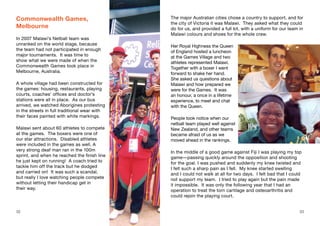
Her Royal Highness the Queen
of England hosted a luncheon
at the Games Village and two
athletes represented Malawi.
Together with a boxer I went
forward to shake her hand.
She asked us questions about
Malawi and how prepared we
were for the Games. It was
an honour, a once in a lifetime
experience, to meet and chat
with the Queen.
People took notice when our
netball team played well against
New Zealand, and other teams
became afraid of us as we
moved ahead in the rankings.
In the middle of a good game against Fiji I was playing my top
game—passing quickly around the opposition and shooting
for the goal. I was pushed and suddenly my knee twisted and
I felt such a sharp pain as I fell. My knee started swelling
and I could not walk at all for two days. I felt bad that I could
not support my team. I tried to play again but the pain made
it impossible. It was only the following year that I had an
operation to treat the torn cartilage and osteoarthritis and
could rejoin the playing court.
32 33
From the Malawi base I watched the team’s live television
interviews. My team mates sang and did netball drills for
international networks from all over the world. When they were
on the court, I cheered them on from the benches. I was so
proud when, from no ranking, the team reached the quarter
finals. England won the game, but we moved up to 6th
. When
you consider the teams we were up against and the resources
they have, this is no mean feat.
Telling my story
Back from the games, and with Diploma in hand, I secured
a job with Skyband, who provide internet service around the
country. With a team of technicians I handle installations and
repair faults in all sorts of places around Blantyre. Sometimes
I climb high roofs to check the connections, which makes me
glad I am fit.
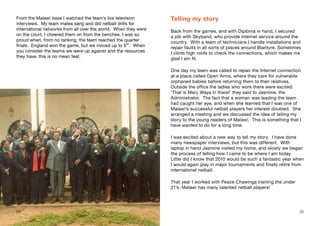
One day my team was called to repair the Internet connection
at a place called Open Arms, where they care for vulnerable
orphaned babies before returning them to their relatives.
Outside the office the ladies who work there were excited:
‘That is Mary Waya in there!’ they said to Jasmine, the
Administrator. The fact that a woman was leading the team
had caught her eye, and when she learned that I was one of
Malawi’s successful netball players her interest doubled. She
arranged a meeting and we discussed the idea of telling my
story to the young readers of Malawi. This is something that I
have wanted to do for a long time.
I was excited about a new way to tell my story. I have done
many newspaper interviews, but this was different. With
laptop in hand Jasmine visited my home, and slowly we began
the process of telling how I came to be where I am today.
Little did I know that 2010 would be such a fantastic year when
I would again play in major tournaments and finally retire from
international netball.
That year I worked with Peace Chawinga training the under
21’s. Malawi has many talented netball players!
34 35
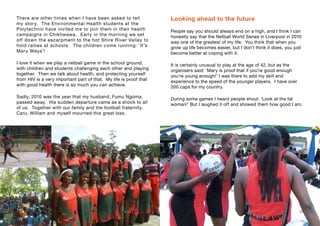
There are other times when I have been asked to tell
my story. The Environmental Health students at the
Polytechnic have invited me to join them in their health
campaigns in Chikhwawa. Early in the morning we set
off down the escarpment to the hot Shire River Valley to
hold rallies at schools. The children come running: ‘It’s
Mary Waya’!
I love it when we play a netball game in the school ground,
with children and students challenging each other and playing
together. Then we talk about health, and protecting yourself
from HIV is a very important part of that. My life is proof that
with good health there is so much you can achieve.
Sadly, 2010 was the year that my husband, Fumu Ngoma,
passed away. His sudden departure came as a shock to all
of us. Together with our family and the football fraternity,
Caru, William and myself mourned this great loss.
Looking ahead to the future
People say you should always end on a high, and I think I can
honestly say that the Netball World Series in Liverpool in 2010
was one of the greatest of my life. You think that when you
grow up life becomes easier, but I don’t think it does, you just
become better at coping with it.
It is certainly unusual to play at the age of 42, but as the
organisers said: ‘Mary is proof that if you’re good enough
you’re young enough!’ I was there to add my skill and
experience to the speed of the younger players. I have over
200 caps for my country.
During some games I heard people shout: ‘Look at the fat
woman!’ But I laughed it off and showed them how good I am.
36 37
But in the end, I don’t wish it had been any different and the
Malawi team is still the best in Africa. Striving and struggling
on my own, like I have done, has made me the person that
I am today. To this day I think of my mother in the kitchen,
making mandazi at 2am and it has been that inner resolve
and will that has carried me through, and made me the best
in my field.
I look back with a smile and am very proud at what I’ve
accomplished and try to instil in my children what my family
taught me. A combination of focus on a goal, hard work and
education has got me where I am.
My son says to me now, ’Mum I want to be a soldier,‘ and I say
to him, ‘OK son, you go for it, but go to school as well, because
there’s no point in holding a gun if you don’t know how to use
it properly!’ I encourage him to go to school, to get a good
understanding of things. Hopefully, one day he will turn out to
have a good eye for a shot… Just like his mum, I suppose!
Now it is time for me to say, ‘Thank you, and good bye,’ to
playing in international netball. My dream is to run a netball
academy which will develop Malawi’s talented netball players.
I will find a way forward for my family and look ahead to
the future.
The criticism hasn’t changed since I was being told by my
sisters not to go to training, it’s just that recently it’s been by
my colleagues, who started to say, ‘Who is the old woman
in the Malawi team? She’s past it.’ So for this tournament I
thought, ‘Right, I’m going to show them.’ I got really fit, lost
14kgs and won Player of the Match twice. I felt it was the
perfect end to a career full of highs and lows, one that I could
have never survived had I not had a belief in myself.
At times I’ve felt hard done by and frustrated that as a
country we don’t have the best netball resources that some
other countries have. I remember when I discovered that
there was such a thing as an indoor court, I never knew one
existed! When I used to hear anecdotes from other players,
about the transport and practical help they have in getting to
training, and just generally how much support they receive, I
sometimes think we need and deserve more.
38 39
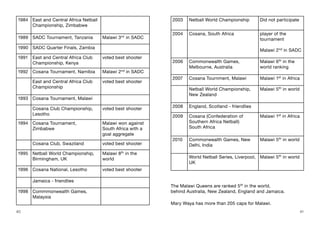
1984 East and Central Africa Netball
Championship, Zimbabwe
1989 SADC Tournament, Tanzania Malawi 3rd
in SADC
1990 SADC Quarter Finals, Zambia
1991 East and Central Africa Club
Championship, Kenya
voted best shooter
1992 Cosana Tournament, Namibia Malawi 2nd
in SADC
East and Central Africa Club
Championship
voted best shooter
1993 Cosana Tournament, Malawi
Cosana Club Championship,
Lesotho
voted best shooter
1994 Cosana Tournament,
Zimbabwe
Malawi won against
South Africa with a
goal aggregate
Cosana Club, Swaziland voted best shooter
1995 Netball World Championship,
Birmingham, UK
Malawi 8th
in the
world
1996 Cosana National, Lesotho voted best shooter
Jamaica - friendlies
1998 Commmonwealth Games,
Malaysia
2003 Netball World Championship Did not participate
2004 Cosana, South Africa player of the
tournament
Malawi 2nd
in SADC
2006 Commonwealth Games,
Melbourne, Australia
Malawi 6th
in the
world ranking
2007 Cosana Tournment, Malawi Malawi 1st
in Africa
Netball World Championship,
New Zealand
Malawi 5th
in world
2008 England, Scotland - friendlies
2009 Cosana (Confederation of
Southern Africa Netball)
South Africa
Malawi 1st
in Africa
2010 Commonwealth Games, New
Delhi, India
Malawi 5th
in world
World Netball Series, Liverpool,
UK
Malawi 5th
in world
The Malawi Queens are ranked 5th
in the world,
behind Australia, New Zealand, England and Jamaica.
Mary Waya has more than 205 caps for Malawi.
40 41
These books are dedicated to the memory of Charlotte Parker
(1996 – 2007), who loved life, school, and Africa, where she lived
for five years. The Trust’s single mission is to help Africans help
themselves through improved education.
www.thecharchartrust.org
www.helpmyfriendsinafrica.org
mail@thecharchartrust.org
Not For Resale. Copyright © The CharCharTrust 2011

E1_Mary Waya_0811[1]

  • 1.
    E1 Mary Waya- Netball Queen
  • 2.
    C7E1 Mary Waya andJasmine Lehnis Leitao photos courtesy of Mary Waya Illustrations. Haswell Kunyenje and Joanna Lehnis Acknowledgements The CharChar Trust would like to thank the following for their contributions to the production of the CharCharTrust Readers Series: St. Andrews International Primary School and the Dept. of Education Management (particularly Victoria Ganiza) in Blantyre, Malawi, for their help in coordinating the grading and approval processes; Gallery Ltd for donating their design and production services for the books; Paul Tagg and the Loseby Settlement for their moral and financial support of the Trust; and especially the countless people in Africa who help the Trust reach children and schools in need, and the writers and illustrators who have selflessly donated their works to the series. The production of this book was sponsored by Illovo Sugar Group.
  • 3.
    Mary Waya –Queen of Malawi Netball Born 25th May 1968 Introduction This is a Malawian story, of a normal girl from Lilongwe, who somehow, with a lot of determination, hard work, and sheer grit managed to seek her goal and accomplish and create her own Malawian dream. She did it by doing something she loved and felt passionate about. Now, at the age of 42, her love of netball and dedication to it has taken her to the Commonwealth Games in Delhi, India. Mary Waya has met two Presidents of Malawi: Dr Bakili Muluzi and Ngwazi Dr Bingu Wa Mutharika. In Australia she shook hands with the Queen of England. She even features in a computer programme that the opposition use as one of the hardest women to mark in netball anywhere in the world! How she has achieved this is quite extraordinary and an inspiration to us all. Of course, there were obstacles along the way, but no-one ever said it was going to be easy…. This is Mary Waya’s story in her own words. 2 3
  • 4.
    Mary Waya’s story Idon’t know where to start …2010 was an incredible year for me. When I look back to my childhood over forty years ago, and see what I’ve managed to achieve, I never imagined so much would have been possible! At the Commonwealth Games in Delhi, India, I was staying with netball players from all over the world, hearing about their different countries, where they were from and educating THEM on Malawi. I felt so proud to be in a position where I was telling them about our special country and what people in Malawi are like… and I’m able to do that because of my work and love of netball. It’s just one of the experiences that I’ve been exposed to, on the path netball has taken me. 2010 was also the year that I received Malawi’s Senior Achiever Award at the Independence Day celebrations. It was really something. President Dr Bingu Wa Mutharika gave me a medal and the full Chichiri Stadium cheered. The Netball World Series in Liverpool later that year was a great way to end my career as a netball player for the national team. TV journalists requested interviews and I was selected to carry the Malawi Flag. During some games I heard people shout: ‘Look at the fat woman!’ ‘How can she do that?’ 4 5
  • 5.
    I laughed andshowed them I have still have talent, even at 42 years of age. My life has not always been easy, so I remember what my mother told me: ‘Be strong, Mary. Life is full of ups and downs. When people talk bad to you, just keep quiet and carry on. Find your goal, work hard and you will be rewarded.’ When we were young, life was hard for my parents and my brothers and sisters. There were 13 children in the home, and it was a constant struggle for my parents to keep the household going and look after us all. In many ways we were left to our own devices and it’s only looking back now that I see how hard they worked and how much I learnt from them. Their lessons in life have taken me to where I am today, whether it be in sport, in education, or in family life. To work hard towards my goal is the lesson that I live by to this day, and try and impart to my children. Many people don’t know the challenges I have faced. I have had tough opposition. If young people know what I have passed through, maybe they can be inspired to choose the right path. In the footsteps of my family Because of my father, my family was full of footballers and netballers. He worked with the Police and played in the football team, and my mother was in the Police netball team. Those of us who loved to play were just following in the footsteps of our parents. My oldest brother, Harry Waya, was on the National Football Team and he encouraged me to play sports. In fact I had 3 brothers in the National Team! Harry went to the UK with the Malawi Team and Coach Ted Powell for football training, and when I was 12 years old he brought back a netball for us. It was 1980. 6 7
  • 6.
    I knew Iwanted to play netball and I would do anything possible to make that happen. Because there were so many of us, often my sisters would end up looking after us, and I would pester and nag and plague them until they took me to netball training. They would say, ‘NO! You are too young. It’s too far to walk, stay at home.’ I would wait until they left the house and then I would run after them and turn up at training. ‘Why are you here? And how did you get here?’ they asked. I think they learned to respect my determination. Now we laugh about those days so much and they will call me saying, ‘We saw you in the paper, we are so proud of you.’ They are so supportive. I remember our family had a large garden. My mother would go early in the morning to work the field. All of us kids were given jobs around the house, and when they were done we would cook and bring food to the garden to help there. When I was small I loved to be in the field with my Mum. Sometimes I would just play around. When I was tired, I curled up and fell asleep, right there in the warm earth of the cassava ridges. My favourite thing was to find ripe groundnuts and show them to Mum so we could eat them. I Would chat with my parents and feel their love and that made me a strong person. I remember so well my mother getting up at 2 am to cook baskets of mandazi to sell in the afternoons in the market. She would often make up to six or eight baskets at a time and carry them to the market to sell. She was enterprising and totally focused on providing for her family, and whatever that took she would do. She would cook, she would knit. My father was a policeman and she even used to teach the policemen’s wives Home Economics. My Mum did whatever she could do to earn extra money for our family. Even my mother, who supported me, would often question the amount of time I gave to netball. She would say, ‘Mary you should be at home more, fetching firewood, fetching water.’ I didn’t want to fall short on my duties at home. Sometimes when I was sent for water I would take a bucket and leave the bucket full of water at the kiosk, and then run off to training. – Even if it was only for an hour. Then I would sprint back, pick up the water and head home. When I got home my parents would say ‘Where have you been? You took so long!’ and I would say, ‘Oh, searching for the keys for the kiosk. We couldn’t find the man who had them.’ All so I could get the training in! But I would always make sure I brought back the water. 8 9
  • 7.
    10 11 Primary education InLilongwe, I went to Chimutu Primary School. My father transferred to Mzuzu in 1983 and I started to play at a netball club: the Oriental Tobacco Sisters Club. They supplied me with everything that I needed for school. They taught me that first I have to study and then I can play netball, because education is the key to every child’s life. At the Club most of the players were much older than me. One day at training, a group of girls looked at me and said, ‘You! How dare you come here to play with us older ones? Go home to your mother for breast feeding! You are too young to compete with us.’ This made me furious! The bullying could not make me stop playing. I knew I was capable, despite my age, and soon proved it. After more training sessions, the same girls told the Coach that I must be included in the first team. They saw that I was a good player: I could run, I could turn, I could mark, and no one could touch me on the court. I started playing with the first seven as a Center and I helped the team win a lot of matches. Our team became first in Mzuzu District Netball League. I see now that I would not have achieved many things if I hadn’t gone to school. Because I learned that there was time for me to do the training and get the water—if I organized my day—that’s something I’ve always tried to do. Netball was my love and passion, but I needed the balance of education in my life to make the dream a reality. It disciplined me, it helped me concentrate and made me more efficient with my time. If you divide your day, you can go to school in the morning, play netball in the afternoon, do the house jobs in the evening and then sleep! I’m sure that the busier you are the more you achieve and if you work hard and have hope then anything is possible. I have a lot to thank my schooling for. If I hadn’t learned English to a high level, it would have been so much harder for me to attend tournaments and engage in netball on an international level. There is also a huge amount of mathematics and geography in netball, all of which I have my teachers to thank for. I think it has helped me learn to cope with pressure and manage tough situations in my life. After the game we caught a lift home; I sat angrily in the back of the pick-up. Suddenly, the truck swerved sharply round a bend. I was flung out. I landed hard on the road. How lucky I wasn’t injured badly. It might have been the end of my netball career when it was only just beginning.
  • 8.
    12 13 A teenagegirl Life in Mzuzu was not always easy for us. My parents helped our relatives in the village to send their children to school, so I lived with four other children and my nieces and nephews. After my older brothers and sisters moved out I was expected to help more around the house. When my father retired he used his savings to buy a piece of land. He said one day his children would need a place to live and cultivate. I would get up early in the morning to collect firewood and fetch water. After school and netball training, I would go to the garden and see what was ready to harvest. I might find bananas, cassava, or green maize, and then I went to the road side to sell them. ‘Mum,’ I would say when I got home, ‘I made a little money. I want you to have it so you can budget for what we need. We can buy relish, and maybe when I need something you can get it for me.’ When I was 14, there was a married man who came to me and said, ‘I see you are hungry at home. I have a lot of money, I can make you my third wife.’ ‘No,’ I told him, ‘I am too young to get married. I need a career, I need to study’. Still he bought me lots of things just to endear himself, like soap and Vaseline, but I refused them. One day I was walking back, so tired, from netball, thinking, ‘Now I still have to carry water and collect vegetables for my parents.’ The man found me and gave me large bags of gifts, and this time I accepted them.
  • 9.
    1514 From a longway away, my mother saw me coming with the shopping bags. She knew if I had money I would give it to her first so she was wondering what had happened. I arrived home and found her sitting by the door. ‘Where have you come from?’ she asked. ‘Training, look, Aunty Martha bought these things for you,’ I lied. After I had cooked dinner and everyone had eaten, my Dad spoke to me. ‘Those things didn’t come from your Aunty Martha.’ ‘Yes they did!’ I insisted. ‘OK, tomorrow I will go and ask her.’ ‘No, you can’t ...’ I replied, and finally told my parents everything. My Mum took the things and threw them in the toilet. I started crying and she beat me. Afterwards, I went to the man and said, ‘I never want you to talk to me again. I know what I want, I want a career. I am only 14; I don’t want to be married to a man who has three wives!’ I learnt a lot from that experience. My whole life could have taken a very different path. All of my friends from that time who followed that culture of having men when they were young are passed away now. Only their children remain. Netball takes me to new places In 1986, a big netball competition came to Mzuzu Stadium: the David Whitehead and Sons National Trophy. There were big teams like Whitex, Produsak, Civonets, Spearhead, Mzuzu Works and my team, the Oriental Tobacco Sisters. People didn’t expect our team to work wonders. We were set to play against the biggest team, Whitex. They had been Champions for five consecutive years. The game against Whitex was fast. I was marking, intercepting the balls, making quick passes. Our club managed to beat them by 7 baskets to 5. Can you imagine? People were crying from happiness! Other teams came on to the court to congratulate us. I was only in Standard 8 in Primary School, but we managed to win. You can be young, but you can still be strong! At the tournament, officials saw I had potential, so I was invited to play for other teams. I accepted the first offer from the Blue Eagles Netball Club in the Central Region. Two friends travelled with me from Mzuzu to join the club: Maria Nkata, who became my school mum, and Connie Mhone. They were both in Form 4. We heard that the East and Central Africa Netball Championship in Zimbabwe was coming up. Together we dreamed about being selected to play for Malawi. When I started at the club I believed that I would still go to school, like at my first club. But to my surprise they gave me a job as a copy typist. For a kid to start work at 15 years old and not go to school is really abuse. I was associating with older people when my age mates were at school. It was difficult for me to cope with adults at the office instead of sharing ideas with my friends.
  • 10.
    16 17 In thehostel, I was living with older girls; some had a bad habit of going out on Fridays and only coming back on Sundays. Men would come to the hostel to pick up girls and they tried to get me to go out with them, but I knew it was wrong. It was like torture for me, because I was too young to live like that. I knew I had to finish school, I had to work on my career and play netball. One day at training, the Coach made the exciting announcement: ‘Four of our players have been called for National Netball Training. They are to report for training in Lilongwe to prepare for the International Championship.’ He read the list and I heard my name! I felt so happy. I was shivering, jumping, screaming! Even better, Maria and Connie were coming too! That evening we started packing our bags. Maria asked me, ‘How are you feeling?’ I looked up from my folded clothes and asked, ‘What about you, mum?’ ‘It is good that we have been selected to go for training,’ Maria told me, ‘because anyone can see that we are good players. I think that we are going to make it to the tournament.’ ‘When we go there we should work as a team,’ I replied. ‘Where things go wrong we can find a solution if we discuss it together.’ At the training camp, our plan worked. We trained hard, encouraged each another, and did what the coach wanted us to do. We learned a lot from players from all the Regions. We became 3 of the 12 players that were to travel to Zimbabwe for the Championship.
  • 11.
    1918 Zimbabwe I wondered howwe would travel to Zimbabwe for the Championship, so one day I asked the Team Manager. He said ‘We are going to travel by plane. It will take only two hours.’ When I heard the news, I asked myself ‘How can I fly in the sky with this plane? I have never travelled by plane before!’ I asked the Coach, ‘Can’t we go by road?’ because I was thinking I would die in the sky! He answered, ‘No, that’s the only way we can go. The tournament will start in just a few days’. The day to travel arrived and the team excitedly boarded the bus, chatting and singing the whole way to the airport. We were going outside Malawi and would experience a new country for the first time. When the tickets were checked at the airport, I met my brother’s girlfriend, an air hostess, Eleanor Malunga. Finally we climbed the steps up to the plane, and Eleanor showed us to our seats. I was so scared; I was vomiting even before the plane went in the air! ‘Mum,’ I thought, ‘come and take me off this plane!’ The plane took off. That was when the seats started bouncing and dancing. I wasn’t myself. I looked out of the window and the houses and trees below us became smaller and smaller as the plane climbed into the air. Eleanor came and helped me, then took me to sit next to her. She talked to me and made me comfortable. After I understood that I could survive the flight, the way back was easy. I decided, ‘I am a person who has to travel by plane so I can compete for my country.’ In Harare we were welcomed by officials from the Zimbabwean Netball Association. At the Hotel, other teams started arriving so we knew that the games would soon be played. The place was full of excitement. There were teams from Kenya, Uganda, Tanzania, Malawi, Zimbabwe, Lesotho, Swaziland, Namibia and Zambia. I met so many new people, and found that it was hard to chat freely like I wanted to. I resolved to continue school so I could learn to speak better English. 18 19
  • 12.
    20 21 I rememberwhen I first started playing in big netball matches at school. Before the game I would be shaking and crying, so nervous. I had played in crowds of kids, but never before so many adults and big people. With time, I gained confidence, and now I was ready for Zimbabwe. At the opening ceremony, all the teams were introduced. When the Malawi National Anthem was played, our team felt a thrill of pride. Our first game was against Lesotho and we won! We gained victory against Swaziland, but lost to the other teams. I learnt so much from the tournament, and met an amazing Kenyan Centre Court player aged 35. When the teams finished competing I asked her, ‘How are you still playing at your age?’ She replied, ‘You have to train hard. When you see a good play you have to teach yourself. Try it at home until you can do it. You have to listen and understand your coach when he teaches you new things. And in any achievement we must not forget to thank God, because He has given us the talent.’ I was encouraged. I knew that if I took her advice it would make me one of the best players. Back to studies, and winning first international trophy When we returned to Malawi I told my brother, Lawrence, that I wasn’t given a chance to study, so I wanted to quit the job as a copy typist. He helped me to move to Blantyre. I went to my brother Alexander’s home and met my older sisters, Harriet and Emmie. Harriet was so surprised to see me, ‘What are you doing here?’ she cried. ‘I am going to live and study here, with you!’ Harriet exclaimed, ‘Oh thank God! Before, you were working and playing netball, but not studying. We were worried about you’. ‘Eee, my sister, it has been difficult. But guess what happened? I have been offered a place at MBC Radio Club where you play!’ ‘Then we are going to the David Whitehead Trophy together!’ Emmie shouted. We hugged and laughed. ‘Other teams will be so surprised to see you in our red, green and white colours! You know, what our team really needs is a shooter.’ ‘Then I will learn to be your shooter. Our team will be the best!’ I replied. Our team did well and grew stronger and stronger. I was accepted into Form 1 at Zingwangwa Malawi College of Distance Education (MCDE) Centre. I had to be good with time management, because in the morning I was in class and in the afternoon I had to be at training. 20 21
  • 13.
    When I wasin Form 2, I was hired by one of the best teams in the Southern Region: ADMARC Tigresses. They were due for a trip to Kenya to represent Malawi in the 1992 East and Central Africa Club Championship. The Championship was just four weeks before my exams. I packed my books along with my kit, because I didn’t want to be embarrassed when it was time to get exam results. My sisters were concerned. They said to Alexander, ‘Your younger sister is going to Kenya to play netball, but she knows she has exams coming. She must choose: education or netball!’ In Kenya, our team came 4th out of seven African clubs. There was a lot of competition between the shooters. I was voted Best Player of the Tournament! It was my first international trophy. All the team and the country were proud that a trophy came home to Malawi because of me. It was really something. I felt that I wanted to exercise more, learn more of the rules and discover new plays so that I could be the best. Back in Malawi I wrote my exams and I passed very well! My parents and my brothers and sisters were surprised and happy. They encouraged me to continue working hard in class. My hard work was rewarded with a place in Zingwangwa Secondary School. I started Form 3, and met new friends from different areas. I was voted Head Girl for the whole school. My fellow students were happy with my habits. I had become a lady who could be a role model, because of my career and how I lived my life. Finally, at 22 years old, I passed the Malawi School Certificate of Education (MSCE) exams. 22 23
  • 14.
    Hard times Of coursethere are times in life which no amount of experience can prepare you for. There have been periods when I thought, ‘I don’t know if I have the strength to keep on fighting for this goal.’ When I was 23 years old my elder brother Harry died. I was living with him at the time, as his wife had already passed away, and I was helping him to bring up and look after his four children. He was like a father to me in many ways, because he was about twenty years older than me. What really bonded us was our absolute love of sport. Harry was the most amazing footballer and he advised me so much in my netball. He died aged 44, after a long battle with cancer, and there was a time after this when I questioned how I was going to be able to carry on. But his message to me stays with me every day. He used to say, ‘Mary, you have to be strong. You have to not react to the things going on around you. You must look forward and see the bigger picture. Keep sight of your goal and see the consequences of your actions.’ When he died I had to understand that he was gone and pave a way for a new life without him. I am trying to live out his wisdom every day, and I have the most incredible memories of him, how he used to take us to football matches, and how he used to love listening to Bob Marley tunes. Harry was without a doubt such an influence on me, and when people would criticize the amount of time I put into netball he would stand up for me. When they do now, I think about what Harry would say, and I rise above it. Out of Africa: Netball World Championship My first tournament outside Africa was the Netball World Championship in England in 1995, with 32 teams from around the world. My sister, Emmie was voted Captain of the team. I was so excited that I would be going to experience another side of the world. Our family was happy for us too, because we were part of Malawi’s first time participating in this big event outside Africa. Our team had only read about England in the papers and magazines before, now we landed in the big, big airport that is Heathrow. A crowd of people welcomed us, singing and waving placards. I had never experienced such a big city as London. We wanted to see everything! I laughed when I first saw a telephone booth. We travelled past the huge Wembley Stadium, saw double- decker buses. It was very exciting. We knew that we had come there to show everyone that Malawi is a small country, but can do big things. We went straight to Cardiff, in Wales, to play friendlies, because the Welsh had sent experts to Malawi to train some players and coaches. It was great preparation because the Welsh Team was ranked 5th in the world at that time. The Welsh players were tall, massive and very fit. Compared to them, we looked like we had been sick! They went to gym and had large muscles, but we knew how to play. In the evening we played the first game. We lost, but it was an exciting game because they didn’t expect us to give them such a small margin. The next game we drew, and in the last game we beat them by two baskets! 24 25
  • 15.
    After the games,the Mayor of Cardiff invited us for a formal dinner and we were given VIP treatment. We signed the City’s Visitors Book, and I like to think that my name and signature is there till today. From Wales we travelled to Birmingham for the Netball World Championship. Before training, we met ladies from Sri Lanka. They were laughing at us and saying, ‘You are as short as school kids! You have just come here for the shopping and entertainment. You can’t actually compete!’ We were wondering why they said this to us. They didn’t know how we play—we have our own style. Most countries say we play the underdog’s netball. Many teams wanted to watch us in training so they could see how we performed, but they would have to wait for the Championships to see what we could do. After three days, the Championship started with the Opening Ceremony. It was held in a huge building with an indoor arena. We proudly marched as a team to music from our country, carrying the flag. Malawi was allocated to Group D with Jamaica, Fiji, and Hong Kong. We managed to beat Fiji and Hong Kong. We lost to Jamaica and were second in our group. My most memorable game was the one against Jamaica. We managed to contain them in the first quarter, second quarter and then lost control in the third and last quarter. At the end of the game we lost by 7 baskets (54-47). 26 27
  • 16.
    That game thecoach complained that it was my fault that we lost because I missed two chances which were very important. He told the team manager that I should go back home and they should call another player to take my position. The camp was shaken, some of my friends were worried because we were used to playing together. It would be a shame to bring someone who wasn’t as well trained. I went back to my coach and apologized. My sister and other officials helped me to convince the coach to allow me to play again. That year we took Malawi to 8th in the world ranking. In our first tournament, the first time outside Africa, we gained a place in the top 10, which no one had expected. We met big players from strong netballing nations: England, New Zealand and Jamaica. My whole life I wanted to meet Vic Wilson, and at this tournament I finally met her face to face. She was a great shooter, with a lot of good tactics. She was much shorter than the South African shooter, but she made the Australians win the tournament. There is no place like home I will never forget the flight home from the UK. The plane hit heavy turbulence that night over the Sahara desert. The whole netball team bounced wildly in their seats. The pilot announced, ‘Good evening, ladies and gentlemen. A sand storm is damaging the engines. The plane will have to fly at an extremely high altitude to avoid the storm. The engines will be working overtime.’ Through the noise I could hear passengers praying in different languages for safety. We were all relieved when the plane touched down in Lusaka for the Zambia stop-over. The plane continued on to Malawi; suddenly in mid-flight the engines stopped. Too many parts had loosened and broken. Holding onto my seat, I prayed. I wished I could have a child before I died. At Kamuzu International Airport, the firemen prepared for an emergency landing. One engine started up again and the plane made it to the ground. That day I knew people can pray and God can save them. For six months afterwards the plane could not fly. Malawi went through many changes as it came out from a one-party system. Yet netball continued to be big part of my life. Jamaica invited the national team for friendlies. 28 29
  • 17.
    Besides the privilegeof playing against the great players, I loved exploring the island home of Bob Marley, the father of reggae music. We visited his small house with the iron sheet roof that became so famous through his songs. Subsequently at the COSANA Cup in Lesotho, Malawi remained best in Africa, and I won the Best Shooter trophy. Back home in Malawi my prayer was answered and I became a mother. By that time I had been friends with my husband, Fumu Ng’oma, for four years. We met when I was in Zingwangwa Secondary School and he was already a terrific footballer. We were speaking the same language of sport. When the nurse brought Caru I could not stop looking at him, I was so happy. ‘I am a mother!’ He seemed to be the most beautiful thing in the world. I felt a sense of responsibility and decided I would work hard to give him the best. Two years later, in 1998, Fumu and I were married at St Columba, in Blantyre. Five hundred guests attended, including the sport fraternity. My parents travelled all the way from Mzuzu to be at the wedding. Two years later our second son, William, was born. People may think that being well-known because of sport would make it easier to get a job. Actually, employers were concerned that I would be away from work because of netball. I started working as a sales lady—selling ice-cream—and later as a secretary at an Estate Agent. But I saw that I needed a qualification. My sister, Emmie, was a Radio Technician; she still works for MBC. My late brother, George, was an Auto Technician. They inspired me, and after a foundation year at Soche Technical Training, I studied Electronics and Electrical Engineering at the Polytechnic, University of Malawi. I had a family to care for, work Monday to Friday, netball training, and on weekends I pursued my education. To achieve my goal, I had to work hard and divide my time, but I won my Diploma in 2004. After some time as a technician with MTL I finally secured a job as a Maintenance Manager at a large hotel. 30 31 Fumu Ng’oma was one of the Bata Bullets when our first son was born. He was also a member of the Malawi National Team, and had competed in countries like Egypt, France, Eritrea and Morocco. His skill and his work ethic were outstanding. Fumu named our first son Caru (meaning World). I gave birth in Queen Elizabeth Central Hospital. When I woke after the birth I didn’t find him there and shouted, ‘Where is my baby?’ My mother laughed, ‘Now you know you have a baby! He is in the nursery and you must rest and recover.’
  • 18.
    Commonwealth Games, Melbourne In 2007Malawi’s Netball team was unranked on the world stage, because the team had not participated in enough major tournaments. It was time to show what we were made of when the Commonwealth Games took place in Melbourne, Australia. A whole village had been constructed for the games: housing, restaurants, playing courts, coaches’ offices and doctor’s stations were all in place. As our bus arrived, we watched Aborigines protesting in the streets in full traditional wear with their faces painted with white markings. Malawi sent about 60 athletes to compete at the games. The boxers were one of our star attractions. Disabled athletes were included in the games as well. A very strong deaf man ran in the 100m sprint, and when he reached the finish line he just kept on running! A coach tried to tackle him off the track but he dodged and carried on! It was such a scandal, but really I love watching people compete without letting their handicap get in their way. The major Australian cities chose a country to support, and for the city of Victoria it was Malawi. They asked what they could do for us, and provided a full kit, with a uniform for our team in Malawi colours and shoes for the whole crew. Her Royal Highness the Queen of England hosted a luncheon at the Games Village and two athletes represented Malawi. Together with a boxer I went forward to shake her hand. She asked us questions about Malawi and how prepared we were for the Games. It was an honour, a once in a lifetime experience, to meet and chat with the Queen. People took notice when our netball team played well against New Zealand, and other teams became afraid of us as we moved ahead in the rankings. In the middle of a good game against Fiji I was playing my top game—passing quickly around the opposition and shooting for the goal. I was pushed and suddenly my knee twisted and I felt such a sharp pain as I fell. My knee started swelling and I could not walk at all for two days. I felt bad that I could not support my team. I tried to play again but the pain made it impossible. It was only the following year that I had an operation to treat the torn cartilage and osteoarthritis and could rejoin the playing court. 32 33
  • 19.
    From the Malawibase I watched the team’s live television interviews. My team mates sang and did netball drills for international networks from all over the world. When they were on the court, I cheered them on from the benches. I was so proud when, from no ranking, the team reached the quarter finals. England won the game, but we moved up to 6th . When you consider the teams we were up against and the resources they have, this is no mean feat. Telling my story Back from the games, and with Diploma in hand, I secured a job with Skyband, who provide internet service around the country. With a team of technicians I handle installations and repair faults in all sorts of places around Blantyre. Sometimes I climb high roofs to check the connections, which makes me glad I am fit. One day my team was called to repair the Internet connection at a place called Open Arms, where they care for vulnerable orphaned babies before returning them to their relatives. Outside the office the ladies who work there were excited: ‘That is Mary Waya in there!’ they said to Jasmine, the Administrator. The fact that a woman was leading the team had caught her eye, and when she learned that I was one of Malawi’s successful netball players her interest doubled. She arranged a meeting and we discussed the idea of telling my story to the young readers of Malawi. This is something that I have wanted to do for a long time. I was excited about a new way to tell my story. I have done many newspaper interviews, but this was different. With laptop in hand Jasmine visited my home, and slowly we began the process of telling how I came to be where I am today. Little did I know that 2010 would be such a fantastic year when I would again play in major tournaments and finally retire from international netball. That year I worked with Peace Chawinga training the under 21’s. Malawi has many talented netball players! 34 35
  • 20.
    There are othertimes when I have been asked to tell my story. The Environmental Health students at the Polytechnic have invited me to join them in their health campaigns in Chikhwawa. Early in the morning we set off down the escarpment to the hot Shire River Valley to hold rallies at schools. The children come running: ‘It’s Mary Waya’! I love it when we play a netball game in the school ground, with children and students challenging each other and playing together. Then we talk about health, and protecting yourself from HIV is a very important part of that. My life is proof that with good health there is so much you can achieve. Sadly, 2010 was the year that my husband, Fumu Ngoma, passed away. His sudden departure came as a shock to all of us. Together with our family and the football fraternity, Caru, William and myself mourned this great loss. Looking ahead to the future People say you should always end on a high, and I think I can honestly say that the Netball World Series in Liverpool in 2010 was one of the greatest of my life. You think that when you grow up life becomes easier, but I don’t think it does, you just become better at coping with it. It is certainly unusual to play at the age of 42, but as the organisers said: ‘Mary is proof that if you’re good enough you’re young enough!’ I was there to add my skill and experience to the speed of the younger players. I have over 200 caps for my country. During some games I heard people shout: ‘Look at the fat woman!’ But I laughed it off and showed them how good I am. 36 37
  • 21.
    But in theend, I don’t wish it had been any different and the Malawi team is still the best in Africa. Striving and struggling on my own, like I have done, has made me the person that I am today. To this day I think of my mother in the kitchen, making mandazi at 2am and it has been that inner resolve and will that has carried me through, and made me the best in my field. I look back with a smile and am very proud at what I’ve accomplished and try to instil in my children what my family taught me. A combination of focus on a goal, hard work and education has got me where I am. My son says to me now, ’Mum I want to be a soldier,‘ and I say to him, ‘OK son, you go for it, but go to school as well, because there’s no point in holding a gun if you don’t know how to use it properly!’ I encourage him to go to school, to get a good understanding of things. Hopefully, one day he will turn out to have a good eye for a shot… Just like his mum, I suppose! Now it is time for me to say, ‘Thank you, and good bye,’ to playing in international netball. My dream is to run a netball academy which will develop Malawi’s talented netball players. I will find a way forward for my family and look ahead to the future. The criticism hasn’t changed since I was being told by my sisters not to go to training, it’s just that recently it’s been by my colleagues, who started to say, ‘Who is the old woman in the Malawi team? She’s past it.’ So for this tournament I thought, ‘Right, I’m going to show them.’ I got really fit, lost 14kgs and won Player of the Match twice. I felt it was the perfect end to a career full of highs and lows, one that I could have never survived had I not had a belief in myself. At times I’ve felt hard done by and frustrated that as a country we don’t have the best netball resources that some other countries have. I remember when I discovered that there was such a thing as an indoor court, I never knew one existed! When I used to hear anecdotes from other players, about the transport and practical help they have in getting to training, and just generally how much support they receive, I sometimes think we need and deserve more. 38 39
  • 22.
    1984 East andCentral Africa Netball Championship, Zimbabwe 1989 SADC Tournament, Tanzania Malawi 3rd in SADC 1990 SADC Quarter Finals, Zambia 1991 East and Central Africa Club Championship, Kenya voted best shooter 1992 Cosana Tournament, Namibia Malawi 2nd in SADC East and Central Africa Club Championship voted best shooter 1993 Cosana Tournament, Malawi Cosana Club Championship, Lesotho voted best shooter 1994 Cosana Tournament, Zimbabwe Malawi won against South Africa with a goal aggregate Cosana Club, Swaziland voted best shooter 1995 Netball World Championship, Birmingham, UK Malawi 8th in the world 1996 Cosana National, Lesotho voted best shooter Jamaica - friendlies 1998 Commmonwealth Games, Malaysia 2003 Netball World Championship Did not participate 2004 Cosana, South Africa player of the tournament Malawi 2nd in SADC 2006 Commonwealth Games, Melbourne, Australia Malawi 6th in the world ranking 2007 Cosana Tournment, Malawi Malawi 1st in Africa Netball World Championship, New Zealand Malawi 5th in world 2008 England, Scotland - friendlies 2009 Cosana (Confederation of Southern Africa Netball) South Africa Malawi 1st in Africa 2010 Commonwealth Games, New Delhi, India Malawi 5th in world World Netball Series, Liverpool, UK Malawi 5th in world The Malawi Queens are ranked 5th in the world, behind Australia, New Zealand, England and Jamaica. Mary Waya has more than 205 caps for Malawi. 40 41
  • 23.
    These books arededicated to the memory of Charlotte Parker (1996 – 2007), who loved life, school, and Africa, where she lived for five years. The Trust’s single mission is to help Africans help themselves through improved education. www.thecharchartrust.org www.helpmyfriendsinafrica.org mail@thecharchartrust.org Not For Resale. Copyright © The CharCharTrust 2011