Critical note on
“frankenstein and
cultural studies
Present by Mansi Gujadiya
Personal Information
Name:- Mansi B. Gujadiya
Roll No.:- 12
Enrollment Number:-4069206420220013
Sem :- 3 (M.A)
Paper No.:-205(A)
Paper Code:-22410
Paper Name:Cultural Studies
Topic:-Critical note on “frankenstein and
cultural studies
Submitted to:- Department of English MKBU
Email:- mansigajjar10131@gmail.com
Introduction
● Cultural studies is one of the more controversial
intellectual formations of the 1990s and the first
decade of the third millennium.
● It has experienced a period of rapid growth in the
academy, appearing at many universities in a
variety of forms and locations .
● At the same time, it has been broadly attacked
both from inside the university and outside
academia.
About Novel
● Shortly after the publication of Mary Shelley’s novel, its eponymous
character, Victor Frankenstein, and the unnamed creature, often referred to
as “Frankenstein”, gained iconic status. Initially,
● the Creature and his Creator became thriving figures of popular culture
through the many theatrical versions produced in the 19th century.
● The advent of film in the 20th century contributed enormously to the
circulation of Frankenstein as a cultural icon, in general, and the
dissemination of the myth of a mad scientist, in particular.
Revolutionary Birth The Frankenpheme in
popular culture
Frankenstein
Creature as
Proletains
A Race to Devils
On the stage
From natural
philosophy to cyborgs
Film Adaptation
Television Adaptation
Revolutionary Birth
● The Frankenstein creature can be seen as a symbol of the
proletariat in a social and economic context. Just as the creature
is created by Victor Frankenstein but then abandoned and
mistreated, the proletariat is often exploited by those in power and
left to suffer.
● The creature's isolation and alienation from society reflect the
isolation and marginalization that many members of the working
class have experienced throughout history.
● Additionally, the creature's desire for acceptance and
understanding can be compared to the working class's struggle for
social equality and recognition. In this interpretation, the
Frankenstein creature serves as a poignant metaphor for the
plight of the proletarian in a society that values wealth and power
over the well-being of its marginalized citizens.
In "Frankenstein," the term "a race of devils" is used by Victor Frankenstein to
describe the potential consequences of his creation, the monster. He fears that the
creature, if allowed to reproduce, could lead to a race of evil beings, causing havoc
and destruction. This statement reflects Victor's growing sense of responsibility and
guilt for the monster he has brought to life, and it raises ethical questions about the
potential consequences of scientific experimentation and the role of the creator in
the actions of the created. The novel explores themes of moral responsibility and
the consequences of playing with the powers of creation, which have enduring
relevance in discussions about scientific ethics.
Race of Devils
● In "Frankenstein," Mary Shelley explores the transition from natural philosophy to the
concept of cyborgs, although the term "cyborg" itself was coined much later. The novel
showcases the evolution of scientific and philosophical thought during the early 19th
century, where natural philosophy was a precursor to modern science.
● Victor Frankenstein's experiments in creating life can be seen as an early form of
biotechnology, foreshadowing the idea of artificial life and, in a broader sense, the
development of cyborgs – beings that combine biological and artificial elements.
● Victor's creation of the monster blurs the boundaries between the natural and artificial,
life and death, and human and non-human.
● This theme is relevant to contemporary discussions about the merging of humans with
technology, such as cyborgs or transhumanism, where individuals may augment their
bodies with artificial components. "Frankenstein" serves as a cautionary tale about the
potential consequences of unchecked scientific ambition and the ethical considerations
associated with pushing the boundaries of what it means to be human.
From Natural Philosophy to Cyborgs
Artificial baby
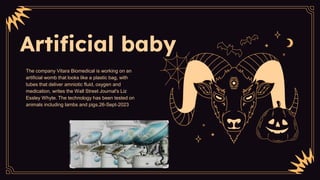
The company Vitara Biomedical is working on an
artificial womb that looks like a plastic bag, with
tubes that deliver amniotic fluid, oxygen and
medication, writes the Wall Street Journal's Liz
Essley Whyte. The technology has been tested on
animals including lambs and pigs.26-Sept-2023
Population Chart
● This tool is the Ngram Viewer. The Ngram Viewer provided
by Google is an online viewer, that charts frequencies of
any word or short sentence using the yearly count of n-
grams found in the sources printed between 1500 and
2015 in American English, British English, French,
German, Spanish, Russian, Hebrew, and Chinese.
● The n-grams are matched by case-sensitive spelling,
comparing exact letters and plotted on a graph . The viewer
was developed by J. Orwant and W. Brockman and
released in mid- December 2010; it was inspired by a
prototype created by J.-B. Michel and E. Aiden from
Harvard's Cultural Observatory and Yuan Shen from MIT
and S. Pinker
Film Adaption
Frankenstein and Robot Movie
Frankenstein
● Victor create a monster
● Creature not giving proper
name
● Monster have a crave for
having family
● Monster wants to Victor’s
girlfriend Elizabeth
● Not happy ending
● Give a horrible look
● Appearance crisis found
here
● Not a good looking
● Not people accepted easily
Robot
● Vaseegaran create robot
● Creature give a name “Chitti”
● Robot have a crave for having family
● Robot also wants to vaseegaran
girlfriend Sanna
● Happy ending scientist control
robot at the end of the movie
● Give a similar look
● No appearance crisis found here
● Smart and good looking
personality
● People accepted easily
Short Film
Ghost Machine
Director: Chris
Hartwill
The IMOM
Director: Ariel Martin
Anukul
Director: Sujoy
Ghosh
● Frankenstein Unbound by Roger Corman.
● The Casebook of Victor Frankenstein by
Peter Ackroyd.
● Hideous Love by Stephanie Hemphill.
● Man Made Boy by Jon Skovron.
Fiction Adaptation
John Croker, a conservative
member of Parliament, called
“Frankenstein” a “tissue of horrible
and disgusting absurdity”—radical,
unhinged, and immoral.
Criticism in Frankenstein
Resources
● Andrzej Weseliński. “Akademia Finansów i Biznesu
Vistula w Warszawie.” The Cultural Legacy of Mary
Shelley’s Frankenstein.
https://www.google.com/search?q=Andrzej+Weseli%C5%
84ski+Akademia+Finans%C3%B3w+i+Biznesu+Vistula+w
+Warszawie+The+Cultural+Legacy+of+Mary+Shelley%E2
%80%99s+Frankenstein&rlz=1C1ONGR_enIN1065IN106
5&oq=Andrzej+Weseli%C5%84ski+Akademia+Finans%C
3%B3w+i+Biznesu+V.
● Guerin, Wilfred L.. A Handbook of Critical
Approaches to Literature. United Kingdom,
Oxford University Press, 2005.
Thank you

Frankenstein.pptx

  • 1.
    Critical note on “frankensteinand cultural studies Present by Mansi Gujadiya
  • 2.
    Personal Information Name:- MansiB. Gujadiya Roll No.:- 12 Enrollment Number:-4069206420220013 Sem :- 3 (M.A) Paper No.:-205(A) Paper Code:-22410 Paper Name:Cultural Studies Topic:-Critical note on “frankenstein and cultural studies Submitted to:- Department of English MKBU Email:- mansigajjar10131@gmail.com
  • 3.
    Introduction ● Cultural studiesis one of the more controversial intellectual formations of the 1990s and the first decade of the third millennium. ● It has experienced a period of rapid growth in the academy, appearing at many universities in a variety of forms and locations . ● At the same time, it has been broadly attacked both from inside the university and outside academia.
  • 4.
    About Novel ● Shortlyafter the publication of Mary Shelley’s novel, its eponymous character, Victor Frankenstein, and the unnamed creature, often referred to as “Frankenstein”, gained iconic status. Initially, ● the Creature and his Creator became thriving figures of popular culture through the many theatrical versions produced in the 19th century. ● The advent of film in the 20th century contributed enormously to the circulation of Frankenstein as a cultural icon, in general, and the dissemination of the myth of a mad scientist, in particular.
  • 5.
    Revolutionary Birth TheFrankenpheme in popular culture Frankenstein Creature as Proletains A Race to Devils On the stage From natural philosophy to cyborgs Film Adaptation Television Adaptation
  • 6.
    Revolutionary Birth ● TheFrankenstein creature can be seen as a symbol of the proletariat in a social and economic context. Just as the creature is created by Victor Frankenstein but then abandoned and mistreated, the proletariat is often exploited by those in power and left to suffer. ● The creature's isolation and alienation from society reflect the isolation and marginalization that many members of the working class have experienced throughout history. ● Additionally, the creature's desire for acceptance and understanding can be compared to the working class's struggle for social equality and recognition. In this interpretation, the Frankenstein creature serves as a poignant metaphor for the plight of the proletarian in a society that values wealth and power over the well-being of its marginalized citizens.
  • 7.
    In "Frankenstein," theterm "a race of devils" is used by Victor Frankenstein to describe the potential consequences of his creation, the monster. He fears that the creature, if allowed to reproduce, could lead to a race of evil beings, causing havoc and destruction. This statement reflects Victor's growing sense of responsibility and guilt for the monster he has brought to life, and it raises ethical questions about the potential consequences of scientific experimentation and the role of the creator in the actions of the created. The novel explores themes of moral responsibility and the consequences of playing with the powers of creation, which have enduring relevance in discussions about scientific ethics. Race of Devils
  • 8.
    ● In "Frankenstein,"Mary Shelley explores the transition from natural philosophy to the concept of cyborgs, although the term "cyborg" itself was coined much later. The novel showcases the evolution of scientific and philosophical thought during the early 19th century, where natural philosophy was a precursor to modern science. ● Victor Frankenstein's experiments in creating life can be seen as an early form of biotechnology, foreshadowing the idea of artificial life and, in a broader sense, the development of cyborgs – beings that combine biological and artificial elements. ● Victor's creation of the monster blurs the boundaries between the natural and artificial, life and death, and human and non-human. ● This theme is relevant to contemporary discussions about the merging of humans with technology, such as cyborgs or transhumanism, where individuals may augment their bodies with artificial components. "Frankenstein" serves as a cautionary tale about the potential consequences of unchecked scientific ambition and the ethical considerations associated with pushing the boundaries of what it means to be human. From Natural Philosophy to Cyborgs
  • 9.
    Artificial baby The companyVitara Biomedical is working on an artificial womb that looks like a plastic bag, with tubes that deliver amniotic fluid, oxygen and medication, writes the Wall Street Journal's Liz Essley Whyte. The technology has been tested on animals including lambs and pigs.26-Sept-2023
  • 10.
    Population Chart ● Thistool is the Ngram Viewer. The Ngram Viewer provided by Google is an online viewer, that charts frequencies of any word or short sentence using the yearly count of n- grams found in the sources printed between 1500 and 2015 in American English, British English, French, German, Spanish, Russian, Hebrew, and Chinese. ● The n-grams are matched by case-sensitive spelling, comparing exact letters and plotted on a graph . The viewer was developed by J. Orwant and W. Brockman and released in mid- December 2010; it was inspired by a prototype created by J.-B. Michel and E. Aiden from Harvard's Cultural Observatory and Yuan Shen from MIT and S. Pinker
  • 11.
  • 12.
    Frankenstein and RobotMovie Frankenstein ● Victor create a monster ● Creature not giving proper name ● Monster have a crave for having family ● Monster wants to Victor’s girlfriend Elizabeth ● Not happy ending ● Give a horrible look ● Appearance crisis found here ● Not a good looking ● Not people accepted easily Robot ● Vaseegaran create robot ● Creature give a name “Chitti” ● Robot have a crave for having family ● Robot also wants to vaseegaran girlfriend Sanna ● Happy ending scientist control robot at the end of the movie ● Give a similar look ● No appearance crisis found here ● Smart and good looking personality ● People accepted easily
  • 13.
    Short Film Ghost Machine Director:Chris Hartwill The IMOM Director: Ariel Martin Anukul Director: Sujoy Ghosh
  • 14.
    ● Frankenstein Unboundby Roger Corman. ● The Casebook of Victor Frankenstein by Peter Ackroyd. ● Hideous Love by Stephanie Hemphill. ● Man Made Boy by Jon Skovron. Fiction Adaptation
  • 15.
    John Croker, aconservative member of Parliament, called “Frankenstein” a “tissue of horrible and disgusting absurdity”—radical, unhinged, and immoral. Criticism in Frankenstein
  • 16.
    Resources ● Andrzej Weseliński.“Akademia Finansów i Biznesu Vistula w Warszawie.” The Cultural Legacy of Mary Shelley’s Frankenstein. https://www.google.com/search?q=Andrzej+Weseli%C5% 84ski+Akademia+Finans%C3%B3w+i+Biznesu+Vistula+w +Warszawie+The+Cultural+Legacy+of+Mary+Shelley%E2 %80%99s+Frankenstein&rlz=1C1ONGR_enIN1065IN106 5&oq=Andrzej+Weseli%C5%84ski+Akademia+Finans%C 3%B3w+i+Biznesu+V. ● Guerin, Wilfred L.. A Handbook of Critical Approaches to Literature. United Kingdom, Oxford University Press, 2005.
  • 17.