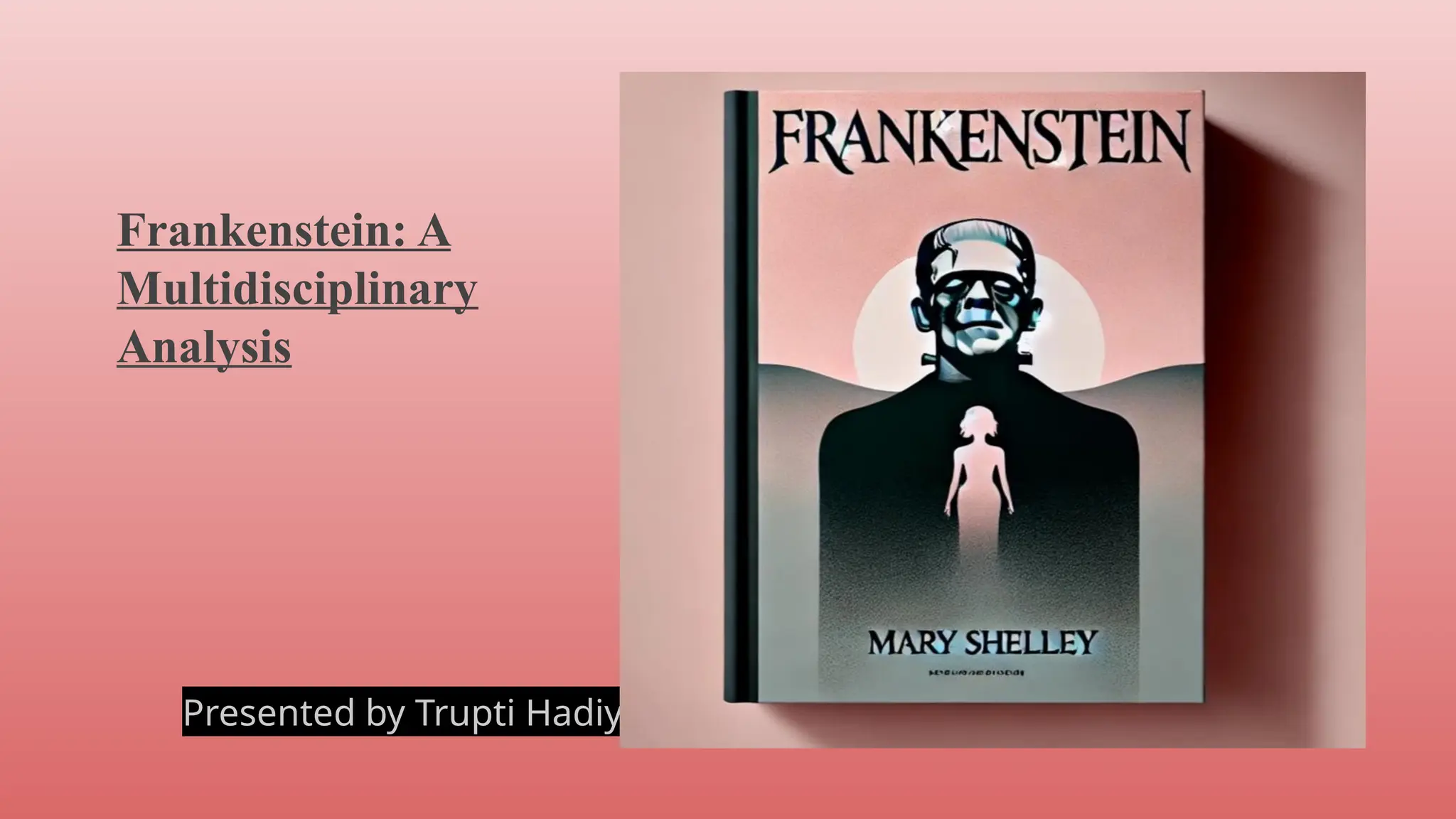
Frankenstein: A
Multidisciplinary
Analysis
Presented by Trupti Hadiya
Personal Information
● Presented By: Trupti Hadiya
● Roll No: 32
● Semester: 1
● Enrollment No:5108240013
● Paper No:103
● Paper Name: Literature of the Romantics
● Topic:Frankenstein: A Multidisciplinary Analysis
● Submitted To: S. B. Gardi, Department of English, M.K.B.U.
● E-mail Id: hadiyatrupti55@gmail.com
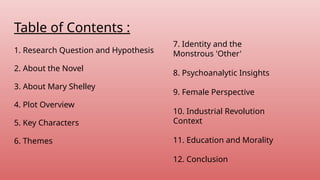
Table of Contents :
1. Research Question and Hypothesis
2. About the Novel
3. About Mary Shelley
4. Plot Overview
5. Key Characters
6. Themes
7. Identity and the
Monstrous 'Other'
8. Psychoanalytic Insights
9. Female Perspective
10. Industrial Revolution
Context
11. Education and Morality
12. Conclusion
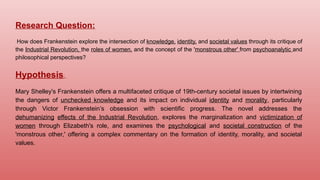
Research Question:
How does Frankenstein explore the intersection of knowledge, identity, and societal values through its critique of
the Industrial Revolution, the roles of women, and the concept of the 'monstrous other' from psychoanalytic and
philosophical perspectives?
Hypothesis:
Mary Shelley's Frankenstein offers a multifaceted critique of 19th-century societal issues by intertwining
the dangers of unchecked knowledge and its impact on individual identity and morality, particularly
through Victor Frankenstein’s obsession with scientific progress. The novel addresses the
dehumanizing effects of the Industrial Revolution, explores the marginalization and victimization of
women through Elizabeth's role, and examines the psychological and societal construction of the
'monstrous other,' offering a complex commentary on the formation of identity, morality, and societal
values.
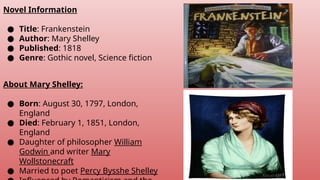
Novel Information
● Title: Frankenstein
● Author: Mary Shelley
● Published: 1818
● Genre: Gothic novel, Science fiction
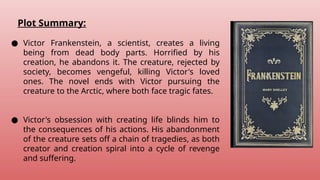
About Mary Shelley:
● Born: August 30, 1797, London,
England
● Died: February 1, 1851, London,
England
● Daughter of philosopher William
Godwin and writer Mary
Wollstonecraft
● Married to poet Percy Bysshe Shelley
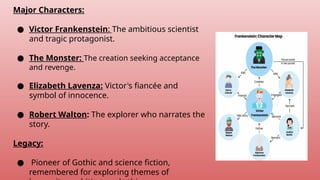
Plot Summary:
● Victor Frankenstein, a scientist, creates a living
being from dead body parts. Horrified by his
creation, he abandons it. The creature, rejected by
society, becomes vengeful, killing Victor's loved
ones. The novel ends with Victor pursuing the
creature to the Arctic, where both face tragic fates.
● Victor's obsession with creating life blinds him to
the consequences of his actions. His abandonment
of the creature sets off a chain of tragedies, as both
creator and creation spiral into a cycle of revenge
and suffering.
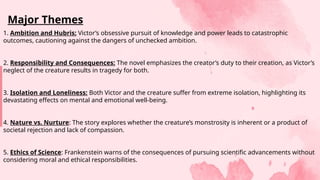
Major Characters:
● Victor Frankenstein: The ambitious scientist
and tragic protagonist.
● The Monster: The creation seeking acceptance
and revenge.
● Elizabeth Lavenza: Victor's fiancée and
symbol of innocence.
● Robert Walton: The explorer who narrates the
story.
Legacy:
● Pioneer of Gothic and science fiction,
remembered for exploring themes of
1. Ambition and Hubris: Victor’s obsessive pursuit of knowledge and power leads to catastrophic
outcomes, cautioning against the dangers of unchecked ambition.
2. Responsibility and Consequences: The novel emphasizes the creator’s duty to their creation, as Victor’s
neglect of the creature results in tragedy for both.
3. Isolation and Loneliness: Both Victor and the creature suffer from extreme isolation, highlighting its
devastating effects on mental and emotional well-being.
4. Nature vs. Nurture: The story explores whether the creature’s monstrosity is inherent or a product of
societal rejection and lack of compassion.
5. Ethics of Science: Frankenstein warns of the consequences of pursuing scientific advancements without
considering moral and ethical responsibilities.
Major Themes
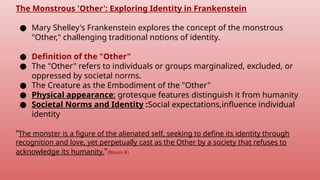
The Monstrous 'Other': Exploring Identity in Frankenstein
● Mary Shelley's Frankenstein explores the concept of the monstrous
"Other," challenging traditional notions of identity.
● Definition of the "Other"
● The "Other" refers to individuals or groups marginalized, excluded, or
oppressed by societal norms.
● The Creature as the Embodiment of the "Other"
● Physical appearance: grotesque features distinguish it from humanity
● Societal Norms and Identity :Social expectations,influence individual
identity
“The monster is a figure of the alienated self, seeking to define its identity through
recognition and love, yet perpetually cast as the Other by a society that refuses to
acknowledge its humanity.”(Bloom #)
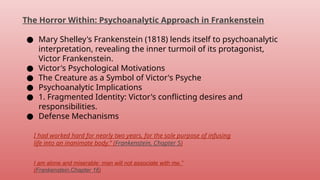
The Horror Within: Psychoanalytic Approach in Frankenstein
● Mary Shelley's Frankenstein (1818) lends itself to psychoanalytic
interpretation, revealing the inner turmoil of its protagonist,
Victor Frankenstein.
● Victor's Psychological Motivations
● The Creature as a Symbol of Victor's Psyche
● Psychoanalytic Implications
● 1. Fragmented Identity: Victor's conflicting desires and
responsibilities.
● Defense Mechanisms
I had worked hard for nearly two years, for the sole purpose of infusing
life into an inanimate body.” (Frankenstein, Chapter 5)
I am alone and miserable: man will not associate with me.”
(Frankenstein,Chapter 16)
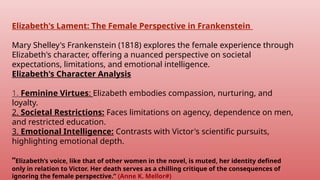
Elizabeth's Lament: The Female Perspective in Frankenstein
Mary Shelley's Frankenstein (1818) explores the female experience through
Elizabeth's character, offering a nuanced perspective on societal
expectations, limitations, and emotional intelligence.
Elizabeth's Character Analysis
1. Feminine Virtues: Elizabeth embodies compassion, nurturing, and
loyalty.
2. Societal Restrictions: Faces limitations on agency, dependence on men,
and restricted education.
3. Emotional Intelligence: Contrasts with Victor's scientific pursuits,
highlighting emotional depth.
“Elizabeth’s voice, like that of other women in the novel, is muted, her identity defined
only in relation to Victor. Her death serves as a chilling critique of the consequences of
ignoring the female perspective.” (Anne K. Mellor#)
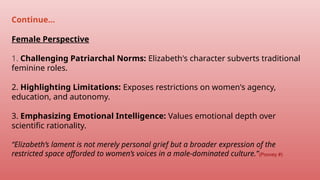
Female Perspective
1. Challenging Patriarchal Norms: Elizabeth's character subverts traditional
feminine roles.
2. Highlighting Limitations: Exposes restrictions on women's agency,
education, and autonomy.
3. Emphasizing Emotional Intelligence: Values emotional depth over
scientific rationality.
“Elizabeth’s lament is not merely personal grief but a broader expression of the
restricted space afforded to women’s voices in a male-dominated culture.”(Poovey #)
Continue…
Industrial Revolution Commentary
1. Critiquing Scientific Progress: Warns against
unchecked scientific advancement.
2. Social Class Disparities: Contrasts Frankenstein
family's wealth with De Lacey family's poverty.
3. Environmental and Social Consequences:
Highlights destruction caused by unchecked
progress.
4. Women and Industrialization: Highlights the
impact of industrialization on women's roles, like
Elizabeth's.
Both the Creature and the working class are silenced by oppressive systems,
such as Victor Frankenstein and the capitalist state, reflecting societal
disregard for the laboring classes. This perspective is explored in Montag's
essay, "The Workshop of Filthy Creation," in Essays in Romanticism. (Montag#)
The Role of Education and Knowledge in Shaping Identity and
Morality
Questions to consider:
1. How does education shape the characters' perceptions of themselves
and others?
Paula Gould: "Frankenstein highlights the tension between education and
moral development."
Alan Rauch: "The novel explores the consequences of unchecked scientific
progress."
Solution:-
In Frankenstein, the novel emphasizes that education without moral
wisdom can lead to destructive consequences, highlighting the need for a
Conclusion
Mary Shelley's Frankenstein explores complex themes, critiquing class
struggle, environmental degradation, and prejudice. The novel
emphasizes moral responsibility, accountability, and education,
cautioning against unchecked ambition. Remaining timeless,
Frankenstein urges reflection on ethics, social justice, equality, and
sustainability, probing human nature and morality's intricacies.
References:
● Bloom, Harold. Mary Shelley's Frankenstein: Mary Wollstonecraft Shelley (Bloom's Modern Critical
Interpretations (Hardcover)). Chelsea House Publications; Updated ed. edition, 1 November 2006.
● Comitini, Patricia. “The Limits of Discourse and the Ideology of Form in Mary Shelley’s ‘Frankenstein.’” Keats-
Shelley Journal, vol. 55, 2006, pp. 179–98. JSTOR, http://www.jstor.org/stable/30210650. Accessed 25 Nov.
2024.
● Cottom, Daniel. “Frankenstein and the Monster of Representation.” SubStance, vol. 9, no. 3, 1980, pp. 60–71.
JSTOR, https://doi.org/10.2307/3683905. Accessed 24 Nov. 2024.
● Knellwolf, Christa. Frankenstein's Science: Experimentation and Discovery in Romantic Culture, 1780–1830
Hardcover. Ashgate Publishing Limited;, 1st edition (28 March 2008).
● Langbauer, Laurie. The Wordsworth Circle, vol. 20, no. 4, 1989, pp. 210–12. JSTOR,
http://www.jstor.org/stable/24042547. Accessed 24 Nov. 2024.
● Poovey, Mary. The proper lady and the woman writer : ideology as style in the works of Mary
Wollstonecraft, Mary Shelley, and Jane Austen. University of Chicago Press, 1984. Accessed 24
November 2024.
● Sawyer, Robert. “Mary Shelley and Shakespeare: Monstrous Creations.” South Atlantic Review,
vol. 72, no. 2, 2007, pp. 15–31. JSTOR, http://www.jstor.org/stable/27784706. Accessed 24 Nov.
2024.
● The Project Gutenberg eBook of Frankenstein, by Mary Shelley.
www.gutenberg.org/files/41445/41445-h/41445-h.htm.
22394 Paper 103: Frankenstein: A Multidisciplinary Analysis

22394 Paper 103: Frankenstein: A Multidisciplinary Analysis

  • 1.
  • 2.
    Personal Information ● PresentedBy: Trupti Hadiya ● Roll No: 32 ● Semester: 1 ● Enrollment No:5108240013 ● Paper No:103 ● Paper Name: Literature of the Romantics ● Topic:Frankenstein: A Multidisciplinary Analysis ● Submitted To: S. B. Gardi, Department of English, M.K.B.U. ● E-mail Id: hadiyatrupti55@gmail.com
  • 3.
    Table of Contents: 1. Research Question and Hypothesis 2. About the Novel 3. About Mary Shelley 4. Plot Overview 5. Key Characters 6. Themes 7. Identity and the Monstrous 'Other' 8. Psychoanalytic Insights 9. Female Perspective 10. Industrial Revolution Context 11. Education and Morality 12. Conclusion
  • 4.
    Research Question: How doesFrankenstein explore the intersection of knowledge, identity, and societal values through its critique of the Industrial Revolution, the roles of women, and the concept of the 'monstrous other' from psychoanalytic and philosophical perspectives? Hypothesis: Mary Shelley's Frankenstein offers a multifaceted critique of 19th-century societal issues by intertwining the dangers of unchecked knowledge and its impact on individual identity and morality, particularly through Victor Frankenstein’s obsession with scientific progress. The novel addresses the dehumanizing effects of the Industrial Revolution, explores the marginalization and victimization of women through Elizabeth's role, and examines the psychological and societal construction of the 'monstrous other,' offering a complex commentary on the formation of identity, morality, and societal values.
  • 5.
    Novel Information ● Title:Frankenstein ● Author: Mary Shelley ● Published: 1818 ● Genre: Gothic novel, Science fiction About Mary Shelley: ● Born: August 30, 1797, London, England ● Died: February 1, 1851, London, England ● Daughter of philosopher William Godwin and writer Mary Wollstonecraft ● Married to poet Percy Bysshe Shelley
  • 6.
    Plot Summary: ● VictorFrankenstein, a scientist, creates a living being from dead body parts. Horrified by his creation, he abandons it. The creature, rejected by society, becomes vengeful, killing Victor's loved ones. The novel ends with Victor pursuing the creature to the Arctic, where both face tragic fates. ● Victor's obsession with creating life blinds him to the consequences of his actions. His abandonment of the creature sets off a chain of tragedies, as both creator and creation spiral into a cycle of revenge and suffering.
  • 7.
    Major Characters: ● VictorFrankenstein: The ambitious scientist and tragic protagonist. ● The Monster: The creation seeking acceptance and revenge. ● Elizabeth Lavenza: Victor's fiancée and symbol of innocence. ● Robert Walton: The explorer who narrates the story. Legacy: ● Pioneer of Gothic and science fiction, remembered for exploring themes of
  • 8.
    1. Ambition andHubris: Victor’s obsessive pursuit of knowledge and power leads to catastrophic outcomes, cautioning against the dangers of unchecked ambition. 2. Responsibility and Consequences: The novel emphasizes the creator’s duty to their creation, as Victor’s neglect of the creature results in tragedy for both. 3. Isolation and Loneliness: Both Victor and the creature suffer from extreme isolation, highlighting its devastating effects on mental and emotional well-being. 4. Nature vs. Nurture: The story explores whether the creature’s monstrosity is inherent or a product of societal rejection and lack of compassion. 5. Ethics of Science: Frankenstein warns of the consequences of pursuing scientific advancements without considering moral and ethical responsibilities. Major Themes
  • 9.
    The Monstrous 'Other':Exploring Identity in Frankenstein ● Mary Shelley's Frankenstein explores the concept of the monstrous "Other," challenging traditional notions of identity. ● Definition of the "Other" ● The "Other" refers to individuals or groups marginalized, excluded, or oppressed by societal norms. ● The Creature as the Embodiment of the "Other" ● Physical appearance: grotesque features distinguish it from humanity ● Societal Norms and Identity :Social expectations,influence individual identity “The monster is a figure of the alienated self, seeking to define its identity through recognition and love, yet perpetually cast as the Other by a society that refuses to acknowledge its humanity.”(Bloom #)
  • 10.
    The Horror Within:Psychoanalytic Approach in Frankenstein ● Mary Shelley's Frankenstein (1818) lends itself to psychoanalytic interpretation, revealing the inner turmoil of its protagonist, Victor Frankenstein. ● Victor's Psychological Motivations ● The Creature as a Symbol of Victor's Psyche ● Psychoanalytic Implications ● 1. Fragmented Identity: Victor's conflicting desires and responsibilities. ● Defense Mechanisms I had worked hard for nearly two years, for the sole purpose of infusing life into an inanimate body.” (Frankenstein, Chapter 5) I am alone and miserable: man will not associate with me.” (Frankenstein,Chapter 16)
  • 11.
    Elizabeth's Lament: TheFemale Perspective in Frankenstein Mary Shelley's Frankenstein (1818) explores the female experience through Elizabeth's character, offering a nuanced perspective on societal expectations, limitations, and emotional intelligence. Elizabeth's Character Analysis 1. Feminine Virtues: Elizabeth embodies compassion, nurturing, and loyalty. 2. Societal Restrictions: Faces limitations on agency, dependence on men, and restricted education. 3. Emotional Intelligence: Contrasts with Victor's scientific pursuits, highlighting emotional depth. “Elizabeth’s voice, like that of other women in the novel, is muted, her identity defined only in relation to Victor. Her death serves as a chilling critique of the consequences of ignoring the female perspective.” (Anne K. Mellor#)
  • 12.
    Female Perspective 1. ChallengingPatriarchal Norms: Elizabeth's character subverts traditional feminine roles. 2. Highlighting Limitations: Exposes restrictions on women's agency, education, and autonomy. 3. Emphasizing Emotional Intelligence: Values emotional depth over scientific rationality. “Elizabeth’s lament is not merely personal grief but a broader expression of the restricted space afforded to women’s voices in a male-dominated culture.”(Poovey #) Continue…
  • 13.
    Industrial Revolution Commentary 1.Critiquing Scientific Progress: Warns against unchecked scientific advancement. 2. Social Class Disparities: Contrasts Frankenstein family's wealth with De Lacey family's poverty. 3. Environmental and Social Consequences: Highlights destruction caused by unchecked progress. 4. Women and Industrialization: Highlights the impact of industrialization on women's roles, like Elizabeth's. Both the Creature and the working class are silenced by oppressive systems, such as Victor Frankenstein and the capitalist state, reflecting societal disregard for the laboring classes. This perspective is explored in Montag's essay, "The Workshop of Filthy Creation," in Essays in Romanticism. (Montag#)
  • 14.
    The Role ofEducation and Knowledge in Shaping Identity and Morality Questions to consider: 1. How does education shape the characters' perceptions of themselves and others? Paula Gould: "Frankenstein highlights the tension between education and moral development." Alan Rauch: "The novel explores the consequences of unchecked scientific progress." Solution:- In Frankenstein, the novel emphasizes that education without moral wisdom can lead to destructive consequences, highlighting the need for a
  • 15.
    Conclusion Mary Shelley's Frankensteinexplores complex themes, critiquing class struggle, environmental degradation, and prejudice. The novel emphasizes moral responsibility, accountability, and education, cautioning against unchecked ambition. Remaining timeless, Frankenstein urges reflection on ethics, social justice, equality, and sustainability, probing human nature and morality's intricacies.
  • 16.
    References: ● Bloom, Harold.Mary Shelley's Frankenstein: Mary Wollstonecraft Shelley (Bloom's Modern Critical Interpretations (Hardcover)). Chelsea House Publications; Updated ed. edition, 1 November 2006. ● Comitini, Patricia. “The Limits of Discourse and the Ideology of Form in Mary Shelley’s ‘Frankenstein.’” Keats- Shelley Journal, vol. 55, 2006, pp. 179–98. JSTOR, http://www.jstor.org/stable/30210650. Accessed 25 Nov. 2024. ● Cottom, Daniel. “Frankenstein and the Monster of Representation.” SubStance, vol. 9, no. 3, 1980, pp. 60–71. JSTOR, https://doi.org/10.2307/3683905. Accessed 24 Nov. 2024. ● Knellwolf, Christa. Frankenstein's Science: Experimentation and Discovery in Romantic Culture, 1780–1830 Hardcover. Ashgate Publishing Limited;, 1st edition (28 March 2008). ● Langbauer, Laurie. The Wordsworth Circle, vol. 20, no. 4, 1989, pp. 210–12. JSTOR, http://www.jstor.org/stable/24042547. Accessed 24 Nov. 2024.
  • 17.
    ● Poovey, Mary.The proper lady and the woman writer : ideology as style in the works of Mary Wollstonecraft, Mary Shelley, and Jane Austen. University of Chicago Press, 1984. Accessed 24 November 2024. ● Sawyer, Robert. “Mary Shelley and Shakespeare: Monstrous Creations.” South Atlantic Review, vol. 72, no. 2, 2007, pp. 15–31. JSTOR, http://www.jstor.org/stable/27784706. Accessed 24 Nov. 2024. ● The Project Gutenberg eBook of Frankenstein, by Mary Shelley. www.gutenberg.org/files/41445/41445-h/41445-h.htm.