Revenue Cycle Management: What Matters Now
           The Future of Coding and Compliance


          Guest                               Host
          Gina Lyons,                         Tim Coan,
          Director of Coding and Compliance   CEO
          ALN Medical Management              ALN Medical Management
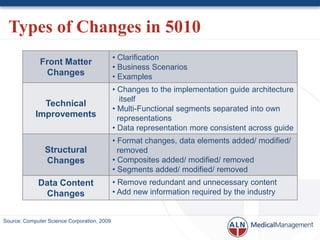
Types of Changes in 5010
                                             • Clarification
              Front Matter
                                             • Business Scenarios
               Changes                       • Examples
                                             • Changes to the implementation guide architecture
                                                itself
              Technical
                                             • Multi-Functional segments separated into own
            Improvements                       representations
                                             • Data representation more consistent across guide
                                             • Format changes, data elements added/ modified/
                Structural                     removed
                Changes                      • Composites added/ modified/ removed
                                             • Segments added/ modified/ removed
             Data Content                    • Remove redundant and unnecessary content
              Changes                        • Add new information required by the industry


Source: Computer Science Corporation, 2009
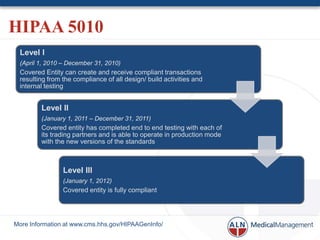
HIPAA 5010
 Level I
 (April 1, 2010 – December 31, 2010)
 Covered Entity can create and receive compliant transactions
 resulting from the compliance of all design/ build activities and
 internal testing


         Level II
         (January 1, 2011 – December 31, 2011)
         Covered entity has completed end to end testing with each of
         its trading partners and is able to operate in production mode
         with the new versions of the standards


                Level III
                (January 1, 2012)
                Covered entity is fully compliant


More Information at www.cms.hhs.gov/HIPAAGenInfo/
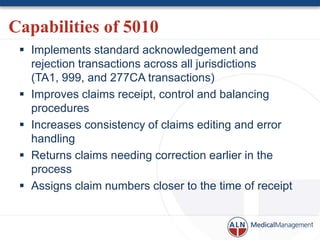
Capabilities of 5010
  Implements standard acknowledgement and
   rejection transactions across all jurisdictions
   (TA1, 999, and 277CA transactions)
  Improves claims receipt, control and balancing
   procedures
  Increases consistency of claims editing and error
   handling
  Returns claims needing correction earlier in the
   process
  Assigns claim numbers closer to the time of receipt
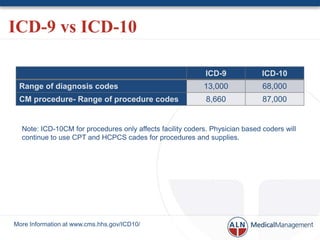
ICD-9 vs ICD-10

                                                            ICD-9             ICD-10
 Range of diagnosis codes                                  13,000             68,000
 CM procedure- Range of procedure codes                     8,660             87,000


  Note: ICD-10CM for procedures only affects facility coders. Physician based coders will
  continue to use CPT and HCPCS cades for procedures and supplies.


More Information at www.cms.hhs.gov/ICD10/
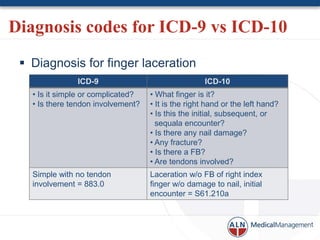
Diagnosis codes for ICD-9 vs ICD-10
  Diagnosis for finger laceration
               ICD-9                                 ICD-10
   • Is it simple or complicated?   • What finger is it?
   • Is there tendon involvement?   • It is the right hand or the left hand?
                                    • Is this the initial, subsequent, or
                                      sequala encounter?
                                    • Is there any nail damage?
                                    • Any fracture?
                                    • Is there a FB?
                                    • Are tendons involved?
   Simple with no tendon            Laceration w/o FB of right index
   involvement = 883.0              finger w/o damage to nail, initial
                                    encounter = S61.210a
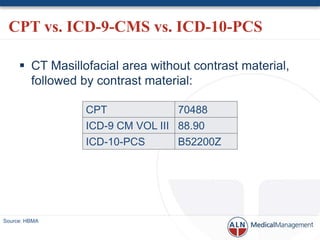
CPT vs. ICD-9-CMS vs. ICD-10-PCS

      CT Masillofacial area without contrast material,
       followed by contrast material:

                 CPT              70488
                 ICD-9 CM VOL III 88.90
                 ICD-10-PCS       B52200Z


Source: HBMA
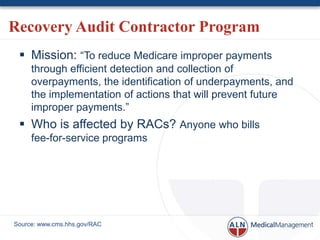
Recovery Audit Contractor Program
  Mission: “To reduce Medicare improper payments
     through efficient detection and collection of
     overpayments, the identification of underpayments, and
     the implementation of actions that will prevent future
     improper payments.”
  Who is affected by RACs? Anyone who bills
     fee-for-service programs


Source: www.cms.hhs.gov/RAC
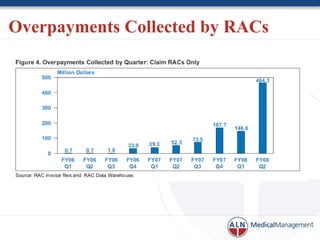
Overpayments Collected by RACs
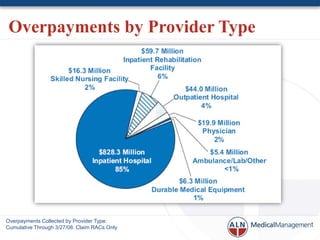
Overpayments by Provider Type


Overpayments Collected by Provider Type:
Cumulative Through 3/27/08. Claim RACs Only
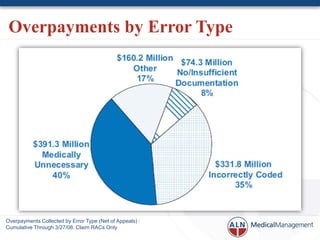
Overpayments by Error Type


Overpayments Collected by Error Type (Net of Appeals) :
Cumulative Through 3/27/08. Claim RACs Only
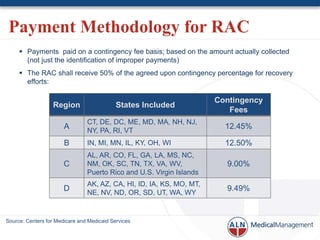
Payment Methodology for RAC
      Payments paid on a contingency fee basis; based on the amount actually collected
       (not just the identification of improper payments)
      The RAC shall receive 50% of the agreed upon contingency percentage for recovery
       efforts:

                                                                      Contingency
                  Region                    States Included
                                                                         Fees
                                CT, DE, DC, ME, MD, MA, NH, NJ,
                       A        NY, PA, RI, VT
                                                                        12.45%

                       B        IN, MI, MN, IL, KY, OH, WI              12.50%
                                AL, AR, CO, FL, GA, LA, MS, NC,
                       C        NM, OK, SC, TN, TX, VA, WV,             9.00%
                                Puerto Rico and U.S. Virgin Islands
                                AK, AZ, CA, HI, ID, IA, KS, MO, MT,
                       D        NE, NV, ND, OR, SD, UT, WA, WY
                                                                        9.49%


Source: Centers for Medicare and Medicaid Services
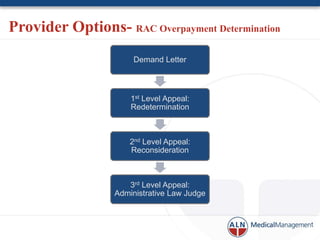
Provider Options- RAC Overpayment Determination
                       Demand Letter


                      1st Level Appeal:
                      Redetermination


                      2nd Level Appeal:
                      Reconsideration


                     3rd Level Appeal:
                  Administrative Law Judge
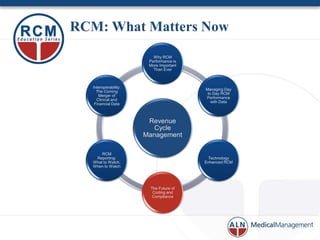
RCM: What Matters Now
                          Why RCM
                        Performance is
                        More Important
                          Than Ever


   Interoperability:
                                         Managing Day
     The Coming
                                          to Day RCM
      Merger of
                                         Performance
     Clinical and
                                            with Data
    Financial Data


                        Revenue
                          Cycle
                       Management

       RCM
    Reporting:                            Technology
   What to Watch,                        Enhanced RCM
   When to Watch


                        The Future of
                         Coding and
                         Compliance

The future of coding and compliance

  • 1.
    Revenue Cycle Management:What Matters Now The Future of Coding and Compliance Guest Host Gina Lyons, Tim Coan, Director of Coding and Compliance CEO ALN Medical Management ALN Medical Management
  • 2.
    Types of Changesin 5010 • Clarification Front Matter • Business Scenarios Changes • Examples • Changes to the implementation guide architecture itself Technical • Multi-Functional segments separated into own Improvements representations • Data representation more consistent across guide • Format changes, data elements added/ modified/ Structural removed Changes • Composites added/ modified/ removed • Segments added/ modified/ removed Data Content • Remove redundant and unnecessary content Changes • Add new information required by the industry Source: Computer Science Corporation, 2009
  • 3.
    HIPAA 5010 LevelI (April 1, 2010 – December 31, 2010) Covered Entity can create and receive compliant transactions resulting from the compliance of all design/ build activities and internal testing Level II (January 1, 2011 – December 31, 2011) Covered entity has completed end to end testing with each of its trading partners and is able to operate in production mode with the new versions of the standards Level III (January 1, 2012) Covered entity is fully compliant More Information at www.cms.hhs.gov/HIPAAGenInfo/
  • 4.
    Capabilities of 5010  Implements standard acknowledgement and rejection transactions across all jurisdictions (TA1, 999, and 277CA transactions)  Improves claims receipt, control and balancing procedures  Increases consistency of claims editing and error handling  Returns claims needing correction earlier in the process  Assigns claim numbers closer to the time of receipt
  • 5.
    ICD-9 vs ICD-10 ICD-9 ICD-10 Range of diagnosis codes 13,000 68,000 CM procedure- Range of procedure codes 8,660 87,000 Note: ICD-10CM for procedures only affects facility coders. Physician based coders will continue to use CPT and HCPCS cades for procedures and supplies. More Information at www.cms.hhs.gov/ICD10/
  • 6.
    Diagnosis codes forICD-9 vs ICD-10  Diagnosis for finger laceration ICD-9 ICD-10 • Is it simple or complicated? • What finger is it? • Is there tendon involvement? • It is the right hand or the left hand? • Is this the initial, subsequent, or sequala encounter? • Is there any nail damage? • Any fracture? • Is there a FB? • Are tendons involved? Simple with no tendon Laceration w/o FB of right index involvement = 883.0 finger w/o damage to nail, initial encounter = S61.210a
  • 7.
    CPT vs. ICD-9-CMSvs. ICD-10-PCS  CT Masillofacial area without contrast material, followed by contrast material: CPT 70488 ICD-9 CM VOL III 88.90 ICD-10-PCS B52200Z Source: HBMA
  • 8.
    Recovery Audit ContractorProgram  Mission: “To reduce Medicare improper payments through efficient detection and collection of overpayments, the identification of underpayments, and the implementation of actions that will prevent future improper payments.”  Who is affected by RACs? Anyone who bills fee-for-service programs Source: www.cms.hhs.gov/RAC
  • 9.
  • 10.
    Overpayments by ProviderType Overpayments Collected by Provider Type: Cumulative Through 3/27/08. Claim RACs Only
  • 11.
    Overpayments by ErrorType Overpayments Collected by Error Type (Net of Appeals) : Cumulative Through 3/27/08. Claim RACs Only
  • 12.
    Payment Methodology forRAC  Payments paid on a contingency fee basis; based on the amount actually collected (not just the identification of improper payments)  The RAC shall receive 50% of the agreed upon contingency percentage for recovery efforts: Contingency Region States Included Fees CT, DE, DC, ME, MD, MA, NH, NJ, A NY, PA, RI, VT 12.45% B IN, MI, MN, IL, KY, OH, WI 12.50% AL, AR, CO, FL, GA, LA, MS, NC, C NM, OK, SC, TN, TX, VA, WV, 9.00% Puerto Rico and U.S. Virgin Islands AK, AZ, CA, HI, ID, IA, KS, MO, MT, D NE, NV, ND, OR, SD, UT, WA, WY 9.49% Source: Centers for Medicare and Medicaid Services
  • 13.
    Provider Options- RACOverpayment Determination Demand Letter 1st Level Appeal: Redetermination 2nd Level Appeal: Reconsideration 3rd Level Appeal: Administrative Law Judge
  • 14.
    RCM: What MattersNow Why RCM Performance is More Important Than Ever Interoperability: Managing Day The Coming to Day RCM Merger of Performance Clinical and with Data Financial Data Revenue Cycle Management RCM Reporting: Technology What to Watch, Enhanced RCM When to Watch The Future of Coding and Compliance