NLU / Intent Detection
Benchmark
by Intento
August 2017
About
• At Intento, we want to make Machine Intelligence
services easy to discover, choose and use.
• So far, the evaluation is the most problematic part: to
compare providers, one need to sign a lot of contracts
and integrate a lot of APIs.
• We deliver that for FREE on public datasets. To
evaluate on you own dataset, contact our sales.
• Also, check out our Machine Translation Benchmark.
Machine Translation is an easy way to build a multi-
lingual bot.
Overview
• Natural Language Understanding Services with Public
APIs*
• IBM Watson Conversation
• API.ai API
• Microsoft LUIS
• Amazon Lex
• Recast.ai API
• wit.ai API
• SNIPS API
• Benchmark Dimensions
• Intent Prediction Performance
• False Positives
• Learning Speed (performance on small datasets)
• Language Coverage, Price, Response time
August 2017© Intento, Inc.
* as of today, some of them don’t have a Public API and we’ve got an access for the purpose of this benchmark
NLU Engines Compared
August 2017© Intento, Inc.
API.ai / Google
• Website: https://api.ai
• Launched: 2010 (acquired by Google in 2016)
• Pricing model: FREE
• Interface: HTTP REST API
“Build delightful and natural
conversational experiences”
August 2017© Intento, Inc.
wit.ai / Facebook
• Website: https://wit.ai
• Launched: 2013 (acquired by Facebook in 2015)
• Pricing model: FREE
• Interface: HTTP REST API
“Natural Language for Developers”
August 2017© Intento, Inc.
IBM Watson Conversation
• Website: https://www.ibm.com/watson/services/
conversation/
• Launched: 2016
• Pricing model: Pay As You Go
• Interface: HTTP REST API
“Quickly build and deploy chatbots and
virtual agents across a variety of
channels, including mobile devices,
messaging platforms, and even robots.”
August 2017© Intento, Inc.
Microsoft LUIS
• Website: https://www.luis.ai/
• Launched: 2015
• Pricing model: Pay As You Go
• Interface: HTTP REST API
“Language Understanding
Intelligent Service. Add
conversational intelligence to your
apps.”
August 2017© Intento, Inc.
Amazon Lex
• Website: https://aws.amazon.com/lex/
• Launched: 2016
• Pricing model: Pay As You Go
• Interface: HTTP REST API
• Important Restrictions apply (see Dataset slide)
“Conversational interfaces for your
applications. Powered by the same deep
learning technologies as Alexa”
August 2017© Intento, Inc.
Recast.ai
• Website: https://recast.ai
• Launched: 2016
• Pricing mode: Free tier + Contact sales
• Interface: HTTP REST API
“The collaborative platform to
build, train, deploy and monitor
intelligent bots for developers”
August 2017© Intento, Inc.
SNIPS
• Website: https://snips.ai
• Launched: 2017
• Pricing model: Free to test + Pay per Device
• Interface: On Device*
“Snips is an AI-powered voice
assistant you can add to your
products. It runs on-device and is
Private by Design”
* we’ve tested a hosted version with a private API provided by SNIPS
August 2017© Intento, Inc.
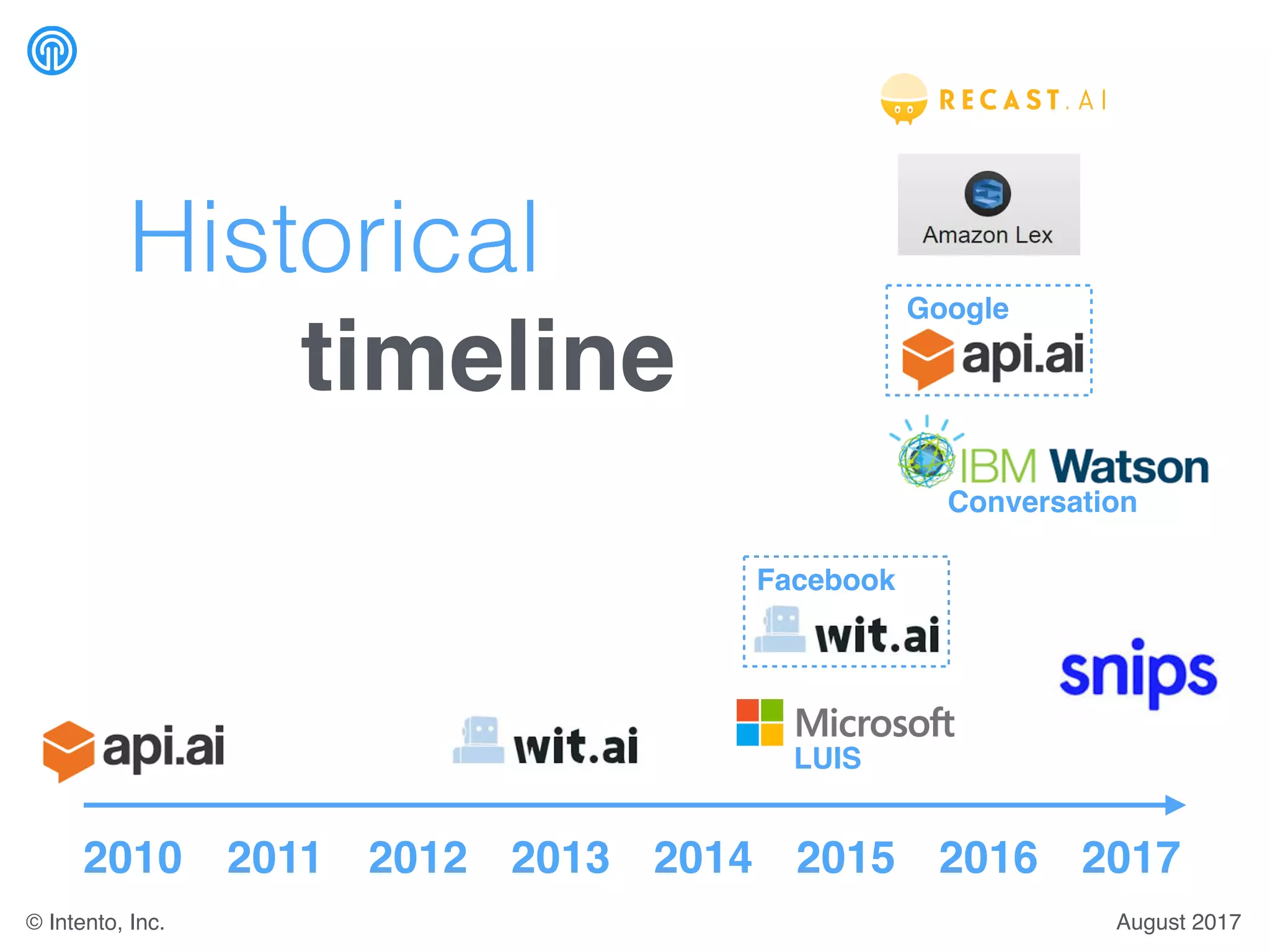
Historical
timeline
2011 2015 20162012 2013 2014 20172010
Conversation
Facebook
Google
LUIS
August 2017© Intento, Inc.
The Approach
August 2017© Intento, Inc.
Dataset
• The original dataset is the SNIPS.ai 2017 NLU Benchmark
• English language only
• We have removed duplicates that differ by number of
whitespaces, quotes, lettercase etc
• Resulting dataset parameters*: 7 intents (next slide),
15.6K samples (~2K per intent), 340K symbols
• We also used ~450 samples from SNIPS.ai 2016 NLU
Benchmark to test for False Positives
* For Amazon Lex, the training set is capped by 200K symbols per API limitation; also symbol limitations
apply, resulting in 4500 utterances (~640 per intent).
August 2017© Intento, Inc.
Intents [*]
• SearchCreativeWork (e.g. Find me the I, Robot television show)
• GetWeather (e.g. Is it windy in Boston, MA right now?)
• BookRestaurant (e.g. I want to book a highly rated restaurant for
me and my boyfriend tomorrow night)
• PlayMusic (e.g. Play the last track from Beyoncé off Spotify)
• AddToPlaylist (e.g. Add Diamonds to my roadtrip playlist)
• RateBook (e.g. Give 6 stars to Of Mice and Men)
• SearchScreeningEvent (e.g. Check the showtimes for Wonder
Woman in Paris)
[*] quoted from https://github.com/snipsco/nlu-benchmark/tree/master/2017-06-custom-intent-engines
August 2017© Intento, Inc.
I. Prediction Performance
August 2017© Intento, Inc.
Experimental setting
• Inspired by the SNIPS Benchmarks (2016, 2017)
• We benchmark intent detection only, no parameter
extraction yet
• For each provider, one model is trained to detect all
intents
• We run all models with the default confidence score
thresholds.
• 3-fold 80/20* Stratified Monte Carlo cross-validation
* 47/20 for Amazon Lex
August 2017© Intento, Inc.
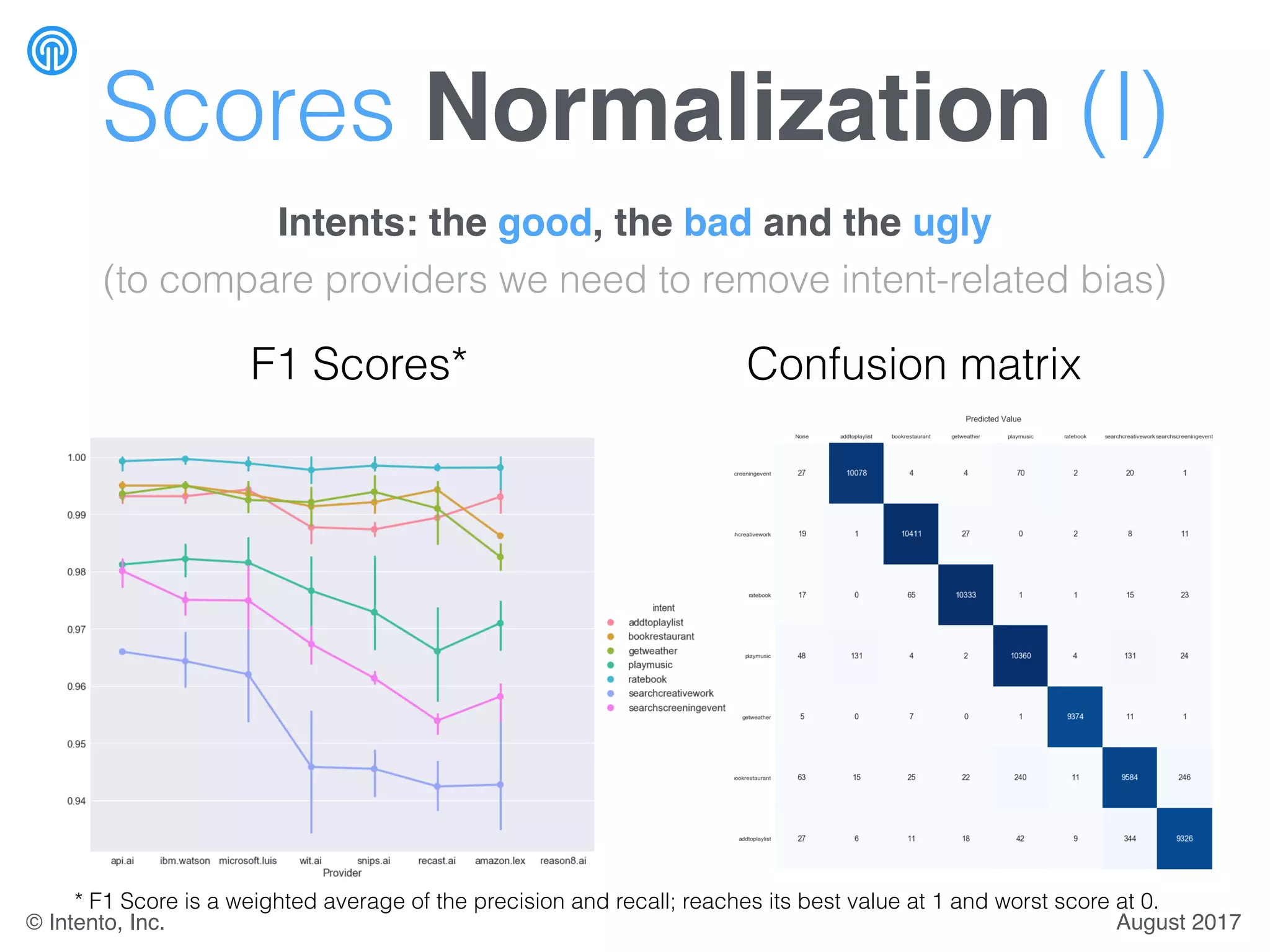
Scores Normalization (I)
Intents: the good, the bad and the ugly
(to compare providers we need to remove intent-related bias)
F1 Scores* Confusion matrix
* F1 Score is a weighted average of the precision and recall; reaches its best value at 1 and worst score at 0.
August 2017© Intento, Inc.
Scores Normalization (II)
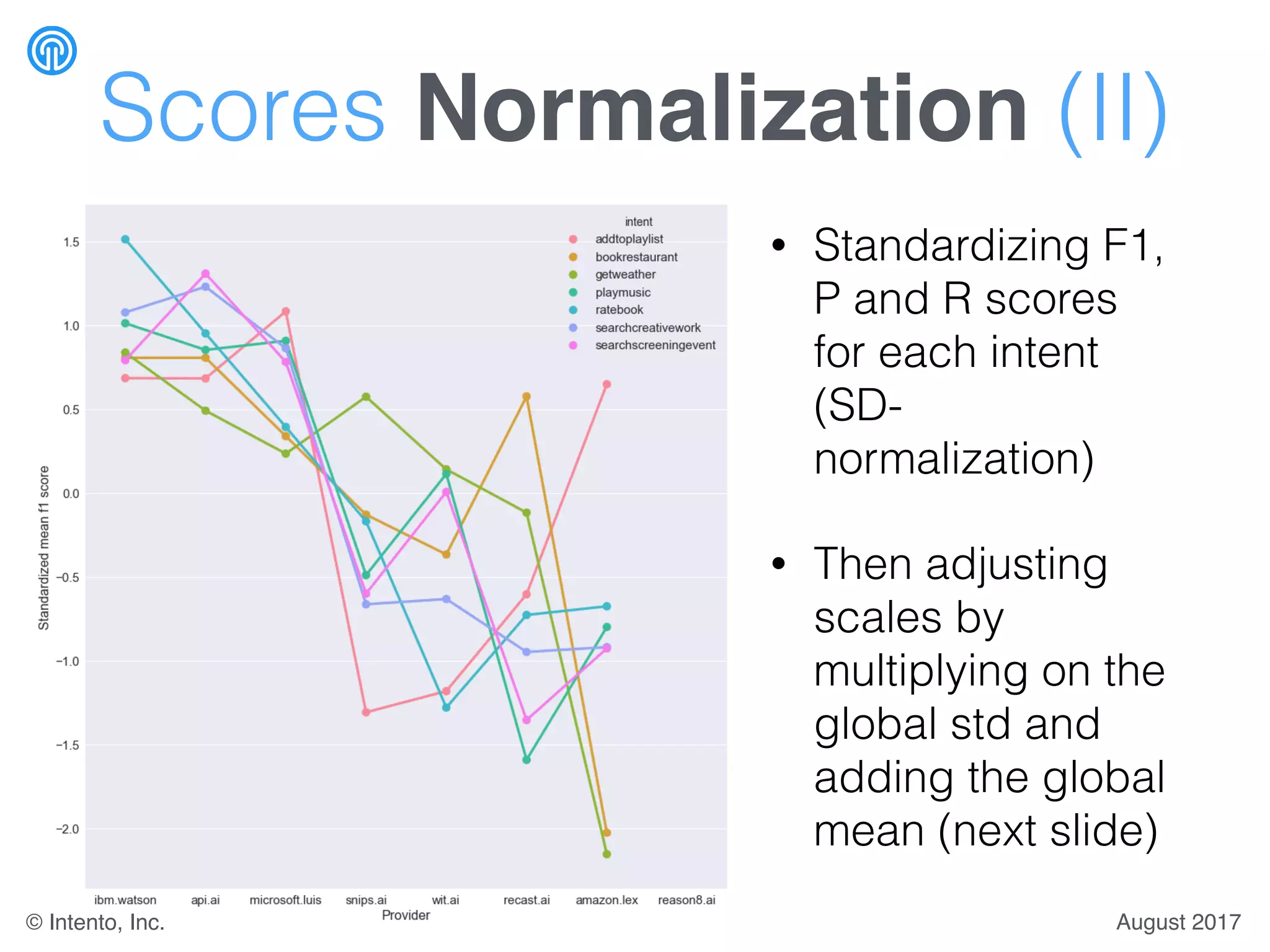
• Standardizing F1,
P and R scores
for each intent
(SD-
normalization)
• Then adjusting
scales by
multiplying on the
global std and
adding the global
mean (next slide)
August 2017© Intento, Inc.
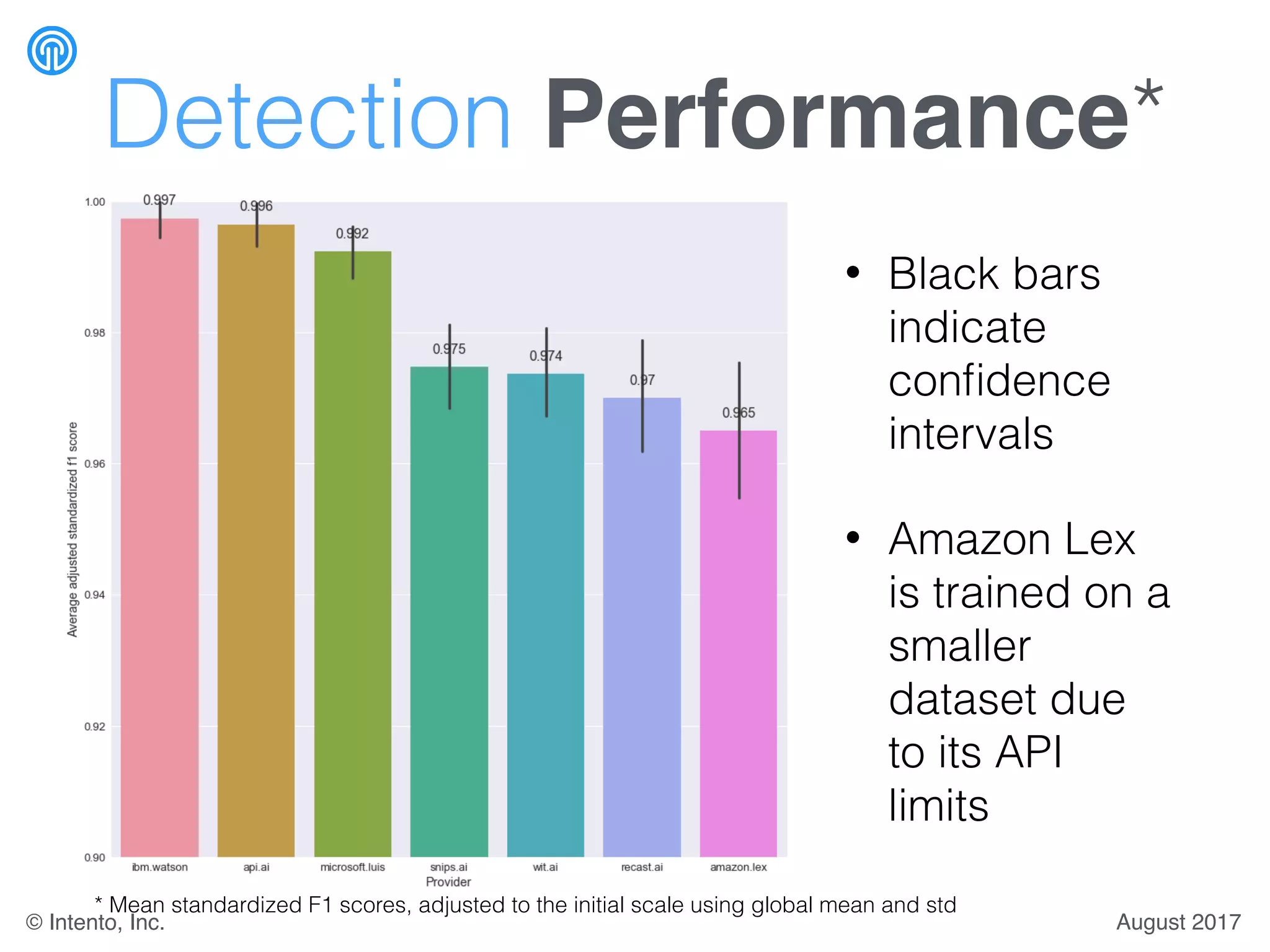
Detection Performance*
• Black bars
indicate
confidence
intervals
• Amazon Lex
is trained on a
smaller
dataset due
to its API
limits
* Mean standardized F1 scores, adjusted to the initial scale using global mean and std
August 2017© Intento, Inc.
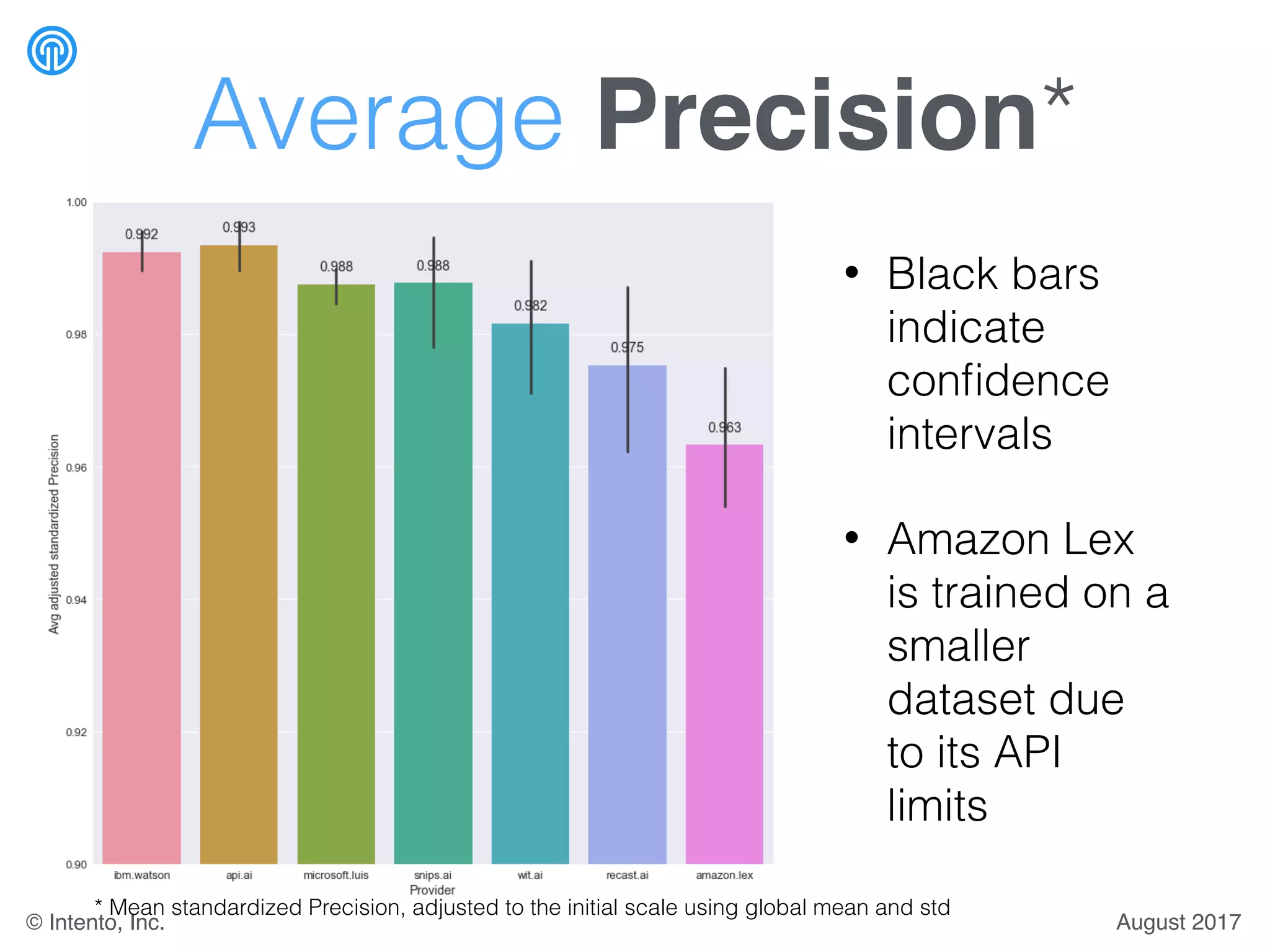
Average Precision*
• Black bars
indicate
confidence
intervals
• Amazon Lex
is trained on a
smaller
dataset due
to its API
limits
August 2017© Intento, Inc.
* Mean standardized Precision, adjusted to the initial scale using global mean and std
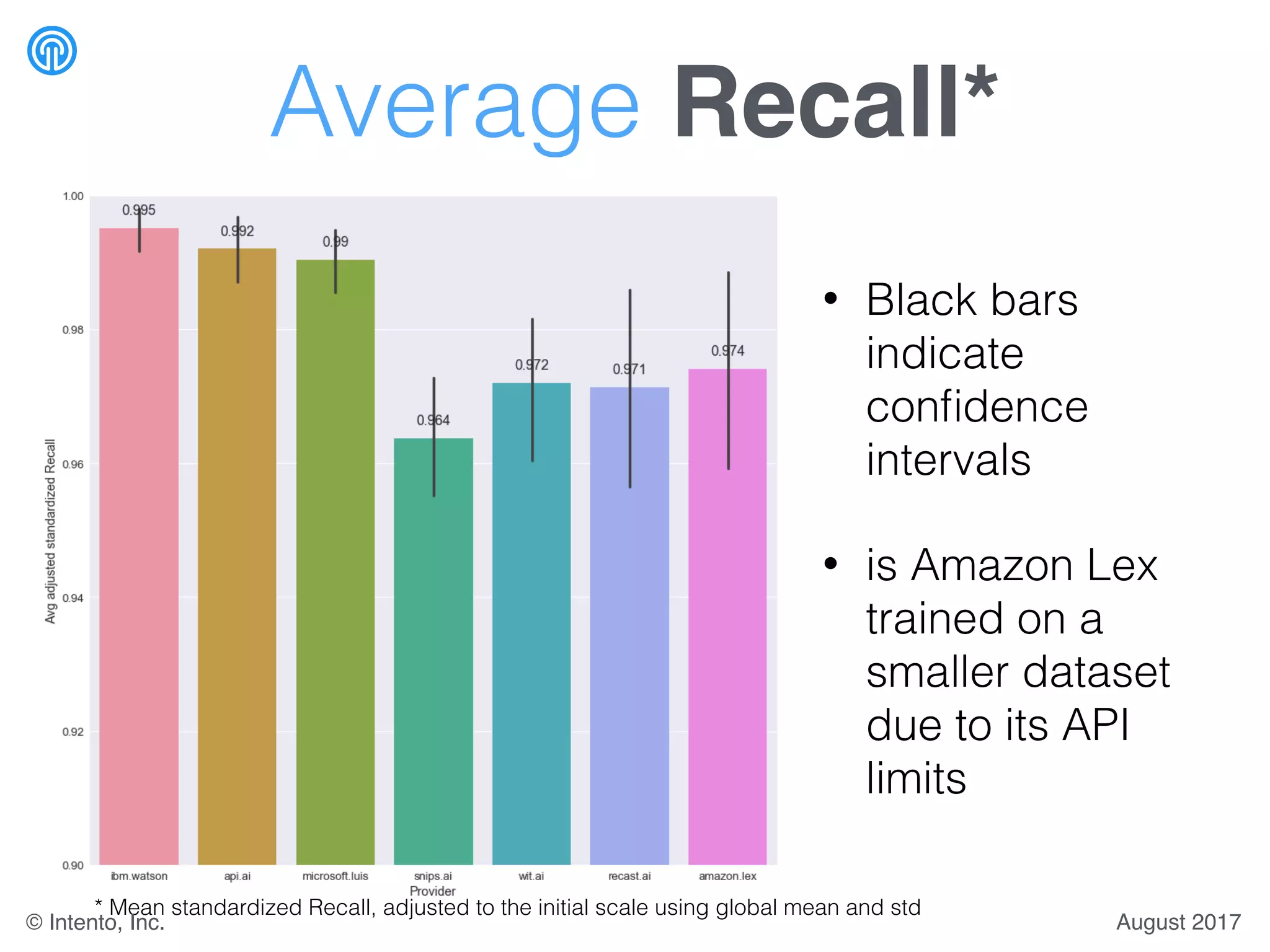
Average Recall*
* Mean standardized Recall, adjusted to the initial scale using global mean and std
• Black bars
indicate
confidence
intervals
• is Amazon Lex
trained on a
smaller dataset
due to its API
limits
August 2017© Intento, Inc.
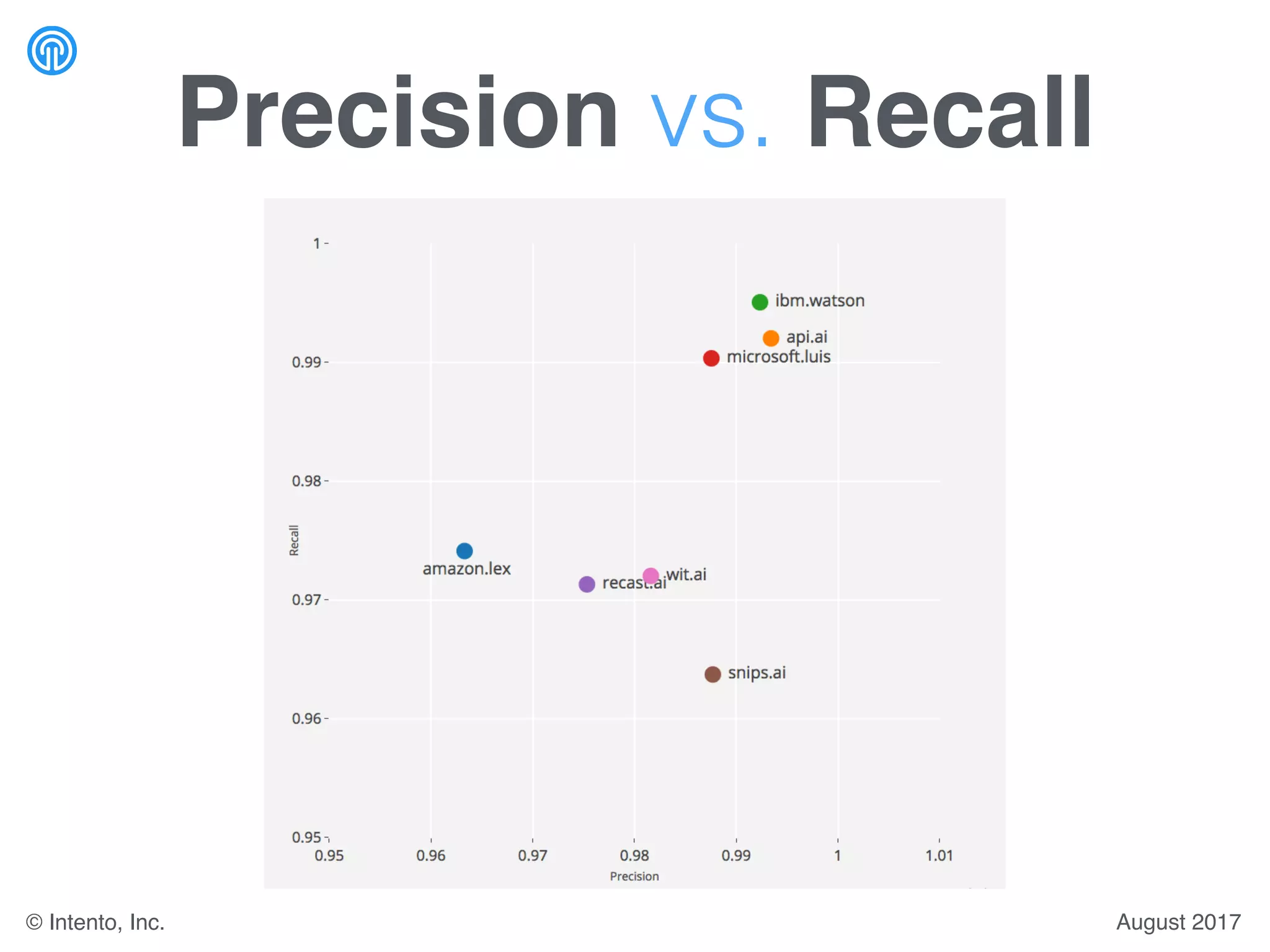
Precision vs. Recall
August 2017© Intento, Inc.
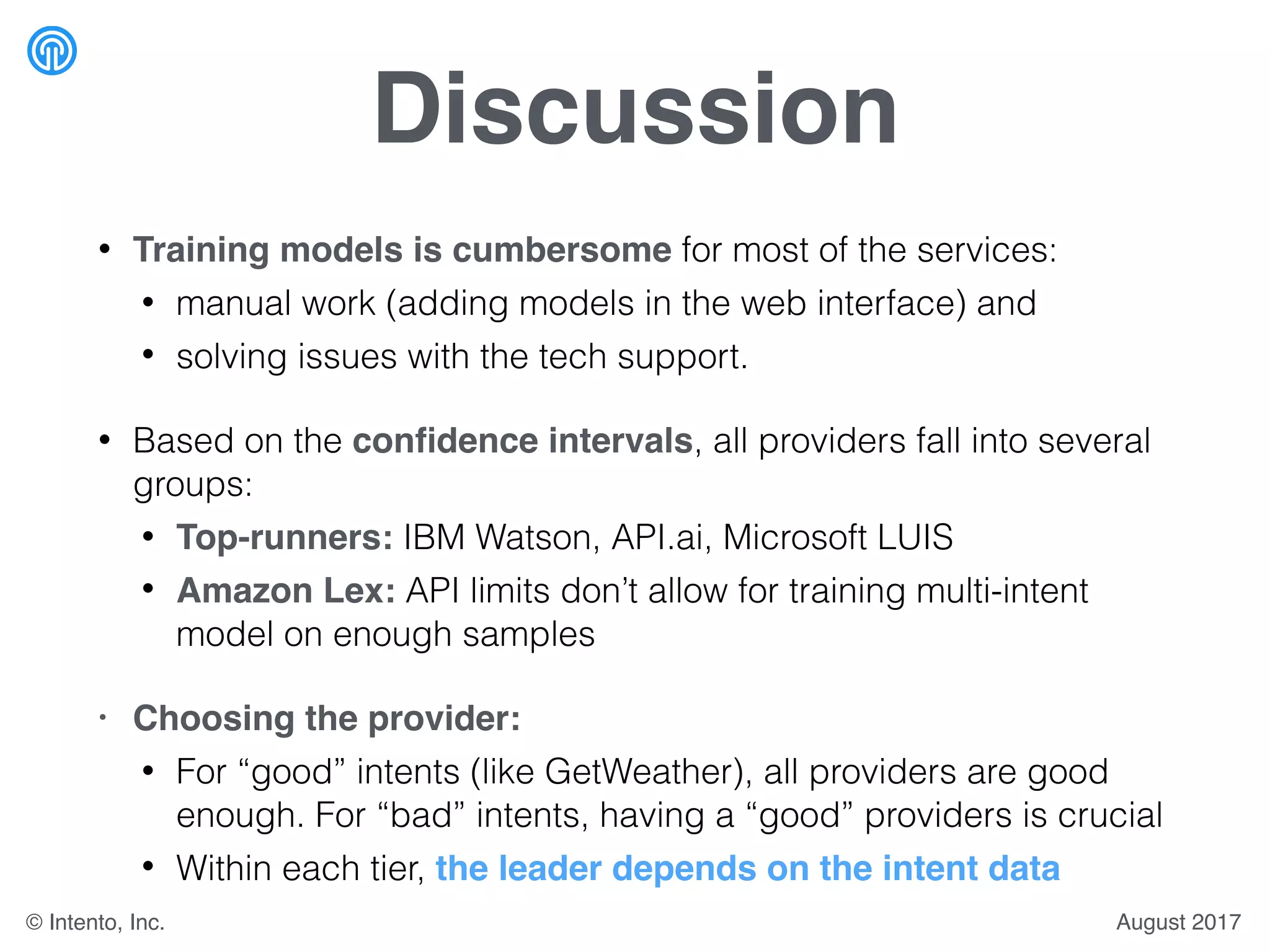
Discussion
• Training models is cumbersome for most of the services:
• manual work (adding models in the web interface) and
• solving issues with the tech support.
• Based on the confidence intervals, all providers fall into several
groups:
• Top-runners: IBM Watson, API.ai, Microsoft LUIS
• Amazon Lex: API limits don’t allow for training multi-intent
model on enough samples
• Choosing the provider:
• For “good” intents (like GetWeather), all providers are good
enough. For “bad” intents, having a “good” providers is crucial
• Within each tier, the leader depends on the intent data
August 2017© Intento, Inc.
II. False Positives
August 2017© Intento, Inc.
Approach
• How does NLU behaves when a user express an
intent it wasn’t trained for?
• Expected behavior: produce the Fallback Intent
(no trained intents pass the detection threshold)
• 1411 utterances from the domains other than
Music, Movie, Weather, RestaurantReservation,
Entertainment and TV.
• Compare % of (false) positive detections for each
NLU provider
August 2017© Intento, Inc.
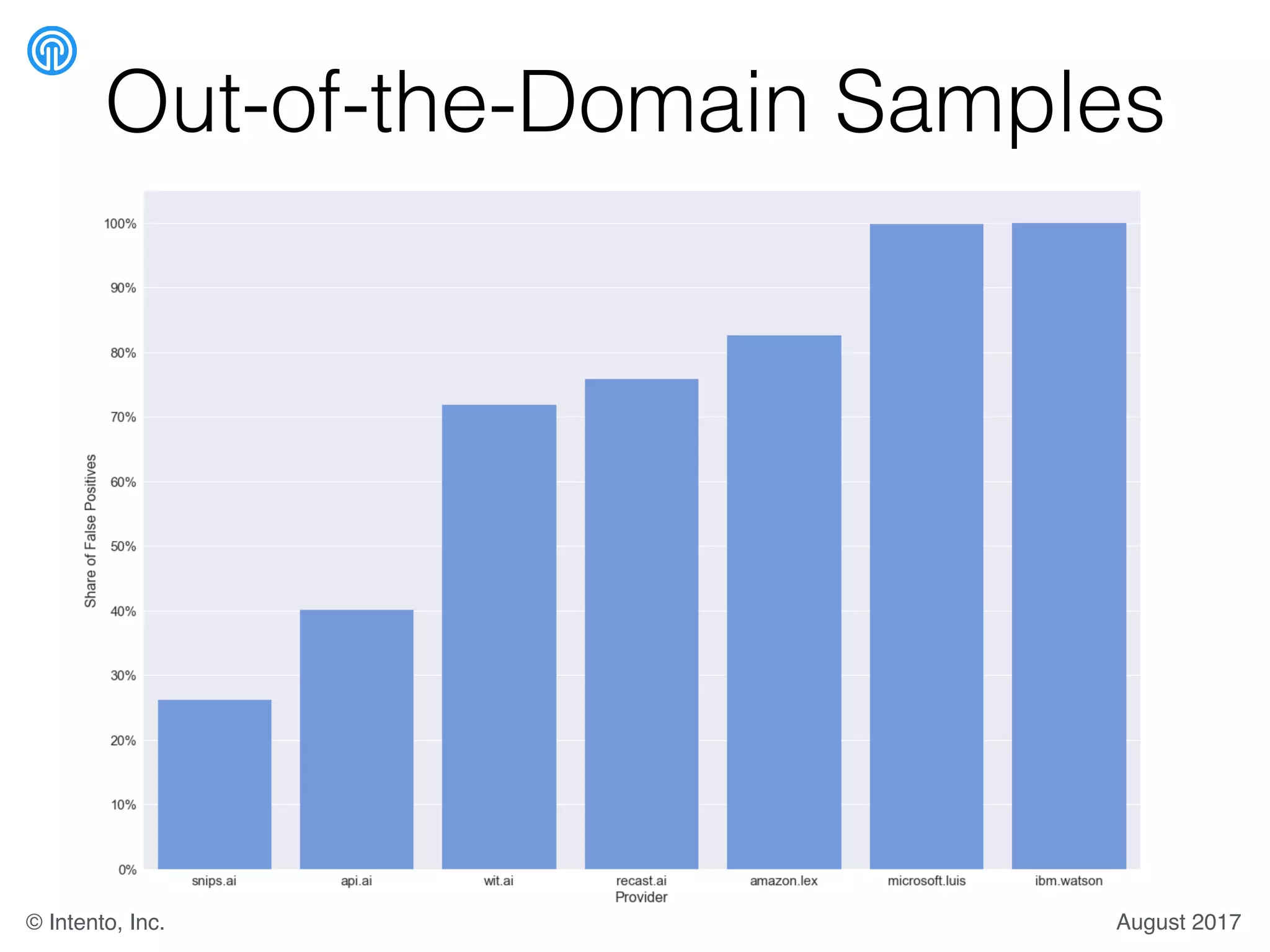
Out-of-the-Domain Samples
August 2017© Intento, Inc.
Discussion
• Only Snips.ai and API.ai are somewhat good at
detecting that users asks for something the agent
is not trained for
• IBM Watson and Microsoft LUIS are trying to map
any user request to one of the intents from the
training set
Perhaps the Fallback intent should be manually
added and trained on junk utterances?
August 2017© Intento, Inc.
III. Learning Curve
August 2017© Intento, Inc.
Experimental Setting
• Similar to the Prediction Performance (slide 18)
• 20% of the dataset reserved for testing (stratified)
• From the remaining 80%, for intent we’ve randomly
built a set of training sets of the following cardinality:
10, 25, 50, 100, 200, 500, 1000*
• No cross-validation
• Analyzed F1 Scores, normalised as described on
slides 19-20.
* for Amazon Lex, 10, 25, 50, 100, 200
August 2017© Intento, Inc.
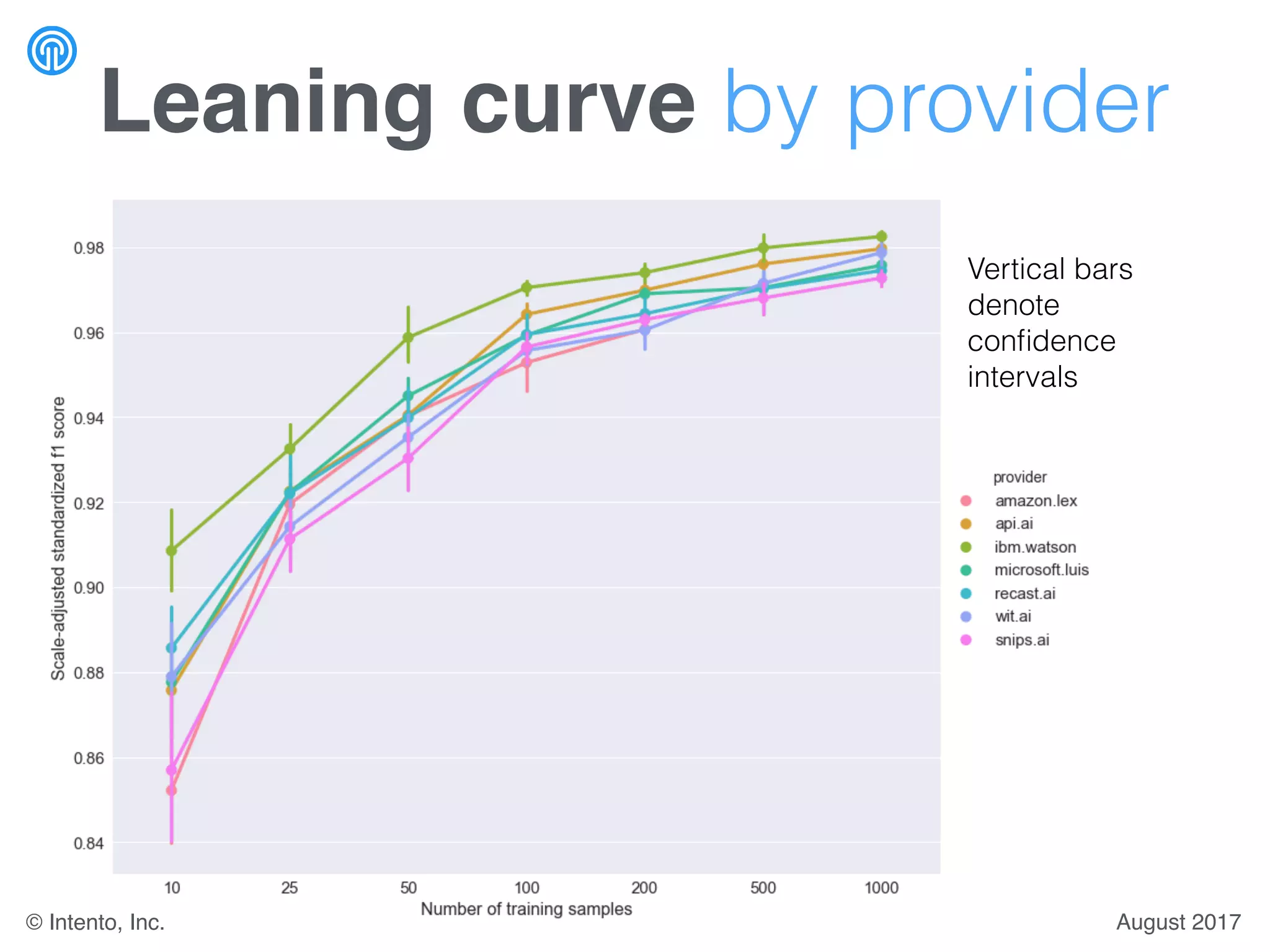
Leaning curve by provider
Vertical bars
denote
confidence
intervals
August 2017© Intento, Inc.
Discussion
• On <100 samples IBM Watson is superior*. API.ai
catches up at >100 samples.
• Detecting the user’s intent is crucial for the
subsequent slot extraction and response generation.
• The learning curve is quite steep, good performance
requires hundreds of utterances to train on.
• Most of the pre-built intents (Microsoft LUIS, API.ai,
etc) are built on 10-50 utterances.
* SNIPS advertises a special enterprise feature to generate additional samples for smaller datasets, but it is not
available by default
August 2017© Intento, Inc.
IV. Language coverage
August 2017© Intento, Inc.
Supported languages
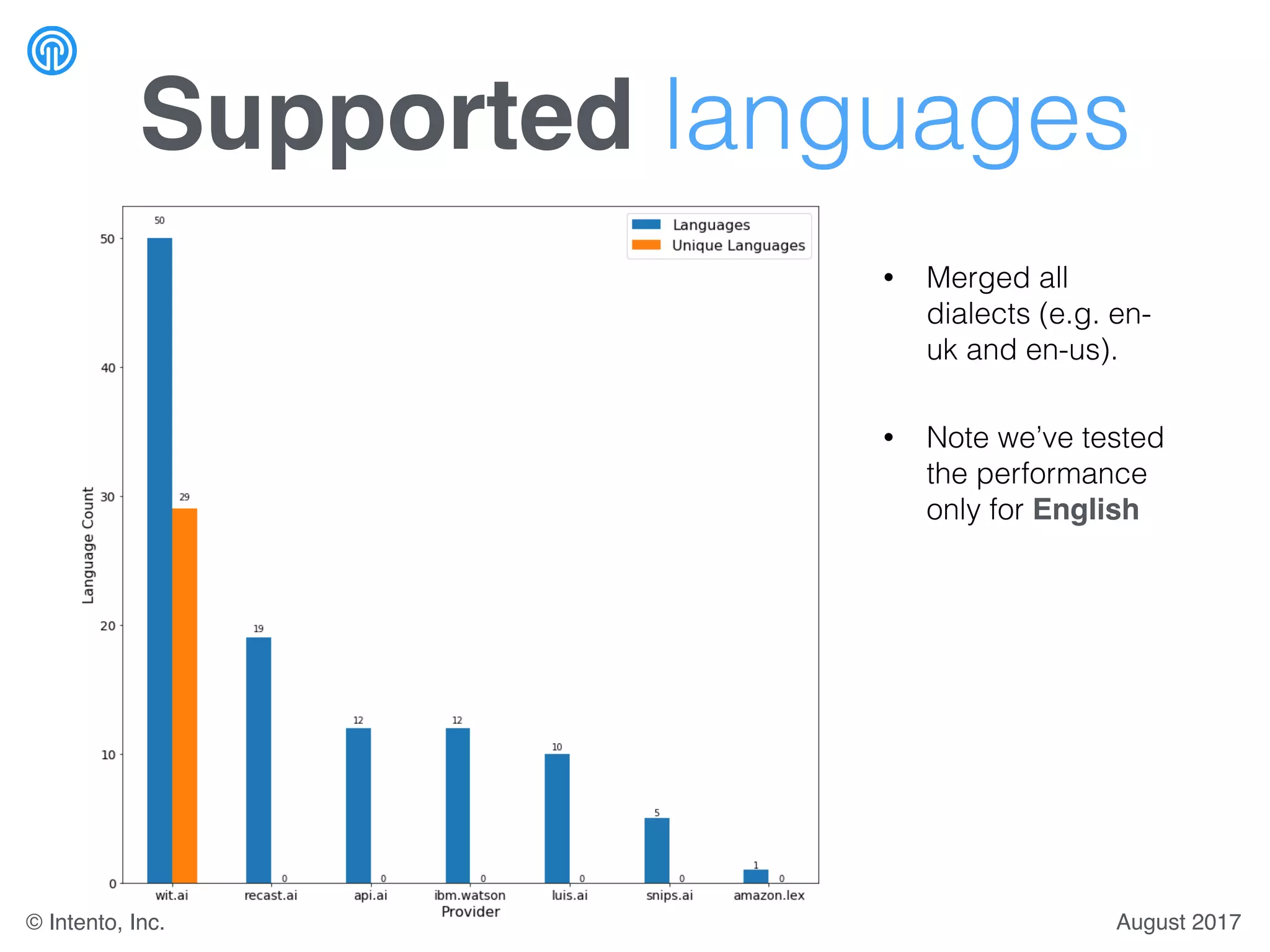
• Merged all
dialects (e.g. en-
uk and en-us).
• Note we’ve tested
the performance
only for English
August 2017© Intento, Inc.
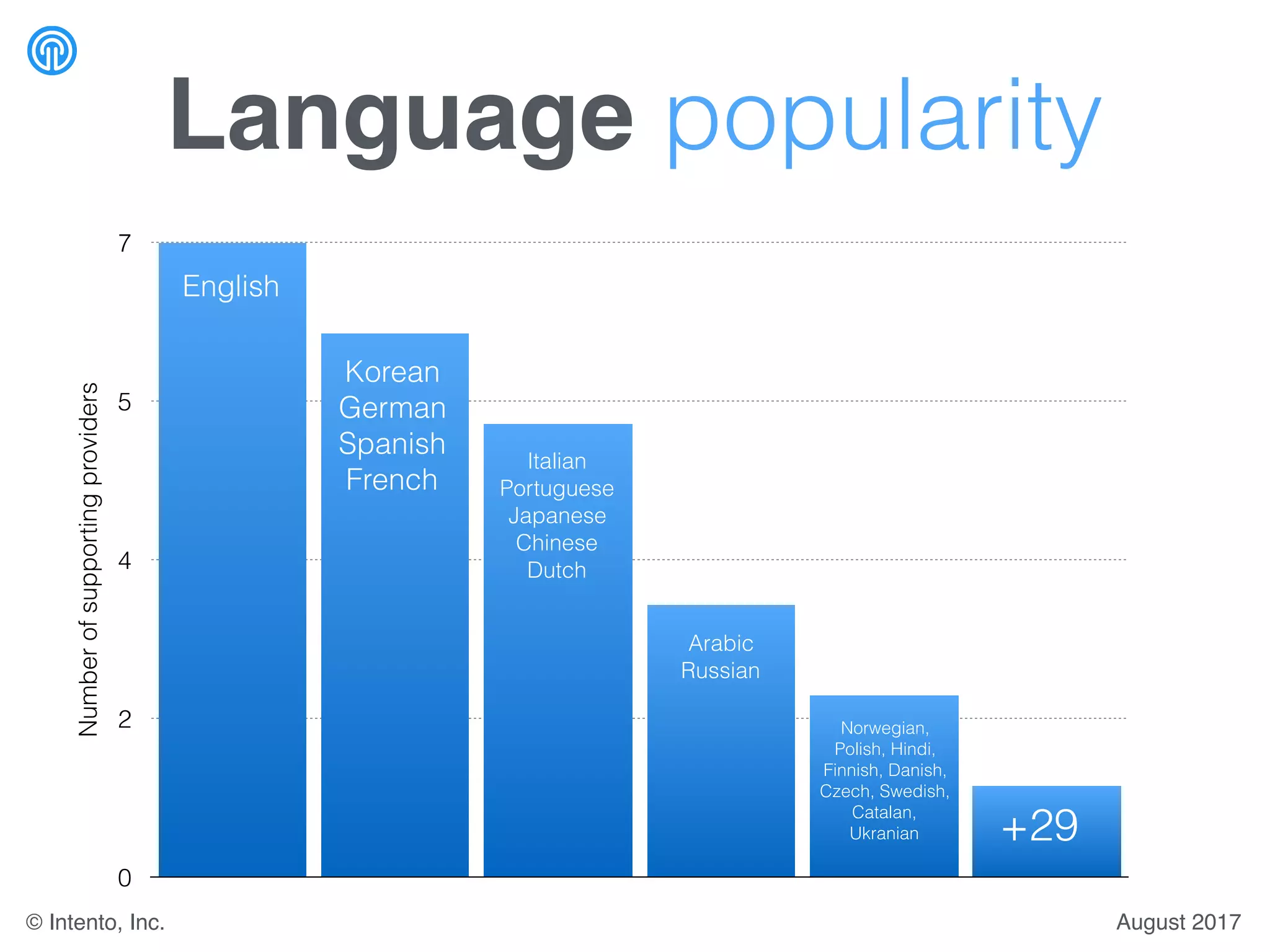
Language popularity
Numberofsupportingproviders
0
2
4
5
7
English
Korean
German
Spanish
French
Italian
Portuguese
Japanese
Chinese
Dutch
Arabic
Russian
Norwegian,
Polish, Hindi,
Finnish, Danish,
Czech, Swedish,
Catalan,
Ukranian +29
August 2017© Intento, Inc.
Discussion
Potentially, Machine Translation may be used to
increase the language coverage and/or performance:
• either by translating both the training and testing
utterances to English
• or by translating only testing utterances and
using the English training model
That’s something to check
in future benchmarks
August 2017© Intento, Inc.
V. Other observations
August 2017© Intento, Inc.
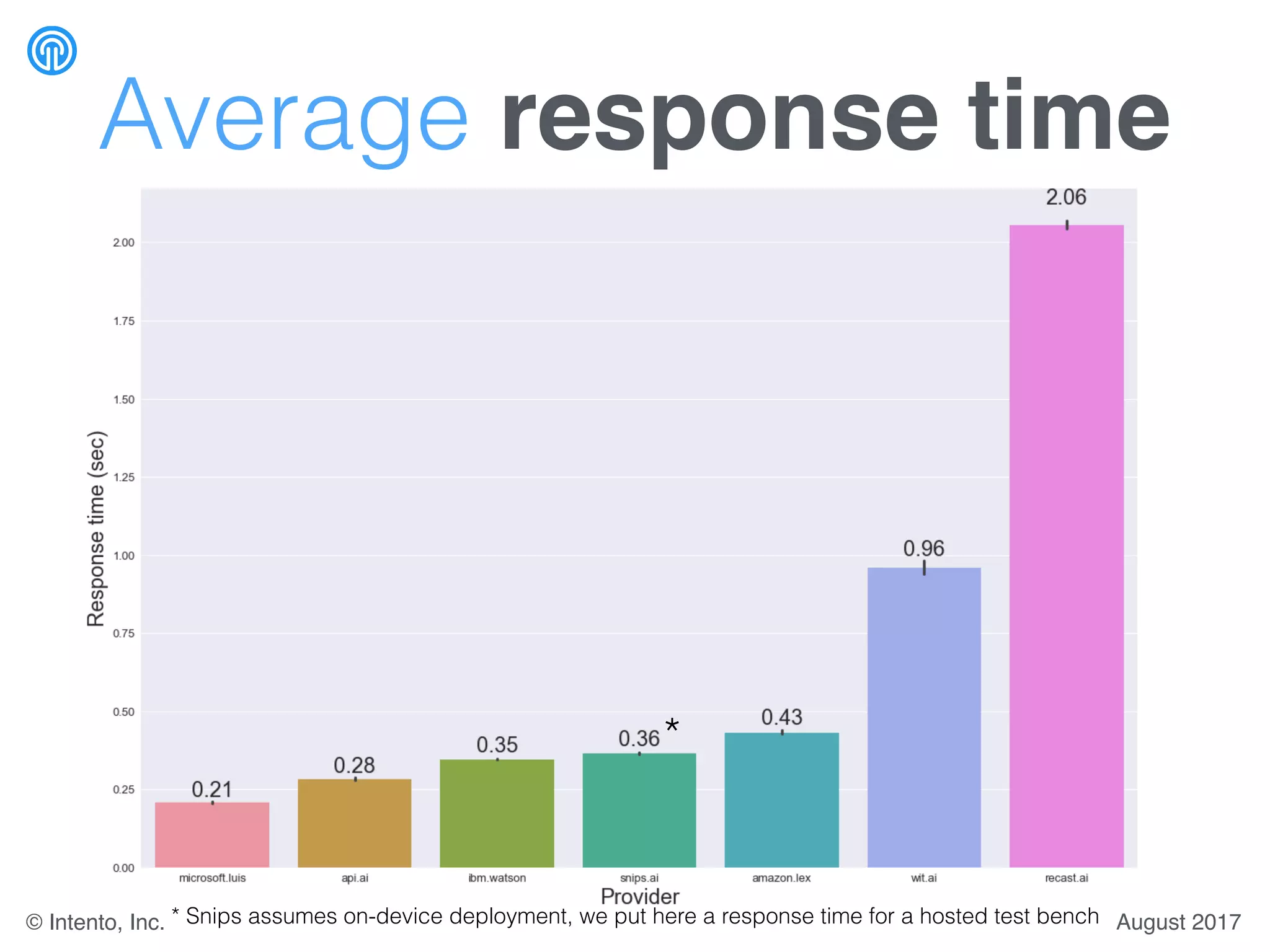
Average response time
*
* Snips assumes on-device deployment, we put here a response time for a hosted test bench August 2017© Intento, Inc.
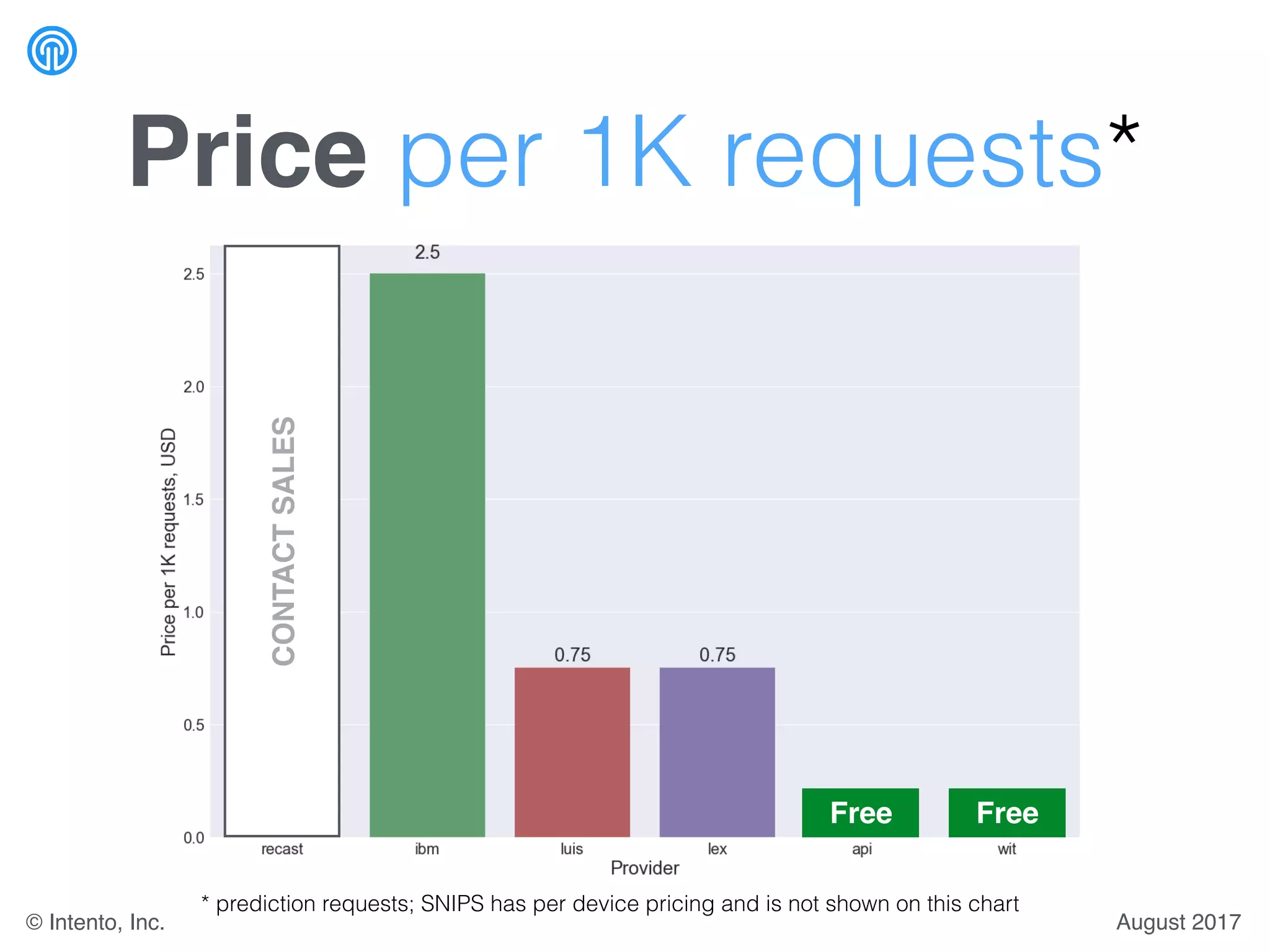
Price per 1K requests*
* prediction requests; SNIPS has per device pricing and is not shown on this chart
CONTACTSALES
Free Free
August 2017© Intento, Inc.
Conclusions
August 2017© Intento, Inc.
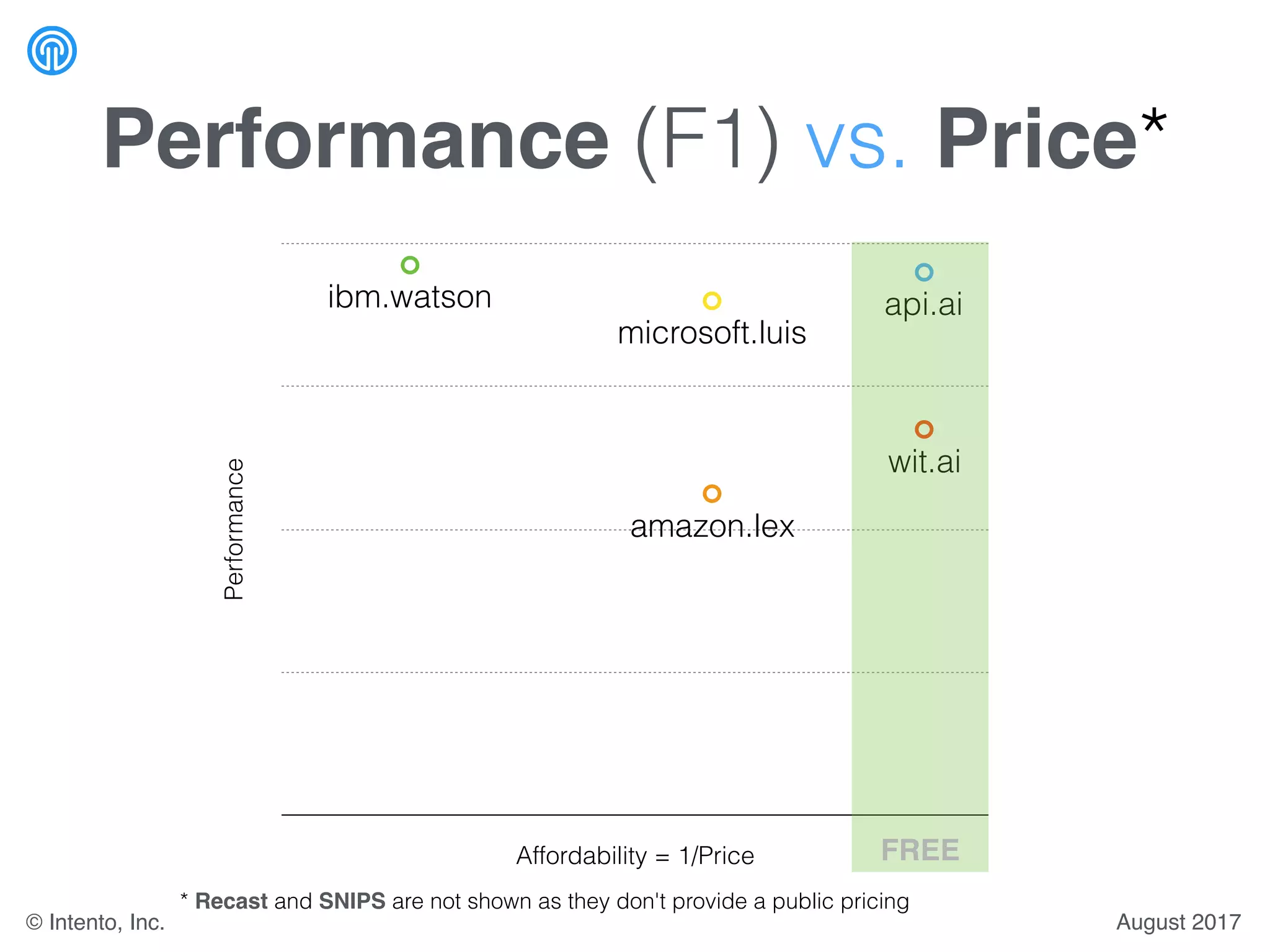
Performance (F1) vs. Price*
Performance
Affordability = 1/Price
wit.ai
amazon.lex
microsoft.luis
ibm.watson api.ai
* Recast and SNIPS are not shown as they don't provide a public pricing
FREE
August 2017© Intento, Inc.
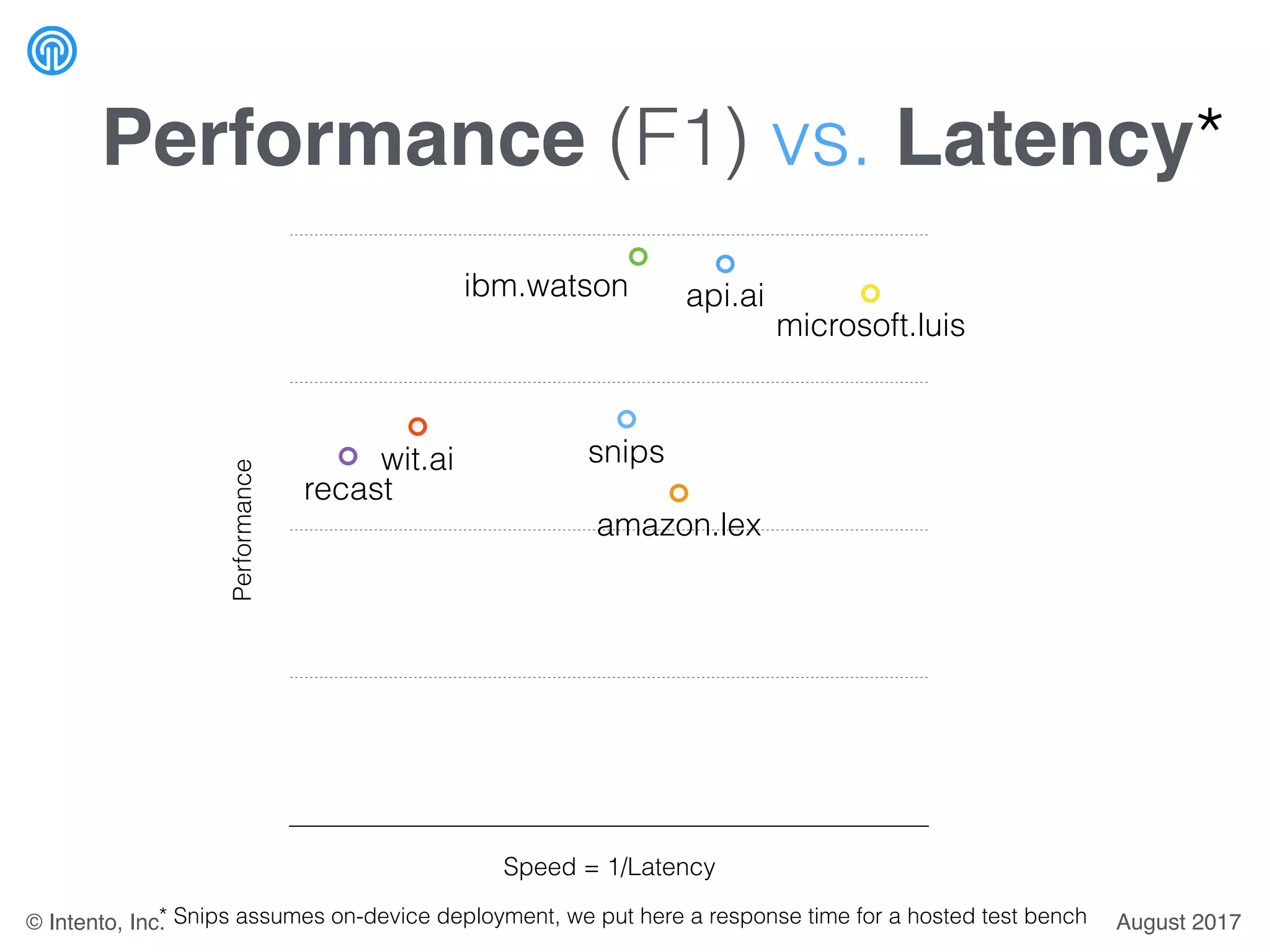
Performance (F1) vs. Latency*
Performance
Speed = 1/Latency
snips
recast
wit.ai
amazon.lex
microsoft.luis
ibm.watson api.ai
* Snips assumes on-device deployment, we put here a response time for a hosted test bench August 2017© Intento, Inc.
Conclusions
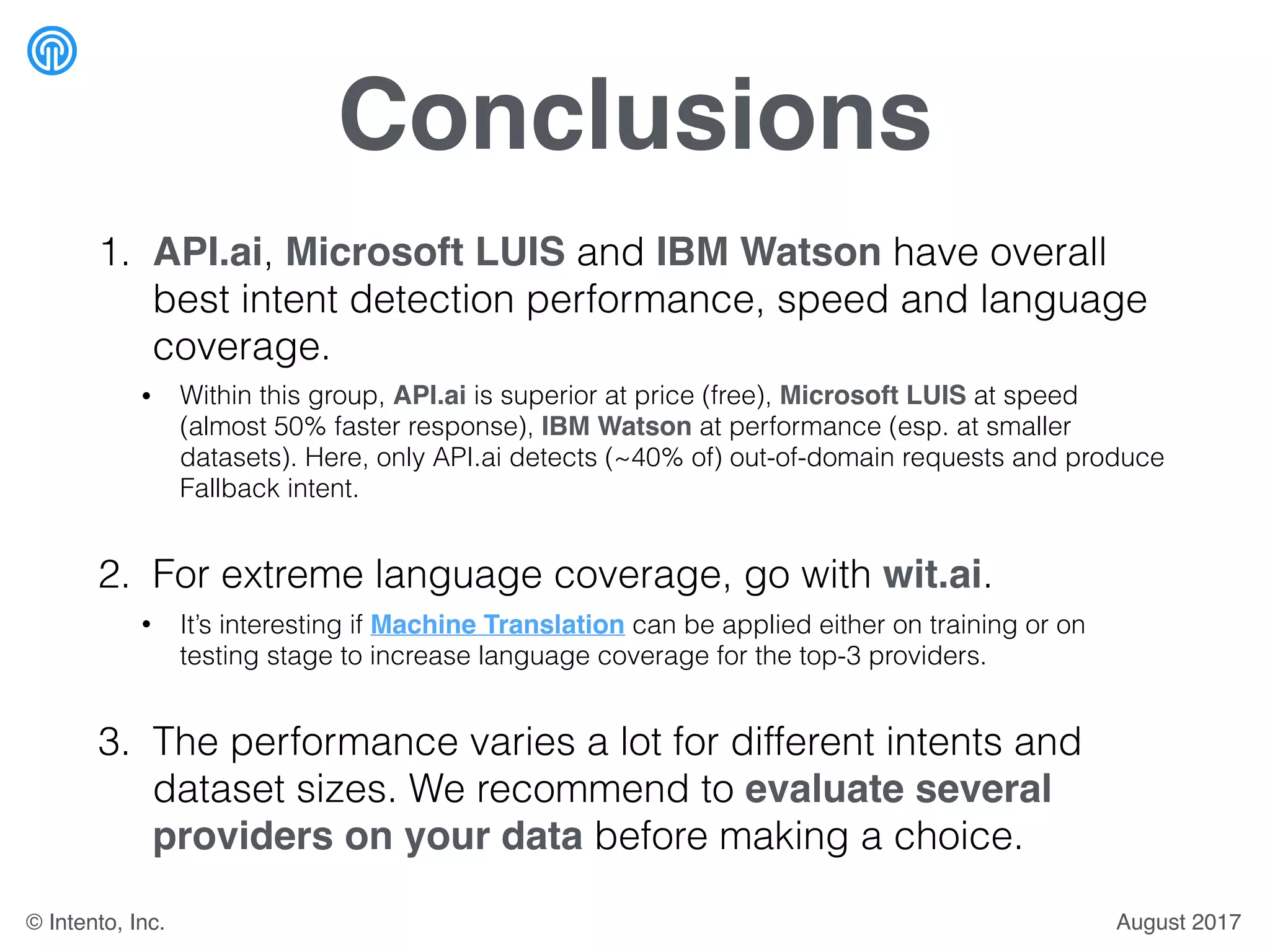
1. API.ai, Microsoft LUIS and IBM Watson have overall
best intent detection performance, speed and language
coverage.
• Within this group, API.ai is superior at price (free), Microsoft LUIS at speed
(almost 50% faster response), IBM Watson at performance (esp. at smaller
datasets). Here, only API.ai detects (~40% of) out-of-domain requests and produce
Fallback intent.
2. For extreme language coverage, go with wit.ai.
• It’s interesting if Machine Translation can be applied either on training or on
testing stage to increase language coverage for the top-3 providers.
3. The performance varies a lot for different intents and
dataset sizes. We recommend to evaluate several
providers on your data before making a choice.
August 2017© Intento, Inc.
Discover the best service providers
for your AI task
Evaluate performance on your own
data
Access any provider with no effort
using to our Single API
Intento Service Platform
August 2017© Intento, Inc.
Intento
https://inten.to
Dmitry Labazkin,
Grigory Sapunov,
Konstantin Savenkov
Intento, Inc.

<hello@inten.to>

NLU / Intent Detection Benchmark by Intento, August 2017

  • 1.
    NLU / IntentDetection Benchmark by Intento August 2017
  • 2.
    About • At Intento,we want to make Machine Intelligence services easy to discover, choose and use. • So far, the evaluation is the most problematic part: to compare providers, one need to sign a lot of contracts and integrate a lot of APIs. • We deliver that for FREE on public datasets. To evaluate on you own dataset, contact our sales. • Also, check out our Machine Translation Benchmark. Machine Translation is an easy way to build a multi- lingual bot.
  • 3.
    Overview • Natural LanguageUnderstanding Services with Public APIs* • IBM Watson Conversation • API.ai API • Microsoft LUIS • Amazon Lex • Recast.ai API • wit.ai API • SNIPS API • Benchmark Dimensions • Intent Prediction Performance • False Positives • Learning Speed (performance on small datasets) • Language Coverage, Price, Response time August 2017© Intento, Inc. * as of today, some of them don’t have a Public API and we’ve got an access for the purpose of this benchmark
  • 4.
    NLU Engines Compared August2017© Intento, Inc.
  • 5.
    API.ai / Google •Website: https://api.ai • Launched: 2010 (acquired by Google in 2016) • Pricing model: FREE • Interface: HTTP REST API “Build delightful and natural conversational experiences” August 2017© Intento, Inc.
  • 6.
    wit.ai / Facebook •Website: https://wit.ai • Launched: 2013 (acquired by Facebook in 2015) • Pricing model: FREE • Interface: HTTP REST API “Natural Language for Developers” August 2017© Intento, Inc.
  • 7.
    IBM Watson Conversation •Website: https://www.ibm.com/watson/services/ conversation/ • Launched: 2016 • Pricing model: Pay As You Go • Interface: HTTP REST API “Quickly build and deploy chatbots and virtual agents across a variety of channels, including mobile devices, messaging platforms, and even robots.” August 2017© Intento, Inc.
  • 8.
    Microsoft LUIS • Website:https://www.luis.ai/ • Launched: 2015 • Pricing model: Pay As You Go • Interface: HTTP REST API “Language Understanding Intelligent Service. Add conversational intelligence to your apps.” August 2017© Intento, Inc.
  • 9.
    Amazon Lex • Website:https://aws.amazon.com/lex/ • Launched: 2016 • Pricing model: Pay As You Go • Interface: HTTP REST API • Important Restrictions apply (see Dataset slide) “Conversational interfaces for your applications. Powered by the same deep learning technologies as Alexa” August 2017© Intento, Inc.
  • 10.
    Recast.ai • Website: https://recast.ai •Launched: 2016 • Pricing mode: Free tier + Contact sales • Interface: HTTP REST API “The collaborative platform to build, train, deploy and monitor intelligent bots for developers” August 2017© Intento, Inc.
  • 11.
    SNIPS • Website: https://snips.ai •Launched: 2017 • Pricing model: Free to test + Pay per Device • Interface: On Device* “Snips is an AI-powered voice assistant you can add to your products. It runs on-device and is Private by Design” * we’ve tested a hosted version with a private API provided by SNIPS August 2017© Intento, Inc.
  • 12.
    Historical timeline 2011 2015 201620122013 2014 20172010 Conversation Facebook Google LUIS August 2017© Intento, Inc.
  • 13.
  • 14.
    Dataset • The originaldataset is the SNIPS.ai 2017 NLU Benchmark • English language only • We have removed duplicates that differ by number of whitespaces, quotes, lettercase etc • Resulting dataset parameters*: 7 intents (next slide), 15.6K samples (~2K per intent), 340K symbols • We also used ~450 samples from SNIPS.ai 2016 NLU Benchmark to test for False Positives * For Amazon Lex, the training set is capped by 200K symbols per API limitation; also symbol limitations apply, resulting in 4500 utterances (~640 per intent). August 2017© Intento, Inc.
  • 15.
    Intents [*] • SearchCreativeWork(e.g. Find me the I, Robot television show) • GetWeather (e.g. Is it windy in Boston, MA right now?) • BookRestaurant (e.g. I want to book a highly rated restaurant for me and my boyfriend tomorrow night) • PlayMusic (e.g. Play the last track from Beyoncé off Spotify) • AddToPlaylist (e.g. Add Diamonds to my roadtrip playlist) • RateBook (e.g. Give 6 stars to Of Mice and Men) • SearchScreeningEvent (e.g. Check the showtimes for Wonder Woman in Paris) [*] quoted from https://github.com/snipsco/nlu-benchmark/tree/master/2017-06-custom-intent-engines August 2017© Intento, Inc.
  • 16.
  • 17.
    Experimental setting • Inspiredby the SNIPS Benchmarks (2016, 2017) • We benchmark intent detection only, no parameter extraction yet • For each provider, one model is trained to detect all intents • We run all models with the default confidence score thresholds. • 3-fold 80/20* Stratified Monte Carlo cross-validation * 47/20 for Amazon Lex August 2017© Intento, Inc.
  • 18.
    Scores Normalization (I) Intents:the good, the bad and the ugly (to compare providers we need to remove intent-related bias) F1 Scores* Confusion matrix * F1 Score is a weighted average of the precision and recall; reaches its best value at 1 and worst score at 0. August 2017© Intento, Inc.
  • 19.
    Scores Normalization (II) •Standardizing F1, P and R scores for each intent (SD- normalization) • Then adjusting scales by multiplying on the global std and adding the global mean (next slide) August 2017© Intento, Inc.
  • 20.
    Detection Performance* • Blackbars indicate confidence intervals • Amazon Lex is trained on a smaller dataset due to its API limits * Mean standardized F1 scores, adjusted to the initial scale using global mean and std August 2017© Intento, Inc.
  • 21.
    Average Precision* • Blackbars indicate confidence intervals • Amazon Lex is trained on a smaller dataset due to its API limits August 2017© Intento, Inc. * Mean standardized Precision, adjusted to the initial scale using global mean and std
  • 22.
    Average Recall* * Meanstandardized Recall, adjusted to the initial scale using global mean and std • Black bars indicate confidence intervals • is Amazon Lex trained on a smaller dataset due to its API limits August 2017© Intento, Inc.
  • 23.
    Precision vs. Recall August2017© Intento, Inc.
  • 24.
    Discussion • Training modelsis cumbersome for most of the services: • manual work (adding models in the web interface) and • solving issues with the tech support. • Based on the confidence intervals, all providers fall into several groups: • Top-runners: IBM Watson, API.ai, Microsoft LUIS • Amazon Lex: API limits don’t allow for training multi-intent model on enough samples • Choosing the provider: • For “good” intents (like GetWeather), all providers are good enough. For “bad” intents, having a “good” providers is crucial • Within each tier, the leader depends on the intent data August 2017© Intento, Inc.
  • 25.
    II. False Positives August2017© Intento, Inc.
  • 26.
    Approach • How doesNLU behaves when a user express an intent it wasn’t trained for? • Expected behavior: produce the Fallback Intent (no trained intents pass the detection threshold) • 1411 utterances from the domains other than Music, Movie, Weather, RestaurantReservation, Entertainment and TV. • Compare % of (false) positive detections for each NLU provider August 2017© Intento, Inc.
  • 27.
  • 28.
    Discussion • Only Snips.aiand API.ai are somewhat good at detecting that users asks for something the agent is not trained for • IBM Watson and Microsoft LUIS are trying to map any user request to one of the intents from the training set Perhaps the Fallback intent should be manually added and trained on junk utterances? August 2017© Intento, Inc.
  • 29.
    III. Learning Curve August2017© Intento, Inc.
  • 30.
    Experimental Setting • Similarto the Prediction Performance (slide 18) • 20% of the dataset reserved for testing (stratified) • From the remaining 80%, for intent we’ve randomly built a set of training sets of the following cardinality: 10, 25, 50, 100, 200, 500, 1000* • No cross-validation • Analyzed F1 Scores, normalised as described on slides 19-20. * for Amazon Lex, 10, 25, 50, 100, 200 August 2017© Intento, Inc.
  • 31.
    Leaning curve byprovider Vertical bars denote confidence intervals August 2017© Intento, Inc.
  • 32.
    Discussion • On <100samples IBM Watson is superior*. API.ai catches up at >100 samples. • Detecting the user’s intent is crucial for the subsequent slot extraction and response generation. • The learning curve is quite steep, good performance requires hundreds of utterances to train on. • Most of the pre-built intents (Microsoft LUIS, API.ai, etc) are built on 10-50 utterances. * SNIPS advertises a special enterprise feature to generate additional samples for smaller datasets, but it is not available by default August 2017© Intento, Inc.
  • 33.
    IV. Language coverage August2017© Intento, Inc.
  • 34.
    Supported languages • Mergedall dialects (e.g. en- uk and en-us). • Note we’ve tested the performance only for English August 2017© Intento, Inc.
  • 35.
  • 36.
    Discussion Potentially, Machine Translationmay be used to increase the language coverage and/or performance: • either by translating both the training and testing utterances to English • or by translating only testing utterances and using the English training model That’s something to check in future benchmarks August 2017© Intento, Inc.
  • 37.
    V. Other observations August2017© Intento, Inc.
  • 38.
    Average response time * *Snips assumes on-device deployment, we put here a response time for a hosted test bench August 2017© Intento, Inc.
  • 39.
    Price per 1Krequests* * prediction requests; SNIPS has per device pricing and is not shown on this chart CONTACTSALES Free Free August 2017© Intento, Inc.
  • 40.
  • 41.
    Performance (F1) vs.Price* Performance Affordability = 1/Price wit.ai amazon.lex microsoft.luis ibm.watson api.ai * Recast and SNIPS are not shown as they don't provide a public pricing FREE August 2017© Intento, Inc.
  • 42.
    Performance (F1) vs.Latency* Performance Speed = 1/Latency snips recast wit.ai amazon.lex microsoft.luis ibm.watson api.ai * Snips assumes on-device deployment, we put here a response time for a hosted test bench August 2017© Intento, Inc.
  • 43.
    Conclusions 1. API.ai, MicrosoftLUIS and IBM Watson have overall best intent detection performance, speed and language coverage. • Within this group, API.ai is superior at price (free), Microsoft LUIS at speed (almost 50% faster response), IBM Watson at performance (esp. at smaller datasets). Here, only API.ai detects (~40% of) out-of-domain requests and produce Fallback intent. 2. For extreme language coverage, go with wit.ai. • It’s interesting if Machine Translation can be applied either on training or on testing stage to increase language coverage for the top-3 providers. 3. The performance varies a lot for different intents and dataset sizes. We recommend to evaluate several providers on your data before making a choice. August 2017© Intento, Inc.
  • 44.
    Discover the bestservice providers for your AI task Evaluate performance on your own data Access any provider with no effort using to our Single API Intento Service Platform August 2017© Intento, Inc.
  • 45.