OPEN DECISION
FRAMEWORK
Community Version 1.0.1
updated Jun 2, 2016
Released under Creative Commons Attribution-Share Alike 4.0 International License2
OVERVIEW
What it is
●
A flexible, open approach to making business decisions and leading projects
When to use it
For decisions and projects that are likely to:
●
impact our culture or
●
affect associates beyond your immediate team
How to use it
●
Build steps from the Open Decision Framework into your project plan or
decision-making process
Released under Creative Commons Attribution-Share Alike 4.0 International License3
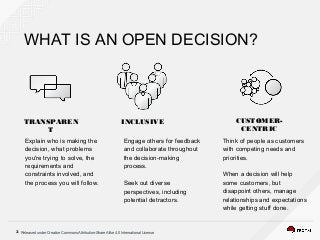
WHAT IS AN OPEN DECISION?
TRANSPAREN
T
INCLUSIVE CUSTOMER-
CENTRIC
Explain who is making the
decision, what problems
you're trying to solve, the
requirements and
constraints involved, and
the process you will follow.
Engage others for feedback
and collaborate throughout
the decision-making
process.
Seek out diverse
perspectives, including
potential detractors.
Think of people as customers
with competing needs and
priorities.
When a decision will help
some customers, but
disappoint others, manage
relationships and expectations
while getting stuff done.
Released under Creative Commons Attribution-Share Alike 4.0 International License4
Open decisions are made using
open source principles
Open exchange
Whether you're developing software or trying to solve a business problem, open exchange begins when you
share your "source code" with others. A free exchange of ideas is critical to creating an environment where
people are allowed to learn and use existing information toward creating new ideas.
Participation
When we are free to collaborate, we create. We can solve problems that no one person may be able to solve on
their own. And when we can implement open standards, we enable others to participate in the future.
Release early + often
Rapid prototypes can lead to rapid failures, and that leads to better solutions faster. When you're free to
experiment, you can look at problems in new ways and look for answers in new places. You can learn by doing.
Meritocracy
In a meritocracy, good ideas can come from anywhere, and the best ideas win. Everyone has access to the
same information. Successful work determines which projects rise and gather support and effort from the
community.
Community
Communities are formed around a common purpose. They bring together diverse ideas and share work.
Together, a global community can create beyond the capabilities of any one individual. It multiplies effort and
shares the work. Together, we can do more.
Adapted from: https://opensource.com/open-source-way
Released under Creative Commons Attribution-Share Alike 4.0 International License5
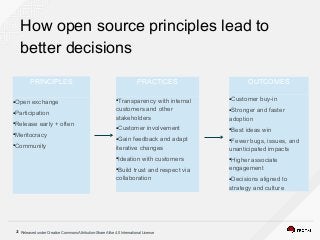
How open source principles lead to
better decisions
PRINCIPLES
●
Open exchange
●
Participation
●
Release early + often
●
Meritocracy
●
Community
PRACTICES
●
Transparency with internal
customers and other
stakeholders
●
Customer involvement
●
Gain feedback and adapt
iterative changes
●
Ideation with customers
●
Build trust and respect via
collaboration
OUTCOMES
●
Customer buy-in
●
Stronger and faster
adoption
●
Best ideas win
●
Fewer bugs, issues, and
unanticipated impacts
●
Higher associate
engagement
●
Decisions aligned to
strategy and culture
Released under Creative Commons Attribution-Share Alike 4.0 International License6
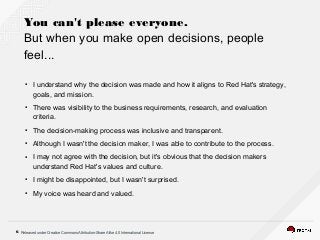
You can't please everyone.
But when you make open decisions, people
feel...
●
I understand why the decision was made and how it aligns to Red Hat's strategy,
goals, and mission.
●
There was visibility to the business requirements, research, and evaluation
criteria.
●
The decision-making process was inclusive and transparent.
●
Although I wasn't the decision maker, I was able to contribute to the process.
●
I may not agree with the decision, but it's obvious that the decision makers
understand Red Hat's values and culture.
●
I might be disappointed, but I wasn't surprised.
●
My voice was heard and valued.
Released under Creative Commons Attribution-Share Alike 4.0 International License7
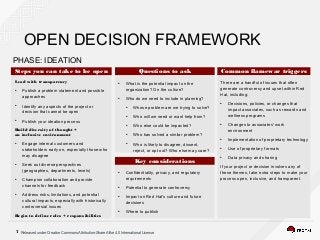
OPEN DECISION FRAMEWORK
PHASE: IDEATION ●
What is the potential impact on the
organization? On the culture?
●
Who do we need to include in planning?
●
Whose problem are we trying to solve?
●
Who will we need or want help from?
●
Who else could be impacted?
●
Who has solved a similar problem?
●
Who is likely to disagree, dissent,
reject, or opt out? Who else may care?
Questions to ask
Lead with transparency
●
Publish a problem statement and possible
approaches
●
Identify any aspects of the project or
decision that cannot be open
●
Publish your ideation process
Build diversity of thought +
an inclusive environment
●
Engage internal customers and
stakeholders early on, especially those who
may disagree
●
Seek out diverse perspectives
(geographies, departments, levels)
●
Champion collaboration and provide
channels for feedback
●
Address risks, limitations, and potential
cultural impacts, especially with historically
controversial issues
Begin to define roles + responsibilities
Steps you can take to be open
●
Confidentiality, privacy, and regulatory
requirements
●
Potential to generate controversy
●
Impact on Red Hat's culture and future
decisions
●
Where to publish
Key considerations
There are a handful of issues that often
generate controversy and upset within Red
Hat, including:
●
Decisions, policies, or changes that
impact associates, such as rewards and
wellness programs
●
Changes to associates' work
environment
●
Implementation of proprietary technology
●
Use of proprietary formats
●
Data privacy and sharing
If your project or decision involves any of
these themes, take extra steps to make your
process open, inclusive, and transparent.
Common flamewar triggers
PHASE: IDEATION
Released under Creative Commons Attribution-Share Alike 4.0 International License8
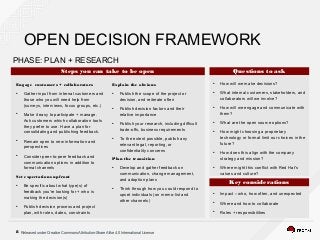
PHASE: IDEATION ●
How will we make decisions?
●
What internal customers, stakeholders, and
collaborators will we involve?
●
How will we engage and communicate with
them?
●
What are the open source options?
●
How might choosing a proprietary
technology or format limit our choices in the
future?
●
How does this align with the company
strategy and mission?
●
Where might this conflict with Red Hat's
values and culture?
Questions to askSteps you can take to be open
●
Impact – who, how often, and unexpected
●
Where and how to collaborate
●
Roles + responsibilities
Key considerations
PHASE: PLAN + RESEARCH
Engage customers + collaborators
●
Gather input from internal customers and
those who you will need help from
(surveys, interviews, focus groups, etc.)
●
Make it easy to participate + manage.
Ask customers which collaboration tools
they prefer to use. Have a plan for
consolidating and publishing feedback.
●
Remain open to new information and
perspectives
●
Consider peer-to-peer feedback and
communication options in addition to
formal channels
Set expectations upfront
●
Be specific about what type(s) of
feedback you're looking for + who is
making the decision(s)
●
Publish decision process and project
plan, with roles, dates, constraints
Explain the obvious
●
Publish the scope of the project or
decision, and reiterate often
●
Publish decision factors and their
relative importance
●
Publish your research, including difficult
trade-offs, business requirements
●
To the extent possible, publish any
relevant legal, reporting, or
confidentiality concerns
Plan the transition
●
Develop and gather feedback on
communication, change management,
and adoption plans
●
Think through how you could respond to
upset individuals (on memo-list and
other channels)
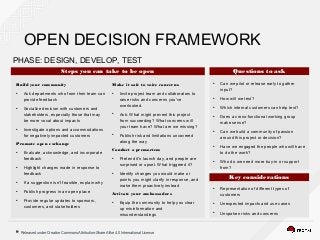
OPEN DECISION FRAMEWORK
Released under Creative Commons Attribution-Share Alike 4.0 International License9
PHASE: IDEATION ●
Can we pilot or release early to gather
input?
●
How will we test?
●
Which internal customers can help test?
●
Does a cross-functional working group
make sense?
●
Can we build a community of passion
around this project or decision?
●
Have we engaged the people who will have
to do the work?
●
Who do we need more buy-in or support
from?
Questions to askSteps you can take to be open
●
Representation of different types of
customers
●
Unexpected impacts and use cases
●
Unspoken risks and concerns
Key considerations
PHASE: DESIGN, DEVELOP, TEST
Build your community
●
Ask departments who from their team can
provide feedback
●
Socialize decision with customers and
stakeholders, especially those that may
be more vocal about impacts
●
Investigate options and accommodations
for negatively impacted customers
Promote open exchange
●
Evaluate, acknowledge, and incorporate
feedback
●
Highlight changes made in response to
feedback
●
If a suggestion isn't feasible, explain why
●
Publish progress in an open place
●
Provide regular updates to sponsors,
customers, and stakeholders
Make it safe to voice concerns
●
Invite project team and collaborators to
raise risks and concerns you've
overlooked.
●
Ask: What might prevent this project
from succeeding? What concerns will
your team have? What are we missing?
●
Publish risk and limitations uncovered
along the way
Conduct a premortem
●
Pretend it's launch day, and people are
surprised or upset. What triggered it?
●
Identify changes you would make or
points you might clarify in response, and
make them proactively instead
Activate your ambassadors
●
Equip the community to help you clear
up misinformation and
misunderstandings
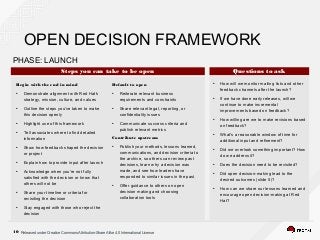
OPEN DECISION FRAMEWORK
Released under Creative Commons Attribution-Share Alike 4.0 International License10
PHASE: IDEATION ●
How will we monitor mailing lists and other
feedback channels after the launch?
●
If we have done early releases, will we
continue to make incremental
improvements based on feedback?
●
How willing are we to make revisions based
on feedback?
●
What's a reasonable window of time for
additional input and refinement?
●
Did we overlook something important? How
do we address it?
●
Does the decision need to be revisited?
●
Did open decision-making lead to the
desired outcomes (slide 5)?
●
How can we share our lessons learned and
encourage open decision-making at Red
Hat?
Questions to askSteps you can take to be open
PHASE: LAUNCH
Begin with the end in mind
●
Demonstrate alignment with Red Hat's
strategy, mission, culture, and values
●
Outline the steps you've taken to make
this decision openly
●
Highlight use of this framework
●
Tell associates where to find detailed
information
●
Show how feedback shaped the decision
or project
●
Explain how to provide input after launch
●
Acknowledge when you're not fully
satisfied with the decision or know that
others will not be
●
Share your timeline or criteria for
revisiting the decision
●
Stay engaged with those who reject the
decision
Default to open
●
Reiterate relevant business
requirements and constraints
●
Share relevant legal, reporting, or
confidentiality issues
●
Communicate success criteria and
publish relevant metrics
Contribute upstream
●
Publish your methods, lessons learned,
communications, and decision criteria to
the archive, so others can review past
decisions, learn why a decision was
made, and see how leaders have
responded to similar issues in the past
●
Offer guidance to others on open
decision making and choosing
collaboration tools
OPEN DECISION FRAMEWORK
RESOURCES
Released under Creative Commons Attribution-Share Alike 4.0 International License12
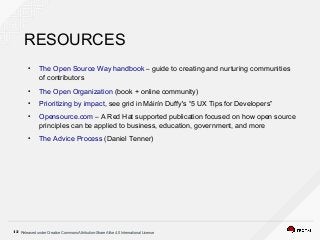
RESOURCES
●
The Open Source Way handbook – guide to creating and nurturing communities
of contributors
●
The Open Organization (book + online community)
●
Prioritizing by impact, see grid in Máirín Duffy's “5 UX Tips for Developers”
●
Opensource.com – A Red Hat supported publication focused on how open source
principles can be applied to business, education, government, and more
●
The Advice Process (Daniel Tenner)
APPENDIX
Released under Creative Commons Attribution-Share Alike 4.0 International License14
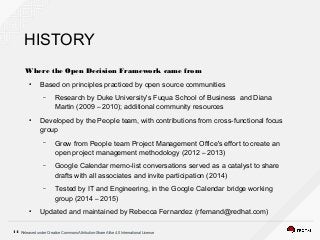
HISTORY
Where the Open Decision Framework came from
●
Based on principles practiced by open source communities
– Research by Duke University's Fuqua School of Business and Diana
Martin (2009 – 2010); additional community resources
●
Developed by the People team, with contributions from cross-functional focus
group
– Grew from People team Project Management Office's effort to create an
open project management methodology (2012 – 2013)
– Google Calendar memo-list conversations served as a catalyst to share
drafts with all associates and invite participation (2014)
– Tested by IT and Engineering, in the Google Calendar bridge working
group (2014 – 2015)
●
Updated and maintained by Rebecca Fernandez (rfernand@redhat.com)
Released under Creative Commons Attribution-Share Alike 4.0 International License15
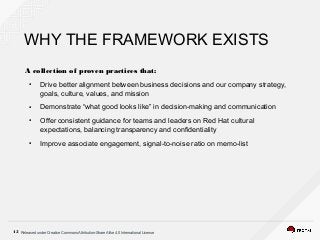
WHY THE FRAMEWORK EXISTS
A collection of proven practices that:
●
Drive better alignment between business decisions and our company strategy,
goals, culture, values, and mission
●
Demonstrate “what good looks like” in decision-making and communication
●
Offer consistent guidance for teams and leaders on Red Hat cultural
expectations, balancing transparency and confidentiality
●
Improve associate engagement, signal-to-noise ratio on memo-list

Open decision framework-community

  • 1.
  • 2.
    Released under CreativeCommons Attribution-Share Alike 4.0 International License2 OVERVIEW What it is ● A flexible, open approach to making business decisions and leading projects When to use it For decisions and projects that are likely to: ● impact our culture or ● affect associates beyond your immediate team How to use it ● Build steps from the Open Decision Framework into your project plan or decision-making process
  • 3.
    Released under CreativeCommons Attribution-Share Alike 4.0 International License3 WHAT IS AN OPEN DECISION? TRANSPAREN T INCLUSIVE CUSTOMER- CENTRIC Explain who is making the decision, what problems you're trying to solve, the requirements and constraints involved, and the process you will follow. Engage others for feedback and collaborate throughout the decision-making process. Seek out diverse perspectives, including potential detractors. Think of people as customers with competing needs and priorities. When a decision will help some customers, but disappoint others, manage relationships and expectations while getting stuff done.
  • 4.
    Released under CreativeCommons Attribution-Share Alike 4.0 International License4 Open decisions are made using open source principles Open exchange Whether you're developing software or trying to solve a business problem, open exchange begins when you share your "source code" with others. A free exchange of ideas is critical to creating an environment where people are allowed to learn and use existing information toward creating new ideas. Participation When we are free to collaborate, we create. We can solve problems that no one person may be able to solve on their own. And when we can implement open standards, we enable others to participate in the future. Release early + often Rapid prototypes can lead to rapid failures, and that leads to better solutions faster. When you're free to experiment, you can look at problems in new ways and look for answers in new places. You can learn by doing. Meritocracy In a meritocracy, good ideas can come from anywhere, and the best ideas win. Everyone has access to the same information. Successful work determines which projects rise and gather support and effort from the community. Community Communities are formed around a common purpose. They bring together diverse ideas and share work. Together, a global community can create beyond the capabilities of any one individual. It multiplies effort and shares the work. Together, we can do more. Adapted from: https://opensource.com/open-source-way
  • 5.
    Released under CreativeCommons Attribution-Share Alike 4.0 International License5 How open source principles lead to better decisions PRINCIPLES ● Open exchange ● Participation ● Release early + often ● Meritocracy ● Community PRACTICES ● Transparency with internal customers and other stakeholders ● Customer involvement ● Gain feedback and adapt iterative changes ● Ideation with customers ● Build trust and respect via collaboration OUTCOMES ● Customer buy-in ● Stronger and faster adoption ● Best ideas win ● Fewer bugs, issues, and unanticipated impacts ● Higher associate engagement ● Decisions aligned to strategy and culture
  • 6.
    Released under CreativeCommons Attribution-Share Alike 4.0 International License6 You can't please everyone. But when you make open decisions, people feel... ● I understand why the decision was made and how it aligns to Red Hat's strategy, goals, and mission. ● There was visibility to the business requirements, research, and evaluation criteria. ● The decision-making process was inclusive and transparent. ● Although I wasn't the decision maker, I was able to contribute to the process. ● I may not agree with the decision, but it's obvious that the decision makers understand Red Hat's values and culture. ● I might be disappointed, but I wasn't surprised. ● My voice was heard and valued.
  • 7.
    Released under CreativeCommons Attribution-Share Alike 4.0 International License7 OPEN DECISION FRAMEWORK PHASE: IDEATION ● What is the potential impact on the organization? On the culture? ● Who do we need to include in planning? ● Whose problem are we trying to solve? ● Who will we need or want help from? ● Who else could be impacted? ● Who has solved a similar problem? ● Who is likely to disagree, dissent, reject, or opt out? Who else may care? Questions to ask Lead with transparency ● Publish a problem statement and possible approaches ● Identify any aspects of the project or decision that cannot be open ● Publish your ideation process Build diversity of thought + an inclusive environment ● Engage internal customers and stakeholders early on, especially those who may disagree ● Seek out diverse perspectives (geographies, departments, levels) ● Champion collaboration and provide channels for feedback ● Address risks, limitations, and potential cultural impacts, especially with historically controversial issues Begin to define roles + responsibilities Steps you can take to be open ● Confidentiality, privacy, and regulatory requirements ● Potential to generate controversy ● Impact on Red Hat's culture and future decisions ● Where to publish Key considerations There are a handful of issues that often generate controversy and upset within Red Hat, including: ● Decisions, policies, or changes that impact associates, such as rewards and wellness programs ● Changes to associates' work environment ● Implementation of proprietary technology ● Use of proprietary formats ● Data privacy and sharing If your project or decision involves any of these themes, take extra steps to make your process open, inclusive, and transparent. Common flamewar triggers PHASE: IDEATION
  • 8.
    Released under CreativeCommons Attribution-Share Alike 4.0 International License8 PHASE: IDEATION ● How will we make decisions? ● What internal customers, stakeholders, and collaborators will we involve? ● How will we engage and communicate with them? ● What are the open source options? ● How might choosing a proprietary technology or format limit our choices in the future? ● How does this align with the company strategy and mission? ● Where might this conflict with Red Hat's values and culture? Questions to askSteps you can take to be open ● Impact – who, how often, and unexpected ● Where and how to collaborate ● Roles + responsibilities Key considerations PHASE: PLAN + RESEARCH Engage customers + collaborators ● Gather input from internal customers and those who you will need help from (surveys, interviews, focus groups, etc.) ● Make it easy to participate + manage. Ask customers which collaboration tools they prefer to use. Have a plan for consolidating and publishing feedback. ● Remain open to new information and perspectives ● Consider peer-to-peer feedback and communication options in addition to formal channels Set expectations upfront ● Be specific about what type(s) of feedback you're looking for + who is making the decision(s) ● Publish decision process and project plan, with roles, dates, constraints Explain the obvious ● Publish the scope of the project or decision, and reiterate often ● Publish decision factors and their relative importance ● Publish your research, including difficult trade-offs, business requirements ● To the extent possible, publish any relevant legal, reporting, or confidentiality concerns Plan the transition ● Develop and gather feedback on communication, change management, and adoption plans ● Think through how you could respond to upset individuals (on memo-list and other channels) OPEN DECISION FRAMEWORK
  • 9.
    Released under CreativeCommons Attribution-Share Alike 4.0 International License9 PHASE: IDEATION ● Can we pilot or release early to gather input? ● How will we test? ● Which internal customers can help test? ● Does a cross-functional working group make sense? ● Can we build a community of passion around this project or decision? ● Have we engaged the people who will have to do the work? ● Who do we need more buy-in or support from? Questions to askSteps you can take to be open ● Representation of different types of customers ● Unexpected impacts and use cases ● Unspoken risks and concerns Key considerations PHASE: DESIGN, DEVELOP, TEST Build your community ● Ask departments who from their team can provide feedback ● Socialize decision with customers and stakeholders, especially those that may be more vocal about impacts ● Investigate options and accommodations for negatively impacted customers Promote open exchange ● Evaluate, acknowledge, and incorporate feedback ● Highlight changes made in response to feedback ● If a suggestion isn't feasible, explain why ● Publish progress in an open place ● Provide regular updates to sponsors, customers, and stakeholders Make it safe to voice concerns ● Invite project team and collaborators to raise risks and concerns you've overlooked. ● Ask: What might prevent this project from succeeding? What concerns will your team have? What are we missing? ● Publish risk and limitations uncovered along the way Conduct a premortem ● Pretend it's launch day, and people are surprised or upset. What triggered it? ● Identify changes you would make or points you might clarify in response, and make them proactively instead Activate your ambassadors ● Equip the community to help you clear up misinformation and misunderstandings OPEN DECISION FRAMEWORK
  • 10.
    Released under CreativeCommons Attribution-Share Alike 4.0 International License10 PHASE: IDEATION ● How will we monitor mailing lists and other feedback channels after the launch? ● If we have done early releases, will we continue to make incremental improvements based on feedback? ● How willing are we to make revisions based on feedback? ● What's a reasonable window of time for additional input and refinement? ● Did we overlook something important? How do we address it? ● Does the decision need to be revisited? ● Did open decision-making lead to the desired outcomes (slide 5)? ● How can we share our lessons learned and encourage open decision-making at Red Hat? Questions to askSteps you can take to be open PHASE: LAUNCH Begin with the end in mind ● Demonstrate alignment with Red Hat's strategy, mission, culture, and values ● Outline the steps you've taken to make this decision openly ● Highlight use of this framework ● Tell associates where to find detailed information ● Show how feedback shaped the decision or project ● Explain how to provide input after launch ● Acknowledge when you're not fully satisfied with the decision or know that others will not be ● Share your timeline or criteria for revisiting the decision ● Stay engaged with those who reject the decision Default to open ● Reiterate relevant business requirements and constraints ● Share relevant legal, reporting, or confidentiality issues ● Communicate success criteria and publish relevant metrics Contribute upstream ● Publish your methods, lessons learned, communications, and decision criteria to the archive, so others can review past decisions, learn why a decision was made, and see how leaders have responded to similar issues in the past ● Offer guidance to others on open decision making and choosing collaboration tools OPEN DECISION FRAMEWORK
  • 11.
  • 12.
    Released under CreativeCommons Attribution-Share Alike 4.0 International License12 RESOURCES ● The Open Source Way handbook – guide to creating and nurturing communities of contributors ● The Open Organization (book + online community) ● Prioritizing by impact, see grid in Máirín Duffy's “5 UX Tips for Developers” ● Opensource.com – A Red Hat supported publication focused on how open source principles can be applied to business, education, government, and more ● The Advice Process (Daniel Tenner)
  • 13.
  • 14.
    Released under CreativeCommons Attribution-Share Alike 4.0 International License14 HISTORY Where the Open Decision Framework came from ● Based on principles practiced by open source communities – Research by Duke University's Fuqua School of Business and Diana Martin (2009 – 2010); additional community resources ● Developed by the People team, with contributions from cross-functional focus group – Grew from People team Project Management Office's effort to create an open project management methodology (2012 – 2013) – Google Calendar memo-list conversations served as a catalyst to share drafts with all associates and invite participation (2014) – Tested by IT and Engineering, in the Google Calendar bridge working group (2014 – 2015) ● Updated and maintained by Rebecca Fernandez (rfernand@redhat.com)
  • 15.
    Released under CreativeCommons Attribution-Share Alike 4.0 International License15 WHY THE FRAMEWORK EXISTS A collection of proven practices that: ● Drive better alignment between business decisions and our company strategy, goals, culture, values, and mission ● Demonstrate “what good looks like” in decision-making and communication ● Offer consistent guidance for teams and leaders on Red Hat cultural expectations, balancing transparency and confidentiality ● Improve associate engagement, signal-to-noise ratio on memo-list