Does Spectral Flatness Affect the Difficulty
of the Peak Frequency Identification Task
in Technical Ear Training?
Atsushi Marui and Toru Kamekawa
(Faculty of Music, Tokyo University of the Arts)
Technical Ear Training?
• Objective: Learn the way to discriminate, identify,
and describe the differences in sound
• Trainings for professionals in Audio Engineering
– Kitamura: “Technical Listening Training” (Kyushu U)
– Nishimura: web-based system (Tokyo U Info Sci)
– Rakowski: “Timbre Solfeggio” (Chopin Academy Mus)
– Quésnel: computer-based interactive system (McGill)
– Corey: practical training software suite (U Mich)
– Moulton: “Golden Ears CD” (Moulton Lab)
– Kassier: trainings for spatial audio (Surrey U)
– Martin et al.: dynamic range (McGIll) May 24, 2018Marui & Kamekawa "Spectral Flatness and Peak Frequency Identification Task" (P08-1, AES144 Milan)
May 24, 2018Marui & Kamekawa "Spectral Flatness and Peak Frequency Identification Task" (P08-1, AES144 Milan)
Training Procedure
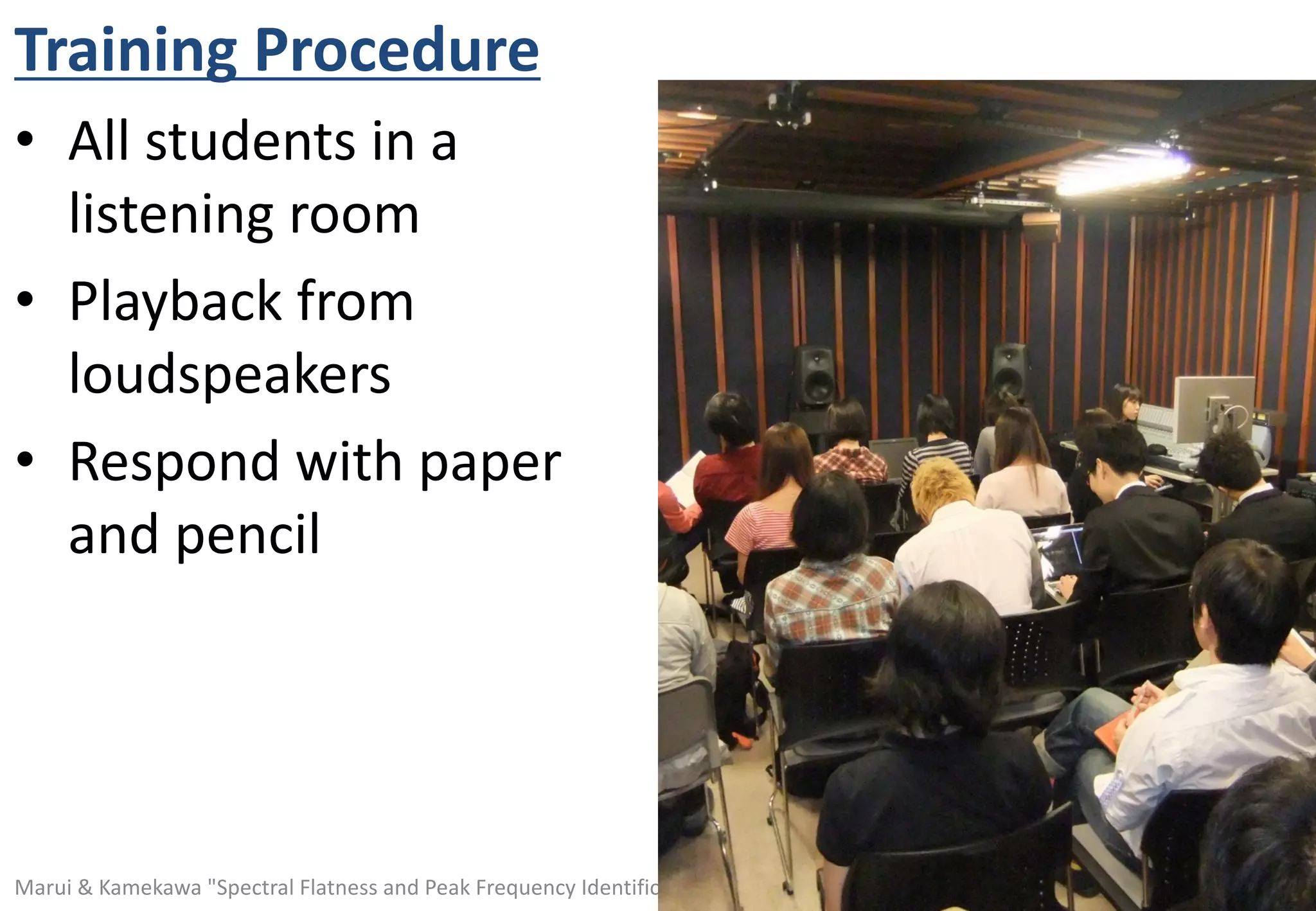
• All students in a
listening room
• Playback from
loudspeakers
• Respond with paper
and pencil
Training Procedure
• Listen to [A (original)] and [B (modified)],
then identify the difference
• Tasks
– Level Differences (SPL)
– Frequency Modification
• Peak (gain on a frequency band)
• Dip (attenuation on a frequency band)
• 10 trials per 1 modification task
4–5 tasks in an hour of lecture time
A B
10–15 sec 10–15 sec0.5 sec 3 sec
May 24, 2018Marui & Kamekawa "Spectral Flatness and Peak Frequency Identification Task" (P08-1, AES144 Milan)
Peak Frequency Identification
• Listen to [A] and [B], then identify the difference
– A frequency band is raised with Parametric EQ
– Answer which frequency band has changed
• Peak frequencies
– 63, 125, 250, 500, 1k, 2k, 4k, 8k, or 16kHz
– +12dB
– Q=2
1000Hz
4000Hz
?
?
May 24, 2018Marui & Kamekawa "Spectral Flatness and Peak Frequency Identification Task" (P08-1, AES144 Milan)
Problem: how to select the sound programs?
• Program is the “largest factor” of difficulty (Olive,
1994)
• The teacher selects programs to be used
– based on the teacher’s tacit knowledge gained from own
experience
– without experiences, students cannot select the suitable
programs for self-learning
• Gradual changes in difficulty levels is ideal for effective
training
– we do not know parameters that determine difficulty
èMeasure of task difficulty is necessary
...but what is “difficulty”?
May 24, 2018Marui & Kamekawa "Spectral Flatness and Peak Frequency Identification Task" (P08-1, AES144 Milan)
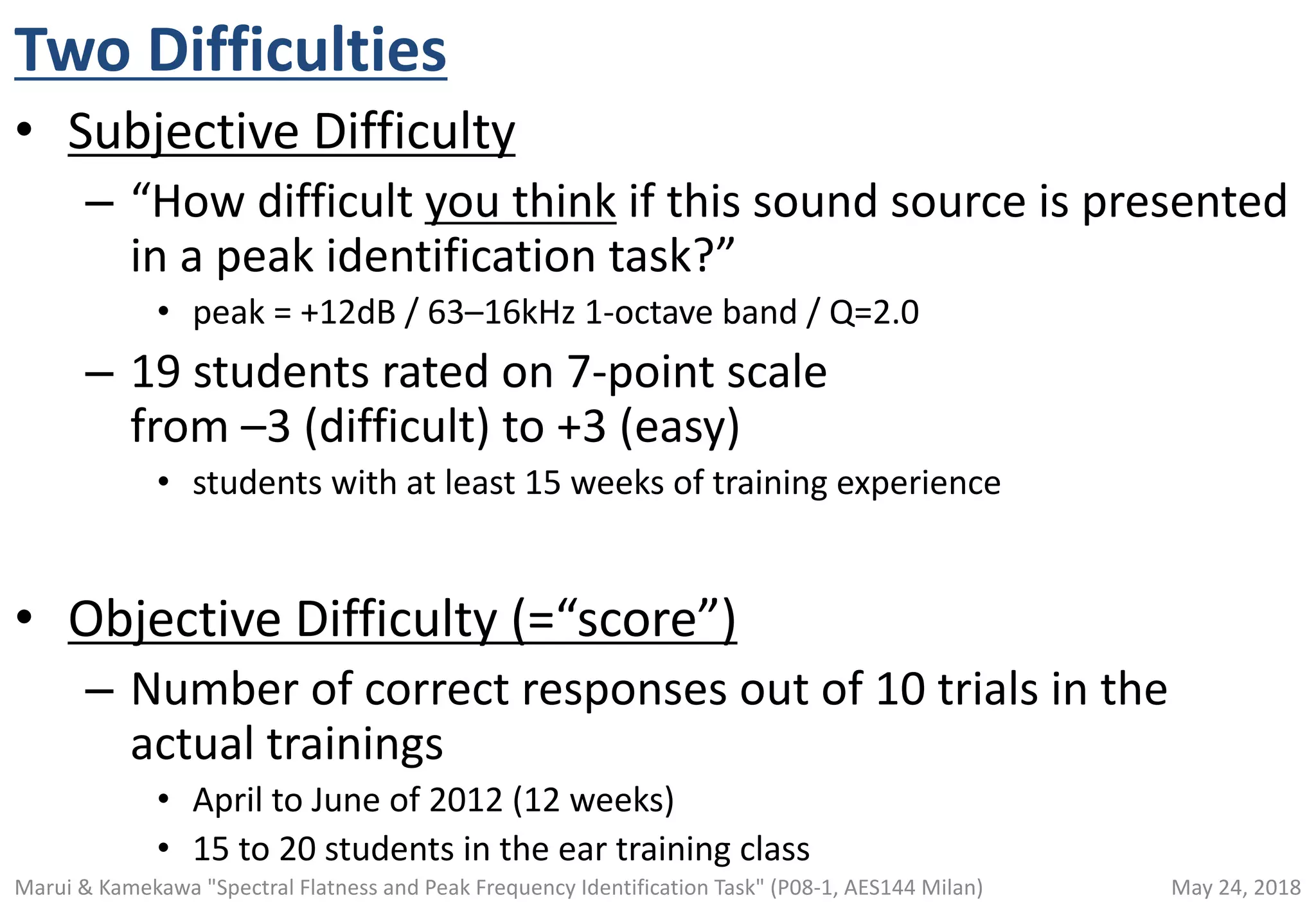
Two Difficulties
• Subjective Difficulty
– “How difficult you think if this sound source is presented
in a peak identification task?”
• peak = +12dB / 63–16kHz 1-octave band / Q=2.0
– 19 students rated on 7-point scale
from –3 (difficult) to +3 (easy)
• students with at least 15 weeks of training experience
• Objective Difficulty (=“score”)
– Number of correct responses out of 10 trials in the
actual trainings
• April to June of 2012 (12 weeks)
• 15 to 20 students in the ear training class
May 24, 2018Marui & Kamekawa "Spectral Flatness and Peak Frequency Identification Task" (P08-1, AES144 Milan)
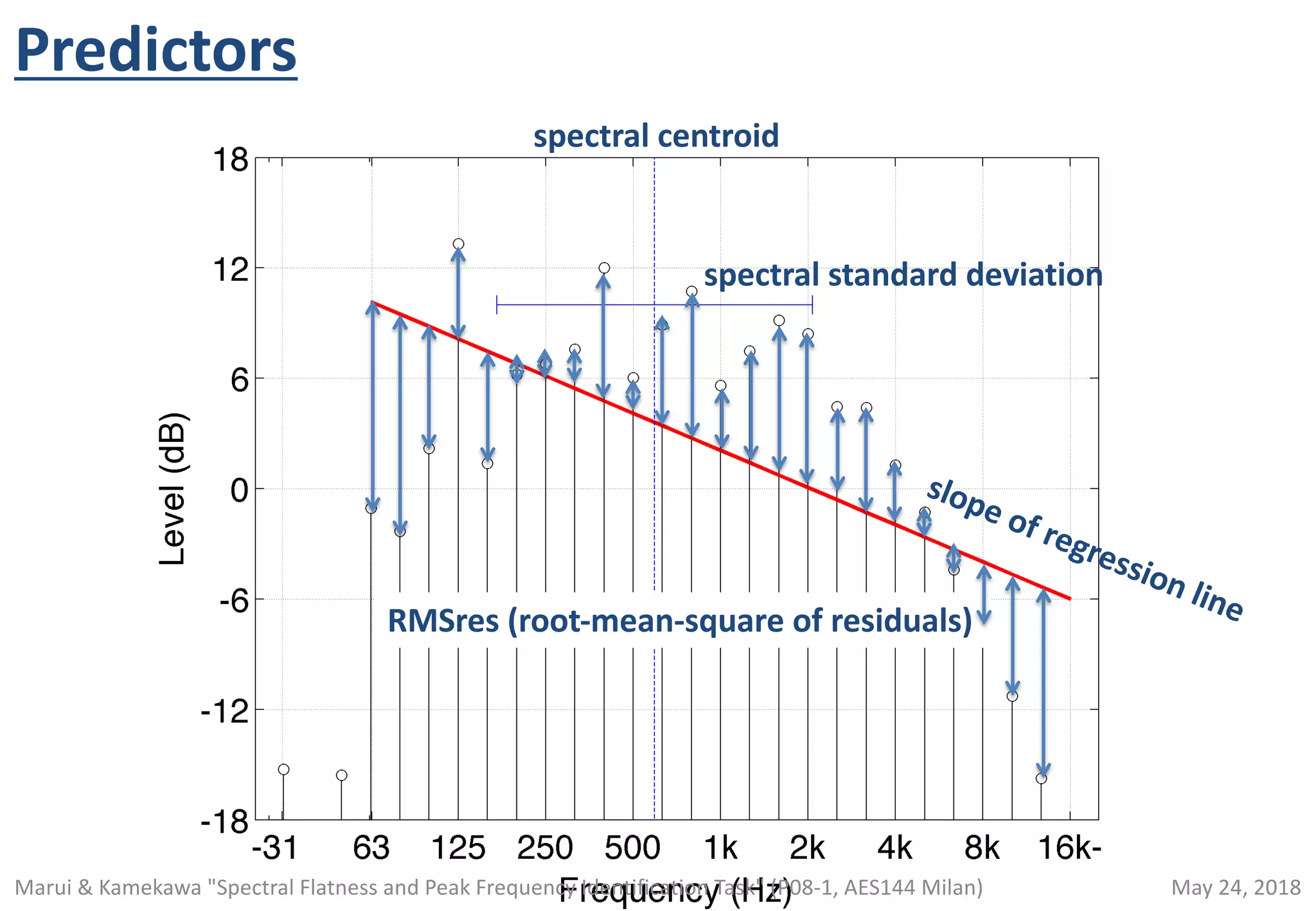
spectral standard deviation
spectral centroid
slope of regression line
Predictors
RMSres (root-mean-square of residuals)
May 24, 2018Marui & Kamekawa "Spectral Flatness and Peak Frequency Identification Task" (P08-1, AES144 Milan)
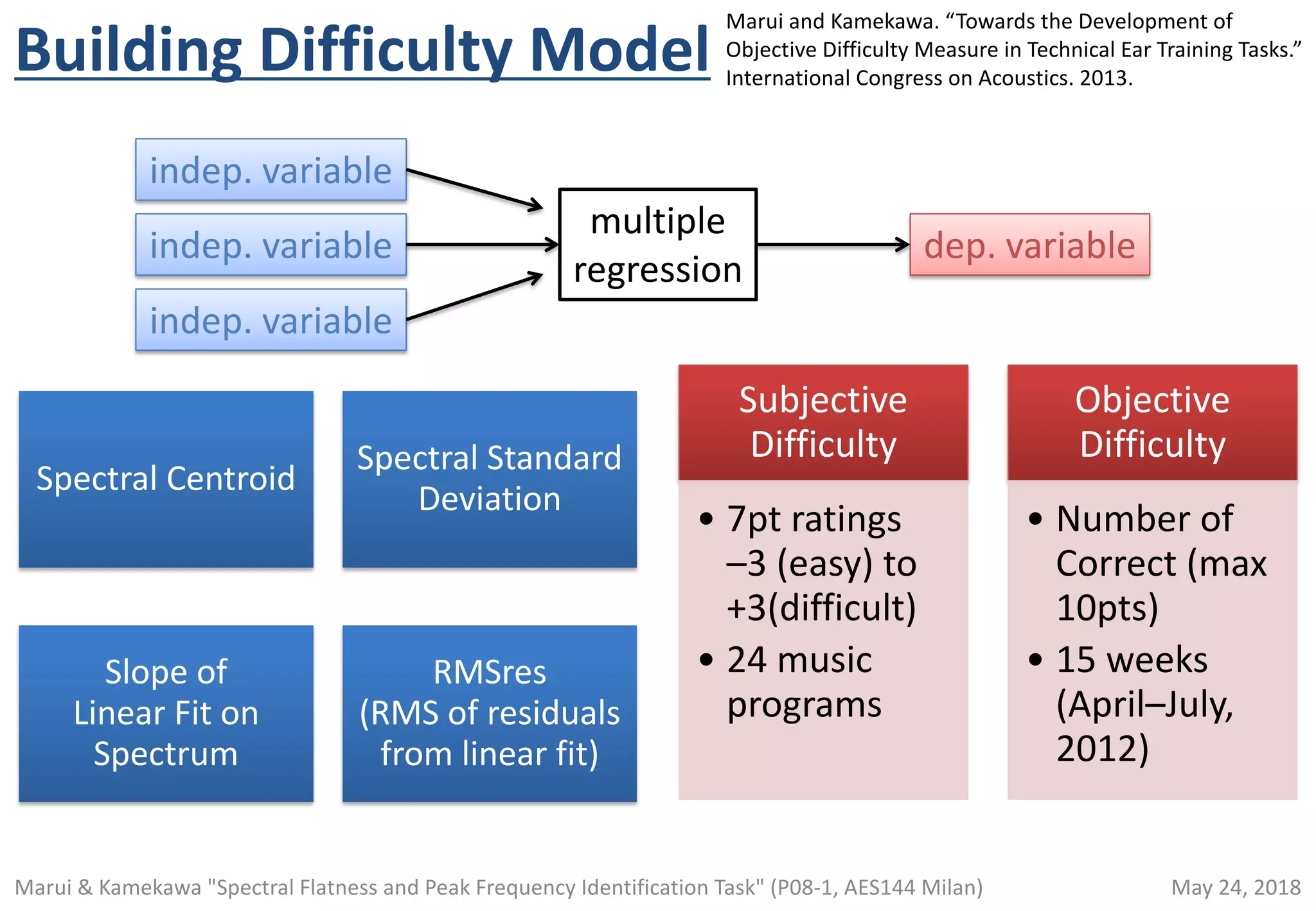
Building Difficulty Model
Subjective
Difficulty
• 7pt ratings
–3 (easy) to
+3(difficult)
• 24 music
programs
Objective
Difficulty
• Number of
Correct (max
10pts)
• 15 weeks
(April–July,
2012)
Spectral Centroid
Spectral Standard
Deviation
Slope of
Linear Fit on
Spectrum
RMSres
(RMS of residuals
from linear fit)
indep. variable dep. variable
multiple
regression
indep. variable
indep. variable
May 24, 2018Marui & Kamekawa "Spectral Flatness and Peak Frequency Identification Task" (P08-1, AES144 Milan)
Marui and Kamekawa. “Towards the Development of
Objective Difficulty Measure in Technical Ear Training Tasks.”
International Congress on Acoustics. 2013.
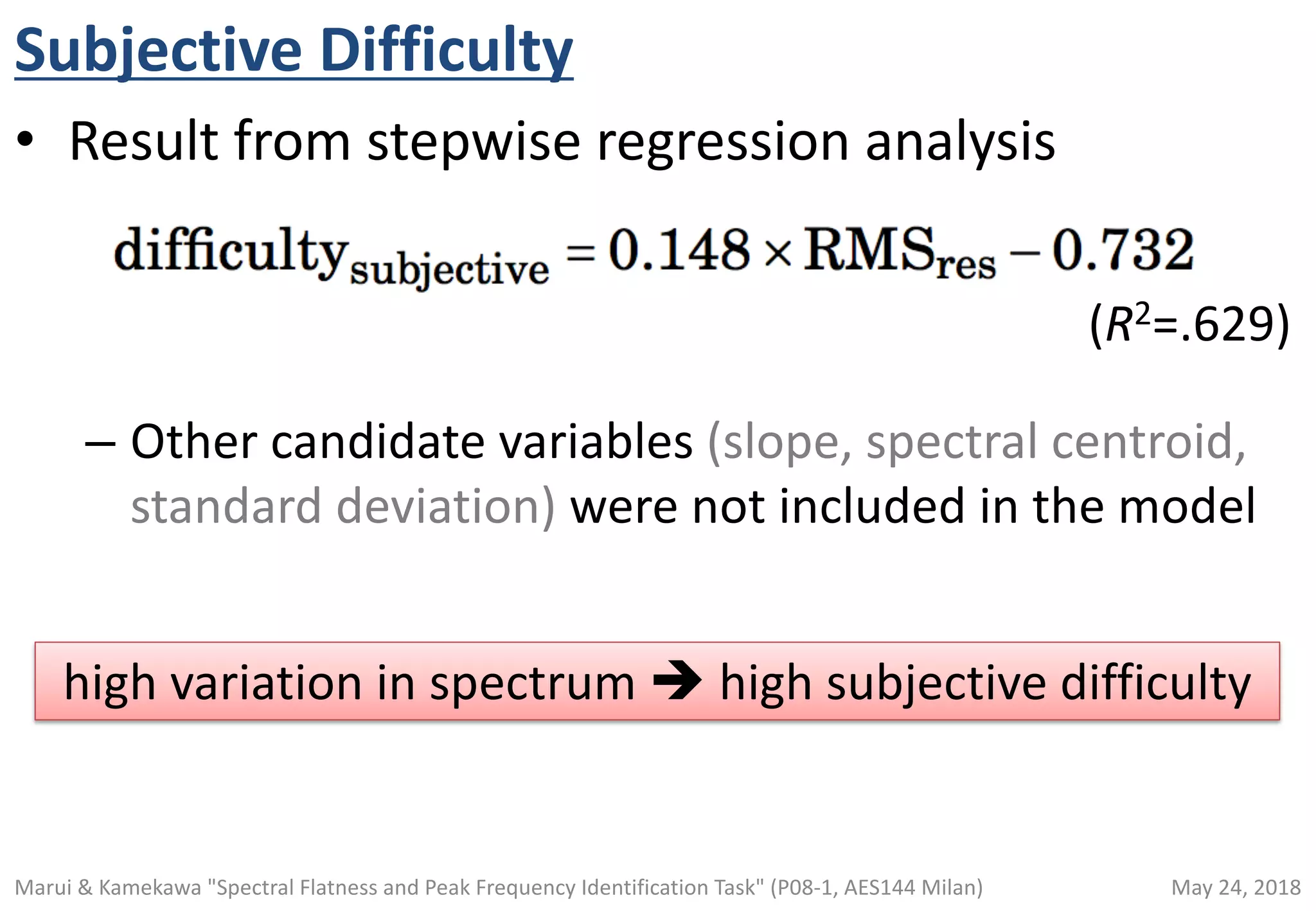
Subjective Difficulty
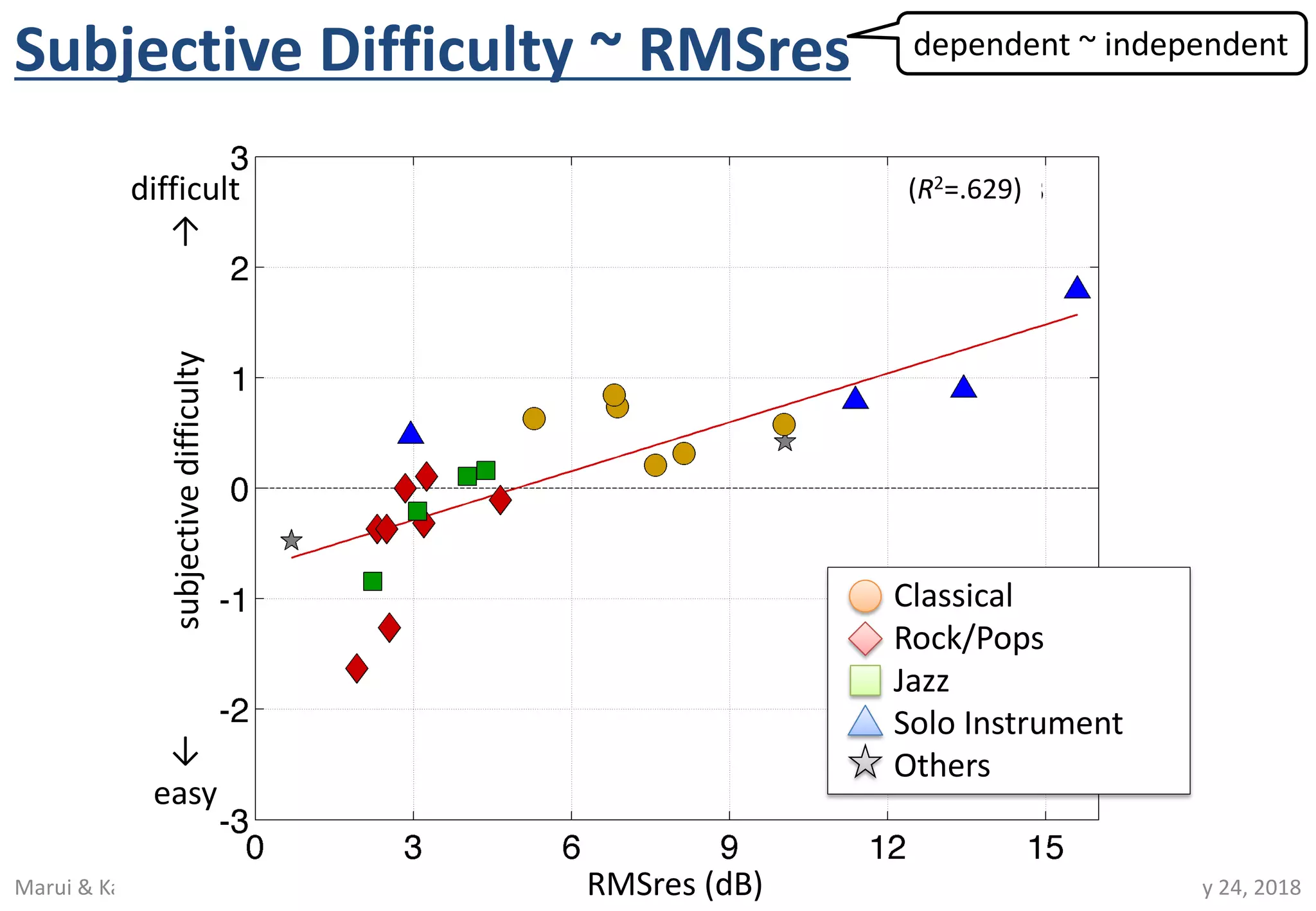
• Result from stepwise regression analysis
– Other candidate variables (slope, spectral centroid,
standard deviation) were not included in the model
(R2=.629)
high variation in spectrum è high subjective difficulty
May 24, 2018Marui & Kamekawa "Spectral Flatness and Peak Frequency Identification Task" (P08-1, AES144 Milan)
Subjective Difficulty ~ RMSres
Classical
Rock/Pops
Jazz
Solo Instrument
Others
subjectivedifficulty
RMSres (dB)
difficult
↑
↓
easy
dependent ~ independent
(R2=.629)
Objective Difficulty
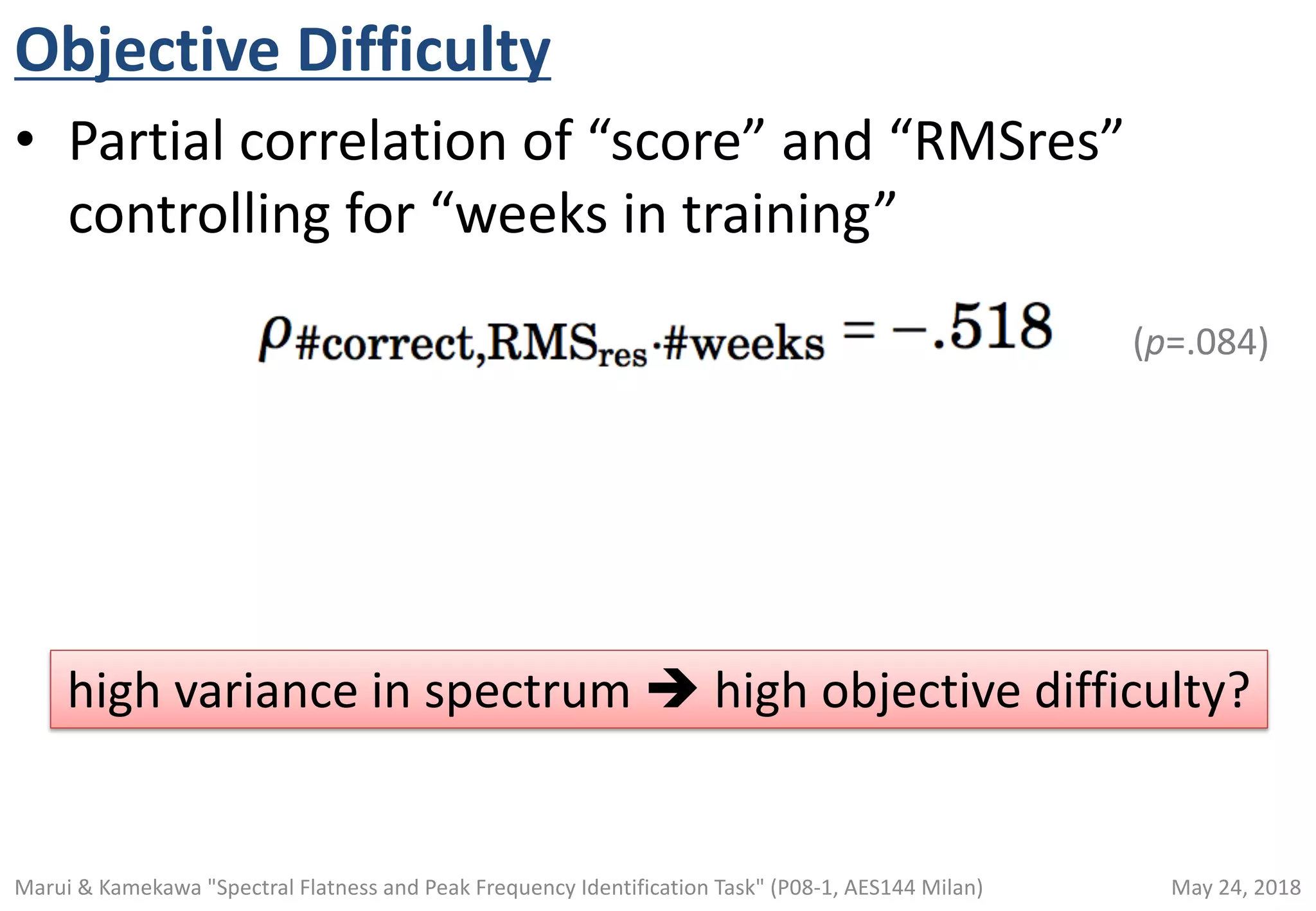
• Partial correlation of “score” and “RMSres”
controlling for “weeks in training”
high variance in spectrum è high objective difficulty?
(p=.084)
May 24, 2018Marui & Kamekawa "Spectral Flatness and Peak Frequency Identification Task" (P08-1, AES144 Milan)
Question
• We were using excerpts from different music
– Spectral flatness (RMSres) was not controlled.
• Does altering spectral flatness affect the objective
difficulty?
– using the same music excerpts different in spectral
envelope only.
May 24, 2018Marui & Kamekawa "Spectral Flatness and Peak Frequency Identification Task" (P08-1, AES144 Milan)
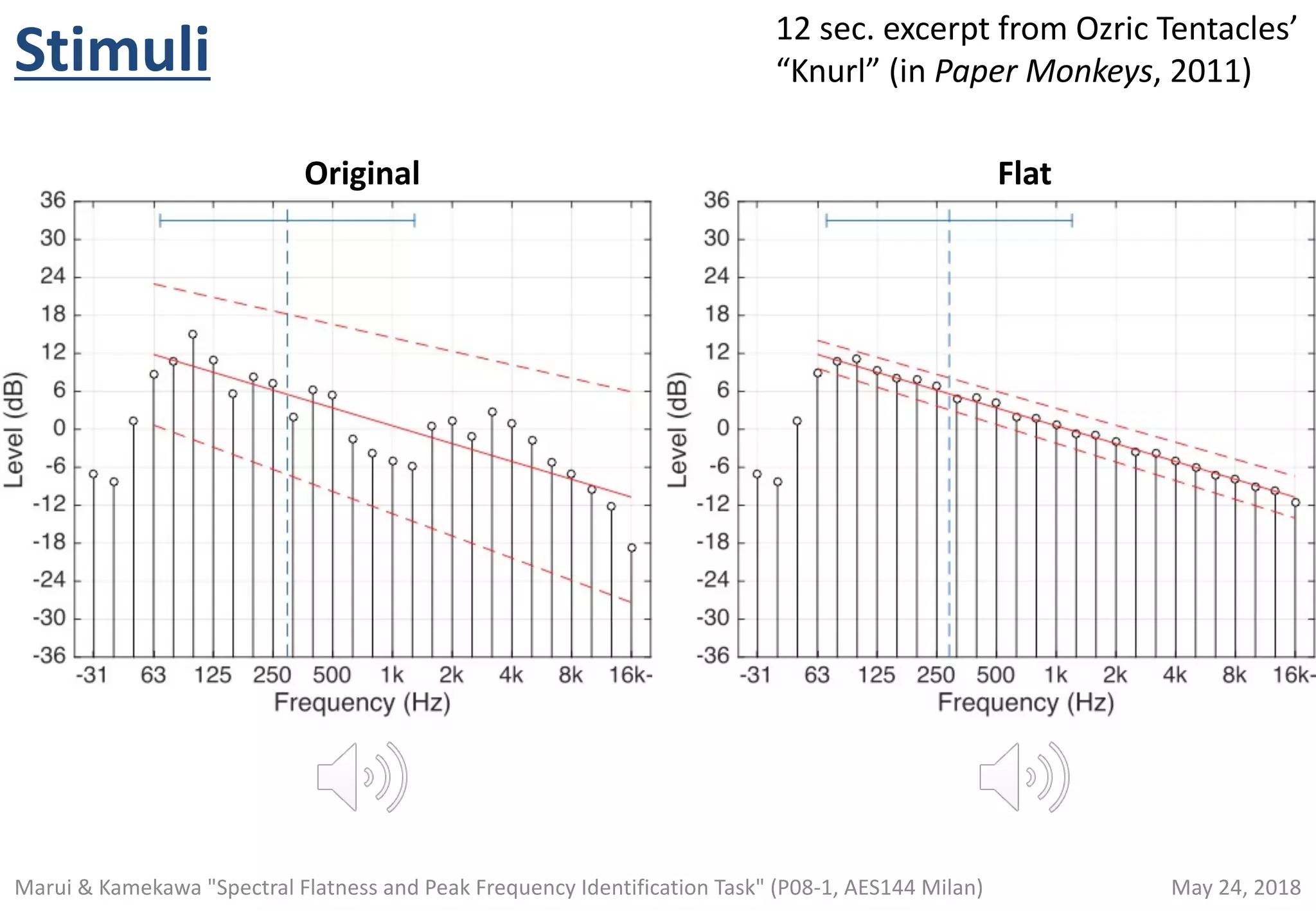
Stimuli
Original Flat
May 24, 2018Marui & Kamekawa "Spectral Flatness and Peak Frequency Identification Task" (P08-1, AES144 Milan)
12 sec. excerpt from Ozric Tentacles’
“Knurl” (in Paper Monkeys, 2011)
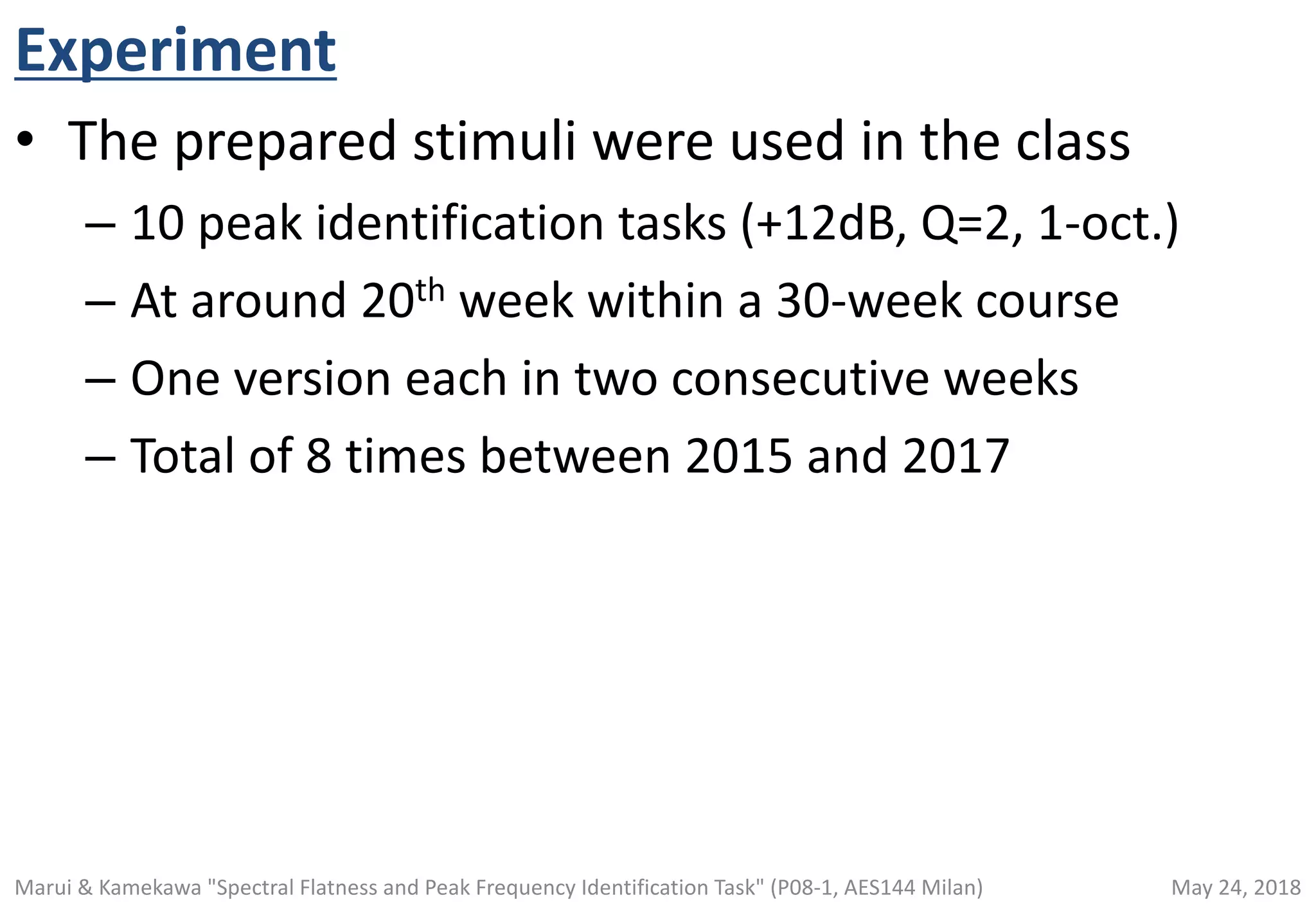
Experiment
• The prepared stimuli were used in the class
– 10 peak identification tasks (+12dB, Q=2, 1-oct.)
– At around 20th week within a 30-week course
– One version each in two consecutive weeks
– Total of 8 times between 2015 and 2017
May 24, 2018Marui & Kamekawa "Spectral Flatness and Peak Frequency Identification Task" (P08-1, AES144 Milan)
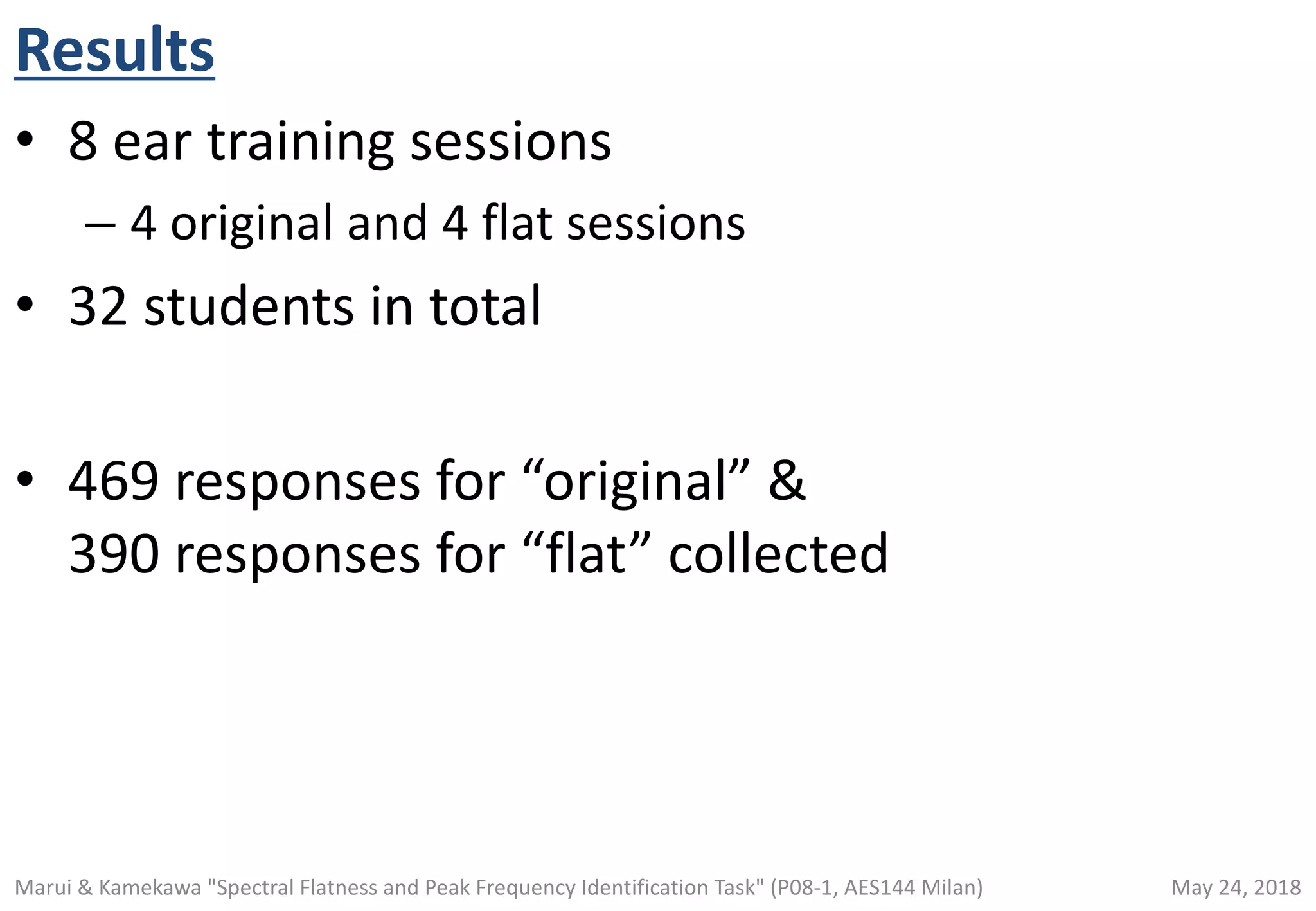
Results
• 8 ear training sessions
– 4 original and 4 flat sessions
• 32 students in total
• 469 responses for “original” &
390 responses for “flat” collected
May 24, 2018Marui & Kamekawa "Spectral Flatness and Peak Frequency Identification Task" (P08-1, AES144 Milan)
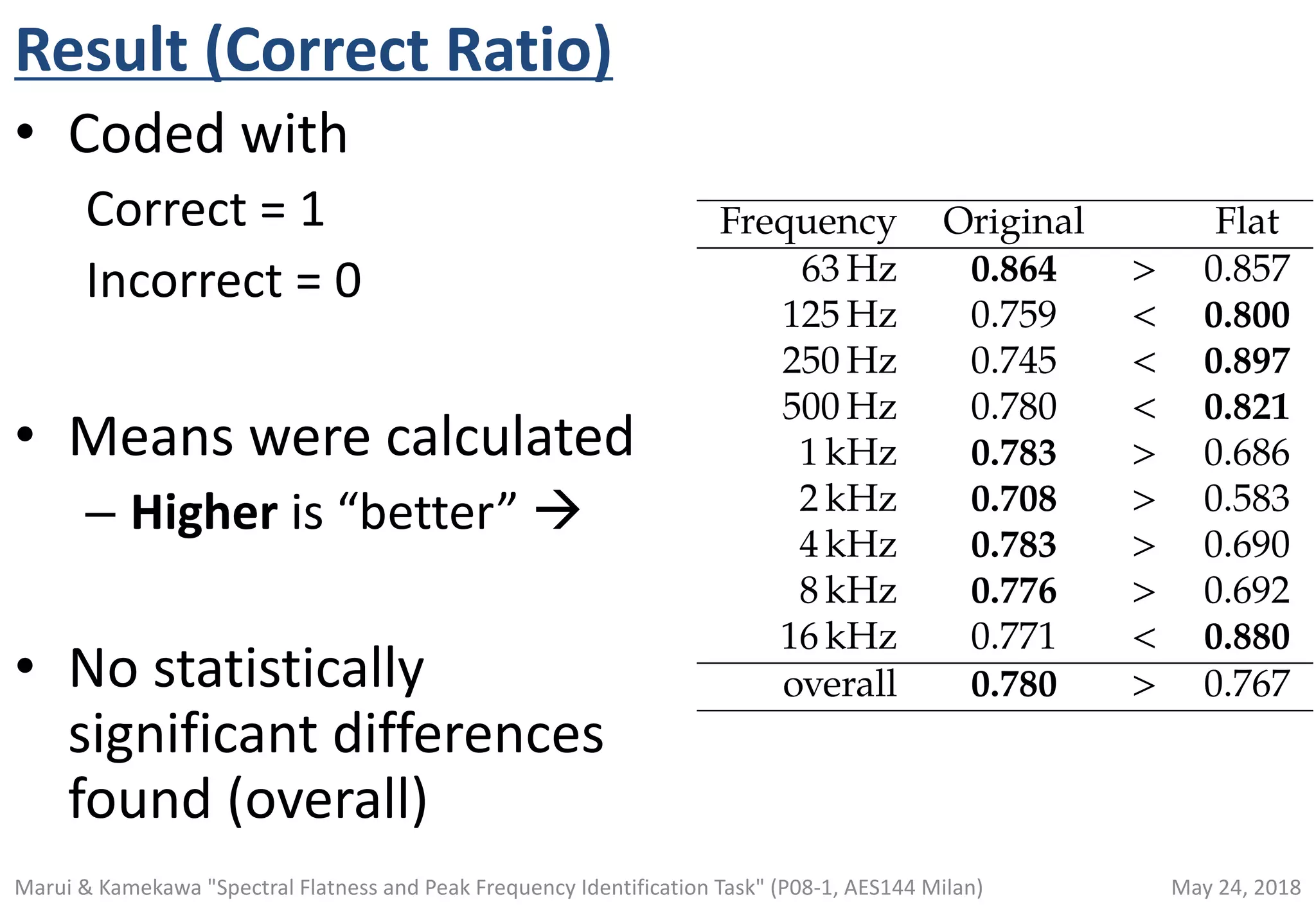
Result (Correct Ratio)
• Coded with
Correct = 1
Incorrect = 0
• Means were calculated
– Higher is “better” à
• No statistically
significant differences
found (overall)
Frequency Original Flat
63 Hz 0.864 > 0.857
125 Hz 0.759 < 0.800
250 Hz 0.745 < 0.897
500 Hz 0.780 < 0.821
1 kHz 0.783 > 0.686
2 kHz 0.708 > 0.583
4 kHz 0.783 > 0.690
8 kHz 0.776 > 0.692
16 kHz 0.771 < 0.880
overall 0.780 > 0.767<latexit sha1_base64="bHdvcqvS0YmBu099fd2aNUqTJo4=">AAAFJHichZLPT9RAFMff1lVw/QHoxcRLIyzhQDavXfoDYwyJCeEmvxZIKCFtmYVmu23pziKwWf8AzyYejCaaaGL8M7x48GY4cPFuPGLixYOvs8UtsMBsOn198/l+972ZcSLfa3DEw5x0JX/1Wl//9cKNm7duDwwO3VlqhM3YZRU39MN4xbEbzPcCVuEe99lKFDO77vhs2ak9SdaXd1jc8MJgke9FbK1ubwZe1XNtTqn1IanPctimF7S47TR9O263Ytd12wVrK3EsTMdsu8kCd08elZ/GHoG2T+FzeqZ9m8uWdUzKetkan9mnBYuzXe5UW1gy9Yk2JUYej9BMn5qRCBRVS0ksGdpkAjwaOalDbCekqmGXnNB6kZOGIDXMkCb2IlVFkLJijddO1WmY5WyduqkLUu1BopklNbMsyInLPSdRkGYP0tBPkqrYJf2YTAilV0dmZ5fSAwjpmG3fP1UEZq0N3cgILBZs/D/2wvrgMJZQDPlsoKTBMKRjNhzKSWDBBoTgQhPqwCAATrEPNjTotwoKIESUW4MW5WKKPLHOoA0F0jaJYkTYlK3RvElfq2k2oO/EsyHULv2LT09MShmKeICf8Ai/4mf8iX/P9WoJj6SWPXo7HS2L1gde3Fv4c6mqTm8OW13VhTVzqIIpavWo9khkki7cjn5n/9XRwsP5YmsU3+Mvqv8dHuIX6iDY+e1+mGPzry9wX6SdTJyrtANBxvf8DgKan1F2V9DJPJ7JdTsrQPESD97Dg2c96N4op2/J2WBJLSlYUubU4amx9Ab1w314AGPUmwFTMAOzUAFXCqSX0hvpbf5j/lv+e/6gg0q5VHMXToz8j385GT0x</latexit><latexit sha1_base64="bHdvcqvS0YmBu099fd2aNUqTJo4=">AAAFJHichZLPT9RAFMff1lVw/QHoxcRLIyzhQDavXfoDYwyJCeEmvxZIKCFtmYVmu23pziKwWf8AzyYejCaaaGL8M7x48GY4cPFuPGLixYOvs8UtsMBsOn198/l+972ZcSLfa3DEw5x0JX/1Wl//9cKNm7duDwwO3VlqhM3YZRU39MN4xbEbzPcCVuEe99lKFDO77vhs2ak9SdaXd1jc8MJgke9FbK1ubwZe1XNtTqn1IanPctimF7S47TR9O263Ytd12wVrK3EsTMdsu8kCd08elZ/GHoG2T+FzeqZ9m8uWdUzKetkan9mnBYuzXe5UW1gy9Yk2JUYej9BMn5qRCBRVS0ksGdpkAjwaOalDbCekqmGXnNB6kZOGIDXMkCb2IlVFkLJijddO1WmY5WyduqkLUu1BopklNbMsyInLPSdRkGYP0tBPkqrYJf2YTAilV0dmZ5fSAwjpmG3fP1UEZq0N3cgILBZs/D/2wvrgMJZQDPlsoKTBMKRjNhzKSWDBBoTgQhPqwCAATrEPNjTotwoKIESUW4MW5WKKPLHOoA0F0jaJYkTYlK3RvElfq2k2oO/EsyHULv2LT09MShmKeICf8Ai/4mf8iX/P9WoJj6SWPXo7HS2L1gde3Fv4c6mqTm8OW13VhTVzqIIpavWo9khkki7cjn5n/9XRwsP5YmsU3+Mvqv8dHuIX6iDY+e1+mGPzry9wX6SdTJyrtANBxvf8DgKan1F2V9DJPJ7JdTsrQPESD97Dg2c96N4op2/J2WBJLSlYUubU4amx9Ab1w314AGPUmwFTMAOzUAFXCqSX0hvpbf5j/lv+e/6gg0q5VHMXToz8j385GT0x</latexit><latexit sha1_base64="bHdvcqvS0YmBu099fd2aNUqTJo4=">AAAFJHichZLPT9RAFMff1lVw/QHoxcRLIyzhQDavXfoDYwyJCeEmvxZIKCFtmYVmu23pziKwWf8AzyYejCaaaGL8M7x48GY4cPFuPGLixYOvs8UtsMBsOn198/l+972ZcSLfa3DEw5x0JX/1Wl//9cKNm7duDwwO3VlqhM3YZRU39MN4xbEbzPcCVuEe99lKFDO77vhs2ak9SdaXd1jc8MJgke9FbK1ubwZe1XNtTqn1IanPctimF7S47TR9O263Ytd12wVrK3EsTMdsu8kCd08elZ/GHoG2T+FzeqZ9m8uWdUzKetkan9mnBYuzXe5UW1gy9Yk2JUYej9BMn5qRCBRVS0ksGdpkAjwaOalDbCekqmGXnNB6kZOGIDXMkCb2IlVFkLJijddO1WmY5WyduqkLUu1BopklNbMsyInLPSdRkGYP0tBPkqrYJf2YTAilV0dmZ5fSAwjpmG3fP1UEZq0N3cgILBZs/D/2wvrgMJZQDPlsoKTBMKRjNhzKSWDBBoTgQhPqwCAATrEPNjTotwoKIESUW4MW5WKKPLHOoA0F0jaJYkTYlK3RvElfq2k2oO/EsyHULv2LT09MShmKeICf8Ai/4mf8iX/P9WoJj6SWPXo7HS2L1gde3Fv4c6mqTm8OW13VhTVzqIIpavWo9khkki7cjn5n/9XRwsP5YmsU3+Mvqv8dHuIX6iDY+e1+mGPzry9wX6SdTJyrtANBxvf8DgKan1F2V9DJPJ7JdTsrQPESD97Dg2c96N4op2/J2WBJLSlYUubU4amx9Ab1w314AGPUmwFTMAOzUAFXCqSX0hvpbf5j/lv+e/6gg0q5VHMXToz8j385GT0x</latexit><latexit sha1_base64="bHdvcqvS0YmBu099fd2aNUqTJo4=">AAAFJHichZLPT9RAFMff1lVw/QHoxcRLIyzhQDavXfoDYwyJCeEmvxZIKCFtmYVmu23pziKwWf8AzyYejCaaaGL8M7x48GY4cPFuPGLixYOvs8UtsMBsOn198/l+972ZcSLfa3DEw5x0JX/1Wl//9cKNm7duDwwO3VlqhM3YZRU39MN4xbEbzPcCVuEe99lKFDO77vhs2ak9SdaXd1jc8MJgke9FbK1ubwZe1XNtTqn1IanPctimF7S47TR9O263Ytd12wVrK3EsTMdsu8kCd08elZ/GHoG2T+FzeqZ9m8uWdUzKetkan9mnBYuzXe5UW1gy9Yk2JUYej9BMn5qRCBRVS0ksGdpkAjwaOalDbCekqmGXnNB6kZOGIDXMkCb2IlVFkLJijddO1WmY5WyduqkLUu1BopklNbMsyInLPSdRkGYP0tBPkqrYJf2YTAilV0dmZ5fSAwjpmG3fP1UEZq0N3cgILBZs/D/2wvrgMJZQDPlsoKTBMKRjNhzKSWDBBoTgQhPqwCAATrEPNjTotwoKIESUW4MW5WKKPLHOoA0F0jaJYkTYlK3RvElfq2k2oO/EsyHULv2LT09MShmKeICf8Ai/4mf8iX/P9WoJj6SWPXo7HS2L1gde3Fv4c6mqTm8OW13VhTVzqIIpavWo9khkki7cjn5n/9XRwsP5YmsU3+Mvqv8dHuIX6iDY+e1+mGPzry9wX6SdTJyrtANBxvf8DgKan1F2V9DJPJ7JdTsrQPESD97Dg2c96N4op2/J2WBJLSlYUubU4amx9Ab1w314AGPUmwFTMAOzUAFXCqSX0hvpbf5j/lv+e/6gg0q5VHMXToz8j385GT0x</latexit>
May 24, 2018Marui & Kamekawa "Spectral Flatness and Peak Frequency Identification Task" (P08-1, AES144 Milan)
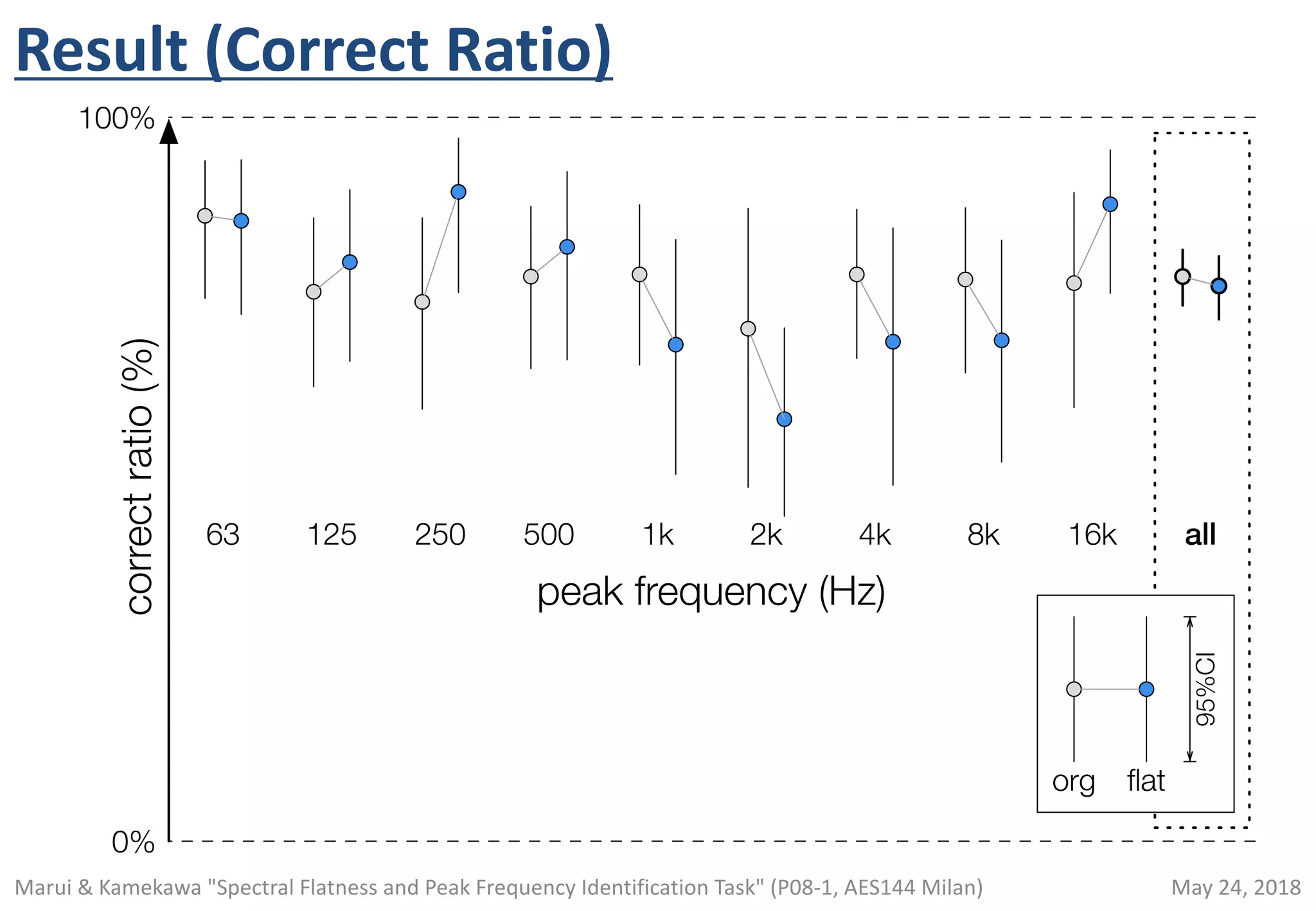
Result (Correct Ratio)
May 24, 2018Marui & Kamekawa "Spectral Flatness and Peak Frequency Identification Task" (P08-1, AES144 Milan)
63 250 500 1k 2k 4k 8k 16k all125
100%
0%
org flat
95%CI
correctratio(%)
peak frequency (Hz)
May 24, 2018Marui & Kamekawa "Spectral Flatness and Peak Frequency Identification Task" (P08-1, AES144 Milan)
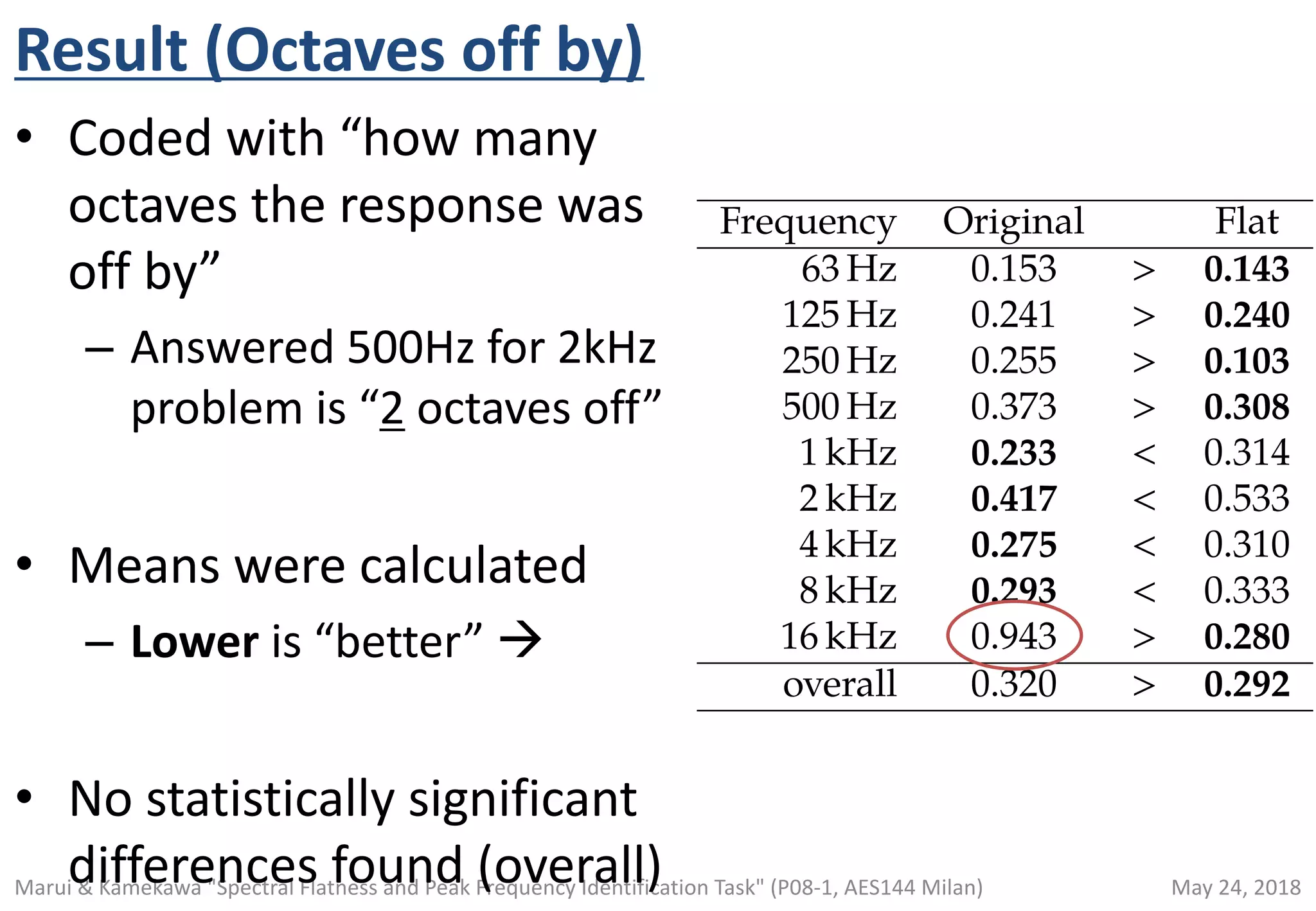
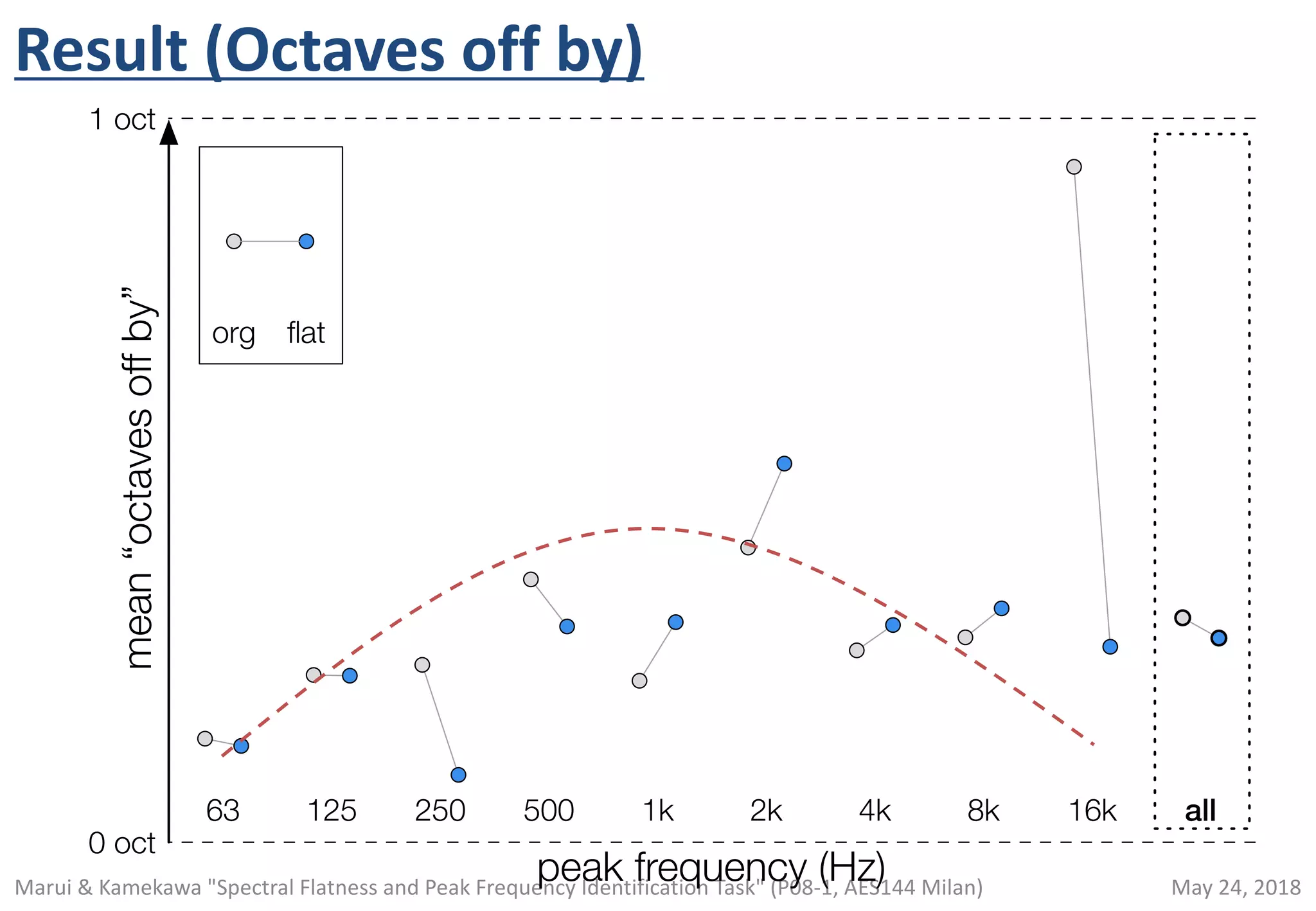
Result (Octaves off by)
• Coded with “how many
octaves the response was
off by”
– Answered 500Hz for 2kHz
problem is “2 octaves off”
• Means were calculated
– Lower is “better” à
• No statistically significant
differences found (overall)
Frequency Original Flat
63 Hz 0.153 > 0.143
125 Hz 0.241 > 0.240
250 Hz 0.255 > 0.103
500 Hz 0.373 > 0.308
1 kHz 0.233 < 0.314
2 kHz 0.417 < 0.533
4 kHz 0.275 < 0.310
8 kHz 0.293 < 0.333
16 kHz 0.943 > 0.280
overall 0.320 > 0.292<latexit sha1_base64="p8wzlJI2uB2fbLCcHylZWILnzz8=">AAAFJHichZPPTxNBFMcfaxWsPwC9mHjZSEs4NM3bX7QYY0hMCDf5VSBhSbO7TGHDdnfZThFo6h/g2cSD0UQTTYx/hhcP3gwHLt6NR0y8ePDtbKHFLjDNzrx98/l+Z97M1g49t8ERjwakK5mr1waHrmdv3Lx1e3hk9M5yI2hGDqs4gRdEq7bVYJ7rswp3ucdWw4hZddtjK/b2k3h+ZZdFDTfwl/h+yNbr1qbv1lzH4pSqjkqDps02Xb/FLbvpWVG7FTmO086aW7FjdiZiO03mO/vyuPw0cgm0PAqf0zPjWVw2zRNSntTMwuwBTWBRMTQac49z1Juc7XG71qKsrrVjgaIap6SqKymkqqMgVQO7pGGkeWLiaWCX1Eppq2tYFqSsmIVtQfasp5ELSR7lEgNFF6TaT+pKqZc0NE2QeopnyTjriYIsp5BTZ1dPPJXJExKLU3paRWo5OaXOBQR0zZbnJR4qpgmm1F6ByfyN02vPVkfGsIiiyf2B0gnGoNPmgtEBCUzYgAAcaEIdGPjAKfbAggb91kABhJBy69CiXESRK+YZtCFL2iZRjAiLstvUb9LbWifr03vs2RBqh1bx6IlIKUMeD/ETHuNX/Iw/8e+5Xi3hEe9ln0Y70bKwOvzi3uKfS1V1GjlsdVUX7plDDcpiry7tPRSZuAon0e8evDpefLiQb43je/xF+3+HR/iFKvB3fzsf5tnC6wvcl+gkY+canYDf43t+BT71zyi7J+i4L/TkupVlIX+JB0/x4L0e9N0o/38l/cGySn/VojKvjk1PdL6gIbgPD2CCaivBNMzCHFTAkXzppfRGepv5mPmW+Z45TFBpoKO5C2da5sc/5QI8oQ==</latexit><latexit sha1_base64="p8wzlJI2uB2fbLCcHylZWILnzz8=">AAAFJHichZPPTxNBFMcfaxWsPwC9mHjZSEs4NM3bX7QYY0hMCDf5VSBhSbO7TGHDdnfZThFo6h/g2cSD0UQTTYx/hhcP3gwHLt6NR0y8ePDtbKHFLjDNzrx98/l+Z97M1g49t8ERjwakK5mr1waHrmdv3Lx1e3hk9M5yI2hGDqs4gRdEq7bVYJ7rswp3ucdWw4hZddtjK/b2k3h+ZZdFDTfwl/h+yNbr1qbv1lzH4pSqjkqDps02Xb/FLbvpWVG7FTmO086aW7FjdiZiO03mO/vyuPw0cgm0PAqf0zPjWVw2zRNSntTMwuwBTWBRMTQac49z1Juc7XG71qKsrrVjgaIap6SqKymkqqMgVQO7pGGkeWLiaWCX1Eppq2tYFqSsmIVtQfasp5ELSR7lEgNFF6TaT+pKqZc0NE2QeopnyTjriYIsp5BTZ1dPPJXJExKLU3paRWo5OaXOBQR0zZbnJR4qpgmm1F6ByfyN02vPVkfGsIiiyf2B0gnGoNPmgtEBCUzYgAAcaEIdGPjAKfbAggb91kABhJBy69CiXESRK+YZtCFL2iZRjAiLstvUb9LbWifr03vs2RBqh1bx6IlIKUMeD/ETHuNX/Iw/8e+5Xi3hEe9ln0Y70bKwOvzi3uKfS1V1GjlsdVUX7plDDcpiry7tPRSZuAon0e8evDpefLiQb43je/xF+3+HR/iFKvB3fzsf5tnC6wvcl+gkY+canYDf43t+BT71zyi7J+i4L/TkupVlIX+JB0/x4L0e9N0o/38l/cGySn/VojKvjk1PdL6gIbgPD2CCaivBNMzCHFTAkXzppfRGepv5mPmW+Z45TFBpoKO5C2da5sc/5QI8oQ==</latexit><latexit sha1_base64="p8wzlJI2uB2fbLCcHylZWILnzz8=">AAAFJHichZPPTxNBFMcfaxWsPwC9mHjZSEs4NM3bX7QYY0hMCDf5VSBhSbO7TGHDdnfZThFo6h/g2cSD0UQTTYx/hhcP3gwHLt6NR0y8ePDtbKHFLjDNzrx98/l+Z97M1g49t8ERjwakK5mr1waHrmdv3Lx1e3hk9M5yI2hGDqs4gRdEq7bVYJ7rswp3ucdWw4hZddtjK/b2k3h+ZZdFDTfwl/h+yNbr1qbv1lzH4pSqjkqDps02Xb/FLbvpWVG7FTmO086aW7FjdiZiO03mO/vyuPw0cgm0PAqf0zPjWVw2zRNSntTMwuwBTWBRMTQac49z1Juc7XG71qKsrrVjgaIap6SqKymkqqMgVQO7pGGkeWLiaWCX1Eppq2tYFqSsmIVtQfasp5ELSR7lEgNFF6TaT+pKqZc0NE2QeopnyTjriYIsp5BTZ1dPPJXJExKLU3paRWo5OaXOBQR0zZbnJR4qpgmm1F6ByfyN02vPVkfGsIiiyf2B0gnGoNPmgtEBCUzYgAAcaEIdGPjAKfbAggb91kABhJBy69CiXESRK+YZtCFL2iZRjAiLstvUb9LbWifr03vs2RBqh1bx6IlIKUMeD/ETHuNX/Iw/8e+5Xi3hEe9ln0Y70bKwOvzi3uKfS1V1GjlsdVUX7plDDcpiry7tPRSZuAon0e8evDpefLiQb43je/xF+3+HR/iFKvB3fzsf5tnC6wvcl+gkY+canYDf43t+BT71zyi7J+i4L/TkupVlIX+JB0/x4L0e9N0o/38l/cGySn/VojKvjk1PdL6gIbgPD2CCaivBNMzCHFTAkXzppfRGepv5mPmW+Z45TFBpoKO5C2da5sc/5QI8oQ==</latexit><latexit sha1_base64="p8wzlJI2uB2fbLCcHylZWILnzz8=">AAAFJHichZPPTxNBFMcfaxWsPwC9mHjZSEs4NM3bX7QYY0hMCDf5VSBhSbO7TGHDdnfZThFo6h/g2cSD0UQTTYx/hhcP3gwHLt6NR0y8ePDtbKHFLjDNzrx98/l+Z97M1g49t8ERjwakK5mr1waHrmdv3Lx1e3hk9M5yI2hGDqs4gRdEq7bVYJ7rswp3ucdWw4hZddtjK/b2k3h+ZZdFDTfwl/h+yNbr1qbv1lzH4pSqjkqDps02Xb/FLbvpWVG7FTmO086aW7FjdiZiO03mO/vyuPw0cgm0PAqf0zPjWVw2zRNSntTMwuwBTWBRMTQac49z1Juc7XG71qKsrrVjgaIap6SqKymkqqMgVQO7pGGkeWLiaWCX1Eppq2tYFqSsmIVtQfasp5ELSR7lEgNFF6TaT+pKqZc0NE2QeopnyTjriYIsp5BTZ1dPPJXJExKLU3paRWo5OaXOBQR0zZbnJR4qpgmm1F6ByfyN02vPVkfGsIiiyf2B0gnGoNPmgtEBCUzYgAAcaEIdGPjAKfbAggb91kABhJBy69CiXESRK+YZtCFL2iZRjAiLstvUb9LbWifr03vs2RBqh1bx6IlIKUMeD/ETHuNX/Iw/8e+5Xi3hEe9ln0Y70bKwOvzi3uKfS1V1GjlsdVUX7plDDcpiry7tPRSZuAon0e8evDpefLiQb43je/xF+3+HR/iFKvB3fzsf5tnC6wvcl+gkY+canYDf43t+BT71zyi7J+i4L/TkupVlIX+JB0/x4L0e9N0o/38l/cGySn/VojKvjk1PdL6gIbgPD2CCaivBNMzCHFTAkXzppfRGepv5mPmW+Z45TFBpoKO5C2da5sc/5QI8oQ==</latexit>
May 24, 2018Marui & Kamekawa "Spectral Flatness and Peak Frequency Identification Task" (P08-1, AES144 Milan)
Result (Octaves off by)
63 250 500 1k 2k 4k 8k 16k all125
1 oct
0 oct
org flat
mean“octavesoffby”
peak frequency (Hz)
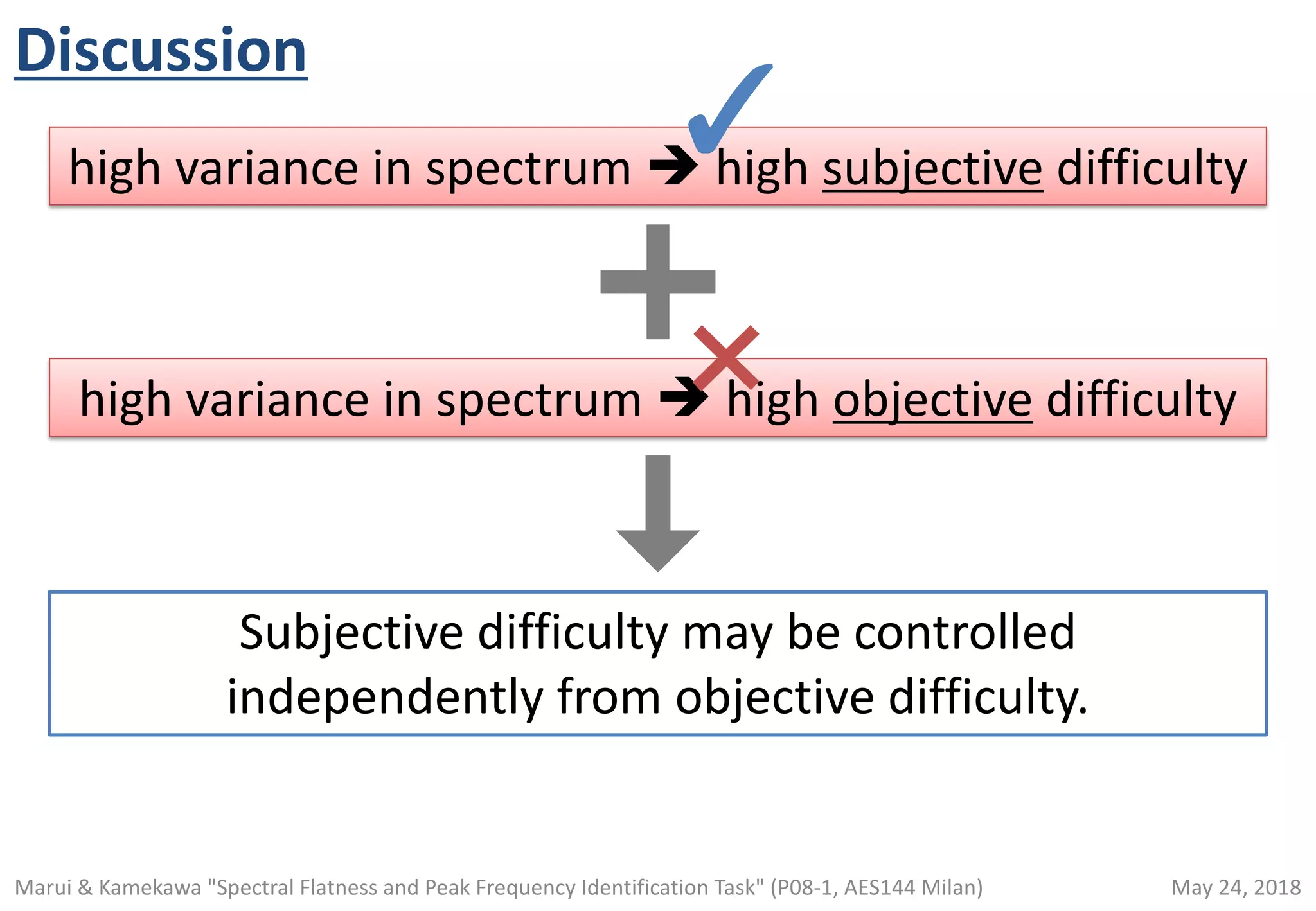
Discussion
high variance in spectrum è high subjective difficulty
high variance in spectrum è high objective difficulty
Subjective difficulty may be controlled
independently from objective difficulty.
May 24, 2018Marui & Kamekawa "Spectral Flatness and Peak Frequency Identification Task" (P08-1, AES144 Milan)
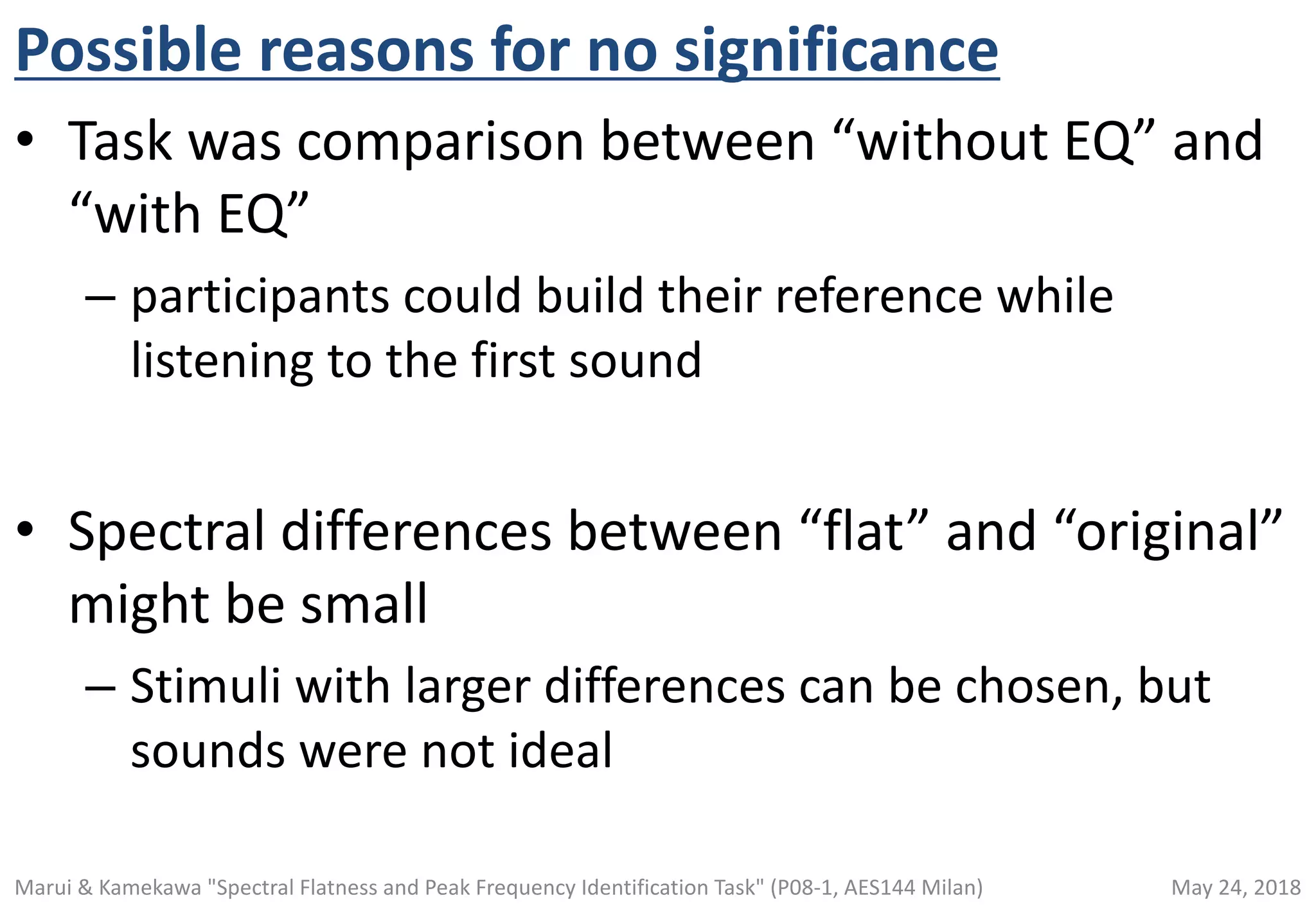
Possible reasons for no significance
• Task was comparison between “without EQ” and
“with EQ”
– participants could build their reference while
listening to the first sound
• Spectral differences between “flat” and “original”
might be small
– Stimuli with larger differences can be chosen, but
sounds were not ideal
May 24, 2018Marui & Kamekawa "Spectral Flatness and Peak Frequency Identification Task" (P08-1, AES144 Milan)
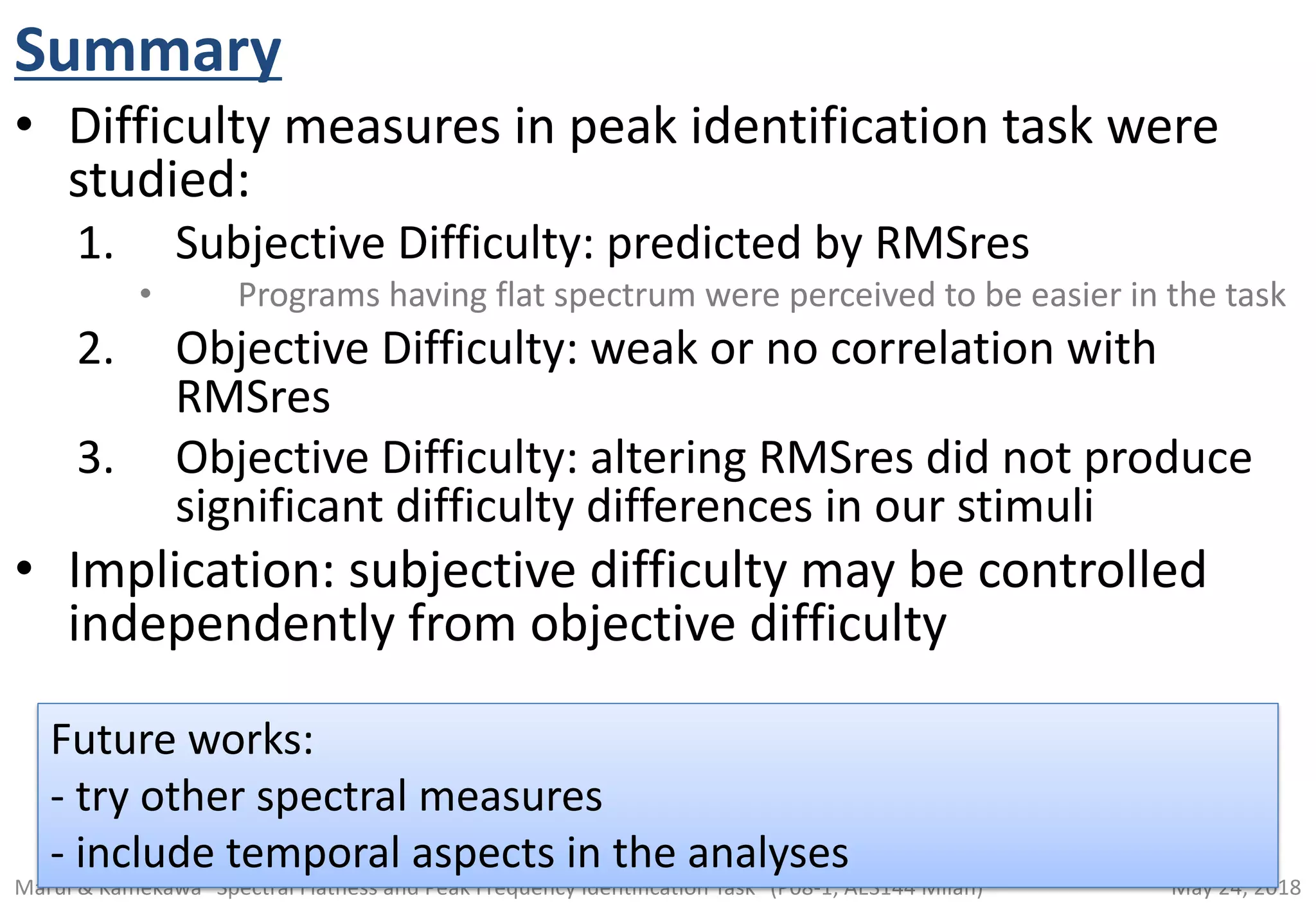
Summary
• Difficulty measures in peak identification task were
studied:
1. Subjective Difficulty: predicted by RMSres
• Programs having flat spectrum were perceived to be easier in the task
2. Objective Difficulty: weak or no correlation with
RMSres
3. Objective Difficulty: altering RMSres did not produce
significant difficulty differences in our stimuli
• Implication: subjective difficulty may be controlled
independently from objective difficulty
Future works:
- try other spectral measures
- include temporal aspects in the analyses
Thank You
Contact: marui@ms.geidai.ac.jp

Does Spectral Flatness Affect the Difficulty of the Peak Frequency Identification Task in Technical Ear Training?

  • 1.
    Does Spectral FlatnessAffect the Difficulty of the Peak Frequency Identification Task in Technical Ear Training? Atsushi Marui and Toru Kamekawa (Faculty of Music, Tokyo University of the Arts)
  • 2.
    Technical Ear Training? •Objective: Learn the way to discriminate, identify, and describe the differences in sound • Trainings for professionals in Audio Engineering – Kitamura: “Technical Listening Training” (Kyushu U) – Nishimura: web-based system (Tokyo U Info Sci) – Rakowski: “Timbre Solfeggio” (Chopin Academy Mus) – Quésnel: computer-based interactive system (McGill) – Corey: practical training software suite (U Mich) – Moulton: “Golden Ears CD” (Moulton Lab) – Kassier: trainings for spatial audio (Surrey U) – Martin et al.: dynamic range (McGIll) May 24, 2018Marui & Kamekawa "Spectral Flatness and Peak Frequency Identification Task" (P08-1, AES144 Milan)
  • 3.
    May 24, 2018Marui& Kamekawa "Spectral Flatness and Peak Frequency Identification Task" (P08-1, AES144 Milan) Training Procedure • All students in a listening room • Playback from loudspeakers • Respond with paper and pencil
  • 4.
    Training Procedure • Listento [A (original)] and [B (modified)], then identify the difference • Tasks – Level Differences (SPL) – Frequency Modification • Peak (gain on a frequency band) • Dip (attenuation on a frequency band) • 10 trials per 1 modification task 4–5 tasks in an hour of lecture time A B 10–15 sec 10–15 sec0.5 sec 3 sec May 24, 2018Marui & Kamekawa "Spectral Flatness and Peak Frequency Identification Task" (P08-1, AES144 Milan)
  • 5.
    Peak Frequency Identification •Listen to [A] and [B], then identify the difference – A frequency band is raised with Parametric EQ – Answer which frequency band has changed • Peak frequencies – 63, 125, 250, 500, 1k, 2k, 4k, 8k, or 16kHz – +12dB – Q=2 1000Hz 4000Hz ? ? May 24, 2018Marui & Kamekawa "Spectral Flatness and Peak Frequency Identification Task" (P08-1, AES144 Milan)
  • 6.
    Problem: how toselect the sound programs? • Program is the “largest factor” of difficulty (Olive, 1994) • The teacher selects programs to be used – based on the teacher’s tacit knowledge gained from own experience – without experiences, students cannot select the suitable programs for self-learning • Gradual changes in difficulty levels is ideal for effective training – we do not know parameters that determine difficulty èMeasure of task difficulty is necessary ...but what is “difficulty”? May 24, 2018Marui & Kamekawa "Spectral Flatness and Peak Frequency Identification Task" (P08-1, AES144 Milan)
  • 7.
    Two Difficulties • SubjectiveDifficulty – “How difficult you think if this sound source is presented in a peak identification task?” • peak = +12dB / 63–16kHz 1-octave band / Q=2.0 – 19 students rated on 7-point scale from –3 (difficult) to +3 (easy) • students with at least 15 weeks of training experience • Objective Difficulty (=“score”) – Number of correct responses out of 10 trials in the actual trainings • April to June of 2012 (12 weeks) • 15 to 20 students in the ear training class May 24, 2018Marui & Kamekawa "Spectral Flatness and Peak Frequency Identification Task" (P08-1, AES144 Milan)
  • 8.
    spectral standard deviation spectralcentroid slope of regression line Predictors RMSres (root-mean-square of residuals) May 24, 2018Marui & Kamekawa "Spectral Flatness and Peak Frequency Identification Task" (P08-1, AES144 Milan)
  • 9.
    Building Difficulty Model Subjective Difficulty •7pt ratings –3 (easy) to +3(difficult) • 24 music programs Objective Difficulty • Number of Correct (max 10pts) • 15 weeks (April–July, 2012) Spectral Centroid Spectral Standard Deviation Slope of Linear Fit on Spectrum RMSres (RMS of residuals from linear fit) indep. variable dep. variable multiple regression indep. variable indep. variable May 24, 2018Marui & Kamekawa "Spectral Flatness and Peak Frequency Identification Task" (P08-1, AES144 Milan) Marui and Kamekawa. “Towards the Development of Objective Difficulty Measure in Technical Ear Training Tasks.” International Congress on Acoustics. 2013.
  • 10.
    Subjective Difficulty • Resultfrom stepwise regression analysis – Other candidate variables (slope, spectral centroid, standard deviation) were not included in the model (R2=.629) high variation in spectrum è high subjective difficulty May 24, 2018Marui & Kamekawa "Spectral Flatness and Peak Frequency Identification Task" (P08-1, AES144 Milan)
  • 11.
    May 24, 2018Marui& Kamekawa "Spectral Flatness and Peak Frequency Identification Task" (P08-1, AES144 Milan) Subjective Difficulty ~ RMSres Classical Rock/Pops Jazz Solo Instrument Others subjectivedifficulty RMSres (dB) difficult ↑ ↓ easy dependent ~ independent (R2=.629)
  • 12.
    Objective Difficulty • Partialcorrelation of “score” and “RMSres” controlling for “weeks in training” high variance in spectrum è high objective difficulty? (p=.084) May 24, 2018Marui & Kamekawa "Spectral Flatness and Peak Frequency Identification Task" (P08-1, AES144 Milan)
  • 13.
    Question • We wereusing excerpts from different music – Spectral flatness (RMSres) was not controlled. • Does altering spectral flatness affect the objective difficulty? – using the same music excerpts different in spectral envelope only. May 24, 2018Marui & Kamekawa "Spectral Flatness and Peak Frequency Identification Task" (P08-1, AES144 Milan)
  • 14.
    Stimuli Original Flat May 24,2018Marui & Kamekawa "Spectral Flatness and Peak Frequency Identification Task" (P08-1, AES144 Milan) 12 sec. excerpt from Ozric Tentacles’ “Knurl” (in Paper Monkeys, 2011)
  • 15.
    Experiment • The preparedstimuli were used in the class – 10 peak identification tasks (+12dB, Q=2, 1-oct.) – At around 20th week within a 30-week course – One version each in two consecutive weeks – Total of 8 times between 2015 and 2017 May 24, 2018Marui & Kamekawa "Spectral Flatness and Peak Frequency Identification Task" (P08-1, AES144 Milan)
  • 16.
    Results • 8 eartraining sessions – 4 original and 4 flat sessions • 32 students in total • 469 responses for “original” & 390 responses for “flat” collected May 24, 2018Marui & Kamekawa "Spectral Flatness and Peak Frequency Identification Task" (P08-1, AES144 Milan)
  • 17.
    Result (Correct Ratio) •Coded with Correct = 1 Incorrect = 0 • Means were calculated – Higher is “better” à • No statistically significant differences found (overall) Frequency Original Flat 63 Hz 0.864 > 0.857 125 Hz 0.759 < 0.800 250 Hz 0.745 < 0.897 500 Hz 0.780 < 0.821 1 kHz 0.783 > 0.686 2 kHz 0.708 > 0.583 4 kHz 0.783 > 0.690 8 kHz 0.776 > 0.692 16 kHz 0.771 < 0.880 overall 0.780 > 0.767<latexit sha1_base64="bHdvcqvS0YmBu099fd2aNUqTJo4=">AAAFJHichZLPT9RAFMff1lVw/QHoxcRLIyzhQDavXfoDYwyJCeEmvxZIKCFtmYVmu23pziKwWf8AzyYejCaaaGL8M7x48GY4cPFuPGLixYOvs8UtsMBsOn198/l+972ZcSLfa3DEw5x0JX/1Wl//9cKNm7duDwwO3VlqhM3YZRU39MN4xbEbzPcCVuEe99lKFDO77vhs2ak9SdaXd1jc8MJgke9FbK1ubwZe1XNtTqn1IanPctimF7S47TR9O263Ytd12wVrK3EsTMdsu8kCd08elZ/GHoG2T+FzeqZ9m8uWdUzKetkan9mnBYuzXe5UW1gy9Yk2JUYej9BMn5qRCBRVS0ksGdpkAjwaOalDbCekqmGXnNB6kZOGIDXMkCb2IlVFkLJijddO1WmY5WyduqkLUu1BopklNbMsyInLPSdRkGYP0tBPkqrYJf2YTAilV0dmZ5fSAwjpmG3fP1UEZq0N3cgILBZs/D/2wvrgMJZQDPlsoKTBMKRjNhzKSWDBBoTgQhPqwCAATrEPNjTotwoKIESUW4MW5WKKPLHOoA0F0jaJYkTYlK3RvElfq2k2oO/EsyHULv2LT09MShmKeICf8Ai/4mf8iX/P9WoJj6SWPXo7HS2L1gde3Fv4c6mqTm8OW13VhTVzqIIpavWo9khkki7cjn5n/9XRwsP5YmsU3+Mvqv8dHuIX6iDY+e1+mGPzry9wX6SdTJyrtANBxvf8DgKan1F2V9DJPJ7JdTsrQPESD97Dg2c96N4op2/J2WBJLSlYUubU4amx9Ab1w314AGPUmwFTMAOzUAFXCqSX0hvpbf5j/lv+e/6gg0q5VHMXToz8j385GT0x</latexit><latexit sha1_base64="bHdvcqvS0YmBu099fd2aNUqTJo4=">AAAFJHichZLPT9RAFMff1lVw/QHoxcRLIyzhQDavXfoDYwyJCeEmvxZIKCFtmYVmu23pziKwWf8AzyYejCaaaGL8M7x48GY4cPFuPGLixYOvs8UtsMBsOn198/l+972ZcSLfa3DEw5x0JX/1Wl//9cKNm7duDwwO3VlqhM3YZRU39MN4xbEbzPcCVuEe99lKFDO77vhs2ak9SdaXd1jc8MJgke9FbK1ubwZe1XNtTqn1IanPctimF7S47TR9O263Ytd12wVrK3EsTMdsu8kCd08elZ/GHoG2T+FzeqZ9m8uWdUzKetkan9mnBYuzXe5UW1gy9Yk2JUYej9BMn5qRCBRVS0ksGdpkAjwaOalDbCekqmGXnNB6kZOGIDXMkCb2IlVFkLJijddO1WmY5WyduqkLUu1BopklNbMsyInLPSdRkGYP0tBPkqrYJf2YTAilV0dmZ5fSAwjpmG3fP1UEZq0N3cgILBZs/D/2wvrgMJZQDPlsoKTBMKRjNhzKSWDBBoTgQhPqwCAATrEPNjTotwoKIESUW4MW5WKKPLHOoA0F0jaJYkTYlK3RvElfq2k2oO/EsyHULv2LT09MShmKeICf8Ai/4mf8iX/P9WoJj6SWPXo7HS2L1gde3Fv4c6mqTm8OW13VhTVzqIIpavWo9khkki7cjn5n/9XRwsP5YmsU3+Mvqv8dHuIX6iDY+e1+mGPzry9wX6SdTJyrtANBxvf8DgKan1F2V9DJPJ7JdTsrQPESD97Dg2c96N4op2/J2WBJLSlYUubU4amx9Ab1w314AGPUmwFTMAOzUAFXCqSX0hvpbf5j/lv+e/6gg0q5VHMXToz8j385GT0x</latexit><latexit sha1_base64="bHdvcqvS0YmBu099fd2aNUqTJo4=">AAAFJHichZLPT9RAFMff1lVw/QHoxcRLIyzhQDavXfoDYwyJCeEmvxZIKCFtmYVmu23pziKwWf8AzyYejCaaaGL8M7x48GY4cPFuPGLixYOvs8UtsMBsOn198/l+972ZcSLfa3DEw5x0JX/1Wl//9cKNm7duDwwO3VlqhM3YZRU39MN4xbEbzPcCVuEe99lKFDO77vhs2ak9SdaXd1jc8MJgke9FbK1ubwZe1XNtTqn1IanPctimF7S47TR9O263Ytd12wVrK3EsTMdsu8kCd08elZ/GHoG2T+FzeqZ9m8uWdUzKetkan9mnBYuzXe5UW1gy9Yk2JUYej9BMn5qRCBRVS0ksGdpkAjwaOalDbCekqmGXnNB6kZOGIDXMkCb2IlVFkLJijddO1WmY5WyduqkLUu1BopklNbMsyInLPSdRkGYP0tBPkqrYJf2YTAilV0dmZ5fSAwjpmG3fP1UEZq0N3cgILBZs/D/2wvrgMJZQDPlsoKTBMKRjNhzKSWDBBoTgQhPqwCAATrEPNjTotwoKIESUW4MW5WKKPLHOoA0F0jaJYkTYlK3RvElfq2k2oO/EsyHULv2LT09MShmKeICf8Ai/4mf8iX/P9WoJj6SWPXo7HS2L1gde3Fv4c6mqTm8OW13VhTVzqIIpavWo9khkki7cjn5n/9XRwsP5YmsU3+Mvqv8dHuIX6iDY+e1+mGPzry9wX6SdTJyrtANBxvf8DgKan1F2V9DJPJ7JdTsrQPESD97Dg2c96N4op2/J2WBJLSlYUubU4amx9Ab1w314AGPUmwFTMAOzUAFXCqSX0hvpbf5j/lv+e/6gg0q5VHMXToz8j385GT0x</latexit><latexit sha1_base64="bHdvcqvS0YmBu099fd2aNUqTJo4=">AAAFJHichZLPT9RAFMff1lVw/QHoxcRLIyzhQDavXfoDYwyJCeEmvxZIKCFtmYVmu23pziKwWf8AzyYejCaaaGL8M7x48GY4cPFuPGLixYOvs8UtsMBsOn198/l+972ZcSLfa3DEw5x0JX/1Wl//9cKNm7duDwwO3VlqhM3YZRU39MN4xbEbzPcCVuEe99lKFDO77vhs2ak9SdaXd1jc8MJgke9FbK1ubwZe1XNtTqn1IanPctimF7S47TR9O263Ytd12wVrK3EsTMdsu8kCd08elZ/GHoG2T+FzeqZ9m8uWdUzKetkan9mnBYuzXe5UW1gy9Yk2JUYej9BMn5qRCBRVS0ksGdpkAjwaOalDbCekqmGXnNB6kZOGIDXMkCb2IlVFkLJijddO1WmY5WyduqkLUu1BopklNbMsyInLPSdRkGYP0tBPkqrYJf2YTAilV0dmZ5fSAwjpmG3fP1UEZq0N3cgILBZs/D/2wvrgMJZQDPlsoKTBMKRjNhzKSWDBBoTgQhPqwCAATrEPNjTotwoKIESUW4MW5WKKPLHOoA0F0jaJYkTYlK3RvElfq2k2oO/EsyHULv2LT09MShmKeICf8Ai/4mf8iX/P9WoJj6SWPXo7HS2L1gde3Fv4c6mqTm8OW13VhTVzqIIpavWo9khkki7cjn5n/9XRwsP5YmsU3+Mvqv8dHuIX6iDY+e1+mGPzry9wX6SdTJyrtANBxvf8DgKan1F2V9DJPJ7JdTsrQPESD97Dg2c96N4op2/J2WBJLSlYUubU4amx9Ab1w314AGPUmwFTMAOzUAFXCqSX0hvpbf5j/lv+e/6gg0q5VHMXToz8j385GT0x</latexit> May 24, 2018Marui & Kamekawa "Spectral Flatness and Peak Frequency Identification Task" (P08-1, AES144 Milan)
  • 18.
    Result (Correct Ratio) May24, 2018Marui & Kamekawa "Spectral Flatness and Peak Frequency Identification Task" (P08-1, AES144 Milan) 63 250 500 1k 2k 4k 8k 16k all125 100% 0% org flat 95%CI correctratio(%) peak frequency (Hz)
  • 19.
    May 24, 2018Marui& Kamekawa "Spectral Flatness and Peak Frequency Identification Task" (P08-1, AES144 Milan) Result (Octaves off by) • Coded with “how many octaves the response was off by” – Answered 500Hz for 2kHz problem is “2 octaves off” • Means were calculated – Lower is “better” à • No statistically significant differences found (overall) Frequency Original Flat 63 Hz 0.153 > 0.143 125 Hz 0.241 > 0.240 250 Hz 0.255 > 0.103 500 Hz 0.373 > 0.308 1 kHz 0.233 < 0.314 2 kHz 0.417 < 0.533 4 kHz 0.275 < 0.310 8 kHz 0.293 < 0.333 16 kHz 0.943 > 0.280 overall 0.320 > 0.292<latexit sha1_base64="p8wzlJI2uB2fbLCcHylZWILnzz8=">AAAFJHichZPPTxNBFMcfaxWsPwC9mHjZSEs4NM3bX7QYY0hMCDf5VSBhSbO7TGHDdnfZThFo6h/g2cSD0UQTTYx/hhcP3gwHLt6NR0y8ePDtbKHFLjDNzrx98/l+Z97M1g49t8ERjwakK5mr1waHrmdv3Lx1e3hk9M5yI2hGDqs4gRdEq7bVYJ7rswp3ucdWw4hZddtjK/b2k3h+ZZdFDTfwl/h+yNbr1qbv1lzH4pSqjkqDps02Xb/FLbvpWVG7FTmO086aW7FjdiZiO03mO/vyuPw0cgm0PAqf0zPjWVw2zRNSntTMwuwBTWBRMTQac49z1Juc7XG71qKsrrVjgaIap6SqKymkqqMgVQO7pGGkeWLiaWCX1Eppq2tYFqSsmIVtQfasp5ELSR7lEgNFF6TaT+pKqZc0NE2QeopnyTjriYIsp5BTZ1dPPJXJExKLU3paRWo5OaXOBQR0zZbnJR4qpgmm1F6ByfyN02vPVkfGsIiiyf2B0gnGoNPmgtEBCUzYgAAcaEIdGPjAKfbAggb91kABhJBy69CiXESRK+YZtCFL2iZRjAiLstvUb9LbWifr03vs2RBqh1bx6IlIKUMeD/ETHuNX/Iw/8e+5Xi3hEe9ln0Y70bKwOvzi3uKfS1V1GjlsdVUX7plDDcpiry7tPRSZuAon0e8evDpefLiQb43je/xF+3+HR/iFKvB3fzsf5tnC6wvcl+gkY+canYDf43t+BT71zyi7J+i4L/TkupVlIX+JB0/x4L0e9N0o/38l/cGySn/VojKvjk1PdL6gIbgPD2CCaivBNMzCHFTAkXzppfRGepv5mPmW+Z45TFBpoKO5C2da5sc/5QI8oQ==</latexit><latexit sha1_base64="p8wzlJI2uB2fbLCcHylZWILnzz8=">AAAFJHichZPPTxNBFMcfaxWsPwC9mHjZSEs4NM3bX7QYY0hMCDf5VSBhSbO7TGHDdnfZThFo6h/g2cSD0UQTTYx/hhcP3gwHLt6NR0y8ePDtbKHFLjDNzrx98/l+Z97M1g49t8ERjwakK5mr1waHrmdv3Lx1e3hk9M5yI2hGDqs4gRdEq7bVYJ7rswp3ucdWw4hZddtjK/b2k3h+ZZdFDTfwl/h+yNbr1qbv1lzH4pSqjkqDps02Xb/FLbvpWVG7FTmO086aW7FjdiZiO03mO/vyuPw0cgm0PAqf0zPjWVw2zRNSntTMwuwBTWBRMTQac49z1Juc7XG71qKsrrVjgaIap6SqKymkqqMgVQO7pGGkeWLiaWCX1Eppq2tYFqSsmIVtQfasp5ELSR7lEgNFF6TaT+pKqZc0NE2QeopnyTjriYIsp5BTZ1dPPJXJExKLU3paRWo5OaXOBQR0zZbnJR4qpgmm1F6ByfyN02vPVkfGsIiiyf2B0gnGoNPmgtEBCUzYgAAcaEIdGPjAKfbAggb91kABhJBy69CiXESRK+YZtCFL2iZRjAiLstvUb9LbWifr03vs2RBqh1bx6IlIKUMeD/ETHuNX/Iw/8e+5Xi3hEe9ln0Y70bKwOvzi3uKfS1V1GjlsdVUX7plDDcpiry7tPRSZuAon0e8evDpefLiQb43je/xF+3+HR/iFKvB3fzsf5tnC6wvcl+gkY+canYDf43t+BT71zyi7J+i4L/TkupVlIX+JB0/x4L0e9N0o/38l/cGySn/VojKvjk1PdL6gIbgPD2CCaivBNMzCHFTAkXzppfRGepv5mPmW+Z45TFBpoKO5C2da5sc/5QI8oQ==</latexit><latexit sha1_base64="p8wzlJI2uB2fbLCcHylZWILnzz8=">AAAFJHichZPPTxNBFMcfaxWsPwC9mHjZSEs4NM3bX7QYY0hMCDf5VSBhSbO7TGHDdnfZThFo6h/g2cSD0UQTTYx/hhcP3gwHLt6NR0y8ePDtbKHFLjDNzrx98/l+Z97M1g49t8ERjwakK5mr1waHrmdv3Lx1e3hk9M5yI2hGDqs4gRdEq7bVYJ7rswp3ucdWw4hZddtjK/b2k3h+ZZdFDTfwl/h+yNbr1qbv1lzH4pSqjkqDps02Xb/FLbvpWVG7FTmO086aW7FjdiZiO03mO/vyuPw0cgm0PAqf0zPjWVw2zRNSntTMwuwBTWBRMTQac49z1Juc7XG71qKsrrVjgaIap6SqKymkqqMgVQO7pGGkeWLiaWCX1Eppq2tYFqSsmIVtQfasp5ELSR7lEgNFF6TaT+pKqZc0NE2QeopnyTjriYIsp5BTZ1dPPJXJExKLU3paRWo5OaXOBQR0zZbnJR4qpgmm1F6ByfyN02vPVkfGsIiiyf2B0gnGoNPmgtEBCUzYgAAcaEIdGPjAKfbAggb91kABhJBy69CiXESRK+YZtCFL2iZRjAiLstvUb9LbWifr03vs2RBqh1bx6IlIKUMeD/ETHuNX/Iw/8e+5Xi3hEe9ln0Y70bKwOvzi3uKfS1V1GjlsdVUX7plDDcpiry7tPRSZuAon0e8evDpefLiQb43je/xF+3+HR/iFKvB3fzsf5tnC6wvcl+gkY+canYDf43t+BT71zyi7J+i4L/TkupVlIX+JB0/x4L0e9N0o/38l/cGySn/VojKvjk1PdL6gIbgPD2CCaivBNMzCHFTAkXzppfRGepv5mPmW+Z45TFBpoKO5C2da5sc/5QI8oQ==</latexit><latexit sha1_base64="p8wzlJI2uB2fbLCcHylZWILnzz8=">AAAFJHichZPPTxNBFMcfaxWsPwC9mHjZSEs4NM3bX7QYY0hMCDf5VSBhSbO7TGHDdnfZThFo6h/g2cSD0UQTTYx/hhcP3gwHLt6NR0y8ePDtbKHFLjDNzrx98/l+Z97M1g49t8ERjwakK5mr1waHrmdv3Lx1e3hk9M5yI2hGDqs4gRdEq7bVYJ7rswp3ucdWw4hZddtjK/b2k3h+ZZdFDTfwl/h+yNbr1qbv1lzH4pSqjkqDps02Xb/FLbvpWVG7FTmO086aW7FjdiZiO03mO/vyuPw0cgm0PAqf0zPjWVw2zRNSntTMwuwBTWBRMTQac49z1Juc7XG71qKsrrVjgaIap6SqKymkqqMgVQO7pGGkeWLiaWCX1Eppq2tYFqSsmIVtQfasp5ELSR7lEgNFF6TaT+pKqZc0NE2QeopnyTjriYIsp5BTZ1dPPJXJExKLU3paRWo5OaXOBQR0zZbnJR4qpgmm1F6ByfyN02vPVkfGsIiiyf2B0gnGoNPmgtEBCUzYgAAcaEIdGPjAKfbAggb91kABhJBy69CiXESRK+YZtCFL2iZRjAiLstvUb9LbWifr03vs2RBqh1bx6IlIKUMeD/ETHuNX/Iw/8e+5Xi3hEe9ln0Y70bKwOvzi3uKfS1V1GjlsdVUX7plDDcpiry7tPRSZuAon0e8evDpefLiQb43je/xF+3+HR/iFKvB3fzsf5tnC6wvcl+gkY+canYDf43t+BT71zyi7J+i4L/TkupVlIX+JB0/x4L0e9N0o/38l/cGySn/VojKvjk1PdL6gIbgPD2CCaivBNMzCHFTAkXzppfRGepv5mPmW+Z45TFBpoKO5C2da5sc/5QI8oQ==</latexit>
  • 20.
    May 24, 2018Marui& Kamekawa "Spectral Flatness and Peak Frequency Identification Task" (P08-1, AES144 Milan) Result (Octaves off by) 63 250 500 1k 2k 4k 8k 16k all125 1 oct 0 oct org flat mean“octavesoffby” peak frequency (Hz)
  • 21.
    Discussion high variance inspectrum è high subjective difficulty high variance in spectrum è high objective difficulty Subjective difficulty may be controlled independently from objective difficulty. May 24, 2018Marui & Kamekawa "Spectral Flatness and Peak Frequency Identification Task" (P08-1, AES144 Milan)
  • 22.
    Possible reasons forno significance • Task was comparison between “without EQ” and “with EQ” – participants could build their reference while listening to the first sound • Spectral differences between “flat” and “original” might be small – Stimuli with larger differences can be chosen, but sounds were not ideal May 24, 2018Marui & Kamekawa "Spectral Flatness and Peak Frequency Identification Task" (P08-1, AES144 Milan)
  • 23.
    May 24, 2018Marui& Kamekawa "Spectral Flatness and Peak Frequency Identification Task" (P08-1, AES144 Milan) Summary • Difficulty measures in peak identification task were studied: 1. Subjective Difficulty: predicted by RMSres • Programs having flat spectrum were perceived to be easier in the task 2. Objective Difficulty: weak or no correlation with RMSres 3. Objective Difficulty: altering RMSres did not produce significant difficulty differences in our stimuli • Implication: subjective difficulty may be controlled independently from objective difficulty Future works: - try other spectral measures - include temporal aspects in the analyses
  • 24.