





for Business Contexts
Designed by tirachardz / Freepikphoto by pch.vector / Freepik
ENGLISH
Meetings : Brainstorm to Evaluation
B2+
Meetings : Brainstorm to Evaluation
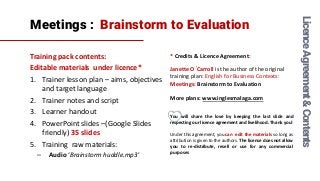
Training pack contents:
Editable materials under licence*
1. Trainer lesson plan – aims, objectives
and target language
2. Trainer notes and script
3. Learner handout
4. PowerPoint slides –(Google Slides
friendly) 35 slides
5. Training raw materials:
– Audio ‘Brainstorm huddle.mp3’
LicenceAgreement&Contents
* Credits & Licence Agreement:
Janette O´Carroll is the author of the original
training plan: English for Business Contexts:
Meetings: Brainstorm to Evaluation
More plans: www.inglesmalaga.com
You will share the love by keeping the last slide and
respecting our licence agreement and livelihood. Thank you!
Under this agreement, you can edit the materials so long as
attribution is given to the authors. The license does not allow
you to re-distribute, resell or use for any commercial
purposes
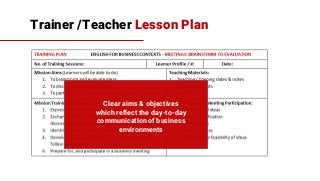
Trainer /Teacher Lesson Plan
Clear aims & objectives
which reflect the day-to-day
communication of business
environments
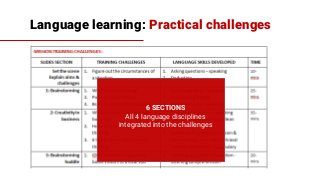
Language learning: Practical challenges
6 SECTIONS
All 4 language disciplines
integrated into the challenges
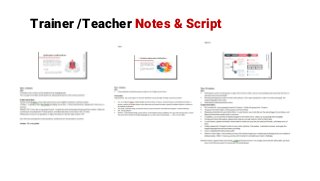
Trainer /Teacher Notes & Script
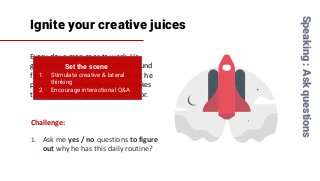
Ignite your creative juices
Every day a man goes to work. He
gets into a lift and presses the ground
floor button. When he comes back he
presses the 7th floor button and takes
the stairs to his flat on the 11th floor.
Speaking:Askquestions
Challenge:
1. Ask me yes / no questions to figure
out why he has this daily routine?
Set the scene
1. Stimulate creative & lateral
thinking
2. Encourage interactional Q&A
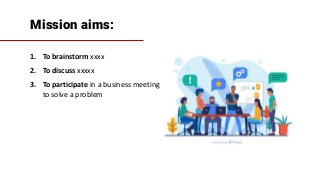
Mission aims:
1. To brainstorm xxxx
2. To discuss xxxxx
3. To participate in a business meeting
to solve a problem
Mission training challenges:
1. Express ideas about brainstorming
2. Exchange opinions about creativity in
business, and discuss techniques to
improve creative thinking
3. Identity key ideas from a recorded
brainstorming huddle
4. Develop language to participate in a
brainstorm follow-up meeting
5. Prepare for, and participate in a
business meeting
Target Language -
Meeting participation:
1. Put forward ideas
2. Ask for clarification
3. Clarify ideas
4. Build on ideas
5. Evaluate the feasibility
of ideas
Brainstorming
#1
Express Ideas
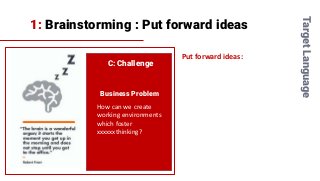
1: Brainstorming : Put forward ideas
TargetLanguage
How can we create
working environments
which foster, inspire
and support creative
thinking?
Business Problem
Challenge:
How can we create
working environments
which foster
xxxxxxthinking?
Business Problem
C: Challenge
Put forward ideas:
Creativity in business
#2
Exchange opinions,
Reading comprehension & Vocabulary
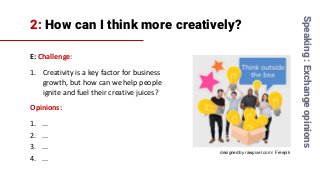
2: How can I think more creatively?
E: Challenge:
1. Creativity is a key factor for business
growth, but how can we help people
ignite and fuel their creative juices?
Opinions:
1. ...
2. ...
3. ...
4. ...
Speaking:Exchangeopinions
designed by rawpixel.com / Freepik
ReadingComprehension
6 Tips to Spark your Creative Potential:
1.To come up with unconventional ideas you often need to outside the box. Talk
to different people and open to different perspectives. down social barriers and
beyond your beliefs.
2.Creative solutions can be stimulated with a change of scenery, so out ways to
regularly get away from your usual working environment to around ideas with co-
workers.
3.Take risks and be prepared for many ideas to by the wayside. Learn to embrace
failure and back on track by understanding that trial and error is part of the
creative process.
4.Fearless creativity comes from a curious mind. Ask questions, challenge existing
ways of doing things, and out new approaches.
5.Jot down, sketch and record your ideas. The more ideas you and your team have,
the greater the chance you might on a game-changer.
6.When ideas don´t off the ground or into problems don´t give up. “Success is
99% failure” (Soichiro Honda) Words: 179
F: Challenge
Ignoring the gaps,
skim read the text
and jot down in a
few words the key
idea for each tip.
Improve speed reading
comprehension &
paraphrasing
Strengthen knowledge and facilitate application:
1. Speed reading comprehension
2. Paraphrasing
3. Use of vocabulary – focusing on phrasal verbs and
expression in context
Improve use of phrasal
verbs & expressions
Brainstorming Huddle
#3
Listening Comprehension
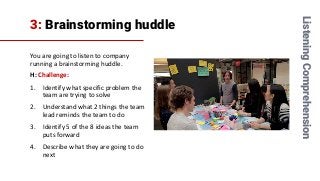
3: Brainstorming huddle
You are going to listen to company
running a brainstorming huddle.
H: Challenge:
1. Identify what specific problem the
team are trying to solve
2. Understand what 2 things the team
lead reminds the team to do
3. Identify 5 of the 8 ideas the team
puts forward
4. Describe what they are going to do
next
ListeningComprehension
Brainstorm follow-up
#4
Target Language
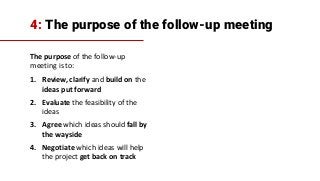
4: The purpose of the follow-up meeting
The purpose of the follow-up
meeting is to:
1. Review, clarify and build on the
ideas put forward
2. Evaluate the feasibility of the
ideas
3. Agree which ideas should fall by
the wayside
4. Negotiate which ideas will help
the project get back on track
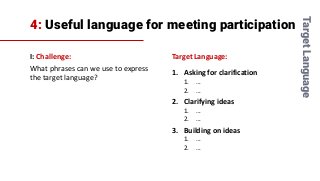
4: Useful language for meeting participation
I: Challenge:
What phrases can we use to express
the target language?
TargetLanguage
Target Language:
1. Asking for clarification
1. ...
2. ...
2. Clarifying ideas
1. ...
2. ...
3. Building on ideas
1. ...
2. ...
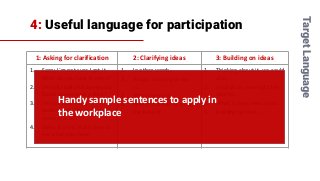
4: Useful language for participation
TargetLanguage
1: Asking for clarification 2: Clarifying ideas 3: Building on ideas
1. Sorry, I´m not sure I get it.
What do you have in mind?
2. I´m not really following you.
Could you expand a little?
3. I´m not sure I fully
understand. What do you
mean exactly?
4. Sorry, it´s not really clear to
me what you mean.
1. In other words...
2. What I´m trying to say
is...
3. What I mean is...
4. Well, I´m thinking along
the lines of...
1. Thinking about it, we could
also...
2. In addition, we might be
able to...
3. What´s more, we could...
4. Building on that,...
Handy sample sentences to apply in
the workplace
The follow-up meeting
#5
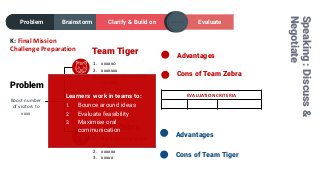
Discuss & Negotiate
Speaking:Discuss&
Negotiate
Clarify & Build onProblem Brainstorm Evaluate
Boost number
of visitors to
xxxx
Problem
1. xxxxxo
2. xxxxxxx
3. Zoo pop-ups in malls,
schools
Team Tiger
1. Night camping at the
zoo
2. xxxxxx
3. xxxxx
Team Zebra
Advantages
Cons of Team Zebra
Advantages
Cons of Team Tiger
EVALUATION CRITERIA
K: Final Mission
Challenge Preparation
Learners work in teams to:
1. Bounce around ideas
2. Evaluate feasibility
3. Maximise oral
communication
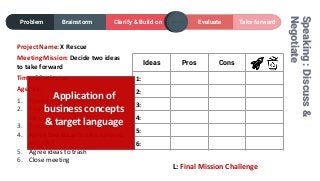
Speaking:Discuss&
Negotiate
Clarify & Build onProblem Brainstorm Evaluate Take forward
Project Name: X Rescue
Meeting Mission: Decide two ideas
to take forward
Time: 20 minutes
Agenda:
1. Open meeting & review aims
2. Teams put forward & clarify
ideas
3. Teams evaluate idea feasibility
4. Agree two ideas to take forward
and pilot
5. Agree ideas to trash
6. Close meeting
Ideas Pros Cons
1:
2:
3:
4:
5:
6:
L: Final Mission Challenge
Application of
business concepts
& target language
The Takeaways
#6
Review. Digest. Apply
for Business Contexts
ENGLISH
Meetings : Brainstorm to Evaluation
Credits & Licence Agreement:
Janette O´Carroll is the author of the original
training plan: English for Business Contexts:
Meetings: Brainstorm to Evaluation
More plans: www.inglesmalaga.com
Slide presentation templates based on the work of Slidesgo,
including icons by Flaticon, and images by Freepik
You will share the love by keeping this last slide and
respecting our licence agreement and livelihood. Thank you!
Under this agreement, you can edit the materials so long as
attribution is given to the authors. The license does not allow
you to re-distribute, resell or use for any commercial
purposes

ESL English for business meetings brainstorm to evaluation sample

  • 1.
    for Business Contexts Designedby tirachardz / Freepikphoto by pch.vector / Freepik ENGLISH Meetings : Brainstorm to Evaluation B2+
  • 2.
    Meetings : Brainstormto Evaluation Training pack contents: Editable materials under licence* 1. Trainer lesson plan – aims, objectives and target language 2. Trainer notes and script 3. Learner handout 4. PowerPoint slides –(Google Slides friendly) 35 slides 5. Training raw materials: – Audio ‘Brainstorm huddle.mp3’ LicenceAgreement&Contents * Credits & Licence Agreement: Janette O´Carroll is the author of the original training plan: English for Business Contexts: Meetings: Brainstorm to Evaluation More plans: www.inglesmalaga.com You will share the love by keeping the last slide and respecting our licence agreement and livelihood. Thank you! Under this agreement, you can edit the materials so long as attribution is given to the authors. The license does not allow you to re-distribute, resell or use for any commercial purposes
  • 3.
    Trainer /Teacher LessonPlan Clear aims & objectives which reflect the day-to-day communication of business environments
  • 4.
    Language learning: Practicalchallenges 6 SECTIONS All 4 language disciplines integrated into the challenges
  • 5.
  • 6.
    Ignite your creativejuices Every day a man goes to work. He gets into a lift and presses the ground floor button. When he comes back he presses the 7th floor button and takes the stairs to his flat on the 11th floor. Speaking:Askquestions Challenge: 1. Ask me yes / no questions to figure out why he has this daily routine? Set the scene 1. Stimulate creative & lateral thinking 2. Encourage interactional Q&A
  • 7.
    Mission aims: 1. Tobrainstorm xxxx 2. To discuss xxxxx 3. To participate in a business meeting to solve a problem
  • 8.
    Mission training challenges: 1.Express ideas about brainstorming 2. Exchange opinions about creativity in business, and discuss techniques to improve creative thinking 3. Identity key ideas from a recorded brainstorming huddle 4. Develop language to participate in a brainstorm follow-up meeting 5. Prepare for, and participate in a business meeting Target Language - Meeting participation: 1. Put forward ideas 2. Ask for clarification 3. Clarify ideas 4. Build on ideas 5. Evaluate the feasibility of ideas
  • 9.
  • 10.
    1: Brainstorming :Put forward ideas TargetLanguage How can we create working environments which foster, inspire and support creative thinking? Business Problem Challenge: How can we create working environments which foster xxxxxxthinking? Business Problem C: Challenge Put forward ideas:
  • 11.
    Creativity in business #2 Exchangeopinions, Reading comprehension & Vocabulary
  • 12.
    2: How canI think more creatively? E: Challenge: 1. Creativity is a key factor for business growth, but how can we help people ignite and fuel their creative juices? Opinions: 1. ... 2. ... 3. ... 4. ... Speaking:Exchangeopinions designed by rawpixel.com / Freepik
  • 13.
    ReadingComprehension 6 Tips toSpark your Creative Potential: 1.To come up with unconventional ideas you often need to outside the box. Talk to different people and open to different perspectives. down social barriers and beyond your beliefs. 2.Creative solutions can be stimulated with a change of scenery, so out ways to regularly get away from your usual working environment to around ideas with co- workers. 3.Take risks and be prepared for many ideas to by the wayside. Learn to embrace failure and back on track by understanding that trial and error is part of the creative process. 4.Fearless creativity comes from a curious mind. Ask questions, challenge existing ways of doing things, and out new approaches. 5.Jot down, sketch and record your ideas. The more ideas you and your team have, the greater the chance you might on a game-changer. 6.When ideas don´t off the ground or into problems don´t give up. “Success is 99% failure” (Soichiro Honda) Words: 179 F: Challenge Ignoring the gaps, skim read the text and jot down in a few words the key idea for each tip. Improve speed reading comprehension & paraphrasing Strengthen knowledge and facilitate application: 1. Speed reading comprehension 2. Paraphrasing 3. Use of vocabulary – focusing on phrasal verbs and expression in context Improve use of phrasal verbs & expressions
  • 14.
  • 15.
    3: Brainstorming huddle Youare going to listen to company running a brainstorming huddle. H: Challenge: 1. Identify what specific problem the team are trying to solve 2. Understand what 2 things the team lead reminds the team to do 3. Identify 5 of the 8 ideas the team puts forward 4. Describe what they are going to do next ListeningComprehension
  • 16.
  • 17.
    4: The purposeof the follow-up meeting The purpose of the follow-up meeting is to: 1. Review, clarify and build on the ideas put forward 2. Evaluate the feasibility of the ideas 3. Agree which ideas should fall by the wayside 4. Negotiate which ideas will help the project get back on track
  • 18.
    4: Useful languagefor meeting participation I: Challenge: What phrases can we use to express the target language? TargetLanguage Target Language: 1. Asking for clarification 1. ... 2. ... 2. Clarifying ideas 1. ... 2. ... 3. Building on ideas 1. ... 2. ...
  • 19.
    4: Useful languagefor participation TargetLanguage 1: Asking for clarification 2: Clarifying ideas 3: Building on ideas 1. Sorry, I´m not sure I get it. What do you have in mind? 2. I´m not really following you. Could you expand a little? 3. I´m not sure I fully understand. What do you mean exactly? 4. Sorry, it´s not really clear to me what you mean. 1. In other words... 2. What I´m trying to say is... 3. What I mean is... 4. Well, I´m thinking along the lines of... 1. Thinking about it, we could also... 2. In addition, we might be able to... 3. What´s more, we could... 4. Building on that,... Handy sample sentences to apply in the workplace
  • 20.
  • 21.
    Speaking:Discuss& Negotiate Clarify & BuildonProblem Brainstorm Evaluate Boost number of visitors to xxxx Problem 1. xxxxxo 2. xxxxxxx 3. Zoo pop-ups in malls, schools Team Tiger 1. Night camping at the zoo 2. xxxxxx 3. xxxxx Team Zebra Advantages Cons of Team Zebra Advantages Cons of Team Tiger EVALUATION CRITERIA K: Final Mission Challenge Preparation Learners work in teams to: 1. Bounce around ideas 2. Evaluate feasibility 3. Maximise oral communication
  • 22.
    Speaking:Discuss& Negotiate Clarify & BuildonProblem Brainstorm Evaluate Take forward Project Name: X Rescue Meeting Mission: Decide two ideas to take forward Time: 20 minutes Agenda: 1. Open meeting & review aims 2. Teams put forward & clarify ideas 3. Teams evaluate idea feasibility 4. Agree two ideas to take forward and pilot 5. Agree ideas to trash 6. Close meeting Ideas Pros Cons 1: 2: 3: 4: 5: 6: L: Final Mission Challenge Application of business concepts & target language
  • 23.
  • 24.
    for Business Contexts ENGLISH Meetings: Brainstorm to Evaluation Credits & Licence Agreement: Janette O´Carroll is the author of the original training plan: English for Business Contexts: Meetings: Brainstorm to Evaluation More plans: www.inglesmalaga.com Slide presentation templates based on the work of Slidesgo, including icons by Flaticon, and images by Freepik You will share the love by keeping this last slide and respecting our licence agreement and livelihood. Thank you! Under this agreement, you can edit the materials so long as attribution is given to the authors. The license does not allow you to re-distribute, resell or use for any commercial purposes