W O R KSTR EAM I
Technology Platform: Case Studies
Technologies, Platforms and Partnerships in Support of the African Agricultural Science Agenda
ABIDJAN, COTE D’IVOIRE / APRIL 4-5, 2017
CORAF/WECARD | Kodjo Kondo
ASARECA | Moses Odeke, CCARDESA | Baitsi Podisi
IFPRI | L. You, U. Wood-Sichra, and J. Koo
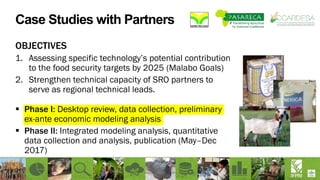
OBJECTIVES
1. Assessing specific technology’s potential contribution
to the food security targets by 2025 (Malabo Goals)
2. Strengthen technical capacity of SRO partners to
serve as regional technical leads.
 Phase I: Desktop review, data collection, preliminary
ex-ante economic modeling analysis
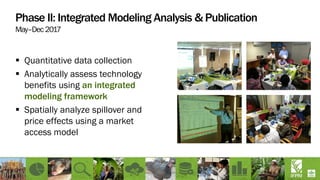
 Phase II: Integrated modeling analysis, quantitative
data collection and analysis, publication (May–Dec
2017)
Case Studies with Partners
Assessing specific technology’s potential
contribution to the food security targets by 2025
Main Research Questions
1. What is the current rate of adoption of the technology in the target regions?
2. What are the drivers and impediments to the technology adoption?
3. What is the impact of the adoption of the technology?
4. Are there any significant technological, managerial and environmental gaps
between adopters and non-adopters?
Case Studies with Partners
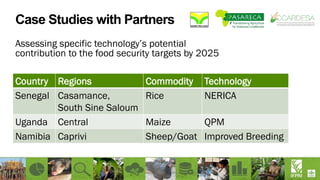
Country Regions Commodity Technology
Senegal Casamance,
South Sine Saloum
Rice NERICA
Uganda Central Maize QPM
Namibia Caprivi Sheep/Goat Improved Breeding
Assessing specific technology’s potential
contribution to the food security targets by 2025
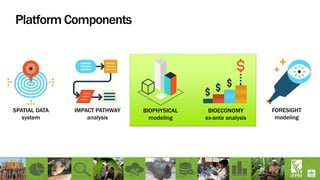
Platform Components
SPATIAL DATA
system
IMPACT PATHWAY
analysis
BIOPHYSICAL
modeling
BIOECONOMY
ex-ante analysis
FORESIGHT
modeling
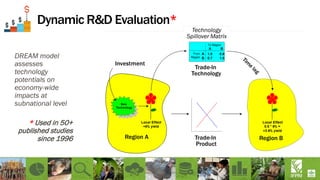
Dynamic R&D Evaluation*
DREAM model
assesses
technology
potentials on
economy-wide
impacts at
subnational level
* Used in 50+
published studies
since 1996
Price
Quantity
a
b
Gross
Annual
Research
Benefit
NERICA in Senegal
Can NERICA Contribute to Achieve
the Malabo Food Security Target in
Senegal by 2025?
Overview
1. Background and justification
2. Study area
3. Research questions
4. Methods and tools
5. Preliminary results
6. Conclusions and way forward
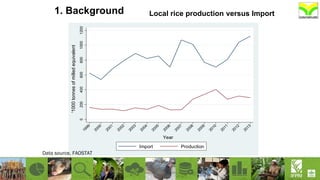
Local rice production versus Import
020040060080010001200
'1000tonnesofmilledequivalent
1999
2000
2001
2002
2003
2004
2005
2006
2007
2008
2009
2010
2011
2012
2013
Year
Import Production
Data source, FAOSTAT
1. Background
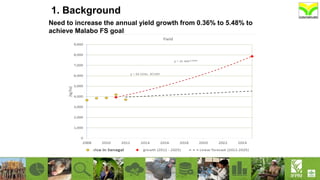
Need to increase the annual yield growth from 0.36% to 5.48% to
achieve Malabo FS goal
1. Background
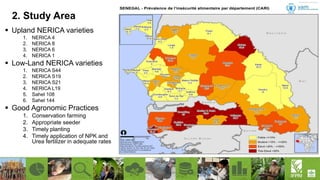
2. Study Area
 Upland NERICA varieties
1. NERICA 4
2. NERICA 8
3. NERICA 6
4. NERICA 1
 Low-Land NERICA varieties
1. NERICA S44
2. NERICA S19
3. NERICA S21
4. NERICA L19
5. Sahel 108
6. Sahel 144
 Good Agronomic Practices
1. Conservation farming
2. Appropriate seeder
3. Timely planting
4. Timely application of NPK and
Urea fertilizer in adequate rates
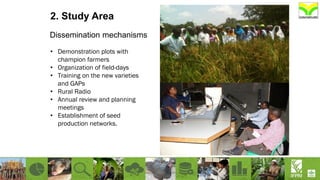
Dissemination mechanisms
2. Study Area
• Demonstration plots with
champion farmers
• Organization of field-days
• Training on the new varieties
and GAPs
• Rural Radio
• Annual review and planning
meetings
• Establishment of seed
production networks.
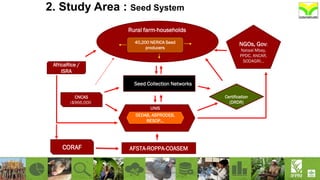
30 Seed Collection Networks
AfricaRice /
ISRA
CNCAS
($966,000)
UNIS
SEDAB, ASPRODEB,
RESOP…
CORAF
NGOs, Gov:
Nataal Mbay,
PPDC, ANCAR,
SODAGRI…
Certification
(DRDR)
Rural farm-households
40,200 NERICA Seed
producers
2. Study Area : Seed System
AFSTA-ROPPA-COASEM
1. What is the current levels adoption of NERICA in the target zones?
2. What are ex-ant impacts of NERICA?
3. What are the drivers and impediments to NERICA adoption and the
intensity of adoption?
4. What is the impact of the adoption on productivity and food
security?
5. Are there any technological, managerial and environmental gaps
between NERICA growers and non-growers?
6. What is the impact of NERICA on seed-producing households’
agricultural income and food security?
7. How efficient are the seed producers and what are the factors
contributing to inefficiency?
3. Research Questions
15
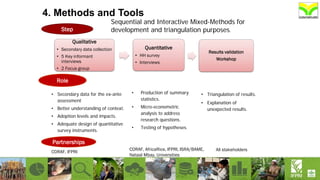
Sequential and Interactive Mixed-Methods for
development and triangulation purposes.
Quantitative
• HH survey
• Interviews
Results validation
Workshop
Qualitative
• Secondary data collection
• 5 Key informant
interviews
• 2 Focus group
• Secondary data for the ex-ante
assessment
• Better understanding of context.
• Adoption levels and impacts.
• Adequate design of quantitative
survey instruments.
• Production of summary
statistics.
• Micro-econometric
analysis to address
research questions.
• Testing of hypotheses.
• Triangulation of results.
• Explanation of
unexpected results.
Role
Step
Partnerships
CORAF, IFPRI
CORAF, AfricaRice, IFPRI, ISRA/BAME,
Nataal Mbay, Universities
All stakeholders
4. Methods and Tools
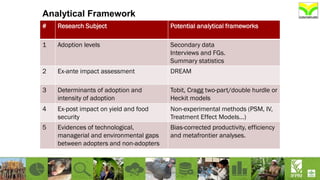
# Research Subject Potential analytical frameworks
1 Adoption levels Secondary data
Interviews and FGs.
Summary statistics
2 Ex-ante impact assessment DREAM
3 Determinants of adoption and
intensity of adoption
Tobit, Cragg two-part/double hurdle or
Heckit models
4 Ex-post impact on yield and food
security
Non-experimental methods (PSM, IV,
Treatment Effect Models…)
5 Evidences of technological,
managerial and environmental gaps
between adopters and non-adopters
Bias-corrected productivity, efficiency
and metafrontier analyses.
Analytical Framework
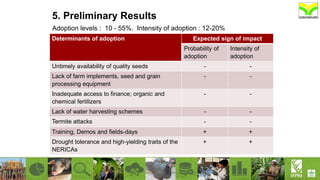
5. Preliminary Results
Adoption levels : 10 - 55%. Intensity of adoption : 12-20%
Determinants of adoption Expected sign of impact
Probability of
adoption
Intensity of
adoption
Untimely availability of quality seeds - -
Lack of farm implements, seed and grain
processing equipment
- -
Inadequate access to finance; organic and
chemical fertilizers
- -
Lack of water harvesting schemes - -
Termite attacks - -
Training, Demos and fields-days + +
Drought tolerance and high-yielding traits of the
NERICAs
+ +
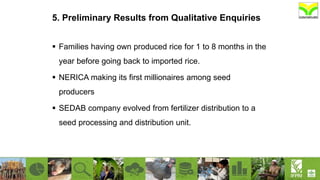
5. Preliminary Results from Qualitative Enquiries
 Families having own produced rice for 1 to 8 months in the
year before going back to imported rice.
 NERICA making its first millionaires among seed
producers
 SEDAB company evolved from fertilizer distribution to a
seed processing and distribution unit.
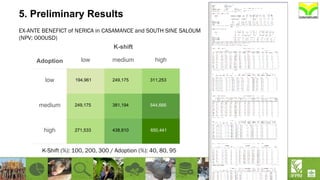
5. Preliminary Results
EX-ANTE BENEFICT of NERICA in CASAMANCE and SOUTH SINE SALOUM
(NPV; 000USD)
Adoption
K-shift
low medium high
low
medium
high 650,441
544,666
311,253
438,810
381,194
249,175
271,533
249,175
194,961
K-Shift (%): 100, 200, 300 / Adoption (%): 40, 80, 95
6. Conclusion & Way Forward
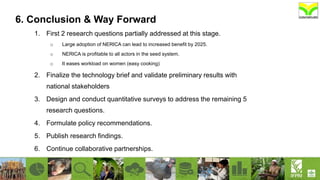
1. First 2 research questions partially addressed at this stage.
o Large adoption of NERICA can lead to increased benefit by 2025.
o NERICA is profitable to all actors in the seed system.
o It eases workload on women (easy cooking)
2. Finalize the technology brief and validate preliminary results with
national stakeholders
3. Design and conduct quantitative surveys to address the remaining 5
research questions.
4. Formulate policy recommendations.
5. Publish research findings.
6. Continue collaborative partnerships.
QPM in Uganda
Can QPM Contribute to Achieve the
Malabo Food Security Target in
Uganda by 2025?
What has been done so far
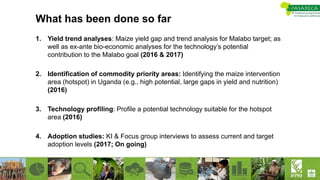
1. Yield trend analyses: Maize yield gap and trend analysis for Malabo target; as
well as ex-ante bio-economic analyses for the technology’s potential
contribution to the Malabo goal (2016 & 2017)
2. Identification of commodity priority areas: Identifying the maize intervention
area (hotspot) in Uganda (e.g., high potential, large gaps in yield and nutrition)
(2016)
3. Technology profiling: Profile a potential technology suitable for the hotspot
area (2016)
4. Adoption studies: KI & Focus group interviews to assess current and target
adoption levels (2017; On going)
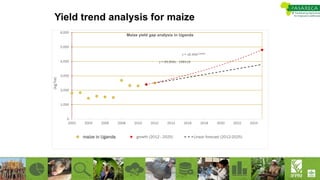
Yield trend analysis for maize
y = 99.856x - 198419
y = 1E-40e0.0495x
0
1,000
2,000
3,000
4,000
5,000
6,000
2002 2004 2006 2008 2010 2012 2014 2016 2018 2020 2022 2024
(kg/ha)
Maize yield gap analysis in Uganda
maize in Uganda growth (2012 - 2025) Linear forecast (2012-2025)
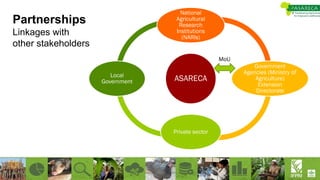
Partnerships
Linkages with
other stakeholders
ASARECA
National
Agricultural
Research
Institutions
(NARIs)
Government
Agencies (Ministry of
Agriculture)
Extension
Directorate
Private sector
Local
Government
MoU
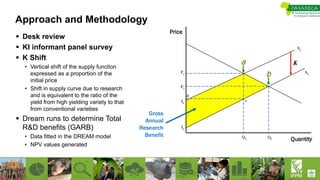
 Desk review
 KI informant panel survey
 K Shift
• Vertical shift of the supply function
expressed as a proportion of the
initial price
• Shift in supply curve due to research
and is equivalent to the ratio of the
yield from high yielding variety to that
from conventional varieties
 Dream runs to determine Total
R&D benefits (GARB)
• Data fitted in the DREAM model
• NPV values generated
Approach and Methodology
Price
Quantity
a
b
Gross
Annual
Research
Benefit
Approach and Methodology (2)
Total Benefits (B) computed from the following formula:
B= PQK (1 + K*0.5ED) (1- [(1-ED)2 ES/(ED-ES)]
Where B= Gross Annual Research Benefits (GARB); P= Price of the Product;
Q=Quantity of Product; K= Shift of the supply curve due to research; and ES and
ED are the supply and demand elasticities respectively
Kmax due to induced R&D effects is computed from the formula
Ki
Max = PiciAi
Max PPi,0 > 0
Where Pi= Probability of success which if the research is successful and the
products are fully adopted; will yield a cost saving per unit of output equal to ci
percent of the initial price PPi,0 in region i; while a ceiling adoption rate of Ai Max
percent holds in region i
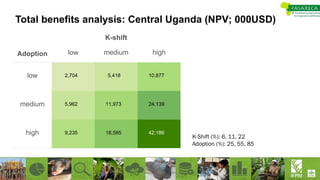
Total benefits analysis: Central Uganda (NPV; 000USD)
Adoption
K-shift
low medium high
low
medium
high 42,186
24,139
10,877
18,585
11,973
5,418
9,235
5,962
2,704
K-Shift (%): 6, 11, 22
Adoption (%): 25, 55, 85
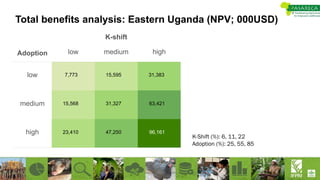
Total benefits analysis: Eastern Uganda (NPV; 000USD)
Adoption
K-shift
low medium high
low
medium
high 96,161
63,421
31,383
47,250
31,327
15,595
23,410
15,568
7,773
K-Shift (%): 6, 11, 22
Adoption (%): 25, 55, 85
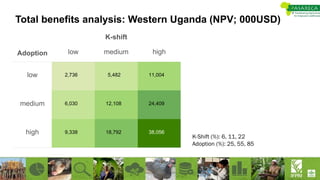
Total benefits analysis: Western Uganda (NPV; 000USD)
Adoption
K-shift
low medium high
low
medium
high 38,056
24,409
11,004
18,792
12,108
5,482
9,338
6,030
2,736
K-Shift (%): 6, 11, 22
Adoption (%): 25, 55, 85
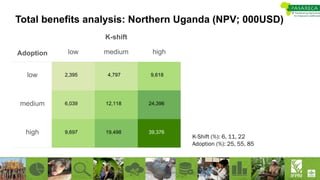
Total benefits analysis: Northern Uganda (NPV; 000USD)
Adoption
K-shift
low medium high
low
medium
high 39,376
24,396
9,618
19,498
12,118
4,797
9,697
6,039
2,395
K-Shift (%): 6, 11, 22
Adoption (%): 25, 55, 85
Conclusions
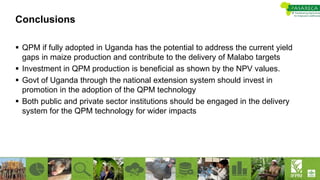
 QPM if fully adopted in Uganda has the potential to address the current yield
gaps in maize production and contribute to the delivery of Malabo targets
 Investment in QPM production is beneficial as shown by the NPV values.
 Govt of Uganda through the national extension system should invest in
promotion in the adoption of the QPM technology
 Both public and private sector institutions should be engaged in the delivery
system for the QPM technology for wider impacts
Next steps
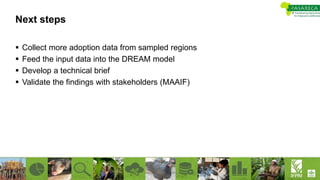
 Collect more adoption data from sampled regions
 Feed the input data into the DREAM model
 Develop a technical brief
 Validate the findings with stakeholders (MAAIF)
Phase II: Integrated Modeling Analysis & Publication
May–Dec2017
 Quantitative data collection
 Analytically assess technology
benefits using an integrated
modeling framework
 Spatially analyze spillover and
price effects using a market
access model
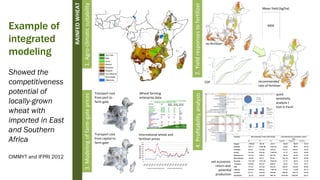
Example of
integrated
modeling
Showed the
competitiveness
potential of
locally-grown
wheat with
imported in East
and Southern
Africa
CIMMYT and IFPRI 2012
RAINFEDWHEAT
1.Agro-climaticsuitability
2.Yieldresponsestofertilizer
3.Modelingoffarm-gateprices
no fertilizer
recommended
rate of fertilizer
Mean Yield (kg/ha)
4000
Transport cost
from port to
farm-gate
Transport cost
from capital to
farm-gate
Wheat farming
enterprise data
4.Profitabilityanalysis
0
50
100
150
200
250
300
350
400
450
Wheatprice(US$/ton)
Nominalworldwheat price Realworld wheat price
International wheat and
fertilizer prices
CDF
Country Net economic return (US $/Ha) Incremental net economic return
(%)
T0 T1 T2 T0 to T1 T0 to T2 T1 to T2
Angola -198.60 -85.75 -22.11 56.82 88.87 74.22
Burundi 753.11 1096.98 1362.42 45.66 80.91 24.20
Ethiopia 59.62 173.80 233.87 191.51 292.27 34.56
Kenya 741.03 976.46 1160.50 31.77 56.61 18.85
Madagascar 161.46 239.31 267.92 48.22 65.94 11.96
Mozambique -46.94 29.15 39.20 162.10 183.51 34.48
Rwanda 1131.30 1377.55 1566.96 21.77 38.51 13.75
Tanzania 379.00 554.67 658.47 46.35 73.74 18.71
DRC 171.67 347.30 454.33 102.31 164.65 30.82
Uganda 639.29 903.64 1103.94 41.35 72.68 22.17
Zambia 67.72 310.20 449.48 358.06 563.73 44.90
Zimbabwe -25.72 236.49 400.16 1019.48 1655.83 69.21
quick
sensitivity
analysis t
tool in Excel
net economic
return and
potential
production
Workstream 1: Technology Platform: Case Studies

Workstream 1: Technology Platform: Case Studies

  • 1.
    W O RKSTR EAM I Technology Platform: Case Studies Technologies, Platforms and Partnerships in Support of the African Agricultural Science Agenda ABIDJAN, COTE D’IVOIRE / APRIL 4-5, 2017 CORAF/WECARD | Kodjo Kondo ASARECA | Moses Odeke, CCARDESA | Baitsi Podisi IFPRI | L. You, U. Wood-Sichra, and J. Koo
  • 2.
    OBJECTIVES 1. Assessing specifictechnology’s potential contribution to the food security targets by 2025 (Malabo Goals) 2. Strengthen technical capacity of SRO partners to serve as regional technical leads.  Phase I: Desktop review, data collection, preliminary ex-ante economic modeling analysis  Phase II: Integrated modeling analysis, quantitative data collection and analysis, publication (May–Dec 2017) Case Studies with Partners
  • 3.
    Case Studies withPartners Assessing specific technology’s potential contribution to the food security targets by 2025 Main Research Questions 1. What is the current rate of adoption of the technology in the target regions? 2. What are the drivers and impediments to the technology adoption? 3. What is the impact of the adoption of the technology? 4. Are there any significant technological, managerial and environmental gaps between adopters and non-adopters?
  • 4.
    Case Studies withPartners Country Regions Commodity Technology Senegal Casamance, South Sine Saloum Rice NERICA Uganda Central Maize QPM Namibia Caprivi Sheep/Goat Improved Breeding Assessing specific technology’s potential contribution to the food security targets by 2025
  • 5.
    Platform Components SPATIAL DATA system IMPACTPATHWAY analysis BIOPHYSICAL modeling BIOECONOMY ex-ante analysis FORESIGHT modeling
  • 6.
    Dynamic R&D Evaluation* DREAMmodel assesses technology potentials on economy-wide impacts at subnational level * Used in 50+ published studies since 1996 Price Quantity a b Gross Annual Research Benefit
  • 7.
    NERICA in Senegal CanNERICA Contribute to Achieve the Malabo Food Security Target in Senegal by 2025?
  • 8.
    Overview 1. Background andjustification 2. Study area 3. Research questions 4. Methods and tools 5. Preliminary results 6. Conclusions and way forward
  • 9.
    Local rice productionversus Import 020040060080010001200 '1000tonnesofmilledequivalent 1999 2000 2001 2002 2003 2004 2005 2006 2007 2008 2009 2010 2011 2012 2013 Year Import Production Data source, FAOSTAT 1. Background
  • 10.
    Need to increasethe annual yield growth from 0.36% to 5.48% to achieve Malabo FS goal 1. Background
  • 11.
    2. Study Area Upland NERICA varieties 1. NERICA 4 2. NERICA 8 3. NERICA 6 4. NERICA 1  Low-Land NERICA varieties 1. NERICA S44 2. NERICA S19 3. NERICA S21 4. NERICA L19 5. Sahel 108 6. Sahel 144  Good Agronomic Practices 1. Conservation farming 2. Appropriate seeder 3. Timely planting 4. Timely application of NPK and Urea fertilizer in adequate rates
  • 12.
    Dissemination mechanisms 2. StudyArea • Demonstration plots with champion farmers • Organization of field-days • Training on the new varieties and GAPs • Rural Radio • Annual review and planning meetings • Establishment of seed production networks.
  • 13.
    30 Seed CollectionNetworks AfricaRice / ISRA CNCAS ($966,000) UNIS SEDAB, ASPRODEB, RESOP… CORAF NGOs, Gov: Nataal Mbay, PPDC, ANCAR, SODAGRI… Certification (DRDR) Rural farm-households 40,200 NERICA Seed producers 2. Study Area : Seed System AFSTA-ROPPA-COASEM
  • 14.
    1. What isthe current levels adoption of NERICA in the target zones? 2. What are ex-ant impacts of NERICA? 3. What are the drivers and impediments to NERICA adoption and the intensity of adoption? 4. What is the impact of the adoption on productivity and food security? 5. Are there any technological, managerial and environmental gaps between NERICA growers and non-growers? 6. What is the impact of NERICA on seed-producing households’ agricultural income and food security? 7. How efficient are the seed producers and what are the factors contributing to inefficiency? 3. Research Questions
  • 15.
    15 Sequential and InteractiveMixed-Methods for development and triangulation purposes. Quantitative • HH survey • Interviews Results validation Workshop Qualitative • Secondary data collection • 5 Key informant interviews • 2 Focus group • Secondary data for the ex-ante assessment • Better understanding of context. • Adoption levels and impacts. • Adequate design of quantitative survey instruments. • Production of summary statistics. • Micro-econometric analysis to address research questions. • Testing of hypotheses. • Triangulation of results. • Explanation of unexpected results. Role Step Partnerships CORAF, IFPRI CORAF, AfricaRice, IFPRI, ISRA/BAME, Nataal Mbay, Universities All stakeholders 4. Methods and Tools
  • 16.
    # Research SubjectPotential analytical frameworks 1 Adoption levels Secondary data Interviews and FGs. Summary statistics 2 Ex-ante impact assessment DREAM 3 Determinants of adoption and intensity of adoption Tobit, Cragg two-part/double hurdle or Heckit models 4 Ex-post impact on yield and food security Non-experimental methods (PSM, IV, Treatment Effect Models…) 5 Evidences of technological, managerial and environmental gaps between adopters and non-adopters Bias-corrected productivity, efficiency and metafrontier analyses. Analytical Framework
  • 17.
    5. Preliminary Results Adoptionlevels : 10 - 55%. Intensity of adoption : 12-20% Determinants of adoption Expected sign of impact Probability of adoption Intensity of adoption Untimely availability of quality seeds - - Lack of farm implements, seed and grain processing equipment - - Inadequate access to finance; organic and chemical fertilizers - - Lack of water harvesting schemes - - Termite attacks - - Training, Demos and fields-days + + Drought tolerance and high-yielding traits of the NERICAs + +
  • 18.
    5. Preliminary Resultsfrom Qualitative Enquiries  Families having own produced rice for 1 to 8 months in the year before going back to imported rice.  NERICA making its first millionaires among seed producers  SEDAB company evolved from fertilizer distribution to a seed processing and distribution unit.
  • 19.
    5. Preliminary Results EX-ANTEBENEFICT of NERICA in CASAMANCE and SOUTH SINE SALOUM (NPV; 000USD) Adoption K-shift low medium high low medium high 650,441 544,666 311,253 438,810 381,194 249,175 271,533 249,175 194,961 K-Shift (%): 100, 200, 300 / Adoption (%): 40, 80, 95
  • 20.
    6. Conclusion &Way Forward 1. First 2 research questions partially addressed at this stage. o Large adoption of NERICA can lead to increased benefit by 2025. o NERICA is profitable to all actors in the seed system. o It eases workload on women (easy cooking) 2. Finalize the technology brief and validate preliminary results with national stakeholders 3. Design and conduct quantitative surveys to address the remaining 5 research questions. 4. Formulate policy recommendations. 5. Publish research findings. 6. Continue collaborative partnerships.
  • 21.
    QPM in Uganda CanQPM Contribute to Achieve the Malabo Food Security Target in Uganda by 2025?
  • 22.
    What has beendone so far 1. Yield trend analyses: Maize yield gap and trend analysis for Malabo target; as well as ex-ante bio-economic analyses for the technology’s potential contribution to the Malabo goal (2016 & 2017) 2. Identification of commodity priority areas: Identifying the maize intervention area (hotspot) in Uganda (e.g., high potential, large gaps in yield and nutrition) (2016) 3. Technology profiling: Profile a potential technology suitable for the hotspot area (2016) 4. Adoption studies: KI & Focus group interviews to assess current and target adoption levels (2017; On going)
  • 23.
    Yield trend analysisfor maize y = 99.856x - 198419 y = 1E-40e0.0495x 0 1,000 2,000 3,000 4,000 5,000 6,000 2002 2004 2006 2008 2010 2012 2014 2016 2018 2020 2022 2024 (kg/ha) Maize yield gap analysis in Uganda maize in Uganda growth (2012 - 2025) Linear forecast (2012-2025)
  • 24.
    Partnerships Linkages with other stakeholders ASARECA National Agricultural Research Institutions (NARIs) Government Agencies(Ministry of Agriculture) Extension Directorate Private sector Local Government MoU
  • 25.
     Desk review KI informant panel survey  K Shift • Vertical shift of the supply function expressed as a proportion of the initial price • Shift in supply curve due to research and is equivalent to the ratio of the yield from high yielding variety to that from conventional varieties  Dream runs to determine Total R&D benefits (GARB) • Data fitted in the DREAM model • NPV values generated Approach and Methodology Price Quantity a b Gross Annual Research Benefit
  • 26.
    Approach and Methodology(2) Total Benefits (B) computed from the following formula: B= PQK (1 + K*0.5ED) (1- [(1-ED)2 ES/(ED-ES)] Where B= Gross Annual Research Benefits (GARB); P= Price of the Product; Q=Quantity of Product; K= Shift of the supply curve due to research; and ES and ED are the supply and demand elasticities respectively Kmax due to induced R&D effects is computed from the formula Ki Max = PiciAi Max PPi,0 > 0 Where Pi= Probability of success which if the research is successful and the products are fully adopted; will yield a cost saving per unit of output equal to ci percent of the initial price PPi,0 in region i; while a ceiling adoption rate of Ai Max percent holds in region i
  • 27.
    Total benefits analysis:Central Uganda (NPV; 000USD) Adoption K-shift low medium high low medium high 42,186 24,139 10,877 18,585 11,973 5,418 9,235 5,962 2,704 K-Shift (%): 6, 11, 22 Adoption (%): 25, 55, 85
  • 28.
    Total benefits analysis:Eastern Uganda (NPV; 000USD) Adoption K-shift low medium high low medium high 96,161 63,421 31,383 47,250 31,327 15,595 23,410 15,568 7,773 K-Shift (%): 6, 11, 22 Adoption (%): 25, 55, 85
  • 29.
    Total benefits analysis:Western Uganda (NPV; 000USD) Adoption K-shift low medium high low medium high 38,056 24,409 11,004 18,792 12,108 5,482 9,338 6,030 2,736 K-Shift (%): 6, 11, 22 Adoption (%): 25, 55, 85
  • 30.
    Total benefits analysis:Northern Uganda (NPV; 000USD) Adoption K-shift low medium high low medium high 39,376 24,396 9,618 19,498 12,118 4,797 9,697 6,039 2,395 K-Shift (%): 6, 11, 22 Adoption (%): 25, 55, 85
  • 31.
    Conclusions  QPM iffully adopted in Uganda has the potential to address the current yield gaps in maize production and contribute to the delivery of Malabo targets  Investment in QPM production is beneficial as shown by the NPV values.  Govt of Uganda through the national extension system should invest in promotion in the adoption of the QPM technology  Both public and private sector institutions should be engaged in the delivery system for the QPM technology for wider impacts
  • 32.
    Next steps  Collectmore adoption data from sampled regions  Feed the input data into the DREAM model  Develop a technical brief  Validate the findings with stakeholders (MAAIF)
  • 33.
    Phase II: IntegratedModeling Analysis & Publication May–Dec2017  Quantitative data collection  Analytically assess technology benefits using an integrated modeling framework  Spatially analyze spillover and price effects using a market access model
  • 34.
    Example of integrated modeling Showed the competitiveness potentialof locally-grown wheat with imported in East and Southern Africa CIMMYT and IFPRI 2012 RAINFEDWHEAT 1.Agro-climaticsuitability 2.Yieldresponsestofertilizer 3.Modelingoffarm-gateprices no fertilizer recommended rate of fertilizer Mean Yield (kg/ha) 4000 Transport cost from port to farm-gate Transport cost from capital to farm-gate Wheat farming enterprise data 4.Profitabilityanalysis 0 50 100 150 200 250 300 350 400 450 Wheatprice(US$/ton) Nominalworldwheat price Realworld wheat price International wheat and fertilizer prices CDF Country Net economic return (US $/Ha) Incremental net economic return (%) T0 T1 T2 T0 to T1 T0 to T2 T1 to T2 Angola -198.60 -85.75 -22.11 56.82 88.87 74.22 Burundi 753.11 1096.98 1362.42 45.66 80.91 24.20 Ethiopia 59.62 173.80 233.87 191.51 292.27 34.56 Kenya 741.03 976.46 1160.50 31.77 56.61 18.85 Madagascar 161.46 239.31 267.92 48.22 65.94 11.96 Mozambique -46.94 29.15 39.20 162.10 183.51 34.48 Rwanda 1131.30 1377.55 1566.96 21.77 38.51 13.75 Tanzania 379.00 554.67 658.47 46.35 73.74 18.71 DRC 171.67 347.30 454.33 102.31 164.65 30.82 Uganda 639.29 903.64 1103.94 41.35 72.68 22.17 Zambia 67.72 310.20 449.48 358.06 563.73 44.90 Zimbabwe -25.72 236.49 400.16 1019.48 1655.83 69.21 quick sensitivity analysis t tool in Excel net economic return and potential production