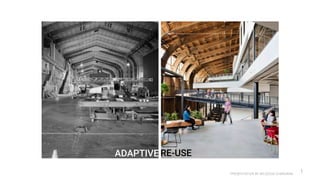
ADAPTIVE RE-USE
PRESENTATION BY AR.GEEVA CHANDANA 1
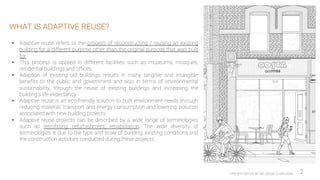
WHAT IS ADAPTIVE REUSE?
PRESENTATION BY AR.GEEVA CHANDANA 2
• Adaptive reuse refers to the process of reconstructing / reusing an existing
building for a different purpose other than the original purpose that was built
for.
• This process is applied in different facilities such as museums, mosques,
residential buildings and offices.
• Adaption of existing old buildings results in many tangible and intangible
benefits to the public and government and also in terms of environmental
sustainability, through the reuse of existing buildings and increasing the
building’s life expectancy.
• Adaptive reuse is an eco-friendly solution to built environment needs through
reducing material, transport and energy consumption and lowering pollution
associated with new building projects
• Adaptive reuse projects can be described by a wide range of terminologies
such as retrofitting, refurbishment, rehabilitation. The wide diversity of
terminologies is due to the type and scale of building, existing conditions and
the construction activities conducted during these projects.
PRESENTATION BY AR.GEEVA CHANDANA 3
Sage and Lavender Bistro, Alwarpet, Chennai
PRESENTATION BY AR.GEEVA CHANDANA 4
PRESENTATION BY AR.GEEVA CHANDANA 5
Fika, Adyar, Chennai
PRESENTATION BY AR.GEEVA CHANDANA 6
PRESENTATION BY AR.GEEVA CHANDANA 7
Svatma Heritage, Thanjavur
PRESENTATION BY AR.GEEVA CHANDANA 8
PRESENTATION BY AR.GEEVA CHANDANA 9
PRESENTATION BY AR.GEEVA CHANDANA 10
PRESENTATION BY AR.GEEVA CHANDANA 11
PRESENTATION BY AR.GEEVA CHANDANA 12
Gratitude Heritage, Pondicherry
PRESENTATION BY AR.GEEVA CHANDANA 13
PRESENTATION BY AR.GEEVA CHANDANA 14
Kandadu, Pondicherry
PRESENTATION BY AR.GEEVA CHANDANA 15
Chidambara Vilas - A Luxury Heritage Resort, Chettinadu Region
PRESENTATION BY AR.GEEVA CHANDANA 16
PRESENTATION BY AR.GEEVA CHANDANA 17
PRESENTATION BY AR.GEEVA CHANDANA 18
PRESENTATION BY AR.GEEVA CHANDANA 19
Collage House | S+PS Architects, Mumbai
PRESENTATION BY AR.GEEVA CHANDANA 20
PRESENTATION BY AR.GEEVA CHANDANA 21
PRESENTATION BY AR.GEEVA CHANDANA 22
PRESENTATION BY AR.GEEVA CHANDANA 23
Alembic Industrial Heritage development, Vadodara | Adaptive reuse of Industry to Cultural Centre
PRESENTATION BY AR.GEEVA CHANDANA 24
PRESENTATION BY AR.GEEVA CHANDANA 25
PRESENTATION BY AR.GEEVA CHANDANA 26
PRESENTATION BY AR.GEEVA CHANDANA 27
Duke Energy Innovation Center at Optimist Hall | Adaptive Reuse of a textile mill
PRESENTATION BY AR.GEEVA CHANDANA 28
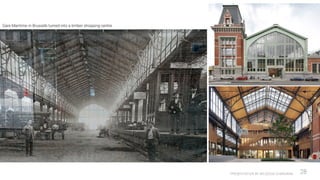
Gare Maritime in Brussels turned into a timber shopping centre
PRESENTATION BY AR.GEEVA CHANDANA 29
Gare Maritime in Brussels turned into a timber shopping centre
PRESENTATION BY AR.GEEVA CHANDANA 30
PRESENTATION BY AR.GEEVA CHANDANA 31
Highline, New York
PRESENTATION BY AR.GEEVA CHANDANA 32
PRESENTATION BY AR.GEEVA CHANDANA 33
Antique / Vintage Furniture
PRESENTATION BY AR.GEEVA CHANDANA 34
Antique / Vintage Furniture
PRESENTATION BY AR.GEEVA CHANDANA 35
ADVANTAGES OF ADAPTIVE REUSE
• Energy Conservation: Energy is conserved by reclaiming and repurposing
existing structures and their materials and their embodied energy, as well as
making use of existing available infrastructure such as access to
transportation and utilities.
• Contributes to Sustainability: Existing structures are often located in
established growth areas with a significant population density and in
developed areas, reusing these structures will help support the neighborhood.
Often, the materials that are used are of high quality and have many years left
in their life cycle. Brick, stone, copper, slate, concrete, and masonry units are
enduring materials, and should be able to withstand the test of time.
• Enhances Community Character: Reuse retains historic resources and
community character by providing renewed life to historic structures in an
economically viable manner. Building reuse can provide a link between the
community's history and its present and future while accommodating up-to-
date needs, and is often more harmonious with community character than
new construction. When done well, adaptive reuse can restore and maintain
the historic significance of a building and help to ensure its survival. Rather
than falling into disrepair through neglect or being rendered unrecognizable,
historic buildings that are sympathetically recycled can continue to be used
and appreciated.
PRESENTATION BY AR.GEEVA CHANDANA 36
ADVANTAGES OF ADAPTIVE REUSE
• Encourages Investment: Reuse can encourage more investment,
development, and revitalization in areas and in other structures that might
otherwise remain vacant or underused, yielding potential employment
opportunities.
• Enhances innovation: Changes in our society have created an opportunity to
develop unique and innovative solutions for existing buildings. There are
plenty of vacant buildings just waiting for innovative solutions. The challenge
is to look beyond their rundown conditions to see the potential. Empty
buildings, which once served only a single function may now successfully
support multiple functions. These innovative design solutions can help spur
new, creative ideas
• Cost Savings: Rather than demolishing existing structures that have outlived
their originally intended use, reuse saves on demolition costs, champions
recycling, and creates unique design opportunities.
• Increases Market Value: Values can be increased by preserving aesthetically-
appealing building features and architectural elements that are often
characteristic of older buildings. Materials and quality of construction of the
past is often not economically possible to reproduce today.
PRESENTATION BY AR.GEEVA CHANDANA 37
ADVANTAGES OF ADAPTIVE REUSE
• Saves Time: Provides potential time savings can result through building reuse
because the building and infrastructure is in place, and municipal approval
and permitting can occur more quickly and less expensively than comparable
new construction.
• Environmental Benefits: One of the main environmental benefits of reusing
buildings is the retention of the original building's "embodied energy". That is,
the energy consumed by al of the processes associated with the production
of a building, from the acquisition of natural resources to product delivery,
including mining, manufacturing of materials and equipment, transport and
administrative functions. By reusing buildings, their embodied energy is
retained, making the project much more environmentally sustainable than
entirely new construction.
• Financial Feasibility: Arguably the most important factor in the decision to
adapt an existing building is cost. Whether the owner is private or public,
budgets always come into play. Unless the actual goal is historic restoration
of a treasured landmark (when restoration may cost more than a new
building), then adaptive reuse must be the more cost-effective option, or
rebuilding will win favor.
PRESENTATION BY AR.GEEVA CHANDANA 38
CRITERIA FOR ADAPTIVE REUSE
• Built form is subject to mainly to three types of obsolescence namely:
physical, functional and economical. Although building derelict is due to a
variety of factors it can be generalized that they are all the natural outcome of
the changing modes of production and consumption triggered primarily by
the consequences of technological transformations.
• There are often criteria for deciding whether a building should be conserved
and reused or just demolished. Some of the determining criteria's include –
• The societal value of a given site - the importance to the community of the
use of a site by community members or visitors.
• The potential for the reuse of a particular site -the physical damage
sustained to the site and its support of future use, the character of the
existing site in terms of the proposed reuse.
• The historical importance of the site - in terms of both the physicality of the
street-scape and the area, as well as of the role of the site in the community
understands of the past.
• The natural ecological conditions of the site - whether the site is suitable
climatically or can support the proposed environmental work needed in the
site.
PRESENTATION BY AR.GEEVA CHANDANA 39
LIMITATIONS FACED IN ADAPTIVE REUSE
• Physical Limitations: Structural constraints involved with retaining new use
into an existing building challenging, and may require added aesthetically
appealing, architectural or historic features may make fitting a creativity and
flexibility.
• Regulatory Constraints: Existing structures may pre-date zoning, building to
meet modern requirements can be challenging. For example, zoning may
permit, and other local development regulations and thus their rehabilitation
limit uses and restrict possible reuse opportunities, or require variances. Off-
street parking may be difficult for an existing older building to meet. However,
the statewide building code has built-in reliefs to help address this matter.
• Potential Environmental Hazards: Environmental contaminants such as
asbestos and lead can be present in many older buildings, requiring costly
mitigation.
PRESENTATION BY AR.GEEVA CHANDANA 40
ASSIGNMENT 01
CASE STUDY OF AN ADAPTIVE REUSE PROJECT IN INDIA (preferably) / ABROAD.
• Study of building typology and need for adaptive reuse.
• Study the existing condition and Characteristic features of the building.
• Understanding the spatial parameters considered in the adaptive reuse.
• Study of proposed typology with plans, elevations and sections (both interior & exterior)
• Interior Elements that were adaptive reused (doors, windows, flooring, walls, frames,
lighting, electrical fixtures etc.)
• Comparative analysis of before and after adaptive reuse with supporting photographs.
PRESENTATION BY AR.GEEVA CHANDANA 41
TYPES OF BUILDINGS ABANDONED
• Historic buildings give neighborhoods their distinct
character and at the same time provide a tangible
connection to the past.
• However, their history and that of their settings are
often ignored and not honored as part of our cultural
heritage.
• As cities face fast rapid growth, the infill expansions
for abandoned sites become more and more attractive
to the development community. These sites are
usually centrally located in large cities. They are often
located next to main transportation routes, surrounded
by the neighborhoods that have grown around them.
• Abandoned buildings in a once prosperous area of
town have created a chain reaction and spurred further
dilapidation of adjacent structures, stores, and
residences.
PRESENTATION BY AR.GEEVA CHANDANA 42
TYPES OF BUILDINGS ABANDONED
In many situations, the types of buildings most likely to
become subjects of adaptive reuse include
• Industrial buildings, as cities become gentrified and the
process of manufacture moves away from city.
• Political buildings, such as palaces and buildings which
cannot support current and future visitors of the site
• Community buildings, such as churches or schools where
the use has changed over time.
• In the mid-twentieth century, the increase in automobile
use and construction of major highways created
alternatives to traditional rail road transportation and
made it possible for people to live and work further away
from the city core. Suburbs grew and industries moved out
of the city, leaving downtown industrial sites abandoned.
Buildings that had served industries in the cities now seem
to be interlopers in their own neighborhoods. There is
currently a proliferation of properties ideally suited to
adaptation situated in former industrial areas, places
which have become redundant as manufacturing has been
relocated. These factories, warehouses and docks are
often perfect for alternative uses as they are robustly built
and grand in scale.
PRESENTATION BY AR.GEEVA CHANDANA 43
ADAPTIVE REUSE : TERMINOLOGIES
• Adaptive reuse is a complex process which similar materials
and construction method should be used.
• Because buildings are old and neglected, workers may have
to strictly follow safety and health requirements.
• The assessment of an old building’s plan and its operation is
a time-consuming exercise.
• Adaptive reuse projects can be described by a wide range of
terminologies such as retrofitting, refurbishment,
rehabilitation.
• The wide diversity of terminologies is due to the type and
scale of building, existing conditions and the construction
activities conducted during these projects.
• In other words, authors in literature used the terminologies
based on the status of the building and what is necessarily
needed for reconstruction. No standards to select a
terminology for each project, each case was dealt with
differently.
• Adaptive reuse can transform heritage buildings to accessible
and useful places as well as to benefit the area in a
sustainable manner.
PRESENTATION BY AR.GEEVA CHANDANA 44
ADAPTIVE REUSE : TERMINOLOGIES
PRESENTATION BY AR.GEEVA CHANDANA 45
PRESENTATION BY AR.GEEVA CHANDANA 46
PRESENTATION BY AR.GEEVA CHANDANA 47
PRESENTATION BY AR.GEEVA CHANDANA 48
PRESENTATION BY AR.GEEVA CHANDANA 49

ADAPTIVE REUSE_Introduction.pdf

  • 1.
  • 2.
    WHAT IS ADAPTIVEREUSE? PRESENTATION BY AR.GEEVA CHANDANA 2 • Adaptive reuse refers to the process of reconstructing / reusing an existing building for a different purpose other than the original purpose that was built for. • This process is applied in different facilities such as museums, mosques, residential buildings and offices. • Adaption of existing old buildings results in many tangible and intangible benefits to the public and government and also in terms of environmental sustainability, through the reuse of existing buildings and increasing the building’s life expectancy. • Adaptive reuse is an eco-friendly solution to built environment needs through reducing material, transport and energy consumption and lowering pollution associated with new building projects • Adaptive reuse projects can be described by a wide range of terminologies such as retrofitting, refurbishment, rehabilitation. The wide diversity of terminologies is due to the type and scale of building, existing conditions and the construction activities conducted during these projects.
  • 3.
    PRESENTATION BY AR.GEEVACHANDANA 3 Sage and Lavender Bistro, Alwarpet, Chennai
  • 4.
  • 5.
    PRESENTATION BY AR.GEEVACHANDANA 5 Fika, Adyar, Chennai
  • 6.
  • 7.
    PRESENTATION BY AR.GEEVACHANDANA 7 Svatma Heritage, Thanjavur
  • 8.
  • 9.
  • 10.
  • 11.
  • 12.
    PRESENTATION BY AR.GEEVACHANDANA 12 Gratitude Heritage, Pondicherry
  • 13.
  • 14.
    PRESENTATION BY AR.GEEVACHANDANA 14 Kandadu, Pondicherry
  • 15.
    PRESENTATION BY AR.GEEVACHANDANA 15 Chidambara Vilas - A Luxury Heritage Resort, Chettinadu Region
  • 16.
  • 17.
  • 18.
  • 19.
    PRESENTATION BY AR.GEEVACHANDANA 19 Collage House | S+PS Architects, Mumbai
  • 20.
  • 21.
  • 22.
  • 23.
    PRESENTATION BY AR.GEEVACHANDANA 23 Alembic Industrial Heritage development, Vadodara | Adaptive reuse of Industry to Cultural Centre
  • 24.
  • 25.
  • 26.
  • 27.
    PRESENTATION BY AR.GEEVACHANDANA 27 Duke Energy Innovation Center at Optimist Hall | Adaptive Reuse of a textile mill
  • 28.
    PRESENTATION BY AR.GEEVACHANDANA 28 Gare Maritime in Brussels turned into a timber shopping centre
  • 29.
    PRESENTATION BY AR.GEEVACHANDANA 29 Gare Maritime in Brussels turned into a timber shopping centre
  • 30.
  • 31.
    PRESENTATION BY AR.GEEVACHANDANA 31 Highline, New York
  • 32.
  • 33.
    PRESENTATION BY AR.GEEVACHANDANA 33 Antique / Vintage Furniture
  • 34.
    PRESENTATION BY AR.GEEVACHANDANA 34 Antique / Vintage Furniture
  • 35.
    PRESENTATION BY AR.GEEVACHANDANA 35 ADVANTAGES OF ADAPTIVE REUSE • Energy Conservation: Energy is conserved by reclaiming and repurposing existing structures and their materials and their embodied energy, as well as making use of existing available infrastructure such as access to transportation and utilities. • Contributes to Sustainability: Existing structures are often located in established growth areas with a significant population density and in developed areas, reusing these structures will help support the neighborhood. Often, the materials that are used are of high quality and have many years left in their life cycle. Brick, stone, copper, slate, concrete, and masonry units are enduring materials, and should be able to withstand the test of time. • Enhances Community Character: Reuse retains historic resources and community character by providing renewed life to historic structures in an economically viable manner. Building reuse can provide a link between the community's history and its present and future while accommodating up-to- date needs, and is often more harmonious with community character than new construction. When done well, adaptive reuse can restore and maintain the historic significance of a building and help to ensure its survival. Rather than falling into disrepair through neglect or being rendered unrecognizable, historic buildings that are sympathetically recycled can continue to be used and appreciated.
  • 36.
    PRESENTATION BY AR.GEEVACHANDANA 36 ADVANTAGES OF ADAPTIVE REUSE • Encourages Investment: Reuse can encourage more investment, development, and revitalization in areas and in other structures that might otherwise remain vacant or underused, yielding potential employment opportunities. • Enhances innovation: Changes in our society have created an opportunity to develop unique and innovative solutions for existing buildings. There are plenty of vacant buildings just waiting for innovative solutions. The challenge is to look beyond their rundown conditions to see the potential. Empty buildings, which once served only a single function may now successfully support multiple functions. These innovative design solutions can help spur new, creative ideas • Cost Savings: Rather than demolishing existing structures that have outlived their originally intended use, reuse saves on demolition costs, champions recycling, and creates unique design opportunities. • Increases Market Value: Values can be increased by preserving aesthetically- appealing building features and architectural elements that are often characteristic of older buildings. Materials and quality of construction of the past is often not economically possible to reproduce today.
  • 37.
    PRESENTATION BY AR.GEEVACHANDANA 37 ADVANTAGES OF ADAPTIVE REUSE • Saves Time: Provides potential time savings can result through building reuse because the building and infrastructure is in place, and municipal approval and permitting can occur more quickly and less expensively than comparable new construction. • Environmental Benefits: One of the main environmental benefits of reusing buildings is the retention of the original building's "embodied energy". That is, the energy consumed by al of the processes associated with the production of a building, from the acquisition of natural resources to product delivery, including mining, manufacturing of materials and equipment, transport and administrative functions. By reusing buildings, their embodied energy is retained, making the project much more environmentally sustainable than entirely new construction. • Financial Feasibility: Arguably the most important factor in the decision to adapt an existing building is cost. Whether the owner is private or public, budgets always come into play. Unless the actual goal is historic restoration of a treasured landmark (when restoration may cost more than a new building), then adaptive reuse must be the more cost-effective option, or rebuilding will win favor.
  • 38.
    PRESENTATION BY AR.GEEVACHANDANA 38 CRITERIA FOR ADAPTIVE REUSE • Built form is subject to mainly to three types of obsolescence namely: physical, functional and economical. Although building derelict is due to a variety of factors it can be generalized that they are all the natural outcome of the changing modes of production and consumption triggered primarily by the consequences of technological transformations. • There are often criteria for deciding whether a building should be conserved and reused or just demolished. Some of the determining criteria's include – • The societal value of a given site - the importance to the community of the use of a site by community members or visitors. • The potential for the reuse of a particular site -the physical damage sustained to the site and its support of future use, the character of the existing site in terms of the proposed reuse. • The historical importance of the site - in terms of both the physicality of the street-scape and the area, as well as of the role of the site in the community understands of the past. • The natural ecological conditions of the site - whether the site is suitable climatically or can support the proposed environmental work needed in the site.
  • 39.
    PRESENTATION BY AR.GEEVACHANDANA 39 LIMITATIONS FACED IN ADAPTIVE REUSE • Physical Limitations: Structural constraints involved with retaining new use into an existing building challenging, and may require added aesthetically appealing, architectural or historic features may make fitting a creativity and flexibility. • Regulatory Constraints: Existing structures may pre-date zoning, building to meet modern requirements can be challenging. For example, zoning may permit, and other local development regulations and thus their rehabilitation limit uses and restrict possible reuse opportunities, or require variances. Off- street parking may be difficult for an existing older building to meet. However, the statewide building code has built-in reliefs to help address this matter. • Potential Environmental Hazards: Environmental contaminants such as asbestos and lead can be present in many older buildings, requiring costly mitigation.
  • 40.
    PRESENTATION BY AR.GEEVACHANDANA 40 ASSIGNMENT 01 CASE STUDY OF AN ADAPTIVE REUSE PROJECT IN INDIA (preferably) / ABROAD. • Study of building typology and need for adaptive reuse. • Study the existing condition and Characteristic features of the building. • Understanding the spatial parameters considered in the adaptive reuse. • Study of proposed typology with plans, elevations and sections (both interior & exterior) • Interior Elements that were adaptive reused (doors, windows, flooring, walls, frames, lighting, electrical fixtures etc.) • Comparative analysis of before and after adaptive reuse with supporting photographs.
  • 41.
    PRESENTATION BY AR.GEEVACHANDANA 41 TYPES OF BUILDINGS ABANDONED • Historic buildings give neighborhoods their distinct character and at the same time provide a tangible connection to the past. • However, their history and that of their settings are often ignored and not honored as part of our cultural heritage. • As cities face fast rapid growth, the infill expansions for abandoned sites become more and more attractive to the development community. These sites are usually centrally located in large cities. They are often located next to main transportation routes, surrounded by the neighborhoods that have grown around them. • Abandoned buildings in a once prosperous area of town have created a chain reaction and spurred further dilapidation of adjacent structures, stores, and residences.
  • 42.
    PRESENTATION BY AR.GEEVACHANDANA 42 TYPES OF BUILDINGS ABANDONED In many situations, the types of buildings most likely to become subjects of adaptive reuse include • Industrial buildings, as cities become gentrified and the process of manufacture moves away from city. • Political buildings, such as palaces and buildings which cannot support current and future visitors of the site • Community buildings, such as churches or schools where the use has changed over time. • In the mid-twentieth century, the increase in automobile use and construction of major highways created alternatives to traditional rail road transportation and made it possible for people to live and work further away from the city core. Suburbs grew and industries moved out of the city, leaving downtown industrial sites abandoned. Buildings that had served industries in the cities now seem to be interlopers in their own neighborhoods. There is currently a proliferation of properties ideally suited to adaptation situated in former industrial areas, places which have become redundant as manufacturing has been relocated. These factories, warehouses and docks are often perfect for alternative uses as they are robustly built and grand in scale.
  • 43.
    PRESENTATION BY AR.GEEVACHANDANA 43 ADAPTIVE REUSE : TERMINOLOGIES • Adaptive reuse is a complex process which similar materials and construction method should be used. • Because buildings are old and neglected, workers may have to strictly follow safety and health requirements. • The assessment of an old building’s plan and its operation is a time-consuming exercise. • Adaptive reuse projects can be described by a wide range of terminologies such as retrofitting, refurbishment, rehabilitation. • The wide diversity of terminologies is due to the type and scale of building, existing conditions and the construction activities conducted during these projects. • In other words, authors in literature used the terminologies based on the status of the building and what is necessarily needed for reconstruction. No standards to select a terminology for each project, each case was dealt with differently. • Adaptive reuse can transform heritage buildings to accessible and useful places as well as to benefit the area in a sustainable manner.
  • 44.
    PRESENTATION BY AR.GEEVACHANDANA 44 ADAPTIVE REUSE : TERMINOLOGIES
  • 45.
  • 46.
  • 47.
  • 48.
  • 49.