In what ways does your media product use, develop or challenge forms
and conventions of real media products?
Why I chose to create a zombie opening
sequence
I always wanted to create a zombie film. Being a fan of
the zombie genre, I felt as if I was able to stay focused and
more interested in my work. Initially I just liked the
zombie aesthetic and the idea of escapism but I soon
found that zombies have a lot more meaning to them.
The overall results of research for my final piece
Zombie culture seems to be everywhere now, while it used to be a sub-
genre that developed some tropes that are still present in today’s media;
zombies tend to be in television, movies, comics, books, on posters, apps
and some even organise events in which people go on ‘zombie runs’.
The movies typically just use zombies to facilitate a situation in which we
see the survivors interact on a more open level – becoming more violent
perhaps due to social restrictions being lifted.
Equally zombies tend to symbolise a fear that either the director or society
has: pathogens, government control, consumerism, the ‘other’ and so on.
Furthermore, my research indicates that zombie culture tends to have a
larger male demographic and, as noted by age ratings on games and films,
target an older audience of either teens or young adults.
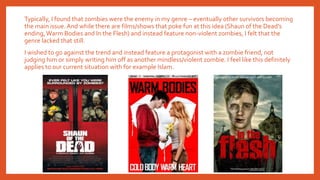
Typically, I found that zombies were the enemy in my genre – eventually other survivors becoming
the main issue.And while there are films/shows that poke fun at this idea (Shaun of the Dead’s
ending,Warm Bodies and In the Flesh) and instead feature non-violent zombies, I felt that the
genre lacked that still.
I wished to go against the trend and instead feature a protagonist with a zombie friend, not
judging him or simply writing him off as another mindless/violent zombie. I feel like this definitely
applies to our current situation with for example Islam.
How my research influenced the representation in my final piece
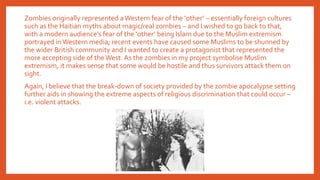
Zombies originally represented aWestern fear of the ‘other’ – essentially foreign cultures
such as the Haitian myths about magic/real zombies – and I wished to go back to that,
with a modern audience’s fear of the ‘other’ being Islam due to the Muslim extremism
portrayed in Western media; recent events have caused some Muslims to be shunned by
the wider British community and I wanted to create a protagonist that represented the
more accepting side of the West. As the zombies in my project symbolise Muslim
extremism, it makes sense that some would be hostile and thus survivors attack them on
sight.
Again, I believe that the break-down of society provided by the zombie apocalypse setting
further aids in showing the extreme aspects of religious discrimination that could occur –
i.e. violent attacks.
• The criteria for my protagonist was to make him young, white and
male. In no way was this due to racial discrimination, I just felt that it
made sense given the message of my film.
• I wished to present the whiteWestern society in a positive and
negative way, with some white characters being hostile towards the
zombies and the protagonist being sympathetic.
• For this idea to work and represent what I wanted; the protagonist
would have to be white but equally it may have worked even the
other way.
Additionally, the actor that I had at my disposal was white and I believe that the
age and gender would also best represent my demographic – with zombie games
and movies mainly targeting an audience between fifteen to their mid-twenties,
containing content such as guns and a male protagonist.
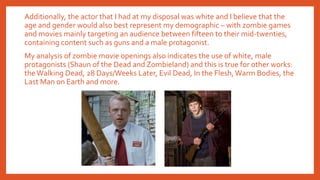
My analysis of zombie movie openings also indicates the use of white, male
protagonists (Shaun of the Dead and Zombieland) and this is true for other works:
the Walking Dead, 28 Days/Weeks Later, Evil Dead, In the Flesh, Warm Bodies, the
Last Man on Earth and more.
Conventions of the genre which I adhered to and why
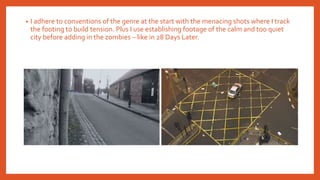
• I adhere to conventions of the genre at the start with the menacing shots where I track
the footing to build tension. Plus I use establishing footage of the calm and too quiet
city before adding in the zombies – like in 28 Days Later.
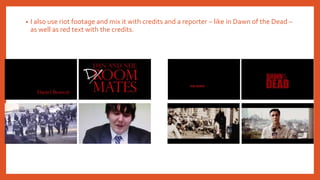
• I also use riot footage and mix it with credits and a reporter – like in Dawn of the Dead –
as well as red text with the credits.
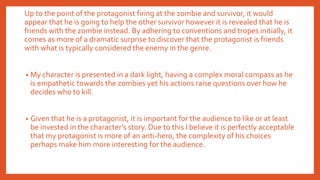
Up to the point of the protagonist firing at the zombie and survivor, it would
appear that he is going to help the other survivor however it is revealed that he is
friends with the zombie instead. By adhering to conventions and tropes initially, it
comes as more of a dramatic surprise to discover that the protagonist is friends
with what is typically considered the enemy in the genre.
• My character is presented in a dark light, having a complex moral compass as he
is empathetic towards the zombies yet his actions raise questions over how he
decides who to kill.
• Given that he is a protagonist, it is important for the audience to like or at least
be invested in the character’s story. Due to this I believe it is perfectly acceptable
that my protagonist is more of an anti-hero, the complexity of his choices
perhaps make him more interesting for the audience.
Important shots
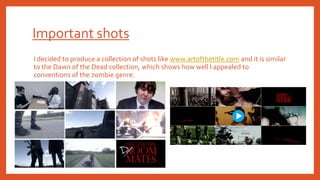
I decided to produce a collection of shots like www.artofthetitle.com and it is similar
to the Dawn of the Dead collection, which shows how well I appealed to
conventions of the zombie genre.

Evaluation question 1

  • 1.
    In what waysdoes your media product use, develop or challenge forms and conventions of real media products?
  • 2.
    Why I choseto create a zombie opening sequence I always wanted to create a zombie film. Being a fan of the zombie genre, I felt as if I was able to stay focused and more interested in my work. Initially I just liked the zombie aesthetic and the idea of escapism but I soon found that zombies have a lot more meaning to them.
  • 3.
    The overall resultsof research for my final piece
  • 4.
    Zombie culture seemsto be everywhere now, while it used to be a sub- genre that developed some tropes that are still present in today’s media; zombies tend to be in television, movies, comics, books, on posters, apps and some even organise events in which people go on ‘zombie runs’. The movies typically just use zombies to facilitate a situation in which we see the survivors interact on a more open level – becoming more violent perhaps due to social restrictions being lifted. Equally zombies tend to symbolise a fear that either the director or society has: pathogens, government control, consumerism, the ‘other’ and so on. Furthermore, my research indicates that zombie culture tends to have a larger male demographic and, as noted by age ratings on games and films, target an older audience of either teens or young adults.
  • 5.
    Typically, I foundthat zombies were the enemy in my genre – eventually other survivors becoming the main issue.And while there are films/shows that poke fun at this idea (Shaun of the Dead’s ending,Warm Bodies and In the Flesh) and instead feature non-violent zombies, I felt that the genre lacked that still. I wished to go against the trend and instead feature a protagonist with a zombie friend, not judging him or simply writing him off as another mindless/violent zombie. I feel like this definitely applies to our current situation with for example Islam.
  • 6.
    How my researchinfluenced the representation in my final piece
  • 7.
    Zombies originally representedaWestern fear of the ‘other’ – essentially foreign cultures such as the Haitian myths about magic/real zombies – and I wished to go back to that, with a modern audience’s fear of the ‘other’ being Islam due to the Muslim extremism portrayed in Western media; recent events have caused some Muslims to be shunned by the wider British community and I wanted to create a protagonist that represented the more accepting side of the West. As the zombies in my project symbolise Muslim extremism, it makes sense that some would be hostile and thus survivors attack them on sight. Again, I believe that the break-down of society provided by the zombie apocalypse setting further aids in showing the extreme aspects of religious discrimination that could occur – i.e. violent attacks.
  • 8.
    • The criteriafor my protagonist was to make him young, white and male. In no way was this due to racial discrimination, I just felt that it made sense given the message of my film. • I wished to present the whiteWestern society in a positive and negative way, with some white characters being hostile towards the zombies and the protagonist being sympathetic. • For this idea to work and represent what I wanted; the protagonist would have to be white but equally it may have worked even the other way.
  • 9.
    Additionally, the actorthat I had at my disposal was white and I believe that the age and gender would also best represent my demographic – with zombie games and movies mainly targeting an audience between fifteen to their mid-twenties, containing content such as guns and a male protagonist. My analysis of zombie movie openings also indicates the use of white, male protagonists (Shaun of the Dead and Zombieland) and this is true for other works: the Walking Dead, 28 Days/Weeks Later, Evil Dead, In the Flesh, Warm Bodies, the Last Man on Earth and more.
  • 10.
    Conventions of thegenre which I adhered to and why
  • 11.
    • I adhereto conventions of the genre at the start with the menacing shots where I track the footing to build tension. Plus I use establishing footage of the calm and too quiet city before adding in the zombies – like in 28 Days Later.
  • 12.
    • I alsouse riot footage and mix it with credits and a reporter – like in Dawn of the Dead – as well as red text with the credits.
  • 13.
    Up to thepoint of the protagonist firing at the zombie and survivor, it would appear that he is going to help the other survivor however it is revealed that he is friends with the zombie instead. By adhering to conventions and tropes initially, it comes as more of a dramatic surprise to discover that the protagonist is friends with what is typically considered the enemy in the genre. • My character is presented in a dark light, having a complex moral compass as he is empathetic towards the zombies yet his actions raise questions over how he decides who to kill. • Given that he is a protagonist, it is important for the audience to like or at least be invested in the character’s story. Due to this I believe it is perfectly acceptable that my protagonist is more of an anti-hero, the complexity of his choices perhaps make him more interesting for the audience.
  • 14.
    Important shots I decidedto produce a collection of shots like www.artofthetitle.com and it is similar to the Dawn of the Dead collection, which shows how well I appealed to conventions of the zombie genre.