The document is a presentation about Binderoo, a rapid iteration framework developed by Remedy Entertainment. It discusses:
- The goals of Binderoo, which are to provide perfect C++ binding, enable rapid iteration of code, and require minimal maintenance.
- The challenges of binding C++ and D, such as D classes being reference types while C++ can use both value and reference types.
- The three components of Binderoo - the service for compiling code, the host for loading code and handling reloads, and the client code embedded in D libraries.
- How to annotate D structs and functions to provide metadata needed for binding C++ code, and how this metadata is used to generate bindings
![BINDEROO
A RAPID ITERATION
FRAMEWORK THAT EVEN
SCRIPTERS CAN USE
BINDEROO
A RAPID ITERATION
FRAMEWORK THAT EVEN
SCRIPTERS CAN USE
Before we get started, I’d like to point out that I’ll take questions
during the talk via this URL. You can go on there and ask a question,
and you can even upvote questions. I’ll check periodically
throughout the talk and answer the most voted questions. In fact,
there’s one here right now:
[SWITCH]
[FORWARD]
2](https://image.slidesharecdn.com/binderoo-arapiditerationframeworkthatevenscripterscanuse-170505150542/85/Binderoo-A-rapid-iteration-framework-that-even-scripters-can-use-2-320.jpg)
![Ethan Watson
14.5 Years
11 Platforms
So a bit about myself to begin with for those that don’t know
me. As the title slide gave away, I’m Ethan Watson.
[FORWARD] And I come from the fictional land of Australia.
[FORWARD] I’ve been in the industry for 14 and a half years,
during which time I’ve shipped games on 11 different
platforms. I’ve shipped a number of titles as both an engine
programmer and a game programmer, some of which include
the TY the Tasmanian Tiger games; Star Wars: The Force
Unleashed; Game Room. I’m currently a senior engine
programmer at Remedy Entertainment, and have most
recently shipped Quantum Break.
[FORWARD]
3](https://image.slidesharecdn.com/binderoo-arapiditerationframeworkthatevenscripterscanuse-170505150542/85/Binderoo-A-rapid-iteration-framework-that-even-scripters-can-use-3-320.jpg)
![Previously...
●Myself at DConf 2016, Manu at DConf 2013
●GDC Europe 2016
● Very well received talk
●Reboot Develop Croatia 2017
● Also well received
I’m no stranger here to DConf, and neither is the company I
work for, Remedy Entertainment.
[FORWARD] I presented here last year about how we shipped
Quantum Break with D Code, and Manu Evans presented here
in 2013 about the initial work to support D.
[FORWARD] I’ve been a bit busy since then. I presented a talk
at the Game Developer Conference Europe held in Cologne last
year.
[FORWARD] The talk was very well received. Unfortunately, it
was scheduled opposite John Romero though, who co-created
the original Doom back in 1993, so the audience was a bit
smaller than I would have liked.
[FORWARD] I also presented at Reboot Develop a couple of
weeks ago in Croatia.
[FORWARD] The talk was also quite well received.
The interest in using D in game development is certainly
increasing. Of course, getting out there and talking to other
4](https://image.slidesharecdn.com/binderoo-arapiditerationframeworkthatevenscripterscanuse-170505150542/85/Binderoo-A-rapid-iteration-framework-that-even-scripters-can-use-4-320.jpg)
![industry professionals, I get to hear some of the reasons why people
are hesitant to pick it up. There’s one in particular that keeps on
cropping up:
[FORWARD]](https://image.slidesharecdn.com/binderoo-arapiditerationframeworkthatevenscripterscanuse-170505150542/85/Binderoo-A-rapid-iteration-framework-that-even-scripters-can-use-5-320.jpg)
![“D needs a large corporate sponsor”
This is something that keeps coming up. D needs a large
corporate sponsor. Just the other week I had a guy from Io
Interactive, who makes the Hitman games, say they’re
interested in what we’re doing of D but skeptical because of
thee lack of a big corporate sponsor. Swift has Apple; Rust has
Mozilla; Go has Google. But D doesn’t have anyone that big.
Even on a historical level, C and C++ had Bell; Java had Sun;
C# has Microsoft; and so on.
I mentioned this to Andrei yesterday, and he’s confident that
this will be solved. That will certainly make getting more
support in gaming for D easier.
[FORWARD]
6](https://image.slidesharecdn.com/binderoo-arapiditerationframeworkthatevenscripterscanuse-170505150542/85/Binderoo-A-rapid-iteration-framework-that-even-scripters-can-use-6-320.jpg)
![Rapid Prototyping
●Programmers wanted a “scripting” system
●Code as data
●Quantum Break’s solution was prototype
quality
● Let’s do it right then...
Remedy’s usage of D, though, came about because of a desire
to have rapid prototyping capabilities.
[FORWARD] Before I joined Remedy, the programmers
decided that they wanted a system that enabled rapid
prototyping. After some discussion, the decision was made to
give D a shot but compiled into a DLL.
[FORWARD] This leads to a system in which code is not
treated as code, but it is in fact treated as data. Anyone
familiar with Unity and Unreal Engine is familiar with this
paradigm - engine code is precompiled, your code sits in with
the rest of your source data, and everyone’s happy.
[FORWARD] The solution we had in Quantum Break was of
prototype quality. It was started by Manu Evans before I
joined Remedy, and after he left Remedy I took over his work
and took it to a functional state.
I never got much of a chance to take it beyond that functional
prototype state, and as such there were many problems with
the system that were screaming out for solutions.
7](https://image.slidesharecdn.com/binderoo-arapiditerationframeworkthatevenscripterscanuse-170505150542/85/Binderoo-A-rapid-iteration-framework-that-even-scripters-can-use-7-320.jpg)
![[FORWARD] Now that Remedy is supporting multi-project
development with a more traditional engine team, this means that
we now have the chance to do it right.
[FORWARD]](https://image.slidesharecdn.com/binderoo-arapiditerationframeworkthatevenscripterscanuse-170505150542/85/Binderoo-A-rapid-iteration-framework-that-even-scripters-can-use-8-320.jpg)
![Binderoo
C++ binding layer
Rapid iteration development
https://github.com/Remedy-Entertainment
/binderoo
And we’re doing it open-sourced to boot!
On our Github is the in-development version of all the
back-end code used in this presentation. The version up there
currently only supports Windows Desktop. We have some
Xbox One support internally. Remedy announced last week
that we’re also branching out into Playstation 4 support. So
while we’ll get to it at some point before we release a PS4
game, if anyone out here is interested and would like to join in
on getting this beast running on a PS4 hit me up after the
presentation.
[FORWARD]
9](https://image.slidesharecdn.com/binderoo-arapiditerationframeworkthatevenscripterscanuse-170505150542/85/Binderoo-A-rapid-iteration-framework-that-even-scripters-can-use-9-320.jpg)
![Binderoo Goals
●Perfect C++ binding
●Rapid iteration
●Minimal maintenance
There’s three important goals that I’m aiming for with
Binderoo:
[FORWARD] Perfect C++ binding is paramount. It’s
unreasonable to say to people “here’s this great new thing! oh,
also, you have to throw away all your old code.” This is quite
important in video games in the “AAA” space, since C++ is our
de-facto standard language. Binderoo will serve as an
interoperation layer between C++ and, well, any language you
can compile in to a DLL. But D is the primary focus to begin
with.
[FORWARD] Rapid iteration of code is also paramount. It’s
becoming unreasonable for people to stop program execution,
recompile for a change, and load it back up with the size of
data we use this day. We need to fill gigabytes of memory
these days before games can start. Anything that removes
that loading time from the equation will be invaluable going
forward.
[FORWARD] And as a lesson learnt from doing it all before on
Quantum Break, it needs to have minimal maintenance.
Programmers are lazy by definition - it’s literally our job to tell
10](https://image.slidesharecdn.com/binderoo-arapiditerationframeworkthatevenscripterscanuse-170505150542/85/Binderoo-A-rapid-iteration-framework-that-even-scripters-can-use-10-320.jpg)

![Perfect C++ Binding
void someCPPFunction( )
{
SomeSimpleClass aNewInstance;
printf( “%dn”, aNewInstance.aMemberInteger );
}
Perfect C++ binding is a tricky one. D has quite a few features
for binding to C++ But things in C++ land are rarely simple.
If you were to write code like this in C++, you’d expect that to
just work with whatever the default constructed value of
aMemberInteger is. Cool.
[FORWARD]
12](https://image.slidesharecdn.com/binderoo-arapiditerationframeworkthatevenscripterscanuse-170505150542/85/Binderoo-A-rapid-iteration-framework-that-even-scripters-can-use-12-320.jpg)
![Perfect C++ Binding
void someEquivalentDFunction( )
{
SomeSimpleClass aNewInstance;
writeln( aNewInstance.aMemberInteger.to!string );
}
void someEquivalentDFunction( )
{
SomeSimpleClass aNewInstance = new SomeSimpleClass;
writeln( aNewInstance.aMemberInteger.to!string );
}
But if you were to write an equivalent in D? You’d immediately
get a null pointer error.
Of course, that’s because classes are in fact reference types.
You have to explicitly instantiate them because as far as your
concerned, their storage is a pointer.
If we wanted our code to not throw a null pointer exception...
[FORWARD] we’d have to allocate a new instance of
SomeSimpleClass. This is an important thing to keep in
mind...
[FORWARD]
13](https://image.slidesharecdn.com/binderoo-arapiditerationframeworkthatevenscripterscanuse-170505150542/85/Binderoo-A-rapid-iteration-framework-that-even-scripters-can-use-13-320.jpg)
![Perfect C++ Binding
extern( C++ ) class SomeOtherType
{
final void SomeOperation();
SomeSimpleClass aNewInstance;
}
extern( C++ ) class SomeOtherType
{
final void SomeOperation();
SomeSimpleClass aNewInstance; // Surprise! This is a pointer
}
extern( C++ ) class SomeOtherType
{
final void SomeOperation();
// Surprise! You also get a vtable pointer here
SomeSimpleClass aNewInstance; // Surprise! This is a pointer
}
...because it gets trickier with more complicated types.
So you’ve embedded an instance of SomeSimpleClass in your
object called SomeOtherType. This would be just peachy in
C++ code.
[FORWARD] But surprise! Because a D class is a reference
type, you’ve actually embedded a pointer in your class.
And there’s one other surprise you’ll find too:
[FORWARD] Regardless of if your class has virtual functions or
not, a vtable entry will be added.
[FORWARD]
14](https://image.slidesharecdn.com/binderoo-arapiditerationframeworkthatevenscripterscanuse-170505150542/85/Binderoo-A-rapid-iteration-framework-that-even-scripters-can-use-14-320.jpg)
![Value and Reference Types
●In C++
● struct - value type
● class - value type
●In D
● struct - value type
● class - reference type
This seems to be just an inescapable piece of language design.
[FORWARD] In C++ there is essentially no difference between
a struct and a class.
[FORWARD] Both a struct
[FORWARD] and a class are value types where storage
location is defined by the user.
[FORWARD] D, however, has taken that modern approach
[FORWARD] where a struct is a value type, with storage
location defined by the user
[FORWARD] and a class is a reference type with storage
defined by the language itself. There’s ways around that with
classes, but they’re all varying levels of broken and they tend
to be fairly unintuitive. We’re going for intuitive and “It Just
Works™” here.
[FORWARD] Alright, so thinking of it that way, maybe the way
to go is to make D structs do all the C++ heavy lifting, right?
15](https://image.slidesharecdn.com/binderoo-arapiditerationframeworkthatevenscripterscanuse-170505150542/85/Binderoo-A-rapid-iteration-framework-that-even-scripters-can-use-15-320.jpg)
![They’re the closest to C++ classes and structs after all.
[FORWARD]](https://image.slidesharecdn.com/binderoo-arapiditerationframeworkthatevenscripterscanuse-170505150542/85/Binderoo-A-rapid-iteration-framework-that-even-scripters-can-use-16-320.jpg)
![A D Struct Can’t Have...
●Default constructors
●Virtual methods
●Inheritance
Weeeellllll, if it wasn’t for the fact that D structs can’t have
[FORWARD] default constructors,
[FORWARD] virtual methods,
[FORWARD] or inheritance, they’d be perfect.
[FORWARD] But don’t despair. All is not lost.
17](https://image.slidesharecdn.com/binderoo-arapiditerationframeworkthatevenscripterscanuse-170505150542/85/Binderoo-A-rapid-iteration-framework-that-even-scripters-can-use-17-320.jpg)
![Rapid Iteration
●Code compiled in dynamic library
● No need to link executable every time
● Also it allows hot reloading
●Can’t hard link functions
●There’s a common solution here...
We’re making a rapid iteration system, after all!
[FORWARD] With code being treated as data, that means our
D code is going to get compiled into dynamic libraries. This is
for two practical reasons:
[FORWARD] If they were compiled to static libraries, we’d
have to link all our code into our main executable every time;
and
[FORWARD] being a dynamic library, that means we can
unload it and replace it with a new version at runtime, thus
supporting hot reloading of our code.
[FORWARD] Windows DLLs can be used in a static manner
thanks to a static lib that does all the function linking for you
on program initialisation. But we can’t do that since we need
to support hot reloading. We also have multiple platforms to
consider at some point, and locking yourself into one inflexible
solution is usually a bad idea there.
There’s a common solution in here that solves our C++
interoperational woes *and* handles the function linking
18](https://image.slidesharecdn.com/binderoo-arapiditerationframeworkthatevenscripterscanuse-170505150542/85/Binderoo-A-rapid-iteration-framework-that-even-scripters-can-use-18-320.jpg)
![automatically without user intervention. Which I call…
[FORWARD]](https://image.slidesharecdn.com/binderoo-arapiditerationframeworkthatevenscripterscanuse-170505150542/85/Binderoo-A-rapid-iteration-framework-that-even-scripters-can-use-19-320.jpg)
![Let’s implement C++ virtual tables from
scratch inside D structs and also let’s make
sure non-virtual methods work and inheritance
works and let’s do it in a way that we can
collect that information at compile time and
use that to link functions on library load and
support hot reloading through automated type
serialisation and also while we’re at it let’s
support version numbers on functions and
objects to also solve Windows DLL Hell!
Let’s implement C++ virtual tables from scratch inside D
structs and also let’s make sure non-virtual methods work and
inheritance works and let’s do it in a way that we can collect
that information at compile time and use that to link functions
on library load and support hot reloading through automated
type serialisation and also while we’re at it let’s support
version numbers on functions and objects to also solve
Windows DLL Hell!
[FORWARD]
20](https://image.slidesharecdn.com/binderoo-arapiditerationframeworkthatevenscripterscanuse-170505150542/85/Binderoo-A-rapid-iteration-framework-that-even-scripters-can-use-20-320.jpg)
![Let’s implement C++ virtual tables from
scratch inside D structs and also let’s make
sure non-virtual methods work and inheritance
works and let’s do it in a way that we can
collect that information at compile time and
use that to link functions on library load and
support hot reloading through automated type
serialisation and also while we’re at it let’s
support version numbers on functions and
objects to also solve Windows DLL Hell!
[CHECK QUESTIONS HERE]
[FORWARD]
21](https://image.slidesharecdn.com/binderoo-arapiditerationframeworkthatevenscripterscanuse-170505150542/85/Binderoo-A-rapid-iteration-framework-that-even-scripters-can-use-21-320.jpg)
![Binderoo’s Three Components
●service
● Handles compiling and reload notifications
●host
● Loads D code, handles reloads
●client
● Where you write your D code
To handle our rapid iteration requirements, Binderoo is split
into three major components:
[FORWARD] There’s the service
[FORWARD] Which is embedded into our content creation tool.
It’s responsible for monitoring our source data directories for
code changes and recompiling the code into new DLLs. It also
needs to communicate to
[FORWARD] a host
[FORWARD] which is the component you embed inside your
game executable. It handles loading up those new DLLs, and
the subsequent function linking and object lifetime concerns.
[FORWARD] The DLLs themselves need to include the binderoo
client code
[FORWARD] and serves to communicate directly with the host.
It is this client code that we’re going to focus on for the next
few slides.
22](https://image.slidesharecdn.com/binderoo-arapiditerationframeworkthatevenscripterscanuse-170505150542/85/Binderoo-A-rapid-iteration-framework-that-even-scripters-can-use-22-320.jpg)
![Give It C Type Information
@CTypeName( “SomeSimpleClass”, “core/src/SomeSimpleClass.h” )
struct SomeSimpleClass
{
}
So, you’re writing a client DLL, and you want to know how to
use your C++ code. There’s a few things you’ll need to do, but
they’re all quite simple.
Start off with a struct that is meant to represent the class…
[FORWARD] and apply the CTypeName User Defined Attribute
to the entire object.
This particular UDA has several uses. When trying to bind
functions, for example, we don’t use the name of the object in
D since that will not include all the C namespacing information
we require - among other things.
[FORWARD] The first parameter, as such, is the name of your
object as accessible from the global namespace.
[FORWARD] The second parameter is a bit more interesting -
we give it the location of the matching C++ header. This
comes in handy later.
[FORWARD]
23](https://image.slidesharecdn.com/binderoo-arapiditerationframeworkthatevenscripterscanuse-170505150542/85/Binderoo-A-rapid-iteration-framework-that-even-scripters-can-use-23-320.jpg)
![Mark Up Bound Functions
struct SomeSimpleClass
{
@BindVirtual( 1 ) void SomeMethod();
@BindVirtual( 1 ) void DoThis( int anIntParam );
@BindMethod( 1 ) void DoThat( float aFloatParam );
}
What’s our C++ class without some functions?
[FORWARD] We tag our virtual methods with a BindVirtual
UDA. It has a numerical parameter here. This is simply the
version number that this function has been introduced in. It
secretly takes a second parameter that defines the version
that function was removed in.
[FORWARD] Non-virtual functions get tagged in the exact
same way, except with the BindMethod UDA.
[FORWARD]
24](https://image.slidesharecdn.com/binderoo-arapiditerationframeworkthatevenscripterscanuse-170505150542/85/Binderoo-A-rapid-iteration-framework-that-even-scripters-can-use-24-320.jpg)
![Generate Code To Make It Work
struct SomeSimpleClass
{
mixin CPPStructBase!( BeginsVirtual.Yes );
mixin( GenerateBindings!( typeof( this ) ) );
int aMemberInteger = 0;
}
And finally, a bit of magic to make it all work. We have two
mixins that do our workL
[FORWARD] A mixin template that will set up constructors
and, if the BeginsVirtual parameter is defined as true, it will
also put a pointer in the object to store the virtual function
table in.
[FORWARD] The second mixin is a fair bit more interesting.
Provide it with a string, and it will be inserted directly into the
code and evaluated as if you had written the code yourself. In
this particular case, the string is being provided to us by the
GenerateBindings function.
[FORWARD]
25](https://image.slidesharecdn.com/binderoo-arapiditerationframeworkthatevenscripterscanuse-170505150542/85/Binderoo-A-rapid-iteration-framework-that-even-scripters-can-use-25-320.jpg)
![GenerateBindings Internals
foreach( Member; __traits( allMembers, ThisType ) )
{
static if( __traits( getOverloads, ThisType, Member ).length > 0 )
{
// Now we’re dealing with functions
}
}
How does GenerateBindings work? It’s actually a conceptually
simple piece of code.
We iterate over each member, and from there
[FORWARD] we use the getOverloads trait. This is the simplest
way by far I’ve found to determine if I’m dealing with a
function. If it’s a function, the tuple length will be a minimum
of 1.
[FORWARD]
26](https://image.slidesharecdn.com/binderoo-arapiditerationframeworkthatevenscripterscanuse-170505150542/85/Binderoo-A-rapid-iteration-framework-that-even-scripters-can-use-26-320.jpg)
![void DoThis( int anIntParam );
alias FnType = extern( C++ ) void function( SomeSimpleClass* pThis, int
anIntParam );
alias FnType = extern( C++ ) ref int function( SomeSimpleClass* pThis,
int anIntParam ); // ERROR!
GenerateBindings Internals
For each function we encounter, we need to do a few things.
The first is to define a function pointer type. For each of our
encountered functions, we need to rewrite the parameters of
the function to support the thiscall function calling convention.
Essentially, we need to make the first parameter of each
function a this pointer.
[FORWARD] And then build up a new type based on all that.
For a C++ calling convention of a method, the this parameter
comes first. So before we insert all our previous parameters,
we just stick our own this pointer in there.
[FORWARD] Of course, when dealing with typical game engine
C++ functions, I come across one of my biggest bugbears with
declaring function pointer types - the inability to specify ref
return types.
27](https://image.slidesharecdn.com/binderoo-arapiditerationframeworkthatevenscripterscanuse-170505150542/85/Binderoo-A-rapid-iteration-framework-that-even-scripters-can-use-27-320.jpg)
![module functionrewriter;
template FnRewritePtr( alias fn )
{
// Do some analysis stuff to generate...
static extern( C++ ) ref int prototype( SomeSimpleClass* pThis,
ref SomeOtherClass param1,
ref YetAnotherClass param2 );
alias FnRewritePtr = typeof( &prototype );
}
The way around this can be solved with templates. The
template takes an alias to a function, we do some analysis of
the function, and we generate a new function prototype that
we then take the typeof for our eponymous template.
Unforunately, this is not problem solved.
[FORWARD] Because our template will live in a module
somewhere.
[FORWARD] And it will deal with types that don’t live inside
this module. This has only become a problem with the
template visibility changes over the last year or so.
[FORWARD]
28](https://image.slidesharecdn.com/binderoo-arapiditerationframeworkthatevenscripterscanuse-170505150542/85/Binderoo-A-rapid-iteration-framework-that-even-scripters-can-use-28-320.jpg)
![alias ParamType = ParameterTypeTuple!fn;
foreach( Type; ParamTypes )
{
alias UnqualType = Unqualified!( Type );
static if( IsUserType!( UnqualType ) )
{
importString ~= "import " ~ ModuleName!( UnqualType ) ~ ";";
}
}
mixin( importString );
And it leads to some truly awful code. Essentially, I have to
analyse each and every single type, from the return type to
each parameter type, of the function that we’re rewriting. If
it’s a user type, then I need to get the module name and
[FORWARD] mix it in inside my template. Otherwise, it errors
out complaining that this type is not visible to the module the
Function Pointer template lives in.
[FORWARD]
29](https://image.slidesharecdn.com/binderoo-arapiditerationframeworkthatevenscripterscanuse-170505150542/85/Binderoo-A-rapid-iteration-framework-that-even-scripters-can-use-29-320.jpg)
![alias ParamType = ParameterTypeTuple!fn;
foreach( Type; ParamTypes )
{
alias UnqualType = Unqualified!( Type );
static if( IsUserType!( UnqualType ) )
{
importString ~= "import " ~ ModuleName!( UnqualType ) ~ ";";
}
}
mixin( importString );
Any kind of template that deals with types in a non-trivial
manner now needs to do this. Reducing the functionality of
templates so that I need to do this makes me not want to use
templates.
Buuuuut at least I have something that works. So I can
continue.
[FORWARD]
30](https://image.slidesharecdn.com/binderoo-arapiditerationframeworkthatevenscripterscanuse-170505150542/85/Binderoo-A-rapid-iteration-framework-that-even-scripters-can-use-30-320.jpg)
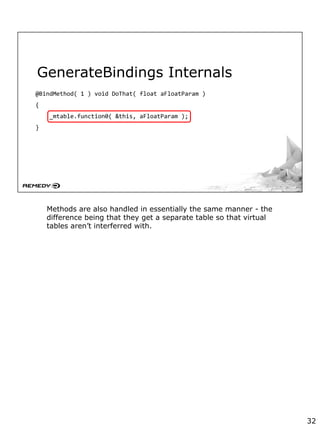
![// Into a vtable you go!
@BindRawImport( ... ) FnType function0;
@BindVirtual( 1 ) void DoThis( int anIntParam )
{
_vtable.function0( &this, anIntParam );
}
GenerateBindings Internals
The second thing - now that we’ve got a function pointer type,
we need to stick an instance of it somewhere
[FORWARD] and mark it up with a new, secret UDA that our
binding system will be looking for. This BindRawImport UDA
will contain all the information required for it to look up the
correct function pointer.
[FORWARD] The final thing - well, we need to provide a
definition for the DoThis function. By silently putting code in
that wraps the D function call in to the C++ function pointer,
this has the end result of making the object precisely as
usable as the native C++ interoperation support. No special
treatment is required, simply get an instance of your object
and use it like any other instance of an object.
Versioning also means that we can support loading new D
code in to an old engine version, or vice versa. We can build
up a version of the vtable according to version number
matching. Which is great if your interfaces are unstable.
[FORWARD]
31](https://image.slidesharecdn.com/binderoo-arapiditerationframeworkthatevenscripterscanuse-170505150542/85/Binderoo-A-rapid-iteration-framework-that-even-scripters-can-use-31-320.jpg)
![Derived Types Are Easy
struct SomeDerivedClass
{
mixin CPPStructInherits!( SomeSimpleClass );
mixin( GenerateBindings!( typeof( this ) ) );
@BindVirtual void aNewMethod( int aNewParam );
}
Derived types are also quite easy to implement. We just need
a slightly different mixin template
[FORWARD] specifically, the CPPStructInherits template. It
must take a parameter of the base type. The
CPPStructInherits template is responsible for iterating through
the inheritance chain and ensuring this new type contains a
complete representation of the object.
There is, of course, one more derived type we need to care
about:
[FORWARD]
33](https://image.slidesharecdn.com/binderoo-arapiditerationframeworkthatevenscripterscanuse-170505150542/85/Binderoo-A-rapid-iteration-framework-that-even-scripters-can-use-33-320.jpg)
![Also, One Last Derived Type
struct ANewDTypeDerivedFromACPPType
{
mixin DStructInherits!( SomeDerivedClass );
mixin( GenerateBindings!( typeof( this ) ) );
@BindVirtual void aNewMethod( int aNewParam )
{ writeln( “I’m in D! With “, aNewParam.to!string ); }
}
Exposing your code from C++ is all well and dandy. But we’re
writing a rapid iteration system. That means that we would
want to write new code and have it Just Work™.
[FORWARD] Enter the DStructInherits mixin. It operates in
essentially the same manner as CPPStructInherits, with one
important distinction:
[FORWARD] each BindVirtual method encountered is now
matched to previous declarations in the inheritance chain and
inserted into the vtable in place of the C++ function pointer.
With perfect binary matching and authoring our own virtual
tables, this means we can sit on top of C++ code, write D
code,
[FORWARD] and get on with enjoying life.
[FORWARD]
34](https://image.slidesharecdn.com/binderoo-arapiditerationframeworkthatevenscripterscanuse-170505150542/85/Binderoo-A-rapid-iteration-framework-that-even-scripters-can-use-34-320.jpg)
![Exposing C++ Code
●This can be automated
●Compile your D definitions to a DLL
●binderoo_util -gA
To tie it all together though, you need to expose all your C++
functions. The system we had in place for Quantum Break was
a sisyphean task of doing all that work by hand.
[FORWARD] But we’re in the future. This can be automated. I
spend an awful lot of time generating D code, which gave me
the idea - I should be able to generate C++ code as well,
right?
The process is a fair bit more manual than the D code, but
with a few simple steps you can automate the binding process
too.
[FORWARD] The first step is to compile your D definitions into
a DLL. This is the first part of the project build chain in our
own projects internally.
[FORWARD] As a post-build process, invoke a program I
distribute with binderoo called binderoo_util and provide the
-gA parameter. This util will load up your generated DLL and
ask it to generate some C++ bindings.
[FORWARD]
35](https://image.slidesharecdn.com/binderoo-arapiditerationframeworkthatevenscripterscanuse-170505150542/85/Binderoo-A-rapid-iteration-framework-that-even-scripters-can-use-35-320.jpg)
![Exposing C++ Code
●
And generate it will. There will be a massive amount of code
generated, all of it taking the heavy lifting of doing the binding
away from you.
[FORWARD]
36](https://image.slidesharecdn.com/binderoo-arapiditerationframeworkthatevenscripterscanuse-170505150542/85/Binderoo-A-rapid-iteration-framework-that-even-scripters-can-use-36-320.jpg)
![Exposing C++ Code
●This can be automated
●Compile your D definitions to a DLL
●binderoo_util -gA
●Add output to your C++/host project
●Compile C++ project, run
●(Future work - parse .h files automatically)
But at the very least, the next few steps should be pretty
obvious:
[FORWARD] Add the output to your C++ project,
[FORWARD] and then compile your C++ project that embeds
the binderoo host and run it. Simple. If everything has been
set up correctly, you’ll now have D code running in your
project that itself is operating on top of your C++ code.
[FORWARD] There’s a major feature I have plans for in the
future, though - the ability to parse C++ header files and
generate both the D representation and the C++ function
exposure automatically. But that’s a massive undertaking and
is a bit off in the future.
[FORWARD]
37](https://image.slidesharecdn.com/binderoo-arapiditerationframeworkthatevenscripterscanuse-170505150542/85/Binderoo-A-rapid-iteration-framework-that-even-scripters-can-use-37-320.jpg)
![“I want to just write code”
At Reboot Develop a few weeks back, I had a few good
conversations Jonathan Blow. Video game fans would know his
games Braid and The Witness. Language nerds would know
him for working on his own programming language, Jai.
There’s actually quite a fair bit of common ground to talk
about. We’ve both had enough of C++ and want a better way
for example. And Jai’s coming along well. It’s got three things
I use quite a bit already - compile time code evaluation,
compile time code generation, and complete introspection.
His philosophy as a programmer can essentially be summed
up with that sentence up on the screen - “I just want to write
code”. This is something I can understand. Every time I have
to battle with a language to get it to do what I want to do, it’s
frustrating.
[FORWARD]
38](https://image.slidesharecdn.com/binderoo-arapiditerationframeworkthatevenscripterscanuse-170505150542/85/Binderoo-A-rapid-iteration-framework-that-even-scripters-can-use-38-320.jpg)
![Battling Compile Time Code
●Type evaluation order and finalisation
● __traits( allMembers )
● Template parameters
●Template engine is slow
● Rewrote it to use CTFE and mixin code
generation
●Also compile time debugging is awful
To get Binderoo to this point, I’ve had to battle D’s compile
time functionality.
[FORWARD] The bindings i just explained are actually a
rewrite of the original form. I had it down to one mixin
originally, but thanks to evaluation order I’ve had to split it out
and be explicit about whether I’m starting a virtual function
table.
[FORWARD] Invoking __traits allmembers will in fact “finalise”
a class so to speak. I want to iterate over my type to see if it
has virtuals so that I know whether to insert a vtable pointer.
But to iterate over that type, I have to finalise the type
making it impossible to insert that vtable pointer.
[FORWARD] Supplying a type to a template parameter at any
point also “finalises” it, thus meaning further mixins won’t
work.
[FORWARD] On top of that, I’ve been working with Stefan
providing him sample code using Binderoo. And as a result, I
found out that the template engine is slow. I wrote my original
implementation of Binderoo using templates in order to be
39](https://image.slidesharecdn.com/binderoo-arapiditerationframeworkthatevenscripterscanuse-170505150542/85/Binderoo-A-rapid-iteration-framework-that-even-scripters-can-use-39-320.jpg)
![readable by humans.
[FORWARD] But to get performance out of it, after Stefan’s
recommendations I’ve had to rewrite it to not rely on templates but
to generate string mixins to get the same functionality. It’s now
harder for a random person to read and understand the code, which
I’m not too pleased with, but it does give performance wins.
[FORWARD] It’d also be remiss of me not to mention that compile
time debugging is rather awful at the moment, especially when it
comes to generated code with mixins. Pragma msg is my only tool
here, I spit out the entire code I generated and then try to match up
the problems with the generated code manually. This is a known
problem, but it’s worth mentioning.
[FORWARD]](https://image.slidesharecdn.com/binderoo-arapiditerationframeworkthatevenscripterscanuse-170505150542/85/Binderoo-A-rapid-iteration-framework-that-even-scripters-can-use-40-320.jpg)
![DIPs I Need To Write
●rvalue reference parameters
I also need to write some D Improvement Proposals to help
facilitate both perfect C++ binding, and allowing programmers
to just write code without having to worry too much about
implementation details.
[FORWARD] The first one I need to write is rvalue reference
parameters. This is something we’ve heavily relied on in the
games industry for a very long time.
41](https://image.slidesharecdn.com/binderoo-arapiditerationframeworkthatevenscripterscanuse-170505150542/85/Binderoo-A-rapid-iteration-framework-that-even-scripters-can-use-41-320.jpg)
![extern( C++ ) Matrix create( ref const( Vector3 ) val1,
ref const( Vector3 ) val2,
ref const( Vector3 ) val3,
ref const( Vector3 ) val4 );
Matrix mat = create( Vector3( 1, 0, 0 ),
Vector3( 0, 1, 0 ),
Vector3( 0, 0, 1 ),
Vector3( 0, 0, 0 ) );
For example. A large chunk of our math is multi-dimensional,
be it 3-dimensional vectors or 3x4/4x4 dimensional matrices.
Copying those values to the stack just to call a function is
quite inefficient, so we pass our values around by reference
where possible.
[FORWARD] This also leads to shortcuts, where people will
create new objects inline to call common function. They never
expect to use them again, so storing them in an explicitly
declared variable is entirely pointless. With something like a
matrix create function, we could do the old “create a wrapper
function that takes arguments by value and wrap into the base
function” but for multiple ref parameters that becomes a
permutation problem. Getting this to be something the
compiler handles is much nicer for the end user.
[FORWARD]
42](https://image.slidesharecdn.com/binderoo-arapiditerationframeworkthatevenscripterscanuse-170505150542/85/Binderoo-A-rapid-iteration-framework-that-even-scripters-can-use-42-320.jpg)
![DIPs I Need To Write
●rvalue reference parameters
●struct default constructors
Further on top of that though
[FORWARD] is that we need default constructors for structs.
[FORWARD]
43](https://image.slidesharecdn.com/binderoo-arapiditerationframeworkthatevenscripterscanuse-170505150542/85/Binderoo-A-rapid-iteration-framework-that-even-scripters-can-use-43-320.jpg)
![int[] generateRandomValues( size_t count)
{
CPPMutex aMutex = CPPMutex();
int[] someArray;
void doSomething( int val )
{
aMutex.lock(); someArray ~= randomInt() ^ val; aMutex.unlock();
}
Threading.parallelForEach( &doSomething, iota( 0, count ) );
return someArray;
}
Our programmers expect to be able to instantiate their objects
on the stack. This particular example is an easy-to-break case
without constructors - a mutex that binds to our C++ code.
On Windows, this C++ code will call InitializeCriticalSection in
the Windows API on construction.
[FORWARD] We have a kind-of-awful workaround for this - the
static brackets operator will call the C++ constructors for
bound objects. This works when you write code like this dodgy
example that no one in their right mind would ever write in the
real world where it puts a mutex on the stack.
[FORWARD]
44](https://image.slidesharecdn.com/binderoo-arapiditerationframeworkthatevenscripterscanuse-170505150542/85/Binderoo-A-rapid-iteration-framework-that-even-scripters-can-use-44-320.jpg)
![extern( C++ ) struct SomeCPPObject
{
int foo;
int bar;
CPPMutex mutex;
int reallyAMutexRightThereAreYouSerious;
int yesTotallyItsQuiteNormal;
int andItNeedsUniqueConstructionWithEachInstance;
}
However, this really becomes a problem when embedding
types in other types. Perfect C++ support means that we need
to be able to instantiate objects anywhere correctly. And
things like
[FORWARD] embedding a mutex in another object need
special consideration when struct default constructors don’t
exist. There is a few instances of this in Remedy’s code where
an object has a mutex sitting in there, and you can’t post-blit
a mutex and expect it to just work.
[FORWARD]
45](https://image.slidesharecdn.com/binderoo-arapiditerationframeworkthatevenscripterscanuse-170505150542/85/Binderoo-A-rapid-iteration-framework-that-even-scripters-can-use-45-320.jpg)
![DIPs I Need To Write
●rvalue reference parameters
●struct default constructors
●Not exactly a DIP, but…
● core.simd
[FORWARD] Also, it’s not exactly a DIP, but
[FORWARD] core.simd is effectively unusable by LDC - or any
platform that is not an x86 platform - which means I need to
write an alternate implementation for each compiler or
platform. Our engine uses SIMD datatypes quite a bit. Manu’s
tried to solve this with his std.simd module he was working
on, but as it stands right now there’s not a SIMD solution
anyone can just pick up and use and expect to just write
portable code with.
[CHECK QUESTIONS HERE]
46](https://image.slidesharecdn.com/binderoo-arapiditerationframeworkthatevenscripterscanuse-170505150542/85/Binderoo-A-rapid-iteration-framework-that-even-scripters-can-use-46-320.jpg)
![Scripting
●Programmers wanted “scripting”...
●How about everyone else?
●Why have a script VM when you have code as
data?
Back at the start of this presentation, I mentioned
[FORWARD] that our usage of D came about as a result of
wanting “scripting” or rapid iteration capabilities.
[FORWARD] I started thinking - why limit this to just the
programming team?
[FORWARD] Just about every other team involved in gameplay
requires scripting capabilities of some kind. Why go to all the
trouble of running a script VM for some language when we
have code that is treated as data?
47](https://image.slidesharecdn.com/binderoo-arapiditerationframeworkthatevenscripterscanuse-170505150542/85/Binderoo-A-rapid-iteration-framework-that-even-scripters-can-use-47-320.jpg)
![Old Script
●Been around since Max Payne
●Message based, string lookups in code
●No debugger
●Lacks modern features - like loops
We already had a scripting solution in place.
[FORWARD] It’s been around since Max Payne. So it’s certainly
battle tested. There are, however, many things that aren’t
ideal with it
[FORWARD] Executing code-provided functions is message
based. One function receives the message, and then works out
which bit of code to execute by if-else-ing string comparisons.
[FORWARD] A big problem with it is that there’s no debugger.
It’s not an insurmountable problem, but it certainly stacks the
chips up against it
But the big red mark against it
[FORWARD] is that it lacks modern features - like loops.
[FORWARD]
48](https://image.slidesharecdn.com/binderoo-arapiditerationframeworkthatevenscripterscanuse-170505150542/85/Binderoo-A-rapid-iteration-framework-that-even-scripters-can-use-48-320.jpg)
![Old Script
●Been around since Max Payne
●Message based, string lookups in code
●No debugger
●Lacks modern features - like loops
We’re totally in the future now though. If we want the old
scripting language to be usable, we’d have to invest quite a bit
of effort into getting it all up to modern standards.
[FORWARD]
49](https://image.slidesharecdn.com/binderoo-arapiditerationframeworkthatevenscripterscanuse-170505150542/85/Binderoo-A-rapid-iteration-framework-that-even-scripters-can-use-49-320.jpg)
![Replace It With D!
●Level team keen for a real programming
language
● Several have CompSci degrees
● Or are otherwise familar with
programming
●Also keen to try multithreading
After much theorising that it would be possible, we’re finally
trying out replacing the scripting system with D.
[FORWARD] Our level team is even keen to be let loose with a
real programming language. Although saying “let loose” is a
bit misleading.
[FORWARD] Several of the team have computer science
degrees. They already know how to program. And in fact, the
hacks they put into the scripts previously to get around loops
is something no one should ever have to see.
[FORWARD] Even if they don’t have a degree, many already
know how to program in a real language.
Our level team these days is highly skilled, and thus the old
assumption of not giving them too much rope to hang
themselves with in a scripting language is just plain wrong
these days.
[FORWARD] After discussing with the team as well, they’re
also keen to try multithreading. We’ve been replacing our old,
monolithic game objects with component-based game objects.
50](https://image.slidesharecdn.com/binderoo-arapiditerationframeworkthatevenscripterscanuse-170505150542/85/Binderoo-A-rapid-iteration-framework-that-even-scripters-can-use-50-320.jpg)
![Each of these components is being designed to run asynchronously
in a task system. Rather than have a monolithic script VM execute
during some execution phase, the D scripting code will just be
function calls during any ordinary task in our system.
After asking around, I’m not aware of any other game studio giving
multithreaded capabilities to scripters. This solution could very well
end up being a litmus test for the industry as a whole.
[FORWARD]](https://image.slidesharecdn.com/binderoo-arapiditerationframeworkthatevenscripterscanuse-170505150542/85/Binderoo-A-rapid-iteration-framework-that-even-scripters-can-use-51-320.jpg)
![Game Dev Terminology
●Component
● Self-contained object wrapping up singular
functionality
● Executes as a task
●Blueprint
● Collection of components defining an
entire object
Of course, I’m talking to a bunch of not-game-developers
here, so I’ll clear up a few terms I’m about to use before I get
to them.
[FORWARD] We’ve been slowly moving over to what is known
as a “component” model. This has been around in the games
industry for many years. I first used components in 2004 for
example.
[FORWARD] And they’re essentially just a self-contained
object wrappping up a single piece of functionality. A car
engine, for example, would be one component. A wheel would
be another component.
[FORWARD] More specifically for our system, they execute as
tasks. This essentially means arbitrary execution on any
thread in a job system. No assumptions can be made about
your environment, you absolutely need to work in a self
contained manner. This also opens up the door to distributed
execution, but we’re not too concerned about that right now.
[FORWARD] We also have this concept of a blueprint in our
engine.
52](https://image.slidesharecdn.com/binderoo-arapiditerationframeworkthatevenscripterscanuse-170505150542/85/Binderoo-A-rapid-iteration-framework-that-even-scripters-can-use-52-320.jpg)
![[FORWARD] A blueprint simply defines a collection of components
that represent an entire object. That car example I mentioned would
be represented by a blueprint that pulls in engines, wheels, a
chassis, and all those other things. It also defines the data
relationship between those components so that we can schedule
component execution in our task system correctly.
[FORWARD]](https://image.slidesharecdn.com/binderoo-arapiditerationframeworkthatevenscripterscanuse-170505150542/85/Binderoo-A-rapid-iteration-framework-that-even-scripters-can-use-53-320.jpg)
![Scripting Environment
●Keep it familiar to old environment
● Hierarchical level structure
● Independently scriptable objects
● Globally scriptable objects
Of course, to serve as a replacement for our scripting
language, we kind of need to keep the scripters away from all
that.
[FORWARD] The environment needs to seem familiar to users
of the previous scripting system. That doesn’t mean the
language needs to be similar, just the constructs that they
work in.
[FORWARD] For example, all objects in our levels live inside a
hierarchy in the old system and can be accessed by name.
This one’s fairly critical for their usage.
[FORWARD] Each one of these objects can also be
independently scriptable, regardless of their blueprint type. So
essentially we need unique logic per instance of an object.
[FORWARD] There’s also a concept of globally scriptable
objects - these are essentially a functional approach to
scripting, you write a function that takes an object as input
and you perform the operations required on it. This is usually
used for effect spawning and the like.
54](https://image.slidesharecdn.com/binderoo-arapiditerationframeworkthatevenscripterscanuse-170505150542/85/Binderoo-A-rapid-iteration-framework-that-even-scripters-can-use-54-320.jpg)
![World Interface
●Generate D code from data
● Blueprints become one object
This does mean, however, that we need to give them their
own self-contained environment to play in. And thanks to
trickery with D and function execution through binderoo_util,
[FORWARD] we generate quite a bit of D code from source
data as well as other pieces of data we have.
[FORWARD] Our blueprint definitions live in a JSON file. In a
Unity-esque environment, you’d have to resolve the
components you want in an object manually, either by calling
a function or storing a pointer in a variable. Rather than make
people look up these components on an object every time they
want to do something, we can go one better - and create a
single object representing a single blueprint.
[FORWARD]
55](https://image.slidesharecdn.com/binderoo-arapiditerationframeworkthatevenscripterscanuse-170505150542/85/Binderoo-A-rapid-iteration-framework-that-even-scripters-can-use-55-320.jpg)
![struct TransformComponentState
{
@ComponentScriptFunction
@BindMethod( 1 ) Vector getWorldPosition() const;
@ComponentScriptFunction
@BindMethod( 1 ) void setWorldPosition( ref const( Vector ) vPos );
@ComponentScriptFunction
@BindMethod( 1 ) Quaternion getWorldRotation() const;
Our components can be augmented with a new user defined
attribute,
[FORWARD] ComponentScriptFunction. This instructs our code
generator to only consider these functions when generating
the scripting interface. And because us programmers are a
nice people, these are functions we’ve written internally
ensuring that they’re safe to call in a threaded environment.
[FORWARD]
56](https://image.slidesharecdn.com/binderoo-arapiditerationframeworkthatevenscripterscanuse-170505150542/85/Binderoo-A-rapid-iteration-framework-that-even-scripters-can-use-56-320.jpg)
![struct HierarchyTransform
{
private TransformComponentState* m_pTransform;
public Vector getWorldPosition( ) const
{
return m_pTransform.getWorldPosition( );
}
public void setWorldPosition( ref const( Vector ) vPos )
{
m_pTransform.setWorldPosition( vPos );
}
The object itself simply comprises of pointers to the relevant
components, and wrapper functions that call the component
functions with the correct parameters. We ensure all those
pointers are set correctly, and a scripter needs to do nothing
more than write their logic and call those functions. Nice and
easy.
[FORWARD]
57](https://image.slidesharecdn.com/binderoo-arapiditerationframeworkthatevenscripterscanuse-170505150542/85/Binderoo-A-rapid-iteration-framework-that-even-scripters-can-use-57-320.jpg)
![World Interface
●Generate D code from data
● Blueprints become one object
● Level reflection
Alright, so the net effect is that we’re auto-generating
scripting interfaces from definitions that the programmers use
themselves, and blueprint data that entities need to use
anyway. Sweet. What’s next?
[FORWARD] We need to reflect the level hierarchy. And again,
because this is just an abstract representation in the editor,
we can go ahead and generate more code.
58](https://image.slidesharecdn.com/binderoo-arapiditerationframeworkthatevenscripterscanuse-170505150542/85/Binderoo-A-rapid-iteration-framework-that-even-scripters-can-use-58-320.jpg)
![struct Entity001
{
HierarchyTransform m_data;
alias m_data this;
private Entity000* m_pParent;
@property Parent() { return m_pParent; }
Entity002 Keyframed_Mesh_Entity_000;
Entity003 Trigger_Entity_000;
}
Each entity in our level gets its own unique structure created
for it. The name of the type is unimportant, since interaction
with these entities will be exclusively through the hierarchy.
[FORWARD] Thus, the concept of its parent, accessible by -
strangely enough - the Parent property is required. That gets
[FORWARD] As is the names of the children entities in the
hierarchy.
This is far from a complete representation by the way - we
also have helpers to get the root object of the level; iterate
over all children, or even iterate over children by type - notice
by the naming conventions that we have one keyframed
mesh; and one trigger as our children entities.
[FORWARD] The interesting bit here is the HierarchyTransform
definition. We’re embedding a copy of our blueprint
representation and calling it m_data. Then we use D’s *alias
this* functionality. This essentially imports the scope of the
object named in the alias this declaration into this object’s
scope.
59](https://image.slidesharecdn.com/binderoo-arapiditerationframeworkthatevenscripterscanuse-170505150542/85/Binderoo-A-rapid-iteration-framework-that-even-scripters-can-use-59-320.jpg)
![[FORWARD]](https://image.slidesharecdn.com/binderoo-arapiditerationframeworkthatevenscripterscanuse-170505150542/85/Binderoo-A-rapid-iteration-framework-that-even-scripters-can-use-60-320.jpg)
![struct Entity001
{
@Event OnUpdate()
{
Vector vPos = Vector( 0, 2 * Time.Delta, 0 );
vPos += Parent.getWorldPosition();
setWorldPosition( vPos );
}
}
This does result in the user being able to write code as if it
was the blueprint type, so it’s an example of alias this working
as intended and making everyone’s life easier. This is also a
case of the per-instance logic here - each object has an
OnUpdate function that can be defined independently.
[FORWARD]
61](https://image.slidesharecdn.com/binderoo-arapiditerationframeworkthatevenscripterscanuse-170505150542/85/Binderoo-A-rapid-iteration-framework-that-even-scripters-can-use-61-320.jpg)
![World Interface
●Generate D code from data
● Blueprints become one object
● Level reflection
●Scripters get their own utility library
●Also get their own components
With all of these in place, the scripters have most of what they
need.
[FORWARD] But now that they have a proper programming
language and disk space, they also get something they didn’t
have in the old scripting system - their own utility library.
Previously, any utility functions would need to be written by a
programmer and exposed through the messaging system. If
they can write code, they can import it and use it wherever
they want. Nifty!
[FORWARD] They also get their own components. Unlike code
components, these are far more limited in scope - and a lot
more flexible for a level builder’s needs.
[FORWARD]
62](https://image.slidesharecdn.com/binderoo-arapiditerationframeworkthatevenscripterscanuse-170505150542/85/Binderoo-A-rapid-iteration-framework-that-even-scripters-can-use-62-320.jpg)
![@PrettyName( "Rotation Component" )
struct RotationComponent
{
@Event OnUpdate();
@Settable( 1, "Pitch speed/second" ) Degrees pitchSpeed = 0.deg;
@Settable( 1, "Yaw speed/second" ) Degrees yawSpeed = 0.deg;
@Settable( 1, "Roll speed/second" ) Degrees rollSpeed = 0.deg;
}
This here is an example of a component that gives an entity
the ability to rotate autonomously on the spot. Our previous
solution required level builders to set up a full keyframed
animation container to do something this simple.
[FORWARD] By giving it a PrettyName, it shows up in the level
editor properties panel
[FORWARD] By giving it an OnUpdate event, it will update
during the normal world step.
[FORWARD] And by marking some variables as settable, it
allows you to set those variables per-instance from the level
editor properties panel.
As a component, this means that a new blueprint needs to be
made. But once that’s done, having an object rotate by itself
in the level means it’s as simple as dropping the blueprint in
the level and setting its parameters. Simple!
One little tidbit worth pointing out in here actually:
[FORWARD]
63](https://image.slidesharecdn.com/binderoo-arapiditerationframeworkthatevenscripterscanuse-170505150542/85/Binderoo-A-rapid-iteration-framework-that-even-scripters-can-use-63-320.jpg)
![Degrees pitchSpeed = 0.deg;
Radians pitchSpeed = 0.rad;
Radians sin( Radians angle );
Degrees sin( Degrees angle ) { return sin( angle.rad ).deg; }
Level builders love their degrees. But programmers know all
our math functions take radians. What do we do? Do we make
them use radians? Probably a bad idea, they’d consider
radians unusable.
So I stumbled across this pattern that I’ve been calling a type
mimic.
[FORWARD] This Degrees object is essentially a float. The float
data in fact uses alias this. We do give it some restrictions
though. Like no multiplying angles together, that’s undefined
mathematically.
[FORWARD] Also a second type - radians. This one’s
important...
[FORWARD] because you make all your front-facing functions
take radians. Zero confusion this way, and the UFCS deg and
rad functions make sure you’re explicit with your intentions.
[FORWARD] We do however need to also write wrapper
functions to make life easier for everyone. Multiple alias this
would remove the need to maintain wrappers, but right now
64](https://image.slidesharecdn.com/binderoo-arapiditerationframeworkthatevenscripterscanuse-170505150542/85/Binderoo-A-rapid-iteration-framework-that-even-scripters-can-use-64-320.jpg)

![World Interface
●Generate D code from data
● Blueprints become one object
● Level reflection
●Scripters get their own utility library
●Also get their own components
●Binderoo handles compile and reloading
All of this gives level builders quite a bit of power to do their
thing while operating within our threaded environment. A lot
of the functionality for them is essentially autogenerated,
which means programmer maintenance comes down to
whatever a programmer needs to do to expose normal C++
functionality to D.
[FORWARD] And let’s not forget - binderoo handles compiling
and reloading of these scripts. They get the exact same rapid
iteration abilities that programmers do. Nifty!
[FORWARD]
66](https://image.slidesharecdn.com/binderoo-arapiditerationframeworkthatevenscripterscanuse-170505150542/85/Binderoo-A-rapid-iteration-framework-that-even-scripters-can-use-66-320.jpg)
![Memory Management
●You what mate?
●Users expect a garbage collected environment
●We’re not introducing a system-blocking
monolithic collect phase
Opening scripters to native code leads in to the inevitable talk
about memory management. To which any higher-level
programmer will be all like
[FORWARD] you what mate?
[FORWARD] Higher level programmers expect a garbage
collected environment. Scripting languages like Python and
Lua, or even languages like C# and Java, don’t make the user
worry about object lifetime management.
[FORWARD] But we’re going towards a massively parallel
task-based execution environment. We’re not going to
introduce a system-blocking monolithic garbage collection
phase.
[FORWARD]
67](https://image.slidesharecdn.com/binderoo-arapiditerationframeworkthatevenscripterscanuse-170505150542/85/Binderoo-A-rapid-iteration-framework-that-even-scripters-can-use-67-320.jpg)
![ARC Garbage Collection
●Collect all the things
●Time to modify the front end
● Pointer acquire and release
● New function calls
●Not done yet
● Ye olde “Cyclic Reference” to be solved
This calls for automatic reference counting garbage collection!
ARC operates in a manner we expect - lose all references,
automatically clean up your object - with a slight overhead to
increment and decrement reference counters.
[FORWARD] It needs to be seamless to the users, and it needs
to collect everything - pointers, references, slices, everything.
[FORWARD] So we need to go into the D frontend.
[FORWARD] We need to identify everywhere that a pointer is
acquired and released
[FORWARD] and we need to insert new code or function calls
to manage it. So things like gc_obtainref and gc_releaseref for
example.
[FORWARD] We’re still working on it. It’s not quite ready yet
[FORWARD] Thanks to the old cyclic reference problem. But
it’ll get there.
The big thing here, of course, is that it does require branching
68](https://image.slidesharecdn.com/binderoo-arapiditerationframeworkthatevenscripterscanuse-170505150542/85/Binderoo-A-rapid-iteration-framework-that-even-scripters-can-use-68-320.jpg)
![DMD to do this solution. There’s been a few examples this
conference already of people branching off DMD or LDC, and even
talk about -betterc, but I’d rather not maintain my own compiler
branch.
[FORWARD]](https://image.slidesharecdn.com/binderoo-arapiditerationframeworkthatevenscripterscanuse-170505150542/85/Binderoo-A-rapid-iteration-framework-that-even-scripters-can-use-69-320.jpg)