
Prehistory
● A hypothetical successor to C named “D” was
talked about on Usenet back in the 80's.
● Nothing much ever came of it
History
● Work began on D in late 1999
● D's first slashdot appearance
● http://developers.slashdot.org/story/01/08/15/23422
3/the-d-programming-language
● D1 released Jan 2007
● First D Conference 2007
D Today
● Rapid and dramatic development since D1
● International, worldwide development
community
● We're doing the impossible - developing a
major new language from grassroots support
● And what amazing grassroots support it is ...
Major Sponsors
● Facebook
● Sociomantic
● Remedy Games
● Andrew Edwards
Today
● Copy And Move Semantics
● Ali Çehreli
● Distributed Caching Compiler for D
● Robert Schadek
● Inside Regular Expressions
● Dmitry Olshansky
● Using D Alongside a Game Engine
● Manu Evans
● Concurrent Garbage Collection
● Leandro Lucarella
Tomorrow
● GDC
● Ian Buclaw
● Shared Libraries
● Martin Nowak
● C# to D
● Adam Wilson
● Web Development in D
● Vladimir Panteleev
● A Precise Garbage Collector for D
● Rainer Schütze
● Higgs, an Experimental JIT Compiler in D
● Maxime Chevalier-Boisvert
● Falling Down: the birth of kerönÅ
● Andrew Edwards
Friday
● Metaprogramming in the Real World
● Don Clugston
● Code Analysis for D with AnalyzeD
● Stefan Rohe
● D-Specific Design Patterns
● David Simcha
● LDC
● David Nadlinger
● Effective SIMD for modern architectures
● Manu Evans
● Writing Testable Code
● Ben Gertzfield
● Quo Vadis?
● Andrei Alexandrescu
Vision
● Easy to read & understand code
● Provably correct
● Industrial Quality
Easy To Read & Understand
● code that looks right is right
● minimal boilerplate
● code looks like the problem being solved
Code That Looks Right Is Right
● and code that looks wrong is wrong
void[] read(string name) {
DWORD numread;
auto namez = toMBSz(name);
auto h=CreateFileA(namez,GENERIC_READ,FILE_SHARE_READ,null, OPEN_EXISTING,
FILE_ATTRIBUTE_NORMAL | FILE_FLAG_SEQUENTIAL_SCAN,cast(HANDLE)null);
if (h == INVALID_HANDLE_VALUE) goto err1;
auto size = GetFileSize(h, null);
if (size == INVALID_FILE_SIZE) goto err2;
auto buf = std.gc.malloc(size);
if (buf) std.gc.hasNoPointers(buf.ptr);
if (ReadFile(h,buf.ptr,size,&numread,null) != 1) goto err2;
if (numread != size) goto err2;
if (!CloseHandle(h)) goto err;
return buf[0 .. size];
err2:
CloseHandle(h);
err:
delete buf;
err1:
throw new FileException(name, GetLastError());
}
Pre-Scope Version of file.read()
Using Scope – No Goto's
void[] read(in char[] name, size_t upTo = size_t.max) {
alias TypeTuple!(GENERIC_READ,
FILE_SHARE_READ, (SECURITY_ATTRIBUTES*).init, OPEN_EXISTING,
FILE_ATTRIBUTE_NORMAL | FILE_FLAG_SEQUENTIAL_SCAN,
HANDLE.init)
defaults;
auto h = CreateFileA(toMBSz(name), defaults);
cenforce(h != INVALID_HANDLE_VALUE, name);
scope(exit) cenforce(CloseHandle(h), name);
auto size = GetFileSize(h, null);
cenforce(size != INVALID_FILE_SIZE, name);
size = min(upTo, size);
auto buf = GC.malloc(size, GC.BlkAttr.NO_SCAN)[0 .. size];
scope(failure) delete buf;
DWORD numread = void;
cenforce(ReadFile(h,buf.ptr, size, &numread, null) == 1
&& numread == size, name);
return buf[0 .. size];
}
Minimal Boilerplate
“The IDE is great. With one key, I can add 100
lines of boilerplate!”
Looks Like the Problem Being
Solved
import std.stdio;
import std.array;
import std.algorithm;
void main() {
stdin.byLine(KeepTerminator.yes)
map!(a => a.idup).
array.
sort.
copy(
stdout.lockingTextWriter());
}
Provably Correct
● Provable memory safety
● Provable purity and immutability
● Contract programming
– No 'faith based' programming
Provable Memory Safety
● Memory safety means “no memory corruption”
● enabled with @safe attribute
● works by disallowing things like pointer arithmetic
● safety is transitive
● turtles all the way down
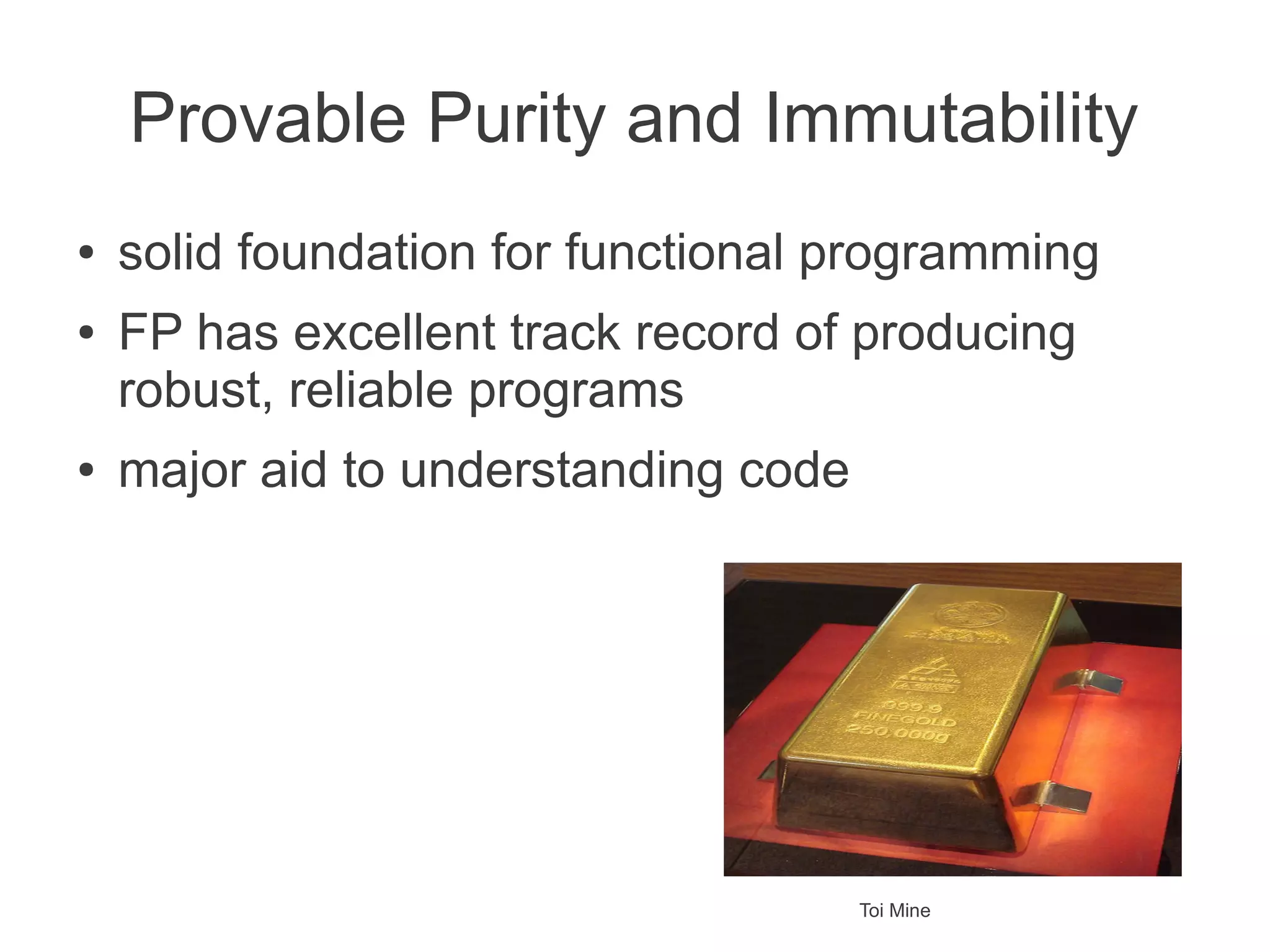
Provable Purity and Immutability
● solid foundation for functional programming
● FP has excellent track record of producing
robust, reliable programs
● major aid to understanding code
Toi Mine
Contract Programming
● some things can only be checked at runtime
● contracts are used to validate that assertions
about data are true
● (contracts are NOT for validating user input)
● can also be used by advanced optimizer to
generate better code
Industrial Quality
● No-compromise performance
● Scales to enormous programs
● Management tools
LTHS Industrial Tech Dept
No Compromise Performance
● Semantics that map directly onto
hardware
● basic types are typical native
machine types
● even SIMD types
● Uses modern optimizing back ends
● LLVM, GCC, Digital Mars
● Semantics amenable to powerful
optimization
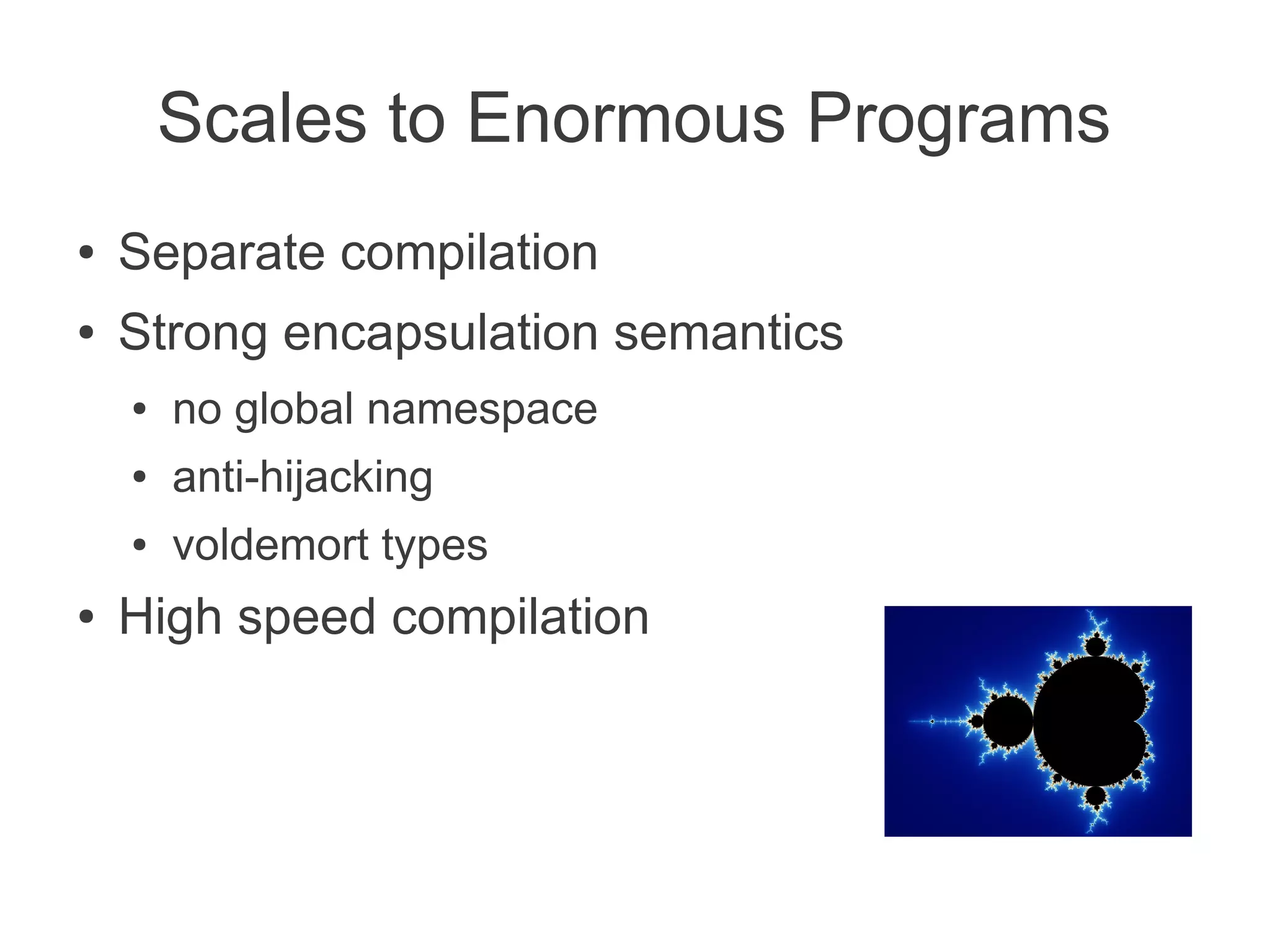
Scales to Enormous Programs
● Separate compilation
● Strong encapsulation semantics
● no global namespace
● anti-hijacking
● voldemort types
● High speed compilation
Management Tools
● Documentation generation
● Unit test
● Coverage analysis
Conclusion
● D has fantastic support from the community
● Very strong technical content for this
conference
● D will be the premier language for high
performance high productivity computing

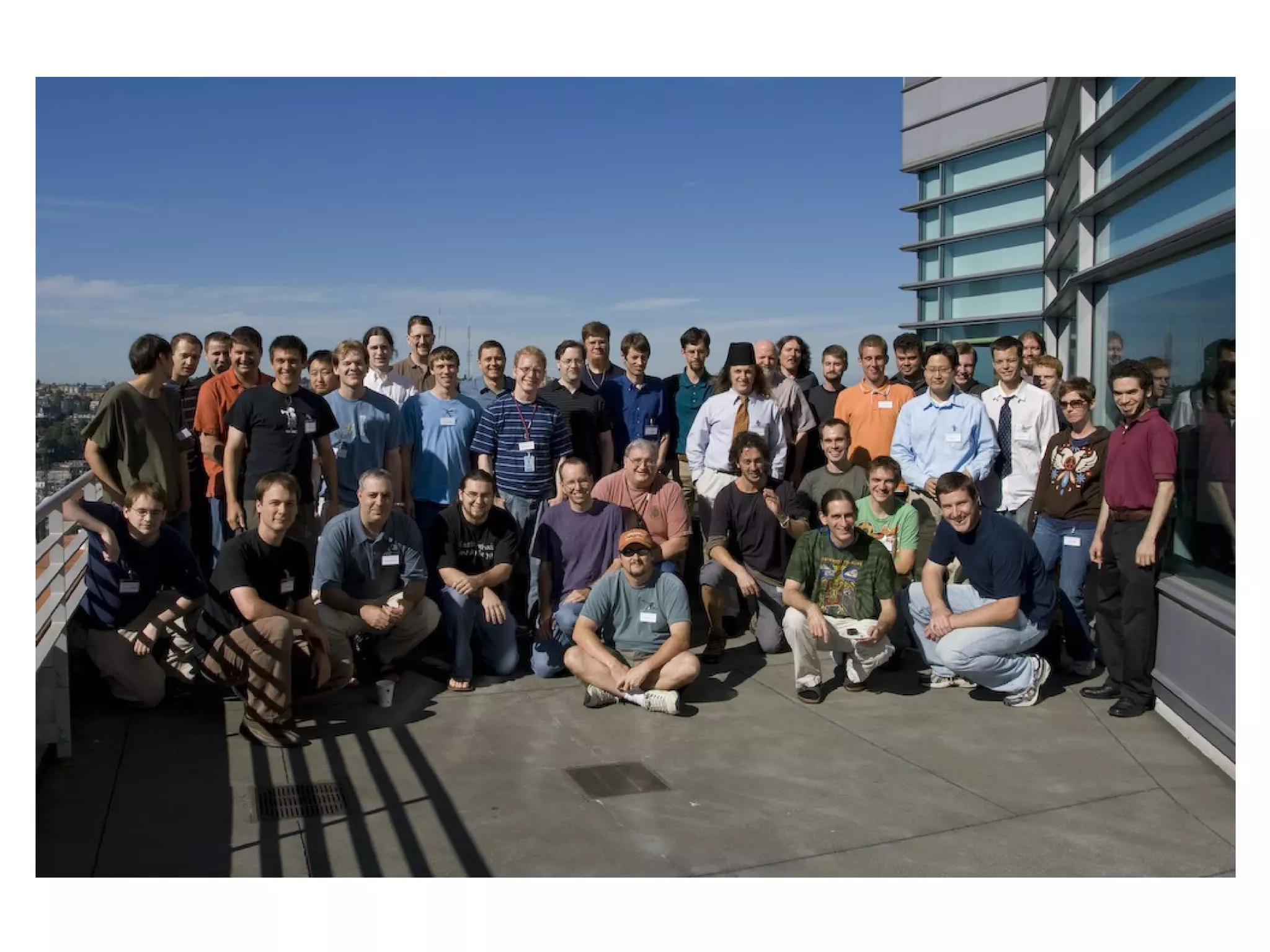
DConf 2013 Opening Keynote by Walter Bright

  • 2.
    Prehistory ● A hypotheticalsuccessor to C named “D” was talked about on Usenet back in the 80's. ● Nothing much ever came of it
  • 3.
    History ● Work beganon D in late 1999 ● D's first slashdot appearance ● http://developers.slashdot.org/story/01/08/15/23422 3/the-d-programming-language ● D1 released Jan 2007 ● First D Conference 2007
  • 5.
    D Today ● Rapidand dramatic development since D1 ● International, worldwide development community ● We're doing the impossible - developing a major new language from grassroots support ● And what amazing grassroots support it is ...
  • 7.
    Major Sponsors ● Facebook ●Sociomantic ● Remedy Games ● Andrew Edwards
  • 8.
    Today ● Copy AndMove Semantics ● Ali Çehreli ● Distributed Caching Compiler for D ● Robert Schadek ● Inside Regular Expressions ● Dmitry Olshansky ● Using D Alongside a Game Engine ● Manu Evans ● Concurrent Garbage Collection ● Leandro Lucarella
  • 9.
    Tomorrow ● GDC ● IanBuclaw ● Shared Libraries ● Martin Nowak ● C# to D ● Adam Wilson ● Web Development in D ● Vladimir Panteleev ● A Precise Garbage Collector for D ● Rainer Schütze ● Higgs, an Experimental JIT Compiler in D ● Maxime Chevalier-Boisvert ● Falling Down: the birth of kerönÅ ● Andrew Edwards
  • 10.
    Friday ● Metaprogramming inthe Real World ● Don Clugston ● Code Analysis for D with AnalyzeD ● Stefan Rohe ● D-Specific Design Patterns ● David Simcha ● LDC ● David Nadlinger ● Effective SIMD for modern architectures ● Manu Evans ● Writing Testable Code ● Ben Gertzfield ● Quo Vadis? ● Andrei Alexandrescu
  • 11.
    Vision ● Easy toread & understand code ● Provably correct ● Industrial Quality
  • 12.
    Easy To Read& Understand ● code that looks right is right ● minimal boilerplate ● code looks like the problem being solved
  • 13.
    Code That LooksRight Is Right ● and code that looks wrong is wrong
  • 14.
    void[] read(string name){ DWORD numread; auto namez = toMBSz(name); auto h=CreateFileA(namez,GENERIC_READ,FILE_SHARE_READ,null, OPEN_EXISTING, FILE_ATTRIBUTE_NORMAL | FILE_FLAG_SEQUENTIAL_SCAN,cast(HANDLE)null); if (h == INVALID_HANDLE_VALUE) goto err1; auto size = GetFileSize(h, null); if (size == INVALID_FILE_SIZE) goto err2; auto buf = std.gc.malloc(size); if (buf) std.gc.hasNoPointers(buf.ptr); if (ReadFile(h,buf.ptr,size,&numread,null) != 1) goto err2; if (numread != size) goto err2; if (!CloseHandle(h)) goto err; return buf[0 .. size]; err2: CloseHandle(h); err: delete buf; err1: throw new FileException(name, GetLastError()); } Pre-Scope Version of file.read()
  • 15.
    Using Scope –No Goto's void[] read(in char[] name, size_t upTo = size_t.max) { alias TypeTuple!(GENERIC_READ, FILE_SHARE_READ, (SECURITY_ATTRIBUTES*).init, OPEN_EXISTING, FILE_ATTRIBUTE_NORMAL | FILE_FLAG_SEQUENTIAL_SCAN, HANDLE.init) defaults; auto h = CreateFileA(toMBSz(name), defaults); cenforce(h != INVALID_HANDLE_VALUE, name); scope(exit) cenforce(CloseHandle(h), name); auto size = GetFileSize(h, null); cenforce(size != INVALID_FILE_SIZE, name); size = min(upTo, size); auto buf = GC.malloc(size, GC.BlkAttr.NO_SCAN)[0 .. size]; scope(failure) delete buf; DWORD numread = void; cenforce(ReadFile(h,buf.ptr, size, &numread, null) == 1 && numread == size, name); return buf[0 .. size]; }
  • 16.
    Minimal Boilerplate “The IDEis great. With one key, I can add 100 lines of boilerplate!”
  • 17.
    Looks Like theProblem Being Solved import std.stdio; import std.array; import std.algorithm; void main() { stdin.byLine(KeepTerminator.yes) map!(a => a.idup). array. sort. copy( stdout.lockingTextWriter()); }
  • 18.
    Provably Correct ● Provablememory safety ● Provable purity and immutability ● Contract programming – No 'faith based' programming
  • 19.
    Provable Memory Safety ●Memory safety means “no memory corruption” ● enabled with @safe attribute ● works by disallowing things like pointer arithmetic ● safety is transitive ● turtles all the way down
  • 20.
    Provable Purity andImmutability ● solid foundation for functional programming ● FP has excellent track record of producing robust, reliable programs ● major aid to understanding code Toi Mine
  • 21.
    Contract Programming ● somethings can only be checked at runtime ● contracts are used to validate that assertions about data are true ● (contracts are NOT for validating user input) ● can also be used by advanced optimizer to generate better code
  • 22.
    Industrial Quality ● No-compromiseperformance ● Scales to enormous programs ● Management tools LTHS Industrial Tech Dept
  • 23.
    No Compromise Performance ●Semantics that map directly onto hardware ● basic types are typical native machine types ● even SIMD types ● Uses modern optimizing back ends ● LLVM, GCC, Digital Mars ● Semantics amenable to powerful optimization
  • 24.
    Scales to EnormousPrograms ● Separate compilation ● Strong encapsulation semantics ● no global namespace ● anti-hijacking ● voldemort types ● High speed compilation
  • 25.
    Management Tools ● Documentationgeneration ● Unit test ● Coverage analysis
  • 26.
    Conclusion ● D hasfantastic support from the community ● Very strong technical content for this conference ● D will be the premier language for high performance high productivity computing