MBU 2520 Spring 2018 - Eric M. Griffin
Copyright Duration
1
COPYRIGHT DURATION
MBU 2520 Spring 2018 - Eric M. Griffin
.
Under the US Constitution, Copyright Duration must be limited… but no guidance
was given as to just how limited it may be.
Why so important? Once the term has expired, the work enters the Public Domain.
There is a value in having works benefit the author.
There is also a value in having works enter the public domain where others can use it
to create future works.
Example: West Side Story and innumerable works stem from Shakespeare.
2
COPYRIGHT DURATION
MBU 2520 Spring 2018 - Eric M. Griffin
.
Steps for determining © duration of a work.
1. When was the work created?
a) Works prior to January 1, 1978 are governed by the 1909 Act.
b) Works after January 1, 1978 are governed by the 1976 Act.
HOWEVER, the duration of both Acts were amended several times… making
things much more complicated.
3
COPYRIGHT DURATION
MBU 2520 Spring 2018 - Eric M. Griffin
.
1909 Act
1. Federal Protection began:
a) Upon publication with a proper© notice; OR
b) On the date of © registration for certain unpublished works.
i) Unpublished works were generally not protected under the Act,
but were protected by Common Law Copyright until published.
Common Law protection lasted until work published or registered
as unpublished work.
ii) If never published or registered, it would be protected indefinitely
under Common Law ©
2. Initial term was 28 years w/28 year renewal. (Max 56 years)
a) In order to keep protection upon renewal, a renewal registration was
needed . If not renewed properly in last year of term 1, it fell into the
Public Domain.
4
COPYRIGHT DURATION
MBU 2520 Spring 2018 - Eric M. Griffin
.
1909 Act
1. The difference b/w Common Law and Federal protection was publication.
Publication = Distribution of Copies or Phonorecords to the public by sale or other
transfer of ownership; by rental, lease, or lending; or the offer to distribute for
purpose of further distribution.
(Example: record company makes available to retailers who intend to resell)
Performance does NOT equal Publication.
If distribution is restricted as to who receives work = NOT Publication.
Why 2 periods? To protect authors. Close to initial creation, the real value of a
work is often uncertain. Renewal was meant to protect them.
Renewal right belonged to author or authors heirs, even if © was transferred.
5
COPYRIGHT DURATION
MBU 2520 Spring 2018 - Eric M. Griffin
.
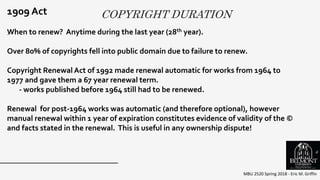
1909 Act
When to renew? Anytime during the last year (28th year).
Over 80% of copyrights fell into public domain due to failure to renew.
Copyright Renewal Act of 1992 made renewal automatic for works from 1964 to
1977 and gave them a 67 year renewal term.
- works published before 1964 still had to be renewed.
Renewal for post-1964 works was automatic (and therefore optional), however
manual renewal within 1 year of expiration constitutes evidence of validity of the ©
and facts stated in the renewal. This is useful in any ownership dispute!
6
COPYRIGHT DURATION
MBU 2520 Spring 2018 - Eric M. Griffin
.
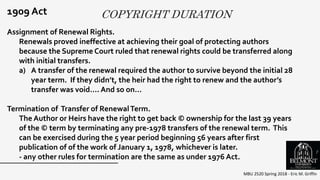
1909 Act
Assignment of Renewal Rights.
Renewals proved ineffective at achieving their goal of protecting authors
because the Supreme Court ruled that renewal rights could be transferred along
with initial transfers.
a) A transfer of the renewal required the author to survive beyond the initial 28
year term. If they didn’t, the heir had the right to renew and the author’s
transfer was void…. And so on…
Termination of Transfer of RenewalTerm.
The Author or Heirs have the right to get back © ownership for the last 39 years
of the © term by terminating any pre-1978 transfers of the renewal term. This
can be exercised during the 5 year period beginning 56 years after first
publication of of the work of January 1, 1978, whichever is later.
- any other rules for termination are the same as under 1976 Act.
7
COPYRIGHT DURATION
MBU 2520 Spring 2018 - Eric M. Griffin
.
1976 Act
1. Federal Protection Begins upon CREATION of the work.
a. Not dependent upon Publication.
2. No more renewal term. Term based on Author’s Lifetime. OriginalTerm is Life plus 50
years. (Increased to Life plus 70 in 1998.)
WHY? 1. Increased life expectancies.
2. So many © lost due to failed renewals.
3.To get in line with most foreign countries.
4.With a term based on author’s life, all their works enter PD at same time
Term is based on the Author’s life regardless of transfers or assignments!
8
COPYRIGHT DURATION
MBU 2520 Spring 2018 - Eric M. Griffin
.
1976 Act
To determine length of © for a work under the 1976 Act:
Divide works into 3 categories:
1. Works created beginning in 1978;
2. Works created but not published before 1978;
3. Works published before 1978.
9
COPYRIGHT DURATION
MBU 2520 Spring 2018 - Eric M. Griffin
.
1976 Act
To determine length of © for a work under the 1976 Act:
Divide works into 3 categories:
1. Works created beginning in 1978;
2. Works created but not published before 1978;
3. Works published before 1978.
10
COPYRIGHT DURATION
MBU 2520 Spring 2018 - Eric M. Griffin
.
11
COPYRIGHT DURATION
MBU 2520 Spring 2018 - Eric M. Griffin
.
1976 Act
1. 1978 to Present: From Creation until Death of Author + 70 years.
EXCEPT for anonymous works, pseudonymous works and works for hire
= 95 years from publication or 120 years from creation, whichever is shorter
Joint works use the date of the last surviving author + 70 years.
If the author of an anonymous work or pseudonymous work is discovered, the term
converts to Life + 70
Anyone with interest in a © can notify the office by 1)registering under authors
true name, 2) filing a supplementary registration if already done, 3) filing a
statement with author’s name, nature of their interest, title, registration #.
An author in bad health or looking for longer protection may use the
pseudonymous name rule to get longer protection than otherwise granted!
12
COPYRIGHT DURATION
MBU 2520 Spring 2018 - Eric M. Griffin
.
1976 Act
How do you know if © owner is dead?The (c) Office provides for recordation.
If after 95 years of first publication or 120 years from creation, a prospective user
gets a report from the © Office that the Office records show nothing to indicate the
author is still living or died less than 70 years before, the prospective user gets the
presumption that author has been dead at least 70 years and work is in PD. This
presumption is a defense against infringement UNLESS the © owner can show that
the user had notice that the author was dead less than 70 years.
(SNEAKY AND COMPLICATED!!!!)
Owners of valuable copyrights may want to file statements of living author or with
date of the authors death in order to avoid the situation above.
© Actually expires on DEC 31 of year 70, so it may be slightly longer!
13
COPYRIGHT DURATION
MBU 2520 Spring 2018 - Eric M. Griffin
.
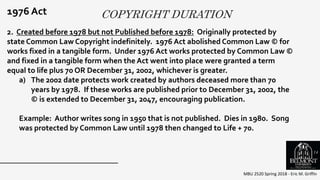
1976 Act
2. Created before 1978 but not Published before 1978: Originally protected by
state Common Law Copyright indefinitely. 1976 Act abolished Common Law © for
works fixed in a tangible form. Under 1976 Act works protected by Common Law ©
and fixed in a tangible form when the Act went into place were granted a term
equal to life plus 70 OR December 31, 2002, whichever is greater.
a) The 2002 date protects work created by authors deceased more than 70
years by 1978. If these works are published prior to December 31, 2002, the
© is extended to December 31, 2047, encouraging publication.
Example: Author writes song in 1950 that is not published. Dies in 1980. Song
was protected by Common Law until 1978 then changed to Life + 70.
14
COPYRIGHT DURATION
MBU 2520 Spring 2018 - Eric M. Griffin
.
1976 Act
The 1976 Act more or less got rid of Common Law © protection EXCEPT for:
1. Works not fixed in any tangible form, such as unrecorded improvisations.
2. Sound Recordings Fixed before Feb 15, 1972 which are protected until Feb 15,
2067.
15
COPYRIGHT DURATION
MBU 2520 Spring 2018 - Eric M. Griffin
.
1976 Act
3. Published or Registered before 1978: Governed initially by 1909 Act with 28
year term and renewals. The 1976 Act made some changes to extend length of
renewal.
A. Renewal #1: Extended Renewal for 19 more years to = 47 years
WHY? To give 75 years protection, making it closer to 1976 Act.
B. Renewal #2: Under 1998 Sonny Bono Act, 20 more years added = 67 years.
This makes the Maximum Term 95 years (28 ofTerm 1 + 67 ofTerm 2 = 95)
Result: 1. Works Published from 1964 to 1977 got automatic renewal
2. Works Published 1923 to 1963 had to renew at 28 years or PD.
3. Works Published before 1923 = Public Domain 16
COPYRIGHT DURATION
MBU 2520 Spring 2018 - Eric M. Griffin
.
17
COPYRIGHT DURATION
MBU 2520 Spring 2018 - Eric M. Griffin
.
How do you know if something is in Public Domain?
You often have the date on the © notice. However, works published prior to 1964
may or may not have been renewed. You will need to find out by:
1. Performing your own search of the Catalog of Copyright Entries (CCE).
2. Have © do a search for you. There are fees involved.
3. Have a professional search firm of attorney do your search.
NOTE: Book is incorrect about Happy Birthday. In 2016 a court found that Happy
Birthday was in Public Domain. The song is based on a song first registered in 1893
with the Birthday lyrics added later. U.S. District Courtruled that the copyright
originally filed by the Clayton F. Summy Co. in 1935 granted rights only to the
melody and specific arrangements of the tune but not to the actual song itself, as
Summy never acquired the rights to the song’s lyrics
18
COPYRIGHT DURATION
MBU 2520 Spring 2018 - Eric M. Griffin
.
Restoration of Copyrights in Foreign Works:
Generally when a work enters the PD it stays there. BUT there may be an
exception with foreign works.
 This allows recapture for works published in the USA before 1964 BUT that
missed renewal since most foreign countries didn’t have a renewal system.
19
COPYRIGHT DURATION
MBU 2520 Spring 2018 - Eric M. Griffin
.
Restoration of Copyrights in ForeignWorks: (cont).
Under the GATT (General Agreement onTrade andTariffs) certain foreign works
had their © restored effective January 1, 1996.
1. Author must be/have been citizen or resident of member of Berne Convention,
WTO, or other Copyright treaty with the US.
2. Work was first published in a foreign country and not published in US within 30
days of first publication
3. Work’s © must still be valid in original country.
• Restored works receive same protection as if the renewal had been filed.
• © Owner cannot recover for infringements prior to 1996 restoration AND must
give notice to anyone continuing to infringe after 1996 before filing a suit.
20
COPYRIGHT DURATION
MBU 2520 Spring 2018 - Eric M. Griffin
.
Restoration of Copyrights in ForeignWorks: (cont).
Under the GATT (General Agreement onTrade andTariffs) certain foreign works
had their © restored effective January 1, 1996.
1. Author must be/have been citizen or resident of member of Berne Convention,
WTO, or other Copyright treaty with the US.
2. Work was first published in a foreign country and not published in US within 30
days of first publication
3. Work’s © must still be valid in original country.
• Restored works receive same protection as if the renewal had been filed.
• © Owner cannot recover for infringements prior to 1996 restoration AND must
give notice to anyone continuing to infringe after 1996 before filing a suit.
21
COPYRIGHT DURATION
MBU 2520 Spring 2018 - Eric M. Griffin
.
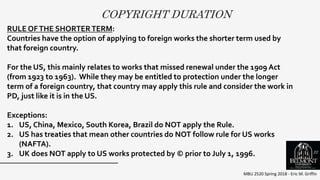
RULE OFTHE SHORTERTERM:
Countries have the option of applying to foreign works the shorter term used by
that foreign country.
For the US, this mainly relates to works that missed renewal under the 1909 Act
(from 1923 to 1963). While they may be entitled to protection under the longer
term of a foreign country, that country may apply this rule and consider the work in
PD, just like it is in the US.
Exceptions:
1. US, China, Mexico, South Korea, Brazil do NOT apply the Rule.
2. US has treaties that mean other countries do NOT follow rule for US works
(NAFTA).
3. UK does NOT apply to US works protected by © prior to July 1, 1996. 22

Mbu 2520 spring 2018 chapter 8

  • 1.
    MBU 2520 Spring2018 - Eric M. Griffin Copyright Duration 1
  • 2.
    COPYRIGHT DURATION MBU 2520Spring 2018 - Eric M. Griffin . Under the US Constitution, Copyright Duration must be limited… but no guidance was given as to just how limited it may be. Why so important? Once the term has expired, the work enters the Public Domain. There is a value in having works benefit the author. There is also a value in having works enter the public domain where others can use it to create future works. Example: West Side Story and innumerable works stem from Shakespeare. 2
  • 3.
    COPYRIGHT DURATION MBU 2520Spring 2018 - Eric M. Griffin . Steps for determining © duration of a work. 1. When was the work created? a) Works prior to January 1, 1978 are governed by the 1909 Act. b) Works after January 1, 1978 are governed by the 1976 Act. HOWEVER, the duration of both Acts were amended several times… making things much more complicated. 3
  • 4.
    COPYRIGHT DURATION MBU 2520Spring 2018 - Eric M. Griffin . 1909 Act 1. Federal Protection began: a) Upon publication with a proper© notice; OR b) On the date of © registration for certain unpublished works. i) Unpublished works were generally not protected under the Act, but were protected by Common Law Copyright until published. Common Law protection lasted until work published or registered as unpublished work. ii) If never published or registered, it would be protected indefinitely under Common Law © 2. Initial term was 28 years w/28 year renewal. (Max 56 years) a) In order to keep protection upon renewal, a renewal registration was needed . If not renewed properly in last year of term 1, it fell into the Public Domain. 4
  • 5.
    COPYRIGHT DURATION MBU 2520Spring 2018 - Eric M. Griffin . 1909 Act 1. The difference b/w Common Law and Federal protection was publication. Publication = Distribution of Copies or Phonorecords to the public by sale or other transfer of ownership; by rental, lease, or lending; or the offer to distribute for purpose of further distribution. (Example: record company makes available to retailers who intend to resell) Performance does NOT equal Publication. If distribution is restricted as to who receives work = NOT Publication. Why 2 periods? To protect authors. Close to initial creation, the real value of a work is often uncertain. Renewal was meant to protect them. Renewal right belonged to author or authors heirs, even if © was transferred. 5
  • 6.
    COPYRIGHT DURATION MBU 2520Spring 2018 - Eric M. Griffin . 1909 Act When to renew? Anytime during the last year (28th year). Over 80% of copyrights fell into public domain due to failure to renew. Copyright Renewal Act of 1992 made renewal automatic for works from 1964 to 1977 and gave them a 67 year renewal term. - works published before 1964 still had to be renewed. Renewal for post-1964 works was automatic (and therefore optional), however manual renewal within 1 year of expiration constitutes evidence of validity of the © and facts stated in the renewal. This is useful in any ownership dispute! 6
  • 7.
    COPYRIGHT DURATION MBU 2520Spring 2018 - Eric M. Griffin . 1909 Act Assignment of Renewal Rights. Renewals proved ineffective at achieving their goal of protecting authors because the Supreme Court ruled that renewal rights could be transferred along with initial transfers. a) A transfer of the renewal required the author to survive beyond the initial 28 year term. If they didn’t, the heir had the right to renew and the author’s transfer was void…. And so on… Termination of Transfer of RenewalTerm. The Author or Heirs have the right to get back © ownership for the last 39 years of the © term by terminating any pre-1978 transfers of the renewal term. This can be exercised during the 5 year period beginning 56 years after first publication of of the work of January 1, 1978, whichever is later. - any other rules for termination are the same as under 1976 Act. 7
  • 8.
    COPYRIGHT DURATION MBU 2520Spring 2018 - Eric M. Griffin . 1976 Act 1. Federal Protection Begins upon CREATION of the work. a. Not dependent upon Publication. 2. No more renewal term. Term based on Author’s Lifetime. OriginalTerm is Life plus 50 years. (Increased to Life plus 70 in 1998.) WHY? 1. Increased life expectancies. 2. So many © lost due to failed renewals. 3.To get in line with most foreign countries. 4.With a term based on author’s life, all their works enter PD at same time Term is based on the Author’s life regardless of transfers or assignments! 8
  • 9.
    COPYRIGHT DURATION MBU 2520Spring 2018 - Eric M. Griffin . 1976 Act To determine length of © for a work under the 1976 Act: Divide works into 3 categories: 1. Works created beginning in 1978; 2. Works created but not published before 1978; 3. Works published before 1978. 9
  • 10.
    COPYRIGHT DURATION MBU 2520Spring 2018 - Eric M. Griffin . 1976 Act To determine length of © for a work under the 1976 Act: Divide works into 3 categories: 1. Works created beginning in 1978; 2. Works created but not published before 1978; 3. Works published before 1978. 10
  • 11.
    COPYRIGHT DURATION MBU 2520Spring 2018 - Eric M. Griffin . 11
  • 12.
    COPYRIGHT DURATION MBU 2520Spring 2018 - Eric M. Griffin . 1976 Act 1. 1978 to Present: From Creation until Death of Author + 70 years. EXCEPT for anonymous works, pseudonymous works and works for hire = 95 years from publication or 120 years from creation, whichever is shorter Joint works use the date of the last surviving author + 70 years. If the author of an anonymous work or pseudonymous work is discovered, the term converts to Life + 70 Anyone with interest in a © can notify the office by 1)registering under authors true name, 2) filing a supplementary registration if already done, 3) filing a statement with author’s name, nature of their interest, title, registration #. An author in bad health or looking for longer protection may use the pseudonymous name rule to get longer protection than otherwise granted! 12
  • 13.
    COPYRIGHT DURATION MBU 2520Spring 2018 - Eric M. Griffin . 1976 Act How do you know if © owner is dead?The (c) Office provides for recordation. If after 95 years of first publication or 120 years from creation, a prospective user gets a report from the © Office that the Office records show nothing to indicate the author is still living or died less than 70 years before, the prospective user gets the presumption that author has been dead at least 70 years and work is in PD. This presumption is a defense against infringement UNLESS the © owner can show that the user had notice that the author was dead less than 70 years. (SNEAKY AND COMPLICATED!!!!) Owners of valuable copyrights may want to file statements of living author or with date of the authors death in order to avoid the situation above. © Actually expires on DEC 31 of year 70, so it may be slightly longer! 13
  • 14.
    COPYRIGHT DURATION MBU 2520Spring 2018 - Eric M. Griffin . 1976 Act 2. Created before 1978 but not Published before 1978: Originally protected by state Common Law Copyright indefinitely. 1976 Act abolished Common Law © for works fixed in a tangible form. Under 1976 Act works protected by Common Law © and fixed in a tangible form when the Act went into place were granted a term equal to life plus 70 OR December 31, 2002, whichever is greater. a) The 2002 date protects work created by authors deceased more than 70 years by 1978. If these works are published prior to December 31, 2002, the © is extended to December 31, 2047, encouraging publication. Example: Author writes song in 1950 that is not published. Dies in 1980. Song was protected by Common Law until 1978 then changed to Life + 70. 14
  • 15.
    COPYRIGHT DURATION MBU 2520Spring 2018 - Eric M. Griffin . 1976 Act The 1976 Act more or less got rid of Common Law © protection EXCEPT for: 1. Works not fixed in any tangible form, such as unrecorded improvisations. 2. Sound Recordings Fixed before Feb 15, 1972 which are protected until Feb 15, 2067. 15
  • 16.
    COPYRIGHT DURATION MBU 2520Spring 2018 - Eric M. Griffin . 1976 Act 3. Published or Registered before 1978: Governed initially by 1909 Act with 28 year term and renewals. The 1976 Act made some changes to extend length of renewal. A. Renewal #1: Extended Renewal for 19 more years to = 47 years WHY? To give 75 years protection, making it closer to 1976 Act. B. Renewal #2: Under 1998 Sonny Bono Act, 20 more years added = 67 years. This makes the Maximum Term 95 years (28 ofTerm 1 + 67 ofTerm 2 = 95) Result: 1. Works Published from 1964 to 1977 got automatic renewal 2. Works Published 1923 to 1963 had to renew at 28 years or PD. 3. Works Published before 1923 = Public Domain 16
  • 17.
    COPYRIGHT DURATION MBU 2520Spring 2018 - Eric M. Griffin . 17
  • 18.
    COPYRIGHT DURATION MBU 2520Spring 2018 - Eric M. Griffin . How do you know if something is in Public Domain? You often have the date on the © notice. However, works published prior to 1964 may or may not have been renewed. You will need to find out by: 1. Performing your own search of the Catalog of Copyright Entries (CCE). 2. Have © do a search for you. There are fees involved. 3. Have a professional search firm of attorney do your search. NOTE: Book is incorrect about Happy Birthday. In 2016 a court found that Happy Birthday was in Public Domain. The song is based on a song first registered in 1893 with the Birthday lyrics added later. U.S. District Courtruled that the copyright originally filed by the Clayton F. Summy Co. in 1935 granted rights only to the melody and specific arrangements of the tune but not to the actual song itself, as Summy never acquired the rights to the song’s lyrics 18
  • 19.
    COPYRIGHT DURATION MBU 2520Spring 2018 - Eric M. Griffin . Restoration of Copyrights in Foreign Works: Generally when a work enters the PD it stays there. BUT there may be an exception with foreign works.  This allows recapture for works published in the USA before 1964 BUT that missed renewal since most foreign countries didn’t have a renewal system. 19
  • 20.
    COPYRIGHT DURATION MBU 2520Spring 2018 - Eric M. Griffin . Restoration of Copyrights in ForeignWorks: (cont). Under the GATT (General Agreement onTrade andTariffs) certain foreign works had their © restored effective January 1, 1996. 1. Author must be/have been citizen or resident of member of Berne Convention, WTO, or other Copyright treaty with the US. 2. Work was first published in a foreign country and not published in US within 30 days of first publication 3. Work’s © must still be valid in original country. • Restored works receive same protection as if the renewal had been filed. • © Owner cannot recover for infringements prior to 1996 restoration AND must give notice to anyone continuing to infringe after 1996 before filing a suit. 20
  • 21.
    COPYRIGHT DURATION MBU 2520Spring 2018 - Eric M. Griffin . Restoration of Copyrights in ForeignWorks: (cont). Under the GATT (General Agreement onTrade andTariffs) certain foreign works had their © restored effective January 1, 1996. 1. Author must be/have been citizen or resident of member of Berne Convention, WTO, or other Copyright treaty with the US. 2. Work was first published in a foreign country and not published in US within 30 days of first publication 3. Work’s © must still be valid in original country. • Restored works receive same protection as if the renewal had been filed. • © Owner cannot recover for infringements prior to 1996 restoration AND must give notice to anyone continuing to infringe after 1996 before filing a suit. 21
  • 22.
    COPYRIGHT DURATION MBU 2520Spring 2018 - Eric M. Griffin . RULE OFTHE SHORTERTERM: Countries have the option of applying to foreign works the shorter term used by that foreign country. For the US, this mainly relates to works that missed renewal under the 1909 Act (from 1923 to 1963). While they may be entitled to protection under the longer term of a foreign country, that country may apply this rule and consider the work in PD, just like it is in the US. Exceptions: 1. US, China, Mexico, South Korea, Brazil do NOT apply the Rule. 2. US has treaties that mean other countries do NOT follow rule for US works (NAFTA). 3. UK does NOT apply to US works protected by © prior to July 1, 1996. 22