Code Division Multiple
Access (CDMA)
Presented by
EduTechLearners
www.edutechlearners.com
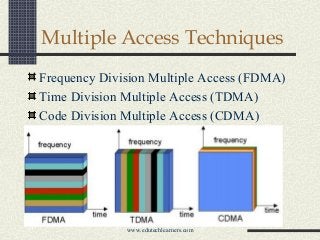
Multiple Access Techniques
Frequency Division Multiple Access (FDMA)
Time Division Multiple Access (TDMA)
Code Division Multiple Access (CDMA)
www.edutechlearners.com
CDMA
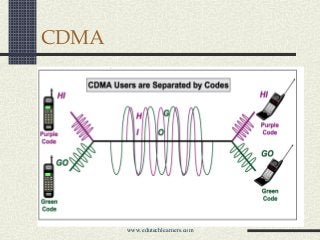
In CDMA, a number of users occupy all of the
channel bandwidth all of the time. Their signals
are encoded so that information from an individual
transmitter can be detected and recovered only by
a properly synchronized receiving station that
knows the code being used.
Each receiving station has its own code, called its
“address” and a transmitting station simply
modulates its transmission with the address of the
intended receiver whenever it wishes to send a
message to that receiver.
www.edutechlearners.com
CDMA
www.edutechlearners.com
Features of CDMA
CDMA is Full Duplex
Eliminates need to engineer reuse pattern
Increases Capacity by about 6 times
Multipath reception improves voice clarity
Security or Interference rejection : Cross-
correlating the code signal with a narrowband
signal spreads the power of the narrowband
signal, thereby reducing the interfering
information bandwidth.
www.edutechlearners.com
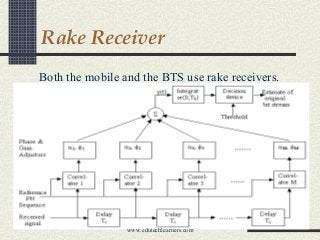
Rake Receiver
Both the mobile and the BTS use rake receivers.
www.edutechlearners.com
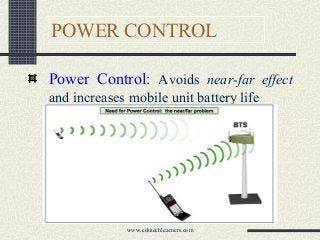
Power Control: Avoids near-far effect
and increases mobile unit battery life
POWER CONTROL
www.edutechlearners.com
Forward link Power Control
The BTS independently adjusts the power
based on the information it receives from
the mobile.
www.edutechlearners.com
Reverse Link Power Control
Open Loop: Prior to any transmission, the
mobile monitors the total power received by the
base station.
Closed Loop: The base station provides
continuous feedback to each mobile so that the
mobile varies its power accordingly.
www.edutechlearners.com
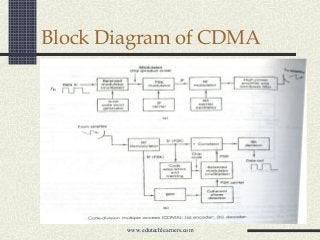
Block Diagram of CDMA
www.edutechlearners.com
CDMA Architecture
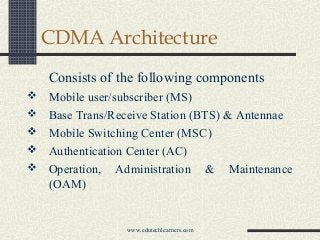
Consists of the following components
 Mobile user/subscriber (MS)
 Base Trans/Receive Station (BTS) & Antennae
 Mobile Switching Center (MSC)
 Authentication Center (AC)
 Operation, Administration & Maintenance
(OAM)
www.edutechlearners.com
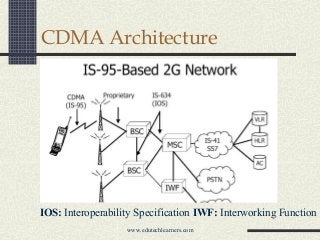
CDMA Architecture
IOS: Interoperability Specification IWF: Interworking Function
www.edutechlearners.com
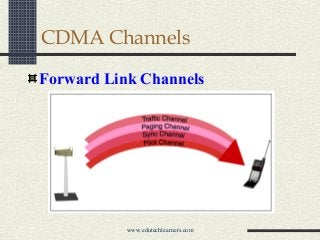
CDMA Channels
Forward Link Channels
www.edutechlearners.com
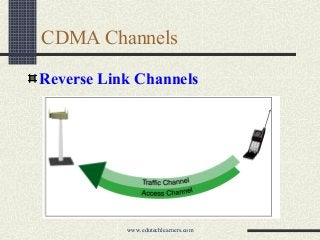
CDMA Channels
Reverse Link Channels
www.edutechlearners.com
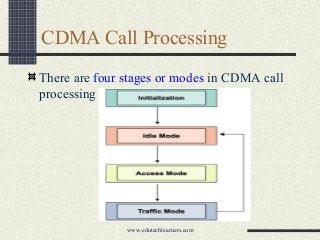
CDMA Call Processing
There are four stages or modes in CDMA call
processing
www.edutechlearners.com
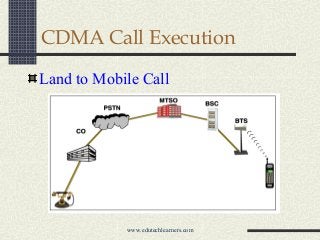
CDMA Call Execution
Land to Mobile Call
www.edutechlearners.com
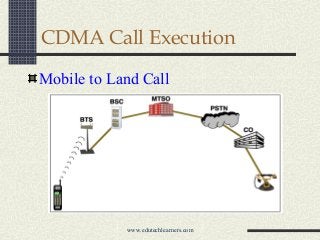
CDMA Call Execution
Mobile to Land Call
www.edutechlearners.com
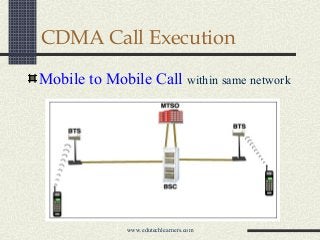
CDMA Call Execution
Mobile to Mobile Call within same network
www.edutechlearners.com
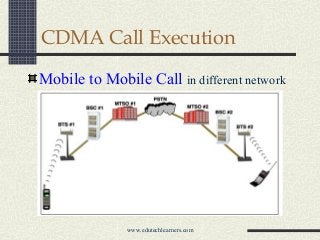
CDMA Call Execution
Mobile to Mobile Call in different network
www.edutechlearners.com
CDMA Applications
In Bluetooth
 Bluetooth uses Fast FH-CDMA with a hopping
rate of 1,600 hops per second.
 Each piconet has its own spreading sequence.
 FH/CDMA in Bluetooth allows tens of piconets
to overlap in the same area providing an
effective throughput of more than 1 Mbps.
www.edutechlearners.com
CDMA Applications
In Global Positioning System (GPS):
 In GPS there are two satellite signals or carriers.
 A PN-sequence of freq. 1023 MHz is used to
modulate one of these carriers to generate coded
signals that are needed for acquisition of the satellite
by the receiver.
 Different satellites use different sequences, which lets
them all broadcast on the same frequencies while still
allowing receivers to distinguish between satellites.
www.edutechlearners.com
Limitations of CDMA
Synchronization Requirement
• Unavailability of large contiguous bandwidth
• Near-far Effect
• Self-Jamming
www.edutechlearners.com
Conclusion
There are now different variants of CDMA, but
the original CDMA is now known as cdmaOne.
We now have cdma2000 and its variants like 1X
EV, 1XEV-DO, and MC 3X. These refer to
variants of usage of a 1.25Mhz channel. For
example, 3X uses a 5 MHz channel.
Over 35 countries have either commercial or trial
activity ongoing regarding CDMA. There are
already 43 Wireless Local Loop (WLL) systems in
22 countries using cdmaOne technology.
www.edutechlearners.com

Code Division Multiple Access (CDMA)

  • 1.
    Code Division Multiple Access(CDMA) Presented by EduTechLearners www.edutechlearners.com
  • 2.
    Multiple Access Techniques FrequencyDivision Multiple Access (FDMA) Time Division Multiple Access (TDMA) Code Division Multiple Access (CDMA) www.edutechlearners.com
  • 3.
    CDMA In CDMA, anumber of users occupy all of the channel bandwidth all of the time. Their signals are encoded so that information from an individual transmitter can be detected and recovered only by a properly synchronized receiving station that knows the code being used. Each receiving station has its own code, called its “address” and a transmitting station simply modulates its transmission with the address of the intended receiver whenever it wishes to send a message to that receiver. www.edutechlearners.com
  • 4.
  • 5.
    Features of CDMA CDMAis Full Duplex Eliminates need to engineer reuse pattern Increases Capacity by about 6 times Multipath reception improves voice clarity Security or Interference rejection : Cross- correlating the code signal with a narrowband signal spreads the power of the narrowband signal, thereby reducing the interfering information bandwidth. www.edutechlearners.com
  • 6.
    Rake Receiver Both themobile and the BTS use rake receivers. www.edutechlearners.com
  • 7.
    Power Control: Avoidsnear-far effect and increases mobile unit battery life POWER CONTROL www.edutechlearners.com
  • 8.
    Forward link PowerControl The BTS independently adjusts the power based on the information it receives from the mobile. www.edutechlearners.com
  • 9.
    Reverse Link PowerControl Open Loop: Prior to any transmission, the mobile monitors the total power received by the base station. Closed Loop: The base station provides continuous feedback to each mobile so that the mobile varies its power accordingly. www.edutechlearners.com
  • 10.
    Block Diagram ofCDMA www.edutechlearners.com
  • 11.
    CDMA Architecture Consists ofthe following components  Mobile user/subscriber (MS)  Base Trans/Receive Station (BTS) & Antennae  Mobile Switching Center (MSC)  Authentication Center (AC)  Operation, Administration & Maintenance (OAM) www.edutechlearners.com
  • 12.
    CDMA Architecture IOS: InteroperabilitySpecification IWF: Interworking Function www.edutechlearners.com
  • 13.
    CDMA Channels Forward LinkChannels www.edutechlearners.com
  • 14.
    CDMA Channels Reverse LinkChannels www.edutechlearners.com
  • 15.
    CDMA Call Processing Thereare four stages or modes in CDMA call processing www.edutechlearners.com
  • 16.
    CDMA Call Execution Landto Mobile Call www.edutechlearners.com
  • 17.
    CDMA Call Execution Mobileto Land Call www.edutechlearners.com
  • 18.
    CDMA Call Execution Mobileto Mobile Call within same network www.edutechlearners.com
  • 19.
    CDMA Call Execution Mobileto Mobile Call in different network www.edutechlearners.com
  • 20.
    CDMA Applications In Bluetooth Bluetooth uses Fast FH-CDMA with a hopping rate of 1,600 hops per second.  Each piconet has its own spreading sequence.  FH/CDMA in Bluetooth allows tens of piconets to overlap in the same area providing an effective throughput of more than 1 Mbps. www.edutechlearners.com
  • 21.
    CDMA Applications In GlobalPositioning System (GPS):  In GPS there are two satellite signals or carriers.  A PN-sequence of freq. 1023 MHz is used to modulate one of these carriers to generate coded signals that are needed for acquisition of the satellite by the receiver.  Different satellites use different sequences, which lets them all broadcast on the same frequencies while still allowing receivers to distinguish between satellites. www.edutechlearners.com
  • 22.
    Limitations of CDMA SynchronizationRequirement • Unavailability of large contiguous bandwidth • Near-far Effect • Self-Jamming www.edutechlearners.com
  • 23.
    Conclusion There are nowdifferent variants of CDMA, but the original CDMA is now known as cdmaOne. We now have cdma2000 and its variants like 1X EV, 1XEV-DO, and MC 3X. These refer to variants of usage of a 1.25Mhz channel. For example, 3X uses a 5 MHz channel. Over 35 countries have either commercial or trial activity ongoing regarding CDMA. There are already 43 Wireless Local Loop (WLL) systems in 22 countries using cdmaOne technology. www.edutechlearners.com