Professor Chris Marsden
Georgetown #InformationPlatforms 23 February
OffData:
a prosumer law agency to
govern big data platforms
in the public interest
.
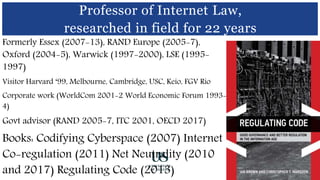
Formerly Essex (2007-13), RAND Europe (2005-7),
Oxford (2004-5), Warwick (1997-2000), LSE (1995-
1997)
Visitor Harvard ‘99, Melbourne, Cambridge, USC, Keio, FGV Rio
Corporate work (WorldCom 2001-2 World Economic Forum 1993-
4)
Govt advisor (RAND 2005-7, ITC 2001, OECD 2017)
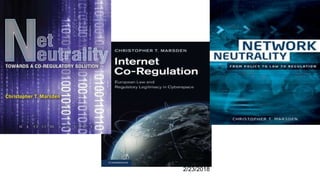
Books: Codifying Cyberspace (2007) Internet
Co-regulation (2011) Net Neutrality (2010
and 2017) Regulating Code (2013)
Professor of Internet Law,
researched in field for 22 years
Prior art....
2/23/2018
50 miles from London
University of Sussex
Brighton, England
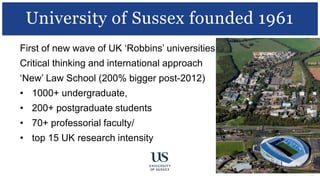
First of new wave of UK ‘Robbins’ universities
Critical thinking and international approach
‘New’ Law School (200% bigger post-2012)
• 1000+ undergraduate,
• 200+ postgraduate students
• 70+ professorial faculty/
• top 15 UK research intensity
University of Sussex founded 1961
Regulate intermediaries who provide platforms for digital service.
• GAFA giants: Google, Amazon, Facebook and Apple.
Many policy entrepreneurs are peddling solutions as policy cycle turns,
Networks are not new, platforms have been regulated for centuries
I take the long view, focussing on common carriage neutrality and
• the railways/telegraphy regulation of the 1840s in England.
Historical examples highly relevant to ‘prosumer’ capitalism 180 years on
Platform regulation the current
cause of technology regulation
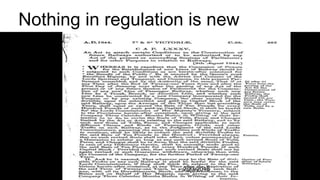
Nothing in regulation is new
2/23/2018
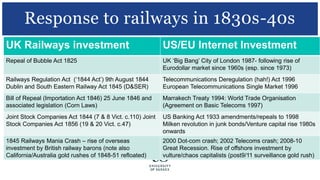
Response to railways in 1830s-40s
UK Railways investment US/EU Internet Investment
Repeal of Bubble Act 1825 UK ‘Big Bang’ City of London 1987- following rise of
Eurodollar market since 1960s (esp. since 1973)
Railways Regulation Act (‘1844 Act’) 9th August 1844
Dublin and South Eastern Railway Act 1845 (D&SER)
Telecommunications Deregulation (hah!) Act 1996
European Telecommunications Single Market 1996
Bill of Repeal (Importation Act 1846) 25 June 1846 and
associated legislation (Corn Laws)
Marrakech Treaty 1994: World Trade Organisation
(Agreement on Basic Telecoms 1997)
Joint Stock Companies Act 1844 (7 & 8 Vict. c.110) Joint
Stock Companies Act 1856 (19 & 20 Vict. c.47)
US Banking Act 1933 amendments/repeals to 1998
Milken revolution in junk bonds/Venture capital rise 1980s
onwards
1845 Railways Mania Crash – rise of overseas
investment by British railway barons (note also
California/Australia gold rushes of 1848-51 refloated)
2000 Dot-com crash; 2002 Telecoms crash; 2008-10
Great Recession. Rise of offshore investment by
vulture/chaos capitalists (post9/11 surveillance gold rush)
Odlyzko, Andrew.
(2010) Collective hallucinations and inefficient markets: The
British Railway Mania of the 1840s
(2000) The History of Communications and its Implications for
the Internet. http://dx.doi.org/10.2139/ssrn.235284
(series of brilliant papers)
Great debt owed to Andrew Odlyzko
2/23/2018
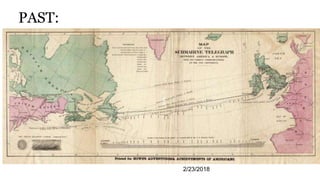
PAST:
2/23/2018
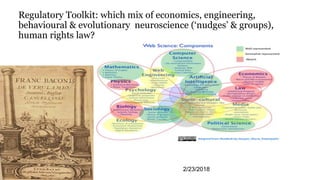
Regulatory Toolkit: which mix of economics, engineering,
behavioural & evolutionary neuroscience (‘nudges’ & groups),
human rights law?
2/23/2018
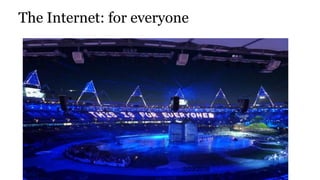
The Internet: for everyone
2/23/2018
But this ‘prosumer environment’ is currently grossly unregulated,
• leaving users' data and content at the mercy of the multinationals
• who host it and sometimes claim to own it,
or subject to knee-jerk over-regulation
• current ‘fake news’ controversy in Germany.
It is a new regulatory policy cycle in network regulation.
We are all becoming ‘prosumers’ sharing
intimate details of our personal lives
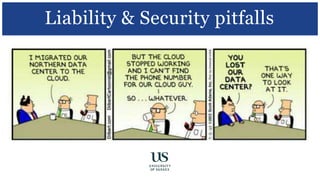
Liability & Security pitfalls
Over-arching need to ensure greater neutrality of intermediaries has
largely been limited to last mile monopolists and mobile oligopolists:
• legacy telecommunications companies who provide Internet access.
What is needed is a comprehensive Prosumer Law solution
• drawing on fundamental human rights to privacy and free expression,
• competition,
• and technology regulation
• to ensure a fair and neutral deal for prosumers and citizens.
Regulatory responses finally emerging, driven
by both data protection and competition
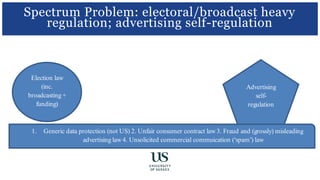
Spectrum Problem: electoral/broadcast heavy
regulation; advertising self-regulation
Election law
(inc.
broadcasting +
funding)
Advertising
self-
regulation
1. Generic data protection (not US) 2. Unfair consumer contract law3. Fraud and (grossly) misleading
advertising law4. Unsolicited commercial commuication (‘spam’) law
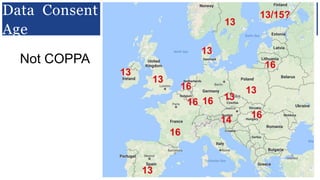
Not COPPA
Data Consent
Age
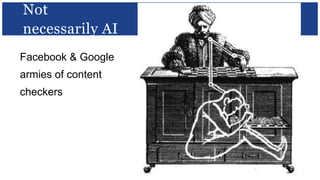
Facebook & Google
armies of content
checkers
Not
necessarily AI
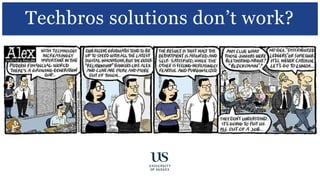
Techbros solutions don’t work?
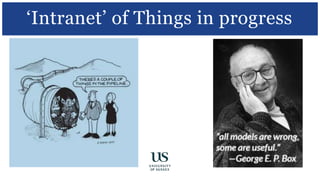
‘Intranet’ of Things in progress
• Personal data protection
• EUR-Lex - L:2016:119: Regulation (EU) 2016/679
• GDPR enters into force 25 May 2018
• Regulation of big data collection and processing lags severely
behind business processes
• Stylianou, Venturini, Zingales: Protecting User Privacy in the Cloud:
An Analysis of Terms of Service
• European Journal of Law and Technology
• Vol 6, No 3 (2015). Available at SSRN:
http://ssrn.com/abstract=2707852
Bulk automated data collection
infringes European law
• Huge trawl of data means they are able to “pick winners”
• among sectoral competitors in e.g. retail/transportation,
• in what is becoming known as "surveillance capitalism".
• Governments rely on big data brokers to support services,
• compromising regulatory independence.
Search engines and social media platforms
Dealing with big data curators:
Khan (2017) Amazon’s Antitrust Paradox, Yale Law Journal
Ezrachi & Stucke (2015) Artificial Intelligence & Collusion: When
Computers Inhibit Competition,
• Oxford Legal Studies Research Paper No.18/2015
http://dx.doi.org/10.2139/ssrn.2591874
Stucke & Grunes (2015) Debunking Myths Over Big Data & Antitrust,
• CPI Antitrust Chronicle, http://ssrn.com/abstract=2612562
Competition law faces existential crises
Governing big data platforms
• in the public interest
Let users take back control
• individual and collective control of their own data
Whispered in Brussels and London
• Turing Institute: Centre for Data Ethics & Innovation
Needed: a more
holistic regulatory framework
@ChrisTMarsden
Prosumer law agency:
‘OffData’

Georgetown Offdata 2018

  • 1.
    Professor Chris Marsden Georgetown#InformationPlatforms 23 February OffData: a prosumer law agency to govern big data platforms in the public interest
  • 2.
    . Formerly Essex (2007-13),RAND Europe (2005-7), Oxford (2004-5), Warwick (1997-2000), LSE (1995- 1997) Visitor Harvard ‘99, Melbourne, Cambridge, USC, Keio, FGV Rio Corporate work (WorldCom 2001-2 World Economic Forum 1993- 4) Govt advisor (RAND 2005-7, ITC 2001, OECD 2017) Books: Codifying Cyberspace (2007) Internet Co-regulation (2011) Net Neutrality (2010 and 2017) Regulating Code (2013) Professor of Internet Law, researched in field for 22 years
  • 3.
  • 4.
    50 miles fromLondon University of Sussex Brighton, England
  • 5.
    First of newwave of UK ‘Robbins’ universities Critical thinking and international approach ‘New’ Law School (200% bigger post-2012) • 1000+ undergraduate, • 200+ postgraduate students • 70+ professorial faculty/ • top 15 UK research intensity University of Sussex founded 1961
  • 6.
    Regulate intermediaries whoprovide platforms for digital service. • GAFA giants: Google, Amazon, Facebook and Apple. Many policy entrepreneurs are peddling solutions as policy cycle turns, Networks are not new, platforms have been regulated for centuries I take the long view, focussing on common carriage neutrality and • the railways/telegraphy regulation of the 1840s in England. Historical examples highly relevant to ‘prosumer’ capitalism 180 years on Platform regulation the current cause of technology regulation
  • 7.
    Nothing in regulationis new 2/23/2018
  • 8.
    Response to railwaysin 1830s-40s UK Railways investment US/EU Internet Investment Repeal of Bubble Act 1825 UK ‘Big Bang’ City of London 1987- following rise of Eurodollar market since 1960s (esp. since 1973) Railways Regulation Act (‘1844 Act’) 9th August 1844 Dublin and South Eastern Railway Act 1845 (D&SER) Telecommunications Deregulation (hah!) Act 1996 European Telecommunications Single Market 1996 Bill of Repeal (Importation Act 1846) 25 June 1846 and associated legislation (Corn Laws) Marrakech Treaty 1994: World Trade Organisation (Agreement on Basic Telecoms 1997) Joint Stock Companies Act 1844 (7 & 8 Vict. c.110) Joint Stock Companies Act 1856 (19 & 20 Vict. c.47) US Banking Act 1933 amendments/repeals to 1998 Milken revolution in junk bonds/Venture capital rise 1980s onwards 1845 Railways Mania Crash – rise of overseas investment by British railway barons (note also California/Australia gold rushes of 1848-51 refloated) 2000 Dot-com crash; 2002 Telecoms crash; 2008-10 Great Recession. Rise of offshore investment by vulture/chaos capitalists (post9/11 surveillance gold rush)
  • 9.
    Odlyzko, Andrew. (2010) Collectivehallucinations and inefficient markets: The British Railway Mania of the 1840s (2000) The History of Communications and its Implications for the Internet. http://dx.doi.org/10.2139/ssrn.235284 (series of brilliant papers) Great debt owed to Andrew Odlyzko
  • 10.
  • 11.
  • 13.
    Regulatory Toolkit: whichmix of economics, engineering, behavioural & evolutionary neuroscience (‘nudges’ & groups), human rights law? 2/23/2018
  • 14.
    The Internet: foreveryone 2/23/2018
  • 15.
    But this ‘prosumerenvironment’ is currently grossly unregulated, • leaving users' data and content at the mercy of the multinationals • who host it and sometimes claim to own it, or subject to knee-jerk over-regulation • current ‘fake news’ controversy in Germany. It is a new regulatory policy cycle in network regulation. We are all becoming ‘prosumers’ sharing intimate details of our personal lives
  • 16.
  • 17.
    Over-arching need toensure greater neutrality of intermediaries has largely been limited to last mile monopolists and mobile oligopolists: • legacy telecommunications companies who provide Internet access. What is needed is a comprehensive Prosumer Law solution • drawing on fundamental human rights to privacy and free expression, • competition, • and technology regulation • to ensure a fair and neutral deal for prosumers and citizens. Regulatory responses finally emerging, driven by both data protection and competition
  • 19.
    Spectrum Problem: electoral/broadcastheavy regulation; advertising self-regulation Election law (inc. broadcasting + funding) Advertising self- regulation 1. Generic data protection (not US) 2. Unfair consumer contract law3. Fraud and (grossly) misleading advertising law4. Unsolicited commercial commuication (‘spam’) law
  • 20.
  • 22.
    Facebook & Google armiesof content checkers Not necessarily AI
  • 24.
  • 25.
  • 26.
    • Personal dataprotection • EUR-Lex - L:2016:119: Regulation (EU) 2016/679 • GDPR enters into force 25 May 2018 • Regulation of big data collection and processing lags severely behind business processes • Stylianou, Venturini, Zingales: Protecting User Privacy in the Cloud: An Analysis of Terms of Service • European Journal of Law and Technology • Vol 6, No 3 (2015). Available at SSRN: http://ssrn.com/abstract=2707852 Bulk automated data collection infringes European law
  • 27.
    • Huge trawlof data means they are able to “pick winners” • among sectoral competitors in e.g. retail/transportation, • in what is becoming known as "surveillance capitalism". • Governments rely on big data brokers to support services, • compromising regulatory independence. Search engines and social media platforms
  • 28.
    Dealing with bigdata curators: Khan (2017) Amazon’s Antitrust Paradox, Yale Law Journal Ezrachi & Stucke (2015) Artificial Intelligence & Collusion: When Computers Inhibit Competition, • Oxford Legal Studies Research Paper No.18/2015 http://dx.doi.org/10.2139/ssrn.2591874 Stucke & Grunes (2015) Debunking Myths Over Big Data & Antitrust, • CPI Antitrust Chronicle, http://ssrn.com/abstract=2612562 Competition law faces existential crises
  • 29.
    Governing big dataplatforms • in the public interest Let users take back control • individual and collective control of their own data Whispered in Brussels and London • Turing Institute: Centre for Data Ethics & Innovation Needed: a more holistic regulatory framework
  • 30.