


Electronic Transactions Development Agency 1
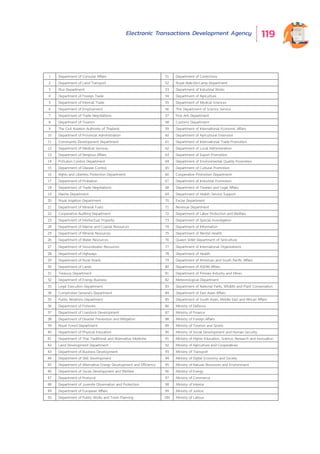
Title: 	 Thailand Internet User Behavior 2019
Complied by:	 Office of Policy and Strategic Affairs
	 Electronic Transactions Development Agency (ETDA)
	 Ministry of Digital Economy and Society
First Edition	 May 2020
All Rights Reserved under the Copyright Act B.E. 2537 (1994) 
Thailand Internet User Behavior 20192
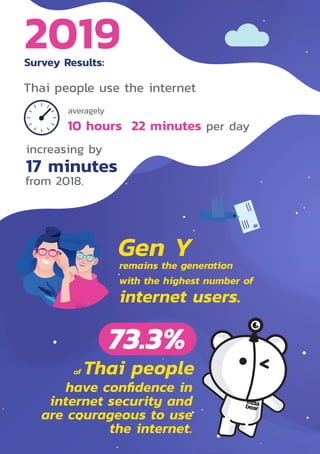
remains the generation
with the highest number of
internet users.
Gen Y
of Thai people
have confidence in
internet security and
are courageous to use
the internet.
Survey Results:
2019
Thai people use the internet
17 minutes
increasing by
from 2018.
averagely
10 hours 22 minutes per day
73.3%
Electronic Transactions Development Agency 3
Trends for 2019:
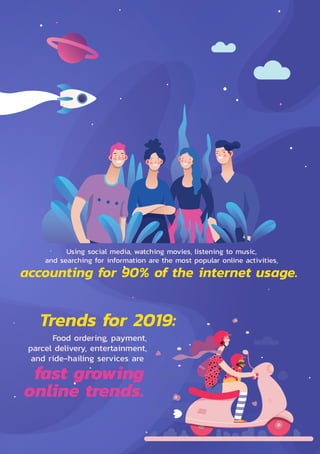
Food ordering, payment,
parcel delivery, entertainment,
and ride-hailing services are
Using social media, watching movies, listening to music,
and searching for information are the most popular online activities,
accounting for 90% of the internet usage.
fast growing
online trends.
Thailand Internet User Behavior 20194
Electronic Transactions Development Agency 5
Board
of ETDA
*	 Since 15 April 2019, ETDA’s Board of Directors has acted as Board of
Commissioners according to the transitional provision in the Electronic
Transactions Development Agency Act, B.E. 2562 (2019).
*	 List as of 31 December 2019.
ETDA’s Board of Commissioners*
1	 Jirawan Boonperm
Chairperson
2	 Ajarin Pattanapanchai
Permanent Secretary,
Ministry of Digital Economy
and Society
Ex Officio Commissioner
3	 Sommai Lakananuruk
Representative of Director
of the Budget Bureau
Ex Officio Commissioner
4	 Chai Wutiwiwatchai
Representative of Director
of the National Science and
Technology Development
Agency
Ex Officio Commissioner
5	 Chartsiri Sophonpanich
Expert Commissioner
(Finance)
06	 Wisit Wisitsora-at
Expert Commissioner
(Jurisprudence)
07	 Viriya Upatising
Expert Commissioner
(Engineering)
08	 Sibporn Thavornchan
Expert Commissioner
(Computer science)
09	 Surangkana Wayuparb
Commissioner and Secretary
Thailand Internet User Behavior 20196
Preface
In the era of digital society, technologies have developed by leaps
and bounds. Online transactions are also increasing in amount and value,
significantly resulting in the economic and societal changes. The survey
‘Thailand Internet User Behavior 2019’ by the Electronic Transactions
Development Agency or ETDA is therefore interesting data reflecting the
extent Thais have changed their lifestyle and internet use behavior in
accordance with digitalization.
From 2019 survey results, it is found that Thai people spend the
average of 10 hours 22 minutes per day using the internet, increasing
gradually from the previous years. That is, ‘Thais spend almost half of
their day on the internet. This survey report, accordingly, will help reveal
activities and locations in which an increasing number of hours on the
internet are used, and demonstrate problems occurred while using the
internet as well as the extent Thai citizens are confident in the internet
use.
In addition, nowadays there are several online services, provided by
both public and private sectors, which require users to be identified (or
authenticated by third party) before accessing these services. As a result,
the numbers of Digital Identity (Digital ID) use cases are increasing. This
report also helps display the big picture of the degree Thais have
knowledge of Digital ID, online services and methods of Enrolment they
use. Furthermore, their expectation from the public sector to ensure trust
on the use of Digital ID. This information will surely support the
improvement of online services from public and private sectors and the
development of Thailand’s Digital ID.
Electronic Transactions Development Agency 7
This survey was conducted online. Between August and October 2019,
ETDA publicized the questionnaire on its website and social media as well
as on those of other supportive agencies, which attracted more than
17,242 volunteer respondents.
Finally, ETDA would like to express gratitude to all respondents for
their answers, and to the agencies (as listed in the appendix) for helpful-
ly publicizing the 2019 survey. ETDA hopes that this report will provide
benefits to government agencies, the private sectors, and those who are
interested.
Production teams
Electronic Transactions Development Agency
Ministry of Digital Economy and Society
December 2019
Thailand Internet User Behavior 20198
Contents
Preface.....................................................................................................6
Contents...................................................................................................8
List of Figures.....................................................................................10
List of Tables......................................................................................15
Key Findings........................................................................................16
Introduction.........................................................................................24
Objectives of the Survey..........................................................25
Survey Methodology..................................................................26
Data Collection.............................................................................26
Internet User Behavior...................................................................28
Number of Hours Spent on the Internet..............................31
Places of Internet Access.........................................................36
Online Activities...........................................................................38
Use of Social Media and Online Channels..........................45
Problems Faced by Internet Users........................................51
Confidence in Internet Security..............................................55
Insight into Internet User Behavior........................................56
Electronic Transactions Development Agency 9
Internet User’s Knowledge of Digital ID...................................70
Digital ID and Activities Related to Enrolment, Identity
Proofing and Authentication....................................................73
Digital ID Use Cases in Online Services..............................82
One Account in Digital Identity...............................................86
Conclusion......................................................................................89
Appendix..............................................................................................90
Profiles of Respondents of Thailand
Internet User Behavior 2019.................................................91
Questionnaire on Thailand Internet
User Behavior 2019...............................................................100
Statistical Tables............................................................................114
List of Agencies Helping Publicize Survey Banners........118
Project Production Teams..........................................................126
Thailand Internet User Behavior 201910
List of Figures
Figure 1	 Number of internet users in Thailand
	 during 2013 – 2018..................................................29
Figure 2	 Comparison of the average number of hours
	 spent on the internet during 2013 - 2019....... 31
Figure 3	 The average number of hours spent on the internet
	 per day of each generation classified by workday/
	 school day and weekend...................................................32
Figure 4	 The average number of hours spent on
	 the internet per day by gender................................33
Figure 5	 The average number of hours spent on
	 the internet per day by region.................................34
Figure 6	 The average number of hours spent on
	 the internet per day by employment status ...35
Figure 7	 Percentage of internet users
	 by place of internet access.......................................36
Figure 8	 Percentage of internet users by place of
	 internet access in 2018 and 2019......................37
Figure 9	 Percentage of internet users by online activity..38
Figure 10	 Online activities of each generation.......................40
Figure 11	 Percentage of internet users by the top five
	 online-activity changes in 2018 and 2019.......42
Electronic Transactions Development Agency 11
Figure 12	 Percentage of internet users
	 by online activity and region....................................43
Figure 13	 Percentage of internet users
	 by online vis-à-vis offline activity...........................44
Figure 14	 Percentage of internet users
	 by online information searching channel ...........45
Figure 15	 Percentage of internet users
	 by online goods/service sales channel.................46
Figure 16	 Percentage of internet users
	 by online goods/service purchases channel.......47
Figure 17	 Percentage of internet users
	 by communication application.................................48
Figure 18	 Percentage of internet users
	 by online entertainment platform............................49
Figure 19	 Percentage of internet users
	 by government online service channel.................50
Figure 20	 Percentage of internet users
	 by problem with internet use....................................51
Figure 21	 Problems with internet use of each generation..53
Figure 22	 Level of confidence in internet security...............55
Figure 23	 Internet use behavior of Baby Boomer ...............56
Figure 24	 Internet use behavior of Gen X...............................57
Thailand Internet User Behavior 201912
Figure 25	 Internet use behavior of Gen Y...............................58
Figure 26	 Internet use behavior of Gen Z...............................59
Figure 27	 Internet use behavior by region (Bangkok)...........62
Figure 28	 Internet use behavior by region
	 (Northern Thailand).......................................................63
Figure 29	Internet use behavior by region
	 (Central Thailand)..........................................................64
Figure 30	 Internet use behavior by region
	 (Northeastern Thailand)...............................................65
Figure 31	 Internet use behavior by region
	 (Southern Thailand)......................................................66
Figure 32	 Familiarity with Digital ID and activities
	 related to Enrolment, Identity Proofing and
	Authentication................................................................73
Figure 33	 Familiarity with Enrolment and Identity Proofing
	 for government online services...............................75
Figure 34	 Familiarity with Enrolment and Identity Proofing
	 for private-sector online services............................76
Figure 35	 Familiarity with Authentication by using password
	 for private-sector online services ..........................77
Figure 36	 Familiarity with Enrolment and Identity Proofing
	 for e-Wallet services....................................................78
Figure 37	 Familiarity with Authentication by using credit
	 card numbers with CVV for online payments.....79
Electronic Transactions Development Agency 13
Figure 38	 Familiarity with Authentication by using OTP
	 for online payments.....................................................80
Figure 39	 Percentage of users’ choice of Enrolment for
	 online services...............................................................82
Figure 40	Percentage of internet users by reason for using
	 their existing account for online services............84
Figure 41	 Percentage of internet users by reason for
	 creating a new account for online services.........85
Figure 42	 Percentage of internet users by preference for
	 using One Account for all online services...........86
Figure 43	 Percentage of internet users
	 by view towards the use of One Account............86
Figure 44	Percentage of internet users by aspect that the
	 government is expected to concern for reliability
	 of Digital ID.....................................................................87
Figure 45	 Percentage of internet users by agency expected
	 to be responsible for the One Account................87
Figure 46	Percentage of internet users by reason to choose
	 an agency responsible for the One Account.......88
Figure 47	 Percentage of survey respondents by gender....91
Figure 48	 Percentage of survey respondents
	 by marital status...........................................................92
Thailand Internet User Behavior 201914
Figure 49	 Percentage of survey respondents
	 by generation.................................................................93
Figure 50	 Percentage of survey respondents
	 by place of residence..................................................94
Figure 51	 Percentage of survey respondents by region.....95
Figure 52	 Percentage of survey respondents
	 by education level........................................................96
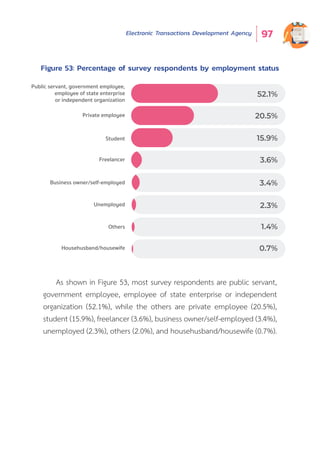
Figure 53	 Percentage of survey respondents
	 by employment status................................................97
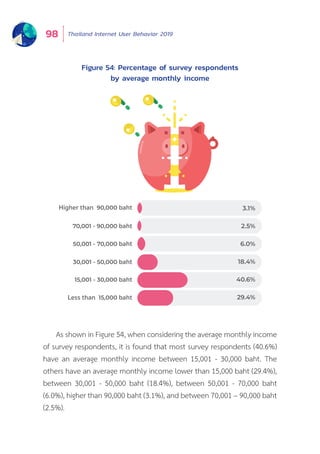
Figure 54	 Percentage of survey respondents
	 by average monthly income ...............................98
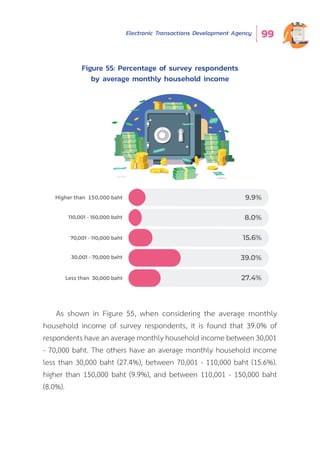
Figure 55	 Percentage of survey respondents
	 by average monthly household income................99
Electronic Transactions Development Agency 15
List of Tables
Table 1	 The average number of hours spent on
	 the internet per day of each generation classified
	 by workday/school day and weekend....................114
Table 2	 Percentage of internet users
	 by online activity...........................................................114
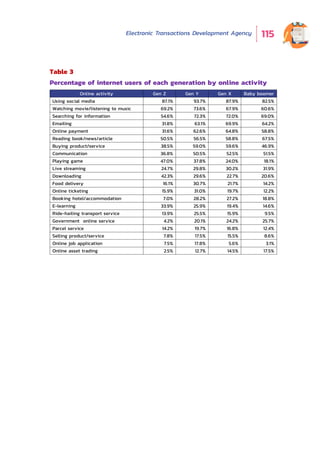
Table 3	 Percentage of internet users of each generation
	 by online activity...........................................................115
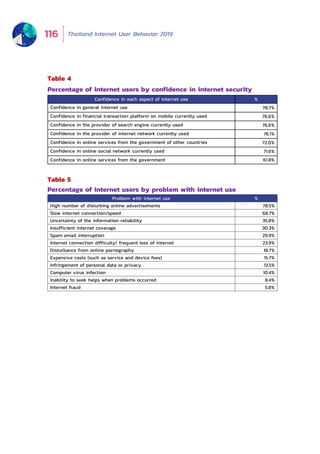
Table 4	 Percentage of internet users
	 by confidence in internet security...........................116
Table 5	 Percentage of internet users
	 by problem with internet use....................................116
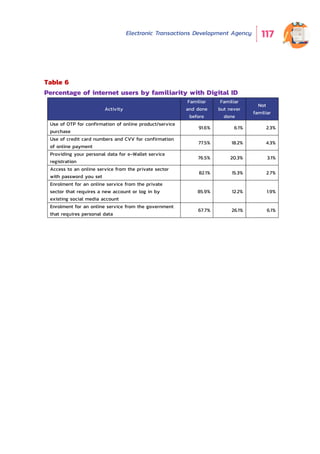
Table 6	 Percentage of internet users
	 by familiarity with Digital ID.......................................117
Thailand Internet User Behavior 201916
Key Findings
General Characteristics of Survey Respondents
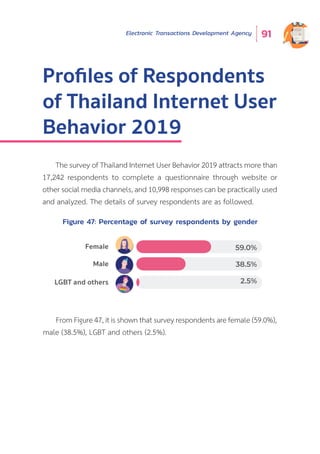
Of all the 17,242 respondents voluntarily completing the survey which
10,998 responses are practical to be analyzed, 59.0% are female and
38.5% are male. Only 2.5% identify themselves as LGBT and others.
Like previous years, this year’s survey also classifies respondents into
four generation groups: Gen Z (ages less than 19), Gen Y (ages 19-38),
Gen X (age 39-54), and Baby Boomer (ages 55-73). It is found that the
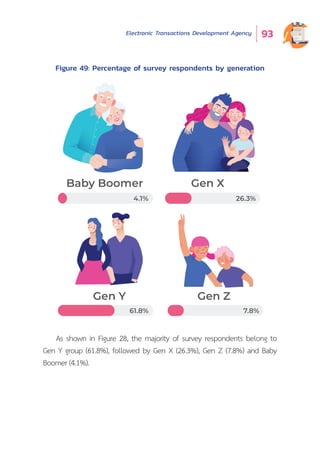
majority of respondents belong to Gen Y group (61.8%), followed by Gen
X (26.3%), Gen Z (7.8%), and Baby Boomer (4.1%) (see Appendix for more
details).
In addition, for consistence of the survey results and the structure of
internet users in Thailand, the data were weighted by age and place of
residence of the internet users base on the data from The 2018 Household
Survey on The Use of Information and Communication Technology by the
National Statistical Office.
Internet User Behavior
From the survey, it is found that Thai people averagely spend 10 hours 22
minutesperdayontheinternet,increasing by 17 minutes from the previous
year.Onworkdays/schooldaystheaverageof9hours52minutesisusedonthe
internet per day, while Thais spend 11 hours 35 minutes per day on weekends.
This is partly due to the Village Broadband Internet (Net Pracharat) Project1
,
agovernmentprojectundertheThailand4.0policywhichexpandshigh-speed
1
Net Pracharat Project:https://www.prachachat.net/ict/news-313848
Electronic Transactions Development Agency 17
network to 24,700 rural villages throughout the country (by the Ministry of
Digital Economy and Society) and provides free public Wi-Fi hotspots to more
than 10,000 community areas.
The survey also shows that Thai people spend more time on the internet
for government and private online services. Moreover, nowadays there are
manyoptionsofinternetpackagepromotionsandmobiledevices,whichtend
to be cheaper, people can choose for internet use. These factors also result
in the increasing use of the internet.
When comparing between each generation group, it is shown that Gen Y
spend the highest number of hours on the internet (10 hours 36 minutes),
followed by Gen Z (10 hours 35 minutes), Baby Boomer (10 hours), and Gen
X(9hours45minutes)respectively.Moreover,inaverageGenYandGenZare
groups that spend the highest number of hours per day on the internet. This
might be due to nature of each generation. To illustrate, Gen Y which is the
group of workers may require the internet for work, and Gen Z which includes
students growing up in the digital age with good IT skills may use the internet
on educational purposes.
Classifyingbyemploymentstatus,inaddition,thesurveyshowsthatgroups
potentially with no income: students, househusbands/housewives, and the
unemployed,areamongthefirstfivegroupswiththehighestaveragenumber
of hours per day for internet use. This information is useful for ETDA to carry
outitsmission.ETDAcommitsitselftopromotee-commerceforcommunity’s
additional incomes as well as to support entrepreneurs by developing an
effective workforce. Therefore, ETDA can apply the data to encourage or
educate the groups potentially with no income, so they will get economic
value from the internet use, i.e. selling products online.
Thailand Internet User Behavior 201918
In addition, it is found that the group of students spend the highest
number of hours on the internet which averagely accounts for 10 hours
50 minutes, followed by househusbands/housewives (10 hours 38 minutes),
businessowners/theself-employed(10hours34minutes),theunemployed
(10 hours 32 minutes), freelancers (10 hours 30 minutes), private
employees (10 hours 22 minutes), and government employees/public
servants/state enterprise employees/independent organization employees
(10 hours 10 minutes). We can assume that a huge quantity of internet
time of students partly results from their use for education, i.e. searching
for information.
When looking into places in which the internet is accessed, home is
the most popular place. This is partly because, in general, people tend
to spend most of the day at home. It is also found that an internet café
is less popular. This is because nowadays people can access the internet
through electronic devices at any places and time; it is no longer necessary
to go to an internet café to play online games. The study shows that most
respondents (95.7%) usually use the internet at home, followed by at
work (67.0%), while travelling (38.4%), in a public place (23.7%), at school
(16.2%), in an internet café (1.3%), and others (0.8%).
Classifying by online activity, moreover, the first ten popular online
activities are using social media such as Facebook, LINE, and Instagram
(91.2%), watching movies/listening to music (71.2%), looking for
information (70.7%), e-mailing (62.5%), using online payments for goods,
services, or credit cards (60.6%), reading books/articles (57.1%), purchasing
products/services (57.0%), communicating (50.0%), playing games (34.1%),
and live broadcasting (29.6%). These activities reflect that internet users
use the internet mostly for entertainment. Therefore, responsible agencies
should encourage users to use the internet for more advantageous
purposes: education or commerce.
Electronic Transactions Development Agency 19
Comparing to 2018’s survey results, the online food delivery service
becomes more popular, increasing by 15.1% from the previous year, and
is considered as the most growing trend. Second to the food delivery
service is the online payment for goods, services, or credit cards
(increasing by 11.4%), followed by online messenger service (11.0%),
watching movies/listening to music (10.5%), and ride-hailing transport
service (9.3%).
Furthermore, concerning problems from the internet use, the survey
shows that excessive online advertisements is the commonest problem
found by the respondents (78.5%), followed by slow internet connection/
speed (68.7%), uncertainty of the online information
reliability (35.8%), insufficient network coverage (30.3%), disturbance by
email spams (29.9%), difficulty with internet connection/frequent loss of
connection (23.9%), disturbance by pornography (18.7%), expensive service
fees (15.7%), personal data or privacy infringement (13.5%), computer
virus infection (10.4%), inability to seek assistance upon difficulty
occurrence (8.4%), and Internet fraud (5.8%).
In the aspect of confidence in the internet security, we can see that
most of the respondents (73%) is confident in security and courageous to
use the internet. This aspect generally covers trust in, for example, online
platforms, internet providers, and social media use.
Thailand Internet User Behavior 201920
Internet User’s Knowledge of Digital Identity
Nowadays, several transactions require users to be identified to ensure
whether the person we are contacting or making transactions with is real.
For example, when opening a bank account, an applicant would be asked
in Enrolment process to show a National ID card or other evidences to
prove his or her identity (Identity Proofing). The bank may also check
whether his or her face is the same with evidences provided, then issue
them a book bank as an authenticator for making transactions afterwards.
Even in online transactions, Identity Proofing is also necessary. The
necessity heightens especially when a seller and a customer never meet
each other in person, because Identity Proofing will help reduce risks of
Internet fraud. This leads to the request of the Identity Proofing before
we get access to any services. Methods of Authentication for accessing
service are varied. For instance, social media or email services usually
issue an authenticator to their users such as username with password for
next access to services. On the other hand, more critical or sensitive ser-
vices like online credit card payments that requires a higher level of Au-
thentication, OTP (One-Time Password) will be used together with the
username and password.
Generally, service providers would create user accounts (Digital ID) for
the purpose of using in their own services (service providers perform
Authentication by themself). However, in some cases, we can use our
username and password for a service of one service provider with a service
of another service provider without new Enrolment (by using an existing
account or Digital ID for another service). To illustrate, we may use our
username and password of our social media account with another mov-
ie streaming service. The streaming service provider will have an interop-
erability system to check with the social media provider whether Identity
Proofing and Authentication (by social media provider) were already
Electronic Transactions Development Agency 21
completed. Thus, before accessing any online services, in general the
Enrolment process could be done in two ways:
1.	 Create a “new account” by identifying oneself directly to the
service provider and create a new Digital ID for that service.
2.	 Use an “existing account” by using Digital ID from other service
providers.
Creating a new account for access to a service is prevalent since
internet users still have security concerns over their personal data; doing
so means a user can be authenticated directly by a service provider.
Unlike creating a new one, using an existing account like a social media
account with a service from another provider, the new service provider
may ask the social media platform provider whether a user is real. This
might risk the social media platform provider sending relevant information,
including sensitive data, more than needed and the new service provider
might misuse the data without a user’s consent. However, users who
prefer using an excising account may do so because the log-in process
becomes easier, faster, and more convenient.
Due to the growing importance of Identity Proofing towards online
transactions, internet users’ understanding, awareness, and readiness
relating this area is worth studying since it will help planning and setting
direction for appropriate governance of Digital ID service providers.
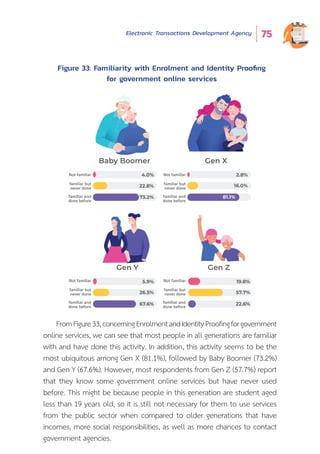
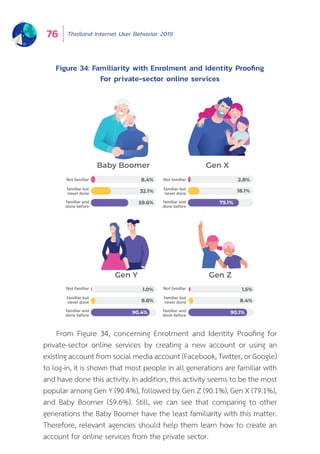
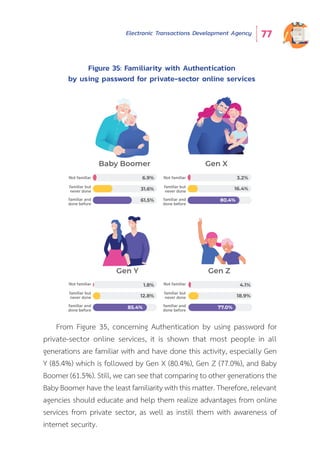
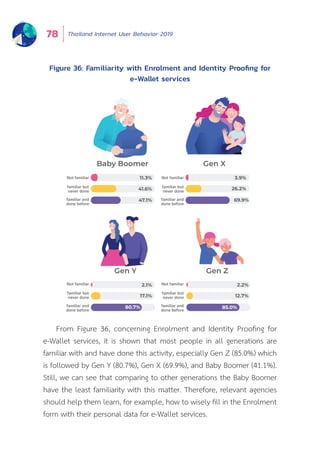
According to the survey result, most internet users are familiar with
Digital ID. However, comparing to other activities, Enrolment for government
online services which requires personal data of a user is an activity the
respondents are the least familiar with. This may be because some
respondents are in Gen Z group which still need not to use
government services, resulting in a low degree of familiarity. In addition,
Thailand Internet User Behavior 201922
the government’s insufficient publicity and less satisfaction of the services
also abate the popularity of the government services. Therefore, it is
necessary that public sectors improve their publicity campaigns and
develop the service system in order to more satisfy the users’ need.
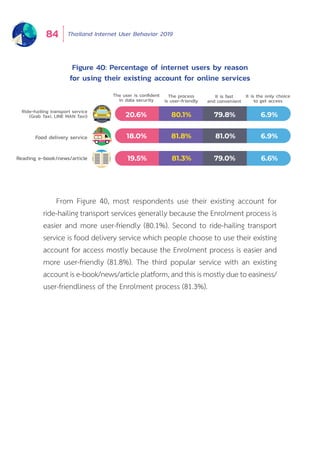
Concerningtheusers’choiceofonlineserviceaccount,mostrespondents
see that using an existing account is easy for online service Enrolment. The
first three online services the internet users use their existing account to
access are ride-hailing transport services (66.9%), food delivery services
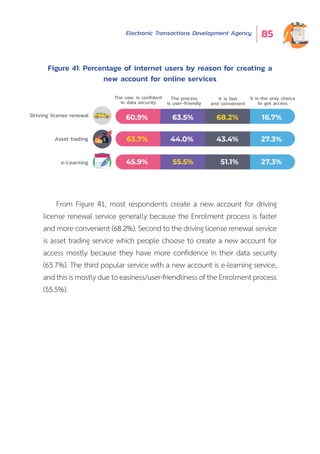
(66.6%), and online news/article/e-book services (65.6%). Still, some prefer
creating a new account for any services since they think that it is fast and
convenient. These respondents also believe that creating a new account is
user-friendly and secured for their personal data. The first three online
servicestheinternetuserscreateanewaccounttoaccessaredrivinglicense
renewal (66.4%), asset trading (58.8%), and e-learning (51.0%).
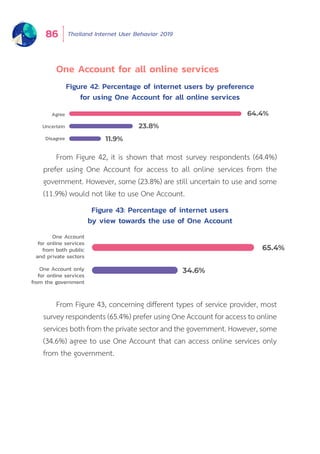
The survey also reveals that, relating to preference for One Account to
access different online services, 65.4% of the internet users require using
singleaccountforbothpublicandprivateonlineservices,whiletheremaining
34.6% prefer One Account only for online services by the government
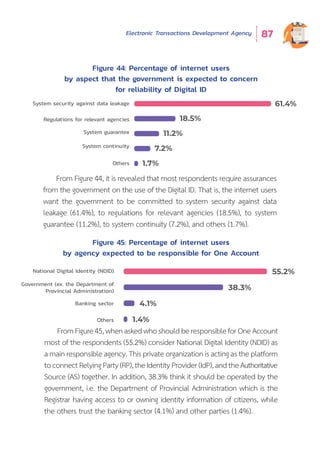
sectors. In addition, when asked who should be responsible for the One
Account most of the respondents (55.2%) consider National Digital Identity
(NDID)2
, which is a private organization taking care of a platform for relevant
parties, as a main responsible agency. 38.3% think it should be operated
by the government, i.e. the Department of Provincial Administration which
is the Registrar having access to or owning identity information of citizens,
while the others trust the banking sector (4.1%) and other parties (1.4%).
Moreover, the main factor the internet users consider when choosing the
2
Digital ID https://www.digitalid.or.th/
Digital ID in Thai context: https://www.etcommission.go.th/article-Signature-DigitalId.html
Electronic Transactions Development Agency 23
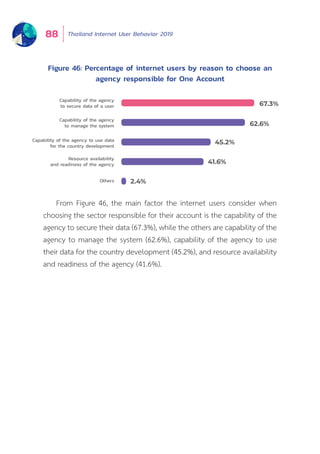
sector responsible for their One Account is the capability of the agency
to secure data of a user (67.3%), while the others are capability of the
agency to manage the system (62.6%), capability of the agency to use
data for the country development (45.2%), and resource availability and
readiness of the agency (41.6%).
It is also shown that most respondents require the government to
ensure trust on the use of Digital ID. That is, the internet users want the
government to be committed to system security against data leakage
(61.4%), to regulations for relevant agencies (18.5%), to system guarantee
(11.2%), to system continuity (7.2%), and to others (1.7%).
Thailand Internet User Behavior 201924
Introduction
Nowadays, the country is driven by Thailand 4.0. It is an economic
model (Prosperity, Security, and Sustainability) aiming to use innovation
to unlock the country from several economic challenges resulting from
past economic development models, to make Thailand a high-income
country3
. As one driving agency under this model, ETDA is committed itself
to developing, promoting, and supporting electronic transactions of the
country, as well as to creating the information technology infrastructure
that supports electronic transactions and related service businesses. In
addition, ETDA also aims to establish information technology standards
and initiate secured and reliable communication. With all these missions,
ETDA considers that the survey on internet user behaviors is very
important and necessary since it will help reflect the current behaviors
of Thai internet users and the trend of behavior changes comparing to
the previous year. The survey results must be of great help to related
public and private agencies; they can make use of the data to determine
directions or models for electronic transaction promotion and support as
well as to create business and marketing plans aligning with the consumer
behaviors that keep changing within the digital economy. ETDA has realized
this importance and, therefore, initiated the survey entitled ‘Thailand
Internet User Behavior’ to collect data of internet user behaviors in
different aspects. The survey has been being conducted yearly since 2013.
Each year, the survey will have its own special issue which is generated
from important incidents or interesting trends in that year.
3
MDES Minister reveals process of technology strategies for Thailand 4.0, Infoquest, 10 August 2018, https://www.
ryt9.com/s/iq03/2869602.
Electronic Transactions Development Agency 25
This year, the special issue concerns the knowledge of Digital ID of
the internet users. This topic gains much attention since nowadays there
are several online services from both the public and private sectors which
require users to be identified (or authenticated by third party) before
accessing the service. Therefore, the survey is expected to delineate the
extent Thais understand the Digital ID, to exhibit the internet users’ reason
and choice of account for service access: creating a new account (username
and password) or using their existing account of social media, e-mail, or
private bank. This is to portray the strength of each chosen online service
channel. In addition, the research also aims to investigate whether Thais
prefer using a system that allows the use of One Account for access to
both private and public online services, as well as to examine the internet
users’ choice of authority agency responsible for their account and to
study their requirement from the government to ensure trust on the use
of Digital ID. This information, accordingly, will benefit the development
of electronic transactions of the country, private and public online services,
and the Digital ID.
Objectives of the Survey
1. To collect information about the internet user behavior of Thai
people on an annual basis to demonstrate the nature and the trend of
change in such behavior.
2. To collect information about the internet user behavior on a
specific topic of interest that occurs in the year in which the survey is
conducted, purposefully to be used by anyone to stay on top of the
current events.
3. To provide important information required for the electronic
transaction development, purposefully to be used by public and private
sectors and any interested parties.
Thailand Internet User Behavior 201926
4.ToprovideETDAwithinformationfordevelopingstrategiestosupport
andpromoteelectrictransaction,aswellasfollow-upandevaluationmeasures.
Survey Methodology
This surveyis carried online and has main objective to collect information
about the internet user behavior of Thai people. As the project production
teams did not have a list of all internet users; therefore, a probability
sampling method was not adopted. The survey respondents are internet
users voluntarily completing the survey. When considering the respondents
by segment, the proportion of sampled internet users may differ from the
actual proportion of the entire internet users in Thailand. Therefore, the
calculation of the values in the overall picture has solved the problem of
the distribution of survey respondents that are not distributed according to
the structure of the internet users in the country. The data are weighted by
ageofallinternetusersinThailand,basedonthedatafrom2018Household
Survey on the Use of Information and Communication Technology by the
National Statistical Office.
Data Collection
Like previous years, Thailand Internet User Behavior 2019 was carried
out online. The survey questionnaire was publicized (as a banner) on the
website and other social media channels, including Facebook, LINE@,
Instagram, and Twitter, of ETDA and other public and private agencies to
have thorough survey distribution to the internet users. The survey
questionnaire was publicized between August and October 2019, and a
total of 17,242 respondents completed the survey. Afterward, the survey
responses were computed by a statistical program.
Electronic Transactions Development Agency 27
Thailand Internet User Behavior 201928
Internet User
Behavior
Electronic Transactions Development Agency 29
Internet User Behavior
Nowadays we are completely living in the digital society which
everything changes by leaps and bounds, more people can easily access
to the internet, and the internet user behaviors alter through time. In 2018,
there are 47.5 million internet users in Thailand4
, accounting for 71.5% of
the entire population in Thailand (66.4 million)5
. This shows the high growth
of internet users comparing to that number of 2013 (26.1 million). We can
see that from previous five years the number of internet users in Thailand
has been increasing averagely6
81.5% per year.
4
Number of internet users in Thailand during 2017-2018: http://webstats.nbtc.go.th/netnbtc/INTERNETUSERS.php
5
Number of populations in Thailand in 2018 is referred from Statistical Registration System, Department of
Provincial Administration, http://stat.dopa.go.th/stat/statnew/upstat_age_disp. php
6
CAGR (Compound Annual Growth Rate) has the formula as followed:
CAGR = [ (End year/ First year) ^1/(n-1)] – 1
When End year = data from the latest year, First year = data from the first year, ^ = the exponentiation
operator, n = number of years
Figure 1: Number of internet users in Thailand during 2013 – 2018
0
10
20
30
40
50
Number of internet users (million)
26.1
2013 2014 2015 2016 2017 2018
27.7
39.5
43.9
45.2
47.5
Thailand Internet User Behavior 201930
ThisispartlyaresultfromtheVillageBroadbandInternet(NetPracharat)Project7
,
a government project under the Thailand 4.0 policy which expands high-speed
network to 24,700 rural villages throughout the country (by the Ministry of Digital
EconomyandSociety)andprovidesfreepublicWi-Fihotspotstomorethan10,000
community areas available to 4 million internet users. The project also links its
networktoterminalservicesofvarioussectors,resultinginthemosteffectiveuseof
the network and cost reduction when calculating internet service fees. This allows
people to access the stable hi-speed internet with reasonable price and to reach
service spots free of charge, which leads to the increase of internet users, to the
decline in inequalities in access to the internet such as the access to information,
learning, private and public services, and proper healthcare, as well as to more
opportunitiesinonlineproduct/serviceselling.
Inaddition,itisapparentthatlifestylesofThaipeoplearemoreinvolvingwith
theinternet.Toillustrate,everydayThaistendtousetheinternetforprivateonline
servicessuchassocialmedia,onlinelearning,onlinemoviesandmusic,andonline
food delivery, as well as for public online services including taxation and passport
appointmentbookingservices.Theseonlineservicesbenefitboththeprovidersand
the users: the service providers can save the costs of human resource and
managementandcollectdatafromonlinetransactionwhichcanbeusedtoimprove
and develop their service to better serve the users’ need, while the users receive
convenientservicesandsavetheirtime,creatingsatisfactoryserviceexperiencesand
increasingservicechannels.
7
Net Pracharat Project: https://www.prachachat.net/ict/news-313848
From Figure 1, the survey reveals that the number of internet users
still has continued growth, but with a slower pace. This might be a sign
showing that more people can access the internet, due to the better in-
ternet network coverage in Thailand.
Electronic Transactions Development Agency 31
2013 2014 2015 2016 2017 2018 2019
4 hours
36 minutes
7 hours
12 minutes
6 hours
54 minutes 6 hours
24 minutes
6 hours
35 minutes
10 hours
5 minutes
10 hours
22 minutes
From Figure 2, the number of hours spent on the internet in Thailand
generally tends to increase with the average growth8
of 14.5% per year.
This rate is considerably high, and partly due to the expanding use of the
internet in every aspect of daily life.
8
CAGR (Compound Annual Growth Rate) has the formula as followed:
CAGR = [ (End year/ First year) ^1/(n-1)] – 1
When End year = data from the latest year, First year = data from the first year, ^ = the exponentiation
operator, n = number of years
Furthermore, Different devices for the internet access are currently
availableinthemarketincludingmobilephones,notebooks,andcomputers,
and their price tends to be lower due to the increase of businesses and
services, high level of industry competition, and the lower cost to manufac-
ture the technological devices. Another factor, in addition, enabling more
peopletoaccesstheinternetisthatmanynetworkprovidershavelaunched
tempting internet promotions which attract more internet users.
Number of Hours Spent on the Internet
Figure 2 : Comparison of the average number of hours spent
on the internet during 2013 - 2019
Thailand Internet User Behavior 201932
Figure 3: The average number of hours spent on
the internet per day of each generation classified
tvby workday/school day and weekend
From Figure 3, it is found that Thai internet users averagely spend 10
hours 22 minutes per day on the internet9
, increasing by 17 minutes
from 2018. They spend 9 hours 52 minutes on the internet on workdays/
school days, and 11 hours 35 minutes on weekends. Looking into each
generation, the survey shows that the number of hours spent on the
internet of Gen Y (10 hours 36 minutes) outnumbers that of other
generations. Second to Gen Y is Gen Z (10 hours 35 minutes), followed by
Baby Boomer (10 hours) and Gen X (9 hours 49 minutes).
9
The average number of hours spent on the internet is the weighted average from the number of days on
workdays/school days (5 days) and weekends (2 days).The average number of hours spent on the internet =
[(hours on workdays/school days * 5) + (hours on weekends * 2)] / 7
HOURS MINUTES
9 52
HOURS MINUTES
11 35Weekend /
day
HOURS MINUTES
10 22
Average use
of the internet
per day in
2019Workday
School day day
Overview
of the internet use
Baby Boomer Gen X Gen Y Gen Z
HOURS MINUTES
9 35
HOURS MINUTES
11 3
HOURS MINUTES
9 20
HOURS MINUTES
10 58
HOURS MINUTES
10 7
HOURS MINUTES
11 50
HOURS MINUTES
10 00
HOURS MINUTES
12 1
Workday
School day Day
Day
HOURS MINUTES
10 00
HOURS MINUTES
9 49
HOURS MINUTES
10 36
HOURS MINUTES
10 35Average per Day
(increasing 17 minutes from 2018)
Gen Y is the group with the highest number
of hours on the internet for consecutive 5 years
Weekend
Electronic Transactions Development Agency 33
Figure 4: The average number of hours spent on
the internet per day by gender
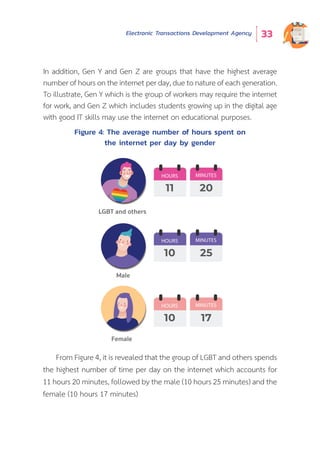
From Figure 4, it is revealed that the group of LGBT and others spends
the highest number of time per day on the internet which accounts for
11 hours 20 minutes, followed by the male (10 hours 25 minutes) and the
female (10 hours 17 minutes)
LGBT and others
Male
Female
HOURS MINUTES
11 20
HOURS MINUTES
10 25
HOURS MINUTES
10 17
In addition, Gen Y and Gen Z are groups that have the highest average
number of hours on the internet per day, due to nature of each generation.
To illustrate, Gen Y which is the group of workers may require the internet
for work, and Gen Z which includes students growing up in the digital age
with good IT skills may use the internet on educational purposes.
Thailand Internet User Behavior 201934
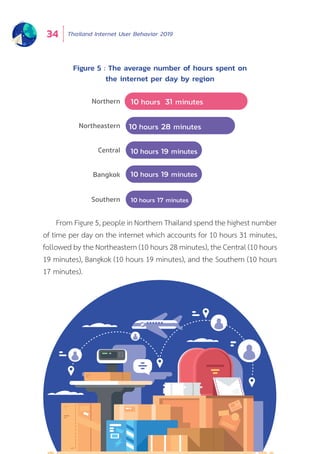
From Figure 5, people in Northern Thailand spend the highest number
of time per day on the internet which accounts for 10 hours 31 minutes,
followed by the Northeastern (10 hours 28 minutes), the Central (10 hours
19 minutes), Bangkok (10 hours 19 minutes), and the Southern (10 hours
17 minutes).
Figure 5 : The average number of hours spent on
the internet per day by region
Northern
Northeastern
Central
Bangkok
Southern
10 hours 31 minutes
10 hours 28 minutes
10 hours 19 minutes
10 hours 19 minutes
10 hours 17 minutes
Electronic Transactions Development Agency 35
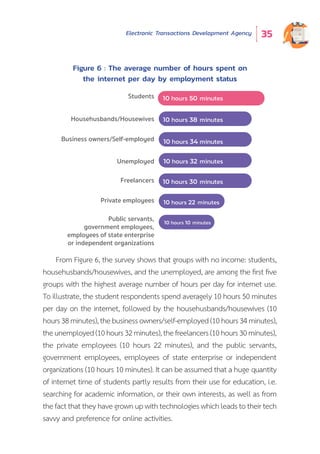
From Figure 6, the survey shows that groups with no income: students,
househusbands/housewives, and the unemployed, are among the first five
groups with the highest average number of hours per day for internet use.
To illustrate, the student respondents spend averagely 10 hours 50 minutes
per day on the internet, followed by the househusbands/housewives (10
hours38minutes),thebusinessowners/self-employed(10hours34minutes),
theunemployed(10hours32minutes),thefreelancers(10hours30minutes),
the private employees (10 hours 22 minutes), and the public servants,
government employees, employees of state enterprise or independent
organizations (10 hours 10 minutes). It can be assumed that a huge quantity
of internet time of students partly results from their use for education, i.e.
searching for academic information, or their own interests, as well as from
thefactthattheyhavegrownupwithtechnologieswhichleadstotheirtech
savvy and preference for online activities.
Figure 6 : The average number of hours spent on
the internet per day by employment status
10 hours 50 minutes
10 hours 30 minutes
10 hours 32 minutes
10 hours 34 minutes
10 hours 38 minutes
10 hours 10 minutes
Business owners/Self-employed
Unemployed
Househusbands/Housewives
Public servants,
government employees,
employees of state enterprise
or independent organizations
Private employees
Freelancers
Students
10 hours 22 minutes
Thailand Internet User Behavior 201936
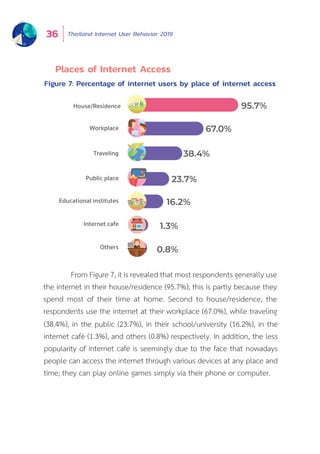
(38.4%), in the public (23.7%), in their school/university (16.2%), in the
internet café (1.3%), and others (0.8%) respectively. In addition, the less
popularity of internet café is seemingly due to the face that nowadays
people can access the internet through various devices at any place and
time; they can play online games simply via their phone or computer.
Figure 7: Percentage of internet users by place of internet access
95.7%
67.0%
38.4%
23.7%
16.2%
1.3%
0.8%
House/Residence
Workplace
Traveling
Public place
Educational institutes
Internet cafe
Others
	 From Figure 7, it is revealed that most respondents generally use
the internet in their house/residence (95.7%); this is partly because they
spend most of their time at home. Second to house/residence, the
respondents use the internet at their workplace (67.0%), while traveling
Places of Internet Access
Electronic Transactions Development Agency 37
Figure 8 : Percentage of internet users
by place of internet access in 2018 and 2019
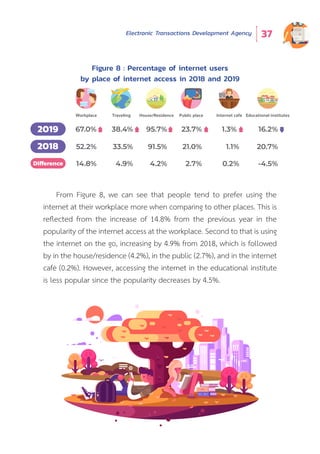
From Figure 8, we can see that people tend to prefer using the
internet at their workplace more when comparing to other places. This is
reflected from the increase of 14.8% from the previous year in the
popularity of the internet access at the workplace. Second to that is using
the internet on the go, increasing by 4.9% from 2018, which is followed
by in the house/residence (4.2%), in the public (2.7%), and in the internet
café (0.2%). However, accessing the internet in the educational institute
is less popular since the popularity decreases by 4.5%.
2018
Workplace Traveling Public place Educational institutesInternet cafe
52.2% 33.5% 21.0% 20.7%1.1%
14.8% 4.9% 2.7% -4.5%0.2%
2019 67.0% 38.4% 23.7% 16.2%1.3%
Difference
House/Residence
91.5%
4.2%
95.7%
Thailand Internet User Behavior 201938
Figure 9 : Percentage of internet users by online activity
Watching movie/
listening to music
Live streaming
Reading book online
Parcel service
71.2%
57.1%
29.6%
25.9%
18.2%
Online job
application
Emailing
Food delivery
Communication
62.5%
50.0%
26.5%
21.4%
13.2%
Selling product/
Service
Searching
for information
Buying product/
Service
Downloading software/
Music/Drama/Game
70.7%
57.0%
28.4%
24.4%
15.9%
91.2%
60.6%
34.1%
26.1%
20.1%
12.6%
Online asset
trading
Playing game
Public online
service
Online payment
Social media
Booking hotel/
Accommodation
Ride-hailing
transport service
e-LearningOnline ticketing
Online Activities
Electronic Transactions Development Agency 39
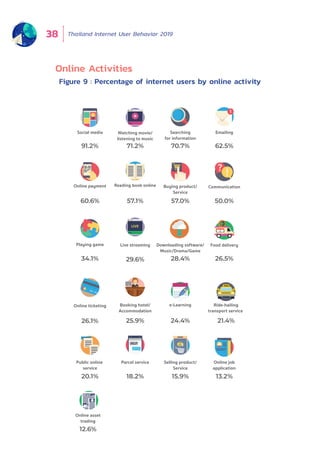
From Figure 9, we can see that the first ten popular online activities
are using social media (91.2%), watching movies/listening to music (71.2%),
searching for information (70.7%), emailing (62.5%), using online payment
for products/services or credit cards (60.6%), reading online books or
articles (57.1%), buying products/services (57.0%), communication (50.0%),
playing games (34.1%), and live streaming (29.6%).
The result demonstrates that people use the internet mostly for
entertainment and, accordingly, responsible agencies should encourage
users to use the internet for more advantageous purposes: education or
commerce.
Thailand Internet User Behavior 201940
From Figure 10, it is shown that using social media is the most popular
online activity of every generations. In addition, the first three popular
activities of each generations are as followed:
Figure 10: Online activities of each generation
Gen ZGen XOnline activities
87.1%
69.2%
54.6%
31.8%
31.6%
50.5%
38.5%
36.8%
47.0%
24.7%
42.3%
16.1%
15.9%
7.0%
33.9%
13.9%
4.2%
14.2%
7.8%
7.5%
2.5%
87.9%
67.9%
72.0%
69.9%
64.8%
58.8%
59.6%
52.5%
24.0%
30.2%
22.7%
21.7%
19.7%
27.2%
19.4%
15.9%
24.2%
16.8%
15.5%
5.6%
14.5%
Baby Boomer
82.5%
60.6%
69.0%
64.2%
58.8%
67.5%
46.9%
51.5%
18.1%
31.9%
20.6%
14.2%
12.2%
18.8%
14.6%
9.5%
25.7%
12.4%
8.6%
3.1%
17.5%
Gen Y
93.7%
73.6%
72.3%
63.1%
62.6%
56.5%
59.0%
50.5%
37.8%
29.8%
29.6%
30.7%
31.0%
28.2%
25.9%
25.5%
20.1%
19.7%
17.5%
17.8%
12.7%
Using social media
Watching movie/listening to music
Searching for information
Emailing
Online payment
Reading book/news/article
Buying product/service
Communication
Playing game
Live streaming
Downloading
Food delivery
Online ticketing
Booking hotel/accommodation
E-learning
Ride-hailing transport service
Public online service
Parcel service
Selling product/service
Online job application
Online asset trading
Electronic Transactions Development Agency 41
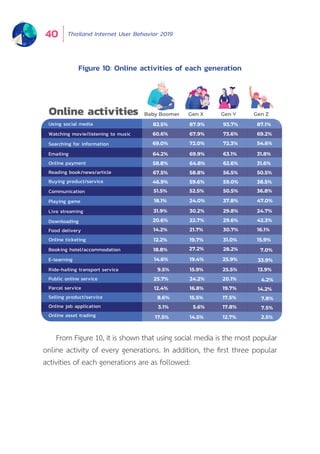
•	 Baby Boomer prefer using social media (82.5%), searching for
information (69.0%), and reading online books/news/articles
(67.5%).
•	 Gen X prefer using social media (87.9%), searching for information
(72.0%), and emailing (69.9%).
•	 Gen Y prefer using social media (93.7%), watching movies/listening
to music (73.6%), and searching for information (72.3%).
•	 Gen Z prefer using social media (87.1%), watching movies/listening
to music (69.2%), and searching for information (54.6%).
Thailand Internet User Behavior 201942
Figure 11: Percentage of internet users
by the top five online-activity changes in 2018 and 2019
Food delivery Ride-hailing
transport service
Parcel service
26.5%
11.4%
15.1%
60.6%
49.2%
11.4%
18.2%
7.2%
11.0%
71.2%
60.7%
10.5%
21.4%
12.1%
9.3%Difference
2018
2019
Watching movie/
listening to music
Online payment
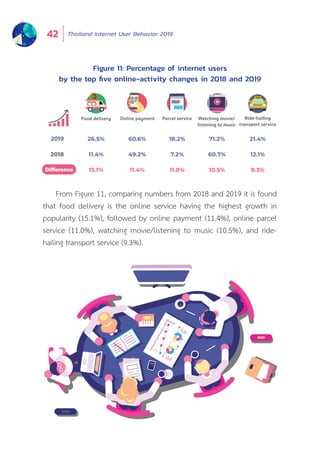
From Figure 11, comparing numbers from 2018 and 2019 it is found
that food delivery is the online service having the highest growth in
popularity (15.1%), followed by online payment (11.4%), online parcel
service (11.0%), watching movie/listening to music (10.5%), and ride-
hailing transport service (9.3%).
Electronic Transactions Development Agency 43
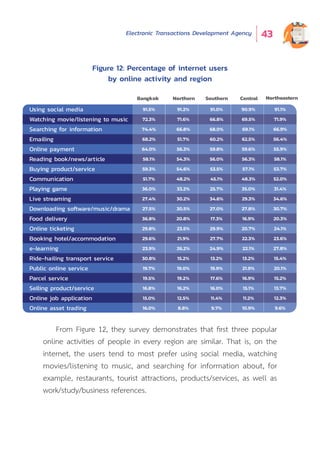
From Figure 12, they survey demonstrates that first three popular
online activities of people in every region are similar. That is, on the
internet, the users tend to most prefer using social media, watching
movies/listening to music, and searching for information about, for
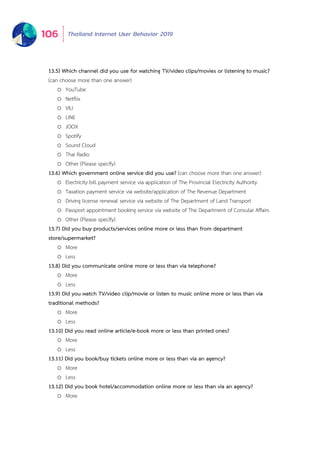
example, restaurants, tourist attractions, products/services, as well as
work/study/business references.
Figure 12: Percentage of internet users
by online activity and region
Bangkok Northern Southern Central Northeastern
91.0%
66.8%
68.0%
60.2%
59.8%
56.0%
53.5%
45.1%
25.7%
34.6%
27.0%
17.3%
29.9%
27.7%
24.9%
13.2%
19.9%
17.6%
16.0%
11.4%
9.7%
91.5%
72.3%
74.4%
68.2%
64.0%
58.1%
59.3%
51.7%
36.0%
27.4%
27.5%
36.8%
29.8%
29.6%
23.9%
30.8%
19.7%
19.5%
16.8%
15.0%
16.0%
91.2%
71.6%
66.8%
51.7%
56.3%
54.3%
54.6%
48.2%
33.2%
30.2%
30.5%
20.8%
23.5%
21.9%
26.2%
15.2%
19.0%
19.2%
16.2%
12.5%
8.8%
90.9%
69.5%
69.1%
62.5%
59.6%
56.3%
57.1%
48.3%
35.0%
29.3%
27.8%
16.9%
20.7%
22.3%
22.1%
13.2%
21.9%
16.9%
15.1%
11.2%
10.9%
91.1%
71.9%
66.9%
56.4%
55.9%
58.1%
53.7%
52.0%
31.4%
34.6%
30.7%
20.3%
24.1%
23.6%
27.8%
15.4%
20.1%
15.2%
13.7%
12.3%
9.6%
Using social media
Watching movie/listening to music
Searching for information
Emailing
Online payment
Reading book/news/article
Buying product/service
Communication
Playing game
Live streaming
Downloading software/music/drama
Food delivery
Online ticketing
Booking hotel/accommodation
e-learning
Ride-hailing transport service
Public online service
Parcel service
Selling product/service
Online job application
Online asset trading
Thailand Internet User Behavior 201944
Hotel/
accommodation booking
Communication
Ticket booking
Watching movie/
listening to music
Product/service payment
Reading book/news/article
Food delivery
Parcel service
Calling a taxi
Public service
Buying products/services
Online Offline
94.1%
91.8%
90.7%
85.4%
85.2%
82.8%
79.5%
77.3%
71.2%
61.3%
49.4%
5.9%
8.2%
9.3%
14.6%
14.8%
17.2%
20.5%
22.7%
28.8%
38.7%
50.6%
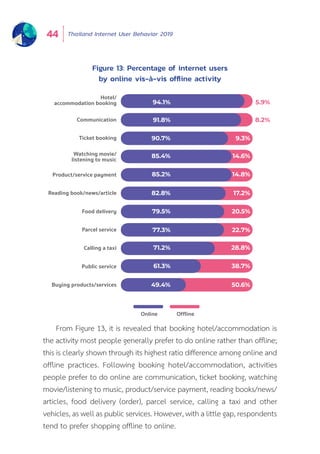
From Figure 13, it is revealed that booking hotel/accommodation is
the activity most people generally prefer to do online rather than offline;
this is clearly shown through its highest ratio difference among online and
offline practices. Following booking hotel/accommodation, activities
people prefer to do online are communication, ticket booking, watching
movie/listening to music, product/service payment, reading books/news/
articles, food delivery (order), parcel service, calling a taxi and other
vehicles, as well as public services. However, with a little gap, respondents
tend to prefer shopping offline to online.
Figure 13: Percentage of internet users
by online vis-à-vis offline activity
Electronic Transactions Development Agency 45
Concerning the study of online activities, this survey also focuses on
channels in which activities such as searching for information, selling/buying
products and services, communication, and watching movies/listening to
music are taken place, as well as channels the internet users use to access
online services from the public sectors. The interesting results are shown as
followed.
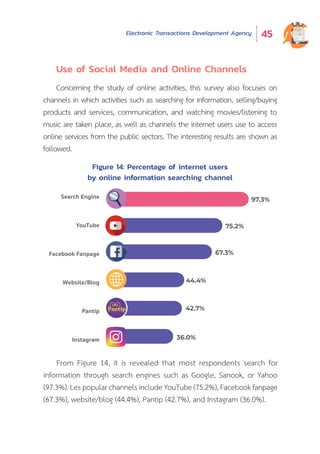
From Figure 14, it is revealed that most respondents search for
information through search engines such as Google, Sanook, or Yahoo
(97.3%). Les popular channels include YouTube (75.2%), Facebook fanpage
(67.3%), website/blog (44.4%), Pantip (42.7%), and Instagram (36.0%).
Use of Social Media and Online Channels
Figure 14: Percentage of internet users
by online information searching channel
Instagram
Pantip
Website/Blog
Facebook Fanpage
YouTube
Search Engine
97.3%
75.2%
67.3%
44.4%
42.7%
36.0%
Thailand Internet User Behavior 201946
Twitter
Lazada
Instagram
LINE
Shopee
Facebook Fanpage
64.0%
43.1%
39.5%
26.6%
24.8%
8.7%
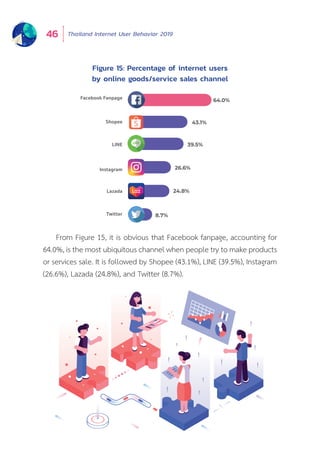
From Figure 15, it is obvious that Facebook fanpage, accounting for
64.0%, is the most ubiquitous channel when people try to make products
or services sale. It is followed by Shopee (43.1%), LINE (39.5%), Instagram
(26.6%), Lazada (24.8%), and Twitter (8.7%).
Figure 15: Percentage of internet users
by online goods/service sales channel
Electronic Transactions Development Agency 47
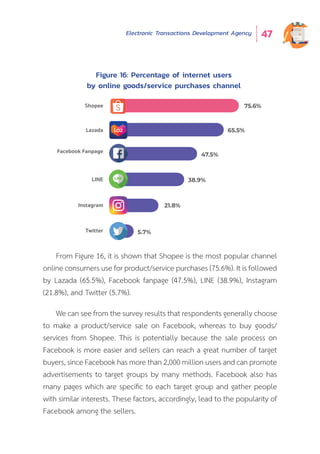
From Figure 16, it is shown that Shopee is the most popular channel
online consumers use for product/service purchases (75.6%). It is followed
by Lazada (65.5%), Facebook fanpage (47.5%), LINE (38.9%), Instagram
(21.8%), and Twitter (5.7%).
We can see from the survey results that respondents generally choose
to make a product/service sale on Facebook, whereas to buy goods/
services from Shopee. This is potentially because the sale process on
Facebook is more easier and sellers can reach a great number of target
buyers, since Facebook has more than 2,000 million users and can promote
advertisements to target groups by many methods. Facebook also has
many pages which are specific to each target group and gather people
with similar interests. These factors, accordingly, lead to the popularity of
Facebook among the sellers.
Figure 16: Percentage of internet users
by online goods/service purchases channel
Twitter
LINE
Shopee 75.6%
65.5%
47.5%
38.9%
21.8%
5.7%
Lazada
Instagram
Facebook Fanpage
Thailand Internet User Behavior 201948
Figure 17: Percentage of internet users
by communication application
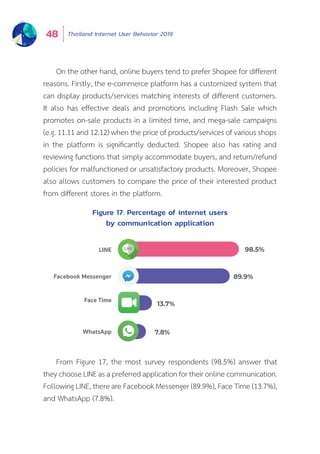
From Figure 17, the most survey respondents (98.5%) answer that
they choose LINE as a preferred application for their online communication.
Following LINE, there are Facebook Messenger (89.9%), Face Time (13.7%),
and WhatsApp (7.8%).
On the other hand, online buyers tend to prefer Shopee for different
reasons. Firstly, the e-commerce platform has a customized system that
can display products/services matching interests of different customers.
It also has effective deals and promotions including Flash Sale which
promotes on-sale products in a limited time, and mega-sale campaigns
(e.g. 11.11 and 12.12) when the price of products/services of various shops
in the platform is significantly deducted. Shopee also has rating and
reviewing functions that simply accommodate buyers, and return/refund
policies for malfunctioned or unsatisfactory products. Moreover, Shopee
also allows customers to compare the price of their interested product
from different stores in the platform.
98.5%
89.9%
13.7%
7.8%
Facebook Messenger
Face Time
WhatsApp
LINE
Electronic Transactions Development Agency 49
Figure 18: Percentage of internet users
by online entertainment platform
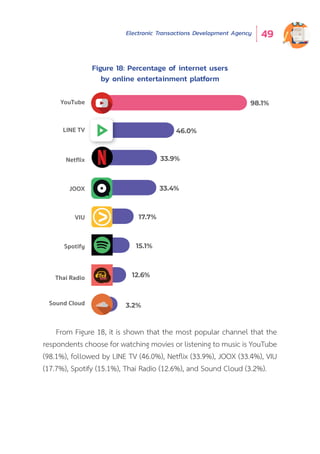
From Figure 18, it is shown that the most popular channel that the
respondents choose for watching movies or listening to music is YouTube
(98.1%), followed by LINE TV (46.0%), Netflix (33.9%), JOOX (33.4%), VIU
(17.7%), Spotify (15.1%), Thai Radio (12.6%), and Sound Cloud (3.2%).
Netflix
LINE TV
YouTube 98.1%
46.0%
33.9%
JOOX 33.4%
Sound Cloud
Thai Radio
Spotify 15.1%
12.6%
3.2%
VIU 17.7%
Thailand Internet User Behavior 201950
Figure 19: Percentage of internet users
by government online service channel
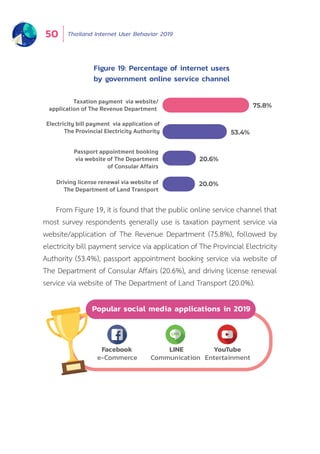
From Figure 19, it is found that the public online service channel that
most survey respondents generally use is taxation payment service via
website/application of The Revenue Department (75.8%), followed by
electricity bill payment service via application of The Provincial Electricity
Authority (53.4%), passport appointment booking service via website of
The Department of Consular Affairs (20.6%), and driving license renewal
service via website of The Department of Land Transport (20.0%).
75.8%
53.4%
20.6%
20.0%
Electricity bill payment via application of
The Provincial Electricity Authority
Passport appointment booking
via website of The Department
of Consular Affairs
Driving license renewal via website of
The Department of Land Transport
Taxation payment via website/
application of The Revenue Department
e-Commerce
Facebook
Communication
LINE
Entertainment
YouTube
Popular social media applications in 2019
Electronic Transactions Development Agency 51
Figure 20: Percentage of internet users
by problem with internet use
SUBSCRIBE
Subscribe now!
Enter your email address
Subscribe to our newsletter & stay updated!
High number of
disturbing online
advertisements
Slow internet
connection/ speed
no connection
internet connection difficulty/
frequent loss of internet
SPAM
Spam email
interruption
Insufficient network
coverage
Uncertainty of
the information reliability
78.5% 68.7% 35.8%
23.9%29.9%30.3%
18+
Disturbance from
online pornography
Expensive costs
Internet fraud
ERROR!
Inability to seek helps
when problems occurred
18.7% 15.7%
Infringement of personal
data or privacy
13.5%
8.4% 5.8%
Warning message
Warning!
cancel
Computer
virus infection
10.4%
Problems Faced by Internet Users
Thailand Internet User Behavior 201952
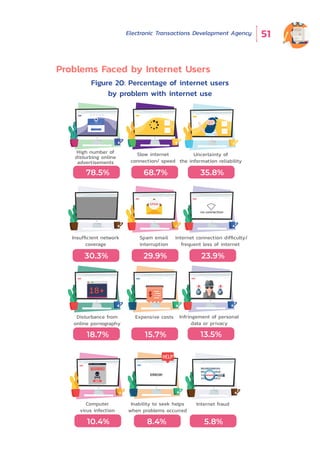
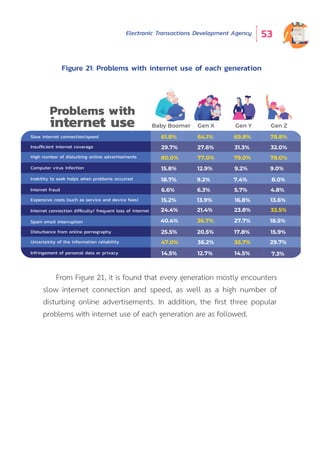
From Figure 20, The most popular problem the respondents usually
found when using the internet is a high number of disturbing online
advertisements which is accounted for (78.5%), followed by slow internet
connection/speed (68.7%), uncertainty of the information reliability (35.8%),
insufficient network coverage (30.3%), spam email interruption (29.9%),
internet connection difficulty/ frequent loss of internet (23.9%), disturbance
from online pornography (18.7%), expensive costs such as service and
device fees (15.7%), Infringement of personal data or privacy (13.5%),
computer virus infection (10.4%), inability to seek helps when problems
occurred (8.4%), and internet fraud (5.8%).
Electronic Transactions Development Agency 53
Figure 21: Problems with internet use of each generation
Gen YBaby Boomer
Problems with
internet use
Slow internet connection/speed
Insufficient internet coverage
High number of disturbing online advertisements
Computer virus infection
Inability to seek helps when problems occurred
Internet fraud
Expensive costs (such as service and device fees)
Internet connection difficulty/ frequent loss of internet
Spam email interruption
Disturbance from online pornography
Uncertainty of the information reliability
Infringement of personal data or privacy
69.8%
31.3%
79.0%
9.2%
7.4%
5.7%
16.8%
23.8%
27.7%
17.8%
35.7%
14.5%
61.8%
29.7%
80.0%
15.8%
18.7%
6.6%
15.2%
24.4%
40.4%
25.5%
47.0%
14.5%
Gen ZGen X
64.1%
27.6%
77.0%
12.9%
9.2%
6.3%
13.9%
21.4%
36.7%
20.5%
36.2%
12.7%
78.8%
32.0%
78.0%
9.0%
8.0%
4.8%
13.6%
32.5%
18.5%
15.9%
29.7%
7.3%
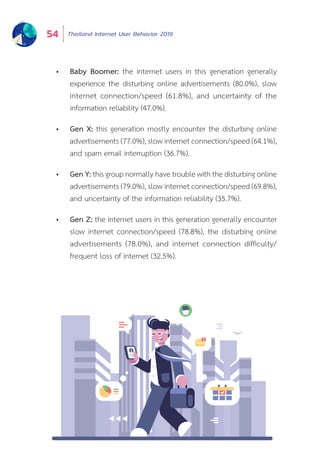
From Figure 21, it is found that every generation mostly encounters
slow internet connection and speed, as well as a high number of
disturbing online advertisements. In addition, the first three popular
problems with internet use of each generation are as followed.
Thailand Internet User Behavior 201954
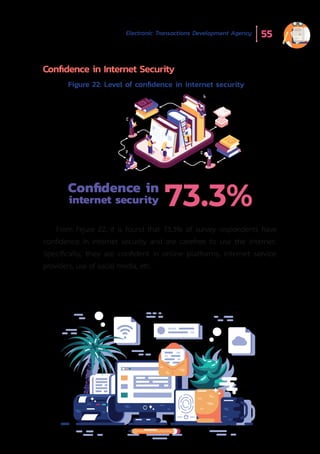
•	 Baby Boomer: the internet users in this generation generally
experience the disturbing online advertisements (80.0%), slow
internet connection/speed (61.8%), and uncertainty of the
information reliability (47.0%).
•	 Gen X: this generation mostly encounter the disturbing online
advertisements (77.0%), slow internet connection/speed (64.1%),
and spam email interruption (36.7%).
•	 Gen Y: this group normally have trouble with the disturbing online
advertisements (79.0%), slow internet connection/speed (69.8%),
and uncertainty of the information reliability (35.7%).
•	 Gen Z: the internet users in this generation generally encounter
slow internet connection/speed (78.8%), the disturbing online
advertisements (78.0%), and internet connection difficulty/
frequent loss of internet (32.5%).
Electronic Transactions Development Agency 55
Figure 22: Level of confidence in internet security
From Figure 22, it is found that 73.3% of survey respondents have
confidence in internet security and are carefree to use the internet.
Specifically, they are confident in online platforms, internet service
providers, use of social media, etc.
Confidence in
internet security 73.3%
Confidence in Internet Security
Thailand Internet User Behavior 201956
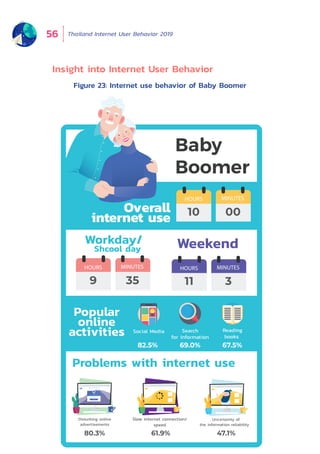
Figure 23: Internet use behavior of Baby Boomer
Insight into Internet User Behavior
Weekend
Problems with internet use
Popular
online
activities
82.5% 69.0% 67.5%
Workday/
Shcool day
Social Media
80.3% 61.9% 47.1%
Uncertainty of
the information reliability
SUBSCRIBE
Subscribe now!
Enter your email address
Subscribe to our newsletter & stay updated!
Disturbing online
advertisements
Slow internet connection/
speed
HOURS MINUTES
9 35
HOURS MINUTES
11 3
HOURS MINUTES
10 00
Reading
books
Search
for information
Overall
internet use
Electronic Transactions Development Agency 57
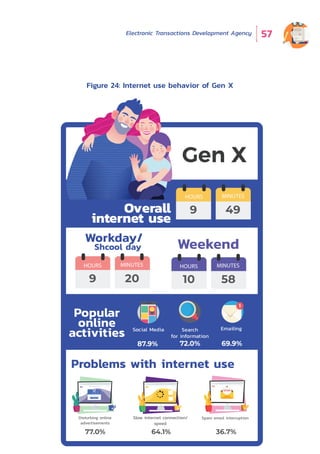
Figure 24: Internet use behavior of Gen X
77.0% 64.1% 36.7%
SUBSCRIBE
Subscribe now!
Enter your email address
Subscribe to our newsletter & stay updated!
Disturbing online
advertisements
Slow internet connection/
speed
87.9% 72.0% 69.9%
Social Media
HOURS MINUTES
9 20
HOURS MINUTES
10 58
9 49
EmailingSearch
for information
HOURS MINUTES
SPAM
Spam email interruption
Problems with internet use
Popular
online
activities
Workday/
Shcool day Weekend
Overall
internet use
Thailand Internet User Behavior 201958
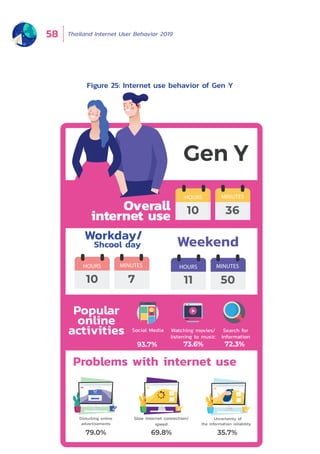
Figure 25: Internet use behavior of Gen Y
79.0% 69.8% 35.7%
Uncertainty of
the information reliability
SUBSCRIBE
Subscribe now!
Enter your email address
Subscribe to our newsletter & stay updated!
Disturbing online
advertisements
Slow internet connection/
speed
93.7% 73.6%
Social Media
HOURS MINUTES
10 7
HOURS MINUTES
11 50
10 36
Watching movies/
listening to music
HOURS MINUTES
72.3%
Search for
information
Problems with internet use
Popular
online
activities
WeekendWorkday/
Shcool day
Overall
internet use
Electronic Transactions Development Agency 59
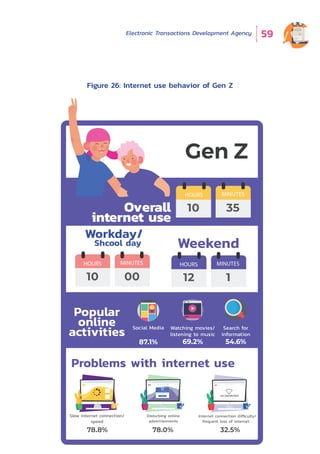
Figure 26: Internet use behavior of Gen Z
87.1% 69.2%
Social Media
HOURS MINUTES
10 00
HOURS MINUTES
12 1
10 35
Watching movies/
listening to music
HOURS MINUTES
54.6%
Search for
information
78.8% 78.0% 32.5%
SUBSCRIBE
Subscribe now!
Enter your email address
Subscribe to our newsletter & stay updated!
Disturbing online
advertisements
no connection
Internet connection difficulty/
frequent loss of internet
Slow internet connection/
speed
Problems with internet use
Popular
online
activities
Weekend
Workday/
Shcool day
Overall
internet use
Thailand Internet User Behavior 201960
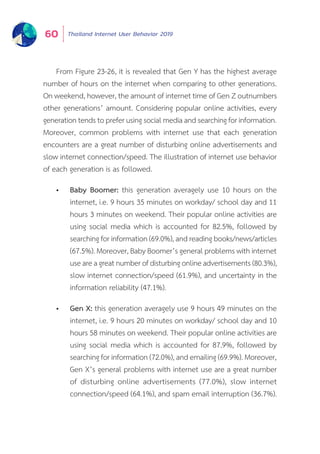
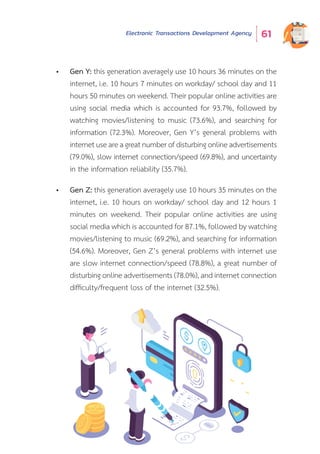
From Figure 23-26, it is revealed that Gen Y has the highest average
number of hours on the internet when comparing to other generations.
On weekend, however, the amount of internet time of Gen Z outnumbers
other generations’ amount. Considering popular online activities, every
generation tends to prefer using social media and searching for information.
Moreover, common problems with internet use that each generation
encounters are a great number of disturbing online advertisements and
slow internet connection/speed. The illustration of internet use behavior
of each generation is as followed.
•	 Baby Boomer: this generation averagely use 10 hours on the
internet, i.e. 9 hours 35 minutes on workday/ school day and 11
hours 3 minutes on weekend. Their popular online activities are
using social media which is accounted for 82.5%, followed by
searching for information (69.0%), and reading books/news/articles
(67.5%). Moreover, Baby Boomer’s general problems with internet
useareagreatnumberofdisturbingonlineadvertisements(80.3%),
slow internet connection/speed (61.9%), and uncertainty in the
information reliability (47.1%).
•	 Gen X: this generation averagely use 9 hours 49 minutes on the
internet, i.e. 9 hours 20 minutes on workday/ school day and 10
hours 58 minutes on weekend. Their popular online activities are
using social media which is accounted for 87.9%, followed by
searching for information (72.0%), and emailing (69.9%). Moreover,
Gen X’s general problems with internet use are a great number
of disturbing online advertisements (77.0%), slow internet
connection/speed (64.1%), and spam email interruption (36.7%).
Electronic Transactions Development Agency 61
•	 Gen Y: this generation averagely use 10 hours 36 minutes on the
internet, i.e. 10 hours 7 minutes on workday/ school day and 11
hours 50 minutes on weekend. Their popular online activities are
using social media which is accounted for 93.7%, followed by
watching movies/listening to music (73.6%), and searching for
information (72.3%). Moreover, Gen Y’s general problems with
internet use are a great number of disturbing online advertisements
(79.0%), slow internet connection/speed (69.8%), and uncertainty
in the information reliability (35.7%).
•	 Gen Z: this generation averagely use 10 hours 35 minutes on the
internet, i.e. 10 hours on workday/ school day and 12 hours 1
minutes on weekend. Their popular online activities are using
social media which is accounted for 87.1%, followed by watching
movies/listening to music (69.2%), and searching for information
(54.6%). Moreover, Gen Z’s general problems with internet use
are slow internet connection/speed (78.8%), a great number of
disturbing online advertisements (78.0%), and internet connection
difficulty/frequent loss of the internet (32.5%).
Thailand Internet User Behavior 201962
Figure 27: Internet use behavior by region (Bangkok)
Popular Online Activities
Social Media Search for
information
SUBSCRIBE
Subscribe now!
Enter your email address
Subscribe to our newsletter & stay updated!
Disturbing online
advertisements
Bangkok
10 19Overall
internet use
HOURS MINUTES
Watching movies/
listening to music
Slow internet connection/
speed
91.5% 74.4% 72.3%
Uncertainty of
the information reliability
79.4% 66.5% 37.3%
Problems with internet use
Electronic Transactions Development Agency 63
Figure 28: Internet use behavior by region (Northern Thailand)
Popular Online Activities
Social Media
SUBSCRIBE
Subscribe now!
Enter your email address
Subscribe to our newsletter & stay updated!
Disturbing online
advertisements
Northern Thailand
10 31Overall
internet use
HOURS MINUTES
Watching movies/
listening to music
Slow internet connection/
speed
91.2% 71.6%
78.5% 71.8% 35.3%
Search for
information
66.8%
Insufficient
internet coverage
Problems with internet use
Thailand Internet User Behavior 201964
Popular Online Activities
Social Media Search for
information
SUBSCRIBE
Subscribe now!
Enter your email address
Subscribe to our newsletter & stay updated!
Disturbing online
advertisements
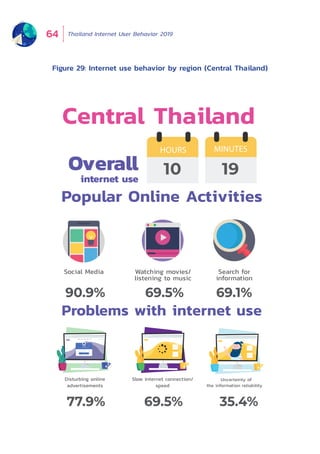
Central Thailand
10 19Overall
internet use
HOURS MINUTES
Slow internet connection/
speed
90.9% 69.1%
Watching movies/
listening to music
69.5%
Uncertainty of
the information reliability
77.9% 69.5% 35.4%
Problems with internet use
Figure 29: Internet use behavior by region (Central Thailand)
Electronic Transactions Development Agency 65
Popular Online Activities
Social Media
SUBSCRIBE
Subscribe now!
Enter your email address
Subscribe to our newsletter & stay updated!
Disturbing online
advertisements
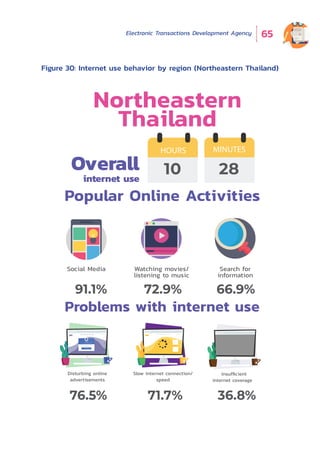
Northeastern
Thailand
10 28Overall
internet use
HOURS MINUTES
Watching movies/
listening to music
Slow internet connection/
speed
91.1% 72.9%
76.5% 71.7%
Search for
information
66.9%
36.8%
Insufficient
internet coverage
Problems with internet use
Figure 30: Internet use behavior by region (Northeastern Thailand)
Thailand Internet User Behavior 201966
Popular Online Activities
Social Media Search for
information
SUBSCRIBE
Subscribe now!
Enter your email address
Subscribe to our newsletter & stay updated!
Disturbing online
advertisements
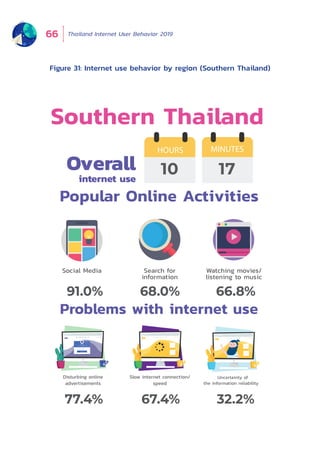
Southern Thailand
10 17Overall
internet use
HOURS MINUTES
Watching movies/
listening to music
Slow internet connection/
speed
91.0% 68.0% 66.8%
Uncertainty of
the information reliability
77.4% 67.4% 32.2%
Problems with internet use
Figure 31: Internet use behavior by region (Southern Thailand)
Electronic Transactions Development Agency 67
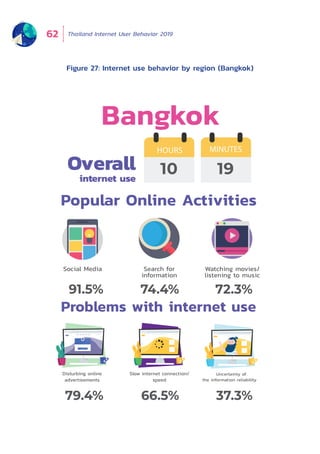
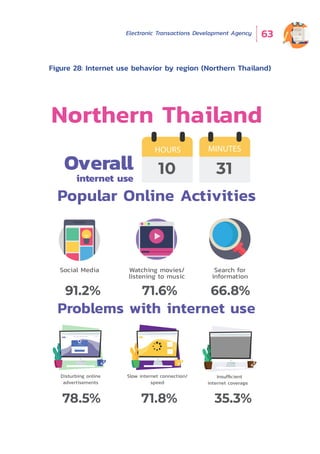
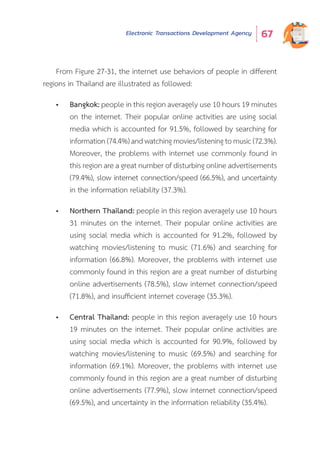
From Figure 27-31, the internet use behaviors of people in different
regions in Thailand are illustrated as followed:
•	 Bangkok: people in this region averagely use 10 hours 19 minutes
on the internet. Their popular online activities are using social
media which is accounted for 91.5%, followed by searching for
information(74.4%)andwatchingmovies/listeningtomusic(72.3%).
Moreover, the problems with internet use commonly found in
this region are a great number of disturbing online advertisements
(79.4%), slow internet connection/speed (66.5%), and uncertainty
in the information reliability (37.3%).
•	 Northern Thailand: people in this region averagely use 10 hours
31 minutes on the internet. Their popular online activities are
using social media which is accounted for 91.2%, followed by
watching movies/listening to music (71.6%) and searching for
information (66.8%). Moreover, the problems with internet use
commonly found in this region are a great number of disturbing
online advertisements (78.5%), slow internet connection/speed
(71.8%), and insufficient internet coverage (35.3%).
•	 Central Thailand: people in this region averagely use 10 hours
19 minutes on the internet. Their popular online activities are
using social media which is accounted for 90.9%, followed by
watching movies/listening to music (69.5%) and searching for
information (69.1%). Moreover, the problems with internet use
commonly found in this region are a great number of disturbing
online advertisements (77.9%), slow internet connection/speed
(69.5%), and uncertainty in the information reliability (35.4%).
Thailand Internet User Behavior 201968
•	 Northeastern Thailand: people in this region averagely use 10
hours 28 minutes on the internet. Their popular online activities
are using social media which is accounted for 91.1%, followed by
watching movies/listening to music (72.9%) and searching for
information (66.9%). Moreover, the problems with internet use
commonly found in this region are a great number of disturbing
online advertisements (76.5%), slow internet connection/speed
(71.7%), and insufficient internet coverage (36.8%).
•	 Southern Thailand: people in this region averagely use 10 hours
17 minutes on the internet. Their popular online activities are
using social media which is accounted for 91.0%, followed by
searching for information (68.0%) and watching movies/listening
to music (66.8%). Moreover, the problems with internet use
commonly found in this region are a great number of disturbing
online advertisements (77.4%), slow internet connection/speed
(67.4%), and insufficient internet coverage (32.2%).
Electronic Transactions Development Agency 69
Thailand Internet User Behavior 201970
Internet User’s
Knowledge of
Digital Identity
Electronic Transactions Development Agency 71
Internet User’s Knowledge
of Digital Identity
Nowadays, users are required to identify themselves before accessing
or making online transactions. The primary purpose is to recognize identity
of the person who is making a transaction and to reduce risks of fraudulent
activities. For example, when opening a bank account, an applicant would
be asked, in the Enrolment process, to show a National ID card or other
evidences to prove his or her identity (Identity Proofing). The bank may also
check whether his or her face is the same with evidences provided, then
issue them a book bank as an authenticator for making transactions
afterwards.
Identity Proofing is also necessary for online transactions, especially
when a service provider and customer never meet each other in person.
Therefore, in the Enrolment process, several online service providers
usually conduct Identity Proofing in order to identify their customers.
However, methods of Identity Proofing are varied and depend on the level
of each transaction risks. For example, services which have low-risk
transactions (e.g., social media or email services) occasionally require only
informationthatusersprovidedtoproveusers’identity.Incontrast,high-risk
transactions (e.g., financial services) may further require checking identity
information from the government database.
Level of transaction risks also affects methods of Authentication.
Generally, service providers would authenticate customers by checking the
Thailand Internet User Behavior 201972
authenticator before allowing access to the service. Authenticators could
be in several forms, whether something you know (password or PIN),
something you have (device or mobile phone) or something you are
(biometric). In general, people are familiar with using a username and
password to gain service access and making transactions. However, making
high-risk transactions (e.g., high-value payment transactions) requires more
than one authenticator to be checked, such as the combined check of PIN
or password and OTP (One-Time Password).
Principally, service providers would authenticate users for the purpose
of allowing access to their own services. Nowadays, some service providers
enable their users to use their account (or Digital ID) for accessing to service
ofotherserviceproviders.Forexample,userscanenrollforthee-commerce
platformbyusinganexistingsocialmediaaccount.Thee-commerceplatform
wouldrequestthesocialmediaprovidertoauthenticateitsusers.Asaresult,
the e-commerce platform would enroll users into their services by relying
on identity information from that social media provider.
1.	 Createa“newaccount”byidentifyingoneselfdirectlytotheservice
provider and create a new Digital ID for that service.
2.	 Use an “existing account” by using Digital ID from other service
providers.
Creatinganewaccountforaccesstoaserviceisprevalentsinceinternet
users still have security concerns over their personal data; doing so means
a user can be authenticated directly by a service provider. Unlike creating a
newone,usinganexistingaccountlikeasocialmediaaccountwithaservice
from another provider, the new service provider may ask the social media
platform provider whether a user is real. This might risk the social media.
Electronic Transactions Development Agency 73
Figure 32: Familiarity with Digital ID and activities related to
Enrolment, Identity Proofing and Authentication
76.5%
82.1%
85.9%
67.8%
20.3%
15.3%
12.2%
26.1%
3.1%
2.7%
1.9%
6.1%
Enrolment for an online service from the public sector
(ex. taxation service) that requires personal data
91.6%
6.1%
2.3%Use of OTP Authentication
of online product/service
Enrolment for an online service from the private sector
(ex. movie streaming service) that requires personal data
Access to an online service from the private sector
(ex. e-learning and e-commerce platforms) with password you set
Providing your personal data (ex. National ID numbers)
for e-Wallet service Enrolment (ex. LINE Pay and TrueMoney Wallet)
77.5%
18.2%
4.3%Use of credit card numbers and CVV
Authentication of online payment
familiar and
done before
familiar but
never done
Not familiar
Digital ID and activities related to Enrolment,
Identity Proofing and Authentication
platformprovidersendingrelevantinformation,includingsensitivedata,
more than needed and the new service provider might misuse the data
withoutauser’sconsent.However,userswhopreferusinganexcisingaccount
may do so because the log-in process becomes easier, faster, and more
convenient
Due to the growing importance of Identity Proofing towards online
transactions, internet users’ understanding, awareness, and readiness
relating this area is worth studying since it will help planning and setting
direction for appropriate governance of Digital ID service providers.
Thailand Internet User Behavior 201974
From Figure 32, it is shown that most survey respondents are familiar
with and have done activities related to Enrolment, Identity Proofing and
Authentication. However, comparing to other activities, Enrolment for
government online services which requires personal data of a user is an
activity the respondents are the least familiar with. This may be because
somerespondentsareinGenZgroupwhichstillneednottousegovernment
services,resultinginalowdegreeoffamiliarity.Inaddition,thegovernment’s
insufficient publicity and less satisfaction of the services also abate the
popularity of the government services. Therefore, it is necessary that
public sectors improve their publicity campaigns and develop the service
system in order to more satisfy the users’ need.
Moreover, to be specific, the activities that the respondents are
accustomed to are use of OTP for Authentication of online product/service
purchase (91.6%), Enrolment for an online service from the private sector
such as movie streaming services and online game applications by
creating a new account or using an existing social media account
(Facebook, Twitter, or Google) for log-in (85.9%), access to an online
service from the private sector (ex. e-learning and e-commerce platforms)
with password the user set (82.1%), use of credit card numbers and Card
Verification Value Code (CVV) for Authentication of online payment (77.5%),
providing personal data (ex. ID numbers) for e-Wallet10
service Enrolment
such as LINE Pay and TrueMoney Wallet (76.5%), and Enrolment for an
online service from the public sector such as taxation service and passport
appointment booking service that requires personal data including name
and ID numbers of the user (67.8%).
10
	 e-Wallet (or e-Money) is an online service that allows the users to make electronic transactions i.e. top up
money into the Wallet and purchase an item (product or service) at a store.
Electronic Transactions Development Agency 75
FromFigure33,concerningEnrolmentandIdentityProofingforgovernment
online services, we can see that most people in all generations are familiar
with and have done this activity. In addition, this activity seems to be the
most ubiquitous among Gen X (81.1%), followed by Baby Boomer (73.2%)
and Gen Y (67.6%). However, most respondents from Gen Z (57.7%) report
that they know some government online services but have never used
before. This might be because people in this generation are student aged
less than 19 years old, so it is still not necessary for them to use services
from the public sector when compared to older generations that have
incomes, more social responsibilities, as well as more chances to contact
government agencies.
Figure 33: Familiarity with Enrolment and Identity Proofing
for government online services
Not familiar
familiar but
never done
familiar and
done before
Baby Boomer Gen X
Gen Y Gen Z
4.0%
73.2%
22.8%
5.9%
26.5%
67.6%
2.8%
16.0%
19.8%
57.7%
22.6%
81.1%
Not familiar
familiar but
never done
familiar and
done before
Not familiar
familiar but
never done
familiar and
done before
Not familiar
familiar but
never done
familiar and
done before
Thailand Internet User Behavior 201976
From Figure 34, concerning Enrolment and Identity Proofing for
private-sector online services by creating a new account or using an
existing account from social media account (Facebook, Twitter, or Google)
to log-in, it is shown that most people in all generations are familiar with
and have done this activity. In addition, this activity seems to be the most
popular among Gen Y (90.4%), followed by Gen Z (90.1%), Gen X (79.1%),
and Baby Boomer (59.6%). Still, we can see that comparing to other
generations the Baby Boomer have the least familiarity with this matter.
Therefore, relevant agencies should help them learn how to create an
account for online services from the private sector.
Figure 34: Familiarity with Enrolment and Identity Proofing
For private-sector online services
Baby Boomer Gen X
Gen Y Gen Z
8.4%
59.6%
32.1%
1.0%
8.6%
90.4% 90.1%
2.8%
18.1%
1.5%
8.4%
79.1%
Not familiar
familiar but
never done
familiar and
done before
Not familiar
familiar but
never done
familiar and
done before
Not familiar
familiar but
never done
familiar and
done before
Not familiar
familiar but
never done
familiar and
done before
Electronic Transactions Development Agency 77
Figure 35: Familiarity with Authentication
by using password for private-sector online services
Baby Boomer Gen X
Gen Y Gen Z
6.9%
31.6%
61.5%
1.8%
12.8%
85.4% 77.0%
3.2%
16.4%
4.1%
18.9%
80.4%
Not familiar
familiar but
never done
familiar and
done before
Not familiar
familiar but
never done
familiar and
done before
Not familiar
familiar but
never done
familiar and
done before
Not familiar
familiar but
never done
familiar and
done before
From Figure 35, concerning Authentication by using password for
private-sector online services, it is shown that most people in all
generations are familiar with and have done this activity, especially Gen
Y (85.4%) which is followed by Gen X (80.4%), Gen Z (77.0%), and Baby
Boomer (61.5%). Still, we can see that comparing to other generations the
Baby Boomer have the least familiarity with this matter. Therefore, relevant
agencies should educate and help them realize advantages from online
services from private sector, as well as instill them with awareness of
internet security.
Thailand Internet User Behavior 201978
From Figure 36, concerning Enrolment and Identity Proofing for
e-Wallet services, it is shown that most people in all generations are
familiar with and have done this activity, especially Gen Z (85.0%) which
is followed by Gen Y (80.7%), Gen X (69.9%), and Baby Boomer (41.1%).
Still, we can see that comparing to other generations the Baby Boomer
have the least familiarity with this matter. Therefore, relevant agencies
should help them learn, for example, how to wisely fill in the Enrolment
form with their personal data for e-Wallet services.
Figure 36: Familiarity with Enrolment and Identity Proofing for
e-Wallet services
Baby Boomer Gen X
Gen Y Gen Z
11.3%
41.6%
47.1%
2.1%
17.1%
80.7% 85.0%
3.9%
26.2%
2.2%
12.7%
69.9%
Not familiar
familiar but
never done
familiar and
done before
Not familiar
familiar but
never done
familiar and
done before
Not familiar
familiar but
never done
familiar and
done before
Not familiar
familiar but
never done
familiar and
done before
Electronic Transactions Development Agency 79
From Figure 37, concerning Authentication by using credit card
numbers with Code Verification Value (CVV) for online payments, it is
shown that most people in all generations are familiar with and have done
this activity, especially Gen Y (81.3%) which is followed by Gen X (78.1%),
Baby Boomer (64.4%), and Gen Z (57.8%). We can assume that Gen Z have
the least familiarity with this matter because they are a student aged less
than 19 years old, so it is still not necessary for them to make transactions
with their own money.
Figure 37: Familiarity with Authentication by using credit card
numbers with CVV for online payments
Baby Boomer Gen X
Gen Y Gen Z
8.8%
26.8%
64.4%
3.4%
15.2%
81.3% 57.8%
4.0%
17.9%
8.5%
33.7%
78.1%
Not familiar
familiar but
never done
familiar and
done before
Not familiar
familiar but
never done
familiar and
done before
Not familiar
familiar but
never done
familiar and
done before
Not familiar
familiar but
never done
familiar and
done before
Thailand Internet User Behavior 201980
From Figure 38, concerning Authentication by using One Time Password
OTP for online payments, it is shown that most people in all generations
are familiar with and have done this activity, especially Gen Y (94.3%)
which is followed by Gen X (90.9%), Gen Z (82.0%), and Baby Boomer
(80.8%). It can be noticed that the results of Gen Z and Baby Boomer are
similar, so relevant agencies should help them realize, for example,
advantages from the use of OTP for online payments.
Figure 38: Familiarity with Authentication
by using OTP for online payments
Baby Boomer Gen X
Gen Y Gen Z
7.5%
11.7%
80.8%
1.8%
4.4%
94.3%
2.8%
6.3%
4.8%
13.2%
90.9%
82.0%
Not familiar
familiar but
never done
familiar and
done before
Not familiar
familiar but
never done
familiar and
done before
Not familiar
familiar but
never done
familiar and
done before
Not familiar
familiar but
never done
familiar and
done before
Electronic Transactions Development Agency 81
Thailand Internet User Behavior 201982
NewaccountExistingaccount
33.4%Fooddelivery
38.7%Onlinepayment
40.3%Parcelservice
37.2%Bookinghotel/accommodation37.2%
40.9%Onlineticketing(movie,concert)
36.7%Watchingclips/onlinemovies
34.4%Readinge-book/news/article
49.3%Onlinejobapplication
58.8%Onlineassettrading
51.0%e-Learning
40.1%Water/electricitybillpayment
38.7%Socialmedia(Facebook,YouTube,LINE,Pantip)
66.4%Drivinglicenserenewal
33.1%Ride-hailingtransportservice
35.4%Playingonlinegame
39.6%e-Commerce
66.6%
61.3%
59.7%
62.8%62.8%
59.1%
63.3%
65.6%
50.7%
41.2%
49.0%
59.9%
61.3%
33.6%
66.9%
64.6%
60.4%
Figure39:Percentageofusers’choiceofEnrolment
foronlineservices
DigitalIDusecasesinonlineservices
Electronic Transactions Development Agency 83
	 FromFigure39,concerningtheusers’choiceofEnrolmentforonline
services, most respondents prefer using an existing account such as social
media,email,publicbank,andfinancialinstitutionaccountforaccesstoonline
services. The first three online services the internet users use their existing
accounttoaccessareride-hailingtransportservice(66.9%),fooddeliveryservice
(66.6%), and online news/article/e-book services (65.6%).
Still, some prefer creating a new account for online services, for example,
driving license renewal (66.4%), asset trading (58.8%), and e-learning (51.0%).
Thailand Internet User Behavior 201984
From Figure 40, most respondents use their existing account for
ride-hailing transport services generally because the Enrolment process is
easier and more user-friendly (80.1%). Second to ride-hailing transport
service is food delivery service which people choose to use their existing
account for access mostly because the Enrolment process is easier and
more user-friendly (81.8%). The third popular service with an existing
account is e-book/news/article platform, and this is mostly due to easiness/
user-friendliness of the Enrolment process (81.3%).
The user is confident
in data security
The process
is user-friendly
It is fast
and convenient
It is the only choice
to get access
18.0%
19.5%
81.8%
81.3%
81.0%
79.0%
6.9%
20.6% 80.1% 79.8% 6.9%
6.6%Reading e-book/news/article
Food delivery service
Ride-hailing transport service
(Grab Taxi, LINE MAN Taxi)
Figure 40: Percentage of internet users by reason
for using their existing account for online services
Electronic Transactions Development Agency 85
From Figure 41, most respondents create a new account for driving
license renewal service generally because the Enrolment process is faster
and more convenient (68.2%). Second to the driving license renewal service
is asset trading service which people choose to create a new account for
access mostly because they have more confidence in their data security
(63.7%). The third popular service with a new account is e-learning service,
andthisismostlyduetoeasiness/user-friendlinessoftheEnrolmentprocess
(55.5%).
Figure 41: Percentage of internet users by reason for creating a
new account for online services
63.7%
45.9%
44.0%
55.5%
43.4%
51.1%
27.3%
60.9% 63.5% 68.2% 16.7%
27.3%e-Learning
Driving license renewal
Asset trading
The user is confident
in data security
The process
is user-friendly
It is fast
and convenient
It is the only choice
to get access
Thailand Internet User Behavior 201986
From Figure 42, it is shown that most survey respondents (64.4%)
prefer using One Account for access to all online services from the
government. However, some (23.8%) are still uncertain to use and some
(11.9%) would not like to use One Account.
From Figure 43, concerning different types of service provider, most
survey respondents (65.4%) prefer using One Account for access to online
services both from the private sector and the government. However, some
(34.6%) agree to use One Account that can access online services only
from the government.
Figure 42: Percentage of internet users by preference
for using One Account for all online services
Figure 43: Percentage of internet users
by view towards the use of One Account
23.8%
64.4%Agree
Uncertain
Disagree 11.9%
23.8%
64.4%
34.6%
65.4%
One Account
for online services
from both public
and private sectors
One Account only
for online services
from the government
One Account for all online services
Electronic Transactions Development Agency 87
From Figure 44, it is revealed that most respondents require assurances
from the government on the use of the Digital ID. That is, the internet users
want the government to be committed to system security against data
leakage (61.4%), to regulations for relevant agencies (18.5%), to system
guarantee (11.2%), to system continuity (7.2%), and others (1.7%).
FromFigure45,whenaskedwhoshouldberesponsibleforOneAccount
most of the respondents (55.2%) consider National Digital Identity (NDID) as
amainresponsibleagency.Thisprivateorganizationisactingastheplatform
toconnectRelyingParty(RP),theIdentityProvider(IdP),andtheAuthoritative
Source (AS) together. In addition, 38.3% think it should be operated by the
government, i.e. the Department of Provincial Administration which is the
Registrar having access to or owning identity information of citizens, while
the others trust the banking sector (4.1%) and other parties (1.4%).
Figure 44: Percentage of internet users
by aspect that the government is expected to concern
for reliability of Digital ID
Figure 45: Percentage of internet users
by agency expected to be responsible for One Account
1.4%
4.1%
38.3%
55.2%National Digital Identity (NDID)
Government (ex. the Department of
Provincial Administration)
Banking sector
Others
1.7%
7.2%
11.2%
18.5%
61.4%System security against data leakage
Regulations for relevant agencies
System guarantee
System continuity
Others
Thailand Internet User Behavior 201988
From Figure 46, the main factor the internet users consider when
choosing the sector responsible for their account is the capability of the
agency to secure their data (67.3%), while the others are capability of the
agency to manage the system (62.6%), capability of the agency to use
their data for the country development (45.2%), and resource availability
and readiness of the agency (41.6%).
Figure 46: Percentage of internet users by reason to choose an
agency responsible for One Account
41.6%
45.2%
62.6%
67.3%
Capability of the agency
to secure data of a user
Capability of the agency
to manage the system
Capability of the agency to use data
for the country development
Resource availability
and readiness of the agency
2.4%Others
Electronic Transactions Development Agency 89
Conclusion
From the study of the internet users’ knowledge of Digital ID, a special
topic of the Thailand Internet User Behavior 2019, it is revealed that some
internet users still do not realize the availability of government online
services. This could reflect the fact that those services do not get enough
publicity campaigns from the government, leading to limited service access
and concern among people that the services need to be done formally
and face-to-face.
In addition, concerning the account for online services from both
public and private sectors, it is found that most internet users prefer
creating a new account for access to government online services to using
their existing account. On the other hand, for access to public online
services, people prefer using their existing account. The preference of
creating a new account for government online services might be due to
people’s understanding that access to online services from the government
would require formality and involve personal data and financial
transactions, resulting in their more concern over accuracy of the
vinformation they provide and of the service use when comparing to the
access to public online services.
Concerning confidence in security of personal data collection, it is
shown that most internet users rely on the government to collect their
data more than the private sector. They also require assurances from the
government on improvements of efficiency and security of the collection
of personal data of online service users. Realizing the importance of this
matter, ETDA commits itself to enhance the reliability of online transactions
with public and private sectors by developing regulation that relates to
services such as Digital ID and Certificate Authority to ensure trust and
security of electronic transactions.
Thailand Internet User Behavior 201990
Appendix
Electronic Transactions Development Agency 91
Profiles of Respondents
of Thailand Internet User
Behavior 2019
The survey of Thailand Internet User Behavior 2019 attracts more than
17,242 respondents to complete a questionnaire through website or
other social media channels, and 10,998 responses can be practically used
and analyzed. The details of survey respondents are as followed.
From Figure 47, it is shown that survey respondents are female (59.0%),
male (38.5%), LGBT and others (2.5%).
Figure 47: Percentage of survey respondents by gender
Female
Male
LGBT and others
59.0%
38.5%
2.5%
Thailand Internet User Behavior 201992
As shown in Figure 27, 66.2% of the survey respondents are single
while 27.2% are married, both registered and unregistered, 3.5% are
domestic partnership, and 3.1% are divorced/ separated/ widowed.
Figure 48: Percentage of survey respondents by marital status
Single
Married
(registered or unregistered)
Domestic partnership
Divorced/separated/
widowed
66.2%
27.2%
3.5%
3.1%
Electronic Transactions Development Agency 93
As shown in Figure 28, the majority of survey respondents belong to
Gen Y group (61.8%), followed by Gen X (26.3%), Gen Z (7.8%) and Baby
Boomer (4.1%).
Figure 49: Percentage of survey respondents by generation
Baby Boomer Gen X
Gen Y Gen Z
4.1%
61.8% 7.8%
26.3%
Thailand Internet User Behavior 201994
Figure 50: Percentage of survey respondents by place of residence
Bangkok and its vicinity
Other provinces
Within municipal areas
Outside municipal areas
43.3%
56.7%
46.1%
53.9%
When considering the place of residence, 43.3% of the survey
respondents live in Bangkok and its vicinity and 56.7% are from other
provinces (among the number of people living in other provinces, 46.1%
live within municipal areas and 53.9% live outside municipal areas), as
shown in Figure 50.
Electronic Transactions Development Agency 95
Figure 51: Percentage of survey respondents by region
From Figure 51, most respondents live in Bangkok (43.3%), followed
by Central (23.1%), Northern (14.9%), Northeastern (11.8%), and Southern
Thailand (6.8%).
Bangkok
Central
43.3%
23.1%
Northern
Northeastern
14.9%
11.8%
Southern 6.8%
Thailand Internet User Behavior 201996
Figure 52: Percentage of survey respondents by education level
Higher than master's degree
Master's degree
Bachelor’s degree
Vocational/ high vocational/
technical certificate/ associate degree
Senior high school
Junior high school
Elementary school or lower
3.0%
26.2%
57.4%
4.9%
5.7%
2.5%
0.4%
From Figure 52, it is revealed most of survey respondents (over 80%)
have completed a bachelor’s degree or higher. Respondents who have
attained a bachelor’s degree, master’s degree and higher than a master’s
degree are 57.4%, 26.2% and 3.0%, respectively. The remaining
respondents have attained degree lower than a bachelor’s degree
including respondents who have held an elementary education certificate
or lower (0.2%), junior high school certificate (2.5%), senior high school
certificate (5.7%), and vocational/ high vocational/ technical certificate/
associate degree (4.9%).
Electronic Transactions Development Agency 97
As shown in Figure 53, most survey respondents are public servant,
government employee, employee of state enterprise or independent
organization (52.1%), while the others are private employee (20.5%),
student (15.9%), freelancer (3.6%), business owner/self-employed (3.4%),
unemployed (2.3%), others (2.0%), and househusband/housewife (0.7%).
Figure 53: Percentage of survey respondents by employment status
Public servant, government employee,
employee of state enterprise
or independent organization
Student
Private employee
Business owner/self-employed
Unemployed
Others
52.1%
20.5%
15.9%
3.4%
2.3%
1.4%
0.7%Househusband/housewife
Freelancer 3.6%
Thailand Internet User Behavior 201998
Figure 54: Percentage of survey respondents
by average monthly income
Higher than 90,000 baht
70,001 - 90,000 baht
50,001 - 70,000 baht
30,001 - 50,000 baht
15,001 - 30,000 baht
Less than 15,000 baht
3.1%
2.5%
6.0%
18.4%
40.6%
29.4%
As shown in Figure 54, when considering the average monthly income
of survey respondents, it is found that most survey respondents (40.6%)
have an average monthly income between 15,001 - 30,000 baht. The
others have an average monthly income lower than 15,000 baht (29.4%),
between 30,001 - 50,000 baht (18.4%), between 50,001 - 70,000 baht
(6.0%), higher than 90,000 baht (3.1%), and between 70,001 – 90,000 baht
(2.5%).
Electronic Transactions Development Agency 99
As shown in Figure 55, when considering the average monthly
household income of survey respondents, it is found that 39.0% of
respondents have an average monthly household income between 30,001
- 70,000 baht. The others have an average monthly household income
less than 30,000 baht (27.4%), between 70,001 - 110,000 baht (15.6%).
higher than 150,000 baht (9.9%), and between 110,001 - 150,000 baht
(8.0%).
Figure 55: Percentage of survey respondents
by average monthly household income
Higher than 150,000 baht
110,001 - 150,000 baht
70,001 - 110,000 baht
30,001 - 70,000 baht
Less than 30,000 baht
9.9%
8.0%
15.6%
39.0%
27.4%
Thailand Internet User Behavior 2019100
Questionnaire on
Thailand Internet User
Behavior 2019
Electronic Transactions Development Agency 101
Questionnaire on Thailand Internet User Profile 2019
Direction: This questionnaire consists of 20 questions separated into 3 parts.
Part 1: General information (8 questions)
Part 2: Internet user behavior (7 questions)
Part 3: Digital Identity (5 questions)
Remark: This questionnaire is for a respondent who currently lives in Thailand only.
Part 1: General information (8 questions)
1) Gender
o Male
o Female
o LGBT and others
2) Marital Status
o Single
o Married (both registered and unregistered)
o Domestic partnership
o Divorced/ separated/ widowed
3) Age .............years (Counting the full year. The fraction of the month shall be discarded.)
4.1) Where do you currently live?
o Bangkok
o Other provinces
4.2) Which province do you currently live in? (please specify.)
4.3) Do you live within or outside a municipal area?
o Within a municipal area
o Outside a municipal area
5. What is your highest level of education or what level of education you are currently
enrolled in?
o Elementary school or lower
o Junior high school
o Senior high school
o Vocational certificate/ High vocational certificate/ Technical certificate/ Associate degree
o Bachelor’s degree
o Master’s degree
o Higher than Master’s degree
Thailand Internet User Behavior 2019102
6) What is your principal occupation/ full time job?
o Public servant/government employee/employee of state enterprise or independent
organization
o Business owner/self-employed
o Private employee
o Student
o Househusband/housewife
o Unemployed
o Freelancer
o Other (please specify)
7) What is your average monthly income?
o Less than 15,000 baht
o 15,001 - 30,000 baht
o 30,001 - 50,000 baht
o 50,001 - 70,000 baht
o 70,001 - 90,000 baht
o More than 90,000 baht
8) What is your average monthly household income?
o Less than 30,000 baht
o 30,001 - 70,000 baht
o 70,001 - 110,000 baht
o 110,001 - 150,000 baht
o More than 150,000 baht
Electronic Transactions Development Agency 103
Part 2: Internet Usage Behavior (7 questions)
Part 2 of the survey is to inquire about your behavior regarding the internet use in various
aspects including duration of use, online activities, trend of change, problems encountered while
using the internet, as well as confidence/trust in personal data protection and internet security.
9. How much time did you spend on these activities on workday/school day in the past
week? (The amount of time you distribute into each activity shall not exceed 24 hours.)
Online activity (on workday/school day) Amount of time
A) Using Social Media (such as Facebook, Twitter, and Instagram) ........hour(s) ........minute(s)
B) Communication (such as LINE, Facebook Messenger WhatsApp, FaceTime) ........hour(s) ........minute(s)
C) Watching video clips/movies or listening to music (such as YouTube, Netflix,
Spotify)
........hour(s) ........minute(s)
D) Playing online game ........hour(s) ........minute(s)
E) Reading news/articles/e-books ........hour(s) ........minute(s)
F) Other (please specify) ........hour(s) ........minute(s)
10) How much time did you spend on these activities on weekend in the past week? (The
amount of time you distribute into each activity shall not exceed 24 hours.)
Online activity (on weekend) Amount of time
A) Using Social Media (such as Facebook, Twitter, and Instagram) ........hour(s) ........minute(s)
B) Communication (such as LINE, Facebook Messenger WhatsApp, FaceTime) ........hour(s) ........minute(s)
C) Watching video clips/movies or listening to music (such as YouTube, Netflix,
Spotify)
........hour(s) ........minute(s)
D) Playing online game ........hour(s) ........minute(s)
E) Reading news/articles/e-books ........hour(s) ........minute(s)
F) Other (please specify) ........hour(s) ........minute(s)
11) On average, how much time did you spend on the internet per day when compared to
last year?
o Increase (........hour(s) ........minute(s))
o B) Decrease (........hour(s) ........minute(s))
o Not changed
Thailand Internet User Behavior 2019104
12) In the past week, where did you usually use the internet? (Choose up to 3 answers)
o Home/ residence
o Workplace
o School
o Internet/ game café
o Public place (such as hotel, restaurant, coffee shop, department store)
o While travelling
o Other (please specify)
13. In the past six months, which of the following did you do online? Through which
channel? Do you prefer doing that activity online or offline?
o Using social media (such as Facebook, Twitter, Instagram)
o Live streaming (such as Facebook Live, YouTube Live)
o Playing online games
o Emailing
o Searching for information (such as information about restaurants, tourist attractions,
products/services, as well as information for work/study/business)
o e-Learning
o Online job application
o Online asset trading
o Selling products/services
o Downloading software/songs/dramas/movies/games/in-game items
o Buying products/services
o Communication
o e-Learning
o Watching TV/video clips/movies or listening to music
o Reading books/news/articles
o Online ticketing (such as movie tickets, concert tickets)
o Booking hotel/accommodation
o Using ride-hailing transport service (such as Grab Taxi, LINE Man Taxi)
o Using parcel service
o Online payment
o Using food delivery service
o Using online service from the government
Electronic Transactions Development Agency 105
13.1) Which channel did you use for information search? (can choose more than one answer)
o Search engine (such as Google, Bing)
o YouTube
o Pantip
o Facebook Fanpage
o Website/blog
o Instagram
o Other (Please specify)
13.2) Which channel did you use for selling products/services? (can choose more than one
answer)
o Shopee
o Lazada
o Facebook Fanpage
o Instagram
o Twitter
o LINE
o Other (Please specify)
13.3) Which channel did you use for buying products/services? (can choose more than one
answer)
o Shopee
o Lazada
o Facebook Fanpage
o Instagram
o Twitter
o LINE
o Other (Please specify)
13.4) Which channel did you use for online communication? (can choose more than one
answer)
o LINE
o Facebook Messenger
o FaceTime
o WhatsApp
o Other (Please specify)
Thailand Internet User Behavior 2019106
13.5) Which channel did you use for watching TV/video clips/movies or listening to music?
(can choose more than one answer)
o YouTube
o Netflix
o VIU
o LINE
o JOOX
o Spotify
o Sound Cloud
o Thai Radio
o Other (Please specify)
13.6) Which government online service did you use? (can choose more than one answer)
o Electricity bill payment service via application of The Provincial Electricity Authority
o Taxation payment service via website/application of The Revenue Department
o Driving license renewal service via website of The Department of Land Transport
o Passport appointment booking service via website of The Department of Consular Affairs
o Other (Please specify)
13.7) Did you buy products/services online more or less than from department
store/supermarket?
o More
o Less
13.8) Did you communicate online more or less than via telephone?
o More
o Less
13.9) Did you watch TV/video clip/movie or listen to music online more or less than via
traditional methods?
o More
o Less
13.10) Did you read online article/e-book more or less than printed ones?
o More
o Less
13.11) Did you book/buy tickets online more or less than via an agency?
o More
o Less
13.12) Did you book hotel/accommodation online more or less than via an agency?
o More
Electronic Transactions Development Agency 107
o Less
13.13) Did you pay for product/service online more or less than by cash/via bank
transfer/via Counter Service?
o More
o Less
13.14) Did you use ride-hailing transport service more or less than hitchhiking/call to the
service center?
o More
o Less
13.15) Did you use parcel service through website/application more or less than via post
office/by motorcycle taxi?
o More
o Less
13.16) Did you order food from online food delivery service more or less than via
telephone/by hiring motorcycle taxi?
o More
o Less
13.17) Did you use government services (such as driving license renewal service and taxation
service) via online channels more or less than by directly contacting their office?
o More
o Less
14) In the past 3 months, what problems did you encounter when using the internet? (Check
all that apply)
o Slow internet connection/speed
o Insufficient network coverage
o Amount of disturbing online advertisements
o Computer virus infection
o Inability to seek helps when problems occurred
o Internet fraud
o Expensive cost i.e. service and device fees
o Internet connection difficulty/frequent loss of internet connection
o Spam email interruption
o Disturbance from online pornography
o Uncertainty of information reliability
o Personal data or privacy infringement
o Other (please specify)
Thailand Internet User Behavior 2019108
15) This question is aimed to study an internet user’s confidence/trust in personal data
protection and internet security
To what extent do you agree with the
following statements?
Completely
agree
Somewhat
agree
Somewhat
disagree
Completely
disagree
I trust the provider of internet network that I use.
I have confidence in financial transaction platform
on mobile that I use.
I trust the provider of search engine that I use.
I have confidence in the internet use.
I have confidence in online social network that I
use.
I have confidence in online services from the
government.
I have confidence in online services from the
government of other countries.
Electronic Transactions Development Agency 109
Part 3: Digital Identity (5 questions)
Digital Identity means an attribute or a set of attributes that are collected and recorded
into digital form. The Digital Identity can be used to identify a person in a specific context and to
make electronic transactions.
16) Are you familiar with or have you ever done the following activities?
Activities
Familiar and
done before
Familiar
but never
done
Not
familiar
Use of OTP for confirmation of online product/service purchase
Use of credit card numbers and CVV for confirmation of online
payment
Providing your personal data (ex. ID numbers) for e-Wallet
service Enrolment (ex. LINE Pay and True Money Wallet)
Access to an online service from the private sector (ex. e-
learning and e-commerce platforms) with password you set
Enrolment for an online service from the private sector (ex.
movie streaming, online game) that requires a new account or
log in by existing social media account (Facebook, Twitter,
Google)
Enrolment for an online service from the government (ex.
taxation service, passport appointment booking service) that
requires personal data
Thailand Internet User Behavior 2019110
17.1) Which government online services do you currently use? (Check all that apply)
Which government online
services do you use?
(Check all that apply)
Which kind of account do you
use for government online
service Enrolment?
From previous section, why do
you use this account for
government online service
Enrolment?
(Check all that apply)
o A) Driving license renewal
service
o B) Taxation service
o C) Passport appointment
booking service
o D) Job application
o E) Check for social security
rights
o F) Water bill payment via
website/application of the
Provincial Waterworks Authority
o G) Electricity bill payment via
website/application of the
Provincial Electricity Authority
o H) Other (Please specify)
o I) Never use any government
online services
o Creating a new account
(username and password)
o Existing social media account
(Facebook, Google, Twitter,
LINE)
o Existing email account
o Existing private bank account
o Existing account from other
financial institutions (LINE Pay,
True Money)
o Other (Please specify)
o I have confidence in data
safety.
o The Enrolment process is user-
friendly.
o The Enrolment process is fast
and convenient.
o There is only one Enrolment
option for the service.
o Other (Please specify)
17.2) What is the reason that you do not use some government online services? (Check all
that apply)
o There are plenty of alternative services.
o I do not know that this service is available.
o I do not know how to use or benefits from the service.
o The similar service from another sector is more convenient.
o I am not confident in the safety of my data.
o Other (Please specify)
Electronic Transactions Development Agency 111
18.1) Which online services from private sector do you currently use? (Check all that apply)
Which private online services
do you use?
(Check all that apply)
Which kind of account do you
use for private online service
Enrolment?
From previous section, why do
you use this account for private
online service Enrolment?
(Check all that apply)
o A) Driving license renewal
service
o B) Water/electricity bill
payment
o C) Social media (ex. Facebook,
YouTube, LINE, Pantip)
o D) E-commerce
o E) Online game
o F) E-learning
o G) Job application
o H) Asset trading
o I) Watching video clip/movie
o J) Reading news/articles/e-
book
o K) Ticket booking (ex. movie,
concert)
o L) Booking
hotel/accommodation
o M) Ride-hailing transport
service
o N) Parcel service
o O) Online payment
o P) Food delivery
o Q) Other (Please specify)
o R) Never use any private
online services
o Creating a new account
(username and password)
o Existing social media account
(Facebook, Google, Twitter,
LINE)
o Existing email account
o Existing private bank account
o Existing account from other
financial institutions (LINE Pay,
True Money)
o Other (Please specify)
o I have confidence in data
safety.
o The Enrolment process is user-
friendly.
o The Enrolment process is fast
and convenient.
o There is only one Enrolment
option for the service.
o Other (Please specify)
Thailand Internet User Behavior 2019112
18.2) What is the reason that you do not use some private online services? (Check all that
apply)
o There are plenty of alternative services.
o The service has complicated processes.
o I do not know that the service is available.
o I do not know how to use or benefits from the service.
o The similar service from another sector is more convenient.
o I am not confident in the safety of my data.
o Other (Please specify)
19.1) If the government initiates the system that requires One Account for access to all
government online services, will you prefer this system?
o Prefer
o Not prefer
o Uncertain
19.2) If you prefer the One Account system from the government, which online service you
aim to be included in the access?
o Only online services from the government.
o Online services both from the government and (important) private sectors
19.3 If the government initiates the One Account system, which Digital ID you would prefer
to use to access all services?
o A) Creating a new Government Digital ID to access all services
o B) Using existing social media account (Facebook, Google, Twitter, LINE)
o C) Using existing private bank account
o D) Using existing account from other financial institutions (LINE Pay, True Money)
o E) Other (Please specify)
19.4) In your opinion, who should mainly take responsibility for the One Account?
o National Digital Identity (NDID), a private organization acting as the platform to connect
the Relying Party (RP), the Identity Provider (IdP), and the Authoritative Source (AS)
together
o Public sector, i.e. the Department of Provincial Administration which is the Registrar having
access to or owning identity information of citizens
o Banking sector
o Other (Please specify)
Electronic Transactions Development Agency 113
19.5) From 19.4), what factor do you keep in mind when choosing the main agency
responsible for the One Account? (Check all that apply)
o Capability of the agency to secure data of a user
o Capability of the agency to manage the system
o Capability of the agency to use data for the country development
o Resource availability and readiness of the agency
o Other (Please specify)
20) Which aspect do you expect the government to concern for reliability of Digital Identity?
(Choose only one answer)
o System guarantees from the government
o Regulations for relevant agencies
o System security against data leakage
o System continuity
Thailand Internet User Behavior 2019114
Statistical Tables
Table 1
The average number of hours spent on the internet per day of each
generation classified by workday/school day and weekend
Table 2
Percentage of internet users by online activity
1 The average number of hours spent on the internet is the weighted average from the number of days on workdays/school days (5 days) and weekends (2 days).
The average number of hours spent on the internet = [(hours on workdays/school days * 5) + (hours on weekends * 2)] / 7
Overall internet use 10 hours 22 minutes
Workday/school day 9 hours 52 minutes
Weekend 11 hours 35 minutes
The amount of time
used on the internet
of each generation
Baby boomer Gen X Gen Y Gen Z
Workday/school day 9 hours 35 minutes 9 hours 20 minutes 10 hours 7 minutes 10 hours
Weekend 11 hours 3 minutes 10 hours 58 minutes 11 hours 50 minutes 12 hours 1 minutes
Average per day 1 10 hours 9 hours 49 minutes 10 hours 36 minutes 10 hours 35 minutes
Details %
Using social media (such as Facebook, Twitter, Instagram) 91.2%
Watching movie/listening to music 71.2%
Searching for information 70.7%
Emailing 62.5%
Online payment 60.6%
Reading book/news/article 57.1%
Buying product/service 57.0%
Communication 50.0%
Playing game 34.1%
Live streaming (such as Facebook live, YouTube Live) 29.6%
Downloading software/music/drama/movie/game/in-game item 28.4%
Food delivery 26.5%
Online ticketing (such as movie, concert ticket) 26.1%
Booking hotel/accommodation 25.9%
E-learning 24.4%
Ride-hailing transport service (such as Grab Taxi, LINE Man Taxi) 21.4%
Government online service 20.1%
Parcel service 18.2%
Selling product/service 15.9%
Online job application 13.2%
Online asset trading 12.6%
Electronic Transactions Development Agency 115
Table 3
Percentage of internet users of each generation by online activity
Online activity Gen Z Gen Y Gen X Baby boomer
Using social media 87.1% 93.7% 87.9% 82.5%
Watching movie/listening to music 69.2% 73.6% 67.9% 60.6%
Searching for information 54.6% 72.3% 72.0% 69.0%
Emailing 31.8% 63.1% 69.9% 64.2%
Online payment 31.6% 62.6% 64.8% 58.8%
Reading book/news/article 50.5% 56.5% 58.8% 67.5%
Buying product/service 38.5% 59.0% 59.6% 46.9%
Communication 36.8% 50.5% 52.5% 51.5%
Playing game 47.0% 37.8% 24.0% 18.1%
Live streaming 24.7% 29.8% 30.2% 31.9%
Downloading 42.3% 29.6% 22.7% 20.6%
Food delivery 16.1% 30.7% 21.7% 14.2%
Online ticketing 15.9% 31.0% 19.7% 12.2%
Booking hotel/accommodation 7.0% 28.2% 27.2% 18.8%
E-learning 33.9% 25.9% 19.4% 14.6%
Ride-hailing transport service 13.9% 25.5% 15.9% 9.5%
Government online service 4.2% 20.1% 24.2% 25.7%
Parcel service 14.2% 19.7% 16.8% 12.4%
Selling product/service 7.8% 17.5% 15.5% 8.6%
Online job application 7.5% 17.8% 5.6% 3.1%
Online asset trading 2.5% 12.7% 14.5% 17.5%
Thailand Internet User Behavior 2019116
Table 4
Percentage of internet users by confidence in internet security
Confidence in each aspect of internet use %
Confidence in general internet use 78.7%
Confidence in financial transaction platform on mobile currently used 76.6%
Confidence in the provider of search engine currently used 76.6%
Confidence in the provider of internet network currently used 76.1%
Confidence in online services from the government of other countries 72.0%
Confidence in online social network currently used 71.6%
Confidence in online services from the government 61.8%
Table 5
Percentage of internet users by problem with internet use
Problem with internet use %
High number of disturbing online advertisements 78.5%
Slow internet connection/speed 68.7%
Uncertainty of the information reliability 35.8%
Insufficient internet coverage 30.3%
Spam email interruption 29.9%
Internet connection difficulty/ frequent loss of internet 23.9%
Disturbance from online pornography 18.7%
Expensive costs (such as service and device fees) 15.7%
Infringement of personal data or privacy 13.5%
Computer virus infection 10.4%
Inability to seek helps when problems occurred 8.4%
Internet fraud 5.8%
Electronic Transactions Development Agency 117
Table 6
Percentage of internet users by familiarity with Digital ID
Activity
Familiar
and done
before
Familiar
but never
done
Not
familiar
Use of OTP for confirmation of online product/service
purchase
91.6% 6.1% 2.3%
Use of credit card numbers and CVV for confirmation
of online payment
77.5% 18.2% 4.3%
Providing your personal data for e-Wallet service
registration
76.5% 20.3% 3.1%
Access to an online service from the private sector
with password you set
82.1% 15.3% 2.7%
Enrolment for an online service from the private
sector that requires a new account or log in by
existing social media account
85.9% 12.2% 1.9%
Enrolment for an online service from the government
that requires personal data
67.7% 26.1% 6.1%
Thailand Internet User Behavior 2019118
List of Agencies Helping
Publicize Survey Banners
Electronic Transactions Development Agency 119
List of Agencies Helping Publicize Survey Banners in 2019
1 Department of Consular Affairs 51 Department of Corrections
2 Department of Land Transport 52 Royal Aide-De-Camp Department
3 Rice Department 53 Department of Industrial Works
4 Department of Foreign Trade 54 Department of Agriculture
5 Department of Internal Trade 55 Department of Medical Sciences
6 Department of Employment 56 The Department of Science Service
7 Department of Trade Negotiations 57 Fine Arts Department
8 Department of Tourism 58 Customs Department
9 The Civil Aviation Authority of Thailand 59 Department of International Economic Affairs
10 Department of Provincial Administration 60 Department of Agricultural Extension
11 Community Development Department 61 Department of International Trade Promotion
12 Department of Medical Services 62 Department of Local Administration
13 Department of Religious Affairs 63 Department of Export Promotion
14 Pollution Control Department 64 Department of Environmental Quality Promotion
15 Department of Disease Control 65 Department of Cultural Promotion
16 Rights and Liberties Protection Department 66 Cooperative Promotion Department
17 Department of Probation 67 Department of Industrial Promotion
18 Department of Trade Negotiations 68 Department of Treaties and Legal Affairs
19 Marine Department 69 Department of Health Service Support
20 Royal Irrigation Department 70 Excise Department
21 Department of Mineral Fuels 71 Revenue Department
22 Cooperative Auditing Department 72 Department of Labor Protection and Welfare
23 Department of Intellectual Property 73 Department of Special Investigation
24 Department of Marine and Coastal Resources 74 Department of Information
25 Department of Mineral Resources 75 Department of Mental Health
26 Department of Water Resources 76 Queen Sirikit Department of Sericulture
27 Department of Groundwater Resources 77 Department of International Organizations
28 Department of Highways 78 Department of Health
29 Department of Rural Roads 79 Department of American and South Pacific Affairs
30 Department of Lands 80 Department of ASEAN Affairs
31 Treasury Department 81 Department of Primary Industry and Mines
32 Department of Energy Business 82 Meteorological Department
33 Legal Execution Department 83 Department of National Parks, Wildlife and Plant Conservation
34 Comptroller General's Department 84 Department of East Asian Affairs
35 Public Relations Department 85 Department of South Asian, Middle East and African Affairs
36 Department of Fisheries 86 Ministry of Defence
37 Department of Livestock Development 87 Ministry of Finance
38 Department of Disaster Prevention and Mitigation 88 Ministry of Foreign Affairs
39 Royal Forest Department 89 Ministry of Tourism and Sports
40 Department of Physical Education 90 Ministry of Social Development and Human Security
41 Department of Thai Traditional and Alternative Medicine 91 Ministry of Higher Education, Science, Research and Innovation
42 Land Development Department 92 Ministry of Agriculture and Cooperatives
43 Department of Business Development 93 Ministry of Transport
44 Department of Skill Development 94 Ministry of Digital Economy and Society
45 Department of Alternative Energy Development and Efficiency 95 Ministry of Natural Resources and Environment
46 Department of Social Development and Welfare 96 Ministry of Energy
47 Department of Protocol 97 Ministry of Commerce
48 Department of Juvenile Observation and Protection 98 Ministry of Interior
49 Department of European Affairs 99 Ministry of Justice
50 Department of Public Works and Town Planning 100 Ministry of Labour
Thailand Internet User Behavior 2019120
List of Agencies Helping Publicize Survey Banners in 2019
101 Ministry of Culture 151 Quality Houses Public Company Limited
102 Ministry of Education 152 Com7 Public Company Limited
103 Ministry of Public Health 153 TMT Steel Public Company Limited
104 Ministry of Industry 154 Fast Money Company Limited
105 Bangkok Metropolis 155 Jasmine International Public Company Limited
106 Royal Thai Army 156 GMM Grammy Public Company Limited
107 Royal Thai Navy 157 Generali Insurance (Thailand) Public Company Limited
108 Royal Thai Air Force 158 Chao Phraya Insurance Public Company Limited
109 Student Loan Fund 159 Ch. Karnchang Public Company Limited
110 Government Pension Fund 160 Chubb Samaggi Insurance Public Company Limited
111 Tourist Police Division 161 Sino-Thai Resources Development Public Company Limited
112 Royal Thai Armed Force Headquarters 162 Sino-Thai Engineering and Construction Public Company Limited
113 Sports Authority of Thailand 163 CP All Public Company Limited
114 National Housing Authority 164 SE-EDUCATION Public Company Limited
115 Tourism Authority of Thailand 165 Central Pattana Public Company Limited
116 Expressway Authority of Thailand 166 The Erawan Group Public Company Limited
117 Port Authority of Thailand 167 Tokio Marine Safety Insurance (Thailand) Public Company Limited
118 Industrial Estate Authority of Thailand 168 Toyota Leasing (Thailand) Company Limited
119 Metropolitan Waterworks Authority 169 Sub Sri Thai Public Company Limited
120 Provincial Waterworks Authority 170 True Corporation Public Company Limited
121 Metropolitan Electricity Authority 171 Bangkok Expressway and Metro Public Company Limited
122 Electricity Generating Authority of Thailand 172 Airports of Thailand Public Company Limited
123 Provincial Electricity Authority 173 TPI Polene Public Company Limited
124 Mass Rapid Transit Authority of Thailand 174 TOT Public Company Limited
125 State Railway of Thailand 175 Thanachart Capital Public Company Limited
126 State Railway of Thailand 176 The Deves Insurance Public Company Limited
127 Stock Exchange of Thailand 177 Thaicom Public Company Limited
128 Medical Correctional Institution 178 Thai Insurance Public Company Limited
129 Dental Council 179 Thai Smile Airways Company Limited
130 Bangkok Bank Public Company Limited 180 Thanachart Insurance Public Company Limited
131 Krung Thai Bank Public Company Limited 181 The Navakij Insurance Public Company Limited
132 Bank of Ayudhya Public Company Limited 182 Bangkok Commercial Asset Management Public Company Limited
133 Kasikornbank Public Company Limited 183 Krungthai Card Public Company Limited
134 Kiatnakin Bank Public Company Limited 184 Bangchak Petroleum Public Company Limited
135 TMB Bank Public Company Limited 185 PTT Public Company Limited
136 TISCO Bank Public Company Limited 186 Thailand Post Company Limited
137 Siam Commercial Bank Public Company Limited 187 Mittare Insurance Public Company Limited
138 Thanachart Bank Public Company Limited 188 Muang Thai Leasing Company Limited
139 Bank for Agriculture and Agricultural Cooperatives 189 Muang Thai Insurance Public Company Limited
140 Export-Import Bank of Thailand 190 Universal Utilities Public Company Limited
141 Bank of Thailand 191 S.R.T. Electrified Train Company Limited
142 Government Savings Bank 192 Aeronautical Radio of Thailand Limited
143 Government Housing Bank 193 Viriyah Insurance Public Company Limited
144 Islamic Bank of Thailand 194 Samaggi Insurance Public Company Limited
145 The Thai Bar Under the Royal Patronage 195 Assets Insurance Public Company Limited
146 Bangkok Dusit Medical Services Public Company Limited 196 Syn Mun Kong Insurance Public Company Limited
147 Bangkok Insurance Public Company Limited 197 Ayudhya Capital Services Company Limited
148 Road Accident Victims Protection Company Limited 198 Ayudhya Capital Auto Lease Public Company Limited
149 Thai Airways International Public Company Limited 199 Allianz C.P. General Insurance Public Company Limited
150 Transport Company Limited 200 MCOT Public Company Limited
Electronic Transactions Development Agency 121
List of Agencies Helping Publicize Survey Banners in 2019
201 Southeast Insurance Public Company Limited 251 Kalasin Rajabhat University
202 AEON Thana Sinsap (Thailand) Public Company Limited 252 Kamphaeng Phet Rajabhat University
203 Easy Buy Public Company Limited 253 Chandrakasem Rajabhat University
204 AXA Insurance Public Company Limited 254 Chaiyaphum Rajabhat University
205 Aioi Bangkok Insurance Public Company Limited 255 Chiang Rai Rajabhat University
206 Trinity Securities Company Limited 256 Chiang Mai Rajabhat University
207 Medical Council of Thailand 257 Thepsatri Rajabhat University
208 Chulalongkorn University 258 Thonburi Rajabhat University
209 Bangkok University 259 Nakhon Pathom Rajabhat University
210 Bangkok University, City Campus 260 Nakhon Ratchasima Rajabhat University
211 Kasetsart University, Kamphaeng Saen Campus 261 Nakhon Si Thammarat Rajabhat University
212 Kasetsart University, Chalermphrakiat Sakon Nakhon Province Campus 262 Nakhon Sawan Rajabhat University
213 Kasetsart University, Bangkhen Campus 263 Bansomdejchaopraya Rajabhat University
214 Kasetsart University, Si Racha Campus 264 Buriram Rajabhat University
215 Khonkaen University 265 Phranakhon Rajabhat University
216 Khonkaen University, Nong Khai Campus 266 Phranakhon Si Ayutthaya Rajabhat University
217 Chiang Mai University 267 Pibulsongkram Rajabhat University
218 Thaksin University 268 Phetchaburi Rajabhat University
219 King Mongkut's University of Technology Thonburi 269 Phetchabun Rajabhat University
220 King Mongkut's University of Technology Thonburi, Bangkhuntien Campus 270 Phuket Rajabhat University
221 King Mongkut's University of Technology Thonburi, Ratchaburi Campus 271 Rajabhat Maha Sarakham University
222 King Mongkut's University of Technology North Bangkok 272 Yala Rajabhat University
223 King Mongkut's University of Technology North Bangkok, Prachin Buri Campus 273 Roi Et Rajabhat University
224 Rajamangala University of Technology Krungthep 274 Rajabhat Rajanagarindra University
225 Rajamangala University of Technology Tawan-ok 275 Rambhai Barni Rajabhat University
226 Rajamangala University of Technology Tawan-ok, Chakrabongse
Bhuvanarth Campus
276 Lampang Rajabhat University
227 Rajamangala University of Technology Tawan-ok, Uthenthawai Campus 277 Loei Rajabhat University
228 Rajamangala University of Technology Thanyaburi 278 Valaya Alongkorn Rajabhat University
229 Rajamangala University of Technology Phra Nakhon 279 Sisaket Rajabhat University
230 Rajamangala University of Technology Rattanakosin 280 Sakon Nakhon Rajabhat University
231 Rajamangala University of Technology Lanna 281 Songkhla Rajabhat University
232 Rajamangala University of Technology Srivijaya 282 Suan Dusit University
233 Rajamangala University of Technology Suvarnabhumi 283 Suan Sunandha Rajabhat University
234 Rajamangala University of Technology Isan 284 Suratthani Rajabhat University
235 Suranaree University of Technology 285 Surindra Rajabhat University
236 Thonburi University 286 Muban Chombueng Rajabhat University
237 Thammasat University 287 Udon Thani Rajabhat University
238 Princess of Naradhiwas University 288 Uttaradit Rajabhat University
239 Naresuan University 289 Ubon Ratchathani Rajabhat University
240 North Bangkok University 290 Ramkhamhaeng University
241 Stamford International University 291 Walailak University
242 Burapa University 292 Srinakharinwirot University
243 Pathumthani University 293 Sripatum University
244 University of Phayao 294 Silpakorn University
245 Mahidol University 295 Prince of Songkla University
246 Maejo University 296 Siam University
247 Mae Fah Luang University 297 Sukhothai Thammathirat Open University
248 Rangsit University 298 University of the Thai Chamber of Commerce
249 Rattana Bundit University 299 Huachiew Chalermprakiet University
250 Kanchanaburi Rajabhat University 300 Hatyai University
Thailand Internet User Behavior 2019122
List of Agencies Helping Publicize Survey Banners in 2019
301 Assumption University 351 Thonburi Hospital
302 Southeast Asia University 352 Nakornping Hospital
303 King Mongkut's Institute of Technology Ladkrabang 353 Nonthavej Hospital
304 National Institute of Development Administration 354 Nopparat Rajathanee Hospital
305 Bunditpatanasilpa Institute 355 Nang Rong Hospital
306 Royal Society of Thailand 356 Na Duang Hospital
307 Playingcard Factory, Excise Department 357 Nan Hospital
308 Thailand Tobacco Monopoly 358 Na Noi Hospital
309 50th Anniversary Maha Vajiralongkorn Hospital 359 Nawa Hospital
310 Bangkok Hospital 360 Nam Pat Hospital
311 Bangkok Christian Hospital 361 Nikhom Nam Un Hospital
312 Bangkok Metropolitan Administration General Hospital 362 Noen Maprang Hospital
313 Kut Chum Hospital 363 Banphot Phisai Hospital
314 Kaset Wisai Hospital 364 Bo Kluea Hospital
315 Kasemrad Hospital 365 Bothong Hospital
316 Khonkaen Ram Hospital 366 Bo Phloi Hospital
317 Khanu Woralaksaburi Hospital 367 Bannang Sata Hospital
318 Khu Khan Hospital 368 Bang Khla Hospital
319 Khelang Nakhon-Ram Hospital 369 Bangna General Hospital 1
320 Khao Chaison Hospital 370 Bangpakok 1 Hospital
321 Khuandon Hospital 371 Bang Saphan Hospital
322 Khuan Niang Hospital 372 Ban Khai Hospital
323 Fort Krit Siwara Hospital 373 Ban Pong Hospital
324 Fort Kawila Hospital, Military Circle 33, Chiang Mai Province 374 Ban Luang Hospital
325 Fort Khun Chueang Thanmikkarat Hospital, Payao Province 375 Bumrungrad International Hospital
326 Fort Khet Udomsak Hospital, Chumphon Province 376 Bueng Na Rang Hospital
327 Fort Mengraimaharaj Hospital 377 Buriram Hospital
328 Fort Weerawatyothin Hospital 378 Pathum Thani Hospital
329 Fort Surasakmontri Hospital 379 Pran Buri Hospital
330 Fort Adisorn Hospital 380 Pluak Daeng Hospital
331 Kham Muang Hospital 381 Pak Thong Chai Hospital
332 Chana Hospital 382 Pak Kret Medical Hospital
333 Chanae Hospital 383 Pak Phli Hospital
334 Charoen Sin Hospital 384 Pang Mapha Hospital
335 Chao Phraya Aphaiphubet Hospital 385 Patong Hospital
336 Jainad Narendra Hospital 386 Pai Hospital
337 Chai Badan Hospital 387 Piyavate Hospital
338 Chiang Khwan Hospital 388 Paolo Hospital
339 Saint Louis Hospital 389 Phyathai Hospital
340 Trang Hospital 390 King Narai Hospital
341 Takua Pa Hospital 391 Phrapokklao Hospital
342 Taksin Hospital 392 Phramongkutklao Hospital
343 Takhli Hospital 393 Praram 9 Hospital
344 Police General Hospital 394 Phra Ajarn Baen Thanagro Hospital
345 Veterans General Hospital 395 Paholpolpayuhasena Hospital
346 Thap Khlo Hospital 396 Photharam Hospital
347 Thapsakae Hospital 397 Phatara-Thonburi Hospital
348 Tha Pla Hospital 398 Bhumibol Adulyadej Hospital
349 Tha Yang Hospital 399 Maharaj Nakhon Si Thammarat Hospital
350 Thepharak Hospital 400 Maharat Nakhon Ratchasima Hospital
Electronic Transactions Development Agency 123
List of Agencies Helping Publicize Survey Banners in 2019
401 Mission Hospital 451 Luang Por Thaweesak Chutinatharo Uthit Hospital
402 Mettapracharak (Wat Raikhing) Hospital 452 Huai Thalaeng Hospital
403 Mae Fah Luang Medical Center Hospital 453 Huai Yot Hospital
404 Mae Moh Hospital 454 Hankha Hospital
405 Mae Lan Hospital 455 Huachiew Hospital
406 Mae Sai Hospital 456 Hua Sai Hospital
407 Yala Hospital 457 Hua-Hin Hospital
408 Yanhee Hospital 458 Hatyai Hospital
409 Roi Et Hospital 459 Ongkharak Hospital
410 Rajavithi Hospital 460 Ananda Mahidol Hospital
411 Rajavej Chiangmai Hospital 461 Udon Thani Hospital
412 Raman Hospital 462 Uthumphon Phisai Hospital
413 Ramathibodi Hospital 463 Erawan Hospital
414 Royal Thai Naval Academy Hospital 464 Bangkok Christian Collage
415 Lam Luk Ka Hospital 465 Army Supported Suesansongkhroad School
416 Vajira Hospital 466 Klongsong School
417 Wang Chan Hospital 467 Klongsibsam (Pusrirajbamroong) School
418 Wang Thong Hospital 468 Klong Nueng (Kaew Nimit) School
419 Wang Saphung Hospital 469 Klong 5 School
420 Wat Sing Hospital 470 Khai Bang Rachan School
421 Vibharam Hospital 471 Khok Samrong School
422 Vibhavadi Hospital 472 Chonlaprathan Songkro School
423 Si Chiang Mai Hospital 473 Chang Akat Aumrung School
424 Srinagarind Hospital 474 Chinorot Witthayalai School
425 Si Songkhram Hospital 475 Saint Gabriel's College
426 Sri Somdet Hospital 476 Saint Theresa School
427 Sisaket Hospital 477 St. Francis Xavier Convent School
428 Srisangworn Hospital 478 St. Joseph Convent School
429 Songkhla Hospital 479 Triam Udom Suksa School
430 Priest Hospital 480 Traimitwitthayalai School
431 Sathing Phra Hospital 481 Taweethapisek School
432 Somdet Phra Pinklao Hospital 482 Tahanagardbamrong School
433 Somdej Phra Piya Maharat Rommanikhet Hospital 483 Debsirin School
434 Somdej Prasangkharach XVII Hospital 484 Nawaminthrachinuthit Satriwitthaya Phutthamonthon School
435 Samitivej Hospital 485 Bodindecha (Sing Singhaseni) 4 School
436 Samitivej Srinakarin Hospital 486 Bangkapi School
437 Samitivej Sriracha Hospital 487 Bangpakok Wittayakom School
438 Samutprakarn Hospital 488 Ban Kluay School
439 Sappasitthiprasong Hospital 489 Ban Donwai School
440 Suan Phueng Hospital 490 Ban Pong (Aniwatrat Samakkhi) School
441 Surat Thani Hospital 491 Banmoung School
442 Surin Hospital 492 Ban Makha School
443 Sena Hospital 493 Benjamarachalai School
444 Sao Hai Hospital 494 Prachasamakkee School
445 Nongkhai Hospital 495 Pramochwithaya Raminthra School
446 Nong Chang Hospital 496 Phratumnuk Suan Kularb School
447 Nong Bun Mak Hospital 497 Phra Phutthabat School
448 Nong Mamong Hospital 498 Pramarnda Nijjanukroh School
449 Nong Song Hong Hospital 499 Photaram Pitayakom School
450 Lomsak Hospital 500 Potisarnpittayakorn School
Thailand Internet User Behavior 2019124
List of Agencies Helping Publicize Survey Banners in 2019
501 Bharat Vidayalaya School 551 Santirat Witthayalai School
502 Mahidol Wittayanusorn School 552 Samsen Wittayalai School
503 Mahidolanusorn School 553 Sai Panya School
504 Mathayom Wat Dusitaram School 554 Nongchokphitthayanussorn Matthayom School
505 Matthayom Watnairong School 555 Hinkong (Piboolanusorn) School
506 Matthayom Wat Benchamabophit School 556 Anuban Chonburi School
507 Mathayom Wat Makutkasat School 557 Amatyakul School
508 Mathayomwatsing School 558 Assumption College
509 Matthayom Wat Nongkhaem School 559 Assumption Convent School
510 Mattayomwatnongchok School 560 Assumption Suksa School
511 Meuang Nakhon Ratchasima School 561 Suvarnabhumi Airport Hotel Company Limited
512 Yothinburana School 562 Vajira Hospital
513 Joan of Arc School 563 Bangkok Suvarnabhumi University
514 Rabiab Suksa School 564 St Theresa International College
515 Rattanakosin Sompotch Bangkhen School 565 Supreme Court of Thailand
516 Ratchawinit School 566 Administrative Court of Thailand
517 Rajavinit Mathayom School 567 Civil Court of Thailand
518 Rajini School 568 Courts of Justice Thailand
519 Rajinibon School 569 Criminal Court of Thailand
520 Lam Sanun School 570 Court of Appeal
521 Vajiravudh College 571 Panyapiwat Institute of Management
522 Woranat Wittaya School 572 Civil Aviation Training Center
523 Wat Khositaram School 573 Institute of Physical Education
524 Wat Chanasongkram School 574 National Institute of Emergency Medicine
525 Wat Thanyaphol School 575 Princess Mother Institute on Drug Abuse Treatment
526 Wat Naboon School 576 Central Institute of Forensic Science
527 Wat Bowonniwet School 577 King Prajadhipok's Institute
528 Wot Bot School 578 Central Chest Institute of Thailand
529 Wat Prachum Rat School 579 Fiscal Policy Research Institute
530 Wat Pailom School 580 Highland Research and Development Institute (Public Organization)
531 Watphutudom School 581 Institute for the Promotion of Teaching Science and Technology
532 Rachprasit School 582 Thai Red Cross Society
533 Ladkhao School 583 Nursing and Midwifery Council
534 Watsakaew School 584 The Teachers Council of Thailand
535 Watsamakeethum School 585 Pharmacy Council
536 Wathuaykhamin School 586 Federation of Accounting Professions
537 Wathuataphan School 587 Thailand Council of Engineers
538 Watampawan School 588 Architect Council of Thailand
539 Wat Aiyikaram School 589 Board of Trade of Thailand
540 Wat Intharam School 590 Institute of Internal Auditors of Thailand
541 Sri Ayudhya School 591 Bureau of the Budget
542 Suksanareewittaya School 592 State Audit Office of the Kingdom of Thailand
543 Settabutr Upathum School 593 Office of the Basic Education Commission
544 Satri Woranat School 594 Office of the Higher Education Commission
545 Satree Wat Mahapruttaram Girls' School 595 Office of the National Broadcasting and Telecommunications
Commission
546 Satri Wat Rakhang School 596 Office of the Civil Service Commission
547 Satriwat Absornsawan School 597 Office of the Consumer Protection Board
548 Satriwithaya School 598 State Enterprise Policy Office
549 Suankularb Wittayalai School 599 National Science Technology and Innovation Policy Office
550 Suankularb Wittayalai Thonburi School 600 Office of the National Anti-Corruption Commission
Electronic Transactions Development Agency 125
List of Agencies Helping Publicize Survey Banners in 2019
601 Office of the Narcotics Control Board 629 Office of the Minister, Ministry of Science and Technology
602 Office of the National Economic and Social Development Board 630 Office of the Minister, Ministry of Education
603 National Research Council of Thailand 631 Office of the Minister, Ministry of Industry
604 Board of Investment of Thailand 632 Secretariat Office of the Teachers' Council of Thailand
605 Office of Vocational Education Commission 633 Secretariat Office of the Medical Council of Thailand
606 State Audit Office of the Kingdom of Thailand 634 The Secretariat of the Senate
607 Royal Thai Police 635 Office of the Education Council
608 The Crown Property Bureau 636 The Secretariat of the House of Representatives
609 National Innovation Agency (Public Organization) 637 Office of the Administrative Courts
610 Office of Atoms for Peace 638 Office of the Judiciary
611 Social Security Office 639 Office of The Constitutional Court
612 Office of the Ombudsman Thailand 640 Office of Agricultural Economics
613 National Science and Technology Development Agency 641 Fiscal Policy Office
614 Office of the Minister, Ministry of Defence 642 Office of Industrial Economics
615 Office of the Minister, Ministry of Finance 643 Digital Economy Promotion Agency
616 Office of the Minister, Ministry of Foreign Affairs 644 National Statistical Office
617 Office of the Minister, Ministry of Tourism and Sports 645 Office of the National Security Council
618 Office of the Minister, Ministry of Social Development and
Human Security
646 Office of the National Economic and Social Advisory Council
619 Office of the Minister, Ministry of Agriculture and Cooperatives 647 Office of the Attorney General
620 Office of the Minister, Ministry of Transport 648 Office of the Prime Minister
621 Office of the Minister, Ministry of Digital Economy and Society 649 Bureau of the Royal Household
622 Office of the Minister, Ministry of Natural Resources and
Environment
650 Film Archive (Public Organization)
623 Office of the Minister, Ministry of Energy 651 Bangkok Mass Transit Authority
624 Office of the Minister, Ministry of Commerce 652 Marketing Organization for Farmers
625 Office of the Minister, Ministry of Interior 653 Government Pharmaceutical Organization
626 Office of the Minister, Ministry of Justice 654 Dairy Farming Promotion Organization Of Thailand
627 Office of the Minister, Ministry of Labour 655 MCOT Public Company Limited
628 Office of the Minister, Ministry of Culture
Project Production Teams
Thailand Internet User Behavior 2019
ETDA Teams
Advisers
Jirawan Boonperm
Surangkana Wayuparb
Chaichana Mitrpant
Chatchai Suttawes
Jitsai Kengsarikit
Editorial Team
Rojana Lamlert
Ploy Charoensom
Data Analysis and
Report Preparation Team
Thamonwan Nim-anong
Nopharat Boonnak
Tanaton Nompitakcharoen
Nichamol Phisalwut
Aimvasee Thiangtham
Lalita Sangkaew
Survey Support Team
Office of Corporate Communication
Nattapong Worapivut
Thosaporn Kompat
Jirayut Kunlaphuk
Office of Policy and Strategic Affairs
Sujin Poonboon
Nutthapat Ong-opas
Natcha Promwan
Kritsanaphong Thepsiri
Pornprapat Butprasurt
Office of Legal Affairs
Phongphun Sripan
Thailand Internet User Behavior 2019

Thailand Internet User Behavior 2019

  • 2.
    Electronic Transactions DevelopmentAgency 1 Title: Thailand Internet User Behavior 2019 Complied by: Office of Policy and Strategic Affairs Electronic Transactions Development Agency (ETDA) Ministry of Digital Economy and Society First Edition May 2020 All Rights Reserved under the Copyright Act B.E. 2537 (1994) 
  • 3.
    Thailand Internet UserBehavior 20192 remains the generation with the highest number of internet users. Gen Y of Thai people have confidence in internet security and are courageous to use the internet. Survey Results: 2019 Thai people use the internet 17 minutes increasing by from 2018. averagely 10 hours 22 minutes per day 73.3%
  • 4.
    Electronic Transactions DevelopmentAgency 3 Trends for 2019: Food ordering, payment, parcel delivery, entertainment, and ride-hailing services are Using social media, watching movies, listening to music, and searching for information are the most popular online activities, accounting for 90% of the internet usage. fast growing online trends.
  • 5.
    Thailand Internet UserBehavior 20194
  • 6.
    Electronic Transactions DevelopmentAgency 5 Board of ETDA * Since 15 April 2019, ETDA’s Board of Directors has acted as Board of Commissioners according to the transitional provision in the Electronic Transactions Development Agency Act, B.E. 2562 (2019). * List as of 31 December 2019. ETDA’s Board of Commissioners* 1 Jirawan Boonperm Chairperson 2 Ajarin Pattanapanchai Permanent Secretary, Ministry of Digital Economy and Society Ex Officio Commissioner 3 Sommai Lakananuruk Representative of Director of the Budget Bureau Ex Officio Commissioner 4 Chai Wutiwiwatchai Representative of Director of the National Science and Technology Development Agency Ex Officio Commissioner 5 Chartsiri Sophonpanich Expert Commissioner (Finance) 06 Wisit Wisitsora-at Expert Commissioner (Jurisprudence) 07 Viriya Upatising Expert Commissioner (Engineering) 08 Sibporn Thavornchan Expert Commissioner (Computer science) 09 Surangkana Wayuparb Commissioner and Secretary
  • 7.
    Thailand Internet UserBehavior 20196 Preface In the era of digital society, technologies have developed by leaps and bounds. Online transactions are also increasing in amount and value, significantly resulting in the economic and societal changes. The survey ‘Thailand Internet User Behavior 2019’ by the Electronic Transactions Development Agency or ETDA is therefore interesting data reflecting the extent Thais have changed their lifestyle and internet use behavior in accordance with digitalization. From 2019 survey results, it is found that Thai people spend the average of 10 hours 22 minutes per day using the internet, increasing gradually from the previous years. That is, ‘Thais spend almost half of their day on the internet. This survey report, accordingly, will help reveal activities and locations in which an increasing number of hours on the internet are used, and demonstrate problems occurred while using the internet as well as the extent Thai citizens are confident in the internet use. In addition, nowadays there are several online services, provided by both public and private sectors, which require users to be identified (or authenticated by third party) before accessing these services. As a result, the numbers of Digital Identity (Digital ID) use cases are increasing. This report also helps display the big picture of the degree Thais have knowledge of Digital ID, online services and methods of Enrolment they use. Furthermore, their expectation from the public sector to ensure trust on the use of Digital ID. This information will surely support the improvement of online services from public and private sectors and the development of Thailand’s Digital ID.
  • 8.
    Electronic Transactions DevelopmentAgency 7 This survey was conducted online. Between August and October 2019, ETDA publicized the questionnaire on its website and social media as well as on those of other supportive agencies, which attracted more than 17,242 volunteer respondents. Finally, ETDA would like to express gratitude to all respondents for their answers, and to the agencies (as listed in the appendix) for helpful- ly publicizing the 2019 survey. ETDA hopes that this report will provide benefits to government agencies, the private sectors, and those who are interested. Production teams Electronic Transactions Development Agency Ministry of Digital Economy and Society December 2019
  • 9.
    Thailand Internet UserBehavior 20198 Contents Preface.....................................................................................................6 Contents...................................................................................................8 List of Figures.....................................................................................10 List of Tables......................................................................................15 Key Findings........................................................................................16 Introduction.........................................................................................24 Objectives of the Survey..........................................................25 Survey Methodology..................................................................26 Data Collection.............................................................................26 Internet User Behavior...................................................................28 Number of Hours Spent on the Internet..............................31 Places of Internet Access.........................................................36 Online Activities...........................................................................38 Use of Social Media and Online Channels..........................45 Problems Faced by Internet Users........................................51 Confidence in Internet Security..............................................55 Insight into Internet User Behavior........................................56
  • 10.
    Electronic Transactions DevelopmentAgency 9 Internet User’s Knowledge of Digital ID...................................70 Digital ID and Activities Related to Enrolment, Identity Proofing and Authentication....................................................73 Digital ID Use Cases in Online Services..............................82 One Account in Digital Identity...............................................86 Conclusion......................................................................................89 Appendix..............................................................................................90 Profiles of Respondents of Thailand Internet User Behavior 2019.................................................91 Questionnaire on Thailand Internet User Behavior 2019...............................................................100 Statistical Tables............................................................................114 List of Agencies Helping Publicize Survey Banners........118 Project Production Teams..........................................................126
  • 11.
    Thailand Internet UserBehavior 201910 List of Figures Figure 1 Number of internet users in Thailand during 2013 – 2018..................................................29 Figure 2 Comparison of the average number of hours spent on the internet during 2013 - 2019....... 31 Figure 3 The average number of hours spent on the internet per day of each generation classified by workday/ school day and weekend...................................................32 Figure 4 The average number of hours spent on the internet per day by gender................................33 Figure 5 The average number of hours spent on the internet per day by region.................................34 Figure 6 The average number of hours spent on the internet per day by employment status ...35 Figure 7 Percentage of internet users by place of internet access.......................................36 Figure 8 Percentage of internet users by place of internet access in 2018 and 2019......................37 Figure 9 Percentage of internet users by online activity..38 Figure 10 Online activities of each generation.......................40 Figure 11 Percentage of internet users by the top five online-activity changes in 2018 and 2019.......42
  • 12.
    Electronic Transactions DevelopmentAgency 11 Figure 12 Percentage of internet users by online activity and region....................................43 Figure 13 Percentage of internet users by online vis-à-vis offline activity...........................44 Figure 14 Percentage of internet users by online information searching channel ...........45 Figure 15 Percentage of internet users by online goods/service sales channel.................46 Figure 16 Percentage of internet users by online goods/service purchases channel.......47 Figure 17 Percentage of internet users by communication application.................................48 Figure 18 Percentage of internet users by online entertainment platform............................49 Figure 19 Percentage of internet users by government online service channel.................50 Figure 20 Percentage of internet users by problem with internet use....................................51 Figure 21 Problems with internet use of each generation..53 Figure 22 Level of confidence in internet security...............55 Figure 23 Internet use behavior of Baby Boomer ...............56 Figure 24 Internet use behavior of Gen X...............................57
  • 13.
    Thailand Internet UserBehavior 201912 Figure 25 Internet use behavior of Gen Y...............................58 Figure 26 Internet use behavior of Gen Z...............................59 Figure 27 Internet use behavior by region (Bangkok)...........62 Figure 28 Internet use behavior by region (Northern Thailand).......................................................63 Figure 29 Internet use behavior by region (Central Thailand)..........................................................64 Figure 30 Internet use behavior by region (Northeastern Thailand)...............................................65 Figure 31 Internet use behavior by region (Southern Thailand)......................................................66 Figure 32 Familiarity with Digital ID and activities related to Enrolment, Identity Proofing and Authentication................................................................73 Figure 33 Familiarity with Enrolment and Identity Proofing for government online services...............................75 Figure 34 Familiarity with Enrolment and Identity Proofing for private-sector online services............................76 Figure 35 Familiarity with Authentication by using password for private-sector online services ..........................77 Figure 36 Familiarity with Enrolment and Identity Proofing for e-Wallet services....................................................78 Figure 37 Familiarity with Authentication by using credit card numbers with CVV for online payments.....79
  • 14.
    Electronic Transactions DevelopmentAgency 13 Figure 38 Familiarity with Authentication by using OTP for online payments.....................................................80 Figure 39 Percentage of users’ choice of Enrolment for online services...............................................................82 Figure 40 Percentage of internet users by reason for using their existing account for online services............84 Figure 41 Percentage of internet users by reason for creating a new account for online services.........85 Figure 42 Percentage of internet users by preference for using One Account for all online services...........86 Figure 43 Percentage of internet users by view towards the use of One Account............86 Figure 44 Percentage of internet users by aspect that the government is expected to concern for reliability of Digital ID.....................................................................87 Figure 45 Percentage of internet users by agency expected to be responsible for the One Account................87 Figure 46 Percentage of internet users by reason to choose an agency responsible for the One Account.......88 Figure 47 Percentage of survey respondents by gender....91 Figure 48 Percentage of survey respondents by marital status...........................................................92
  • 15.
    Thailand Internet UserBehavior 201914 Figure 49 Percentage of survey respondents by generation.................................................................93 Figure 50 Percentage of survey respondents by place of residence..................................................94 Figure 51 Percentage of survey respondents by region.....95 Figure 52 Percentage of survey respondents by education level........................................................96 Figure 53 Percentage of survey respondents by employment status................................................97 Figure 54 Percentage of survey respondents by average monthly income ...............................98 Figure 55 Percentage of survey respondents by average monthly household income................99
  • 16.
    Electronic Transactions DevelopmentAgency 15 List of Tables Table 1 The average number of hours spent on the internet per day of each generation classified by workday/school day and weekend....................114 Table 2 Percentage of internet users by online activity...........................................................114 Table 3 Percentage of internet users of each generation by online activity...........................................................115 Table 4 Percentage of internet users by confidence in internet security...........................116 Table 5 Percentage of internet users by problem with internet use....................................116 Table 6 Percentage of internet users by familiarity with Digital ID.......................................117
  • 17.
    Thailand Internet UserBehavior 201916 Key Findings General Characteristics of Survey Respondents Of all the 17,242 respondents voluntarily completing the survey which 10,998 responses are practical to be analyzed, 59.0% are female and 38.5% are male. Only 2.5% identify themselves as LGBT and others. Like previous years, this year’s survey also classifies respondents into four generation groups: Gen Z (ages less than 19), Gen Y (ages 19-38), Gen X (age 39-54), and Baby Boomer (ages 55-73). It is found that the majority of respondents belong to Gen Y group (61.8%), followed by Gen X (26.3%), Gen Z (7.8%), and Baby Boomer (4.1%) (see Appendix for more details). In addition, for consistence of the survey results and the structure of internet users in Thailand, the data were weighted by age and place of residence of the internet users base on the data from The 2018 Household Survey on The Use of Information and Communication Technology by the National Statistical Office. Internet User Behavior From the survey, it is found that Thai people averagely spend 10 hours 22 minutesperdayontheinternet,increasing by 17 minutes from the previous year.Onworkdays/schooldaystheaverageof9hours52minutesisusedonthe internet per day, while Thais spend 11 hours 35 minutes per day on weekends. This is partly due to the Village Broadband Internet (Net Pracharat) Project1 , agovernmentprojectundertheThailand4.0policywhichexpandshigh-speed 1 Net Pracharat Project:https://www.prachachat.net/ict/news-313848
  • 18.
    Electronic Transactions DevelopmentAgency 17 network to 24,700 rural villages throughout the country (by the Ministry of Digital Economy and Society) and provides free public Wi-Fi hotspots to more than 10,000 community areas. The survey also shows that Thai people spend more time on the internet for government and private online services. Moreover, nowadays there are manyoptionsofinternetpackagepromotionsandmobiledevices,whichtend to be cheaper, people can choose for internet use. These factors also result in the increasing use of the internet. When comparing between each generation group, it is shown that Gen Y spend the highest number of hours on the internet (10 hours 36 minutes), followed by Gen Z (10 hours 35 minutes), Baby Boomer (10 hours), and Gen X(9hours45minutes)respectively.Moreover,inaverageGenYandGenZare groups that spend the highest number of hours per day on the internet. This might be due to nature of each generation. To illustrate, Gen Y which is the group of workers may require the internet for work, and Gen Z which includes students growing up in the digital age with good IT skills may use the internet on educational purposes. Classifyingbyemploymentstatus,inaddition,thesurveyshowsthatgroups potentially with no income: students, househusbands/housewives, and the unemployed,areamongthefirstfivegroupswiththehighestaveragenumber of hours per day for internet use. This information is useful for ETDA to carry outitsmission.ETDAcommitsitselftopromotee-commerceforcommunity’s additional incomes as well as to support entrepreneurs by developing an effective workforce. Therefore, ETDA can apply the data to encourage or educate the groups potentially with no income, so they will get economic value from the internet use, i.e. selling products online.
  • 19.
    Thailand Internet UserBehavior 201918 In addition, it is found that the group of students spend the highest number of hours on the internet which averagely accounts for 10 hours 50 minutes, followed by househusbands/housewives (10 hours 38 minutes), businessowners/theself-employed(10hours34minutes),theunemployed (10 hours 32 minutes), freelancers (10 hours 30 minutes), private employees (10 hours 22 minutes), and government employees/public servants/state enterprise employees/independent organization employees (10 hours 10 minutes). We can assume that a huge quantity of internet time of students partly results from their use for education, i.e. searching for information. When looking into places in which the internet is accessed, home is the most popular place. This is partly because, in general, people tend to spend most of the day at home. It is also found that an internet café is less popular. This is because nowadays people can access the internet through electronic devices at any places and time; it is no longer necessary to go to an internet café to play online games. The study shows that most respondents (95.7%) usually use the internet at home, followed by at work (67.0%), while travelling (38.4%), in a public place (23.7%), at school (16.2%), in an internet café (1.3%), and others (0.8%). Classifying by online activity, moreover, the first ten popular online activities are using social media such as Facebook, LINE, and Instagram (91.2%), watching movies/listening to music (71.2%), looking for information (70.7%), e-mailing (62.5%), using online payments for goods, services, or credit cards (60.6%), reading books/articles (57.1%), purchasing products/services (57.0%), communicating (50.0%), playing games (34.1%), and live broadcasting (29.6%). These activities reflect that internet users use the internet mostly for entertainment. Therefore, responsible agencies should encourage users to use the internet for more advantageous purposes: education or commerce.
  • 20.
    Electronic Transactions DevelopmentAgency 19 Comparing to 2018’s survey results, the online food delivery service becomes more popular, increasing by 15.1% from the previous year, and is considered as the most growing trend. Second to the food delivery service is the online payment for goods, services, or credit cards (increasing by 11.4%), followed by online messenger service (11.0%), watching movies/listening to music (10.5%), and ride-hailing transport service (9.3%). Furthermore, concerning problems from the internet use, the survey shows that excessive online advertisements is the commonest problem found by the respondents (78.5%), followed by slow internet connection/ speed (68.7%), uncertainty of the online information reliability (35.8%), insufficient network coverage (30.3%), disturbance by email spams (29.9%), difficulty with internet connection/frequent loss of connection (23.9%), disturbance by pornography (18.7%), expensive service fees (15.7%), personal data or privacy infringement (13.5%), computer virus infection (10.4%), inability to seek assistance upon difficulty occurrence (8.4%), and Internet fraud (5.8%). In the aspect of confidence in the internet security, we can see that most of the respondents (73%) is confident in security and courageous to use the internet. This aspect generally covers trust in, for example, online platforms, internet providers, and social media use.
  • 21.
    Thailand Internet UserBehavior 201920 Internet User’s Knowledge of Digital Identity Nowadays, several transactions require users to be identified to ensure whether the person we are contacting or making transactions with is real. For example, when opening a bank account, an applicant would be asked in Enrolment process to show a National ID card or other evidences to prove his or her identity (Identity Proofing). The bank may also check whether his or her face is the same with evidences provided, then issue them a book bank as an authenticator for making transactions afterwards. Even in online transactions, Identity Proofing is also necessary. The necessity heightens especially when a seller and a customer never meet each other in person, because Identity Proofing will help reduce risks of Internet fraud. This leads to the request of the Identity Proofing before we get access to any services. Methods of Authentication for accessing service are varied. For instance, social media or email services usually issue an authenticator to their users such as username with password for next access to services. On the other hand, more critical or sensitive ser- vices like online credit card payments that requires a higher level of Au- thentication, OTP (One-Time Password) will be used together with the username and password. Generally, service providers would create user accounts (Digital ID) for the purpose of using in their own services (service providers perform Authentication by themself). However, in some cases, we can use our username and password for a service of one service provider with a service of another service provider without new Enrolment (by using an existing account or Digital ID for another service). To illustrate, we may use our username and password of our social media account with another mov- ie streaming service. The streaming service provider will have an interop- erability system to check with the social media provider whether Identity Proofing and Authentication (by social media provider) were already
  • 22.
    Electronic Transactions DevelopmentAgency 21 completed. Thus, before accessing any online services, in general the Enrolment process could be done in two ways: 1. Create a “new account” by identifying oneself directly to the service provider and create a new Digital ID for that service. 2. Use an “existing account” by using Digital ID from other service providers. Creating a new account for access to a service is prevalent since internet users still have security concerns over their personal data; doing so means a user can be authenticated directly by a service provider. Unlike creating a new one, using an existing account like a social media account with a service from another provider, the new service provider may ask the social media platform provider whether a user is real. This might risk the social media platform provider sending relevant information, including sensitive data, more than needed and the new service provider might misuse the data without a user’s consent. However, users who prefer using an excising account may do so because the log-in process becomes easier, faster, and more convenient. Due to the growing importance of Identity Proofing towards online transactions, internet users’ understanding, awareness, and readiness relating this area is worth studying since it will help planning and setting direction for appropriate governance of Digital ID service providers. According to the survey result, most internet users are familiar with Digital ID. However, comparing to other activities, Enrolment for government online services which requires personal data of a user is an activity the respondents are the least familiar with. This may be because some respondents are in Gen Z group which still need not to use government services, resulting in a low degree of familiarity. In addition,
  • 23.
    Thailand Internet UserBehavior 201922 the government’s insufficient publicity and less satisfaction of the services also abate the popularity of the government services. Therefore, it is necessary that public sectors improve their publicity campaigns and develop the service system in order to more satisfy the users’ need. Concerningtheusers’choiceofonlineserviceaccount,mostrespondents see that using an existing account is easy for online service Enrolment. The first three online services the internet users use their existing account to access are ride-hailing transport services (66.9%), food delivery services (66.6%), and online news/article/e-book services (65.6%). Still, some prefer creating a new account for any services since they think that it is fast and convenient. These respondents also believe that creating a new account is user-friendly and secured for their personal data. The first three online servicestheinternetuserscreateanewaccounttoaccessaredrivinglicense renewal (66.4%), asset trading (58.8%), and e-learning (51.0%). The survey also reveals that, relating to preference for One Account to access different online services, 65.4% of the internet users require using singleaccountforbothpublicandprivateonlineservices,whiletheremaining 34.6% prefer One Account only for online services by the government sectors. In addition, when asked who should be responsible for the One Account most of the respondents (55.2%) consider National Digital Identity (NDID)2 , which is a private organization taking care of a platform for relevant parties, as a main responsible agency. 38.3% think it should be operated by the government, i.e. the Department of Provincial Administration which is the Registrar having access to or owning identity information of citizens, while the others trust the banking sector (4.1%) and other parties (1.4%). Moreover, the main factor the internet users consider when choosing the 2 Digital ID https://www.digitalid.or.th/ Digital ID in Thai context: https://www.etcommission.go.th/article-Signature-DigitalId.html
  • 24.
    Electronic Transactions DevelopmentAgency 23 sector responsible for their One Account is the capability of the agency to secure data of a user (67.3%), while the others are capability of the agency to manage the system (62.6%), capability of the agency to use data for the country development (45.2%), and resource availability and readiness of the agency (41.6%). It is also shown that most respondents require the government to ensure trust on the use of Digital ID. That is, the internet users want the government to be committed to system security against data leakage (61.4%), to regulations for relevant agencies (18.5%), to system guarantee (11.2%), to system continuity (7.2%), and to others (1.7%).
  • 25.
    Thailand Internet UserBehavior 201924 Introduction Nowadays, the country is driven by Thailand 4.0. It is an economic model (Prosperity, Security, and Sustainability) aiming to use innovation to unlock the country from several economic challenges resulting from past economic development models, to make Thailand a high-income country3 . As one driving agency under this model, ETDA is committed itself to developing, promoting, and supporting electronic transactions of the country, as well as to creating the information technology infrastructure that supports electronic transactions and related service businesses. In addition, ETDA also aims to establish information technology standards and initiate secured and reliable communication. With all these missions, ETDA considers that the survey on internet user behaviors is very important and necessary since it will help reflect the current behaviors of Thai internet users and the trend of behavior changes comparing to the previous year. The survey results must be of great help to related public and private agencies; they can make use of the data to determine directions or models for electronic transaction promotion and support as well as to create business and marketing plans aligning with the consumer behaviors that keep changing within the digital economy. ETDA has realized this importance and, therefore, initiated the survey entitled ‘Thailand Internet User Behavior’ to collect data of internet user behaviors in different aspects. The survey has been being conducted yearly since 2013. Each year, the survey will have its own special issue which is generated from important incidents or interesting trends in that year. 3 MDES Minister reveals process of technology strategies for Thailand 4.0, Infoquest, 10 August 2018, https://www. ryt9.com/s/iq03/2869602.
  • 26.
    Electronic Transactions DevelopmentAgency 25 This year, the special issue concerns the knowledge of Digital ID of the internet users. This topic gains much attention since nowadays there are several online services from both the public and private sectors which require users to be identified (or authenticated by third party) before accessing the service. Therefore, the survey is expected to delineate the extent Thais understand the Digital ID, to exhibit the internet users’ reason and choice of account for service access: creating a new account (username and password) or using their existing account of social media, e-mail, or private bank. This is to portray the strength of each chosen online service channel. In addition, the research also aims to investigate whether Thais prefer using a system that allows the use of One Account for access to both private and public online services, as well as to examine the internet users’ choice of authority agency responsible for their account and to study their requirement from the government to ensure trust on the use of Digital ID. This information, accordingly, will benefit the development of electronic transactions of the country, private and public online services, and the Digital ID. Objectives of the Survey 1. To collect information about the internet user behavior of Thai people on an annual basis to demonstrate the nature and the trend of change in such behavior. 2. To collect information about the internet user behavior on a specific topic of interest that occurs in the year in which the survey is conducted, purposefully to be used by anyone to stay on top of the current events. 3. To provide important information required for the electronic transaction development, purposefully to be used by public and private sectors and any interested parties.
  • 27.
    Thailand Internet UserBehavior 201926 4.ToprovideETDAwithinformationfordevelopingstrategiestosupport andpromoteelectrictransaction,aswellasfollow-upandevaluationmeasures. Survey Methodology This surveyis carried online and has main objective to collect information about the internet user behavior of Thai people. As the project production teams did not have a list of all internet users; therefore, a probability sampling method was not adopted. The survey respondents are internet users voluntarily completing the survey. When considering the respondents by segment, the proportion of sampled internet users may differ from the actual proportion of the entire internet users in Thailand. Therefore, the calculation of the values in the overall picture has solved the problem of the distribution of survey respondents that are not distributed according to the structure of the internet users in the country. The data are weighted by ageofallinternetusersinThailand,basedonthedatafrom2018Household Survey on the Use of Information and Communication Technology by the National Statistical Office. Data Collection Like previous years, Thailand Internet User Behavior 2019 was carried out online. The survey questionnaire was publicized (as a banner) on the website and other social media channels, including Facebook, LINE@, Instagram, and Twitter, of ETDA and other public and private agencies to have thorough survey distribution to the internet users. The survey questionnaire was publicized between August and October 2019, and a total of 17,242 respondents completed the survey. Afterward, the survey responses were computed by a statistical program.
  • 28.
  • 29.
    Thailand Internet UserBehavior 201928 Internet User Behavior
  • 30.
    Electronic Transactions DevelopmentAgency 29 Internet User Behavior Nowadays we are completely living in the digital society which everything changes by leaps and bounds, more people can easily access to the internet, and the internet user behaviors alter through time. In 2018, there are 47.5 million internet users in Thailand4 , accounting for 71.5% of the entire population in Thailand (66.4 million)5 . This shows the high growth of internet users comparing to that number of 2013 (26.1 million). We can see that from previous five years the number of internet users in Thailand has been increasing averagely6 81.5% per year. 4 Number of internet users in Thailand during 2017-2018: http://webstats.nbtc.go.th/netnbtc/INTERNETUSERS.php 5 Number of populations in Thailand in 2018 is referred from Statistical Registration System, Department of Provincial Administration, http://stat.dopa.go.th/stat/statnew/upstat_age_disp. php 6 CAGR (Compound Annual Growth Rate) has the formula as followed: CAGR = [ (End year/ First year) ^1/(n-1)] – 1 When End year = data from the latest year, First year = data from the first year, ^ = the exponentiation operator, n = number of years Figure 1: Number of internet users in Thailand during 2013 – 2018 0 10 20 30 40 50 Number of internet users (million) 26.1 2013 2014 2015 2016 2017 2018 27.7 39.5 43.9 45.2 47.5
  • 31.
    Thailand Internet UserBehavior 201930 ThisispartlyaresultfromtheVillageBroadbandInternet(NetPracharat)Project7 , a government project under the Thailand 4.0 policy which expands high-speed network to 24,700 rural villages throughout the country (by the Ministry of Digital EconomyandSociety)andprovidesfreepublicWi-Fihotspotstomorethan10,000 community areas available to 4 million internet users. The project also links its networktoterminalservicesofvarioussectors,resultinginthemosteffectiveuseof the network and cost reduction when calculating internet service fees. This allows people to access the stable hi-speed internet with reasonable price and to reach service spots free of charge, which leads to the increase of internet users, to the decline in inequalities in access to the internet such as the access to information, learning, private and public services, and proper healthcare, as well as to more opportunitiesinonlineproduct/serviceselling. Inaddition,itisapparentthatlifestylesofThaipeoplearemoreinvolvingwith theinternet.Toillustrate,everydayThaistendtousetheinternetforprivateonline servicessuchassocialmedia,onlinelearning,onlinemoviesandmusic,andonline food delivery, as well as for public online services including taxation and passport appointmentbookingservices.Theseonlineservicesbenefitboththeprovidersand the users: the service providers can save the costs of human resource and managementandcollectdatafromonlinetransactionwhichcanbeusedtoimprove and develop their service to better serve the users’ need, while the users receive convenientservicesandsavetheirtime,creatingsatisfactoryserviceexperiencesand increasingservicechannels. 7 Net Pracharat Project: https://www.prachachat.net/ict/news-313848 From Figure 1, the survey reveals that the number of internet users still has continued growth, but with a slower pace. This might be a sign showing that more people can access the internet, due to the better in- ternet network coverage in Thailand.
  • 32.
    Electronic Transactions DevelopmentAgency 31 2013 2014 2015 2016 2017 2018 2019 4 hours 36 minutes 7 hours 12 minutes 6 hours 54 minutes 6 hours 24 minutes 6 hours 35 minutes 10 hours 5 minutes 10 hours 22 minutes From Figure 2, the number of hours spent on the internet in Thailand generally tends to increase with the average growth8 of 14.5% per year. This rate is considerably high, and partly due to the expanding use of the internet in every aspect of daily life. 8 CAGR (Compound Annual Growth Rate) has the formula as followed: CAGR = [ (End year/ First year) ^1/(n-1)] – 1 When End year = data from the latest year, First year = data from the first year, ^ = the exponentiation operator, n = number of years Furthermore, Different devices for the internet access are currently availableinthemarketincludingmobilephones,notebooks,andcomputers, and their price tends to be lower due to the increase of businesses and services, high level of industry competition, and the lower cost to manufac- ture the technological devices. Another factor, in addition, enabling more peopletoaccesstheinternetisthatmanynetworkprovidershavelaunched tempting internet promotions which attract more internet users. Number of Hours Spent on the Internet Figure 2 : Comparison of the average number of hours spent on the internet during 2013 - 2019
  • 33.
    Thailand Internet UserBehavior 201932 Figure 3: The average number of hours spent on the internet per day of each generation classified tvby workday/school day and weekend From Figure 3, it is found that Thai internet users averagely spend 10 hours 22 minutes per day on the internet9 , increasing by 17 minutes from 2018. They spend 9 hours 52 minutes on the internet on workdays/ school days, and 11 hours 35 minutes on weekends. Looking into each generation, the survey shows that the number of hours spent on the internet of Gen Y (10 hours 36 minutes) outnumbers that of other generations. Second to Gen Y is Gen Z (10 hours 35 minutes), followed by Baby Boomer (10 hours) and Gen X (9 hours 49 minutes). 9 The average number of hours spent on the internet is the weighted average from the number of days on workdays/school days (5 days) and weekends (2 days).The average number of hours spent on the internet = [(hours on workdays/school days * 5) + (hours on weekends * 2)] / 7 HOURS MINUTES 9 52 HOURS MINUTES 11 35Weekend / day HOURS MINUTES 10 22 Average use of the internet per day in 2019Workday School day day Overview of the internet use Baby Boomer Gen X Gen Y Gen Z HOURS MINUTES 9 35 HOURS MINUTES 11 3 HOURS MINUTES 9 20 HOURS MINUTES 10 58 HOURS MINUTES 10 7 HOURS MINUTES 11 50 HOURS MINUTES 10 00 HOURS MINUTES 12 1 Workday School day Day Day HOURS MINUTES 10 00 HOURS MINUTES 9 49 HOURS MINUTES 10 36 HOURS MINUTES 10 35Average per Day (increasing 17 minutes from 2018) Gen Y is the group with the highest number of hours on the internet for consecutive 5 years Weekend
  • 34.
    Electronic Transactions DevelopmentAgency 33 Figure 4: The average number of hours spent on the internet per day by gender From Figure 4, it is revealed that the group of LGBT and others spends the highest number of time per day on the internet which accounts for 11 hours 20 minutes, followed by the male (10 hours 25 minutes) and the female (10 hours 17 minutes) LGBT and others Male Female HOURS MINUTES 11 20 HOURS MINUTES 10 25 HOURS MINUTES 10 17 In addition, Gen Y and Gen Z are groups that have the highest average number of hours on the internet per day, due to nature of each generation. To illustrate, Gen Y which is the group of workers may require the internet for work, and Gen Z which includes students growing up in the digital age with good IT skills may use the internet on educational purposes.
  • 35.
    Thailand Internet UserBehavior 201934 From Figure 5, people in Northern Thailand spend the highest number of time per day on the internet which accounts for 10 hours 31 minutes, followed by the Northeastern (10 hours 28 minutes), the Central (10 hours 19 minutes), Bangkok (10 hours 19 minutes), and the Southern (10 hours 17 minutes). Figure 5 : The average number of hours spent on the internet per day by region Northern Northeastern Central Bangkok Southern 10 hours 31 minutes 10 hours 28 minutes 10 hours 19 minutes 10 hours 19 minutes 10 hours 17 minutes
  • 36.
    Electronic Transactions DevelopmentAgency 35 From Figure 6, the survey shows that groups with no income: students, househusbands/housewives, and the unemployed, are among the first five groups with the highest average number of hours per day for internet use. To illustrate, the student respondents spend averagely 10 hours 50 minutes per day on the internet, followed by the househusbands/housewives (10 hours38minutes),thebusinessowners/self-employed(10hours34minutes), theunemployed(10hours32minutes),thefreelancers(10hours30minutes), the private employees (10 hours 22 minutes), and the public servants, government employees, employees of state enterprise or independent organizations (10 hours 10 minutes). It can be assumed that a huge quantity of internet time of students partly results from their use for education, i.e. searching for academic information, or their own interests, as well as from thefactthattheyhavegrownupwithtechnologieswhichleadstotheirtech savvy and preference for online activities. Figure 6 : The average number of hours spent on the internet per day by employment status 10 hours 50 minutes 10 hours 30 minutes 10 hours 32 minutes 10 hours 34 minutes 10 hours 38 minutes 10 hours 10 minutes Business owners/Self-employed Unemployed Househusbands/Housewives Public servants, government employees, employees of state enterprise or independent organizations Private employees Freelancers Students 10 hours 22 minutes
  • 37.
    Thailand Internet UserBehavior 201936 (38.4%), in the public (23.7%), in their school/university (16.2%), in the internet café (1.3%), and others (0.8%) respectively. In addition, the less popularity of internet café is seemingly due to the face that nowadays people can access the internet through various devices at any place and time; they can play online games simply via their phone or computer. Figure 7: Percentage of internet users by place of internet access 95.7% 67.0% 38.4% 23.7% 16.2% 1.3% 0.8% House/Residence Workplace Traveling Public place Educational institutes Internet cafe Others From Figure 7, it is revealed that most respondents generally use the internet in their house/residence (95.7%); this is partly because they spend most of their time at home. Second to house/residence, the respondents use the internet at their workplace (67.0%), while traveling Places of Internet Access
  • 38.
    Electronic Transactions DevelopmentAgency 37 Figure 8 : Percentage of internet users by place of internet access in 2018 and 2019 From Figure 8, we can see that people tend to prefer using the internet at their workplace more when comparing to other places. This is reflected from the increase of 14.8% from the previous year in the popularity of the internet access at the workplace. Second to that is using the internet on the go, increasing by 4.9% from 2018, which is followed by in the house/residence (4.2%), in the public (2.7%), and in the internet café (0.2%). However, accessing the internet in the educational institute is less popular since the popularity decreases by 4.5%. 2018 Workplace Traveling Public place Educational institutesInternet cafe 52.2% 33.5% 21.0% 20.7%1.1% 14.8% 4.9% 2.7% -4.5%0.2% 2019 67.0% 38.4% 23.7% 16.2%1.3% Difference House/Residence 91.5% 4.2% 95.7%
  • 39.
    Thailand Internet UserBehavior 201938 Figure 9 : Percentage of internet users by online activity Watching movie/ listening to music Live streaming Reading book online Parcel service 71.2% 57.1% 29.6% 25.9% 18.2% Online job application Emailing Food delivery Communication 62.5% 50.0% 26.5% 21.4% 13.2% Selling product/ Service Searching for information Buying product/ Service Downloading software/ Music/Drama/Game 70.7% 57.0% 28.4% 24.4% 15.9% 91.2% 60.6% 34.1% 26.1% 20.1% 12.6% Online asset trading Playing game Public online service Online payment Social media Booking hotel/ Accommodation Ride-hailing transport service e-LearningOnline ticketing Online Activities
  • 40.
    Electronic Transactions DevelopmentAgency 39 From Figure 9, we can see that the first ten popular online activities are using social media (91.2%), watching movies/listening to music (71.2%), searching for information (70.7%), emailing (62.5%), using online payment for products/services or credit cards (60.6%), reading online books or articles (57.1%), buying products/services (57.0%), communication (50.0%), playing games (34.1%), and live streaming (29.6%). The result demonstrates that people use the internet mostly for entertainment and, accordingly, responsible agencies should encourage users to use the internet for more advantageous purposes: education or commerce.
  • 41.
    Thailand Internet UserBehavior 201940 From Figure 10, it is shown that using social media is the most popular online activity of every generations. In addition, the first three popular activities of each generations are as followed: Figure 10: Online activities of each generation Gen ZGen XOnline activities 87.1% 69.2% 54.6% 31.8% 31.6% 50.5% 38.5% 36.8% 47.0% 24.7% 42.3% 16.1% 15.9% 7.0% 33.9% 13.9% 4.2% 14.2% 7.8% 7.5% 2.5% 87.9% 67.9% 72.0% 69.9% 64.8% 58.8% 59.6% 52.5% 24.0% 30.2% 22.7% 21.7% 19.7% 27.2% 19.4% 15.9% 24.2% 16.8% 15.5% 5.6% 14.5% Baby Boomer 82.5% 60.6% 69.0% 64.2% 58.8% 67.5% 46.9% 51.5% 18.1% 31.9% 20.6% 14.2% 12.2% 18.8% 14.6% 9.5% 25.7% 12.4% 8.6% 3.1% 17.5% Gen Y 93.7% 73.6% 72.3% 63.1% 62.6% 56.5% 59.0% 50.5% 37.8% 29.8% 29.6% 30.7% 31.0% 28.2% 25.9% 25.5% 20.1% 19.7% 17.5% 17.8% 12.7% Using social media Watching movie/listening to music Searching for information Emailing Online payment Reading book/news/article Buying product/service Communication Playing game Live streaming Downloading Food delivery Online ticketing Booking hotel/accommodation E-learning Ride-hailing transport service Public online service Parcel service Selling product/service Online job application Online asset trading
  • 42.
    Electronic Transactions DevelopmentAgency 41 • Baby Boomer prefer using social media (82.5%), searching for information (69.0%), and reading online books/news/articles (67.5%). • Gen X prefer using social media (87.9%), searching for information (72.0%), and emailing (69.9%). • Gen Y prefer using social media (93.7%), watching movies/listening to music (73.6%), and searching for information (72.3%). • Gen Z prefer using social media (87.1%), watching movies/listening to music (69.2%), and searching for information (54.6%).
  • 43.
    Thailand Internet UserBehavior 201942 Figure 11: Percentage of internet users by the top five online-activity changes in 2018 and 2019 Food delivery Ride-hailing transport service Parcel service 26.5% 11.4% 15.1% 60.6% 49.2% 11.4% 18.2% 7.2% 11.0% 71.2% 60.7% 10.5% 21.4% 12.1% 9.3%Difference 2018 2019 Watching movie/ listening to music Online payment From Figure 11, comparing numbers from 2018 and 2019 it is found that food delivery is the online service having the highest growth in popularity (15.1%), followed by online payment (11.4%), online parcel service (11.0%), watching movie/listening to music (10.5%), and ride- hailing transport service (9.3%).
  • 44.
    Electronic Transactions DevelopmentAgency 43 From Figure 12, they survey demonstrates that first three popular online activities of people in every region are similar. That is, on the internet, the users tend to most prefer using social media, watching movies/listening to music, and searching for information about, for example, restaurants, tourist attractions, products/services, as well as work/study/business references. Figure 12: Percentage of internet users by online activity and region Bangkok Northern Southern Central Northeastern 91.0% 66.8% 68.0% 60.2% 59.8% 56.0% 53.5% 45.1% 25.7% 34.6% 27.0% 17.3% 29.9% 27.7% 24.9% 13.2% 19.9% 17.6% 16.0% 11.4% 9.7% 91.5% 72.3% 74.4% 68.2% 64.0% 58.1% 59.3% 51.7% 36.0% 27.4% 27.5% 36.8% 29.8% 29.6% 23.9% 30.8% 19.7% 19.5% 16.8% 15.0% 16.0% 91.2% 71.6% 66.8% 51.7% 56.3% 54.3% 54.6% 48.2% 33.2% 30.2% 30.5% 20.8% 23.5% 21.9% 26.2% 15.2% 19.0% 19.2% 16.2% 12.5% 8.8% 90.9% 69.5% 69.1% 62.5% 59.6% 56.3% 57.1% 48.3% 35.0% 29.3% 27.8% 16.9% 20.7% 22.3% 22.1% 13.2% 21.9% 16.9% 15.1% 11.2% 10.9% 91.1% 71.9% 66.9% 56.4% 55.9% 58.1% 53.7% 52.0% 31.4% 34.6% 30.7% 20.3% 24.1% 23.6% 27.8% 15.4% 20.1% 15.2% 13.7% 12.3% 9.6% Using social media Watching movie/listening to music Searching for information Emailing Online payment Reading book/news/article Buying product/service Communication Playing game Live streaming Downloading software/music/drama Food delivery Online ticketing Booking hotel/accommodation e-learning Ride-hailing transport service Public online service Parcel service Selling product/service Online job application Online asset trading
  • 45.
    Thailand Internet UserBehavior 201944 Hotel/ accommodation booking Communication Ticket booking Watching movie/ listening to music Product/service payment Reading book/news/article Food delivery Parcel service Calling a taxi Public service Buying products/services Online Offline 94.1% 91.8% 90.7% 85.4% 85.2% 82.8% 79.5% 77.3% 71.2% 61.3% 49.4% 5.9% 8.2% 9.3% 14.6% 14.8% 17.2% 20.5% 22.7% 28.8% 38.7% 50.6% From Figure 13, it is revealed that booking hotel/accommodation is the activity most people generally prefer to do online rather than offline; this is clearly shown through its highest ratio difference among online and offline practices. Following booking hotel/accommodation, activities people prefer to do online are communication, ticket booking, watching movie/listening to music, product/service payment, reading books/news/ articles, food delivery (order), parcel service, calling a taxi and other vehicles, as well as public services. However, with a little gap, respondents tend to prefer shopping offline to online. Figure 13: Percentage of internet users by online vis-à-vis offline activity
  • 46.
    Electronic Transactions DevelopmentAgency 45 Concerning the study of online activities, this survey also focuses on channels in which activities such as searching for information, selling/buying products and services, communication, and watching movies/listening to music are taken place, as well as channels the internet users use to access online services from the public sectors. The interesting results are shown as followed. From Figure 14, it is revealed that most respondents search for information through search engines such as Google, Sanook, or Yahoo (97.3%). Les popular channels include YouTube (75.2%), Facebook fanpage (67.3%), website/blog (44.4%), Pantip (42.7%), and Instagram (36.0%). Use of Social Media and Online Channels Figure 14: Percentage of internet users by online information searching channel Instagram Pantip Website/Blog Facebook Fanpage YouTube Search Engine 97.3% 75.2% 67.3% 44.4% 42.7% 36.0%
  • 47.
    Thailand Internet UserBehavior 201946 Twitter Lazada Instagram LINE Shopee Facebook Fanpage 64.0% 43.1% 39.5% 26.6% 24.8% 8.7% From Figure 15, it is obvious that Facebook fanpage, accounting for 64.0%, is the most ubiquitous channel when people try to make products or services sale. It is followed by Shopee (43.1%), LINE (39.5%), Instagram (26.6%), Lazada (24.8%), and Twitter (8.7%). Figure 15: Percentage of internet users by online goods/service sales channel
  • 48.
    Electronic Transactions DevelopmentAgency 47 From Figure 16, it is shown that Shopee is the most popular channel online consumers use for product/service purchases (75.6%). It is followed by Lazada (65.5%), Facebook fanpage (47.5%), LINE (38.9%), Instagram (21.8%), and Twitter (5.7%). We can see from the survey results that respondents generally choose to make a product/service sale on Facebook, whereas to buy goods/ services from Shopee. This is potentially because the sale process on Facebook is more easier and sellers can reach a great number of target buyers, since Facebook has more than 2,000 million users and can promote advertisements to target groups by many methods. Facebook also has many pages which are specific to each target group and gather people with similar interests. These factors, accordingly, lead to the popularity of Facebook among the sellers. Figure 16: Percentage of internet users by online goods/service purchases channel Twitter LINE Shopee 75.6% 65.5% 47.5% 38.9% 21.8% 5.7% Lazada Instagram Facebook Fanpage
  • 49.
    Thailand Internet UserBehavior 201948 Figure 17: Percentage of internet users by communication application From Figure 17, the most survey respondents (98.5%) answer that they choose LINE as a preferred application for their online communication. Following LINE, there are Facebook Messenger (89.9%), Face Time (13.7%), and WhatsApp (7.8%). On the other hand, online buyers tend to prefer Shopee for different reasons. Firstly, the e-commerce platform has a customized system that can display products/services matching interests of different customers. It also has effective deals and promotions including Flash Sale which promotes on-sale products in a limited time, and mega-sale campaigns (e.g. 11.11 and 12.12) when the price of products/services of various shops in the platform is significantly deducted. Shopee also has rating and reviewing functions that simply accommodate buyers, and return/refund policies for malfunctioned or unsatisfactory products. Moreover, Shopee also allows customers to compare the price of their interested product from different stores in the platform. 98.5% 89.9% 13.7% 7.8% Facebook Messenger Face Time WhatsApp LINE
  • 50.
    Electronic Transactions DevelopmentAgency 49 Figure 18: Percentage of internet users by online entertainment platform From Figure 18, it is shown that the most popular channel that the respondents choose for watching movies or listening to music is YouTube (98.1%), followed by LINE TV (46.0%), Netflix (33.9%), JOOX (33.4%), VIU (17.7%), Spotify (15.1%), Thai Radio (12.6%), and Sound Cloud (3.2%). Netflix LINE TV YouTube 98.1% 46.0% 33.9% JOOX 33.4% Sound Cloud Thai Radio Spotify 15.1% 12.6% 3.2% VIU 17.7%
  • 51.
    Thailand Internet UserBehavior 201950 Figure 19: Percentage of internet users by government online service channel From Figure 19, it is found that the public online service channel that most survey respondents generally use is taxation payment service via website/application of The Revenue Department (75.8%), followed by electricity bill payment service via application of The Provincial Electricity Authority (53.4%), passport appointment booking service via website of The Department of Consular Affairs (20.6%), and driving license renewal service via website of The Department of Land Transport (20.0%). 75.8% 53.4% 20.6% 20.0% Electricity bill payment via application of The Provincial Electricity Authority Passport appointment booking via website of The Department of Consular Affairs Driving license renewal via website of The Department of Land Transport Taxation payment via website/ application of The Revenue Department e-Commerce Facebook Communication LINE Entertainment YouTube Popular social media applications in 2019
  • 52.
    Electronic Transactions DevelopmentAgency 51 Figure 20: Percentage of internet users by problem with internet use SUBSCRIBE Subscribe now! Enter your email address Subscribe to our newsletter & stay updated! High number of disturbing online advertisements Slow internet connection/ speed no connection internet connection difficulty/ frequent loss of internet SPAM Spam email interruption Insufficient network coverage Uncertainty of the information reliability 78.5% 68.7% 35.8% 23.9%29.9%30.3% 18+ Disturbance from online pornography Expensive costs Internet fraud ERROR! Inability to seek helps when problems occurred 18.7% 15.7% Infringement of personal data or privacy 13.5% 8.4% 5.8% Warning message Warning! cancel Computer virus infection 10.4% Problems Faced by Internet Users
  • 53.
    Thailand Internet UserBehavior 201952 From Figure 20, The most popular problem the respondents usually found when using the internet is a high number of disturbing online advertisements which is accounted for (78.5%), followed by slow internet connection/speed (68.7%), uncertainty of the information reliability (35.8%), insufficient network coverage (30.3%), spam email interruption (29.9%), internet connection difficulty/ frequent loss of internet (23.9%), disturbance from online pornography (18.7%), expensive costs such as service and device fees (15.7%), Infringement of personal data or privacy (13.5%), computer virus infection (10.4%), inability to seek helps when problems occurred (8.4%), and internet fraud (5.8%).
  • 54.
    Electronic Transactions DevelopmentAgency 53 Figure 21: Problems with internet use of each generation Gen YBaby Boomer Problems with internet use Slow internet connection/speed Insufficient internet coverage High number of disturbing online advertisements Computer virus infection Inability to seek helps when problems occurred Internet fraud Expensive costs (such as service and device fees) Internet connection difficulty/ frequent loss of internet Spam email interruption Disturbance from online pornography Uncertainty of the information reliability Infringement of personal data or privacy 69.8% 31.3% 79.0% 9.2% 7.4% 5.7% 16.8% 23.8% 27.7% 17.8% 35.7% 14.5% 61.8% 29.7% 80.0% 15.8% 18.7% 6.6% 15.2% 24.4% 40.4% 25.5% 47.0% 14.5% Gen ZGen X 64.1% 27.6% 77.0% 12.9% 9.2% 6.3% 13.9% 21.4% 36.7% 20.5% 36.2% 12.7% 78.8% 32.0% 78.0% 9.0% 8.0% 4.8% 13.6% 32.5% 18.5% 15.9% 29.7% 7.3% From Figure 21, it is found that every generation mostly encounters slow internet connection and speed, as well as a high number of disturbing online advertisements. In addition, the first three popular problems with internet use of each generation are as followed.
  • 55.
    Thailand Internet UserBehavior 201954 • Baby Boomer: the internet users in this generation generally experience the disturbing online advertisements (80.0%), slow internet connection/speed (61.8%), and uncertainty of the information reliability (47.0%). • Gen X: this generation mostly encounter the disturbing online advertisements (77.0%), slow internet connection/speed (64.1%), and spam email interruption (36.7%). • Gen Y: this group normally have trouble with the disturbing online advertisements (79.0%), slow internet connection/speed (69.8%), and uncertainty of the information reliability (35.7%). • Gen Z: the internet users in this generation generally encounter slow internet connection/speed (78.8%), the disturbing online advertisements (78.0%), and internet connection difficulty/ frequent loss of internet (32.5%).
  • 56.
    Electronic Transactions DevelopmentAgency 55 Figure 22: Level of confidence in internet security From Figure 22, it is found that 73.3% of survey respondents have confidence in internet security and are carefree to use the internet. Specifically, they are confident in online platforms, internet service providers, use of social media, etc. Confidence in internet security 73.3% Confidence in Internet Security
  • 57.
    Thailand Internet UserBehavior 201956 Figure 23: Internet use behavior of Baby Boomer Insight into Internet User Behavior Weekend Problems with internet use Popular online activities 82.5% 69.0% 67.5% Workday/ Shcool day Social Media 80.3% 61.9% 47.1% Uncertainty of the information reliability SUBSCRIBE Subscribe now! Enter your email address Subscribe to our newsletter & stay updated! Disturbing online advertisements Slow internet connection/ speed HOURS MINUTES 9 35 HOURS MINUTES 11 3 HOURS MINUTES 10 00 Reading books Search for information Overall internet use
  • 58.
    Electronic Transactions DevelopmentAgency 57 Figure 24: Internet use behavior of Gen X 77.0% 64.1% 36.7% SUBSCRIBE Subscribe now! Enter your email address Subscribe to our newsletter & stay updated! Disturbing online advertisements Slow internet connection/ speed 87.9% 72.0% 69.9% Social Media HOURS MINUTES 9 20 HOURS MINUTES 10 58 9 49 EmailingSearch for information HOURS MINUTES SPAM Spam email interruption Problems with internet use Popular online activities Workday/ Shcool day Weekend Overall internet use
  • 59.
    Thailand Internet UserBehavior 201958 Figure 25: Internet use behavior of Gen Y 79.0% 69.8% 35.7% Uncertainty of the information reliability SUBSCRIBE Subscribe now! Enter your email address Subscribe to our newsletter & stay updated! Disturbing online advertisements Slow internet connection/ speed 93.7% 73.6% Social Media HOURS MINUTES 10 7 HOURS MINUTES 11 50 10 36 Watching movies/ listening to music HOURS MINUTES 72.3% Search for information Problems with internet use Popular online activities WeekendWorkday/ Shcool day Overall internet use
  • 60.
    Electronic Transactions DevelopmentAgency 59 Figure 26: Internet use behavior of Gen Z 87.1% 69.2% Social Media HOURS MINUTES 10 00 HOURS MINUTES 12 1 10 35 Watching movies/ listening to music HOURS MINUTES 54.6% Search for information 78.8% 78.0% 32.5% SUBSCRIBE Subscribe now! Enter your email address Subscribe to our newsletter & stay updated! Disturbing online advertisements no connection Internet connection difficulty/ frequent loss of internet Slow internet connection/ speed Problems with internet use Popular online activities Weekend Workday/ Shcool day Overall internet use
  • 61.
    Thailand Internet UserBehavior 201960 From Figure 23-26, it is revealed that Gen Y has the highest average number of hours on the internet when comparing to other generations. On weekend, however, the amount of internet time of Gen Z outnumbers other generations’ amount. Considering popular online activities, every generation tends to prefer using social media and searching for information. Moreover, common problems with internet use that each generation encounters are a great number of disturbing online advertisements and slow internet connection/speed. The illustration of internet use behavior of each generation is as followed. • Baby Boomer: this generation averagely use 10 hours on the internet, i.e. 9 hours 35 minutes on workday/ school day and 11 hours 3 minutes on weekend. Their popular online activities are using social media which is accounted for 82.5%, followed by searching for information (69.0%), and reading books/news/articles (67.5%). Moreover, Baby Boomer’s general problems with internet useareagreatnumberofdisturbingonlineadvertisements(80.3%), slow internet connection/speed (61.9%), and uncertainty in the information reliability (47.1%). • Gen X: this generation averagely use 9 hours 49 minutes on the internet, i.e. 9 hours 20 minutes on workday/ school day and 10 hours 58 minutes on weekend. Their popular online activities are using social media which is accounted for 87.9%, followed by searching for information (72.0%), and emailing (69.9%). Moreover, Gen X’s general problems with internet use are a great number of disturbing online advertisements (77.0%), slow internet connection/speed (64.1%), and spam email interruption (36.7%).
  • 62.
    Electronic Transactions DevelopmentAgency 61 • Gen Y: this generation averagely use 10 hours 36 minutes on the internet, i.e. 10 hours 7 minutes on workday/ school day and 11 hours 50 minutes on weekend. Their popular online activities are using social media which is accounted for 93.7%, followed by watching movies/listening to music (73.6%), and searching for information (72.3%). Moreover, Gen Y’s general problems with internet use are a great number of disturbing online advertisements (79.0%), slow internet connection/speed (69.8%), and uncertainty in the information reliability (35.7%). • Gen Z: this generation averagely use 10 hours 35 minutes on the internet, i.e. 10 hours on workday/ school day and 12 hours 1 minutes on weekend. Their popular online activities are using social media which is accounted for 87.1%, followed by watching movies/listening to music (69.2%), and searching for information (54.6%). Moreover, Gen Z’s general problems with internet use are slow internet connection/speed (78.8%), a great number of disturbing online advertisements (78.0%), and internet connection difficulty/frequent loss of the internet (32.5%).
  • 63.
    Thailand Internet UserBehavior 201962 Figure 27: Internet use behavior by region (Bangkok) Popular Online Activities Social Media Search for information SUBSCRIBE Subscribe now! Enter your email address Subscribe to our newsletter & stay updated! Disturbing online advertisements Bangkok 10 19Overall internet use HOURS MINUTES Watching movies/ listening to music Slow internet connection/ speed 91.5% 74.4% 72.3% Uncertainty of the information reliability 79.4% 66.5% 37.3% Problems with internet use
  • 64.
    Electronic Transactions DevelopmentAgency 63 Figure 28: Internet use behavior by region (Northern Thailand) Popular Online Activities Social Media SUBSCRIBE Subscribe now! Enter your email address Subscribe to our newsletter & stay updated! Disturbing online advertisements Northern Thailand 10 31Overall internet use HOURS MINUTES Watching movies/ listening to music Slow internet connection/ speed 91.2% 71.6% 78.5% 71.8% 35.3% Search for information 66.8% Insufficient internet coverage Problems with internet use
  • 65.
    Thailand Internet UserBehavior 201964 Popular Online Activities Social Media Search for information SUBSCRIBE Subscribe now! Enter your email address Subscribe to our newsletter & stay updated! Disturbing online advertisements Central Thailand 10 19Overall internet use HOURS MINUTES Slow internet connection/ speed 90.9% 69.1% Watching movies/ listening to music 69.5% Uncertainty of the information reliability 77.9% 69.5% 35.4% Problems with internet use Figure 29: Internet use behavior by region (Central Thailand)
  • 66.
    Electronic Transactions DevelopmentAgency 65 Popular Online Activities Social Media SUBSCRIBE Subscribe now! Enter your email address Subscribe to our newsletter & stay updated! Disturbing online advertisements Northeastern Thailand 10 28Overall internet use HOURS MINUTES Watching movies/ listening to music Slow internet connection/ speed 91.1% 72.9% 76.5% 71.7% Search for information 66.9% 36.8% Insufficient internet coverage Problems with internet use Figure 30: Internet use behavior by region (Northeastern Thailand)
  • 67.
    Thailand Internet UserBehavior 201966 Popular Online Activities Social Media Search for information SUBSCRIBE Subscribe now! Enter your email address Subscribe to our newsletter & stay updated! Disturbing online advertisements Southern Thailand 10 17Overall internet use HOURS MINUTES Watching movies/ listening to music Slow internet connection/ speed 91.0% 68.0% 66.8% Uncertainty of the information reliability 77.4% 67.4% 32.2% Problems with internet use Figure 31: Internet use behavior by region (Southern Thailand)
  • 68.
    Electronic Transactions DevelopmentAgency 67 From Figure 27-31, the internet use behaviors of people in different regions in Thailand are illustrated as followed: • Bangkok: people in this region averagely use 10 hours 19 minutes on the internet. Their popular online activities are using social media which is accounted for 91.5%, followed by searching for information(74.4%)andwatchingmovies/listeningtomusic(72.3%). Moreover, the problems with internet use commonly found in this region are a great number of disturbing online advertisements (79.4%), slow internet connection/speed (66.5%), and uncertainty in the information reliability (37.3%). • Northern Thailand: people in this region averagely use 10 hours 31 minutes on the internet. Their popular online activities are using social media which is accounted for 91.2%, followed by watching movies/listening to music (71.6%) and searching for information (66.8%). Moreover, the problems with internet use commonly found in this region are a great number of disturbing online advertisements (78.5%), slow internet connection/speed (71.8%), and insufficient internet coverage (35.3%). • Central Thailand: people in this region averagely use 10 hours 19 minutes on the internet. Their popular online activities are using social media which is accounted for 90.9%, followed by watching movies/listening to music (69.5%) and searching for information (69.1%). Moreover, the problems with internet use commonly found in this region are a great number of disturbing online advertisements (77.9%), slow internet connection/speed (69.5%), and uncertainty in the information reliability (35.4%).
  • 69.
    Thailand Internet UserBehavior 201968 • Northeastern Thailand: people in this region averagely use 10 hours 28 minutes on the internet. Their popular online activities are using social media which is accounted for 91.1%, followed by watching movies/listening to music (72.9%) and searching for information (66.9%). Moreover, the problems with internet use commonly found in this region are a great number of disturbing online advertisements (76.5%), slow internet connection/speed (71.7%), and insufficient internet coverage (36.8%). • Southern Thailand: people in this region averagely use 10 hours 17 minutes on the internet. Their popular online activities are using social media which is accounted for 91.0%, followed by searching for information (68.0%) and watching movies/listening to music (66.8%). Moreover, the problems with internet use commonly found in this region are a great number of disturbing online advertisements (77.4%), slow internet connection/speed (67.4%), and insufficient internet coverage (32.2%).
  • 70.
  • 71.
    Thailand Internet UserBehavior 201970 Internet User’s Knowledge of Digital Identity
  • 72.
    Electronic Transactions DevelopmentAgency 71 Internet User’s Knowledge of Digital Identity Nowadays, users are required to identify themselves before accessing or making online transactions. The primary purpose is to recognize identity of the person who is making a transaction and to reduce risks of fraudulent activities. For example, when opening a bank account, an applicant would be asked, in the Enrolment process, to show a National ID card or other evidences to prove his or her identity (Identity Proofing). The bank may also check whether his or her face is the same with evidences provided, then issue them a book bank as an authenticator for making transactions afterwards. Identity Proofing is also necessary for online transactions, especially when a service provider and customer never meet each other in person. Therefore, in the Enrolment process, several online service providers usually conduct Identity Proofing in order to identify their customers. However, methods of Identity Proofing are varied and depend on the level of each transaction risks. For example, services which have low-risk transactions (e.g., social media or email services) occasionally require only informationthatusersprovidedtoproveusers’identity.Incontrast,high-risk transactions (e.g., financial services) may further require checking identity information from the government database. Level of transaction risks also affects methods of Authentication. Generally, service providers would authenticate customers by checking the
  • 73.
    Thailand Internet UserBehavior 201972 authenticator before allowing access to the service. Authenticators could be in several forms, whether something you know (password or PIN), something you have (device or mobile phone) or something you are (biometric). In general, people are familiar with using a username and password to gain service access and making transactions. However, making high-risk transactions (e.g., high-value payment transactions) requires more than one authenticator to be checked, such as the combined check of PIN or password and OTP (One-Time Password). Principally, service providers would authenticate users for the purpose of allowing access to their own services. Nowadays, some service providers enable their users to use their account (or Digital ID) for accessing to service ofotherserviceproviders.Forexample,userscanenrollforthee-commerce platformbyusinganexistingsocialmediaaccount.Thee-commerceplatform wouldrequestthesocialmediaprovidertoauthenticateitsusers.Asaresult, the e-commerce platform would enroll users into their services by relying on identity information from that social media provider. 1. Createa“newaccount”byidentifyingoneselfdirectlytotheservice provider and create a new Digital ID for that service. 2. Use an “existing account” by using Digital ID from other service providers. Creatinganewaccountforaccesstoaserviceisprevalentsinceinternet users still have security concerns over their personal data; doing so means a user can be authenticated directly by a service provider. Unlike creating a newone,usinganexistingaccountlikeasocialmediaaccountwithaservice from another provider, the new service provider may ask the social media platform provider whether a user is real. This might risk the social media.
  • 74.
    Electronic Transactions DevelopmentAgency 73 Figure 32: Familiarity with Digital ID and activities related to Enrolment, Identity Proofing and Authentication 76.5% 82.1% 85.9% 67.8% 20.3% 15.3% 12.2% 26.1% 3.1% 2.7% 1.9% 6.1% Enrolment for an online service from the public sector (ex. taxation service) that requires personal data 91.6% 6.1% 2.3%Use of OTP Authentication of online product/service Enrolment for an online service from the private sector (ex. movie streaming service) that requires personal data Access to an online service from the private sector (ex. e-learning and e-commerce platforms) with password you set Providing your personal data (ex. National ID numbers) for e-Wallet service Enrolment (ex. LINE Pay and TrueMoney Wallet) 77.5% 18.2% 4.3%Use of credit card numbers and CVV Authentication of online payment familiar and done before familiar but never done Not familiar Digital ID and activities related to Enrolment, Identity Proofing and Authentication platformprovidersendingrelevantinformation,includingsensitivedata, more than needed and the new service provider might misuse the data withoutauser’sconsent.However,userswhopreferusinganexcisingaccount may do so because the log-in process becomes easier, faster, and more convenient Due to the growing importance of Identity Proofing towards online transactions, internet users’ understanding, awareness, and readiness relating this area is worth studying since it will help planning and setting direction for appropriate governance of Digital ID service providers.
  • 75.
    Thailand Internet UserBehavior 201974 From Figure 32, it is shown that most survey respondents are familiar with and have done activities related to Enrolment, Identity Proofing and Authentication. However, comparing to other activities, Enrolment for government online services which requires personal data of a user is an activity the respondents are the least familiar with. This may be because somerespondentsareinGenZgroupwhichstillneednottousegovernment services,resultinginalowdegreeoffamiliarity.Inaddition,thegovernment’s insufficient publicity and less satisfaction of the services also abate the popularity of the government services. Therefore, it is necessary that public sectors improve their publicity campaigns and develop the service system in order to more satisfy the users’ need. Moreover, to be specific, the activities that the respondents are accustomed to are use of OTP for Authentication of online product/service purchase (91.6%), Enrolment for an online service from the private sector such as movie streaming services and online game applications by creating a new account or using an existing social media account (Facebook, Twitter, or Google) for log-in (85.9%), access to an online service from the private sector (ex. e-learning and e-commerce platforms) with password the user set (82.1%), use of credit card numbers and Card Verification Value Code (CVV) for Authentication of online payment (77.5%), providing personal data (ex. ID numbers) for e-Wallet10 service Enrolment such as LINE Pay and TrueMoney Wallet (76.5%), and Enrolment for an online service from the public sector such as taxation service and passport appointment booking service that requires personal data including name and ID numbers of the user (67.8%). 10 e-Wallet (or e-Money) is an online service that allows the users to make electronic transactions i.e. top up money into the Wallet and purchase an item (product or service) at a store.
  • 76.
    Electronic Transactions DevelopmentAgency 75 FromFigure33,concerningEnrolmentandIdentityProofingforgovernment online services, we can see that most people in all generations are familiar with and have done this activity. In addition, this activity seems to be the most ubiquitous among Gen X (81.1%), followed by Baby Boomer (73.2%) and Gen Y (67.6%). However, most respondents from Gen Z (57.7%) report that they know some government online services but have never used before. This might be because people in this generation are student aged less than 19 years old, so it is still not necessary for them to use services from the public sector when compared to older generations that have incomes, more social responsibilities, as well as more chances to contact government agencies. Figure 33: Familiarity with Enrolment and Identity Proofing for government online services Not familiar familiar but never done familiar and done before Baby Boomer Gen X Gen Y Gen Z 4.0% 73.2% 22.8% 5.9% 26.5% 67.6% 2.8% 16.0% 19.8% 57.7% 22.6% 81.1% Not familiar familiar but never done familiar and done before Not familiar familiar but never done familiar and done before Not familiar familiar but never done familiar and done before
  • 77.
    Thailand Internet UserBehavior 201976 From Figure 34, concerning Enrolment and Identity Proofing for private-sector online services by creating a new account or using an existing account from social media account (Facebook, Twitter, or Google) to log-in, it is shown that most people in all generations are familiar with and have done this activity. In addition, this activity seems to be the most popular among Gen Y (90.4%), followed by Gen Z (90.1%), Gen X (79.1%), and Baby Boomer (59.6%). Still, we can see that comparing to other generations the Baby Boomer have the least familiarity with this matter. Therefore, relevant agencies should help them learn how to create an account for online services from the private sector. Figure 34: Familiarity with Enrolment and Identity Proofing For private-sector online services Baby Boomer Gen X Gen Y Gen Z 8.4% 59.6% 32.1% 1.0% 8.6% 90.4% 90.1% 2.8% 18.1% 1.5% 8.4% 79.1% Not familiar familiar but never done familiar and done before Not familiar familiar but never done familiar and done before Not familiar familiar but never done familiar and done before Not familiar familiar but never done familiar and done before
  • 78.
    Electronic Transactions DevelopmentAgency 77 Figure 35: Familiarity with Authentication by using password for private-sector online services Baby Boomer Gen X Gen Y Gen Z 6.9% 31.6% 61.5% 1.8% 12.8% 85.4% 77.0% 3.2% 16.4% 4.1% 18.9% 80.4% Not familiar familiar but never done familiar and done before Not familiar familiar but never done familiar and done before Not familiar familiar but never done familiar and done before Not familiar familiar but never done familiar and done before From Figure 35, concerning Authentication by using password for private-sector online services, it is shown that most people in all generations are familiar with and have done this activity, especially Gen Y (85.4%) which is followed by Gen X (80.4%), Gen Z (77.0%), and Baby Boomer (61.5%). Still, we can see that comparing to other generations the Baby Boomer have the least familiarity with this matter. Therefore, relevant agencies should educate and help them realize advantages from online services from private sector, as well as instill them with awareness of internet security.
  • 79.
    Thailand Internet UserBehavior 201978 From Figure 36, concerning Enrolment and Identity Proofing for e-Wallet services, it is shown that most people in all generations are familiar with and have done this activity, especially Gen Z (85.0%) which is followed by Gen Y (80.7%), Gen X (69.9%), and Baby Boomer (41.1%). Still, we can see that comparing to other generations the Baby Boomer have the least familiarity with this matter. Therefore, relevant agencies should help them learn, for example, how to wisely fill in the Enrolment form with their personal data for e-Wallet services. Figure 36: Familiarity with Enrolment and Identity Proofing for e-Wallet services Baby Boomer Gen X Gen Y Gen Z 11.3% 41.6% 47.1% 2.1% 17.1% 80.7% 85.0% 3.9% 26.2% 2.2% 12.7% 69.9% Not familiar familiar but never done familiar and done before Not familiar familiar but never done familiar and done before Not familiar familiar but never done familiar and done before Not familiar familiar but never done familiar and done before
  • 80.
    Electronic Transactions DevelopmentAgency 79 From Figure 37, concerning Authentication by using credit card numbers with Code Verification Value (CVV) for online payments, it is shown that most people in all generations are familiar with and have done this activity, especially Gen Y (81.3%) which is followed by Gen X (78.1%), Baby Boomer (64.4%), and Gen Z (57.8%). We can assume that Gen Z have the least familiarity with this matter because they are a student aged less than 19 years old, so it is still not necessary for them to make transactions with their own money. Figure 37: Familiarity with Authentication by using credit card numbers with CVV for online payments Baby Boomer Gen X Gen Y Gen Z 8.8% 26.8% 64.4% 3.4% 15.2% 81.3% 57.8% 4.0% 17.9% 8.5% 33.7% 78.1% Not familiar familiar but never done familiar and done before Not familiar familiar but never done familiar and done before Not familiar familiar but never done familiar and done before Not familiar familiar but never done familiar and done before
  • 81.
    Thailand Internet UserBehavior 201980 From Figure 38, concerning Authentication by using One Time Password OTP for online payments, it is shown that most people in all generations are familiar with and have done this activity, especially Gen Y (94.3%) which is followed by Gen X (90.9%), Gen Z (82.0%), and Baby Boomer (80.8%). It can be noticed that the results of Gen Z and Baby Boomer are similar, so relevant agencies should help them realize, for example, advantages from the use of OTP for online payments. Figure 38: Familiarity with Authentication by using OTP for online payments Baby Boomer Gen X Gen Y Gen Z 7.5% 11.7% 80.8% 1.8% 4.4% 94.3% 2.8% 6.3% 4.8% 13.2% 90.9% 82.0% Not familiar familiar but never done familiar and done before Not familiar familiar but never done familiar and done before Not familiar familiar but never done familiar and done before Not familiar familiar but never done familiar and done before
  • 82.
  • 83.
    Thailand Internet UserBehavior 201982 NewaccountExistingaccount 33.4%Fooddelivery 38.7%Onlinepayment 40.3%Parcelservice 37.2%Bookinghotel/accommodation37.2% 40.9%Onlineticketing(movie,concert) 36.7%Watchingclips/onlinemovies 34.4%Readinge-book/news/article 49.3%Onlinejobapplication 58.8%Onlineassettrading 51.0%e-Learning 40.1%Water/electricitybillpayment 38.7%Socialmedia(Facebook,YouTube,LINE,Pantip) 66.4%Drivinglicenserenewal 33.1%Ride-hailingtransportservice 35.4%Playingonlinegame 39.6%e-Commerce 66.6% 61.3% 59.7% 62.8%62.8% 59.1% 63.3% 65.6% 50.7% 41.2% 49.0% 59.9% 61.3% 33.6% 66.9% 64.6% 60.4% Figure39:Percentageofusers’choiceofEnrolment foronlineservices DigitalIDusecasesinonlineservices
  • 84.
    Electronic Transactions DevelopmentAgency 83 FromFigure39,concerningtheusers’choiceofEnrolmentforonline services, most respondents prefer using an existing account such as social media,email,publicbank,andfinancialinstitutionaccountforaccesstoonline services. The first three online services the internet users use their existing accounttoaccessareride-hailingtransportservice(66.9%),fooddeliveryservice (66.6%), and online news/article/e-book services (65.6%). Still, some prefer creating a new account for online services, for example, driving license renewal (66.4%), asset trading (58.8%), and e-learning (51.0%).
  • 85.
    Thailand Internet UserBehavior 201984 From Figure 40, most respondents use their existing account for ride-hailing transport services generally because the Enrolment process is easier and more user-friendly (80.1%). Second to ride-hailing transport service is food delivery service which people choose to use their existing account for access mostly because the Enrolment process is easier and more user-friendly (81.8%). The third popular service with an existing account is e-book/news/article platform, and this is mostly due to easiness/ user-friendliness of the Enrolment process (81.3%). The user is confident in data security The process is user-friendly It is fast and convenient It is the only choice to get access 18.0% 19.5% 81.8% 81.3% 81.0% 79.0% 6.9% 20.6% 80.1% 79.8% 6.9% 6.6%Reading e-book/news/article Food delivery service Ride-hailing transport service (Grab Taxi, LINE MAN Taxi) Figure 40: Percentage of internet users by reason for using their existing account for online services
  • 86.
    Electronic Transactions DevelopmentAgency 85 From Figure 41, most respondents create a new account for driving license renewal service generally because the Enrolment process is faster and more convenient (68.2%). Second to the driving license renewal service is asset trading service which people choose to create a new account for access mostly because they have more confidence in their data security (63.7%). The third popular service with a new account is e-learning service, andthisismostlyduetoeasiness/user-friendlinessoftheEnrolmentprocess (55.5%). Figure 41: Percentage of internet users by reason for creating a new account for online services 63.7% 45.9% 44.0% 55.5% 43.4% 51.1% 27.3% 60.9% 63.5% 68.2% 16.7% 27.3%e-Learning Driving license renewal Asset trading The user is confident in data security The process is user-friendly It is fast and convenient It is the only choice to get access
  • 87.
    Thailand Internet UserBehavior 201986 From Figure 42, it is shown that most survey respondents (64.4%) prefer using One Account for access to all online services from the government. However, some (23.8%) are still uncertain to use and some (11.9%) would not like to use One Account. From Figure 43, concerning different types of service provider, most survey respondents (65.4%) prefer using One Account for access to online services both from the private sector and the government. However, some (34.6%) agree to use One Account that can access online services only from the government. Figure 42: Percentage of internet users by preference for using One Account for all online services Figure 43: Percentage of internet users by view towards the use of One Account 23.8% 64.4%Agree Uncertain Disagree 11.9% 23.8% 64.4% 34.6% 65.4% One Account for online services from both public and private sectors One Account only for online services from the government One Account for all online services
  • 88.
    Electronic Transactions DevelopmentAgency 87 From Figure 44, it is revealed that most respondents require assurances from the government on the use of the Digital ID. That is, the internet users want the government to be committed to system security against data leakage (61.4%), to regulations for relevant agencies (18.5%), to system guarantee (11.2%), to system continuity (7.2%), and others (1.7%). FromFigure45,whenaskedwhoshouldberesponsibleforOneAccount most of the respondents (55.2%) consider National Digital Identity (NDID) as amainresponsibleagency.Thisprivateorganizationisactingastheplatform toconnectRelyingParty(RP),theIdentityProvider(IdP),andtheAuthoritative Source (AS) together. In addition, 38.3% think it should be operated by the government, i.e. the Department of Provincial Administration which is the Registrar having access to or owning identity information of citizens, while the others trust the banking sector (4.1%) and other parties (1.4%). Figure 44: Percentage of internet users by aspect that the government is expected to concern for reliability of Digital ID Figure 45: Percentage of internet users by agency expected to be responsible for One Account 1.4% 4.1% 38.3% 55.2%National Digital Identity (NDID) Government (ex. the Department of Provincial Administration) Banking sector Others 1.7% 7.2% 11.2% 18.5% 61.4%System security against data leakage Regulations for relevant agencies System guarantee System continuity Others
  • 89.
    Thailand Internet UserBehavior 201988 From Figure 46, the main factor the internet users consider when choosing the sector responsible for their account is the capability of the agency to secure their data (67.3%), while the others are capability of the agency to manage the system (62.6%), capability of the agency to use their data for the country development (45.2%), and resource availability and readiness of the agency (41.6%). Figure 46: Percentage of internet users by reason to choose an agency responsible for One Account 41.6% 45.2% 62.6% 67.3% Capability of the agency to secure data of a user Capability of the agency to manage the system Capability of the agency to use data for the country development Resource availability and readiness of the agency 2.4%Others
  • 90.
    Electronic Transactions DevelopmentAgency 89 Conclusion From the study of the internet users’ knowledge of Digital ID, a special topic of the Thailand Internet User Behavior 2019, it is revealed that some internet users still do not realize the availability of government online services. This could reflect the fact that those services do not get enough publicity campaigns from the government, leading to limited service access and concern among people that the services need to be done formally and face-to-face. In addition, concerning the account for online services from both public and private sectors, it is found that most internet users prefer creating a new account for access to government online services to using their existing account. On the other hand, for access to public online services, people prefer using their existing account. The preference of creating a new account for government online services might be due to people’s understanding that access to online services from the government would require formality and involve personal data and financial transactions, resulting in their more concern over accuracy of the vinformation they provide and of the service use when comparing to the access to public online services. Concerning confidence in security of personal data collection, it is shown that most internet users rely on the government to collect their data more than the private sector. They also require assurances from the government on improvements of efficiency and security of the collection of personal data of online service users. Realizing the importance of this matter, ETDA commits itself to enhance the reliability of online transactions with public and private sectors by developing regulation that relates to services such as Digital ID and Certificate Authority to ensure trust and security of electronic transactions.
  • 91.
    Thailand Internet UserBehavior 201990 Appendix
  • 92.
    Electronic Transactions DevelopmentAgency 91 Profiles of Respondents of Thailand Internet User Behavior 2019 The survey of Thailand Internet User Behavior 2019 attracts more than 17,242 respondents to complete a questionnaire through website or other social media channels, and 10,998 responses can be practically used and analyzed. The details of survey respondents are as followed. From Figure 47, it is shown that survey respondents are female (59.0%), male (38.5%), LGBT and others (2.5%). Figure 47: Percentage of survey respondents by gender Female Male LGBT and others 59.0% 38.5% 2.5%
  • 93.
    Thailand Internet UserBehavior 201992 As shown in Figure 27, 66.2% of the survey respondents are single while 27.2% are married, both registered and unregistered, 3.5% are domestic partnership, and 3.1% are divorced/ separated/ widowed. Figure 48: Percentage of survey respondents by marital status Single Married (registered or unregistered) Domestic partnership Divorced/separated/ widowed 66.2% 27.2% 3.5% 3.1%
  • 94.
    Electronic Transactions DevelopmentAgency 93 As shown in Figure 28, the majority of survey respondents belong to Gen Y group (61.8%), followed by Gen X (26.3%), Gen Z (7.8%) and Baby Boomer (4.1%). Figure 49: Percentage of survey respondents by generation Baby Boomer Gen X Gen Y Gen Z 4.1% 61.8% 7.8% 26.3%
  • 95.
    Thailand Internet UserBehavior 201994 Figure 50: Percentage of survey respondents by place of residence Bangkok and its vicinity Other provinces Within municipal areas Outside municipal areas 43.3% 56.7% 46.1% 53.9% When considering the place of residence, 43.3% of the survey respondents live in Bangkok and its vicinity and 56.7% are from other provinces (among the number of people living in other provinces, 46.1% live within municipal areas and 53.9% live outside municipal areas), as shown in Figure 50.
  • 96.
    Electronic Transactions DevelopmentAgency 95 Figure 51: Percentage of survey respondents by region From Figure 51, most respondents live in Bangkok (43.3%), followed by Central (23.1%), Northern (14.9%), Northeastern (11.8%), and Southern Thailand (6.8%). Bangkok Central 43.3% 23.1% Northern Northeastern 14.9% 11.8% Southern 6.8%
  • 97.
    Thailand Internet UserBehavior 201996 Figure 52: Percentage of survey respondents by education level Higher than master's degree Master's degree Bachelor’s degree Vocational/ high vocational/ technical certificate/ associate degree Senior high school Junior high school Elementary school or lower 3.0% 26.2% 57.4% 4.9% 5.7% 2.5% 0.4% From Figure 52, it is revealed most of survey respondents (over 80%) have completed a bachelor’s degree or higher. Respondents who have attained a bachelor’s degree, master’s degree and higher than a master’s degree are 57.4%, 26.2% and 3.0%, respectively. The remaining respondents have attained degree lower than a bachelor’s degree including respondents who have held an elementary education certificate or lower (0.2%), junior high school certificate (2.5%), senior high school certificate (5.7%), and vocational/ high vocational/ technical certificate/ associate degree (4.9%).
  • 98.
    Electronic Transactions DevelopmentAgency 97 As shown in Figure 53, most survey respondents are public servant, government employee, employee of state enterprise or independent organization (52.1%), while the others are private employee (20.5%), student (15.9%), freelancer (3.6%), business owner/self-employed (3.4%), unemployed (2.3%), others (2.0%), and househusband/housewife (0.7%). Figure 53: Percentage of survey respondents by employment status Public servant, government employee, employee of state enterprise or independent organization Student Private employee Business owner/self-employed Unemployed Others 52.1% 20.5% 15.9% 3.4% 2.3% 1.4% 0.7%Househusband/housewife Freelancer 3.6%
  • 99.
    Thailand Internet UserBehavior 201998 Figure 54: Percentage of survey respondents by average monthly income Higher than 90,000 baht 70,001 - 90,000 baht 50,001 - 70,000 baht 30,001 - 50,000 baht 15,001 - 30,000 baht Less than 15,000 baht 3.1% 2.5% 6.0% 18.4% 40.6% 29.4% As shown in Figure 54, when considering the average monthly income of survey respondents, it is found that most survey respondents (40.6%) have an average monthly income between 15,001 - 30,000 baht. The others have an average monthly income lower than 15,000 baht (29.4%), between 30,001 - 50,000 baht (18.4%), between 50,001 - 70,000 baht (6.0%), higher than 90,000 baht (3.1%), and between 70,001 – 90,000 baht (2.5%).
  • 100.
    Electronic Transactions DevelopmentAgency 99 As shown in Figure 55, when considering the average monthly household income of survey respondents, it is found that 39.0% of respondents have an average monthly household income between 30,001 - 70,000 baht. The others have an average monthly household income less than 30,000 baht (27.4%), between 70,001 - 110,000 baht (15.6%). higher than 150,000 baht (9.9%), and between 110,001 - 150,000 baht (8.0%). Figure 55: Percentage of survey respondents by average monthly household income Higher than 150,000 baht 110,001 - 150,000 baht 70,001 - 110,000 baht 30,001 - 70,000 baht Less than 30,000 baht 9.9% 8.0% 15.6% 39.0% 27.4%
  • 101.
    Thailand Internet UserBehavior 2019100 Questionnaire on Thailand Internet User Behavior 2019
  • 102.
    Electronic Transactions DevelopmentAgency 101 Questionnaire on Thailand Internet User Profile 2019 Direction: This questionnaire consists of 20 questions separated into 3 parts. Part 1: General information (8 questions) Part 2: Internet user behavior (7 questions) Part 3: Digital Identity (5 questions) Remark: This questionnaire is for a respondent who currently lives in Thailand only. Part 1: General information (8 questions) 1) Gender o Male o Female o LGBT and others 2) Marital Status o Single o Married (both registered and unregistered) o Domestic partnership o Divorced/ separated/ widowed 3) Age .............years (Counting the full year. The fraction of the month shall be discarded.) 4.1) Where do you currently live? o Bangkok o Other provinces 4.2) Which province do you currently live in? (please specify.) 4.3) Do you live within or outside a municipal area? o Within a municipal area o Outside a municipal area 5. What is your highest level of education or what level of education you are currently enrolled in? o Elementary school or lower o Junior high school o Senior high school o Vocational certificate/ High vocational certificate/ Technical certificate/ Associate degree o Bachelor’s degree o Master’s degree o Higher than Master’s degree
  • 103.
    Thailand Internet UserBehavior 2019102 6) What is your principal occupation/ full time job? o Public servant/government employee/employee of state enterprise or independent organization o Business owner/self-employed o Private employee o Student o Househusband/housewife o Unemployed o Freelancer o Other (please specify) 7) What is your average monthly income? o Less than 15,000 baht o 15,001 - 30,000 baht o 30,001 - 50,000 baht o 50,001 - 70,000 baht o 70,001 - 90,000 baht o More than 90,000 baht 8) What is your average monthly household income? o Less than 30,000 baht o 30,001 - 70,000 baht o 70,001 - 110,000 baht o 110,001 - 150,000 baht o More than 150,000 baht
  • 104.
    Electronic Transactions DevelopmentAgency 103 Part 2: Internet Usage Behavior (7 questions) Part 2 of the survey is to inquire about your behavior regarding the internet use in various aspects including duration of use, online activities, trend of change, problems encountered while using the internet, as well as confidence/trust in personal data protection and internet security. 9. How much time did you spend on these activities on workday/school day in the past week? (The amount of time you distribute into each activity shall not exceed 24 hours.) Online activity (on workday/school day) Amount of time A) Using Social Media (such as Facebook, Twitter, and Instagram) ........hour(s) ........minute(s) B) Communication (such as LINE, Facebook Messenger WhatsApp, FaceTime) ........hour(s) ........minute(s) C) Watching video clips/movies or listening to music (such as YouTube, Netflix, Spotify) ........hour(s) ........minute(s) D) Playing online game ........hour(s) ........minute(s) E) Reading news/articles/e-books ........hour(s) ........minute(s) F) Other (please specify) ........hour(s) ........minute(s) 10) How much time did you spend on these activities on weekend in the past week? (The amount of time you distribute into each activity shall not exceed 24 hours.) Online activity (on weekend) Amount of time A) Using Social Media (such as Facebook, Twitter, and Instagram) ........hour(s) ........minute(s) B) Communication (such as LINE, Facebook Messenger WhatsApp, FaceTime) ........hour(s) ........minute(s) C) Watching video clips/movies or listening to music (such as YouTube, Netflix, Spotify) ........hour(s) ........minute(s) D) Playing online game ........hour(s) ........minute(s) E) Reading news/articles/e-books ........hour(s) ........minute(s) F) Other (please specify) ........hour(s) ........minute(s) 11) On average, how much time did you spend on the internet per day when compared to last year? o Increase (........hour(s) ........minute(s)) o B) Decrease (........hour(s) ........minute(s)) o Not changed
  • 105.
    Thailand Internet UserBehavior 2019104 12) In the past week, where did you usually use the internet? (Choose up to 3 answers) o Home/ residence o Workplace o School o Internet/ game café o Public place (such as hotel, restaurant, coffee shop, department store) o While travelling o Other (please specify) 13. In the past six months, which of the following did you do online? Through which channel? Do you prefer doing that activity online or offline? o Using social media (such as Facebook, Twitter, Instagram) o Live streaming (such as Facebook Live, YouTube Live) o Playing online games o Emailing o Searching for information (such as information about restaurants, tourist attractions, products/services, as well as information for work/study/business) o e-Learning o Online job application o Online asset trading o Selling products/services o Downloading software/songs/dramas/movies/games/in-game items o Buying products/services o Communication o e-Learning o Watching TV/video clips/movies or listening to music o Reading books/news/articles o Online ticketing (such as movie tickets, concert tickets) o Booking hotel/accommodation o Using ride-hailing transport service (such as Grab Taxi, LINE Man Taxi) o Using parcel service o Online payment o Using food delivery service o Using online service from the government
  • 106.
    Electronic Transactions DevelopmentAgency 105 13.1) Which channel did you use for information search? (can choose more than one answer) o Search engine (such as Google, Bing) o YouTube o Pantip o Facebook Fanpage o Website/blog o Instagram o Other (Please specify) 13.2) Which channel did you use for selling products/services? (can choose more than one answer) o Shopee o Lazada o Facebook Fanpage o Instagram o Twitter o LINE o Other (Please specify) 13.3) Which channel did you use for buying products/services? (can choose more than one answer) o Shopee o Lazada o Facebook Fanpage o Instagram o Twitter o LINE o Other (Please specify) 13.4) Which channel did you use for online communication? (can choose more than one answer) o LINE o Facebook Messenger o FaceTime o WhatsApp o Other (Please specify)
  • 107.
    Thailand Internet UserBehavior 2019106 13.5) Which channel did you use for watching TV/video clips/movies or listening to music? (can choose more than one answer) o YouTube o Netflix o VIU o LINE o JOOX o Spotify o Sound Cloud o Thai Radio o Other (Please specify) 13.6) Which government online service did you use? (can choose more than one answer) o Electricity bill payment service via application of The Provincial Electricity Authority o Taxation payment service via website/application of The Revenue Department o Driving license renewal service via website of The Department of Land Transport o Passport appointment booking service via website of The Department of Consular Affairs o Other (Please specify) 13.7) Did you buy products/services online more or less than from department store/supermarket? o More o Less 13.8) Did you communicate online more or less than via telephone? o More o Less 13.9) Did you watch TV/video clip/movie or listen to music online more or less than via traditional methods? o More o Less 13.10) Did you read online article/e-book more or less than printed ones? o More o Less 13.11) Did you book/buy tickets online more or less than via an agency? o More o Less 13.12) Did you book hotel/accommodation online more or less than via an agency? o More
  • 108.
    Electronic Transactions DevelopmentAgency 107 o Less 13.13) Did you pay for product/service online more or less than by cash/via bank transfer/via Counter Service? o More o Less 13.14) Did you use ride-hailing transport service more or less than hitchhiking/call to the service center? o More o Less 13.15) Did you use parcel service through website/application more or less than via post office/by motorcycle taxi? o More o Less 13.16) Did you order food from online food delivery service more or less than via telephone/by hiring motorcycle taxi? o More o Less 13.17) Did you use government services (such as driving license renewal service and taxation service) via online channels more or less than by directly contacting their office? o More o Less 14) In the past 3 months, what problems did you encounter when using the internet? (Check all that apply) o Slow internet connection/speed o Insufficient network coverage o Amount of disturbing online advertisements o Computer virus infection o Inability to seek helps when problems occurred o Internet fraud o Expensive cost i.e. service and device fees o Internet connection difficulty/frequent loss of internet connection o Spam email interruption o Disturbance from online pornography o Uncertainty of information reliability o Personal data or privacy infringement o Other (please specify)
  • 109.
    Thailand Internet UserBehavior 2019108 15) This question is aimed to study an internet user’s confidence/trust in personal data protection and internet security To what extent do you agree with the following statements? Completely agree Somewhat agree Somewhat disagree Completely disagree I trust the provider of internet network that I use. I have confidence in financial transaction platform on mobile that I use. I trust the provider of search engine that I use. I have confidence in the internet use. I have confidence in online social network that I use. I have confidence in online services from the government. I have confidence in online services from the government of other countries.
  • 110.
    Electronic Transactions DevelopmentAgency 109 Part 3: Digital Identity (5 questions) Digital Identity means an attribute or a set of attributes that are collected and recorded into digital form. The Digital Identity can be used to identify a person in a specific context and to make electronic transactions. 16) Are you familiar with or have you ever done the following activities? Activities Familiar and done before Familiar but never done Not familiar Use of OTP for confirmation of online product/service purchase Use of credit card numbers and CVV for confirmation of online payment Providing your personal data (ex. ID numbers) for e-Wallet service Enrolment (ex. LINE Pay and True Money Wallet) Access to an online service from the private sector (ex. e- learning and e-commerce platforms) with password you set Enrolment for an online service from the private sector (ex. movie streaming, online game) that requires a new account or log in by existing social media account (Facebook, Twitter, Google) Enrolment for an online service from the government (ex. taxation service, passport appointment booking service) that requires personal data
  • 111.
    Thailand Internet UserBehavior 2019110 17.1) Which government online services do you currently use? (Check all that apply) Which government online services do you use? (Check all that apply) Which kind of account do you use for government online service Enrolment? From previous section, why do you use this account for government online service Enrolment? (Check all that apply) o A) Driving license renewal service o B) Taxation service o C) Passport appointment booking service o D) Job application o E) Check for social security rights o F) Water bill payment via website/application of the Provincial Waterworks Authority o G) Electricity bill payment via website/application of the Provincial Electricity Authority o H) Other (Please specify) o I) Never use any government online services o Creating a new account (username and password) o Existing social media account (Facebook, Google, Twitter, LINE) o Existing email account o Existing private bank account o Existing account from other financial institutions (LINE Pay, True Money) o Other (Please specify) o I have confidence in data safety. o The Enrolment process is user- friendly. o The Enrolment process is fast and convenient. o There is only one Enrolment option for the service. o Other (Please specify) 17.2) What is the reason that you do not use some government online services? (Check all that apply) o There are plenty of alternative services. o I do not know that this service is available. o I do not know how to use or benefits from the service. o The similar service from another sector is more convenient. o I am not confident in the safety of my data. o Other (Please specify)
  • 112.
    Electronic Transactions DevelopmentAgency 111 18.1) Which online services from private sector do you currently use? (Check all that apply) Which private online services do you use? (Check all that apply) Which kind of account do you use for private online service Enrolment? From previous section, why do you use this account for private online service Enrolment? (Check all that apply) o A) Driving license renewal service o B) Water/electricity bill payment o C) Social media (ex. Facebook, YouTube, LINE, Pantip) o D) E-commerce o E) Online game o F) E-learning o G) Job application o H) Asset trading o I) Watching video clip/movie o J) Reading news/articles/e- book o K) Ticket booking (ex. movie, concert) o L) Booking hotel/accommodation o M) Ride-hailing transport service o N) Parcel service o O) Online payment o P) Food delivery o Q) Other (Please specify) o R) Never use any private online services o Creating a new account (username and password) o Existing social media account (Facebook, Google, Twitter, LINE) o Existing email account o Existing private bank account o Existing account from other financial institutions (LINE Pay, True Money) o Other (Please specify) o I have confidence in data safety. o The Enrolment process is user- friendly. o The Enrolment process is fast and convenient. o There is only one Enrolment option for the service. o Other (Please specify)
  • 113.
    Thailand Internet UserBehavior 2019112 18.2) What is the reason that you do not use some private online services? (Check all that apply) o There are plenty of alternative services. o The service has complicated processes. o I do not know that the service is available. o I do not know how to use or benefits from the service. o The similar service from another sector is more convenient. o I am not confident in the safety of my data. o Other (Please specify) 19.1) If the government initiates the system that requires One Account for access to all government online services, will you prefer this system? o Prefer o Not prefer o Uncertain 19.2) If you prefer the One Account system from the government, which online service you aim to be included in the access? o Only online services from the government. o Online services both from the government and (important) private sectors 19.3 If the government initiates the One Account system, which Digital ID you would prefer to use to access all services? o A) Creating a new Government Digital ID to access all services o B) Using existing social media account (Facebook, Google, Twitter, LINE) o C) Using existing private bank account o D) Using existing account from other financial institutions (LINE Pay, True Money) o E) Other (Please specify) 19.4) In your opinion, who should mainly take responsibility for the One Account? o National Digital Identity (NDID), a private organization acting as the platform to connect the Relying Party (RP), the Identity Provider (IdP), and the Authoritative Source (AS) together o Public sector, i.e. the Department of Provincial Administration which is the Registrar having access to or owning identity information of citizens o Banking sector o Other (Please specify)
  • 114.
    Electronic Transactions DevelopmentAgency 113 19.5) From 19.4), what factor do you keep in mind when choosing the main agency responsible for the One Account? (Check all that apply) o Capability of the agency to secure data of a user o Capability of the agency to manage the system o Capability of the agency to use data for the country development o Resource availability and readiness of the agency o Other (Please specify) 20) Which aspect do you expect the government to concern for reliability of Digital Identity? (Choose only one answer) o System guarantees from the government o Regulations for relevant agencies o System security against data leakage o System continuity
  • 115.
    Thailand Internet UserBehavior 2019114 Statistical Tables Table 1 The average number of hours spent on the internet per day of each generation classified by workday/school day and weekend Table 2 Percentage of internet users by online activity 1 The average number of hours spent on the internet is the weighted average from the number of days on workdays/school days (5 days) and weekends (2 days). The average number of hours spent on the internet = [(hours on workdays/school days * 5) + (hours on weekends * 2)] / 7 Overall internet use 10 hours 22 minutes Workday/school day 9 hours 52 minutes Weekend 11 hours 35 minutes The amount of time used on the internet of each generation Baby boomer Gen X Gen Y Gen Z Workday/school day 9 hours 35 minutes 9 hours 20 minutes 10 hours 7 minutes 10 hours Weekend 11 hours 3 minutes 10 hours 58 minutes 11 hours 50 minutes 12 hours 1 minutes Average per day 1 10 hours 9 hours 49 minutes 10 hours 36 minutes 10 hours 35 minutes Details % Using social media (such as Facebook, Twitter, Instagram) 91.2% Watching movie/listening to music 71.2% Searching for information 70.7% Emailing 62.5% Online payment 60.6% Reading book/news/article 57.1% Buying product/service 57.0% Communication 50.0% Playing game 34.1% Live streaming (such as Facebook live, YouTube Live) 29.6% Downloading software/music/drama/movie/game/in-game item 28.4% Food delivery 26.5% Online ticketing (such as movie, concert ticket) 26.1% Booking hotel/accommodation 25.9% E-learning 24.4% Ride-hailing transport service (such as Grab Taxi, LINE Man Taxi) 21.4% Government online service 20.1% Parcel service 18.2% Selling product/service 15.9% Online job application 13.2% Online asset trading 12.6%
  • 116.
    Electronic Transactions DevelopmentAgency 115 Table 3 Percentage of internet users of each generation by online activity Online activity Gen Z Gen Y Gen X Baby boomer Using social media 87.1% 93.7% 87.9% 82.5% Watching movie/listening to music 69.2% 73.6% 67.9% 60.6% Searching for information 54.6% 72.3% 72.0% 69.0% Emailing 31.8% 63.1% 69.9% 64.2% Online payment 31.6% 62.6% 64.8% 58.8% Reading book/news/article 50.5% 56.5% 58.8% 67.5% Buying product/service 38.5% 59.0% 59.6% 46.9% Communication 36.8% 50.5% 52.5% 51.5% Playing game 47.0% 37.8% 24.0% 18.1% Live streaming 24.7% 29.8% 30.2% 31.9% Downloading 42.3% 29.6% 22.7% 20.6% Food delivery 16.1% 30.7% 21.7% 14.2% Online ticketing 15.9% 31.0% 19.7% 12.2% Booking hotel/accommodation 7.0% 28.2% 27.2% 18.8% E-learning 33.9% 25.9% 19.4% 14.6% Ride-hailing transport service 13.9% 25.5% 15.9% 9.5% Government online service 4.2% 20.1% 24.2% 25.7% Parcel service 14.2% 19.7% 16.8% 12.4% Selling product/service 7.8% 17.5% 15.5% 8.6% Online job application 7.5% 17.8% 5.6% 3.1% Online asset trading 2.5% 12.7% 14.5% 17.5%
  • 117.
    Thailand Internet UserBehavior 2019116 Table 4 Percentage of internet users by confidence in internet security Confidence in each aspect of internet use % Confidence in general internet use 78.7% Confidence in financial transaction platform on mobile currently used 76.6% Confidence in the provider of search engine currently used 76.6% Confidence in the provider of internet network currently used 76.1% Confidence in online services from the government of other countries 72.0% Confidence in online social network currently used 71.6% Confidence in online services from the government 61.8% Table 5 Percentage of internet users by problem with internet use Problem with internet use % High number of disturbing online advertisements 78.5% Slow internet connection/speed 68.7% Uncertainty of the information reliability 35.8% Insufficient internet coverage 30.3% Spam email interruption 29.9% Internet connection difficulty/ frequent loss of internet 23.9% Disturbance from online pornography 18.7% Expensive costs (such as service and device fees) 15.7% Infringement of personal data or privacy 13.5% Computer virus infection 10.4% Inability to seek helps when problems occurred 8.4% Internet fraud 5.8%
  • 118.
    Electronic Transactions DevelopmentAgency 117 Table 6 Percentage of internet users by familiarity with Digital ID Activity Familiar and done before Familiar but never done Not familiar Use of OTP for confirmation of online product/service purchase 91.6% 6.1% 2.3% Use of credit card numbers and CVV for confirmation of online payment 77.5% 18.2% 4.3% Providing your personal data for e-Wallet service registration 76.5% 20.3% 3.1% Access to an online service from the private sector with password you set 82.1% 15.3% 2.7% Enrolment for an online service from the private sector that requires a new account or log in by existing social media account 85.9% 12.2% 1.9% Enrolment for an online service from the government that requires personal data 67.7% 26.1% 6.1%
  • 119.
    Thailand Internet UserBehavior 2019118 List of Agencies Helping Publicize Survey Banners
  • 120.
    Electronic Transactions DevelopmentAgency 119 List of Agencies Helping Publicize Survey Banners in 2019 1 Department of Consular Affairs 51 Department of Corrections 2 Department of Land Transport 52 Royal Aide-De-Camp Department 3 Rice Department 53 Department of Industrial Works 4 Department of Foreign Trade 54 Department of Agriculture 5 Department of Internal Trade 55 Department of Medical Sciences 6 Department of Employment 56 The Department of Science Service 7 Department of Trade Negotiations 57 Fine Arts Department 8 Department of Tourism 58 Customs Department 9 The Civil Aviation Authority of Thailand 59 Department of International Economic Affairs 10 Department of Provincial Administration 60 Department of Agricultural Extension 11 Community Development Department 61 Department of International Trade Promotion 12 Department of Medical Services 62 Department of Local Administration 13 Department of Religious Affairs 63 Department of Export Promotion 14 Pollution Control Department 64 Department of Environmental Quality Promotion 15 Department of Disease Control 65 Department of Cultural Promotion 16 Rights and Liberties Protection Department 66 Cooperative Promotion Department 17 Department of Probation 67 Department of Industrial Promotion 18 Department of Trade Negotiations 68 Department of Treaties and Legal Affairs 19 Marine Department 69 Department of Health Service Support 20 Royal Irrigation Department 70 Excise Department 21 Department of Mineral Fuels 71 Revenue Department 22 Cooperative Auditing Department 72 Department of Labor Protection and Welfare 23 Department of Intellectual Property 73 Department of Special Investigation 24 Department of Marine and Coastal Resources 74 Department of Information 25 Department of Mineral Resources 75 Department of Mental Health 26 Department of Water Resources 76 Queen Sirikit Department of Sericulture 27 Department of Groundwater Resources 77 Department of International Organizations 28 Department of Highways 78 Department of Health 29 Department of Rural Roads 79 Department of American and South Pacific Affairs 30 Department of Lands 80 Department of ASEAN Affairs 31 Treasury Department 81 Department of Primary Industry and Mines 32 Department of Energy Business 82 Meteorological Department 33 Legal Execution Department 83 Department of National Parks, Wildlife and Plant Conservation 34 Comptroller General's Department 84 Department of East Asian Affairs 35 Public Relations Department 85 Department of South Asian, Middle East and African Affairs 36 Department of Fisheries 86 Ministry of Defence 37 Department of Livestock Development 87 Ministry of Finance 38 Department of Disaster Prevention and Mitigation 88 Ministry of Foreign Affairs 39 Royal Forest Department 89 Ministry of Tourism and Sports 40 Department of Physical Education 90 Ministry of Social Development and Human Security 41 Department of Thai Traditional and Alternative Medicine 91 Ministry of Higher Education, Science, Research and Innovation 42 Land Development Department 92 Ministry of Agriculture and Cooperatives 43 Department of Business Development 93 Ministry of Transport 44 Department of Skill Development 94 Ministry of Digital Economy and Society 45 Department of Alternative Energy Development and Efficiency 95 Ministry of Natural Resources and Environment 46 Department of Social Development and Welfare 96 Ministry of Energy 47 Department of Protocol 97 Ministry of Commerce 48 Department of Juvenile Observation and Protection 98 Ministry of Interior 49 Department of European Affairs 99 Ministry of Justice 50 Department of Public Works and Town Planning 100 Ministry of Labour
  • 121.
    Thailand Internet UserBehavior 2019120 List of Agencies Helping Publicize Survey Banners in 2019 101 Ministry of Culture 151 Quality Houses Public Company Limited 102 Ministry of Education 152 Com7 Public Company Limited 103 Ministry of Public Health 153 TMT Steel Public Company Limited 104 Ministry of Industry 154 Fast Money Company Limited 105 Bangkok Metropolis 155 Jasmine International Public Company Limited 106 Royal Thai Army 156 GMM Grammy Public Company Limited 107 Royal Thai Navy 157 Generali Insurance (Thailand) Public Company Limited 108 Royal Thai Air Force 158 Chao Phraya Insurance Public Company Limited 109 Student Loan Fund 159 Ch. Karnchang Public Company Limited 110 Government Pension Fund 160 Chubb Samaggi Insurance Public Company Limited 111 Tourist Police Division 161 Sino-Thai Resources Development Public Company Limited 112 Royal Thai Armed Force Headquarters 162 Sino-Thai Engineering and Construction Public Company Limited 113 Sports Authority of Thailand 163 CP All Public Company Limited 114 National Housing Authority 164 SE-EDUCATION Public Company Limited 115 Tourism Authority of Thailand 165 Central Pattana Public Company Limited 116 Expressway Authority of Thailand 166 The Erawan Group Public Company Limited 117 Port Authority of Thailand 167 Tokio Marine Safety Insurance (Thailand) Public Company Limited 118 Industrial Estate Authority of Thailand 168 Toyota Leasing (Thailand) Company Limited 119 Metropolitan Waterworks Authority 169 Sub Sri Thai Public Company Limited 120 Provincial Waterworks Authority 170 True Corporation Public Company Limited 121 Metropolitan Electricity Authority 171 Bangkok Expressway and Metro Public Company Limited 122 Electricity Generating Authority of Thailand 172 Airports of Thailand Public Company Limited 123 Provincial Electricity Authority 173 TPI Polene Public Company Limited 124 Mass Rapid Transit Authority of Thailand 174 TOT Public Company Limited 125 State Railway of Thailand 175 Thanachart Capital Public Company Limited 126 State Railway of Thailand 176 The Deves Insurance Public Company Limited 127 Stock Exchange of Thailand 177 Thaicom Public Company Limited 128 Medical Correctional Institution 178 Thai Insurance Public Company Limited 129 Dental Council 179 Thai Smile Airways Company Limited 130 Bangkok Bank Public Company Limited 180 Thanachart Insurance Public Company Limited 131 Krung Thai Bank Public Company Limited 181 The Navakij Insurance Public Company Limited 132 Bank of Ayudhya Public Company Limited 182 Bangkok Commercial Asset Management Public Company Limited 133 Kasikornbank Public Company Limited 183 Krungthai Card Public Company Limited 134 Kiatnakin Bank Public Company Limited 184 Bangchak Petroleum Public Company Limited 135 TMB Bank Public Company Limited 185 PTT Public Company Limited 136 TISCO Bank Public Company Limited 186 Thailand Post Company Limited 137 Siam Commercial Bank Public Company Limited 187 Mittare Insurance Public Company Limited 138 Thanachart Bank Public Company Limited 188 Muang Thai Leasing Company Limited 139 Bank for Agriculture and Agricultural Cooperatives 189 Muang Thai Insurance Public Company Limited 140 Export-Import Bank of Thailand 190 Universal Utilities Public Company Limited 141 Bank of Thailand 191 S.R.T. Electrified Train Company Limited 142 Government Savings Bank 192 Aeronautical Radio of Thailand Limited 143 Government Housing Bank 193 Viriyah Insurance Public Company Limited 144 Islamic Bank of Thailand 194 Samaggi Insurance Public Company Limited 145 The Thai Bar Under the Royal Patronage 195 Assets Insurance Public Company Limited 146 Bangkok Dusit Medical Services Public Company Limited 196 Syn Mun Kong Insurance Public Company Limited 147 Bangkok Insurance Public Company Limited 197 Ayudhya Capital Services Company Limited 148 Road Accident Victims Protection Company Limited 198 Ayudhya Capital Auto Lease Public Company Limited 149 Thai Airways International Public Company Limited 199 Allianz C.P. General Insurance Public Company Limited 150 Transport Company Limited 200 MCOT Public Company Limited
  • 122.
    Electronic Transactions DevelopmentAgency 121 List of Agencies Helping Publicize Survey Banners in 2019 201 Southeast Insurance Public Company Limited 251 Kalasin Rajabhat University 202 AEON Thana Sinsap (Thailand) Public Company Limited 252 Kamphaeng Phet Rajabhat University 203 Easy Buy Public Company Limited 253 Chandrakasem Rajabhat University 204 AXA Insurance Public Company Limited 254 Chaiyaphum Rajabhat University 205 Aioi Bangkok Insurance Public Company Limited 255 Chiang Rai Rajabhat University 206 Trinity Securities Company Limited 256 Chiang Mai Rajabhat University 207 Medical Council of Thailand 257 Thepsatri Rajabhat University 208 Chulalongkorn University 258 Thonburi Rajabhat University 209 Bangkok University 259 Nakhon Pathom Rajabhat University 210 Bangkok University, City Campus 260 Nakhon Ratchasima Rajabhat University 211 Kasetsart University, Kamphaeng Saen Campus 261 Nakhon Si Thammarat Rajabhat University 212 Kasetsart University, Chalermphrakiat Sakon Nakhon Province Campus 262 Nakhon Sawan Rajabhat University 213 Kasetsart University, Bangkhen Campus 263 Bansomdejchaopraya Rajabhat University 214 Kasetsart University, Si Racha Campus 264 Buriram Rajabhat University 215 Khonkaen University 265 Phranakhon Rajabhat University 216 Khonkaen University, Nong Khai Campus 266 Phranakhon Si Ayutthaya Rajabhat University 217 Chiang Mai University 267 Pibulsongkram Rajabhat University 218 Thaksin University 268 Phetchaburi Rajabhat University 219 King Mongkut's University of Technology Thonburi 269 Phetchabun Rajabhat University 220 King Mongkut's University of Technology Thonburi, Bangkhuntien Campus 270 Phuket Rajabhat University 221 King Mongkut's University of Technology Thonburi, Ratchaburi Campus 271 Rajabhat Maha Sarakham University 222 King Mongkut's University of Technology North Bangkok 272 Yala Rajabhat University 223 King Mongkut's University of Technology North Bangkok, Prachin Buri Campus 273 Roi Et Rajabhat University 224 Rajamangala University of Technology Krungthep 274 Rajabhat Rajanagarindra University 225 Rajamangala University of Technology Tawan-ok 275 Rambhai Barni Rajabhat University 226 Rajamangala University of Technology Tawan-ok, Chakrabongse Bhuvanarth Campus 276 Lampang Rajabhat University 227 Rajamangala University of Technology Tawan-ok, Uthenthawai Campus 277 Loei Rajabhat University 228 Rajamangala University of Technology Thanyaburi 278 Valaya Alongkorn Rajabhat University 229 Rajamangala University of Technology Phra Nakhon 279 Sisaket Rajabhat University 230 Rajamangala University of Technology Rattanakosin 280 Sakon Nakhon Rajabhat University 231 Rajamangala University of Technology Lanna 281 Songkhla Rajabhat University 232 Rajamangala University of Technology Srivijaya 282 Suan Dusit University 233 Rajamangala University of Technology Suvarnabhumi 283 Suan Sunandha Rajabhat University 234 Rajamangala University of Technology Isan 284 Suratthani Rajabhat University 235 Suranaree University of Technology 285 Surindra Rajabhat University 236 Thonburi University 286 Muban Chombueng Rajabhat University 237 Thammasat University 287 Udon Thani Rajabhat University 238 Princess of Naradhiwas University 288 Uttaradit Rajabhat University 239 Naresuan University 289 Ubon Ratchathani Rajabhat University 240 North Bangkok University 290 Ramkhamhaeng University 241 Stamford International University 291 Walailak University 242 Burapa University 292 Srinakharinwirot University 243 Pathumthani University 293 Sripatum University 244 University of Phayao 294 Silpakorn University 245 Mahidol University 295 Prince of Songkla University 246 Maejo University 296 Siam University 247 Mae Fah Luang University 297 Sukhothai Thammathirat Open University 248 Rangsit University 298 University of the Thai Chamber of Commerce 249 Rattana Bundit University 299 Huachiew Chalermprakiet University 250 Kanchanaburi Rajabhat University 300 Hatyai University
  • 123.
    Thailand Internet UserBehavior 2019122 List of Agencies Helping Publicize Survey Banners in 2019 301 Assumption University 351 Thonburi Hospital 302 Southeast Asia University 352 Nakornping Hospital 303 King Mongkut's Institute of Technology Ladkrabang 353 Nonthavej Hospital 304 National Institute of Development Administration 354 Nopparat Rajathanee Hospital 305 Bunditpatanasilpa Institute 355 Nang Rong Hospital 306 Royal Society of Thailand 356 Na Duang Hospital 307 Playingcard Factory, Excise Department 357 Nan Hospital 308 Thailand Tobacco Monopoly 358 Na Noi Hospital 309 50th Anniversary Maha Vajiralongkorn Hospital 359 Nawa Hospital 310 Bangkok Hospital 360 Nam Pat Hospital 311 Bangkok Christian Hospital 361 Nikhom Nam Un Hospital 312 Bangkok Metropolitan Administration General Hospital 362 Noen Maprang Hospital 313 Kut Chum Hospital 363 Banphot Phisai Hospital 314 Kaset Wisai Hospital 364 Bo Kluea Hospital 315 Kasemrad Hospital 365 Bothong Hospital 316 Khonkaen Ram Hospital 366 Bo Phloi Hospital 317 Khanu Woralaksaburi Hospital 367 Bannang Sata Hospital 318 Khu Khan Hospital 368 Bang Khla Hospital 319 Khelang Nakhon-Ram Hospital 369 Bangna General Hospital 1 320 Khao Chaison Hospital 370 Bangpakok 1 Hospital 321 Khuandon Hospital 371 Bang Saphan Hospital 322 Khuan Niang Hospital 372 Ban Khai Hospital 323 Fort Krit Siwara Hospital 373 Ban Pong Hospital 324 Fort Kawila Hospital, Military Circle 33, Chiang Mai Province 374 Ban Luang Hospital 325 Fort Khun Chueang Thanmikkarat Hospital, Payao Province 375 Bumrungrad International Hospital 326 Fort Khet Udomsak Hospital, Chumphon Province 376 Bueng Na Rang Hospital 327 Fort Mengraimaharaj Hospital 377 Buriram Hospital 328 Fort Weerawatyothin Hospital 378 Pathum Thani Hospital 329 Fort Surasakmontri Hospital 379 Pran Buri Hospital 330 Fort Adisorn Hospital 380 Pluak Daeng Hospital 331 Kham Muang Hospital 381 Pak Thong Chai Hospital 332 Chana Hospital 382 Pak Kret Medical Hospital 333 Chanae Hospital 383 Pak Phli Hospital 334 Charoen Sin Hospital 384 Pang Mapha Hospital 335 Chao Phraya Aphaiphubet Hospital 385 Patong Hospital 336 Jainad Narendra Hospital 386 Pai Hospital 337 Chai Badan Hospital 387 Piyavate Hospital 338 Chiang Khwan Hospital 388 Paolo Hospital 339 Saint Louis Hospital 389 Phyathai Hospital 340 Trang Hospital 390 King Narai Hospital 341 Takua Pa Hospital 391 Phrapokklao Hospital 342 Taksin Hospital 392 Phramongkutklao Hospital 343 Takhli Hospital 393 Praram 9 Hospital 344 Police General Hospital 394 Phra Ajarn Baen Thanagro Hospital 345 Veterans General Hospital 395 Paholpolpayuhasena Hospital 346 Thap Khlo Hospital 396 Photharam Hospital 347 Thapsakae Hospital 397 Phatara-Thonburi Hospital 348 Tha Pla Hospital 398 Bhumibol Adulyadej Hospital 349 Tha Yang Hospital 399 Maharaj Nakhon Si Thammarat Hospital 350 Thepharak Hospital 400 Maharat Nakhon Ratchasima Hospital
  • 124.
    Electronic Transactions DevelopmentAgency 123 List of Agencies Helping Publicize Survey Banners in 2019 401 Mission Hospital 451 Luang Por Thaweesak Chutinatharo Uthit Hospital 402 Mettapracharak (Wat Raikhing) Hospital 452 Huai Thalaeng Hospital 403 Mae Fah Luang Medical Center Hospital 453 Huai Yot Hospital 404 Mae Moh Hospital 454 Hankha Hospital 405 Mae Lan Hospital 455 Huachiew Hospital 406 Mae Sai Hospital 456 Hua Sai Hospital 407 Yala Hospital 457 Hua-Hin Hospital 408 Yanhee Hospital 458 Hatyai Hospital 409 Roi Et Hospital 459 Ongkharak Hospital 410 Rajavithi Hospital 460 Ananda Mahidol Hospital 411 Rajavej Chiangmai Hospital 461 Udon Thani Hospital 412 Raman Hospital 462 Uthumphon Phisai Hospital 413 Ramathibodi Hospital 463 Erawan Hospital 414 Royal Thai Naval Academy Hospital 464 Bangkok Christian Collage 415 Lam Luk Ka Hospital 465 Army Supported Suesansongkhroad School 416 Vajira Hospital 466 Klongsong School 417 Wang Chan Hospital 467 Klongsibsam (Pusrirajbamroong) School 418 Wang Thong Hospital 468 Klong Nueng (Kaew Nimit) School 419 Wang Saphung Hospital 469 Klong 5 School 420 Wat Sing Hospital 470 Khai Bang Rachan School 421 Vibharam Hospital 471 Khok Samrong School 422 Vibhavadi Hospital 472 Chonlaprathan Songkro School 423 Si Chiang Mai Hospital 473 Chang Akat Aumrung School 424 Srinagarind Hospital 474 Chinorot Witthayalai School 425 Si Songkhram Hospital 475 Saint Gabriel's College 426 Sri Somdet Hospital 476 Saint Theresa School 427 Sisaket Hospital 477 St. Francis Xavier Convent School 428 Srisangworn Hospital 478 St. Joseph Convent School 429 Songkhla Hospital 479 Triam Udom Suksa School 430 Priest Hospital 480 Traimitwitthayalai School 431 Sathing Phra Hospital 481 Taweethapisek School 432 Somdet Phra Pinklao Hospital 482 Tahanagardbamrong School 433 Somdej Phra Piya Maharat Rommanikhet Hospital 483 Debsirin School 434 Somdej Prasangkharach XVII Hospital 484 Nawaminthrachinuthit Satriwitthaya Phutthamonthon School 435 Samitivej Hospital 485 Bodindecha (Sing Singhaseni) 4 School 436 Samitivej Srinakarin Hospital 486 Bangkapi School 437 Samitivej Sriracha Hospital 487 Bangpakok Wittayakom School 438 Samutprakarn Hospital 488 Ban Kluay School 439 Sappasitthiprasong Hospital 489 Ban Donwai School 440 Suan Phueng Hospital 490 Ban Pong (Aniwatrat Samakkhi) School 441 Surat Thani Hospital 491 Banmoung School 442 Surin Hospital 492 Ban Makha School 443 Sena Hospital 493 Benjamarachalai School 444 Sao Hai Hospital 494 Prachasamakkee School 445 Nongkhai Hospital 495 Pramochwithaya Raminthra School 446 Nong Chang Hospital 496 Phratumnuk Suan Kularb School 447 Nong Bun Mak Hospital 497 Phra Phutthabat School 448 Nong Mamong Hospital 498 Pramarnda Nijjanukroh School 449 Nong Song Hong Hospital 499 Photaram Pitayakom School 450 Lomsak Hospital 500 Potisarnpittayakorn School
  • 125.
    Thailand Internet UserBehavior 2019124 List of Agencies Helping Publicize Survey Banners in 2019 501 Bharat Vidayalaya School 551 Santirat Witthayalai School 502 Mahidol Wittayanusorn School 552 Samsen Wittayalai School 503 Mahidolanusorn School 553 Sai Panya School 504 Mathayom Wat Dusitaram School 554 Nongchokphitthayanussorn Matthayom School 505 Matthayom Watnairong School 555 Hinkong (Piboolanusorn) School 506 Matthayom Wat Benchamabophit School 556 Anuban Chonburi School 507 Mathayom Wat Makutkasat School 557 Amatyakul School 508 Mathayomwatsing School 558 Assumption College 509 Matthayom Wat Nongkhaem School 559 Assumption Convent School 510 Mattayomwatnongchok School 560 Assumption Suksa School 511 Meuang Nakhon Ratchasima School 561 Suvarnabhumi Airport Hotel Company Limited 512 Yothinburana School 562 Vajira Hospital 513 Joan of Arc School 563 Bangkok Suvarnabhumi University 514 Rabiab Suksa School 564 St Theresa International College 515 Rattanakosin Sompotch Bangkhen School 565 Supreme Court of Thailand 516 Ratchawinit School 566 Administrative Court of Thailand 517 Rajavinit Mathayom School 567 Civil Court of Thailand 518 Rajini School 568 Courts of Justice Thailand 519 Rajinibon School 569 Criminal Court of Thailand 520 Lam Sanun School 570 Court of Appeal 521 Vajiravudh College 571 Panyapiwat Institute of Management 522 Woranat Wittaya School 572 Civil Aviation Training Center 523 Wat Khositaram School 573 Institute of Physical Education 524 Wat Chanasongkram School 574 National Institute of Emergency Medicine 525 Wat Thanyaphol School 575 Princess Mother Institute on Drug Abuse Treatment 526 Wat Naboon School 576 Central Institute of Forensic Science 527 Wat Bowonniwet School 577 King Prajadhipok's Institute 528 Wot Bot School 578 Central Chest Institute of Thailand 529 Wat Prachum Rat School 579 Fiscal Policy Research Institute 530 Wat Pailom School 580 Highland Research and Development Institute (Public Organization) 531 Watphutudom School 581 Institute for the Promotion of Teaching Science and Technology 532 Rachprasit School 582 Thai Red Cross Society 533 Ladkhao School 583 Nursing and Midwifery Council 534 Watsakaew School 584 The Teachers Council of Thailand 535 Watsamakeethum School 585 Pharmacy Council 536 Wathuaykhamin School 586 Federation of Accounting Professions 537 Wathuataphan School 587 Thailand Council of Engineers 538 Watampawan School 588 Architect Council of Thailand 539 Wat Aiyikaram School 589 Board of Trade of Thailand 540 Wat Intharam School 590 Institute of Internal Auditors of Thailand 541 Sri Ayudhya School 591 Bureau of the Budget 542 Suksanareewittaya School 592 State Audit Office of the Kingdom of Thailand 543 Settabutr Upathum School 593 Office of the Basic Education Commission 544 Satri Woranat School 594 Office of the Higher Education Commission 545 Satree Wat Mahapruttaram Girls' School 595 Office of the National Broadcasting and Telecommunications Commission 546 Satri Wat Rakhang School 596 Office of the Civil Service Commission 547 Satriwat Absornsawan School 597 Office of the Consumer Protection Board 548 Satriwithaya School 598 State Enterprise Policy Office 549 Suankularb Wittayalai School 599 National Science Technology and Innovation Policy Office 550 Suankularb Wittayalai Thonburi School 600 Office of the National Anti-Corruption Commission
  • 126.
    Electronic Transactions DevelopmentAgency 125 List of Agencies Helping Publicize Survey Banners in 2019 601 Office of the Narcotics Control Board 629 Office of the Minister, Ministry of Science and Technology 602 Office of the National Economic and Social Development Board 630 Office of the Minister, Ministry of Education 603 National Research Council of Thailand 631 Office of the Minister, Ministry of Industry 604 Board of Investment of Thailand 632 Secretariat Office of the Teachers' Council of Thailand 605 Office of Vocational Education Commission 633 Secretariat Office of the Medical Council of Thailand 606 State Audit Office of the Kingdom of Thailand 634 The Secretariat of the Senate 607 Royal Thai Police 635 Office of the Education Council 608 The Crown Property Bureau 636 The Secretariat of the House of Representatives 609 National Innovation Agency (Public Organization) 637 Office of the Administrative Courts 610 Office of Atoms for Peace 638 Office of the Judiciary 611 Social Security Office 639 Office of The Constitutional Court 612 Office of the Ombudsman Thailand 640 Office of Agricultural Economics 613 National Science and Technology Development Agency 641 Fiscal Policy Office 614 Office of the Minister, Ministry of Defence 642 Office of Industrial Economics 615 Office of the Minister, Ministry of Finance 643 Digital Economy Promotion Agency 616 Office of the Minister, Ministry of Foreign Affairs 644 National Statistical Office 617 Office of the Minister, Ministry of Tourism and Sports 645 Office of the National Security Council 618 Office of the Minister, Ministry of Social Development and Human Security 646 Office of the National Economic and Social Advisory Council 619 Office of the Minister, Ministry of Agriculture and Cooperatives 647 Office of the Attorney General 620 Office of the Minister, Ministry of Transport 648 Office of the Prime Minister 621 Office of the Minister, Ministry of Digital Economy and Society 649 Bureau of the Royal Household 622 Office of the Minister, Ministry of Natural Resources and Environment 650 Film Archive (Public Organization) 623 Office of the Minister, Ministry of Energy 651 Bangkok Mass Transit Authority 624 Office of the Minister, Ministry of Commerce 652 Marketing Organization for Farmers 625 Office of the Minister, Ministry of Interior 653 Government Pharmaceutical Organization 626 Office of the Minister, Ministry of Justice 654 Dairy Farming Promotion Organization Of Thailand 627 Office of the Minister, Ministry of Labour 655 MCOT Public Company Limited 628 Office of the Minister, Ministry of Culture
  • 127.
    Project Production Teams ThailandInternet User Behavior 2019 ETDA Teams Advisers Jirawan Boonperm Surangkana Wayuparb Chaichana Mitrpant Chatchai Suttawes Jitsai Kengsarikit Editorial Team Rojana Lamlert Ploy Charoensom Data Analysis and Report Preparation Team Thamonwan Nim-anong Nopharat Boonnak Tanaton Nompitakcharoen Nichamol Phisalwut Aimvasee Thiangtham Lalita Sangkaew Survey Support Team Office of Corporate Communication Nattapong Worapivut Thosaporn Kompat Jirayut Kunlaphuk Office of Policy and Strategic Affairs Sujin Poonboon Nutthapat Ong-opas Natcha Promwan Kritsanaphong Thepsiri Pornprapat Butprasurt Office of Legal Affairs Phongphun Sripan