Informing social progress since 1966
An Irish Solution...? Developing Inclusive
Education in Ireland
Joanne Banks and Selina McCoy, ESRI
Informing social progress since 1966
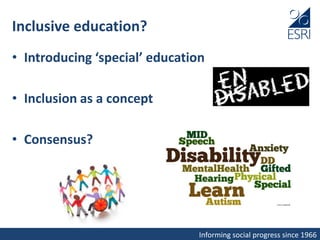
Inclusive education?
• Introducing ‘special’ education
• Inclusion as a concept
• Consensus?
Informing social progress since 1966
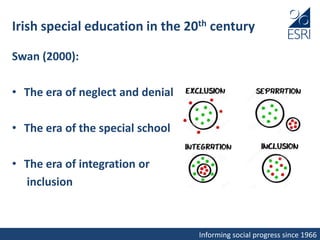
Irish special education in the 20th century
Swan (2000):
• The era of neglect and denial
• The era of the special school
• The era of integration or
inclusion
Informing social progress since 1966
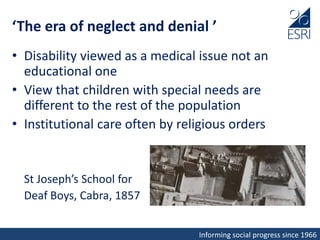
‘The era of neglect and denial ’
• Disability viewed as a medical issue not an
educational one
• View that children with special needs are
different to the rest of the population
• Institutional care often by religious orders
St Joseph’s School for
Deaf Boys, Cabra, 1857
Informing social progress since 1966
‘The era of neglect and denial ’
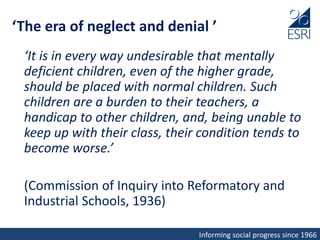
‘It is in every way undesirable that mentally
deficient children, even of the higher grade,
should be placed with normal children. Such
children are a burden to their teachers, a
handicap to other children, and, being unable to
keep up with their class, their condition tends to
become worse.’
(Commission of Inquiry into Reformatory and
Industrial Schools, 1936)
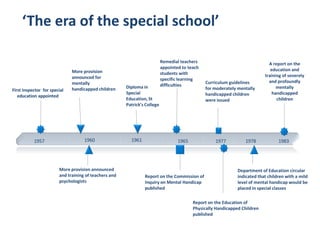
1960 1961 1965 1977 1978 1983
First Inspector for special
education appointed
More provision
announced for
mentally
handicapped children Diploma in
Special
Education, St
Patrick’s College
Remedial teachers
appointed to teach
students with
specific learning
difficulties
A report on the
education and
training of severely
and profoundly
mentally
handicapped
children
More provision announced
and training of teachers and
psychologists
Report on the Commission of
Inquiry on Mental Handicap
published
Department of Education circular
indicated that children with a mild
level of mental handicap would be
placed in special classes
Curriculum guidelines
for moderately mentally
handicapped children
were issued
‘The era of the special school’
Report on the Education of
Physically Handicapped Children
published
1957
Informing social progress since 1966
‘The era of integration and inclusion’
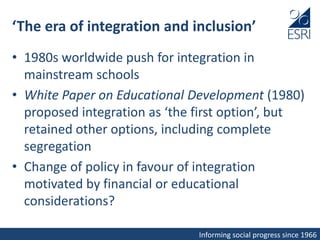
• 1980s worldwide push for integration in
mainstream schools
• White Paper on Educational Development (1980)
proposed integration as ‘the first option’, but
retained other options, including complete
segregation
• Change of policy in favour of integration
motivated by financial or educational
considerations?
Informing social progress since 1966
‘The era of integration and inclusion’
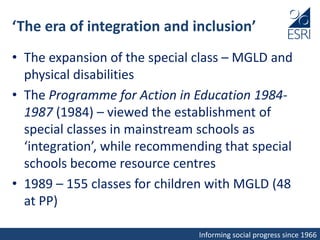
• The expansion of the special class – MGLD and
physical disabilities
• The Programme for Action in Education 1984-
1987 (1984) – viewed the establishment of
special classes in mainstream schools as
‘integration’, while recommending that special
schools become resource centres
• 1989 – 155 classes for children with MGLD (48
at PP)
Informing social progress since 1966
‘The era of integration and inclusion’
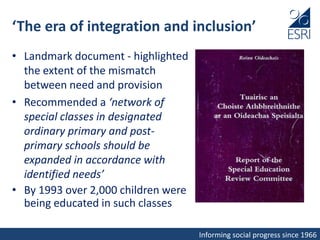
• Landmark document - highlighted
the extent of the mismatch
between need and provision
• Recommended a ‘network of
special classes in designated
ordinary primary and post-
primary schools should be
expanded in accordance with
identified needs’
• By 1993 over 2,000 children were
being educated in such classes
Informing social progress since 1966
‘The era of integration and inclusion’
• 1990s - series of policy reports, documents and
legal cases (national and international)
• 2004 - EPSEN Act explicitly states children with
SEN will be educated ‘in an inclusive
environment with children who do not have
SEN’, unless this is inconsistent either with the
best interest of the child, or with the effective
provision for the other children. Section 2 EPSEN (2004)
Informing social progress since 1966
Prevalence
Defining special educational needs or disability
3% 0-18 year olds ‘long lasting condition’ Census of Population,
2006
11% 0-17 year olds have 1 of 9 disabilities, National Disability Survey, 2008
17% Students in receipt of Learning Support, Department of
Education and Skills, 2007/2008
EPSEN Act definition
‘a restriction in the capacity of a person to participate in and benefit from
education on account of an enduring physical, sensory, mental health or
learning disability, or any other condition which results in a person learning
differently from a person without that condition’
18% NCSE Implementation Report, 2006
25% 9 year olds in Growing Up in Ireland (Banks and McCoy, 2011)
Informing social progress since 1966
Expenditure
Mirroring prevalence...
2005
€605m
9.8%
2011
€1.3bn
14.1%
2016
€1.5bn
17.8%
(projected)
Source: DES and NCSE
Informing social progress since 1966
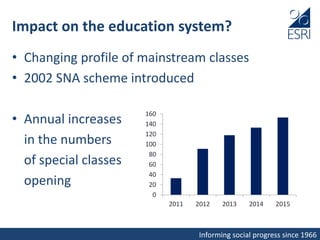
Impact on the education system?
• Changing profile of mainstream classes
• 2002 SNA scheme introduced
• Annual increases
in the numbers
of special classes
opening
0
20
40
60
80
100
120
140
160
2011 2012 2013 2014 2015
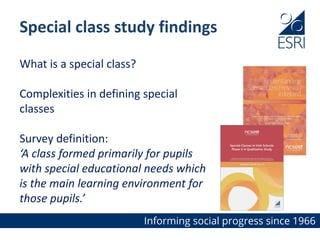
What is a special class?
Complexities in defining special
classes
Survey definition:
‘A class formed primarily for pupils
with special educational needs which
is the main learning environment for
those pupils.’
Special class study findings
A safe haven:
We’ve one kid in first year, [teacher] found him and
he came to the front door and he hugged the door
and he said this is the only place I feel safe. (PP SC
teacher, Wave 1)
They are quite vulnerable, they don’t always get the
subtle nuances and ...banter, that might go on in the
mainstream class, so it’s kind of safer down here...
(Primary SC teacher, Wave 1)
Definition / purpose
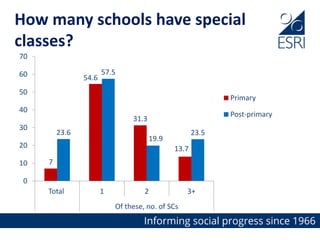
How many schools have special
classes?
7
54.6
31.3
13.7
23.6
57.5
19.9
23.5
0
10
20
30
40
50
60
70
Total 1 2 3+
Of these, no. of SCs
Primary
Post-primary
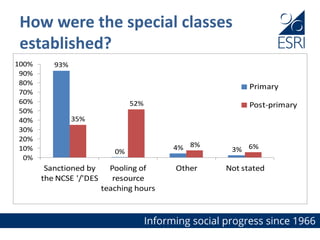
How were the special classes
established?
93%
0%
4% 3%
35%
52%
8% 6%
0%
10%
20%
30%
40%
50%
60%
70%
80%
90%
100%
Sanctioned by
the NCSE '/'DES
Pooling of
resource
teaching hours
Other Not stated
Primary
Post-primary
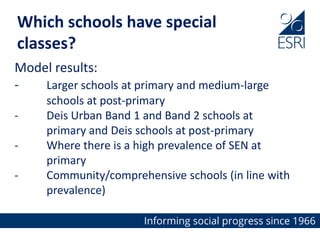
Model results:
- Larger schools at primary and medium-large
schools at post-primary
- Deis Urban Band 1 and Band 2 schools at
primary and Deis schools at post-primary
- Where there is a high prevalence of SEN at
primary
- Community/comprehensive schools (in line with
prevalence)
Which schools have special
classes?
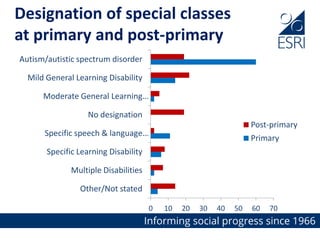
Designation of special classes
at primary and post-primary
0 10 20 30 40 50 60 70
Other/Not stated
Multiple Disabilities
Specific Learning Disability
Specific speech & language…
No designation
Moderate General Learning…
Mild General Learning Disability
Autism/autistic spectrum disorder
Post-primary
Primary
Informing social progress since 1966
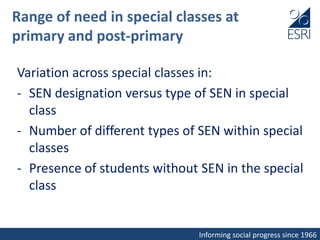
Range of need in special classes at
primary and post-primary
Variation across special classes in:
- SEN designation versus type of SEN in special
class
- Number of different types of SEN within special
classes
- Presence of students without SEN in the special
class
Informing social progress since 1966
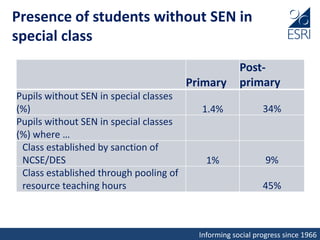
Presence of students without SEN in
special class
Primary
Post-
primary
Pupils without SEN in special classes
(%) 1.4% 34%
Pupils without SEN in special classes
(%) where …
Class established by sanction of
NCSE/DES 1% 9%
Class established through pooling of
resource teaching hours 45%
Informing social progress since 1966
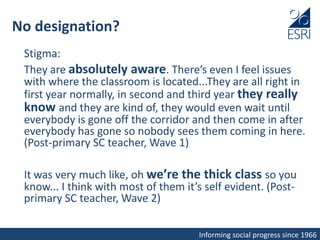
No designation?
Stigma:
They are absolutely aware. There’s even I feel issues
with where the classroom is located...They are all right in
first year normally, in second and third year they really
know and they are kind of, they would even wait until
everybody is gone off the corridor and then come in after
everybody has gone so nobody sees them coming in here.
(Post-primary SC teacher, Wave 1)
It was very much like, oh we’re the thick class so you
know... I think with most of them it’s self evident. (Post-
primary SC teacher, Wave 2)
Informing social progress since 1966
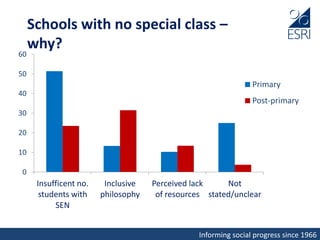
Schools with no special class –
why?
0
10
20
30
40
50
60
Insufficent no.
students with
SEN
Inclusive
philosophy
Perceived lack
of resources
Not
stated/unclear
Primary
Post-primary
Informing social progress since 1966
Schools with no special class – why?
• ‘We believe in inclusion, not educationally sound to categorise all SEN
students in one class group’
• ‘Afraid it would stigmatise students in these classes and reduce their self-
esteem’
• ‘We would have a variety of SEN students, but not sufficient in number of
similar profile to require a special class’
• ‘We would love to have a special class, but have had difficulty accessing
resources for same’
• ‘Had one [SC] years ago but it was felt it became a dumping ground for
pupils with behavioural problems’
Informing social progress since 1966
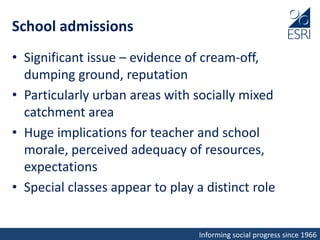
School admissions
• Significant issue – evidence of cream-off,
dumping ground, reputation
• Particularly urban areas with socially mixed
catchment area
• Huge implications for teacher and school
morale, perceived adequacy of resources,
expectations
• Special classes appear to play a distinct role
Informing social progress since 1966
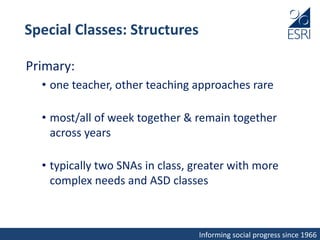
Special Classes: Structures
Primary:
• one teacher, other teaching approaches rare
• most/all of week together & remain together
across years
• typically two SNAs in class, greater with more
complex needs and ASD classes
Informing social progress since 1966
Special Classes: Structures
Post-primary
• more variation in teaching arrangements, but one
teacher a dominant model
• considerable variation in time in class and
permanence of allocation
• typically one SNA, varies across designations and
greater in DEIS schools
Informing social progress since 1966
Special Classes: Teaching and Learning
Primary – curricular provision not very distinct in
special classes
• BUT Irish generally not taught
• Just one-third provide alternative/additional
modules/subjects
Post-primary
– Main focus on junior cycle
– JCSP prominent, but difficulties for non-DEIS and smaller
schools
– LCA programme at senior cycle, but provision difficulties
– Exemption from Irish the norm
Informing social progress since 1966
Special Classes: Teaching and Learning
I felt very unequipped to deal with it. Felt very
inexperienced, felt I’m not going to be able to
manage it (Primary SC teacher, Wave 1)
Sometimes [I] find it frustrating because I don’t
know how to teach these students the best possible
way for them. I am frustrated that I haven’t got
adequate training that I feel that I’m not
adequately trained to deal with their needs (Post-
primary MC teacher, Wave 2)
Informing social progress since 1966
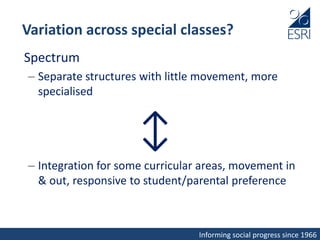
Variation across special classes?
Spectrum
– Separate structures with little movement, more
specialised
↕
– Integration for some curricular areas, movement in
& out, responsive to student/parental preference
Informing social progress since 1966
Summary
• Integration or inclusion? Special class data,
terminology, perceptions and stigma
• School context: large, disadvantaged schools with
high prevalence of SEN more likely to have special
classes
• Operating special classes: Less integration,
movement at primary, importance of whole school
approach to inclusion, role of principal is key
• Teaching and learning: Not distinct at primary, JCSP,
LCA prevalent at post-primary, teacher isolation and
lack of relevant expertise
Informing social progress since 1966
Policy implications
• Growing special class provision each year
• School admissions
• Serving particular groups
• Teacher capacity and expertise
• Curricular issues
• School leadership
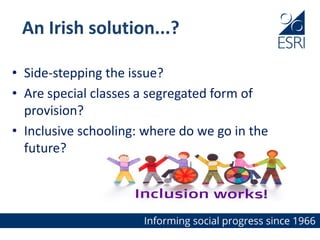
• Side-stepping the issue?
• Are special classes a segregated form of
provision?
• Inclusive schooling: where do we go in the
future?
An Irish solution...?

An Irish Solution? Developing Inclusive Education in Ireland

  • 1.
    Informing social progresssince 1966 An Irish Solution...? Developing Inclusive Education in Ireland Joanne Banks and Selina McCoy, ESRI
  • 2.
    Informing social progresssince 1966 Inclusive education? • Introducing ‘special’ education • Inclusion as a concept • Consensus?
  • 3.
    Informing social progresssince 1966 Irish special education in the 20th century Swan (2000): • The era of neglect and denial • The era of the special school • The era of integration or inclusion
  • 4.
    Informing social progresssince 1966 ‘The era of neglect and denial ’ • Disability viewed as a medical issue not an educational one • View that children with special needs are different to the rest of the population • Institutional care often by religious orders St Joseph’s School for Deaf Boys, Cabra, 1857
  • 5.
    Informing social progresssince 1966 ‘The era of neglect and denial ’ ‘It is in every way undesirable that mentally deficient children, even of the higher grade, should be placed with normal children. Such children are a burden to their teachers, a handicap to other children, and, being unable to keep up with their class, their condition tends to become worse.’ (Commission of Inquiry into Reformatory and Industrial Schools, 1936)
  • 6.
    1960 1961 19651977 1978 1983 First Inspector for special education appointed More provision announced for mentally handicapped children Diploma in Special Education, St Patrick’s College Remedial teachers appointed to teach students with specific learning difficulties A report on the education and training of severely and profoundly mentally handicapped children More provision announced and training of teachers and psychologists Report on the Commission of Inquiry on Mental Handicap published Department of Education circular indicated that children with a mild level of mental handicap would be placed in special classes Curriculum guidelines for moderately mentally handicapped children were issued ‘The era of the special school’ Report on the Education of Physically Handicapped Children published 1957
  • 7.
    Informing social progresssince 1966 ‘The era of integration and inclusion’ • 1980s worldwide push for integration in mainstream schools • White Paper on Educational Development (1980) proposed integration as ‘the first option’, but retained other options, including complete segregation • Change of policy in favour of integration motivated by financial or educational considerations?
  • 8.
    Informing social progresssince 1966 ‘The era of integration and inclusion’ • The expansion of the special class – MGLD and physical disabilities • The Programme for Action in Education 1984- 1987 (1984) – viewed the establishment of special classes in mainstream schools as ‘integration’, while recommending that special schools become resource centres • 1989 – 155 classes for children with MGLD (48 at PP)
  • 9.
    Informing social progresssince 1966 ‘The era of integration and inclusion’ • Landmark document - highlighted the extent of the mismatch between need and provision • Recommended a ‘network of special classes in designated ordinary primary and post- primary schools should be expanded in accordance with identified needs’ • By 1993 over 2,000 children were being educated in such classes
  • 10.
    Informing social progresssince 1966 ‘The era of integration and inclusion’ • 1990s - series of policy reports, documents and legal cases (national and international) • 2004 - EPSEN Act explicitly states children with SEN will be educated ‘in an inclusive environment with children who do not have SEN’, unless this is inconsistent either with the best interest of the child, or with the effective provision for the other children. Section 2 EPSEN (2004)
  • 11.
    Informing social progresssince 1966 Prevalence Defining special educational needs or disability 3% 0-18 year olds ‘long lasting condition’ Census of Population, 2006 11% 0-17 year olds have 1 of 9 disabilities, National Disability Survey, 2008 17% Students in receipt of Learning Support, Department of Education and Skills, 2007/2008 EPSEN Act definition ‘a restriction in the capacity of a person to participate in and benefit from education on account of an enduring physical, sensory, mental health or learning disability, or any other condition which results in a person learning differently from a person without that condition’ 18% NCSE Implementation Report, 2006 25% 9 year olds in Growing Up in Ireland (Banks and McCoy, 2011)
  • 12.
    Informing social progresssince 1966 Expenditure Mirroring prevalence... 2005 €605m 9.8% 2011 €1.3bn 14.1% 2016 €1.5bn 17.8% (projected) Source: DES and NCSE
  • 13.
    Informing social progresssince 1966 Impact on the education system? • Changing profile of mainstream classes • 2002 SNA scheme introduced • Annual increases in the numbers of special classes opening 0 20 40 60 80 100 120 140 160 2011 2012 2013 2014 2015
  • 14.
    What is aspecial class? Complexities in defining special classes Survey definition: ‘A class formed primarily for pupils with special educational needs which is the main learning environment for those pupils.’ Special class study findings
  • 15.
    A safe haven: We’veone kid in first year, [teacher] found him and he came to the front door and he hugged the door and he said this is the only place I feel safe. (PP SC teacher, Wave 1) They are quite vulnerable, they don’t always get the subtle nuances and ...banter, that might go on in the mainstream class, so it’s kind of safer down here... (Primary SC teacher, Wave 1) Definition / purpose
  • 16.
    How many schoolshave special classes? 7 54.6 31.3 13.7 23.6 57.5 19.9 23.5 0 10 20 30 40 50 60 70 Total 1 2 3+ Of these, no. of SCs Primary Post-primary
  • 17.
    How were thespecial classes established? 93% 0% 4% 3% 35% 52% 8% 6% 0% 10% 20% 30% 40% 50% 60% 70% 80% 90% 100% Sanctioned by the NCSE '/'DES Pooling of resource teaching hours Other Not stated Primary Post-primary
  • 18.
    Model results: - Largerschools at primary and medium-large schools at post-primary - Deis Urban Band 1 and Band 2 schools at primary and Deis schools at post-primary - Where there is a high prevalence of SEN at primary - Community/comprehensive schools (in line with prevalence) Which schools have special classes?
  • 19.
    Designation of specialclasses at primary and post-primary 0 10 20 30 40 50 60 70 Other/Not stated Multiple Disabilities Specific Learning Disability Specific speech & language… No designation Moderate General Learning… Mild General Learning Disability Autism/autistic spectrum disorder Post-primary Primary
  • 20.
    Informing social progresssince 1966 Range of need in special classes at primary and post-primary Variation across special classes in: - SEN designation versus type of SEN in special class - Number of different types of SEN within special classes - Presence of students without SEN in the special class
  • 21.
    Informing social progresssince 1966 Presence of students without SEN in special class Primary Post- primary Pupils without SEN in special classes (%) 1.4% 34% Pupils without SEN in special classes (%) where … Class established by sanction of NCSE/DES 1% 9% Class established through pooling of resource teaching hours 45%
  • 22.
    Informing social progresssince 1966 No designation? Stigma: They are absolutely aware. There’s even I feel issues with where the classroom is located...They are all right in first year normally, in second and third year they really know and they are kind of, they would even wait until everybody is gone off the corridor and then come in after everybody has gone so nobody sees them coming in here. (Post-primary SC teacher, Wave 1) It was very much like, oh we’re the thick class so you know... I think with most of them it’s self evident. (Post- primary SC teacher, Wave 2)
  • 23.
    Informing social progresssince 1966 Schools with no special class – why? 0 10 20 30 40 50 60 Insufficent no. students with SEN Inclusive philosophy Perceived lack of resources Not stated/unclear Primary Post-primary
  • 24.
    Informing social progresssince 1966 Schools with no special class – why? • ‘We believe in inclusion, not educationally sound to categorise all SEN students in one class group’ • ‘Afraid it would stigmatise students in these classes and reduce their self- esteem’ • ‘We would have a variety of SEN students, but not sufficient in number of similar profile to require a special class’ • ‘We would love to have a special class, but have had difficulty accessing resources for same’ • ‘Had one [SC] years ago but it was felt it became a dumping ground for pupils with behavioural problems’
  • 25.
    Informing social progresssince 1966 School admissions • Significant issue – evidence of cream-off, dumping ground, reputation • Particularly urban areas with socially mixed catchment area • Huge implications for teacher and school morale, perceived adequacy of resources, expectations • Special classes appear to play a distinct role
  • 26.
    Informing social progresssince 1966 Special Classes: Structures Primary: • one teacher, other teaching approaches rare • most/all of week together & remain together across years • typically two SNAs in class, greater with more complex needs and ASD classes
  • 27.
    Informing social progresssince 1966 Special Classes: Structures Post-primary • more variation in teaching arrangements, but one teacher a dominant model • considerable variation in time in class and permanence of allocation • typically one SNA, varies across designations and greater in DEIS schools
  • 28.
    Informing social progresssince 1966 Special Classes: Teaching and Learning Primary – curricular provision not very distinct in special classes • BUT Irish generally not taught • Just one-third provide alternative/additional modules/subjects Post-primary – Main focus on junior cycle – JCSP prominent, but difficulties for non-DEIS and smaller schools – LCA programme at senior cycle, but provision difficulties – Exemption from Irish the norm
  • 29.
    Informing social progresssince 1966 Special Classes: Teaching and Learning I felt very unequipped to deal with it. Felt very inexperienced, felt I’m not going to be able to manage it (Primary SC teacher, Wave 1) Sometimes [I] find it frustrating because I don’t know how to teach these students the best possible way for them. I am frustrated that I haven’t got adequate training that I feel that I’m not adequately trained to deal with their needs (Post- primary MC teacher, Wave 2)
  • 30.
    Informing social progresssince 1966 Variation across special classes? Spectrum – Separate structures with little movement, more specialised ↕ – Integration for some curricular areas, movement in & out, responsive to student/parental preference
  • 31.
    Informing social progresssince 1966 Summary • Integration or inclusion? Special class data, terminology, perceptions and stigma • School context: large, disadvantaged schools with high prevalence of SEN more likely to have special classes • Operating special classes: Less integration, movement at primary, importance of whole school approach to inclusion, role of principal is key • Teaching and learning: Not distinct at primary, JCSP, LCA prevalent at post-primary, teacher isolation and lack of relevant expertise
  • 32.
    Informing social progresssince 1966 Policy implications • Growing special class provision each year • School admissions • Serving particular groups • Teacher capacity and expertise • Curricular issues • School leadership
  • 33.
    • Side-stepping theissue? • Are special classes a segregated form of provision? • Inclusive schooling: where do we go in the future? An Irish solution...?