RIT HAPTIC FEEDBACKUNIT
RIT 1
Designing of Haptic Feedback/Rumble Unit For Smart Cane
Objective:
1. To design a haptic feedback control to utilize a push pull effect.
2. To calibrate the haptic feedback unit for responsiveness, comfort and reliability.
Goal:
The goal of this project is to design a cost effective rumble unit which is mounted on a smart cane. A
smart cane is a specially built device for users who are deaf-blind. There are an estimated 42,000 to
700,000 individuals in the U.S, with some level of both vision and hearing loss.
The aim of the smart cane is to guide the user in his/her surroundings by means of a real time tactile and
directional force feedback unit. It is offered as a suitable replacement to a normal cane and service
animals, which is a low technology solution.
From interactions with potential customers, we found that the smart cane should be lightweight, cost
effective, safe, responsive and comfortable to handle. The customer requirements sums up our project
goals in designing the smart cane.
Description:
In this project, the handle of a standard long white cane shaft will have a built-in sensitive tactile pad with
a haptic feedback rumble unit which guides the user away from the obstacle and object.
The haptic feedback unit is composed of different parts. The main parts being:
Microcontroller
Magnets
Servomotors
Batteries
The user will be able to sweep, tap and feel the ground with the cane. The rumble unit guides and warns
the user around obstacles in his/her surroundings via a detection system.
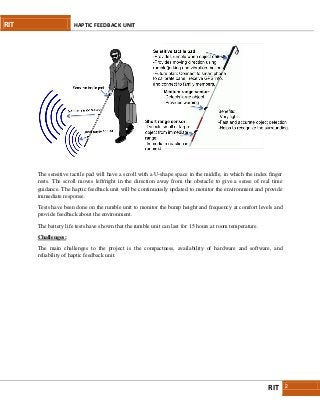
The detection system will have sensors mounted on the cane to provide a real time feedback of the
environment which activates the rumble unit. The sensors will be a combination of ultrasonic and infrared
sensors to provide long range and short range sensing. The intensity of the vibrations of the haptic
feedback unit increases when its proximity towards the obstacle increases.
Image recognition software can be a useful addition to the smart cane, it can distinguish doors from other
obstacles and thereby assist the user in gaining access to buildings.
2.
RIT HAPTIC FEEDBACKUNIT
RIT 2
The sensitive tactile pad will have a scroll with a U-shape space in the middle, in which the index finger
rests. The scroll moves left/right in the direction away from the obstacle to give a sense of real time
guidance. The haptic feedback unit will be continuously updated to monitor the environment and provide
immediate response.
Tests have been done on the rumble unit to monitor the bump height and frequency at comfort levels and
provide feedback about the environment.
The battery life tests have shown that the rumble unit can last for 15 hours at room temperature.
Challenges:
The main challenges to the project is the compactness, availability of hardware and software, and
reliability of haptic feedback unit.