Quantitative
Methods
for
Lawyers
Power Laws, Hypothesis
Testing & Statistical
Significance
Class #11
@ computational
computationallegalstudies.com
professor daniel martin katz danielmartinkatz.com
lexpredict.com slideshare.net/DanielKatz
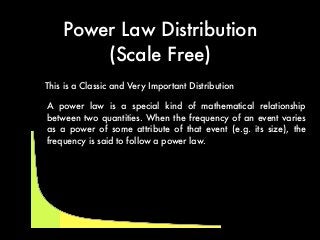
Power Law Distribution
(Scale Free)
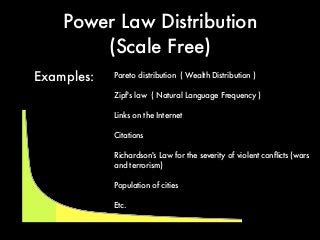
This is a Classic and Very Important Distribution
A power law is a special kind of mathematical relationship
between two quantities. When the frequency of an event varies
as a power of some attribute of that event (e.g. its size), the
frequency is said to follow a power law.
Power Law Distribution
(Scale Free)
Pareto distribution ( Wealth Distribution )
Zipf's law ( Natural Language Frequency )
Links on the Internet
Citations
Richardson's Law for the severity of violent conflicts (wars
and terrorism)
Population of cities
Etc.
Examples:
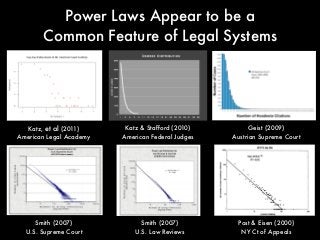
Power Laws Appear to be a
Common Feature of Legal Systems
Katz, et al (2011)
American Legal Academy
Katz & Stafford (2010)
American Federal Judges
Geist (2009)
Austrian Supreme Court
Smith (2007)
U.S. Supreme Court
Smith (2007)
U.S. Law Reviews
Post & Eisen (2000)
NY Ct of Appeals
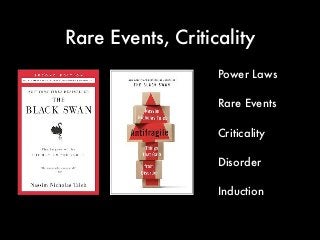
Rare Events, Criticality
Power Laws
Rare Events
Criticality
Disorder
Induction
“ [T]here are known knowns; there are things we know we know.
We also know there are known unknowns; that is to say we know
there are some things we do not know.
But there are also unknown unknowns – there are things we do
not know we don't know. ”
United States Secretary of Defense
Donald Rumsfeld
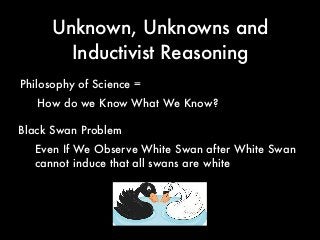
Unknown, Unknowns and
Inductivist Reasoning
Philosophy of Science =
How do we Know What We Know?
Black Swan Problem
Even If We Observe White Swan after White Swan
cannot induce that all swans are white
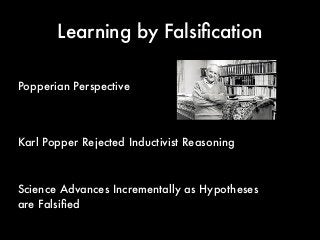
Learning by Falsification
Science Advances Incrementally as Hypotheses
are Falsified
Popperian Perspective
Karl Popper Rejected Inductivist Reasoning
Learning by Falsification
the sun has risen every day for as long as anyone can
remember.
what is the rational proof that it will rise tomorrow?
How can one rationally prove that past events will continue to
repeat in the future, just because they have repeated in the
past?
Of Course, Certain Hypothesis cannot likely be falsified
on a Reasonable Time Scale
The problem of induction:
Learning by Falsification
No Need to Reject the Hypothesis of Sun Rising
Popper Solution to the Question:
Cannot Really Formulate a Theory that Can Prove
that the Sun Will Always Rise
Can Develop a Theory that It Rise which will be
falsified if the sun fails to rise
Hypothesis Testing
& Statistical Significance
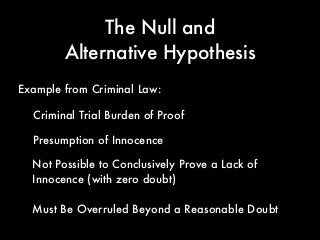
The Null and
Alternative Hypothesis
Criminal Trial Burden of Proof
Example from Criminal Law:
Must Be Overruled Beyond a Reasonable Doubt
Presumption of Innocence
Not Possible to Conclusively Prove a Lack of
Innocence (with zero doubt)
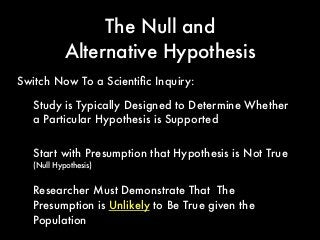
The Null and
Alternative Hypothesis
Study is Typically Designed to Determine Whether
a Particular Hypothesis is Supported
Switch Now To a Scientific Inquiry:
Start with Presumption that Hypothesis is Not True
(Null Hypothesis)
Researcher Must Demonstrate That The
Presumption is Unlikely to Be True given the
Population
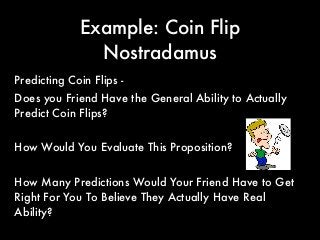
Example: Coin Flip
Nostradamus
Predicting Coin Flips -
Does you Friend Have the General Ability to Actually
Predict Coin Flips?
How Would You Evaluate This Proposition?
How Many Predictions Would Your Friend Have to Get
Right For You To Believe They Actually Have Real
Ability?
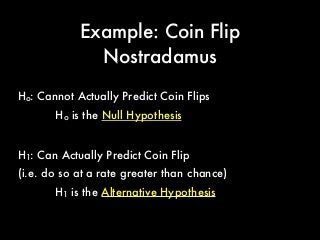
Ho: Cannot Actually Predict Coin Flips
Example: Coin Flip
Nostradamus
H1: Can Actually Predict Coin Flip
(i.e. do so at a rate greater than chance)
Ho is the Null Hypothesis
H1 is the Alternative Hypothesis
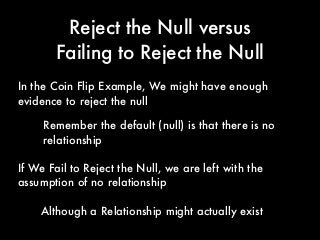
Reject the Null versus
Failing to Reject the Null
If We Fail to Reject the Null, we are left with the
assumption of no relationship
In the Coin Flip Example, We might have enough
evidence to reject the null
Remember the default (null) is that there is no
relationship
Although a Relationship might actually exist
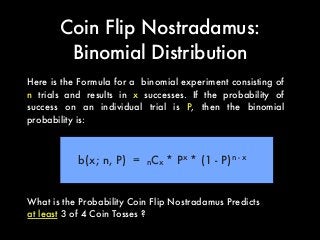
Coin Flip Nostradamus:
Binomial Distribution
Here is the Formula for a binomial experiment consisting of
n trials and results in x successes. If the probability of
success on an individual trial is P, then the binomial
probability is:
b(x; n, P) = nCx * Px
* (1 - P)n - x
What is the Probability Coin Flip Nostradamus Predicts
at least 3 of 4 Coin Tosses ?
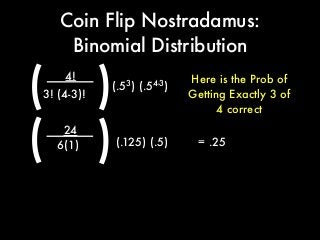
4!
Coin Flip Nostradamus:
Binomial Distribution
(3! (4-3)! )(.53
) (.54-3
)
(.125) (.5)
24
( 6(1)
) = .25
Here is the Prob of
Getting Exactly 3 of
4 correct
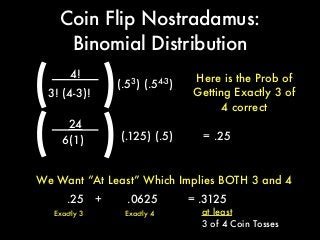
4!
Coin Flip Nostradamus:
Binomial Distribution
(3! (4-3)! )(.53
) (.54-3
)
(.125) (.5)
24
( 6(1) ) = .25
Here is the Prob of
Getting Exactly 3 of
4 correct
= .3125
We Want “At Least” Which Implies BOTH 3 and 4
.25 + .0625
Exactly 3 Exactly 4 at least
3 of 4 Coin Tosses
Namely, there is a 31.25% Probability that by
Chance he/she would be able to predict at least
3 out of 4
If Our Would Be Coin Flip Nostradamus were able to
get 3 out 4 Correct - we would not generally be
prepared to give him/her credit just yet
Coin Flip Nostradamus:
Binomial Distribution
How Much Do We Need to Be Convinced that Our
Friend is Actually Coin Flip Nostradamus?
Now We Can Calculate Probability Associated of
Prediction across some arbitrary number of trials
Coin Flip Nostradamus:
Binomial Distribution
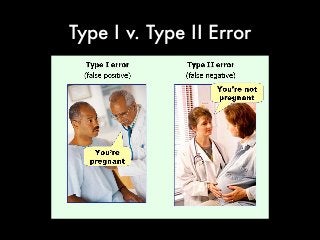
This is a Question of Type I and Type II
Error
Type I v. Type II Error
Type I
v.
Type II
Error
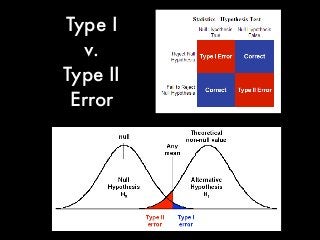
Type I v. Type II Error
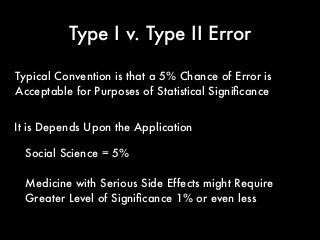
It is Depends Upon the Application
Typical Convention is that a 5% Chance of Error is
Acceptable for Purposes of Statistical Significance
Social Science = 5%
Medicine with Serious Side Effects might Require
Greater Level of Significance 1% or even less
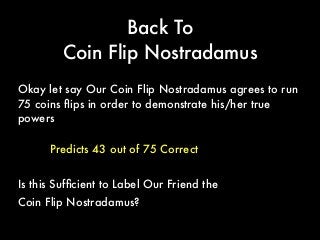
Back To
Coin Flip Nostradamus
Predicts 43 out of 75 Correct
Okay let say Our Coin Flip Nostradamus agrees to run
75 coins flips in order to demonstrate his/her true
powers
Is this Sufficient to Label Our Friend the
Coin Flip Nostradamus?
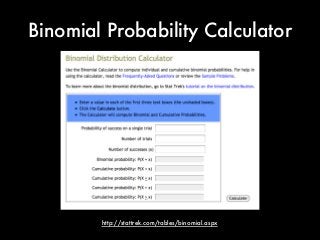
Binomial Probability Calculator
http://stattrek.com/tables/binomial.aspx
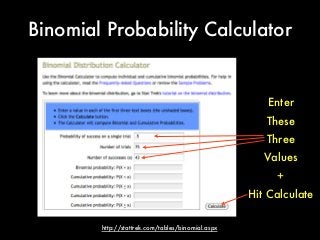
Binomial Probability Calculator
http://stattrek.com/tables/binomial.aspx
Enter
These
Three
Values
+
Hit Calculate
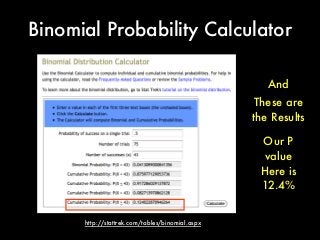
Binomial Probability Calculator
http://stattrek.com/tables/binomial.aspx
And
These are
the Results
Our P
value
Here is
12.4%
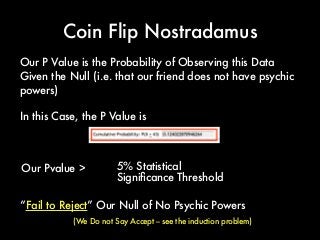
Coin Flip Nostradamus
In this Case, the P Value is
Our P Value is the Probability of Observing this Data
Given the Null (i.e. that our friend does not have psychic
powers)
Our Pvalue > 5% Statistical
Significance Threshold
“Fail to Reject” Our Null of No Psychic Powers
(We Do not Say Accept -- see the induction problem)
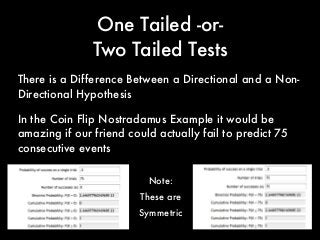
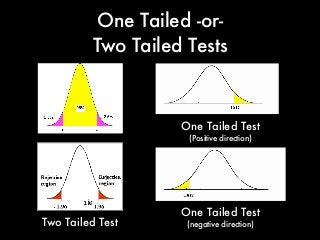
One Tailed -or-
Two Tailed Tests
In the Coin Flip Nostradamus Example it would be
amazing if our friend could actually fail to predict 75
consecutive events
There is a Difference Between a Directional and a Non-
Directional Hypothesis
Note:
These are
Symmetric
One Tailed -or-
Two Tailed Tests
Stricter Crime Law and the Crime Rate
We are Often Interested in a Non-
Directional Hypothesis
We are Interested in Whether there is
Deterrence and if there were to be higher
crime rates
New Drug and Health
We Want to Both if It Makes the Patient Better
and if the Patient’s condition get worse
One Tailed -or-
Two Tailed Tests
Two Tailed Test
One Tailed Test
(negative direction)
One Tailed Test
(Positive direction)
https://onlinecourses.science.psu.edu/stat500/book/export/html/43
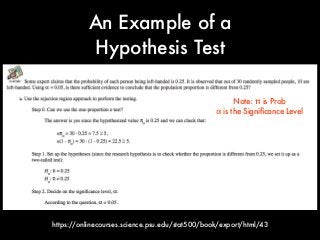
An Example of a
Hypothesis Test
Note: π is Prob
α is the Significance Level
https://onlinecourses.science.psu.edu/stat500/book/export/html/43
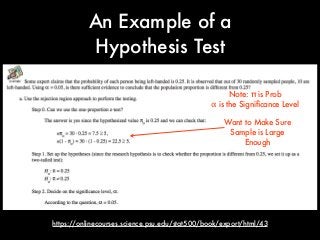
An Example of a
Hypothesis Test
Want to Make Sure
Sample is Large
Enough
Note: π is Prob
α is the Significance Level
https://onlinecourses.science.psu.edu/stat500/book/export/html/43
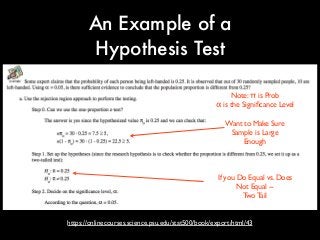
An Example of a
Hypothesis Test
Want to Make Sure
Sample is Large
Enough
If you Do Equal vs. Does
Not Equal --
Two Tail
Note: π is Prob
α is the Significance Level
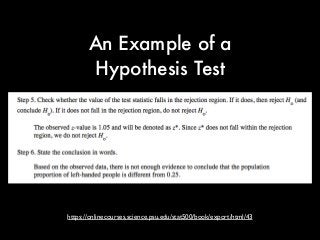
An Example of a
Hypothesis Test
https://onlinecourses.science.psu.edu/stat500/book/export/html/43
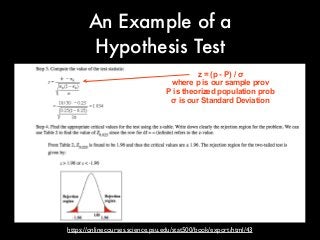
z = (p - P) / σ
where p is our sample prov
P is theorized population prob
σ is our Standard Deviation
An Example of a
Hypothesis Test
https://onlinecourses.science.psu.edu/stat500/book/export/html/43
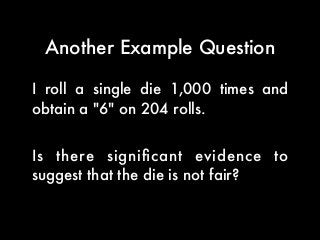
I roll a single die 1,000 times and
obtain a "6" on 204 rolls.
Is there significant evidence to
suggest that the die is not fair?
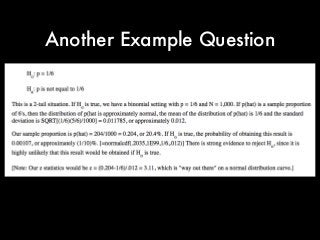
Another Example Question
Daniel Martin Katz
@ computational
computationallegalstudies.com
lexpredict.com
danielmartinkatz.com
illinois tech - chicago kent college of law@

Quantitative Methods for Lawyers - Class #11 - Power Laws, Hypothesis Testing & Statistical Significance - Professor Daniel Martin Katz

  • 1.
    Quantitative Methods for Lawyers Power Laws, Hypothesis Testing& Statistical Significance Class #11 @ computational computationallegalstudies.com professor daniel martin katz danielmartinkatz.com lexpredict.com slideshare.net/DanielKatz
  • 2.
    Power Law Distribution (ScaleFree) This is a Classic and Very Important Distribution A power law is a special kind of mathematical relationship between two quantities. When the frequency of an event varies as a power of some attribute of that event (e.g. its size), the frequency is said to follow a power law.
  • 3.
    Power Law Distribution (ScaleFree) Pareto distribution ( Wealth Distribution ) Zipf's law ( Natural Language Frequency ) Links on the Internet Citations Richardson's Law for the severity of violent conflicts (wars and terrorism) Population of cities Etc. Examples:
  • 4.
    Power Laws Appearto be a Common Feature of Legal Systems Katz, et al (2011) American Legal Academy Katz & Stafford (2010) American Federal Judges Geist (2009) Austrian Supreme Court Smith (2007) U.S. Supreme Court Smith (2007) U.S. Law Reviews Post & Eisen (2000) NY Ct of Appeals
  • 5.
    Rare Events, Criticality PowerLaws Rare Events Criticality Disorder Induction
  • 6.
    “ [T]here areknown knowns; there are things we know we know. We also know there are known unknowns; that is to say we know there are some things we do not know. But there are also unknown unknowns – there are things we do not know we don't know. ” United States Secretary of Defense Donald Rumsfeld
  • 7.
    Unknown, Unknowns and InductivistReasoning Philosophy of Science = How do we Know What We Know? Black Swan Problem Even If We Observe White Swan after White Swan cannot induce that all swans are white
  • 8.
    Learning by Falsification ScienceAdvances Incrementally as Hypotheses are Falsified Popperian Perspective Karl Popper Rejected Inductivist Reasoning
  • 9.
    Learning by Falsification thesun has risen every day for as long as anyone can remember. what is the rational proof that it will rise tomorrow? How can one rationally prove that past events will continue to repeat in the future, just because they have repeated in the past? Of Course, Certain Hypothesis cannot likely be falsified on a Reasonable Time Scale The problem of induction:
  • 10.
    Learning by Falsification NoNeed to Reject the Hypothesis of Sun Rising Popper Solution to the Question: Cannot Really Formulate a Theory that Can Prove that the Sun Will Always Rise Can Develop a Theory that It Rise which will be falsified if the sun fails to rise
  • 11.
  • 12.
    The Null and AlternativeHypothesis Criminal Trial Burden of Proof Example from Criminal Law: Must Be Overruled Beyond a Reasonable Doubt Presumption of Innocence Not Possible to Conclusively Prove a Lack of Innocence (with zero doubt)
  • 13.
    The Null and AlternativeHypothesis Study is Typically Designed to Determine Whether a Particular Hypothesis is Supported Switch Now To a Scientific Inquiry: Start with Presumption that Hypothesis is Not True (Null Hypothesis) Researcher Must Demonstrate That The Presumption is Unlikely to Be True given the Population
  • 14.
    Example: Coin Flip Nostradamus PredictingCoin Flips - Does you Friend Have the General Ability to Actually Predict Coin Flips? How Would You Evaluate This Proposition? How Many Predictions Would Your Friend Have to Get Right For You To Believe They Actually Have Real Ability?
  • 15.
    Ho: Cannot ActuallyPredict Coin Flips Example: Coin Flip Nostradamus H1: Can Actually Predict Coin Flip (i.e. do so at a rate greater than chance) Ho is the Null Hypothesis H1 is the Alternative Hypothesis
  • 16.
    Reject the Nullversus Failing to Reject the Null If We Fail to Reject the Null, we are left with the assumption of no relationship In the Coin Flip Example, We might have enough evidence to reject the null Remember the default (null) is that there is no relationship Although a Relationship might actually exist
  • 17.
    Coin Flip Nostradamus: BinomialDistribution Here is the Formula for a binomial experiment consisting of n trials and results in x successes. If the probability of success on an individual trial is P, then the binomial probability is: b(x; n, P) = nCx * Px * (1 - P)n - x What is the Probability Coin Flip Nostradamus Predicts at least 3 of 4 Coin Tosses ?
  • 18.
    4! Coin Flip Nostradamus: BinomialDistribution (3! (4-3)! )(.53 ) (.54-3 ) (.125) (.5) 24 ( 6(1) ) = .25 Here is the Prob of Getting Exactly 3 of 4 correct
  • 19.
    4! Coin Flip Nostradamus: BinomialDistribution (3! (4-3)! )(.53 ) (.54-3 ) (.125) (.5) 24 ( 6(1) ) = .25 Here is the Prob of Getting Exactly 3 of 4 correct = .3125 We Want “At Least” Which Implies BOTH 3 and 4 .25 + .0625 Exactly 3 Exactly 4 at least 3 of 4 Coin Tosses
  • 20.
    Namely, there isa 31.25% Probability that by Chance he/she would be able to predict at least 3 out of 4 If Our Would Be Coin Flip Nostradamus were able to get 3 out 4 Correct - we would not generally be prepared to give him/her credit just yet Coin Flip Nostradamus: Binomial Distribution
  • 21.
    How Much DoWe Need to Be Convinced that Our Friend is Actually Coin Flip Nostradamus? Now We Can Calculate Probability Associated of Prediction across some arbitrary number of trials Coin Flip Nostradamus: Binomial Distribution This is a Question of Type I and Type II Error
  • 22.
    Type I v.Type II Error
  • 23.
  • 24.
    Type I v.Type II Error It is Depends Upon the Application Typical Convention is that a 5% Chance of Error is Acceptable for Purposes of Statistical Significance Social Science = 5% Medicine with Serious Side Effects might Require Greater Level of Significance 1% or even less
  • 25.
    Back To Coin FlipNostradamus Predicts 43 out of 75 Correct Okay let say Our Coin Flip Nostradamus agrees to run 75 coins flips in order to demonstrate his/her true powers Is this Sufficient to Label Our Friend the Coin Flip Nostradamus?
  • 26.
  • 27.
  • 28.
  • 29.
    Coin Flip Nostradamus Inthis Case, the P Value is Our P Value is the Probability of Observing this Data Given the Null (i.e. that our friend does not have psychic powers) Our Pvalue > 5% Statistical Significance Threshold “Fail to Reject” Our Null of No Psychic Powers (We Do not Say Accept -- see the induction problem)
  • 30.
    One Tailed -or- TwoTailed Tests In the Coin Flip Nostradamus Example it would be amazing if our friend could actually fail to predict 75 consecutive events There is a Difference Between a Directional and a Non- Directional Hypothesis Note: These are Symmetric
  • 31.
    One Tailed -or- TwoTailed Tests Stricter Crime Law and the Crime Rate We are Often Interested in a Non- Directional Hypothesis We are Interested in Whether there is Deterrence and if there were to be higher crime rates New Drug and Health We Want to Both if It Makes the Patient Better and if the Patient’s condition get worse
  • 32.
    One Tailed -or- TwoTailed Tests Two Tailed Test One Tailed Test (negative direction) One Tailed Test (Positive direction)
  • 33.
    https://onlinecourses.science.psu.edu/stat500/book/export/html/43 An Example ofa Hypothesis Test Note: π is Prob α is the Significance Level
  • 34.
    https://onlinecourses.science.psu.edu/stat500/book/export/html/43 An Example ofa Hypothesis Test Want to Make Sure Sample is Large Enough Note: π is Prob α is the Significance Level
  • 35.
    https://onlinecourses.science.psu.edu/stat500/book/export/html/43 An Example ofa Hypothesis Test Want to Make Sure Sample is Large Enough If you Do Equal vs. Does Not Equal -- Two Tail Note: π is Prob α is the Significance Level
  • 36.
    An Example ofa Hypothesis Test https://onlinecourses.science.psu.edu/stat500/book/export/html/43 z = (p - P) / σ where p is our sample prov P is theorized population prob σ is our Standard Deviation
  • 37.
    An Example ofa Hypothesis Test https://onlinecourses.science.psu.edu/stat500/book/export/html/43
  • 38.
    I roll asingle die 1,000 times and obtain a "6" on 204 rolls. Is there significant evidence to suggest that the die is not fair? Another Example Question
  • 39.
  • 40.
    Daniel Martin Katz @computational computationallegalstudies.com lexpredict.com danielmartinkatz.com illinois tech - chicago kent college of law@