CRIS ANDRE D.PAGDILAO
8-RED LAUAN
…
References:
Video: https://www.youtube.com/watch?v=pqis3gZwVaY
Information:
www.Wikipedia.com
Big Dipper
Cassiopeia
Carina
Different
Constellations
Capricornus
Gemini Aquarius
Last Slide
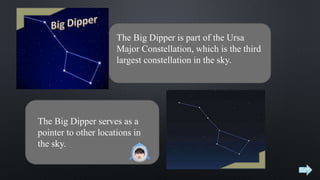
The Big Dipper is part of the Ursa
Major Constellation, which is the third
largest constellation in the sky.
The Big Dipper serves as a
pointer to other locations in
the sky.
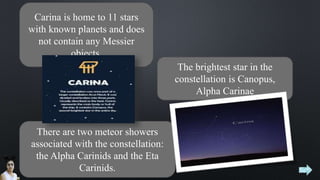
Carina is home to 11 stars
with known planets and does
not contain any Messier
objects.
The brightest star in the
constellation is Canopus,
Alpha Carinae
There are two meteor showers
associated with the constellation:
the Alpha Carinids and the Eta
Carinids.
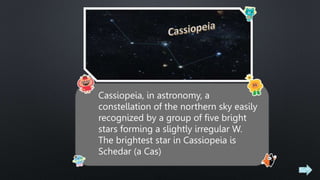
Cassiopeia, in astronomy, a
constellation of the northern sky easily
recognized by a group of five bright
stars forming a slightly irregular W.
The brightest star in Cassiopeia is
Schedar (a Cas)
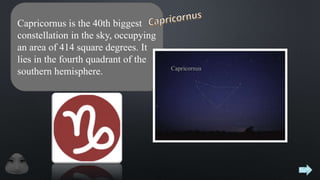
Capricornus is the 40th biggest
constellation in the sky, occupying
an area of 414 square degrees. It
lies in the fourth quadrant of the
southern hemisphere.
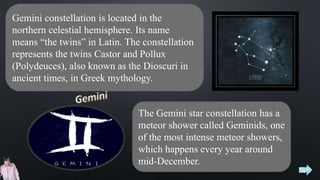
Gemini constellation is located in the
northern celestial hemisphere. Its name
means “the twins” in Latin. The constellation
represents the twins Castor and Pollux
(Polydeuces), also known as the Dioscuri in
ancient times, in Greek mythology.
The Gemini star constellation has a
meteor shower called Geminids, one
of the most intense meteor showers,
which happens every year around
mid-December.
Aquarius was said to represent a "cup bearer"
or "water bearer," which is what its name
means in Latin. Aquarius is one of the oldest
constellations documented in the historical
record, first recorded in the second century by
the Greek astronomer Claudius Ptolemy.
Facts About some Constellations (SlideShow).pptx

Facts About some Constellations (SlideShow).pptx

  • 1.
    CRIS ANDRE D.PAGDILAO 8-REDLAUAN … References: Video: https://www.youtube.com/watch?v=pqis3gZwVaY Information: www.Wikipedia.com
  • 3.
  • 4.
    The Big Dipperis part of the Ursa Major Constellation, which is the third largest constellation in the sky. The Big Dipper serves as a pointer to other locations in the sky.
  • 5.
    Carina is hometo 11 stars with known planets and does not contain any Messier objects. The brightest star in the constellation is Canopus, Alpha Carinae There are two meteor showers associated with the constellation: the Alpha Carinids and the Eta Carinids.
  • 6.
    Cassiopeia, in astronomy,a constellation of the northern sky easily recognized by a group of five bright stars forming a slightly irregular W. The brightest star in Cassiopeia is Schedar (a Cas)
  • 7.
    Capricornus is the40th biggest constellation in the sky, occupying an area of 414 square degrees. It lies in the fourth quadrant of the southern hemisphere.
  • 8.
    Gemini constellation islocated in the northern celestial hemisphere. Its name means “the twins” in Latin. The constellation represents the twins Castor and Pollux (Polydeuces), also known as the Dioscuri in ancient times, in Greek mythology. The Gemini star constellation has a meteor shower called Geminids, one of the most intense meteor showers, which happens every year around mid-December.
  • 9.
    Aquarius was saidto represent a "cup bearer" or "water bearer," which is what its name means in Latin. Aquarius is one of the oldest constellations documented in the historical record, first recorded in the second century by the Greek astronomer Claudius Ptolemy.