Hallie Prescott, MD, MSc
The Back-End of Sepsis:
De-escalating & de-resuscitating
@HalliePrescott
B17 - CRITICAL CARE:
BURDEN OF SURVIVAL -
OUTCOMES AFTER
CRITICAL ILLNESS IN
ADULTS AND CHILDREN
*ThispresentationdoesnotrepresentviewsofUSGovernmentorDepartmentofVeteransAffairs.
Rhodes, et al. Crit Care Med. 2017.
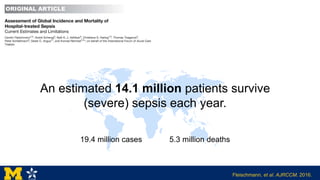
Fleischmann, et al. AJRCCM. 2016.
19.4 million cases 5.3 million deaths
An estimated 14.1 million patients survive
(severe) sepsis each year.
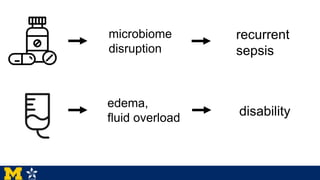
microbiome
disruption
edema,
fluid overload
recurrent
sepsis
disability
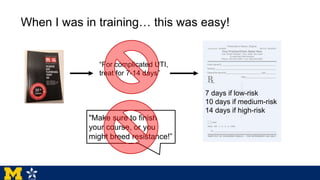
"Make sure to finish
your course, or you
might breed resistance!”
When I was in training… this was easy!
“For complicated UTI,
treat for 7-14 days”
7 days if low-risk
10 days if medium-risk
14 days if high-risk
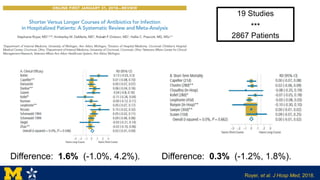
Royer, et al. J Hosp Med, 2018.
19 Studies
***
2867 Patients
Difference: 1.6% (-1.0%, 4.2%). Difference: 0.3% (-1.2%, 1.8%).
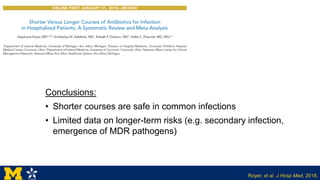
Royer, et al. J Hosp Med, 2018.
Conclusions:
• Shorter courses are safe in common infections
• Limited data on longer-term risks (e.g. secondary infection,
emergence of MDR pathogens)
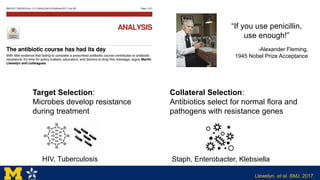
“If you use penicillin,
use enough!”
-Alexander Fleming,
1945 Nobel Prize Acceptance
Llewelyn, et al. BMJ, 2017.
HIV, Tuberculosis
Target Selection:
Microbes develop resistance
during treatment
Collateral Selection:
Antibiotics select for normal flora and
pathogens with resistance genes
Staph, Enterobacter, Klebsiella
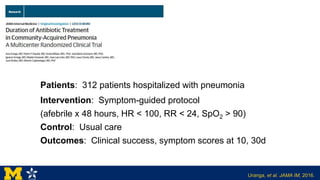
Patients: 312 patients hospitalized with pneumonia
Intervention: Symptom-guided protocol
(afebrile x 48 hours, HR < 100, RR < 24, SpO2 > 90)
Control: Usual care
Outcomes: Clinical success, symptom scores at 10, 30d
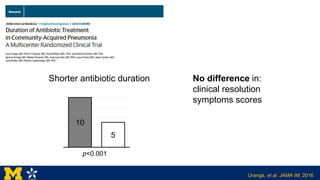
Uranga, et al. JAMA IM, 2016.
10
5
0
2
4
6
8
10
12
1 2
Shorter antibiotic duration No difference in:
clinical resolution
symptoms scores
p<0.001
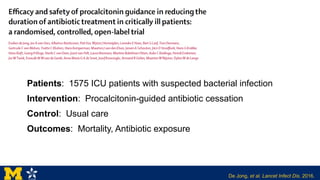
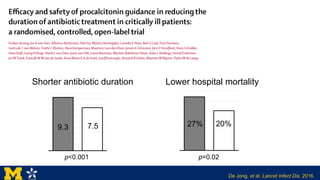
Patients: 1575 ICU patients with suspected bacterial infection
Intervention: Procalcitonin-guided antibiotic cessation
Control: Usual care
Outcomes: Mortality, Antibiotic exposure
De Jong, et al. Lancet Infect Dis. 2016.
9.3 7.5
0
1
2
3
4
5
6
7
8
9
10
1 2
Shorter antibiotic duration
27% 20%
0%
5%
10%
15%
20%
25%
30%
1 2
Lower hospital mortality
p<0.001 p=0.02
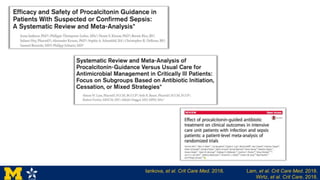
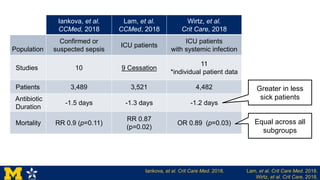
Iankova, et al. Crit Care Med. 2018. Lam, et al. Crit Care Med. 2018.
Wirtz, et al. Crit Care. 2018.
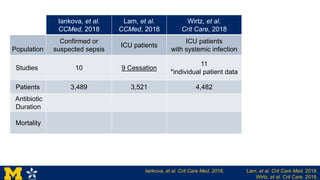
Iankova, et al.
CCMed, 2018
Lam, et al.
CCMed, 2018
Wirtz, et al.
Crit Care, 2018
Population
Confirmed or
suspected sepsis
ICU patients
ICU patients
with systemic infection
Studies 10 9 Cessation
11
*individual patient data
Patients 3,489 3,521 4,482
Antibiotic
Duration
Mortality
Iankova, et al. Crit Care Med. 2018. Lam, et al. Crit Care Med. 2018.
Wirtz, et al. Crit Care. 2018.
Iankova, et al.
CCMed, 2018
Lam, et al.
CCMed, 2018
Wirtz, et al.
Crit Care, 2018
Population
Confirmed or
suspected sepsis
ICU patients
ICU patients
with systemic infection
Studies 10 9 Cessation
11
*individual patient data
Patients 3,489 3,521 4,482
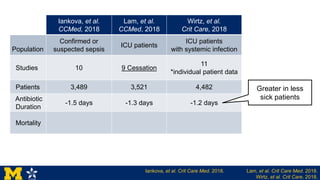
Antibiotic
Duration
-1.5 days -1.3 days -1.2 days
Mortality
Greater in less
sick patients
Iankova, et al. Crit Care Med. 2018. Lam, et al. Crit Care Med. 2018.
Wirtz, et al. Crit Care. 2018.
Iankova, et al.
CCMed, 2018
Lam, et al.
CCMed, 2018
Wirtz, et al.
Crit Care, 2018
Population
Confirmed or
suspected sepsis
ICU patients
ICU patients
with systemic infection
Studies 10 9 Cessation
11
*individual patient data
Patients 3,489 3,521 4,482
Antibiotic
Duration
-1.5 days -1.3 days -1.2 days
Mortality RR 0.9 (p=0.11)
RR 0.87
(p=0.02)
OR 0.89 (p=0.03)
Greater in less
sick patients
Equal across all
subgroups
Iankova, et al. Crit Care Med. 2018. Lam, et al. Crit Care Med. 2018.
Wirtz, et al. Crit Care. 2018.
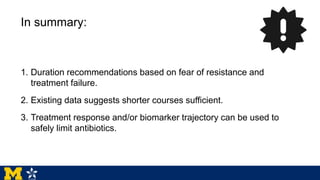
In summary:
1. Duration recommendations based on fear of resistance and
treatment failure.
2. Existing data suggests shorter courses sufficient.
3. Treatment response and/or biomarker trajectory can be used to
safely limit antibiotics.
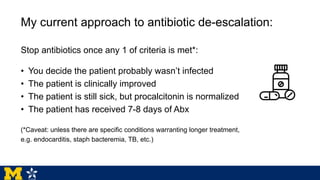
My current approach to antibiotic de-escalation:
Stop antibiotics once any 1 of criteria is met*:
• You decide the patient probably wasn’t infected
• The patient is clinically improved
• The patient is still sick, but procalcitonin is normalized
• The patient has received 7-8 days of Abx
(*Caveat: unless there are specific conditions warranting longer treatment,
e.g. endocarditis, staph bacteremia, TB, etc.)
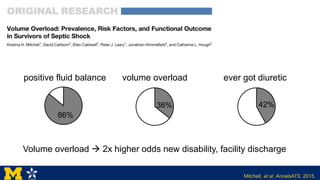
Mitchell, et al. AnnalsATS. 2015.
Volume overload  2x higher odds new disability, facility discharge
positive fluid balance
86%
36%
volume overload
42%
ever got diuretic
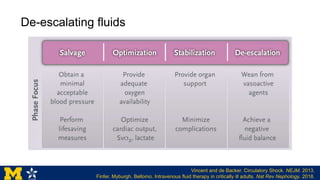
De-escalating fluids
Vincent and de Backer. Circulatory Shock. NEJM. 2013.
Finfer, Myburgh, Bellomo. Intravenous fluid therapy in critically ill adults. Nat Rev Nephology. 2018.
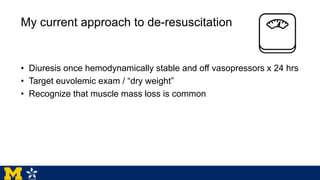
My current approach to de-resuscitation
• Diuresis once hemodynamically stable and off vasopressors x 24 hrs
• Target euvolemic exam / “dry weight”
• Recognize that muscle mass loss is common
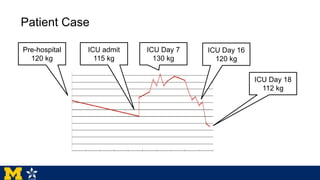
Patient Case
Pre-hospital
120 kg
ICU admit
115 kg
ICU Day 7
130 kg
ICU Day 16
120 kg
ICU Day 18
112 kg
Thank
You!
@hallieprescott
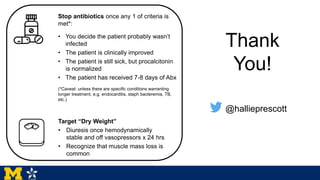
Stop antibiotics once any 1 of criteria is
met*:
• You decide the patient probably wasn’t
infected
• The patient is clinically improved
• The patient is still sick, but procalcitonin
is normalized
• The patient has received 7-8 days of Abx
(*Caveat: unless there are specific conditions warranting
longer treatment, e.g. endocarditis, staph bacteremia, TB,
etc.)
Target “Dry Weight”
• Diuresis once hemodynamically
stable and off vasopressors x 24 hrs
• Recognize that muscle mass loss is
common

Back-end sepsis: de-escalating & de-resuscitating

  • 1.
    Hallie Prescott, MD,MSc The Back-End of Sepsis: De-escalating & de-resuscitating @HalliePrescott B17 - CRITICAL CARE: BURDEN OF SURVIVAL - OUTCOMES AFTER CRITICAL ILLNESS IN ADULTS AND CHILDREN *ThispresentationdoesnotrepresentviewsofUSGovernmentorDepartmentofVeteransAffairs.
  • 2.
    Rhodes, et al.Crit Care Med. 2017.
  • 3.
    Fleischmann, et al.AJRCCM. 2016. 19.4 million cases 5.3 million deaths An estimated 14.1 million patients survive (severe) sepsis each year.
  • 4.
  • 5.
    "Make sure tofinish your course, or you might breed resistance!” When I was in training… this was easy! “For complicated UTI, treat for 7-14 days” 7 days if low-risk 10 days if medium-risk 14 days if high-risk
  • 6.
    Royer, et al.J Hosp Med, 2018. 19 Studies *** 2867 Patients Difference: 1.6% (-1.0%, 4.2%). Difference: 0.3% (-1.2%, 1.8%).
  • 7.
    Royer, et al.J Hosp Med, 2018. Conclusions: • Shorter courses are safe in common infections • Limited data on longer-term risks (e.g. secondary infection, emergence of MDR pathogens)
  • 8.
    “If you usepenicillin, use enough!” -Alexander Fleming, 1945 Nobel Prize Acceptance Llewelyn, et al. BMJ, 2017. HIV, Tuberculosis Target Selection: Microbes develop resistance during treatment Collateral Selection: Antibiotics select for normal flora and pathogens with resistance genes Staph, Enterobacter, Klebsiella
  • 9.
    Patients: 312 patientshospitalized with pneumonia Intervention: Symptom-guided protocol (afebrile x 48 hours, HR < 100, RR < 24, SpO2 > 90) Control: Usual care Outcomes: Clinical success, symptom scores at 10, 30d Uranga, et al. JAMA IM, 2016.
  • 10.
    Uranga, et al.JAMA IM, 2016. 10 5 0 2 4 6 8 10 12 1 2 Shorter antibiotic duration No difference in: clinical resolution symptoms scores p<0.001
  • 11.
    Patients: 1575 ICUpatients with suspected bacterial infection Intervention: Procalcitonin-guided antibiotic cessation Control: Usual care Outcomes: Mortality, Antibiotic exposure De Jong, et al. Lancet Infect Dis. 2016.
  • 12.
    De Jong, etal. Lancet Infect Dis. 2016. 9.3 7.5 0 1 2 3 4 5 6 7 8 9 10 1 2 Shorter antibiotic duration 27% 20% 0% 5% 10% 15% 20% 25% 30% 1 2 Lower hospital mortality p<0.001 p=0.02
  • 13.
    Iankova, et al.Crit Care Med. 2018. Lam, et al. Crit Care Med. 2018. Wirtz, et al. Crit Care. 2018.
  • 14.
    Iankova, et al. CCMed,2018 Lam, et al. CCMed, 2018 Wirtz, et al. Crit Care, 2018 Population Confirmed or suspected sepsis ICU patients ICU patients with systemic infection Studies 10 9 Cessation 11 *individual patient data Patients 3,489 3,521 4,482 Antibiotic Duration Mortality Iankova, et al. Crit Care Med. 2018. Lam, et al. Crit Care Med. 2018. Wirtz, et al. Crit Care. 2018.
  • 15.
    Iankova, et al. CCMed,2018 Lam, et al. CCMed, 2018 Wirtz, et al. Crit Care, 2018 Population Confirmed or suspected sepsis ICU patients ICU patients with systemic infection Studies 10 9 Cessation 11 *individual patient data Patients 3,489 3,521 4,482 Antibiotic Duration -1.5 days -1.3 days -1.2 days Mortality Greater in less sick patients Iankova, et al. Crit Care Med. 2018. Lam, et al. Crit Care Med. 2018. Wirtz, et al. Crit Care. 2018.
  • 16.
    Iankova, et al. CCMed,2018 Lam, et al. CCMed, 2018 Wirtz, et al. Crit Care, 2018 Population Confirmed or suspected sepsis ICU patients ICU patients with systemic infection Studies 10 9 Cessation 11 *individual patient data Patients 3,489 3,521 4,482 Antibiotic Duration -1.5 days -1.3 days -1.2 days Mortality RR 0.9 (p=0.11) RR 0.87 (p=0.02) OR 0.89 (p=0.03) Greater in less sick patients Equal across all subgroups Iankova, et al. Crit Care Med. 2018. Lam, et al. Crit Care Med. 2018. Wirtz, et al. Crit Care. 2018.
  • 17.
    In summary: 1. Durationrecommendations based on fear of resistance and treatment failure. 2. Existing data suggests shorter courses sufficient. 3. Treatment response and/or biomarker trajectory can be used to safely limit antibiotics.
  • 18.
    My current approachto antibiotic de-escalation: Stop antibiotics once any 1 of criteria is met*: • You decide the patient probably wasn’t infected • The patient is clinically improved • The patient is still sick, but procalcitonin is normalized • The patient has received 7-8 days of Abx (*Caveat: unless there are specific conditions warranting longer treatment, e.g. endocarditis, staph bacteremia, TB, etc.)
  • 19.
    Mitchell, et al.AnnalsATS. 2015. Volume overload  2x higher odds new disability, facility discharge positive fluid balance 86% 36% volume overload 42% ever got diuretic
  • 20.
    De-escalating fluids Vincent andde Backer. Circulatory Shock. NEJM. 2013. Finfer, Myburgh, Bellomo. Intravenous fluid therapy in critically ill adults. Nat Rev Nephology. 2018.
  • 21.
    My current approachto de-resuscitation • Diuresis once hemodynamically stable and off vasopressors x 24 hrs • Target euvolemic exam / “dry weight” • Recognize that muscle mass loss is common
  • 22.
    Patient Case Pre-hospital 120 kg ICUadmit 115 kg ICU Day 7 130 kg ICU Day 16 120 kg ICU Day 18 112 kg
  • 23.
    Thank You! @hallieprescott Stop antibiotics onceany 1 of criteria is met*: • You decide the patient probably wasn’t infected • The patient is clinically improved • The patient is still sick, but procalcitonin is normalized • The patient has received 7-8 days of Abx (*Caveat: unless there are specific conditions warranting longer treatment, e.g. endocarditis, staph bacteremia, TB, etc.) Target “Dry Weight” • Diuresis once hemodynamically stable and off vasopressors x 24 hrs • Recognize that muscle mass loss is common

Editor's Notes

  • #4 And --- there is evidence that fluid overload and prolonged Abx may contribute to this morbidity.
  • #12 Antibiotic initiation based on procalcitonin level. Procalcitonin checked daily. Antibiotics shopped when procalcitonin is either: > 80% declined from peak concentration < 0.5 µg/L