Food and Drug Law Institute
Tobacco and Nicotine Products Regulation and Policy Conference
Clive Bates, MA MSc
The Appropriate for the Protection of Public Health (APPH)
Standard:
What Does it Actually Mean?
26-27 October 2023
Washington DC
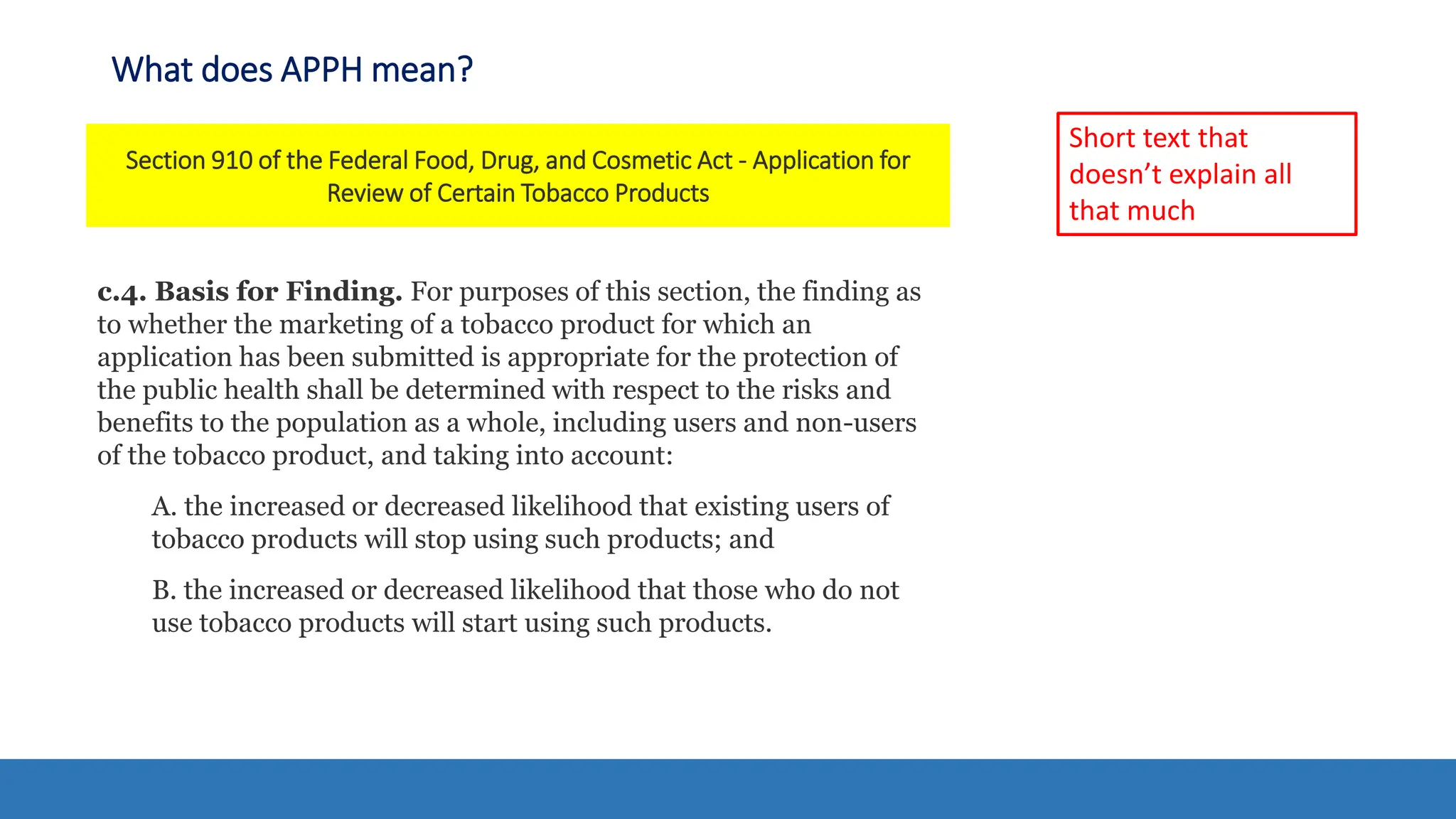
Short text that
doesn’t explain all
that much
What does APPH mean?
Section 910 of the Federal Food, Drug, and Cosmetic Act - Application for
Review of Certain Tobacco Products
c.4. Basis for Finding. For purposes of this section, the finding as
to whether the marketing of a tobacco product for which an
application has been submitted is appropriate for the protection of
the public health shall be determined with respect to the risks and
benefits to the population as a whole, including users and non-users
of the tobacco product, and taking into account:
A. the increased or decreased likelihood that existing users of
tobacco products will stop using such products; and
B. the increased or decreased likelihood that those who do not
use tobacco products will start using such products.
What does APPH mean?
Section 910 of the Federal Food, Drug, and Cosmetic Act - Application for
Review of Certain Tobacco Products
c.4. Basis for Finding. For purposes of this section, the finding as
to whether the marketing of a tobacco product for which an
application has been submitted is appropriate for the protection of
the public health shall be determined with respect to the risks and
benefits to the population as a whole, including users and non-users
of the tobacco product, and taking into account:
A. the increased or decreased likelihood that existing users of
tobacco products will stop using such products; and
B. the increased or decreased likelihood that those who do not
use tobacco products will start using such products.
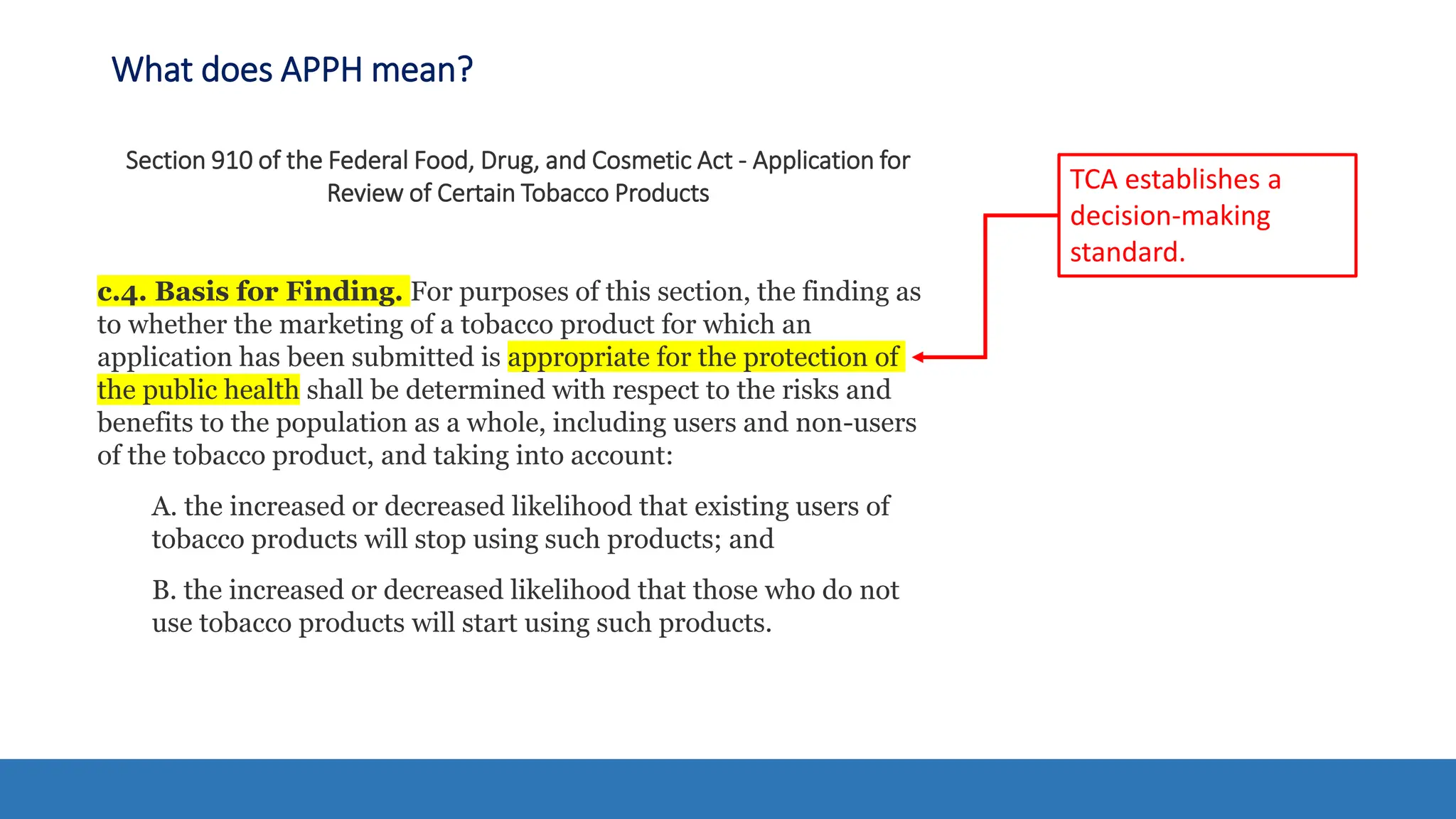
TCA establishes a
decision-making
standard.
What does APPH mean?
Section 910 of the Federal Food, Drug, and Cosmetic Act - Application for
Review of Certain Tobacco Products
c.4. Basis for Finding. For purposes of this section, the finding as
to whether the marketing of a tobacco product for which an
application has been submitted is appropriate for the protection of
the public health shall be determined with respect to the risks and
benefits to the population as a whole, including users and non-users
of the tobacco product, and taking into account:
A. the increased or decreased likelihood that existing users of
tobacco products will stop using such products; and
B. the increased or decreased likelihood that those who do not
use tobacco products will start using such products.
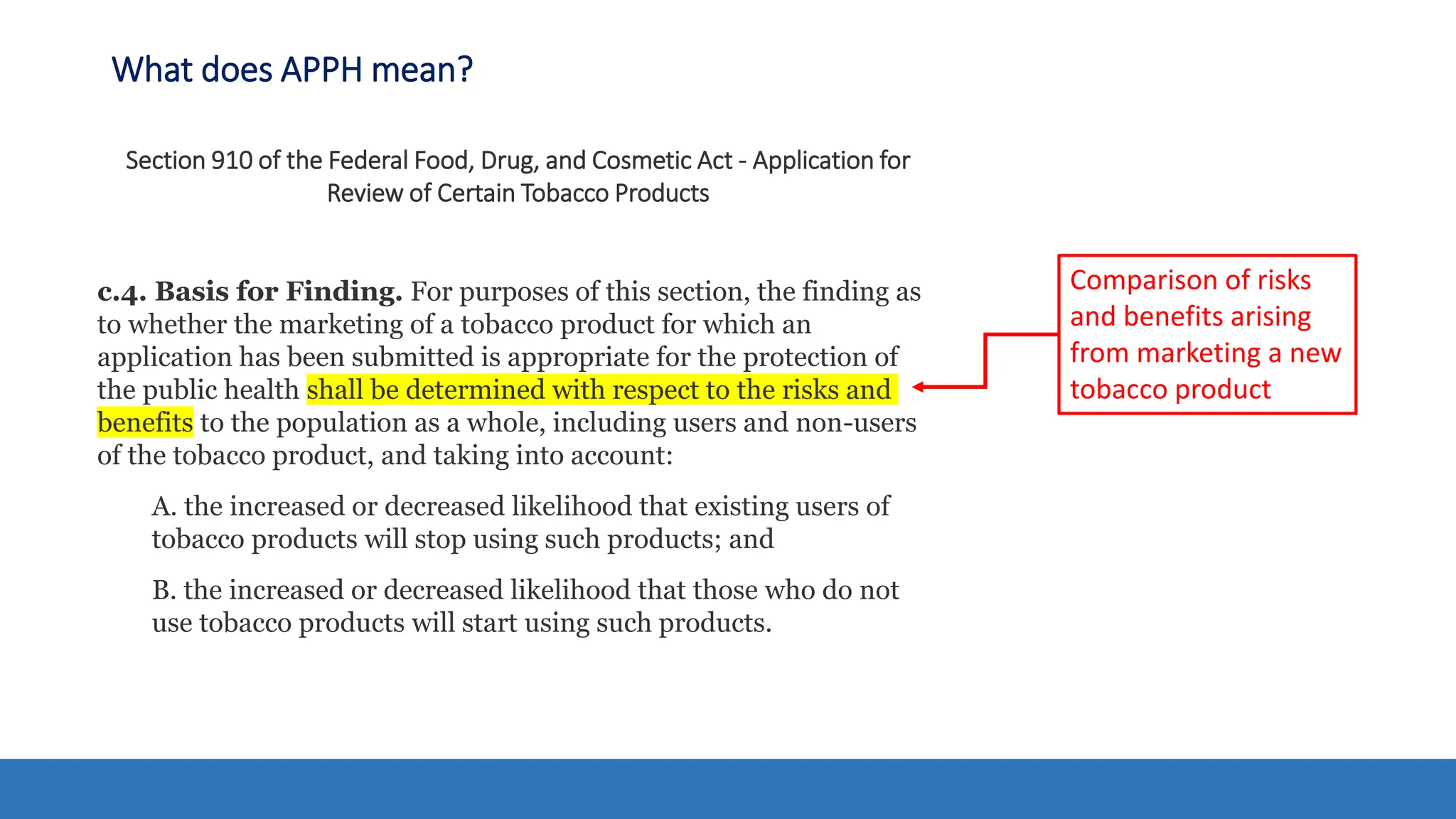
Comparison of risks
and benefits arising
from marketing a new
tobacco product
What does APPH mean?
Section 910 of the Federal Food, Drug, and Cosmetic Act - Application for
Review of Certain Tobacco Products
c.4. Basis for Finding. For purposes of this section, the finding as
to whether the marketing of a tobacco product for which an
application has been submitted is appropriate for the protection of
the public health shall be determined with respect to the risks and
benefits to the population as a whole, including users and non-users
of the tobacco product, and taking into account:
A. the increased or decreased likelihood that existing users of
tobacco products will stop using such products; and
B. the increased or decreased likelihood that those who do not
use tobacco products will start using such products.
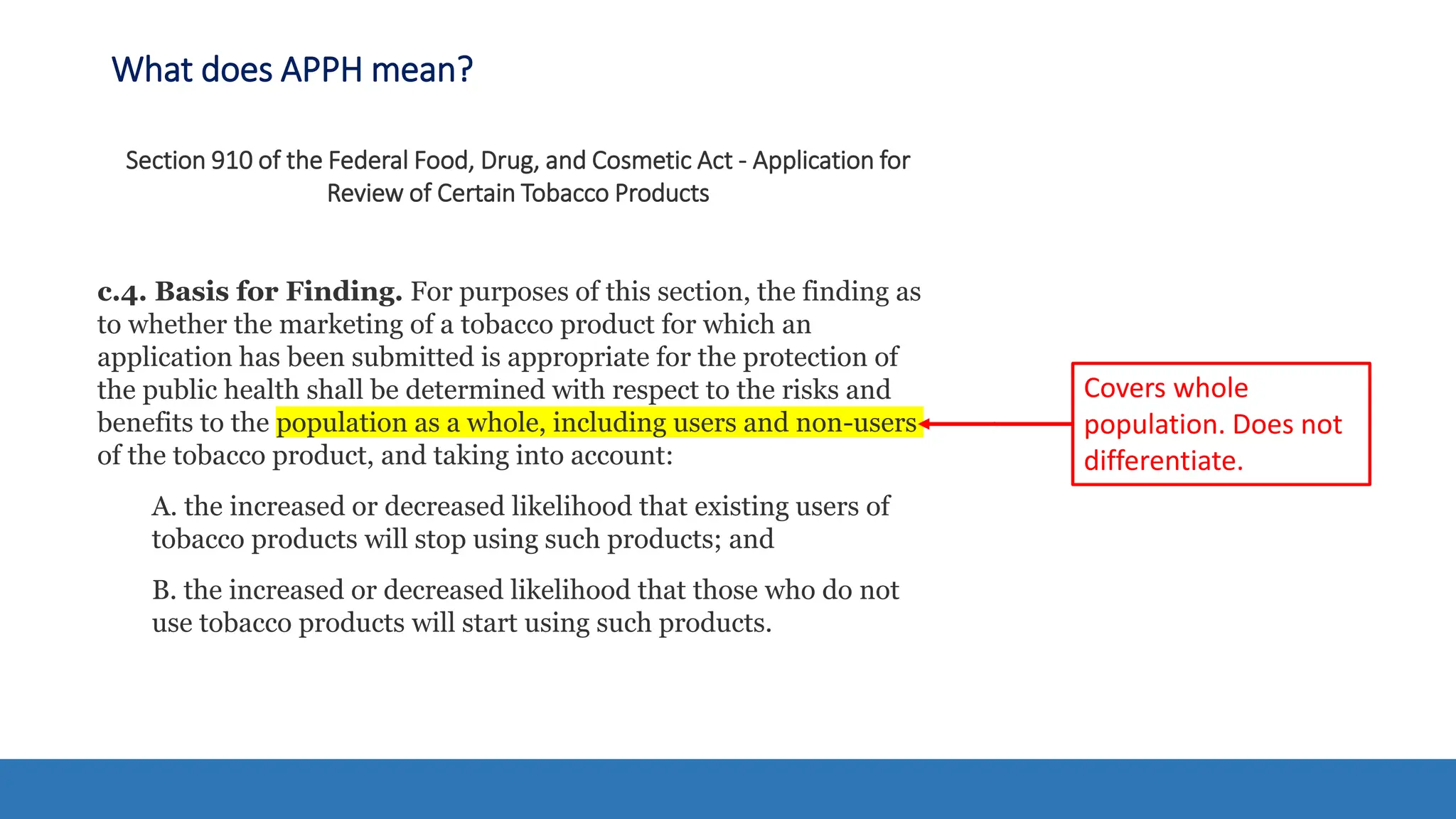
Covers whole
population. Does not
differentiate.
What does APPH mean?
Section 910 of the Federal Food, Drug, and Cosmetic Act - Application for
Review of Certain Tobacco Products
c.4. Basis for Finding. For purposes of this section, the finding as
to whether the marketing of a tobacco product for which an
application has been submitted is appropriate for the protection of
the public health shall be determined with respect to the risks and
benefits to the population as a whole, including users and non-users
of the tobacco product, and taking into account:
A. the increased or decreased likelihood that existing users of
tobacco products will stop using such products; and
B. the increased or decreased likelihood that those who do not
use tobacco products will start using such products.
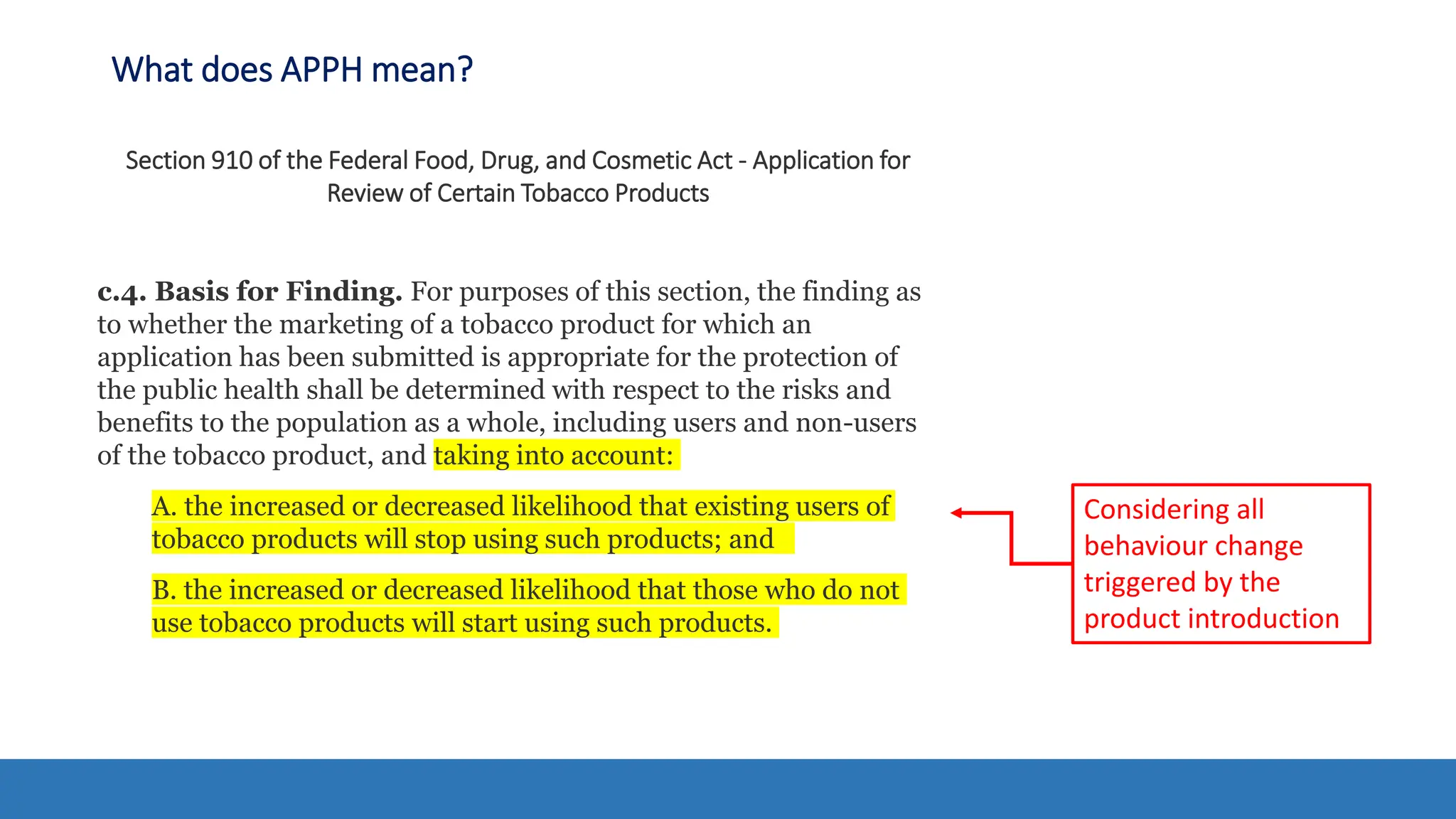
Considering all
behaviour change
triggered by the
product introduction
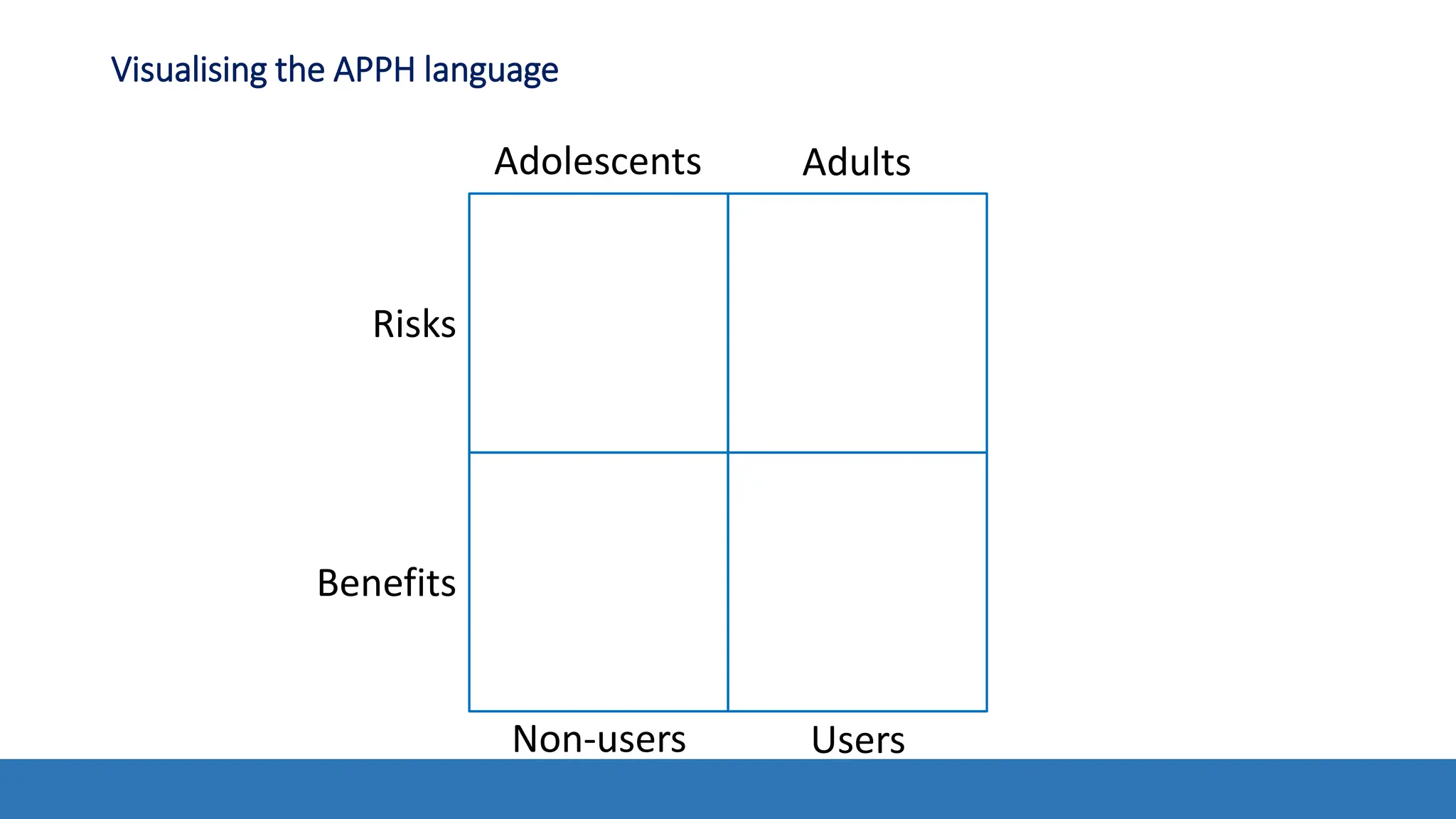
Visualising the APPH language
Risks
Benefits
Adolescents Adults
Non-users Users
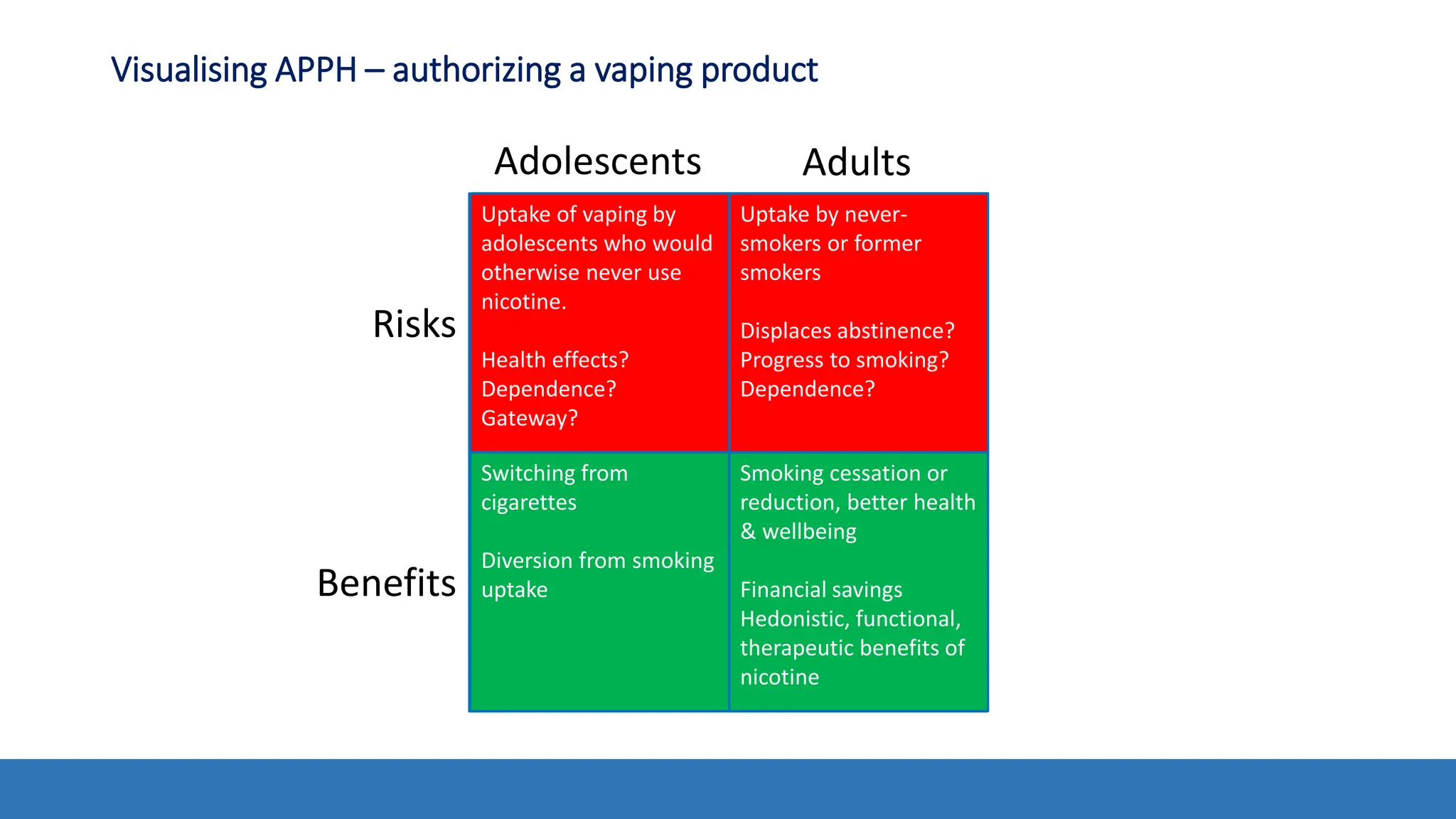
Visualising APPH – authorizing a vaping product
Risks
Benefits
Adolescents Adults
Uptake of vaping by
adolescents who would
otherwise never use
nicotine.
Health effects?
Dependence?
Gateway?
Uptake by never-
smokers or former
smokers
Displaces abstinence?
Progress to smoking?
Dependence?
Switching from
cigarettes
Diversion from smoking
uptake
Smoking cessation or
reduction, better health
& wellbeing
Financial savings
Hedonistic, functional,
therapeutic benefits of
nicotine
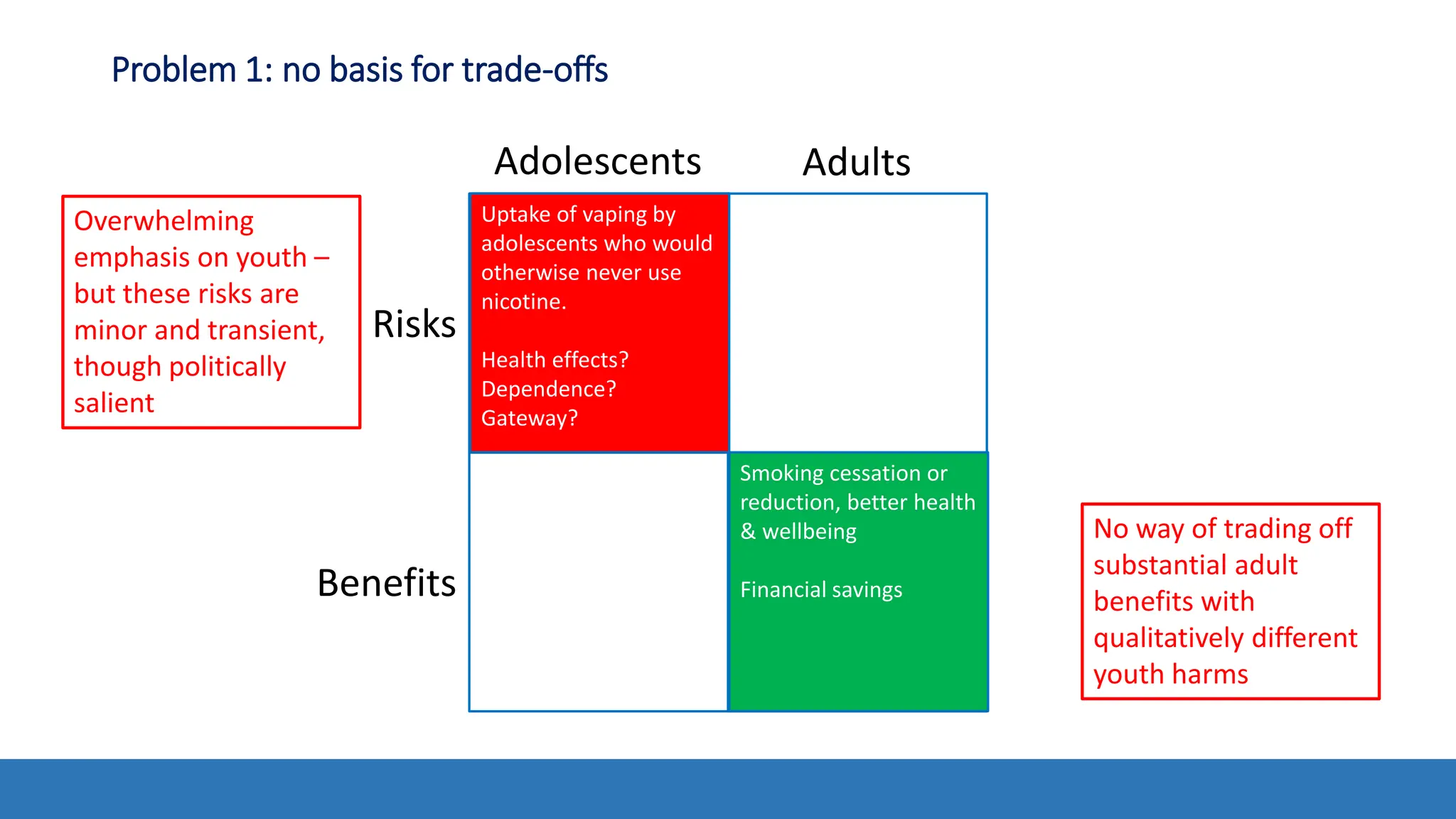
Problem 1: no basis for trade-offs
Risks
Benefits
Adolescents Adults
Uptake of vaping by
adolescents who would
otherwise never use
nicotine.
Health effects?
Dependence?
Gateway?
Smoking cessation or
reduction, better health
& wellbeing
Financial savings
Overwhelming
emphasis on youth –
but these risks are
minor and transient,
though politically
salient
No way of trading off
substantial adult
benefits with
qualitatively different
youth harms
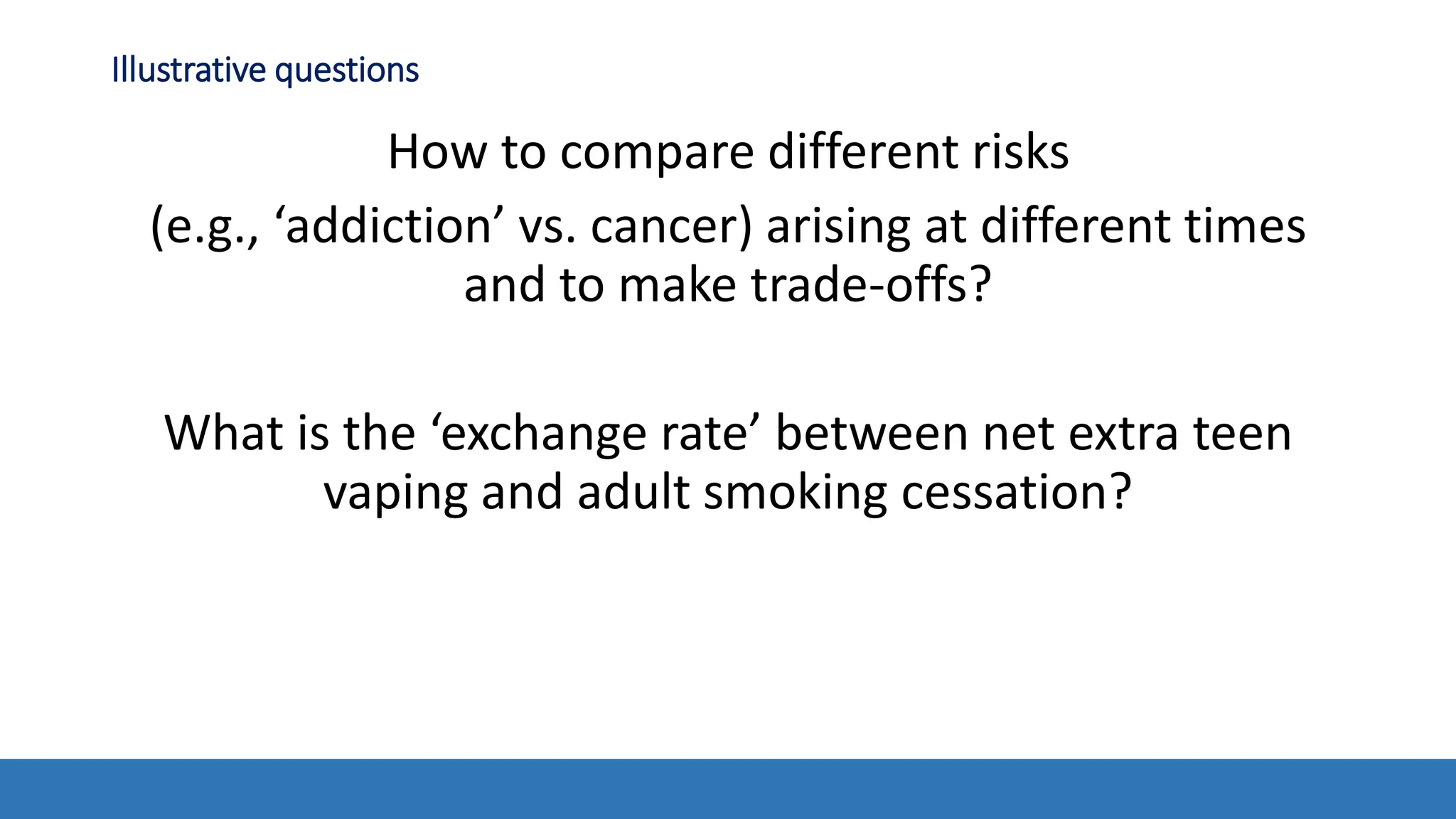
Illustrative questions
How to compare different risks
(e.g., ‘addiction’ vs. cancer) arising at different times
and to make trade-offs?
What is the ‘exchange rate’ between net extra teen
vaping and adult smoking cessation?
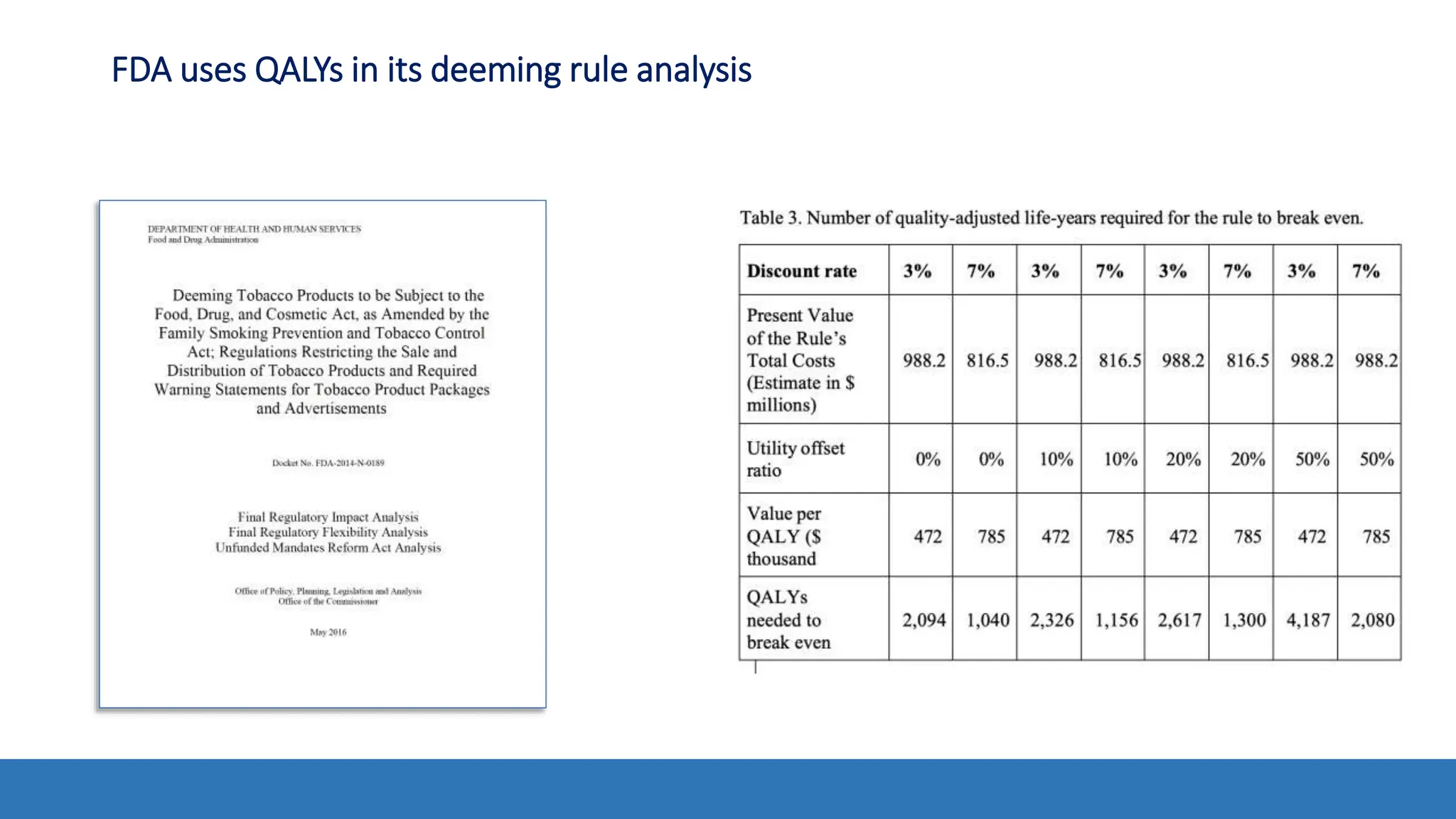
FDA uses QALYs in its deeming rule analysis
1.0
0.0
Quality
of
life
Years of life from now
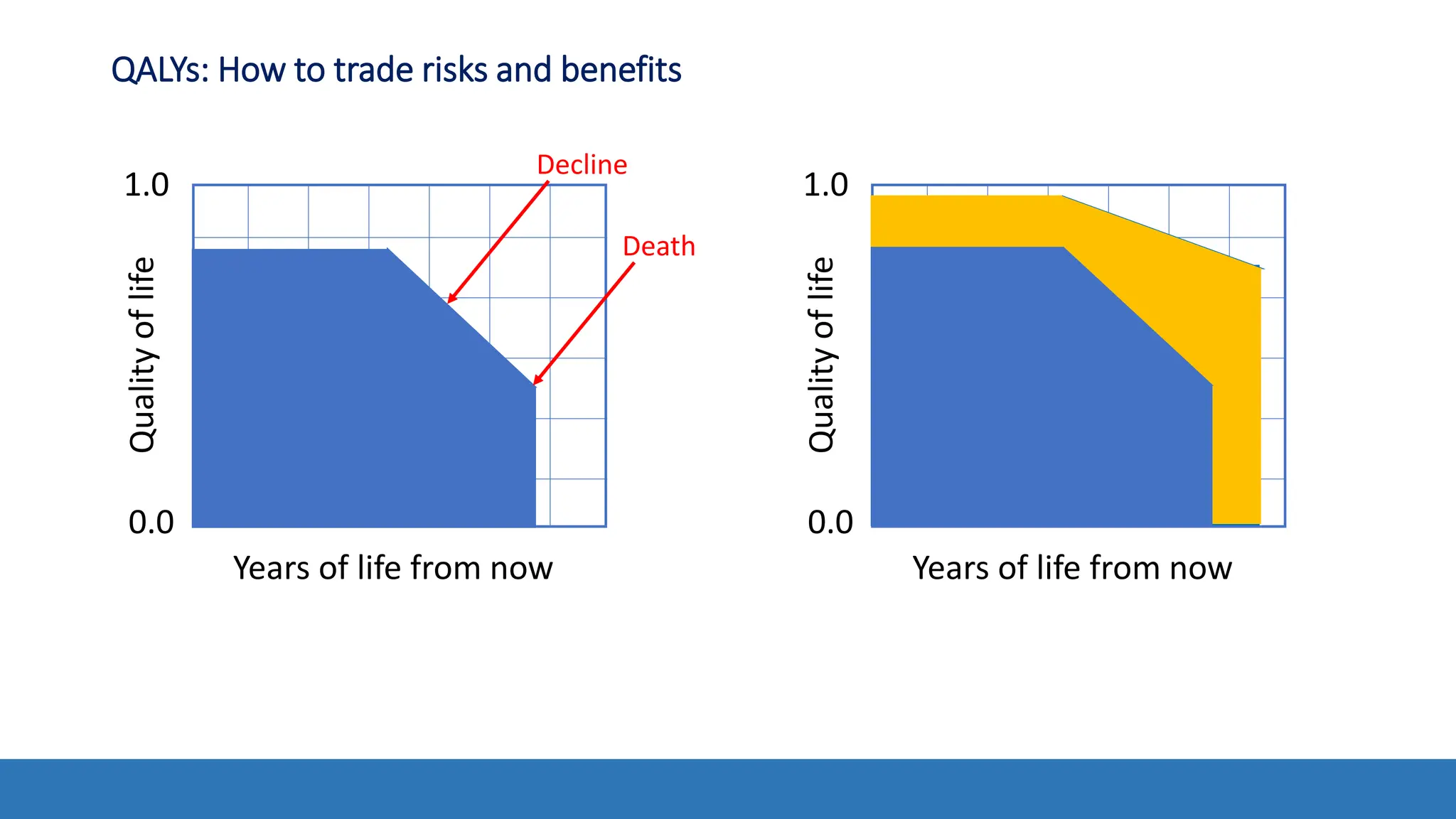
QALYs: How to trade risks and benefits
1.0
0.0
Quality
of
life
Years of life from now
Decline
Death
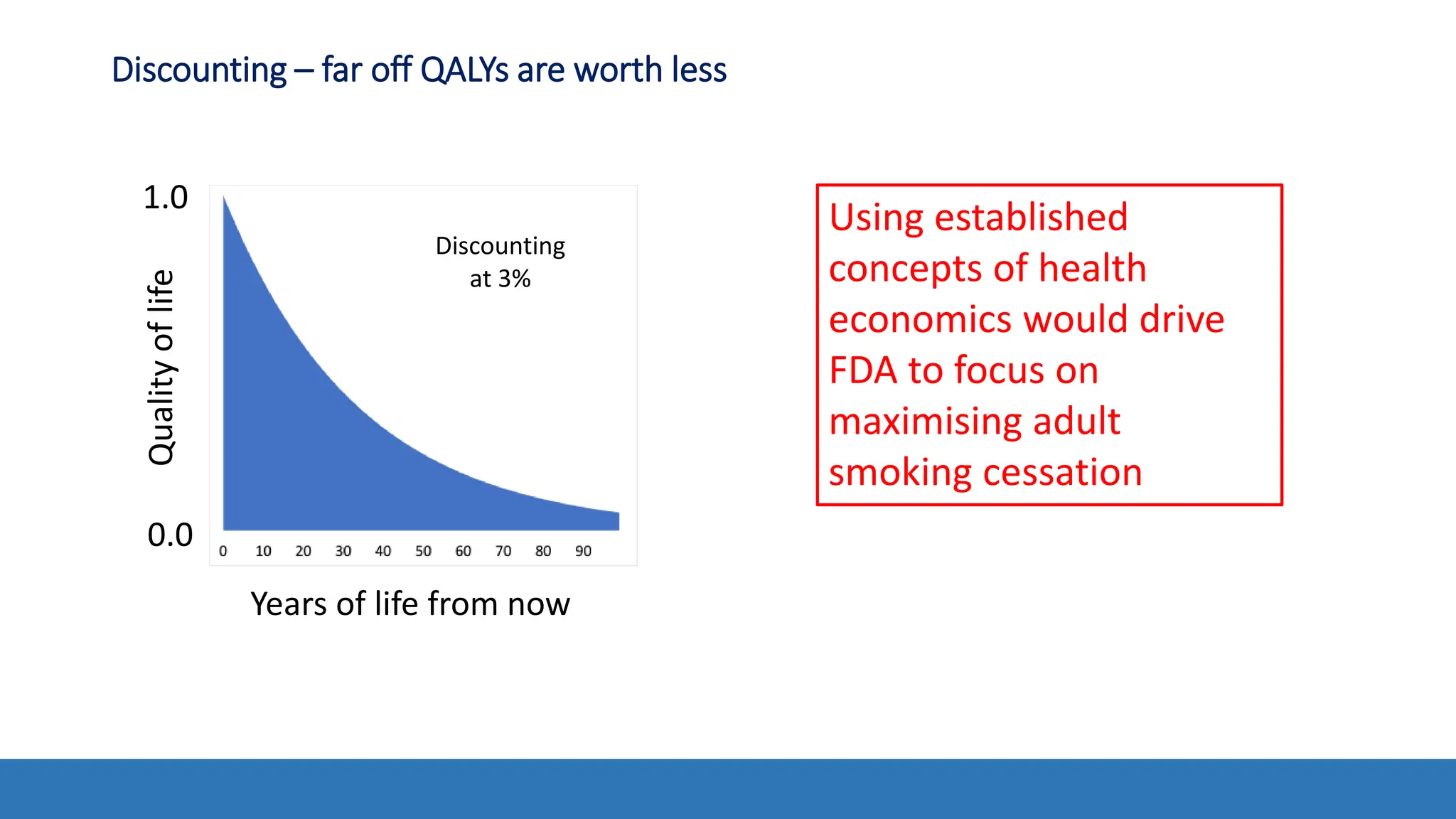
Discounting – far off QALYs are worth less
1.0
0.0
Quality
of
life
Years of life from now
Discounting
at 3%
Using established
concepts of health
economics would drive
FDA to focus on
maximising adult
smoking cessation
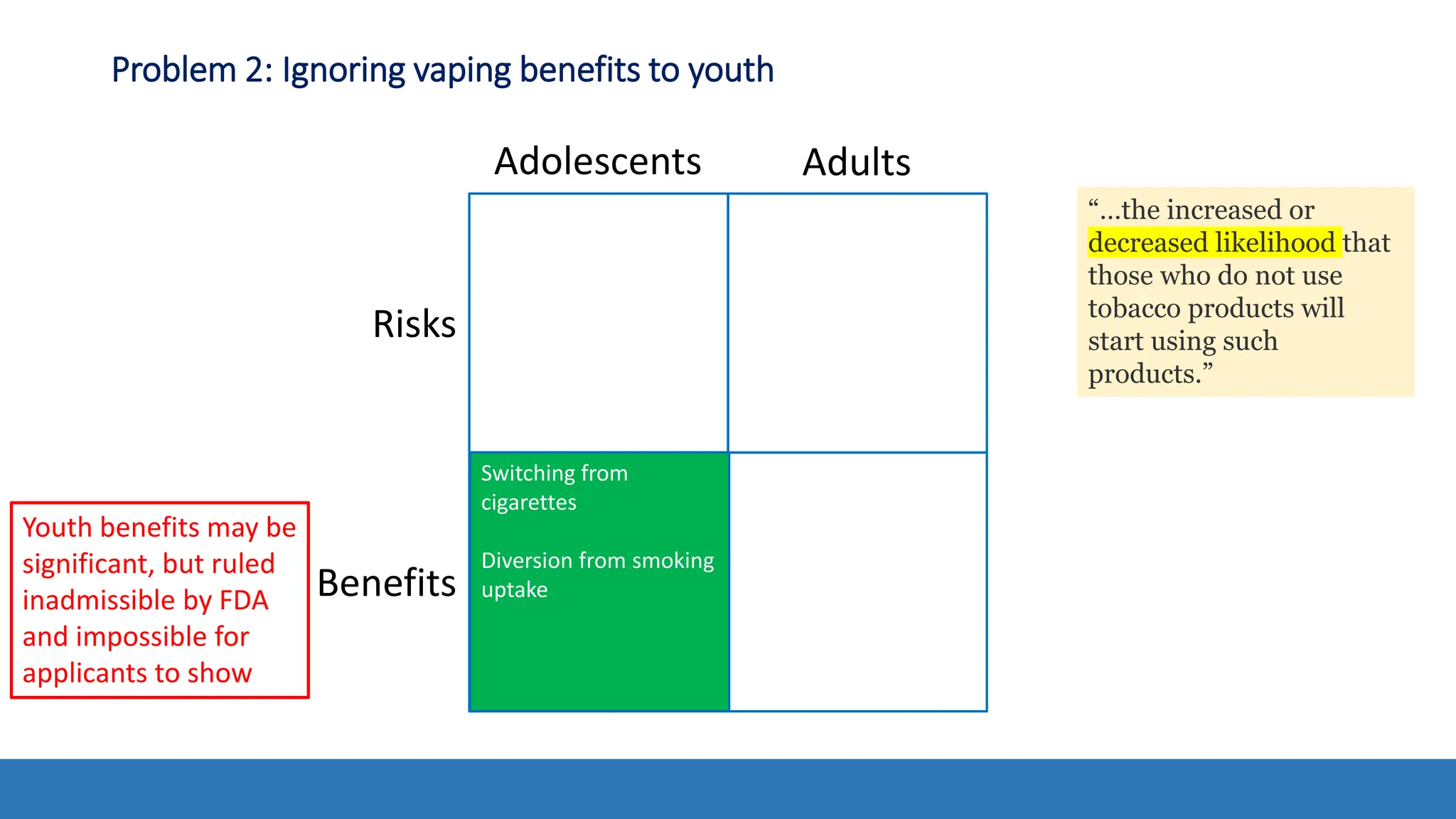
Problem 2: Ignoring vaping benefits to youth
Risks
Benefits
Adolescents Adults
Switching from
cigarettes
Diversion from smoking
uptake
Youth benefits may be
significant, but ruled
inadmissible by FDA
and impossible for
applicants to show
“…the increased or
decreased likelihood that
those who do not use
tobacco products will
start using such
products.”
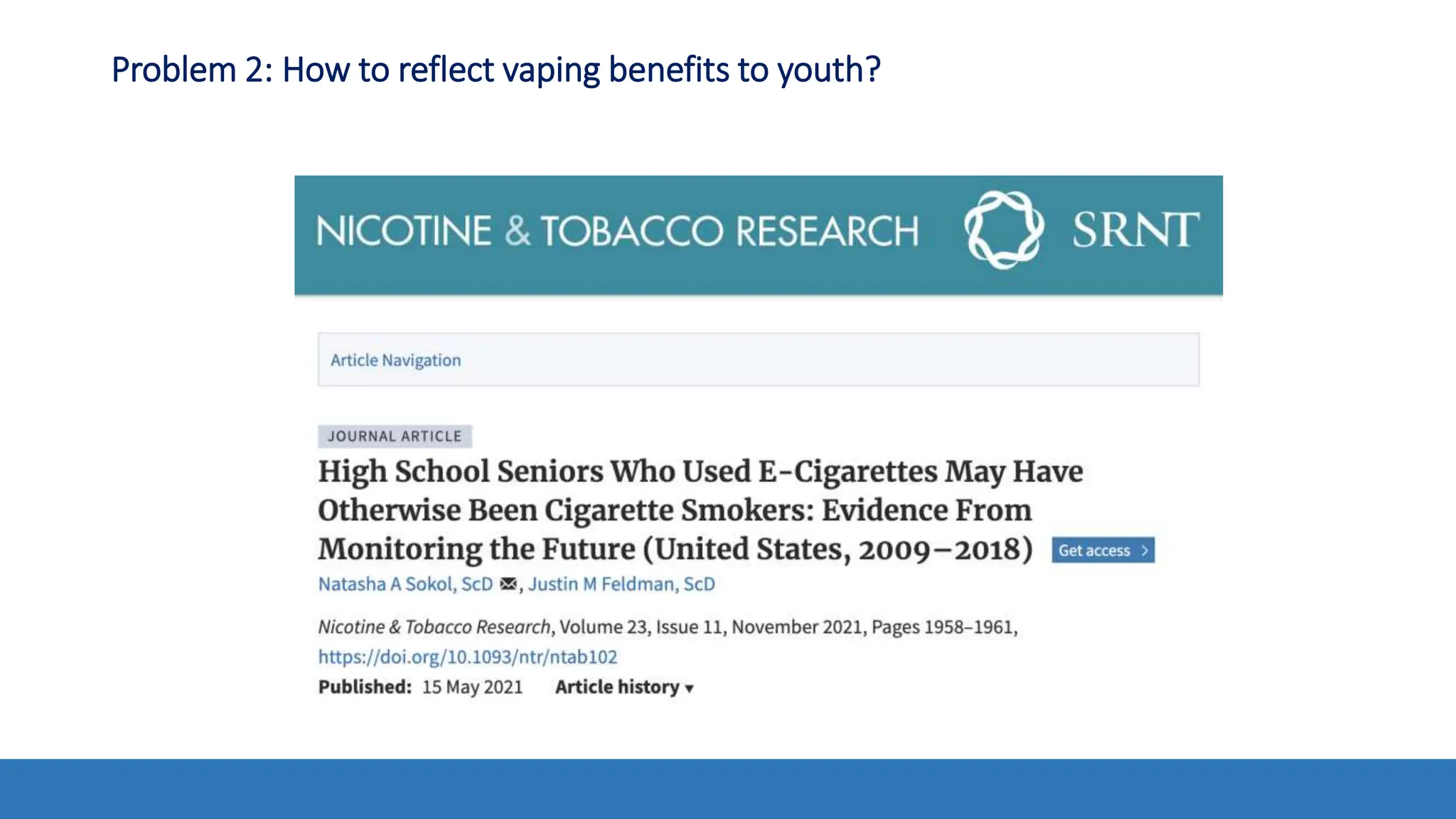
Problem 2: How to reflect vaping benefits to youth?
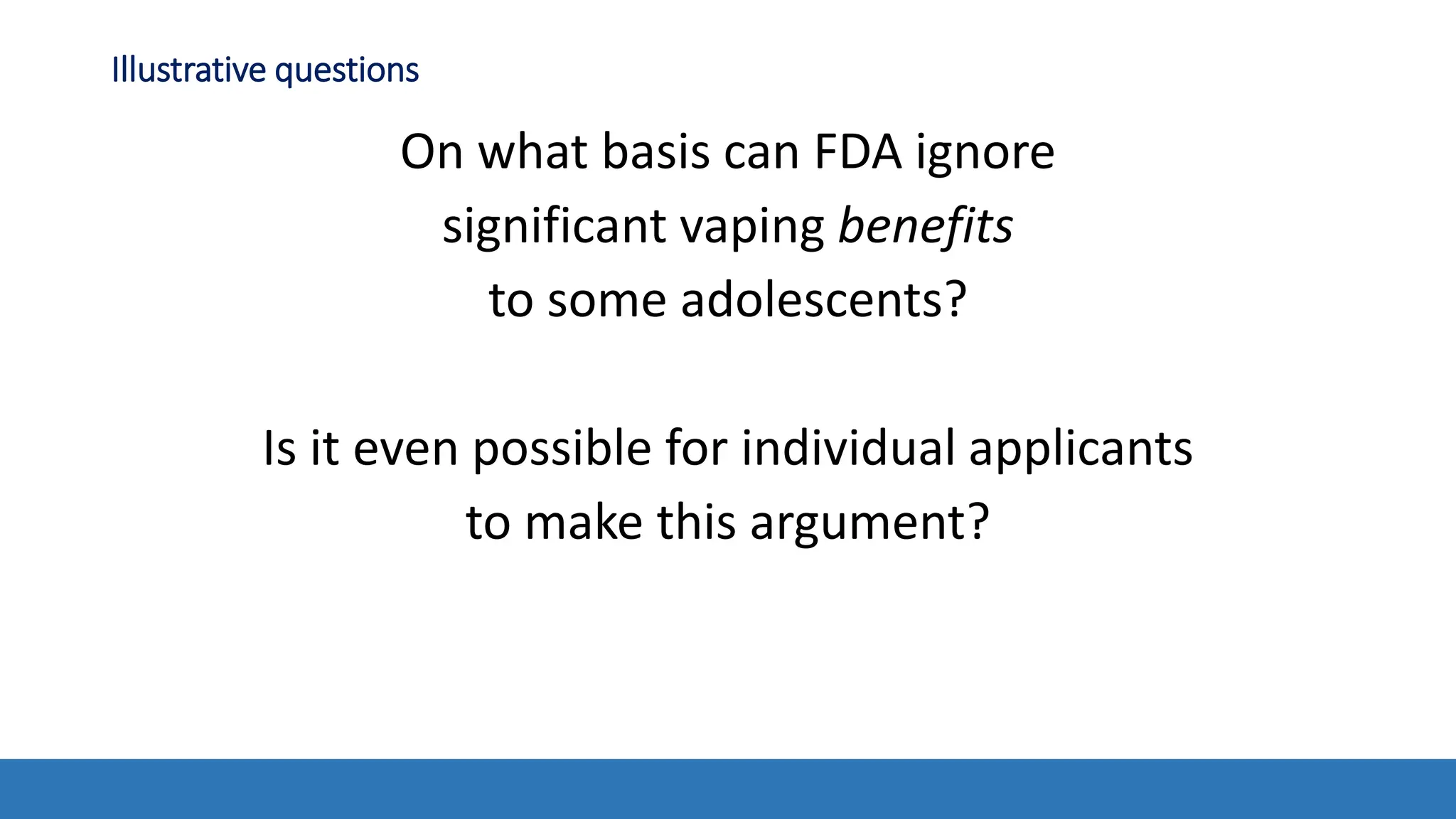
Illustrative questions
On what basis can FDA ignore
significant vaping benefits
to some adolescents?
Is it even possible for individual applicants
to make this argument?
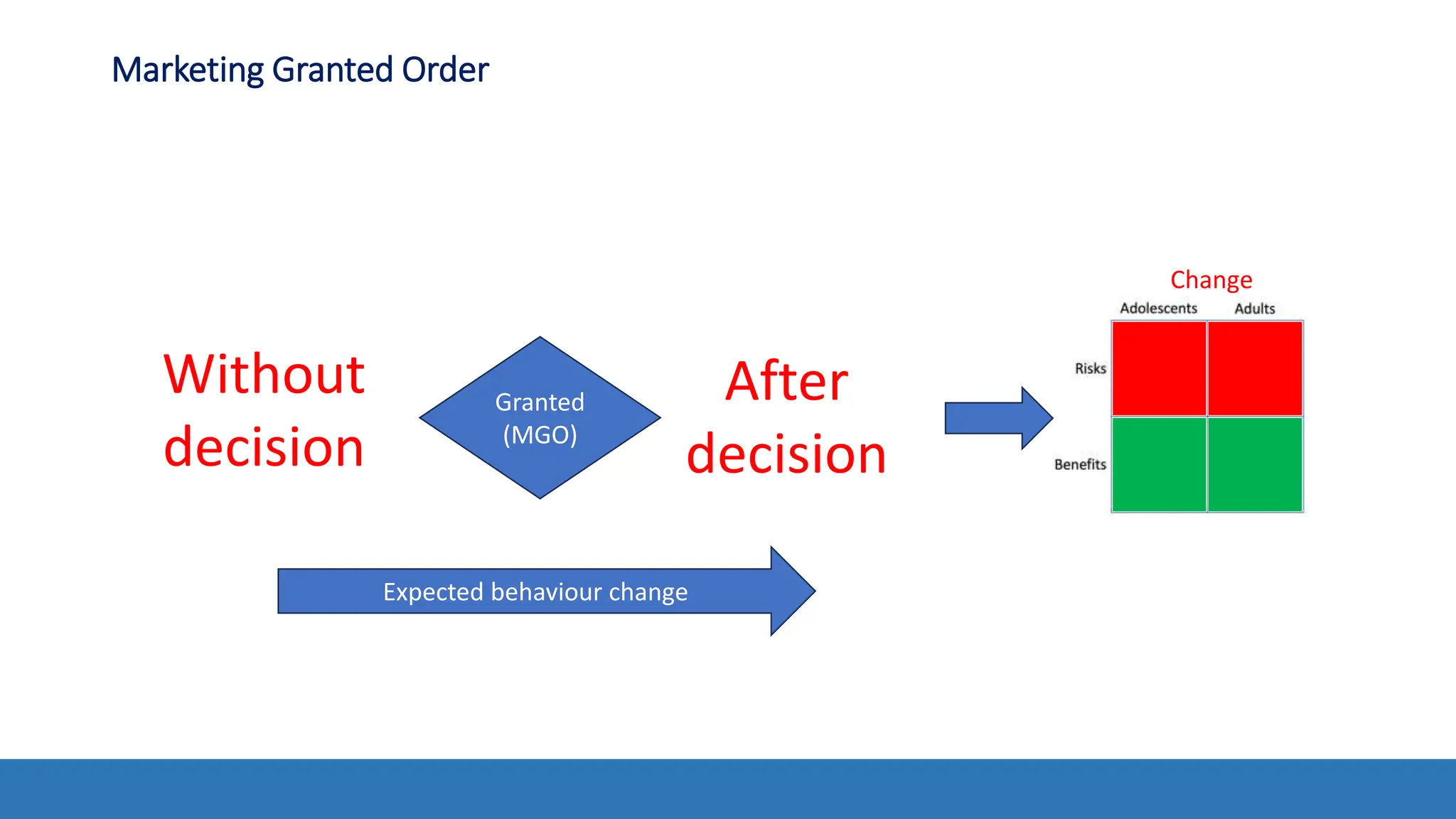
Marketing Granted Order
Without
decision
After
decision
Granted
(MGO)
Expected behaviour change
Change
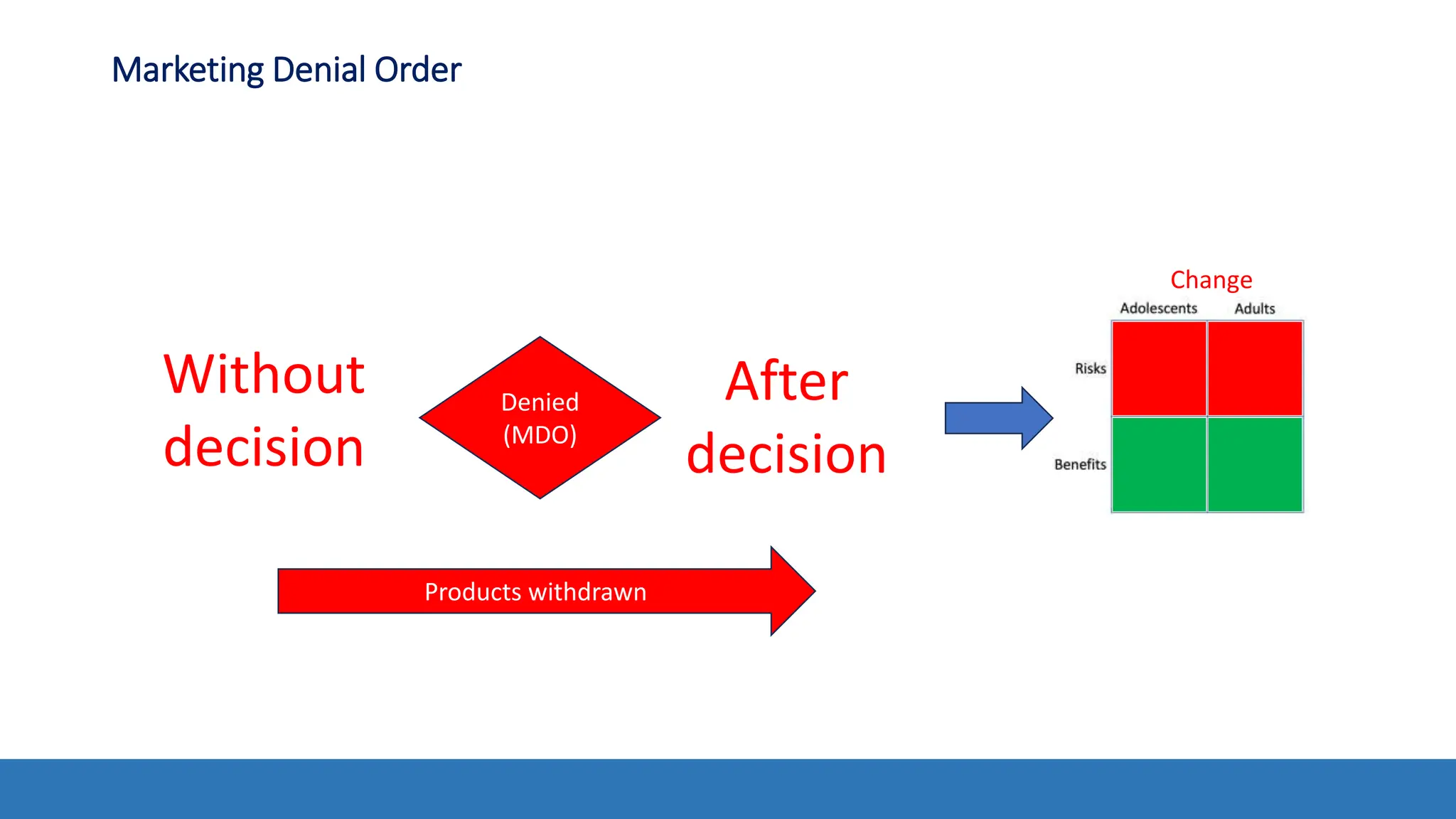
Marketing Denial Order
Denied
(MDO)
Change
Without
decision
After
decision
Products withdrawn
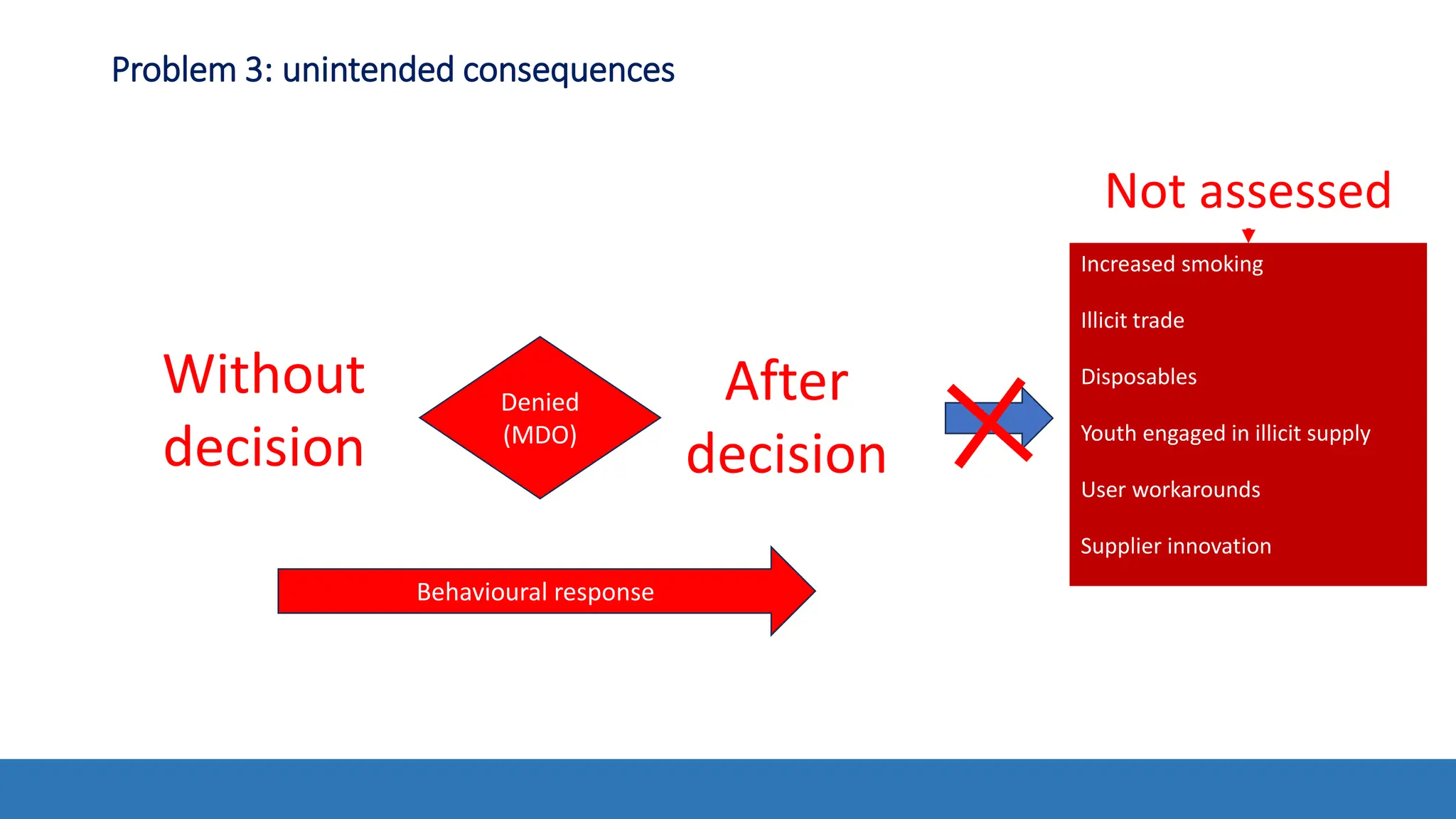
Problem 3: unintended consequences
Denied
(MDO)
Behavioural response
Increased smoking
Illicit trade
Disposables
Youth engaged in illicit supply
User workarounds
Supplier innovation
Not assessed
Without
decision
After
decision
Illustrative questions
When the FDA denied the Juul PMTA,
who cared about the welfare of
three million Juul users?
How does FDA factor in the real-world
rise of illicit vape products?
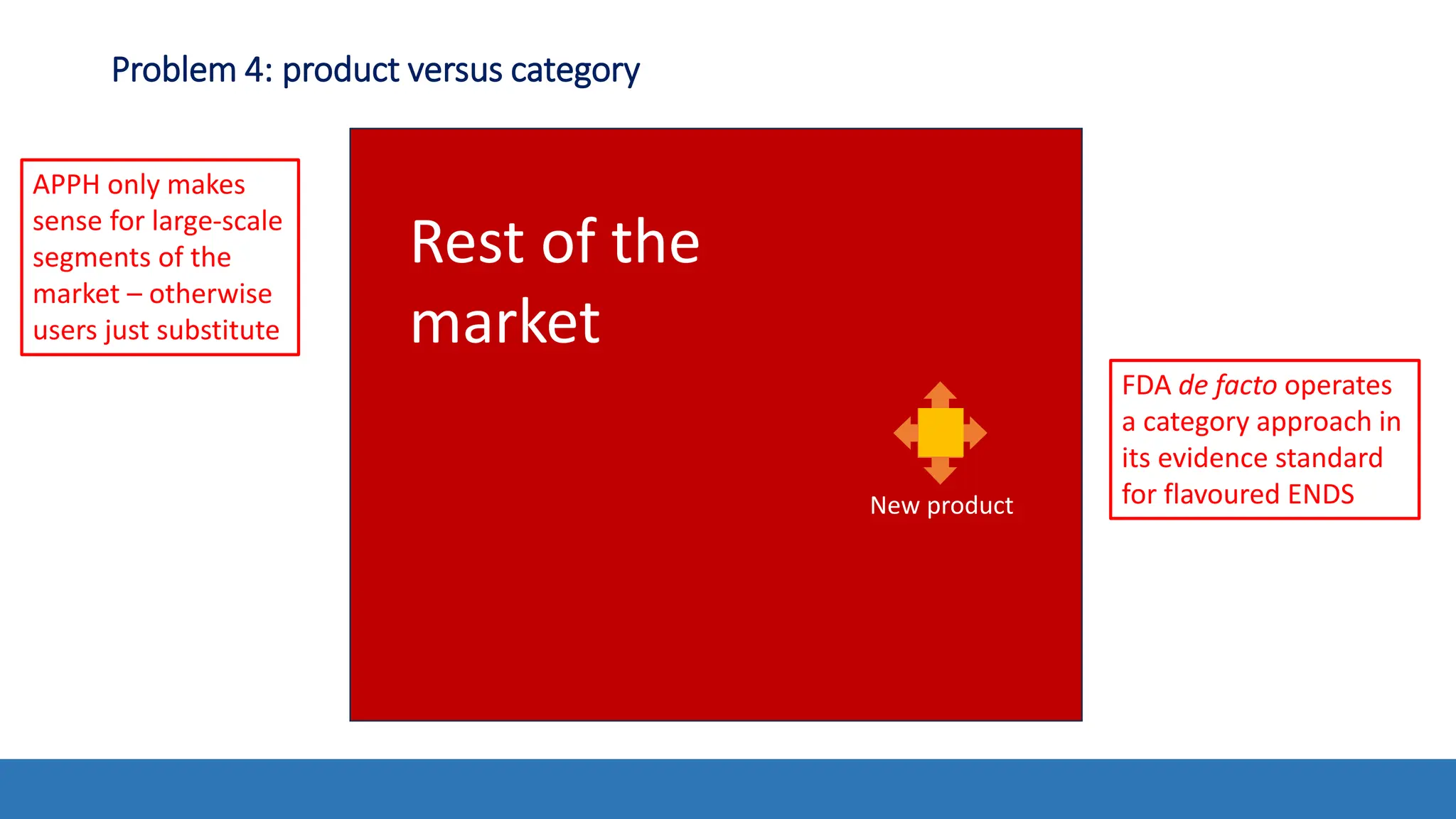
Problem 4: product versus category
Rest of the
market
New product
APPH only makes
sense for large-scale
segments of the
market – otherwise
users just substitute
FDA de facto operates
a category approach in
its evidence standard
for flavoured ENDS
Illustrative questions
How can one product affect population
health when users can switch to a similar product?
How can APPH be assessed other than for whole
categories or dominant products?
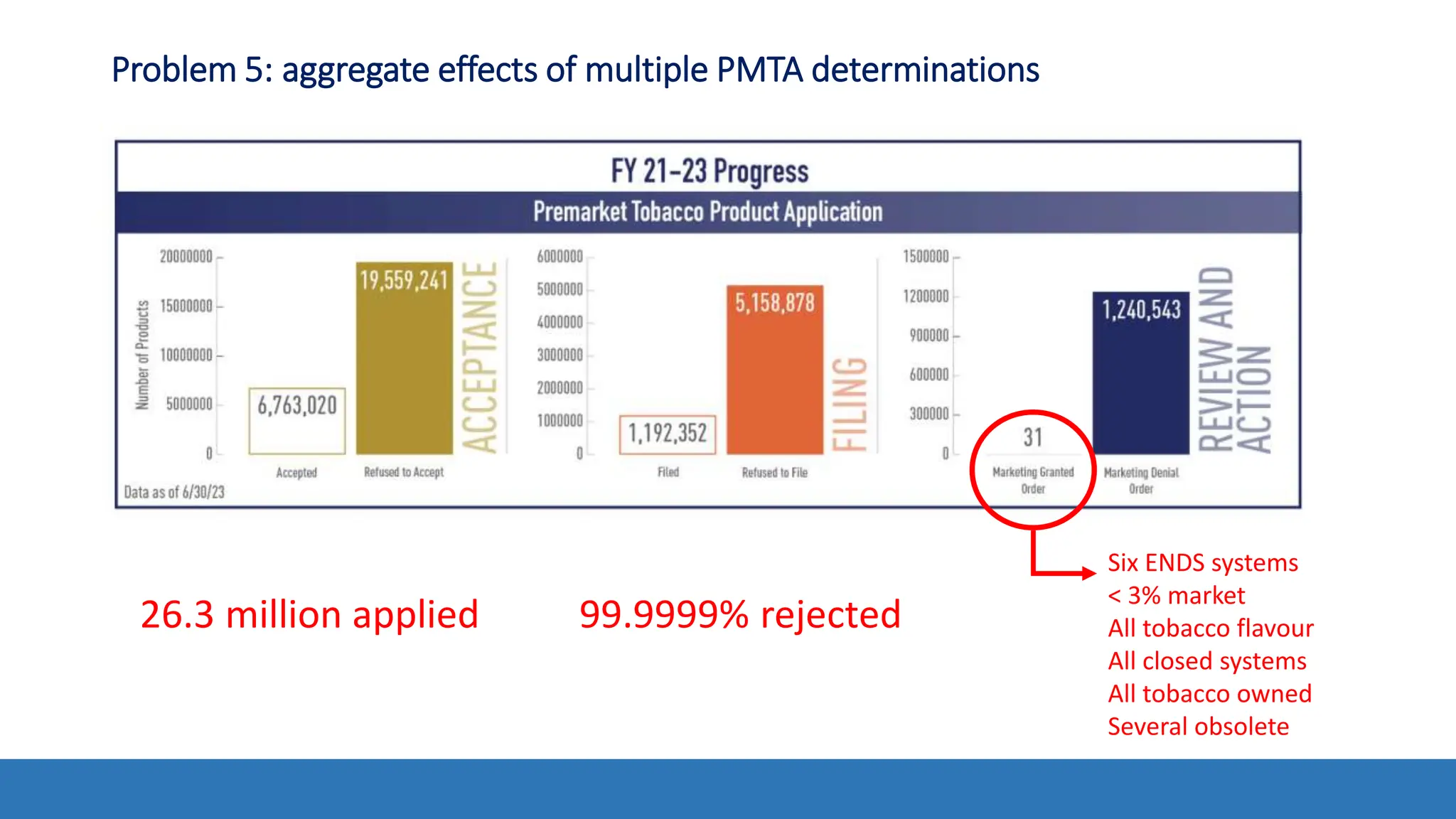
Problem 5: aggregate effects of multiple PMTA determinations
Six ENDS systems
< 3% market
All tobacco flavour
All closed systems
All tobacco owned
Several obsolete
26.3 million applied 99.9999% rejected
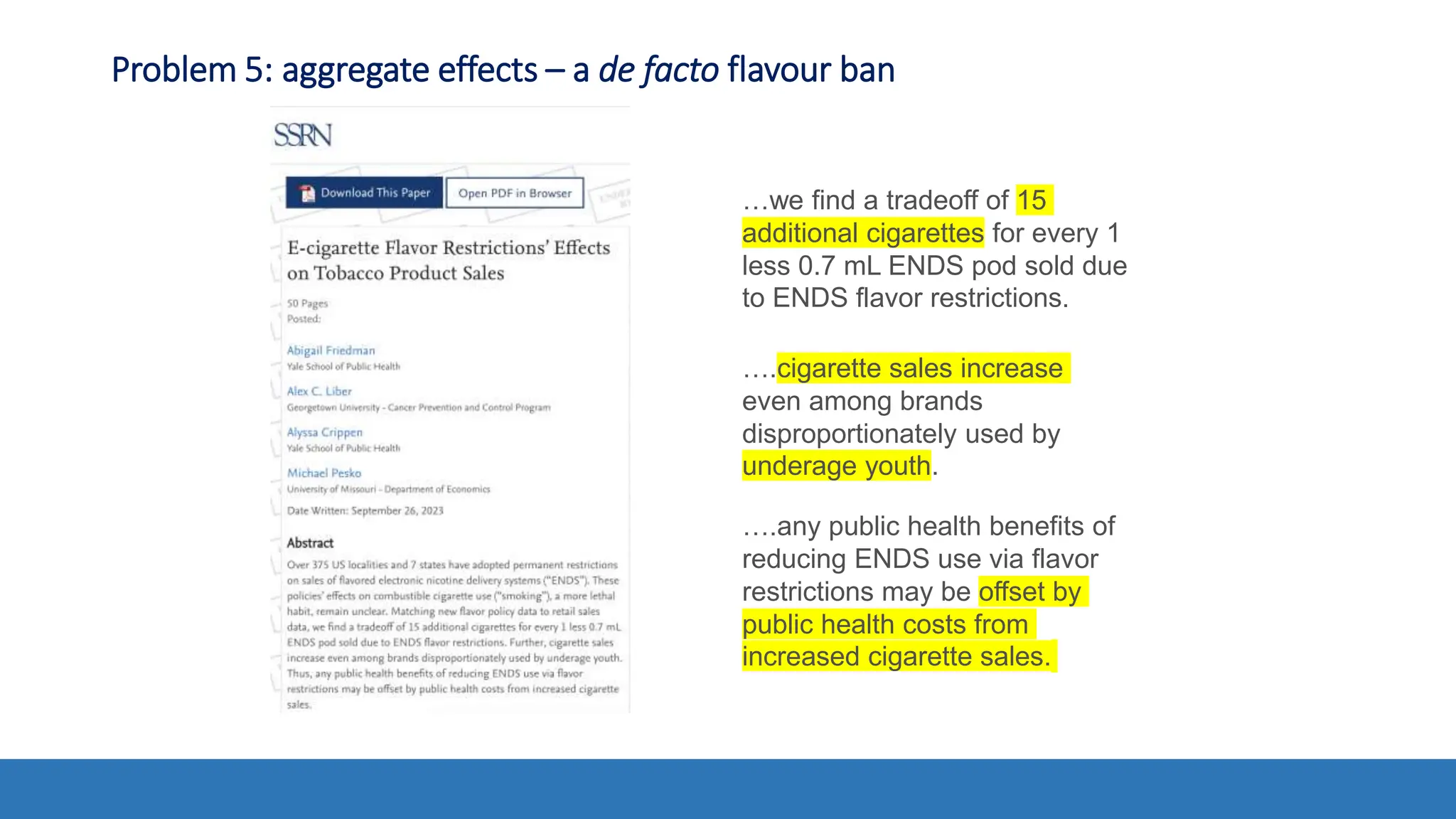
Problem 5: aggregate effects – a de facto flavour ban
…we find a tradeoff of 15
additional cigarettes for every 1
less 0.7 mL ENDS pod sold due
to ENDS flavor restrictions.
….cigarette sales increase
even among brands
disproportionately used by
underage youth.
….any public health benefits of
reducing ENDS use via flavor
restrictions may be offset by
public health costs from
increased cigarette sales.
Illustrative questions
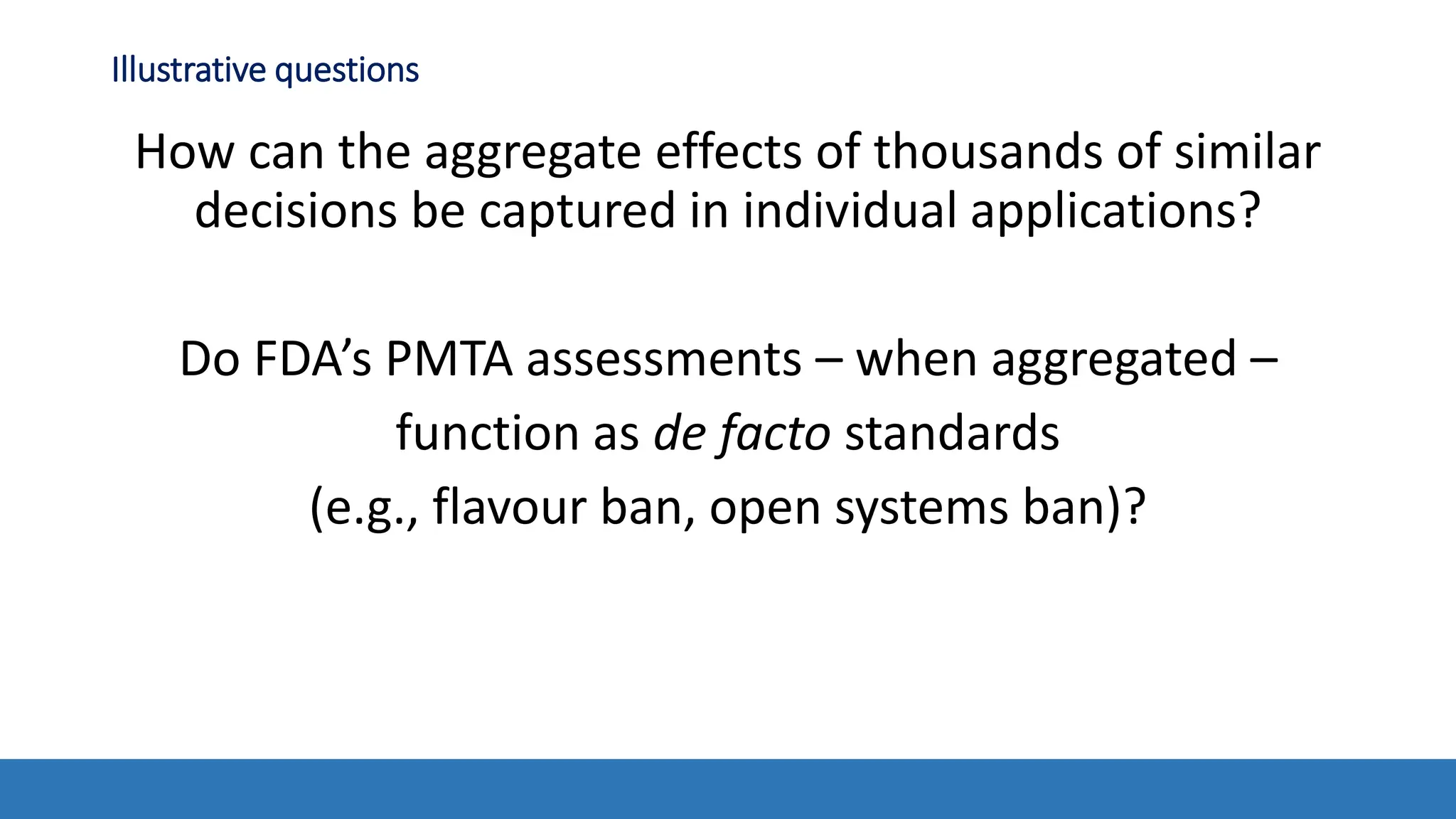
How can the aggregate effects of thousands of similar
decisions be captured in individual applications?
Do FDA’s PMTA assessments – when aggregated –
function as de facto standards
(e.g., flavour ban, open systems ban)?
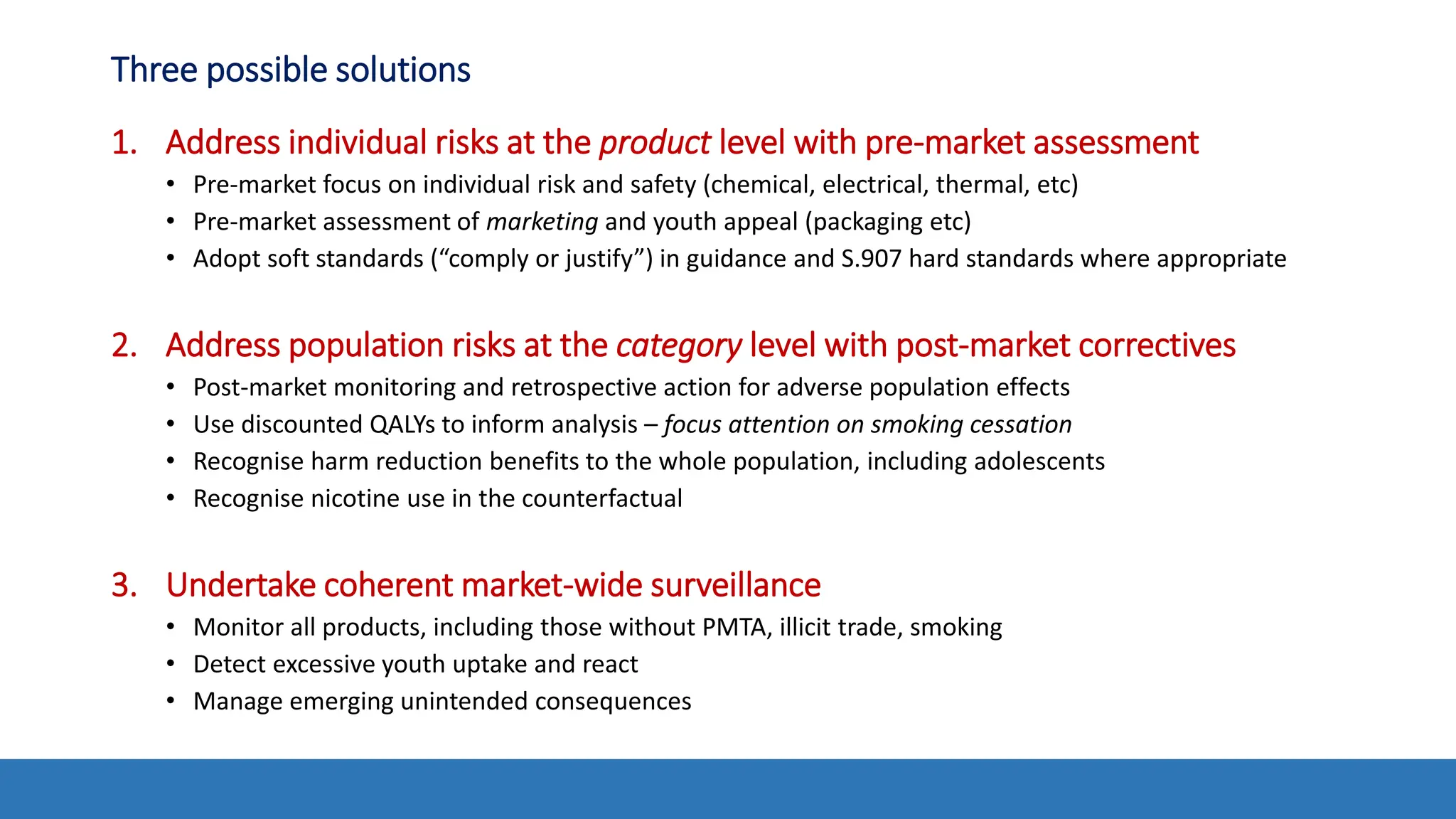
Three possible solutions
1. Address individual risks at the product level with pre-market assessment
• Pre-market focus on individual risk and safety (chemical, electrical, thermal, etc)
• Pre-market assessment of marketing and youth appeal (packaging etc)
• Adopt soft standards (“comply or justify”) in guidance and S.907 hard standards where appropriate
2. Address population risks at the category level with post-market correctives
• Post-market monitoring and retrospective action for adverse population effects
• Use discounted QALYs to inform analysis – focus attention on smoking cessation
• Recognise harm reduction benefits to the whole population, including adolescents
• Recognise nicotine use in the counterfactual
3. Undertake coherent market-wide surveillance
• Monitor all products, including those without PMTA, illicit trade, smoking
• Detect excessive youth uptake and react
• Manage emerging unintended consequences

The APPH Standard: What Does it Actually Mean?

  • 1.
    Food and DrugLaw Institute Tobacco and Nicotine Products Regulation and Policy Conference Clive Bates, MA MSc The Appropriate for the Protection of Public Health (APPH) Standard: What Does it Actually Mean? 26-27 October 2023 Washington DC
  • 2.
    Short text that doesn’texplain all that much What does APPH mean? Section 910 of the Federal Food, Drug, and Cosmetic Act - Application for Review of Certain Tobacco Products c.4. Basis for Finding. For purposes of this section, the finding as to whether the marketing of a tobacco product for which an application has been submitted is appropriate for the protection of the public health shall be determined with respect to the risks and benefits to the population as a whole, including users and non-users of the tobacco product, and taking into account: A. the increased or decreased likelihood that existing users of tobacco products will stop using such products; and B. the increased or decreased likelihood that those who do not use tobacco products will start using such products.
  • 3.
    What does APPHmean? Section 910 of the Federal Food, Drug, and Cosmetic Act - Application for Review of Certain Tobacco Products c.4. Basis for Finding. For purposes of this section, the finding as to whether the marketing of a tobacco product for which an application has been submitted is appropriate for the protection of the public health shall be determined with respect to the risks and benefits to the population as a whole, including users and non-users of the tobacco product, and taking into account: A. the increased or decreased likelihood that existing users of tobacco products will stop using such products; and B. the increased or decreased likelihood that those who do not use tobacco products will start using such products. TCA establishes a decision-making standard.
  • 4.
    What does APPHmean? Section 910 of the Federal Food, Drug, and Cosmetic Act - Application for Review of Certain Tobacco Products c.4. Basis for Finding. For purposes of this section, the finding as to whether the marketing of a tobacco product for which an application has been submitted is appropriate for the protection of the public health shall be determined with respect to the risks and benefits to the population as a whole, including users and non-users of the tobacco product, and taking into account: A. the increased or decreased likelihood that existing users of tobacco products will stop using such products; and B. the increased or decreased likelihood that those who do not use tobacco products will start using such products. Comparison of risks and benefits arising from marketing a new tobacco product
  • 5.
    What does APPHmean? Section 910 of the Federal Food, Drug, and Cosmetic Act - Application for Review of Certain Tobacco Products c.4. Basis for Finding. For purposes of this section, the finding as to whether the marketing of a tobacco product for which an application has been submitted is appropriate for the protection of the public health shall be determined with respect to the risks and benefits to the population as a whole, including users and non-users of the tobacco product, and taking into account: A. the increased or decreased likelihood that existing users of tobacco products will stop using such products; and B. the increased or decreased likelihood that those who do not use tobacco products will start using such products. Covers whole population. Does not differentiate.
  • 6.
    What does APPHmean? Section 910 of the Federal Food, Drug, and Cosmetic Act - Application for Review of Certain Tobacco Products c.4. Basis for Finding. For purposes of this section, the finding as to whether the marketing of a tobacco product for which an application has been submitted is appropriate for the protection of the public health shall be determined with respect to the risks and benefits to the population as a whole, including users and non-users of the tobacco product, and taking into account: A. the increased or decreased likelihood that existing users of tobacco products will stop using such products; and B. the increased or decreased likelihood that those who do not use tobacco products will start using such products. Considering all behaviour change triggered by the product introduction
  • 7.
    Visualising the APPHlanguage Risks Benefits Adolescents Adults Non-users Users
  • 8.
    Visualising APPH –authorizing a vaping product Risks Benefits Adolescents Adults Uptake of vaping by adolescents who would otherwise never use nicotine. Health effects? Dependence? Gateway? Uptake by never- smokers or former smokers Displaces abstinence? Progress to smoking? Dependence? Switching from cigarettes Diversion from smoking uptake Smoking cessation or reduction, better health & wellbeing Financial savings Hedonistic, functional, therapeutic benefits of nicotine
  • 9.
    Problem 1: nobasis for trade-offs Risks Benefits Adolescents Adults Uptake of vaping by adolescents who would otherwise never use nicotine. Health effects? Dependence? Gateway? Smoking cessation or reduction, better health & wellbeing Financial savings Overwhelming emphasis on youth – but these risks are minor and transient, though politically salient No way of trading off substantial adult benefits with qualitatively different youth harms
  • 10.
    Illustrative questions How tocompare different risks (e.g., ‘addiction’ vs. cancer) arising at different times and to make trade-offs? What is the ‘exchange rate’ between net extra teen vaping and adult smoking cessation?
  • 11.
    FDA uses QALYsin its deeming rule analysis
  • 12.
    1.0 0.0 Quality of life Years of lifefrom now QALYs: How to trade risks and benefits 1.0 0.0 Quality of life Years of life from now Decline Death
  • 13.
    Discounting – faroff QALYs are worth less 1.0 0.0 Quality of life Years of life from now Discounting at 3% Using established concepts of health economics would drive FDA to focus on maximising adult smoking cessation
  • 14.
    Problem 2: Ignoringvaping benefits to youth Risks Benefits Adolescents Adults Switching from cigarettes Diversion from smoking uptake Youth benefits may be significant, but ruled inadmissible by FDA and impossible for applicants to show “…the increased or decreased likelihood that those who do not use tobacco products will start using such products.”
  • 15.
    Problem 2: Howto reflect vaping benefits to youth?
  • 16.
    Illustrative questions On whatbasis can FDA ignore significant vaping benefits to some adolescents? Is it even possible for individual applicants to make this argument?
  • 17.
  • 18.
  • 19.
    Problem 3: unintendedconsequences Denied (MDO) Behavioural response Increased smoking Illicit trade Disposables Youth engaged in illicit supply User workarounds Supplier innovation Not assessed Without decision After decision
  • 20.
    Illustrative questions When theFDA denied the Juul PMTA, who cared about the welfare of three million Juul users? How does FDA factor in the real-world rise of illicit vape products?
  • 21.
    Problem 4: productversus category Rest of the market New product APPH only makes sense for large-scale segments of the market – otherwise users just substitute FDA de facto operates a category approach in its evidence standard for flavoured ENDS
  • 22.
    Illustrative questions How canone product affect population health when users can switch to a similar product? How can APPH be assessed other than for whole categories or dominant products?
  • 23.
    Problem 5: aggregateeffects of multiple PMTA determinations Six ENDS systems < 3% market All tobacco flavour All closed systems All tobacco owned Several obsolete 26.3 million applied 99.9999% rejected
  • 24.
    Problem 5: aggregateeffects – a de facto flavour ban …we find a tradeoff of 15 additional cigarettes for every 1 less 0.7 mL ENDS pod sold due to ENDS flavor restrictions. ….cigarette sales increase even among brands disproportionately used by underage youth. ….any public health benefits of reducing ENDS use via flavor restrictions may be offset by public health costs from increased cigarette sales.
  • 25.
    Illustrative questions How canthe aggregate effects of thousands of similar decisions be captured in individual applications? Do FDA’s PMTA assessments – when aggregated – function as de facto standards (e.g., flavour ban, open systems ban)?
  • 26.
    Three possible solutions 1.Address individual risks at the product level with pre-market assessment • Pre-market focus on individual risk and safety (chemical, electrical, thermal, etc) • Pre-market assessment of marketing and youth appeal (packaging etc) • Adopt soft standards (“comply or justify”) in guidance and S.907 hard standards where appropriate 2. Address population risks at the category level with post-market correctives • Post-market monitoring and retrospective action for adverse population effects • Use discounted QALYs to inform analysis – focus attention on smoking cessation • Recognise harm reduction benefits to the whole population, including adolescents • Recognise nicotine use in the counterfactual 3. Undertake coherent market-wide surveillance • Monitor all products, including those without PMTA, illicit trade, smoking • Detect excessive youth uptake and react • Manage emerging unintended consequences