Fluid-Structure Interaction
Analysis of Composite Bow Foil
MARINE || COMPOSITES || RENEWABLES || SUBSEA
CDYNAMICS COMPANY INTRO
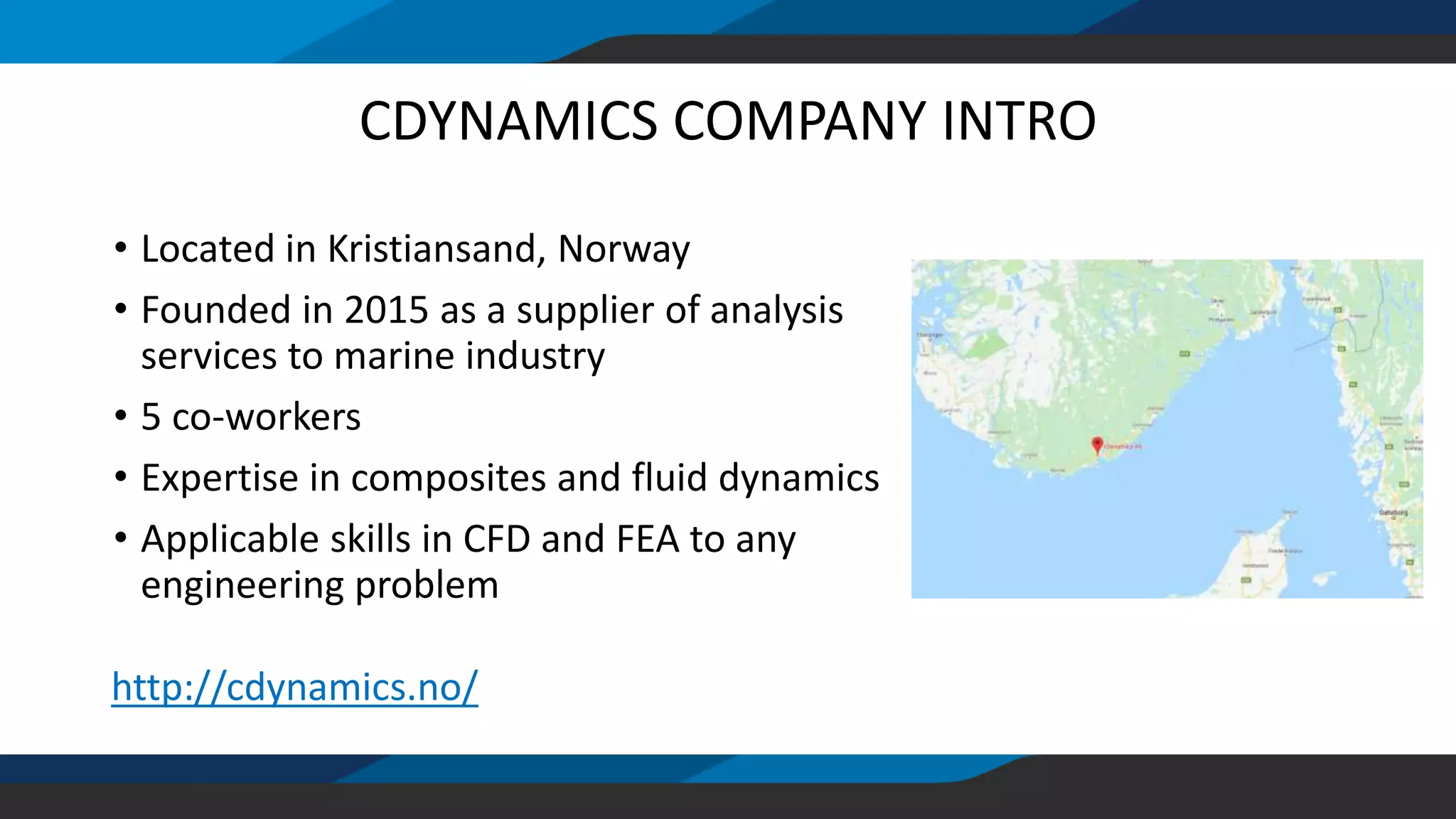
• Located in Kristiansand, Norway
• Founded in 2015 as a supplier of analysis
services to marine industry
• 5 co-workers
• Expertise in composites and fluid dynamics
• Applicable skills in CFD and FEA to any
engineering problem
http://cdynamics.no/
Wavefoil
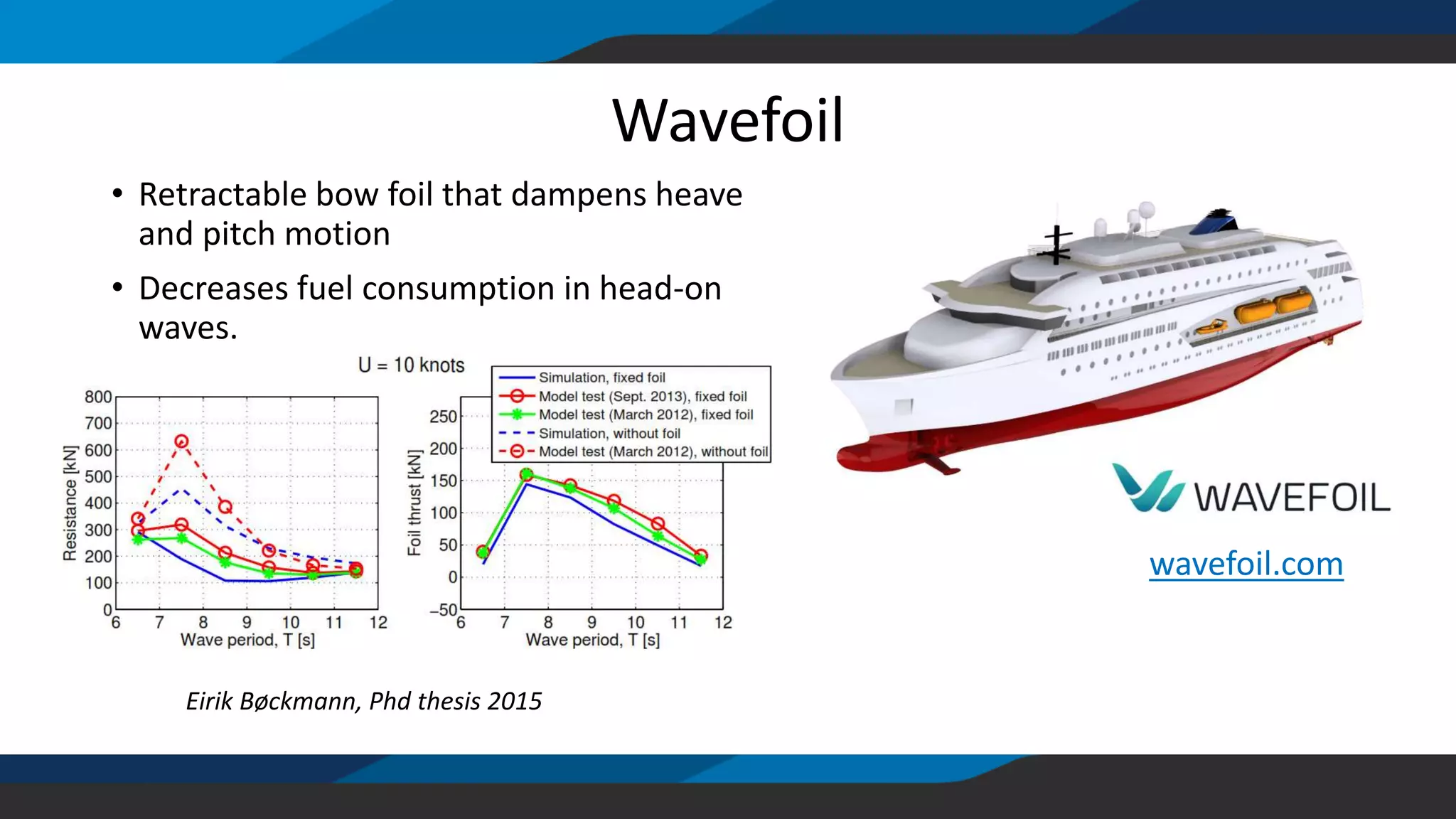
• Retractable bow foil that dampens heave
and pitch motion
• Decreases fuel consumption in head-on
waves.
Eirik Bøckmann, Phd thesis 2015
wavefoil.com
Project objectives
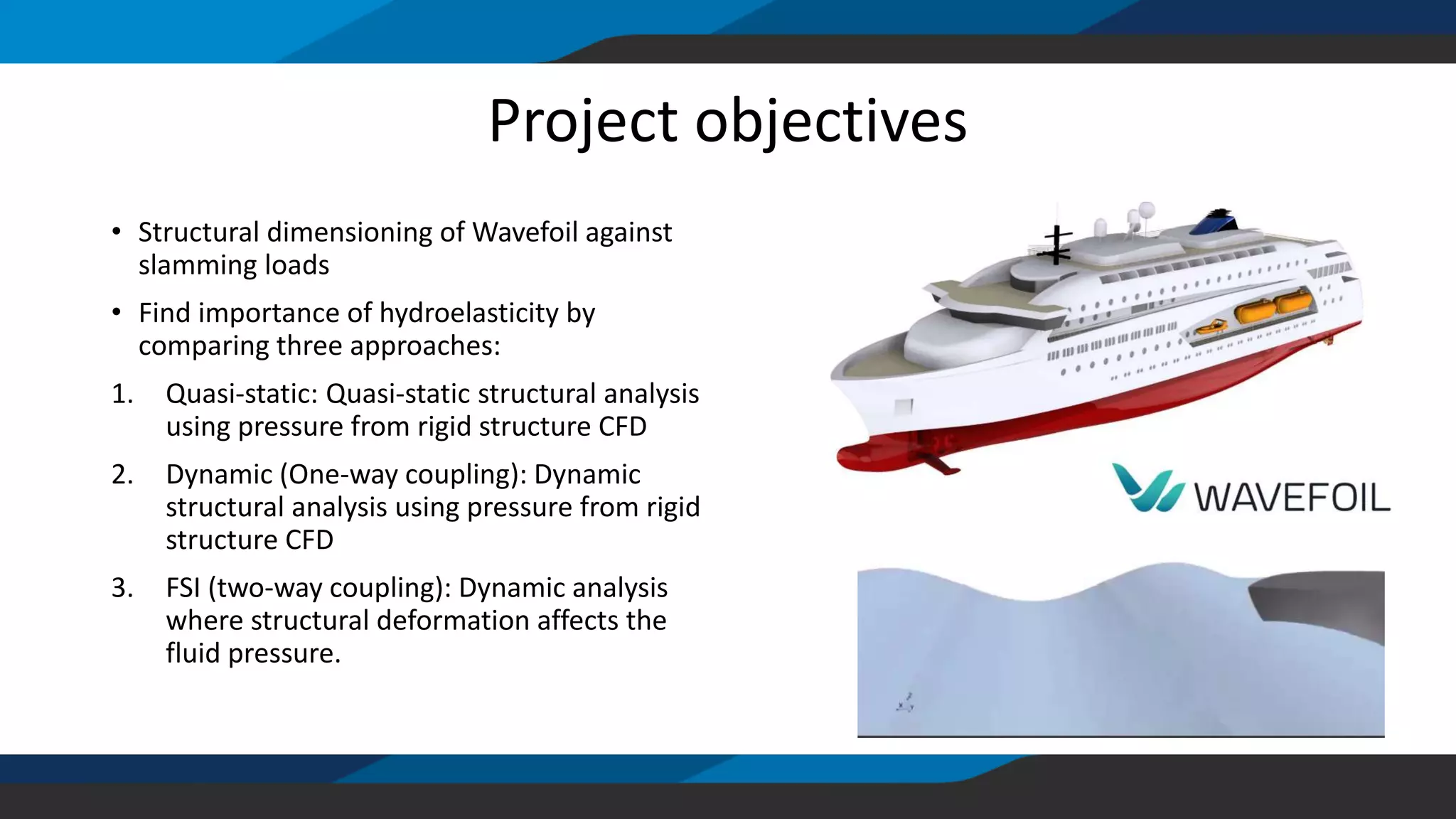
• Structural dimensioning of Wavefoil against
slamming loads
• Find importance of hydroelasticity by
comparing three approaches:
1. Quasi-static: Quasi-static structural analysis
using pressure from rigid structure CFD
2. Dynamic (One-way coupling): Dynamic
structural analysis using pressure from rigid
structure CFD
3. FSI (two-way coupling): Dynamic analysis
where structural deformation affects the
fluid pressure.
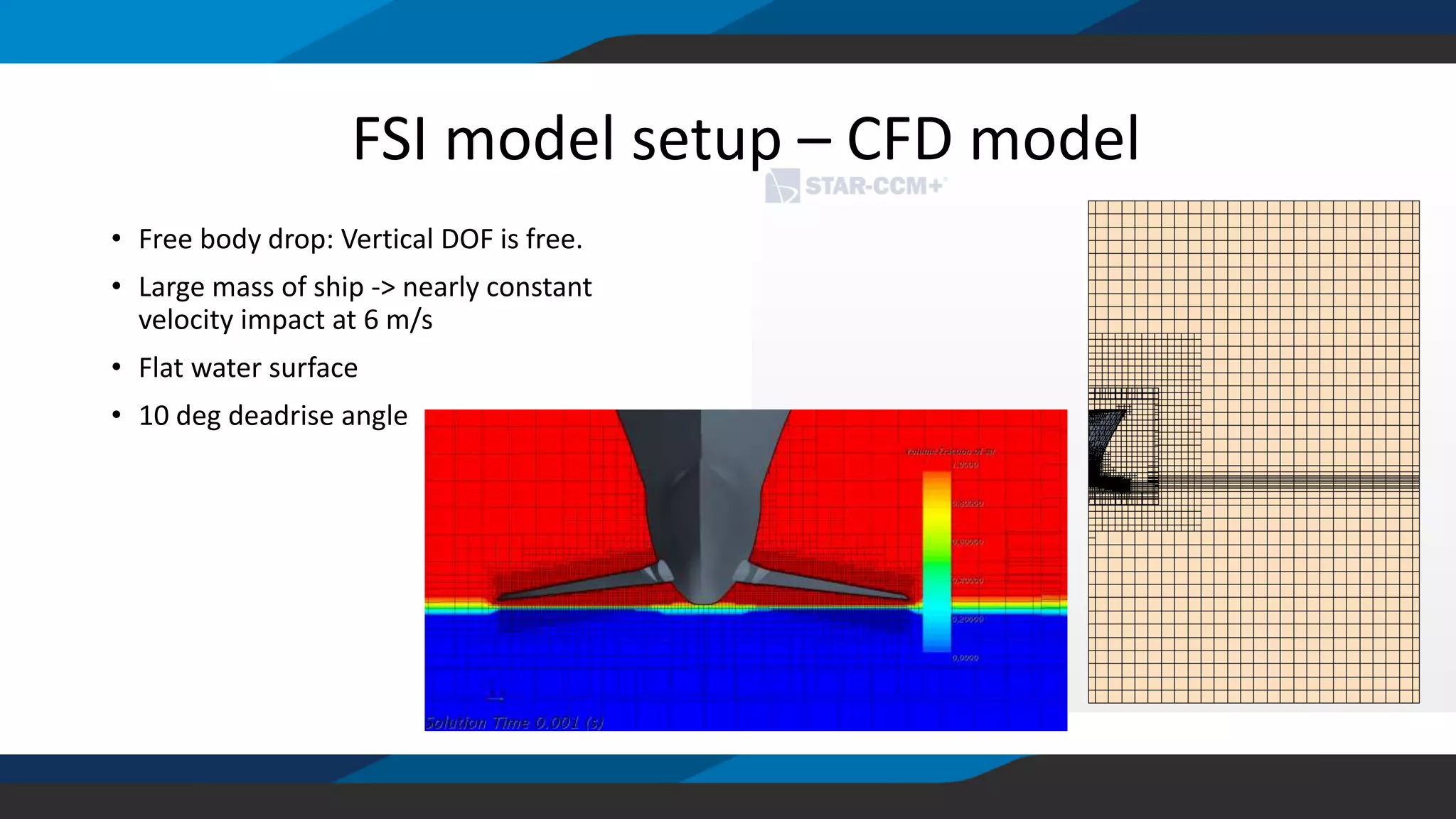
• Free body drop: Vertical DOF is free.
• Large mass of ship -> nearly constant
velocity impact at 6 m/s
• Flat water surface
• 10 deg deadrise angle
FSI model setup – CFD model
Property Value
Software StarCCM+
Timestep 2.5e-5 - 1e-4 s
Cell size at foil 10 mm
Mesh size 500000 cells
Viscous regime Laminar
Co-simulation Implicit
Mesh motion Overset+morphing
Equation of state Compressible (both
air and water)
FSI model setup – CFD model
Time step convergence
0
0.2
0.4
0.6
0.8
1
1.2
0.00E+00 2.00E-05 4.00E-05 6.00E-05 8.00E-05 1.00E-04 1.20E-04
Verticalforce/CFL
Timestep [s]
Vertical force CFL
0.00
0.10
0.20
0.30
0.40
0.50
0.60
0.70
0.80
0.90
1.00
1.10
1.20
0.035 0.037 0.039 0.041 0.043 0.045 0.047
Verticalforce[MN]
Time [s]
dt=1e-4 dt=2.5e-5 dt=1e-5
• CFL < 1 gives sufficient accuracy on forces (average of pressure)
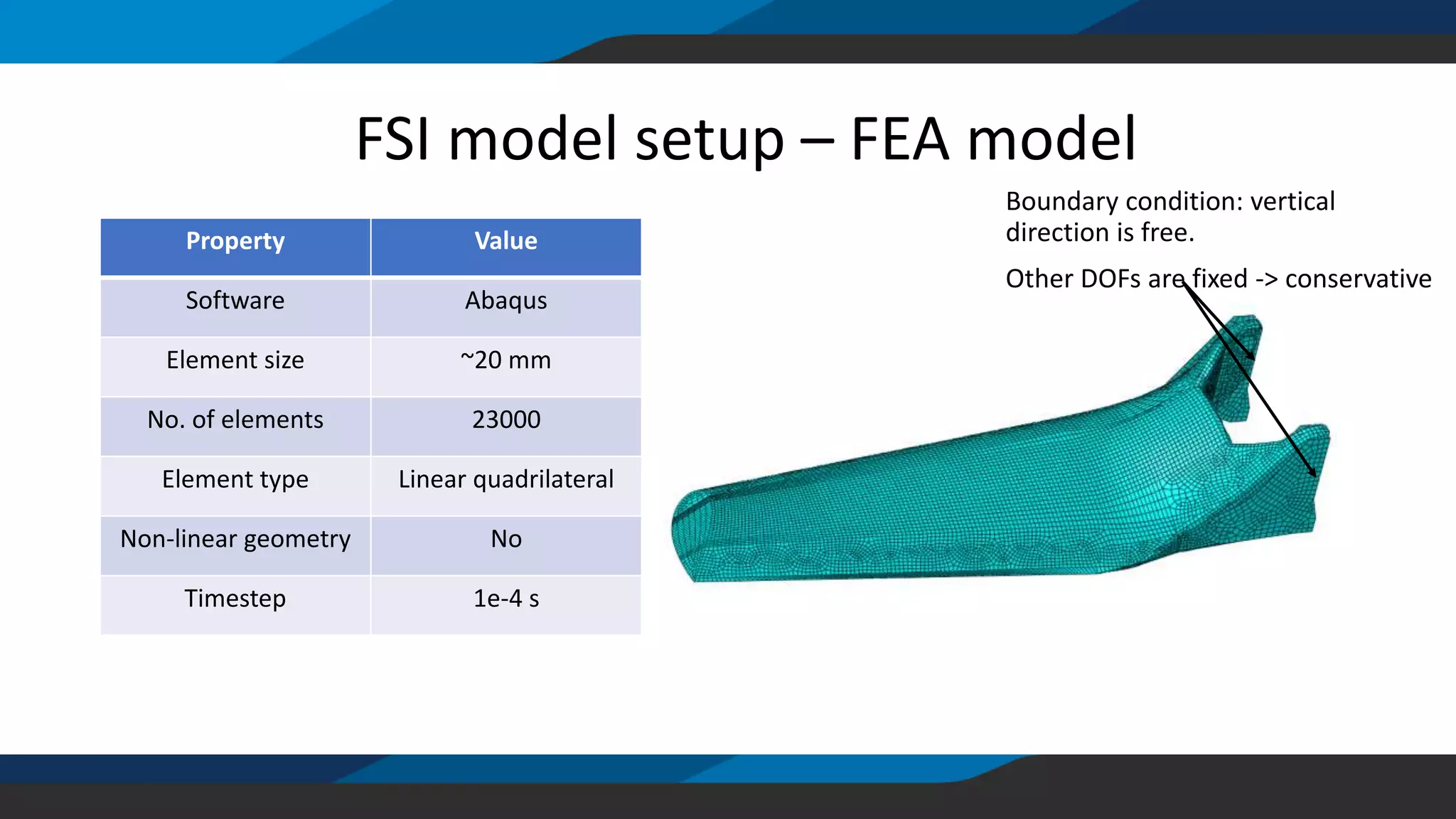
Property Value
Software Abaqus
Element size ~20 mm
No. of elements 23000
Element type Linear quadrilateral
Non-linear geometry No
Timestep 1e-4 s
Boundary condition: vertical
direction is free.
Other DOFs are fixed -> conservative
FSI model setup – FEA model
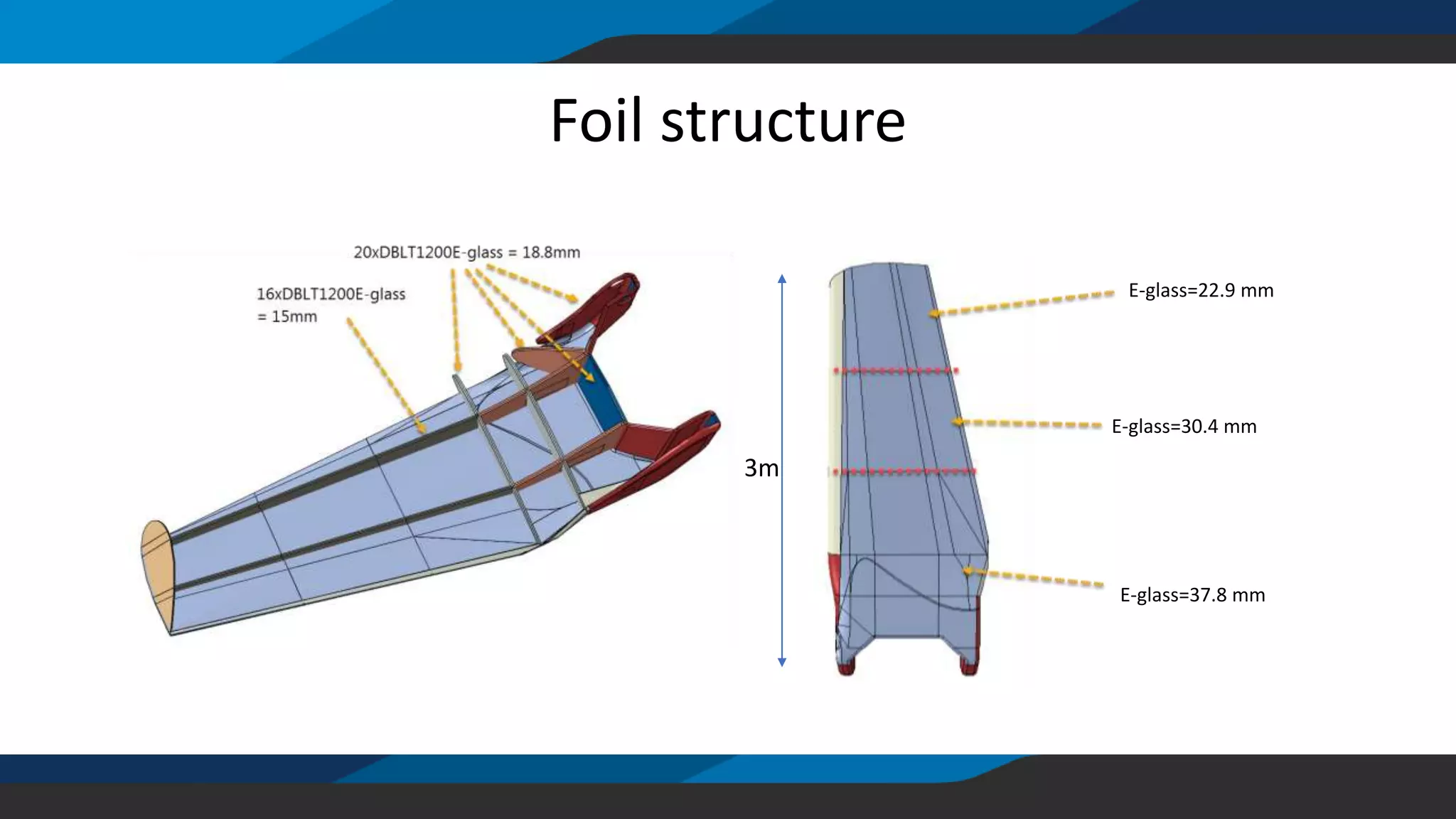
Foil structure
E-glass=22.9 mm
E-glass=30.4 mm
E-glass=37.8 mm
3m
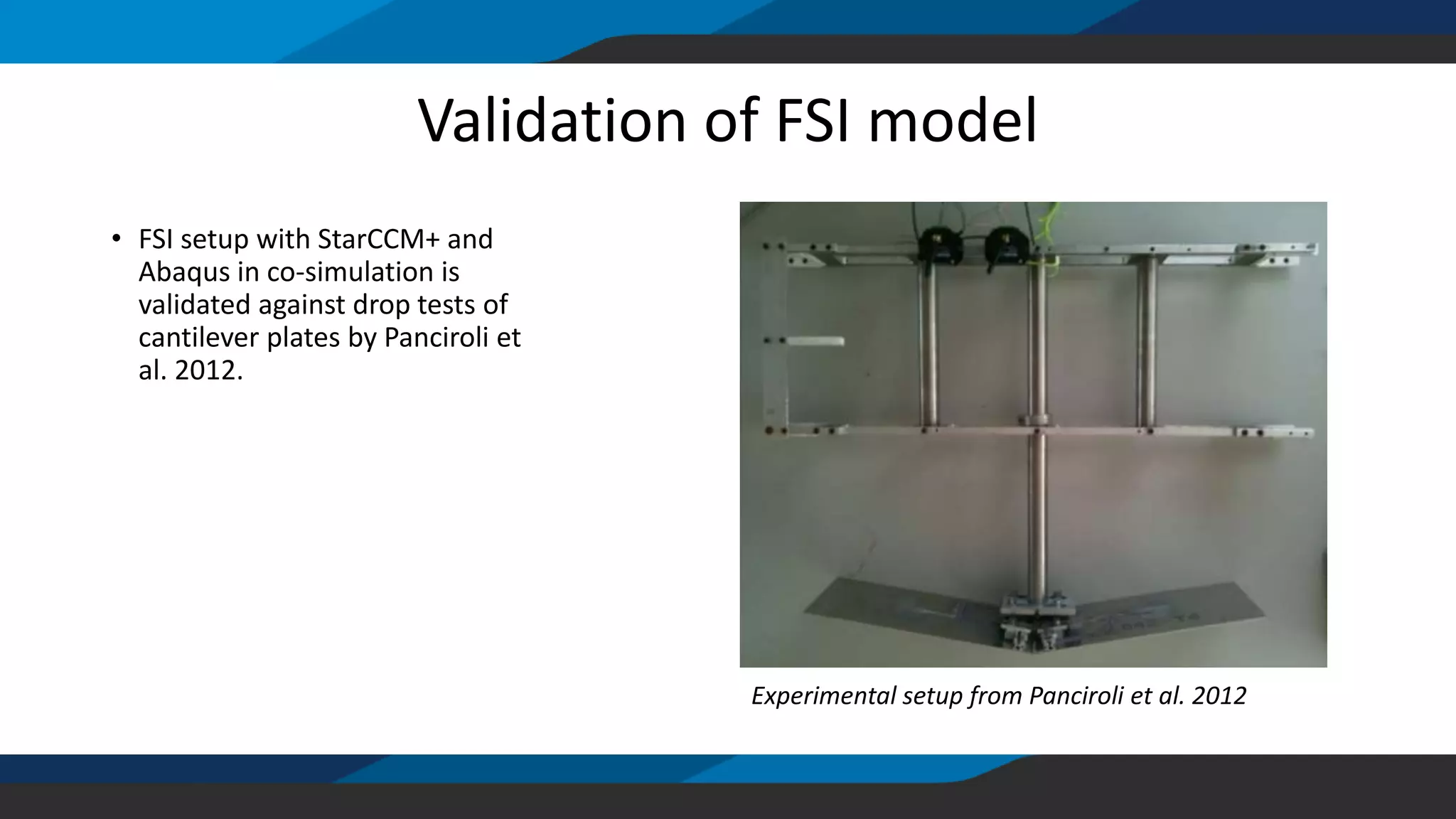
Validation of FSI model
• FSI setup with StarCCM+ and
Abaqus in co-simulation is
validated against drop tests of
cantilever plates by Panciroli et
al. 2012.
Experimental setup from Panciroli et al. 2012
Validation of FSI model
• FSI setup with StarCCM+ and
Abaqus in co-simulation is
validated against drop tests of
cantilever plates by Panciroli et
al. 2012.
Validation of FSI model
Experimental data from Panciroli et al. 2012
-0.002
-0.0015
-0.001
-0.0005
0
0.0005
0.001
0.0015
0.002
0.0025
0 0.01 0.02 0.03 0.04 0.05 0.06 0.07
Strain[%]
Time[s]
FSI (CFD)
Experiment (Panciroli)
• FSI setup with StarCCM+ and
Abaqus in co-simulation is
validated against drop tests of
cantilever plates by Panciroli et
al. 2012.
Results - compressible air effects
• FSI versus quasi-static yields
reduction of bending moment of
50%
• Dynamic vs quasi-static yields
reduction of bending moment of
50%
-0.9
-0.7
-0.5
-0.3
-0.1
0.1
0.3
0.5
0.7
0.9
1.1
1.3
1.5
1.7
1.9
2.1
0.02 0.025 0.03 0.035 0.04 0.045 0.05 0.055 0.06 0.065
Verticalforce[MN]
Time [s]
Quasi-static Quasi-static (incompressible air)
• Compressible air effects are
relevant
• Part of Hull adjacent to foil
needs to be included in CFD
model
• FSI approach renders vertical
force about 40% of quasi-static
• Dynamic approach gives spurious
oscillations because of no
damping
-0.9
-0.7
-0.5
-0.3
-0.1
0.1
0.3
0.5
0.7
0.9
1.1
1.3
1.5
1.7
1.9
2.1
0.02 0.025 0.03 0.035 0.04 0.045 0.05 0.055 0.06 0.065Verticalforce[MN]
Time [s]
Quasi-static FSI Dynamic
Results – vertical force
• FSI bending moment about 40% of
quasi-static
• Dynamic bending moment about
60% of quasi-static
• Incompressible air effects yields
only 10% difference to FSI bending
moment
-0.4
-0.2
0.0
0.2
0.4
0.6
0.8
1.0
1.2
1.4
1.6
1.8
2.0
2.2
2.4
0.02 0.025 0.03 0.035 0.04 0.045 0.05 0.055 0.06 0.065
Bendingmoment[MNm]
Time [s]
Quasi-static FSI (two-way coupling) Dynamic (One-way coupling) FSI (incompressible)
Results – bending moment
Results
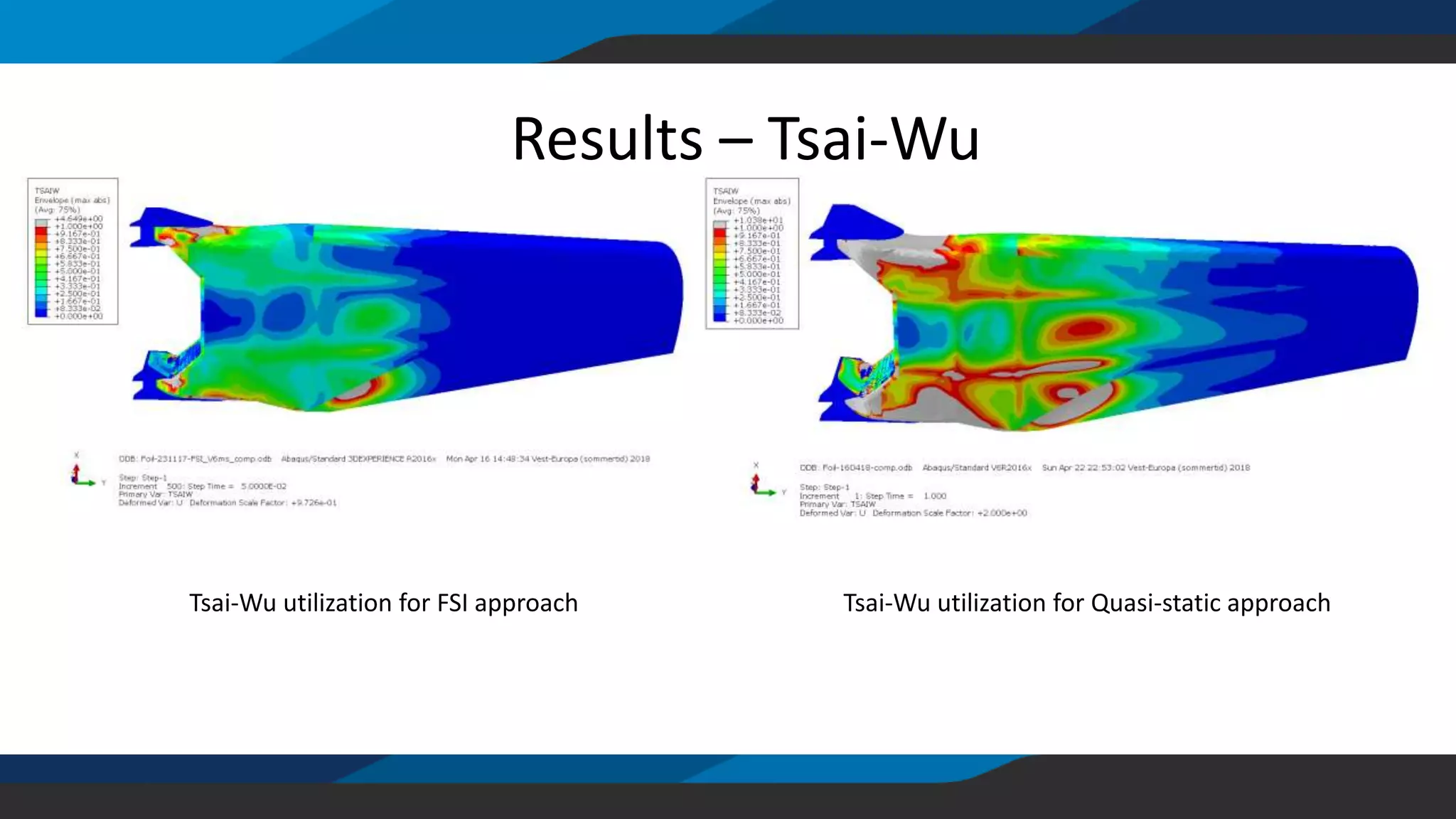
Tsai-Wu utilization for FSI approach Tsai-Wu utilization for Quasi-static approach
Results – Tsai-Wu
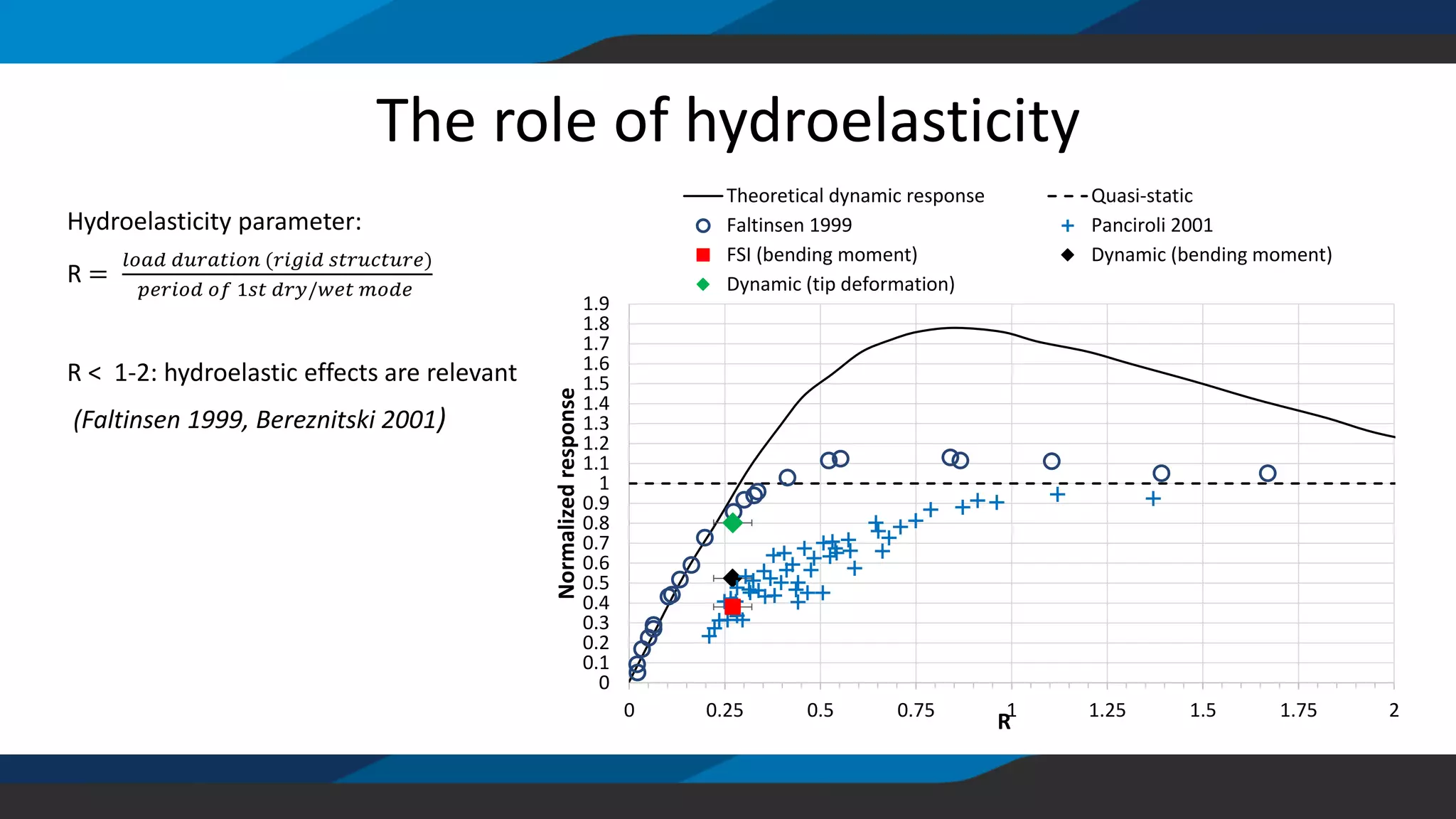
The role of hydroelasticity
Hydroelasticity parameter:
R =
𝑙𝑜𝑎𝑑 𝑑𝑢𝑟𝑎𝑡𝑖𝑜𝑛 (𝑟𝑖𝑔𝑖𝑑 𝑠𝑡𝑟𝑢𝑐𝑡𝑢𝑟𝑒)
𝑝𝑒𝑟𝑖𝑜𝑑 𝑜𝑓 1𝑠𝑡 𝑑𝑟𝑦/𝑤𝑒𝑡 𝑚𝑜𝑑𝑒
R < 1-2: hydroelastic effects are relevant
(Faltinsen 1999, Bereznitski 2001)
0
0.1
0.2
0.3
0.4
0.5
0.6
0.7
0.8
0.9
1
1.1
1.2
1.3
1.4
1.5
1.6
1.7
1.8
1.9
0 0.25 0.5 0.75 1 1.25 1.5 1.75 2
Normalizedresponse
R
Theoretical dynamic response (DAF) Quasi-static
Faltinsen 1999 Panciroli 2001
The role of hydroelasticity
Dry mode 1: 34Hz
Hydroelasticity parameter:
R =
𝑙𝑜𝑎𝑑 𝑑𝑢𝑟𝑎𝑡𝑖𝑜𝑛 (𝑟𝑖𝑔𝑖𝑑 𝑠𝑡𝑟𝑢𝑐𝑡𝑢𝑟𝑒)
𝑝𝑒𝑟𝑖𝑜𝑑 𝑜𝑓 1𝑠𝑡 𝑑𝑟𝑦/𝑤𝑒𝑡 𝑚𝑜𝑑𝑒
R < 1-2: hydroelastic effects are relevant
(Faltinsen 1999, Bereznitski 2001)
The role of hydroelasticity
-0.9
-0.7
-0.5
-0.3
-0.1
0.1
0.3
0.5
0.7
0.9
1.1
1.3
1.5
1.7
1.9
2.1
0.02 0.022 0.024 0.026 0.028 0.03 0.032 0.034 0.036 0.038 0.04 0.042 0.044 0.046 0.048 0.05 0.052 0.054 0.056 0.058 0.06 0.062 0.064
Verticalforce[MN]
Time [s]
Quasi-static
Duration=5-10 ms
R=0.2-0.3
Hydroelasticity parameter:
R =
𝑙𝑜𝑎𝑑 𝑑𝑢𝑟𝑎𝑡𝑖𝑜𝑛 (𝑟𝑖𝑔𝑖𝑑 𝑠𝑡𝑟𝑢𝑐𝑡𝑢𝑟𝑒)
𝑝𝑒𝑟𝑖𝑜𝑑 𝑜𝑓 1𝑠𝑡 𝑑𝑟𝑦/𝑤𝑒𝑡 𝑚𝑜𝑑𝑒
R < 1-2: hydroelastic effects are relevant
(Faltinsen 1999, Bereznitski 2001)
The role of hydroelasticity
0
0.1
0.2
0.3
0.4
0.5
0.6
0.7
0.8
0.9
1
1.1
1.2
1.3
1.4
1.5
1.6
1.7
1.8
1.9
0 0.25 0.5 0.75 1 1.25 1.5 1.75 2
Normalizedresponse
R
Theoretical dynamic response Quasi-static
Faltinsen 1999 Panciroli 2001
FSI (bending moment) Dynamic (bending moment)
Dynamic (tip deformation)
Hydroelasticity parameter:
R =
𝑙𝑜𝑎𝑑 𝑑𝑢𝑟𝑎𝑡𝑖𝑜𝑛 (𝑟𝑖𝑔𝑖𝑑 𝑠𝑡𝑟𝑢𝑐𝑡𝑢𝑟𝑒)
𝑝𝑒𝑟𝑖𝑜𝑑 𝑜𝑓 1𝑠𝑡 𝑑𝑟𝑦/𝑤𝑒𝑡 𝑚𝑜𝑑𝑒
R < 1-2: hydroelastic effects are relevant
(Faltinsen 1999, Bereznitski 2001)
Conclusions
• FSI and dynamic analysis of Wavefoil yield considerable
reduction in laminate utilization compared to quasi-static
analysis ->
– Lighter structure
– Easier production
• Compressible air effects are only minor in FSI approach
• Dynamic approach can be a good trade-off between CPU
time/cost and accuracy
THANK YOU FOR YOUR TIME
MARINE || COMPOSITES || RENEWABLES || SUBSEA
post@cdynamics.Contact

cDynamics AS NAFEMS Nordic 2018 Presentation

  • 1.
    Fluid-Structure Interaction Analysis ofComposite Bow Foil MARINE || COMPOSITES || RENEWABLES || SUBSEA
  • 2.
    CDYNAMICS COMPANY INTRO •Located in Kristiansand, Norway • Founded in 2015 as a supplier of analysis services to marine industry • 5 co-workers • Expertise in composites and fluid dynamics • Applicable skills in CFD and FEA to any engineering problem http://cdynamics.no/
  • 3.
    Wavefoil • Retractable bowfoil that dampens heave and pitch motion • Decreases fuel consumption in head-on waves. Eirik Bøckmann, Phd thesis 2015 wavefoil.com
  • 4.
    Project objectives • Structuraldimensioning of Wavefoil against slamming loads • Find importance of hydroelasticity by comparing three approaches: 1. Quasi-static: Quasi-static structural analysis using pressure from rigid structure CFD 2. Dynamic (One-way coupling): Dynamic structural analysis using pressure from rigid structure CFD 3. FSI (two-way coupling): Dynamic analysis where structural deformation affects the fluid pressure.
  • 5.
    • Free bodydrop: Vertical DOF is free. • Large mass of ship -> nearly constant velocity impact at 6 m/s • Flat water surface • 10 deg deadrise angle FSI model setup – CFD model
  • 6.
    Property Value Software StarCCM+ Timestep2.5e-5 - 1e-4 s Cell size at foil 10 mm Mesh size 500000 cells Viscous regime Laminar Co-simulation Implicit Mesh motion Overset+morphing Equation of state Compressible (both air and water) FSI model setup – CFD model
  • 7.
    Time step convergence 0 0.2 0.4 0.6 0.8 1 1.2 0.00E+002.00E-05 4.00E-05 6.00E-05 8.00E-05 1.00E-04 1.20E-04 Verticalforce/CFL Timestep [s] Vertical force CFL 0.00 0.10 0.20 0.30 0.40 0.50 0.60 0.70 0.80 0.90 1.00 1.10 1.20 0.035 0.037 0.039 0.041 0.043 0.045 0.047 Verticalforce[MN] Time [s] dt=1e-4 dt=2.5e-5 dt=1e-5 • CFL < 1 gives sufficient accuracy on forces (average of pressure)
  • 8.
    Property Value Software Abaqus Elementsize ~20 mm No. of elements 23000 Element type Linear quadrilateral Non-linear geometry No Timestep 1e-4 s Boundary condition: vertical direction is free. Other DOFs are fixed -> conservative FSI model setup – FEA model
  • 9.
  • 10.
    Validation of FSImodel • FSI setup with StarCCM+ and Abaqus in co-simulation is validated against drop tests of cantilever plates by Panciroli et al. 2012. Experimental setup from Panciroli et al. 2012
  • 11.
    Validation of FSImodel • FSI setup with StarCCM+ and Abaqus in co-simulation is validated against drop tests of cantilever plates by Panciroli et al. 2012.
  • 12.
    Validation of FSImodel Experimental data from Panciroli et al. 2012 -0.002 -0.0015 -0.001 -0.0005 0 0.0005 0.001 0.0015 0.002 0.0025 0 0.01 0.02 0.03 0.04 0.05 0.06 0.07 Strain[%] Time[s] FSI (CFD) Experiment (Panciroli) • FSI setup with StarCCM+ and Abaqus in co-simulation is validated against drop tests of cantilever plates by Panciroli et al. 2012.
  • 13.
    Results - compressibleair effects • FSI versus quasi-static yields reduction of bending moment of 50% • Dynamic vs quasi-static yields reduction of bending moment of 50% -0.9 -0.7 -0.5 -0.3 -0.1 0.1 0.3 0.5 0.7 0.9 1.1 1.3 1.5 1.7 1.9 2.1 0.02 0.025 0.03 0.035 0.04 0.045 0.05 0.055 0.06 0.065 Verticalforce[MN] Time [s] Quasi-static Quasi-static (incompressible air) • Compressible air effects are relevant • Part of Hull adjacent to foil needs to be included in CFD model
  • 14.
    • FSI approachrenders vertical force about 40% of quasi-static • Dynamic approach gives spurious oscillations because of no damping -0.9 -0.7 -0.5 -0.3 -0.1 0.1 0.3 0.5 0.7 0.9 1.1 1.3 1.5 1.7 1.9 2.1 0.02 0.025 0.03 0.035 0.04 0.045 0.05 0.055 0.06 0.065Verticalforce[MN] Time [s] Quasi-static FSI Dynamic Results – vertical force
  • 15.
    • FSI bendingmoment about 40% of quasi-static • Dynamic bending moment about 60% of quasi-static • Incompressible air effects yields only 10% difference to FSI bending moment -0.4 -0.2 0.0 0.2 0.4 0.6 0.8 1.0 1.2 1.4 1.6 1.8 2.0 2.2 2.4 0.02 0.025 0.03 0.035 0.04 0.045 0.05 0.055 0.06 0.065 Bendingmoment[MNm] Time [s] Quasi-static FSI (two-way coupling) Dynamic (One-way coupling) FSI (incompressible) Results – bending moment
  • 16.
  • 17.
    Tsai-Wu utilization forFSI approach Tsai-Wu utilization for Quasi-static approach Results – Tsai-Wu
  • 18.
    The role ofhydroelasticity Hydroelasticity parameter: R = 𝑙𝑜𝑎𝑑 𝑑𝑢𝑟𝑎𝑡𝑖𝑜𝑛 (𝑟𝑖𝑔𝑖𝑑 𝑠𝑡𝑟𝑢𝑐𝑡𝑢𝑟𝑒) 𝑝𝑒𝑟𝑖𝑜𝑑 𝑜𝑓 1𝑠𝑡 𝑑𝑟𝑦/𝑤𝑒𝑡 𝑚𝑜𝑑𝑒 R < 1-2: hydroelastic effects are relevant (Faltinsen 1999, Bereznitski 2001) 0 0.1 0.2 0.3 0.4 0.5 0.6 0.7 0.8 0.9 1 1.1 1.2 1.3 1.4 1.5 1.6 1.7 1.8 1.9 0 0.25 0.5 0.75 1 1.25 1.5 1.75 2 Normalizedresponse R Theoretical dynamic response (DAF) Quasi-static Faltinsen 1999 Panciroli 2001
  • 19.
    The role ofhydroelasticity Dry mode 1: 34Hz Hydroelasticity parameter: R = 𝑙𝑜𝑎𝑑 𝑑𝑢𝑟𝑎𝑡𝑖𝑜𝑛 (𝑟𝑖𝑔𝑖𝑑 𝑠𝑡𝑟𝑢𝑐𝑡𝑢𝑟𝑒) 𝑝𝑒𝑟𝑖𝑜𝑑 𝑜𝑓 1𝑠𝑡 𝑑𝑟𝑦/𝑤𝑒𝑡 𝑚𝑜𝑑𝑒 R < 1-2: hydroelastic effects are relevant (Faltinsen 1999, Bereznitski 2001)
  • 20.
    The role ofhydroelasticity -0.9 -0.7 -0.5 -0.3 -0.1 0.1 0.3 0.5 0.7 0.9 1.1 1.3 1.5 1.7 1.9 2.1 0.02 0.022 0.024 0.026 0.028 0.03 0.032 0.034 0.036 0.038 0.04 0.042 0.044 0.046 0.048 0.05 0.052 0.054 0.056 0.058 0.06 0.062 0.064 Verticalforce[MN] Time [s] Quasi-static Duration=5-10 ms R=0.2-0.3 Hydroelasticity parameter: R = 𝑙𝑜𝑎𝑑 𝑑𝑢𝑟𝑎𝑡𝑖𝑜𝑛 (𝑟𝑖𝑔𝑖𝑑 𝑠𝑡𝑟𝑢𝑐𝑡𝑢𝑟𝑒) 𝑝𝑒𝑟𝑖𝑜𝑑 𝑜𝑓 1𝑠𝑡 𝑑𝑟𝑦/𝑤𝑒𝑡 𝑚𝑜𝑑𝑒 R < 1-2: hydroelastic effects are relevant (Faltinsen 1999, Bereznitski 2001)
  • 21.
    The role ofhydroelasticity 0 0.1 0.2 0.3 0.4 0.5 0.6 0.7 0.8 0.9 1 1.1 1.2 1.3 1.4 1.5 1.6 1.7 1.8 1.9 0 0.25 0.5 0.75 1 1.25 1.5 1.75 2 Normalizedresponse R Theoretical dynamic response Quasi-static Faltinsen 1999 Panciroli 2001 FSI (bending moment) Dynamic (bending moment) Dynamic (tip deformation) Hydroelasticity parameter: R = 𝑙𝑜𝑎𝑑 𝑑𝑢𝑟𝑎𝑡𝑖𝑜𝑛 (𝑟𝑖𝑔𝑖𝑑 𝑠𝑡𝑟𝑢𝑐𝑡𝑢𝑟𝑒) 𝑝𝑒𝑟𝑖𝑜𝑑 𝑜𝑓 1𝑠𝑡 𝑑𝑟𝑦/𝑤𝑒𝑡 𝑚𝑜𝑑𝑒 R < 1-2: hydroelastic effects are relevant (Faltinsen 1999, Bereznitski 2001)
  • 22.
    Conclusions • FSI anddynamic analysis of Wavefoil yield considerable reduction in laminate utilization compared to quasi-static analysis -> – Lighter structure – Easier production • Compressible air effects are only minor in FSI approach • Dynamic approach can be a good trade-off between CPU time/cost and accuracy
  • 23.
    THANK YOU FORYOUR TIME MARINE || COMPOSITES || RENEWABLES || SUBSEA post@cdynamics.Contact