Publishing data on the
Web
Bernadette Farias Lóscio and Caroline Burle
 Data on the Web
 Linked Data
 Open Data
 Big Data, Open Data and Data on the Web
 Data on the Web lifecycle
 DWBP: Challenges and Benefits
 Questions and comments
Topics to be discussed
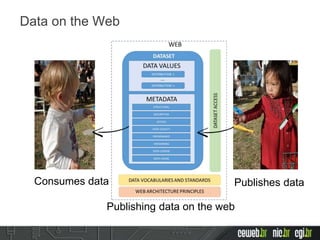
Data on the Web
Consumes data Publishes data
Publishing data on the web
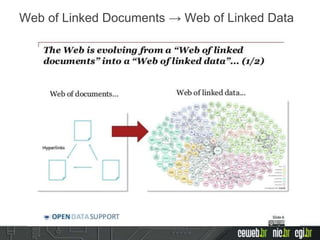
Web of Linked Documents → Web of Linked Data
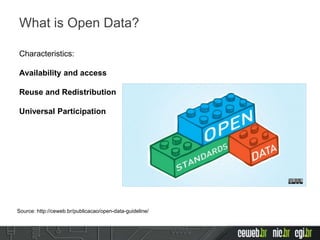
Characteristics:
Availability and access
Reuse and Redistribution
Universal Participation
What is Open Data?
Source: http://ceweb.br/publicacao/open-data-guideline/
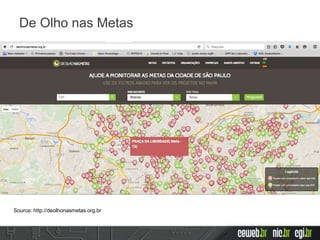
De Olho nas Metas
Source: http://deolhonasmetas.org.br
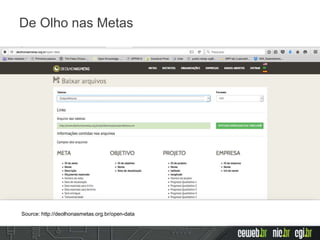
De Olho nas Metas
Source: http://deolhonasmetas.org.br/open-data
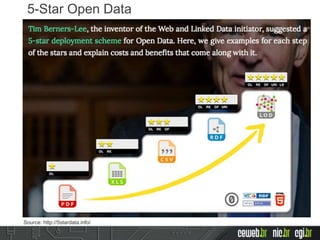
Source: http://5stardata.info/
5-Star Open Data
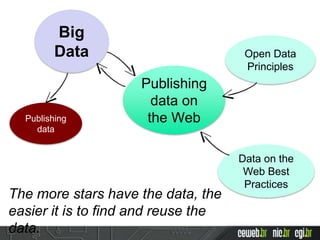
Big
Data
Publishing
data on
the Web
Open Data
Principles
Data on the
Web Best
Practices
The more stars have the data, the
easier it is to find and reuse the
data.
Publishing
data
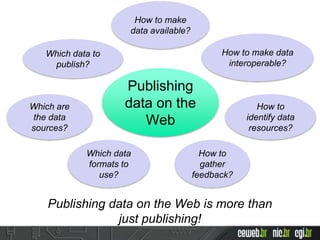
Publishing
data on the
Web
Which data to
publish?
Publishing data on the Web is more than
just publishing!
Which are
the data
sources?
Which data
formats to
use?
How to make
data available?
How to make data
interoperable?
How to
identify data
resources?
How to
gather
feedback?
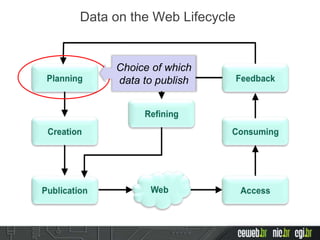
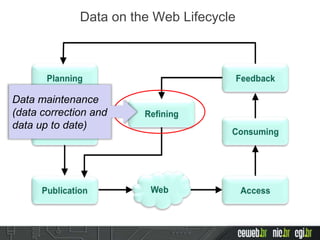
Data on the Web Lifecycle
Choice of which
data to publish
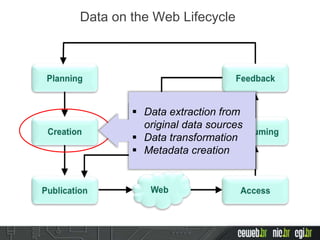
Data on the Web Lifecycle
 Data extraction from
original data sources
 Data transformation
 Metadata creation
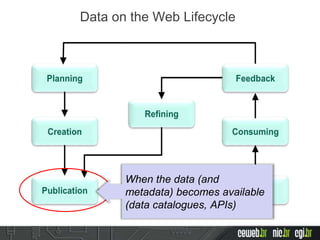
Data on the Web Lifecycle
When the data (and
metadata) becomes available
(data catalogues, APIs)
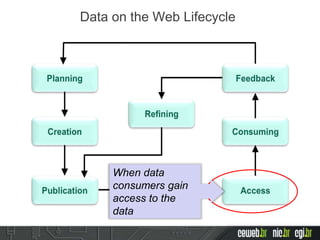
Data on the Web Lifecycle
When data
consumers gain
access to the
data
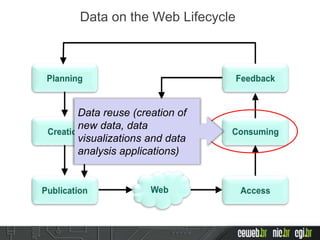
Data on the Web Lifecycle
Data reuse (creation of
new data, data
visualizations and data
analysis applications)
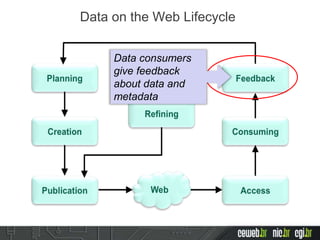
Data on the Web Lifecycle
Data consumers
give feedback
about data and
metadata
Data on the Web Lifecycle
Data maintenance
(data correction and
data up to date)
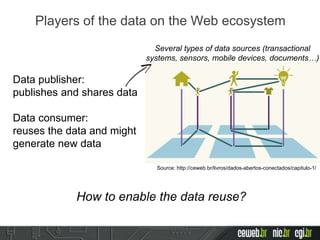
Data publisher:
publishes and shares data
Data consumer:
reuses the data and might
generate new data
Players of the data on the Web ecosystem
Source: http://ceweb.br/livros/dados-abertos-conectados/capitulo-1/
Several types of data sources (transactional
systems, sensors, mobile devices, documents…)
How to enable the data reuse?
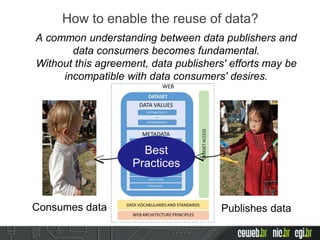
How to enable the reuse of data?
A common understanding between data publishers and
data consumers becomes fundamental.
Without this agreement, data publishers' efforts may be
incompatible with data consumers' desires.
Consumes data Publishes data
Best
Practices
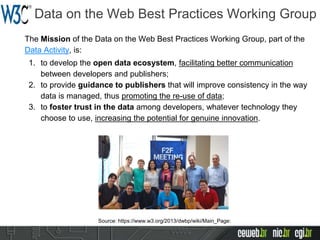
Data on the Web Best Practices Working Group
The Mission of the Data on the Web Best Practices Working Group, part of the
Data Activity, is:
1. to develop the open data ecosystem, facilitating better communication
between developers and publishers;
2. to provide guidance to publishers that will improve consistency in the way
data is managed, thus promoting the re-use of data;
3. to foster trust in the data among developers, whatever technology they
choose to use, increasing the potential for genuine innovation.
Source: https://www.w3.org/2013/dwbp/wiki/Main_Page:
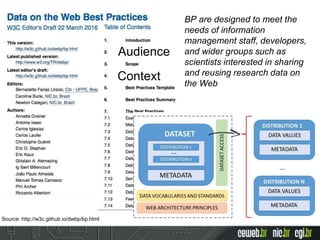
Source: http://w3c.github.io/dwbp/bp.html
Context
Audience
BP are designed to meet the
needs of information
management staff, developers,
and wider groups such as
scientists interested in sharing
and reusing research data on
the Web
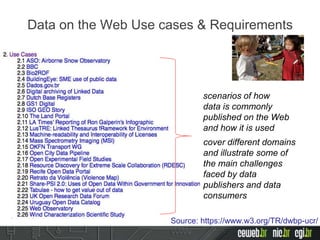
Data on the Web Use cases & Requirements
Source: https://www.w3.org/TR/dwbp-ucr/
scenarios of how
data is commonly
published on the Web
and how it is used
cover different domains
and illustrate some of
the main challenges
faced by data
publishers and data
consumers
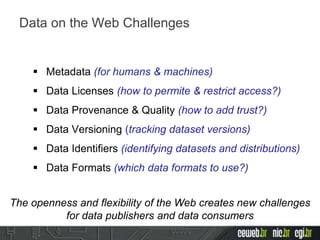
 Metadata (for humans & machines)
 Data Licenses (how to permite & restrict access?)
 Data Provenance & Quality (how to add trust?)
 Data Versioning (tracking dataset versions)
 Data Identifiers (identifying datasets and distributions)
 Data Formats (which data formats to use?)
Data on the Web Challenges
The openness and flexibility of the Web creates new challenges
for data publishers and data consumers
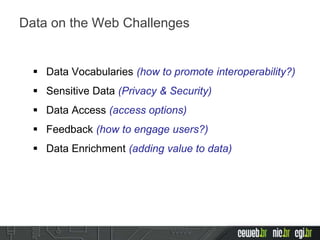
 Data Vocabularies (how to promote interoperability?)
 Sensitive Data (Privacy & Security)
 Data Access (access options)
 Feedback (how to engage users?)
 Data Enrichment (adding value to data)
Data on the Web Challenges
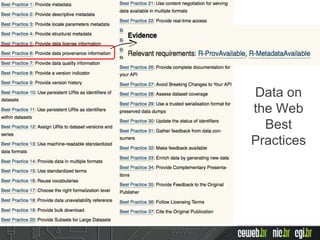
Data on
the Web
Best
Practices
Source: http://w3c.github.io/dwbp/bp.html#challenges
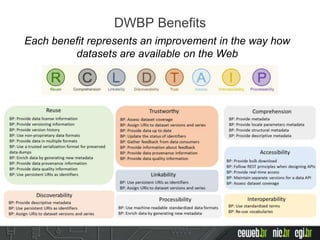
DWBP Benefits
Each benefit represents an improvement in the way how
datasets are available on the Web
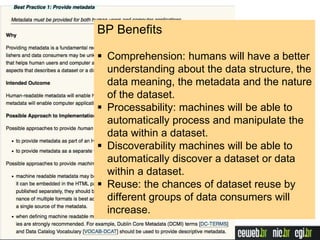
BP Benefits
 Comprehension: humans will have a better
understanding about the data structure, the
data meaning, the metadata and the nature
of the dataset.
 Processability: machines will be able to
automatically process and manipulate the
data within a dataset.
 Discoverability machines will be able to
automatically discover a dataset or data
within a dataset.
 Reuse: the chances of dataset reuse by
different groups of data consumers will
increase.
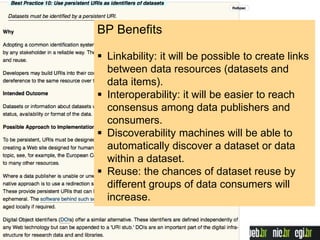
BP Benefits
 Linkability: it will be possible to create links
between data resources (datasets and
data items).
 Interoperability: it will be easier to reach
consensus among data publishers and
consumers.
 Discoverability machines will be able to
automatically discover a dataset or data
within a dataset.
 Reuse: the chances of dataset reuse by
different groups of data consumers will
increase.
Data on the Web Best Practices
1. They are still being developed
2. Publication of the next draft as Candidate
Recommendation - April 2016
3. Publication as recommendation - July 2016
4. Feedback is welcome! :)
https://www.w3.org/TR/dwbp/
Obrigada!
www.ceweb.br
cburle@nic.br @carolburle
April 12th, 2016
bfl@cin.ufpe.br @bernafarias

Publishing Data on the Web

  • 1.
    Publishing data onthe Web Bernadette Farias Lóscio and Caroline Burle
  • 3.
     Data onthe Web  Linked Data  Open Data  Big Data, Open Data and Data on the Web  Data on the Web lifecycle  DWBP: Challenges and Benefits  Questions and comments Topics to be discussed
  • 4.
    Data on theWeb Consumes data Publishes data Publishing data on the web
  • 5.
    Web of LinkedDocuments → Web of Linked Data
  • 6.
    Characteristics: Availability and access Reuseand Redistribution Universal Participation What is Open Data? Source: http://ceweb.br/publicacao/open-data-guideline/
  • 7.
    De Olho nasMetas Source: http://deolhonasmetas.org.br
  • 8.
    De Olho nasMetas Source: http://deolhonasmetas.org.br/open-data
  • 9.
  • 10.
    Big Data Publishing data on the Web OpenData Principles Data on the Web Best Practices The more stars have the data, the easier it is to find and reuse the data. Publishing data
  • 11.
    Publishing data on the Web Whichdata to publish? Publishing data on the Web is more than just publishing! Which are the data sources? Which data formats to use? How to make data available? How to make data interoperable? How to identify data resources? How to gather feedback?
  • 12.
    Data on theWeb Lifecycle Choice of which data to publish
  • 13.
    Data on theWeb Lifecycle  Data extraction from original data sources  Data transformation  Metadata creation
  • 14.
    Data on theWeb Lifecycle When the data (and metadata) becomes available (data catalogues, APIs)
  • 15.
    Data on theWeb Lifecycle When data consumers gain access to the data
  • 16.
    Data on theWeb Lifecycle Data reuse (creation of new data, data visualizations and data analysis applications)
  • 17.
    Data on theWeb Lifecycle Data consumers give feedback about data and metadata
  • 18.
    Data on theWeb Lifecycle Data maintenance (data correction and data up to date)
  • 19.
    Data publisher: publishes andshares data Data consumer: reuses the data and might generate new data Players of the data on the Web ecosystem Source: http://ceweb.br/livros/dados-abertos-conectados/capitulo-1/ Several types of data sources (transactional systems, sensors, mobile devices, documents…) How to enable the data reuse?
  • 20.
    How to enablethe reuse of data? A common understanding between data publishers and data consumers becomes fundamental. Without this agreement, data publishers' efforts may be incompatible with data consumers' desires. Consumes data Publishes data Best Practices
  • 21.
    Data on theWeb Best Practices Working Group The Mission of the Data on the Web Best Practices Working Group, part of the Data Activity, is: 1. to develop the open data ecosystem, facilitating better communication between developers and publishers; 2. to provide guidance to publishers that will improve consistency in the way data is managed, thus promoting the re-use of data; 3. to foster trust in the data among developers, whatever technology they choose to use, increasing the potential for genuine innovation. Source: https://www.w3.org/2013/dwbp/wiki/Main_Page:
  • 22.
    Source: http://w3c.github.io/dwbp/bp.html Context Audience BP aredesigned to meet the needs of information management staff, developers, and wider groups such as scientists interested in sharing and reusing research data on the Web
  • 23.
    Data on theWeb Use cases & Requirements Source: https://www.w3.org/TR/dwbp-ucr/ scenarios of how data is commonly published on the Web and how it is used cover different domains and illustrate some of the main challenges faced by data publishers and data consumers
  • 24.
     Metadata (forhumans & machines)  Data Licenses (how to permite & restrict access?)  Data Provenance & Quality (how to add trust?)  Data Versioning (tracking dataset versions)  Data Identifiers (identifying datasets and distributions)  Data Formats (which data formats to use?) Data on the Web Challenges The openness and flexibility of the Web creates new challenges for data publishers and data consumers
  • 25.
     Data Vocabularies(how to promote interoperability?)  Sensitive Data (Privacy & Security)  Data Access (access options)  Feedback (how to engage users?)  Data Enrichment (adding value to data) Data on the Web Challenges
  • 26.
    Data on the Web Best Practices Source:http://w3c.github.io/dwbp/bp.html#challenges
  • 27.
    DWBP Benefits Each benefitrepresents an improvement in the way how datasets are available on the Web
  • 28.
    BP Benefits  Comprehension:humans will have a better understanding about the data structure, the data meaning, the metadata and the nature of the dataset.  Processability: machines will be able to automatically process and manipulate the data within a dataset.  Discoverability machines will be able to automatically discover a dataset or data within a dataset.  Reuse: the chances of dataset reuse by different groups of data consumers will increase.
  • 29.
    BP Benefits  Linkability:it will be possible to create links between data resources (datasets and data items).  Interoperability: it will be easier to reach consensus among data publishers and consumers.  Discoverability machines will be able to automatically discover a dataset or data within a dataset.  Reuse: the chances of dataset reuse by different groups of data consumers will increase.
  • 30.
    Data on theWeb Best Practices 1. They are still being developed 2. Publication of the next draft as Candidate Recommendation - April 2016 3. Publication as recommendation - July 2016 4. Feedback is welcome! :) https://www.w3.org/TR/dwbp/
  • 31.