AppNexus
Infrastructure for a Connected World
Contents
• Founders
• Why AppNexus?
• Differentiation / Competitive Analysis
• Timeline
• Financials
Founders
• Brian O’Kelley, CEO - former CTO of Right Media.
Invented, built, sold, and launched the Right Media
Exchange. Scaled the RM environment from 10 to
1500 servers and felt the pain of not having
AppNexus.
• Michiel Nolet,VP of Product - former Director of
Analytics at Right Media.
Why AppNexus
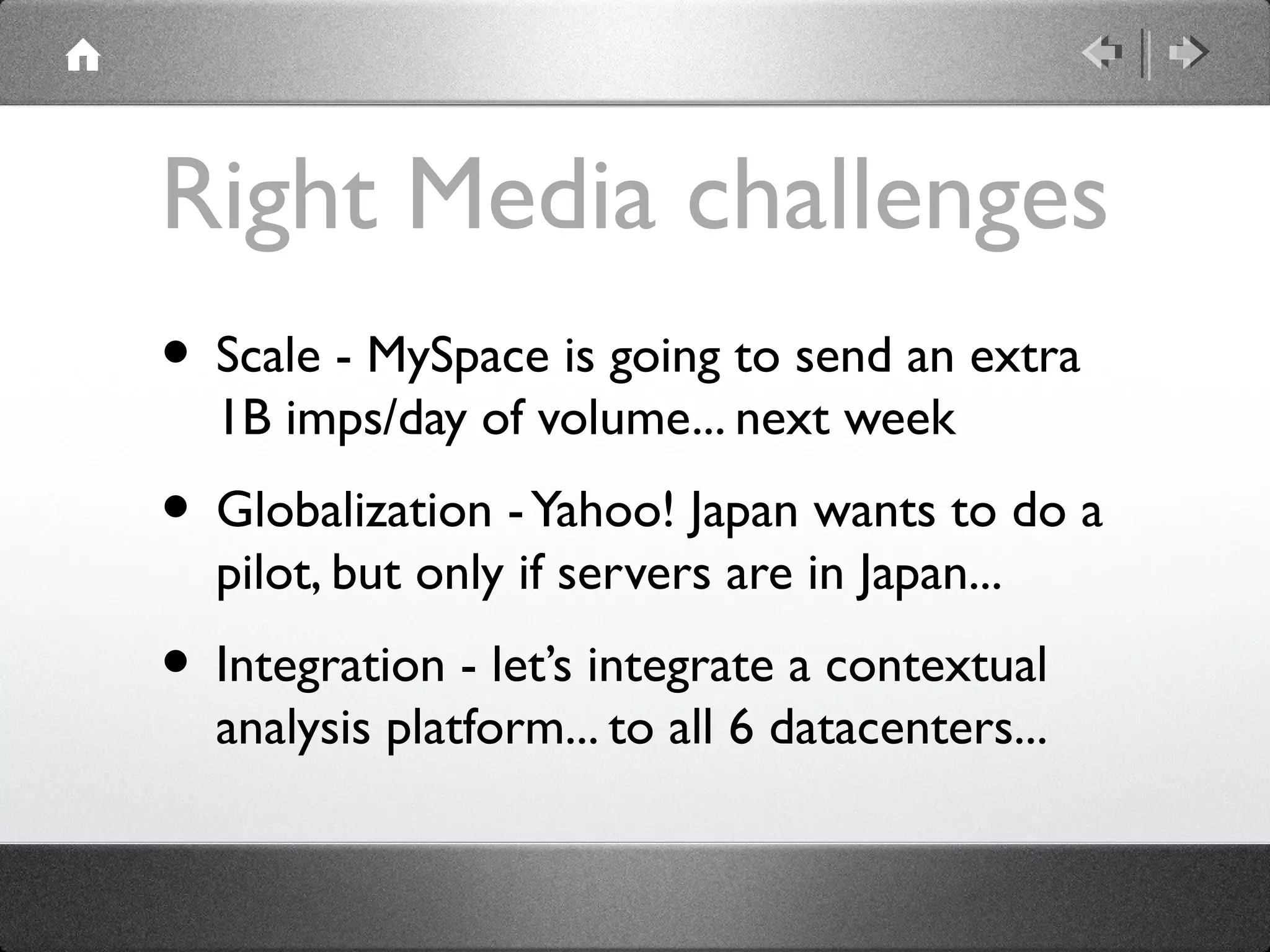
Right Media challenges
• Scale - MySpace is going to send an extra
1B imps/day of volume... next week
• Globalization -Yahoo! Japan wants to do a
pilot, but only if servers are in Japan...
• Integration - let’s integrate a contextual
analysis platform... to all 6 datacenters...
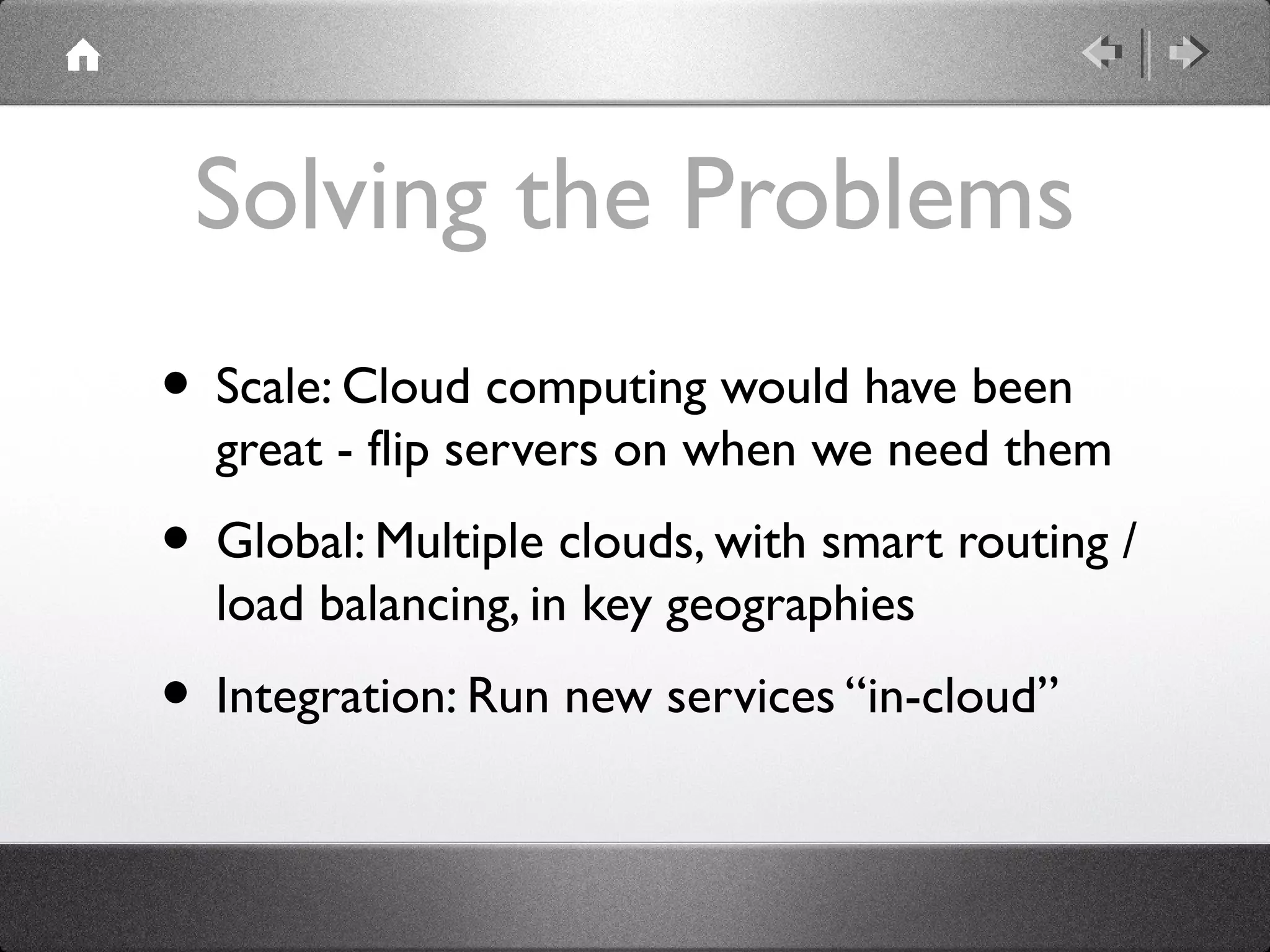
Solving the Problems
• Scale: Cloud computing would have been
great - flip servers on when we need them
• Global: Multiple clouds, with smart routing /
load balancing, in key geographies
• Integration: Run new services “in-cloud”
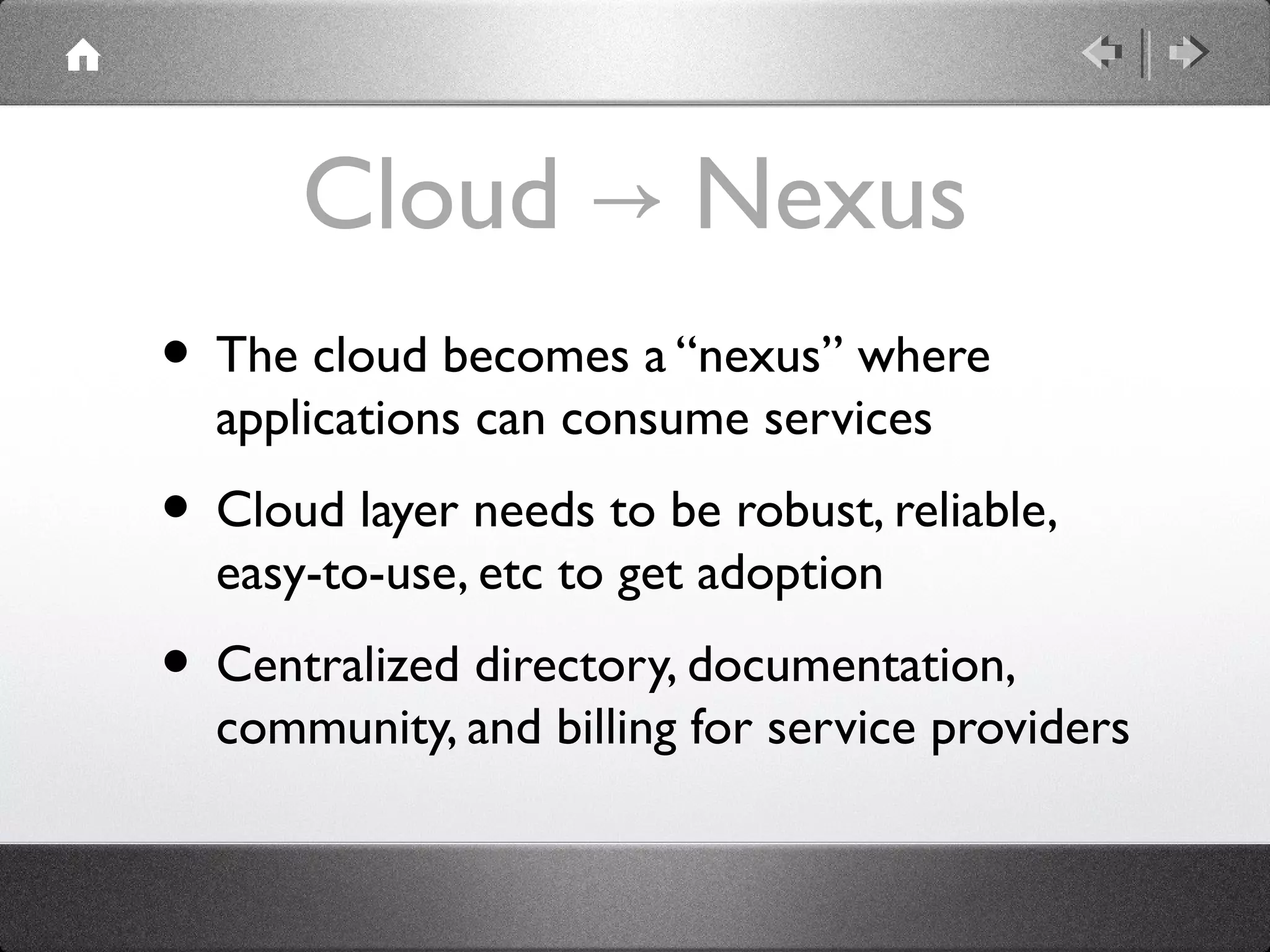
Cloud Nexus→
• The cloud becomes a “nexus” where
applications can consume services
• Cloud layer needs to be robust, reliable,
easy-to-use, etc to get adoption
• Centralized directory, documentation,
community, and billing for service providers
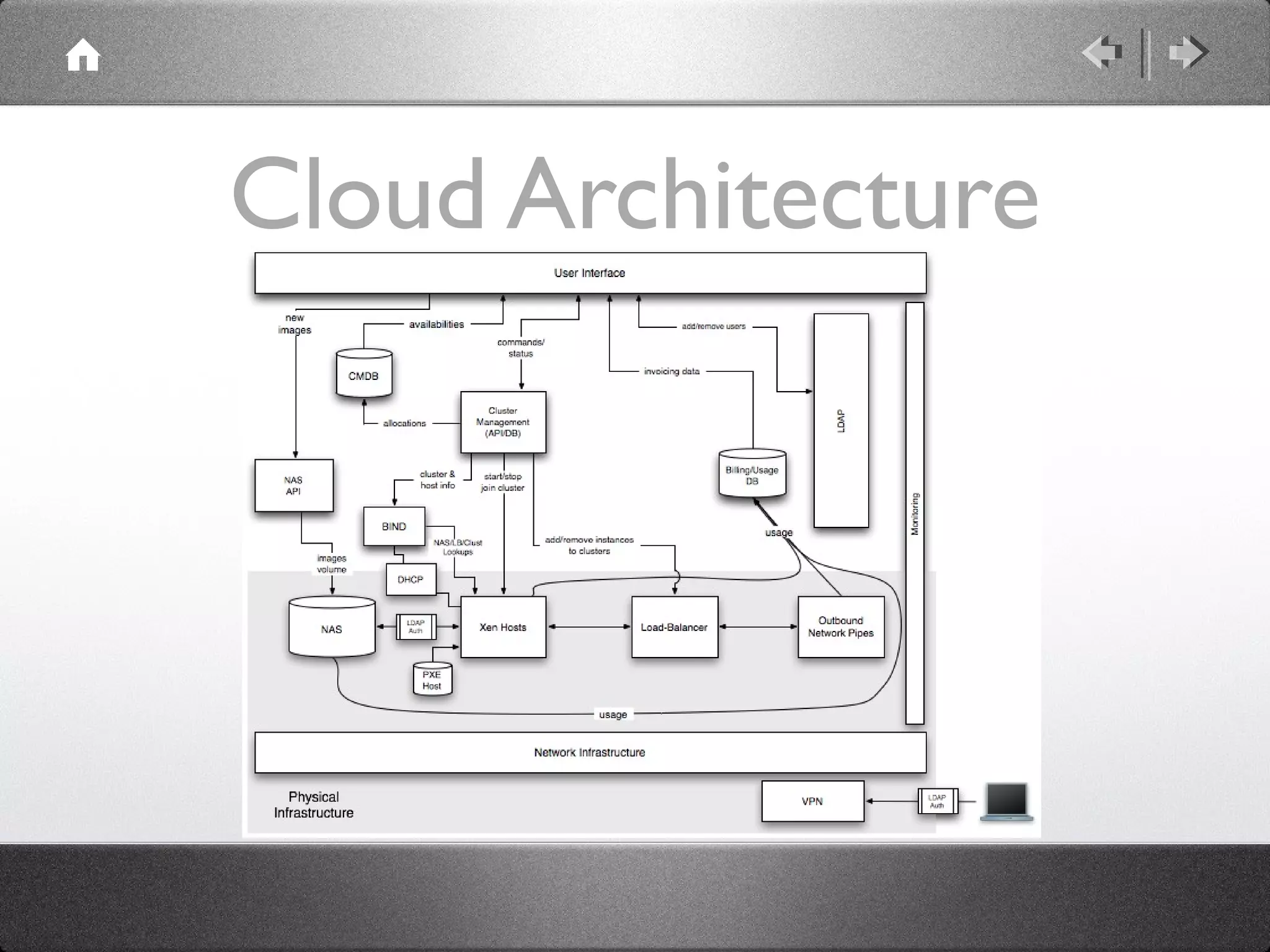
Cloud Architecture
Nexuses
• One Nexus isn’t enough - applications are
moving global quickly
• Multiple Nexuses around the world, each
with same services and applications
• Build tools to help scale applications (data
tier especially)
Revenue Sources
• Rent high-end 4-core boxes for around
$10/core/day (virtualized, of course)
• Rent database boxes, storage, bandwidth,
backup, and many other things too
• Profit-sharing with service providers
• Access fees
Competitive Analysis
Differentiators - Near Term
• Global (some tough problems to solve
there - will be compelling)
• Ops tools (very challenging to build a
scalable ops layer)
• Customer-centric (not exciting, but need to
get the little things right - it’s a small world,
and trust travels)
Differentiators - Long Term
• With network effect (lots of services & lots
of applications) will be difficult for a new
cloud player to compete - will need to
recruit the services to get the apps and will
need to recruit the apps to get the services
• Lots of tools - idea is to get applications
“locked in” to the AppNexus way
Competition
• Amazon / EC2 (biggest risk - they have
capital, the SOA concept, and momentum)
• Rackspace / Gridlayer (hosting companies
have the hardware and the customer base,
but probably not the SOA mentality)
• Google /Yahoo / MSFT etc (not in space
now, but have the capex to enter)
Growth Plan
“Ping pong” growth
• First applications sign up for the cloud
• These clients become leverage to recruit
software providers
• Co-market with software providers to get
more applications on board
• Repeat...
Phase 1:The Cloud
• Build-out and deploy robust physical and
virtual infrastructure to underlie the
Nexuses
• Can be profitable as a standalone service
Phase 1 Logistics
• First location live Jan 2008; 2nd in Mar-Apr
• Work closely with initial clients to refine ops layers
(monitoring, provisioning, cluster management tools)
• Beta launch Jan 2008, Scale to 20 clients by mid-2008
• Ideal clients are platforms and services (natural SOA
consumers and purchasers)
• Fund via $2-3MM seed round (plus $2MM of personally
guaranteed debt)
Phase 1 Pipeline
• Behavioral Marketing (Exelate, Blue Kai,
Media Six Degrees)
• SaaS (Wide Orbit)
• Gaming (Garage Games)
• Video CDN (Digital Fountain)
Phase 2: Credibility
• Go elephant hunting - recruit the
platforms that will make all the services
want to be in their Nexus (or vice versa)
• Aggressively brand as the high-end of the
cloud market - graduate from EC2
Competitor/Cloud-Computing provider
• Leverage key differentiators to keep
pricing high; continue to build IP
Phase 2 Logistics
• Start in Q3 2008
• Raise $10-15MM to ramp team, provide
working capital for 2000+ servers
• Need global presence - market may be
stronger (as is currency) overseas
Phase 3: Nexus
• With key clients and critical mass, network
effect begins to build
• Focus on comarketing with partners - help
service providers recruit platforms & apps
• Provide arms to both sides of a war that
never ends...
Phase 3 Logistics
• Begin in early 2010
• Infrastructure side of business should be
self-sustaining at this point, so shift to
marketing, support, evangelism
• Be opportunistic about acquiring facilities
• Business should be profitable but raise $25-
50MM to expand (and compete)
Financials

AppNexus' First Pitch Deck

  • 1.
  • 2.
    Contents • Founders • WhyAppNexus? • Differentiation / Competitive Analysis • Timeline • Financials
  • 3.
    Founders • Brian O’Kelley,CEO - former CTO of Right Media. Invented, built, sold, and launched the Right Media Exchange. Scaled the RM environment from 10 to 1500 servers and felt the pain of not having AppNexus. • Michiel Nolet,VP of Product - former Director of Analytics at Right Media.
  • 4.
  • 5.
    Right Media challenges •Scale - MySpace is going to send an extra 1B imps/day of volume... next week • Globalization -Yahoo! Japan wants to do a pilot, but only if servers are in Japan... • Integration - let’s integrate a contextual analysis platform... to all 6 datacenters...
  • 6.
    Solving the Problems •Scale: Cloud computing would have been great - flip servers on when we need them • Global: Multiple clouds, with smart routing / load balancing, in key geographies • Integration: Run new services “in-cloud”
  • 7.
    Cloud Nexus→ • Thecloud becomes a “nexus” where applications can consume services • Cloud layer needs to be robust, reliable, easy-to-use, etc to get adoption • Centralized directory, documentation, community, and billing for service providers
  • 8.
  • 9.
    Nexuses • One Nexusisn’t enough - applications are moving global quickly • Multiple Nexuses around the world, each with same services and applications • Build tools to help scale applications (data tier especially)
  • 10.
    Revenue Sources • Renthigh-end 4-core boxes for around $10/core/day (virtualized, of course) • Rent database boxes, storage, bandwidth, backup, and many other things too • Profit-sharing with service providers • Access fees
  • 11.
  • 12.
    Differentiators - NearTerm • Global (some tough problems to solve there - will be compelling) • Ops tools (very challenging to build a scalable ops layer) • Customer-centric (not exciting, but need to get the little things right - it’s a small world, and trust travels)
  • 13.
    Differentiators - LongTerm • With network effect (lots of services & lots of applications) will be difficult for a new cloud player to compete - will need to recruit the services to get the apps and will need to recruit the apps to get the services • Lots of tools - idea is to get applications “locked in” to the AppNexus way
  • 14.
    Competition • Amazon /EC2 (biggest risk - they have capital, the SOA concept, and momentum) • Rackspace / Gridlayer (hosting companies have the hardware and the customer base, but probably not the SOA mentality) • Google /Yahoo / MSFT etc (not in space now, but have the capex to enter)
  • 15.
  • 16.
    “Ping pong” growth •First applications sign up for the cloud • These clients become leverage to recruit software providers • Co-market with software providers to get more applications on board • Repeat...
  • 17.
    Phase 1:The Cloud •Build-out and deploy robust physical and virtual infrastructure to underlie the Nexuses • Can be profitable as a standalone service
  • 18.
    Phase 1 Logistics •First location live Jan 2008; 2nd in Mar-Apr • Work closely with initial clients to refine ops layers (monitoring, provisioning, cluster management tools) • Beta launch Jan 2008, Scale to 20 clients by mid-2008 • Ideal clients are platforms and services (natural SOA consumers and purchasers) • Fund via $2-3MM seed round (plus $2MM of personally guaranteed debt)
  • 19.
    Phase 1 Pipeline •Behavioral Marketing (Exelate, Blue Kai, Media Six Degrees) • SaaS (Wide Orbit) • Gaming (Garage Games) • Video CDN (Digital Fountain)
  • 20.
    Phase 2: Credibility •Go elephant hunting - recruit the platforms that will make all the services want to be in their Nexus (or vice versa) • Aggressively brand as the high-end of the cloud market - graduate from EC2 Competitor/Cloud-Computing provider • Leverage key differentiators to keep pricing high; continue to build IP
  • 21.
    Phase 2 Logistics •Start in Q3 2008 • Raise $10-15MM to ramp team, provide working capital for 2000+ servers • Need global presence - market may be stronger (as is currency) overseas
  • 22.
    Phase 3: Nexus •With key clients and critical mass, network effect begins to build • Focus on comarketing with partners - help service providers recruit platforms & apps • Provide arms to both sides of a war that never ends...
  • 23.
    Phase 3 Logistics •Begin in early 2010 • Infrastructure side of business should be self-sustaining at this point, so shift to marketing, support, evangelism • Be opportunistic about acquiring facilities • Business should be profitable but raise $25- 50MM to expand (and compete)
  • 24.