Downloaded 37 times

![Christian Life, Summaries of Catholic Teaching, part 3: Life in Christ
Topic 1: Freedom, Law and Conscience!
"
God created us with the great gift of freedom. The natural law has the
force of law as the voice and interpreter of the 'higher reason' of the
divine Lawgiver."
"
Human freedom has various dimensions. Freedom from coercion is the
freedom to carry out externally what one has decided upon, without
impediments from outside agents. Examples of this are freedom of
expression, freedom of organization, etc. Freedom of choice or
psychological freedom connotes the absence of the internal need to
choose one thing or another. This refers not to the freedom to do
something, but rather to decide autonomously, without being bound by
an interior determinism. In the moral sense, freedom refers to the
capacity to affirm and love the good, which is the object of one’s free
will, without being enslaved by disordered passions or by sin."
"
God wanted human freedom so that man “might of his own accord seek
his Creator and freely attain his full and blessed perfection by cleaving
to him. Man’s dignity requires him to act out of conscious and free
choice, as moved and drawn in a personal way from within, and not by
blind impulses in himself or by mere external constraint. Man gains such
dignity when, ridding himself of all slavery to the passions, he presses
forward towards his goal by freely choosing what is good, and, by his
diligence and skill, effectively secures for himself the means suited to
this end.”[1]"
"
Freedom from external coercion, from internal necessity and from
disordered passions, in a word, full human freedom possesses a great
value because only thus can we love (freely affirm) the good because it
is good, and as a result love God as the Greatest Good; by doing so we
imitate divine Love and attain the end for which we were created. Thus
we can say that “authentic freedom is an exceptional sign of the image
of God in man.”[2]"
Source: www.opusdei.org.uk" Pagina van5 150](https://image.slidesharecdn.com/christianlifeiiilifeinchrist-150227151851-conversion-gate02/85/Christian-Life-Part-3-Life-in-Christ-the-Ten-Commandments-5-320.jpg)
![Christian Life, Summaries of Catholic Teaching, part 3: Life in Christ
"
Sacred Scripture considers human freedom in the light of salvation
history. On account of the original fall, the freedom man had received
from God became subject to the slavery of sin, although it was not
completely lost (cf. Catechism, 1739-1740). By his glorious Cross,
announced and prepared for in the Old Testament, “Christ has won
salvation for all men. He redeemed them from the sin that held them in
bondage” (Catechism, 1741). Only by cooperating with the grace that
God gives through Christ can man enjoy complete freedom in the moral
sense: for freedom Christ has set us free (Gal 5:1; cf. Catechism, 1742)."
"
The possibility that man might sin did not stop God from deciding to
create us free. Human authorities should respect freedom and not place
limits beyond those required by just laws. But at the same time one
shouldn’t forget that for decisions to be good it is not enough that they
be free, and that only in the light of the immense value of freely affirming
the good can one understand the ethical requirement to respect
people’s fallible freedom."
"
The concept of law is analogous. The natural law, the New Law or the
Law of Christ, and human laws, both political and ecclesiastical, are all
moral laws in distinct senses, although all have something in common."
"
Eternal law refers to the plan of divine Wisdom leading all creation
towards its goal.[3] In mankind’s regard, it corresponds to God’s eternal
salvific plan, by which he chose us in Christ before the foundation of the
world, that we should be holy and blameless before him . . . to be his
sons through Jesus Christ (Eph 1:4-5)."
"
God guides every creature towards its end according to its nature. “God
provides for man differently from the way in which he provides for beings
which are not persons. He cares for man not ‘from without,’ through the
laws of physical nature, but ‘from within,’ through reason, which, by its
Source: www.opusdei.org.uk" Pagina van6 150](https://image.slidesharecdn.com/christianlifeiiilifeinchrist-150227151851-conversion-gate02/85/Christian-Life-Part-3-Life-in-Christ-the-Ten-Commandments-6-320.jpg)
![Christian Life, Summaries of Catholic Teaching, part 3: Life in Christ
natural knowledge of God’s eternal law, is consequently able to show
man the right direction to take in his free actions.”[4]"
"
Natural moral law is the participation in the eternal law by the rational
creature.[5] The natural law “is itself the eternal law, implanted in beings
endowed with reason, and inclining them towards their right action and
end.”[6] It is, therefore, a divine law (divine-natural). It consists of the
very light of reason that enables man to discern good from evil, and has
the force of law as the voice and interpreter of the “higher reason” of the
divine Lawgiver, in which our spirit participates and to which our freedom
adheres.[7] It is called “natural” because it consists of the light of reason
that each person has by nature."
"
Natural moral law is a first step in the communication to all humankind of
the divine salvific plan, whose complete unveiling is only made possible
by Revelation. The natural law “hinges upon the desire for God and
submission to him, who is the source and judge of all that is good, as
well as upon the sense that the other is one’s equal” (Catechism, 1955)."
"
— Properties. The natural law is universal because it encompasses
every human person, of every epoch (cf. Catechism, 1956). “It is
immutable and permanent throughout the variations of history; it
subsists under the flux of ideas and customs and supports their
progress. The rules that express it remain substantially
valid” (Catechism, 1958).[8] It is obligatory because, in order to reach
God, man must freely do good and avoid evil. Thus he needs to be able
to distinguish good from evil, which happens above all thanks to the light
of natural reason.[9] The observance of the natural moral law can
sometimes be hard, but it is never impossible.[10]"
"
— Knowledge of the natural law. The precepts of the natural law can be
known by all men and women through their reason. Nonetheless, in fact
not all its precepts are perceived by everyone in an immediate and clear
way (cf. Catechism, 1960). Its effective knowledge can be conditioned
Source: www.opusdei.org.uk" Pagina van7 150](https://image.slidesharecdn.com/christianlifeiiilifeinchrist-150227151851-conversion-gate02/85/Christian-Life-Part-3-Life-in-Christ-the-Ten-Commandments-7-320.jpg)
![Christian Life, Summaries of Catholic Teaching, part 3: Life in Christ
by personal dispositions, by the social and cultural climate, by one’s
education and upbringing, etc. Since mankind’s present situation is still
subject to the effects of sin, grace and Revelation are necessary for
moral truths to be known “by everyone with facility, with firm certainty
and with no admixture of error.”[11]"
The Old Law, revealed by God to Moses, “is the first stage of revealed
Law. Its moral prescriptions are summed up in the Ten Commandments”
(Catechism, 1962), which expresses immediate conclusions of the
natural moral law. The entire economy of the Old Testament is ordered
above all to preparing, announcing, and signifying the coming of the
Savior.[12]"
"
The New Law or the Law of Christ “is the grace of the Holy Spirit given
through faith in Christ. The external precepts also mentioned in the
Gospel dispose one for this grace or produce its effects in one’s life.”[13]"
"
The principal element of the Law of Christ is the grace of the Holy Spirit,
which heals the whole person and is expressed in a faith that works
through love.[14] It is above all an internal law, which gives the interior
strength needed to achieve what it teaches. In second place, it is also a
written law that is found in Christ’s teachings (in the Sermon on the
Mount, the Beatitudes, etc.) and in the moral catechesis of the apostles,
and which can be summed up in the commandment of love. This second
element is not of secondary importance. The grace of the Holy Spirit,
infused in the believer’s heart, necessarily implies “living according to
the Spirit” and is expressed via the “fruits of the Spirit,” which are
opposed by the “works of the flesh” (cf. Gal 5:16-26)."
"
The Church, through its Magisterium, is the authentic interpreter of the
natural law (cf. Catechism, 2036). This mission is not restricted only to
the faithful, but—by Christ’s command: euntes, docete omnes gentes
(Mt 28:19)—encompasses all men and women. Hence the responsibility
of all Catholics to teach the natural moral law, since by faith and with the
assistance of the Magisterium they can know it easily and without error."
Source: www.opusdei.org.uk" Pagina van8 150](https://image.slidesharecdn.com/christianlifeiiilifeinchrist-150227151851-conversion-gate02/85/Christian-Life-Part-3-Life-in-Christ-the-Ten-Commandments-8-320.jpg)
![Christian Life, Summaries of Catholic Teaching, part 3: Life in Christ
Civil laws are the normative dispositions decreed by state authorities
(generally, by the legislative branch of the state) with the purpose of
promulgating and making explicit the demands of the natural moral law
needed to make possible and regulate adequately the life of its citizens
in the sphere of a politically organized society.[15] These laws should
principally guaranty peace and security, freedom, justice, the
safeguarding of fundamental rights of the person and public morality.[16]"
"
The virtue of justice entails the moral obligation to obey just civil laws.
The gravity of this obligation depends on the greater or lesser
importance of the content of the law for the common good of society."
"
Unjust laws are those that oppose the natural moral law and the
common good of society. More specifically, unjust laws are those:"
"
1) that prohibit citizens from doing something they are morally obligated
to do, or that order them to do something they cannot do without
committing a moral offense;"
"
2) that harm or deprive of due safeguards goods pertaining to the
common good: life, justice, fundamental rights of the person, marriage
and the family, etc.;"
"
3) that are not legitimately promulgated;"
"
4) that fail to distribute burdens and benefits in an equitable and
proportioned way among the citizens."
"
Unjust civil laws do not oblige in conscience; to the contrary, there is a
moral obligation not to obey them, above all if they are unjust for the
reasons indicated in 1) and 2), to make clear one’s disagreement with
them, and to try to change them insofar as possible or, at least, to
Source: www.opusdei.org.uk" Pagina van9 150](https://image.slidesharecdn.com/christianlifeiiilifeinchrist-150227151851-conversion-gate02/85/Christian-Life-Part-3-Life-in-Christ-the-Ten-Commandments-9-320.jpg)
![Christian Life, Summaries of Catholic Teaching, part 3: Life in Christ
reduce their negative effects. At times, one may need to appeal to
conscientious objection (cf. Catechism, 2242-2243).[17]"
"
To save mankind God has also wanted a specific society[18]: the
Church, founded by Jesus Christ and endowed with all the means for
fulfilling its supernatural end, which is the salvation of souls. Among
these means is legislative authority, held by the Roman Pontiff for the
universal Church and by diocesan bishops (and authorities likened to
them) for the people they are responsible for. The majority of the laws of
universal scope are contained in the Code of Canon Law. There exists a
Code for the faithful of the Latin Rite and another for those of the
Eastern Rite."
"
The ecclesiastical laws give rise to an authentic moral obligation[19] that
will be more or less grave according to the gravity of the matter."
"
The most general precepts of the Church are the following five: first, to
attend the entire Mass on Sundays and Holy Days of Obligation (cf.
Catechism, 2042); second, to confess one’s mortal sins at least once a
year, when in danger of death, and when needed in order to receive
communion (cf. Catechism, 2042); third, to receive communion at least
once a year, during the Easter season (cf. Catechism, 2042); fourth, to
fast and abstain from eating meat on days established by the Church
(cf. Catechism, 2043); fifth, to assist the Church in its needs (cf.
Catechism, 2043)."
"
Some discussions of moral questions seem to imply that the ethical
demands contained in the moral law are external to freedom. Freedom
and law seem, then, to be realities that are opposed to one another and
that limit each other reciprocally: as though freedom begins where the
law ends and vice versa."
"
Source: www.opusdei.org.uk" Pagina van10 150](https://image.slidesharecdn.com/christianlifeiiilifeinchrist-150227151851-conversion-gate02/85/Christian-Life-Part-3-Life-in-Christ-the-Ten-Commandments-10-320.jpg)
![Christian Life, Summaries of Catholic Teaching, part 3: Life in Christ
The truth is that free behavior does not stem from instinct or from a
physical or biological necessity. Instead, it is guided by each person
according to each one’s knowledge of good and evil: one freely carries
out the good contained in the moral law and freely avoids the evil known
by means of the same law."
"
The denial of the good known through the moral law is not freedom, but
sin. What goes against the moral law is sin, not freedom. The moral law
clearly requires us to correct any desire to carry out sinful actions: the
desire for vengeance, for violence, for stealing, etc. But this moral
guidance is not opposed to freedom, which is always directed to the free
affirmation of the good, nor is it a coercion of freedom, which always
holds out the sad possibility of sinning. “When we breathe this air of
freedom we see clearly that evil is an enslavement, not a liberation . . .
Such a person may show that he has acted according to his
preferences, but he does not speak with the voice of true freedom,
because he has become the slave of his decision and he has decided
for the worst, for the absence of God, where there is no freedom to be
found.”[20]"
"
A different matter altogether are human laws and rules. Owing to the
generality and conciseness of the terms in which these laws are
expressed, in a specific case they may not be a true indicator of what a
specific person should do. A well formed person knows that in these
concrete cases one should do what one knows with certainty to be right.
[21] But there exists no case in which it would be good to carry out the
intrinsically evil actions prohibited by the negative precepts of the natural
moral law or divine-positive law (adultery, deliberate homicide, etc.).[22]"
"
“Conscience is a judgment of reason whereby the human person
recognizes the moral quality of a concrete act that he is going to
perform, is in the process of performing, or has already
completed” (Catechism, 1778). Conscience specifies our “moral
obligation in the light of the natural law: it is the obligation to do what the
Source: www.opusdei.org.uk" Pagina van11 150](https://image.slidesharecdn.com/christianlifeiiilifeinchrist-150227151851-conversion-gate02/85/Christian-Life-Part-3-Life-in-Christ-the-Ten-Commandments-11-320.jpg)
![Christian Life, Summaries of Catholic Teaching, part 3: Life in Christ
individual, through the workings of his conscience, knows to be a good
he is called to do here and now.”[23]"
"
Conscience is “the proximate norm of personal morality.”[24] Therefore a
person who acts against it commits a moral evil. This function of
proximate norm pertains to conscience not because it is the highest
norm,[25] but because it has for the person an ultimate and inescapable
nature: “The judgment of conscience states ‘in an ultimate way’ whether
a certain particular kind of behavior is in conformity with the law”[26]:
when a person judges with certainty, after having evaluated the problem
using all the means at one’s disposal, no ulterior appeal exists—a
“conscience of conscience,” a “judgment of judgment,”—because
otherwise the process would go on to infinitely."
"
A right or true conscience refers to a conscience that judges truthfully
regarding the moral quality of an act. An erroneous conscience fails to
reach the truth, viewing as good an action that in reality is bad, or vice
versa. The cause of an erroneous conscience is ignorance, which can
be invincible (and blameless) if it dominates a person to such an extent
that there is no possibility of recognizing it and amending it; this
ignorance may also be vincible (or culpable) if a person can recognize
and overcome it but fails to do so because he or she does not want to
use the means available.[27] A culpably erroneous conscience does not
excuse from sin, and can actually aggravate it."
"
Conscience is certain, when it expresses a judgment with the moral
certainty of not being mistaken. It is probable when it judges with the
conviction that there is some probability of error, but less than the
probability of being correct. It is called doubtful when the probability of
being mistaken is considered to be equal to or greater than that of being
correct. Finally, it is called perplexed when one does not dare to judge
because one thinks that both doing an act or omitting it is a sin."
"
Source: www.opusdei.org.uk" Pagina van12 150](https://image.slidesharecdn.com/christianlifeiiilifeinchrist-150227151851-conversion-gate02/85/Christian-Life-Part-3-Life-in-Christ-the-Ten-Commandments-12-320.jpg)
![Christian Life, Summaries of Catholic Teaching, part 3: Life in Christ
In practice one should only follow a certain and true conscience or a
certain invincibly erroneous conscience.[28] One should not act with a
doubtful conscience, but rather first seek to resolve the doubt through
prayer, study, asking for advice, etc."
"
Actions that are morally negative and done with invincible ignorance
harm the person who commits them as well as possibly also others.
Moreover, they can contribute to a greater darkening of conscience in
society as a whole. Hence the urgent need to form one’s conscience
correctly (cf. Catechism, 1738)."
"
To form a right conscience requires instructing the intellect in the
knowledge of the truth (for which a Catholic relies on the help of the
Church’s Magisterium), and educating the will and the emotions through
the practice of the virtues.[29] This is an effort that lasts one’s entire life
(cf. Catechism, 1784)."
"
In order to form one’s conscience correctly, humility is especially
important, attained by being sincere with God, and in spiritual direction.
[30]"
"
Ángel Rodríguez Luño"
"
"
Basic Bibliography!
"
Catechism of the Catholic Church, 1730-1742, 1776-1794 and 1950-1974."
"
John Paul II, Encyclical Veritatis splendor, August 6, 1993, 28-64."
"
"
"
Source: www.opusdei.org.uk" Pagina van13 150](https://image.slidesharecdn.com/christianlifeiiilifeinchrist-150227151851-conversion-gate02/85/Christian-Life-Part-3-Life-in-Christ-the-Ten-Commandments-13-320.jpg)
![Christian Life, Summaries of Catholic Teaching, part 3: Life in Christ
"
Recommended Readings!
"
Saint Josemaría, Homily, “Freedom, a Gift from God,” in Friends of God, 23-38."
"
J. Ratzinger, Conscience and Truth: Presented at the 10th Workshop for Bishops,
February 1991, Dallas Texas. "
"
http://www.ewtn.com/library/curia/ratzcons.htm. "
"
"
Footnotes!
"
[1] Second Vatican Council, Gaudium et spes, 17. Cf. Catechism, 1731."
"
[2] Ibid."
"
[3] Cf. St. Thomas Aquinas, Summa Theologiae, I-II, q. 93, a.1, c; Second Vatican
Council, Dignitatis humanae, 3."
"
[4] John Paul II, Enc. Veritatis splendor, August, 6, 1993, 43"
"
[5] Cf. Ibid.; St. Thomas Aquinas, Summa Theologiae, I-II, q.91, a. 2."
"
[6] John Paul II, Enc Veritatis splendor, 44."
"
[7] Cf. Ibid."
"
[8] “Application of the natural law varies greatly; it can demand reflection that takes
account of various conditions of life according to places, times, and circumstances.
Nevertheless, in the diversity of cultures, the natural law remains as a rule that
Source: www.opusdei.org.uk" Pagina van14 150](https://image.slidesharecdn.com/christianlifeiiilifeinchrist-150227151851-conversion-gate02/85/Christian-Life-Part-3-Life-in-Christ-the-Ten-Commandments-14-320.jpg)
![Christian Life, Summaries of Catholic Teaching, part 3: Life in Christ
binds men among themselves and imposes on them, beyond the inevitable
differences, common principles” (Catechism, 1957)."
"
[9] Cf. John Paul II, Enc. Veritatis splendor, 42."
"
[10] Cf. Ibid., 102."
"
[11] Pius XII, Enc. Humani generis: DZ 3876. Cf. Catechism, 1960."
"
[12] Cf. Second Vatican Council, Const. Dei verbum, 15."
"
[13] John Paul II, Enc. Veritatis splendor, 24. Cf. St. Thomas Aquinas, Summa
Theologiae, I-II, q.106, a.1, c. and ad 2."
"
[14] Cf. St. Thomas Aquinas, Summa Theologiae, I-II, q. 108, a.1."
"
[15] Cf. St Thomas Aquinas, Summa Theologiae, I-II, q. 95, a. 2; Catechism, 1959."
"
[16] Cf. John Paul II, Enc. Evangelium vitae, May 25, 1995, 71."
"
[17] Cf. John Paul II, Enc. Evangelium vitae, 72-74."
"
[18] Cf. Second Vatican Council, Cost. Lumen gentium, 9."
"
[19] Cf. Council of Trent, Canons on the Sacrament of Baptism, 8: DZ 1621."
"
[20] Saint Josemaría, Friends of God, 37."
"
[21] Cf. St. Thomas Aquinas, Summa Theologiae, I-II, q. 96, a. 6 and II-II, q. 120."
"
[22] Cf. John Paul II, Enc. Veritatis splendor, 76, 80, 81, 82."
Source: www.opusdei.org.uk" Pagina van15 150](https://image.slidesharecdn.com/christianlifeiiilifeinchrist-150227151851-conversion-gate02/85/Christian-Life-Part-3-Life-in-Christ-the-Ten-Commandments-15-320.jpg)
![Christian Life, Summaries of Catholic Teaching, part 3: Life in Christ
"
[23] John Paul II, Enc. Veritatis splendor, 59."
"
[24] Ibid., 60."
"
[25] Cf. Ibid., 60."
"
[26] Ibid., 59."
"
[27] Cf. Ibid., 62; Second Vatican Council, Gaudium et spes, 16."
"
[28] A certain invincibly erroneous conscience is not a moral rule in an absolute
way: it obliges only while it remains in error. And it does so not on account of what it
is in itself: the obligatory force of conscience derives from the truth, and therefore
an erroneous conscience can oblige only to the extent that subjectively and
invincibly it is considered truthful. In very important matters (deliberate homicide,
etc.) it is difficult to have an erroneous conscience that is inculpable."
"
[29] Cf. John Pau II, Enc. Veritatis splendor, 64"
"
[30] “Spiritual guidance should not be used to turn people into beings with no
judgment of their own, who limit themselves to carrying out mechanically what
others tell them. On the contrary, it should tend to develop men with their own
Christian standards. This requires maturity, firm convictions, sufficient doctrinal
knowledge, a refined spirit and an educated will” (Saint Josemaría, Conversations,
93)."
"
Source: www.opusdei.org.uk" Pagina van16 150](https://image.slidesharecdn.com/christianlifeiiilifeinchrist-150227151851-conversion-gate02/85/Christian-Life-Part-3-Life-in-Christ-the-Ten-Commandments-16-320.jpg)
![Christian Life, Summaries of Catholic Teaching, part 3: Life in Christ
Topic 2: Morality of Human Acts!
"
“Acting is morally good when the choices of freedom are in conformity
with man’s true good and thus express the voluntary ordering of the
person towards our ultimate end: God himself.”"
"
“Human acts, that is, acts that are freely chosen in consequence of a
judgment of conscience, can be morally evaluated. They are either good
or evil” (Catechism of the Catholic Church, 1749)."
"
“Acting is morally good when the choices of freedom are in conformity
with man’s true good and thus express the voluntary ordering of the
person towards our ultimate end: God himself.”[1]"
"
The morality of human acts depends on:"
"
— the object chosen;"
"
— the end sought or the intention;"
"
— the circumstances of the action."
"
“The object, the intention, and the circumstances make up the ‘sources,’
or constitutive elements, of the morality of human acts” (Catechism of
the Catholic Church, 1750)."
"
“The morality of the human act depends primarily and fundamentally on
the ‘object’ rationally chosen by the deliberate will, as is borne out by the
insightful analysis, still valid today, made by Saint Thomas.”[2] The
moral value of human acts (whether they are good or evil) depends
above all on the conformity of the object or act that is willed with the
Source: www.opusdei.org.uk" Pagina van18 150](https://image.slidesharecdn.com/christianlifeiiilifeinchrist-150227151851-conversion-gate02/85/Christian-Life-Part-3-Life-in-Christ-the-Ten-Commandments-18-320.jpg)
![Christian Life, Summaries of Catholic Teaching, part 3: Life in Christ
good of the person according to right reason. “The reason why a good
intention is not itself sufficient, but a correct choice of actions is also
needed, is that the human act depends on its object, whether that object
is capable or not of being ordered to God, to the One who ‘alone is
good,’ and thus brings about the perfection of the person.”[3]"
"
“Reason attests that there are objects of the human act which are by
their nature ‘incapable of being ordered’ to God, because they radically
contradict the good of the person made in his image. These are the acts
which, in the Church’s moral tradition, have been termed ‘intrinsically
evil’ (intrinsece malum): they are such always and per se, in other
words, on account of their very object, and quite apart from the ulterior
intentions of the one acting and the circumstances.”[4]"
"
Consequentialism and proportionalism are erroneous theories
concerning the moral object of an action. “The former claims to draw the
criteria of the rightness of a given way of acting solely from a calculation
of foreseeable consequences deriving from a given choice. The latter,
by weighing the various values and goods being sought, focuses rather
on the proportion acknowledged between the good and bad effects of
that choice, with a view to the ‘greater good’ or ‘lesser evil’ actually
possible in a particular situation.”[5]"
"
In human actions “the end is the first goal of the intention and indicates
the purpose pursued in the action. The intention is a movement of the
will toward the end: it is concerned with the goal of the
activity” (Catechism of the Catholic Church, 1752).[6] An act that “can be
offered to God according to its object, is also capable of being ordered
to its ultimate end. That same act then attains its ultimate and decisive
perfection when the will actually does order it to God.”[7] The intention of
the person acting “is an element essential to the moral evaluation of an
action” (Catechism of the Catholic Church, 1752)."
"
Source: www.opusdei.org.uk" Pagina van19 150](https://image.slidesharecdn.com/christianlifeiiilifeinchrist-150227151851-conversion-gate02/85/Christian-Life-Part-3-Life-in-Christ-the-Ten-Commandments-19-320.jpg)
![Christian Life, Summaries of Catholic Teaching, part 3: Life in Christ
“Intention is not limited to directing individual actions, but can guide
several actions toward one and the same purpose; it can orient one’s
whole life toward its ultimate end . . . One and the same action can also
be inspired by several intentions” (Catechism of the Catholic Church,
1752)."
"
“A good intention does not make behavior that is intrinsically disordered,
such as lying and calumny, good or just. The end does not justify the
means” (Catechism of the Catholic Church, 1753).[8] “On the other
hand, an added bad intention (such as vainglory) makes an act evil that,
in and of itself, can be good (such as almsgiving; cf Mt
6:2-4)” (Catechism of the Catholic Church, 1753)."
"
Circumstances “are secondary elements of a moral act. They contribute
to increasing or diminishing the moral goodness or evil of human acts
(for example, the amount of a theft). They can also diminish or increase
the agent’s responsibility (such as acting out of a fear of
death)” (Catechism of the Catholic Church, 1754). Circumstances “of
themselves cannot change the moral quality of acts themselves; they
can make neither good nor right an action that is in itself evil” (Ibid.)."
"
“A morally good act requires the goodness of the object, of the end, and
of the circumstances together” (Catechism of the Catholic Church,
1755).[9]"
"
“An action can be indirectly voluntary when it results from negligence
regarding something one should have known or done” (Catechism of the
Catholic Church, 1736).[10]"
"
“An effect can be tolerated without being willed by its agent; for instance,
a mother’s exhaustion from tending her sick child. A bad effect is not
imputable if it was not willed either as an end or as a means of an
action, e.g., a death a person incurs in aiding someone in danger. For a
Source: www.opusdei.org.uk" Pagina van20 150](https://image.slidesharecdn.com/christianlifeiiilifeinchrist-150227151851-conversion-gate02/85/Christian-Life-Part-3-Life-in-Christ-the-Ten-Commandments-20-320.jpg)
![Christian Life, Summaries of Catholic Teaching, part 3: Life in Christ
bad effect to be imputable it must be foreseeable and the agent must
have the possibility of avoiding it, as in the case of manslaughter caused
by a drunken driver” (Catechism of the Catholic Church, 1737)."
"
An effect can be said to be “willed indirectly” when it is not willed either
as an end or a means for anything else, but it is something that
necessarily accompanies the desired action.[11] This is important in the
moral life, because at times actions can have two effects, one good and
another bad, and it may be licit to carry them out in order to obtain the
good effect (willed directly), even though the evil one cannot be avoided
(which, therefore, is willed only indirectly). These situations at times
require great moral discernment, where prudence dictates seeking
advice from someone able to give sound guidance."
"
An act is voluntary (and thus blameworthy) in causa when, though not
chosen for itself, it frequently follows a directly willed action. For
example, a person who fails to keep proper custody of the eyes before
obscene images is responsible (because it has been willed in causa) for
the disorder (not directly chosen) in one’s imagination."
"
“Freedom makes man responsible for his acts to the extent that they are
voluntary” (Catechism of the Catholic Church, 1734). The exercise of
freedom always brings with it responsibility before God: in every free act
we either accept or reject God’s will."
"
“Imputability and responsibility for an action can be diminished or even
nullified by ignorance, inadvertence, duress, fear, habit, inordinate
attachments, and other psychological or social factors” (Catechism of
the Catholic Church, 1735)."
"
“The term ‘merit’ refers in general to the recompense owed by a
community or a society for the action of one of its members,
experienced either as beneficial or harmful, deserving reward or
Source: www.opusdei.org.uk" Pagina van21 150](https://image.slidesharecdn.com/christianlifeiiilifeinchrist-150227151851-conversion-gate02/85/Christian-Life-Part-3-Life-in-Christ-the-Ten-Commandments-21-320.jpg)
![Christian Life, Summaries of Catholic Teaching, part 3: Life in Christ
punishment. Merit is relative to the virtue of justice, in conformity with
the principle of equality which governs it” (Catechism of the Catholic
Church, 2006)."
"
We have no strict right to any merit before God for our good works (cf.
Catechism of the Catholic Church, 2007).[12] Nevertheless, “filial
adoption, in making us partakers by grace in the divine nature, can
bestow true merit on us as a result of God’s gratuitous justice. This is
our right by grace, the full right of love, making us ‘co-heirs’ with Christ
and worthy of obtaining the promised inheritance of eternal
life” (Catechism of the Catholic Church, 2009).[13]"
"
“The merit of man before God in the Christian life arises from the fact
that God has freely chosen to associate man with the work of his
grace” (Catechism of the Catholic Church, 2008).[14]"
"
Francisco Diaz"
"
"
Basic bibliography!
"
Catechism of the Catholic Church, 1749-1761."
"
John Paul II, Enc. Veritatis splendor, August 6, 1993, nos. 71-83."
"
"
Recommended readings!
"
St. Josemaría, Homily, “Christian Respect for Persons and their Freedom,” Christ Is
Passing By, 67-72."
"
Source: www.opusdei.org.uk" Pagina van22 150](https://image.slidesharecdn.com/christianlifeiiilifeinchrist-150227151851-conversion-gate02/85/Christian-Life-Part-3-Life-in-Christ-the-Ten-Commandments-22-320.jpg)
![Christian Life, Summaries of Catholic Teaching, part 3: Life in Christ
[1] John Paul II, Enc. Veritatis splendor, August 6, 1993, 72. “The first question in
the young man’s conversation with Jesus: ‘What good must I do to have eternal
life?’ (Mt 19:6) immediately brings out the essential connection between the moral
value of an act and man’s final end . . . Jesus’ answer and his reference to the
commandments also make it clear that the path to that end is marked by respect for
the divine laws which safeguard human good. Only the act in conformity with the
good can be a path that leads to life” (Ibid.)."
"
[2] John Paul II, Enc. Veritatis splendor, 78; cf. Catechism of the Catholic Church,
1751. “In order to be able to grasp the object of an act which specifies that act
morally, it is therefore necessary to place oneself in the perspective of the acting
person. The object of the act of willing is in fact a freely chosen kind of behavior. To
the extent that it is in conformity with the order of reason, it is the cause of the
goodness of the will; it perfects us morally, and disposes us to recognize our
ultimate end in the perfect good, primordial love. By the object of a given moral act,
then, one cannot mean a process or an event of the merely physical order, to be
assessed on the basis of its ability to bring about a given state of affairs in the
outside world”(Ibid.). The “physical object” should not be confused with the “moral
object” of the action (one and the same physical action may be the object of
different moral acts, e.g., cutting with a scalpel may be a surgical operation or a
homicide)."
"
[3] John Paul II, Enc. Veritatis splendor, 78."
"
[4] Ibid. 80; Cf. Catechism of the Catholic Church, 1756. Vatican Council II specifies
several examples: attempts against human life, such as “any type of murder,
genocide, abortion, euthanasia or willful self-destruction, whatever violates the
integrity of the human person, such as mutilation, torments inflicted on body or
mind, attempts to coerce the will itself; whatever insults human dignity, such as
subhuman living conditions, arbitrary imprisonment, deportation, slavery,
prostitution, the selling of women and children; as well as disgraceful working
conditions, where men are treated as mere tools for profit, rather than as free and
responsible persons; all these things and others of their like are infamies indeed.
They poison human society, but they do more harm to those who practice them
than those who suffer from the injury. Moreover, they are supreme dishonor to the
Creator” (Vatican Council II, Gaudium et spes, 27)."
"
Source: www.opusdei.org.uk" Pagina van23 150](https://image.slidesharecdn.com/christianlifeiiilifeinchrist-150227151851-conversion-gate02/85/Christian-Life-Part-3-Life-in-Christ-the-Ten-Commandments-23-320.jpg)
![Christian Life, Summaries of Catholic Teaching, part 3: Life in Christ
Paul VI, referring to contraceptive practices, taught that it is never licit “to intend
directly something which of its very nature contradicts the moral order, and which
must therefore be judged unworthy of man, even though the intention is to protect
or promote the welfare of an individual, of a family or of society in general” (Paul VI,
Enc. Humanae vitae, July 25, 1968, 14)."
"
[5] John Paul II, Enc. Veritatis splendor, 75. This is not the same as saying that one
may do evil in order to obtain a good end. For example, a proportionalist would not
hold that one could carry out a swindle for a good aim, but rather would examine
whether what is done is or is not a swindle (whether what is “objectively chosen” is
a swindle or not) by taking into account all the circumstances and the intention. One
could thus end up saying that what really is a swindle is not such given the
circumstances and intention and could justify that action (or any other)."
"
[6] The moral object refers to what the will wants to carry out with a specific action
(for example, to kill a person, or to give alms), while intention refers to why he wills
it (for example, to collect an inheritance, to look good before others, or to help
someone who is poor)."
"
[7] John Paul II, Enc. Veritatis splendor, 78."
"
[8] ”It frequently happens that a man acts with a good intention, but without any
spiritual benefit because he lacks good will. For example, one commits a robbery to
help the poor: in this case, even if on the inside his intention is good, he lacks
rectitude of will because the acts are evil. In conclusion, a good intention does not
authorize performing any evil work. ‘Some claim we say—that we should do evil
that good may come of it? Their penalty is what they deserve’ (Rom 3:8)” (St.
Thomas Aquinas, In duo praecepta caritatis, Opuscula theologica II, no. 1168)."
"
[9] That is to say, for a free act to be ordered to our true ultimate end, it requires:"
"
a) that in itself it be capable of being ordered to that end: that it be objectively good,
given the object of the moral act"
"
b) that it be capable of being ordered to that end given the circumstances of place,
time, etc. in which it is carried out."
Source: www.opusdei.org.uk" Pagina van24 150](https://image.slidesharecdn.com/christianlifeiiilifeinchrist-150227151851-conversion-gate02/85/Christian-Life-Part-3-Life-in-Christ-the-Ten-Commandments-24-320.jpg)
![Christian Life, Summaries of Catholic Teaching, part 3: Life in Christ
c) that the will of the person acting effectively orders it to our true ultimate end: that
it be subjectively good, by the intention."
"
[10] “For example, an accident arising from ignorance of traffic laws” (Catechism of
the Catholic Church, 1736). When someone is ignorant of elementary traffic laws
(voluntarily and culpably), the consequences of that ignorance can be said to be
willed indirectly."
"
[11] For example, a person who takes a pill to cure a cold, knowing that it will bring
on sleep; what is directly willed is to cure the cold, and indirectly sleep. Properly
speaking, the indirect effects of an action are not “willed,” but rather tolerated or
permitted insofar as inevitably united to what one has to do."
"
[12] Guilt is the responsibility we take one before God when we sin, making us
worthy of punishment."
"
[13] Cf. Council of Trent, DS 1546."
"
[14] When a Christian does good “the fatherly action of God is first on his own
initiative, and then follows man’s free acting through his collaboration, so that the
merit of good works is to be attributed in the first place to the grace of God, then to
the faithful” (Ibid.)."
"
"
"
"
"
Source: www.opusdei.org.uk" Pagina van25 150](https://image.slidesharecdn.com/christianlifeiiilifeinchrist-150227151851-conversion-gate02/85/Christian-Life-Part-3-Life-in-Christ-the-Ten-Commandments-25-320.jpg)
![Christian Life, Summaries of Catholic Teaching, part 3: Life in Christ
Topic 3: Grace and Virtues!
"
Grace “is the gratuitous gift that God makes to us of his own life, infused
by the Holy Spirit into our soul to heal it of sin and to sanctify
it” (Catechism of the Catholic Church, 1999)."
"
From all eternity, God has called man to participate in the life of the
Blessed Trinity.“This vocation to eternal life is supernatural” (Catechism,
1998).[1] To lead us to this supernatural final end, God grants us even
here on earth a beginning of this participation which will reach its
fullness in heaven and which St. Thomas Aquinas calls “a foretaste of
glory.”[2] This gift is sanctifying grace:"
• it “is the gratuitous gift that God makes to us of his own life, infused by
the Holy Spirit into our soul to heal it of sin and to sanctify
it” (Catechism, 1999);"
• “it is a participation in the life of God” (Catechism, 1997; see 2 Pet 1:4),
who divinizes us (see Catechism, 1999);"
• it is, therefore, a new, supernatural life; a new birth through which we
are made children of God by adoption, sharers in the natural filiation of
the Son: “sons in the Son”;[3]"
• it thus introduces us into the intimacy of the Trinitarian life. As adopted
children we can call God “Father,” united to his only Son (see
Catechism, 1997);"
• it is the “grace of Christ,” because in our present situation—that is,
after sin and the Redemption worked by Christ—grace reaches us as a
participation in the grace Christ won for us (Catechism, 1997): And from
his fullness have we all received, grace upon grace (Jn 1:16). Grace
configures us to Christ (see Rom 8:29);"
Source: www.opusdei.org.uk" Pagina van27 150](https://image.slidesharecdn.com/christianlifeiiilifeinchrist-150227151851-conversion-gate02/85/Christian-Life-Part-3-Life-in-Christ-the-Ten-Commandments-27-320.jpg)
![Christian Life, Summaries of Catholic Teaching, part 3: Life in Christ
• it is the “grace of the Holy Spirit,” because it is infused in the soul by
the Holy Spirit.[4]"
Sanctifying grace is also called habitual grace because it is a stable
disposition which perfects the soul through the infusion of virtues, to
enable it to live with God, to act by his love (see Catechism, 2000).[5]"
The first action of grace within us is justification (see Catechism, 1989).
Justification is the passing from the state of sin to the state of grace (or
“of justice,” because grace makes us “just”).[6] This takes place in
Baptism, and every time that God pardons our mortal sins and infuses
sanctifying grace (ordinarily in the sacrament of Penance).[7]
Justification “is the most excellent work of God’s love” (Catechism, 1994;
see Eph 2:4–5)."
God does not deny his grace to anyone, because he wants everyone to
be saved (1 Tim 2:4): all are called to holiness (see Mt 5:48).[8] Grace
“is in us the source of the work of sanctification” (Catechism, 1999); it
heals and elevates our nature, wounded by original sin, and makes us
capable of acting as God’s children,[9] and of reproducing the image of
Christ (see Rom 8:29): that is to say, of being, each one, alter Christus,
another Christ. This resemblance to Christ is manifested in the virtues."
Sanctification means growing in holiness, attaining an ever more
intimate union with God (see Catechism, 2014), to the point of becoming
not just another Christ but ipse Christus, Christ himself[10]—one and the
same with Christ, as a member in his Body (see 1 Cor 12:27). To grow in
sanctity requires freely cooperating with grace, and this entails effort,
struggle, because of the disorder introduced by sin (the fomes peccati,
the inclination to sin). “There is no holiness without renunciation and
spiritual battle” (Catechism, 2015).[11]"
"
Source: www.opusdei.org.uk" Pagina van28 150](https://image.slidesharecdn.com/christianlifeiiilifeinchrist-150227151851-conversion-gate02/85/Christian-Life-Part-3-Life-in-Christ-the-Ten-Commandments-28-320.jpg)
![Christian Life, Summaries of Catholic Teaching, part 3: Life in Christ
Therefore, in order to conquer in the ascetical struggle, we need to ask
God for grace through prayer and mortification (“the prayer of the
senses”),[12] and receive grace through the sacraments.[13]"
Our union with Christ will be definitive only in heaven. We have to ask
God for the grace of final perseverance, that is, the gift of dying in God’s
grace (see Catechism, 2016 and 2849)."
In general terms, virtue “is an habitual and firm disposition to do the
good” (Catechism, 1803).[14] “The theological virtues relate directly to
God. They dispose Christians to live in a relationship with the Holy
Trinity” (Catechism, 1812). “They are infused by God into the souls of
the faithful to make them capable of acting as his children” (Catechism,
1813).[15] There are three theological virtues: faith, hope and charity
(see 1 Cor 13:13)."
Faith “is the theological virtue by which we believe in God and believe all
that he has said and revealed to us, and that Holy Church proposes for
our belief” (Catechism, 1814). By faith “man freely commits his entire
self to God,”[16] and strives to know and do the will of God: The
righteous shall live by faith (Rom 1:17).[17]"
“The disciple of Christ must not only keep the faith and live it, but also
profess it, confidently bear witness to it, and spread it” (Catechism,
1816; see Mt 10:32-33)."
Hope “is the theological virtue by which we desire the kingdom of
heaven and eternal life as our happiness, placing our trust in Christ’s
promises and relying not on our own strength, but on the help of the
grace of the Holy Spirit” (Catechism, 1817).[18] Charity “is the
theological virtue by which we love God above all things for his own
sake, and our neighbor as ourselves for the love of God” (Catechism,
1822). This is Christ’s “new commandment”: that you love one another
as I have loved you (Jn 15:12).[19]"
Source: www.opusdei.org.uk" Pagina van29 150](https://image.slidesharecdn.com/christianlifeiiilifeinchrist-150227151851-conversion-gate02/85/Christian-Life-Part-3-Life-in-Christ-the-Ten-Commandments-29-320.jpg)
![Christian Life, Summaries of Catholic Teaching, part 3: Life in Christ
“Human virtues are firm attitudes, stable dispositions, habitual
perfections of intellect and will that govern our actions, order our
passions, and guide our conduct according to reason and faith. They
make possible ease, self‑mastery, and joy in leading a morally good life”
(Catechism, 1804). These virtues “are acquired by human effort. They
are the fruit and seed of morally good acts” (Catechism, 1804).[20]"
Among the human virtues there are four that are called cardinal virtues
because all of the others are grouped around them. These are
prudence, justice, fortitude, and temperance (see Catechism, 1805)."
• Prudence “is the virtue that disposes practical reason to discern our
true good in every circumstance and to choose the right means of
achieving it” (Catechism, 1806). It is “right reason in action,”[21] says St.
Thomas Aquinas."
• Justice “is the moral virtue that consists in the constant and firm will to
give their due to God and neighbor” (Catechism, 1807).[22]"
• Fortitude “is the moral virtue that ensures firmness in difficulties and
constancy in the pursuit of the good. It strengthens the resolve to resist
temptations and to overcome obstacles in the moral life. The virtue of
fortitude enables one to conquer fear, even fear of death, and to face
trials and persecutions. It disposes one even to renounce and sacrifice
his life in defense of a just cause” (Catechism, 1808).[23]"
• Temperance “is the moral virtue that moderates the attraction of
pleasures and provides balance in the use of created goods. It ensures
the will’s mastery over instincts” (Catechism, 1809). A temperate person
directs his sensible appetites towards what is truly good and does not let
himself be controlled by his passions (see Sir 18:30). In the New
Testament it is called “moderation” or “sobriety” (see Catechism, 1809)."
The saying in medio virtus, ”virtue lies in the middle,” with respect to the
moral virtues means that virtue consists in a mean between a defect and
Source: www.opusdei.org.uk" Pagina van30 150](https://image.slidesharecdn.com/christianlifeiiilifeinchrist-150227151851-conversion-gate02/85/Christian-Life-Part-3-Life-in-Christ-the-Ten-Commandments-30-320.jpg)
![Christian Life, Summaries of Catholic Teaching, part 3: Life in Christ
an excess.[24] However, in medio virtus is not a call to mediocrity. Virtue
is not a middle term between two or more vices, but a rightness of will—
a summit, as it were—which is opposed to all the abysms of the vices.
[25]"
The wounds left by original sin on human nature make the acquisition
and exercise of human virtues difficult (see Catechism, 1811).[26] To
acquire and live them, Christians count on God’s grace, which heals
human nature."
Grace elevates human nature to participate in the divine nature. At the
same time grace elevates the human virtues to the supernatural order
(see Catechism, 1810), leading the human person to act according to
right reason illumined by faith: in a word, to imitate Christ. In this way,
human virtues become Christian virtues.[27]"
“The moral life of Christians is sustained by the gifts of the Holy Spirit.
These are permanent dispositions which make man docile in following
the promptings of the Holy Spirit” (Catechism, 1830).[28] The gifts of the
Holy Spirit are (see Catechism, 1831):"
1st the gift of wisdom: in order to understand and judge rightly about
God’s plans;"
2nd the gift of understanding: in order to penetrate into the truth about
God;"
3rd the gift of counsel: to recognize and further God’s plans in particular
acts;"
4th the gift of fortitude: to overcome difficulties in Christian life;"
5th the gift of knowledge: to grasp the order of created reality;"
Source: www.opusdei.org.uk" Pagina van31 150](https://image.slidesharecdn.com/christianlifeiiilifeinchrist-150227151851-conversion-gate02/85/Christian-Life-Part-3-Life-in-Christ-the-Ten-Commandments-31-320.jpg)
![Christian Life, Summaries of Catholic Teaching, part 3: Life in Christ
6th the gift of piety: to behave as children of God and in a fraternal
manner towards all our brothers and sisters, being other Christs;"
7th the gift of fear of the Lord: to reject all that could offend God, as
achild would reject, through love, all that might offend his father."
The fruits of the Holy Spirit “are perfections that the Holy Spirit forms in
us as the first fruits of eternal glory” (Catechism, 1832). These are acts
which the action of the Holy Spirit produces in our soul in a habitual way.
The tradition of the Church enumerates twelve fruits: “love, joy, peace,
patience, forbearance, kindness, goodness, faithfulness, gentleness,
modesty, self-control, chastity” (see Gal 5:22–23)."
By the substantial union of our body and soul, our spiritual life—
intellectual knowledge and free choice of the will—is subject to the
influence of our feelings. This influence is manifested in the passions,
which are “movements of the sensitive appetite that incline us to act or
not to act in regard to something felt or imagined to be good or
evil” (Catechism, 1763). The passions are movements of the sensible
appetite (irascible and concupiscible). They can also be called, in the
broad sense, “sentiments” or “emotions.”[29]"
Love, anger, fear, etc. are examples of passions. “The most fundamental
passion is love, aroused by the attraction of the good. Love causes a
desire for the absent good and the hope of obtaining it; this movement
finds completion in the pleasure and joy of the good possessed. The
apprehension of evil causes hatred, aversion, and fear of the impending
evil; this movement ends in sadness at some present evil, or in the
anger that resists it” (Catechism, 1765)."
The passions have a great influence on our moral life. “In themselves
passions are neither good nor evil” (Catechism, 1767). “Passions are
morally good when they contribute to a good action, evil in the opposite
case” (Catechism, 1768).[30] Human perfection requires having one’s
passions regulated by reason and controlled by the will.[31] Since
Source: www.opusdei.org.uk" Pagina van32 150](https://image.slidesharecdn.com/christianlifeiiilifeinchrist-150227151851-conversion-gate02/85/Christian-Life-Part-3-Life-in-Christ-the-Ten-Commandments-32-320.jpg)
![Christian Life, Summaries of Catholic Teaching, part 3: Life in Christ
original sin, our passions are no longer subject to the control of reason
and they frequently push us towards something that is not good.[32] To
channel them towards the good in a constant or habitual manner
requires ascetical struggle and the help of grace, which heals the
wounds of sin."
The will, if it is good, makes use of the passions, ordering them towards
the good.[33] In contrast a bad will, which stems from selfishness,
succumbs to disordered passions or uses them for evil (see Catechism,
1768)."
Paul O’Callaghan "
"
Basic bibliography !
"
Catechism of the Catholic Church, 1762–1770, 1803–1832 and 1987–2005."
"
Recommended readings!
"
St. Josemaria, homily “Human Virtues,” in Friends of God, nos. 73–92."
St. Thomas Aquinas, Summa Theologiae, I-II, qq. 22ff; 109-114; II-II, qq. 1-27;
47-62; 139-143. "
"
Footnotes!
"
[1] This vocation “depends entirely on God’s gratuitous initiative, for he alone can
reveal and give himself. It surpasses the power of human intellect and will, as that
of every other creature (see 1 Cor 2:7–9)” (Catechism, 1998)."
[2] St. Thomas Aquinas, Summa Theologiae, II–II, q. 24, a.3, ad 2."
Source: www.opusdei.org.uk" Pagina van33 150](https://image.slidesharecdn.com/christianlifeiiilifeinchrist-150227151851-conversion-gate02/85/Christian-Life-Part-3-Life-in-Christ-the-Ten-Commandments-33-320.jpg)
![Christian Life, Summaries of Catholic Teaching, part 3: Life in Christ
[3] Second Vatican Council, Const. Gaudium et Spes, 22. See Rom 8:14–17; Gal
4:5–6; 1 Jn 3:1."
[4] Every created gift proceeds from the uncreated Gift, the Holy Spirit. God’s love
has been poured into our hearts through the Holy Spirit who has been given to us
(Rom 5:5. See Gal 4:6)."
[5] One must distinguish between habitual grace and actual graces, “which refer to
God’s interventions, whether at the beginning of conversion or in the course of the
work of sanctification” (Catechism, 2000)."
[6] “Justification is not only the remission of sins, but sanctification and renovation
of the interior man” (Council of Trent: DZ 1528)."
[7] In adults, this step is the fruit of God’s impulse (actual grace) and human
freedom. “Moved by grace, man turns toward God and away from sin, thus
accepting forgiveness and righteousness from on high [sanctifying
grace]” (Catechism, 1989)."
[8] This is a truth our Lord has wanted to remind us of, with special force, through
the teachings of Saint Josemaria, since October 2, 1928. As the Church proclaimed
in the Second Vatican Council (1962–65): “all Christians in any state or walk of life
are called to the fullness of Christian life and to the perfection of love” (Lumen
Gentium, 40)."
[9] See St. Thomas Aquinas, Summa Theologiae, III, q.2, a.12, c."
[10] See St. Josemaria, Christ Is Passing By, 104."
[11] But grace “is not in the slightest way a rival of our freedom when this freedom
accords with the sense of the true and the good that God has put in the human
heart” (Catechism, 1742). On the contrary, “grace responds to the deepest
yearnings of human freedom, calls freedom to cooperate with it, and perfects
freedom” (Catechism, 2022).In the present state of human nature, wounded by sin,
grace is necessary to live constantly in accord with the natural moral law."
[12] Christ Is Passing By, 9."
Source: www.opusdei.org.uk" Pagina van34 150](https://image.slidesharecdn.com/christianlifeiiilifeinchrist-150227151851-conversion-gate02/85/Christian-Life-Part-3-Life-in-Christ-the-Ten-Commandments-34-320.jpg)
![Christian Life, Summaries of Catholic Teaching, part 3: Life in Christ
[13] To gain God’s grace we can also have recourse to the intercession of our most
holy Mother Mary, the Mediatrix of all grace, and also of St. Joseph, our guardian
angels, and the saints."
[14] Vices, on the contrary, are moral habits which result from bad acts and incline
one to repeat them and to grow worse."
[15] In a way analogous to how the human soul operates through its potencies
(understanding and will), the Christian in the state of grace acts through the
theological virtues, which are, as it were, potencies of the “new nature” elevated by
grace."
"
[16] Second Vatican Council, Const. Dei Verbum, 5. [17] Faith is manifested in
deeds: a living faith works through charity (Gal 5:6), while faith apart from works is
dead (Jas 2:26), although the gift of faith remains in one who has not sinned
directly against it (see Council of Trent: DZ 1545)."
[18] See Heb 10:23; Tit 3:6–7. “The virtue of hope responds to the aspiration to
happiness which God has placed in the heart of every man” (Catechism, 1818): it
purifies and elevates this aspiration and protects us from discouragement; it opens
our heart to the prospect of eternal beatitude, protects us from selfishness and
leads us to happiness (see ibid.)."
We should hope for the glory of heaven promised by God to those who love him
(see Rom 8:28–30) and who do his will (see Mt 7:21), certain that with God’s grace
we will be able to persevere to the end (see Mt 10:22) (see Catechism, 1821)."
[19] Charity is superior to all the other virtues (see 1 Cor 13:13). If I . . . have not
love, I am nothing . . . I gain nothing (1 Cor 13:1–3)."
“The practice of all the virtues is animated and inspired by charity” (Catechism,
1827). It is the form of all the virtues: it “informs” or “vivifies” them because it directs
them to the love of God; without charity, the other virtues are “dead.”"
Source: www.opusdei.org.uk" Pagina van35 150](https://image.slidesharecdn.com/christianlifeiiilifeinchrist-150227151851-conversion-gate02/85/Christian-Life-Part-3-Life-in-Christ-the-Ten-Commandments-35-320.jpg)
![Christian Life, Summaries of Catholic Teaching, part 3: Life in Christ
Charity purifies our human faculty of loving and elevates it to the supernatural
perfection of divine love (see Catechism, 1827). There is an order of charity. Charity
is also shown in fraternal correction (see Catechism, 1829)."
"
[20] As is explained in the next section, the Christian develops these virtues with
the help of God’s grace which, as it purifies nature, gives strength to practice them,
and orders them to a higher end."
[21] St. Thomas Aquinas, Summa Theologiae, II–II, q.47, a.2, c.Prudence leads one
to judge rightly about how to act: it does not dissuade one from acting. “It is not to
be confused with timidity or fear, nor with duplicity or dissimulation. It is called
auriga virtutum (the charioteer of the virtues); it guides the other virtues by setting
rule and measure. With the help of this virtue we apply moral principles to particular
cases without error and overcome doubts about the good to achieve and the evil to
avoid” (Catechism, 1806)."
[22] Man cannot give God what is owed to him or what is just in the strict sense.
Therefore, justice towards God is called more properly “the virtue of religion,” “since
for God it is sufficient that we fulfill these duties insofar as we are able to” (St.
Thomas Aquinas, Summa Theologiae, II-II, q.57, a.1, ad 3)."
[23] In the world you have tribulation; but be of good cheer, I have overcome the
world (Jn 16:33)."
[24] For example, laboriousness consists in working as much as one should, which
is a mean between an excess and a lack. Opposed to laboriousness is to work less
than one should, wasting time, etc. And also opposed to laboriousness is working
without measure, without respect for all the other things which one also has to do
(duties of piety, attention to family, necessary and just rest, charity, etc.)."
"
[25] The principle in medio virtus is valid only for the moral virtues, which have as
their object the means for attaining a goal, and in the means there is always a
measure. This is not true of the theological virtues (faith, hope and charity), which
Source: www.opusdei.org.uk" Pagina van36 150](https://image.slidesharecdn.com/christianlifeiiilifeinchrist-150227151851-conversion-gate02/85/Christian-Life-Part-3-Life-in-Christ-the-Ten-Commandments-36-320.jpg)
![Christian Life, Summaries of Catholic Teaching, part 3: Life in Christ
have God directly as their object. Therefore no excess is possible with them: it is
impossible to “hope in God too much,” or “to love him too much.” "
[26] Human nature has been wounded by sin. As a result it has inclinations which
are not natural, but are the consequence of sin. Just as limping is not natural, but
the result of an infirmity, and it would not be natural even if everyone limped, the
wounds in the soul left by original sin and by personal sins are not “natural” either:
the tendency to pride, to laziness, to sensuality, etc. With the help of grace and with
personal effort these wounds can be healed, so that the person becomes and acts
as befits his or her nature as a child of God. This “health” is gained through virtues.
Similarly, the “sickness”is aggravated by vices."
[27] In this sense, there is a prudence which is a human virtue, and a supernatural
prudence, which is a virtue infused by God into the soul, together with grace. For
the supernatural virtue to be able to produce fruit—good acts—it needs the
corresponding human virtue (the same thing happens with the other cardinal
virtues: the supernatural virtue of justice requires the human virtue of justice; and
the same with fortitude and temperance). In other words, Christian perfection—
sanctity—requires and involves human perfection."
[28] Here, to help in understanding the function of the gifts of the Holy Spirit in the
moral life, we can add the following classic explanation. Just as human nature has
certain powers (intelligence and will) which permit it to carry out the operations of
understanding and willing, so also does nature elevated by grace have powers
which permit it to accomplish supernatural acts. These powers are the theological
virtues (faith, hope and charity). They are like the oars of a boat, which permit it to
move in the direction of its supernatural end. Nevertheless, this end surpasses us
to such an extent that the theological virtues are not sufficient to attain it. God
grants us, together with grace, the gifts of the Holy Spirit, which are new perfections
of the soul that enable it to be moved by the Holy Spirit himself. They are like the
sail in a boat that enables it to move by the wind’s force. The gifts perfect us by
making us more docile to the action of the Holy Spirit."
"
[29] One can also speak of supra-sensible or spiritual “sentiments” or “emotions,”
which are not properly “passions” because they do not bring with them movements
of the sensitive appetite."
Source: www.opusdei.org.uk" Pagina van37 150](https://image.slidesharecdn.com/christianlifeiiilifeinchrist-150227151851-conversion-gate02/85/Christian-Life-Part-3-Life-in-Christ-the-Ten-Commandments-37-320.jpg)
![Christian Life, Summaries of Catholic Teaching, part 3: Life in Christ
[30] For example, there is such a thing as good anger, which is to become indignant
in the face of evil, and there is also bad anger, which is uncontrolled or which
impels one towards evil (as is the case with vengeance); there is a good fear and a
bad fear, which prevents one from doing the good; etc."
[31] See St. Thomas Aquinas, Summa Theologiae, I–II, q.24, aa. 1 and 3."
[32] At times the passions can come to dominate a person to such an extent that
one’s moral responsibility is reduced to a minimum."
[33] “Moral perfection consists in man’s being moved to the good not by his will
alone, but also by his sensitive appetite, as in the words of the psalm: ‘My heart and
flesh sing for joy to the living God’ (Ps 84:3)” (Catechism, 1770). “The passions are
bad if our love is bad, good if it is good” (St. Augustine, De Civitate Dei, 14:7)."
"
"
"
"
"
"
"
"
Source: www.opusdei.org.uk" Pagina van38 150](https://image.slidesharecdn.com/christianlifeiiilifeinchrist-150227151851-conversion-gate02/85/Christian-Life-Part-3-Life-in-Christ-the-Ten-Commandments-38-320.jpg)
![Christian Life, Summaries of Catholic Teaching, part 3: Life in Christ
Topic 4: The Person and Society!
"
A new doctrinal outline in the "Summaries of Catholic Teaching" series.
Many people have found these helpful for getting to know the Catholic
faith better and explaining it to others."
"
God did not create man as a “solitary being,” but wanted him to be a
“social being” (cf. Gen 1:27; 2:18-20, 23). Life in society is not
something “added-on” for the human person; it stems from an important
dimension intrinsic to human nature. Human beings can grow and attain
their calling in life only in union with others.[1]"
The social nature of the human person is even more evident in the light
of faith, since there is a certain likeness between the intimate life of the
Holy Trinity and the communion that should be established among
mankind; all men and women have been redeemed by Christ and are
called to share in the same end.[2] Revelation teaches us that human
relationships should be marked by a deep gratuitousness, since in our
neighbor we see, more than an equal, the living image of God, and we
have to be ready to give ourselves fully, even to the ultimate extreme,
for each one.[3] "
Therefore each person “is called to exist ‘for’ others, to become a
gift.”[4] Existing “for” others entails much more than just “co-existing”
with them: it means serving them and loving them. Human freedom “can
wither in an ivory-tower isolation brought on by an over indulgence in the
good things of life.”[5]"
A personal and collective effort is needed to develop social relationships
correctly: “The social nature of human beings does not automatically
lead to communion among persons, to the gift of self. Because of pride
and selfishness, man discovers in himself the seeds of asocial behavior,
impulses leading him to close himself within his own individuality and to
dominate his neighbor.”[6]"
Source: www.opusdei.org.uk" Pagina van40 150](https://image.slidesharecdn.com/christianlifeiiilifeinchrist-150227151851-conversion-gate02/85/Christian-Life-Part-3-Life-in-Christ-the-Ten-Commandments-40-320.jpg)
![Christian Life, Summaries of Catholic Teaching, part 3: Life in Christ
The person’s social nature is not limited to political and commercial
aspects; the relationships based on the most deeply human aspects of
the person, especially the spiritual ones, are much more important for
the correct building up of society.[7] Therefore the real possibility of
constructing a society worthy of the human person depends on the
interior growth of men and women. It is free human acts that build up a
society, and not the impersonal forces of history.[8] Hence the special
importance that should be accorded to spiritual values and human
relationships based on sincere self-giving."
The social nature of the human person entails another important
characteristic: the radical equality of all human beings. All men and
women possess the same human nature and origin; all have been
redeemed by Christ and called to share in the same divine happiness."
“All therefore enjoy an equal dignity” (Catechism, 1934). Along with this
radical equality there are also differences, which have a positive value if
they are not the result of injustice: “These differences belong to God’s
plan, who wills that each receive what he needs from others, and that
those endowed with particular ‘talents’ share the benefits with those who
need them” (Catechism, 1937)."
The social nature of the human being finds expression in the setting up
of a variety of associations aimed at attaining distinct goals: “A society is
a group of persons bound together organically by a principle of unity that
goes beyond each one of them” (Catechism, 1880)."
Many different human goals exist, as well as bonds that unite people:
love, ethnicity, language, country, culture, etc. Therefore human
relationships entail a wide mosaic of institutions and associations: the
family, city, state, international community, etc."
Certain societies, such and the family and state, correspond more
directly to human nature and therefore are necessary. Others
correspond to people’s free initiative, and are intrinsic to what could be
Source: www.opusdei.org.uk" Pagina van41 150](https://image.slidesharecdn.com/christianlifeiiilifeinchrist-150227151851-conversion-gate02/85/Christian-Life-Part-3-Life-in-Christ-the-Ten-Commandments-41-320.jpg)
![Christian Life, Summaries of Catholic Teaching, part 3: Life in Christ
termed human “socialization.” This “socialization” expresses the natural
tendency for human beings to associate with one another for the sake of
attaining objectives that exceed individual capacities, and help develop
the human qualities of each person (cf. Catechism, 1882)."
The close tie between the person and life in society explains the
enormous influence of society on the development of each person, and
the harm that is done to the human person by living in a defectively
organized society. The way people behave depends, to some extent, on
the way society is organized, which exerts a cultural influence on
people."
While never reducing the human being to an anonymous element in
society,[9] it is good to remember that the integral development of the
human person and social progress mutually influence one another.[10]
No opposition exists between the personal dimension and the social
dimension of the human being. Rather these two dimensions are
intimately united and are strengthened in union with one another."
In this context, due to people’s sins, unjust structures or “structure of
sin” can be set up.[11] These structures are opposed to the right
ordering of society, and make the practice of virtue more difficult and
facilitate personal sins against justice, charity, chastity, etc. These
structures may involve widespread immoral customs (for example,
political and economic corruption), or unjust laws (such as those
allowing abortion), etc.[12] A serious effort should be made to undo
these “structures of sin” and replace them with just structures.[13]"
To undo unjust structures and christianize professional relationships and
the entire society, the diligent effort to live the moral norms intrinsic to
one’s professional work is very important. This is also a necessary
condition for sanctifying that work."
“Every human community needs an authority to govern it. The
foundation of such authority lies in human nature. It is necessary for the
Source: www.opusdei.org.uk" Pagina van42 150](https://image.slidesharecdn.com/christianlifeiiilifeinchrist-150227151851-conversion-gate02/85/Christian-Life-Part-3-Life-in-Christ-the-Ten-Commandments-42-320.jpg)
![Christian Life, Summaries of Catholic Teaching, part 3: Life in Christ
unity of the state. Its role is to ensure as far as possible the common
good of the society” (Catechism, 1898)."
Since our social nature is a property of human nature, all legitimate
authority stems from God, the Author of nature (cf. Rom 13:1;
Catechism, 1899). However, “the choice of the political regime and the
appointment of rulers are left to the free decision of the citizens.”[14]"
The moral legitimacy of authority does not stem from itself, but rather
from being God’s servant (cf. Rom 13:4), and is ordered to the common
good.[15] Those who have been given authority should exercise it as a
service, practice distributive justice, avoid favoritism and self-seeking,
and never act despotically (cf. Catechism, 1902, 2235 and 2236)."
“While public authority can sometimes choose not to put a stop to
something which—were it prohibited—would cause more serious harm
(cf. St. Thomas Aquinas, Summa Theologiae, I-II, q. 96, a. 2), it can
never presume to legitimize as a right of individuals—even if they are
the majority of the members of society—an offence against other
persons caused by the disregard of so fundamental a right as the right
to life.”[16]"
With regard to political systems, “the Church values the democratic
system inasmuch as it ensures the participation of citizens in making
political choices, guarantees to the governed the possibility both of
electing and holding accountable those who govern them.”[17] That a
state be a democracy is part of the common good. But “the value of
democracy stands or falls with the values which it embodies and
promotes. Of course, values such as the dignity of every human person,
respect for inviolable and inalienable human rights . . . are certainly
fundamental and not to be ignored.”[18] “A democracy without values
easily turns into open or thinly disguised totalitarianism.”[19]"
The common good can be defined as “the sum total of social conditions
which allow people, either as groups or as individuals, to reach their
Source: www.opusdei.org.uk" Pagina van43 150](https://image.slidesharecdn.com/christianlifeiiilifeinchrist-150227151851-conversion-gate02/85/Christian-Life-Part-3-Life-in-Christ-the-Ten-Commandments-43-320.jpg)
![Christian Life, Summaries of Catholic Teaching, part 3: Life in Christ
fulfillment more fully and more easily.”[20] Therefore the common good
is not only a matter of material well-being but also spiritual (the two are
inter-connected), and entails “three essential elements” (Catechism,
1906):"
—respecting the human person and his or her freedom[21];"
—furthering social progress and integral human development[22];"
—fostering “peace, that is, the stability and security of a just
order” (Catechism, 1909).[23]"
Given the human being’s social nature, the good of each person is
necessarily related to the common good, which in turn should be
directed to each one’s progress (cf. Catechism, 1905 and 1912).[24]"
The scope of the common good is not limited to a city or country. A
“universal common good” also exists, which “calls for an organization of
the community of nations” (Catechism, 1911)."
The social nature of the person encompasses all human dimensions,
including the transcendent one. The deepest truth about the person, and
the ground of all human dignity, is being created in the image and
likeness of God and called to communion with Him.[25] “Christian
anthropology therefore is really a chapter of theology . . . The theological
dimension is needed both for interpreting and solving present-day
problems in human society.”[26]"
Hence the emptiness of social projects that overlook this transcendent
dimension. Atheism, in its various manifestations, has many harmful
effects on society.[27] This reality is especially evident today. In the
measure that the religious roots of a community are lost sight of, inter-
personal relationships become more tense and violent, since the moral
force needed to act rightly is weakened or even lost.[28]"
Source: www.opusdei.org.uk" Pagina van44 150](https://image.slidesharecdn.com/christianlifeiiilifeinchrist-150227151851-conversion-gate02/85/Christian-Life-Part-3-Life-in-Christ-the-Ten-Commandments-44-320.jpg)
![Christian Life, Summaries of Catholic Teaching, part 3: Life in Christ
A stable social order requires an unwavering foundation that is not at
the mercy of changing opinions or the hunger for power; only belief in
God can provide an unshakable foundation for society.[29] Hence the
importance of not separating, or even worse placing in opposition, the
religious and social dimensions of the human person.[30] Both aspects
about the truth of the human person need to be harmoniously fostered:
the sincere search for God (cf. Catechism, 358 and 1721; Compendium,
109) and the concern for one’s neighbor and the progress of society, a
concern that is strengthened by the theocentric dimension.[31]"
Hence the indispensable need for spiritual growth in order to further
society’s development: social renewal is nourished by contemplation.
The encounter with God in prayer introduces a mysterious force into
history that changes hearts and moves people to convert, thus providing
the energy needed to transform social structures."
To strive to bring about social change without a serious effort to change
one’s own life only leads to disillusionment in the end, and often even
lowers the level of people’s lives. "
A “new social order” that is realistic, and therefore always open to
improvement, requires the growth in the needed technical and scientific
skills,[32] but also at the same time the strengthening of people’s moral
formation and spiritual life. This is the true path for renewing society’s
institutions and structures.[33]"
Nor should one forget that the effort to construct a just social order
ennobles the person who endeavors to bring this about."
The effort to foster the common good, each in one’s own place and role
in society, is a duty “inherent in the dignity of the human
person” (Catechism, 1913). No one can accept “the luxury of a merely
individualistic morality.”[34] Therefore “as far as possible citizens should
take an active part in public life” (Catechism, 1915).[35]"
Source: www.opusdei.org.uk" Pagina van45 150](https://image.slidesharecdn.com/christianlifeiiilifeinchrist-150227151851-conversion-gate02/85/Christian-Life-Part-3-Life-in-Christ-the-Ten-Commandments-45-320.jpg)
![Christian Life, Summaries of Catholic Teaching, part 3: Life in Christ
The right and duty to take part in the life of society stems from the
principle of subsidiarity: “a community of a higher order should not
interfere in the internal life of a community of a lower order, depriving the
latter of its functions, but rather should support it in case of need and
help to coordinate its activity with the activities of the rest of society,
always with a view to the common good.”[36]"
This participation in public life requires, first of all, the responsible
fulfillment of one’s family and professional duties (cf. Catechism, 1914)
and the obligations of legal justice (for example, paying taxes).[37] It
also means practicing the human virtues, especially solidarity with
others."
Given the interdependence of persons and human groups, participation
in public life should be carried out with a spirit of solidarity, striving for
the good of others.[38] “Socio‑economic problems can be resolved only
with the help of all the forms of solidarity: solidarity of the poor among
themselves, between rich and poor, of workers among themselves,
between employers and employees in a business, solidarity among
nations and peoples. International solidarity is a requirement of the
moral order; world peace depends in part upon this” (Catechism, 1941).
[39] Although solidarity should encompass all men and women, “the duty
of making oneself a neighbor to others and actively serving them
becomes even more urgent when it involves the disadvantaged, in
whatever area this may be” (Catechism, 1932; cf. 2443-2449)."
As citizens, the faithful have the same rights and duties are their fellow
citizens; but as Catholics, they bear a special responsibility (cf. Tit 3:1-2;
1 Pet 2:13-15).[40] Therefore the lay faithful can never abdicate their
responsibility to take part in political life.[41] This participation is
particularly needed in order to permeate “social, political, and economic
realities with the demands of Christian doctrine and life” (Catechism,
899). "
Source: www.opusdei.org.uk" Pagina van46 150](https://image.slidesharecdn.com/christianlifeiiilifeinchrist-150227151851-conversion-gate02/85/Christian-Life-Part-3-Life-in-Christ-the-Ten-Commandments-46-320.jpg)
![Christian Life, Summaries of Catholic Teaching, part 3: Life in Christ
Given the reality that civil laws often fail to accord with the Church’s
teaching, Catholics should do all they can, with the help of other citizens
of good will, to rectify these law, always acting within legitimate channels
and with charity.[42] In any case, their conduct should always be guided
by Catholic teaching, even when society may present obstacles, since
we must obey God rather than men (Acts 5:29)."
In summary, Catholics should diligently exercise their civil rights and
fulfill their duties. This falls especially to the lay faithful, who are called to
sanctify the world from within, with personal initiative and responsibility,
without waiting for the hierarchy to resolve problems with civil authorities
or to indicate the solutions they should adopt.[43]"
Enrique Colom "
"
Basic Bibliography !
"
Catechism of the Catholic Church, 1877-1917; 1939-1942; 2234-2249."
Compendium of the Social Doctrine of the Church, 34-43; 149-151; 164-170;
541-574."
"
Recommended Reading!
"
St. Josemaria, Homily “Christ the King,” in Christ is Passing By, 179-187. "
Congregation for the Doctrine of the Faith, Doctrinal Note on Some Questions
Regarding the Participation of Catholics in Political Life, 24 November 2002. "
"
"
Source: www.opusdei.org.uk" Pagina van47 150](https://image.slidesharecdn.com/christianlifeiiilifeinchrist-150227151851-conversion-gate02/85/Christian-Life-Part-3-Life-in-Christ-the-Ten-Commandments-47-320.jpg)
![Christian Life, Summaries of Catholic Teaching, part 3: Life in Christ
Footnotes!
"
[1] Cf. Vatican II, Gaudium et spes, 24-25; Congregation for the Doctrine of the
Faith,"
Instr. Libertatis conscientia, 32; Compendium of the Social Doctrine of the Church,
110."
[2] “Being in communion with Jesus Christ draws us into his ‘being for all’; it makes
it our own way of being. He commits us to live for others, but only through
communion with him does it become possible truly to be there for others” (Benedict
XVI, Enc. Spe salvi, 30 November 2007, 28)."
[3] Cf. John Paul II, Enc. Sollicitudo rei socialis, 30 December1987, 40."
[4] John Paul II, Apost. Letter Mulieris dignitatem, 15 August 1988, 7."
[5] Vatican II, Gaudium et spes, 31."
[6] Compendium of the Social Doctrine of the Church, 150."
[7] Cf. Benedict XVI, Spe salvi, 24."
[8] “The origins of a society existing in history are found in the interconnectedness
of the freedoms of all the persons who interact within it, contributing by means of
their choices either to build it up or to impoverish it” (Compendium of the Social
Doctrine of the Church, 163)."
[9] The human person is “the beginning, the subject and the object of every social
organization” (Gaudium et spes, 25). Cf. Pius XII, Radio Message for Christmas, 24
December1942: AAS 35 (1943) 12; John XXIII, Enc. Mater et magistra: AAS 53
(1961) 453; Compendium of the Social Doctrine of the Church, 106."
[10] Cf. John Paul II, Enc. Sollicitudo rei socialis, 38; Catechism, 1888;
Compendium of the Social Doctrine of the Church, 62, 82 and 134."
Source: www.opusdei.org.uk" Pagina van48 150](https://image.slidesharecdn.com/christianlifeiiilifeinchrist-150227151851-conversion-gate02/85/Christian-Life-Part-3-Life-in-Christ-the-Ten-Commandments-48-320.jpg)
![Christian Life, Summaries of Catholic Teaching, part 3: Life in Christ
[11] Cf. John Paul II, Enc. Sollicitudo rei socialis, 36."
[12] “Whenever the Church speaks of situations of sin or when she condemns as
social sins certain situations or the collective behavior of certain social groups . . .
she knows and she proclaims that such cases of social sin are the result of the
accumulation and concentration of many personal sins. It is a case of the very
personal sins of those who cause or support evil or who exploit it; of those who are
in a position to avoid, eliminate or at least limit certain social evils but who fail to do
so out of laziness, fear or the conspiracy of silence, through secret complicity or
indifference; of those who take refuge in the supposed impossibility of changing the
world and also of those who sidestep the effort and sacrifice required” (John Paul II,
Apost. Exhort. Reconciliatio et paenitentia, 2 December 1984, 16. "
[13] Cf. Vatican II, Const. Lumen gentium, 36; John Paul II, Enc. Centesimus
annus, 38; Compendium of the Social Doctrine of the Church, 570. This effort will
usually involve a process and not an immediate change, which means that the
faithful will often have to “co-exist” with these structures and endure their
consequences, without being corrupted by them or ceding in the effort to change
them. Our Lord’s words are very relevant here: I do not pray that thou shouldst take
them out of the world, but that thou shoudst keep them from the evil one (Jn 17:15)."
[14] Gaudium et spes, 74. Cf. Catechism, 1901."
[15] “Authority is exercised legitimately only when it seeks the common good of the
group concerned and if it employs morally licit means to attain it. If rulers were to
enact unjust laws or take measures contrary to the moral order, such arrangements
would not be binding in conscience” (Catechism, 1903)."
[16] John Paul II, Enc. Evangelium vitae, 25 March 1995, 71."
[17] John Paul II, Enc. Centesimus annus, 46."
[18] John Paul II, Enc. Evangelium vitae, 70. The Pope refers in particular to the
right of each innocent human being to life, which laws permitting abortion violate."
[19] John Paul II, Centesimus annus, 46."
Source: www.opusdei.org.uk" Pagina van49 150](https://image.slidesharecdn.com/christianlifeiiilifeinchrist-150227151851-conversion-gate02/85/Christian-Life-Part-3-Life-in-Christ-the-Ten-Commandments-49-320.jpg)
![Christian Life, Summaries of Catholic Teaching, part 3: Life in Christ
[20] Gaudium et spes, 26. Cf. Catechism, 1906."
[21] “In the name of the common good, public authorities are bound to respect the
fundamental and inalienable rights of the human person. Society should permit
each of its members to fulfill his vocation” (Catechism, 1907)."
[22] The public authority, while respecting the principle of subsidiarity and fostering
private initiative, should strive to ensure that each person possesses what is
needed to lead a humanly dignified life: food, clothing, health, work, education and
culture, etc. Cf. Catechism, 1908 and 2211."
[23] Peace is not only the absence of war. Peace cannot be attained without
safeguarding the dignity of the human person (cf. Catechism, 2304). Peace is the
“tranquility of order” (St. Augustine, De civitate Dei, 19, 13). It is a work of justice
(cf. Is 32:17). “The common good requires peace, that is, the stability and security
of a just order. It presupposes that authority should ensure by morally acceptable
means the security of society and its members. It is the basis of the right to
legitimate personal and collective defense” (Catechism, 1909). "
[24] The common good is always oriented towards the progress of persons: “The
order of things must be subordinate to the order of persons, and not the other way
around” (Gaudium et spes, 26)."
[25] Cf. Gaudium et spes, 19."
[26] John Paul, II, Enc. Centisimus annus, 55. Cf. Gaudium et spes, 11 and 41."
[27] Cf. John Paul II, Enc. Evangelium vitae, 21-24. “If we then inquire as to the
source of this mistaken concept of the nature of the person and the ‘subjectivity’ of
society, we must reply that its first cause is atheism. It is by responding to the call of
God contained in the being of things that man becomes aware of his transcendent
dignity . . . The denial of God deprives the person of his foundation, and
consequently leads to a reorganization of the social order without reference to the
person’s dignity and responsibility” (John Paul II, Centesimus annus, 13)."
[28] “Man can set about organizing terrestrial realities without God. But closed off
from God, they will end up being directed against man” (Paul VI, Enc. Populorum
progressio, 26 March 1967, 42). Cf. John XXIII, Enc. Mater et magistra: AAS 53
Source: www.opusdei.org.uk" Pagina van50 150](https://image.slidesharecdn.com/christianlifeiiilifeinchrist-150227151851-conversion-gate02/85/Christian-Life-Part-3-Life-in-Christ-the-Ten-Commandments-50-320.jpg)
![Christian Life, Summaries of Catholic Teaching, part 3: Life in Christ
(1961) 452-453; Vatican II, Const. Gaudium et spes, 21; Benedict XVI, Enc. Deus
caritas est, 25 December 2005, 42."
[29] Cf. Leo XIII, Enc. Diuturnum illud: Acta Leonis XIII, 2 (1882) 277 and 278; Pius
XI, Enc. Caritate Christi: AAS 24 (1932) 183-184."
[30] “Some people tend to see Christianity as a collection of devout practices,
failing to realize the relation between them and the circumstances of ordinary life,
including the urgency to meet the needs of other people and remedy injustice . . .
Others tend to imagine that in order to remain human we need to play down some
central aspects of Christian dogma. They act as if the life of prayer, continual
relationship with God, implied fleeing from responsibilities and forsaking the world.
But they forget that it was none other than Jesus who showed us the extreme to
which we should go in love and service. Only if we try to understand the mystery of
God’s love—a love which went as far as death—will we be able to give ourselves
totally to others and not let ourselves be overcome by difficulties or
indifference” (St. Josemaria, Christ is Passing By, 98)."
[31] There is a deep inter-connection “between love of God and love of
neighbor . . . If I have no contact whatsoever with God in my life, then I cannot see
in the other anything more than the other, and I am incapable of seeing in him the
image of God. But if in my life I fail completely to heed others, seeking only to be
‘devout’ and to perform my ‘religious duties,’ then my relationship with God will also
grow arid” (Benedict XVI, Enc. Deus caritas est, 18). Cf. John Paul II, Enc.
Evangelium vitae, 35-36; Compendium of the Social Doctrine of the Church, 40."
[32] “All professional work demands previous training and a constant effort to
improve one’s formation and to adapt it to the new circumstances that may arise.
And this is very specially true for those who aspire to occupy leading positions in
society, because they are called to a very important service on which the entire
community’s well‑being depends” (St. Josemaria, Conversations, 90)."
[33] “We contribute to a better world only by personally doing good now, with full
commitment and wherever we have the opportunity” (Benedict XVI, Enc. Deus
caritas est, 31b)."
[34] Gaudium et spes, 30."
Source: www.opusdei.org.uk" Pagina van51 150](https://image.slidesharecdn.com/christianlifeiiilifeinchrist-150227151851-conversion-gate02/85/Christian-Life-Part-3-Life-in-Christ-the-Ten-Commandments-51-320.jpg)
![Christian Life, Summaries of Catholic Teaching, part 3: Life in Christ
[35] “A person or a society that does not react to suffering and injustice and makes
no effort to alleviate them is still distant from the love of Christ’s heart. While
Christians enjoy the fullest freedom in finding and applying various solutions to
these problems, they should be united in having one and the same desire to serve
mankind. Otherwise their Christianity will not be the word and life of Jesus; it will be
a fraud, a deception of God and man” (St. Josemaria, Christ is Passing By, 167)."
[36] John Paul II, Enc. Centesimus annus, 48. Cf. Catechism, 1883; Compendium
of the Social Doctrine of the Church, 186 and 187."
“The principle of subsidiarity is opposed to all forms of collectivism. It sets limits for
state intervention. It aims at harmonizing the relationships between individuals and
societies. It tends toward the establishment of true international order” (Catechism,
1885)."
God “entrusts to every creature the functions it is capable of performing, according
to the capacities of its own nature. This mode of governance ought to be followed in
social life. The way God acts in governing the world, which bears witness to such
great regard for human freedom, should inspire the wisdom of those who govern
human communities. They should behave as ministers of divine
providence” (Catechism, 1884)."
[37] Legal justice “concerns what the citizen owes in fairness to the
community” (Catechism, 2411). “Submission to authority and co‑responsibility for
the common good make it morally obligatory to pay taxes” (Catechism, 2240).
“Fraud and other subterfuges, by which some people evade the constraints of the
law and the prescriptions of societal obligation, must be firmly condemned because
they are incompatible with the requirements of justice” (Catechism, 1916)."
[38] “It is above all a question of interdependence, sensed as a system determining
relationships in the contemporary world, in its economic, cultural, political and
religious elements, and accepted as a moral category. When interdependence
becomes recognized in this way, the correlative response as a moral and social
attitude, as a ‘virtue,’ is solidarity” (John Paul II, Enc. Sollicitudo rei socialis, 38)."
[39] Cf. Compendium of the Social Doctrine of the Church, 193-195."
[40] Cf. Gaudium et spes, 75."
Source: www.opusdei.org.uk" Pagina van52 150](https://image.slidesharecdn.com/christianlifeiiilifeinchrist-150227151851-conversion-gate02/85/Christian-Life-Part-3-Life-in-Christ-the-Ten-Commandments-52-320.jpg)
![Christian Life, Summaries of Catholic Teaching, part 3: Life in Christ
[41] Cf. John Paul II, Christifideles laici, 42."
[42] For example, “when it is not possible to overturn or completely abrogate a pro-
abortion law, an elected official, whose absolute personal opposition to procured
abortion was well known, could licitly support proposals aimed at limiting the harm
done by such a law and at lessening its negative consequences at the level of
general opinion and public morality” (John Paul II, Enc. Evangelium vitae, 73)."
[43] “The laity have the duty of using their own initiative and taking action in this
area—without waiting passively for directives and precepts from others. They must
try to infuse a Christian spirit into people’s mental outlook and daily behavior, into
the laws and structures of the civil government “(Paul VI, Enc. Populorum
progressio, 81). Cf. Lumen gentium, 31; Gaudium et spes, 43; John Paul II,
Christifideles laici, 15; Catechism, 2442."
"
Source: www.opusdei.org.uk" Pagina van53 150](https://image.slidesharecdn.com/christianlifeiiilifeinchrist-150227151851-conversion-gate02/85/Christian-Life-Part-3-Life-in-Christ-the-Ten-Commandments-53-320.jpg)
![Christian Life, Summaries of Catholic Teaching, part 3: Life in Christ
Topic 5: Personal Sin!
"
Personal sin is an “action, word or desire contrary to the eternal law.""
"
Personal sin is an “action, word or desire contrary to the eternal law.”[1]
Sin is a human act, since it requires the exercise of freedom,[2] and is
expressed in external actions, words, or internal acts. Moreover, it is a
human act that is evil. That is, it is opposed to God’s eternal law, which
is the first and supreme moral law, and the foundation of all other law. In
a more general sense, sin can be defined as any human act opposed to
the moral norm, that is, to right reason illumined by faith."
"
Sin therefore involves a negative stance with respect to God and, in
contrast, a disordered love for oneself. It entails aversio a Deo et
conversio ad creaturas, a turning away from God and a disordered
turning towards earthly goods. The aversio of sin does not necessarily
represent an explicit hatred of God, but rather the distancing of oneself
from God, as the result of placing an apparent or finite good above
mankind’s supreme good (conversio ad creaturas). St. Augustine
describes it as “love of self that reaches the point of contempt for
God.”[3] “In this proud self-exaltation, sin is diametrically opposed to the
obedience of Jesus, which achieves our salvation (cf. Phil.
2:6-9)” (Catechism of the Catholic Church, 1850)."
Sin is the only real evil. Other evils (sickness, for example) in
themselves do not separate us from God, although they are certainly the
deprivation of a good."
"
Sin can be divided into mortal or grave sin and venial sin (cf. Jn
5:16-17), depending on whether one loses God’s grace totally or not.[4]
Mortal sin and venial sin can be viewed respectively as either the death
or the sickness of the soul."
"
"
"
Source: www.opusdei.org.uk" Pagina van55 150](https://image.slidesharecdn.com/christianlifeiiilifeinchrist-150227151851-conversion-gate02/85/Christian-Life-Part-3-Life-in-Christ-the-Ten-Commandments-55-320.jpg)
![Christian Life, Summaries of Catholic Teaching, part 3: Life in Christ
“Mortal sin is sin whose object is grave matter and which is also
committed with full knowledge and deliberate consent.”[5] “With the
whole tradition of the Church, we call mortal sin the act by which man
freely and consciously rejects God, his law, the covenant of love that
God offers [aversio a Deo], preferring to turn in on himself or to some
created and finite reality, something contrary to the divine will [conversio
ad creaturam]. This can occur in a direct and formal way in the sins of
idolatry, apostasy and atheism; or in an equivalent way as in every act of
disobedience to God’s commandments in a grave matter.”[6] Grave
matter: this means that the act is intrinsically incompatible with charity
and therefore also with the unavoidable demands of the moral or
theological virtues."
"
Full knowledge (or advertence): that is, with the realization that the
action carried out is sinful, namely, contrary to God’s law."
"
Deliberate (or full) consent of the will: that is, one openly wills this action,
which one knows is contrary to God’s law. This does not mean that, for
there to be mortal sin, it is necessary to wish to offend God directly: it is
sufficient that one wishes to carry out something gravely contrary to the
divine will.[7]"
These three conditions must be fulfilled simultaneously.[8] If one of the
three is missing the sin is venial: for example, when the matter is not
grave, although there may be full knowledge and full consent; or when
there is not full knowledge or full consent, even if the matter is grave.
Logically, if there is neither advertence nor consent, the conditions are
lacking for calling the act sinful, since it would not be a properly human
act."
"
Mortal sin “results in the loss of charity and the privation of sanctifying
grace, that is, of the state of grace. If it is not redeemed by repentance
and God’s forgiveness, it causes exclusion from Christ’s kingdom and
the eternal death of hell” (Catechism of the Catholic Church, 1861).[9]"
"
Source: www.opusdei.org.uk" Pagina van56 150](https://image.slidesharecdn.com/christianlifeiiilifeinchrist-150227151851-conversion-gate02/85/Christian-Life-Part-3-Life-in-Christ-the-Ten-Commandments-56-320.jpg)
![Christian Life, Summaries of Catholic Teaching, part 3: Life in Christ
When a person has committed a mortal sin, and remains outside the
“state of grace” (without recovering it in sacramental confession), one
must not receive Communion, since one cannot wish at the same time
both to be united to and alienated from Christ: one would commit a
sacrilege.[10]"
By losing vital union with Christ through mortal sin, one also loses union
with his Mystical Body, the Church. This person does not stop belonging
to the Church, but is as it were a sick member, which harms the whole
body. It also brings harm to human society, since one ceases being light
and leaven for others, even though this may go unnoticed."
"
Through mortal sin any acquired merits are lost (although these can
recovered on receiving the sacrament of Penance), and one loses the
capacity to acquire new ones. This person becomes subject to the
slavery of the devil; the natural desire to do good is diminished, and
disorder is unleashed in the faculties and affections."
"
“Venial sin weakens charity; it manifests a disordered affection for
created goods; it impedes the soul’s progress in the exercise of the
virtues and the practice of the moral good; it merits temporal
punishment. Deliberate and unrepented venial sin disposes us little by
little to commit mortal sin. However venial sin does not break the
covenant with God. With God’s grace it is humanly reparable. ‘Venial sin
does not deprive the sinner of sanctifying grace, friendship with God,
charity, and consequently eternal happiness’ (John Paul II, Reconciliatio
et paenitentia (December 2, 1984)” (Catechism of the Catholic Church,
1863)."
"
God forgives our venial sins in Confession and also, outside of the
Sacrament, when we make an act of contrition and do penance, being
sorry for not having lived up to his infinite love for us."
"
Deliberate venial sin, even though it does not separate us totally from
God, is very unfortunate and damages our friendship with him. We
Source: www.opusdei.org.uk" Pagina van57 150](https://image.slidesharecdn.com/christianlifeiiilifeinchrist-150227151851-conversion-gate02/85/Christian-Life-Part-3-Life-in-Christ-the-Ten-Commandments-57-320.jpg)
![Christian Life, Summaries of Catholic Teaching, part 3: Life in Christ
should have a “horror” for deliberate venial sin. For a person who truly
wishes to love God, it makes no sense to consent to small betrayals
simply because they are not mortal sins;[11] such an attitude leads to
“lukewarmness.”[12]"
The moral theory of the “fundamental option,”[13] which rejects the
traditional distinction between mortal and venial sins, holds that the loss
of sanctifying grace through mortal sin (with all that this entails)
compromises a person so fully that it can only be the result of an act of
radical and total opposition to God, that is, of a fundamental option
against him.[14] The defenders of this erroneous opinion claim it would
be almost impossible to fall into mortal sin in the course of our daily
choices; or if this were to happen, to recover the state of grace through
sincere penance. A person’s freedom, they claim, in its ordinary exercise
of choice would not be able to determine in such a unique and decisive
way the state of one’s moral life. And since these acts would be
“momentary exceptions” in an overall upright life, it would be possible to
justify grave faults in failing to live up to one’s Christian life. An
unfortunate consequence of this erroneous theory is that it undermines
the person’s capacity of decision and commitment in the use of one’s
free will."
"
Closely related to the previous theory is the proposal of a three-way
division of sin into venial, grave, and mortal. The latter would represent
a conscious and irrevocable decision to offend God, and would be the
only sin that could separate us from God and close the doors to eternal
life. Thus the majority of sins which, given their matter, have traditionally
been considered as mortal would now only be “grave” sins, since they
would not be committed with the positive intention to reject God."
"
The Church has frequently pointed out the errors that underlie these
currents of thought. This is a theory that greatly weakens human
freedom, since it overlooks the fact that in reality it is the person who
decides, and who can choose to modify his deepest aspirations and
goals through specific individual acts.[15] “It still remains true that the
essential and decisive distinction is between sin which destroys charity
Source: www.opusdei.org.uk" Pagina van58 150](https://image.slidesharecdn.com/christianlifeiiilifeinchrist-150227151851-conversion-gate02/85/Christian-Life-Part-3-Life-in-Christ-the-Ten-Commandments-58-320.jpg)
![Christian Life, Summaries of Catholic Teaching, part 3: Life in Christ
and sin which does not kill the supernatural life: there is no middle way
between life and death.”[16]"
"
a) We can distinguish between actual sin, which is the very act of
sinning, and habitual sin, which is the stain left in the soul by actual sin,
the debt of penalty and guilt and, if a mortal sin, the privation of grace."
"
b) Personal sin is distinguished in turn from original sin, with which all of
us are born, and which we have contracted through Adam’s
disobedience. Original sin inheres in each of us, even though we have
not personally committed it. It can be compared to an inherited illness,
which is cured by Baptism (at least, by its implicit desire), although a
certain weakness remains that inclines us to commit new personal sins.
Personal sin, therefore, is committed, while original sin is contracted (cf.
Topic no 7: “Elevation to the Supernatural Order and Original Sin”)."
"
c) External personal sins are those that are committed with an action
that can be observed from outside (murder, robbery, defamation, etc.).
Internal sins, on the other hand, remain in one’s interior world, that is, in
our will, without being manifested in external actions (interior anger,
envy, avarice , etc.). All sin, whether external or internal, has its origin in
an internal act of the will: this is the moral act, properly speaking. Purely
internal acts can be sins and even grave ones."
d) We can speak of carnal or spiritual sins, according to whether they
tend in a disordered way to a sensible good (or a reality that is
presented under the appearance of good, for example, lust) or spiritual
(pride). In themselves, the second group is graver; nevertheless, carnal
sins as a general rule are more vehement, precisely because the object
that attracts (a sensible reality) is more immediate."
"
e) Sins of commission and omission: all sin involves a disordered
voluntary act. If this leads to an action, it is called a sin of commission; if,
on the contrary, the voluntary act involves omitting some due action, it is
called one of omission."
Source: www.opusdei.org.uk" Pagina van59 150](https://image.slidesharecdn.com/christianlifeiiilifeinchrist-150227151851-conversion-gate02/85/Christian-Life-Part-3-Life-in-Christ-the-Ten-Commandments-59-320.jpg)
![Christian Life, Summaries of Catholic Teaching, part 3: Life in Christ
“Sin creates a proclivity to sin; it engenders vice by repetition of the
same acts. This results in perverse inclinations which cloud conscience
and corrupt the concrete judgment of good and evil. Thus sin tends to
reproduce itself and reinforce itself, but it cannot destroy the moral
sense at its root” (Catechism of the Catholic Church, 1865)."
"
Capital sins are personal sins that especially incline one to further sins,
since they are the “head” of the other sins. These capital sins are pride
(source of all sin ex parte aversionis; cf. Sir 10: 12-13), avarice, (source
of sin ex parte conversionis), lust, anger, gluttony, envy, and sloth (cf.
Catechism of the Catholic Church, 1866)."
"
The loss of the sense of sin is the result of the voluntary clouding of the
conscience that leads a person, out of pride, to deny that personal sins
are what they are and even to deny that sin exists.[17]"
"
At times we ourselves do not directly do evil, but collaborate in some
way, with greater or lesser responsibility and moral guilt, in the sinful
action of other persons. “Sin is a personal act. Moreover, we have a
responsibility for the sins committed by others when we cooperate in
them: by participating directly and voluntarily in them; by ordering,
advising, praising, or approving them; by not disclosing or not hindering
them when we have an obligation to do so; by protecting evil-
doers” (Catechism of the Catholic Church, 1868)."
"
Personal sins also give rise to social situations opposed to God’s
goodness, which are called “structures of sin.”[18] These are the
expression and effect of the sins of each person (cf. Catechism of the
Catholic Church, 1869).[19]"
"
In the context of the causes of sin, we need to speak of temptation,
which is the incitement to evil. “The root of all sins lies in man’s
heart” (Catechism of the Catholic Church, 1873), and our heart can be
Source: www.opusdei.org.uk" Pagina van60 150](https://image.slidesharecdn.com/christianlifeiiilifeinchrist-150227151851-conversion-gate02/85/Christian-Life-Part-3-Life-in-Christ-the-Ten-Commandments-60-320.jpg)
![Christian Life, Summaries of Catholic Teaching, part 3: Life in Christ
attracted by the presence of apparent goods. The attraction of a
temptation can never be so strong that it obliges us to sin. No temptation
has overtaken you that is not common to man. God is faithful, and he
will not let you be tempted beyond your strength, but with the temptation
will also provide the way of escape, that you may be able to endure it (1
Cor 10:13). If not deliberately sought after, and if made use of as an
opportunity for moral effort, temptations can have a positive value for
Christian life."
"
The causes of temptation can be reduced to three (cf. 1 Jn 2:16):"
"
The “world”: not as God’s creation, because as such it is good, but in so
far as it spurs us, through the disorder of sin, to “turn to creatures,” with
a materialist and pagan environment.[20]"
"
The devil: who urges us to sin, but does not have the power to make us
sin. The devil’s temptations are rejected with prayer.[21]"
"
The “flesh” or concupiscence: the disorder in the powers of our soul that
stems from original sin (also called fomes peccati, tinder for sin). These
temptations are overcome with mortification and penance, and with the
decision not to dialogue with them and to be sincere in spiritual
direction, without covering them up with “unreasonable reasons.”[22]"
"
When facing temptation, we need to struggle to avoid consenting with
our will to the involuntary representation of the evil contained in the
suggestion."
"
To combat temptations we need to be very sincere with God, with
ourselves, and in spiritual direction. Otherwise we run the risk of
deforming our conscience. Sincerity is a great means for not falling into
sin and for attaining true humility. God the Father comes out to meet us
Source: www.opusdei.org.uk" Pagina van61 150](https://image.slidesharecdn.com/christianlifeiiilifeinchrist-150227151851-conversion-gate02/85/Christian-Life-Part-3-Life-in-Christ-the-Ten-Commandments-61-320.jpg)
![Christian Life, Summaries of Catholic Teaching, part 3: Life in Christ
Footnotes!
"
[1] St. Augustine, Contra Faustum manichoeum, 22, 27. Cf. Catechism of the
Catholic Church, 1849."
"
[2] Classically, sin has been defined as a voluntary disobedience to the law of God;
if it were not voluntary, it would not be a sin, since there would be no true human
act. "
"
[3] St. Augustine, De civitate Dei, 14, 28."
"
[4] Cf..John Paul II, Apost..Exhort. Reconciliatio et paenitentia, December 2, 1984,
17."
"
[5] Ibid. Cf. Catechism of the Catholic Church, 1857-1860."
"
[6] John Paul II, Reconciliatio et paenitentia, December 2, 1984, 17."
"
[7] One commits a mortal sin “when a person knowingly and willingly, for whatever
reason, chooses something gravely disordered. In fact, such a choice already
includes contempt for the divine law, a rejection of God’s love for humanity and the
whole of creation; the person turns away from God and loses charity” (Ibid.)."
"
[8] Cf. John Paul II, Enc. Veritatis splendor, August 6, 1993, 70."
"
[9] Besides considering the act in itself, it is important to keep in mind that the
judgment of persons should be entrusted only to the justice and mercy of God (cf.
Catechism of the Catholic Church, 1861)."
"
[10] Only a person who has a truly grave reason to do so and finds it impossible to
go to confession, can celebrate the sacraments and receive Holy Communion, after
making an act of perfect contrition, which includes the resolution of going to
confession as soon as possible (cf. Catechism of the Catholic Church, 1452 and
1457)."
Source: www.opusdei.org.uk" Pagina van63 150](https://image.slidesharecdn.com/christianlifeiiilifeinchrist-150227151851-conversion-gate02/85/Christian-Life-Part-3-Life-in-Christ-the-Ten-Commandments-63-320.jpg)
![Christian Life, Summaries of Catholic Teaching, part 3: Life in Christ
"
[11] Cf. St. Josemaría, Friends of God, 243; Furrow, 139."
"
[12] Cf. St. Josemaría, The Way, 325-331."
"
[13] Cf. John Paul II, Enc. Veritatis splendor, August 6, 1993, 65-70."
"
[14] Cf. Ibid., 69."
"
[15] Cf. John Paul II, Reconciliatio et paenitentia, December 2, 1984, 17; Veritatis
splendor, 70."
[16] Ibid., 17."
"
[17] Cf. Ibid., 18."
"
[18] Cf. John Paul II, Enc. Sollicitudo rei socialis, December 30, 1987, 36 ff."
"
[19] Cf. John Paul II, Reconciliatio et paenitentia, 16."
"
[20] Combatting these temptations requires going against the current with fortitude,
as often as necessary, instead of being drawn along by worldly customs (cf. St.
Josemaría, The Way, 376)."
"
[21] For example, the prayer to St. Michael the Archangel, conqueror of Satan (cf.
Rev 12:7 and 20:2). The Church has also always recommended some
sacramentals, such as holy water, to combat the devil’s temptations. “From nothing
do evil spirits flee more, never to return, than from holy water,” says St. Teresa of
Avila (quoted in St. Josemaría, The Way, 572)."
"
[22] Cf. St. Josemaría, The Way, 134 and 727."
"
Source: www.opusdei.org.uk" Pagina van64 150](https://image.slidesharecdn.com/christianlifeiiilifeinchrist-150227151851-conversion-gate02/85/Christian-Life-Part-3-Life-in-Christ-the-Ten-Commandments-64-320.jpg)
![Christian Life, Summaries of Catholic Teaching, part 3: Life in Christ
intentions of those who carry them out and the circumstances
surrounding them.[1]"
"
“Jesus shows that the commandments should not be understood merely
as an ultimate limit not to be transgressed but rather as a path leading to
a way of moral and spiritual perfection, whose inner impulse is love (cf.
Col 3:14).”[2] For example, the commandment “You shall not kill”
contains the call not only to respect the life of our neighbors but also to
further their development and foster their enrichment as persons. The
commandments should be seen not as prohibitions that restrict our
freedom, but as lights that indicate the path to human fullness and
happiness, freeing us from moral error. "
"
The first commandment is twofold: love for God and love for neighbor
out of love for God. ‘Teacher, which is the great commandment in the
law?’ And he said to him, ‘You shall love the Lord your God with all your
heart, and with all your soul, and with all your mind. This is the great and
first commandment. And a second is like it, You shall love your neighbor
as yourself. On these two commandments depend all the law and the
prophets’ (Mt 22: 36-40)."
"
This love is called charity. The same term is also used for the theological
virtue of charity, which entails love for God and love for our neighbor
because of God. Charity is a gift that the Holy Spirit infuses in those who
have become adopted children of God (cf. Rom 5:5). Charity has to
grow throughout our life on earth through the action of the Holy Spirit
and our own cooperation: growing in holiness is growing in charity.
Holiness is nothing other than the fullness of divine filiation and charity.
It can also diminish through venial sin and even be lost through grave
sin. There is an order in charity: God, others (out of love for God) and
oneself (out of love for God)."
"
Loving God as his children requires:"
"
Source: www.opusdei.org.uk" Pagina van67 150](https://image.slidesharecdn.com/christianlifeiiilifeinchrist-150227151851-conversion-gate02/85/Christian-Life-Part-3-Life-in-Christ-the-Ten-Commandments-67-320.jpg)
![Christian Life, Summaries of Catholic Teaching, part 3: Life in Christ
a) choosing him as the ultimate end of all we undertake. We are asked
to do everything out of love for him and for his glory: whether you eat or
drink, or do anything else, do all for the glory of God (1 Cor 10:31). “Deo
omnis gloria. All glory to God.”[3] No love can be put higher than love for
God. He who loves father or mother more than me is not worthy of me;
and he who loves son or daughter more than me is not worthy of me (Mt
10:37). “The only real love is God’s love!”[4] Any love that tries to
exclude God or put him in second place is not a true love."
"
b) carrying out God’s will in deeds: Not everyone who says to me, ‘Lord,
Lord,’ shall enter the kingdom of heaven, but he who does the will of my
Father who is in heaven” (Mt 7:21). God’s will is that we be saints (cf. 1
Thess 4:3), that we follow Christ (cf. Mt 17:5), carrying out his
commandments (cf. Jn 14:21). “Do you really want to be a saint? Carry
out the little duty of each moment; do what you ought, and put yourself
in what you are doing.”[5] We need to do so also when it calls for
sacrifice: not my will but thine be done (Lk 22:42)."
"
c) corresponding to his love for us. He loved us first; he created us as
free beings and has made us his children (cf. 1 Jn 4:19). Sin is refusing
God’s love (cf. Catechism, 2094). But God is always ready to pardon us,
and he gives himself up for us. In this is love, not that we loved God but
that he loved us and sent his Son to be the expiation for our sins (1 Jn
4:10; cf. Jn 3:16). He loved me and gave himself up for me (Gal 2:20).
“To correspond to so much love requires of us a total gift, body and
soul.”[6] This is not a matter of feeling but rather a decision of the will
which may or may not be accompanied by our emotions."
"
Loving God leads us to seek a personal relationship with him, a
relationship consisting of prayer, which in turn fosters love. Prayer can
take several forms[7]:"
"
a) “Adoration is the first attitude of man acknowledging that he is a
creature before his Creator” (Catechism, 2628). It is the most
Source: www.opusdei.org.uk" Pagina van68 150](https://image.slidesharecdn.com/christianlifeiiilifeinchrist-150227151851-conversion-gate02/85/Christian-Life-Part-3-Life-in-Christ-the-Ten-Commandments-68-320.jpg)
![Christian Life, Summaries of Catholic Teaching, part 3: Life in Christ
fundamental attitude of religion (cf. Catechism, 2096). You shall worship
the Lord your God and him only shall you serve (Mt 4:10). Adoring God
frees us from the various forms of idolatry that lead to slavery. “May your
prayer always be a real and sincere act of adoration of God.”[8]"
"
b) Thanksgiving (cf. Catechism 2638), because everything we are and
have we have received from him: What have you that you did not
receive? If then you received it, why do you boast as if it were not a gift?
(1 Cor 4:7)."
"
c) Petition: asking for pardon for what separates us from God (sin) and
asking for help for ourselves and for others, as well as for the Church
and all mankind. These two forms of petition are found in the Our
Father: “… give us this day our daily bread, and forgive us our
trespasses.” A Christian’s petition is full of confidence, for in hope were
we saved” (Rom 8:24), and because it is a filial petition through Christ: if
you ask the Father anything in my name, he will give it to you” (Jn 16:23;
cf. 1 Jn 5:14-15)."
"
Love is also shown by sacrifice, closely tied to prayer: “prayer is worth
more with sacrifice.”[9] Sacrifice is offering God something that costs us,
in homage to him and as an expression of the interior surrender of our
own will, that is, of obedience to God. Christ redeemed us through the
sacrifice of the Cross, showing his perfect obedience to the point of
dying for us (cf. Phil 2:8). As Christians, as members of Christ, we can
coredeem with him, uniting our sacrifices to his, in Holy Mass (cf.
Catechism, 2100)."
"
The worship of God consists of prayer and sacrifice. It is called the
worship of latria or adoration, to distinguish it from the cult due to the
angels and saints, which is the worship of dulia or veneration, and the
cult honoring the Blessed Virgin, called hyperdulia (cf. Catechism, 971).
The pre-eminent act of worship is Holy Mass, image of the heavenly
liturgy. The love of God should be reflected by the dignity of our worship:
Source: www.opusdei.org.uk" Pagina van69 150](https://image.slidesharecdn.com/christianlifeiiilifeinchrist-150227151851-conversion-gate02/85/Christian-Life-Part-3-Life-in-Christ-the-Ten-Commandments-69-320.jpg)
![Christian Life, Summaries of Catholic Teaching, part 3: Life in Christ
observing what the Church prescribes, with “the good manners of
piety,”[10] cleanliness and care for liturgical objects. “That woman in the
house of Simon the leper in Bethany, who anoints the Master’s head
with precious ointment, reminds us of the duty to be generous in the
worship of God. All the richness, majesty and beauty seem too little to
me.”[11]"
"
Faith, hope and charity are the three “theological” virtues (virtues
directed to God). The greatest is charity (cf. 1 Cor 13:13), which gives
“form” and supernatural “life” to faith and hope (in a way analogous to
how the soul gives life to the body). But charity in this life presupposes
faith because only those who know God can love him; and it also
presupposes hope, because only those who make their desire for
happiness depend on God can love him."
"
Faith is a gift from God, a light in our intellect that enables us to know
the truth that God has revealed and to assent to it. This implies two
things: believing what God has revealed (the mystery of the Holy Trinity
and all the articles of the Creed) and believing that it is God himself who
has revealed it (trusting in him). There is no opposition—nor can there
ever be—between faith and reason."
"
Doctrinal formation is important for attaining a solid faith, and therefore
for fostering love for God and others out of love for God: for sanctity and
apostolate. The life of faith is a life based on faith and consistent with it."
"
Hope is a gift from God that leads us to desire union with him, where we
will find happiness. It gives us confidence that he will give us the
capacity and the means to attain it (cf. Catechism, 2090)."
"
Christians should always be rejoicing in hope (Rom 12:12), because if
we are faithful the happiness of heaven awaits us, the vision of God face
to face (1 Cor 13:12), the beatific vision. If we are sons, we are heirs
Source: www.opusdei.org.uk" Pagina van70 150](https://image.slidesharecdn.com/christianlifeiiilifeinchrist-150227151851-conversion-gate02/85/Christian-Life-Part-3-Life-in-Christ-the-Ten-Commandments-70-320.jpg)
![Christian Life, Summaries of Catholic Teaching, part 3: Life in Christ
also: heirs indeed of God and joint heirs with Christ, provided, however,
we suffer with him that we may also be glorified with him” (Rom 8:17)
Christian life in this world is a path of happiness because even now
through grace we have a pledge of this union with the Holy Trinity; but it
is a happiness mixed with suffering, with the Cross. Hope makes us
aware that it is all worthwhile: “It is worthwhile putting our whole life at
stake, working and suffering for Love, in order to accomplish God’s
plans and coredeem with him.”[12]"
"
Sins against the first commandment are sins against the theological
virtues:"
"
a) Against faith: atheism, agnosticism, religious indifference, heresy,
apostasy, schism, etc. (cf. Catechism 2089) It is also contrary to the first
commandment to put in danger voluntarily one’s own faith, either
through reading books against the faith or morals without a sufficient
reason and preparation, or through failing to employ the means required
to safeguard one’s faith."
"
b) Against hope: despairing of one’s own salvation (cf. Catechism 2091)
and, at the opposite extreme, presuming that divine mercy will pardon
sins without conversion or contrition, or without the necessary
sacrament of penance (cf. Catechism 2092). It is also against this virtue
to put one’s hope for final happiness in anything outside of God."
"
c) Against charity: any sin whatsoever goes against charity. Directly
contrary to it is the rejection of God, and also lukewarmness—not
wanting to love him with all one’s heart. Opposed to the worship of God
is sacrilege, simony, certain superstitious practices, magic, etc., and
Satanism (cf. Catechism 2111-2128)."
"
Love for God requires loving those God loves. If anyone says, ‘I love
God,’ and hates his brother, he is a liar; for he who does not love his
Source: www.opusdei.org.uk" Pagina van71 150](https://image.slidesharecdn.com/christianlifeiiilifeinchrist-150227151851-conversion-gate02/85/Christian-Life-Part-3-Life-in-Christ-the-Ten-Commandments-71-320.jpg)
![Christian Life, Summaries of Catholic Teaching, part 3: Life in Christ
brother whom he has seen, cannot love God whom he has not seen.
And this commandment we have from him, that he who loves God
should love his brother also (1 Jn 4: 20-21). We cannot love God without
loving all men and women, created by him in his image and likeness,
and called to be his children by divine grace (cf. Catechism 2069)."
"
We have to behave as God’s children with all God’s sons and
daughters:[13]"
"
a) behaving like a child of God, like another Christ. The standard for
loving others is Christ’s love: A new commandment I give you, that you
love one another; even as I have loved you, that you also love one
another. By this will all men will know that you are my disciples (Jn
13:34-35). The Holy Spirit has been sent into our hearts so that we can
love as God’s children, with Christ’s love (cf. Rom 5:5). “We must give
our life for others. That is the only way to live the life of Jesus Christ and
to become one and the same with Him.”[14]"
"
b) seeing a child of God, Christ, in others: As you did it to one of the
least of my brethren, you did it to me (Mt 25:40). We need to want for
others what God wants, their real good: for them to be saints, and so to
be happy. The first manifestation of charity is apostolate. This also
includes caring for others’ material needs. It means being understanding
(“making one’s own”) the spiritual and material needs of others; and
being merciful (cf. Mt 18:15). Love is patient and kind; love is not jealous
… does not insist on its own way; it is not irritable or resentful (1 Cor
13:4-5). It also requires fraternal correction (cf Mt 18:15). "
"
The precept of charity also includes love for oneself: You shall love your
neighbour as yourself (Mt 22:39) This rightly ordered love of self means
loving ourselves out of love for God. It leads to seeking for ourselves
what God wants: sanctity and, thereby, happiness (with sacrifice on this
earth, with the Cross). There is also a disordered love of self, egoism,
which is loving ourselves for our own excellence, and not for love of
Source: www.opusdei.org.uk" Pagina van72 150](https://image.slidesharecdn.com/christianlifeiiilifeinchrist-150227151851-conversion-gate02/85/Christian-Life-Part-3-Life-in-Christ-the-Ten-Commandments-72-320.jpg)
![Christian Life, Summaries of Catholic Teaching, part 3: Life in Christ
God. This means putting our own will before God’s, and our own
interests before serving others."
"
It is impossible to have a rightly ordered love of self without struggling
against selfishness. This involves denying oneself, giving oneself to God
and others. If any man would come after me, let him deny himself and
take up his cross and follow me. For whoever would save his life will
lose it, and whoever loses his life for my sake will find it (Mt 16:24-25).
Man “cannot fully find himself except through a sincere gift of
himself.”[15]"
"
Javier Lopez "
"
"
Basic bibliography !
"
Catechism of the Catholic Church, 2064-2132."
"
"
Recommended reading!
"
Benedict XVI, Enc. Deus caritas est, 25 December 2005, 1-18."
"
Benedict XVI, Enc. Spe salvi, 30 November 2007."
"
St Josemaria, “Living by Faith”, “The Christian’s Hope”, “The Strength of Love” in
Friends of God, 190-237."
"
"
Footnotes!
"
[1] Cf. John Paul II, Enc. Veritatis splendor, 6 August 1993, 80."
Source: www.opusdei.org.uk" Pagina van73 150](https://image.slidesharecdn.com/christianlifeiiilifeinchrist-150227151851-conversion-gate02/85/Christian-Life-Part-3-Life-in-Christ-the-Ten-Commandments-73-320.jpg)
![Christian Life, Summaries of Catholic Teaching, part 3: Life in Christ
"
[2] Ibid., 15."
"
[3] St Josemaría, The Way, 780."
"
[4] Ibid., 417."
"
[5] Ibid., 815. Cf. Ibid., 933."
"
[6] St Josemaría, Christ is Passing By, 87."
"
[7] Cf. St Josemaría, The Way, 91."
[8] St Josemaría, The Forge, 263."
"
[9] St Josemaría, The Way, 81."
"
[10] Cf. ibid., 541."
"
[11] Ibid. 527. Cf. Mt 26: 6-13. [12] St Josemaría, The Forge, 26."
"
[13] Cf. St Josemaría, Christ is Passing By, 36."
"
[14] St Josemaría, The Way of the Cross, XIVth Station. Cf. Benedict XVI, Enc.
Deus Caritas est, 25 August 2005, 12-15."
"
[15] Vatican Council II, Gaudium et spes, 24"
"
"
"
"
"
Source: www.opusdei.org.uk" Pagina van74 150](https://image.slidesharecdn.com/christianlifeiiilifeinchrist-150227151851-conversion-gate02/85/Christian-Life-Part-3-Life-in-Christ-the-Ten-Commandments-74-320.jpg)
![Christian Life, Summaries of Catholic Teaching, part 3: Life in Christ
Topic 7: The Second and Third Commandment!
"
The second commandment prescribes honoring God's name, while the
third requires keeping feast days holy.
The second commandment of God’s Law is You shall not take the name
of the Lord your God in vain. This commandment “prescribes respect for
the Lord’s name” (Catechism 2142), and commands us to honor the
name of God. The Lord’s name is not to be pronounced “except to bless,
praise, and glorify it” (Catechism 2143)."
"
“A name expresses a person’s essence and identity and the meaning of
this person’s life. God has a name; he is not an anonymous
force” (Catechism 203). However, God cannot be grasped through
human concepts; no idea can represent him and no name can
exhaustively express the divine essence. God is “Holy,” which means
that he is absolutely superior, that he is above any creature, that he is
transcendent."
"
Nevertheless, so that we can invoke him and speak to him, in the Old
Testament he “revealed himself progressively and under different names
to his people” (Catechism 204). The name he revealed to Moses
indicates that God is Being in essence, the fullness of being and of
every perfection. “God said to Moses, ‘I Am who I Am.’ And he said, ‘Say
this to the people of Israel: I Am [Yahweh: He is] has sent me to you’…’
This is my name for ever” (Ex 3:13-15; (cf. Catechism 213). Out of
respect for God’s holiness, the people of Israel never pronounced this
name, replacing it rather by the title “Lord” (Adonai in Hebrew, Kyrios in
Greek) (cf. Catechism 209). There are other names for God in the Old
Testament: Elohim, the majestic plural of plenitude or grandeur, and El-
Saddai, which means mighty, omnipotent."
"
In the New Testament, God makes known the mystery of his intimate
Trinitarian life: a single God in three Persons—Father, Son and Holy
Source: www.opusdei.org.uk" Pagina van76 150](https://image.slidesharecdn.com/christianlifeiiilifeinchrist-150227151851-conversion-gate02/85/Christian-Life-Part-3-Life-in-Christ-the-Ten-Commandments-76-320.jpg)
![Christian Life, Summaries of Catholic Teaching, part 3: Life in Christ
Spirit. Christ teaches us to call God “Father” (Mt 6:9), “Abba,” which is
the familiar way of saying “father” in Hebrew (cf. Rom 8:15). God is the
Father of Christ and our Father, but not in the same way: Jesus is the
Only-begotten Son and we are adopted children. But we truly are
children (cf. 1 Jn 3:1), brothers and sisters of Jesus Christ (cf. Rom
8:29), because the Holy Spirit has been sent into our hearts and we
participate in the divine nature (cf. Gal 4:6; 2 Pet 1:4). We are children of
God in Christ. As a consequence we can address God as “Father.” St.
Josemaria wrote: “God is a Father who is full of tenderness, of infinite
love. Call him ‘Father ‘ many times a day and tell him—alone, in your
heart—that you love him, that you adore him, that you feel proud and
strong because you are his son.”[1]"
"
In the Our Father we pray: “Hallowed be thy name.” The term “hallowed”
means in this context “to recognize as holy, to treat in a holy
way” (Catechism 2807). This is what we do when we adore, praise or
give thanks to God. But “hallowed be thy name” is also one of the
petitions of the Our Father: in saying it we ask that his name be
hallowed through us, that is, that we give him glory by our life and that
others may glorify him (cf. Mt 5:16). “The sanctification of his name
among the nations depends inseparably on our life and our
prayer” (Catechism 2814)."
"
Respecting the name of God also calls for respecting the name of the
Blessed Virgin Mary and of the saints, and respecting holy things where
God is present in one way or another, especially the Holy Eucharist, the
real Presence among us of Jesus Christ, Second Person of the Holy
Trinity."
"
The second commandment forbids the improper use of God’s name (cf.
Catechism 2146), and especially blasphemy, which “consists in uttering
against God—inwardly or outwardly—words of hatred, reproach, or
defiance… It is also blasphemous to make use of God’s name to cover
up criminal practices, to reduce peoples to servitude, to torture persons
Source: www.opusdei.org.uk" Pagina van77 150](https://image.slidesharecdn.com/christianlifeiiilifeinchrist-150227151851-conversion-gate02/85/Christian-Life-Part-3-Life-in-Christ-the-Ten-Commandments-77-320.jpg)
![Christian Life, Summaries of Catholic Teaching, part 3: Life in Christ
or put them to death … Blasphemy … is in itself a grave sin” (Catechism
2148)."
"
It also forbids false oaths (cf. Catechism 2850). Taking an oath is to take
God as a witness for what is affirmed (for example, to guarantee a
promise or a testimony, to prove the innocence of a person unjustly
accused or suspected, or to put an end to litigation and controversy,
etc.). There are circumstances when an oath is lawful if it is taken in
truth and justice, and if it is necessary, as may be the case in a trial or
on assuming office (cf. Catechism 2154). Otherwise, the Lord teaches
us not to swear: Let what you say be simply ‘Yes’ or ‘No’ (Mt 5:37; cf.
Jas 5:12; Catechism 2153)."
"
Man “is the only creature on earth that God has willed for its own
sake.”[2] He is not “something” but “someone,” a person. “He alone is
called to share, by knowledge and love, in God’s own life. It was for this
end that he was created, and this is the fundamental reason for his
dignity” (Catechism 356). In baptism, on being made a child of God,
each person receives a name that represents his or her unrepeatable
singularity before God and before others (cf. Catechism 2156, 2158).
Baptism is also called “christening.” A “Christian,” a follower of Jesus
Christ, is the proper name of every baptized person, who has received
the call to identify himself with the Lord: it was in Antioch that the
disciples were first called ‘Christians’ (Acts 11:26)."
"
God calls each person by name (cf. 1 Sam 3:4-10; Is 43:1; Jn 10:3; Acts
9:4). He loves each one personally. Christ, says St Paul, loved me and
gave himself up for me (Gal 2:20). He expects from everyone a loving
response: you shall love the Lord your God with all your heart, and with
all your soul, and with all your mind, and with all your strength (Mk
12:30) Nobody else can give God this response of love in our place. St
Josemaria encourages us to meditate “calmly that divine admonition
which fills the soul with disquiet and which at the same time tastes as
sweet as honey from the comb: redemi te, et vocavi te, nomine tuo:
meus es tu (Is 43:1); I have redeemed you and called you by your
Source: www.opusdei.org.uk" Pagina van78 150](https://image.slidesharecdn.com/christianlifeiiilifeinchrist-150227151851-conversion-gate02/85/Christian-Life-Part-3-Life-in-Christ-the-Ten-Commandments-78-320.jpg)
![Christian Life, Summaries of Catholic Teaching, part 3: Life in Christ
name: you are mine! Let us not steal from God what belongs to him. A
God who has loved us to the point of dying for us, who has chosen us
from all eternity, before the creation of the world, so that we may be holy
in his presence (cf. Eph 1:4).”[3]"
"
The third commandment of the Decalogue is: Keep feast days holy. "
"
The Bible recounts the work of creation in six “days.” At the end God
saw everything that he had made, and behold, it was very good … So
God blessed the seventh day and hallowed it, because on it God rested
from all his work which he had done in creation (Gen 1:31; 2:3). In the
Old Testament, God decreed that the seventh day of the week should be
holy, a day set off and distinct from the others. Man, who was called to
participate in the creative power of God, perfecting the world through his
work, was also to cease working on the seventh day in order to dedicate
it to divine worship and to rest."
"
Before the coming of Jesus Christ, the seventh day was the Sabbath. In
the New Testament it is Sunday, Dies Domini, the day of the Lord,
because it is the day of the Lord’s Resurrection. The Sabbath
represented the end of creation; Sunday represents the beginning of the
“new creation,” which took place with Christ’s resurrection (cf.
Catechism 2174). "
"
Since the sacrifice of the Eucharist is the “fountain and the summit of the
life of the Church,”[4] Sunday is kept holy mainly by participating in holy
Mass. The Church expressed the third commandment of the Decalogue
concretely in the following decree: “On Sundays and other holy days of
obligation the faithful are bound to participate in the Mass” (CIC, can.
1247; Catechism 2180). Outside of Sundays, the main days of obligation
are: “Christmas, the Epiphany, the Ascension, the Body and Blood of
Christ, Mary the Mother of God, her Immaculate Conception, her
Assumption, Saint Joseph, the Apostles Saints Peter and Paul, and
lastly All Saints”(CIC, can. 1246; Catechism 2177). “The precept of
Source: www.opusdei.org.uk" Pagina van79 150](https://image.slidesharecdn.com/christianlifeiiilifeinchrist-150227151851-conversion-gate02/85/Christian-Life-Part-3-Life-in-Christ-the-Ten-Commandments-79-320.jpg)
![Christian Life, Summaries of Catholic Teaching, part 3: Life in Christ
public.”[5] In fact, natural moral law, inscribed in man’s heart, prescribes
“giving God exterior, visible, public worship”[6] (cf. Catechism 2176). Of
course worshiping God is first of all a private act, but people need to be
able to manifest it exteriorly because the human spirit “needs to use
material things as signs by means of which it is prompted to carry out
the spiritual acts that unite it to God.”[7]"
"
People need to be free to profess religion not only exteriorly, but also
socially, that is, with others, because “the social nature of man itself
requires that … he should profess his religion in community.”[8] “Injury
therefore is done to the human person … if the free exercise of religion
is denied in society when the just requirements of public order do not so
require … Government, therefore, ought indeed to take into account the
religious life of the people and show it favor, since the function of
government is to make provision for the common welfare.”[9]"
"
There is a social and civil right to freedom in religious matters. Society
and the government cannot hinder anyone from acting in this area in
accord with the dictates of their conscience, whether in private or in
public, while respecting just limits derived from the requirements of the
common good, such as public order and public morality[10] (cf.
Catechism 2109). Every person is obliged in conscience to seek the true
religion and to adhere to it. In this search they can receive the help of
others (and Christian faithful, moreover, have the duty to provide this
help in their apostolate), but nobody should be forced either to act
against their convictions or prevented from acting in accord with their
conscience in religious matters. Embracing the faith and practicing it
always have to be free acts(cf. Catechism 2104-2106)."
"
“Your task as a Christian citizen is to help see Christ’s love and freedom
preside over all aspects of modern life: culture and the economy, work
and rest, family life and social relations.”[11]"
"
Javier Lopez"
Source: www.opusdei.org.uk" Pagina van81 150](https://image.slidesharecdn.com/christianlifeiiilifeinchrist-150227151851-conversion-gate02/85/Christian-Life-Part-3-Life-in-Christ-the-Ten-Commandments-81-320.jpg)
![Christian Life, Summaries of Catholic Teaching, part 3: Life in Christ
Basic bibliography!
"
Second commandment: Catechism of the Catholic Church 203-213; 2142-2195."
"
Third commandment: Catechism of the Catholic Church 2168-2188; John Paul II,
Apostolic letter Dies Domini, 31 May 1998."
"
Benedict XVI-Joseph Ratzinger, Jesus of Nazareth Part I, Ignatius Press, (ch. 5,
para. 2)."
"
"
Recommended reading!
"
St Josemaria, “Getting to know God,” in Friends of God, 142-153."
"
"
Footnotes!
"
[1] Friends of God, 150."
"
[2] Vatican Council II, Const. Gaudium et Spes, 24."
"
[3] St Josemaria, Friends of God, 312."
"
[4] Vatican Council II, Const. Sacrosanctum Concilium, 10."
"
[5] Vatican Council II, Decl. Dignitatis humanae, 15; Catechism, 2137."
"
[6] St Thomas Aquinas, Summa Theologiae, II-II, q. 122, a. 4, c."
"
[7] St Thomas Aquinas, Summa Theologiae, II-II, q. 81, a. 7, c."
Source: www.opusdei.org.uk" Pagina van82 150](https://image.slidesharecdn.com/christianlifeiiilifeinchrist-150227151851-conversion-gate02/85/Christian-Life-Part-3-Life-in-Christ-the-Ten-Commandments-82-320.jpg)
![Christian Life, Summaries of Catholic Teaching, part 3: Life in Christ
"
[8] Vatican Council II, Decl. Dignitatis humanae, 3."
"
[9] Ibid. "
"
[10] Cf. Ibid., 7."
"
[11] St Josemaria, Furrow, 302."
"
"
"
Source: www.opusdei.org.uk" Pagina van83 150](https://image.slidesharecdn.com/christianlifeiiilifeinchrist-150227151851-conversion-gate02/85/Christian-Life-Part-3-Life-in-Christ-the-Ten-Commandments-83-320.jpg)
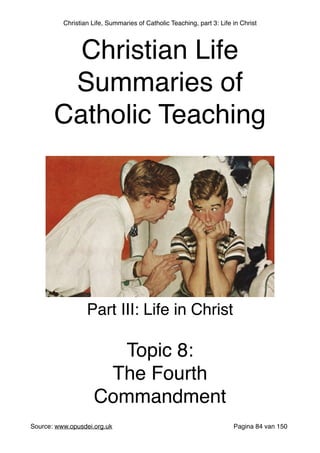
![Christian Life, Summaries of Catholic Teaching, part 3: Life in Christ
b) Family and society: “The family is the original cell of social life. It is
the natural society in which husband and wife are called to give
themselves in love and in the gift of life. Authority, stability, and a life of
relationships within the family constitute the foundations for freedom,
security, and fraternity within society … Family life is an initiation into life
in society” (Catechism 2207). “The family should live in such a way that
its members learn to care and take responsibility for the young, the old,
the sick, the handicapped, and the poor” (Catechism 2208). “The fourth
commandment illuminates other relationships in society”(Catechism
2212).[1]"
"
Society has the grave duty to support and strengthen marriage and the
family, to recognize their true nature, to foster and protect them, and to
safeguard public morality (cf. Catechism 2210).[2] The Holy Family is
the model of every family—a model of love and service, of obedience
and authority."
"
Children have to respect and honor their parents, trying to give them joy,
praying for them and appreciating their sacrifice. Every good Christian
should find these duties a “most sweet” precept."
"
Divine paternity is the source of human paternity (cf. Eph 3:14); this is
the foundation of the honor owed to parents (cf. Catechism 2214).
“Respect for parents (filial piety) derives from gratitude toward those
who, by the gift of life, their love and their word, have brought their
children into the world and enabled them to grow in stature, wisdom,
and grace. ‘With all your heart honor your father, and do not forget the
birth pangs of your mother. Remember that through your parents you
were born; what can you give back to them that equals their gift to
you?’ (Sir 7:27-28)” (Catechism 2215)."
"
Respect for parents is shown by docility and obedience. Children, obey
your parents in everything, for this pleases the Lord (Col 3:20). As long
as they are subject to their parents, children should obey them in what
Source: www.opusdei.org.uk" Pagina van86 150](https://image.slidesharecdn.com/christianlifeiiilifeinchrist-150227151851-conversion-gate02/85/Christian-Life-Part-3-Life-in-Christ-the-Ten-Commandments-86-320.jpg)
![Christian Life, Summaries of Catholic Teaching, part 3: Life in Christ
concerns their own good and that of the family. This obligation ends
when children leave home, but the respect owed parents never ends (cf.
Catechism 2216-2217)."
"
“The fourth commandment reminds grown children of their
responsibilities toward their parents. As much as they can, they must
give them material and moral support in old age and in times of illness,
loneliness, or distress” (Catechism 2218)."
"
If parents order them to do something contrary to the law of God,
children are obliged to give God’s will priority over the desires of their
parents, always keeping in mind the words of Scripture: We must obey
God rather than men (Acts 5:29). God is more a Father than our
parents; all paternity comes from him (cf. Eph 3:15)."
"
Parents have the duty to receive the children God sends them gratefully,
as a real blessing and sign of confidence. Besides caring for their
material needs, they have the serious responsibility of giving them a
solid human and Christian education. The role of parents in forming
children is so important that, were it to be lacking, it would be hard to
make up for it.[3] The parents’ right and duty to educate their children is
irreplaceable and inalienable.[4]"
"
Parents have the responsibility of creating a home built on love, pardon,
respect, faithfulness and disinterested service. The home is the
appropriate place for forming virtues. Parents, through their example
and word, should teach their children to live a simple, sincere and joyful
life of piety, and transmit to them the fullness of Catholic teaching; they
need to encourage them to carry out a generous struggle to live up to
the requirements of God’s law and of each one’s personal vocation to
holiness. Fathers, do not provoke your children to anger but bring them
up in the discipline and instruction of the Lord (Eph 6:4) Parents must
not neglect this responsibility, leaving the education of their children to
other people or institutions, although they can, and sometimes should,
Source: www.opusdei.org.uk" Pagina van87 150](https://image.slidesharecdn.com/christianlifeiiilifeinchrist-150227151851-conversion-gate02/85/Christian-Life-Part-3-Life-in-Christ-the-Ten-Commandments-87-320.jpg)
![Christian Life, Summaries of Catholic Teaching, part 3: Life in Christ
count on the help of those they have confidence in (cf. Catechism
2222-2226)."
"
Parents need to know how to correct because what son is there whom
his father does not discipline? (Heb 12:7); they need to always keep in
mind the Apostle’s advice: Fathers, do not provoke your children, lest
they become discouraged (Col 3:21)."
"
a) Parents need to truly respect and love their children’s freedom,
teaching them to use it well, responsibly.[5] Their own example is
fundamental here."
"
b) In dealing with their children, parents need to combine affection and
firmness, vigilance and patience. It is import for them to “make friends”
with their children, earning their trust and keeping it."
"
c) To succeed in the task of bringing up children, the supernatural
means should be given priority over the human means, although these
too are important and indispensable."
"
“As those first responsible for the education of their children, parents
have the right to choose a school for them which corresponds to their
own convictions. This right is fundamental. As far as possible, parents
have the duty of choosing the schools that will best help them in their
task as Christian educators (cf. Gravissimum educationis, 6). Public
authorities have the duty of guaranteeing this parental right and of
ensuring the concrete conditions of its exercise” (Catechism 2229)."
"
“Family ties are important but not absolute. Just as the child grows to
maturity and human and spiritual autonomy, so his unique vocation
which comes from God asserts itself more clearly and forcefully. Parents
should respect this call and encourage their children to follow it. They
must be convinced that the first vocation of the Christian is to follow
Source: www.opusdei.org.uk" Pagina van88 150](https://image.slidesharecdn.com/christianlifeiiilifeinchrist-150227151851-conversion-gate02/85/Christian-Life-Part-3-Life-in-Christ-the-Ten-Commandments-88-320.jpg)
![Christian Life, Summaries of Catholic Teaching, part 3: Life in Christ
Jesus: ‘He who loves father and mother more than me is not worthy of
me; and he who loves son or daughter more than me is not worthy of
me’ (Mt 10:37)” (Catechism 2232).[6] The divine vocation of a child to
undertake a specific apostolic mission is truly a gift from God to the
family. Parents need to respect the mystery of their child’s call, even if
they do not understand it. Prayer strengthens this respect for freedom
and the readiness to accept God’s intervention. Thus parents will avoid
being overly protective and controlling of their children, a “possessive”
way of acting that does not foster their human and spiritual
development. "
"
Catholics need to have “a true filial spirit toward the Church” (Catechism
2040). This spirit is to be shown toward those who govern the Church."
"
The faithful “with ready Christian obedience … should accept whatever
their sacred pastors, as representatives of Christ, decree in their role as
teachers and rulers in the Church … Nor should they omit to pray to
God for those placed over them, who keep watch as having to render an
account of their souls, so that they may render this account with joy and
not with grief (cf. Heb 13:17).”[7]"
"
This filial spirit is shown above all by faithful adherence to and union
with the Pope, visible head of the Church and Vicar of Christ on earth,
and with the bishops in communion with the Pope."
"
Catholics know that, after God and our Mother the Most Holy Virgin, the
Holy Father comes next in the hierarchy of love and authority.[8]"
"
“God’s fourth commandment also enjoins us to honor all who for our
good have received authority in society from God. It clarifies the duties
of those who exercise authority as well as those who benefit from
it” (Catechism 2234).[9] The duties of the latter include:"
"
Source: www.opusdei.org.uk" Pagina van89 150](https://image.slidesharecdn.com/christianlifeiiilifeinchrist-150227151851-conversion-gate02/85/Christian-Life-Part-3-Life-in-Christ-the-Ten-Commandments-89-320.jpg)
![Christian Life, Summaries of Catholic Teaching, part 3: Life in Christ
a) respecting just laws and legitimate mandates of authority;"
"
b) exercising their rights as citizens and carrying out their duties;"
"
c) intervening in a responsible way in social and political life."
"
“The choice of government and the method of selecting leaders is left to
the free will of citizens.”[10] Responsibility for the common good makes
exercising the right to vote a moral duty (cf. Catechism 2240). It is not
lawful to support anyone whose program for society is opposed to
Christian teaching and as such contrary to the common good and to the
real dignity of man."
"
“The citizen is obliged in conscience not to follow the directives of civil
authorities when they are contrary to the demands of the moral order, to
the fundamental rights of persons or the teachings of the Gospel.
Refusing obedience to civil authorities, when their demands are contrary
to those of an upright conscience, finds its justification in the distinction
between serving God and serving the political community. ‘Render
therefore to Caesar the things that are Caesar’s, and to God the things
that are God’s’ (Mt 22:21). ‘We must obey God rather than men’ (Acts
5:29)” (Catechism 2242). "
"
The exercise of authority should facilitate the exercise of freedom and
responsibility by all men and women. Those governing must be careful
not to give the personal interest of certain individuals priority over the
common good.[11]"
"
“Political authorities are obliged to respect the fundamental rights of the
human person. They will dispense justice humanely by respecting the
rights of everyone, especially of families and the disadvantaged. The
political rights attached to citizenship … cannot be suspended by public
Source: www.opusdei.org.uk" Pagina van90 150](https://image.slidesharecdn.com/christianlifeiiilifeinchrist-150227151851-conversion-gate02/85/Christian-Life-Part-3-Life-in-Christ-the-Ten-Commandments-90-320.jpg)
![Christian Life, Summaries of Catholic Teaching, part 3: Life in Christ
authorities without legitimate and proportionate reasons” (Catechism
2237)."
"
Antonio Porras"
"
"
Basic bibliography !
"
Catechism of the Catholic Church, 2196-2257."
"
Compendium of the Social Doctrine of the Church, 209-214; 221-254; 377-383;
393-411."
"
"
Footnotes!
"
[1] Cf. Compendium of the Social Doctrine of the Church,209-214;221-251."
"
[2] Cf. Ibid, 252-254."
"
[3] Cf. Vatican Council II, Declaration Gravissimum educationis, 3."
"
[4] Cf. John Paul II, Apost. exhort. Familiaris consortio, 22 November 1981, 36;
Catechism 2221 and Compendium of the Social Doctrine of the Church, 239."
"
[5] “When they become adults, children have the right and duty to choose their
profession and state of life” (Catechism 2230)."
"
"
[6] “And, as we are consoled by the joy of finding Jesus—three days He was gone!
—debating with the doctors of Israel (Lk 2:46), your soul and mine will be left
Source: www.opusdei.org.uk" Pagina van91 150](https://image.slidesharecdn.com/christianlifeiiilifeinchrist-150227151851-conversion-gate02/85/Christian-Life-Part-3-Life-in-Christ-the-Ten-Commandments-91-320.jpg)
![Christian Life, Summaries of Catholic Teaching, part 3: Life in Christ
deeply impressed by the duty to leave our home and family to serve our heavenly
Father” (St Josemaria, Holy Rosary, 5th joyful mystery)."
"
[7] Vatican Council II, Const. Lumen gentium, 37."
"
[8] St Josemaria, The Forge, 135."
"
[9] Cf. Compendium of the Social Doctrine of the Church, 377-383, 393-398,
410-411."
"
[10] Vatican Council II, Const. Gaudium et spes, 74. Cf. Catechism, 1901."
"
[11] Cf. John Paul II, Enc. Centesimus annus, 1 May 1991, 25. Cf. Catechism,
2236."
"
"
"
"
"
Source: www.opusdei.org.uk" Pagina van92 150](https://image.slidesharecdn.com/christianlifeiiilifeinchrist-150227151851-conversion-gate02/85/Christian-Life-Part-3-Life-in-Christ-the-Ten-Commandments-92-320.jpg)
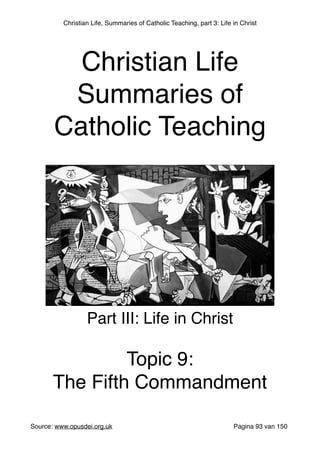
![Christian Life, Summaries of Catholic Teaching, part 3: Life in Christ
Topic 9: The Fifth Commandment!
"
Human life is sacred because from its beginning it involves the creative
action of God and it remains forever in a special relationship with the
Creator.
“Human life is sacred because from its beginning it involves the creative
action of God and it remains forever in a special relationship with the
Creator, who is its sole end. God alone is the Lord of life from its
beginning until its end: no one can under any circumstance claim for
himself the right directly to destroy an innocent human
being” (Catechism 2258)."
"
Man is unique, the only creature on earth that God has loved for its own
sake.[1] Destined to know and love God eternally, man’s life is sacred.
All men and women are created in the image and likeness of God (cf.
Gen 1:26-27). This is the ultimate basis of human dignity and of the
commandment not to kill."
"
The book of Genesis presents the assault on human life as the
consequence of original sin. Yahweh always shows himself to be the
protector of life, even of Cain’s life after he kills his brother Abel, blood of
his own blood (the image of every homicide). No one should take justice
into his own hands, and no one can give himself the right to dispose of
his neighbor’s life (cf. Gen 4:13-15)."
"
This commandment applies to human beings. It is permissible to make
use of animals for food, clothing, etc. God put them on earth to be useful
for man. The requirement not to kill or mistreat them comes from the
disorder human passions may involve, or from a duty of justice (if they
are someone else’s property) (cf. Catechism 2418). Besides, it must not
be forgotten that man is not the “master” of creation, but rather its
administrator, and as such is obliged to respect and care for nature,
Source: www.opusdei.org.uk" Pagina van94 150](https://image.slidesharecdn.com/christianlifeiiilifeinchrist-150227151851-conversion-gate02/85/Christian-Life-Part-3-Life-in-Christ-the-Ten-Commandments-94-320.jpg)
![Christian Life, Summaries of Catholic Teaching, part 3: Life in Christ
which he needs for his own existence and development (cf. Catechism
2415). "
"
“The deepest element of God’s commandment to protect human life is
the requirement to show reverence and love for every person and the
life of every person.”[2]"
"
Mercy and pardon are proper to God. Mercy must also be present in the
life of a child of God, stirring up in our heart compassion for those who
are suffering: Blessed are the merciful, for they shall obtain mercy (Mt
5:7).[3]"
"
It is also necessary to learn to forgive those who offend us (cf. Mt 5:22).
When others offend us, we must try not to lose our peace, and never let
anger gain control of our heart. Moreover, in the Our Father, the prayer
that Jesus left us as the Lord’s prayer, Christ links his forgiveness—
pardon for the transgressions we have committed—to our pardon for
those who have offended us (cf. Mt 6:9-13; Lk 11:2-4). We will be helped
in this struggle by the contemplation of the passion of our Lord, who
pardoned and redeemed us by bearing with love and patience his unjust
treatment. We should also keep in mind that a Christian should never
see anyone as an alien or an enemy (cf. Mt 5:44-45), and that we will be
judged after death according to our love for our neighbor. Christians are
asked to overcome evil with good (cf. Rom 12, 21), and to see insults as
an opportunity for our own purification. "
"
The fifth precept orders us “not to kill.” It also prohibits striking, hurting or
causing unjust bodily pain to oneself or to another, as well as insulting
our neighbor with offensive words or wishing evil on him. This
commandment also includes the prohibition of killing oneself (suicide). "
"
“The fifth commandment forbids direct and intentional killing as gravely
sinful. The murderer and those who cooperate voluntarily in murder
Source: www.opusdei.org.uk" Pagina van95 150](https://image.slidesharecdn.com/christianlifeiiilifeinchrist-150227151851-conversion-gate02/85/Christian-Life-Part-3-Life-in-Christ-the-Ten-Commandments-95-320.jpg)
![Christian Life, Summaries of Catholic Teaching, part 3: Life in Christ
commit a sin that cries out to heaven for vengeance” (Catechism 2268).
[4]"
"
The encyclical Evangelium vitae has set forth in a definitive and infallible
way the following norm: “by the authority which Christ conferred upon
Peter and his Successors, and in communion with the Bishops of the
Catholic Church, I confirm that the direct and voluntary killing of an
innocent human being is always gravely immoral. This doctrine, based
upon that unwritten law which man, in the light of reason, finds in his
own heart (cf. Rom 2:14-15), is reaffirmed by Sacred Scripture,
transmitted by the Tradition of the Church and taught by the ordinary
and universal Magisterium.”[5] Thus homicide is without exception
gravely immoral if it is an act resulting from a deliberate decision and
directed to an innocent person. As such, legitimate defense and the
death penalty are not included in this definitive formulation, and are
dealt with in a separate section.[6]"
"
The fact that God has entrusted human life into our hands calls for an
attitude of love and service, and not of arbitrary dominion. God alone is
the Master of human life.[7]"
"
“Human life must be respected and protected absolutely from the
moment of conception. From the first moment of his existence, a human
being must be recognized as having the rights of a person” (Catechism
2270)."
"
“Direct abortion, that is, abortion willed as an end or as a means, always
constitutes a grave moral disorder, since it is the deliberate killing of an
innocent human being.”[8] “No circumstance, no purpose, no law
whatsoever can ever make licit an act which is intrinsically illicit, since it
is contrary to the Law of God which is written in every human heart,
knowable by reason itself, and proclaimed by the Church.”[9] The
respect for life must be recognized as the boundary that no activity on
the part of an individual or a government can cross. The inalienable right
Source: www.opusdei.org.uk" Pagina van96 150](https://image.slidesharecdn.com/christianlifeiiilifeinchrist-150227151851-conversion-gate02/85/Christian-Life-Part-3-Life-in-Christ-the-Ten-Commandments-96-320.jpg)
![Christian Life, Summaries of Catholic Teaching, part 3: Life in Christ
of every innocent human person to life is a constitutive element of a civil
society and its legislation and as such must be respected by both
society as a whole and the political authority (cf. Catechism 2273).[10]"
"
“The right to command is required by the moral order and has its source
in God; it follows that if civil authority legislate for or allow anything that
is contrary to that order and therefore contrary to the will of God, neither
the laws made nor the authorizations granted can be binding on the
consciences of the citizens … Otherwise, authority breaks down
completely and results in shameful abuse.”[11] So much so that “there is
no obligation in conscience to obey such laws; instead there is a grave
and clear obligation to oppose them by conscientious objection.”[12]"
"
“Since it must be treated from conception as a person, the embryo must
be defended in its integrity, cared for, and healed, as far as possible like
any other human being” (Catechism 2274)."
"
“Euthanasia in the strict sense is understood to be an action or omission
which of itself and by intention causes death, with the purpose of
eliminating all suffering … euthanasia is a grave violation of the law of
God since it is the deliberate and morally unacceptable killing of a
human person … Depending on the circumstances, this practice
involves the malice proper to suicide or murder.”[13] Gravely opposed to
the dignity of the human person, euthanasia is one of the consequences
that hedonism and the loss of the Christian sense of suffering can lead
to."
"
“Discontinuing medical procedures that are burdensome, dangerous,
extraordinary, or disproportionate to the expected outcome can be
legitimate; it is the refusal of ‘over-zealous’ treatment. Here one does not
will to cause death; one’s inability to impede it is merely
accepted” (Catechism 2278).[14]"
"
Source: www.opusdei.org.uk" Pagina van97 150](https://image.slidesharecdn.com/christianlifeiiilifeinchrist-150227151851-conversion-gate02/85/Christian-Life-Part-3-Life-in-Christ-the-Ten-Commandments-97-320.jpg)
![Christian Life, Summaries of Catholic Teaching, part 3: Life in Christ
Nevertheless, “even if death is thought imminent, the ordinary care
owed to a sick person cannot be legitimately interrupted” (Catechism
2279).[15] Artificial nutrition and hydration are, in principle, ordinary care
owed to all the sick.[16]"
"
“We are stewards, not owners, of the life God has entrusted to us. It is
not ours to dispose of” (Catechism 2280). “Suicide contradicts the
natural inclination of the human being to preserve and perpetuate his
life. It is gravely contrary to the just love of self. It likewise offends love
of neighbor because it unjustly breaks the rites of solidarity with family,
nation, and other human societies to which we continue to have
obligations. Suicide is contrary to love for the living God” (Catechism
2281).[17]"
"
To choose to die to save the life of someone else is not suicide; on the
contrary, it can be an act of the utmost charity. "
"
The prohibition against causing anyone’s death does not suppress the
right to prevent an unjust aggressor from causing injury.[18] Legitimate
defense can also be a grave duty for someone responsible for the life of
another person or for the common good (cf. Catechism 2265)."
"
Defending the common good requires rendering an aggressor unable to
do harm. Therefore, the legitimate authority can impose punishment
commensurate with the gravity of the crime committed. The aim of
punishments is to compensate for the disorder caused by the offense, to
ensure public order and the security of persons, as well as the
correction of the guilty person (cf. Catechism 2266). “For these
purposes to be achieved, the nature and extent of the punishment must
be carefully evaluated and decided upon, and ought not go to the
extreme of executing the offender except in cases of absolute necessity:
in other words, when it would not be possible otherwise to defend
society … such cases are very rare, if not practically non-existent.”[19]"
"
Source: www.opusdei.org.uk" Pagina van98 150](https://image.slidesharecdn.com/christianlifeiiilifeinchrist-150227151851-conversion-gate02/85/Christian-Life-Part-3-Life-in-Christ-the-Ten-Commandments-98-320.jpg)
![Christian Life, Summaries of Catholic Teaching, part 3: Life in Christ
Christians have the duty to safeguard the life and supernatural health of
their neighbor’s soul and body."
"
In contrast, “scandal is an attitude or behavior which leads another to do
evil. The person who gives scandal becomes his neighbor’s tempter …
Scandal is a grave offense if by deed or omission another is deliberately
led into a grave offense” (Catechism 2284). Scandal can be caused by
unjust comments, by promoting immoral shows, books and magazines,
by immodest dress, etc."
"
“Scandal takes on a particular gravity by reason of the authority of those
who cause it or the weakness of those who are scandalized” (Catechism
2285). Whoever causes one of these little ones who believe in me to sin,
it would be better for him to have a great millstone fastened round his
neck and to be drowned in the depth of the sea (Mt 18:6).[20]"
"
Respect for one’s own body is a requirement of charity since the body is
the temple of the Holy Spirit (cf. 1 Cor 6:19; 3, 16ff; 2 Cor 6:16), and we
are responsible, insofar as it depends on us, to maintain our health as a
means of serving God and others. However, bodily life is not an absolute
value. Christian morality is opposed to a neo-pagan conception that
fosters the cult of the body and can lead to perverting human
relationships (cf. Catechism 2289)."
"
“The virtue of temperance disposes us to avoid every kind of excess: the
abuse of food, alcohol, tobacco, or medicine. Those incur grave guilt
who, by drunkenness or a love of speed, endanger their own and others’
safety on the road, at sea, or in the air.” (Catechism 2290)."
"
The use of drugs is a grave offense because of the harm it can do to
one’s health and the loss of responsibility in acts accomplished under
their influence. Clandestine production and traffic of drugs are immoral
activities (cf. Catechism 2291)."
Source: www.opusdei.org.uk" Pagina van99 150](https://image.slidesharecdn.com/christianlifeiiilifeinchrist-150227151851-conversion-gate02/85/Christian-Life-Part-3-Life-in-Christ-the-Ten-Commandments-99-320.jpg)
![Christian Life, Summaries of Catholic Teaching, part 3: Life in Christ
Scientific research cannot justify acts that, in themselves, are contrary to
the dignity of the human person and the moral law. No human being can
be treated as a means for the progress of science (cf. Catechism 2295).
This principle is transgressed by practices of substitute artificial
procreation or the use of embryos for experimental purposes."
"
Giving organs as transplants is licit and can be an act of charity if the
donation is without constraint and free,[21] and if it is arranged in a just
and charitable way."
"
“A person can donate an organ only if it involves no serious danger of
harm for his own life or personal identity, and for a just and proportionate
reason. As an obvious consequence, vital organs can be donated only
after death.”[22]"
"
It is necessary for the donor or his representatives to give their informed
consent (cf. Catechism 2296). This donation, “although licit in itself, can
become illicit if it violates the rights and feelings of third parties
responsible for guardianship of the body: close relatives in the first
place; but this may also include other persons by virtue of public or
private rights.”[23]"
"
Kidnapping and hostage taking are morally illicit. They involve treating
persons merely as means to obtaining some end, depriving them
unjustly of their freedom. Likewise, terrorism and torture gravely violate
justice and charity."
"
“Except when performed for strictly therapeutic medical reasons, directly
intended amputations, mutilations, and sterilizations performed on
innocent persons are against the moral law” (Catechism 2297)."
"
“The bodies of the dead must be treated with respect and charity, in faith
and hope of the Resurrection. The burial of the dead is a corporal work
Source: www.opusdei.org.uk" Pagina van100 150](https://image.slidesharecdn.com/christianlifeiiilifeinchrist-150227151851-conversion-gate02/85/Christian-Life-Part-3-Life-in-Christ-the-Ten-Commandments-100-320.jpg)
![Christian Life, Summaries of Catholic Teaching, part 3: Life in Christ
of mercy (cf. Tob 1:6-18); it honors the children of God, who are temples
of the Holy Spirit” (Catechism 2300). “The Church strongly advises
maintaining the pious custom of burying the body of the deceased;
however it does not forbid cremation, provided it has not been chosen
for reasons contrary to Christian doctrine” (CIC, can. 1176)."
"
Blessed are the peacemakers for they shall be called sons of God (Mt
5:9). A characteristic of the spirit of divine filiation is to be sowers of
peace and joy.[24] “Peace cannot be attained on earth without
safeguarding the goods of persons, free communication among men,
respect for the dignity of persons and peoples, and the assiduous
practice of fraternity … Peace is the work of justice and the effect of
charity” (Catechism 2304)."
"
“Because of the evils and injustices that accompany all war, the Church
insistently urges everyone to prayer and to action so that the divine
Goodness may free us from the ancient bondage of war (cf. Vatican
Council II, Const. Gaudium et spes, 81,4)” (Catechism 2307)."
"
There can be a need for “legitimate defense by military force.” However
“the gravity of such a decision makes it subject to rigorous conditions of
moral legitimacy” (Catechism 2309).[25]"
"
“Injustice, excessive economic or social inequalities, envy, distrust, and
pride raging among men and nations constantly threaten peace and
cause wars. Everything done to overcome these disorders contributes to
building up peace and avoiding war” (Catechism 2317)."
"
“Love your own country: it is a Christian virtue to be patriotic. But if
patriotism becomes nationalism, which leads you to look at other
people, at other countries, with indifference, with scorn, without Christian
charity and justice, then it is a sin.”[26]"
"
Source: www.opusdei.org.uk" Pagina van101 150](https://image.slidesharecdn.com/christianlifeiiilifeinchrist-150227151851-conversion-gate02/85/Christian-Life-Part-3-Life-in-Christ-the-Ten-Commandments-101-320.jpg)
![Christian Life, Summaries of Catholic Teaching, part 3: Life in Christ
Pau Agulles Simo"
"
Basic Bibliography !
"
Catechism of the Catholic Church, 2258-2330."
"
John Paul II, Enc. Evangelium vitae, 25 March 1995, ch. 3."
"
"
Footnotes!
"
[1] Cf. Vatican Council II, Const. Gaudium et spes, 24."
"
[2] John Paul II, Enc. Evangelium vitae, 25 March 1995, 41."
"
[3] “The works of mercy are charitable actions by which we come to the aid of our
neighbor in his spiritual and bodily necessities” (Catechism 2447)."
"
[4] Furthermore, it “forbids doing anything with the intention of indirectly bringing
about a person’s death. The moral law prohibits exposing someone to mortal
danger without grave reason, as well as refusing assistance to a person in
danger” (Catechism 2469)."
"
[5] John Paul II, Evangelium vitae, 57."
"
[6] Cf. Ibid, 55-56."
"
[7] Cf. Ibid, 52."
"
[8] Ibid, 62."
"
Source: www.opusdei.org.uk" Pagina van102 150](https://image.slidesharecdn.com/christianlifeiiilifeinchrist-150227151851-conversion-gate02/85/Christian-Life-Part-3-Life-in-Christ-the-Ten-Commandments-102-320.jpg)
![Christian Life, Summaries of Catholic Teaching, part 3: Life in Christ
[9] Ibid, 62. The crime of abortion is of such gravity that the Church sanctions this
transgression with the canonical punishment of excommunication latae sententiae
(cf. Catechism 2272)."
"
[10] “These human rights depend neither on single individuals nor on parents; nor
do they represent a concession made by society and the State: they pertain to
human nature and are inherent in the person by virtue of the creative act from
which the person took his of her origin … the moment a positive law deprives a
category of human beings of the protection which civil legislation must accord them,
the State is denying the equality of all before the law. When the State does not
place its power at the service of the rights of each citizen, and in particular of the
more vulnerable, the very foundations of a State based on law are
undermined” (Congregation for the Doctrine of the Faith, Instr. Donum vitae, 22
February 1987, III)."
"
“How many crimes are committed in the name of justice! If you were a dealer in
guns and someone paid you the price of one of them, so that he might use the
weapon to kill your mother, would you sell it to him? And yet, wasn’t he ready to pay
you a just price for it? Professor, journalist, politician, diplomat: reflect” (St
Josemaria, The Way, 400)."
"
[11] John XXIII, Enc. Pacem in terris, 11 April 1963, 51."
"
[12] John Paul II, Enc. Evangelium vitae, 73."
"
[13] John Paul II, Enc. Evangelium vitae, 65."
"
[14] “The decisions should be made by the patient if he is competent and able or, if
not, by those legally entitled to act for the patient, whose reasonable will and
legitimate interests must always be respected” (Catechism 2278)."
"
[15] “The use of painkillers to alleviate the sufferings of the dying, even at the risk of
shortening their days, can be morally in conformity with human dignity if death is
not willed as either an end or a means, but only foreseen and tolerated as
inevitable. Palliative care is a special form of disinterested charity. As such it should
be encouraged” (Catechism 2279)."
Source: www.opusdei.org.uk" Pagina van103 150](https://image.slidesharecdn.com/christianlifeiiilifeinchrist-150227151851-conversion-gate02/85/Christian-Life-Part-3-Life-in-Christ-the-Ten-Commandments-103-320.jpg)
![Christian Life, Summaries of Catholic Teaching, part 3: Life in Christ
"
[16] Cf. John Paul II, Discorso ai partecipanti al Congresso Internazionale su “I
trattamenti di sostegno vitale e lo stato vegetativo. Progressi scientifici e dilemmi
etici,” 20 March 2004, no. 4; cf. Congregation for the Doctrine of the Faith,
“Responses to Certain Questions of the United States Conference of Catholic
Bishops Regarding Artificial Nutrition and Hydration," 1 August 2007."
"
[17] “We should not despair of the eternal salvation of persons who have taken their
own lives. By ways known to him alone, God can provide the opportunity for
salutary repentance. The Church prays for persons who have taken their own lives”
(Catechism 2283)."
"
[18] “Love toward oneself remains a fundamental principle of morality. Therefore it
is legitimate to insist on respect for one’s own right to life. Someone who defends
his life is not guilty of murder even if he is forced to deal his aggressor a lethal
blow” (Catechism 2264; cf. John Paul II, Enc. Evangelium vitae, 55). In this case,
killing the aggressor does not constitute the direct purpose of the will of the person
defending himself; rather, the moral aim consists in removing an imminent threat to
one’s own life."
"
[19] John Paul II, Enc. Evangelium vitae, 56. Cf. Catechism, 2267."
"
[20] “They are guilty of scandal who establish laws or social structures leading to
the decline of morals and the corruption of religious practice, or to ‘social conditions
that, intentionally or not, make Christian conduct and obedience to the
Commandments difficult and practically impossible’ (Pius XII, Discourse, June 1,
1941)” (Catechism 2286)."
"
[21] Cf. John Paul II, Discourse, 22 June 1991, 3; Catechism, 2301."
"
[22] Ibid. 4."
"
[23] Pius XII, Discorso all’Associazione Italiana Donatori di Cornea, 14 May 1956."
"
[24] Cf. St Josemaria Christ is Passing By, 124."
Source: www.opusdei.org.uk" Pagina van104 150](https://image.slidesharecdn.com/christianlifeiiilifeinchrist-150227151851-conversion-gate02/85/Christian-Life-Part-3-Life-in-Christ-the-Ten-Commandments-104-320.jpg)
![Christian Life, Summaries of Catholic Teaching, part 3: Life in Christ
"
[25] “At one and the same time:"
"
—the damage inflicted by the aggressor on the nation or community of nations
must be lasting, grave, and certain;"
"
—all other means of putting an end to it must have been shown to be impractical or
ineffective;"
"
—there must be serious prospects of success;"
"
—the use of arms must not produce evils and disorders graver than the evil to be
eliminated. The power of modern means of destruction weighs very heavily in
evaluating this condition."
"
“These are the traditional elements enumerated in what is called the ‘just war’
doctrine. The evaluation of these conditions for moral legitimacy belongs to the
prudential judgment of those who have responsibility for the common
good” (Catechism 2309). Moreover, “one is morally bound to resist orders that
command genocide” (Catechism 2313)."
"
Regarding the so-called arms race: “Far from eliminating the causes of war, it risks
aggravating them. Spending enormous sums to produce ever new types of
weapons impedes efforts to aid needy populations; it thwarts the development of
peoples” (Catechism 2315). The arms race “is an utterly treacherous trap for
humanity, and one which injures the poor to an intolerable degree” (Vatican Council
II, Const. Gaudium et spes, 81). Public authorities have the right and the duty to
regulate the production and sale of arms (cf. Catechism 2316)."
"
[26] St Josemaria, Furrow, 315. Cf. St Josemaria The Forge, 879; The Way, 525."
"
Source: www.opusdei.org.uk" Pagina van105 150](https://image.slidesharecdn.com/christianlifeiiilifeinchrist-150227151851-conversion-gate02/85/Christian-Life-Part-3-Life-in-Christ-the-Ten-Commandments-105-320.jpg)
![Christian Life, Summaries of Catholic Teaching, part 3: Life in Christ
Topic 10: The Sixth Commandment!
"
"God is love" (1 Jn 4:8), and his love is fruitful. He wants human beings
to share in this fecundity, by linking the procreation of each new person
with a specific act of love between a man and a woman. "
"
God’s call to men and women to “be fruitful and multiply” should be
understood from the perspective of our creation “in the image and
likeness” of God (cf. Catechism 2331, 2334). This entails that human
procreation, in the wider context of our sexuality, cannot be “something
simply biological, but concerns the innermost being of the human person
as such” (Catechism 2361), and so is essentially distinct from animal
life."
"
God is love (1 Jn 4:8), and his love is fruitful. He wants human beings to
share in this fecundity, by linking the procreation of each new person
with a specific act of love between a man and a woman.[1] Therefore
“sex is not a shameful thing; it is a divine gift, ordained to life, to love, to
fruitfulness.”[2]"
"
Since a human being is an individual consisting of a body and a soul,
the loving procreative act calls for the participation of all dimensions of
the human person—body, feelings, spirit.[3]"
"
Original sin broke the harmony within each person and with other men
and women. This rupture had a special repercussion on the capacity to
live our sexuality in accord with human reason. It obscured the
inseparable bond between the affective and procreative dimensions of
the conjugal act, and made it more difficult for the will to exercise control
over the affective and bodily forces of sexuality."
"
In these circumstances, the struggle for purification and growth in
maturity that our sexuality requires does not imply any rejection or
Source: www.opusdei.org.uk" Pagina van107 150](https://image.slidesharecdn.com/christianlifeiiilifeinchrist-150227151851-conversion-gate02/85/Christian-Life-Part-3-Life-in-Christ-the-Ten-Commandments-107-320.jpg)
![Christian Life, Summaries of Catholic Teaching, part 3: Life in Christ
negative consideration of this gift that men and women have received
from God. Rather it entails the need to “heal it and restore its true
grandeur.”[4] The virtue of chastity plays a key role here."
"
The Catechism of the Catholic Church speaks of a “vocation to chastity”
because this virtue is a condition and essential part of our vocation to
love—the gift of self to which God calls every man and woman. Chastity
makes it possible to love in and through our bodies.[5] In a certain way,
it could be said that chastity is the virtue that enables a human person to
live well, with benevolence and interior peace in relation to other men
and women and to oneself, because human sexuality influences all our
capacities from the most physical and material to the most spiritual,
giving a masculine or feminine tint to all our faculties."
"
Thus the virtue of chastity is not simply a remedy against the disorder
sin gives rise to in human sexuality, but a joyful affirmation, since it
enables us to love God and, through him, other men and women, with
our whole heart, all whole our soul, our whole mind and our whole
strength (cf. Mt 12:30).[6]"
"
“The virtue of chastity comes under the cardinal virtue of temperance,
which seeks to permeate the passions and appetites of the senses with
reason” (Catechism 2341). “Chastity means the successful integration of
sexuality within the person and thus the inner unity of man in his bodily
and spiritual being” (Catechism 2337)."
"
When speaking about chastity, especially with young people, it is
important to stress the capacity to love that this virtue imparts to
sexuality and procreation. Otherwise, chastity could come to be seen as
a negative virtue, since a good part of the struggle to live chastity
involves the struggle to control one’s passions, which at times can be
directed towards a particular good that cannot be rationally ordered to
the good of the person as a whole.[7]"
"
Source: www.opusdei.org.uk" Pagina van108 150](https://image.slidesharecdn.com/christianlifeiiilifeinchrist-150227151851-conversion-gate02/85/Christian-Life-Part-3-Life-in-Christ-the-Ten-Commandments-108-320.jpg)
![Christian Life, Summaries of Catholic Teaching, part 3: Life in Christ
In his present state, man cannot live in accord with the natural moral
law, and hence be chaste, without the help of grace. This does not imply
the impossibility of acquiring the human virtue that brings a certain
control over one’s passions, but rather that the wound caused by sin is
so deep that only divine help can bring about a perfect reintegration of
the human person.[8]"
"
Chastity is aimed at attaining control of one’s concupiscence, an
important part of self-mastery. Attaining this control is a task that lasts
for one’s whole life and that calls for repeated efforts, which can be
particularly demanding at certain periods. Chastity should always keep
growing with the grace of God and each one’s personal ascetical
struggle (cf. Catechism 2342).[9]"
"
“Charity is the form of all the virtues. Under its influence, chastity
appears as a school of the gift of the person. Self-mastery is ordered to
the gift of self” (Catechism 2346)."
"
Educating for chastity is much more than what some reductively call
“sex education,” usually limited to giving information on the physiological
aspects of human reproduction and methods of contraception. A true
education in chastity involves much more than the biological aspects. It
needs to provide help in reflecting on the personal and moral values
involved in the issues of human life and personal maturity. Moreover, it
needs to foster high ideals of love for God and other men and women,
through virtues such as generosity, self-giving, the modesty that protects
intimacy, etc. —virtues that help a person to overcome selfishness and
the temptation to become self-centered."
"
Parents have a great responsibility in this task, since they are the first
and principal teachers in instilling the virtue of chastity in their children.
[10]"
"
Source: www.opusdei.org.uk" Pagina van109 150](https://image.slidesharecdn.com/christianlifeiiilifeinchrist-150227151851-conversion-gate02/85/Christian-Life-Part-3-Life-in-Christ-the-Ten-Commandments-109-320.jpg)
![Christian Life, Summaries of Catholic Teaching, part 3: Life in Christ
In the struggle to live this virtue, the following means are important:"
"
a) prayer: asking God for the virtue of holy purity;[11] frequenting the
sacraments, which are the “medicine” for our weakness;"
"
b) working intensely, avoiding idleness;"
"
c) moderation in food and drink;"
"
d) caring for details of decency and modesty in dress, etc.;"
"
e) avoiding unsuitable books, magazines and newspapers, and immoral
shows;"
"
f) being very sincere in spiritual direction;"
"
g) not thinking about oneself;"
"
h) having a deep devotion to Mary Most Holy, Mater pulchrae dilectionis."
"
Chastity, while an eminently personal virtue, “involves a cultural
effort” (Catechism 2344), since there is “an interdependence between
personal betterment and the improvement of society.”[12] Respect for
the rights of the person requires respect for chastity, and particularly the
right “to receive information and an education that respect the moral and
spiritual dimensions of human life” (Catechism 2344).[13]"
"
The specific manifestations of this virtue will differ depending on one’s
vocation. “Married people are called to live conjugal chastity; others
practice chastity in continence” (Catechism 2349)."
Source: www.opusdei.org.uk" Pagina van110 150](https://image.slidesharecdn.com/christianlifeiiilifeinchrist-150227151851-conversion-gate02/85/Christian-Life-Part-3-Life-in-Christ-the-Ten-Commandments-110-320.jpg)
![Christian Life, Summaries of Catholic Teaching, part 3: Life in Christ
Sexual union “is ordered to the conjugal love of man and
woman” (Catechism 2360); “it is realized in a truly human way only if it is
an integral part of the love by which a man and a woman commit
themselves totally to one another until death.”[14]"
"
The grandeur of the act whereby man and woman cooperate freely with
God’s creative action requires certain strict moral conditions, precisely
because of its deep human meaning: the capacity to engender a new
human life called to eternal happiness. This is why one should never
voluntarily separate the unitive and procreative dimensions of this act,
as happens with contraception.[15]"
"
Chaste couples will find the most adequate moments to live this bodily
union so that in each act it always reflects the gift of self it signifies.[16]"
"
Unlike the procreative dimension, which can be realized in a truly human
way only through the conjugal act, the unitive and affective dimension
proper to this act can and should be manifested in many other ways.
Hence, if for reasons of health or other reasons, the spouses cannot
carry out the conjugal union, or if they decide that it is preferable to
abstain temporarily (or permanently in particularly serious situations)
from the conjugal act, they can and should continue making this gift of
self a reality, which fosters the growth of a truly personal love. "
"
God calls some people to live their vocation to love in a special way, in
apostolic celibacy.[17] Living the Christian vocation in apostolic celibacy
requires continence.[18] Excluding the use of one’s reproductive
capacity in no way entails excluding love or affection.[19] On the
contrary, freely giving to God the possibility of a married life enables one
to love and to give oneself to many other men and women, helping them
in turn to find God, which is the reason for their celibacy.[20]"
"
Source: www.opusdei.org.uk" Pagina van111 150](https://image.slidesharecdn.com/christianlifeiiilifeinchrist-150227151851-conversion-gate02/85/Christian-Life-Part-3-Life-in-Christ-the-Ten-Commandments-111-320.jpg)
![Christian Life, Summaries of Catholic Teaching, part 3: Life in Christ
This way of life must always be viewed and lived as a gift, since no one
can attribute to himself or herself the capacity to be faithful to God in this
path of life without the help of grace."
"
Opposed to chastity is lust, a “disordered desire for or inordinate
enjoyment of sexual pleasure. Sexual pleasure is morally disordered
when sought for itself, isolated from its procreative and unitive purposes”
(Catechism 2351)."
"
Since sexuality is a central dimension in human life, sins against chastity
are always materially grave and as such entail losing the inheritance of
the Kingdom of God (cf. Eph 5:5). However they can be venial when full
awareness or perfect consent is lacking."
"
The vice of lust has numerous serious consequences: mental blindness,
which obscures our final end and our good; weakening of the will, which
is made almost incapable of any effort, becoming passive, indifferent to
work, to serving others, etc.; attachment to earthly goods and forgetting
eternal goods; and finally it can even lead to hatred for God, seen by a
lustful person as the major obstacle to satisfying his sensuality."
"
Masturbation is the “deliberate stimulation of the genital organs in order
to derive sexual pleasure” (Catechism 2352). “Both the Magisterium of
the Church in the course of a constant tradition, and the moral sense of
the faithful have been in no doubt and have firmly maintained that
masturbation is an intrinsically and gravely disordered action.”[21] By its
very nature, masturbation contradicts the Christian sense of sexuality as
being at the service of love. Being a solitary and selfish exercise of
sexuality, deprived of the truth of love, it leaves a person unsatisfied and
leads to emptiness and regret."
"
“Fornication is carnal union between an unmarried man and an
unmarried woman. It is gravely contrary to the dignity of persons and of
Source: www.opusdei.org.uk" Pagina van112 150](https://image.slidesharecdn.com/christianlifeiiilifeinchrist-150227151851-conversion-gate02/85/Christian-Life-Part-3-Life-in-Christ-the-Ten-Commandments-112-320.jpg)
![Christian Life, Summaries of Catholic Teaching, part 3: Life in Christ
human sexuality which is naturally ordered to the good of spouses and
the generation and education of children. Moreover, it is a grave scandal
when there is corruption of the young” (Catechism 2353).[22]"
"
Adultery “refers to marital infidelity. When two partners, of whom at least
one is married to another party, have sexual relations—even transient
ones—they commit adultery” (Catechism 2380).[23]"
"
Also opposed to chastity are conversations, looks, manifestations of
affection for another person, including fiancés, prompted by a lewd
desire or constituting a near occasion of sin which is sought or not
rejected.[24] Pornography—displaying the human body as a mere object
of concupiscence—and prostitution—making one’s own body an object
for financial gain and for carnal pleasure—are grave faults of sexual
disorder which, besides offending the dignity of any person involved, are
a true social scourge (cf. Catechism 2355)."
"
“Rape is the forcible violation of the sexual intimacy of another person. It
does injury to justice and charity. Rape deeply wounds the respect,
freedom, and physical and moral integrity to which every person has a
right. It causes grave damage that can mark the victim for life. It is
always an intrinsically evil act. Graver still is the rape of children
committed by parents (incest) or those responsible for the education of
the children entrusted to them” (Catechism 2356)."
“Homosexual acts are intrinsically disordered,” as the tradition of the
Church has always declared.[25] This clear moral evaluation of acts
must in no way prejudge those persons who have homosexual
tendencies,[26] since not infrequently their condition involves a difficult
trial.[27] Furthermore, these persons “are called to chastity. By the
virtues of self-mastery that teach them inner freedom, at times by the
support of disinterested friendship, by prayer and sacramental grace,
they can and should gradually and resolutely approach Christian
perfection” (Catechism 2359)."
"
Source: www.opusdei.org.uk" Pagina van113 150](https://image.slidesharecdn.com/christianlifeiiilifeinchrist-150227151851-conversion-gate02/85/Christian-Life-Part-3-Life-in-Christ-the-Ten-Commandments-113-320.jpg)
![Christian Life, Summaries of Catholic Teaching, part 3: Life in Christ
Pablo Requena "
"
"
Basic Bibliography !
"
Catechism of the Catholic Church, 2331-2400."
"
Benedict XVI, Enc. Deus caritas est, 25 December 2005, 1-18."
"
John Paul II, Apost. Ex. Familiaris consortio, 22 November 1981. "
"
"
Recommended Reading!
"
St Josemaria, “For They Shall See God,” in Friends of God: Homilies, 175-189;
“Marriage, a Christian Vocation,” in Christ is Passing By, 22-30."
"
Congregation for the Doctrine of the Faith, Decl. Persona humana, 29 December
1975."
"
Congregation for Catholic Education, Educational orientations on human love, 1
November 1983."
"
"
Footnotes!
"
[1] “Each of the two sexes is an image of the power and tenderness of God, with
equal dignity though in a different way. The union of man and woman in marriage is
a way of imitating in the flesh the Creator’s generosity and fecundity: ‘Therefore a
man leaves his father and his mother and cleaves to his wife, and they become one
flesh’ (Gen 2:24) All human generations proceed from this union. (cf. Gen 4:1-2,
25-26; 5:1)” (Catechism, 2335)."
"
Source: www.opusdei.org.uk" Pagina van114 150](https://image.slidesharecdn.com/christianlifeiiilifeinchrist-150227151851-conversion-gate02/85/Christian-Life-Part-3-Life-in-Christ-the-Ten-Commandments-114-320.jpg)
![Christian Life, Summaries of Catholic Teaching, part 3: Life in Christ
[2] St Josemaria, Christ is Passing By, 24."
"
[3] “Should he aspire to be pure spirit and to reject the flesh as pertaining to his
animal nature alone, then spirit and body would both lose their dignity. On the other
hand, should he deny the spirit and consider matter, the body, as the only reality, he
would likewise lose his greatness” (Benedict XVI, Enc. Deus caritas est, 25
December 2005, 5)"
"
[4] Ibid."
"
[5] “God is love and in himself He lives a mystery of personal loving communion.
Creating the human race in his own image … God inscribed in the humanity of man
and woman the vocation, and thus the capacity and responsibility, of love and
communion” (John Paul II, Apost. Ex. Familiaris consortio, 22 November 1981, 11)."
"
[6] “Chastity is the joyous affirmation of someone who knows how to live self-giving,
free from any form of self-centred slavery” (Pontifical Council for the Family, The
Truth and Meaning of Human Sexuality, 8 December 1995, 17). “Purity is a
consequence of the love that prompts us to commit to Christ our soul and body, our
faculties and senses. It is not something negative; it is a joyful affirmation” (St
Josemaria, Christ is Passing By, 5)."
"
[7] “Chastity includes an apprenticeship in self-mastery which is a training in human
freedom. The alternative is clear: either man governs his passions and finds peace,
or he lets himself be dominated by them and becomes unhappy (cf. Sir 1:22).
‘Man's dignity therefore requires him to act out of conscious and free choice, as
moved and drawn in a personal way from within, and not by blind impulses in
himself or by mere external constraint. Man gains such dignity when, ridding
himself of all slavery to the passions, he presses forward to his goal by freely
choosing what is good and, by his diligence and skill, effectively secures for himself
the means suited to this end’ (Gaudium et spes, 17)” (Catechism 2339)."
"
[8] “Chastity is a moral virtue. It is also a gift from God, a grace, a fruit of spiritual
effort. (cf. Gal 5:22). The Holy Spirit enables one whom the water of Baptism has
regenerated to imitate the purity of Christ (cf. 1 Jn 3:3)” (Catechism 2345)."
"
Source: www.opusdei.org.uk" Pagina van115 150](https://image.slidesharecdn.com/christianlifeiiilifeinchrist-150227151851-conversion-gate02/85/Christian-Life-Part-3-Life-in-Christ-the-Ten-Commandments-115-320.jpg)
![Christian Life, Summaries of Catholic Teaching, part 3: Life in Christ
[9] Personal maturity includes self-mastery, which requires modesty and
temperance, as well as respect for, and being open to, others (cf. Congregation for
Catholic Education, Educational orientations on human love, 1 November 1983,
35)."
"
[10] This aspect of education is of greater importance now than in the past because
today’s society provides many negative models in this areas (cf. Pontifical Council
for the Family, The Truth and Meaning of Human Sexuality, 8 December 1995, 47).
“Faced with a culture that largely reduces human sexuality to the level of something
commonplace, since it interprets and lives it in a reductive and impoverished way
by linking it solely with the body and with selfish pleasure, the educational service
of parents must aim firmly at a training in the area of sex that is truly and fully
personal” (John Paul II, Familiaris consortio, 37)."
"
[11] “Holy purity is granted by God when it is asked for with humility” (St Josemaria,
The Way, 118)."
"
[12] Vatican Council II, Const. Gaudium et spes, 25."
"
[13] John Paul II spoke about the need to foster a genuine “human ecology” in the
sense of achieving a healthy moral environment that will facilitate the human
development of the person (cf., for example, Enc. Centesimus annus, 1 May 1991,
38). Part of the “cultural effort” mentioned above consists in making clear the need
to respect certain moral norms in the media, especially in television, to safeguard
the dignity of the human person. “In these times of violence and of brutal, savage
sexuality, we have to be rebels: we refuse point blank to go with the tide, and
become beasts. We want to behave like children of God, like men and women who
are on intimate terms with their Father, who is in Heaven and who wants to be very
close to—inside!—each one of us” (St Josemaria, The Forge, 15)."
"
[14] John Paul II, Familiaris consortio, 11."
"
[15] Also in artificial fertilization there is a rupture between these two dimensions
proper to human sexuality, as the Instruction Donum vitae (1987) makes clear."
"
Source: www.opusdei.org.uk" Pagina van116 150](https://image.slidesharecdn.com/christianlifeiiilifeinchrist-150227151851-conversion-gate02/85/Christian-Life-Part-3-Life-in-Christ-the-Ten-Commandments-116-320.jpg)
![Christian Life, Summaries of Catholic Teaching, part 3: Life in Christ
[16] As the Catechism of the Catholic Church teaches, the pleasure accompanying
conjugal union is something good and desired by God (cf. Catechism 2362)."
"
[17] Although the measure of sanctity is the love one has for God and not one’s
state in life, whether celibate or married, the Church teaches that celibacy for the
Kingdom of Heaven is a gift superior to matrimony (cf. Council of Trent: DZ 1810; 1
Cor 7:38)."
"
[18] We will not say anything specific here about priestly celibacy or virginity or
consecrated celibacy. But from the moral point of view, total continence is required
in each of these situations."
"
[19] It would not make any sense to maintain that celibacy goes “against nature.”
The fact that man and woman can complement one another does not mean that
they complete one another, because both are complete as human persons."
"
[20] When speaking of priestly celibacy (though applicable to all celibacy for the
Kingdom of Heaven), Benedict XVI explains that it cannot be understood merely in
functional terms because in reality “it represents a special configuration to the style
of life of Christ himself” (Benedict XVI, Apost. Ex. Sacramentum caritatis, 24)."
"
[21] Congregation for the Doctrine of the Faith, Decl. Persona humana, 29
December 1975, 9."
"
[22] Free unions or cohabitation without the intention to marry, trial unions when
there is an intention to marry and premarital relations all offend the dignity of human
sexuality and marriage. “They are contrary to the moral law. The sexual act must
take place exclusively within marriage. Outside of marriage it always constitutes a
grave sin and excludes one from sacramental communion” (Catechism 2390). A
sincere gift of self, freely made, must be permanent and lasting."
"
[23] Christ also condemns the desire to commit adultery (cf. Mt 5:27-28). In the
New Testament, adultery is absolutely forbidden (cf. Mt 5:32; 19, 6; Mk 10:11; 1 Cor
6:9-10). The Catechism, when speaking of offenses against marriage, also
mentions divorce, polygamy and contraception."
"
Source: www.opusdei.org.uk" Pagina van117 150](https://image.slidesharecdn.com/christianlifeiiilifeinchrist-150227151851-conversion-gate02/85/Christian-Life-Part-3-Life-in-Christ-the-Ten-Commandments-117-320.jpg)
![Christian Life, Summaries of Catholic Teaching, part 3: Life in Christ
[24] “Those who are engaged to marry are called to live chastity in continence.
They should see in this time of testing a discovery of mutual respect, an
apprenticeship in fidelity, and the hope of receiving one another from God. They
should reserve for marriage the expressions of affection that belong to married
love. They will help each other grow in chastity” (Catechism 2350)."
"
[25] Congregation for the Doctrine of the Faith, Decl. Persona humana, 8. Such
acts “are contrary to the natural law. They close the sexual act to the gift of life.
They do not proceed from a genuine affective and sexual complementarity. Under
no circumstances can they be approved” (Catechism 2357)."
"
[26] Homosexuality designates the condition of those men and women who feel a
sexual attraction, whether exclusive or predominant, for persons of the same sex.
The possible situations where this can arise are very diverse and as a
consequence extreme prudence is required when treating such cases."
"
[27] “The number of men and women who have deep-seated homosexual
tendencies is not negligible. This inclination, which is objectively disordered,
constitutes for most of them a trial. They must be accepted with respect,
compassion, and sensitivity. Every sign of unjust discrimination in their regard
should be avoided. These persons are called to fulfill God’s will in their lives and, if
they are Christians, to unite to the sacrifice of the Lord’s Cross the difficulties they
may encounter from their condition” (Catechism 2358)."
"
Source: www.opusdei.org.uk" Pagina van118 150](https://image.slidesharecdn.com/christianlifeiiilifeinchrist-150227151851-conversion-gate02/85/Christian-Life-Part-3-Life-in-Christ-the-Ten-Commandments-118-320.jpg)
![Christian Life, Summaries of Catholic Teaching, part 3: Life in Christ
Topic 11: The Seventh Commandment!
"
The seventh commandment forbids unjustly taking or keeping the goods
of one’s neighbor and wronging him in any way with respect to his
goods."
“The seventh commandment forbids unjustly taking or keeping the
goods of one’s neighbor and wronging him in any way with respect to
his goods. It commands justice and charity in the care of earthly goods
and the fruits of men’s labor. For the sake of the common good, it
requires respect for the universal destination of goods and respect for
the right to private property. Christian life strives to order this world’s
goods to God and to fraternal charity” (Catechism 2401)."
"
“In the beginning God entrusted the earth and its resources to the
common stewardship of mankind to take care of them, master them by
labor, and enjoy their fruits (cf. Gen 1:26-29). The goods of creation are
destined for the whole human race” (Catechism 2402)."
"
However, “the appropriation of property is legitimate for guaranteeing
the freedom and dignity of persons and for helping each of them to meet
his basic needs and the needs of those in his charge” (Ibid.)."
"
“The right to private property, acquired or received in a just way, does
not do away with the original gift of the earth to the whole of mankind.
The universal destination of goods remains primordial,[1] even if the
promotion of the common good requires respect for the right to private
property and its exercise” (Catechism 2403). Respecting the right to
private property is important for the orderly development of social life."
"
“‘In his use of things man should regard the external goods he
legitimately owns not merely as exclusive to himself but common to
others also, in the sense that they can benefit others as well as
Source: www.opusdei.org.uk" Pagina van120 150](https://image.slidesharecdn.com/christianlifeiiilifeinchrist-150227151851-conversion-gate02/85/Christian-Life-Part-3-Life-in-Christ-the-Ten-Commandments-120-320.jpg)
![Christian Life, Summaries of Catholic Teaching, part 3: Life in Christ
himself’ (Vatican Council II, Const. Gaudium et spes, 69, 1). The
ownership of any property makes its holder a steward of Providence,
with the task of making it fruitful and communicating its benefits to
others, first of all his family” (Catechism 2404)."
"
Marxist socialism, and particularly communism, in seeking among other
things the complete subordination of the individual to society, denies the
right of the person to private ownership of the goods of production
(those used to produce other goods, such as land, certain industries,
etc.), affirming that only the state can possess these goods, as the
condition for instituting a “classless”society.[2]"
"
“The Church has rejected the totalitarian and atheistic ideologies
associated in modem times with ‘communism’ or ‘socialism.’ She has
likewise refused to accept, in the practice of ‘capitalism,’ individualism
and the absolute primacy of the law of the marketplace over human
labor” (Catechism 2425).[3]"
"
“In economic matters, respect for human dignity requires the practice of
the virtue of temperance, so as to moderate attachment to this world’s
goods; the practice of the virtue of justice, to preserve our neighbor’s
rights and render him what is his due; and the practice of
solidarity” (Catechism 2407)."
"
The virtue of poverty, which is part of temperance, is not a matter of “not
possessing” things but of not being attached to material goods, of being
happy with what suffices for a sober and moderate life,[4] as well as
administrating goods as a service to others. Our Lord gave us an
example of poverty and detachment right from his coming into this world
to his death on the Cross (cf. 2 Cor 8, 9). Likewise he warned of the
harm attachment to riches can cause: It will be hard for a rich man to
enter the kingdom of heaven (Mt 19:23)."
"
Source: www.opusdei.org.uk" Pagina van121 150](https://image.slidesharecdn.com/christianlifeiiilifeinchrist-150227151851-conversion-gate02/85/Christian-Life-Part-3-Life-in-Christ-the-Ten-Commandments-121-320.jpg)
![Christian Life, Summaries of Catholic Teaching, part 3: Life in Christ
As a moral virtue, justice consists of the habit whereby with a firm and
constant will one gives to everyone their due. Justice between individual
persons is called commutative justice (for example paying a debt);
distributive justice “regulates what the community owes its citizens in
proportion to their contributions and needs” (Catechism 2411);[5] and
legal justice is that of the citizen with regard to the community (for
example, paying just taxes)."
"
The virtue of solidarity is “the firm and constant decision to insist on
fostering the common good, that is, the good of each and every person,
because we are all truly responsible for everyone.”[6] Solidarity is the
“sharing of spiritual goods even more than material ones” (Catechism
1948)."
"
The seventh commandment forbids taking or keeping unjustly what is
our neighbor’s, or causing him unjust harm in his material goods. Theft
or stealing is committed when another’s goods are taken secretly.
Robbery is the violent seizing of another’s goods. Fraud is theft by
means of deceiving one’s neighbor with traps, false documents, etc., or
withholding a just salary. Usury consists in claiming greater interest than
is lawful for the amount loaned (generally, taking advantage of a
neighbor in financial straits)."
"
“The following are also morally illicit: speculation in which one contrives
to manipulate the price of goods artificially in order to gain an advantage
to the detriment of others; corruption in which one influences the
judgment of those who must make decisions according to law;
appropriation and use for private purposes of the common goods of an
enterprise; work poorly done; tax evasion; forgery of checks and
invoices; excessive expenses and waste. Willfully damaging private or
public property is contrary to the moral law and requires
reparation” (Catechism 2409)."
"
Source: www.opusdei.org.uk" Pagina van122 150](https://image.slidesharecdn.com/christianlifeiiilifeinchrist-150227151851-conversion-gate02/85/Christian-Life-Part-3-Life-in-Christ-the-Ten-Commandments-122-320.jpg)
![Christian Life, Summaries of Catholic Teaching, part 3: Life in Christ
“Contracts are subject to commutative justice which regulates
exchanges between persons in accordance with a strict respect for their
rights. Commutative justice obliges strictly; it requires safeguarding
property rights, paying debts, and fulfilling obligations freely
contracted” (Catechism 2411). “Contracts [must be] strictly observed to
the extent that the commitments made in them are morally
just” (Catechism 2410)."
"
There is an obligation to make reparation: anyone committing an
injustice must make reparation for the harm caused insofar as is
possible. The restitution of stolen goods—or at least the desire and
intention to do so—is necessary to receive sacramental absolution. The
duty of restitution is an urgent obligation: guilty delay increases the
creditor’s harm and the debtor’s guilt. The physical or moral
impossibility, as long as it lasts, excuses from the duty to reimburse. The
duty can be eliminated if, for example, the debt is pardoned by the
creditor.[7]"
"
“When [the Church] fulfills her mission of proclaiming the Gospel, she
bears witness to man, in the name of Christ, to his dignity and his
vocation to the communion of persons. She teaches him the demands of
justice and peace in conformity with divine wisdom” (Catechism 2419).
The collection of these teachings on the principles that should guide
social life is called social doctrine and is part of Catholic moral doctrine.
[8]"
"
Among the fundamental teachings of the social doctrine of the Church
are: 1) the transcendent dignity of the human person and the inviolability
of his or her rights; 2) recognizing as the basic cell of society the family
founded on true indissoluble matrimony, and the need to protect it and
foster it through sound laws on matrimony, education and public
morality; 3) teachings concerning the common good and the role of the
state."
"
Source: www.opusdei.org.uk" Pagina van123 150](https://image.slidesharecdn.com/christianlifeiiilifeinchrist-150227151851-conversion-gate02/85/Christian-Life-Part-3-Life-in-Christ-the-Ten-Commandments-123-320.jpg)
![Christian Life, Summaries of Catholic Teaching, part 3: Life in Christ
The mission of the hierarchy of the Church differs from the mission of
the political authority. The aim of the Church is supernatural and its
mission is to lead men to salvation. This is why, when the Magisterium
refers to temporal aspects of the common good, it does so insofar as
they should be ordered to the supreme Good, our ultimate destiny. The
Church gives a moral judgment on economic and social questions
“when required for the fundamental rights of the person or the saving of
souls.”[9]"
"
It is important to emphasize the following point: “It is not the role of the
Pastors of the Church to intervene directly in the political structuring and
organization of social life. This task is part of the vocation of the lay
faithful, acting on their own initiative with their fellow
citizens” (Catechism 2442).[10]"
"
“Human work proceeds directly from persons created in the image of
God and called to prolong the work of creation by subduing the earth,
both with and for one another (cf. Gen 1: 28; Vatican Council II, Const.
Gaudium et spes, 34; John Paul II, Enc. Centessimus annus, 31).
Hence work is a duty: ‘If any one will not work, let him not eat’ (2 Thess
3:10; cf. 1 Thess 4:11). Work honors the Creator’s gifts and the talents
received from him. It can also be redemptive” (Catechism 2427). By
working in union with Jesus, we collaborates with the Son of God in his
redemptive work. Work is a means of sanctifying persons and earthly
realities, animating them with the Spirit of Christ (cf. Ibid.).[11]"
"
In working, “Everyone has the right of economic initiative; everyone
should make legitimate use of his talents to contribute to the abundance
that will benefit all and to harvest the just fruits of his labor. He should
seek to observe regulations issued by legitimate authority for the sake of
the common good (cf. John Paul II, Enc. Centesimus annus, 1 May
1991, 32; 34)” (Catechism 2429).[12] Responsibility of the state:
“Economic activity, especially the activity of a market economy, cannot
be conducted in an institutional, juridical, or political vacuum. On the
contrary, it presupposes sure guarantees of individual freedom and
Source: www.opusdei.org.uk" Pagina van124 150](https://image.slidesharecdn.com/christianlifeiiilifeinchrist-150227151851-conversion-gate02/85/Christian-Life-Part-3-Life-in-Christ-the-Ten-Commandments-124-320.jpg)
![Christian Life, Summaries of Catholic Teaching, part 3: Life in Christ
private property, as well as a stable currency and efficient public
services. Hence the principal task of the state is to guarantee this
security, so that those who work and produce can enjoy the fruits of their
labors and thus feel encouraged to work efficiently and honestly.”[13]"
"
Those responsible for business enterprises “have an obligation to
consider the good of persons and not only the increase of profits. Profits
are necessary, however. They make possible the investments that
ensure the future of a business and they guarantee
employment” (Catechism 2432). Those directing businesses “are
responsible to society for the economic and ecological effects of their
operations.”[14]"
"
“Access to employment and to professions must be open to all without
unjust discrimination: men and women, healthy and disabled, natives
and immigrants (cf. John Paul II, Enc. Laborem exercens, 14 September
1981, 19; 22-23). For its part society should, according to
circumstances, help citizens find work and employment (cf. John Paul II,
Enc. Centessimus annus, 48)” (Catechism 2433). “A just wage is the
legitimate fruit of work. To refuse or withhold it can be a grave
injustice” (Catechism 2434).[15] Social justice: this expression came into
use in the 20th century to refer to the universal dimension problems of
justice had acquired. “Society ensures social justice when it provides the
conditions that allow associations or individuals to obtain what is their
due, according to their nature and their vocation” (Catechism 1928)."
Justice and solidarity between nations: “Rich nations have a grave moral
responsibility toward those which are unable to ensure the means of
their development by themselves or have been prevented from doing so
by tragic historical events. It is a duty in solidarity and charity; it is also
an obligation in justice if the prosperity of the rich nations has come from
resources that have not been paid for fairly” (Catechism 2439)."
"
“Direct aid is an appropriate response to immediate, extraordinary needs
caused by natural catastrophes, epidemics, and the like. But it does not
Source: www.opusdei.org.uk" Pagina van125 150](https://image.slidesharecdn.com/christianlifeiiilifeinchrist-150227151851-conversion-gate02/85/Christian-Life-Part-3-Life-in-Christ-the-Ten-Commandments-125-320.jpg)
![Christian Life, Summaries of Catholic Teaching, part 3: Life in Christ
suffice to repair the grave damage resulting from destitution or to
provide a lasting solution to a country’s needs” (Catechism 2440)."
"
It is also necessary to “reform” international economic and financial
institutions so that they will make possible and promote equitable
relations with less developed countries (cf. ibid; John Paul II, Enc.
Sollicitudo rei socialis, 30 December 1987, 16)."
"
Charity—forma virtutum, the form of all the virtues—is at a higher level
than justice. It is shown not only, or even principally, by giving more than
is owed in strict justice. Charity consists above all in giving oneself
(since that is what love is), and must always accompany justice,
enlivening it from the inside. This union of justice and charity is shown,
for example, in giving what is owed with joy, in a concern not only for the
rights of others but also for their needs, and generally in practicing
justice with refinement and understanding.[16]"
"
Justice must always be informed by charity. It is fruitless to try to resolve
the problems of people living together simply with justice understood as
an anonymous “adequate functioning” of social structures: “When you
are dealing with problems, try not to exaggerate justice to the point of
forgetting charity” (St Josemaria, Furrow 973)."
"
Justice and charity are both required when caring for those in need (the
poor, the sick, etc.). The situation of society will never reach the point
where personal attention to the material and spiritual needs of one’s
neighbor is superfluous. Carrying out works of mercy, both material and
spiritual, will always be necessary (cf. Catechism 2447)."
"
“Love—charity—will always be necessary, even in the most just of all
societies. No political order, however just it may be, can make service
prompted by love superfluous. Anyone who wants to leave out love, is
going to neglect man as a human person. There will always be suffering
Source: www.opusdei.org.uk" Pagina van126 150](https://image.slidesharecdn.com/christianlifeiiilifeinchrist-150227151851-conversion-gate02/85/Christian-Life-Part-3-Life-in-Christ-the-Ten-Commandments-126-320.jpg)
![Christian Life, Summaries of Catholic Teaching, part 3: Life in Christ
calling for advice and help. There will always be loneliness. There will
always be situations of material need necessitating help that shows
concrete love for one’s neighbor. The state that wants to provide
everything, that takes over everything, ends us as a bureaucracy that
cannot ensure the most essential need of suffering man—of any human
being: an affectionate personal attention.”[17]"
"
Human misery draws down the compassion of Christ the Savior, who
wished to take it upon himself, identifying himself with the least of his
brothers (Mt 25:40). This is why those who suffer in misery are the
object of a preferential love on the part of the Church, which, since the
very beginning, has never ceased working to alleviate their suffering and
to protect them (cf. Catechism 2448)."
"
Pau Agulles "
"
"
Basic bibliography !
"
Catechism of the Catholic Church 2401-2463."
"
"
Recommended reading!
"
St Josemaria, “Open to God and Man,” in Friends of God, 154-174."
"
"
Footnotes!
"
[1] This fact takes on special moral relevance in cases of real danger where one
must make use of the goods of others as a prime necessity."
"
Source: www.opusdei.org.uk" Pagina van127 150](https://image.slidesharecdn.com/christianlifeiiilifeinchrist-150227151851-conversion-gate02/85/Christian-Life-Part-3-Life-in-Christ-the-Ten-Commandments-127-320.jpg)
![Christian Life, Summaries of Catholic Teaching, part 3: Life in Christ
[2] The twentieth century saw the sad consequences, both economic and social, of
this ideology."
"
[3] Cf. John Paul II, Enc. Centessimus annus, 1 May 1991, 10; 13; 44."
"
“Regulating the economy solely by centralized planning perverts the basis of social
bonds; regulating it solely by the law of the marketplace fails social justice, for
‘there are many human needs which cannot be satisfied by the market’ (John Paul
II, Enc. Centessimus annus, 34). Reasonable regulation of the marketplace and
economic initiatives, in keeping with a just hierarchy of values and a view to the
common good, is to be commended” (Catechism 2425)."
"
[4] Cf. St Josemaria, The Way, 631."
"
[5] Distributive justice spurs those governing society to distribute the common good,
to assign honors or jobs to those who deserve it, without giving in to favoritism."
"
[6] John Paul II, Enc. Sollicitudo rei socialis, 30 December 1987, 38."
"
[7] “Those who, directly or indirectly, have taken possession of the goods of
another, are obliged to make restitution of them, or to return the equivalent in kind
or in money, if the goods have disappeared, as well as the profit or advantages
their owner would have legitimately obtained from them. Likewise, all who in some
manner have taken part in a theft or who have knowingly benefited from it—for
example, those who ordered it, assisted in it, or received the stolen goods—are
obliged to make restitution in proportion to their responsibility and to their share of
what was stolen” (Catechism 2412)."
"
In cases where one cannot locate the owner of some good, the person possessing
it in good faith can keep it in his possession; whereas something possessed in bad
faith—something stolen, for example—must be given to the poor or to welfare work. "
"
[8] Cf. John Paul II, Enc. Sollicitudo rei socialis, 41."
"
[9] Vatican Council II, Const. Gaudium et spes, 76; cf. Catechism, 2420."
Source: www.opusdei.org.uk" Pagina van128 150](https://image.slidesharecdn.com/christianlifeiiilifeinchrist-150227151851-conversion-gate02/85/Christian-Life-Part-3-Life-in-Christ-the-Ten-Commandments-128-320.jpg)
![Christian Life, Summaries of Catholic Teaching, part 3: Life in Christ
"
"
"
"
"
"
[10] “Social action can assume various concrete forms. It should always have the
common good in view and be in conformity with the message of the Gospel and the
teaching of the Church. It is the role of the laity ‘to animate temporal realities with
Christian commitment, by which they show that they are witnesses and agents of
peace and justice’ (John Paul II, Enc. Sollicitudo rei socialis, 47)” (Catechism,
2442). Cf. also John Paul II, Enc. Sollicitudo rei socialis, 42."
"
“A priest, by virtue of his teaching mission should preach the Christian virtues, and
their practical demands and manifestations in the concrete circumstances of the
lives of the men to whom he ministers. He should, also, teach men to respect and
esteem the dignity and freedom with which God has endowed the human person,
and the special supernatural dignity which a Christian receives at Baptism."
"
“No priest who fulfils this duty of his ministry can ever be accused, except through
ignorance or bad faith, of meddling in politics. Nor could it be said that his teaching
interferes in the apostolic task which belongs specifically to the laity, of ordering
temporal structures and occupations in a Christian fashion” (St Josemaria,
Conversations, 5)."
[11] “Professional work—and working in the home is also a first-class profession—
is a witness to the worth of the human creature; a chance to develop one’s own
personality; a bond of union with others; a fund of resources; a way of helping in the
improvement of the society we live in, and of promoting the progress of the whole
human race...."
"
“For a Christian, these grand views become even deeper and wider. Because work,
which Christ took up as something both redeemed and redeeming, becomes a
means, a way of holiness, a specific task which sanctifies and can be sanctified” (St
Josemaria, The Forge, 702). Cf. St Josemaria, Christ is Passing By, 53."
"
Source: www.opusdei.org.uk" Pagina van129 150](https://image.slidesharecdn.com/christianlifeiiilifeinchrist-150227151851-conversion-gate02/85/Christian-Life-Part-3-Life-in-Christ-the-Ten-Commandments-129-320.jpg)
![Christian Life, Summaries of Catholic Teaching, part 3: Life in Christ
[12] “Carry out all your duties as a citizen. Do not try to get out of any of your
obligations. Exercise all your rights, too, for the good of society, without making any
rash exceptions."
"
“You must give Christian witness in that also” (St. Josemaria, The Forge, 697)."
[13] John Paul II, Enc. Centesimus annus, 48. Cf. Catechism, 2431. “Another task
of the state is that of overseeing and directing the exercise of human rights in the
economic sector. However, primary responsibility in this area belongs not to the
state but to individuals and to the various groups and associations which make up
society.” (Ibid.)"
"
[14] John Paul II, loc. cit., 37."
"
[15] “‘Remuneration for work should guarantee man the opportunity to provide a
dignified livelihood for himself and his family on the material, social, cultural and
spiritual level, taking into account the role and the productivity of each, the state of
the business, and the common good’ (Vatican Council II, Const. Gaudium et spes,
67, 2)” (Catechism 2434)."
"
"
"
"
[16] “There is a long road to travel from the demands of strict justice to the
abundance of charity. And there are not many who persevere to the end. Some are
content to go as far as the threshold: they leave aside justice and limit their actions
to a bit of welfare work, which they define as charitable, without realising that they
are doing only a small part of what in fact they have a strict duty to do. And they are
as satisfied with themselves as the Pharisee who thought he had fulfilled the law
perfectly because he fasted twice a week and gave tithes of all he possessed” (St.
Josemaria, Friends of God, 172). Cf. Ibid., 83; St Josemaria, The Forge, 502."
"
[17] Benedict XVI, Enc. Deus caritas est, 25 December 2005, 28."
"
"
Source: www.opusdei.org.uk" Pagina van130 150](https://image.slidesharecdn.com/christianlifeiiilifeinchrist-150227151851-conversion-gate02/85/Christian-Life-Part-3-Life-in-Christ-the-Ten-Commandments-130-320.jpg)
![Christian Life, Summaries of Catholic Teaching, part 3: Life in Christ
Topic 12: The Eighth Commandment!
"
With the grace of Christ, who is the Truth, Christians can live a life
governed by truth."
"
“The eighth commandment forbids misrepresenting the truth in our
relations with others…Offenses against the truth express by word or
deed a refusal to commit oneself to moral uprightness” (Catechism
2464). "
"
"It is in accordance with their dignity that all men, because they are
persons...are both impelled by their nature and bound by a moral
obligation to seek the truth, especially religious truth. They are also
bound to adhere to the truth once they come to know it and direct their
whole lives in accordance with the demands of truth."[1]"
"
But our readiness to know the truth and to express it by word and deed
has been distorted by sin, which has wounded human nature, inflicting
the intellect with ignorance and the will with malice. As a consequence
of sin, our love for truth has diminished, and we are prone to deceiving
one another out of selfishness and self-interest. However, with Christ’s
grace, Christians can live a life governed by truth."
"
The virtue that disposes us to always speak the truth is called
truthfulness, sincerity or candor (cf. Catechism 2468). Three basic
aspects of this virtue are:"
"
– sincerity with oneself: this involves recognizing the truth about one’s
own behaviour, both external and internal (intentions, thoughts, feelings,
etc), without fear of facing the whole truth, without shutting one’s eyes
to reality;[2]"
"
Source: www.opusdei.org.uk" Pagina van132 150](https://image.slidesharecdn.com/christianlifeiiilifeinchrist-150227151851-conversion-gate02/85/Christian-Life-Part-3-Life-in-Christ-the-Ten-Commandments-132-320.jpg)
![Christian Life, Summaries of Catholic Teaching, part 3: Life in Christ
– sincerity with others: living together with other men and women would
be impossible if people could not trust one another, that is, if they did not
speak or act truthfully, for example, by respecting contracts or pacts in
general, and keeping their word (cf. Catechism 2469);"
"
– sincerity with God: God sees everything that happens but wants us, as
his sons and daughters, to be sincere with him. “A son of God behaves
as a son with the Lord. His behaviour is not obsequious and servile or
formally reverential or merely courteous, but full of sincerity and trust.
God is not scandalized by men. God does not get tired of our lack of
fidelity. Our Father in heaven pardons any offence when his son returns
once again to him, when he repents and asks for pardon. Our Lord is a
Father to the point of foreseeing our need to be pardoned and comes
toward us, opening his arms with his grace.”[3]"
"
Sincerity in the sacrament of Confession and in spiritual direction are
extraordinarily effective means for growing in interior life—in simplicity,
humility and in the other virtues.[4] Sincerity is essential to persevere in
following Christ, since Christ is the Truth (cf. Jn 14:6).[5]"
"
Holy Scripture teaches us to speak the truth with charity (cf. Eph 4:15).
Sincerity, like all the virtues, must be lived out of love for God and other
men and women, with refinement and understanding."
"
Fraternal correction: this is the gospel practice of telling someone of a
mistake he has made or of a defect so that he can correct it. It is a real
manifestation of love for the truth and of charity, and can sometimes be
a serious duty."
"
Simplicity in dealing with others: Simplicity results when one’s intention
is manifested quite naturally in one’s behaviour. Simplicity arises from
love for the truth and from the desire that it be faithfully reflected in one’s
actions with naturalness, without affectation. This is also what is known
Source: www.opusdei.org.uk" Pagina van133 150](https://image.slidesharecdn.com/christianlifeiiilifeinchrist-150227151851-conversion-gate02/85/Christian-Life-Part-3-Life-in-Christ-the-Ten-Commandments-133-320.jpg)
![Christian Life, Summaries of Catholic Teaching, part 3: Life in Christ
as sincerity of life. Like the other moral virtues, simplicity and sincerity
must be guided by prudence to be real virtues."
"
Sincerity and humility: Sincerity is the path for growing in humility
(“travelling in the truth” as Saint Teresa of Jesus used to say). Pride
leads to seeing the faults of others very easily—exaggerating them or
even inventing them—and not to take into account one’s own failings.
The disordered love of one’s own excellence always tries to keep us
from seeing ourselves as we are, with all our wretchedness. "
"
“Witness is an act of justice that establishes the truth or makes it known”
(Catechism 2472). Christians have the duty of bearing witness to the
Truth, to Christ. As such, they must be witnesses to the Gospel with
clarity and coherence, without hiding their faith. The opposite would
mean being ashamed of Christ, who said: whoever denies me before
men, I also will deny before my Father who is in heaven (Mt 10:33)."
"
“Martyrdom is the supreme witness given to the truth of the faith: it
means bearing witness even unto death. The martyr bears witness to
Christ who died and rose, to whom he is united by charity” (Catechism
2473). Confronted with the choice between denying the faith (by word or
by deed) or losing one’s earthly life, Christians must be ready to give up
their life: what does it profit a man to gain the whole world and forfeit his
life? (Mk 8:36) Christ was condemned to die for giving witness to the
truth (cf. Mt 26:63-66). A great multitude of Christians have been
martyred for remaining faithful to Christ, but “the blood of the martyrs
has been transformed into the seed of new Christians.”[6]"
"
“If martyrdom, to which few are called, is the supreme witness of moral
truth, there does exist a witness to coherence which all Christians must
be disposed to give every day, at the cost of suffering and great
sacrifices. In fact, confronting many difficulties which even in the most
ordinary circumstances can require fidelity to the moral order, the
Christian, imploring God for his grace, is called to a commitment which
Source: www.opusdei.org.uk" Pagina van134 150](https://image.slidesharecdn.com/christianlifeiiilifeinchrist-150227151851-conversion-gate02/85/Christian-Life-Part-3-Life-in-Christ-the-Ten-Commandments-134-320.jpg)
![Christian Life, Summaries of Catholic Teaching, part 3: Life in Christ
is at times heroic. He is supported by the virtue of fortitude, which, as St
Gregory the Great taught, enables him ‘to love difficulties in this world in
view of the eternal award’ (Moralia in Job, 7,21,24).”[7] 4. Offences
against truth"
"
“‘A lie consists in speaking a falsehood with the intention of
deceiving’ (St Augustine, De mendacio 4, 5). The Lord denounces lying
as the work of the devil: ‘You are of your father the devil . . . there is no
truth in him. When he lies, he speaks according to his own nature, for he
is a liar and the father of lies’ (Jn 8:44)” (Catechism 2482)."
"
“The gravity of a lie is measured against the nature of the truth it
deforms, the circumstances, the intentions of the one who lies, and the
harm suffered by its victims” (Catechism 2484). It can be a mortal sin
“when it does grave injury to the virtues of justice and charity” (ibid.).
Frivolous speaking or talkativeness (cf. Mt 12:36) can easily lead to lying
(inexact or unjust criticisms, exaggerations, at times calumnies)."
"
False witness and perjury: “When it is made publicly, a statement
contrary to the truth takes on a particular gravity. In court it becomes
false witness. When it is under oath, it is perjury” (Catechism 2476).
There is an obligation to make amends for the harm caused."
"
“Respect for the reputation of persons forbids every attitude and word
likely to cause them unjust injury” (Catechism 2477). The right to honor
and good reputation—one’s own and others’—is something more
precious than riches, and of great importance for the life of each person
and family, and for society in general. Sins against the good reputation
of others include:"
"
– rash judgment: this sin arises when, without sufficient grounds, one
assumes the truth of another’s moral fault (for example, judging, without
being certain, that someone acted with an evil intention). Judge not and
Source: www.opusdei.org.uk" Pagina van135 150](https://image.slidesharecdn.com/christianlifeiiilifeinchrist-150227151851-conversion-gate02/85/Christian-Life-Part-3-Life-in-Christ-the-Ten-Commandments-135-320.jpg)
![Christian Life, Summaries of Catholic Teaching, part 3: Life in Christ
you will not be judged; condemn not and you will not be condemned (Lk
6:37; cf. Catechism 2477);"
"
– defamation: This is any unjust act offending another’s reputation in
one of two ways: 1) detraction or slander, which involves disclosing
someone’s real faults or defects without valid reason (called gossiping
when done behind that person’s back); 2) calumny, which consists in
attributing to someone false misdeeds or faults. The twofold malice of
calumny violates both truth and justice; its gravity depends on the
gravity of the calumny and how wide it is spread."
"
Nowadays, these offenses against the truth and others’ good reputation
are quite frequent in the media. Therefore, one needs to view
information from newspapers, magazines, TV, etc. with a healthy critical
spirit. A naïve or credulous attitude leads to forming false judgments.[8]"
Whenever defamation takes place, whether by detraction or calumny,
there is an obligation to take all possible means to restore the good
reputation of the person unjustly offended."
"
Cooperating in these sins must be avoided. This includes anyone who
likes to listen to someone defaming another person, and enjoys what is
said; anyone in charge who does not prevent gossiping about
colleagues; anyone, though offended by the sin of detraction, who fails
to correct or contradict the defamer out of fear, negligence or shame;
and anyone who thoughtlessly spreads what someone has insinuated
about another person.[9]"
"
In addition, “every word or attitude is forbidden which by flattery,
adulation, or complaisance encourages and confirms another in
malicious acts and perverse conduct. Adulation is a grave fault if it
makes one an accomplice in another's vices or grave sins. Neither the
desire to be of service nor friendship justifies duplicitous speech.
Adulation is a venial sin when it only seeks to be agreeable, to avoid
Source: www.opusdei.org.uk" Pagina van136 150](https://image.slidesharecdn.com/christianlifeiiilifeinchrist-150227151851-conversion-gate02/85/Christian-Life-Part-3-Life-in-Christ-the-Ten-Commandments-136-320.jpg)
![Christian Life, Summaries of Catholic Teaching, part 3: Life in Christ
Basic Bibliography !
"
Catechism of the Catholic Church, 2464-2499."
"
"
Recommended reading!
"
St Josemaria, “Christian Respect for Persons and their Freedom,” in Christ is
Passing By, 69-72."
"
"
Footnotes!
"
[1] Vatican Council II, Declar. Dignitatis humanae, 2. Cf. Catechism 2467."
"
[2] Cf. St Josemaria, The Way, 33 and 34; Furrow, 148: with “savage sincerity” in
the examination of conscience."
"
[3] St Josemaria, Christ is Passing By, 64."
"
[4] Cf. St Josemaria, The Forge, 126-128."
"
“Sincerity is indispensable if we are to achieve greater union with God. If you have
an ugly ‘toad’ inside you, my son, let it out! As I have always advised you, the first
thing you must mention is what you wouldn’t like anybody to know. Once the ‘toad’
has been let out in Confession—how well one feels!” (The Forge, 193)."
"
[5] “Sincerity: with God, with the director, with your fellow men. If you act like that, I
shall be certain of your perseverance” (St Josemaria, Furrow, 325)."
"
[6] “Martyrum sanguis est semen christianorum” (Tertulien, Apologeticus, 50. Cf. St
Justin, Dialogus cum Tryphone, 110: PG 6,729)."
Source: www.opusdei.org.uk" Pagina van138 150](https://image.slidesharecdn.com/christianlifeiiilifeinchrist-150227151851-conversion-gate02/85/Christian-Life-Part-3-Life-in-Christ-the-Ten-Commandments-138-320.jpg)
![Christian Life, Summaries of Catholic Teaching, part 3: Life in Christ
"
[7] John Paul II, Enc. Veritatis splendor, 6 August 1993, 93. Cf. St Josemaria, The
Way, 204."
"
[8] “The means of social communication (especially the mass media) can give rise
to a certain passivity among users, making them less than vigilant consumers of
what is said or shown. Users should practice moderation and discipline in their
approach to the mass media. They will want to form enlightened and correct
consciences the more easily to resist unwholesome influences” (Catechism 2496)."
"
When broadcasting news, public opinion professionals have an obligation “to serve
the truth and not offend against charity in disseminating information. They should
strive to respect, with equal care, the nature of the facts and the limits of critical
judgment concerning individuals. They should not stoop to defamation” (Catechism,
2497)."
"
[9] Cf. St Josemaria, The Way, 49. Gossiping is a mortal enemy of the unity of the
apostolate: “Gossip is trash that soils and hinders the apostolate. It goes against
charity, takes away strength, takes away peace, and makes one lose his union with
God” (St Josemaria, The Way, 445. Cf. ibid., 453)"
"
"
"
"
Source: www.opusdei.org.uk" Pagina van139 150](https://image.slidesharecdn.com/christianlifeiiilifeinchrist-150227151851-conversion-gate02/85/Christian-Life-Part-3-Life-in-Christ-the-Ten-Commandments-139-320.jpg)
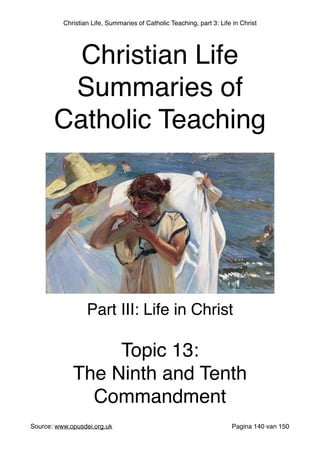
![Christian Life, Summaries of Catholic Teaching, part 3: Life in Christ
Topic 13: The Ninth and Tenth Commandment!
"
These two commandments help us to live holy purity (the ninth) and
detachment from material goods (the tenth) in our thoughts and desires."
"
Neither shall you covet your neighbor’s wife; and you shall not desire
your neighbor’s house, his field, or his manservant, or his maidservant,
his ox, or his ass, or anything that is your neighbor’s (Deut 5:21)."
"
Everyone who looks at a woman lustfully has already committed
adultery with her in his heart (Mt 5:28)."
"
These two commandments refer to internal acts that are sins against the
sixth and seventh commandments, which moral tradition classifies as
internal sins. From a positive point of view, they prescribe living purity
(the ninth) and detachment from material goods (the tenth) in our
thoughts and desires, living in accord with Christ’s words: Blessed are
the poor in spirit, for theirs is the kingdom of heaven and Blessed are
the pure in heart, for they shall see God (Mt 5:3 and 8)."
"
The first point to clarify here is whether it makes sense to speak of
“internal” sins. In other words, why should an act of the intellect and will
that is not expressed in an external action be viewed as morally
reprehensible?"
"
The answer is not obvious since the lists of sins found in the New
Testament appear to be mainly external acts: adultery, fornication,
homicide, idolatry, sorcery, angry arguments, etc. And yet, in the same
catalogue of sins we also find certain internal acts cited as sins: envy,
evil desires, avarice.[1]"
"
Source: www.opusdei.org.uk" Pagina van141 150](https://image.slidesharecdn.com/christianlifeiiilifeinchrist-150227151851-conversion-gate02/85/Christian-Life-Part-3-Life-in-Christ-the-Ten-Commandments-141-320.jpg)
![Christian Life, Summaries of Catholic Teaching, part 3: Life in Christ
Jesus himself says that evil thoughts, murder, adultery, fornication, theft,
false witness, slander (Mt 15:19) come from man’s heart. And referring
specifically to chastity he teaches that everyone who looks at a woman
lustfully has already committed adultery with her in his heart (Mt 5:28).
These texts are important for our understanding of morality since they
stress that the source of human actions, and therefore of the good or
evil in a person, is found in the desires of the heart, in what the person
“wants” and chooses. The evil of murder, adultery, theft is not primarily in
the physical reality of the action, or in its consequences (although these
are an important part of it), but in the will, in the heart of the murderer,
the adulterer, the thief, who in choosing that particular action is deciding
on an orientation opposed to love for his neighbor, and therefore also to
love for God."
"
The will always seeks a good, but at times what appears good is
something that is not rationally ordered to one’s overall good. The thief
seeks something that he considers good, but the fact that the object
belongs to another person makes the choice to obtain it something that
cannot contribute to his own good as a person, that is, to the purpose of
his life. In this sense, an exterior action is not required to decide if the
will is heading in a good or bad direction. Anyone who decides to steal
an object, even if something unforeseen keeps him from doing so, has
“acted” badly. He has carried out an internal act of the will against the
virtue of justice."
"
The goodness or wickedness of a person is rooted in the will, and so,
strictly speaking, we should use these categories to refer to desires
(what we want, approve), and not to thoughts. To speak of the intellect
we use other categories such as true or false. When the ninth
commandment forbids “impure thoughts” it is not referring to images or
to the thoughts in themselves, but to the movement of the will which
accepts the disordered pleasure provoked by a certain image (internal
or external).[2]"
"
Internal sins can be divided into:"
Source: www.opusdei.org.uk" Pagina van142 150](https://image.slidesharecdn.com/christianlifeiiilifeinchrist-150227151851-conversion-gate02/85/Christian-Life-Part-3-Life-in-Christ-the-Ten-Commandments-142-320.jpg)
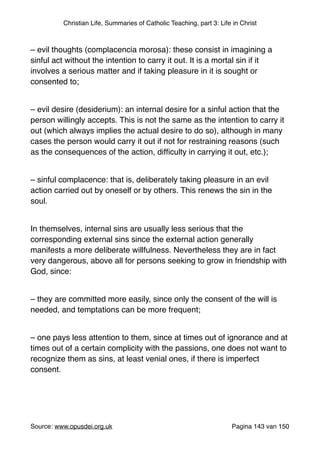
![Christian Life, Summaries of Catholic Teaching, part 3: Life in Christ
Internal sins can deform the conscience, as when one accepts an
internal venial sin as a matter of habit or with a certain frequency,
although one seeks to avoid mortal sin. This deformation can give rise to
manifestations of irritability, lack of charity, critical spirit, resigning
oneself to having frequent temptations without struggling tenaciously
against them, etc.[3] In some cases, this can lead to not wanting to
recognize internal sins, hiding them with unreasonable excuses, and
thus confusing one’s conscience even more. As a result, self love easily
increases, worries arise, humility and sincere contrition become more
difficult and lukewarmness can easily result. In the struggle against
internal sins, it is very important not to become scrupulous.[4]"
"
Helpful in struggling against internal sins are:"
"
– frequenting the sacraments, which give us grace or increase it, and
heal us of our daily mistakes;"
"
– prayer, mortification and work, seeking God sincerely;"
"
– humility, which enables us to recognize our wretchedness without
getting discouraged by our mistakes, and trust in God, knowing that he
is always ready to forgive us;"
"
– being sincere with God, with ourselves and in spiritual direction, taking
special care of the examination of conscience."
"
The ninth and tenth commandments deal with the internal roots of sins
against chastity and justice, and in a wider sense, of any sin.[5] In a
positive sense, these commandments prompt us to act with a right
intention, with a pure heart. Therefore they are very important, since
they are concerned with the source giving rise to our external actions."
"
Source: www.opusdei.org.uk" Pagina van144 150](https://image.slidesharecdn.com/christianlifeiiilifeinchrist-150227151851-conversion-gate02/85/Christian-Life-Part-3-Life-in-Christ-the-Ten-Commandments-144-320.jpg)
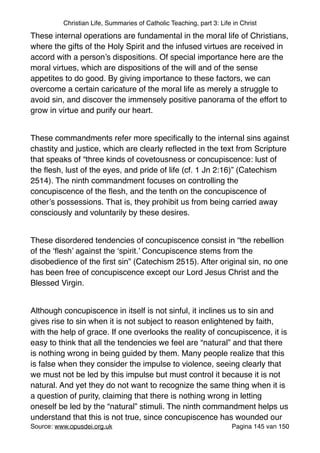
![Christian Life, Summaries of Catholic Teaching, part 3: Life in Christ
nature, and what we feel as natural is frequently the consequence of sin,
and needs to be controlled. The same could be said about the excessive
desire for riches, or covetousness, prohibited by the tenth
commandment."
"
It is important that we be aware of this disorder caused in us by original
sin and by our personal sins, since this knowledge:"
"
– incites us to pray: only God can undo original sin, the source of
concupiscence; likewise only with his help will we succeed in
overcoming this disordered tendency. God’s grace heals the wounds of
sin in our nature and raises us to the supernatural order;"
"
– teaches us to love all creatures, since everything coming from God’s
hands was created good; it is our disordered desires that twist God’s
creation."
"
Purity of heart means having a healthy way of feeling. With God’s help
and our own struggle we can acquire an ever greater “purity of heart”:
purity in our thoughts and desires."
"
Christians obtain this purity through God’s grace and through the virtue
and the gift of chastity, through purity of intention and vision, and
through prayer.[6] Purity of vision is not just refusing to look at
something clearly unsuitable. It also requires purifying the use of our
external senses, leading us to look at the world and at other men and
women with supernatural vision, with Christ’s eyes. This entails a
positive struggle that enables us to discover the real beauty of all
created reality and, in a special way, the beauty of those who have been
formed in the image and likeness of God.[7]"
"
“Purity requires modesty, an integral part of temperance. Modesty
protects the intimate center of the person. It means refusing to unveil
Source: www.opusdei.org.uk" Pagina van146 150](https://image.slidesharecdn.com/christianlifeiiilifeinchrist-150227151851-conversion-gate02/85/Christian-Life-Part-3-Life-in-Christ-the-Ten-Commandments-146-320.jpg)
![Christian Life, Summaries of Catholic Teaching, part 3: Life in Christ
what should remain hidden. It is ordered to chastity to whose sensitivity
it bears witness. It guides how one looks at others and behaves toward
them in conformity with the dignity of persons and their
solidarity” (Catechism 2521)."
“Desire for true happiness frees man from his immoderate attachment to
the goods of this world so that he can find his fulfillment in the vision and
beatitude of God” (Catechism 2548). “The promise [of seeing God]
surpasses all beatitude . . . In Scripture, to see is to possess . . .
Whoever sees God has obtained all the goods of which he can
conceive.”[8]"
"
Material goods are good as a means but not as an end. They cannot
satisfy man’s heart, which is made for God and is not satisfied with
material well-being."
"
“The tenth commandment forbids greed and the desire to amass earthly
goods without limit. It forbids avarice arising from a passion for riches
and their attendant power. It also forbids the desire to commit injustice
by harming our neighbor in his temporal goods” (Catechism 2536). "
"
Sin is turning away from God and turning towards creatures. Attachment
to material goods nourishes the root of this turning towards creatures
and leads to blindness of spirit and hardness of heart: if anyone has the
world’s goods and sees his brother in need, yet closes his heart against
him, how does God’s love abide in him? (1 Jn 3:17). We cannot serve
both God and riches (cf. Mt 6:24; Lk 16:13)"
"
The exaggerated importance given to material well-being today, putting
it above many other values, is not a sign of human progress. It implies a
lessening and degradation of man, whose dignity resides in being a
spiritual creature called to eternal life as a son of God (cf. Lk 12:19-20)."
"
Source: www.opusdei.org.uk" Pagina van147 150](https://image.slidesharecdn.com/christianlifeiiilifeinchrist-150227151851-conversion-gate02/85/Christian-Life-Part-3-Life-in-Christ-the-Ten-Commandments-147-320.jpg)
![Christian Life, Summaries of Catholic Teaching, part 3: Life in Christ
“The tenth commandment requires that envy be banished from the
human heart” (Catechism 2538). Envy is a capital sin. “It refers to the
sadness at the sight of another's goods” (Catechism 2539). Envy can
give rise to many other sins: hatred, calumny, detraction, disobedience,
etc."
"
Envy is opposed to charity, which leads us to desire what is good for
others as a manifestation of the love we have for them. The virtue of
humility also helps us in this struggle since envy often arises from pride
(cf. Catechism 2540)."
"
Pablo Requena "
"
"
Basic bibliography !
"
Catechism of the Catholic Church, 2514-2557."
"
"
Recommended reading!
"
St Josemaria, “For They Shall See God” in Friends of God, 175-189;
“Detachment” in Friends of God, 110-126."
"
"
Footnotes!
"
[1] Cf. Gal 5:19-21; Rom 1:29-31; Col 3:5. After making an appeal to shun
fornication, St Paul writes: that each one of you know how to control his own body
in holiness and honor, not in the passion of lust like heathen who do not know God .
. . For God has not called us for uncleanness, but in holiness” (1 Thess 4:4-7). In
doing so, he emphasizes the importance of the feelings, which lie at the root of our
actions, and the need to purify them for the sake of attaining sanctity."
Source: www.opusdei.org.uk" Pagina van148 150](https://image.slidesharecdn.com/christianlifeiiilifeinchrist-150227151851-conversion-gate02/85/Christian-Life-Part-3-Life-in-Christ-the-Ten-Commandments-148-320.jpg)
![Christian Life, Summaries of Catholic Teaching, part 3: Life in Christ
"
[2] Thus one needs to keep clear the difference between “feeling” and “consenting”
in reference to a particular passion or movement of the senses. Only when there is
consent of the will is it a question of sin (if the matter is sinful)."
"
[3] “You play around with temptations, you put yourself in danger, you fool around
with your sight and with your imagination, you chat about... stupidities. And then
you are anxious that doubts, scruples, confusion, sadness and discouragement
might assail you.—You must admit that you are not very consistent” (St Josemaria,
Furrow, 132)."
"
[4] “Whatever happens, there is no need to worry as long as you don’t consent. For
only the will can open the door of the heart and let that corruption in” (St Josemaria,
The Way, 140; cf. ibid., 258)."
"
[5] “The tenth commandment concerns the intentions of the heart; with the ninth, it
summarizes all the precepts of the Law” (Catechism 2534)."
"
[6] “With God’s grace he will prevail:"
"
— by the virtue and gift of chastity, for chastity lets us love with upright and
undivided heart;"
"
— by purity of intention, which consists in seeking the true end of man: with
simplicity of vision, the baptized person seeks to find and to fulfill God's will in
everything (cf. Rom 12, 2; Col 1, 10);"
"
— by purity of vision, external and internal; by discipline of feelings and
imagination; by refusing all complicity in impure thoughts that incline us to turn
aside from the path of God’s commandments: ‘Appearance arouses yearning in
fools’ (Wis 15,5);"
"
— by prayer” (Catechism 2520)"
"
Source: www.opusdei.org.uk" Pagina van149 150](https://image.slidesharecdn.com/christianlifeiiilifeinchrist-150227151851-conversion-gate02/85/Christian-Life-Part-3-Life-in-Christ-the-Ten-Commandments-149-320.jpg)
![Christian Life, Summaries of Catholic Teaching, part 3: Life in Christ
[7] “The eyes! Through them many iniquities enter the soul. — What experiences
like David’s! If you guard your sight you have assured the guard of your heart” (St
Josemaria, The Way, 183). “Dear Lord, I find beauty and charm in everything I see!
I will guard my sight at every moment, for the sake of Love” (St Josemaria, The
Forge, 415)."
"
[8] St. Gregory of Nyssa, Orationes de beatitudinibus, 6: PG 44, 1265A. Cf.
Catechism 2548."
Source: www.opusdei.org.uk" Pagina van150 150](https://image.slidesharecdn.com/christianlifeiiilifeinchrist-150227151851-conversion-gate02/85/Christian-Life-Part-3-Life-in-Christ-the-Ten-Commandments-150-320.jpg)

This document is a summary of the Catholic Church's teachings on Christian life, specifically focusing on the concept of freedom, law, and conscience. It emphasizes the importance of human freedom in moral decisions and the role of natural law as a guide for discerning good from evil. The document also discusses the relationship between civil laws, unjust laws, and moral obligations, highlighting the Church's authority in interpreting moral law for its members.


