Spring 2014
Magazine
ENTREPRENEURS
From the President
USI Magazine is published three times annually
by the University of Southern Indiana for its alumni
and friends.
Vice President for Government
and University Relations
Cynthia Brinker
Assistant Vice President for
Marketing and Communications
Kindra Strupp
Director of News and Information Services
John Farless ’98
Director of Alumni and Volunteer Services
Janet Johnson M’05
Editor
C. L. Stambush
Contributing Writers
Wendy Knipe Bredhold ’98
John Farless ’98
Sarah Harlan ’10
Angie O’Nan ’12
C. L. Stambush
Art Direction and Design
Christopher Norrick ’98
Photography
David Arthur
Elizabeth Courtney Randolph
LaVerne Jones ’05
Illustrator
Jared Cook ’14
Senior Administrative Assistant
Barbara Goodwin
Administrative Associate
Angie O’Nan ’12
Send editorial information to News and
Information Services. Send alumni information
to Alumni and Volunteer Services. Send donor
information and address changes to USI
Foundation.
Address
University of Southern Indiana
8600 University Boulevard
Evansville, IN 47712
Telephone
USI Magazine 812-465-7005
Email
usinews@usi.edu
Other University phone numbers
Alumni and Volunteer Services 812-464-1924
USI Foundation 812-464-1918
Admission 812-464-1765
Athletics 812-464-1846
It is the policy of the University of Southern Indiana to be in full
compliance with all federal and state non-discrimination and equal
opportunity laws, orders, and regulations relating to race, sex, religion,
disability, age, national origin, sexual orientation, or veteran status.
Questions or concerns should be directed to the Affirmative Action
Officer, USI Human Resources Department, University of Southern
Indiana, 8600 University Boulevard, Evansville, Indiana 47712.
USI.edu
Dr. Linda L. M. Bennett
President
Follow USI on
The story of USI’s founding is a
tale of entrepreneurs who believed
that an institution of public higher edu-
cation was essential to the develop-
ment of Southwestern Indiana. The
visionaries who formed Southern
Indiana Higher Education, Inc. were
business and community leaders of
foresight and courage. They knew it
would be a major undertaking with
many challenges and risks, but their
triumph resulted in the establishment
in 1965 of ISUE, that evolved into
USI in 1985.
Entrepreneurial spirit is the focus
of this edition of USI Magazine.
Boldness, persistence, and a
willingness to take on the hard work
of seeing a vision through from idea
to implementation are essential com-
ponents of USI’s history and future.
Today, USI is at an exciting juncture
as we anticipate our 50th anniversary
in 2015. Building on the strong foun-
dation established by our founders,
USI is now a university with national
and international partnerships,
increased national recognition for the
excellence of its academic programs,
and admired for the creativity and
scholarly talents of its faculty, staff,
alumni, and students. We highlight just
a few of those talented alumni in this
issue, and I hope their stories inspire
other alums to share with us their own
stories of challenge and success.
To mark this important time in
USI’s development, new logos for the
University and for USI Athletics were
unveiled on April 9.
Entrepreneurs often light the way
for others and the new University logo
pays homage to the torch of knowl-
edge on the University seal, while
conveying the energy of our vibrant,
contemporary campus. The new
Athletic logo updates the look for the
Screaming Eagles and heralds pride
in the success of our student athletes
and their competitive spirit. Both new
logos reflect the wisdom of USI’s
founders and the University motto:
a great public university “of the
people, for the people.”
Volume 47 Issue 1 • SPRING 2014
On the Cover
	FEATURES
	 Purses Fashioned from a Dream 	 2
	 Young Entrepreneur’s Six-figure Business
	 Solar Energy	 6
	 Visionary Banks on a Better Tomorrow
	 Reinventing the Toilet 	 10
	 The Challenge of the Business
	 New Look for USI Brand 	 14
	 The Story Behind the Image
	
	DEPARTMENTS
	 Campus News	 16
	 Diana Nyad Keynote at MAIA
	 Foundation News	 22
	 $1 Million Donation to Ceramics
	 Athletic News	 24
	 USI to Co-host NCAA II Championships
	 Alumni Today	 26
	 Accidental Entrepreneurs
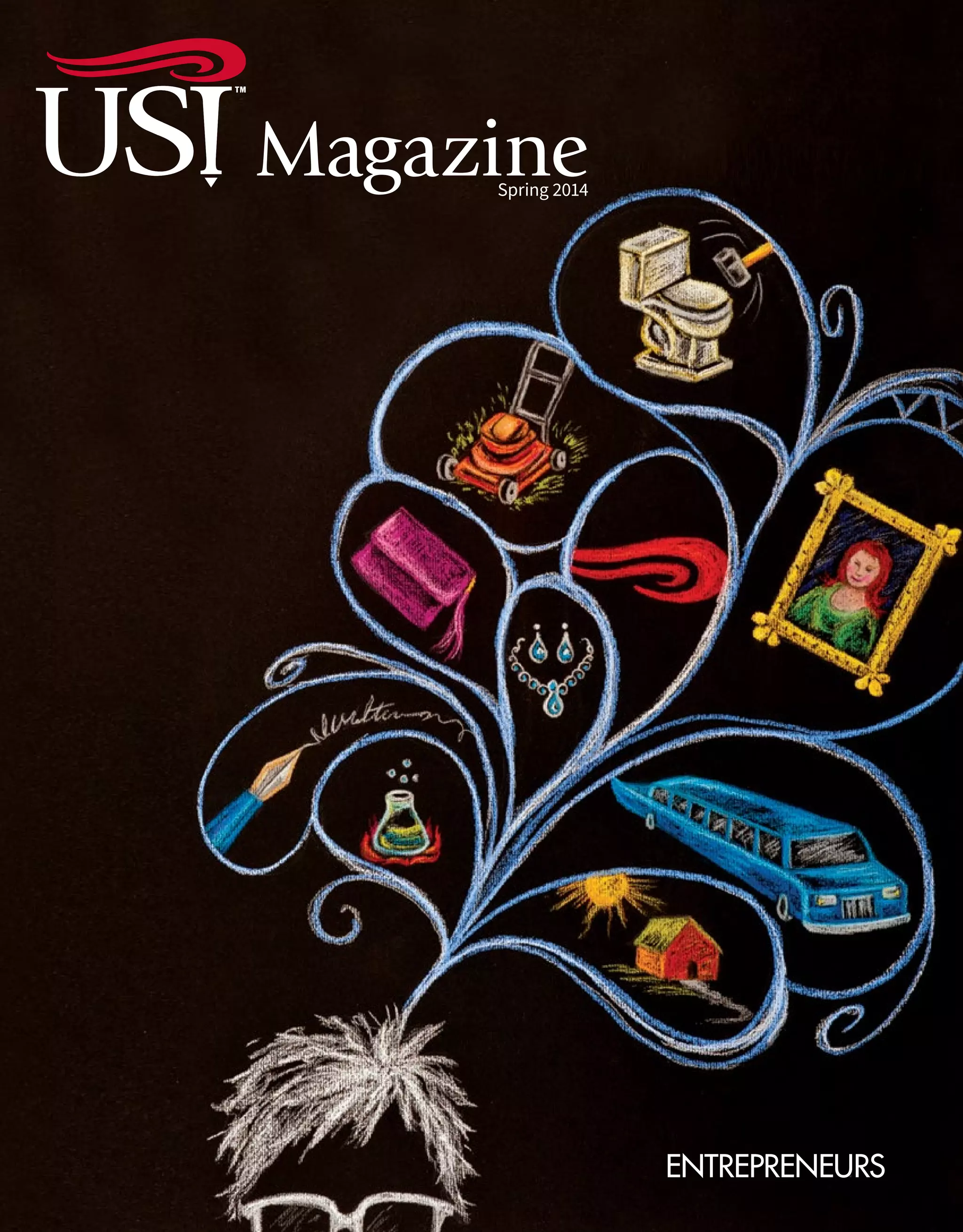
An original creation by Terri Bischoff,
USI’s assistant director of Publishing
Services, depicting the visions of
entrepreneurs far and wide.
We know our alumni are doing
great things, and we want to hear
about it. We’re eager to share
your stories in upcoming issues
of USI Magazine. Future themes
include “transitions” and “food.”
If you have a story to tell or a
topic to suggest that you think
relates to one of these subjects
or others, we’re all ears. Contact
us at usinews@usi.edu.
Thanks,
C. L. Stambush,
Editor
Startup Weekend 3.0
Vote for Archie’s Makeover
16
25
Magazine
Can Doa made-in-America spirit
By C. L. Stambush
2 SPRING 2014 USI Magazine
I
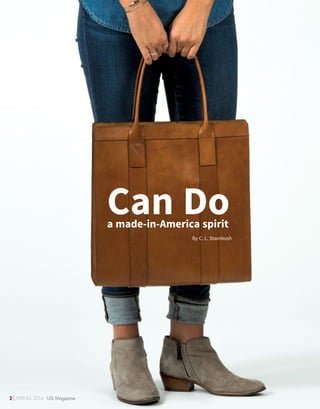
t’s difficult to imagine the tall, slim, winsome woman—eyes bright...smile genuine—once lacked confi-
dence. It’s difficult to imagine others taunted her to the point she was homeschooled from fourth through
seventh grade. It’s also difficult to imagine Kelsea Slade ’09, owner and designer of K.slademade,
a line of boutique leather handbags, being anything but successful.
“All my life my father told my sisters and me, ‘You can be anything you want to be,’” she said. “At the
time I didn’t know what that meant, but now I feel it’s what brought me here.”
While “different” doesn’t work when you’re a kid, as an entrepreneur and designer of a product tens of
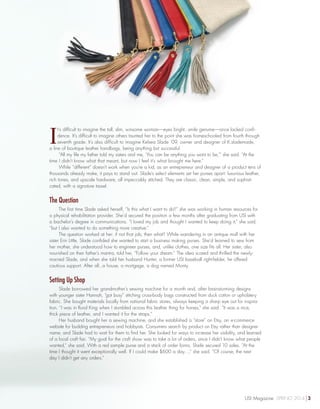
thousands already make, it pays to stand out. Slade’s select elements set her purses apart: luxurious leather,
rich tones, and upscale hardware, all impeccably stitched. They are classic, clean, simple, and sophisti-
cated, with a signature tassel.
The Question
The first time Slade asked herself, “Is this what I want to do?” she was working in human resources for
a physical rehabilitation provider. She’d secured the position a few months after graduating from USI with
a bachelor’s degree in communications. “I loved my job and thought I wanted to keep doing it,” she said,
“but I also wanted to do something more creative.”
The question worked at her: if not that job, then what? While wandering in an antique mall with her
sister Erin Little, Slade confided she wanted to start a business making purses. She’d learned to sew from
her mother, she understood how to engineer purses, and, unlike clothes, one size fits all. Her sister, also
nourished on their father’s mantra, told her, “Follow your dream.” The idea scared and thrilled the newly-
married Slade, and when she told her husband Hunter, a former USI baseball right-fielder, he offered
cautious support. After all...a house, a mortgage, a dog named Monty.
Setting Up Shop
Slade borrowed her grandmother’s sewing machine for a month and, after brainstorming designs
with younger sister Hannah, “got busy” stitching cross-body bags constructed from duck cotton or upholstery
fabric. She bought materials locally from national fabric stores, always keeping a sharp eye out for inspira-
tion. “I was in Rural King when I stumbled across this leather thing for horses,” she said. “It was a nice,
thick piece of leather, and I wanted it for the straps.”
Her husband bought her a sewing machine, and she established a “store” on Etsy, an e-commerce
website for budding entrepreneurs and hobbyists. Consumers search by product on Etsy rather than designer
name, and Slade had to wait for them to find her. She looked for ways to increase her visibility, and learned
of a local craft fair. “My goal for the craft show was to take a lot of orders, since I didn’t know what people
wanted,” she said. With a red sample purse and a stack of order forms, Slade secured 10 sales. “At the
time I thought it went exceptionally well. If I could make $600 a day…,” she said. “Of course, the next
day I didn’t get any orders.”
USI Magazine SPRING 2014 3
Growing Pains
When her work outgrew her small guest room, she moved to a larger one.
She sewed eight to 13 hours a day to keep up with Etsy orders. “I was sewing
non-stop because at my price point everyone could afford to buy,” she said. “I didn’t
know what to charge for labor, so I wasn’t charging for my time. I didn’t give myself
value.” That’s when she asked herself for the second time, “Is this what I want to do?”
She reassessed her business and made major changes. Driving around town
purchasing materials wasn’t productive, even though she liked to feel the material before
buying it. Additionally, she wanted her purses to last, and cloth wasn’t durable enough
for her taste. She decided to switch to leather and scoured the Internet for suppliers who’d
mail samples. “Altogether it made more sense to transition to leather,” Slade said.
“Besides, I love leather, even though it’s unforgiving. You can’t make mistakes because
you’ve already punched a hole in it.”
Slade’s purses caught the attention of Ree Drummond, aka The Pioneer Woman
(a blogger sensation, best-selling author, and Food Network personality) who posted
on her site “Hold the phone. I’m in love with these. Help,” and included photos of the
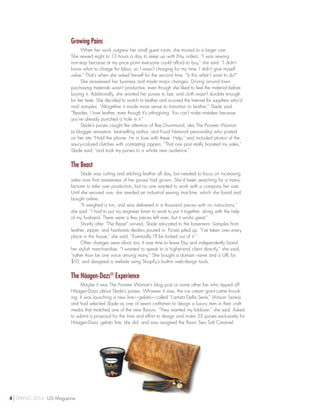
saucy-colored clutches with contrasting zippers. “That one post really boosted my sales,”
Slade said, “and took my purses to a whole new audience.”
The Beast
Slade was cutting and stitching leather all day, but needed to focus on increasing
sales now that awareness of her purses had grown. She’d been searching for a manu-
facturer to take over production, but no one wanted to work with a company her size.
Until she secured one, she needed an industrial sewing machine, which she found and
bought online.
“It weighed a ton, and was delivered in a thousand pieces with no instructions,”
she said. “I had to put my engineer brain to work to put it together, along with the help
of my husband. There were a few pieces left over, but it works great.”
Shortly after “The Beast” arrived, Slade relocated to the basement. Samples from
leather, zipper, and hardware dealers poured in. Purses piled up. “I’ve taken over every
place in the house,” she said. “Eventually I’ll be kicked out of it.”
Other changes were afoot, too. It was time to leave Etsy and independently brand
her stylish merchandise. “I wanted to speak to a higher-end client directly,” she said,
“rather than be one voice among many.” She bought a domain name and a URL for
$10, and designed a website using Shopify’s built-in web-design tools.
The Häagen-Dazs®
Experience
Maybe it was The Pioneer Woman’s blog post or some other fan who tipped off
Häagen-Dazs about Slade’s purses. Whoever it was, the ice cream giant came knock-
ing. It was launching a new line—gelato—called “L’artista Della Serie,” (Artisan Series),
and had selected Slade as one of seven craftsmen to design a luxury item in their craft
media that matched one of the new flavors. “They wanted my foldover,” she said. Asked
to submit a proposal for the time and effort to design and make 25 purses exclusively for
Häagen-Dazs’ gelato line, she did, and was assigned the flavor Sea Salt Caramel.
4 SPRING 2014 USI Magazine
Slade and her sister Erin, who by then worked for her, were flown to
Italy and immersed in the culture for a week. The goal: soak up the feel
of Italy and infuse it into a unique creation. Originally, she thought Italian
leather might be best, but later found the perfect shade and texture from
a U.S. supplier—one that mimicked the swirl of rich caramel with licks of
salt. It was so perfect she momentarily questioned using it. “We’d signed
a contract stating we could never use the exact materials again,” she said.
“But we felt they deserved the best so we gave them the one we loved
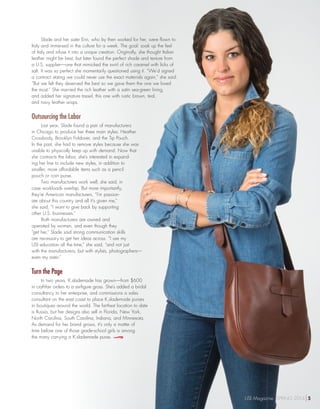
the most.” She married the rich leather with a satin sea-green lining,
and added her signature tassel, this one with rustic brown, teal,
and navy leather wisps.
Outsourcing the Labor 	
Last year, Slade found a pair of manufacturers
in Chicago to produce her three main styles: Heather
Crossbody, Brooklyn Foldover, and the Tip Pouch.
In the past, she had to remove styles because she was
unable to physically keep up with demand. Now that
she contracts the labor, she’s interested in expand-
ing her line to include new styles, in addition to
smaller, more affordable items such as a pencil
pouch or coin purse.
Two manufacturers work well, she said, in
case workloads overlap. But more importantly,
they’re American manufacturers. “I’m passion-
ate about this country and all it’s given me,”
she said, “I want to give back by supporting
other U.S. businesses.”
Both manufacturers are owned and
operated by women, and even though they
“get her,” Slade said strong communication skills
are necessary to get her ideas across. “I use my
USI education all the time,” she said, “and not just
with the manufacturers, but with stylists, photographers—
even my sister.”
Turn the Page
In two years, K.slademade has grown—from $600
in craft-fair orders to a six-figure gross. She’s added a bridal
consultancy to her enterprise, and commissions a sales
consultant on the east coast to place K.slademade purses
in boutiques around the world. The farthest location to date
is Russia, but her designs also sell in Florida, New York,
North Carolina, South Carolina, Indiana, and Minnesota.
As demand for her brand grows, it’s only a matter of
time before one of those grade-school girls is among
the many carrying a K.slademade purse.
USI Magazine SPRING 2014 5
6 SPRING 2014 USI Magazine
PIONEERING
A NEW
FRONTIER
B
rad Morton ’92 knows exactly where he was when he decided to take a leap of faith and
become an entrepreneur. He was driving through Nebraska on business when a miles-long
convoy of military vehicles passed him. It was 2004, Morton assumed the soldiers were
headed for Iraq, and the consequences of U.S. dependence on fossil fuels hit home.
“We were fighting these wars and the oil prices were going crazy. That was part of the big
picture—where we were at not only nationally but regionally—Indiana was 93 percent powered
by coal. To me, that was a red flag. We definitely needed to diversify. It didn’t make sense to be
90 percent of anything in energy.”
Morton worked for several companies in the machine manufacturing industry after graduating
from USI with a degree in electrical engineering technology and an associate’s degree in mechanical
engineering technology. A former customer encouraged him to go to work for himself as an independent
consultant. “They couldn’t find anyone willing to put a new computer on this machine I programmed,
because it was kind of a dangerous machine and people thought it would be risky. I was already
familiar with it, so it was no problem, but I had to quit my job to do it.”
Morton saw the move as an opportunity for better job security, and it allowed him to build a
renewable energy business. It made sense, considering U.S. dependence on fossil fuels; he felt con-
fident the federal government would pass legislation to deal with the threat posed by climate change.
“That’s when I took the leap of faith. It was a big step.”
Today, he’s president of Morton Solar LLC, one of the first solar design and installation companies
in Indiana. His company is on the frontline of a battle between old and new energy paradigms, with
very high stakes, in a state where fossil fuels rule. “I have encountered more barriers than I ever could
have imagined,” he says. “I am just surviving.”
By Wendy Bredhold ’98
USI Magazine SPRING 2014 7
8 SPRING 2014 USI Magazine
Having grown up in Gibson and Perry
counties, he knows Indiana is coal country. His
grandfather and uncles were coal miners. His
grandparents’ home in Spurgeon, Indiana, was
surrounded by strip mines. For most of his forma-
tive years, his attitude toward coal was one of dis-
interest—simply a fact of life he took for granted,
like the air you breathe. But as he grew older, he
realized breathing air would be easier if Indiana
didn’t rely on coal for its electricity needs.
As a businessman, Morton is persistent, pas-
sionate, and visionary. Over the past decade, his
entrepreneurial endeavors have expanded from a
consulting business, Industrial Control Engineering,
to Morton Energy,
to Morton Solar
and Wind, to
its present focus,
Morton Solar.
“Solar is just a
much better option
in this part of the
state,” he said.
The problem
with being a
visionary, however, is it takes the rest of the world
a long time to catch up. Morton had to educate
the public about the benefits of solar. “We’ve
created the market here—for ourselves and others.
For a long time we were the only company doing
this work, and that made it much more difficult to
sell, because we had to do all the education.”
Once education creates a desire, the ques-
tion becomes can people afford it. “The biggest
challenge in selling a solar energy system is the
upfront cost for most people,” he said. “We fig-
ured out there was no way we could do it without
grants, and we got lucky by being able to find
some early on.”
There’s not as much need for grants today.
The federal government offers a 30 percent tax
credit (set to expire in 2016) to Americans who
install a solar power system. The price of solar
panels has dramatically decreased, reducing the
need for Morton to find customers grants.
“On a national level, the solar industry is
really taking off, and that’s helping us in Indiana,”
he said. “Now it’s economical to do these proj-
ects without a grant—and it’s even economical,
probably, without the federal tax credit. With
utility prices going up, solar is well-positioned at
this time to take off here in the state.”
When Morton’s company was just two years
old, he received U.S. Senator Richard Lugar’s
Energy Patriot Award “for outstanding contributions
to energy security.” He’s installed solar panels on
the first net-zero library and first net-zero school
in the United States (buildings that produce as
much energy as they consume), and put a record
number of solar panels on homes and businesses
in the Evansville area last year, including the home
of Stephen Zehr, USI professor of sociology.
But all is not sunny. “There’s a fight building
nationwide with utility companies over solar,” he
said. “The fossil fuel
industry doesn’t want
any competition,
and they don’t want
their customers to
generate their own
energy. They say
you will never get a
payback, that it’s too
expensive. That’s not
true any longer.”
In 2013, Indiana saw 178 percent growth
in solar jobs, according to a report released in
February by The Solar Foundation. From 2012 to
2013, Indiana created nearly 1,000 new jobs in
the solar industry and ranked 25th in the nation in
total solar jobs, up from 27th in 2012.
“The fact that this region includes the first
net-zero school and library in the country says we
have plenty of solar energy in this area and we
are not taking advantage of it,” Morton said. “It’s
another resource we should be utilizing.”
As concern grows over the threat posed by
climate change, Morton may get the legislation
he’s awaited for years. “I thought we would have
a climate bill by now, all the way back in 2005,”
he said. “We fully expected a carbon tax at the
federal level. It needs to happen. Climate change
is happening, and I wouldn’t have started the busi-
ness if I didn’t think that.”
While he waits for the world to come
around, Morton, a father of three girls ages six to
17, takes comfort in the personal rewards of his
business. “It never gets old to see a customer’s
meter spin backwards. It’s a liberating feeling. It’s
a feeling of empowerment.”
“If our way of using energy
doesn’t change, then I don’t think
my children or their children are
going to have a planet to live on.”
USI Magazine SPRING 2014 9
TOILETthe
By C. L. Stambush
Rethinking
T
here are certain expectations in life—
among them the right to clean water,
a sanitary environment, and personal
safety. Yet of the seven billion people populating
the world, 2.5 billion don’t have access to them.
Heather Deal ’03 wants to do something about
that, and she’s starting with a reinvention of
the toilet.
D
eal didn’t set out to be
in the business of human
waste, although in the year
and a half since founding Santec
LLC, a company that uses technolo-
gy-based solutions to address sanita-
tion issues, she’s grown confident in
her ability to build a business and
a future in the industry. Santec is
the second problem-solving startup
she’s initiated since graduating from
the University of Southern Indiana
with a degree in public relations.
The first was a consulting group
she operated for three years with
her husband Jeremiah. Before that,
both were employed in traditional
jobs: he worked for Toyota, and she
was a grants program manager for
Goodwill Industries.
As an entrepreneur, Heather
knows it takes determination and
confidence to be successful—and
if you’re not willing to put in the
hours, you can’t move forward. But
when Jeremiah discovered the Bill &
Melinda Gates Foundation’s Reinvent
the Toilet Challenge online, Heather
never imagined the career change
ahead. At the time, their consulting
group was growing, but Jeremiah
wanted a side project that tested his
engineering talents. “He’s a curious
person and thought he could do
this,” Heather said.
Although he had 15 years of
experience in engineering and manu-
facturing, he had no background
designing toilets, and neither of
them knew anything about public
sanitation. To learn, they turned to
the Internet. “It’s the new library,”
Heather said. “We learned so much
about sanitation and the challenges
so many face. Most Americans don’t
consider the issues.” While the Deals
have three toilets in their house, 40
percent of the world’s population
must use community toilets or an
open field.
10 SPRING 2014 USI Magazine
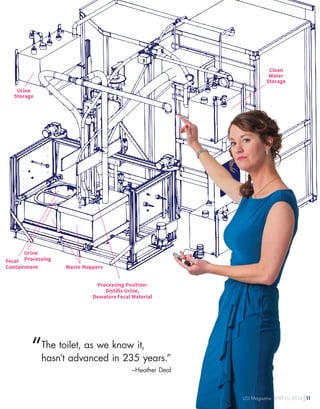
“The toilet, as we know it,
hasn’t advanced in 235 years.”
–Heather Deal
Waste Hoppers
Processing Position:
Distills Urine,
Dewaters Fecal Material
Urine
ProcessingFecal
Containment
Urine
Storage
Clean
Water
Storage
USI Magazine SPRING 2014 11
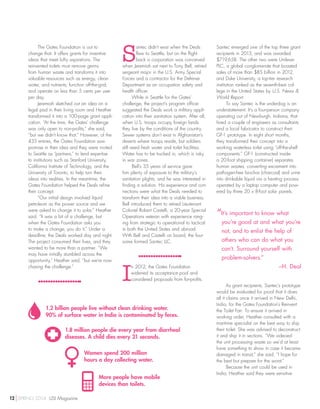
1.2 billion people live without clean drinking water.
90% of surface water in India is contaminated by feces.
The Gates Foundation is out to
change that. It offers grants for inventive
ideas that meet lofty aspirations. The
reinvented toilets must remove germs
from human waste and transforms it into
valuable resources such as energy, clean
water, and nutrients; function off-the-grid;
and operate on less than 5 cents per user
per day.
Jeremiah sketched out an idea on a
legal pad in their living room and Heather
transformed it into a 100-page grant appli-
cation. “At the time, the Gates’ challenge
was only open to non-profits,” she said,
“but we didn’t know that.” However, of the
435 entries, the Gates Foundation saw
promise in their idea and they were invited
to Seattle as “partners,” to lend expertise
to institutions such as Stanford University,
California Institute of Technology, and the
University of Toronto, to help turn their
ideas into realities. In the meantime, the
Gates Foundation helped the Deals refine
their concept.
“Our initial design involved liquid
petroleum as the power source and we
were asked to change it to solar,” Heather
said. “It was a bit of a challenge, but
when the Gates Foundation asks you
to make a change, you do it.” Under a
deadline, the Deals worked day and night.
The project consumed their lives, and they
wanted to be more than a partner. “We
may have initially stumbled across the
opportunity,” Heather said, “but we’re now
chasing the challenge.”
S
antec didn’t exist when the Deals
flew to Seattle, but on the flight
back a corporation was conceived
when Jeremiah sat next to Tony Bell, retired
sergeant major in the U.S. Army Special
Forces and a contractor for the Defense
Department as an occupation safety and
health officer.
While in Seattle for the Gates’
challenge, the project’s program officer
suggested the Deals work a military appli-
cation into their sanitation system. After all,
when U.S. troops occupy foreign lands
they live by the conditions of the country.
Sewer systems don’t exist in Afghanistan’s
deserts where troops reside, but soldiers
still need fresh water and toilet facilities.
Water has to be trucked in, which is risky
in war zones.
Bell’s 35 years of service gave
him plenty of exposure to the military’s
sanitation plights, and he was interested in
finding a solution. His experience and con-
nections were what the Deals needed to
transform their idea into a viable business.
Bell introduced them to retired Lieutenant
Colonel Robert Castelli, a 20-year Special
Operations veteran with experience rang-
ing from strategic to operational to tactical
in both the United States and abroad.
With Bell and Castelli on board, the four-
some formed Santec LLC.
I
n 2012, the Gates Foundation
widened its acceptance pool and
considered proposals from for-profits.
Santec emerged one of the top three grant
recipients in 2013, and was awarded
$719,658. The other two were Unilever
PLC, a global conglomerate that boasted
sales of more than $85 billion in 2012,
and Duke University, a top-tier research
institution ranked as the seventh-best col-
lege in the United States by U.S. News 
World Report.
To say Santec is the underdog is an
understatement. It’s a four-person company
operating out of Newburgh, Indiana, that
hired a couple of engineers as consultants
and a local fabricator to construct their
GF-1 prototype. In eight short months,
they transformed their concept into a
working waterless toilet using “off-the-shelf
components.” GF-1 (constructed inside
a 20-foot shipping container) separates
human wastes, converting excrement into
pathogen-free biochar (charcoal) and urine
into drinkable liquid via a heating process
operated by a laptop computer and pow-
ered by three 20 x 8-foot solar panels.
As grant recipients, Santec’s prototype
would be evaluated for proof that it does
all it claims once it arrived in New Delhi,
India, for the Gates Foundation’s Reinvent
the Toilet Fair. To ensure it arrived in
working order, Heather consulted with a
maritime specialist on the best way to ship
their toilet. She was advised to deconstruct
it and ship it in sections. “We videoed
the unit processing waste so we’d at least
have something to show in case it became
damaged in transit,” she said. “I hope for
the best but prepare for the worst.”
Because the unit could be used in
India, Heather said they were sensitive
1.8 million people die every year from diarrheal
diseases. A child dies every 21 seconds.
Women spend 200 million
hours a day collecting water.
More people have mobile
devices than toilets.
“It’s important to know what
you’re good at and what you’re
not, and to enlist the help of
others who can do what you
can’t. Surround yourself with
problem-solvers.”
–H. Deal
12 SPRING 2014 USI Magazine
to cultural differences. For instance,
Indians prefer to squat rather than sit,
so Santec’s unit has footplates built
into the bench that forms the seat.
She’ll travel to India a week
before the Reinvent the Toilet Fair with
Jeremiah and two others. They’ll reas-
semble the unit in India and it will be
transported to the Taj Hotel, the site of
the event, where it will be displayed
along with 15 other reinvented toilets.
J
eremiah may have had the
engineering insight for a sanita-
tion system, but it takes leader-
ship for a company to prosper, and
that’s all Heather. “Being a small busi-
ness owner, I wear lots of hats,” she
said. “On any given day I meet with
bankers, lawyers, or accountants. I
consult with the engineers we contract,
and regularly talk to our partners at
the Research Triangle Institute (RTI) and
Duke University. I work 80 hours a
week, pushing myself far harder than I
would if I wasn’t working for myself.”
Heather and her team work
hard, but they don’t work alone.
Collaboration is key in the challenge,
and Santec partners with Duke and
RTI. Heather confers with scientists at
both institutions, communicating ideas
in a community of PhDs. Duke tested
the results of the GF-1 and gave it a
clean bill of health. “I am pleased
to inform you that the trials with real
human liquid and solid waste have
been proven pathogen-free by my col-
leagues,” she said.
S
antec’s GF-1 toilet costs
$400,000 to engineer and
build, although future costs will
be greatly reduced as the engineering
is refined. The unit, however, is more
than an expensive self-contained
waste management system. It provides
dignity, privacy, and personal safety
for women and girls in third-world
countries where, due to isolation, rape
is a problem associated with open-
latrine environments.
In terms of military and disaster
applications (such as the Super Dome
in New Orleans during Hurricane
Katrina), GF-1 would be a blessing,
but when it comes to promoting a
change in countries like India, Kenya,
and China, it’s daunting. Perceptions
must change. “We have to make
owning a toilet a status symbol like
a Louis Vuitton purse,” Heather said
(paraphrasing Jack Sim, a.k.a Mr.
Toilet, an international social
advocate). “I have a toilet, so I’m
somebody.”
Santec’s concept has elements
that will help it gain acceptance and
shift perspectives. Its solar panels
allow the waste management unit to
operate as a cell phone charging
station. The Internet signal, designed
to inform an operator within a 10-mile
radius when the solid waste basket
is full and safe for humans to handle,
also provides Internet access to remote
areas. In a world of haves and have-
nots, it will make a difference. “This
challenge opened our awareness,”
said Heather. “We ought to be able
to improve the lives of others. We’re
going to get there.”
“If I’m going to guarantee the outcome is safe enough to
drink, and encourage others to do so, I should drink it
myself. I would be confident to drink [the urine] in the future.”
–H. Deal
21 solar panels
in 3 arrays at
200 Kw each
Secure
bathroom
doors
WIFI radius
of 10 miles
Constructed in a standard 20’ x 8’
metal shipping container.
Accommodates up to 15 users before
an email is sent signaling fecal matter
has processed and is pathogen-free.
Internal battery array of 48 marine,
sealed, lead-acid batteries have a
five-day capacity and can charge
cell phones with excess power.
Results:
• Fertilizer
• Fuel source
• Drinkable liquid
GF-1 Prototype
USI Magazine SPRING 2014 13
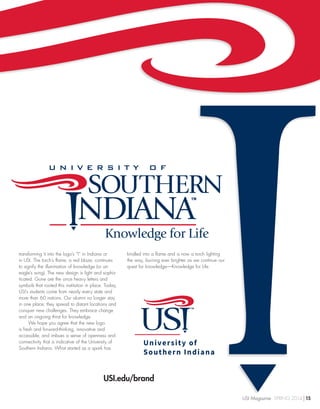
You know the place—nestled on
a grassy swath surrounded by trees and
walking paths. You met your best friend
here, and married her. You competed in
intramural sports. You studied late into the
night in Rice Library. You learned to decon-
struct Dostoyevsky and to construct a finan-
cial plan. You learned curiosity was invalu-
able to science and empathy to matters of
health. You shared your knowledge—how
it affected and inspired you—with your
friends. You grew, and with you we grew.
We know you, and you know us.
We are the University of Southern
Indiana, and we’ve been a valuable
presence in your life and the community’s
for nearly 50 years. We’re dedicated to
education, collaboration, and outreach.
At our core, we work hard to bring you
a brighter tomorrow. Education is an
evolution—a series of transitions resulting
in achievement and personal growth.
Our University recently underwent such a
transformation with our logo, moving to
one that brands and represents who we
are today, what we do, and where we’re
headed.
Selecting the right symbol required
distilling the essence of our University into
a few simple strokes. The resulting image
had to convey our history as well as a
long and bright future. To best understand
the new icon, we must peek into the past.
From 1965 to 1985, the University operat-
ed as Indiana State University–Evansville.
When Governor Robert Orr signed the bill
creating the University of Southern Indiana,
we hungered for an identity that put us on
the map. Inspired by the shape of Indiana,
a logo was created to represent the
University’s physical location with a star
denoting its place within the state.
That symbol served us well for more
than 30 years as USI grew from the shadow
of another to become a beacon in its own
right. Our physical and intellectual progress
has morphed the University from a few
buildings on 1,400 acres to a modern,
vibrant campus unmatched in both quality
and affordable excellence.
Our new logo borrows symbolism
from the University’s seal, taking the torch
found in the spine of an open book,
SYMBOLFOR THE FUTURE
OUR NEW LOGO DESIGN
14 SPRING 2014 USI Magazine
Knowledge for Life
transforming it into the logo’s “I” in Indiana or
in USI. The torch’s flame, a red blaze, continues
to signify the illumination of knowledge (or an
eagle’s wing). The new design is light and sophis-
ticated. Gone are the once heavy letters and
symbols that rooted this institution in place. Today,
USI’s students come from nearly every state and
more than 60 nations. Our alumni no longer stay
in one place; they spread to distant locations and
conquer new challenges. They embrace change
and an ongoing thirst for knowledge.
We hope you agree that the new logo
is fresh and forward-thinking, innovative and
accessible, and imbues a sense of openness and
connectivity that is indicative of the University of
Southern Indiana. What started as a spark has
kindled into a flame and is now a torch lighting
the way, burning ever brighter as we continue our
quest for knowledge—Knowledge for Life.
USI.edu/brand
USI Magazine SPRING 2014 15
Campus News
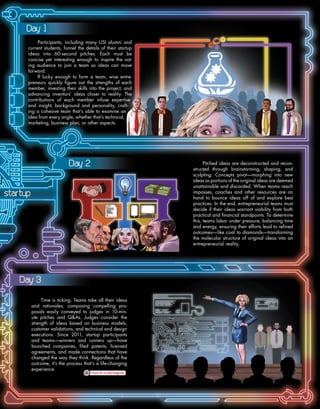
This spring, more than 90
people converged on USI’s
Business and Engineering Center
for Startup Weekend Evansville
3.0—a three-day flurry of entre-
preneurial overload that takes
ideas from inception to concrete
business startup proposals. In
its third year, Startup Weekend
Evansville remains the largest
event of its kind in Indiana.
Like a business incubator on
steroids—in 54 hours, ideas
pitched can evolve into viable
business proposals.
ENTREPRENEURIAL KICKSTART
EVOLUTION OF AN IDEAIllustration by Jared Cook ’14
Participants, including many USI alumni and
current students, funnel the details of their startup
ideas into 60-second pitches. Each must be
concise yet interesting enough to inspire the vot-
ing audience to join a team so ideas can move
forward.
If lucky enough to form a team, wise entre-
preneurs quickly figure out the strengths of each
member, investing their skills into the project, and
advancing inventors’ ideas closer to reality. The
contributions of each member infuse expertise
and insight, background and personality, craft-
ing a cohesive team that’s able to examine an
idea from every angle, whether that’s technical,
marketing, business plan, or other aspects.
Pitched ideas are deconstructed and recon-
structed through brainstorming, shaping, and
sculpting. Concepts pivot—morphing into new
ideas as portions of the original ideas are deemed
unattainable and discarded. When teams reach
impasses, coaches and other resources are on
hand to bounce ideas off of and explore best
practices. In the end, entrepreneurial teams must
decide if their ideas warrant viability from both
practical and financial standpoints. To determine
this, teams labor under pressure, balancing time
and energy, ensuring their efforts lead to refined
outcomes—like coal to diamonds—transforming
the molecular structure of original ideas into an
entrepreneurial reality.
Time is ticking. Teams take all their ideas
and rationales, composing compelling pro-
posals easily conveyed to judges in 10-min-
ute pitches and QAs. Judges consider the
strength of ideas based on business models,
customer validations, and technical and design
executions. Since 2011, startup participants
and teams—winners and runners up—have
launched companies, filed patents, licensed
agreements, and made connections that have
changed the way they think. Regardless of the
outcome, it’s the process that’s a life-changing
experience.
Extras @ usi.edu/magazine
Campus News
Magazine survey results reveal reader interests
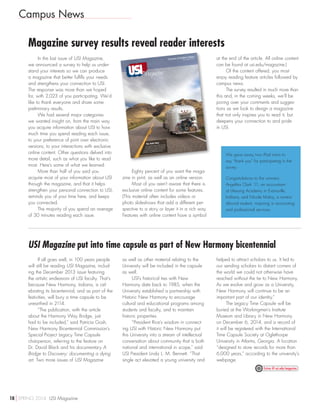
In the last issue of USI Magazine,
we announced a survey to help us under-
stand your interests so we can produce
a magazine that better fulfills your needs
and strengthens your connection to USI.
The response was more than we hoped
for, with 2,023 of you participating. We’d
like to thank everyone and share some
preliminary results.
We had several major categories
we wanted insight on, from the main way
you acquire information about USI to how
much time you spend reading each issue,
to your preference of print over electronic
versions, to your interactions with exclusive
online content. Other questions delved into
more detail, such as what you like to read
most. Here’s some of what we learned:
More than half of you said you
acquire most of your information about USI
through the magazine, and that it helps
strengthen your personal connection to USI,
reminds you of your time here, and keeps
you connected.
The majority of you spend an average
of 30 minutes reading each issue.
Eighty percent of you want the maga-
zine in print, as well as an online version.
Most of you aren’t aware that there is
exclusive online content for some features.
(This material often includes videos or
photo slideshows that add a different per-
spective to a story or layer it in a rich way.
Features with online content have a symbol
at the end of the article. All online content
can be found at usi.edu/magazine.)
Of the content offered, you most
enjoy reading feature articles followed by
campus news.
The survey resulted in much more than
this and, in the coming weeks, we’ll be
poring over your comments and sugges-
tions as we look to design a magazine
that not only inspires you to read it, but
deepens your connection to and pride
in USI.
December 2013
Magazine
University of Southern Indiana
The Artist Way
In the world of creation, there is no one
way to make art. Every artist’s approach
is as unique as the outcome. Hear what a
filmmaker, a photographer, and a pair of
poets have to say about their journeys.
USI Magazine put into time capsule as part of New Harmony bicentennial
If all goes well, in 100 years people
will still be reading USI Magazine, includ-
ing the December 2013 issue featuring
the artistic endeavors of USI faculty. That’s
because New Harmony, Indiana, is cel-
ebrating its bicentennial, and as part of the
festivities, will bury a time capsule to be
unearthed in 2114.
“The publication, with the article
about the Harmony Way Bridge, just
had to be included,” said Patricia Gosh,
New Harmony Bicentennial Commission’s
Special Project Legacy Time Capsule
chairperson, referring to the feature on
Dr. David Black and his documentary A
Bridge to Discovery: documenting a dying
art. Two more issues of USI Magazine
as well as other material relating to the
University will be included in the capsule
as well.
USI’s historical ties with New
Harmony date back to 1985, when the
University established a partnership with
Historic New Harmony to encourage
cultural and educational programs among
students and faculty, and to maintain
historic properties.
“President Rice’s wisdom in connect-
ing USI with Historic New Harmony put
this University into a stream of intellectual
conversation about community that is both
national and international in scope,” said
USI President Linda L. M. Bennett. “That
single act elevated a young university and
helped to attract scholars to us. It led to
our sending scholars to distant corners of
the world we could not otherwise have
reached without the tie to New Harmony.
As we evolve and grow as a University,
New Harmony will continue to be an
important part of our identity.”
The Legacy Time Capsule will be
buried at the Workingmen’s Institute
Museum and Library in New Harmony
on December 6, 2014, and a record of
it will be registered with the International
Time Capsule Society at Oglethorpe
University in Atlanta, Georgia. A location
“designed to store records for more than
6,000 years,” according to the university’s
webpage.
We gave away two iPad minis to
say “thank you” for participating in the
survey.
Congratulations to the winners:
Angelika Clark ’11, an accountant
at Lifesong Academy in Evansville,
Indiana, and Nicole Maloy, a nontra-
ditional student, majoring in accounting
and professional services.
Extras @ usi.edu/magazine
18 SPRING 2014 USI Magazine
Lilly Endowment grant is $3 Million investment in students’ future
The University of Southern Indiana
recently received $3 million from Lilly
Endowment Inc., putting it in an even
stronger position to enhance and expand
career opportunities for students. The
money, earmarked to fund six initiatives,
will not only enrich the education of all
USI students, but will help ensure that
these talented individuals stay and work
in Indiana.
The grant was awarded as part of
the Lilly Endowment’s Initiative to Promote
Opportunities Through Educational
Collaborations and will expand or
enhance programs that provide continuity
from college to career. “USI is laying out
a blueprint for success by investing in its
students and building and strengthening
community connections with area
businesses,” said Dr. Ronald Rochon,
USI provost.
The initiatives include:
•	Establishing an undergraduate career readiness program
•	Expanding internship programs
•	Creating teams of students to review and potentially commercialize technologies developed at Naval Surface Warfare
Center, Crane Division through USI’s Technology Commercialization Academy
•	Forming an accelerator program that leads to job growth and increased economic prosperity
•	Developing certificate programs for graduates and regional workers aimed at increasing their technical and soft-skills
•	Aligning with the I-69 Innovation Corridor Initiative to transform Southwest Indiana into an innovation hub
The University received Lilly Endowment grants for other initiatives in 2003 and 2008, totaling more than $1.5 million.
Fertility Clinic for
Endangered Species:
Marlene V. Shaw Biology
Lecture
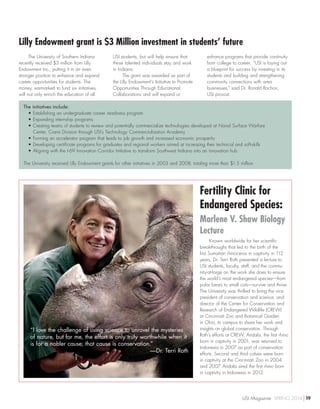
Known worldwide for her scientific
breakthroughs that led to the birth of the
first Sumatran rhinoceros in captivity in 112
years, Dr. Terri Roth presented a lecture to
USI students, faculty, staff, and the commu-
nity-at-large on the work she does to ensure
the world’s most endangered species—from
polar bears to small cats—survive and thrive.
The University was thrilled to bring the vice
president of conservation and science, and
director of the Center for Conservation and
Research of Endangered Wildlife (CREW)
at Cincinnati Zoo and Botanical Garden
in Ohio, to campus to share her work and
insights on global conservation. Through
Roth’s efforts at CREW, Andala, the first rhino
born in captivity in 2001, was returned to
Indonesia in 2007 as part of conservation
efforts. Second and third calves were born
in captivity at the Cincinnati Zoo in 2004
and 2007. Andala sired the first rhino born
in captivity in Indonesia in 2012.
“I love the challenge of using science to unravel the mysteries
of nature, but for me, the effort is only truly worthwhile when it
is for a nobler cause; that cause is conservation.”
—Dr. Terri Roth
USI Magazine SPRING 2014 19
Campus News
The Best of
Both Worlds:
a creative space for
entrepreneurs to collaborate
A cup of coffee and the opportunity to share
brainwaves is often the catalyst startup entrepreneurs
need to advance their ideas toward reality. But finding
a space that brings like-minded creative types together
isn’t easy, let alone affordable. The University of
Southern Indiana and the Romain College of Business,
however, recently collaborated with Growth Alliance
for Greater Evansville (GAGE) to create a co-work
space to accommodate the business needs of
innovative thinkers.
“Co-working hinges on the belief that innovation
and inspiration come from cross pollination of different
people in various fields or specializations,” said Bryan
Bourdeau, instructor in business.
The concept of co-work space swept across
America once it became known that companies like
Apple, Hewlett-Packard, and Google created opportu-
nities for their people to congregate in casual spaces,
a move that led to inspired ideas. These mega-corpo-
rations knew there was more to business than a desk,
four walls, and a door. It takes not only basic facilities
(such as high-speed Wi-Fi, printing and photocopying
resources, meeting rooms, and presentation space to
conduct business) but also opportunities for creative
ideas to ignite—which is what happens when people
with diverse expertise come together.
While creative people need such opportunities,
they also need solitude, something the new space pro-
vides too. Located in Innovation Pointe in downtown
Evansville, Indiana, the co-work area can comfortably
hold 10 to 12 entrepreneurs at a time. There are sofas
for gathering and sharing ideas, and workstations
with chairs for getting work done. Tenants bring their
laptops or other devices, and have access 24/7 to
their workspace via a key card.
“The launch of the Evansville co-working space
represents an important next step in the development of
our entrepreneurial ecosystem,” said Shance Sizemore,
GAGE’s Economic Development Programs manager.
“Because most economic growth comes from existing
businesses, the co-working model provides a platform
for startup companies to develop their peer networks,
access previously unaffordable resources, and provide
an Internet searchable location.”
From Cuba to Florida
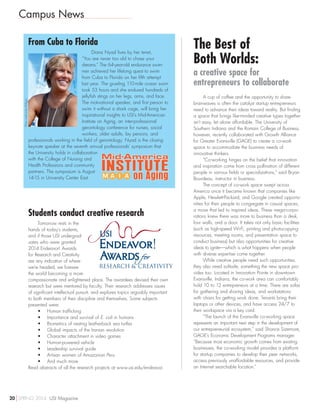
Diana Nyad lives by her tenet,
“You are never too old to chase your
dreams.” The 64-year-old endurance swim-
mer achieved her lifelong quest to swim
from Cuba to Florida on her fifth attempt
last year. The grueling 110-mile ocean swim
took 53 hours and she endured hundreds of
jellyfish stings on her legs, arms, and face.
The motivational speaker, and first person to
swim it without a shark cage, will bring her
inspirational insights to USI’s Mid-American
Institute on Aging, an inter-professional
gerontology conference for nurses, social
workers, older adults, lay persons, and
professionals working in the field of gerontology. Nyad is the closing
keynote speaker at the seventh annual professionals’ symposium that
the University holds in collaboration
with the College of Nursing and
Health Professions and community
partners. The symposium is August
14-15 in University Center East.
Students conduct creative research
Tomorrow rests in the
hands of today’s students,
and if those USI undergrad-
uates who were granted
2014 Endeavor! Awards
for Research and Creativity
are any indication of where
we’re headed, we foresee
the world becoming a more
compassionate and enlightened place. The awardees devised their own
research but were mentored by faculty. Their research addresses issues
of significant intellectual pursuit, and explores topics arguably important
to both members of their discipline and themselves. Some subjects
presented were:
•	 Human trafficking
•	 Importance and survival of E. coli in humans
•	 Biometrics of nesting leatherback sea turtles
•	 Global impacts of the Iranian revolution
•	 Character attachment in video games
•	 Human-powered vehicle
•	 Leadership survival guide
•	 Artisan women of Amazonian Peru
•	 And much more
Read abstracts of all the research projects at www.usi.edu/endeavor.
PhotocreditJulieMilligan
I
20 SPRING 2014 USI Magazine
Conference center will overlook Reflection Lake
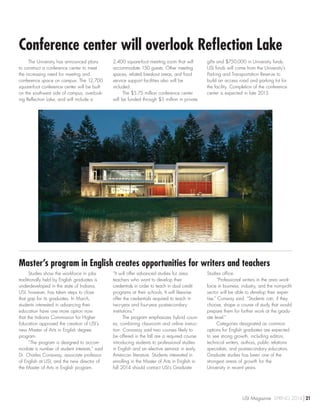
The University has announced plans
to construct a conference center to meet
the increasing need for meeting and
conference space on campus. The 12,700
square-foot conference center will be built
on the southwest side of campus, overlook-
ing Reflection Lake, and will include a
2,400 square-foot meeting room that will
accommodate 150 guests. Other meeting
spaces, related breakout areas, and food
service support facilities also will be
included.
The $5.75 million conference center
will be funded through $5 million in private
gifts and $750,000 in University funds.
USI funds will come from the University’s
Parking and Transportation Reserve to
build an access road and parking lot for
the facility. Completion of the conference
center is expected in late 2015.
Master’s program in English creates opportunities for writers and teachers
Studies show the workforce in jobs
traditionally held by English graduates is
underdeveloped in the state of Indiana.
USI, however, has taken steps to close
that gap for its graduates. In March,
students interested in advancing their
education have one more option now
that the Indiana Commission for Higher
Education approved the creation of USI’s
new Master of Arts in English degree
program.
“The program is designed to accom-
modate a number of student interests,” said
Dr. Charles Conaway, associate professor
of English at USI, and the new director of
the Master of Arts in English program.
“It will offer advanced studies for area
teachers who want to develop their
credentials in order to teach in dual credit
programs at their schools. It will likewise
offer the credentials required to teach in
two-year and four-year postsecondary
institutions.”
The program emphasizes hybrid cours-
es, combining classroom and online instruc-
tion. Conaway said two courses likely to
be offered in the fall are a required course
introducing students to professional studies
in English and an elective seminar in early
American literature. Students interested in
enrolling in the Master of Arts in English in
fall 2014 should contact USI’s Graduate
Studies office.
“Professional writers in the area work-
force in business, industry, and the non-profit
sector will be able to develop their exper-
tise,” Conway said. “Students can, if they
choose, shape a course of study that would
prepare them for further work at the gradu-
ate level.”
Categories designated as common
options for English graduates are expected
to see strong growth, including editors,
technical writers, authors, public relations
specialists, and postsecondary educators.
Graduate studies has been one of the
strongest areas of growth for the
University in recent years.
USI Magazine SPRING 2014 21
Foundation News
Mixing art and business ends in endowment
By Sarah Harlan ’10
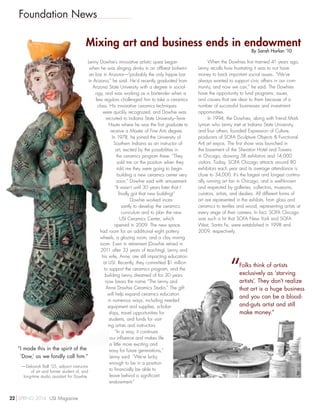
Lenny Dowhie’s innovative artistic quest began
when he was slinging drinks in an offbeat bohemi-
an bar in Arizona—“probably the only hippie bar
in Arizona,” he said. He’d recently graduated from
Arizona State University with a degree in sociol-
ogy, and was working as a bartender when a
few regulars challenged him to take a ceramics
class. His innovative ceramics techniques
were quickly recognized, and Dowhie was
recruited to Indiana State University–Terre
Haute where he was the first graduate to
receive a Master of Fine Arts degree.
In 1978, he joined the University of
Southern Indiana as an instructor of
art, excited by the possibilities in
the ceramics program there. “They
sold me on the position when they
told me they were going to begin
building a new ceramics center very
soon,” Dowhie said with amusement.
“It wasn’t until 30 years later that I
finally got that new building!”
Dowhie worked inces-
santly to develop the ceramics
curriculum and to plan the new
USI Ceramics Center, which
opened in 2009. The new space
had room for an additional eight pottery
wheels, a glazing room, and a clay mixing
room. Even in retirement (Dowhie retired in
2011 after 33 years of teaching), Lenny and
his wife, Anne, are still impacting education
at USI. Recently, they committed $1 million
to support the ceramics program, and the
building Lenny dreamed of for 30 years
now bears the name “The Lenny and
Anne Dowhie Ceramics Studio.” The gift
will help expand ceramics education
in numerous ways, including needed
equipment and supplies, scholar-
ships, travel opportunities for
students, and funds for visit-
ing artists and instructors.
“In a way, it continues
our influence and makes life
a little more exciting and
easy for future generations,”
Lenny said. “We’re lucky
enough to be in a position
to financially be able to
leave behind a significant
endowment.”
When the Dowhies first married 41 years ago,
Lenny recalls how frustrating it was to not have
money to back important social issues. “We’ve
always wanted to support civic affairs in our com-
munity, and now we can,” he said. The Dowhies
have the opportunity to fund programs, issues,
and causes that are dear to them because of a
number of successful businesses and investment
opportunities.
In 1994, the Dowhies, along with friend Mark
Lyman who Lenny met at Indiana State University,
and four others, founded Expression of Culture,
producers of SOFA (Sculpture Objects  Functional
Art) art expos. The first show was launched in
the basement of the Sheraton Hotel and Towers
in Chicago, drawing 58 exhibitors and 14,000
visitors. Today, SOFA Chicago attracts around 80
exhibitors each year and its average attendance is
close to 34,000. It’s the largest and longest continu-
ally running art fair in Chicago, and is well-known
and respected by galleries, collectors, museums,
curators, artists, and dealers. All different forms of
art are represented in the exhibits, from glass and
ceramics to textiles and wood, representing artists at
every stage of their careers. In fact, SOFA Chicago
was such a hit that SOFA New York and SOFA
West, Santa Fe, were established in 1998 and
2009, respectively.
“I made this in the spirit of the
‘Dow,’ as we fondly call him.”
—Deborah Ball ’05, adjunct instructor
of art and former student of, and
long-time studio assistant for Dowhie.
“Folks think of artists
exclusively as ‘starving
artists’. They don’t realize
that art is a huge business
and you can be a blood-
and-guts artist and still
make money.”
22 SPRING 2014 USI Magazine
Fueled by students for students
In an effort to establish a pay-it-forward
philosophy, the University of Southern Indiana
Foundation has joined forces with students
to create a USI student giving society. In it,
students strive to generate understanding among
their peers as to how essential it is to give to
their prospective alma mater. “I couldn’t be
more excited about the potential it holds,” said
Gabby Randazzo, a senior marketing major
leading the effort to build the society from the
ground up.
To determine the level of interest among
students, Randazzo administered 100 random
surveys, gaining valuable insight. “Forty-seven
percent said they’d make a gift to the USI
Foundation because ‘it is a good school, so
why not make it better?’, and ‘because it would
benefit future students,’” she said.
While these results were positive,
Randazzo said, “It was the students who said
they would not give that truly inspired me. My
goal is to change these students’ minds about
giving. My aim for this society is to make
students feel special when they give back to
their University—after all, it is a chance for us to
help future Screaming Eagles.”
Through gifts to the University, students
benefit from scholarships, cutting-edge technol-
ogy in classrooms and labs, student research
projects, and many more opportunities.
Development of the student giving society
is still in the early stages, but a clear direction
has been set. A website is being designed and
a presence on social media is planned for the
end of the semester. A student committee will
create awareness through promotional events
when the giving society officially launches. The
committee also will make recommendations
to the USI Foundation as to where to allocate
funds raised over the academic year.
Lenny served USI and national art institutions in numerous capacities,
and has been a visiting artist in the United States, Australia, Canada,
Japan, Mexico, China, and Russia. His ceramics and drawings are in
national and international collections, including The Renwick Gallery -
Smithsonian American Art Museum.
Anne ’83 taught two- and three-dimensional art at Central High School
for 22 years. She received a Lilly Endowment grant for teaching that
enabled her to travel to Australia, and she traveled to Japan as part of
an exchange program. Her work has been featured in local and region-
al exhibitions. She’s served as vice president, president, and past-presi-
dent of the Art Education Association of Indiana.
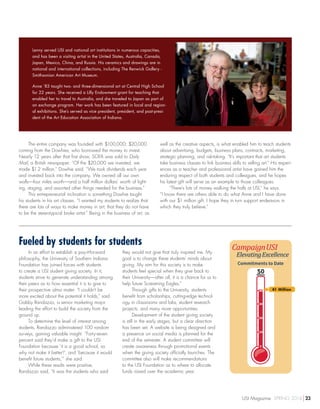
50Million
40
30
20
10
0
Commitments to Date
The entire company was founded with $100,000; $20,000
coming from the Dowhies, who borrowed the money to invest.
Nearly 12 years after that first show, SOFA was sold to Daily
Mail, a British newspaper. “Of the $20,000 we invested, we
made $1.2 million,” Dowhie said. “We took dividends each year
and invested back into the company. We owned all our own
walls—four miles worth—and a half million dollars’ worth of light-
ing, staging, and assorted other things needed for the business.”
This entrepreneurial inclination is something Dowhie taught
his students in his art classes. “I wanted my students to realize that
there are lots of ways to make money in art; that they do not have
to be the stereotypical broke artist.” Being in the business of art, as
well as the creative aspects, is what enabled him to teach students
about advertising, budgets, business plans, contracts, marketing,
strategic planning, and risk-taking. “It’s important that art students
take business classes to link business skills to selling art.” His experi-
ences as a teacher and professional artist have gained him the
enduring respect of both students and colleagues, and he hopes
his latest gift will serve as an example to those colleagues.
“There’s lots of money walking the halls at USI,” he says.
“I know there are others able to do what Anne and I have done
with our $1 million gift. I hope they in turn support endeavors in
which they truly believe.”
41 Million
USI Magazine SPRING 2014 23
Athletic News
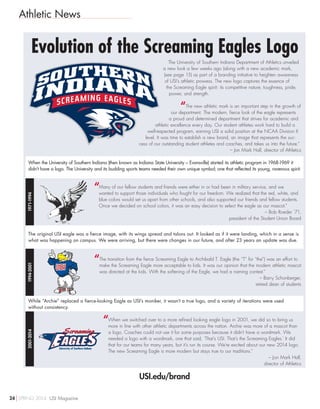
The University of Southern Indiana Department of Athletics unveiled
a new look a few weeks ago (along with a new academic mark,
(see page 15) as part of a branding initiative to heighten awareness
of USI’s athletic prowess. The new logo captures the essence of
the Screaming Eagle spirit: its competitive nature, toughness, pride,
power, and strength.
“The new athletic mark is an important step in the growth of
our department. The modern, fierce look of the eagle represents
a proud and determined department that strives for academic and
athletic excellence every day. Our student athletes work hard to build a
well-respected program, earning USI a solid position at the NCAA Division II
level. It was time to establish a new brand, an image that represents the suc-
cess of our outstanding student athletes and coaches, and takes us into the future.”
– Jon Mark Hall, director of Athletics
When the University of Southern Indiana (then known as Indiana State University – Evansville) started its athletic program in 1968-1969 it
didn’t have a logo. The University and its budding sports teams needed their own unique symbol; one that reflected its young, ravenous spirit.
“Many of our fellow students and friends were either in or had been in military service, and we
wanted to support those individuals who fought for our freedom. We realized that the red, white, and
blue colors would set us apart from other schools, and also supported our friends and fellow students.
Once we decided on school colors, it was an easy decision to select the eagle as our mascot.”
– Bob Roeder ’71,
president of the Student Union Board
The original USI eagle was a fierce image, with its wings spread and talons out. It looked as if it were landing, which in a sense is
what was happening on campus. We were arriving, but there were changes in our future, and after 23 years an update was due.
“The transition from the fierce Screaming Eagle to Archibald T. Eagle (the “T” for “the”) was an effort to
make the Screaming Eagle more acceptable to kids. It was our opinion that the modern athletic mascot
was directed at the kids. With the softening of the Eagle, we had a naming contest.”
– Barry Schonberger,
retired dean of students
While “Archie” replaced a fierce-looking Eagle as USI’s moniker, it wasn’t a true logo, and a variety of iterations were used
without consistency.
“When we switched over to a more refined looking eagle logo in 2001, we did so to bring us
more in line with other athletic departments across the nation. Archie was more of a mascot than
a logo. Coaches could not use it for some purposes because it didn’t have a wordmark. We
needed a logo with a wordmark, one that said, ‘That’s USI. That’s the Screaming Eagles.’ It did
that for our teams for many years, but it’s run its course. We’re excited about our new 2014 logo.
The new Screaming Eagle is more modern but stays true to our traditions.”
– Jon Mark Hall,
director of Athletics
Evolution of the Screaming Eagles Logo
USI.edu/brand
1971-19941994-20012001-2014
24 SPRING 2014 USI Magazine
NCAA Division II championships
come to Evansville
Over the next three years the University of Southern Indiana
and the Evansville Sports Corporation (ESC) will co-host five NCAA
national championships and regional events, starting with the 2015
NCAA Division II Men’s Basketball Elite Eight at the Ford Center in
downtown Evansville, Indiana. In 2017, they’ll co-host the NCAA
II Cross Country National Championships at Angel Mounds State
Historic site in Evansville. In 2014, 2015, and 2016 the NCAA II
Midwest Regionals also will be held at Angel Mounds.
“Bringing Division II championships to Evansville is a big win
for us,” said Jon Mark Hall, USI director of Athletics. “We’re excited
to work with the ESC to bring the Division II Men’s Basketball
Championship back to our great city. Evansville has a deep tradi-
tion with Division II Men’s Basketball, dating from 1957, and we
hope everyone embraces these teams and student athletes as
they strive for the national championships.”
The ESC was formed in 2010, and has been instrumental
in bringing major sporting events to the area and creating an
economic impact for the region. “Hosting two NCAA national
championships and three regionals over the next few years is
a great accomplishment for this community,” said Jason Sands,
executive director of ESC.
NCAA Division II Men’s Basketball Championships
hosted by Evansville
• 1957–1975 • 2002* • 2014*
* Years USI and Evansville co-hosted.
NCAA II Men’s and Women’s Cross Country
Championships hosted by USI
• 1987 • 2004* • 2009*
* Cross country championships held on USI’s campus.
The men’s cross country team has appeared in the
national championships 21 times since 1980, finish-
ing 11th-place in the 2013 meet after its ninth-straight
GLVC title.
The USI women’s cross country team has appeared
in the national championships nine times since 1997,
winning its third-straight GLVC title this past fall.
Years USI men’s basketball advanced to the Elite Eight
• 1994 • 1995* • 2004
* USI won the Division II national title in 1995.
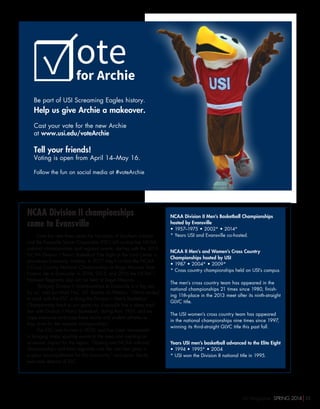
otefor Archie
 
Be part of USI Screaming Eagles history.
Help us give Archie a makeover.
 
Cast your vote for the new Archie
at www.usi.edu/voteArchie
Tell your friends!
Voting is open from April 14–May 16.
Follow the fun on social media at #voteArchie
☑
USI Magazine SPRING 2014 25
Alumni Today
More events at USI.edu/alumni
Alumni Council
2013–2014
Officers
Kyle Wininger ’01
President
Jennifer Titzer ’00, M’10, D’13
President Elect
Sally Gries ’02
Secretary
Randall Haaff ’84
Treasurer
Mark Chandler ’01
Immediate Past President
Ronald Romain ’73
Alumni Trustee
Tarrie Kendall Crist ’94
Indianapolis Chapter
Brian Pauley ’00
Louisville Chapter
Allyson Breeden ’98
Autum Byrd ’01, M’03
Claudine Fairchild ’01, M’05
Neil Fortwendel ’05
Mandi Fulton ’06, M’10
Ashley Hancock ’10
John Havill ’04
Charlene Kaufman ’09, M’12
Rebecca Korba ’95
Andy Lemon ’05
Lauren Lesher ’04, M’05
Kacheyta McClellan ’10
John Raisor ’03
Kenneth Schnautz ’11
Eileen Weber ’98
University Staff
Janet Johnson M’05
Director of Alumni and
Volunteer Services
Sarah Harlan ’10
Assistant Director of Alumni
and Volunteer Services
Deb Schmuck
Senior Administrative Assistant
	 May 2	USI Graduate Commencement, USI Campus
Alumni Graduate Reception, University Center East
	 May 3	USI Commencement Exercises, USI Campus
Alumni Graduation Receptions, University Center East
	 May 13	USI Alumni Association Annual Meeting, 5:45 p.m.,
University Center West, Room 206
	 June 1	 Alumni Picnic, 4–6 p.m., University Center East/USI Quad
	 June 7	 USI Day at Churchill Downs, Louisville, Kentucky
	 June 16	 Alumni Travel, “Discover Scotland,” June 16–June 25
	 June 27	Indianapolis Alumni Chapter Cookout, 6:30 p.m.
Bob ‘71 and Mary Roeder home, Indianapolis
	 July 8	USI Alumni Council Meeting with orientation
5:45 p.m., University Center East, Traditions Lounge
	 July 24	 USI Eagle Hour, alumni networking, Location TBA
	 August 8	Indianapolis Scholarship Golf Outing,
Eagle Creek, Indianapolis
	September 12	 Alumni Golf Scramble, Helfrich Hills Golf Course, Evansville
	September 16	 USI Founder’s Day Luncheon, Carter Hall
	 October 23	 USI Eagle Hour, alumni networking, Location TBA
C A L E N D A R O F E V E N T S
All alumni are invited to attend these events.
26 SPRING 2014 USI Magazine
1970s
David Goodman ’79, finance/marketing,
is the CEO of Cancerinsurance.com, a web-
based marketplace of cancer and critical
illness insurance plans that allows consumers
to generate instant quotes, compare options,
and apply online through a unique e-application
format. His mission is to provide Americans the
broadest and easiest method for obtaining
supplemental cancer or critical illness
healthcare insurance during critical times.
1980s
MaryJane Baine Silvey ’82, management, is
the owner and manager of WriteMonitor LLC,
providing medical-related writing, editing, and
communicating assistance to companies and
institutions conducting or supporting clinical
research. MaryJane, who holds an MBA,
started her business in 2013 after more
than 30 years of experience working in
the pharmaceutical industry.
Scott Stambush ’85, communications, is
the CEO and In-House Counsel of Stambush
Staffing, LLC, a temporary staffing agency
based in Houston, Texas. Scott founded
Stambush Staffing with his wife Susan in 1989,
became a Texas attorney in 1994, and has
grown his business into the most esteemed
staffing agency in the Greater Houston area.
David Dunn ’86, mechanical engineering
technology, is president of Shamrock Engineering
Inc. in Evansville. Dave started Shamrock 15
years ago and they have designed and built
automated assembly and test equipment for
the automotive, medical, appliance, and other
industries around the world.
Angela Jeffries ’86, elementary education, ’13,
Master of Health Administration, has started a
new business, Sharpensiron Enrichment Program,
in Mount Vernon, Indiana.
Nancy Backer Poehlein ’89, visual art teaching,
is an art teacher at Perry Center High School in
Leopold, Indiana.
1990s
Rusty McGowan Watson ’92, elementary
education, is excited to tell everyone that she
has illustrated two children’s books as well as
written an historical fiction novel entitled The Idler
that is currently in the publication process.
The Idler is a coming-of-age true story of
Watson’s great, great grandfather and his
harrowing adventure aboard a whaling ship in
1845–1849. She researched his journal for
accuracy and hopes she told his story the way
he would want it to be told. Rusty retired from
public school teaching kindergarten in 2009.
She now teaches art to adults and children in
her art studio, and teaches a summer art camp
for children at Cedarhurst Center for Arts at the
Mitchell Museum in Mount Vernon, Illinois.
Barry Heichelbech ’94, accounting, is an
assistant plant controller for Dana Corporation
in Henderson, Kentucky.
Sarah Claycomb ’97, nursing, is the owner
of Specialty Home Health Care, based in
Evansville. She started her company in 1999
after receiving her bachelor’s degree in nursing.
In 2013 the company was ranked in the top
100 nationally and number one in Indiana
based on quality care and patient satisfaction.
Her company employs experienced nurses and
therapists, providing professional care in
patients’ homes.
April Schmuck Boeke ’98, psychology,
is the owner/president of Culinary Innovations
by April, a catering service on Evansville’s
west side.
Stay Connected
We want to hear from you!
Do you have good news to share? We’d love to share your success with
other graduates here in the USI Magazine Alumni Today.
Send us your updates online at
USI.edu/alumni/update
Email: alumni@usi.edu
USI Magazine SPRING 2014 27
Alumni Today
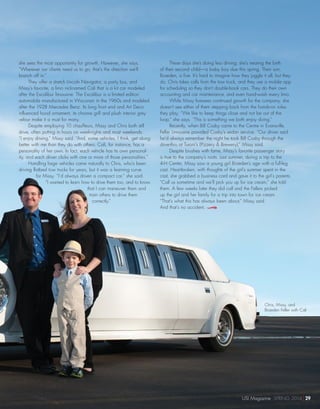
Accidental EntrepreneursBy John Farless ’98
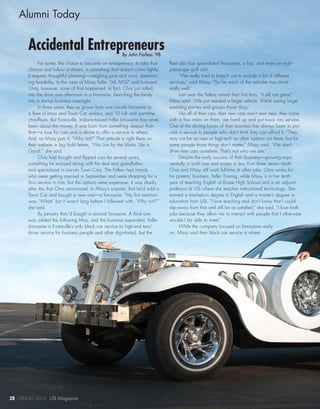
For some, the choice to become an entrepreneur, to take that
chance and follow a dream, is something that doesn’t come lightly.
It requires thoughtful planning—weighing pros and cons, determin-
ing feasibility. In the case of Missy Feller ’04, M’07 and husband
Chris, however, none of that happened. In fact, Chris just rolled
into the drive one afternoon in a limousine, launching the family
into a startup business overnight.
In three years, they’ve grown from one Lincoln limousine to
a fleet of limos and Town Car sedans, and 10 full- and part-time
chauffeurs. But Evansville, Indiana-based Feller Limousine has never
been about the money. It was born from something deeper than
that—a love for cars and a desire to offer a service to others.
And, as Missy puts it, “Why not?” That attitude is right there on
their website in big bold letters, “We Live by the Motto ‘Life is
Good,’” she said.
Chris had bought and flipped cars for several years,
something he enjoyed doing with his dad and grandfather,
and specialized in Lincoln Town Cars. The Fellers had friends
who were getting married in September and were shopping for a
limo service to hire, but the options were expensive. It was shortly
after this that Chris announced, to Missy’s surprise, that he’d sold a
Town Car and bought a new one—a limousine. “My first reaction
was, ‘What!’ but it wasn’t long before I followed with, ‘Why not?’”
she said.
By January they’d bought a second limousine. A third one
was added the following May, and the business expanded. Feller
Limousine is Evansville’s only black car service (a high-end taxi/
driver service for business people and other dignitaries), but the
fleet also has specialized limousines, a bus, and even an eight-
passenger golf cart.
“We really tried to branch out to include a lot of different
services,” said Missy. “So far each of the vehicles has done
really well.”
Last year the Fellers retired their first limo. “It still ran great,”
Missy said. “We just needed a larger vehicle. We’re seeing larger
wedding parties and groups these days.”
Like all of their cars, their new cars aren’t ever new; they come
with a few miles on them, are fixed up and put back into service.
One of the driving forces of their business has always been to pro-
vide a service to people who don’t think they can afford it. “They
may not be as new or high-tech as other options out there, but for
some people those things don’t matter,” Missy said. “We don’t
drive new cars ourselves. That’s not who we are.”
Despite the early success of their business—growing expo-
nentially in both size and scope in less than three years—both
Chris and Missy still work full-time at other jobs. Chris works for
his parents’ business, Feller Towing, while Missy is in her tenth
year of teaching English at Bosse High School and is an adjunct
professor at USI where she teaches instructional technology. She
earned a bachelor’s degree in English and a master’s degree in
education from USI. “I love teaching and don’t know that I could
slip away from that and still be as satisfied,” she said. “I love both
jobs because they allow me to interact with people that I otherwise
wouldn’t be able to meet.”
While the company focused on limousines early
on, Missy said their black car service is where
28 SPRING 2014 USI Magazine
she sees the most opportunity for growth. However, she says,
“Wherever our clients need us to go, that’s the direction we’ll
branch off in.”
They offer a stretch Lincoln Navigator, a party bus, and
Missy’s favorite, a limo nicknamed Cali that is a kit car modeled
after the Excalibur limousine. The Excalibur is a limited edition
automobile manufactured in Wisconsin in the 1960s and modeled
after the 1928 Mercedes Benz. Its long front end and Art Deco-
influenced hood ornament, its chrome grill and plush interior grey
velour make it a must for many.
Despite employing 10 chauffeurs, Missy and Chris both still
drive, often putting in hours on weeknights and most weekends.
“I enjoy driving,” Missy said. “And, some vehicles, I think, get along
better with me than they do with others. Cali, for instance, has a
personality of her own. In fact, each vehicle has its own personal-
ity, and each driver clicks with one or more of those personalities.”
Handling large vehicles came naturally to Chris, who’s been
driving flatbed tow trucks for years, but it was a learning curve
for Missy. “I’d always driven a compact car,” she said.
“I wanted to learn how to drive them too, and to know
that I can maneuver them and
train others to drive them
correctly.”
These days she’s doing less driving; she’s nearing the birth
of their second child—a baby boy due this spring. Their son,
Braeden, is five. It’s hard to imagine how they juggle it all, but they
do. Chris takes calls from the tow truck, and they use a mobile app
for scheduling so they don’t double-book cars. They do their own
accounting and car maintenance, and even hand-wash every limo.
While Missy foresees continued growth for the company, she
doesn’t see either of them stepping back from the hands-on roles
they play. “We like to keep things close and not be out of the
loop,” she says. “This is something we both enjoy doing.”
Recently, when Bill Cosby came to the Centre in Evansville,
Feller Limousine provided Cosby’s sedan service. “Our driver said
he’d always remember the night he took Bill Cosby through the
drive-thru at Turoni’s (Pizzery  Brewery),” Missy said.
Despite brushes with fame, Missy’s favorite passenger story
is true to the company’s roots. Last summer, during a trip to the
4-H Center, Missy saw a young girl Braeden’s age with a full-leg
cast. Heartbroken, with thoughts of the girl’s summer spent in the
cast, she grabbed a business card and gave it to the girl’s parents.
“Call us sometime and we’ll pick you up for ice cream,” she told
them. A few weeks later they did call and the Fellers picked
up the girl and her family for a trip into town for ice cream.
“That’s what this has always been about,” Missy said.
And that’s no accident.
Chris, Missy, and
Braeden Feller with Cali
USI Magazine SPRING 2014 29
2000s
Heather Wilson ’01, interpersonal organizational
communications, along with her husband Mike
Wilson, recently began a residential rental property
business in Evansville. Carrying on the tradition
of her grandfather and mother, Legacy Residential
Properties, LLC provides welcoming and
convenient homes to families on the west and
north side. They plan to continue to grow the
business over the next several years.
Stephanie Moll Bricking ’02, history, is a
metadata librarian at the Public Library of
Cincinnati and Hamilton County Library in
Cincinnati, Ohio.
Tim Roman ’02, journalism and computer
publishing, is the owner of To The Finish, L.L.C.,
a timing company based in Evansville, that
provides finish line timing for 5K, 10K, and half
marathons in Indiana, Illinois, and Kentucky, or
elsewhere upon request.
Angelica Crawford ’03, psychology,
is the sole proprietor of The Indiana Institute
for Behavior Analysis, LLC, a company that
provides ABA Therapy for children with special
needs. Angelica started her company in 2011
and serves families in Central and Southern
Indiana.
Matt Keener ’05, marketing, ’12, Master of
Business Administration, is President of Keener
Marketing Solutions, LLC, a leading virtual-
based, digital marketing firm. Matt started
working online as a consultant in 2009, and
since then he’s helped dozens of global clients,
mainly in the software-as-a-service (Saas) industry.
His book, Executive in Sweatpants, has hit
number one on several Amazon best seller lists,
and was recently featured on the Dave Ramsey
radio show.
Sara Rhoades ’06, art, ’11, Master of Liberal
Studies, is the designer behind S.K. Rhoades
contemporary jewelry. Founded in 2006, S.K.
Rhoades jewelry has been featured in Bead
Star Magazine, in national advertisements for
Fire Mountain Gems, and is sold in museums,
galleries, and online.
Cynthia West Ward ’08, Master in Nursing,
is a surgical clinical nurse specialist at Carlion
Roanoke Memorial Hospital in Roanoke, Virginia.
She received her Doctor of Nursing Practice in
December 2013.
Jodi Sander ’09, health services, has been
named activity director at Parkview Care Center
in Evansville.
2010s
Mandy Chinn ’09, accounting and professional
services, has been promoted to accounting
manager at Regency Properties in Evansville.
Joshua Calhoun ’10, political science, is the
co-owner of Community Mowing LLC, a small
lawn care business with big aspirations. He
started Community Mowing with his business
partner, Terrance Johnson, in 2013.
Nickolas John ’10, management, ’12, Master
of Business Administration, is a career services
advisor/career coach at Oakland City University
in Oakland City, Indiana.
Michael Gibbs ’11, kinesiology/sport
management, has taken the position of
academic compliance coordinator at Old
Dominion Athletics in Norfolk, Virginia.
Joshua Pietrowski ’11, English, is the assistant
brew master at Turonis Pizzery  Brewery in
Evansville.
Christopher Render ’11, computer information
systems, is a team leader at Toyota Motor
Manufacturing of Indiana in Princeton, Indiana.
Matt Schutz ’11, business administration, is an
account executive for Tulsa Oilers Professional
Hockey in Tulsa, Oklahoma.
Danielle Monks ’12, special education,
is a full-time teacher at FJ Reitz High School,
Evansville, in special education, science, and
mathematics, and assistant athletics director.
Chelsea Ivy Thomas ’12, public relations and
advertising, is a marketing specialist at Unison
at Elanco Animal Health in Greenfield, Indiana.
Tiffani Hall Weatherford ’12, individual
studies, is a corporate safety assistant at
Flanders Electric in Evansville.
Kendrea Latay Yates ’12, health services, is a
health educator for WebMD in Indianapolis,
Indiana.
Marriages
Erin Ennes ’08, public relations and advertising/
Spanish studies, and Kevin Hansert, September 14,
2013.
Erin Deisher ’11, public relations and
advertising, and Zachary Goldman ’11,
communication studies, September 29, 2013.
Sarah Lehman ’12, communications studies,
and Cole Feldmann, November 16, 2013.
Katelynn Weisheit ’12, German, ’13, early
childhood education, and Nicholas Smith ’09,
public relations and advertising, June 22, 2013.
Alicen Schwartz ’13, chemistry/psychology,
and Brett Williams ’13, chemistry, July 6, 2013.
Births and Adoptions
Steven Greulich ’98, business administration,
and Kimberly welcomed Katherine, December
13, 2013.
Nancy Dauby Meyer ’99, elementary education,
’07, Master of Public Administration, and Heath
welcomed Christina Alise, December 4, 2013.
Kent Starnes ’01, mathematics, and Katrina
welcomed Konnor David, January 31, 2014.
Audra Weisheit Wood ’02, elementary
education, and Chris welcomed Carter Robert,
July 6, 2013.
Kelly Wepsic Graber ’04, history, ’06,
social science teaching, and Cyle welcomed
Belle Elizabeth, October 15, 2013.
Miranda Bender Meeks ’06, radio and
television, and Nicholas Meeks ’10, history,
welcomed Luna May, November 6, 2013.
Kayla Owens Hurley ’07, marketing, and
Joseph Hurley ’07, marketing, welcomed
Finn Owen, November 19, 2013.
Audrey Merkley Zimmer ’08, accounting and
professional services, and Nicholas Zimmer
’05, computer science, welcomed Aiden Keith,
April 28, 2013.
Alumni Today
30 SPRING 2014 USI Magazine
ScotlandUSI Alumni Association trip
June 16–25, 2014
10 days with 14 meals
Tour operator: Collette Vacations and Lifestyle Tours
Tour Highlights
Experience the riches of Scotland on this 10-day leisurely tour by visiting Edinburgh Castle, Holyrood
Palace, St. Andrews, Dunrobin Castle, Orkney Islands, Loch Ness, Isle of Skye, and Armadale Castle.
Essential Experience
•	Explore Edinburgh Castle
•	Learn the secrets of making Scotch whiskey
•	Spot “Nessie”
•	Discover Ring Brodgar (older than Stonehenge)
•	Experience a Neolithic village
•	Cruise Loch Lomond
Please Join Us!
Call Ken Meyer or Tracy Wilson at LifeStyle Tours, 812-682-4477, with your travel questions.
You also may contact Janet Johnson at USI at 812-464-1928 or alumni@usi.edu.
Proceeds from alumni travel fund scholarships for USI students.
alumni.usi.edu
To sign up or find out more about the program,
contact USI Alumni and Volunteer Services at
alumni@usi.edu or 812-464-1924.
Reduce energy, build the Alumni Scholarship Fund
USI Alumni Association is participating in a community outreach and enrichment program with Energizing
Indiana to reduce energy costs and increase scholarship dollars for USI students.
Energizing Indiana provides free residential home energy assessments to lower energy bills, improve in-
home air quality, and increase your home’s value. The initiative is a united effort by participating utilities
and residents to decrease energy costs across the state.
For each home that enrolls through the USI Alumni Association, $25 is donated to the USI
Alumni Scholarship Fund.
USI Magazine SPRING 2014 31
Alumni Today
In Memoriam
Ronald Ellerbush ’72, elementary education,
of Evansville, died February 19, 2014. He was
a former teacher at Camp Breckinridge Job
Corps Center.
Michael Story ’73, marketing, of Evansville,
died January 5, 2014. He was a sales
representative for Armour Dial and recently
worked for Keebler.
Kay Temme Gann ’75, social science
teaching, of Evansville, died December 23,
2014. She worked for the U.S. Postal Service
for over 30 years.
Gerald Mills ’75, accounting, of Benton,
Kentucky, died December 25, 2014. He was
an Air Force veteran, and was retired from the
U.S. Postal Service.
Ronald Coultas ’76, accounting, of Crowley,
Texas, died January 18, 2014. He was a
Vietnam veteran and was based in Cam Rahn
Bay. Ron owned a trucking company.
Mitzi Ferderber ’77, radiologic technology,
of Evansville, died December 31, 2014.
She was an employee of Deaconess Hospital
for 35 years.
Gary Davis ’81, radiologic technology, of
Evansville, died January 3, 2014. He was a
Vietnam veteran, serving two tours of duty as
a hospital corpsmen attached to the Navy
Seabees. Gary worked at Deaconess Hospital
for 35 years, the last 15 years as a clinical
instructor for radiology students attending USI.
Stanley Addy ’86, social science teaching,
of Evansville, died December 24, 2013.
He served 20 years in the U.S. Air Force.
Norman Memmer ’86, social science, of
Mackey, Indiana, died January 21, 2014.
He was social services director at The Good
Samaritan Home in Oakland City.
Robert Peppiatt ’96, history, of Evansville,
died December 30 2013. He worked for
George Koch Sons, Alcoa Warrick Operations,
and recently was a self-employed attorney.
Michele Mehringer ’99, visual art teaching,
of Evansville, died December 20, 2013. She
taught at Christ the King School for the past
12 years. Michele was an avid runner and
a regular at yoga. For years, she was seen
running with her dog in tow.
Mary Hartley ’05, Master of Social Work, of
Evansville, died December 31, 2013. She was
a therapist at Lampion Center.
Anthony Hall ’06, biology, of Saint Petersburg,
Florida, died December 20, 2013. He owned
and operated Smooth Sailing Dive Service in
Saint Petersburg, Florida. Anthony was working
to complete his master’s degree in Biology and
taught undergraduate biology at the University
of South Florida Tampa.
Patrick Wesseler ’07, radio and television,
of Straughn, Indiana, died January 25, 2014.
He was a radio personality, known as the
“Big P” at 103GBF in Evansville.
Faculty/staff in Memoriam
Ronald ‘Ron’ Clair Roat, author, retired
journalism professor, and long-time advisor
to The Shield, died November 28, 2013. He
taught journalism in the College of Liberal Arts
from 1986 to 2008, and wrote mystery novels:
Closed Softly the Doors and A Still and Icy
Silence.
Stephen Herron ’81, art, of Rockport, Indiana,
died November 28, 2013. He was a ceramic
arts professor at USI.
Take Your USI Spirit
on the Road!
It’s easier than ever to tag your car with
a red and blue USI license plate. Ask for a USI
license plate at your local Indiana Bureau of
Motor Vehicles. BMVs state-wide will collect your
$25 tax-deductible contribution in support of the
Alumni Scholarship Endowment and forward it
to the University.
When you purchase or renew your license
plate, you will pay the state-assessed fees, a $15
BMV processing fee, and your $25 scholarship
contribution directly to the BMV. You can request
a USI license plate from the BMV by mail, at your
local license branch, or online through the BMV
website at www.state.in.us/bmv. For more
information, contact the Alumni Association at
812-464-1924, or alumni@usi.edu.
Get rolling today with a collegiate license
plate!
INDIANA
0123456789
INDIANA
0123456789
INDIANA
0123456789
INDIANA
0123456789
INDIANA
0123456789
INDIANA
0123456789
Help Fund the USI Alumni Scholarship
Endowment and show your school spirit
INDIANA
0123456789
$
25
+
$
25
+
$
25
+
$
25
+
$
25
+
$
25
Your gift to
will make a difference.
Online giving is easy, secure,
and convenient.
Please visit
www.usi.edu/onlinegiving
for more information.
www.usi.edu/foundation
www.usi.edu/campaign
32 SPRING 2014 USI Magazine
USI
Revisit Looking forward to the University’s 50th Anniversary
The University of Southern Indiana will celebrate its 50th
anniversary in 2015. In anticipation of that milestone, USI
Magazine takes a look back at some of the events, people,
and experiences from years past. Watch for this Revisit USI
column in every issue.
It’s been a long, cold, and brutal winter, but no matter the year USI students are always eager for good
weather and good times. If you recognize yourself and/or your friends in this image, or were part of the
crowd that day, let us and others know the story behind the photo. Start a conversation and reconnect by
tweeting us at #USItugofwar or posting comments to USI’s Facebook page or emailing us at usinews@usi.edu.
Pulling for Spring
USI Magazine SPRING 2014 33
Producing Artistic Director – Elliot Wasserman
Managing /Marketing Director – Angela Torres
Produced by the University of Southern Indiana
2014 SEASON
Last of the Red Hot Lovers
By Neil Simon
June 20–29
The Hound of
the Baskervilles
By Sir Arthur Conan Doyle,
adapted by Steven Canny and John Nicholson
July 11–20
The Fantasticks
Book and lyrics by Tom Jones
Music by Harvey Schmidt
July 25–August 3
newharmonytheatre.com
877-NHT-SHOW
Paula Leggett Chase and Joe Paparella
Boeing Boeing, 2013 Season
V14-108947

USI Magazine Spring 2014

  • 1.
  • 2.
    From the President USIMagazine is published three times annually by the University of Southern Indiana for its alumni and friends. Vice President for Government and University Relations Cynthia Brinker Assistant Vice President for Marketing and Communications Kindra Strupp Director of News and Information Services John Farless ’98 Director of Alumni and Volunteer Services Janet Johnson M’05 Editor C. L. Stambush Contributing Writers Wendy Knipe Bredhold ’98 John Farless ’98 Sarah Harlan ’10 Angie O’Nan ’12 C. L. Stambush Art Direction and Design Christopher Norrick ’98 Photography David Arthur Elizabeth Courtney Randolph LaVerne Jones ’05 Illustrator Jared Cook ’14 Senior Administrative Assistant Barbara Goodwin Administrative Associate Angie O’Nan ’12 Send editorial information to News and Information Services. Send alumni information to Alumni and Volunteer Services. Send donor information and address changes to USI Foundation. Address University of Southern Indiana 8600 University Boulevard Evansville, IN 47712 Telephone USI Magazine 812-465-7005 Email usinews@usi.edu Other University phone numbers Alumni and Volunteer Services 812-464-1924 USI Foundation 812-464-1918 Admission 812-464-1765 Athletics 812-464-1846 It is the policy of the University of Southern Indiana to be in full compliance with all federal and state non-discrimination and equal opportunity laws, orders, and regulations relating to race, sex, religion, disability, age, national origin, sexual orientation, or veteran status. Questions or concerns should be directed to the Affirmative Action Officer, USI Human Resources Department, University of Southern Indiana, 8600 University Boulevard, Evansville, Indiana 47712. USI.edu Dr. Linda L. M. Bennett President Follow USI on The story of USI’s founding is a tale of entrepreneurs who believed that an institution of public higher edu- cation was essential to the develop- ment of Southwestern Indiana. The visionaries who formed Southern Indiana Higher Education, Inc. were business and community leaders of foresight and courage. They knew it would be a major undertaking with many challenges and risks, but their triumph resulted in the establishment in 1965 of ISUE, that evolved into USI in 1985. Entrepreneurial spirit is the focus of this edition of USI Magazine. Boldness, persistence, and a willingness to take on the hard work of seeing a vision through from idea to implementation are essential com- ponents of USI’s history and future. Today, USI is at an exciting juncture as we anticipate our 50th anniversary in 2015. Building on the strong foun- dation established by our founders, USI is now a university with national and international partnerships, increased national recognition for the excellence of its academic programs, and admired for the creativity and scholarly talents of its faculty, staff, alumni, and students. We highlight just a few of those talented alumni in this issue, and I hope their stories inspire other alums to share with us their own stories of challenge and success. To mark this important time in USI’s development, new logos for the University and for USI Athletics were unveiled on April 9. Entrepreneurs often light the way for others and the new University logo pays homage to the torch of knowl- edge on the University seal, while conveying the energy of our vibrant, contemporary campus. The new Athletic logo updates the look for the Screaming Eagles and heralds pride in the success of our student athletes and their competitive spirit. Both new logos reflect the wisdom of USI’s founders and the University motto: a great public university “of the people, for the people.”
  • 3.
    Volume 47 Issue1 • SPRING 2014 On the Cover FEATURES Purses Fashioned from a Dream 2 Young Entrepreneur’s Six-figure Business Solar Energy 6 Visionary Banks on a Better Tomorrow Reinventing the Toilet 10 The Challenge of the Business New Look for USI Brand 14 The Story Behind the Image DEPARTMENTS Campus News 16 Diana Nyad Keynote at MAIA Foundation News 22 $1 Million Donation to Ceramics Athletic News 24 USI to Co-host NCAA II Championships Alumni Today 26 Accidental Entrepreneurs An original creation by Terri Bischoff, USI’s assistant director of Publishing Services, depicting the visions of entrepreneurs far and wide. We know our alumni are doing great things, and we want to hear about it. We’re eager to share your stories in upcoming issues of USI Magazine. Future themes include “transitions” and “food.” If you have a story to tell or a topic to suggest that you think relates to one of these subjects or others, we’re all ears. Contact us at usinews@usi.edu. Thanks, C. L. Stambush, Editor Startup Weekend 3.0 Vote for Archie’s Makeover 16 25 Magazine
  • 4.
    Can Doa made-in-Americaspirit By C. L. Stambush 2 SPRING 2014 USI Magazine
  • 5.
    I t’s difficult toimagine the tall, slim, winsome woman—eyes bright...smile genuine—once lacked confi- dence. It’s difficult to imagine others taunted her to the point she was homeschooled from fourth through seventh grade. It’s also difficult to imagine Kelsea Slade ’09, owner and designer of K.slademade, a line of boutique leather handbags, being anything but successful. “All my life my father told my sisters and me, ‘You can be anything you want to be,’” she said. “At the time I didn’t know what that meant, but now I feel it’s what brought me here.” While “different” doesn’t work when you’re a kid, as an entrepreneur and designer of a product tens of thousands already make, it pays to stand out. Slade’s select elements set her purses apart: luxurious leather, rich tones, and upscale hardware, all impeccably stitched. They are classic, clean, simple, and sophisti- cated, with a signature tassel. The Question The first time Slade asked herself, “Is this what I want to do?” she was working in human resources for a physical rehabilitation provider. She’d secured the position a few months after graduating from USI with a bachelor’s degree in communications. “I loved my job and thought I wanted to keep doing it,” she said, “but I also wanted to do something more creative.” The question worked at her: if not that job, then what? While wandering in an antique mall with her sister Erin Little, Slade confided she wanted to start a business making purses. She’d learned to sew from her mother, she understood how to engineer purses, and, unlike clothes, one size fits all. Her sister, also nourished on their father’s mantra, told her, “Follow your dream.” The idea scared and thrilled the newly- married Slade, and when she told her husband Hunter, a former USI baseball right-fielder, he offered cautious support. After all...a house, a mortgage, a dog named Monty. Setting Up Shop Slade borrowed her grandmother’s sewing machine for a month and, after brainstorming designs with younger sister Hannah, “got busy” stitching cross-body bags constructed from duck cotton or upholstery fabric. She bought materials locally from national fabric stores, always keeping a sharp eye out for inspira- tion. “I was in Rural King when I stumbled across this leather thing for horses,” she said. “It was a nice, thick piece of leather, and I wanted it for the straps.” Her husband bought her a sewing machine, and she established a “store” on Etsy, an e-commerce website for budding entrepreneurs and hobbyists. Consumers search by product on Etsy rather than designer name, and Slade had to wait for them to find her. She looked for ways to increase her visibility, and learned of a local craft fair. “My goal for the craft show was to take a lot of orders, since I didn’t know what people wanted,” she said. With a red sample purse and a stack of order forms, Slade secured 10 sales. “At the time I thought it went exceptionally well. If I could make $600 a day…,” she said. “Of course, the next day I didn’t get any orders.” USI Magazine SPRING 2014 3
  • 6.
    Growing Pains When herwork outgrew her small guest room, she moved to a larger one. She sewed eight to 13 hours a day to keep up with Etsy orders. “I was sewing non-stop because at my price point everyone could afford to buy,” she said. “I didn’t know what to charge for labor, so I wasn’t charging for my time. I didn’t give myself value.” That’s when she asked herself for the second time, “Is this what I want to do?” She reassessed her business and made major changes. Driving around town purchasing materials wasn’t productive, even though she liked to feel the material before buying it. Additionally, she wanted her purses to last, and cloth wasn’t durable enough for her taste. She decided to switch to leather and scoured the Internet for suppliers who’d mail samples. “Altogether it made more sense to transition to leather,” Slade said. “Besides, I love leather, even though it’s unforgiving. You can’t make mistakes because you’ve already punched a hole in it.” Slade’s purses caught the attention of Ree Drummond, aka The Pioneer Woman (a blogger sensation, best-selling author, and Food Network personality) who posted on her site “Hold the phone. I’m in love with these. Help,” and included photos of the saucy-colored clutches with contrasting zippers. “That one post really boosted my sales,” Slade said, “and took my purses to a whole new audience.” The Beast Slade was cutting and stitching leather all day, but needed to focus on increasing sales now that awareness of her purses had grown. She’d been searching for a manu- facturer to take over production, but no one wanted to work with a company her size. Until she secured one, she needed an industrial sewing machine, which she found and bought online. “It weighed a ton, and was delivered in a thousand pieces with no instructions,” she said. “I had to put my engineer brain to work to put it together, along with the help of my husband. There were a few pieces left over, but it works great.” Shortly after “The Beast” arrived, Slade relocated to the basement. Samples from leather, zipper, and hardware dealers poured in. Purses piled up. “I’ve taken over every place in the house,” she said. “Eventually I’ll be kicked out of it.” Other changes were afoot, too. It was time to leave Etsy and independently brand her stylish merchandise. “I wanted to speak to a higher-end client directly,” she said, “rather than be one voice among many.” She bought a domain name and a URL for $10, and designed a website using Shopify’s built-in web-design tools. The Häagen-Dazs® Experience Maybe it was The Pioneer Woman’s blog post or some other fan who tipped off Häagen-Dazs about Slade’s purses. Whoever it was, the ice cream giant came knock- ing. It was launching a new line—gelato—called “L’artista Della Serie,” (Artisan Series), and had selected Slade as one of seven craftsmen to design a luxury item in their craft media that matched one of the new flavors. “They wanted my foldover,” she said. Asked to submit a proposal for the time and effort to design and make 25 purses exclusively for Häagen-Dazs’ gelato line, she did, and was assigned the flavor Sea Salt Caramel. 4 SPRING 2014 USI Magazine
  • 7.
    Slade and hersister Erin, who by then worked for her, were flown to Italy and immersed in the culture for a week. The goal: soak up the feel of Italy and infuse it into a unique creation. Originally, she thought Italian leather might be best, but later found the perfect shade and texture from a U.S. supplier—one that mimicked the swirl of rich caramel with licks of salt. It was so perfect she momentarily questioned using it. “We’d signed a contract stating we could never use the exact materials again,” she said. “But we felt they deserved the best so we gave them the one we loved the most.” She married the rich leather with a satin sea-green lining, and added her signature tassel, this one with rustic brown, teal, and navy leather wisps. Outsourcing the Labor Last year, Slade found a pair of manufacturers in Chicago to produce her three main styles: Heather Crossbody, Brooklyn Foldover, and the Tip Pouch. In the past, she had to remove styles because she was unable to physically keep up with demand. Now that she contracts the labor, she’s interested in expand- ing her line to include new styles, in addition to smaller, more affordable items such as a pencil pouch or coin purse. Two manufacturers work well, she said, in case workloads overlap. But more importantly, they’re American manufacturers. “I’m passion- ate about this country and all it’s given me,” she said, “I want to give back by supporting other U.S. businesses.” Both manufacturers are owned and operated by women, and even though they “get her,” Slade said strong communication skills are necessary to get her ideas across. “I use my USI education all the time,” she said, “and not just with the manufacturers, but with stylists, photographers— even my sister.” Turn the Page In two years, K.slademade has grown—from $600 in craft-fair orders to a six-figure gross. She’s added a bridal consultancy to her enterprise, and commissions a sales consultant on the east coast to place K.slademade purses in boutiques around the world. The farthest location to date is Russia, but her designs also sell in Florida, New York, North Carolina, South Carolina, Indiana, and Minnesota. As demand for her brand grows, it’s only a matter of time before one of those grade-school girls is among the many carrying a K.slademade purse. USI Magazine SPRING 2014 5
  • 8.
    6 SPRING 2014USI Magazine
  • 9.
    PIONEERING A NEW FRONTIER B rad Morton’92 knows exactly where he was when he decided to take a leap of faith and become an entrepreneur. He was driving through Nebraska on business when a miles-long convoy of military vehicles passed him. It was 2004, Morton assumed the soldiers were headed for Iraq, and the consequences of U.S. dependence on fossil fuels hit home. “We were fighting these wars and the oil prices were going crazy. That was part of the big picture—where we were at not only nationally but regionally—Indiana was 93 percent powered by coal. To me, that was a red flag. We definitely needed to diversify. It didn’t make sense to be 90 percent of anything in energy.” Morton worked for several companies in the machine manufacturing industry after graduating from USI with a degree in electrical engineering technology and an associate’s degree in mechanical engineering technology. A former customer encouraged him to go to work for himself as an independent consultant. “They couldn’t find anyone willing to put a new computer on this machine I programmed, because it was kind of a dangerous machine and people thought it would be risky. I was already familiar with it, so it was no problem, but I had to quit my job to do it.” Morton saw the move as an opportunity for better job security, and it allowed him to build a renewable energy business. It made sense, considering U.S. dependence on fossil fuels; he felt con- fident the federal government would pass legislation to deal with the threat posed by climate change. “That’s when I took the leap of faith. It was a big step.” Today, he’s president of Morton Solar LLC, one of the first solar design and installation companies in Indiana. His company is on the frontline of a battle between old and new energy paradigms, with very high stakes, in a state where fossil fuels rule. “I have encountered more barriers than I ever could have imagined,” he says. “I am just surviving.” By Wendy Bredhold ’98 USI Magazine SPRING 2014 7
  • 10.
    8 SPRING 2014USI Magazine
  • 11.
    Having grown upin Gibson and Perry counties, he knows Indiana is coal country. His grandfather and uncles were coal miners. His grandparents’ home in Spurgeon, Indiana, was surrounded by strip mines. For most of his forma- tive years, his attitude toward coal was one of dis- interest—simply a fact of life he took for granted, like the air you breathe. But as he grew older, he realized breathing air would be easier if Indiana didn’t rely on coal for its electricity needs. As a businessman, Morton is persistent, pas- sionate, and visionary. Over the past decade, his entrepreneurial endeavors have expanded from a consulting business, Industrial Control Engineering, to Morton Energy, to Morton Solar and Wind, to its present focus, Morton Solar. “Solar is just a much better option in this part of the state,” he said. The problem with being a visionary, however, is it takes the rest of the world a long time to catch up. Morton had to educate the public about the benefits of solar. “We’ve created the market here—for ourselves and others. For a long time we were the only company doing this work, and that made it much more difficult to sell, because we had to do all the education.” Once education creates a desire, the ques- tion becomes can people afford it. “The biggest challenge in selling a solar energy system is the upfront cost for most people,” he said. “We fig- ured out there was no way we could do it without grants, and we got lucky by being able to find some early on.” There’s not as much need for grants today. The federal government offers a 30 percent tax credit (set to expire in 2016) to Americans who install a solar power system. The price of solar panels has dramatically decreased, reducing the need for Morton to find customers grants. “On a national level, the solar industry is really taking off, and that’s helping us in Indiana,” he said. “Now it’s economical to do these proj- ects without a grant—and it’s even economical, probably, without the federal tax credit. With utility prices going up, solar is well-positioned at this time to take off here in the state.” When Morton’s company was just two years old, he received U.S. Senator Richard Lugar’s Energy Patriot Award “for outstanding contributions to energy security.” He’s installed solar panels on the first net-zero library and first net-zero school in the United States (buildings that produce as much energy as they consume), and put a record number of solar panels on homes and businesses in the Evansville area last year, including the home of Stephen Zehr, USI professor of sociology. But all is not sunny. “There’s a fight building nationwide with utility companies over solar,” he said. “The fossil fuel industry doesn’t want any competition, and they don’t want their customers to generate their own energy. They say you will never get a payback, that it’s too expensive. That’s not true any longer.” In 2013, Indiana saw 178 percent growth in solar jobs, according to a report released in February by The Solar Foundation. From 2012 to 2013, Indiana created nearly 1,000 new jobs in the solar industry and ranked 25th in the nation in total solar jobs, up from 27th in 2012. “The fact that this region includes the first net-zero school and library in the country says we have plenty of solar energy in this area and we are not taking advantage of it,” Morton said. “It’s another resource we should be utilizing.” As concern grows over the threat posed by climate change, Morton may get the legislation he’s awaited for years. “I thought we would have a climate bill by now, all the way back in 2005,” he said. “We fully expected a carbon tax at the federal level. It needs to happen. Climate change is happening, and I wouldn’t have started the busi- ness if I didn’t think that.” While he waits for the world to come around, Morton, a father of three girls ages six to 17, takes comfort in the personal rewards of his business. “It never gets old to see a customer’s meter spin backwards. It’s a liberating feeling. It’s a feeling of empowerment.” “If our way of using energy doesn’t change, then I don’t think my children or their children are going to have a planet to live on.” USI Magazine SPRING 2014 9
  • 12.
    TOILETthe By C. L.Stambush Rethinking T here are certain expectations in life— among them the right to clean water, a sanitary environment, and personal safety. Yet of the seven billion people populating the world, 2.5 billion don’t have access to them. Heather Deal ’03 wants to do something about that, and she’s starting with a reinvention of the toilet. D eal didn’t set out to be in the business of human waste, although in the year and a half since founding Santec LLC, a company that uses technolo- gy-based solutions to address sanita- tion issues, she’s grown confident in her ability to build a business and a future in the industry. Santec is the second problem-solving startup she’s initiated since graduating from the University of Southern Indiana with a degree in public relations. The first was a consulting group she operated for three years with her husband Jeremiah. Before that, both were employed in traditional jobs: he worked for Toyota, and she was a grants program manager for Goodwill Industries. As an entrepreneur, Heather knows it takes determination and confidence to be successful—and if you’re not willing to put in the hours, you can’t move forward. But when Jeremiah discovered the Bill & Melinda Gates Foundation’s Reinvent the Toilet Challenge online, Heather never imagined the career change ahead. At the time, their consulting group was growing, but Jeremiah wanted a side project that tested his engineering talents. “He’s a curious person and thought he could do this,” Heather said. Although he had 15 years of experience in engineering and manu- facturing, he had no background designing toilets, and neither of them knew anything about public sanitation. To learn, they turned to the Internet. “It’s the new library,” Heather said. “We learned so much about sanitation and the challenges so many face. Most Americans don’t consider the issues.” While the Deals have three toilets in their house, 40 percent of the world’s population must use community toilets or an open field. 10 SPRING 2014 USI Magazine
  • 13.
    “The toilet, aswe know it, hasn’t advanced in 235 years.” –Heather Deal Waste Hoppers Processing Position: Distills Urine, Dewaters Fecal Material Urine ProcessingFecal Containment Urine Storage Clean Water Storage USI Magazine SPRING 2014 11
  • 14.
    1.2 billion peoplelive without clean drinking water. 90% of surface water in India is contaminated by feces. The Gates Foundation is out to change that. It offers grants for inventive ideas that meet lofty aspirations. The reinvented toilets must remove germs from human waste and transforms it into valuable resources such as energy, clean water, and nutrients; function off-the-grid; and operate on less than 5 cents per user per day. Jeremiah sketched out an idea on a legal pad in their living room and Heather transformed it into a 100-page grant appli- cation. “At the time, the Gates’ challenge was only open to non-profits,” she said, “but we didn’t know that.” However, of the 435 entries, the Gates Foundation saw promise in their idea and they were invited to Seattle as “partners,” to lend expertise to institutions such as Stanford University, California Institute of Technology, and the University of Toronto, to help turn their ideas into realities. In the meantime, the Gates Foundation helped the Deals refine their concept. “Our initial design involved liquid petroleum as the power source and we were asked to change it to solar,” Heather said. “It was a bit of a challenge, but when the Gates Foundation asks you to make a change, you do it.” Under a deadline, the Deals worked day and night. The project consumed their lives, and they wanted to be more than a partner. “We may have initially stumbled across the opportunity,” Heather said, “but we’re now chasing the challenge.” S antec didn’t exist when the Deals flew to Seattle, but on the flight back a corporation was conceived when Jeremiah sat next to Tony Bell, retired sergeant major in the U.S. Army Special Forces and a contractor for the Defense Department as an occupation safety and health officer. While in Seattle for the Gates’ challenge, the project’s program officer suggested the Deals work a military appli- cation into their sanitation system. After all, when U.S. troops occupy foreign lands they live by the conditions of the country. Sewer systems don’t exist in Afghanistan’s deserts where troops reside, but soldiers still need fresh water and toilet facilities. Water has to be trucked in, which is risky in war zones. Bell’s 35 years of service gave him plenty of exposure to the military’s sanitation plights, and he was interested in finding a solution. His experience and con- nections were what the Deals needed to transform their idea into a viable business. Bell introduced them to retired Lieutenant Colonel Robert Castelli, a 20-year Special Operations veteran with experience rang- ing from strategic to operational to tactical in both the United States and abroad. With Bell and Castelli on board, the four- some formed Santec LLC. I n 2012, the Gates Foundation widened its acceptance pool and considered proposals from for-profits. Santec emerged one of the top three grant recipients in 2013, and was awarded $719,658. The other two were Unilever PLC, a global conglomerate that boasted sales of more than $85 billion in 2012, and Duke University, a top-tier research institution ranked as the seventh-best col- lege in the United States by U.S. News World Report. To say Santec is the underdog is an understatement. It’s a four-person company operating out of Newburgh, Indiana, that hired a couple of engineers as consultants and a local fabricator to construct their GF-1 prototype. In eight short months, they transformed their concept into a working waterless toilet using “off-the-shelf components.” GF-1 (constructed inside a 20-foot shipping container) separates human wastes, converting excrement into pathogen-free biochar (charcoal) and urine into drinkable liquid via a heating process operated by a laptop computer and pow- ered by three 20 x 8-foot solar panels. As grant recipients, Santec’s prototype would be evaluated for proof that it does all it claims once it arrived in New Delhi, India, for the Gates Foundation’s Reinvent the Toilet Fair. To ensure it arrived in working order, Heather consulted with a maritime specialist on the best way to ship their toilet. She was advised to deconstruct it and ship it in sections. “We videoed the unit processing waste so we’d at least have something to show in case it became damaged in transit,” she said. “I hope for the best but prepare for the worst.” Because the unit could be used in India, Heather said they were sensitive 1.8 million people die every year from diarrheal diseases. A child dies every 21 seconds. Women spend 200 million hours a day collecting water. More people have mobile devices than toilets. “It’s important to know what you’re good at and what you’re not, and to enlist the help of others who can do what you can’t. Surround yourself with problem-solvers.” –H. Deal 12 SPRING 2014 USI Magazine
  • 15.
    to cultural differences.For instance, Indians prefer to squat rather than sit, so Santec’s unit has footplates built into the bench that forms the seat. She’ll travel to India a week before the Reinvent the Toilet Fair with Jeremiah and two others. They’ll reas- semble the unit in India and it will be transported to the Taj Hotel, the site of the event, where it will be displayed along with 15 other reinvented toilets. J eremiah may have had the engineering insight for a sanita- tion system, but it takes leader- ship for a company to prosper, and that’s all Heather. “Being a small busi- ness owner, I wear lots of hats,” she said. “On any given day I meet with bankers, lawyers, or accountants. I consult with the engineers we contract, and regularly talk to our partners at the Research Triangle Institute (RTI) and Duke University. I work 80 hours a week, pushing myself far harder than I would if I wasn’t working for myself.” Heather and her team work hard, but they don’t work alone. Collaboration is key in the challenge, and Santec partners with Duke and RTI. Heather confers with scientists at both institutions, communicating ideas in a community of PhDs. Duke tested the results of the GF-1 and gave it a clean bill of health. “I am pleased to inform you that the trials with real human liquid and solid waste have been proven pathogen-free by my col- leagues,” she said. S antec’s GF-1 toilet costs $400,000 to engineer and build, although future costs will be greatly reduced as the engineering is refined. The unit, however, is more than an expensive self-contained waste management system. It provides dignity, privacy, and personal safety for women and girls in third-world countries where, due to isolation, rape is a problem associated with open- latrine environments. In terms of military and disaster applications (such as the Super Dome in New Orleans during Hurricane Katrina), GF-1 would be a blessing, but when it comes to promoting a change in countries like India, Kenya, and China, it’s daunting. Perceptions must change. “We have to make owning a toilet a status symbol like a Louis Vuitton purse,” Heather said (paraphrasing Jack Sim, a.k.a Mr. Toilet, an international social advocate). “I have a toilet, so I’m somebody.” Santec’s concept has elements that will help it gain acceptance and shift perspectives. Its solar panels allow the waste management unit to operate as a cell phone charging station. The Internet signal, designed to inform an operator within a 10-mile radius when the solid waste basket is full and safe for humans to handle, also provides Internet access to remote areas. In a world of haves and have- nots, it will make a difference. “This challenge opened our awareness,” said Heather. “We ought to be able to improve the lives of others. We’re going to get there.” “If I’m going to guarantee the outcome is safe enough to drink, and encourage others to do so, I should drink it myself. I would be confident to drink [the urine] in the future.” –H. Deal 21 solar panels in 3 arrays at 200 Kw each Secure bathroom doors WIFI radius of 10 miles Constructed in a standard 20’ x 8’ metal shipping container. Accommodates up to 15 users before an email is sent signaling fecal matter has processed and is pathogen-free. Internal battery array of 48 marine, sealed, lead-acid batteries have a five-day capacity and can charge cell phones with excess power. Results: • Fertilizer • Fuel source • Drinkable liquid GF-1 Prototype USI Magazine SPRING 2014 13
  • 16.
    You know theplace—nestled on a grassy swath surrounded by trees and walking paths. You met your best friend here, and married her. You competed in intramural sports. You studied late into the night in Rice Library. You learned to decon- struct Dostoyevsky and to construct a finan- cial plan. You learned curiosity was invalu- able to science and empathy to matters of health. You shared your knowledge—how it affected and inspired you—with your friends. You grew, and with you we grew. We know you, and you know us. We are the University of Southern Indiana, and we’ve been a valuable presence in your life and the community’s for nearly 50 years. We’re dedicated to education, collaboration, and outreach. At our core, we work hard to bring you a brighter tomorrow. Education is an evolution—a series of transitions resulting in achievement and personal growth. Our University recently underwent such a transformation with our logo, moving to one that brands and represents who we are today, what we do, and where we’re headed. Selecting the right symbol required distilling the essence of our University into a few simple strokes. The resulting image had to convey our history as well as a long and bright future. To best understand the new icon, we must peek into the past. From 1965 to 1985, the University operat- ed as Indiana State University–Evansville. When Governor Robert Orr signed the bill creating the University of Southern Indiana, we hungered for an identity that put us on the map. Inspired by the shape of Indiana, a logo was created to represent the University’s physical location with a star denoting its place within the state. That symbol served us well for more than 30 years as USI grew from the shadow of another to become a beacon in its own right. Our physical and intellectual progress has morphed the University from a few buildings on 1,400 acres to a modern, vibrant campus unmatched in both quality and affordable excellence. Our new logo borrows symbolism from the University’s seal, taking the torch found in the spine of an open book, SYMBOLFOR THE FUTURE OUR NEW LOGO DESIGN 14 SPRING 2014 USI Magazine
  • 17.
    Knowledge for Life transformingit into the logo’s “I” in Indiana or in USI. The torch’s flame, a red blaze, continues to signify the illumination of knowledge (or an eagle’s wing). The new design is light and sophis- ticated. Gone are the once heavy letters and symbols that rooted this institution in place. Today, USI’s students come from nearly every state and more than 60 nations. Our alumni no longer stay in one place; they spread to distant locations and conquer new challenges. They embrace change and an ongoing thirst for knowledge. We hope you agree that the new logo is fresh and forward-thinking, innovative and accessible, and imbues a sense of openness and connectivity that is indicative of the University of Southern Indiana. What started as a spark has kindled into a flame and is now a torch lighting the way, burning ever brighter as we continue our quest for knowledge—Knowledge for Life. USI.edu/brand USI Magazine SPRING 2014 15
  • 18.
    Campus News This spring,more than 90 people converged on USI’s Business and Engineering Center for Startup Weekend Evansville 3.0—a three-day flurry of entre- preneurial overload that takes ideas from inception to concrete business startup proposals. In its third year, Startup Weekend Evansville remains the largest event of its kind in Indiana. Like a business incubator on steroids—in 54 hours, ideas pitched can evolve into viable business proposals. ENTREPRENEURIAL KICKSTART EVOLUTION OF AN IDEAIllustration by Jared Cook ’14
  • 19.
    Participants, including manyUSI alumni and current students, funnel the details of their startup ideas into 60-second pitches. Each must be concise yet interesting enough to inspire the vot- ing audience to join a team so ideas can move forward. If lucky enough to form a team, wise entre- preneurs quickly figure out the strengths of each member, investing their skills into the project, and advancing inventors’ ideas closer to reality. The contributions of each member infuse expertise and insight, background and personality, craft- ing a cohesive team that’s able to examine an idea from every angle, whether that’s technical, marketing, business plan, or other aspects. Pitched ideas are deconstructed and recon- structed through brainstorming, shaping, and sculpting. Concepts pivot—morphing into new ideas as portions of the original ideas are deemed unattainable and discarded. When teams reach impasses, coaches and other resources are on hand to bounce ideas off of and explore best practices. In the end, entrepreneurial teams must decide if their ideas warrant viability from both practical and financial standpoints. To determine this, teams labor under pressure, balancing time and energy, ensuring their efforts lead to refined outcomes—like coal to diamonds—transforming the molecular structure of original ideas into an entrepreneurial reality. Time is ticking. Teams take all their ideas and rationales, composing compelling pro- posals easily conveyed to judges in 10-min- ute pitches and QAs. Judges consider the strength of ideas based on business models, customer validations, and technical and design executions. Since 2011, startup participants and teams—winners and runners up—have launched companies, filed patents, licensed agreements, and made connections that have changed the way they think. Regardless of the outcome, it’s the process that’s a life-changing experience. Extras @ usi.edu/magazine
  • 20.
    Campus News Magazine surveyresults reveal reader interests In the last issue of USI Magazine, we announced a survey to help us under- stand your interests so we can produce a magazine that better fulfills your needs and strengthens your connection to USI. The response was more than we hoped for, with 2,023 of you participating. We’d like to thank everyone and share some preliminary results. We had several major categories we wanted insight on, from the main way you acquire information about USI to how much time you spend reading each issue, to your preference of print over electronic versions, to your interactions with exclusive online content. Other questions delved into more detail, such as what you like to read most. Here’s some of what we learned: More than half of you said you acquire most of your information about USI through the magazine, and that it helps strengthen your personal connection to USI, reminds you of your time here, and keeps you connected. The majority of you spend an average of 30 minutes reading each issue. Eighty percent of you want the maga- zine in print, as well as an online version. Most of you aren’t aware that there is exclusive online content for some features. (This material often includes videos or photo slideshows that add a different per- spective to a story or layer it in a rich way. Features with online content have a symbol at the end of the article. All online content can be found at usi.edu/magazine.) Of the content offered, you most enjoy reading feature articles followed by campus news. The survey resulted in much more than this and, in the coming weeks, we’ll be poring over your comments and sugges- tions as we look to design a magazine that not only inspires you to read it, but deepens your connection to and pride in USI. December 2013 Magazine University of Southern Indiana The Artist Way In the world of creation, there is no one way to make art. Every artist’s approach is as unique as the outcome. Hear what a filmmaker, a photographer, and a pair of poets have to say about their journeys. USI Magazine put into time capsule as part of New Harmony bicentennial If all goes well, in 100 years people will still be reading USI Magazine, includ- ing the December 2013 issue featuring the artistic endeavors of USI faculty. That’s because New Harmony, Indiana, is cel- ebrating its bicentennial, and as part of the festivities, will bury a time capsule to be unearthed in 2114. “The publication, with the article about the Harmony Way Bridge, just had to be included,” said Patricia Gosh, New Harmony Bicentennial Commission’s Special Project Legacy Time Capsule chairperson, referring to the feature on Dr. David Black and his documentary A Bridge to Discovery: documenting a dying art. Two more issues of USI Magazine as well as other material relating to the University will be included in the capsule as well. USI’s historical ties with New Harmony date back to 1985, when the University established a partnership with Historic New Harmony to encourage cultural and educational programs among students and faculty, and to maintain historic properties. “President Rice’s wisdom in connect- ing USI with Historic New Harmony put this University into a stream of intellectual conversation about community that is both national and international in scope,” said USI President Linda L. M. Bennett. “That single act elevated a young university and helped to attract scholars to us. It led to our sending scholars to distant corners of the world we could not otherwise have reached without the tie to New Harmony. As we evolve and grow as a University, New Harmony will continue to be an important part of our identity.” The Legacy Time Capsule will be buried at the Workingmen’s Institute Museum and Library in New Harmony on December 6, 2014, and a record of it will be registered with the International Time Capsule Society at Oglethorpe University in Atlanta, Georgia. A location “designed to store records for more than 6,000 years,” according to the university’s webpage. We gave away two iPad minis to say “thank you” for participating in the survey. Congratulations to the winners: Angelika Clark ’11, an accountant at Lifesong Academy in Evansville, Indiana, and Nicole Maloy, a nontra- ditional student, majoring in accounting and professional services. Extras @ usi.edu/magazine 18 SPRING 2014 USI Magazine
  • 21.
    Lilly Endowment grantis $3 Million investment in students’ future The University of Southern Indiana recently received $3 million from Lilly Endowment Inc., putting it in an even stronger position to enhance and expand career opportunities for students. The money, earmarked to fund six initiatives, will not only enrich the education of all USI students, but will help ensure that these talented individuals stay and work in Indiana. The grant was awarded as part of the Lilly Endowment’s Initiative to Promote Opportunities Through Educational Collaborations and will expand or enhance programs that provide continuity from college to career. “USI is laying out a blueprint for success by investing in its students and building and strengthening community connections with area businesses,” said Dr. Ronald Rochon, USI provost. The initiatives include: • Establishing an undergraduate career readiness program • Expanding internship programs • Creating teams of students to review and potentially commercialize technologies developed at Naval Surface Warfare Center, Crane Division through USI’s Technology Commercialization Academy • Forming an accelerator program that leads to job growth and increased economic prosperity • Developing certificate programs for graduates and regional workers aimed at increasing their technical and soft-skills • Aligning with the I-69 Innovation Corridor Initiative to transform Southwest Indiana into an innovation hub The University received Lilly Endowment grants for other initiatives in 2003 and 2008, totaling more than $1.5 million. Fertility Clinic for Endangered Species: Marlene V. Shaw Biology Lecture Known worldwide for her scientific breakthroughs that led to the birth of the first Sumatran rhinoceros in captivity in 112 years, Dr. Terri Roth presented a lecture to USI students, faculty, staff, and the commu- nity-at-large on the work she does to ensure the world’s most endangered species—from polar bears to small cats—survive and thrive. The University was thrilled to bring the vice president of conservation and science, and director of the Center for Conservation and Research of Endangered Wildlife (CREW) at Cincinnati Zoo and Botanical Garden in Ohio, to campus to share her work and insights on global conservation. Through Roth’s efforts at CREW, Andala, the first rhino born in captivity in 2001, was returned to Indonesia in 2007 as part of conservation efforts. Second and third calves were born in captivity at the Cincinnati Zoo in 2004 and 2007. Andala sired the first rhino born in captivity in Indonesia in 2012. “I love the challenge of using science to unravel the mysteries of nature, but for me, the effort is only truly worthwhile when it is for a nobler cause; that cause is conservation.” —Dr. Terri Roth USI Magazine SPRING 2014 19
  • 22.
    Campus News The Bestof Both Worlds: a creative space for entrepreneurs to collaborate A cup of coffee and the opportunity to share brainwaves is often the catalyst startup entrepreneurs need to advance their ideas toward reality. But finding a space that brings like-minded creative types together isn’t easy, let alone affordable. The University of Southern Indiana and the Romain College of Business, however, recently collaborated with Growth Alliance for Greater Evansville (GAGE) to create a co-work space to accommodate the business needs of innovative thinkers. “Co-working hinges on the belief that innovation and inspiration come from cross pollination of different people in various fields or specializations,” said Bryan Bourdeau, instructor in business. The concept of co-work space swept across America once it became known that companies like Apple, Hewlett-Packard, and Google created opportu- nities for their people to congregate in casual spaces, a move that led to inspired ideas. These mega-corpo- rations knew there was more to business than a desk, four walls, and a door. It takes not only basic facilities (such as high-speed Wi-Fi, printing and photocopying resources, meeting rooms, and presentation space to conduct business) but also opportunities for creative ideas to ignite—which is what happens when people with diverse expertise come together. While creative people need such opportunities, they also need solitude, something the new space pro- vides too. Located in Innovation Pointe in downtown Evansville, Indiana, the co-work area can comfortably hold 10 to 12 entrepreneurs at a time. There are sofas for gathering and sharing ideas, and workstations with chairs for getting work done. Tenants bring their laptops or other devices, and have access 24/7 to their workspace via a key card. “The launch of the Evansville co-working space represents an important next step in the development of our entrepreneurial ecosystem,” said Shance Sizemore, GAGE’s Economic Development Programs manager. “Because most economic growth comes from existing businesses, the co-working model provides a platform for startup companies to develop their peer networks, access previously unaffordable resources, and provide an Internet searchable location.” From Cuba to Florida Diana Nyad lives by her tenet, “You are never too old to chase your dreams.” The 64-year-old endurance swim- mer achieved her lifelong quest to swim from Cuba to Florida on her fifth attempt last year. The grueling 110-mile ocean swim took 53 hours and she endured hundreds of jellyfish stings on her legs, arms, and face. The motivational speaker, and first person to swim it without a shark cage, will bring her inspirational insights to USI’s Mid-American Institute on Aging, an inter-professional gerontology conference for nurses, social workers, older adults, lay persons, and professionals working in the field of gerontology. Nyad is the closing keynote speaker at the seventh annual professionals’ symposium that the University holds in collaboration with the College of Nursing and Health Professions and community partners. The symposium is August 14-15 in University Center East. Students conduct creative research Tomorrow rests in the hands of today’s students, and if those USI undergrad- uates who were granted 2014 Endeavor! Awards for Research and Creativity are any indication of where we’re headed, we foresee the world becoming a more compassionate and enlightened place. The awardees devised their own research but were mentored by faculty. Their research addresses issues of significant intellectual pursuit, and explores topics arguably important to both members of their discipline and themselves. Some subjects presented were: • Human trafficking • Importance and survival of E. coli in humans • Biometrics of nesting leatherback sea turtles • Global impacts of the Iranian revolution • Character attachment in video games • Human-powered vehicle • Leadership survival guide • Artisan women of Amazonian Peru • And much more Read abstracts of all the research projects at www.usi.edu/endeavor. PhotocreditJulieMilligan I 20 SPRING 2014 USI Magazine
  • 23.
    Conference center willoverlook Reflection Lake The University has announced plans to construct a conference center to meet the increasing need for meeting and conference space on campus. The 12,700 square-foot conference center will be built on the southwest side of campus, overlook- ing Reflection Lake, and will include a 2,400 square-foot meeting room that will accommodate 150 guests. Other meeting spaces, related breakout areas, and food service support facilities also will be included. The $5.75 million conference center will be funded through $5 million in private gifts and $750,000 in University funds. USI funds will come from the University’s Parking and Transportation Reserve to build an access road and parking lot for the facility. Completion of the conference center is expected in late 2015. Master’s program in English creates opportunities for writers and teachers Studies show the workforce in jobs traditionally held by English graduates is underdeveloped in the state of Indiana. USI, however, has taken steps to close that gap for its graduates. In March, students interested in advancing their education have one more option now that the Indiana Commission for Higher Education approved the creation of USI’s new Master of Arts in English degree program. “The program is designed to accom- modate a number of student interests,” said Dr. Charles Conaway, associate professor of English at USI, and the new director of the Master of Arts in English program. “It will offer advanced studies for area teachers who want to develop their credentials in order to teach in dual credit programs at their schools. It will likewise offer the credentials required to teach in two-year and four-year postsecondary institutions.” The program emphasizes hybrid cours- es, combining classroom and online instruc- tion. Conaway said two courses likely to be offered in the fall are a required course introducing students to professional studies in English and an elective seminar in early American literature. Students interested in enrolling in the Master of Arts in English in fall 2014 should contact USI’s Graduate Studies office. “Professional writers in the area work- force in business, industry, and the non-profit sector will be able to develop their exper- tise,” Conway said. “Students can, if they choose, shape a course of study that would prepare them for further work at the gradu- ate level.” Categories designated as common options for English graduates are expected to see strong growth, including editors, technical writers, authors, public relations specialists, and postsecondary educators. Graduate studies has been one of the strongest areas of growth for the University in recent years. USI Magazine SPRING 2014 21
  • 24.
    Foundation News Mixing artand business ends in endowment By Sarah Harlan ’10 Lenny Dowhie’s innovative artistic quest began when he was slinging drinks in an offbeat bohemi- an bar in Arizona—“probably the only hippie bar in Arizona,” he said. He’d recently graduated from Arizona State University with a degree in sociol- ogy, and was working as a bartender when a few regulars challenged him to take a ceramics class. His innovative ceramics techniques were quickly recognized, and Dowhie was recruited to Indiana State University–Terre Haute where he was the first graduate to receive a Master of Fine Arts degree. In 1978, he joined the University of Southern Indiana as an instructor of art, excited by the possibilities in the ceramics program there. “They sold me on the position when they told me they were going to begin building a new ceramics center very soon,” Dowhie said with amusement. “It wasn’t until 30 years later that I finally got that new building!” Dowhie worked inces- santly to develop the ceramics curriculum and to plan the new USI Ceramics Center, which opened in 2009. The new space had room for an additional eight pottery wheels, a glazing room, and a clay mixing room. Even in retirement (Dowhie retired in 2011 after 33 years of teaching), Lenny and his wife, Anne, are still impacting education at USI. Recently, they committed $1 million to support the ceramics program, and the building Lenny dreamed of for 30 years now bears the name “The Lenny and Anne Dowhie Ceramics Studio.” The gift will help expand ceramics education in numerous ways, including needed equipment and supplies, scholar- ships, travel opportunities for students, and funds for visit- ing artists and instructors. “In a way, it continues our influence and makes life a little more exciting and easy for future generations,” Lenny said. “We’re lucky enough to be in a position to financially be able to leave behind a significant endowment.” When the Dowhies first married 41 years ago, Lenny recalls how frustrating it was to not have money to back important social issues. “We’ve always wanted to support civic affairs in our com- munity, and now we can,” he said. The Dowhies have the opportunity to fund programs, issues, and causes that are dear to them because of a number of successful businesses and investment opportunities. In 1994, the Dowhies, along with friend Mark Lyman who Lenny met at Indiana State University, and four others, founded Expression of Culture, producers of SOFA (Sculpture Objects Functional Art) art expos. The first show was launched in the basement of the Sheraton Hotel and Towers in Chicago, drawing 58 exhibitors and 14,000 visitors. Today, SOFA Chicago attracts around 80 exhibitors each year and its average attendance is close to 34,000. It’s the largest and longest continu- ally running art fair in Chicago, and is well-known and respected by galleries, collectors, museums, curators, artists, and dealers. All different forms of art are represented in the exhibits, from glass and ceramics to textiles and wood, representing artists at every stage of their careers. In fact, SOFA Chicago was such a hit that SOFA New York and SOFA West, Santa Fe, were established in 1998 and 2009, respectively. “I made this in the spirit of the ‘Dow,’ as we fondly call him.” —Deborah Ball ’05, adjunct instructor of art and former student of, and long-time studio assistant for Dowhie. “Folks think of artists exclusively as ‘starving artists’. They don’t realize that art is a huge business and you can be a blood- and-guts artist and still make money.” 22 SPRING 2014 USI Magazine
  • 25.
    Fueled by studentsfor students In an effort to establish a pay-it-forward philosophy, the University of Southern Indiana Foundation has joined forces with students to create a USI student giving society. In it, students strive to generate understanding among their peers as to how essential it is to give to their prospective alma mater. “I couldn’t be more excited about the potential it holds,” said Gabby Randazzo, a senior marketing major leading the effort to build the society from the ground up. To determine the level of interest among students, Randazzo administered 100 random surveys, gaining valuable insight. “Forty-seven percent said they’d make a gift to the USI Foundation because ‘it is a good school, so why not make it better?’, and ‘because it would benefit future students,’” she said. While these results were positive, Randazzo said, “It was the students who said they would not give that truly inspired me. My goal is to change these students’ minds about giving. My aim for this society is to make students feel special when they give back to their University—after all, it is a chance for us to help future Screaming Eagles.” Through gifts to the University, students benefit from scholarships, cutting-edge technol- ogy in classrooms and labs, student research projects, and many more opportunities. Development of the student giving society is still in the early stages, but a clear direction has been set. A website is being designed and a presence on social media is planned for the end of the semester. A student committee will create awareness through promotional events when the giving society officially launches. The committee also will make recommendations to the USI Foundation as to where to allocate funds raised over the academic year. Lenny served USI and national art institutions in numerous capacities, and has been a visiting artist in the United States, Australia, Canada, Japan, Mexico, China, and Russia. His ceramics and drawings are in national and international collections, including The Renwick Gallery - Smithsonian American Art Museum. Anne ’83 taught two- and three-dimensional art at Central High School for 22 years. She received a Lilly Endowment grant for teaching that enabled her to travel to Australia, and she traveled to Japan as part of an exchange program. Her work has been featured in local and region- al exhibitions. She’s served as vice president, president, and past-presi- dent of the Art Education Association of Indiana. 50Million 40 30 20 10 0 Commitments to Date The entire company was founded with $100,000; $20,000 coming from the Dowhies, who borrowed the money to invest. Nearly 12 years after that first show, SOFA was sold to Daily Mail, a British newspaper. “Of the $20,000 we invested, we made $1.2 million,” Dowhie said. “We took dividends each year and invested back into the company. We owned all our own walls—four miles worth—and a half million dollars’ worth of light- ing, staging, and assorted other things needed for the business.” This entrepreneurial inclination is something Dowhie taught his students in his art classes. “I wanted my students to realize that there are lots of ways to make money in art; that they do not have to be the stereotypical broke artist.” Being in the business of art, as well as the creative aspects, is what enabled him to teach students about advertising, budgets, business plans, contracts, marketing, strategic planning, and risk-taking. “It’s important that art students take business classes to link business skills to selling art.” His experi- ences as a teacher and professional artist have gained him the enduring respect of both students and colleagues, and he hopes his latest gift will serve as an example to those colleagues. “There’s lots of money walking the halls at USI,” he says. “I know there are others able to do what Anne and I have done with our $1 million gift. I hope they in turn support endeavors in which they truly believe.” 41 Million USI Magazine SPRING 2014 23
  • 26.
    Athletic News The Universityof Southern Indiana Department of Athletics unveiled a new look a few weeks ago (along with a new academic mark, (see page 15) as part of a branding initiative to heighten awareness of USI’s athletic prowess. The new logo captures the essence of the Screaming Eagle spirit: its competitive nature, toughness, pride, power, and strength. “The new athletic mark is an important step in the growth of our department. The modern, fierce look of the eagle represents a proud and determined department that strives for academic and athletic excellence every day. Our student athletes work hard to build a well-respected program, earning USI a solid position at the NCAA Division II level. It was time to establish a new brand, an image that represents the suc- cess of our outstanding student athletes and coaches, and takes us into the future.” – Jon Mark Hall, director of Athletics When the University of Southern Indiana (then known as Indiana State University – Evansville) started its athletic program in 1968-1969 it didn’t have a logo. The University and its budding sports teams needed their own unique symbol; one that reflected its young, ravenous spirit. “Many of our fellow students and friends were either in or had been in military service, and we wanted to support those individuals who fought for our freedom. We realized that the red, white, and blue colors would set us apart from other schools, and also supported our friends and fellow students. Once we decided on school colors, it was an easy decision to select the eagle as our mascot.” – Bob Roeder ’71, president of the Student Union Board The original USI eagle was a fierce image, with its wings spread and talons out. It looked as if it were landing, which in a sense is what was happening on campus. We were arriving, but there were changes in our future, and after 23 years an update was due. “The transition from the fierce Screaming Eagle to Archibald T. Eagle (the “T” for “the”) was an effort to make the Screaming Eagle more acceptable to kids. It was our opinion that the modern athletic mascot was directed at the kids. With the softening of the Eagle, we had a naming contest.” – Barry Schonberger, retired dean of students While “Archie” replaced a fierce-looking Eagle as USI’s moniker, it wasn’t a true logo, and a variety of iterations were used without consistency. “When we switched over to a more refined looking eagle logo in 2001, we did so to bring us more in line with other athletic departments across the nation. Archie was more of a mascot than a logo. Coaches could not use it for some purposes because it didn’t have a wordmark. We needed a logo with a wordmark, one that said, ‘That’s USI. That’s the Screaming Eagles.’ It did that for our teams for many years, but it’s run its course. We’re excited about our new 2014 logo. The new Screaming Eagle is more modern but stays true to our traditions.” – Jon Mark Hall, director of Athletics Evolution of the Screaming Eagles Logo USI.edu/brand 1971-19941994-20012001-2014 24 SPRING 2014 USI Magazine
  • 27.
    NCAA Division IIchampionships come to Evansville Over the next three years the University of Southern Indiana and the Evansville Sports Corporation (ESC) will co-host five NCAA national championships and regional events, starting with the 2015 NCAA Division II Men’s Basketball Elite Eight at the Ford Center in downtown Evansville, Indiana. In 2017, they’ll co-host the NCAA II Cross Country National Championships at Angel Mounds State Historic site in Evansville. In 2014, 2015, and 2016 the NCAA II Midwest Regionals also will be held at Angel Mounds. “Bringing Division II championships to Evansville is a big win for us,” said Jon Mark Hall, USI director of Athletics. “We’re excited to work with the ESC to bring the Division II Men’s Basketball Championship back to our great city. Evansville has a deep tradi- tion with Division II Men’s Basketball, dating from 1957, and we hope everyone embraces these teams and student athletes as they strive for the national championships.” The ESC was formed in 2010, and has been instrumental in bringing major sporting events to the area and creating an economic impact for the region. “Hosting two NCAA national championships and three regionals over the next few years is a great accomplishment for this community,” said Jason Sands, executive director of ESC. NCAA Division II Men’s Basketball Championships hosted by Evansville • 1957–1975 • 2002* • 2014* * Years USI and Evansville co-hosted. NCAA II Men’s and Women’s Cross Country Championships hosted by USI • 1987 • 2004* • 2009* * Cross country championships held on USI’s campus. The men’s cross country team has appeared in the national championships 21 times since 1980, finish- ing 11th-place in the 2013 meet after its ninth-straight GLVC title. The USI women’s cross country team has appeared in the national championships nine times since 1997, winning its third-straight GLVC title this past fall. Years USI men’s basketball advanced to the Elite Eight • 1994 • 1995* • 2004 * USI won the Division II national title in 1995. otefor Archie   Be part of USI Screaming Eagles history. Help us give Archie a makeover.   Cast your vote for the new Archie at www.usi.edu/voteArchie Tell your friends! Voting is open from April 14–May 16. Follow the fun on social media at #voteArchie ☑ USI Magazine SPRING 2014 25
  • 28.
    Alumni Today More eventsat USI.edu/alumni Alumni Council 2013–2014 Officers Kyle Wininger ’01 President Jennifer Titzer ’00, M’10, D’13 President Elect Sally Gries ’02 Secretary Randall Haaff ’84 Treasurer Mark Chandler ’01 Immediate Past President Ronald Romain ’73 Alumni Trustee Tarrie Kendall Crist ’94 Indianapolis Chapter Brian Pauley ’00 Louisville Chapter Allyson Breeden ’98 Autum Byrd ’01, M’03 Claudine Fairchild ’01, M’05 Neil Fortwendel ’05 Mandi Fulton ’06, M’10 Ashley Hancock ’10 John Havill ’04 Charlene Kaufman ’09, M’12 Rebecca Korba ’95 Andy Lemon ’05 Lauren Lesher ’04, M’05 Kacheyta McClellan ’10 John Raisor ’03 Kenneth Schnautz ’11 Eileen Weber ’98 University Staff Janet Johnson M’05 Director of Alumni and Volunteer Services Sarah Harlan ’10 Assistant Director of Alumni and Volunteer Services Deb Schmuck Senior Administrative Assistant May 2 USI Graduate Commencement, USI Campus Alumni Graduate Reception, University Center East May 3 USI Commencement Exercises, USI Campus Alumni Graduation Receptions, University Center East May 13 USI Alumni Association Annual Meeting, 5:45 p.m., University Center West, Room 206 June 1 Alumni Picnic, 4–6 p.m., University Center East/USI Quad June 7 USI Day at Churchill Downs, Louisville, Kentucky June 16 Alumni Travel, “Discover Scotland,” June 16–June 25 June 27 Indianapolis Alumni Chapter Cookout, 6:30 p.m. Bob ‘71 and Mary Roeder home, Indianapolis July 8 USI Alumni Council Meeting with orientation 5:45 p.m., University Center East, Traditions Lounge July 24 USI Eagle Hour, alumni networking, Location TBA August 8 Indianapolis Scholarship Golf Outing, Eagle Creek, Indianapolis September 12 Alumni Golf Scramble, Helfrich Hills Golf Course, Evansville September 16 USI Founder’s Day Luncheon, Carter Hall October 23 USI Eagle Hour, alumni networking, Location TBA C A L E N D A R O F E V E N T S All alumni are invited to attend these events. 26 SPRING 2014 USI Magazine
  • 29.
    1970s David Goodman ’79,finance/marketing, is the CEO of Cancerinsurance.com, a web- based marketplace of cancer and critical illness insurance plans that allows consumers to generate instant quotes, compare options, and apply online through a unique e-application format. His mission is to provide Americans the broadest and easiest method for obtaining supplemental cancer or critical illness healthcare insurance during critical times. 1980s MaryJane Baine Silvey ’82, management, is the owner and manager of WriteMonitor LLC, providing medical-related writing, editing, and communicating assistance to companies and institutions conducting or supporting clinical research. MaryJane, who holds an MBA, started her business in 2013 after more than 30 years of experience working in the pharmaceutical industry. Scott Stambush ’85, communications, is the CEO and In-House Counsel of Stambush Staffing, LLC, a temporary staffing agency based in Houston, Texas. Scott founded Stambush Staffing with his wife Susan in 1989, became a Texas attorney in 1994, and has grown his business into the most esteemed staffing agency in the Greater Houston area. David Dunn ’86, mechanical engineering technology, is president of Shamrock Engineering Inc. in Evansville. Dave started Shamrock 15 years ago and they have designed and built automated assembly and test equipment for the automotive, medical, appliance, and other industries around the world. Angela Jeffries ’86, elementary education, ’13, Master of Health Administration, has started a new business, Sharpensiron Enrichment Program, in Mount Vernon, Indiana. Nancy Backer Poehlein ’89, visual art teaching, is an art teacher at Perry Center High School in Leopold, Indiana. 1990s Rusty McGowan Watson ’92, elementary education, is excited to tell everyone that she has illustrated two children’s books as well as written an historical fiction novel entitled The Idler that is currently in the publication process. The Idler is a coming-of-age true story of Watson’s great, great grandfather and his harrowing adventure aboard a whaling ship in 1845–1849. She researched his journal for accuracy and hopes she told his story the way he would want it to be told. Rusty retired from public school teaching kindergarten in 2009. She now teaches art to adults and children in her art studio, and teaches a summer art camp for children at Cedarhurst Center for Arts at the Mitchell Museum in Mount Vernon, Illinois. Barry Heichelbech ’94, accounting, is an assistant plant controller for Dana Corporation in Henderson, Kentucky. Sarah Claycomb ’97, nursing, is the owner of Specialty Home Health Care, based in Evansville. She started her company in 1999 after receiving her bachelor’s degree in nursing. In 2013 the company was ranked in the top 100 nationally and number one in Indiana based on quality care and patient satisfaction. Her company employs experienced nurses and therapists, providing professional care in patients’ homes. April Schmuck Boeke ’98, psychology, is the owner/president of Culinary Innovations by April, a catering service on Evansville’s west side. Stay Connected We want to hear from you! Do you have good news to share? We’d love to share your success with other graduates here in the USI Magazine Alumni Today. Send us your updates online at USI.edu/alumni/update Email: alumni@usi.edu USI Magazine SPRING 2014 27
  • 30.
    Alumni Today Accidental EntrepreneursByJohn Farless ’98 For some, the choice to become an entrepreneur, to take that chance and follow a dream, is something that doesn’t come lightly. It requires thoughtful planning—weighing pros and cons, determin- ing feasibility. In the case of Missy Feller ’04, M’07 and husband Chris, however, none of that happened. In fact, Chris just rolled into the drive one afternoon in a limousine, launching the family into a startup business overnight. In three years, they’ve grown from one Lincoln limousine to a fleet of limos and Town Car sedans, and 10 full- and part-time chauffeurs. But Evansville, Indiana-based Feller Limousine has never been about the money. It was born from something deeper than that—a love for cars and a desire to offer a service to others. And, as Missy puts it, “Why not?” That attitude is right there on their website in big bold letters, “We Live by the Motto ‘Life is Good,’” she said. Chris had bought and flipped cars for several years, something he enjoyed doing with his dad and grandfather, and specialized in Lincoln Town Cars. The Fellers had friends who were getting married in September and were shopping for a limo service to hire, but the options were expensive. It was shortly after this that Chris announced, to Missy’s surprise, that he’d sold a Town Car and bought a new one—a limousine. “My first reaction was, ‘What!’ but it wasn’t long before I followed with, ‘Why not?’” she said. By January they’d bought a second limousine. A third one was added the following May, and the business expanded. Feller Limousine is Evansville’s only black car service (a high-end taxi/ driver service for business people and other dignitaries), but the fleet also has specialized limousines, a bus, and even an eight- passenger golf cart. “We really tried to branch out to include a lot of different services,” said Missy. “So far each of the vehicles has done really well.” Last year the Fellers retired their first limo. “It still ran great,” Missy said. “We just needed a larger vehicle. We’re seeing larger wedding parties and groups these days.” Like all of their cars, their new cars aren’t ever new; they come with a few miles on them, are fixed up and put back into service. One of the driving forces of their business has always been to pro- vide a service to people who don’t think they can afford it. “They may not be as new or high-tech as other options out there, but for some people those things don’t matter,” Missy said. “We don’t drive new cars ourselves. That’s not who we are.” Despite the early success of their business—growing expo- nentially in both size and scope in less than three years—both Chris and Missy still work full-time at other jobs. Chris works for his parents’ business, Feller Towing, while Missy is in her tenth year of teaching English at Bosse High School and is an adjunct professor at USI where she teaches instructional technology. She earned a bachelor’s degree in English and a master’s degree in education from USI. “I love teaching and don’t know that I could slip away from that and still be as satisfied,” she said. “I love both jobs because they allow me to interact with people that I otherwise wouldn’t be able to meet.” While the company focused on limousines early on, Missy said their black car service is where 28 SPRING 2014 USI Magazine
  • 31.
    she sees themost opportunity for growth. However, she says, “Wherever our clients need us to go, that’s the direction we’ll branch off in.” They offer a stretch Lincoln Navigator, a party bus, and Missy’s favorite, a limo nicknamed Cali that is a kit car modeled after the Excalibur limousine. The Excalibur is a limited edition automobile manufactured in Wisconsin in the 1960s and modeled after the 1928 Mercedes Benz. Its long front end and Art Deco- influenced hood ornament, its chrome grill and plush interior grey velour make it a must for many. Despite employing 10 chauffeurs, Missy and Chris both still drive, often putting in hours on weeknights and most weekends. “I enjoy driving,” Missy said. “And, some vehicles, I think, get along better with me than they do with others. Cali, for instance, has a personality of her own. In fact, each vehicle has its own personal- ity, and each driver clicks with one or more of those personalities.” Handling large vehicles came naturally to Chris, who’s been driving flatbed tow trucks for years, but it was a learning curve for Missy. “I’d always driven a compact car,” she said. “I wanted to learn how to drive them too, and to know that I can maneuver them and train others to drive them correctly.” These days she’s doing less driving; she’s nearing the birth of their second child—a baby boy due this spring. Their son, Braeden, is five. It’s hard to imagine how they juggle it all, but they do. Chris takes calls from the tow truck, and they use a mobile app for scheduling so they don’t double-book cars. They do their own accounting and car maintenance, and even hand-wash every limo. While Missy foresees continued growth for the company, she doesn’t see either of them stepping back from the hands-on roles they play. “We like to keep things close and not be out of the loop,” she says. “This is something we both enjoy doing.” Recently, when Bill Cosby came to the Centre in Evansville, Feller Limousine provided Cosby’s sedan service. “Our driver said he’d always remember the night he took Bill Cosby through the drive-thru at Turoni’s (Pizzery Brewery),” Missy said. Despite brushes with fame, Missy’s favorite passenger story is true to the company’s roots. Last summer, during a trip to the 4-H Center, Missy saw a young girl Braeden’s age with a full-leg cast. Heartbroken, with thoughts of the girl’s summer spent in the cast, she grabbed a business card and gave it to the girl’s parents. “Call us sometime and we’ll pick you up for ice cream,” she told them. A few weeks later they did call and the Fellers picked up the girl and her family for a trip into town for ice cream. “That’s what this has always been about,” Missy said. And that’s no accident. Chris, Missy, and Braeden Feller with Cali USI Magazine SPRING 2014 29
  • 32.
    2000s Heather Wilson ’01,interpersonal organizational communications, along with her husband Mike Wilson, recently began a residential rental property business in Evansville. Carrying on the tradition of her grandfather and mother, Legacy Residential Properties, LLC provides welcoming and convenient homes to families on the west and north side. They plan to continue to grow the business over the next several years. Stephanie Moll Bricking ’02, history, is a metadata librarian at the Public Library of Cincinnati and Hamilton County Library in Cincinnati, Ohio. Tim Roman ’02, journalism and computer publishing, is the owner of To The Finish, L.L.C., a timing company based in Evansville, that provides finish line timing for 5K, 10K, and half marathons in Indiana, Illinois, and Kentucky, or elsewhere upon request. Angelica Crawford ’03, psychology, is the sole proprietor of The Indiana Institute for Behavior Analysis, LLC, a company that provides ABA Therapy for children with special needs. Angelica started her company in 2011 and serves families in Central and Southern Indiana. Matt Keener ’05, marketing, ’12, Master of Business Administration, is President of Keener Marketing Solutions, LLC, a leading virtual- based, digital marketing firm. Matt started working online as a consultant in 2009, and since then he’s helped dozens of global clients, mainly in the software-as-a-service (Saas) industry. His book, Executive in Sweatpants, has hit number one on several Amazon best seller lists, and was recently featured on the Dave Ramsey radio show. Sara Rhoades ’06, art, ’11, Master of Liberal Studies, is the designer behind S.K. Rhoades contemporary jewelry. Founded in 2006, S.K. Rhoades jewelry has been featured in Bead Star Magazine, in national advertisements for Fire Mountain Gems, and is sold in museums, galleries, and online. Cynthia West Ward ’08, Master in Nursing, is a surgical clinical nurse specialist at Carlion Roanoke Memorial Hospital in Roanoke, Virginia. She received her Doctor of Nursing Practice in December 2013. Jodi Sander ’09, health services, has been named activity director at Parkview Care Center in Evansville. 2010s Mandy Chinn ’09, accounting and professional services, has been promoted to accounting manager at Regency Properties in Evansville. Joshua Calhoun ’10, political science, is the co-owner of Community Mowing LLC, a small lawn care business with big aspirations. He started Community Mowing with his business partner, Terrance Johnson, in 2013. Nickolas John ’10, management, ’12, Master of Business Administration, is a career services advisor/career coach at Oakland City University in Oakland City, Indiana. Michael Gibbs ’11, kinesiology/sport management, has taken the position of academic compliance coordinator at Old Dominion Athletics in Norfolk, Virginia. Joshua Pietrowski ’11, English, is the assistant brew master at Turonis Pizzery Brewery in Evansville. Christopher Render ’11, computer information systems, is a team leader at Toyota Motor Manufacturing of Indiana in Princeton, Indiana. Matt Schutz ’11, business administration, is an account executive for Tulsa Oilers Professional Hockey in Tulsa, Oklahoma. Danielle Monks ’12, special education, is a full-time teacher at FJ Reitz High School, Evansville, in special education, science, and mathematics, and assistant athletics director. Chelsea Ivy Thomas ’12, public relations and advertising, is a marketing specialist at Unison at Elanco Animal Health in Greenfield, Indiana. Tiffani Hall Weatherford ’12, individual studies, is a corporate safety assistant at Flanders Electric in Evansville. Kendrea Latay Yates ’12, health services, is a health educator for WebMD in Indianapolis, Indiana. Marriages Erin Ennes ’08, public relations and advertising/ Spanish studies, and Kevin Hansert, September 14, 2013. Erin Deisher ’11, public relations and advertising, and Zachary Goldman ’11, communication studies, September 29, 2013. Sarah Lehman ’12, communications studies, and Cole Feldmann, November 16, 2013. Katelynn Weisheit ’12, German, ’13, early childhood education, and Nicholas Smith ’09, public relations and advertising, June 22, 2013. Alicen Schwartz ’13, chemistry/psychology, and Brett Williams ’13, chemistry, July 6, 2013. Births and Adoptions Steven Greulich ’98, business administration, and Kimberly welcomed Katherine, December 13, 2013. Nancy Dauby Meyer ’99, elementary education, ’07, Master of Public Administration, and Heath welcomed Christina Alise, December 4, 2013. Kent Starnes ’01, mathematics, and Katrina welcomed Konnor David, January 31, 2014. Audra Weisheit Wood ’02, elementary education, and Chris welcomed Carter Robert, July 6, 2013. Kelly Wepsic Graber ’04, history, ’06, social science teaching, and Cyle welcomed Belle Elizabeth, October 15, 2013. Miranda Bender Meeks ’06, radio and television, and Nicholas Meeks ’10, history, welcomed Luna May, November 6, 2013. Kayla Owens Hurley ’07, marketing, and Joseph Hurley ’07, marketing, welcomed Finn Owen, November 19, 2013. Audrey Merkley Zimmer ’08, accounting and professional services, and Nicholas Zimmer ’05, computer science, welcomed Aiden Keith, April 28, 2013. Alumni Today 30 SPRING 2014 USI Magazine
  • 33.
    ScotlandUSI Alumni Associationtrip June 16–25, 2014 10 days with 14 meals Tour operator: Collette Vacations and Lifestyle Tours Tour Highlights Experience the riches of Scotland on this 10-day leisurely tour by visiting Edinburgh Castle, Holyrood Palace, St. Andrews, Dunrobin Castle, Orkney Islands, Loch Ness, Isle of Skye, and Armadale Castle. Essential Experience • Explore Edinburgh Castle • Learn the secrets of making Scotch whiskey • Spot “Nessie” • Discover Ring Brodgar (older than Stonehenge) • Experience a Neolithic village • Cruise Loch Lomond Please Join Us! Call Ken Meyer or Tracy Wilson at LifeStyle Tours, 812-682-4477, with your travel questions. You also may contact Janet Johnson at USI at 812-464-1928 or alumni@usi.edu. Proceeds from alumni travel fund scholarships for USI students. alumni.usi.edu To sign up or find out more about the program, contact USI Alumni and Volunteer Services at alumni@usi.edu or 812-464-1924. Reduce energy, build the Alumni Scholarship Fund USI Alumni Association is participating in a community outreach and enrichment program with Energizing Indiana to reduce energy costs and increase scholarship dollars for USI students. Energizing Indiana provides free residential home energy assessments to lower energy bills, improve in- home air quality, and increase your home’s value. The initiative is a united effort by participating utilities and residents to decrease energy costs across the state. For each home that enrolls through the USI Alumni Association, $25 is donated to the USI Alumni Scholarship Fund. USI Magazine SPRING 2014 31
  • 34.
    Alumni Today In Memoriam RonaldEllerbush ’72, elementary education, of Evansville, died February 19, 2014. He was a former teacher at Camp Breckinridge Job Corps Center. Michael Story ’73, marketing, of Evansville, died January 5, 2014. He was a sales representative for Armour Dial and recently worked for Keebler. Kay Temme Gann ’75, social science teaching, of Evansville, died December 23, 2014. She worked for the U.S. Postal Service for over 30 years. Gerald Mills ’75, accounting, of Benton, Kentucky, died December 25, 2014. He was an Air Force veteran, and was retired from the U.S. Postal Service. Ronald Coultas ’76, accounting, of Crowley, Texas, died January 18, 2014. He was a Vietnam veteran and was based in Cam Rahn Bay. Ron owned a trucking company. Mitzi Ferderber ’77, radiologic technology, of Evansville, died December 31, 2014. She was an employee of Deaconess Hospital for 35 years. Gary Davis ’81, radiologic technology, of Evansville, died January 3, 2014. He was a Vietnam veteran, serving two tours of duty as a hospital corpsmen attached to the Navy Seabees. Gary worked at Deaconess Hospital for 35 years, the last 15 years as a clinical instructor for radiology students attending USI. Stanley Addy ’86, social science teaching, of Evansville, died December 24, 2013. He served 20 years in the U.S. Air Force. Norman Memmer ’86, social science, of Mackey, Indiana, died January 21, 2014. He was social services director at The Good Samaritan Home in Oakland City. Robert Peppiatt ’96, history, of Evansville, died December 30 2013. He worked for George Koch Sons, Alcoa Warrick Operations, and recently was a self-employed attorney. Michele Mehringer ’99, visual art teaching, of Evansville, died December 20, 2013. She taught at Christ the King School for the past 12 years. Michele was an avid runner and a regular at yoga. For years, she was seen running with her dog in tow. Mary Hartley ’05, Master of Social Work, of Evansville, died December 31, 2013. She was a therapist at Lampion Center. Anthony Hall ’06, biology, of Saint Petersburg, Florida, died December 20, 2013. He owned and operated Smooth Sailing Dive Service in Saint Petersburg, Florida. Anthony was working to complete his master’s degree in Biology and taught undergraduate biology at the University of South Florida Tampa. Patrick Wesseler ’07, radio and television, of Straughn, Indiana, died January 25, 2014. He was a radio personality, known as the “Big P” at 103GBF in Evansville. Faculty/staff in Memoriam Ronald ‘Ron’ Clair Roat, author, retired journalism professor, and long-time advisor to The Shield, died November 28, 2013. He taught journalism in the College of Liberal Arts from 1986 to 2008, and wrote mystery novels: Closed Softly the Doors and A Still and Icy Silence. Stephen Herron ’81, art, of Rockport, Indiana, died November 28, 2013. He was a ceramic arts professor at USI. Take Your USI Spirit on the Road! It’s easier than ever to tag your car with a red and blue USI license plate. Ask for a USI license plate at your local Indiana Bureau of Motor Vehicles. BMVs state-wide will collect your $25 tax-deductible contribution in support of the Alumni Scholarship Endowment and forward it to the University. When you purchase or renew your license plate, you will pay the state-assessed fees, a $15 BMV processing fee, and your $25 scholarship contribution directly to the BMV. You can request a USI license plate from the BMV by mail, at your local license branch, or online through the BMV website at www.state.in.us/bmv. For more information, contact the Alumni Association at 812-464-1924, or alumni@usi.edu. Get rolling today with a collegiate license plate! INDIANA 0123456789 INDIANA 0123456789 INDIANA 0123456789 INDIANA 0123456789 INDIANA 0123456789 INDIANA 0123456789 Help Fund the USI Alumni Scholarship Endowment and show your school spirit INDIANA 0123456789 $ 25 + $ 25 + $ 25 + $ 25 + $ 25 + $ 25 Your gift to will make a difference. Online giving is easy, secure, and convenient. Please visit www.usi.edu/onlinegiving for more information. www.usi.edu/foundation www.usi.edu/campaign 32 SPRING 2014 USI Magazine
  • 35.
    USI Revisit Looking forwardto the University’s 50th Anniversary The University of Southern Indiana will celebrate its 50th anniversary in 2015. In anticipation of that milestone, USI Magazine takes a look back at some of the events, people, and experiences from years past. Watch for this Revisit USI column in every issue. It’s been a long, cold, and brutal winter, but no matter the year USI students are always eager for good weather and good times. If you recognize yourself and/or your friends in this image, or were part of the crowd that day, let us and others know the story behind the photo. Start a conversation and reconnect by tweeting us at #USItugofwar or posting comments to USI’s Facebook page or emailing us at usinews@usi.edu. Pulling for Spring USI Magazine SPRING 2014 33
  • 36.
    Producing Artistic Director– Elliot Wasserman Managing /Marketing Director – Angela Torres Produced by the University of Southern Indiana 2014 SEASON Last of the Red Hot Lovers By Neil Simon June 20–29 The Hound of the Baskervilles By Sir Arthur Conan Doyle, adapted by Steven Canny and John Nicholson July 11–20 The Fantasticks Book and lyrics by Tom Jones Music by Harvey Schmidt July 25–August 3 newharmonytheatre.com 877-NHT-SHOW Paula Leggett Chase and Joe Paparella Boeing Boeing, 2013 Season V14-108947